This Is My Dog’s Final Day, and Tomorrow I’ll Say Goodbye to the One Who Saved My Life
This Is My Dog’s Final Day, and Tomorrow I’ll Say Goodbye to the One Who Saved My Life
This is my dog’s final day.
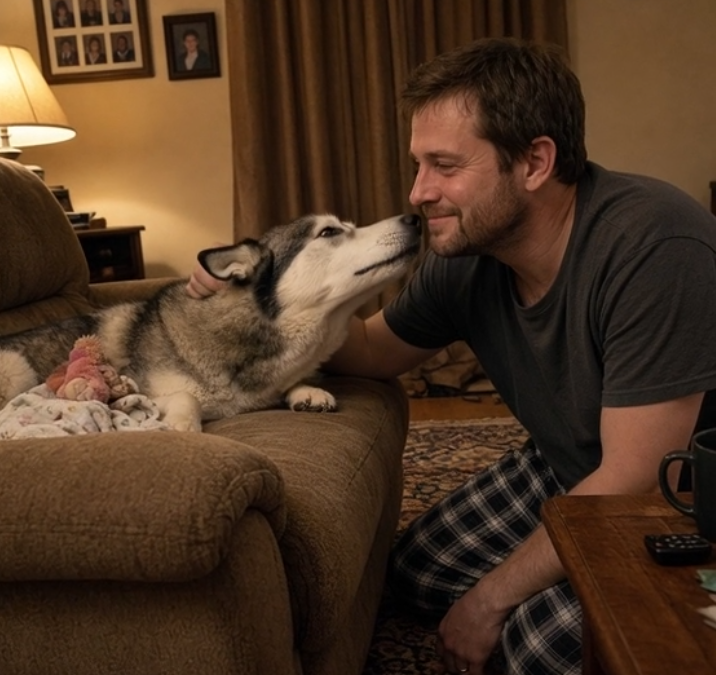
He is resting in front of me on the couch, making small, faint sounds in his sleep. Every few minutes, his paws twitch like he is chasing something in a dream, though his body is too tired now to chase anything in this world.
The couch belongs to him.
Technically, I bought it years ago with money I probably should have saved for something more practical. At the time, I told myself it would be my place to recover after work, watch television, read, maybe sleep on lazy Sunday afternoons. But somewhere along the way, a scarred, stubborn dog with one damaged ear climbed onto it, turned in a circle, sighed like an old soldier setting down his gear, and claimed it as his own.
I fought him for it for about three days.
Then I surrendered.
His name is Major.
I chose the name because even after I came home from war, some part of me still lived in the language of ranks, orders, formations, and missions. I did not know how to call myself whole anymore, but I still knew what structure sounded like. Major felt strong. Steady. Certain.
He became all those things before I did.
Tomorrow morning, Dr. Hernandez is coming to the house.
She has a soft voice, gentle hands, and the kind of eyes that tell you she has helped families through this goodbye more times than anyone should have to. She explained everything carefully. Major will not be afraid. He will not suffer. He will be in my arms, on his couch, surrounded by the people who love him.
My partner, Emily, will sit beside me.
Our daughter, Lily, will probably be clutching the stuffed yellow duck she insists is Major’s favorite, even though Major has never cared about stuffed animals except when Lily places them around him like a royal guard. She is five years old. She understands that Major is sick. She understands that tomorrow he will not hurt anymore.
She does not fully understand forever.
I wish I didn’t either.
Tonight, the house is quiet in that strange way houses become quiet before grief enters completely. The dishwasher hums in the kitchen. Rain taps lightly against the windows. Emily is upstairs trying to help Lily sleep, though I can hear Lily asking questions through the ceiling.
“Will Major know we love him?”
“Will he be scared?”
“Can he take Duck with him?”
Emily answers each one with more courage than I have left.
I sit on the floor beside the couch with one hand resting on Major’s side. His breathing is shallow but steady. His fur, once rough and thick beneath my fingers, feels thinner now. Cancer has taken weight from him, then strength, then appetite, then ease. It has taken the dog who used to pull me up hills and left me with this fragile old body that still tries to lift its head whenever Lily walks into the room.
He is exhausted.
I can see it most clearly in his eyes.
They are still his eyes. Brown, watchful, patient. The same eyes that looked at me seven years ago and somehow decided I was worth staying beside.
I returned from Afghanistan in 2014 after two tours.
I was thirty-one years old, though I felt older in ways I could not explain. People told me I looked good. Healthy. Strong. They said it with relief, as if appearing normal meant the worst had stayed overseas.
It had not.
I brought the war home quietly.
PART2:
Not in stories. I did not tell many stories. Not in dramatic breakdowns either. I became very good at looking functional when I had to. I could stand in line at the grocery store, answer basic questions, pay bills, nod at neighbors, and make it back inside before my hands started shaking.
But inside the house, everything fell apart.
Sleep became something I chased and feared at the same time. When I did sleep, I woke with my heart hammering, certain I had missed something, failed someone, ignored a warning. Food tasted like dust. The phone rang until it stopped ringing. Friends left messages. My sister drove across town and knocked until her knuckles must have hurt. People from the VA called. My mother cried into voicemails I did not play all the way through.
I refused everyone.
Not because I hated them.
Because I could not bear to be witnessed.
I spent most days on this couch with the curtains drawn and the television off. The room stayed dark even at noon. I told myself I was resting. Then I told myself I was adjusting. Then I stopped telling myself anything.
There was one date circled in my mind, though not on any calendar. A day I had chosen quietly, coldly, with the kind of certainty that scares me now when I think about it. I did not call it a plan. I did not call it anything.
I just knew I was tired.
Then, one evening, something scraped at the back door.
At first, I ignored it.
The sound came again.
Scratch.
Pause.
Scratch.
I sat motionless on the couch, staring at the dark television screen, watching my own reflection refuse to move.
The scratching stopped for a while.
Then it returned.
PART3:
After nearly two hours, irritation did what concern could not. I got up, crossed the kitchen, and opened the back door.
A dog stood on the porch.
He was ugly in the way only a dog with a hard past can be ugly. One ear bent wrong. Scars crossed his shoulders and muzzle. His ribs showed faintly beneath a dirty brown coat. He had mud on his legs, a nick above one eye, and the exhausted expression of something that had been surviving instead of living.
He looked at me.
I looked at him.
“Wrong house,” I muttered.
He stepped inside.
No hesitation. No apology. No fear.
He walked past me into the living room, climbed onto my couch, turned around three times, and collapsed like he had finally reached the place he had been looking for.
Then he stared at me.
Not begging.
Not pleading.
Waiting.
I should have put him back outside. I should have called animal control. I should have done any of the normal things people do when a strange battered dog walks into their house and steals their couch.
Instead, I closed the door.
“You hungry?” I asked.
His tail hit the cushion once.
That was how Major began saving my life.
Not through one heroic act. Not by barking at danger, dragging me from a fire, or standing between me and some visible threat.
Major saved me by needing breakfast.
The next morning, he was still there.
I woke curled in the chair across from the couch, stiff and confused, and found him watching me like he had been assigned to my case overnight. I gave him the last pieces of turkey from the fridge and half a slice of toast, which he accepted with grave seriousness.
Then he stared at the empty kitchen.
So I had to go to the store.
It was the first time I had left the house in four days.
I remember standing in the pet food aisle under fluorescent lights, overwhelmed by choices I had never thought about before. Grain-free. Senior. Puppy. Sensitive stomach. Lamb. Chicken. Salmon. Bags with smiling golden retrievers on them, cans with dogs who looked like they belonged to families who hiked on weekends and owned matching raincoats.
I stood there too long.
A woman asked if I needed help.
I almost left.
Instead, I grabbed a bag with a picture of a dog that looked nothing like Major and carried it to the register.
Major ate it like it was the best meal ever served.
Then he threw up on the rug.
So the next day, I went back.
That became the pattern.
Major needed food that did not upset his stomach. Major needed a collar. Major needed flea medicine. Major needed a vet because the cut above his eye looked infected. Major needed walks because he had energy beneath the exhaustion. Major needed routine.
And because Major needed those things, I had to exist in the world again.
I made a veterinary appointment and kept it.
Dr. Hernandez met him for the first time on a rainy Tuesday. Major growled once when she reached toward his ear, then looked at me as if asking whether she was allowed.
“It’s okay,” I said.
He believed me.
That was the first time I realized he trusted me more than I trusted myself.
She scanned him for a microchip. Nothing. No tags, no reports matching him, no one looking for a scarred brown dog with a ruined ear and the manners of an uninvited houseguest.
“He may have been on his own for a while,” she said.
I looked at him lying on the exam room floor, chin on his paws, eyes on me.
“Yeah,” I said. “I know the feeling.”
I named him Major that afternoon.
He learned it immediately, or maybe he simply tolerated whatever sound I made as long as food followed.
Weeks passed.
The date I had once been moving toward came and went without ceremony.
I did not even notice until three days later, when I was standing in my kitchen boiling chicken and rice because Major’s stomach had acted up again. I looked at the calendar on the wall and realized the day was behind me.
I sat down on the floor.
Major limped over, pressed his head against my chest, and stayed there while I cried into his dirty fur.
Recovery did not feel like victory.
It felt like small chores.
Open the curtains.
Feed the dog.
Walk to the mailbox.
Answer one text.
Take Major to the park.
Buy groceries.
Call the VA back.
Sit in a waiting room.
Tell the therapist one true thing.
Then another.
Then another.
Major came with me to the edge of many of those moments. He waited in the truck during appointments, nose prints fogging the window. He slept beside the couch on nights I could not make it to bed. When nightmares tore me awake, he put his heavy head on my leg and held me down in the present.
Not trapped.
Anchored.
That was the difference.
Years moved forward.
I moved houses. Major claimed new couches.
I changed jobs. Major inspected every pair of work boots.
I met Emily at a friend’s barbecue I almost didn’t attend. Major liked her before I was ready to admit I did. He walked straight to her, placed his head under her hand, and sighed.
“Well,” she said, smiling at me, “I guess I passed.”
“You passed him,” I told her. “I’m still reviewing your file.”
She married me anyway.
When Lily was born, I worried Major might struggle with the noise, the crying, the sudden rearrangement of our entire life. Instead, he became her shadow.
The first night we brought her home, he lay beneath the bassinet and refused to move. When she cried, he looked at us with deep disappointment, as if we were failing basic instructions. When she learned to crawl, he followed her from room to room, placing himself between her and every table corner, staircase, and questionable decision.
Lily grew up believing Major was not a pet but a department of household security.
“He’s my guard dog,” she tells people.
Major, who has never guarded anything more aggressively than a dropped pancake, accepts the title with dignity.
Last month, Dr. Hernandez found the cancer.
I knew before she said it. Maybe not the word, but the shape of the news. I saw it in the way her hand lingered on Major’s side. The way her voice softened. The way she asked me to sit down.
There were options, technically. Tests. Specialists. Treatments that might buy time but not comfort. Major was old. The cancer was advanced. His body had already carried him through more battles than anyone knew.
So we chose peace.
Since then, we have let life become slow.
Short walks.
Long naps.
Scrambled eggs.
Sunlight on the porch.
Lily reading picture books to him, most of them upside down.
Emily taking photos when she thinks I’m not looking.
Me sitting beside him at night, remembering the dog who once walked through my door without asking permission and refused to let me disappear.
Yesterday, Lily placed every one of her stuffed animals around him.
“He needs friends,” she said.
Major looked mildly trapped but did not object.
Tonight, the stuffed yellow duck is tucked between his front paws.
Emily comes downstairs after Lily finally falls asleep. She sits beside me on the floor and rests her head against my shoulder.
“How is he?” she whispers.
“Tired.”
She reaches over and strokes Major’s neck.
“He knows you’re here.”
I nod, though my throat tightens so hard I cannot answer.
After a while, Emily says, “He gave us everything.”
“No,” I say quietly. “He gave me everything. You and Lily are part of what he gave me.”
She cries then, silently.
I take her hand.
Major opens his eyes.
For a moment, he looks at both of us, and I see him as he was that first night: scarred, stubborn, unafraid, standing at my door like fate had teeth and a tail.
Tomorrow, I will hold him when he leaves.
I will tell him he was a good boy, though those words are too small for what he was. I will tell him he saved me. I will thank him for every morning he forced me up, every walk that pulled me back into sunlight, every night he kept watch when my mind turned against me.
I will give him permission to rest.
That is the final duty love asks of me.
Not to keep him here because I cannot imagine the couch empty.
Not to make him stay because I still need him.
But to love him enough to let peace be the last gift I give.
Anyone who has loved a dog deeply knows this pain. The terrible bargain of it. We get their whole lives, and they take a piece of ours when they go. But Major’s story will not end tomorrow morning.
It cannot.
He is in the life I have now.
He is in the woman sleeping upstairs who met me because he dragged me back into the world.
He is in the little girl who will grow up hearing that before she was born, an old wounded dog found her father in the dark and taught him how to stay.
He is in every open curtain.
Every answered phone.
Every morning I choose to get up.
Every door I no longer lock against the world.
Major makes another soft sound in his sleep.
I lean forward and press my forehead gently against his.
“Goodnight, Major,” I whisper.
His tail moves once against the couch.
Just once.
Enough.
“You did far more than wander through my doorway,” I tell him. “You taught me how to leave it open.”
Outside, the rain continues.
Inside, my dog sleeps beneath my hand.
And because he found me when I was most lost, because he stayed when I could not stay for myself, because he carried me one ordinary day at a time into a future I never thought I would see, I know something now that I did not know seven years ago.
Tomorrow will hurt.
The house will feel too quiet.
The couch will look too empty.
But I am going to be all right.
Because Major taught me how.

