Thirty People Walked Past a 17-Year-Old Cat Marked FREE—Then I Became Number 31
PART3:
A ceramic bird with one wing repaired by glue.
A pair of slippers.
Nothing was expensive.
That somehow made it harder.
A woman around fifty-five sat behind the main table.
She wore jeans, a gray sweatshirt, and the exhausted expression of someone who had answered the same painful questions all morning.
Every few minutes somebody held up an object.
“How much?”
“Two dollars.”
“This lamp?”
“Five.”
“Would you take three?”
“Yes.”
She never argued.
Never countered.
Everything needed to disappear.
I had seen estate sales before.
This wasn’t professionally organized enough to be one.
It was more personal than that.
Someone was clearing her mother’s home.
You could tell.
I looked through a small tray of hand tools near the driveway.
Pliers.
Screwdrivers.
An adjustable wrench.
Nothing I needed.
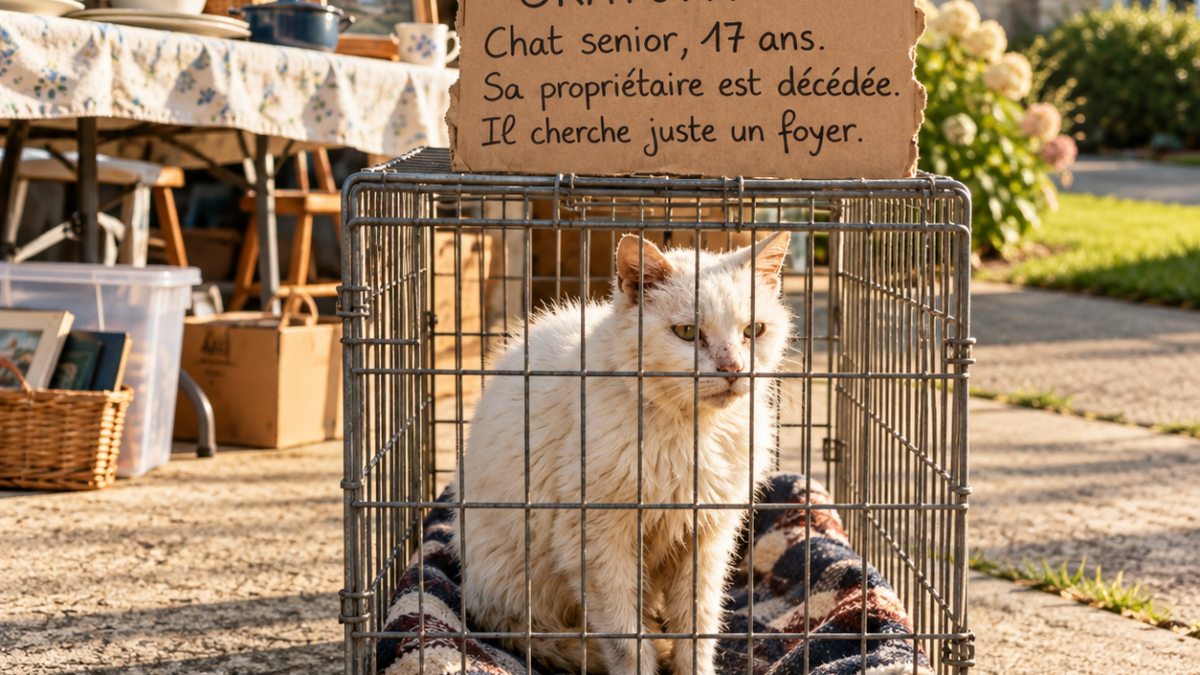
I was about to keep walking when I noticed the cage.
It sat on the ground beside the folding table.
Large wire crate.
Old blanket inside.
Food bowl.
Water.
And a cat.
White and gray.
Beautiful even at seventeen.
He wasn’t curled tightly in fear.
He wasn’t meowing at everyone passing.
He simply lay there.
Quiet.
His paws tucked beneath his chest.
His fur had thinned along his shoulders and back.
His face had that delicate, almost angular shape very old cats sometimes develop.
Large green eyes.
Slightly cloudy.
Not blind.
Just aged.
Beside the cage was a piece of brown cardboard.
Black marker.
The handwriting looked rushed.
FREE.
SENIOR CAT.
17 YEARS OLD.
OWNER PASSED AWAY.
JUST NEEDS A HOME.
LITTER BOX + FOOD INCLUDED.
I stopped long enough to read it.
Then I looked at him.
The cat looked back.
That was all.
No dramatic connection.
No instant certainty.
No voice in my head telling me fate had brought us together.
I thought:
Seventeen.
Then:
Poor guy.
Then I kept walking.
Two houses later, I found the socket set I had come for.
Craftsman.
Almost complete.
Fifteen dollars.
I talked the man down to twelve.
At that point I should have gone home.
Instead, I carried the case back toward my truck and passed the old woman’s house again.
Arthur was still there.
I didn’t know his name yet.
Another couple had stopped.
The woman bent slightly toward the sign.
“Oh my gosh. Seventeen?”
The man shook his head.
“That’s ancient.”
They walked away.
I slowed.
The woman behind the table watched them leave.
She didn’t say anything.
A little girl came next.
Maybe seven.
She pointed toward the cage.
“Mommy, cat!”
Her mother read the sign.
“No, honey.”
“Can I pet him?”
“No. Come on.”
The girl looked over her shoulder as they left.
Arthur did not move.
I put my socket set inside my truck.
Then, for reasons I still don’t fully understand, I did not get inside.
I leaned against the driver’s door.
Watched.
At first I wasn’t counting.
Then I started.
One man.
He looked down.
Kept going.
A teenage couple.
Didn’t notice the cage.
An older woman paused.
Read everything.
Looked at Arthur.
Then shook her head slowly and moved toward the next driveway.
A family with two kids.
A man carrying golf clubs.
Two women who had bought a lamp.
Three people walking dogs.
The dogs noticed Arthur.
The people noticed the dogs noticing Arthur.
They pulled them away.
Ten.
Fifteen.
Twenty.
I began feeling ridiculous.
What was I doing?
Standing beside my truck in the middle of a garage sale counting strangers who didn’t adopt an elderly cat?
I could have left.
Nobody was asking me to stay.
The woman never called out:
“Free cat!”
She never tried marketing him.
Never told people he was sweet.
Never begged.
She sat in a folding chair beside the cage and occasionally put her fingers through the bars.
Arthur would smell them.
That was it.
I think that was what kept me there.
There was something dignified and terrible about it.
She wasn’t trying to get rid of him.
She was waiting for someone to choose him.
Those are not the same thing.
Around noon, most of the furniture had disappeared.
Someone bought the walker.
A young couple bought a small dining table.
The porcelain dishes went to an older woman for twenty dollars.
The mystery novels disappeared in a box for five.
I watched the woman’s mother’s life shrink.
At one point, a man carried away an old recliner.
Arthur watched him.
His ears moved.
I wondered if that chair had belonged inside the house.
If he recognized it.
If he understood that familiar things kept leaving and never returned.
That thought bothered me more than I expected.
Twenty-four.
Twenty-five.
A woman stopped.
Read the sign.
“Oh, sweetheart.”
She crouched halfway.
Arthur lifted his head.
Then she said:
“My husband would kill me.”
And walked away.
Twenty-six.
Twenty-seven.
Twenty-eight.
Twenty-nine.
Number thirty was a man about my age.
For a second, I thought he might actually take him.
He stood there for almost a minute.
Asked:
“Is he healthy?”
The woman answered:
“For his age.”
“Any medical problems?”
“Arthritis. His kidneys are being watched. He’s slower now.”
The man nodded.
“Seventeen is just…”
He didn’t finish.
The woman said:
“I know.”
He walked away.
Thirty.
By then it was close to two in the afternoon.
The sale was nearly over.
Empty tables.
Flattened cardboard.
A few unsold coats.
The woman started packing.
She folded tablecloths.
Closed boxes.
Removed price stickers.
Then she sat beside Arthur.
For the first time all day, I saw her expression break.
She looked down at him.
Then at the nearly empty street.
There are some emotions you shouldn’t describe for other people.
I don’t know exactly what she was thinking.
Maybe guilt.
Maybe grief.
Maybe panic.
Maybe she was imagining what happened when the garage sale ended and there was still a cat nobody wanted.
All I know is she reached through the cage and touched Arthur’s cheek.
He leaned into her finger.
Very slightly.
I left my truck.
Walked back.
She noticed me approaching.
I crouched in front of the cage.
Up close, Arthur looked even older.
There was a little stiffness in the way he adjusted his front paws.
His whiskers were uneven.
One ear had a small notch.
He looked tired.
Not sick exactly.
Tired in that ancient-cat way where every movement seems considered.
I put my fingers near the wire.
Didn’t push them through.
Arthur opened his eyes wider.
Then slowly stood.
It took effort.
One back leg seemed stiffer than the other.
He walked three steps.
Stopped in front of me.
Sniffed.
Then touched his nose against the metal exactly where my fingertip rested on the other side.
Something in my chest shifted.
I looked at the woman.
“Tell me about him.”
Her face changed immediately.
Not relief yet.
Too early.
But hope.
“His name is Arthur.”
I looked back at him.
“Arthur.”
One ear twitched.
She smiled.
“He knows.”
“How long did your mom have him?”
“All seventeen years.”
That surprised me.
“Since he was a kitten?”
She nodded.
“Mom adopted him the year she retired.”
She sat back.
“She always joked that she finally had time to get a cat because nobody could tell her she was too busy anymore.”
I smiled.
“What was her name?”
“Margaret.”
Arthur turned toward the woman’s voice.
She reached through the bars again.
“Mom and Arthur were… everything to each other.”
She swallowed.
“She lived alone after Dad died. Arthur slept in her bed every night.”
I looked at him.
“She got sick last year.”
“What happened?”
“Heart failure mostly. Then everything else started going.”
Her eyes lowered.
“Arthur knew.”
“Cats usually do.”
“He stopped spending time anywhere else in the house. If she was in bed, he was there. If she went to the bathroom, he waited outside. If she sat in the living room, he sat beside her.”
She smiled faintly.
“Toward the end we had home-health nurses coming in and out. He hated everybody.”
Arthur blinked.
I said:
“Understandable.”
She laughed softly.
It was the first time I’d heard her laugh.
“Mom died three weeks ago.”
I looked at the empty house.
“I’m sorry.”
“Thank you.”
She drew a breath.
“When we came after the funeral, Arthur was on her bed.”
Her voice changed.
“He wouldn’t leave it.”
I stayed quiet.
“For two days.”
“Two?”
“He came down for water once. Maybe food. But every time we looked, he was right where she used to sleep.”
Her eyes filled.
“We finally had to remove the bedding because we needed to clean the room.”
Arthur lowered himself onto the blanket again.
“When we took the sheets away, he walked around the room crying.”
That one hurt.
I looked at him.
She continued.
“I brought him to my house.”
“You couldn’t keep him?”
“I tried.”
There was something defensive in the answer.
I immediately regretted asking it that way.
She explained.
“I have two dogs. Big dogs. They’ve never lived with cats.”
“Ah.”
“I kept Arthur in our guest bedroom at first.”
She shook her head.
“He hid under the bed for almost a week.”
“Didn’t eat?”
“Almost nothing.”
“Did you take him to a vet?”
“Yes. They gave him fluids. Checked him. Nothing suddenly catastrophic.”
She looked at Arthur.
“The vet said grief and stress were probably making everything worse.”
I nodded.
“She suggested finding him a quiet home.”
The woman wiped beneath one eye.
“I called rescues.”
“And?”
“Most were full.”
Of course.
“One senior-cat rescue offered to put him on a waiting list.”
“How long?”
“They didn’t know.”
She glanced toward the street.
“The county shelter said they would take him.”
I didn’t say anything.
“At seventeen…”
Her sentence faded.
She didn’t need to finish.
Older animals can be adopted from shelters.
They absolutely can.
But seventeen years old.
Arthritis.
Early kidney concerns.
Recent grief.
Stress.
An unfamiliar kennel.
His chances were not something she wanted to gamble.
“So you brought him here.”
“I didn’t know what else to do.”
That answer held so much shame that I immediately said:
“Hey.”
She looked at me.
“You’re trying.”
Her mouth trembled.
“I put ‘free’ on the sign and now I feel terrible.”
“Why?”
“Because he’s not garbage.”
“I don’t think anyone thinks that.”
“It looks like I’m giving him away with furniture.”
I looked toward the empty tables.
Then at Arthur.
“I understand why you did it.”
“I kept thinking somebody would see him.”
She looked down the street.
“Someone older. Someone quiet. Someone who had just lost their cat. I don’t know.”
“Someone.”
“Yes.”
She whispered:
“He just needs someone.”
That was the line on the sign.
Suddenly it sounded different.
Not advertising.
A plea.
I asked:
“What happens if nobody takes him today?”
She closed her eyes for half a second.
“I don’t know.”
There it was.
The actual question.
I looked at Arthur.
Arthur looked at me.
I was forty-three.
Divorced.
No kids living with me.
Quiet house.
I worked from home three days a week.
No dogs.
No pets.
I traveled occasionally, but my sister lived fifteen minutes away.
None of those facts had mattered when I woke up that morning.
Now they lined up in my head like someone filling out an application.
I said:
“I don’t know anything about owning an old cat.”
She stared at me.
Then laughed through tears.
“You don’t need to know much.”
“I’ve never owned a cat.”
“They’re easier than people.”
“I believe that.”
Arthur slowly blinked at me.
The woman said:
“He eats twice a day.”
“Okay.”
“He likes his water bowl away from his food.”
“Why?”
“No idea.”
“Fair.”
“He doesn’t like closed doors.”
“Okay.”
“He scratches the side of the couch sometimes.”
I looked at her.
“You’re supposed to lie about that part.”
She laughed again.
“He sleeps most of the day.”
“Reasonable.”
“He likes watching birds.”
“Also reasonable.”
“And…”
She hesitated.
“What?”
“He may not have much time.”
That was the sentence people avoid when talking about old animals.
I appreciated her saying it.
“How much?”
“Nobody knows.”
“Months?”
“Maybe.”
“A year?”
“Maybe.”
“More?”
She shrugged.
“The vet said cats don’t read charts.”
I smiled.
Arthur sat between us.
Seventeen years.
If I took him, there was no version of this ending where I didn’t eventually lose him.
Maybe soon.
That scared me.
I had spent the previous decade becoming very good at not volunteering for grief.
Divorce teaches you that.
So does watching your father die.
You begin confusing emotional self-protection with wisdom.
Don’t attach too quickly.
Don’t expect too much.
Don’t create situations where losing something can hurt.
Then a seventeen-year-old cat sat in front of me having already lost the only person he had ever belonged to.
And I felt ridiculous.
I was afraid of future grief.
Arthur was living inside grief right now.
I looked at the woman.
“I’ll take him.”
She didn’t react at first.
Maybe she thought she’d misunderstood.
“What?”
“I’ll take Arthur.”
Her hand went to her mouth.
“You’re serious?”
“I think so.”
Not exactly inspiring.
But true.
She started crying.
Immediately.
Not polite tears.
Full crying.
She stood, then sat again because her knees seemed to give slightly.
“Oh my God.”
I looked around.
A couple at the next house glanced over.
“I don’t really know what I’m doing.”
“That doesn’t matter.”
“It probably does.”
She laughed through the tears.
“Thank you.”
“You don’t need to thank me yet. He might hate me.”
“He won’t.”
Arthur looked completely indifferent to our conversation.
She reached into the cage.
For the first time, she opened the door.
Arthur didn’t try escaping.
She lifted him carefully.
He was lighter than I expected.
She held him against her chest.
He didn’t struggle.
“Mom would be so relieved.”
That sentence almost undid me.
She buried her face briefly in his fur.
Then handed him to me.
I had held cats before.
But never one like Arthur.
Old animals have a different physical presence.
His bones felt closer to the surface.
His body was warm but fragile.
He smelled faintly like laundry detergent and cat food.
For one moment he stiffened.
Then his front paw rested against my chest.
I whispered:
“Hi, Arthur.”
He looked at me.
No panic.
No dramatic purr.
Just looking.
I said:
“I guess we’re roommates.”
The woman smiled.
She told me her name was Rebecca.
We exchanged numbers.
Then she started giving me things.
Litter box.
Litter.
Two bags of food.
Medication.
Bowls.
Vet records.
A soft-sided carrier in addition to the wire crate.
A brush.
Nail clippers.
Three toys Arthur apparently hadn’t touched in years.
Then the blanket.
It was old.
Blue fleece.
Covered in white and gray hair.
“This was from Mom’s bed.”
I looked at it.
“He knows it?”
“He sleeps on it.”
“Then it’s coming.”
She folded it carefully.
I loaded everything into my truck.
Arthur rode in the carrier on the passenger seat.
Before I left, Rebecca ran back into the house.
I thought she’d forgotten medication.
She returned holding a framed photograph.
She slid it into the bag.
I looked.
A younger woman sat in a recliner.
Margaret.
Maybe sixty-five.
Smiling.
A tiny gray-and-white kitten was curled against her shoulder.
Arthur.
His ears looked enormous.
He couldn’t have been more than a few months old.
Rebecca touched the frame.
“He should have this.”
I didn’t know what to say.
Cats don’t understand photographs the way humans do.
Arthur didn’t need a picture.
But Rebecca did.
Maybe I did too.
So I said:
“I’ll keep it near him.”
She nodded.
I drove away.
Arthur cried for the first seven minutes.
Soft, questioning sounds.
Every one made me feel worse.
“I’m sorry.”
Meow.
“I know.”
Meow.
“I don’t know where we’re going either.”
Meow.
“Okay, technically I do.”
Arthur stopped crying.
Maybe because he was tired of me.
At home I carried the carrier inside.
Set it in the living room.
Closed the front door.
Then opened his carrier.
Nothing happened.
Arthur remained inside.
“Whenever you’re ready.”
He stared.
I went to the kitchen.
Set up food.
Water on the other side because apparently Arthur had standards.
Placed the litter box in the laundry room.
Then realized Rebecca said he disliked closed doors and moved it to the downstairs bathroom with the door propped fully open.
When I returned, Arthur was halfway out of the carrier.
One paw.
Then two.
He sniffed the carpet.
Looked around.
The house suddenly felt enormous.
Too open.
I sat on the floor.
Didn’t approach.
Arthur walked maybe six feet.
Stopped.
Sat.
Looked back at the carrier.
Then at me.
I spread Margaret’s blanket on the couch.
Arthur smelled it immediately.
His head lifted.
He crossed the room slowly.
Stiff rear legs.
Then somehow climbed onto the couch without my help.
He stepped onto the blanket.
Circled twice.
Lay down.
That was it.
His first decision in my house.
I sat in the chair across from him.
For almost an hour, neither of us did anything.
Around six, I warmed a spoonful of his wet food because Rebecca had told me he preferred it that way.
Arthur ate the entire serving.
I texted her.
HE ATE EVERYTHING.
Three dots appeared immediately.
Then:
THANK GOD.
A minute later:
MOM USED TO WARM IT 10 SECONDS IN THE MICROWAVE. HE’S SPOILED.
I replied:
WE HAVE ALREADY DISCUSSED HIS ATTITUDE.
Rebecca sent a laughing emoji.
That first night, I expected Arthur to hide.
Instead he remained on the couch until eleven.
When I stood to go upstairs, he raised his head.
I took three steps.
Arthur got down.
Slowly.
Followed me.
I stopped.
“You coming?”
He looked at me as though the question were stupid.
He climbed the stairs one at a time.
It took forever.
I almost picked him up.
Something told me not to.
At the top he followed me to my bedroom.
I had placed his blanket downstairs.
Arthur stood beside my bed.
Then looked up.
Seventeen-year-old cat.
Arthritic.
No chance he was making that jump.
I picked him up.
Placed him on the bed.
He walked across the comforter.
Circled.
Then settled near my feet.
Exactly where Rebecca said he had slept with Margaret.
I lay there staring at the ceiling.
Arthur remained very still.
Around midnight, I felt movement.
He walked toward me.
Then lay against my hip.
His body was warm.
A low rumble started.
Purring.
The first time I’d heard it.
I didn’t move.
I was afraid even breathing differently might stop him.
For seventeen years, that sound had belonged to somebody else.
That night, for the first time, Arthur gave a little of it to me.
The next morning he woke me at 5:48 by stepping directly on my chest.
Apparently seventeen years of life had not taught him manners.
“What?”
He stared.
“What?”
Meow.
“Food?”
Meow.
“I understand.”
I did not understand.
But food worked.
Two days later I took him to his veterinarian.
Dr. Laura Chen.
She had treated Arthur for eleven years.
The moment she saw him, she looked surprised.
“You’re Arthur’s new person?”
Apparently I was.
“Yes.”
She opened the carrier.
Arthur stepped out.
Dr. Chen scratched his cheek.
“I was worried about you.”
Arthur leaned into her hand.
She examined him.
Arthritis.
Early chronic kidney disease.
Dental wear.
Mild heart murmur.
Nothing unexpected.
“How long?” I asked.
She knew what I meant.
“I can’t answer that.”
“Rebecca said the same thing.”
“Smart woman.”
“Could be months?”
“Yes.”
“A year?”
“Yes.”
“Two?”
“Possible.”
“Five?”
She smiled.
“Let’s not get ambitious.”
I laughed.
Then she became serious.
“Senior cats don’t need promises about time.”
“What do they need?”
“Comfort.”
She looked at Arthur.
“Routine.”
Then at me.
“And somebody willing to accept that loving an old animal means the ending is part of the agreement.”
I didn’t like that.
Because it was true.
The first week, Arthur slept.
A lot.
The second week, he began exploring.
Kitchen.
Office.
Upstairs hallway.
Guest room.
He found the sunniest patch of carpet in the entire house on his first attempt.
He discovered the bird feeder outside my office window.
I moved a chair closer so he could see better.
Then a small ottoman because climbing onto the chair was difficult.
Then a folded blanket because apparently the chair itself was unacceptable.
Within a month, my house had been redesigned by a seventeen-year-old animal weighing nine pounds.
Rebecca visited after three weeks.
I wasn’t sure how Arthur would react.
She sat on the couch.
Arthur walked in.
Stopped.
Recognized her immediately.
He climbed beside her.
Rebecca covered her mouth.
“Hi, baby.”
Arthur rubbed his face against her hand.
She cried.
Then something happened that I think helped both of us.
After ten minutes, Arthur stood.
Walked across the couch.
And lay beside me.
Rebecca looked at him.
Then at me.
For one terrible second I worried it would hurt her.
Instead she smiled.
“Good.”
“What?”
“He knows this is home.”
I looked down at Arthur.
“He still remembers your mom.”
“I know.”
“How?”
Rebecca touched the blanket.
“Because loving someone new doesn’t erase who came before.”
That sentence stayed with me.
Maybe because it wasn’t only about Arthur.
I put Margaret’s photograph on a shelf near his favorite couch.
People laughed when I told them.
“He can’t understand pictures.”
I knew.
The photograph wasn’t for Arthur.
It was for the house.
A reminder that he had a life before me.
A woman loved him for seventeen years.
He wasn’t an unwanted old cat from a garage sale.
He was Margaret’s cat.
Then, somehow, mine.
Arthur gained weight.
Not much.
Enough.
His coat improved.
Dr. Chen changed one medication.
I bought little pet stairs for the bed.
Arthur ignored them for eight days, then started using them as though they had been his idea.
He developed a routine.
5:48 breakfast.
Not 5:47.
Not 5:49.
5:48.
Window watching.
Sleep.
Office inspection around ten.
Lunch was apparently expected although nobody had authorized lunch.
Afternoon nap.
Evening couch.
Bed.
Whenever I left the house, Arthur waited near the living-room window.
I discovered that because my doorbell camera occasionally captured his face between the curtains.
The first time I saw it, something tightened in my chest.
Waiting.
I wondered how much of Arthur’s life after Margaret had been waiting.
Waiting beside her bed.
Waiting beneath Rebecca’s bed.
Waiting inside the cage.
Waiting for person thirty-one.
I started coming home faster.
One Saturday, almost three months after the garage sale, Rebecca texted.
CAN I ASK SOMETHING WEIRD?
I replied:
DEPENDS HOW WEIRD.
She wrote:
TODAY WOULD HAVE BEEN MOM’S BIRTHDAY.
A second message came.
CAN I COME SEE ARTHUR?
I said yes.
She arrived carrying flowers.
Not for me.
She placed them beside Margaret’s photograph.
Then sat with Arthur for an hour.
She told stories.
Apparently Margaret had once canceled a vacation because she didn’t trust anyone to care for Arthur correctly.
Arthur had stolen Thanksgiving turkey.
Arthur hated one particular neighbor.
Arthur once disappeared inside a linen closet for nine hours while six people searched the neighborhood.
Arthur had been present when Rebecca’s daughter came home from the hospital as a newborn.
Seventeen years.
A cat had quietly witnessed an entire section of a family history.
Birthdays.
Deaths.
Christmas mornings.
Arguments.
Illness.
Ordinary Tuesdays.
That was when I understood something the garage-sale sign never could have communicated.
Arthur wasn’t simply Margaret’s pet.
He was evidence she had been here.
A living thread.
Everything else from her house had been distributed.
Sold.
Donated.
Packed into family cars.
Arthur still carried routines nobody had written down.
He waited beside the bed because Margaret once slept there.
He preferred warmed food because Margaret warmed it.
He disliked closed doors because Margaret had apparently left every door open.
He slept near my feet because that was where he had slept beside her.
We inherit people in strange ways.
Sometimes through jewelry.
Recipes.
Photographs.
Sometimes through an old cat who wakes you at 5:48 every morning.
One afternoon, I drove past the neighborhood where the sale had happened.
The house had a SOLD sign.
Different car in the driveway.
New family moving in.
For a moment I imagined Arthur returning there.
Would he recognize it?
Would he search for Margaret?
Then I realized it didn’t matter.
Home isn’t always a building.
Arthur had lost the building.
Lost Margaret.
Lost the routine.
But he had not lost the capacity to settle somewhere new.
That seemed important.
Maybe for both of us.
A year ago, I would have described my house as peaceful.
Now I realize it was empty.
There is a difference.
Arthur doesn’t make much noise.
He sleeps twenty hours some days.
But the house feels occupied now.
His bowl in the kitchen.
White fur on black shirts.
A scratching post he mostly ignores.
Medication lined beside the coffee maker.
A warm body on the couch.
Small things.
Enough to change a place.
People occasionally ask why I adopted a seventeen-year-old cat instead of a kitten.
I tell them the truth.
I didn’t.
I adopted Arthur.
That’s different.
If I had walked into a shelter that morning intending to choose a cat, maybe I would have chosen younger.
Healthier.
More time.
That’s how people think.
We look for beginnings.
We like potential.
Puppies.
Kittens.
Blank pages.
Arthur came with seventeen years already written.
Maybe that’s why people walked past.
They saw an ending.
I think I did too at first.
What I failed to understand was that an ending can still contain a whole life.
Arthur doesn’t know he is old in the way we define old.
He knows his hips hurt.
He knows stairs are slower.
He knows the sun still feels warm.
Food still tastes good.
Birds are still suspicious.
Blankets matter.
Hands can still be gentle.
That’s his life.
Not a countdown.
One night, about six months after I brought him home, Arthur didn’t come upstairs.
I found him sleeping unusually deeply on the couch.
I touched him.
He opened his eyes but didn’t stand.
Fear went through me immediately.
I called the emergency vet.
They checked him.
Dehydration.
Kidney values worse.
He stayed overnight on fluids.
I drove home alone.
The house looked wrong.
His blanket on the couch.
Food dish.
Pet stairs beside my bed.
I barely slept.
That was when I understood the bargain Dr. Chen had described.
The ending is part of the agreement.
I hated the agreement.
Still do.
Arthur came home the next afternoon.
He was tired.
I placed him on the couch.
He crawled onto Margaret’s blanket.
Then looked at me.
I sat beside him.
He put one paw on my leg.
That tiny gesture felt enormous.
“You scared me.”
Slow blink.
“Don’t do that again.”
Another slow blink.
“No promises?”
Arthur went to sleep.
Since then, there have been good months.
Some difficult days.
Medication adjustments.
Bloodwork.
A heated bed.
More ramps.
A water fountain Arthur was afraid of for three days and obsessed with on the fourth.
He turned eighteen.
Rebecca brought a tiny piece of plain cooked chicken.
We did not put a birthday hat on him.
Arthur has limits.
The photograph of Margaret still sits near the couch.
Rebecca eventually gave me another one.
Margaret older.
Arthur older.
Both asleep together.
I put that one beside the first.
Sometimes I look at them and think about the garage sale.
Thirty people.
I remember every number because once I started counting, I couldn’t stop.
I used to feel angry at those people.
I don’t anymore.
They weren’t cruel.
Most probably had pets.
Allergies.
Landlords.
Children.
Dogs.
Financial problems.
Lives I knew nothing about.
Taking an elderly animal isn’t a moral test everyone is required to pass.
Nobody owed Arthur adoption.
That’s important.
But somebody had to stop.
That happened to be me.
Number thirty-one.
I sometimes wonder what would have happened if I’d driven away after buying the socket set.
Rebecca would have stayed another hour.
Maybe someone else would have taken him.
Maybe not.
There is no value in imagining the worst ending.
The real one happened.
Arthur came home.
He ate.
He slept.
He chose the couch.
He learned my footsteps.
I learned his.
That’s enough.
The old socket set sits in my garage now.
I barely use it.
Whenever I see it, I remember that technically it is the reason I met Arthur.
Twelve dollars.
Pretty good purchase.
Rebecca and I still talk.
Mostly Arthur updates.
Photos.
“He ate.”
“He’s sleeping.”
“He yelled at a bird.”
“His kidney numbers are stable.”
Sometimes she tells me things about Margaret.
Sometimes I send her pictures of Arthur asleep beneath Margaret’s photograph.
She once replied:
MOM WOULD HAVE LOVED KNOWING HE LANDED THERE.
I stared at the message for a long time.
Landed.
That’s exactly what it feels like.
Arthur had been dropped out of one life and carried through several temporary places, unable to understand why the woman he loved had vanished.
Then somewhere between a garage sale, a cardboard sign, and stranger number thirty-one, he landed.
So did something in me.
I hadn’t realized I needed that.
Perhaps that is why the story stays with people when I tell it.
They expect the sad part to be that a seventeen-year-old cat was marked FREE at a garage sale.
That bothered me too.
But the price was never the point.
Arthur was free because Rebecca wasn’t trying to sell him.
She wasn’t assigning value.
She was trying to remove the last possible barrier between him and someone willing to say yes.
Everything else from Margaret’s house had prices.
Five dollars.
Ten.
Twenty.
Take two for one.
Arthur didn’t.
Because how do you price seventeen years of sleeping beside someone?
How much for the cat who sat with her through illness?
How much for the animal who waited on her empty bed after she died?
There isn’t a number.
The cardboard said FREE.
What it meant was:
Please.
Today Arthur is asleep on my couch.
Right now, as I write this.
Gray-and-white body curled on the same blue blanket Rebecca gave me that afternoon.
His back legs don’t bend easily anymore.
His hearing is worse.
Sometimes I think he forgets where I am and calls until I answer.
His green eyes have become cloudier.
He moves slowly.
But this morning he ate every bite of breakfast.
At 5:48.
Naturally.
Then he climbed onto the couch with help from his little step.
Turned around twice.
Settled.
Safe.
Warm.
Wanted.
Eventually there will be a morning when Arthur doesn’t wake me.
I know that.
I think about it more than I should.
When that day comes, I will probably wonder whether bringing home an animal so close to the end was worth the pain.
I already know the answer.
Yes.
Because love isn’t measured only by how long you get to keep something.
Margaret had seventeen years.
Maybe I’ll get two.
Maybe less.
Maybe, if Arthur continues being stubborn, more.
Whatever he gives me is enough.
He did not need someone to replace Margaret.
Nobody could.
He needed somebody willing to carry the next part.
That’s all.
The afternoon I met him, thirty people walked past his cage.
Then I became number thirty-one.
People sometimes tell me:
“You saved Arthur.”
I understand why they say it.
But I don’t think that’s exactly what happened.
I gave an old cat a couch.
Food.
Medicine.
A warm bed.
A quiet house.
Arthur gave something back that I hadn’t known was missing.
Routine.
Company.
A reason to come home.
Proof that being near the end does not mean being beyond beginning again.
There is a framed photograph beside my couch of a woman I never met holding Arthur as a kitten.
Sometimes I look at Margaret’s face and think:
I hope you’re okay with this.
I hope the food is warm enough.
I hope I’m putting his water in the right place.
I hope you know he still sleeps beside someone.
I hope you know he wasn’t left behind.
And if there is one thing I wish I could tell her, it is the same thing I texted Rebecca after Arthur’s first night in my house:
He ate everything.
He slept beside me.
He’s okay.
Arthur was the last thing left at the garage sale.
Everything else had been sold.
Packed.
Carried away.
He was seventeen.
He was free.
And for four hours, nobody wanted him.
Then I stopped.
Now Arthur will never have to wait in a cage for someone again.
For however much time he has left, this is his house.
That is his couch.
That is his blanket.
And I am his person.
Number thirty-one stayed.

