They Used Her as Bait for Two Years—Then the Cat With Half a Face Started Purring in My Arms
They Used Her as Bait for Two Years—Then the Cat With Half a Face Started Purring in My Arms
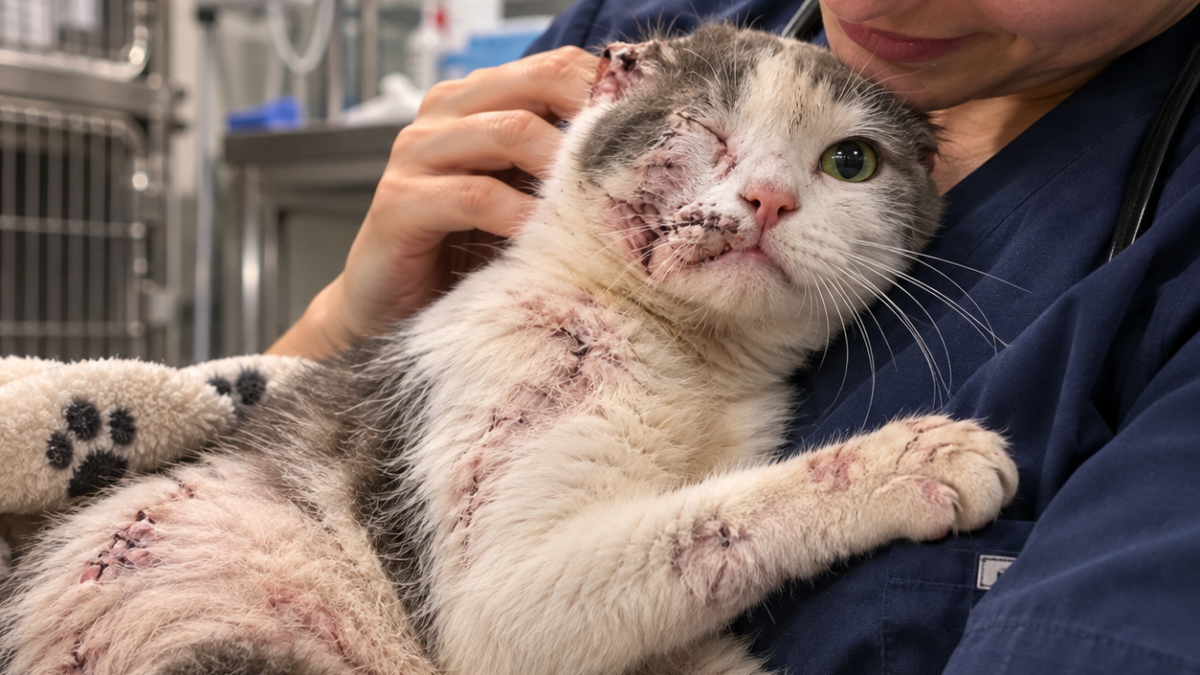
The little white-and-gray cat weighed barely four pounds when the police carried her into our clinic, and at first I couldn’t understand how something missing both ears, most of her tail, one eye, and nearly half her face could still be alive.
Then I learned she had spent almost two years locked in a rabbit cage and thrown to fighting dogs as bait, surviving more than forty bite wounds, untreated broken ribs, starvation, and injuries no animal should have endured.
But the moment I lifted her against my chest, expecting fear, pain, or even aggression, she pressed what remained of her face into my hand—and began to purr so loudly that I had to leave the room before anyone saw me cry.
My name is Emily Carter.
I’ve worked as a veterinary technician for seventeen years.
I’ve seen animals come through clinic doors after being hit by cars.
I’ve held dogs burned in house fires.
I’ve cleaned wounds on cats rescued from hoarding cases so severe that twenty animals were living in one room.
I’ve watched puppies die from parvovirus.
I’ve helped stabilize police dogs with bullet wounds.
I’ve seen horses arrive with ribs showing through skin because someone stopped feeding them months earlier and simply waited for nature to finish what neglect had started.
People ask sometimes how you keep doing this kind of work without becoming numb.
The answer is that you don’t.
At least, I never did.
You learn to function while something inside you is breaking.
That’s different.
You focus on numbers.
Temperature.
Heart rate.
Respiratory rate.
Weight.
Blood pressure.
Medication doses.
You learn that if you allow yourself to think about everything an animal has suffered while you’re trying to save them, your hands start shaking.
So you don’t think about the story.
You think about the patient.
PART2:
PART3:
“Animals?”
“Yes.”
She swallowed.
“Seventeen dogs.”
I put the protein bar down.
“And one cat.”
That stopped me.
“A cat?”
“That’s what they said.”
Animal-control trucks pulled into the rear lot.
Then two sheriff’s vehicles.
Then another transport van.
The raid had taken place less than an hour outside the county.
An illegal dogfighting operation.
Those cases are different.
Not because the injuries are necessarily worse than everything else we see.
Because so much of the damage is deliberate.
A car doesn’t decide to hit an animal.
Cancer doesn’t enjoy suffering.
Dogfighting requires planning.
People build the cages.
Tie the chains.
Arrange the fights.
Collect the money.
Breed aggression.
Watch.
Cheer.
Then do it again.
The first dogs came through our back entrance one by one.
Pit bull-type mixes mostly.
Some terrified.
Some shut down.
Several wounded.
Old scars crossing new scars.
One dog had a torn lip.
Another could barely put weight on a front leg.
One female had infected puncture wounds around her neck.
Their bodies told stories nobody wanted to read.
The clinic filled with noise.
Barking.
Metal kennel doors.
Radios.
Police talking.
Veterinary staff calling weights and medication doses.
Then one of the officers appeared carrying something small.
Not in his arms.
Inside a plastic evidence carrier.
He set it on the treatment table.
“What is that?”
He looked at me.
“The cat.”
I stepped closer.
The carrier smelled before I opened it.
Urine.
Infection.
Wet paper.
Fear.
The officer said:
“She was behind the barn.”
“In what?”
“Rabbit cage.”
“How long?”
“No idea.”
Then:
“Doc thinks maybe a while.”
I opened the carrier door.
For one second, I didn’t understand what I was seeing.
There was a cat inside.
White and gray.
Adult.
Maybe four years old.
Very small.
At first I thought her head was turned.
Then she looked directly at me.
And I realized half of what I expected to see wasn’t there.
No visible ears.
Not folded.
Gone.
Her right eye was missing.
The socket had healed beneath thick scar tissue.
Part of the right cheek was gone too.
The upper lip had been torn and healed distorted, exposing teeth and gum even with her mouth closed.
Her tail ended in a short scarred stump.
The fur along her chest and legs was patchy.
Scars crossed scars.
Some pale and old.
Some darker.
One on her chest looked like a rope had been dragged across her body.
Her front legs were the worst.
Puncture marks.
Thickened tissue.
Old tears.
Defense wounds.
The kind you see when an animal repeatedly raises its paws to protect its face.
She stared at me with one remaining green eye.
Didn’t hiss.
Didn’t growl.
Didn’t retreat.
She simply watched.
I heard myself whisper:
“Oh, sweetheart.”
Dr. Grant came beside me.
Her voice changed too.
“Don’t touch yet.”
“I know.”
“Get photographs first.”
Evidence case.
Everything documented.
We took pictures.
Left side.
Right side.
Face.
Tail stump.
Limbs.
Chest.
Teeth.
Every visible scar.
The cat never moved.
One sheriff’s deputy stood near the wall.
Young guy.
Maybe twenty-six.
He turned his face away halfway through.
Nobody said anything.
Dr. Grant put gloves on.
“Let’s get her out.”
I slid a towel inside the carrier.
Expected her to recoil.
Nothing.
I positioned one hand beneath her chest.
The moment my fingers touched her, her entire body stiffened.
I froze.
“Easy.”
Dr. Grant said:
“Take your time.”
The cat smelled my hand.
Then something extraordinary happened.
She leaned forward.
Barely.
One centimeter maybe.
But toward me.
Not away.
I lifted her.
There was almost no weight.
That’s what I remember first.
An adult cat should feel solid.
Muscle.
Bone covered by flesh.
She felt like a bundle of warm fabric wrapped around a skeleton.
I pulled her gently against my chest.
And she began to purr.
Immediately.
Not a faint vibration.
Not the uncertain purr injured cats sometimes make under stress.
A deep, loud, continuous rumble.
I stopped breathing.
Dr. Grant looked at me.
“Is she…”
“Yes.”
The deputy turned back.
The cat pressed the intact left side of her face against my palm.
Purring harder.
I couldn’t understand it.
I still can’t fully.
I had held abused animals before.
Some froze.
Some shook.
Some tried to hide inside themselves.
Some attacked because teeth were the only boundary humans had ever respected.
All of those responses made sense.
This didn’t.
She had been found in a dogfighting compound.
Her body was covered in bite wounds.
Her ears looked as if they had been torn away.
Her tail mutilated.
Half her face destroyed.
Yet my hand touched her and she purred.
I swallowed.
Dr. Grant said quietly:
“Emily?”
“I’m fine.”
I wasn’t.
“Can you weigh her?”
“Yes.”
I placed her on the scale.
1.9 kilograms.
Just over four pounds.
Dr. Grant repeated:
“One point nine.”
I looked at the cat.
A healthy adult her size should have been close to double.
Her spine stood sharply under skin.
Hips visible.
Shoulder blades prominent.
“Body condition?”
“Two out of nine.”
“Maybe one and a half.”
Dr. Grant examined her mouth.
Six missing teeth.
Some broken at the gumline.
Others entirely absent.
Old trauma.
Then the tail.
The remaining stump was infected.
She flinched.
That was the first obvious sign of pain.
She didn’t scratch.
Didn’t bite.
Instead she pressed harder against my forearm.
And kept purring.
I wanted to scream.
Not at her.
At whoever had taught an animal that pain and affection could occupy the same moment.
We cleaned the tail wound.
Purring.
Flushed punctures.
Purring.
Drew blood.
Purring.
Radiographs.
She purred when I held her still.
Ultrasound.
Purring.
The sound followed us through the treatment room like a tiny engine refusing to shut off.
At one point Dr. Grant stepped away from the X-ray monitor.
“Emily.”
“Yeah?”
“Look.”
Two old rib fractures.
Healed badly.
One slightly displaced.
Another thick with callus.
Neither recent.
She had lived through them without treatment.
The chest scar corresponded to a deeper old wound.
Dr. Grant said:
“This should have been sutured.”
“How long ago?”
“Months at least.”
I looked toward the cat.
She sat on the towel grooming the only front paw she could comfortably reach.
Her face looked impossible.
Destroyed and gentle at the same time.
The medical exam eventually filled four pages.
Missing ears due to traumatic tissue loss.
Partial facial avulsion with healed deformation.
Right eye absent secondary to trauma.
Tail traumatic amputation with chronic infection.
Multiple healed bite wounds.
More than forty visible scars.
Old rib fractures.
Severe malnutrition.
Dental trauma.
Chronic skin infection.
Anemia.
Evidence of previous pregnancy.
That last finding silenced the room.
Dr. Grant studied the ultrasound.
“She has had kittens.”
The deputy looked at her.
“Recently?”
“Not extremely.”
“How many?”
“No way to know.”
“Were any found?”
The officer shook his head.
“No cats.”
Nobody said the next part.
We all thought it.
If she had given birth while captive, what happened to the kittens?
Maybe they died.
Maybe they were sold.
Maybe they were removed.
Maybe something worse.
There are times when imagination is crueler than facts.
I forced myself back to the patient.
Bloodwork showed no major infectious disease.
No obvious neurological injury.
Kidney values surprisingly decent considering dehydration.
Liver stressed but functioning.
Her heart sounded strong.
She was horribly injured.
But alive.
Not barely alive.
Alive in the stubborn sense.
Her body had adapted.
Compensated.
Healed around damage it should never have been forced to heal around.
One of the investigators came in later.
“We have more information.”
Dr. Grant looked up.
“What?”
“The suspects admitted using smaller animals as bait.”
My stomach turned.
The investigator continued.
“Cats.”
“Possums.”
“Whatever they could get.”
I looked toward her.
She was kneading the towel beneath her front paws.
Slowly.
“What about this cat?”
“We’re still interviewing.”
“How long was she there?”
“One guy says almost two years.”
I thought I’d misheard.
“Two years?”
“He says she kept surviving.”
That sentence still haunts me.
She kept surviving.
As though survival had been an inconvenience.
The investigator continued.
“They’d put her in with dogs during training sessions.”
Dr. Grant closed her eyes.
I asked:
“How many times?”
“No one knows.”
The officer stared at the floor.
“She wasn’t supposed to survive.”
There are statements that divide your life into before and after.
That was one.
She wasn’t supposed to survive.
I looked at the cat.
Four pounds.
One eye.
No ears.
Tail gone.
Half a face.
More than forty scars.
And she was kneading a towel because it was soft.
I walked into the supply room.
Closed the door.
Then cried.
Not politely.
I pressed both hands over my mouth because I didn’t want anyone outside hearing.
I’d been doing veterinary work seventeen years.
I thought I had built whatever wall professionals need.
That cat walked through it without trying.
Dr. Grant found me a few minutes later.
Didn’t say anything.
Just stood there.
Eventually I wiped my face.
“How do people do that?”
Melissa answered honestly.
“I don’t know.”
“She purred.”
“I know.”
“How?”
“I don’t know.”
I leaned against the shelves.
“She should hate us.”
“She doesn’t know us.”
“Humans did that to her.”
“Some humans.”
“You think she knows the difference?”
Melissa looked toward the treatment room.
“Maybe better than we do.”
We moved Lace into intensive-care housing.
She didn’t have a name yet.
Evidence animals are often assigned numbers initially.
Her temporary designation was CAT-18.
I hated it.
The dogs were 1 through 17.
She was 18.
An evidence number.
A living being reduced to sequence.
I put a soft fleece bed inside the kennel.
When I set her down, she stood still.
Looked at the bed.
Touched it with one paw.
Then another.
She began kneading.
Left.
Right.
Left.
Right.
Scarred paws sinking into fabric.
Purring.
She turned three times.
Curled up.
Within minutes she was asleep.
I’ve never forgotten the sight.
What may have been the first genuinely soft bed of her life.
And she knew immediately what it was for.
The next morning I arrived twenty minutes early.
Told myself it was because we had seventeen dogs plus a critical cat.
Lie.
I wanted to see whether she was still alive.
I opened the treatment room.
She lifted her head.
Purr.
Before I touched her.
The sound began just because I entered.
“Oh, no.”
I laughed.
“You’re going to ruin me.”
She stood.
Walked toward the kennel door.
I opened it.
She stepped into my arms.
No hesitation.
That was when CAT-18 stopped being a case number to me.
I started calling her Baby.
Not official.
Just something.
“Morning, Baby.”
Purr.
“Medication time.”
Purr.
“This tastes terrible.”
Purr.
“You should be angrier.”
Purr.
Over the next two weeks, we stabilized her.
Antibiotics.
Pain medication.
Nutrition introduced gradually because severely malnourished animals can become sick if fed too much too quickly.
Wound care.
Dental management.
Tail surgery to clean the infected tissue and create a healthier closure.
She handled anesthesia well.
When she woke, groggy and disoriented, I sat beside her.
Her remaining eye focused.
Purr.
I laughed and cried simultaneously.
One afternoon the sheriff returned with photographs from the property.
I wish I had never seen them.
Concrete fighting area.
Heavy chains.
Treadmill equipment.
Blood.
Wooden breaking sticks.
Outdoor pens.
And behind a barn, almost hidden from the main compound:
rabbit cage.
Small.
Wire.
Newspaper inside.
No food bowl.
No water container visible.
I recognized white fur caught on the wire.
My stomach twisted.
“How long was she kept there?”
The detective said:
“Likely most of the time.”
“In that?”
“Yes.”
“It’s too small.”
“I know.”
“Why a rabbit cage?”
He hesitated.
“Easy to carry.”
I didn’t ask more.
That night, I dreamed about the cage.
In the dream I kept opening it.
But every time I reached inside, another scar appeared.
I’d wake before getting her out.
Three weeks after the raid, the animals were released from evidentiary hold to approved rescue organizations.
Most dogs went to specialized rehabilitation groups.
Lace—as she would soon be called—went to a foster caregiver named Sarah Bennett.
Sarah had twenty years of experience with severely abused cats.
She lived outside town in a quiet farmhouse.
No children.
Two calm senior dogs.
Three cats.
Separate rooms for decompression.
I helped transport her.
Before we left the clinic, I stood by the carrier longer than necessary.
Sarah noticed.
“You attached?”
“No.”
She smiled.
“Of course not.”
“I’m professional.”
“Obviously.”
Lace reached one paw through the carrier door and touched my finger.
Traitor.
Sarah laughed.
“You can visit.”
“I know.”
“You’ll visit.”
“I know.”
At Sarah’s house we opened the carrier in a prepared bedroom.
Soft bed.
Low litter box.
Food.
Water.
Hide boxes.
Blankets.
We expected Lace to spend hours under furniture.
Instead she walked out.
Sniffed.
Looked around.
Then climbed directly into Sarah’s lap.
Sarah froze.
Lace placed the intact side of her face against Sarah’s palm.
Purred.
Sarah looked at me.
“How long does she do this?”
“At the clinic?”
“Yes.”
“All the time.”
“No.”
Sarah looked down.
“This.”
The face against palm.
“I don’t know.”
Lace stayed there twenty minutes.
We timed it without admitting we were timing it.
That evening Sarah texted:
She’s asleep beside me.
Then:
She ate half a can.
Then:
I think she snores.
Then at 6:47 the next morning:
She climbed into my lap during breakfast.
Face in hand again.
Every morning after that, Lace repeated the ritual.
Sarah would sit with coffee.
Lace climbed up.
Pressed her left cheek into Sarah’s palm.
Stayed.
Ten minutes.
Fifteen.
Twenty.
Nobody taught her.
Maybe she liked warmth.
Maybe pressure felt comforting.
Maybe she had once been held that way before everything terrible happened.
We’ll never know.
Sarah named her Lace after about a week.
I asked:
“Why Lace?”
She looked over the cat’s body.
Scars crossing white fur.
“Because she looks like torn lace.”
I frowned.
“That sounds sad.”
Sarah shook her head.
“Lace has holes.”
“It can be ripped.”
“Fragile.”
“But still one piece.”
She stroked Lace’s head.
“That’s her.”
The name stayed.
The biggest question remained the dogs.
Sarah had two.
Charlie and Moose.
Both elderly.
Both gentle.
But after what Lace had endured, nobody knew what a canine presence would do.
We prepared carefully.
Scent swapping.
Closed doors.
Baby gates.
Distance.
No pressure.
The first time Lace saw Charlie through the gate, everyone held their breath.
Charlie was a thirteen-year-old golden retriever mix.
About sixty pounds.
He looked at her.
Lace froze.
Body low.
That made sense.
Charlie turned sideways.
Soft posture.
No staring.
Good dog.
Lace took one step.
Then another.
Sarah whispered:
“We can stop.”
Lace moved closer.
Her remaining eye stayed on Charlie.
He lay down.
Then Lace walked to the gate.
Charlie sniffed.
Lace sniffed.
Pause.
Then she rubbed her face against the bars.
Charlie licked the air.
I started crying.
Again.
Sarah whispered:
“Emily.”
“I know.”
A few days later they met without barrier.
Charlie lay down.
Lace approached.
Every muscle in my body was waiting for panic.
She walked directly to him.
Sniffed his shoulder.
Then rubbed against his chest.
Like a normal cat greeting a familiar dog.
Charlie looked confused.
Then wagged.
That was the thing Sarah struggled to explain later.
Not the purring.
Not the survival.
The dogs.
Lace had spent nearly two years being attacked by dogs trained to hurt her.
Yet when presented with a dog offering calm instead of violence, she appeared capable of recognizing the difference.
People turned that into something poetic.
“She forgave dogs.”
I don’t know if that’s accurate.
Animals don’t frame forgiveness the way we do.
I think Lace did something simpler.
She responded to the dog in front of her.
Not every dog she’d ever known.
Maybe humans could learn something from that.
Her medical recovery took months.
Weight first.
1.9 kilos.
Then 2.3.
2.8.
3.2.
Every gain celebrated.
Sarah sent photos of the scale.
We cheered over ounces.
Her coat improved.
Infections cleared.
Tail stump healed.
Dental surgery removed painful broken roots.
The right side of her face would always look damaged.
Reconstructive surgery could have improved appearance, but specialists agreed aggressive cosmetic reconstruction offered little functional benefit and significant risk.
So we left her face alone.
That mattered.
People sometimes asked:
“Can’t they fix her?”
She wasn’t broken in the way they meant.
Her face was different.
One eye.
No pinnae.
Uneven mouth.
Scars.
She ate.
Drank.
Groomed.
Played.
Climbed.
Purred.
What exactly were we supposed to fix?
The world needed to adjust its idea of beauty more than Lace needed another surgery.
She discovered toys.
That was one of my favorite parts.
The first feather wand terrified her.
Too quick.
We stopped.
Next week, Sarah moved it slowly.
Lace watched.
One paw.
Tiny swat.
Then another.
Within minutes she attacked it with the enthusiasm of an animal who had apparently decided retirement from being prey meant she was now the hunter.
Sarah sent video.
I watched it eight times.
The same front paws covered in defense scars now batting at feathers for fun.
Another first:
window sunlight.
Lace lay in it for hours.
Another:
cardboard box.
Ignored expensive cat bed.
Slept in shipping carton.
Normal cat.
Another:
catnip.
Absolute chaos.
For five minutes she became a four-pound criminal.
I treasure that video more than most of my career awards.
People first heard about Lace when the rescue posted her story.
They used one photograph.
Not the worst.
We refused that.
There is a line between telling an animal’s history and turning suffering into spectacle.
The photo showed Lace sitting on a blanket.
One eye.
Scarred face.
No visible ears.
Looking directly at camera.
Caption explained the abuse.
Donations flooded in.
So did comments.
Most kind.
Some horrifying.
“Put her down.”
“She looks miserable.”
“That poor thing shouldn’t have to live like that.”
Those comments made me angrier than I expected.
People saw appearance and assumed suffering.
Lace was not miserable.
Pain had been controlled.
She ate enthusiastically.
Played.
Slept.
Sought affection.
Enjoyed dogs.
Chased dust particles.
Once stole chicken off Sarah’s plate.
Her face was not evidence that her life lacked value.
It was evidence she had survived.
That distinction matters.
One afternoon I was visiting when a delivery driver came to the door.
Lace sat near entry.
The driver saw her.
Flinched.
Couldn’t help it.
Then immediately looked embarrassed.
“Oh.”
Sarah said gently:
“She looks different.”
Driver nodded.
“Was she…”
“Abused.”
He crouched.
“Can I pet her?”
Sarah smiled.
“If she asks.”
Lace walked straight over.
Purr.
The man covered his mouth.
Then sat on the porch floor for ten minutes scratching the one spot beneath her chin she loved.
Before leaving he said:
“She doesn’t know she’s ugly.”
I didn’t mean to snap.
“She isn’t.”
His face fell.
“I’m sorry.”
I softened.
“I know what you meant.”
Then looked at Lace.
“She knows exactly who she is.”
The abuse case eventually went to court.
I testified about the medical findings.
I hated it.
Photographs enlarged.
Every scar numbered.
Defense wounds explained.
Rib fractures.
Facial trauma.
Ear avulsion.
Tail trauma.
Malnutrition.
The prosecutor asked:
“In your professional opinion, were these injuries accidental?”
“No.”
“Could they have resulted from a single attack?”
“No.”
“Why?”
“Different healing stages.”
“Repeated trauma over extended time.”
He asked:
“What does the pattern on the front limbs indicate?”
“Defensive positioning.”
“Meaning?”
I swallowed.
“She was trying to protect herself.”
The courtroom went quiet.
The defendants barely looked at me.
One looked bored.
That nearly broke my professionalism.
I stared at the prosecutor instead.
“Was she expected to survive?”
“I can’t speak to intent.”
“What can you say?”
I took a breath.
“Her survival was medically extraordinary.”
That was the clean answer.
The human answer was:
They tried to destroy her and failed.
But courtrooms require different language.
After testimony I sat in my car twenty minutes before driving.
Sarah called.
“You okay?”
“Yes.”
“Liar.”
“I hate court.”
“Come over.”
“I have work.”
“Lace has requested you.”
“She did not.”
“She was very specific.”
I went.
Lace climbed into my lap.
Pressed her cheek into my palm.
Purred.
My hands stopped shaking.
That’s when I realized we often described ourselves as the people helping Lace heal.
She was doing the same for us.
The officers.
Clinic staff.
Sarah.
Me.
Everyone who had seen that property carried some version of it home.
Lace gave us a different image to carry.
Soft bed.
Purring.
Sunlight.
A cat rubbing against a golden retriever.
The investigators eventually told us more.
Seventeen dogs were rescued from the property.
Some rehabilitated.
Several required extensive behavior work.
At least one could not safely be placed in an ordinary home.
That didn’t make those dogs evil.
They had been shaped deliberately for violence.
Another cruelty.
Lace’s story was never “cat good, fighting dogs bad.”
The dogs were victims too.
Humans created the circumstances.
Humans chose targets.
Humans trained aggression.
Humans profited.
Lace didn’t seem interested in assigning guilt by species.
That was smarter than many people online.
The longer she lived with Sarah, the more personality emerged.
She was bossy.
This delighted me.
After months of everyone treating her like fragile glass, Lace developed opinions.
Breakfast late?
Yell.
Door closed?
Yell.
Wrong blanket?
Move it herself.
Sarah working on laptop?
Sit on keyboard.
Charlie taking preferred sunspot?
Stand beside him and stare until the sixty-pound dog moved.
Victim?
Yes.
Survivor?
Yes.
Also tiny tyrant.
Good.
I didn’t want abuse to be the only interesting thing about her.
That happens with rescue animals.
We tell the worst thing that ever happened to them until it replaces everything else.
Lace deserved more biography than torture.
She loved rotisserie chicken.
Hated salmon.
Preferred blue fleece blankets.
Would only drink from a wide ceramic bowl.
Slept curled clockwise.
Loved men’s voices.
Strangely.
Ignored most catnip toys except one purple mouse.
Hated closed bathroom doors.
Purred when anyone sneezed.
Nobody understood why.
She would climb onto Sarah’s lap every morning.
Face in palm.
Twenty minutes if allowed.
Those things were Lace too.
More importantly, those things became Lace.
The abuse moved backward in her story.
Still there.
Never erased.
Not the center of every day.
A year after rescue, we held a small open house at the clinic for donors and foster families.
Sarah brought Lace briefly.
Quiet room only.
No crowds around her.
One of the original deputies attended.
The young one who had turned away during her first exam.
His name was Officer Ben Wallace.
He walked into the room.
Saw Lace.
Stopped.
“She looks…”
He didn’t finish.
“Healthy?”
I offered.
He smiled.
“Yeah.”
He crouched.
Lace walked over.
Rubbed against his knee.
Ben’s eyes filled.
“I carried her cage.”
“I remember.”
“I thought she was going to die before we reached you.”
“She didn’t.”
“I know.”
He reached down.
Lace purred.
Ben said:
“I’ve thought about that place almost every day.”
“So have I.”
He looked at her.
“But I never pictured this.”
That sentence matters.
Trauma gives your mind an ending.
Usually the worst one.
Healing introduces another.
Ben later became one of our most active contacts for animal-cruelty cases.
He said Lace changed how he handled them.
Before, he saw animals as evidence.
After, patients first.
Evidence second.
That’s legacy.
Not becoming famous online.
Changing how the next frightened animal is carried.
Lace never became a perfect symbol.
I’m glad.
Symbols don’t knock over water bowls.
Lace did.
Symbols don’t wake you at three in the morning because they’ve decided to sprint across furniture.
Lace did.
Symbols don’t steal turkey.
She absolutely did.
Living beings are better than symbols.
Sarah eventually made the foster permanent.
Nobody was surprised.
The adoption paperwork was ceremonial.
Sarah signed.
I witnessed.
Lace slept through the entire thing.
When Sarah said:
“She’s officially mine.”
I corrected:
“You’re officially hers.”
That evening we opened one small bottle of champagne.
Lace got chicken.
Charlie got chicken.
Moose got chicken.
The humans learned why sharing celebratory food near animals is a tactical error.
Life.
Normal.
Beautifully normal.
I still get asked whether Lace remembers.
Of course she remembers something.
Maybe not narrative.
Not two years measured in calendars.
But bodies remember.
A sudden movement.
A particular bark.
A certain smell.
Hands approaching too quickly.
Sometimes she freezes.
Sometimes she wakes suddenly.
Once, years later, a large dog barked unexpectedly outside the veterinary clinic during her checkup.
Lace flattened.
Whole body.
Pupils wide.
Purring stopped.
I sat on floor.
Didn’t touch.
Sarah sat too.
We waited.
Thirty seconds.
Maybe a minute.
Lace looked at us.
Then walked into Sarah’s lap.
The memory remained.
So did choice.
That’s what I mean when people say:
“She forgot.”
No.
She didn’t need to forget.
Healing isn’t amnesia.
A scar does not disappear because the wound closed.
Her right eye didn’t grow back.
Her ears didn’t regrow.
Tail didn’t return.
Broken ribs didn’t become unbroken.
The goal was never pretending nothing happened.
The goal was building a life large enough that what happened was no longer the only thing inside it.
Food.
Warmth.
Dogs who didn’t hurt her.
Hands that stopped when she asked.
Windows.
Toys.
Sleep.
Routine.
Choice.
Love.
Those things accumulated too.
Sometimes healing is just giving good experiences enough time to become memories of their own.
Years after Lace arrived, a veterinary student shadowed me.
Young woman named Olivia.
We were discussing trauma cases.
I showed her Lace’s first medical record with identifying details removed.
She read.
Went pale.
“How did you do this exam?”
“What do you mean?”
“How did you not lose it?”
“I did.”
“But you were working.”
“Both can happen.”
She studied the report.
Then:
“Was she aggressive?”
“No.”
“Never?”
“Not once with us.”
“How is that possible?”
I looked at her.
“Don’t confuse understandable with predictable.”
She waited.
“Animals don’t owe us the trauma response we expect.”
“Some hide.”
“Some fight.”
“Some freeze.”
“Some seek contact.”
“All can be trauma.”
“And personality.”
“Both.”
Olivia nodded.
Then asked:
“Did you trust her immediately?”
“No.”
That surprised her.
“But you said she was gentle.”
“She was.”
“Then why not?”
“Because respecting an animal means not pretending history disappears because we want an inspirational story.”
We used careful handling.
Observed body language.
Managed dogs slowly.
Monitored triggers.
Gave space.
Lace rewarded us with trust.
But she didn’t owe it.
That’s important too.
If Lace had bitten me that first day, she would still have deserved care.
If she hated dogs forever, she would still have deserved a home.
If she never purred again, her survival would still matter.
People loved her story because she remained affectionate.
I understand why.
But worth should not depend on being a “perfect victim.”
Animals do not have to respond beautifully to cruelty in order to deserve rescue.
Neither do people.
Lace just happened to be Lace.
Soft despite everything.
Not because softness was morally superior.
Because it was hers.
Sarah once put it better than I ever could.
A reporter asked:
“How did she forgive humanity?”
Sarah said:
“I don’t think she made a philosophical decision about humanity.”
The reporter looked disappointed.
Sarah smiled.
“She likes the hand in front of her.”
That’s Lace.
Not an abstract saint.
A cat responding to this hand.
This dog.
This morning.
This blanket.
The present tense saved her.
The court case eventually ended with convictions tied to animal fighting and cruelty offenses.
People wanted punishment details.
I cared less than I thought I would.
Maybe because no sentence could make the cage disappear.
Justice mattered.
Absolutely.
But I found myself more interested in Lace gaining half a pound.
Or Charlie sleeping beside her.
Or the infected tail finally closing.
Punishment looks backward.
Recovery looks forward.
We needed both.
But only one gave her a life.
On the second anniversary of the rescue, Sarah sent me a photo at 6:31 a.m.
Lace in her lap.
Coffee mug beside them.
One eye half closed.
Face pressed into Sarah’s palm.
Caption:
Still twenty minutes every morning.
I stared at that photo before work.
Then opened the old first-day picture.
Same cat.
And not the same cat.
First photograph:
Bones.
Infection.
Fear hidden beneath stillness.
Second:
Healthy weight.
Clean coat.
Soft body.
No tension.
Scars unchanged.
Life completely changed.
That’s why I no longer wish her scars away.
I wish she never received them.
Different thing.
But now that they’re part of her, I don’t see them only as ugliness.
They’re not inspirational decorations either.
They’re tissue.
History.
Evidence.
Somebody once hurt her there.
Her body closed the wound.
Again.
Again.
Again.
More than forty times.
Sarah named her Lace because torn lace remains lace.
I understand now.
Fragile doesn’t mean weak.
Damaged doesn’t mean destroyed.
Incomplete doesn’t mean worthless.
One eye can still find sunlight.
Half a face can still press into a loving hand.
Scarred paws can still knead a blanket.
A body shaped by violence can still experience pleasure.
Maybe that’s what moved everyone.
Not that Lace forgave.
That joy remained physically possible.
After everything, her nervous system still knew how to purr.
I once asked a feline behavior specialist whether purring necessarily meant happiness in Lace’s first exam.
She answered:
“No.”
Cats may purr when injured.
Afraid.
Self-soothing.
Seeking contact.
Under stress.
For a moment I felt strangely disappointed.
I wanted the beautiful interpretation.
Then I realized the scientific explanation might be more powerful.
Maybe that first purr wasn’t pure happiness.
Maybe it was self-comfort.
Maybe it was:
Please keep holding me.
Maybe:
This feels safer.
Maybe:
Don’t put me down.
Maybe all three.
We romanticize animals by assigning human language.
We don’t need to.
A four-pound cat endured repeated attacks, malnutrition, confinement, untreated injuries, and still used one of the oldest calming behaviors her species possesses while held gently by a stranger.
That’s extraordinary enough.
Later purrs were easier to interpret.
Tail stump relaxed.
Paws kneading.
Slow blink.
Soft muscles.
Seeking contact.
Those were contentment.
The first?
Maybe hope.
I’ll allow myself that word.
Hope doesn’t require knowing the future.
Sometimes it is simply the body recognizing:
This moment hurts less.
Years have passed now.
Lace is older.
Her remaining eye has a little age-related cloudiness.
She sleeps more.
She still rules Sarah’s dogs.
Charlie is gone.
Old age.
Lace spent his final afternoon lying near him.
Not touching.
Just nearby.
After he died, she searched the house for two days.
Another dog eventually joined the family.
A young rescue named Finn.
Too enthusiastic.
Lace smacked him once.
Good.
Boundaries.
Finn learned.
They now sleep on the same couch.
Sarah jokes that Lace has finally discovered violence.
One paw.
No claws.
Effective.
I visit when I can.
Every time, I wonder if she’ll remember me.
Every time, she walks over.
Sniffs.
Then purrs.
Maybe it’s my smell.
Maybe everyone gets the same treatment.
I don’t care.
The first time I held her, I thought I was witnessing something impossible.
Now I know better.
Lace was never impossible.
She was alive.
And living things contain contradictions.
Fear and trust.
Pain and pleasure.
Memory and curiosity.
Scars and softness.
You can carry all of them.
The world likes clean stories.
Abused cat becomes loving cat.
Darkness defeated by kindness.
But kindness does not erase darkness.
It creates somewhere else to live.
That’s more honest.
And more hopeful.
There is one photograph on my desk at the clinic.
Not the original evidence photo.
I couldn’t look at that every day.
This one was taken years later.
Lace sits in sunlight on Sarah’s kitchen table, which she is technically not supposed to do.
One eye glowing green.
No ears.
No tail visible.
Right side of face scarred and uneven.
Left paw lifted like she’s about to knock over Sarah’s coffee.
Under the photo, Sarah wrote:
Still entire.
That’s the phrase I use now.
Not broken.
Not half a cat.
Not miracle cat.
Entire.
Her body doesn’t match the picture people carry of what a cat should look like.
That’s their problem.
Lace wakes.
Eats.
Purrs.
Demands breakfast.
Chooses laps.
Avoids vacuum cleaners.
Bullies dogs.
Sleeps in sun.
She has no awareness that strangers think her face is tragic.
Animals are blessed that way.
They live inside function and feeling more than appearance.
When people meet her and start crying, Lace often walks away.
Probably bored.
I respect that.
She doesn’t exist to teach every visitor a lesson.
But she taught me one anyway.
The cruelest people at that compound tried to reduce her to a purpose.
Bait.
That’s all she was supposed to be.
An object used to make dogs more aggressive.
Disposable.
Replaceable.
Something whose pain had value only because it changed another animal’s behavior.
They took almost everything visible.
Ears.
Tail.
Eye.
Teeth.
Flesh.
Weight.
Safety.
What they could not take was the part of her that remained capable of responding to gentleness.
Maybe they never understood that part existed.
The first time a human hand touched her carefully after rescue, Lace didn’t know our names.
Didn’t know police had shut the operation down.
Didn’t know she had been saved.
Didn’t understand foster homes or court cases or medical plans.
She knew touch.
Pressure.
Warmth.
Tone.
And she purred.
That sound changed everyone in the room.
The deputy.
Dr. Grant.
Me.
We had walked into treatment prepared to catalogue destruction.
Instead we heard evidence of something that hadn’t been destroyed.
I don’t call it forgiveness.
I don’t call it innocence.
I call it capacity.
The capacity to feel safety again.
The capacity to trust selectively.
The capacity to enjoy.
That is what trauma tries hardest to steal.
Lace kept it.
Not untouched.
Not perfect.
But alive.
There are days in veterinary medicine when I still want to quit.
Cases where humans fail animals in ways that make my profession feel like an endless cleanup operation after cruelty.
Then I think about a rabbit cage behind a barn.
And the creature who came out of it.
I think about her first bed.
Those scarred paws pressing into fleece.
One.
Then the other.
Her little body turning three times before curling up.
I think about waking the next morning and hearing her purr because I walked into the room.
And I remember why we do this.
Not because we can undo what happened.
We can’t.
Not because every story ends well.
It doesn’t.
We do it because sometimes life survives long enough to meet kindness.
And when it does, kindness needs to be ready.
Lace’s first medical report was four pages long.
Forty-plus scars.
Two healed rib fractures.
Six missing teeth.
One missing eye.
Both ears gone.
Tail mostly gone.
Severe malnutrition.
Evidence of pregnancy.
Infection.
Trauma layered over trauma.
Years later, her normal wellness record is wonderfully boring.
Weight stable.
Heart normal.
Kidney values appropriate for age.
Coat good.
Appetite excellent.
Behavior affectionate.
That’s my favorite kind of ending.
Boring medicine.
Boring mornings.
Boring breakfast.
A cat in a lap.
A hand against one cheek.
Purring.
No raid.
No cage.
No blood.
No one asking whether she’ll survive the night.
Just Tuesday.
Then Wednesday.
Then Thursday.
The accumulation of ordinary days.
That’s what they tried to steal from her.
Not only body parts.
Days.
She got some back.
Not the same ones.
New ones.
When Lace eventually leaves us—and I hate even writing that sentence—I know people will remember the dramatic details.
Bait cat.
Missing ears.
One eye.
Half a face.
Forty scars.
I hope they remember something else.
The purr.
Not because it made her angelic.
Because it meant there was still a self inside all that injury.
A little white-and-gray cat who had been treated like an object for almost two years and immediately responded when somebody finally treated her like a living thing.
The first time I picked her up, I thought I was comforting her.
Maybe I was.
But when that purr started vibrating against my chest, I felt something inside me come back too.
Something I had allowed too many cruelty cases to wear down.
The belief that damage is not the same thing as the end.
Lace still presses the left side of her face into Sarah’s palm every morning.
Twenty minutes if Sarah lets her.
Sometimes longer.
She closes her one eye.
Kneads.
Purrs loud enough to hear across the room.
The right side of her face will always carry what happened.
Her body remembers.
We remember.
But memory doesn’t own the whole cat.
There is breakfast.
Sunlight.
Warm hands.
Dogs she trusts.
A purple mouse she still attacks like it personally offended her.
A fleece blanket.
A family.
And that ridiculous, enormous purr.
Two years of nightmare could not silence it.
Forty scars could not silence it.
A broken body could not silence it.
Because Lace was never only what had been done to her.
She was also everything that remained.
And somehow, against every expectation, what remained was enough to fill an entire room.

