They Tied a Cat to a Stone and Threw Her Into the River—But She Chewed Through the Rope and Led Her Rescuer to the Truth
PART3:
Boone barked.
Henry dropped the leash.
He went down the bank on his backside, sliding through mud and leaves, one hand clawing for roots. Cold water rushed over his boots when he reached the edge. The river was higher than he expected, and faster. It slapped against his shins with enough force to knock him sideways.
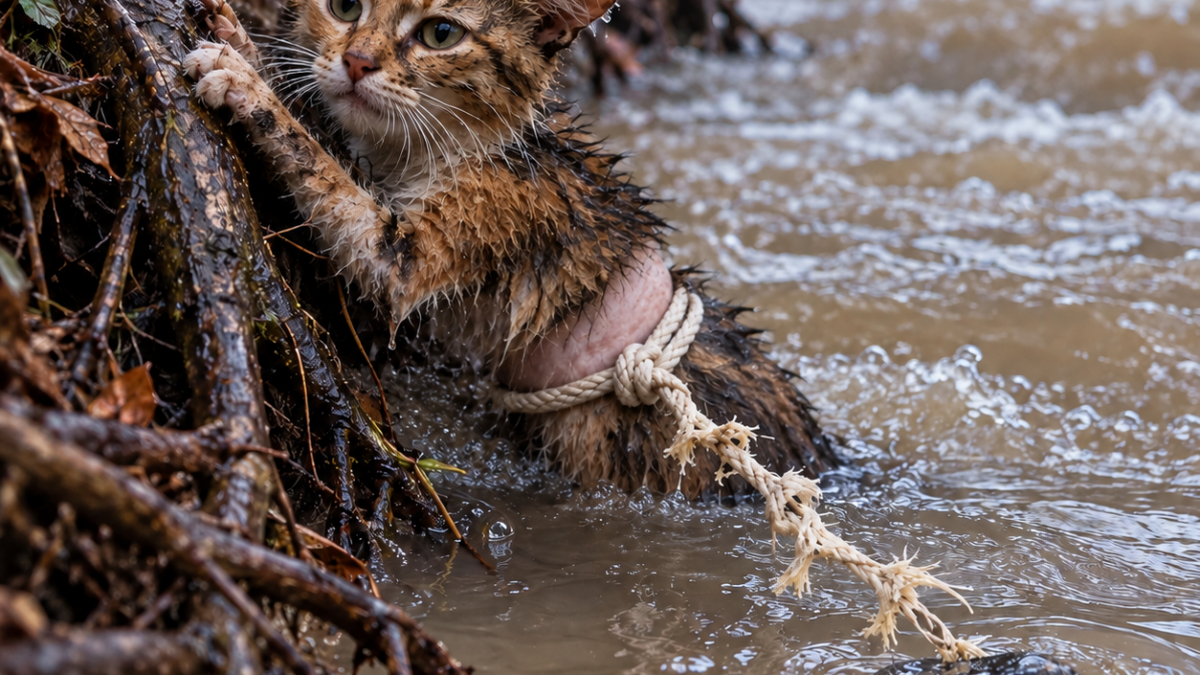
The cat’s remaining paw scraped at the root.
Henry lunged.
His fingers brushed wet fur.
She made a sound then.
A raw, broken little cry.
“I’ve got you,” he said, though he didn’t yet.
The water shoved hard against him. His right boot sank into mud. His knee hit a submerged rock. Pain shot up his leg, but he reached again, farther this time, chest leaning over the current.
His hand closed around the rope.
The cat screamed.
Not from anger.
From pain.
Henry immediately let the rope go and grabbed her body instead, sliding his hand under her chest. She was so cold she felt unreal, like something already leaving the world. Her claws hooked into his coat. Her mouth opened, but no sound came out.
“I’ve got you,” he said again, and this time it was true.
He pulled her against him and scrambled backward up the bank with the cat pressed to his chest. Boone stood above them barking frantically, tail stiff, eyes wide.
“Quiet, Boone. Quiet. I got her.”
But his own voice was shaking.
At the top of the bank, Henry dropped to his knees in the wet grass. He unzipped his coat and tucked the cat inside against his flannel shirt. She did not fight. That scared him more than if she had. A frightened cat should scratch, bite, twist, protest being handled by a stranger.
This one only trembled.
Not even trembled.
Shuddered.
Her head lolled against him. Her eyes stayed open but unfocused.
Henry looked at the rope around her body. Nylon, blue and white, the kind sold in hardware stores for tying down tarps or hauling tools. It was knotted around her middle with brutal tightness. The loose end was frayed into wet fibers, chewed ragged until it had separated.
He had grown up around fishing line, rope, and farm twine. He knew what cut nylon looked like.
This had not been cut.
This had been bitten through.
His stomach turned.
The other end of the rope had been attached to something. Something heavy. Something now sitting at the bottom of the river.
Henry reached for his phone with muddy fingers and called the only place he could think of.
“Millstone Emergency Vet,” a woman answered.
“I found a cat in the river,” Henry said. “She’s alive, but barely. Rope tied around her. She’s freezing.”
The receptionist’s voice changed instantly.
“How far are you?”
“Forty minutes.”
“Bring her now. Put the heat on in your vehicle. Wrap her in anything dry if you can. Do not use hot water. Do you understand? Warm air. Dry blankets. Drive safely, but come now.”
Henry hung up.
He looked at Boone.
The dog stood beside him, trembling with excitement and fear, leash dragging through the leaves.
“You found her,” Henry whispered.
Boone whined.
Henry got to his feet, holding the cat inside his coat with one arm and Boone’s leash with the other. The walk back to the truck felt three times longer than it had coming in. Every few steps he looked down, afraid the cat had stopped breathing.
She was breathing.
Barely.
In the truck, Henry spread Boone’s old plaid blanket across the passenger seat. The blanket had been his wife’s once. She used to keep it folded at the end of their bed before cancer took the warmth from that room. After she died, Boone claimed it, and Henry let him because grief does not need to win every argument.
Now he wrapped the blanket around the cat.
Boone climbed into the back seat and pressed his nose between the front seats, whining softly.
Henry turned the heat all the way up and drove.
The cat did not move during the entire forty-minute trip.
Not once.
Henry kept one hand on the steering wheel and the other resting lightly on the blanket, feeling for breathing. When traffic slowed near the school, he laid on the horn for the first time in years. When a pickup drifted under the speed limit in front of him, Henry muttered things his late wife would have scolded him for saying.
“Stay,” he told the cat again and again.
He did not know why he used that word.
Maybe because he had said it to Boone a thousand times.
Maybe because he had said it silently to his wife in hospital rooms, knowing she could not obey.
“Stay. Come on, little one. Stay.”
At the clinic, a technician met him at the door before he could even reach the handle.
“River cat?” she asked.
Henry nodded.
They took the bundle from his arms and disappeared through double doors.
For a few seconds, Henry stood alone in the lobby, his coat soaked, his jeans streaked with mud, his hands shaking. Boone pressed against his leg. The receptionist handed Henry a clipboard, then took one look at his face and gently set it aside.
“Sit down,” she said.
“I’m all right.”
“No, sir. Sit down.”
He sat.
Boone put his head on Henry’s knee.
Behind the doors, people moved quickly. Voices rose and fell. Machines beeped. Someone said, “Temperature is thirty-one point seven Celsius.” Someone else swore under their breath.
Henry did not know Celsius well, but he knew tone.
Bad.
A veterinarian came out fifteen minutes later.
He was a tall man in his forties with tired eyes and a name embroidered on his coat: Dr. Samuel Reeves.
“You brought in the cat?”
Henry stood.
“Yes.”
“She’s alive.”
Henry exhaled so hard he almost sat back down.
“But she’s critical,” Dr. Reeves continued. “Severely hypothermic. Her body temperature is about seven degrees Celsius below normal. She has rope constriction injuries around the abdomen. She’s dehydrated, shocky, and her front incisors are cracked. Badly.”
“Her teeth?”
Dr. Reeves looked at him.
“She chewed through the rope.”
Henry heard the words, but they seemed too large to enter him all at once.
“She what?”
“She chewed through the rope. The fibers match the damage pattern in her mouth. Several incisors are fractured down near the nerve. She bit that rope over and over until it gave way.”
Henry looked toward the closed doors.
“How long was she in the water?”
“I can’t say exactly. Based on her temperature and condition? Three to four hours. Maybe longer. In water around five degrees Celsius.”
Boone whined.
Henry put a hand on the dog’s head.
Dr. Reeves’s jaw tightened.
“There was something attached to the other end.”
“A weight,” Henry said.
The veterinarian nodded.
“Most likely. A rock, brick, cinder block, something heavy enough to hold her under or drag her away from shore. Whoever did this tied the rope tight around her body, attached weight to it, and threw her in.”
Henry’s hands curled.
He was not a violent man. He had lived too long and lost too much to think anger solved much. But for one bright second, he wanted to find the person responsible and show them the river from below.
“Can you save her?” he asked.
“We’re trying.”
“What does that mean?”
“It means she survived long enough to reach us. That matters. But she’s not out of danger. Warming a hypothermic animal too fast can kill them. We need to raise her temperature slowly, manage shock, treat possible aspiration, assess internal injury, and remove that rope without tearing damaged skin.”
Henry nodded though he understood only half of it.
“I’ll pay.”
Dr. Reeves studied him.
“This could get expensive.”
“I said I’ll pay.”
“Do you own her?”
Henry looked toward the treatment doors again.
“No.”
The answer surprised him with how much it hurt.
“No,” he repeated. “But I found her.”
Dr. Reeves gave a small nod, the kind one tired person gives another when explanation is unnecessary.
“We’ll do everything we can.”
The sheriff’s deputy arrived an hour later.
His name was Caleb Morrison. He was young enough that Henry briefly wondered if he had packed a lunch for school. But his expression changed when Dr. Reeves showed him the rope and the photographs of the injuries.
Deputy Morrison asked Henry to walk him through everything.
Where exactly had he found her? What time? Had he seen anyone nearby? Tire tracks? Footprints? Any vehicles parked near the bridge?
Henry answered as best he could. His mind replayed the riverbank in fragments. The mud. The roots. Boone barking. The chewed rope. The cold weight of the cat against his chest.
“I didn’t look for tracks,” Henry admitted. “I was trying to get her out.”
“You did the right thing.”
“Will you investigate?”
“Yes, sir.”
Henry had lived in Millstone County long enough to know that yes did not always mean much.
A cat was not a person. Some people believed that distinction meant the suffering mattered less. Henry had never understood that. Pain was pain. Fear was fear. A creature fighting to live did not care what category humans placed her in afterward.
Deputy Morrison placed the rope in an evidence bag. Dr. Reeves had cut it carefully away from the cat’s body after photographing it from every angle. The knot was still intact. The chewed end remained ragged and stiff.
“Looks like hardware-store rope,” the deputy said.
Henry stared at the blue and white nylon.
“Can you trace it?”
“Maybe. Maybe not. We’ll check recent reports. See if anyone’s missing a cat. Ask around near the river access. There might be trail cameras.”
“There are cameras at the boat ramp,” Henry said suddenly. “The county installed them last summer after those kids vandalized the docks.”
Deputy Morrison looked up.
“You’re sure?”
“Yes.”
“That could help.”
Henry clung to that.
While the deputy left to begin whatever justice looked like for a half-drowned cat, Henry stayed in the waiting room. Boone slept at his feet. The receptionist brought him coffee. It went cold in his hands.
Hours passed.
Other people came in and out. A woman with a coughing pug. A teenage boy carrying a shoebox with a hamster inside. A man in a work uniform whose German shepherd had eaten part of a rubber mat. Life kept being ordinary all around Henry, and that seemed impossible.
At three in the afternoon, Dr. Reeves came back.
“She’s stable for now.”
Henry closed his eyes.
“Can I see her?”
“For a minute.”
The treatment room smelled like antiseptic, wet fur, and warm towels. The cat lay on a heated pad under layers of blankets. An IV line ran into one front leg. Her fur, now partially dried, revealed a patchwork of tortoiseshell colors: black, amber, cinnamon, cream. She was smaller than Henry had realized. Barely five pounds, maybe less. Around her middle, where the rope had been, ran a raw groove of angry skin.
Her eyes were closed.
“She’s sedated for pain,” Dr. Reeves said. “We removed two broken incisors. We may need to remove more later, but right now I didn’t want to keep her under anesthesia too long. There’s some necrotic tissue at the tail tip. We’ll watch it.”
Henry stepped closer.
“Does she have a microchip?”
“No.”
“Any idea how old?”
“Maybe three. Maybe four.”
“A baby,” Henry said.
Dr. Reeves gave him a tired half-smile.
“Not a kitten, but young.”
Henry looked at the cat’s face. Even unconscious, she seemed exhausted.
“What happens if nobody claims her?”
“That depends. We’ll report her to animal control. After the hold period, she can be transferred to the shelter or adopted if medically cleared.”
Henry already knew the answer before he said it.
“I’ll take her.”
Dr. Reeves looked at him.
“You should think about that.”
“I have.”
“No,” the veterinarian said gently. “You’ve reacted. That’s not the same as thinking.”
Henry appreciated the honesty.
“She may have long-term trauma,” Dr. Reeves continued. “Fear of water. Handling sensitivity. Medical issues. Dental pain. She might never be affectionate. She might hide for months. She may panic at rain, sinks, bathtubs. She may not trust anyone.”
Henry looked at the tiny cat.
“She chewed through a rope underwater for four hours,” he said. “I think I can give her time.”
Dr. Reeves did not argue after that.
The first night, the cat almost died twice.
Henry learned that later. Dr. Reeves did not call him during the worst of it because there was nothing Henry could do except suffer in another room. Her temperature rose too slowly, then dipped. Her blood pressure crashed. Fluid crackled faintly in one lung, likely from river water she had inhaled. She stopped responding to touch around midnight.
A technician named Lydia sat beside her for nearly three hours, rubbing warmth into the pads of her paws.
“Come on, River Girl,” Lydia whispered.
Nobody had named the cat yet.
But sometimes names arrive before paperwork catches up.
River Girl survived the night.
By morning, she lifted her head.
By the second day, she swallowed a spoonful of warmed food.
By the third, she hissed at Dr. Reeves when he checked her belly.
He came out grinning.
“She hissed at me.”
Henry stared.
“That’s good?”
“That’s excellent.”
The first time Henry held her after the rescue, she weighed less than a bag of sugar and felt just as fragile. Lydia placed the cat in his lap in a small consultation room, wrapped in a towel, IV removed, eyes half open.
Boone sat beside Henry’s chair, unusually still.
The cat saw the dog and tensed.
Boone lowered his head to the floor and looked away, as if he understood that direct attention can feel like threat.
“Well,” Henry said softly, “that’s Boone. He’s the reason you’re here.”
The cat blinked.
Henry did not touch her at first. He let her smell his hand. Her nose twitched. She smelled mud, old wool, coffee, dog, rain, and whatever else made up the life of a widower who had not expected to become responsible for a river survivor.
Finally, she lowered her chin onto the towel.
Not trust.
Not yet.
But not terror either.
Henry took it as a beginning.
“What are you going to call her?” Lydia asked from the doorway.
Henry looked down.
The name was already there.
“River.”
Lydia smiled.
“Fitting.”
“Maybe too fitting.”
“She earned it.”
Henry nodded.
“She did.”
River came home eight days after she was pulled from the water.
Henry prepared the spare bedroom like he was expecting royalty. He bought a heated cat bed, three kinds of wet food, two litter boxes, soft blankets, ceramic bowls, a scratching post, and a ridiculous toy shaped like a fish that flopped electronically when touched. Boone watched the preparations with the weary dignity of an old dog whose household management had clearly been compromised.
Henry placed River’s water in a shallow dish, then moved it away from the bed. Then closer. Then away again. He spent ten minutes worrying about whether the sound of the furnace might remind her of rushing water.
When he opened the carrier, River did not come out.
He sat on the floor beside her.
“That’s all right,” he said. “No hurry.”
She stayed in the carrier for six hours.
Henry stayed on the floor for two of them, until his hip objected and Boone came to stare at him as if to say, This is embarrassing for both of us.
That first week, River hid under the bed.
Henry brought food twice a day and slid the plate just far enough under the frame that she could reach it without coming out. He spoke to her while he folded laundry. He read the local newspaper aloud. He told her about Boone, about his wife Margaret, about the town, about the maple tree in the front yard that turned red later than all the others as if it enjoyed being dramatic.
River did not answer.
At night, rain struck the windows, and River cried from under the bed with a sound so low Henry felt it in his chest.
The first time it happened, he rushed into the room. She flattened herself against the wall, eyes black with terror.
He stopped immediately.
“I’m sorry,” he said.
Rain tapped harder against the glass.
River’s body shook.
Henry sat with his back against the door, far from the bed.
“I know,” he whispered. “I know.”
He did not know, of course. Not really. He had never been tied to a stone and thrown into freezing water. He had never chewed through rope until his teeth cracked to the nerve. He had never fought a river alone in the dark.
But he knew what it meant for the past to enter a room uninvited.
After Margaret died, Henry could not hear the beeping of a microwave timer without being back in the hospital. He could not smell lavender lotion without seeing her hands, thin and bruised, resting on white sheets. He had learned that memory does not care about calendars. It comes when it comes.
So he sat with River through the rain.
Again and again.
On the twelfth day, she came out from under the bed while he was reading.
Henry saw the movement from the corner of his eye and kept his voice steady.
“County commissioners argued for forty-seven minutes about parking meters,” he read from the newspaper. “Which seems excessive, but I suppose everyone needs a hobby.”
River paused near the bed skirt.
Boone, lying in the hall outside the baby gate Henry had installed, lifted his head.
“Don’t ruin this,” Henry told him.
Boone sighed and lowered his head.
River took three more steps. Her belly still bore the raw ring where the rope had been. The fur around it had been shaved, and the skin beneath looked too vulnerable.
Henry did not reach for her.
She approached his shoe.
Sniffed it.
Then, with all the caution in the world, rubbed one cheek against the toe.
Henry stared at the newspaper until the words blurred.
“Well,” he said, voice rough. “That’s good news too.”
She vanished under the bed immediately afterward.
But the next day she stayed out for five minutes.
The day after that, nine.
On the fourth week, she climbed onto the windowsill and watched leaves scrape across the yard. When a truck drove by too fast, she hid. When the dishwasher ran, she hid. When Henry filled Boone’s water bowl and the stream splashed loudly against metal, she bolted under the couch so fast she knocked over a lamp.
Water was the worst.
She would approach her drinking bowl only after circling it twice. Sometimes she lowered her head, then jerked back as if expecting the bowl to rise around her. Henry switched from metal to ceramic. Then from deep to shallow. He tried a fountain because someone at the pet store said cats liked moving water, and River did not emerge for eleven hours after hearing it.
The fountain went back into the box.
For months, every drink was a decision.
She would stand over the bowl, stare into it, and pause.
Every time.
As if asking whether water could be trusted today.
But each morning, she came farther into Henry’s life.
First the bedroom.
Then the hallway.
Then the living room.
Boone treated her with the careful politeness of an old gentleman avoiding sudden opinions. River watched him from chairs and tabletops. One afternoon, she walked up while he slept and sniffed his ear.
Boone opened one eye.
River slapped his nose.
Boone closed his eye again.
After that, they were family.
The investigation moved more slowly than healing.
Deputy Morrison called Henry four days after the rescue.
“We pulled the boat ramp footage.”
“And?”
“There’s a truck.”
Henry gripped the phone tighter.
“Can you see who?”
“Not clearly. Dark-colored pickup. Older model. No front plate visible because of the angle. It came in around 4:12 a.m. the morning you found her. Stayed nine minutes. Left.”
“That has to be them.”
“It may be.”
“What do you mean may be?”
“I mean we need evidence. The footage doesn’t show anyone throwing anything. Just a vehicle near the ramp.”
Henry closed his eyes.
“What else?”
“We’re checking other cameras on Route 6. Also looking into rope purchases, but that’s a long shot. It’s common rope.”
“What about the stone?”
“We sent a dive team.”
Henry blinked.
“For a cat?”
The deputy’s voice hardened slightly.
“For evidence.”
Henry liked him more after that.
The dive team found it two days later.
Not a stone.
A concrete landscaping block with a hole through the center. The rope had been tied through it. The chewed end recovered from River matched the remaining rope attached to the block.
The block had traces of green paint on one side.
That detail meant nothing to Henry at first.
It would mean everything later.
The local newspaper ran a small story.
CAT RESCUED FROM RIVER AFTER SUSPECTED ABUSE.
No photo of River. Henry refused. She had been through enough without becoming a spectacle.
But the story spread anyway.
People called the clinic. Some offered donations. Some offered to adopt her, though Henry had already made clear she was not available. One woman mailed a hand-knit blanket. A second-grade class sent cards. Someone left a bag of cat food on Henry’s porch with a note that said, For the river girl.
Then came the ugly comments.
Henry did not use social media much, but his neighbor Linda did, and Linda believed every person over sixty needed a personal news service whether they asked for one or not.
She came over one afternoon holding her phone.
“Don’t read the comments,” she said.
Henry, naturally, read the comments.
Some were kind.
Some were furious.
Some demanded prison.
Then there were others.
It’s just a cat.
People are too sensitive.
Maybe it was feral.
How do we know this old guy didn’t make it up for attention?
That last one sat in Henry’s chest like a hot coal.
He had expected cruelty toward the person who hurt River.
He had not expected suspicion toward the person who saved her.
Linda snatched the phone back.
“I told you not to read them.”
“You showed me.”
“I said don’t read them while showing you. There’s a difference.”
“No, there isn’t.”
“Well, there should be.”
Henry almost smiled.
But that night, as River slept curled in the corner of the couch and Boone snored on the rug, he thought about the phrase.
Just a cat.
He looked at the bare ring around River’s body, still healing but already forming the smooth scar that would never grow fur again.
Just a cat.
As if suffering became smaller when the body was small.
As if terror mattered only when it belonged to something that could speak in court.
The first real break in the case came from a woman named Marlene Price, who owned a gardening shop near the river road.
She called the sheriff’s department after seeing the newspaper story.
“I sold blocks like that,” she told Deputy Morrison.
So did every garden center in three counties, but Marlene remembered the green paint.
Two weeks before River was found, someone had stolen six painted landscaping blocks from behind her shop. They had been part of a display, each one marked with a stripe of leftover green barn paint so employees would know not to sell them.
Marlene had reported the theft because she was, in her words, “petty enough to care about twenty dollars’ worth of concrete.”
Deputy Morrison reviewed her security footage.
This time, the truck appeared clearly.
Dark green Ford Ranger.
Dented passenger door.
Missing tailgate handle.
The driver wore a hood, but the vehicle was unmistakable.
Henry recognized it when Deputy Morrison showed him the still image.
His stomach dropped.
“That’s Evan Pike’s truck.”
The deputy looked up.
“You know him?”
“Everyone knows Evan.”
That was not entirely true, but it felt true in Millstone.
Evan Pike lived three miles outside town in a sagging rental house behind the old feed mill. He did odd jobs badly and blamed everyone else when people stopped hiring him. He had a temper that arrived before he did. Henry had once watched him scream at a teenage cashier over the price of motor oil. Another time, Evan’s ex-girlfriend, Tessa, came into the grocery store wearing sunglasses indoors, and nobody asked why because small towns are skilled at confusing silence with manners.
“Does he own cats?” Deputy Morrison asked.
Henry thought.
“I don’t know.”
But Linda did.
Linda knew everything because she walked her mail to the road at exactly the same time every day and considered observation a civic duty.
When Henry asked her, she pursed her lips.
“Tessa had a little tortoiseshell when she lived with him.”
Henry felt cold.
“You’re sure?”
“Of course I’m sure. Pretty little thing. Used to sit in the kitchen window. I’d see her when I drove by.”
“What happened to Tessa?”
“Moved out in September. Went to her sister’s in Kentucky, I think. Left in a hurry.”
“And the cat?”
Linda’s face changed.
“I don’t know.”
Deputy Morrison found Tessa through her sister.
She answered his call, and within ten minutes she was crying so hard he had to wait for her to breathe.
The cat’s name had been Maple.
Tessa had found her as a kitten behind the diner four years earlier. Maple slept on her pillow, followed her from room to room, and hid whenever Evan came home drunk. When Tessa left Evan after he shoved her into a doorframe, she tried to take Maple.
Evan would not let her.
According to Tessa, he held the cat by the scruff and said, “You don’t get to take anything from my house.”
Tessa called animal control the next day, but when an officer stopped by, Evan said the cat had run away.
There was no proof.
There rarely is when cruelty happens behind doors.
Tessa sent photos.
Maple on a windowsill.
Maple in a laundry basket.
Maple curled against Tessa’s chest.
Same tortoiseshell pattern.
Same amber streak down the nose.
Same small cream patch under the chin.
River had been Maple.
Henry sat at his kitchen table looking at the photos after Deputy Morrison forwarded them with permission.
River, now curled in Boone’s blanket on the chair beside him, opened one eye.
“Maple,” Henry said softly.
Her ear twitched.
Not recognition.
Maybe sound.
Maybe coincidence.
Maybe memory moving somewhere too deep for humans to reach.
The evidence built piece by piece.
Security footage of Evan’s truck stealing the blocks.
Footage of the same truck near the boat ramp before dawn.
Rope fibers from Evan’s shed matching the rope tied around River.
A receipt from a hardware store for blue and white nylon rope purchased two days before the rescue.
Tessa’s statement.
A neighbor who heard a cat crying from Evan’s garage the night before.
Another neighbor who heard Evan yell, “You should’ve taken that thing when you had the chance.”
The sheriff arrested Evan Pike on a gray Tuesday morning.
He denied everything.
Then he claimed the cat had scratched him.
Then he claimed she was feral.
Then he claimed Tessa had abandoned her.
Then he claimed, according to Deputy Morrison, that “people are acting like I drowned a kid.”
That quote made it into the paper.
It changed everything.
The same people who had said just a cat began arguing in the grocery store checkout line. The hardware store owner put a jar on the counter for River’s medical bills and wrote SHE FOUGHT HARDER THAN MOST MEN on a piece of cardboard. Marlene Price taped a copy of the stolen-block report to her shop window. Someone spray-painted ANIMAL ABUSER on Evan’s rental house, which Henry did not approve of but privately understood.
Tessa came back to Millstone for the hearing.
Henry met her outside the courthouse.
She was twenty-nine, small, pale, with dark hair cut shorter than in the photos she had sent. Her hands shook when she saw him.
“Is she alive?” she asked before saying hello.
Henry nodded.
“She’s alive.”
Tessa covered her mouth.
“I thought he killed her.”
“He tried.”
She flinched.
Henry regretted the bluntness, but not enough to take it back.
“Can I see her?” Tessa asked.
Henry hesitated.
He had thought about this moment for days. Legally, River had been unclaimed when he adopted her after the hold period. Emotionally, nothing about love was that tidy. Tessa had loved Maple first. Tessa had also left without her, though Henry understood why. People who have never been trapped often misunderstand what it costs to escape.
“She scares easily,” Henry said.
“I know.”
“She doesn’t like being picked up.”
“She never did unless it was her idea.”
“She’s afraid of water.”
Tessa’s eyes filled.
“I figured.”
Henry looked at her and saw not an owner coming to claim property, but a woman facing the living evidence of what she had been unable to protect.
“You can come by after court,” he said.
Tessa cried then.
Right there on the courthouse steps.
“I’m sorry,” she whispered.
Henry did not know whether she was saying it to him, to River, to herself, or to the version of Maple who had sat in the kitchen window waiting for someone to come back.
Maybe all of them.
The hearing was ugly in the way legal proceedings often are when they turn suffering into schedules and statutes.
Evan wore a collared shirt and looked bored. His attorney argued that the evidence was circumstantial, that nobody had seen him throw the cat into the river, that emotions were running high because of media attention. He suggested the cat could have become tangled accidentally, that the rope and block might have come from someone else, that Tessa was biased because of a “contentious breakup.”
Tessa sat behind Henry, hands clenched so tightly her knuckles whitened.
When Dr. Reeves testified, the courtroom changed.
He explained hypothermia. Rope constriction. Dental fractures. The difference between cut nylon and chewed nylon. He spoke calmly, clinically, but everyone heard the horror beneath the words.
“The cat’s incisors were fractured from repeated force against the rope fibers,” he said. “In my medical opinion, she chewed through the rope while submerged or partially submerged in cold water.”
The prosecutor asked, “Would that have caused pain?”
“Yes.”
“How much?”
Dr. Reeves looked at Evan.
“Extreme pain.”
Evan looked away first.
Then Henry testified.
He described Boone stopping on the trail. The sound in the water. The root. The rope. The way River felt inside his coat.
The prosecutor asked, “Why did you go down the bank?”
Henry frowned.
“Because she was alive.”
That answer seemed to settle over the courtroom.
Because she was alive.
As if anything else would have required explanation.
Tessa testified last.
She did not exaggerate. She did not perform. She simply told the truth.
Maple had been her cat. Evan had used the cat to punish her after she left. He had threatened before to “get rid of the thing.” She had called animal control. She had tried. She had been afraid.
Evan’s attorney asked why she left without the cat.
Tessa went very still.
Then she said, “Because he was holding her by the neck and telling me if I stepped closer, he’d break mine.”
The courtroom went silent.
Even Evan stopped moving.
That was the moment, Henry later thought, when the case stopped being only about River. Everyone in that room understood, whether they wanted to or not, that cruelty rarely lives in one room of a house. It moves around. It practices. It starts with words, then walls, then animals, then people, then back again.
Evan accepted a plea before trial.
Animal cruelty. Theft. Evidence-related charges. A domestic violence charge from Tessa’s earlier report was reopened after her testimony and additional evidence from neighbors. The sentence was not enough in Henry’s opinion. It probably never could have been.
But Evan lost his job, his rental, his firearms, and his freedom for a time. He was ordered to pay restitution for River’s medical care, attend court-mandated counseling, and stay away from Tessa, Henry, and any animals. His face, so smug at the first hearing, looked smaller at sentencing.
The judge, an older woman with silver hair and a voice like gravel, looked directly at him.
“People reveal themselves in how they treat those who cannot fight back,” she said. “In this case, the evidence shows you chose cruelty against a defenseless animal to punish a human being you could no longer control. This court takes that seriously.”
Henry wished River could understand that part.
Not the legal words.
The fact that someone had said, out loud, that what happened to her mattered.
After the sentencing, Tessa came to Henry’s house.
She stood in the living room with her coat still on, eyes fixed on the tortoiseshell cat sleeping on the armchair.
River lifted her head.
For a long moment, nobody moved.
Then Tessa whispered, “Maple.”
River stared.
Boone watched from the rug.
Tessa lowered herself slowly to the floor, not approaching, not reaching.
“Hi, baby.”
River’s body tensed.
Henry held his breath.
Tessa began to cry silently.
“I’m sorry,” she said. “I’m so sorry. I tried to come back. I did. I should have—”
Her voice broke.
River jumped down from the chair.
Henry expected her to run.
Instead, she took three cautious steps toward Tessa.
Stopped.
Sniffed.
Tessa held out one shaking hand, palm down.
River sniffed her fingers.
Then she turned and walked away into the kitchen.
Tessa covered her face.
Henry sat beside her on the floor, because sometimes grief lowers everyone to the same place.
“She doesn’t hate you,” he said.
“You don’t know that.”
“No,” he admitted. “But cats don’t usually bother with hate when walking away will do.”
Tessa laughed through tears.
A few minutes later, River returned.
Not to Tessa’s lap.
Not into her arms.
But to the edge of the rug, where she sat with her tail wrapped around her feet and watched the woman she had once loved.
That was all.
For that day, it was enough.
Tessa did not ask to take her back.
Henry had feared she might.
Instead, as she left, she looked at River and said, “You look safe.”
River blinked slowly.
Tessa smiled with her whole broken heart.
“Good.”
Over time, Tessa became part of River’s life again in a careful, limited way. She visited once a month at first. Then sometimes less, sometimes more. She brought treats River pretended not to like before eating them when no one watched. She brought a small quilt she had kept from the old house, washed three times because she was afraid it might smell like Evan.
River slept on it that same afternoon.
Tessa cried in her car for twenty minutes before driving away.
Henry never felt threatened by Tessa’s love for River. Love, he had learned, was not a bowl that emptied when shared. River had been Maple once. She was River now. Both names could live in the same small body.
But it was River who slept on Henry’s chest.
River who followed Boone from room to room.
River who learned the sound of Henry’s truck and waited on the windowsill.
River who paused before drinking water every single time.
The scar around her body changed as months passed. The raw groove healed, then smoothed, then became a permanent naked band around her middle, about an inch wide. Fur never grew there again. From above, it looked like someone had drawn a pale ring around her body with an unforgiving hand.
Children noticed it when they visited.
Adults tried not to.
River did not care for visitors, but she tolerated Linda, adored Lydia from the vet clinic, ignored Deputy Morrison, and once climbed into Dr. Reeves’s medical bag as if attempting to avoid an appointment by becoming equipment.
Her fear of rain lasted longest.
During the first winter, every storm sent her beneath Henry’s bed. He would lie on the floor with a flashlight and talk to her until his knees ached. Boone usually joined him, though he did not fit under the bed and seemed offended by that fact.
The second year, River stopped hiding every time it rained. Sometimes she stayed on the couch, body low, eyes alert, while Henry sat nearby pretending not to monitor her.
During thunderstorms, she still vanished.
Henry did not blame her.
He had a few thunderstorms of his own.
Grief for Margaret still came in weather. Some days gentle. Some days violent. On those days, River seemed to know. She climbed into his lap with surprising determination, turned three times, and pressed her face against his chest. Her purr was loud, rough, and uneven, likely because of the damage done to her body that day in the river.
Henry loved that sound more than most music.
“You know,” he told Boone one morning as River kneaded his thigh with painful affection, “I used to think I rescued her.”
Boone glanced at him.
“Don’t look smug.”
Boone looked smug anyway.
The story did not end at the sentencing, though people often wanted it to.
They liked neat endings.
Cruel man punished.
Cat saved.
Old widower healed.
Roll credits.
But real healing is less dramatic and more repetitive.
It is filling the water bowl gently so it does not splash.
It is learning which towel texture does not irritate a scar.
It is removing two more damaged teeth a year later because survival often sends bills long after the miracle.
It is sitting through rain.
It is River biting Henry the first time he tried to bathe mud from her paws because fear does not care about good intentions.
It is Henry apologizing while bleeding into a dish towel.
It is Boone dying three years after River came home, and River searching the house for him for eleven days.
That nearly broke Henry.
Boone had grown slower through the last winter. His hips worsened. His hearing faded. He still walked to the river trail, but not far. Sometimes he stood at the top of the bank where he had found River and simply sniffed the wind, as if checking whether the world needed him again.
On his last morning, he refused breakfast.
Henry knew.
River knew too, though he could not explain how. She lay beside Boone’s bed all day, her body curled along his back. When Dr. Reeves came to the house that evening, River did not hide from the medical bag. She stayed beside Boone until Henry lifted her gently away.
Boone died with his head in Henry’s lap.
The house became impossibly quiet.
For eleven days, River walked from room to room calling in a voice Henry had never heard before. She checked Boone’s bed. His food bowl. The back door. The truck. At night, she sat in the hallway and cried.
Henry had saved her from the river.
Boone had found her there.
Maybe she understood that debt in some animal way.
Maybe she only missed her friend.
Both were true enough.
On the twelfth day, River climbed into Boone’s empty bed and slept there.
Henry sat on the floor and wept into his hands.
River woke, walked over, climbed into his lap, and pressed the scarred ring of her body against his stomach.
She purred.
Loud enough to hear from the next room.
After Boone died, Henry stopped going to the river trail for a while.
Then one morning, he picked up Boone’s old leash, folded it, placed it in his coat pocket, and drove there alone.
The river was calm that day. Clearer than it had been in years, shallow sunlight moving across stones. The sycamore root where River had clung was still there, thicker now, exposed above the waterline. Henry stood at the bank for a long time.
He thought about the sound he almost ignored.
He thought about Boone stopping.
He thought about the tiny body in the water and the rope chewed through in the dark.
He thought about how close the world comes, every day, to losing things it never knew were fighting.
Behind him, a voice said, “Mr. Cole?”
Henry turned.
Deputy Morrison stood on the trail, older now, no longer looking like he needed a hall pass. He was off duty, wearing jeans and a county sheriff sweatshirt.
“Caleb,” Henry said.
The deputy nodded toward the river.
“I still think about it.”
“So do I.”
“My wife and I adopted a cat last month.”
Henry raised an eyebrow.
“That right?”
“Three-legged tabby. Mean as taxes.”
Henry smiled.
“Sounds perfect.”
“Named her Root.”
Henry stared.
Caleb shrugged.
“Seemed fitting.”
Henry laughed for the first time all week.
Years moved the way they always do, somehow slowly and all at once.
River aged.
Her face grew narrower. Her back legs stiffened. Her once-bright tortoiseshell coat dulled around the edges. The bare ring around her belly remained visible, pale and smooth beneath Henry’s hand. She still paused before drinking water. She still disliked rain. She still hated being picked up unless it was her idea.
But every morning, she climbed onto Henry’s lap.
Even when jumping became hard.
Even when he had to lift her gently.
She would press her face into his chest and purr with that rough, stubborn engine of hers.
Tessa rebuilt her life too.
She became a veterinary receptionist in Kentucky, then later moved back to Millstone and began volunteering at a domestic violence advocacy center. She never used River’s story without permission. When she spoke to women trying to leave dangerous homes, she sometimes said, “Take the pet if you can. Ask for help if you can’t. Don’t assume he won’t use what you love.”
People listened.
Because Tessa spoke like someone who knew the cost of leaving without everything.
She married a quiet electrician named Paul who understood that kindness is not softness. They adopted two senior cats and a beagle with one eye. River never met the beagle, which was probably best for everyone.
Henry remained Henry.
He fixed things around the house. He drank coffee too late in the day. He argued with Linda about whether her maple tree was dropping leaves into his gutters on purpose. He brought River to Dr. Reeves for checkups and pretended not to be terrified every time she seemed tired.
At the clinic, River became something of a legend.
Not publicly.
Not online.
Just among the staff.
When new technicians complained about difficult cases, Lydia would say, “Let me tell you about River.” When frightened animals came in with rope injuries, water trauma, neglect, or worse, Dr. Reeves would sometimes place a hand on the exam table and remember a tiny tortoiseshell who arrived colder than death and still found a way back.
The hardware store owner kept the donation jar long after River’s bills were paid. He changed the label to THE RIVER FUND and used it for emergency treatment of abused animals whose owners could not be found. The first year, it paid for a terrier with a broken jaw. The second, a barn cat shot with a pellet gun. The third, a rabbit abandoned in a box behind the laundromat.
Henry did not start the fund.
River did.
That was how he thought of it.
Not as charity created by outrage, but as a current redirected.
One life refusing to end where cruelty tried to leave it.
On the seventh anniversary of River’s rescue, Henry woke before dawn to the sound of rain.
Not heavy rain.
Soft, steady rain.
He lay still, listening.
For years, rain had meant getting up to find River, to sit near her hiding place, to speak softly into the dark. But River no longer ran every time. Age had made her slower, yes, but it had also made some fears less sharp.
He turned his head.
She was on the pillow beside him.
Awake.
Listening.
Her eyes, cloudy now with age, reflected the dim light from the hallway.
Rain tapped the window.
River’s body tensed.
Henry waited.
She did not run.
Instead, she stood carefully, stepped onto his chest, turned once, and lay down with her front paws tucked beneath her.
Her purr started low.
Uneven.
Determined.
Henry placed one hand over the bare ring around her body.
The scar was smooth beneath his fingers.
An absence shaped like evidence.
“You hear that?” he whispered. “Just rain.”
River blinked slowly.
Thunder rolled far away.
She pressed her face into his shirt.
Henry looked toward the ceiling.
He thought of Margaret. Boone. Tessa. Dr. Reeves. Deputy Morrison. Lydia. The second-grade cards. The green paint on the concrete block. The rope in the evidence bag. The root by the riverbank. The tiny cracked teeth that had bought River the rest of her life one bite at a time.
He thought of how people talk about survival as if it is a single brave moment.
It isn’t.
Survival is often ugly. Desperate. Repetitive. It is biting the rope again when the first bite does nothing. It is biting again when your teeth crack. Again when the current pulls. Again when the cold tells you to sleep. Again when nobody is coming because you do not yet know that an old dog has stopped on the trail and refused to move.
River lived seven more years after the river tried to take her.
Seven years of sunlit windowsills.
Seven years of pausing before water bowls and drinking anyway.
Seven years of stealing Boone’s bed, hissing at veterinarians, sleeping through baseball games on Henry’s lap, and swatting anyone foolish enough to rub her belly without written permission.
Seven years of rain that did not drown her.
Seven years of mornings.
When the end finally came, it came gently.
She was old by then. Thin. Tired. Her kidneys failing in the quiet, unfair way old cats’ bodies often fail. Dr. Reeves came to the house because Henry could not bear the thought of her last moments happening under clinic lights.
Tessa came too.
So did Lydia.
Linda stood on the porch with a casserole nobody would eat.
River lay in Boone’s old blanket on Henry’s lap, the same plaid blanket he had wrapped around her on the day he found her. Her breathing was shallow. Her body weighed almost nothing.
Henry stroked the bare ring around her belly.
“You did so good,” he whispered.
Tessa knelt beside them, tears running down her face.
“Hi, Maple,” she said softly. “Thank you for staying.”
River’s cloudy eyes moved toward her.
Maybe she knew the name.
Maybe she knew the voice.
Maybe love does not need memory to recognize itself.
Dr. Reeves gave the injection.
Henry felt River’s body relax.
Her purr, faint but still there, faded beneath his hand.
Outside, the rain stopped.
For a long time, nobody moved.
Then Henry bent over her and cried the way he had not cried since Margaret died. Not because River’s ending was tragic. It wasn’t. That was the terrible beauty of it. Her ending was peaceful, warm, held, witnessed.
It was everything the river had tried to deny her.
A week later, Henry returned to the trail.
He carried no leash this time. No dog walked beside him. No cat rode in his arms. He carried only a small wooden box and a folded note Tessa had written.
The Blue Ash River moved quietly under a pale morning sky.
At the sycamore tree, Henry knelt with difficulty. The root where River had clung was thicker now, strong and exposed, reaching over the water like a hand.
He did not scatter her ashes in the river.
People asked him later if he had, and he always said no.
River had spent enough time in that water.
Instead, he buried a small portion of her ashes beneath the sycamore, near the root that had held her until Boone found her. Tessa’s note went with them.
Henry had read it once.
Maple,
I am sorry I could not save you first.
I am grateful someone saved you next.
You were loved in both your names.
Henry covered the small hole with soil and leaves. Then he sat on the bank, knees aching, hands cold, heart full of the kind of grief that proves love had somewhere real to live.
The river kept moving.
It had carried the worst morning of River’s life.
It had also carried Boone’s bark.
It had carried Henry to the edge.
It had carried evidence.
It had carried truth.
Years later, people in Millstone still told the story, though stories change depending on who tells them.
Some said she was tied to a brick.
Some said a stone.
Some said Boone jumped in after her, which was not true but made him sound heroic, and Henry never corrected children when they said it.
Some said River chewed through the rope in minutes.
Henry always corrected that part.
“No,” he would say. “Not minutes. Hours.”
Because the time mattered.
The suffering mattered.
The fight mattered.
It mattered that she had spent three or four hours in freezing water doing the only thing left to do.
Biting.
Again.
Again.
Again.
Until the thing meant to drag her down finally broke.
The scar around her body never disappeared.
Not in life.
Not in memory.
A perfect ring of bare skin, visible from every angle, proof of what had been done to her.
But that was never all it proved.
It proved that someone had tried to make her story end at the bottom of a river.
It proved that she had disagreed with her whole body.
It proved that a dog can hear what a man almost misses.
It proved that an old widower can become a home again.
It proved that justice sometimes begins with a frayed piece of rope in an evidence bag.
Most of all, it proved that cruelty may write a chapter, but it does not get to hold the pen forever.
Because River lived.
She lived long enough to learn the sound of safe footsteps.
Long enough to sleep through gentle rain.
Long enough to turn a grieving house warm again.
Long enough to be called River by one person, Maple by another, and loved completely as both.
And every morning for seven years, a little tortoiseshell cat with a bare ring around her belly climbed into the lap of the man who had pulled her from the water, buried her face against his chest, and purred so loudly that anyone in the next room could hear it.
Not because she had forgotten.
She never forgot.
But because the rope had broken.
The river had failed.
And she was still here.



