They Threw a Battered Woman Into a 110-Pound Attack Dog’s Kennel and Waited for Her to Scream—Then She Gave One Command That Made Every Guard Go Silent.
PART3:
Riley tilted her head slightly.
She did not look at his fist.
She did not look at the blood on the floor.
She looked at his stance.
Then his right hip.
Then the two guards near the door.
“Your stance is too wide,” she said quietly.
Hayes blinked.
“What?”
“Your holster is unclasped. That means you’re anxious. The man on my left keeps shifting weight off his back foot because he has a knee injury. Cole breathes through his mouth when he’s about to swing. And the two men by the door haven’t checked their corners since they walked in.”
Her eyes returned to Hayes.
“For a high-end security outfit, your boys are remarkably sloppy.”
The room went silent.
For one brief second, doubt crossed Hayes’s face.
Not fear.
Not yet.
Just the flicker of a man realizing the woman tied to the chair was not reacting correctly.
She had been beaten for forty-five minutes.
She should have been crying.
Begging.
Trying to bargain.
Instead, she was evaluating their tactical discipline like an instructor grading a failed training exercise.
The doubt vanished beneath anger.
Hayes backhanded her.
The crack of his knuckles against her cheekbone rang out like a gunshot.
Riley’s head snapped to the side.
Blood hit the floor.
She stayed silent.
Slowly, she turned back.
Then she smiled.
Not wide.
Not warm.
A thin ghost of a smile that made Cole stop moving.
“Is that it?” she whispered.
Cole looked at Hayes.
“Boss, let me break her arms.”
Hayes wiped her blood from his knuckles.
“No.”
He hated that she had not screamed.
He hated that her eyes held no panic.
He hated that every minute she remained calm made him feel less in control of his own room.
There was something unnatural about her.
Something old and dark and disciplined.
He had seen fear in hundreds of faces. Fear was his currency. Men paid him with it. Women paid him with it. Prisoners paid him with it.
Riley Caldwell gave him nothing.
Hayes straightened.
“Standard pain isn’t working.”
Cole grinned.
“Then let me get creative.”
“No,” Hayes said. “She thinks she’s tough.”
He looked at the far wall, toward the corridor beyond it.
“Let’s see how tough she is when she meets Kaiser.”
The grin left Cole’s face.
“Boss.”
Hayes turned.
“What?”
“That dog hasn’t been fed since yesterday.”
“And?”
“He won’t just scare her. He’ll tear her apart.”
Hayes looked back at Riley.
“Then she better start talking fast.”
He grabbed a fistful of her hair and jerked her head back.
“You know what an attack dog does to a human body?”
Riley stared up at him.
“Depends on the dog.”
Hayes sneered.
“This one goes for limbs. Crushes bone. Tears muscle. By the time I pull him off you, you’ll beg me for a bullet.”
Riley’s expression remained flat.
“I like dogs.”
That irritated him more than pleading would have.
“Cut her loose,” Hayes snapped. “Drag her to the kennels.”
Cole sliced the zip ties.
Before Riley could fully stand, two guards grabbed her under the arms and hauled her from the chair.
They dragged her down the corridor, through a steel door, and into the freezing rain.
The cold hit her cuts like knives.
Riley did not react.
Four seconds in.
Four seconds out.
Box breathing.
Automatic.
Drilled so deep that even pain could not interrupt it.
As they dragged her across the compound, Riley’s eyes moved constantly.
Camera on the northeast tower.
Two-man patrol every ninety seconds along the inner fence.
Fuel drums near the west wall.
Blind spot between the container stack and comms shed.
Satellite dish facing south.
Main server likely hardwired inside the tech booth above the kennel or the central operations trailer.
Forty armed hostiles minimum.
Maybe more.
She had not been captured because she made a mistake.
She had been captured because Cobalt was too insulated to breach from outside.
No wireless network.
No cloud sync.
No sloppy communications.
No external access point.
The only way to confirm the location of the stolen ordnance and map the internal network was to get inside.
So Riley had given them something to catch.
A woman hiking alone near the perimeter.
A phone in her pocket.
A trail of clues just convincing enough.
Bruises were part of the cost.
So was time.
But Hayes had accelerated the plan when he decided to use the dog.
That was his first real mistake.
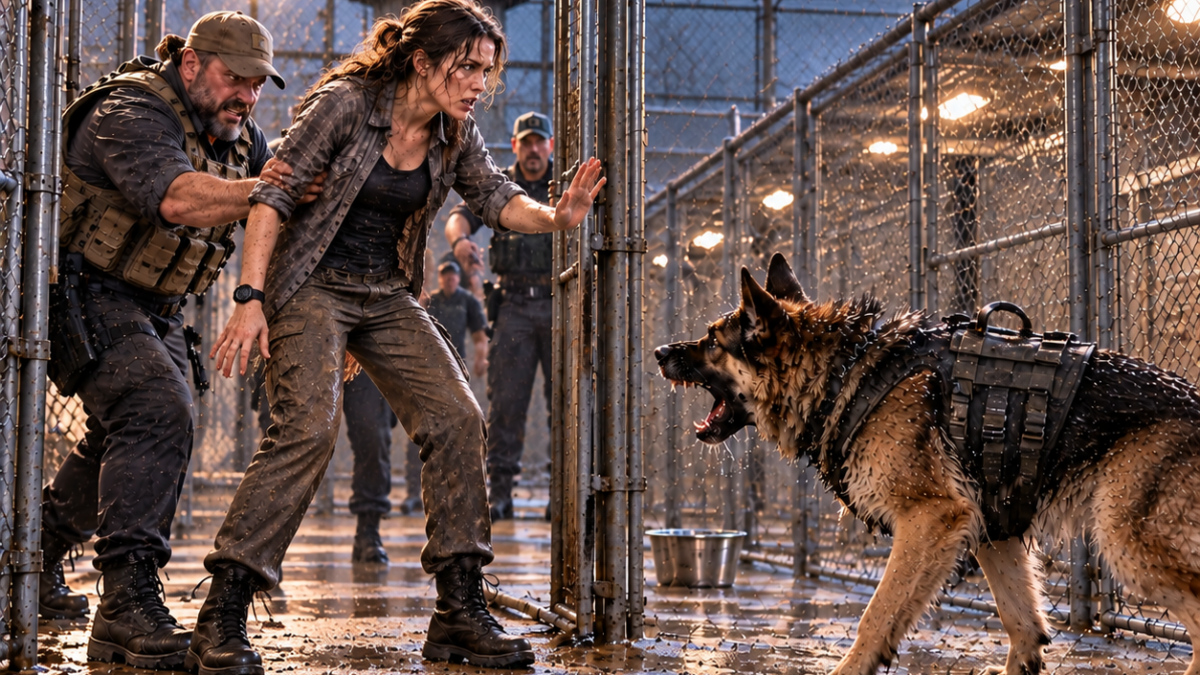
The kennel sat at the far edge of the compound, a reinforced steel structure with a concrete foundation and a fenced exercise run beside it. Even from outside, the sound coming from within was enough to make one of the guards slow down.
It was not barking.
It was a deep, guttural roar of pure animal rage.
Something massive slammed into metal.
The door rattled in its frame.
Cole swallowed.
Hayes smiled.
“Last chance, sweetheart,” he shouted over the rain. “Who sent you?”
Riley looked at the steel door.
Then at Hayes.
“You’re going to need a muzzle for what happens next.”
Hayes’s face flushed.
“Throw her in.”
Cole yanked open the outer door.
The smell hit first.
Wet fur.
Old blood.
Raw meat.
Bleach poured too late over concrete that had absorbed fear.
Inside was a dim corridor lined with chain-link and reinforced bars. At the end stood the main enclosure.
Inside it paced Kaiser.
At least one hundred ten pounds.
German Shepherd, technically, but built like something war had designed after losing patience with wolves. Jet black and dark sable coat. Thick neck. Corded shoulders. Scar tissue along one flank. Amber eyes locked so hard on Riley that even Cole took a step back.
Kaiser launched himself at the bars.
The metal groaned.
Saliva flew from his jaws.
His teeth snapped inches from the chain-link.
“He washed out of military work,” Hayes said proudly. “Too lethal. No restraint. No off switch. Cost me more than most trucks.”
Riley’s eyes narrowed.
Not at the teeth.
At the left ear.
A faded numeric tattoo just visible beneath scar tissue.
Her pulse did not change.
Cole unlatched the main enclosure.
He opened it just wide enough.
Then he kicked Riley square in the back.
She stumbled forward and hit the damp concrete inside the cage.
The gate slammed behind her.
The deadbolt locked with a metallic thud.
Hayes stepped safely back.
Above them, in the glassed-in observation booth overlooking the kennel, Finch, Cobalt’s lead tech specialist, was sweating through his shirt.
While Hayes played interrogator, Finch had been working on the encrypted phone taken from Riley’s pocket.
At first, he had been excited.
A phone like this meant something.
Not police issue.
Not civilian.
Layered encryption.
Rolling cipher architecture.
Decoy shells.
Dead-end pathways designed to trap lazy intrusion attempts.
Finch loved puzzles.
Then the puzzle started loving him back.
“Come on,” he muttered, fingers flying over the keyboard.
He bypassed a decoy server.
The screen flashed black.
A red prompt appeared.
UNAUTHORIZED ACCESS DETECTED
DEPARTMENT OF DEFENSE
NAVAL SPECIAL WARFARE COMMAND
Finch’s blood went cold.
“No,” he whispered.
The firewall collapsed.
Not because he beat it.
Because it opened.
A personnel file appeared on the screen.
Photo.
Name.
RILEY CALDWELL.
Most of the text remained blacked out.
But enough showed.
Special Warfare Operator.
Tier-One.
DEVGRU Tactical Assault Division.
Specialized: high-value target extraction, clandestine infiltration, canine warfare.
Finch stopped breathing.
Riley Caldwell was not an activist.
She was not ATF.
She was not state police.
She was not even ordinary military.
She was a ghost story in special operations circles.
The kind of name contractors whispered when they wanted to frighten new men into discipline.
One of the first women to pass through the classified selection pipeline that placed her inside the Navy’s most elite counterterrorism unit.
Kandahar.
Horn of Africa.
Syria.
Hostage extraction.
Canine integration.
A phantom.
A legend.
And Cobalt had tied her to a chair, hit her in the face, and kicked her into a kennel.
Finch scrambled for the radio.
His hands shook so badly he nearly dropped it.
“Boss,” he shouted. “Boss, do you copy? Get her out of there. Pull her out right now!”
Down in the kennel, Hayes could not hear him over the rain and the roar.
Inside the cage, Kaiser lunged.
The massive Shepherd flew across the concrete, jaws open, aiming directly for Riley’s throat.
She did not scream.
She did not curl up.
She did not raise her arms in panic.
In a fraction of a second, the battered woman disappeared.
What rose in her place was something else.
Riley rolled smoothly onto one knee, then up.
Shoulders squared.
Chest expanded.
Feet placed.
Chin low.
Eyes hard.
She did not merely stand.
She took command of the room.
As the dog launched, Riley raised her left hand in a sharp, flat-palmed signal and barked one guttural command.
“Fass. Sitz!”
The words cracked through the enclosure like a detonation.
Not fear.
Authority.
Not a plea.
An order.
Kaiser’s instincts collided midair with conditioning buried so deep even abuse had not burned it out.
His body twisted.
He landed hard inches from her boots.
Concrete shook beneath the impact.
His teeth remained bared.
His hackles stood high.
A growl rumbled from deep in his chest.
But he had stopped.
Hayes’s smirk faltered.
Cole took another step back.
The dog had never hesitated before.
Riley did not break eye contact.
She took one deliberate step forward.
Invading his space.
Testing the line between control and blood.
If she showed even the smallest twitch of fear, the dog would take her apart.
Her heart rate remained dead calm.
“Nein,” she said, voice lower now. “Platz. Hier.”
Kaiser’s ears twitched.
The wild glaze in his eyes fractured.
He knew that tone.
Not Hayes’s shouting.
Not Cole’s fear.
Not the crude commands men had used to turn him into a weapon.
This was handler language.
Real handler language.
The posture.
The timing.
The stillness.
The absolute certainty.
Slowly, almost impossibly, Kaiser stopped growling.
His hackles flattened.
His breath changed.
Then the one-hundred-ten-pound attack dog lowered his hindquarters to the concrete.
He sat.
Hayes stared through the bars.
“What did you do?” he whispered.
Riley lowered her hand.
She reached forward.
Kaiser leaned his massive head into her palm.
The movement was not submission to violence.
It was recognition.
Riley scratched behind his ear.
That was when she saw the tattoo clearly.
Three faded digits.
A naval special warfare canine brand.
Her face changed.
Not shock.
Grief.
Anger.
Memory.
“You didn’t buy a junkyard dog, Hayes,” she said.
Her voice echoed through the silent kennel.
Kaiser pressed closer to her leg.
“You bought a stolen military working dog.”
Hayes shook his head.
“No.”
“His name isn’t Kaiser.”
The dog’s ears flicked.
Riley crouched beside him.
“It’s Havoc.”
The dog exhaled.
Almost a whine.
“He did two tours in Syria with my unit before he was reported KIA.”
The radio on Hayes’s belt finally crackled loud enough to cut through the stunned silence.
“Boss! Boss, answer me!”
Finch’s voice was hysterical.
“She’s a SEAL! Tier-One! They let us take her, Hayes. It’s a trap. The whole compound is compromised!”
Hayes froze.
The color drained from his face.
He looked from the radio to Riley.
She no longer looked like a prisoner.
She looked at him the way a sniper looks through glass.
Riley reached into her soaked flannel collar and palmed the ceramic micro-blade she had hidden against a seam before capture.
She had kept it through the interrogation.
Cole had searched her badly.
Sloppy.
Just as she told them.
“Havoc,” she whispered.
The dog snapped to attention.
His eyes moved from Riley to the men outside the bars.
“You locked me in a cage to see how tough I am,” Riley said.
A dark smile touched her split lip.
She slid the ceramic blade into the mechanical lock.
“The problem, Hayes, is I’m not locked in here with him.”
Click.
The deadbolt released.
Riley pushed the steel gate open.
“You’re locked in here with us.”
The gate swung outward with a metallic screech.
For one suspended heartbeat, no one moved.
Hayes’s mind tried to understand the new shape of reality.
The beaten woman was standing.
The attack dog was at her heel.
The cage door was open.
And every assumption he had made since the moment his men dragged her into the bunker was dead.
“Havoc,” Riley said.
Her voice cut the air.
“Packen.”
The dog moved like darkness given muscle.
He launched from the concrete and hit Cole before the big guard cleared his holster. Havoc’s jaws locked onto Cole’s forearm, not wild, not chaotic, but controlled and devastating. Cole crashed backward, screaming, weapon clattering across the floor.
Hayes reached for his sidearm.
Riley was already inside his guard.
She trapped the weapon hand, drove a palm strike under his chin, swept his lead leg, and sent him face-first into concrete.
Fast.
Clean.
No wasted motion.
Before he could breathe again, his weapon was gone.
Riley checked the chamber and tucked it into her waistband.
“Havoc.”
The dog released Cole instantly and returned to a sit, eyes still fixed on the threat.
That was the difference between a weapon and a warrior.
Control.
The compound alarm exploded to life.
Red strobes flashed across the kennel corridor.
Finch had triggered lockdown.
Riley wiped blood from her split lip and looked down at Havoc.
The dog stared up at her.
His tail gave one short wag.
He was back in the fight.
He knew it.
“Time to work, buddy.”
Hayes groaned on the floor.
“You’re dead, Caldwell,” he rasped. “I’ve got forty armed men out there.”
Riley crouched beside him.
“You still don’t get it, Richard.”
His eyes struggled to focus.
“I didn’t get caught because I made a mistake. I got caught because your server is hardwired. Isolated. No remote access. The only way my team could pinpoint your ordnance was if a beacon got inside your central network.”
Hayes’s eyes widened.
“Finch just hacked my phone,” she said. “Which means he downloaded my tracker into your system himself.”
“No.”
“The distress signal went live the second he opened my Navy file.”
Riley stood.
“I’m not breaking out.”
She racked the stolen pistol.
“I’m clearing the landing zone.”
Outside the kennel block, rain hammered the compound.
Riley moved to the exterior door and listened.
Boots in mud.
Four men.
Heavy approach.
Panicked breathing.
No discipline.
She glanced down at Havoc and gave a two-finger signal.
He shifted silently to the side.
Riley kicked the door open and dropped low as gunfire tore into the frame.
Sparks jumped from steel.
Concrete dust burst from the wall.
She waited.
Not long.
Just long enough to hear the first reload.
Then she moved.
Three controlled shots.
The lead mercenary dropped into the mud.
“Havoc. Fast.”
The dog burst into the storm.
A black-and-sable blur through rain and red strobe light.
The remaining men panicked, flashlights jerking wildly as they tried to track him. Havoc hit the flank, taking one man down hard. Riley used the chaos, crossing the doorway and disarming another before he understood she was already inside his reach.
Within less than a minute, the kennel perimeter was silent except for rain and groaning men.
Riley scooped up a dropped carbine, checked the magazine, and slung it into position.
The weight settled against her shoulder like something remembered.
For the first time since capture, she was fully armed.
She moved through the compound in darkness and storm, Havoc clearing blind spots as naturally as breathing. They needed no words. Hand signal. Shift. Pause. Advance. Cover. Heel. Search.
Handler and dog.
Not new partners.
Reunited ones.
As they reached the loading dock, the true scale of Cobalt’s operation came into view.
Eight transport trucks.
Trailers loaded with stolen Javelin systems, artillery shells, crates marked with false agricultural codes.
Men running in panic.
Floodlights sweeping.
Radios screaming.
Finch’s voice blasted over the compound PA.
“She’s out! The SEAL is out! Do not engage close quarters! Shoot the dog on sight!”
Riley’s jaw tightened.
She motioned Havoc into shadow beneath a rusted crane.
Too many rifles.
Open ground.
No cover.
She had the element of fear now, but fear was not armor.
If she crossed that courtyard too early, they would pin her down.
Then the floodlights died.
All at once.
The compound plunged into blackness.
Mercenaries shouted.
Flashlights whipped through rain.
Riley looked up.
A low, rhythmic thump vibrated in her chest.
Not thunder.
Rotor blades.
The clouds above Cobalt ripped open.
Two matte-black MH-60 Black Hawks descended through the storm like avenging angels.
Running dark.
Flying low.
Guided by the beacon Finch had unknowingly activated.
“Contact!” someone screamed.
A white beam from the lead helicopter pinned the courtyard in artificial daylight.
Before the mercenaries could orient, suppressive fire tore through the mud and barricades, forcing the armed men flat.
Thick ropes dropped.
Operators in advanced tactical gear fast-roped into the compound with terrifying precision.
Night vision.
Suppressed weapons.
Sector calls.
Controlled violence.
The kind Cobalt pretended to understand and never truly had.
Riley stepped from the shadows and lowered her rifle.
Havoc trotted at her side.
His tail wagged once as familiar scents reached him through the rain.
A towering SEAL operator approached, face obscured by a tactical mask. He pulled off his night vision goggles.
Commander Brody.
Her commanding officer.
He looked at Riley’s bruised face, split lip, muddy clothes, then down at the massive German Shepherd sitting perfectly at heel.
“I see you found our missing asset, Caldwell.”
Riley rested one hand on Havoc’s head.
“He found me, sir.”
Brody’s mouth twitched.
“Looks like the black market doesn’t know how to handle a tier-one K9.”
“No, sir.”
“Havoc ready to come home?”
The dog looked up at Brody.
Then back to Riley.
“He’s been waiting.”
Brody keyed his radio.
“Target secured. Ordnance secured. Bring in the heavy lifters. We’re cleaning this place out.”
Two operators dragged Hayes from the kennel block in zip ties, bruised and limping, his arrogance stripped down to terror.
He saw Riley and stopped struggling.
Havoc gave a low warning growl.
Hayes looked at the dog.
Then at Riley.
Only then did he understand.
He had never been the predator.
He had been bait.
Riley stepped close enough for him to hear over the helicopters.
“I told you your boys were sloppy.”
Hayes said nothing.
There was nothing left in him large enough for words.
Riley turned her back on him and walked toward the extraction helicopter.
The rain washed mud and blood from her face.
Havoc bumped his heavy head against her hip as they crossed the courtyard.
She reached down and touched his ear.
“I thought you were dead,” she said quietly.
Havoc leaned harder into her.
Brody walked beside them.
“Report said KIA?”
“Two years ago. Syria. Convoy ambush. We lost his signal after the blast. They told me nothing came back from the site.”
“Looks like someone pulled him out and sold him.”
Riley looked toward the transport trucks, the weapons, the men face-down in mud.
“Then someone made a very expensive mistake.”
At the helicopter, Havoc stopped at the ramp.
For one second, the dog looked back at the compound.
The kennel.
The bars.
The place men had tried to turn him into a monster.
Riley knelt beside him.
“Leave it.”
Havoc’s ears shifted.
“Home,” she said.
That did it.
The dog climbed into the helicopter.
Riley followed.
As the Black Hawk rose into the storm, Cobalt Security shrank beneath them: lights, mud, weapons, men in cuffs, the ruined empire of a man who thought fear made him powerful.
Havoc lay against Riley’s leg.
For the first time in years, his breathing eased.
Back at the Naval facility, doctors tried to take Riley one direction and Havoc another.
That lasted eight seconds.
Havoc planted himself between Riley and the veterinary team and bared his teeth at anyone who did not understand reunions.
Riley, one eye swelling, lip split, ribs bruised, pointed at the exam room beside hers.
“He stays where he can see me.”
A corpsman opened his mouth.
Brody said, “You heard her.”
Havoc stayed.
Veterinarians found old injuries.
Improper conditioning.
Signs of abuse.
Scar tissue around the ribs.
A half-healed fracture that should have been treated months earlier.
But beneath all of it, he was still Havoc.
Disciplined.
Brilliant.
Loyal.
Dangerous only to people foolish enough to mistake loyalty for tameness.
Riley sat on the floor beside his exam table while a doctor stitched her lip.
Havoc kept one paw on her boot.
Brody stood in the doorway.
“You know the paperwork on him will be a nightmare.”
Riley looked at Havoc.
“He was declared dead.”
“So were a lot of things tonight.”
“He’s not going back into rotation.”
“No.”
“He’s done being used.”
Brody nodded.
“I figured you’d say that.”
Riley stroked the dog’s head.
“He comes home with me.”
Brody studied her.
“You asking or informing?”
Riley looked up.
“Sir.”
Brody sighed.
“I hate when you do that.”
“Yes, sir.”
“I’ll start the paperwork.”
For the first time all night, Riley smiled without blood in it.
Three months later, in a small house near the Oregon coast, Havoc slept on a rug beside Riley’s front door.
Not in a kennel.
Not in a cage.
Not behind bars.
A rug.
Sunlight warmed the floorboards. Rain tapped the windows softly instead of attacking metal roofs. A fireplace cracked in the corner. On the wall above the mantel hung Havoc’s old Cobalt collar, sealed in glass as evidence and reminder.
Beside it hung a new framed patch.
ECHO7
RECOVERED
Havoc wore a new harness now.
Black leather.
Soft lining.
A small trident patch stitched near the shoulder.
No choke chain.
No shock collar.
No steel kennel tag with a fake name.
Riley walked in from the kitchen with two mugs of coffee just as Commander Brody stepped onto the porch.
Havoc lifted his head, recognized him, and wagged once.
Brody entered carefully.
“I brought the final disposition paperwork.”
Riley handed him coffee.
“He retired?”
“Officially.”
“And ownership?”
Brody held out the folder.
“Transferred to you.”
Riley took it.
She did not speak for a moment.
Brody glanced at the massive dog now rolling onto his side like a spoiled house pet.
“Hard to believe that thing cleared a courtyard.”
Havoc sneezed.
Riley smiled.
“He contains multitudes.”
Brody looked at her.
“You were right about the compound.”
“I usually am.”
“You were also reckless.”
“I usually am.”
He sighed.
“Caldwell.”
She looked up.
“You let them beat you for forty-five minutes to get inside that network.”
“It worked.”
“That is not the point.”
“It is frequently the point.”
Brody shook his head.
“You ever think about retiring?”
Riley looked at Havoc.
The dog was asleep now, one ear twitching.
“Sometimes.”
“And?”
“I think I’m tired of cages.”
Brody understood.
He nodded once.
“There are other ways to serve.”
Riley looked out the window toward the gray line of ocean.
Maybe there were.
Maybe not the same ways.
Maybe quieter ones.
Maybe work with rescued military dogs.
Handlers with trauma.
K9 rehabilitation.
Training programs built on trust instead of fear.
Maybe she could teach people that a dog like Havoc was never broken because he was strong. He was broken because the wrong men thought strength meant cruelty.
Maybe she could teach herself the same thing.
That evening, after Brody left, Riley sat on the porch steps.
Havoc came out and lowered himself beside her with a groan.
Old injuries.
New peace.
She scratched behind his ear.
“You remember Syria?” she asked.
Havoc leaned into her hand.
“Yeah. Me too.”
The ocean wind moved through the trees.
No alarms.
No floodlights.
No cages.
Riley looked at the fading sky.
“You know what Hayes got wrong?”
Havoc looked up as if listening.
“He thought fear made him the handler.”
The dog rested his head on her knee.
“But fear only gets obedience until the door opens.”
She ran her fingers over the scar near his ear.
“Trust gets you home.”
Havoc sighed.
Riley smiled.
When people later told the story, they focused on the impossible part.
The guards throwing a battered woman into a kennel.
The attack dog stopping inches from her throat.
The reveal that she was a legendary Navy SEAL.
The helicopter raid.
The stolen weapons.
The mercenaries on their knees in the mud.
They liked the twist.
The reversal.
The moment the predator realized he had locked himself in with something worse than fear.
But Riley remembered the quieter moment.
A faded tattoo inside a torn ear.
A forgotten command buried beneath abuse.
A dog who had been renamed, caged, starved, and weaponized, but who still recognized a real handler when she spoke.
That was the miracle.
Not that Riley survived the kennel.
Not that she took down Hayes.
Not that the SEAL team arrived from the storm.
The miracle was that Havoc was still there beneath Kaiser.
Waiting.
Not tame.
Not broken.
Waiting for someone who knew his true name.
Because names matter.
Trust matters.
The right voice matters.
And sometimes the thing men call a monster is only a soldier who has been locked away too long by people who never deserved to command him.
They kicked Riley Caldwell into a K9 kennel expecting screams.
Instead, they opened a cage.
And from that cage walked out a Navy SEAL, a legendary war dog, and a truth Richard Hayes understood far too late:
You cannot make warriors kneel by treating them like animals.
Sooner or later, someone says the right name.
And the whole pack remembers who it is.


