They Returned an Old Orange Cat Because He Was “Too Old”—Then Oli Put One Paw on My Shoe, and I Made the Choice I Swore I’d Never Make Again.
PART2:
By the time I walked into Pine Ridge Animal Clinic with that bag of canned food, I had built a life around never needing more than I could reliably maintain.
No pets.
No plants except a cactus my sister gave me as a joke.
No commitments that required somebody else’s schedule.
No living thing waiting by the door.
That was the rule.
Then I heard a woman in the hallway say:
“No, that’s not really my cat anymore.”
I remember the sentence because it sounded so ordinary.
Not angry.
Not cruel.
If she had sounded cruel, maybe I could have dismissed her immediately.
She sounded tired.
Busy.
Like someone explaining why an old piece of furniture no longer fit after moving apartments.
Another voice answered.
A receptionist, I think.
Soft.
Careful.
“Are you sure?”
The woman exhaled.
“He’s too old. He’s not like he used to be.”
PART3:
I looked toward the cat sitting on the towel.
Oli.
I didn’t know his name yet.
He didn’t move.
But his eyes did.
His head remained down.
His body stayed folded.
His eyes shifted toward the door.
There are moments you remember because something dramatic happened.
This was not one of those.
Nothing moved.
Nothing broke.
Nobody shouted.
An old orange cat simply looked toward a familiar voice and waited for the sentence to become something else.
It didn’t.
A minute later, the exam-room door opened.
The woman stepped in carrying a hard plastic pet carrier.
She was probably in her late fifties.
Gray showing at the roots of brown hair.
No makeup except something pale on her lips.
She looked tired enough that I almost felt guilty for having heard anything.
She didn’t notice me at first.
She set the carrier by the wall.
Oli lifted his head.
Slowly.
Hopefully.
I swear that part happened.
He looked at her.
His ears moved forward.
For one second I thought he was going to stand.
She didn’t reach for him.
She didn’t kneel.
She stood with one hand on the door.
“I can’t do this again.”
Then she left.
Oli watched the door close.
The room felt different afterward.
Smaller somehow.
Meaner.
Not because the woman had screamed at him.
Because she hadn’t.
There is a kind of rejection that comes with anger, and animals can at least react to it.
Fight.
Hide.
Defend.
This was worse.
This was dismissal.
I stayed still for a few seconds.
Then I crouched several feet away.
“Hey.”
Oli kept staring at the door.
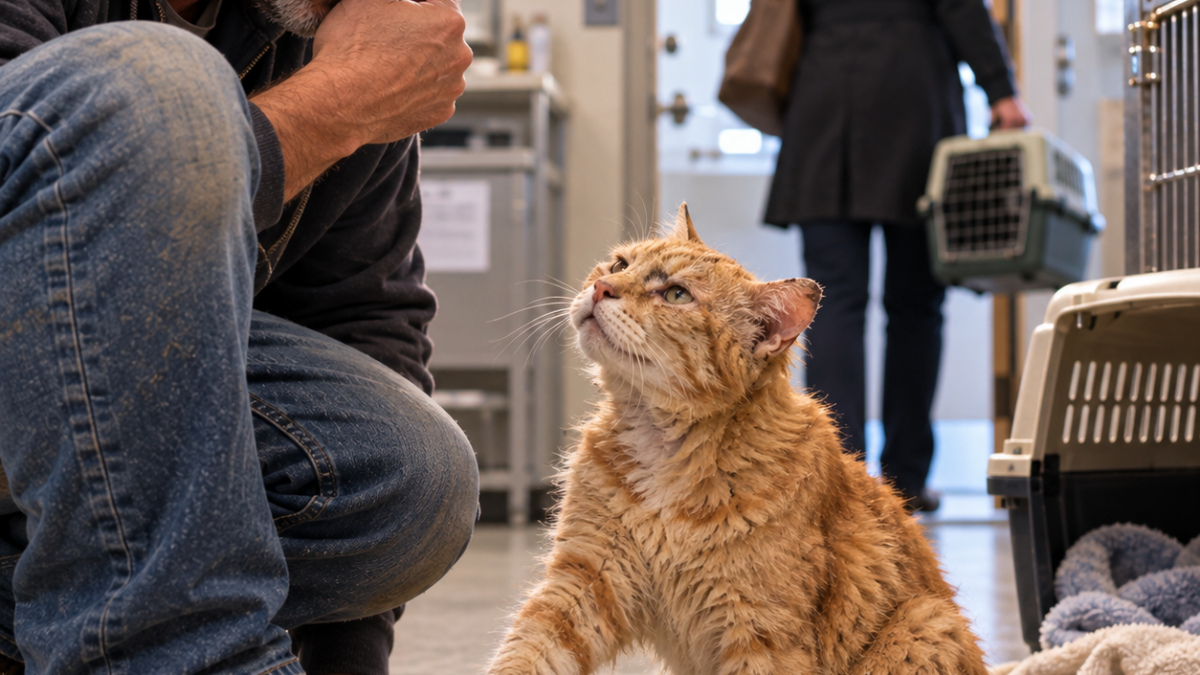
He was old.
You could see it immediately.
His orange coat had faded into something closer to dusty copper.
The fur around his face had thinned.
One ear had a small notch.
His hips stuck out more than they should.
When he finally shifted position, his rear legs trembled.
He wasn’t starving.
He wasn’t injured.
He simply looked like time had been taking small pieces from him for years.
“Rough morning?”
One ear moved.
I held my hand low against the floor.
Not reaching.
Just offering.
He looked at my fingers.
Then the door again.
I don’t know why that got to me.
Maybe because I knew what it felt like to keep expecting someone to come back and fix a sentence they had already chosen.
Maybe because I knew what it felt like to be loved for an earlier version of yourself.
Younger.
Lighter.
Easier.
Less complicated.
The version who didn’t need appointments.
Or patience.
Or forgiveness.
We live in a country very good at replacing things.
Phones.
Cars.
Kitchens.
Jobs.
Furniture.
Sometimes relationships.
We celebrate upgrades.
New beginnings.
Fresh starts.
We are less comfortable with things that slow down.
Things that require maintenance.
Things whose value becomes harder to photograph.
An old animal sits inside that discomfort.
A kitten promises a future.
An old cat asks whether the years he has already survived count for anything.
Oli rose.
Slowly.
His back legs shook.
He took one step.
Stopped.
Another.
I expected him to change his mind.
Instead he walked close enough to touch my shoe.
Then he placed one paw on it.
That was all.
No purring.
No headbutt.
No miracle.
One tired old cat resting one paw on the toe of my sneaker like he was asking the smallest question in the world.
I nearly cried.
I didn’t want to.
I wasn’t ready for that kind of feeling in a room where I had expected to spend ninety seconds dropping off cat food.
A veterinary technician named Marla came in.
She found me crouched beside Oli.
“He likes you.”
“I’ve known him eleven minutes.”
“That’s nine longer than most people give him.”
I looked at her.
“What happened?”
She sat on the edge of the counter.
The woman who had left was named Cynthia Webb.
Oli had belonged to Cynthia and her husband, David, for thirteen years.
David had died the previous year.
Cancer.
Long illness.
Afterward, Cynthia moved from their house into a smaller apartment.
Oli’s health declined too.
Arthritis.
Early kidney disease.
Some digestive issues.
He had begun crying at night.
Missing the litter box occasionally.
Needing medication.
Cynthia surrendered him once six months earlier.
Then came back two days later in tears and took him home.
That morning, she had returned him again.
“I can’t do this again,” I repeated.
Marla nodded.
“That’s what she meant.”
“Did she love him?”
Marla looked through the closed door.
“I think she did.”
That made it worse.
I wished she hadn’t.
I wished she had told me Cynthia was heartless.
That she had gotten a new couch and didn’t want cat hair.
That she had a boyfriend who disliked animals.
Anything simple.
Instead she was grieving.
Exhausted.
Financially strained.
And she had still abandoned him.
Both things could be true.
I looked at Oli.
“What happens now?”
“He’ll go to our rescue foster system if we have space.”
“And if you don’t?”
“We’ll make space.”
That answer told me more about Marla than any speech would have.
“Is he adoptable?”
“Every animal is adoptable.”
“That isn’t what I asked.”
She smiled sadly.
“No.”
“Why?”
“You see him.”
Old.
Medication.
Medical costs.
Probably years? Maybe months.
Nobody knew.
I thought about my apartment.
The neat couch.
The empty window.
The mornings when no one needed me.
“I can’t take him.”
Marla nodded.
“I didn’t ask.”
“I work.”
“So do most adopters.”
“I live alone.”
“Cats generally survive that.”
“I’ve never had a cat.”
“He has.”
I glared.
She laughed.
Then stopped.
“I’m not trying to push you.”
“Good.”
“Oli doesn’t need a hero.”
That caught me.
“What does he need?”
“Somebody who won’t make another promise they can’t keep.”
I looked at my shoe.
His paw was still there.
That was unfair.
Not Marla.
Oli.
He had no idea what he was doing to me.
Or maybe he did.
I sat with him another fifteen minutes.
Then twenty.
I thought about veterinary bills.
Medication.
Travel.
What happens if I became attached and he died three months later.
What if he started having accidents.
What if he cried every night.
What if I resented him.
What if I became Cynthia?
That question frightened me more than all the others.
I looked down.
Oli had lowered himself beside my leg.
He wasn’t asking for youth.
Or miracles.
He wasn’t asking for his old house back.
He needed food.
Warmth.
Medication.
A litter box with a low side.
A soft place to sleep.
And one person whose love didn’t expire when maintenance increased.
“What do I need to do?”
Marla didn’t move.
“For what?”
“You know.”
“I want you to say it.”
I hated her.
“I want to adopt him.”
She smiled.
Not big.
No celebration.
“Okay.”
“I haven’t filled anything out.”
“You will.”
“I don’t own anything for a cat.”
“We have starter supplies.”
“This is a terrible idea.”
“Probably.”
I looked at Oli.
He looked back.
“You and I are going to regret this.”
He blinked.
An hour later, I carried him out in the same plastic carrier Cynthia had left behind.
He was lighter than I expected.
All bone and old trust.
When I lifted him, his body stiffened.
Not fighting.
Bracing.
Like being picked up had become connected with being moved somewhere he hadn’t chosen.
I held him against my chest for one second before placing him in the carrier.
“You don’t get left behind again.”
I don’t know why I said it aloud.
Maybe promises feel more real when someone hears them.
“Not with me.”
The drive home took twenty-two minutes.
Oli cried for seventeen.
Not a normal meow.
A low, broken sound.
At every stoplight I put fingers through the carrier door.
“I’m here.”
He smelled them.
Kept crying.
When I carried him into the apartment, he refused to leave the carrier for almost an hour.
I put water beside it.
A small plate of food.
Then I sat on the opposite side of living room pretending to read.
Eventually one paw appeared.
Then a face.
Then the whole cat.
He walked through my apartment like an old man entering a church after decades away.
Every step measured.
Every room inspected.
Bedroom.
Bathroom.
Kitchen.
Hall closet.
Back to living room.
He smelled the couch.
The window.
My shoes.
Then returned to the folded blankets I had placed near the coffee table.
He turned once.
Lay down.
And stared at the front door.
He did that for days.
The door was his compass.
If I walked toward it, his head rose.
If I picked up keys, he stiffened.
If I put on shoes, he stood.
The first time I left for groceries, I returned forty minutes later and found him sitting six inches from the door.
Not sleeping.
Waiting.
“I’m back.”
He looked at me.
I don’t know if cats understand those words.
I said them every time anyway.
The second week, he stopped waiting directly against the door.
The third week, he stayed on the couch when I checked the mail.
By the fourth, I could pick up keys and he would only lift his head.
Trust doesn’t return dramatically.
It returns through boring repetition.
You leave.
You return.
You leave.
You return.
Food appears.
Medicine comes gently.
The hand doesn’t hurt.
The door opens and the same person walks back through it.
Again.
Again.
Again.
Oli taught me that security is mostly repetition.
His health was not simple.
He needed arthritis medication.
Kidney-support food.
More water.
A supplement he hated.
A low-entry litter box.
Some mornings he missed anyway.
The first accident happened beside my bedroom dresser.
I found it before work.
For half a second, frustration flashed through me.
Then Oli appeared in the doorway.
He looked at the mess.
Then at me.
His body lowered.
That hurt more than the accident.
He expected something.
Anger.
Removal.
Punishment.
I crouched.
“Hey.”
He didn’t move.
“It’s a floor.”
Slow blink.
“I own paper towels.”
One ear twitched.
“Very advanced technology.”
I cleaned it.
Nothing happened.
That evening, Oli slept pressed against my leg.
The first time he did that, I barely moved for two hours because I was afraid of waking him.
Within a month, he had taken over the left side of my bed.
He followed me from room to room.
Not close enough to trip me.
Just close enough to know where I was.
He learned the microwave sound because I warmed his food for ten seconds.
He learned I drank coffee by the window at seven.
He developed a habit of sitting in the afternoon patch of sunlight on the living-room rug from roughly 2:45 until 4:10.
He hated thunder.
Loved the dryer.
He would sit outside the laundry closet while it ran, eyes half closed.
The first time he purred loudly enough for me to hear, I almost called Marla.
I didn’t.
I had some dignity left.
The clinic posted his adoption update six weeks later.
I agreed because Marla told me senior cats rarely got attention.
The photograph showed Oli in his afternoon sunbeam.
Orange fur glowing.
Eyes closed.
One paw stretched forward.
The caption said something simple about senior adoption.
Nothing about Cynthia.
No blame.
No surrender story.
The post spread anyway.
Not millions.
Enough.
Comments.
Shares.
Messages.
People saying he looked happy.
Three days later, Pine Ridge called.
Oli was asleep against my shin, snoring in that broken-motor way old cats do.
I almost ignored the phone.
Then I saw the clinic number.
“Hello?”
The receptionist sounded strained.
“Do you have a minute?”
No good conversation starts like that.
I sat up.
Oli opened one eye.
“What happened?”
“Nothing happened to Oli.”
My chest loosened.
“Okay.”
“But Cynthia is here.”
Everything tightened again.
“What?”
“She saw the post.”
I looked at Oli.
His paw hung over the edge of the blanket.
“She says she made a mistake.”
I said nothing.
“She wants to speak to you.”
“No.”
I didn’t say it aloud.
In my head I said it so loudly I could hear myself.
No.
You do not leave an old cat because his age becomes inconvenient and then return because the internet shows him looking beautiful in somebody else’s sunlight.
You do not get to remember love after another person handles the pills and the accidents and the nights.
You do not get to circle back because guilt suddenly has a photograph.
But anger makes everything simple.
Life rarely is.
“Is she asking for him back?”
“Yes.”
The receptionist said it gently.
Something cold settled in my stomach.
“What did you tell her?”
“That the adoption is final. That legally you’re his owner.”
“Then what is there to discuss?”
“She keeps saying she wants to explain.”
I looked down.
Oli had closed his eyes.
Trusting.
That word had changed meaning since I met him.
It used to sound soft.
Trust is not soft.
Trust is responsibility.
“I’ll come.”
The clinic felt different when I returned.
Same floors.
Same disinfectant smell.
Same hallway.
Room Three.
The same room where I had first seen Oli.
Of course.
Life has no respect for subtlety.
Cynthia stood when I entered.
She looked older.
Not physically much older.
Life had moved across her face.
The rushed impatience from that first day was gone.
In its place:
Shame.
Grief.
Fatigue.
Maybe fear.
“Hi.”
I did not return the greeting immediately.
“You wanted to talk.”
She gripped the strap of her purse.
“Yes.”
I stayed by the door.
She noticed.
“How is he?”
That question annoyeded me more than anger would have.
It sounded normal.
Human.
“He’s doing well.”
Her eyes filled immediately.
“He eats better. Sleeps through the night. He likes the living-room window in the afternoon.”
Her mouth trembled.
“He always loved warm spots.”
I hated that sentence.
Because somebody who never loved him would not know.
Cruelty would have been easier.
“You remember that.”
“Of course I do.”
“But you left him.”
She looked down.
“Yes.”
“Twice.”
“Yes.”
Silence.
Then she said:
“My husband died.”
I knew.
“David.”
Her eyes came up.
“You know his name?”
“The clinic told me some history.”
She nodded.
“He and Oli were inseparable.”
Her voice changed.
“David used to fall asleep on the couch every Sunday after lunch. Oli would climb onto his chest and stay there until dinner.”
I pictured it.
Didn’t want to.
“After David got sick, Oli started sleeping outside the bedroom.”
She pressed lips.
“When David died, Oli cried at night.”
I thought about the early weeks in my apartment.
The staring.
The doors.
Cynthia continued.
“He cried for hours.”
“Did the vet check?”
“Yes.”
“Pain?”
“Some. Arthritis. But they said grief too.”
She wiped an eye.
“I was grieving. He was grieving. The apartment was too small. Money was tighter. I was cleaning accidents. Giving medicine. Not sleeping.”
“And you got tired.”
“Yes.”
No excuse.
No pretty word.
“I got so tired that everything started feeling like something else I had to carry.”
I understood that sentence.
That frightened me.
There are versions of exhaustion that make love feel like labor.
I had been there with my mother.
Medication schedules.
Appointments.
Night calls.
Fear.
I loved her.
And some days I wanted the phone to stop ringing more than I wanted to admit.
Understanding is not the same as excusing.
“I heard what you said that day.”
Cynthia closed her eyes.
“He’s not really my cat anymore.”
“Yes.”
Her shoulders folded.
“I hate that sentence.”
“He heard it.”
Tears spilled.
“I know.”
“You don’t know.”
She looked at me.
I heard my voice harden.
“He was watching the door after you left.”
“I know.”
“No. You weren’t there.”
She flinched.
“He looked toward your voice because he thought you were coming back.”
Her face broke.
A cruel part of me felt satisfied.
I hated that part.
People imagine compassion means never wanting somebody to feel consequences.
That isn’t true.
Sometimes hurt wants witnesses.
I took a breath.
“He froze every time I picked up my keys for weeks.”
Cynthia covered her mouth.
“He waited by my door.”
She sat.
I kept going because I needed her to know.
“He thought leaving meant abandonment. I had to teach him otherwise.”
“I’m sorry.”
“That doesn’t fix it.”
“I know.”
“Do you?”
“Yes.”
And I believed her.
That was the worst part.
She wasn’t performing.
She had failed him.
She knew.
“I saw his photo,” she whispered. “My daughter sent it.”
I waited.
“She said, ‘Mom, is that Oli?’”
Cynthia laughed once, without humor.
“Then she asked what I’d done.”
Silence.
“I didn’t have a good answer.”
Regret is complicated.
We love redemption when it costs nothing.
Second chances.
Forgiveness.
Fresh beginnings.
But if the thing you regret hurting is alive, your redemption can become another burden placed on them.
Cynthia looked at me.
“If there is any way—”
“No.”
The word came immediately.
She stopped.
“I am sorry your life got hard.”
I meant it.
“But Oli isn’t a coat you donated and came back for because the weather changed.”
Her tears started again.
“He spent weeks learning that my apartment wasn’t another temporary stop.”
I lowered my voice.
“You don’t get to ask him to start over because seeing him loved reminded you how much you miss being loved by him.”
That landed.
Cynthia sat down.
She cried quietly.
I stood there, angry at her and sorry for her at the same time.
Humans hate holding two truths.
We want verdict.
Good.
Bad.
Victim.
Villain.
Cynthia had loved Oli for thirteen years.
She had also abandoned him when he became hardest to care for.
Both were true.
After several minutes she said:
“Can I see him?”
I stared.
“Not to take him.”
I said nothing.
“I heard you.”
She rubbed her hands together.
“I just want to see that he’s okay.”
I thought about saying no.
Maybe I should have.
Oli’s stability mattered more than her guilt.
But mercy and recklessness are not same.
“Once.”
She nodded.
“On his terms.”
“Yes.”
“You don’t pick him up.”
“I won’t.”
“You don’t corner him.”
“I won’t.”
“If he shows stress, we stop.”
“Yes.”
“And this does not mean he’s coming back.”
She closed her eyes.
“I understand.”
“Tomorrow.”
I barely slept.
The question kept changing shape.
What do people deserve after they fail somebody helpless?
Punishment?
Mercy?
Distance?
A second chance?
Nothing?
And beneath that:
What if a person can genuinely love someone and still abandon them?
That possibility ruins easy morals.
Love is feeling.
Care is behavior.
Sometimes they travel together.
Sometimes they don’t.
The next afternoon, I brought Oli to the clinic in the same carrier Cynthia had left.
He hated the drive.
He complained the entire way.
A scratchy, indignant howl that made him sound healthier than he was.
At red lights, I put fingers through the door.
“I’ve got you.”
He pressed his nose against them.
Room Three.
Again.
Cynthia entered with empty hands.
No purse.
No coat.
Nothing she could use as excuse to reach quickly.
That mattered.
I opened the carrier.
Oli stepped out.
Slow.
Back legs trembling from car ride.
Then he smelled her.
He froze.
His head lifted.
Cynthia’s eyes widened.
“Oh, baby.”
Oli stood still.
Not afraid exactly.
Not happy.
Recognizing.
Animals know voices.
Smells.
Footsteps.
The shape of the person who once meant home.
Cynthia sat on floor.
Slowly.
“I’m sorry.”
Oli took one step.
My chest tightened.
Then another.
Cynthia held perfectly still.
A part of me became afraid.
Not that she’d take him.
That he would choose her.
That thought ashamed me.
If this was supposed to be about what Oli needed, then I had to accept that his need might not flatter me.
He took one more step.
Stopped.
Looked at Cynthia.
Really looked.
Then he turned.
Walked back to me.
Pressed his side against my shoe.
And sat.
No drama.
No hiss.
No rejection.
A choice.
Cynthia made a small sound.
She covered her mouth.
“He knows.”
“Yes.”
I could have left it there.
Instead I said:
“He also knows he’s safe.”
She cried.
Hard.
I gave her time.
Oli stayed against my foot.
After a while, Cynthia reached into the pocket of her cardigan.
“I brought one thing.”
I tensed.
She held a small blue fabric mouse.
Old.
Ragged.
Missing one stitched eye.
“I found it under the couch.”
She placed it on floor.
“He used to carry this at night.”
Oli looked.
Walked over.
Sniffed the mouse.
Touched it once with his nose.
Cynthia stopped breathing.
Then Oli returned to me.
He lowered his chin onto my shoe.
Cynthia laughed through tears.
“That’s fair.”
Something softened in the room.
Not forgiveness.
Not restoration.
Recognition.
Before leaving, Cynthia said:
“Thank you for not letting me take the easy way back in.”
I remembered that sentence.
Still do.
Because people often want grace cheaply.
Forgiveness without repair.
Return without rebuilding.
Access without accountability.
We want consequences to hurt less than the damage did.
The next week I wrote about Oli online.
Not Cynthia’s name.
Not the real clinic.
No photographs of her.
I did not want strangers hunting a grieving woman so they could feel morally useful.
I wrote about old pets.
About convenience.
About the language people use when love becomes expensive.
I also wrote that not every person who rehomes an animal is heartless.
Life corners people.
Eviction.
Illness.
Domestic violence.
Medical bills.
Military deployment.
Death.
Sometimes surrender is the kindest option available.
But sometimes we call something unavoidable because the alternative asks more from us than we want to give.
That distinction matters.
The post spread.
Too far.
Comments multiplied.
Some people said I was compassionate.
Some said judgmental.
Some thought Cynthia deserved Oli back because remorse matters.
Others wrote:
“A second chance for her could become a second abandonment for him.”
That was the comment I couldn’t forget.
Second chances are usually described from the perspective of the person receiving one.
Rarely the person being asked to risk trust again.
For three days strangers argued.
About mercy.
About money.
About burnout.
About animals as family.
About whether devotion should have limits.
One woman wrote:
“Maybe Cynthia was doing the best she could. Why are we so quick to condemn people who are struggling?”
I stared at it for a long time.
Then answered:
“I don’t condemn her for struggling. I think we should be careful about calling every painful decision unavoidable simply because it was easier than staying. There is a difference.”
That response got shared even more.
I regretted posting at all.
Not because I changed my mind.
Because the internet is bad at holding people gently.
Some commenters turned Cynthia into a monster.
I deleted what I could.
Blocked names.
Asked the clinic not to engage.
Cynthia had done something wrong.
She did not need thousands of strangers inventing worse things to punish her for it.
Accountability without cruelty.
We claim to want that.
We’re not very practiced.
A week later, someone knocked on my apartment door.
Oli was sleeping on the couch.
The knock came.
His eyes opened.
A month earlier he would have jumped down and hidden.
This time he looked at me.
Then closed his eyes again.
That nearly broke me.
I opened the door.
Cynthia stood outside.
My body tightened.
“I’m not here to ask for him.”
I waited.
She held a grocery bag.
“I found his blanket.”
Another bag inside.
“His brush. A little ceramic bowl. Some things.”
Her voice shook.
“I thought they should be where he actually lives.”
That line took all my prepared anger away.
I stepped aside.
“Come in.”
She entered like someone walking into a church she no longer belonged to.
Oli remained on the couch.
Cynthia stayed near door.
“He looks good.”
“He is.”
Oli stretched.
Slowly.
Got down.
Walked toward us.
Cynthia lowered herself to floor.
Hands in lap.
He smelled the bag.
Her sleeve.
The air.
Then touched her knee with his nose.
One small contact.
Her eyes flooded.
She did not grab him.
That mattered more than anything she said.
Oli turned.
Walked away.
Drank water loudly.
Then climbed into the afternoon sun.
Done.
Cynthia laughed.
“He always knew how to leave a conversation.”
For the first time, I laughed with her.
We sat at kitchen table.
She told me things I hadn’t known.
Oli used to steal warm laundry.
He would crawl into the dryer if someone left the door open.
He hated the vacuum but slept through thunderstorms when David was alive.
After David died, thunder frightened him.
He liked turkey.
He once disappeared overnight and was found sleeping inside a closet where Christmas wrapping paper was stored.
I told her about his new life.
Microwave.
My left leg.
The afternoon sun.
His habit of yelling at me if I stayed awake past midnight.
She smiled.
“David used to stay up watching old movies. Oli would stand in front of television until he went to bed.”
“That tracks.”
For twenty minutes, Oli’s life became whole.
Not old home versus new.
Before versus after.
Cynthia had thirteen years I didn’t.
I had the present she no longer did.
Neither erased the other.
At one point she asked:
“Do you think he forgives me?”
I looked at Oli sleeping in the window.
I thought about his early days.
The door watching.
The freezing.
Then how little he reacted to door now.
“I think he stopped building his life around that question.”
Cynthia cried again.
Not because it was cruel.
Because it was freedom she hadn’t earned but Oli had found anyway.
Before leaving, she placed his old blanket on my couch.
He slept on it that night.
That detail stayed with me.
The blanket did not make him want to leave.
Memory didn’t pull him backward.
It simply became another soft thing in the home he had now.
Months passed.
Oli got older.
That sounds ridiculous because he was already old.
But aging can accelerate.
His kidney numbers worsened.
We adjusted medication.
He lost weight.
Then stabilized.
He stopped jumping onto bed, so I bought pet stairs.
He ignored them.
I built a wider ramp from plywood.
He used that.
Of course.
Some nights he cried.
Not often.
When he did, I would sit on floor beside him until he settled.
Sometimes I resented being awake at two in morning.
I need to say that.
Because stories about devotion become dishonest if they pretend care never exhausts caregiver.
I got tired.
I got frustrated.
I spilled medication.
Stepped in vomit.
Canceled dinner once because Oli had diarrhea and I didn’t feel safe leaving.
I paid veterinary bills that made me stare at my bank app longer than I wanted.
Love did not make those things easy.
It made them worth doing.
That is different.
There were nights I understood Cynthia more than I wanted.
I understood the exhausted woman who looked at another accident and thought:
I cannot do this.
The difference wasn’t that I was morally superior.
The difference was that I had help.
I called Marla.
I asked my sister to check Oli when I worked late.
The clinic taught me subcutaneous fluids when the time came.
I joined an online senior-cat group.
I rearranged my life before deciding the life didn’t fit.
Support can be the distance between exhaustion and abandonment.
That lesson softened me toward Cynthia without changing Oli’s home.
One afternoon she texted.
We had exchanged numbers after her visit.
How is he?
I sent picture.
Oli asleep beneath my desk while I worked.
She replied:
Thank you.
Nothing else.
Every few weeks she asked.
Never demanded.
Never hinted.
Sometimes she sent an old photograph.
Oli as a kitten inside David’s work boot.
Oli sitting beneath Christmas tree.
Oli on David’s chest.
I began saving them in a folder.
Not for Cynthia.
For Oli.
His history belonged in the house too.
Winter came.
He slowed more.
His arthritis worsened during cold mornings.
I put a heating pad under half his bed so he could move away when warm.
He loved it.
The clinic started featuring senior animals on Saturdays.
Not sad photos.
No manipulative captions.
Just facts.
MARGIE — 12 YEARS OLD. LOVES BRUSHING. NEEDS THYROID MEDICATION.
SAMSON — 14. DEAF. WANTS TO SLEEP BESIDE SOMEBODY.
PEARL — 11. HATES OTHER CATS. LOVES PEOPLE.
One Saturday I visited with a donation.
A teenage boy sat cross-legged on floor with a gray arthritic cat asleep in his lap.
His mother said:
“We came for a kitten.”
The boy whispered:
“I want the one everybody skips.”
I had to leave room for a minute.
Not every senior got adopted.
Let’s not turn this into miracle.
Some waited.
Some died in foster homes.
Some medical costs scared people away.
Some animals genuinely needed care a family could not provide.
But more people stopped.
Asked.
Looked longer.
That mattered.
Cynthia came to my apartment again near Christmas.
She brought no bag.
Just herself.
Oli was asleep on couch.
She sat on floor.
He woke.
Looked at her.
Then went back to sleep.
She smiled.
“That feels like progress.”
“It is.”
She watched him for a while.
Then said:
“I used to think if he forgave me, I could forgive myself.”
I didn’t answer.
She continued:
“I think that was selfish too.”
“Maybe.”
“I don’t know what to do with guilt if I can’t fix what I did.”
That was the most honest thing she ever said to me.
I thought.
“Use it.”
She looked.
“To do what?”
“Something different next time.”
“With who?”
“Anyone.”
She stared at Oli.
“My daughter barely talks to me.”
I had known there was tension.
“Maybe start there.”
She laughed sadly.
“You’re cheaper than therapist.”
“Less qualified.”
She eventually did start there.
I learned because several months later her daughter, Emily, came with her to drop off supplies at the clinic.
They were not magically repaired.
They were talking.
Sometimes that’s enough.
Oli’s health held through spring.
Then early summer changed things.
He stopped finishing meals.
Drank more.
Lost another pound.
His veterinarian, Dr. Patel, looked at lab work.
“We’re moving from managing chronic disease to watching quality.”
I knew what that meant.
I hated her for saying it.
She gave me a quality-of-life chart.
Eating.
Drinking.
Mobility.
Pain.
Grooming.
Interaction.
Good days versus bad.
I took it home.
Put it in drawer.
Then pulled it back out.
Oli deserved honesty more than I deserved avoidance.
For several weeks, more good days than bad.
He still sat in sun.
Still yelled for warmed food.
Still slept against me.
Then fewer.
One morning he tried to climb ramp and stopped halfway.
I lifted him gently.
His body felt lighter.
He pressed his forehead against my chest.
I sat on bed holding him and understood why people delay the decision.
Love always believes one more day may contain something important.
Sometimes it does.
Sometimes one more day is for us, not them.
I called Dr. Patel.
Cynthia was the second call.
I don’t know why.
Maybe because thirteen years mattered.
“He’s declining.”
Silence.
“How long?”
“I don’t know.”
“Can I see him?”
“Yes.”
She came that evening.
No drama.
Oli lay on the couch.
She sat beside him, not touching at first.
Then he moved one paw onto her hand.
Cynthia stopped breathing.
“He did that when David was dying.”
I looked at her.
“He would sit beside him with one paw on his wrist.”
She cried quietly.
Oli kept paw there.
I don’t think it meant forgiveness.
Or goodbye.
Or anything we could prove.
Maybe he was comfortable.
Maybe her hand was warm.
Humans want symbols.
Cats want warmth.
Both can be true.
Cynthia stayed an hour.
Before leaving, she whispered:
“Thank you for keeping the promise I couldn’t.”
I did not answer because I could not.
The final day came two weeks later.
Oli stopped eating.
Not picky.
Stopped.
He could barely walk to water.
He still responded to my voice.
Still wanted my hand.
That was enough to make decision impossible and necessary at same time.
Dr. Patel offered clinic or home visit.
I chose home.
I asked Cynthia if she wanted to come.
Then I worried immediately that I had done it for her.
But when she arrived, Oli showed no stress.
So she stayed.
My sister came too.
Marla.
Small apartment suddenly full of people because one old cat had spent years convincing us he didn’t take up much room.
Oli lay on his old blanket.
Cynthia had brought the blue mouse.
The ragged one.
She placed it beside him.
He smelled it.
Then rested his chin against it.
That almost destroyed me.
I sat on floor.
One hand beside his shoulder.
Same way he liked from the beginning.
“You did good, buddy.”
His eyes opened.
Cloudy.
Tired.
Safe.
I don’t know what he understood.
I refuse to pretend animals understand our speeches exactly because the truth is beautiful enough.
He knew touch.
Voice.
Smell.
Warmth.
Presence.
Nobody was leaving him alone.
That was enough.
Dr. Patel explained everything.
We nodded.
Cynthia cried before anything started.
I didn’t until Oli’s breathing stopped.
Then all discipline disappeared.
I put my forehead against his side and cried like a child.
No dignity.
No lesson.
Just grief.
Cynthia sat on other side, holding one paw.
For a long time nobody moved.
Then she whispered:
“He didn’t die alone.”
“No.”
“I almost made that happen.”
I looked at her.
“Don’t make his last moment about your worst one.”
She nodded.
That was harsh.
Also kind, I think.
We sat another minute.
“He was loved,” I said.
“Yes.”
“That’s enough for tonight.”
After cremation, I kept a small wooden box on the bookshelf beneath the window where Oli used to sleep.
Beside it sits the blue mouse.
Not under shelf.
Not ignored anymore.
I changed my mind about that.
It belonged with him.
Cynthia kept David’s old photographs.
She gave me copies.
One now sits beside the box.
David asleep on couch.
Young Oli on his chest.
A life before I knew either of them.
The old blanket remains folded over the end of my couch.
For weeks I couldn’t move it.
Then one day I washed it.
Folded it again.
That felt like betrayal.
Then relief.
Grief makes ordinary chores morally complicated.
The apartment became too quiet again.
Not the quiet I had protected before Oli.
Different.
Absence has a sound once something has lived beside you.
I kept expecting his nails in hallway.
His complaint at microwave.
The soft thump when he climbed down.
Nothing.
For two months, I refused every suggestion that I adopt again.
Marla never pushed.
Cynthia texted once:
I dreamed about him. He was young.
I replied:
I hope David was there.
She wrote:
He was.
Maybe she invented that because she knew I’d like it.
I didn’t care.
Then one Saturday, I went to Pine Ridge to drop off donated heating pads.
I was leaving when I passed senior room.
A black cat sat in back cage.
Fourteen.
One eye.
A white patch on chest.
Card read:
MILES. OWNER DIED. SHY. DIABETIC.
I stopped.
He looked at me.
Then away.
“Don’t,” I told Marla.
She wasn’t near me.
Good.
I stood five minutes.
Ten.
Miles did nothing.
Perfect.
The next week, I went back.
Not to adopt.
Obviously.
I sat outside his cage.
He ignored me.
Third visit, he ate while I sat nearby.
Fourth, he sniffed my hand.
Fifth, he put one paw against cage door.
I laughed.
“No.”
Marla, three cages away, smiled.
“I didn’t say anything.”
“You were thinking.”
“I think lots of things.”
“I can’t do this again.”
Her face softened.
“I know.”
That stopped me.
Not:
You should.
Not:
Oli would want.
No manipulation.
Just:
I know.
I sat there.
Miles watched.
“I don’t want to replace him.”
“You can’t.”
“What if I compare?”
“You will.”
“What if this hurts?”
“It will.”
Terrible sales pitch.
“What if I get tired?”
“Ask for help.”
There.
The lesson.
Not stay until broken.
Stay connected enough to know you are not only person carrying.
I did not adopt Miles that day.
I fostered.
Technical distinction that fooled nobody.
He came home with insulin, prescription food, a blanket, and deep suspicion of everything.
The first night he hid behind my toilet for six hours.
Oli would have hated him.
Maybe.
Or ignored him.
It took Miles three weeks to sit in same room voluntarily.
Two months before he slept on couch.
He never used Oli’s sunbeam.
He preferred bedroom window.
Never cared about microwave.
Hated warm food.
Loved cold chicken.
Completely different.
Good.
I needed different.
Six months later, foster paperwork became adoption.
Cynthia sent:
Oli would approve.
I replied:
He would probably complain about sharing.
She wrote:
Also true.
Her daughter Emily began volunteering at clinic.
Not because redemption needed neat ending.
Because she liked animals.
Cynthia sometimes joined donation drives.
She never turned her mistake into public identity.
I respected that.
No speeches.
No social-media confession.
She simply showed up.
Blankets.
Food.
Transportation for seniors.
One evening she drove an elderly woman’s cat to emergency vet because owner could not.
Marla told me later.
Cynthia never did.
That is what I meant by using guilt.
Not worshiping it.
Not demanding it disappear.
Let it teach behavior.
Years have passed now.
Oli’s box remains by window.
Miles is asleep behind me as I write this, snoring far louder than Oli ever did.
The blue mouse still sits beside the box.
One stitched eye missing.
Fabric faded.
Sometimes visitors ask.
I tell story.
Not all.
Not immediately.
I usually begin with:
“I went to donate cat food.”
Because that’s funny.
No one believes life changes when you’re dropping off six cans of food.
But that’s often how change comes.
Not while seeking it.
Through a door you planned to leave quickly.
I think differently about abandonment now.
People say rescue is opposite.
I don’t think so.
Rescue is an event.
A moment.
Someone picks up a cat.
Signs form.
Pays fee.
Takes picture.
The opposite of abandonment is staying.
Staying through medicine.
Through accidents.
Through slower walks.
Through bad nights.
Through fear.
But even that needs nuance.
Staying does not mean destroying yourself in silence.
It means asking for help before love turns into resentment.
Calling family.
Calling veterinarian.
Using respite foster.
Finding resources.
Admitting:
I am overwhelmed.
What else can we do?
Sometimes rehoming is still necessary.
I know people hate that sentence after hearing Oli.
But truth matters.
A person fleeing domestic violence may need surrender.
A family losing housing may have no safe option.
An owner entering hospice cannot promise care they physically cannot give.
Love is not measured by whether circumstances defeat us.
It is measured partly by whether we treat the living being affected as a life rather than inconvenience.
Cynthia’s mistake wasn’t merely surrender.
It was waiting until exhaustion had erased Oli’s subjectivity.
He became another burden.
Then she said it aloud.
Not really my cat anymore.
That was failure.
Her redemption, if you want word, was not reclaiming him.
It was accepting she couldn’t undo the choice and learning to love him without owning outcome.
That mattered.
Oli’s choice in Room Three mattered too.
People sometimes ask whether I truly think he “chose me.”
I don’t know.
Maybe he smelled home on my clothes.
Maybe he associated my shoes with food.
Maybe Cynthia’s grief made him nervous.
Maybe he was tired.
Animals don’t need human courtroom verdicts.
But I know this:
He walked toward her.
Recognized her.
Then walked back to me.
Whatever reason, I respected it.
We all did.
That is enough.
I also stopped believing old means less.
Not just animals.
People too.
My mother spent final year moving more slowly.
Repeating stories.
Needing help with things she once did herself.
I loved her, but I sometimes treated that version as interruption to the woman she had been.
Oli made me revisit those memories.
That hurt.
I wish I had been more patient.
You don’t get to redo everything.
Sometimes the only repair available is becoming different afterward.
Maybe that is why old animals matter.
They confront our obsession with potential.
A kitten is all future.
An old cat is mostly history.
Scars.
Habits.
Preferences.
Limits.
You cannot imagine them into anyone.
You must meet who they already are.
There is humility in that.
At the clinic, a teenager once asked:
“Why adopt something that’s going to die sooner?”
Marla answered:
“So will you.”
His mother nearly dropped her purse.
I laughed for five minutes.
Marla later admitted maybe phrasing could improve.
But she wasn’t wrong.
Length is not value.
Love isn’t investment requiring minimum return period.
Some lives enter yours briefly and rearrange furniture forever.
Oli did.
He lived with me less than two years.
Not enough.
Also enough to change everything.
He taught me doors could become ordinary again.
He taught Cynthia regret does not entitle you to restoration.
He taught me compassion without boundaries becomes instability.
Boundaries without compassion become cruelty.
He taught me that somebody can fail badly without being permanently reduced to their worst choice.
And he taught all of us what age reveals.
Not worth.
Character.
Ours.
The animal grows slower.
Needs more.
Stops entertaining.
Stops being convenient.
What remains is the relationship stripped of novelty.
Then we learn what kind of love we had.
The cheap kind loves performance.
The durable kind learns care.
Not perfectly.
Not without frustration.
Not without asking for help.
But it keeps seeing the other life as a life.
That is difference.
The last photograph I have of Oli alive was taken three days before he died.
He is asleep in the afternoon sun.
One paw over his nose.
Blue mouse near his chest.
His old blanket beneath him.
If you looked only at picture, you would never know he was sick.
You would never know Cynthia had left.
You would never know I had once promised myself I would never have another living thing depend on me.
You would see an old orange cat sleeping.
Peace looks small from outside.
That’s why people underestimate it.
They expect rescue to look like drama.
Sirens.
Tears.
A door opening.
Sometimes rescue is a pill hidden in food at 7 a.m.
A towel beneath an old body.
A ramp built badly from plywood.
A person coming home when they said they would.
Sometimes rescue is refusing to give somebody back when guilt comes knocking.
Sometimes it is allowing the person who failed them to sit quietly on the floor and say goodbye.
Sometimes it is recognizing that forgiveness does not require restoring access.
And sometimes it is simply staying.
Miles just woke.
He is staring at me because dinner is eleven minutes late.
He has no respect for literary timing.
I’ll feed him.
Warm? Absolutely not.
He would complain.
Then tonight he’ll sleep in the bedroom window.
Not against my leg.
That was Oli’s place.
I used to think that distinction mattered because I was preserving something.
Now I think every animal makes a new map.
Nothing is replaced.
Life just keeps adding rooms.
Oli has his.
Miles has his.
Cynthia has hers.
David too, though I never met him.
And somewhere inside mine there will always be one small exam room, a folded towel, an old orange cat watching a door, and a paw resting against my shoe.
That was all he did.
One paw.
One question.
I answered it before I understood what answering would cost.
I would answer the same way again.
“You do not get left behind.”
Not because I could make him young.
Not because I could keep him forever.
Not because love defeats age.
It doesn’t.
But because old does not mean finished.
Need does not mean burden.
And a heart does not become worth less just because caring for it stops being easy.
Oli never needed his old life back.
He needed a home that meant what home was supposed to mean.
A place where keys could jingle without panic.
Where doors could close without becoming abandonment.
Where the hand beside him did not disappear when medicine got expensive.
Where nobody expected him to become young enough to deserve staying.
That is what I gave him.
And in return, the old cat I almost walked past gave me something I had not realized I needed.
He taught me that the opposite of being left behind is not being rescued once.
It is waking up, day after day, and discovering that someone is still there.

