They Ordered This Military K9 Put Down—Then He Dropped a Dead Soldier’s Tag at My Feet
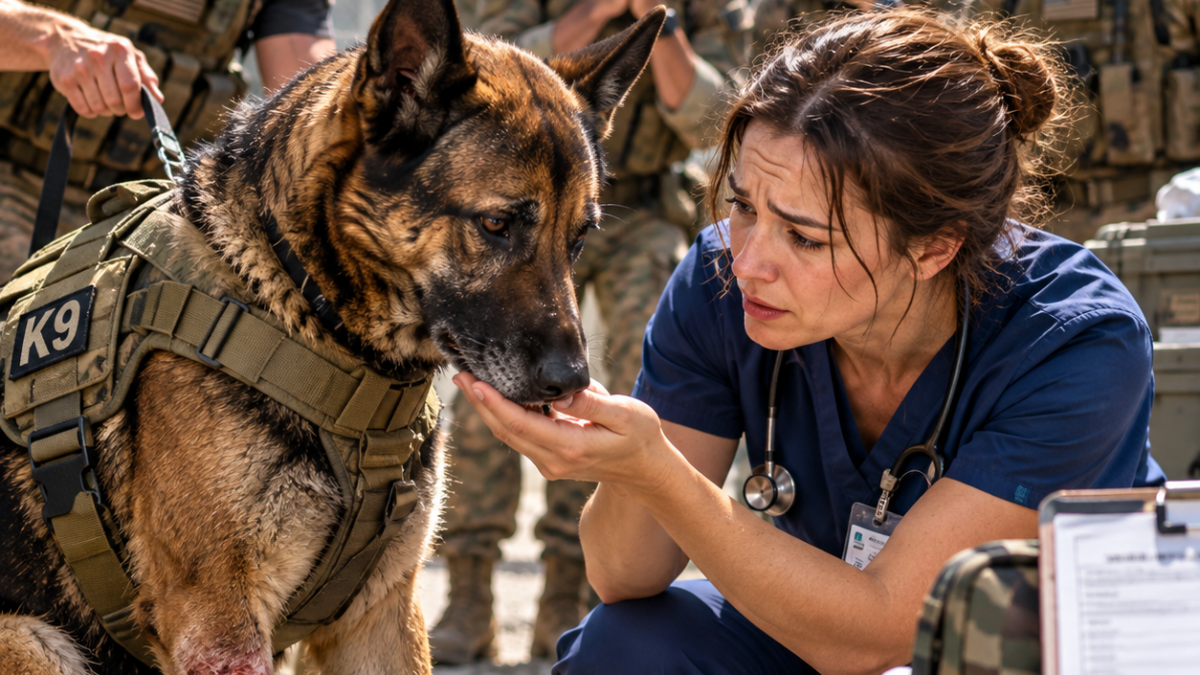
PART2:
Enough to remember the sound of his laugh.
Enough to remember that he drank coffee black and hated fluorescent lighting.
Enough to remember him sleeping on the floor outside Rex’s recovery kennel because he refused to leave the dog alone after surgery.
Enough to remember arguing with him about whether handlers should be allowed inside sterile prep areas.
Enough to remember the last promise he asked me to make.
Not enough to save either of them.
“Very well,” I said.
Thomas pushed the file closer.
“Then you may not be the right person for this evaluation.”
“Why?”
“Conflict.”
“You called me.”
“I didn’t know.”
“You knew my name.”
“I didn’t know you had prior involvement.”
I finally opened the file.
Page one.
Incident history.
Page two.
Behavioral summary.
Page three.
Risk designation.
Then the line I could not stop reading.
FINAL EUTHANASIA AUTHORIZATION.
Tomorrow.
I looked up.
“This has already been approved.”
“Yes.”
“Why am I here?”
“Final independent review.”
“That isn’t an independent review if the decision is already made.”
Thomas exhaled.
“Claire.”
“How many evaluators?”
“Three.”
“Behaviorists?”
“One.”
“Veterinary?”
“Yes.”
“Handler assessment?”
“Yes.”
“Duration?”
Thomas hesitated.
“How long has Rex been here?”
“Eighteen days.”
I closed the file.
“Eighteen days.”
“He has a long documented history.”
“Here?”
“No.”
“Then eighteen days.”
“Claire, he has injured three handlers.”
“Bites?”
“Two bites.”
“Severity?”
“One Level Three, one Level Four.”
“What was happening immediately before?”
Thomas’s mouth tightened.
“You haven’t changed.”
“That wasn’t an answer.”
He pointed toward the file.
“Read it.”
I did.
The first incident occurred during harness removal.
Second during forced relocation from a transport kennel.
Third was a near bite when a handler reached for Rex while he was sleeping.
I felt anger rising.
Not because the incidents were harmless.
They weren’t.
A Malinois with Rex’s training could injure someone badly.
But the reports described events.
Not causes.
Every paragraph ended in the same language.
Unpredictable.
Unsafe.
Escalating.
No warning.
“Did anyone evaluate the harness?”
Thomas frowned.
“What?”
“The original harness.”
“No.”
“Pain response?”
“He’s medically cleared.”
“Old shoulder injury?”
“Stable.”
“Neurological?”
“Normal.”
“Sleep?”
“Poor.”
“Appetite?”
“Inconsistent.”
“Startle threshold?”
“Low.”
“Separation behavior?”
Thomas looked at me.
“This is what I mean.”
“What?”
“You’re building a trauma narrative before meeting him.”
“No.”
I tapped the report.
“Your staff built an aggression narrative before asking a trauma question.”
Thomas leaned back.
“He has hurt people.”
“I know.”
“And tomorrow he may hurt someone worse.”
“I know.”
“So don’t romanticize him because Daniel was your friend.”
That sentence hit exactly where Thomas intended.
I kept my face neutral.
“Take me to him.”
The reinforced kennel door had five warning labels.
HIGH-RISK MWD.
AUTHORIZED PERSONNEL ONLY.
TWO-HANDLER MINIMUM.
DO NOT ENTER WITHOUT RESTRAINT PLAN.
BITE HISTORY.
Inside stood Rex.
Older.
Thinner.
His coat had lost the hard shine I remembered.
Gray around the muzzle.
Scar along one cheek.
Another across his left shoulder.
He still wore an old tactical harness.
Not the exact field harness from the years I knew him.
Modified.
Repaired.
Faded.
But old enough that the fabric had molded around his body.
Rex stood against the back wall.
Not pacing.
Not barking.
Not lunging.
Watching.
That bothered me more.
Fearful dogs often advertise.
Barking.
Growling.
Snapping.
Movement.
Rex conserved everything.
Eyes followed every hand.
Every key.
Every shift in posture.
Like a soldier who had learned mistakes came from people approaching.
Two handlers stood behind me.
One whispered:
“Hard to believe he used to be one of the best.”
I turned.
“What happened?”
Silence.
The younger handler looked at the older one.
Finally:
“His handler died.”
“Daniel Hayes?”
Both looked surprised.
“You know his name?”
I turned back toward Rex.
“Yes.”
And then eight years disappeared.
I first met Daniel Hayes at a military K9 rehabilitation program near San Antonio.
I was thirty-two.
Civilian veterinary rehabilitation specialist.
Still young enough to believe knowledge automatically created influence.
It doesn’t.
Institutions respect expertise until expertise becomes inconvenient.
I worked mostly with orthopedic recovery then.
Tendon injuries.
Joint surgery.
Spinal rehabilitation.
Heat injury.
But I had already started pushing for behavioral recovery to be treated as seriously as physical recovery.
Military working dogs were routinely evaluated by performance.
Can the dog detect?
Track?
Engage?
Search?
Recover?
But what happened when a dog completed a task while terrified?
What happened when the body healed but the nervous system didn’t?
Some people considered those soft questions.
Daniel didn’t.
He arrived with Rex after a deployment-related shoulder injury.
Rex was three.
Pure electricity.
Lean muscle.
Focused eyes.
The first time I tried to inspect his shoulder, Rex looked at Daniel.
Daniel said:
“She’s okay.”
Rex looked back at me.
I said:
“Thanks for the endorsement.”
Daniel smiled.
“He’s checking references.”
“You trained him to distrust veterinarians?”
“I trained him to distrust everybody.”
“That seems healthy.”
“For my job?”
“Yes.”
Then I touched Rex’s shoulder.
No reaction.
Worked down the limb.
Tenderness near scar tissue.
I looked up.
“He’s compensating.”
Daniel’s smile disappeared.
“How bad?”
“Fixable.”
“Time?”
“Six weeks minimum.”
“He won’t like that.”
“Neither will you.”
He laughed.
We spent six weeks arguing.
Daniel wanted Rex back to work sooner.
I refused.
Rex wanted to work immediately.
I refused him too.
Daniel slept at the facility twice after Rex had pain flares.
Not because it was medically necessary.
Because Rex settled faster when Daniel was nearby.
One night I found Daniel sitting outside the kennel at 2:00 a.m.
Back against wall.
Rex sleeping inside.
“You know there are chairs.”
“I know.”
“Beds.”
“I know.”
“Hotels.”
“I know.”
“Then why are you sitting on concrete?”
Daniel glanced at Rex.
“He wakes if I leave.”
“That’s attachment.”
“That’s partnership.”
“Could be both.”
Daniel thought.
Then:
“People think these dogs are brave because they aren’t afraid.”
I sat beside him.
He continued.
“They’re afraid.”
“Of course.”
“Explosions.”
“Noise.”
“Pain.”
“Confusion.”
“He still goes.”
Daniel looked through kennel glass.
“That’s bravery.”
“That he chooses to protect us while afraid.”
I never forgot that.
Because Daniel understood something many handlers learned only after years.
Training does not erase emotion.
Discipline does not erase fear.
A working dog can obey while frightened.
So can a soldier.
That’s why I understood them both.
Over those six weeks, I learned Daniel had been partnered with Rex almost six years, including pre-deployment training rotations.
He talked about Rex like a teammate.
Not equipment.
Not pet either.
Something between categories.
Rex knew Daniel’s body language before commands.
Daniel knew when Rex was overloaded before anyone else.
Watching them together was like watching two people finish each other’s sentences without speech.
The last week of rehabilitation, Rex began following Daniel even more closely.
Door to door.
Room to room.
If Daniel moved, Rex moved.
Daniel joked:
“He thinks I’m the injured one.”
I said:
“He might know something you don’t.”
Daniel looked at me.
“Like what?”
“That you need him.”
For a second, his face changed.
Then he smiled.
“Don’t psychoanalyze me, Doc.”
“Occupational hazard.”
That was one of our last easy conversations.
A few nights later, Daniel found me outside the rehab building.
Rex lay beside him.
Stars.
Warm Texas air.
He was unusually quiet.
“Claire.”
“What?”
“If something happens to me—”
“No.”
He looked over.
“That’s mature.”
“I refuse hypothetical dead-handler conversations.”
“Humor me.”
“No.”
“Claire.”
Something in his tone stopped me.
Rex raised his head.
Daniel said:
“If I don’t come back, don’t let them treat him like damaged equipment.”
I stared.
“What are you talking about?”
“Nothing.”
“That’s not nothing.”
“Operations.”
“Daniel.”
“Just promise.”
“Why me?”
“Because you look at him.”
I frowned.
“Everybody looks at him.”
“No.”
“You watch him.”
He placed one hand on Rex’s neck.
“If something happens, he’ll wait.”
“For you.”
“Yes.”
“You’ll come back.”
“Promise me.”
I hated him for asking.
“Fine.”
“Say it.”
“I promise.”
Daniel exhaled.
Then:
“And if he acts like an idiot?”
“I’ll assume he learned it from you.”
“Good.”
He smiled.
For years afterward, I replayed that conversation and wondered whether he knew.
Not the specifics.
Something.
A feeling.
A report.
A risk.
Maybe nothing.
Maybe soldiers preparing to deploy always speak like men making wills.
The official report of Daniel’s final mission was almost insulting in its brevity.
Extraction support.
Vehicle incident.
One casualty.
Military working dog recovered.
Daniel Hayes did not come home.
Rex did.
I saw him forty-eight hours later.
The dog I remembered was gone.
Not physically.
His body was there.
His attention wasn’t.
He refused food.
Wouldn’t sleep.
Stared at doors.
Any footsteps made him stand.
Every engine made him pull toward outside.
Handlers tried removing Daniel’s equipment from the kennel.
Rex guarded it.
They tried washing the harness.
He snapped.
Someone called it resource guarding.
I called it grief.
They said dogs don’t understand death the way people do.
I said maybe not.
But they understand absence.
Rex searched every room.
Every vehicle.
Every hallway.
I watched him hear Daniel’s name and lift his head.
Weeks passed.
He improved slightly.
Would eat when I sat nearby.
Would allow me close.
Would rest for twenty minutes instead of five.
Then a storm came through.
Thunder.
Hard.
A young handler entered too quickly.
Rex woke disoriented.
The handler grabbed the harness.
Rex bit.
One bite.
Released.
No pursuit.
The report did not say disoriented.
It said:
Unprovoked aggressive incident.
Everything changed.
Risk review.
Retirement recommendation.
Transfer.
I argued.
Lost.
Rex was moved to another program.
Then another.
I tried following.
Records stopped.
Contacts changed.
People told me the dog had been reassigned.
Then placed.
Then possibly retired.
Nobody gave me one clean answer.
I had broken my promise.
At least that’s how I experienced it.
I stayed in the military canine program another six months.
Every dog reminded me.
Eventually I resigned.
Went into civilian trauma rehabilitation.
Built a career.
Published papers.
Trained veterinary teams.
Helped hundreds of dogs.
And privately avoided ever saying Rex’s name.
Because guilt has strange rules.
You can save a hundred animals and still count yourself by the one you lost.
Now, eight years later, Rex stood behind reinforced glass.
And people wanted me to approve his death.
I asked Thomas:
“Let me evaluate him alone.”
“No.”
“Through observation first.”
“Yes.”
“Then room.”
“Two handlers present.”
“No.”
“Claire.”
“If he reacts to restraint and multiple people, surrounding me with handlers destroys the assessment.”
“He has bite history.”
“I know.”
“You don’t get special rules because you knew him.”
“I get professional judgment because that’s why you called.”
Thomas stared.
Then:
“Observation glass.”
“Handlers outside.”
“Door unlocked.”
“Emergency protocol active.”
“Fine.”
“No physical contact unless Rex initiates.”
“Obviously.”
He sighed.
“Fifteen minutes.”
“I need longer.”
“Thirty.”
“Two hours.”
“Absolutely not.”
“Thomas.”
He looked through glass at Rex.
Then me.
“Sixty.”
I entered.
No leash.
No pole.
No muzzle.
No medication.
Nothing in my hands.
Rex watched.
I sat on floor six feet away.
Sideways.
Less direct pressure.
Five minutes.
Nothing.
Ten.
Nothing.
People outside shifted.
Rex’s eyes flicked toward them.
I said:
“Hi, Rex.”
His ears moved.
Tiny.
I swallowed.
“It’s been a while.”
No movement.
“They’ve decided you’re dangerous.”
His breathing changed.
Ridiculous to attach meaning to words he couldn’t understand.
Tone mattered.
Presence mattered.
“They say you stopped giving warnings.”
Rex stared.
“I don’t believe that.”
I glanced toward observation window.
“I think they stopped listening.”
Rex lowered his head slightly.
I sat.
No agenda.
No reaching.
One of the greatest mistakes people make with traumatized animals is treating stillness like consent.
A frozen animal is not relaxed.
Rex’s body was rigid.
Ready.
I waited.
Twenty minutes.
Thirty.
Forty.
He moved one step.
Stopped.
Outside glass, a handler leaned forward.
Rex looked at movement.
Then at me.
Another step.
Eventually he stood three feet away.
His nose tested air.
I didn’t offer my hand.
Trust is not something you reach out and collect.
It is something the other living thing decides to give.
Rex looked at my face.
Then my hands.
Then something strange happened.
He lowered his head.
Mouth opened.
Something metallic hit the floor.
Small.
Dirty.
Worn.
I stared.
Dog tag.
Not his.
Human.
I didn’t move at first.
Rex nudged it toward me.
My chest tightened.
I picked it up.
Front:
HAYES, DANIEL R.
Service information.
Blood type.
Old.
Scratched almost smooth.
Daniel’s tag.
I stopped breathing.
Then turned it over.
Three words had been crudely engraved into the back.
Not military issue.
Hand done.
FIND CLAIRE MORGAN.
I read it once.
Again.
Again.
Rex sat.
Watching.
My vision blurred.
“You kept this?”
His ears shifted.
Eight years.
Transfers.
Kennels.
Handlers.
Harnesses.
Bite reports.
Reevaluations.
Somehow Daniel’s tag had stayed with him.
I closed my fist around it.
The evaluation-room door opened.
Lieutenant Marcus Cole entered.
Former handler supervisor.
I had met him years before.
He stopped.
Looked at Rex sitting calmly near me.
“What happened?”
“What do you mean?”
“Claire.”
He pointed.
“He doesn’t sit near anyone.”
I looked at Rex.
“Maybe nobody sat near him first.”
Marcus frowned.
Then saw metal in my hand.
“What is that?”
I held it out.
His face drained.
“Where did you get that?”
“Rex.”
“No.”
“He dropped it.”
Marcus took one step closer.
“That’s Daniel’s.”
“I know.”
“It disappeared.”
“When?”
“Recovery.”
He stared at Rex.
“I was there.”
“When they brought Daniel back, Rex was beside him.”
“Tag wasn’t.”
I looked down.
“Maybe Rex took it.”
Marcus whispered:
“Jesus.”
“You knew Daniel?”
“Yes.”
“How well?”
“Well enough.”
“Then explain this.”
I turned tag.
FIND CLAIRE MORGAN.
Marcus closed his eyes.
“He knew.”
“Knew what?”
“I don’t know.”
“Marcus.”
“I don’t.”
But his face said fear.
Not ignorance.
“Tell me.”
He looked at observation window.
“Not here.”
That night I stayed at North Valley.
Pulled every archived record I could access.
Rex.
Daniel.
Old program files.
Transfer logs.
Most of what I found made no sense.
The final six weeks before Daniel’s last mission were almost empty.
No routine evaluation reports.
No handler notes.
No canine medical updates.
Then after Daniel’s death, records reappeared.
Behavioral concerns.
Transition failure.
Reassignment.
Three transfers.
Each report described Rex as progressively more difficult.
But none included a detailed rehabilitation plan.
None documented sustained trauma work.
One handwritten line sat at the bottom of an old photocopy.
Trust Rex. He remembers.
Daniel’s handwriting.
I knew it immediately.
Same slanted letters from notes he used to leave on rehab charts.
Rex needs more ball work.
Rex hates your peanut-butter treats.
Rex says your recovery timeline is nonsense.
The last one had made me write back:
Rex cannot write.
Daniel added:
Prove it.
Now:
Trust Rex. He remembers.
I sat alone in records room until 2:00 a.m.
Why would Daniel write my name on a tag before dying?
Why tell someone to trust Rex?
What was he expecting?
At eight the next morning, Thomas Reed held emergency review.
Six people.
Military representative.
Veterinary staff.
Behavior specialist.
Marcus.
Thomas.
Me.
Rex’s file lay center.
Thomas began:
“Final disposition remains scheduled pending review.”
“No.”
He looked at me.
“Claire.”
“I will not sign.”
The military representative said:
“Dr. Morgan, Rex has two documented bites.”
“Yes.”
“He represents liability.”
“Yes.”
“So?”
“So liability doesn’t answer cause.”
“Cause does not eliminate risk.”
“I agree.”
That surprised him.
I continued.
“We manage risk.”
“We don’t kill first because management takes work.”
Thomas rubbed forehead.
“You have emotional involvement.”
“Yes.”
The room shifted.
I didn’t deny it.
“I knew Daniel.”
“I knew Rex.”
“That biases me.”
Pause.
“It also means I recognized behaviors the reports mischaracterized.”
The behaviorist asked:
“Such as?”
“Harness sensitivity.”
“Door guarding.”
“Sleep startle.”
“Separation response.”
“Possession of Daniel’s tag.”
The military representative frowned.
“What tag?”
I placed it on table.
Marcus went still again.
Everyone read.
FIND CLAIRE MORGAN.
Thomas looked at me.
“Where has this been?”
“With Rex.”
“For eight years?”
“Apparently.”
The representative said:
“That proves sentimentality, not safety.”
“No.”
I looked at him.
“It proves history in this file is incomplete.”
Then Marcus spoke.
“He’s right.”
Everyone turned.
Marcus corrected himself.
“She’s right.”
He placed both hands on table.
“Daniel was investigating the transition program before his final mission.”
Silence.
I stared.
“You knew.”
“Pieces.”
“Why didn’t you tell me?”
“Because Daniel asked me not to involve anyone until he had proof.”
“What proof?”
Marcus looked at the tag.
“He thought retired K9s were being written off too quickly.”
“Dogs with trauma histories.”
“Dogs that needed expensive rehabilitation.”
The military representative stiffened.
“Be careful.”
Marcus looked at him.
“I am.”
He continued.
“Daniel believed some assessments were being altered.”
“Behavior incidents exaggerated.”
“Context removed.”
“Placement failures turned into dangerous-animal classifications.”
I thought about Rex’s reports.
“Why?”
“Money.”
Thomas frowned.
“What?”
“Rehabilitation costs money.”
“Specialized placement costs money.”
“Long-term management costs money.”
Marcus’s voice grew bitter.
“A clean disposition closes a file.”
No one liked that sentence.
I asked:
“Who ran the program?”
Marcus hesitated.
“Dr. Alan Pierce.”
I knew the name.
Everybody in military canine rehabilitation did.
Pierce had once been considered a pioneer in post-service transition.
Published.
Awarded.
Consultant.
Then retired quietly.
“Daniel suspected Pierce?”
“Yes.”
“Why didn’t he report?”
“He was building a case.”
“And then died.”
“Yes.”
“Vehicle accident?”
Marcus looked at me.
“I don’t think Daniel’s death was murder, Claire.”
“I didn’t say it was.”
“You were about to.”
Maybe.
The room ended with Rex’s euthanasia postponed seventy-two hours.
Not cancelled.
But time.
I spent that afternoon with him again.
This time I brought a photograph.
Daniel.
Rex.
Me.
Taken outside rehab center.
Daniel smiling.
I looked annoyed.
Rex staring somewhere off-camera because a tennis ball existed.
I placed it on floor.
Rex stood immediately.
Walked over.
Sniffed.
His nose touched Daniel’s face.
Then mine.
My eyes burned.
“You remember.”
He looked up.
The past hit me.
Daniel beside rehab building.
“If something happens to me…”
I had buried the conversation because remembering it meant remembering the promise.
“Don’t let him think he was abandoned.”
I sat on floor.
“I thought I failed you.”
Rex came closer.
Close enough to touch.
I waited.
Then he lowered his head against my knee.
I put one hand on his shoulder.
First touch in eight years.
He didn’t flinch.
Didn’t freeze.
Just exhaled.
Maybe he wasn’t waiting for Daniel anymore.
Maybe he had known Daniel was gone long before any human accepted it.
Maybe he had been waiting for somebody who remembered who he was before every file called him dangerous.
Marcus came that evening carrying a box.
“Found something.”
Inside were Daniel’s personal notebooks.
Not official.
Field observations.
Program notes.
Names.
Dates.
Cases.
First page:
Rex did not fail the mission. Someone failed Rex.
I looked up.
Marcus said:
“I had these.”
“For eight years?”
“Yes.”
“Why?”
“Daniel gave them to me.”
“And you did nothing?”
His face changed.
“Claire.”
“Eight years.”
“I was afraid.”
“Of what?”
“The answer.”
“That isn’t good enough.”
“I know.”
He stared toward Rex’s room.
“Daniel died.”
“The dog collapsed.”
“You left.”
“Everyone connected to that year disappeared.”
“Pierce had command support.”
“People above me said transition problems were normal.”
“I wanted to believe it.”
That last sentence mattered.
Because cowardice doesn’t always feel like fear.
Sometimes it feels like accepting the explanation that costs you least.
We opened Daniel’s notes.
Case after case.
Retired K9.
Fear after deployment.
Aggressive classification.
Failed placement.
Transfer.
Euthanasia recommendation.
Not all.
Enough for pattern.
Daniel had written:
They are not broken. They are asking for help.
Another:
Behavior report removes trigger.
Another:
Handler states bite occurred after forced harness removal. Final report says “unprovoked.”
Rex’s report.
Almost identical.
Daniel had seen it coming before his own death.
The investigation reopened quietly.
Military inspector general liaison.
Archived program staff.
Old assistants.
Handlers.
Veterinarians.
One retired technician finally agreed to talk.
Her name was Melissa Crane.
She sat across from me holding water she never drank.
“I should’ve said something.”
“What happened?”
She stared at cup.
“Pierce believed a working dog had to transition quickly.”
“And if it didn’t?”
“Unsuitable.”
“That’s not a treatment plan.”
“I know.”
“What happened to unsuitable dogs?”
“Depends.”
“Melissa.”
She swallowed.
“Some transferred.”
“Some placed with specialized handlers.”
“Some…”
She stopped.
“Were euthanized.”
“How many?”
“I don’t know.”
“You worked there.”
“Records were coded differently.”
Marcus asked:
“Why?”
“Budget.”
There it was again.
Melissa continued.
“The program was under pressure to show successful closure rates.”
“Long-term trauma cases looked bad.”
“So Pierce reclassified them?”
“Sometimes.”
“What about Rex?”
She looked at me.
“Rex was the case Daniel wouldn’t let go.”
I felt cold.
“Daniel fought him.”
“Yes.”
“Pierce wanted Rex removed from active service after early trauma signs.”
“Daniel refused.”
“Then what?”
“Daniel started collecting examples.”
“Other dogs.”
“Other reports.”
“He said fear wasn’t failure.”
I almost heard him.
Brave because they’re afraid and still protect us.
“Did Pierce know Daniel was investigating?”
“Yes.”
“What did he do?”
“Ordered a review.”
“And?”
“Daniel deployed before it happened.”
Then Daniel died.
Rex came back alone.
The dog most protected by the one man willing to fight the system suddenly had no advocate.
Except me.
And I left.
That truth almost crushed me again.
But guilt is useful only if it changes what you do next.
So I stayed.
The final breakthrough came from an old body-camera archive associated with Rex’s harness system.
Most footage routine.
Training.
Transport.
Deployment fragments.
Then Daniel’s final operation.
We watched in secure room.
I wasn’t prepared.
Daniel alive.
Laughing.
Rex beside him.
Daniel looked down at camera.
“You supposed to be working?”
Rex stared.
“You hear that, Claire?”
I froze.
Marcus looked at me.
Recording continued.
“He thinks he’s my supervisor.”
My own laughter came faintly from off-camera in earlier footage.
Different time.
Maybe Daniel had copied rehabilitation video into personal archive.
Then final mission.
Movement.
Vehicle.
Confusion.
Impact.
Daniel down.
Rex stayed.
People shouted.
Someone tried pulling dog away.
Rex fought restraint.
Not attacking.
Refusing separation.
Daniel was conscious briefly.
His hand reached toward Rex’s harness.
Then audio.
Weak.
“Tag.”
Someone said:
“What?”
Daniel:
“For Claire.”
The camera shifted.
His hand disappeared near Rex’s harness pocket.
My entire body went cold.
He had put the tag there.
On purpose.
Before evacuation.
Before dying.
The words had been engraved earlier.
Find Claire Morgan.
Daniel had known Rex would need an advocate.
He didn’t know whether I could save him.
He trusted Rex to find me.
That was insane.
Impossible.
Unfair.
And somehow Rex had carried the message for eight years.
Transfers.
Handlers.
Kennels.
The tag had remained hidden in a small torn compartment under the harness lining.
Probably inaccessible until fabric finally split.
Rex wasn’t delivering it according to a trained command.
He had simply retained an object saturated with Daniel’s scent and history.
Then placed it in front of the one person he remembered from before.
Me.
The next morning, I walked into Thomas Reed’s office.
Set the tag down.
Then Daniel’s notes.
Then investigative findings.
“The order ends today.”
Thomas stared.
“We still need final approval.”
“No.”
“Claire.”
“You asked for independent evaluation.”
“My evaluation is that Rex’s behavior is trauma-linked, trigger-specific, and manageable under controlled rehabilitation.”
“He still represents risk.”
“So do half the animals in this center.”
“You know what I mean.”
“I do.”
I leaned closer.
“You want to euthanize him because his treatment is difficult.”
Thomas looked hurt.
“That isn’t fair.”
“Neither was writing ‘unprovoked’ when handlers pulled Daniel’s harness off his body.”
Silence.
He stared at Rex’s file.
Then reached for euthanasia authorization.
For several seconds, he just held it.
Finally he drew a line through it.
SIGNED CANCELLATION PENDING LONG-TERM REHAB.
My breath left.
Not victory.
Relief.
Rex lived.
But I refused to make his recovery magical.
Trauma doesn’t disappear because somebody discovers the correct backstory.
For the first week, he still paced.
Still startled.
Still guarded the harness.
Still refused most handlers.
We changed the environment.
No forced equipment removal.
Predictable routines.
Visual cues.
One primary handler.
Then two.
Sleep protection.
Pain reassessment.
Choice-based approach.
I spent hours sitting without touching him.
Rex began eating near me.
Then sleeping while I was in the room.
That mattered more.
Sleep is vulnerability.
A hypervigilant dog that sleeps beside you is lending you his life for a few minutes.
One night I found him on his side.
Deep sleep.
Door unguarded.
I sat in hallway and cried.
The staff thought something was wrong.
Nothing was wrong.
For the first time in years, Rex believed he did not have to watch every entrance.
Weeks later I brought Daniel’s old jacket.
His sister had kept it.
Stored carefully.
Canvas field jacket.
Faded.
I placed it on floor.
Rex froze.
He approached slowly.
One sniff.
Then another.
His body trembled.
Not violently.
Small.
He pressed his muzzle into fabric.
Made a sound.
Not bark.
Not whine exactly.
Recognition.
I sat beside him.
“It’s okay.”
Rex looked at me.
I touched his neck.
“He didn’t leave you because he wanted to.”
That sentence was for both of us.
Rex lay down against jacket.
Stayed there an hour.
Afterward something changed.
Not cured.
Looser.
Like grief had finally been named.
A month into rehabilitation, a young Malinois arrived from another program.
Koda.
Three years old.
Explosion exposure.
Handler separation.
Terrified of metal kennels.
Snapped at anyone approaching.
Staff asked me to evaluate.
I entered corridor.
Before I reached Koda’s area, Rex stood.
Watched.
Koda barked wildly.
Rex didn’t.
He walked toward kennel.
Sat ten feet away.
Koda stopped barking.
Watched him.
Rex lowered his head.
Relaxed.
The younger dog slowly mirrored him.
Marcus stood beside me.
“He learned that from you.”
I shook my head.
“No.”
“Daniel.”
Maybe both.
The investigation into Dr. Alan Pierce expanded.
Not criminal conspiracy.
Reality was less cinematic and more disturbing because it was bureaucratic.
Metrics.
Budgets.
Liability fears.
Culture.
Pierce had created a system where difficult dogs were pushed toward rapid disposition.
Reports were simplified.
Triggers omitted.
Behavior context removed.
Long rehabilitation looked inefficient.
The worst decisions weren’t hidden behind evil speeches.
They were hidden inside clean spreadsheets.
That mattered.
Because fixing the program required more than removing one bad man.
It required changing incentives.
Mandatory trauma-informed behavioral review.
Minimum observation periods.
Handler history preservation.
Independent assessment before euthanasia in non-emergency cases.
Full documentation of bite context.
Pain reassessment.
Retired-dog transition plans.
No more rewriting fear as unexplained aggression without evidence.
Daniel’s notes became part of reform.
He had been right.
They are not broken.
They are asking for help.
Not every dog could be safely placed.
I want that clear.
Some animals carried risk too high for ordinary homes.
Some needed sanctuary.
Some required lifelong management.
And yes, in rare cases euthanasia could still be humane.
Compassion doesn’t mean denying danger.
It means understanding danger before deciding what it means.
Rex did not deserve death for communicating in a language people had stopped listening to.
One year after I arrived at North Valley, I walked past his old kennel.
Warning labels gone.
Reinforced door remained.
Smart.
Trust doesn’t require pretending teeth disappear.
But outside hung a small plaque.
REX
MILITARY WORKING DOG
SURVIVOR
TEACHER
I blamed Marcus.
He denied involvement.
Bad liar.
Rex lived in a quieter wing by then.
Not adopted into a suburban family.
That would have made a neat ending.
It would also have been irresponsible.
He stayed at North Valley under a sanctuary-training designation.
He worked with selected rehabilitation dogs.
Spent afternoons outside.
Slept on an orthopedic bed that cost more than my first couch.
Accepted five staff members.
Tolerated three others.
Loved exactly two.
Me.
And Marcus, eventually.
Marcus had to earn it.
Good.
On Daniel’s birthday, I walked with Rex to the memorial garden.
Daniel had a stone there.
Not grave.
Marker.
SERGEANT DANIEL HAYES
HANDLER
SOLDIER
PARTNER
I sat.
Rex stood beside me.
Not behind.
Not at heel.
Beside.
I took Daniel’s tag from my pocket.
By then I kept it on a chain.
Not around my neck.
Too much.
I held it.
“You were right.”
Rex looked at me.
“He wasn’t broken.”
Wind through trees.
I remembered promising Daniel.
I had broken that promise for eight years.
Then fulfilled it late.
Maybe that still counts.
“I thought I failed both of you.”
Rex lowered his head onto my shoulder.
Heavy.
Warm.
Alive.
I laughed through tears.
“You weren’t waiting for me to save you.”
He breathed.
“You were waiting for somebody to remember.”
That became my understanding of his story.
Not hero vet rescues dangerous dog.
Too simple.
Rex saved me too.
Before him, I had built an entire career around not revisiting my biggest failure.
I helped animals because helping allowed me to avoid grieving the one I believed I abandoned.
Rex forced me back into the room.
Forced me to look at Daniel.
At the program.
At myself.
I had not caused what happened to Rex.
But I had walked away because staying hurt.
That mattered.
I returned.
That mattered too.
Years passed.
New veterinarians rotated through North Valley.
I lectured them.
Not about Rex specifically at first.
About labels.
Reactive.
Aggressive.
Noncompliant.
Dangerous.
Unadoptable.
Untrainable.
Words can be useful.
They can also end thinking.
I would ask:
“What happened immediately before?”
Then:
“What happened the day before?”
Then:
“What happened eight years before?”
Somebody once said:
“That’s excessive.”
I pointed toward Rex.
Old by then.
Gray.
Sleeping through my lecture.
“Ask him.”
Students laughed.
I didn’t.
Rex’s story eventually became formal case training.
Names partially changed publicly.
Military details redacted.
The core stayed.
A dog labeled dangerous after repeated traumatic transitions.
Trigger-specific bite history.
Grief-related hypervigilance.
Attachment disruption.
Successful long-term management through trauma-informed rehabilitation.
No miracle.
No instant cure.
Evidence.
That mattered to me.
I didn’t want Rex becoming legend at expense of science.
He wasn’t saved by love alone.
Love without technique can get people hurt.
He was saved by observation.
History.
Pain management.
Behavior science.
Consistency.
Choice.
Time.
And yes.
Love.
But the useful kind.
The kind willing to learn.
Marcus retired from active duty later and joined North Valley full-time.
One evening, years after investigation, we sat outside while Rex slept.
Marcus said:
“Daniel would hate all this attention.”
“Yes.”
“He’d say the dog did everything.”
“Yes.”
“He’d also complain plaque font is too small.”
“Absolutely.”
Marcus looked at me.
“You ever wonder why he chose you?”
“For the tag?”
“Yes.”
“All the people he knew.”
I thought.
“Because I argued with him.”
Marcus laughed.
“No.”
“Because I told him no.”
“Maybe.”
Then he became serious.
“He trusted you with Rex before he trusted anyone with himself.”
I looked down.
That hurt in a good way.
“Why didn’t he ask you?”
Marcus shrugged.
“I was his officer.”
“You were friend.”
“Still.”
He looked toward Rex.
“You were person who saw dog before mission.”
That was probably true.
Daniel didn’t need someone who admired Rex.
He needed somebody willing to believe behavior had meaning.
Eight years later, I finally did.
Rex reached fourteen.
Old.
Very old for Malinois.
Hearing faded.
Eyes cloudy.
Arthritis.
No more training frightened dogs.
No more long walks.
He spent most days in my office.
Yes, my office.
I became clinical director.
Thomas retired.
On his last day he handed me master keys.
“Don’t make me regret it.”
“You’ll be gone.”
“I can still regret remotely.”
He had been wrong about Rex.
But he had allowed himself to change.
That deserves recognition.
Leadership isn’t never being wrong.
It’s what you do when evidence humiliates your certainty.
Thomas became one of Rex’s tolerated humans.
Not loved.
Let’s not get carried away.
Rex’s final months were peaceful.
He slept.
Ate when he felt like it.
Stole food from Marcus once.
Excellent.
On his last day, he couldn’t stand.
I knew before tests.
Veterinarian part of me knew.
Woman who had promised Daniel refused.
For about ten minutes.
Then I stopped fighting reality.
I lay on floor.
Rex’s head in my lap.
Marcus nearby.
Daniel’s jacket folded beside us.
I held tag.
Find Claire Morgan.
The three words that brought me back.
“You found me.”
Rex’s eyes opened slightly.
I smiled.
“Technically I found you.”
No reaction.
“Fine.”
“You win.”
Marcus laughed quietly.
I stroked Rex’s head.
“You carried him long enough.”
My voice broke.
“You can put it down.”
The medication went in.
His breathing slowed.
I whispered:
“Good boy.”
Then the words Daniel once used.
“Partner.”
Rex died without guarding the door.
That mattered to me more than anything.
We buried his ashes in the memorial garden beside Daniel’s marker.
The tag stayed with me.
I thought about placing it there.
Didn’t.
Daniel wrote my name on it.
Maybe it had finished one job and started another.
It hangs today in a shadow box inside North Valley’s training room.
Under it:
TRUST REX. HE REMEMBERS.
No explanation.
New staff ask.
Older staff tell the story.
Usually wrong in small ways.
Stories do that.
I correct the important parts.
He was not cured by a tag.
Daniel did not predict everything.
There was no secret plot to murder dogs.
Rex was dangerous in certain circumstances.
People were injured.
The system failed because it confused risk management with disposal and efficiency with care.
That’s important.
Real injustice is often less theatrical than fiction.
That makes it easier to repeat.
Nobody needs to twirl a mustache.
They just need to stop asking one more question.
Why did he bite?
Why that harness?
Why that door?
Why after sleep?
Why only after Daniel died?
Why is the record missing six weeks?
Why are five other dogs showing the same pattern?
One more question saved Rex.
Then saved others.
Years after his death, a young veterinarian came to me.
Her name was Maya.
She had a shepherd case.
Retired detection dog.
Two bite incidents.
Family considering euthanasia.
She said:
“I keep thinking about Rex.”
“Good.”
“I don’t want to repeat that mistake.”
“Also good.”
“But what if wanting to save him makes me ignore danger?”
Best question she could ask.
I said:
“Then don’t decide whether he deserves saving.”
She frowned.
“What?”
“Decide what evidence says.”
“Look at triggers.”
“Medical.”
“History.”
“Environment.”
“Management.”
“Be willing to conclude he’s unsafe.”
“And be equally willing to conclude people misunderstood him.”
Maya nodded.
“What if I still don’t know?”
“Then say you don’t know.”
She smiled.
“That’s uncomfortable.”
“Science often is.”
Her dog ultimately went to experienced sanctuary placement.
No miracle adoption.
No tragedy.
Managed life.
Good outcome.
Rex taught us to respect those endings too.
Daniel’s family eventually visited North Valley.
His younger sister, Rachel.
She stood before shadow box.
Read tag.
Cried.
Then laughed.
“He engraved that himself.”
“You know?”
“He had a stupid little engraving tool.”
Of course.
“He labeled everything.”
“Everything?”
“Tools.”
“Knives.”
“Flashlights.”
“One year he engraved MY CHAIR on a folding chair.”
I laughed.
Rachel touched glass.
“Find Claire Morgan.”
She looked at me.
“He trusted you.”
“So people keep telling me.”
“He talked about you.”
I froze.
“What did he say?”
Rachel smiled.
“That you were impossible.”
“Accurate.”
“That you treated Rex like he had opinions.”
“He did.”
“That you were the only person who could tell him he was being an idiot and make him laugh.”
My chest tightened.
Rachel continued.
“He wasn’t in love with you.”
I laughed through tears.
“Thank you for clarifying.”
“He loved you.”
Different sentence.
I stopped.
“As family.”
“As somebody safe.”
“That kind.”
I looked at tag.
Daniel and I had never named what we were.
Didn’t need to.
Some relationships matter without fitting romantic categories.
Friend.
Colleague.
Witness.
Person entrusted with what someone loves most.
That was enough.
Rachel said:
“He would’ve been furious it took eight years.”
“I am too.”
Then she hugged me.
“Still.”
“You found him.”
“No.”
I looked at the tag.
“He found me.”
That remains the sentence I believe.
Rex found me twice.
First when Daniel brought him into rehab years earlier.
Second when he placed that tag between us.
The first time I taught his shoulder how to work without pain.
The second time he taught me that guilt and responsibility are not same thing.
Guilt says:
You failed once, so leave.
Responsibility says:
You failed once, so return differently.
I returned.
That was enough to begin.
North Valley changed.
Not because of one dog.
Because people let one dog’s case reveal a system problem.
Every euthanasia decision now requires deeper review when behavior history is involved.
Not endless delay.
Not false hope.
Review.
Context.
Independent voices.
Retirement records stay intact.
Prior handler history follows the dog.
Trauma plans are documented.
Trigger descriptions cannot be deleted from final summaries for brevity.
That last one exists because of Rex.
One sentence matters.
“Bite occurred during forced removal of deceased handler’s harness.”
Very different from:
“Dog attacked handler without warning.”
Language can kill.
Language can save.
That’s what I teach.
The old plaque remains outside Rex’s former kennel.
REX
SURVIVOR
TEACHER
Sometimes I stand there early in morning.
Facility quiet.
Hear dogs breathing.
Handlers arriving.
Metal doors.
Coffee machine.
Normal.
Daniel wanted Rex not to spend rest of his life believing he was abandoned.
He didn’t.
Not at end.
And because Rex carried Daniel’s message until somebody finally listened, other dogs won’t be abandoned as easily either.
That’s legacy.
Not medals.
Not headlines.
A better rule after you’re gone.
People sometimes ask whether I believe Rex knew exactly what the tag meant.
No.
Not the words.
He couldn’t read.
He wasn’t carrying a secret mission in human sense.
But he knew the tag smelled like Daniel.
He knew I belonged to a period of his life when Daniel was alive.
He remembered me.
He trusted me enough to surrender the object he had guarded.
That is extraordinary without inventing magic.
Dogs don’t need supernatural powers to humble us.
Memory is enough.
Loyalty is enough.
Trust is enough.
Eight years is enough.
The last time I held Daniel’s tag before putting it in the shadow box, I traced those three words.
Find Claire Morgan.
For years I interpreted them as Daniel asking Rex to find me.
Now I think maybe Daniel was speaking to me too.
Find Claire Morgan.
Find the woman who used to ask why.
Find the veterinarian who believed fear was information.
Find the person who had walked away after one failure.
I had lost her.
Rex brought her back.
So when people tell the story now, they usually say:
“They ordered a military K9 put down, and one veterinarian saved him.”
I always correct them.
“No.”
Rex saved himself long before I arrived.
He survived the mission.
Survived losing Daniel.
Survived transfers.
Bad reports.
Misunderstood warnings.
Handlers who approached too fast.
A system that reduced grief to liability.
Eight years carrying an old tag beneath a worn harness.
All I did was finally stop talking long enough to listen.
And when he placed Daniel Hayes’s tag between my feet, Rex wasn’t asking me to see a hero.
He was asking me to remember the dog he had been before everyone else decided what he had become.
That was enough to stop the clock.
Enough to reopen the file.
Enough to expose what had happened.
Enough to change what happened to the dogs who came after him.
Rex’s euthanasia had been scheduled for nine the next morning.
Instead, he lived three more years.
Three years of sleep without guarding every door.
Three years of sunlight.
Daniel’s jacket.
Quiet walks.
Teaching younger dogs how to settle.
Three years of being treated not as a weapon that had malfunctioned, but as an old soldier whose war had followed him home.
And sometimes, when everything else fails, those three years are what justice looks like.

