They Left Their Little Dog at an Empty Apartment Door—A Year Later, He Led Me to the Truth They Tried to Bury
They Left Their Little Dog at an Empty Apartment Door—A Year Later, He Led Me to the Truth They Tried to Bury
Every evening, the little Jack Russell returned to Door 4B like love alone could make a deadbolt turn.
His family had driven away with their furniture, their dishes, and their lies, but they left behind the one witness too broken to accuse them.
By the time I named him Chance, I had no idea he was about to expose a cruelty everyone in our building had been taught to ignore.
The first time I noticed him, I was carrying two grocery bags up the third-floor walkway, trying not to drop a carton of eggs under one arm.
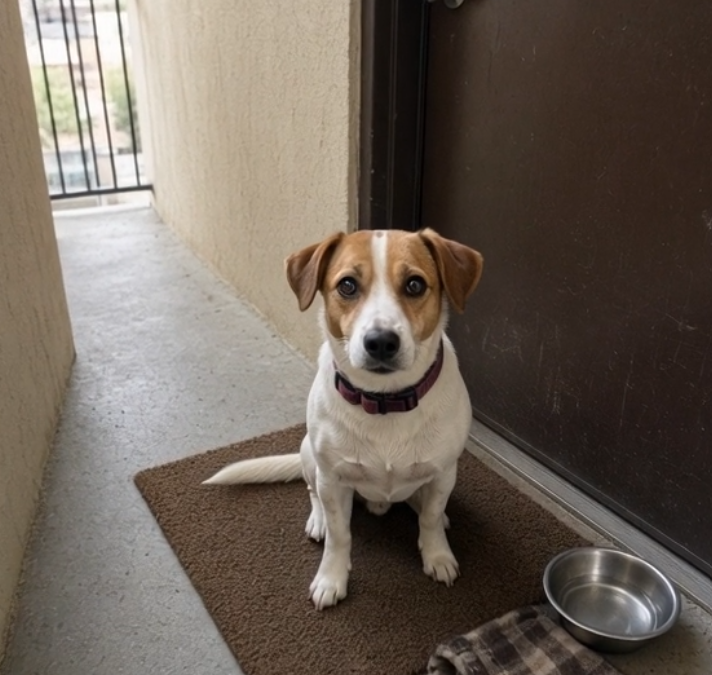
He was sitting across from my apartment, pressed close to the door of the unit that had gone empty the previous weekend. A small Jack Russell Terrier, mostly white with tan patches over one ear and one eye, stiff-backed and alert, like a soldier waiting for orders. His leash was gone. His collar was still on. His little paws were tucked neatly on the faded welcome mat that no one had bothered to take.
At first, I assumed the movers had left him outside by accident.
People made mistakes during moving days. Someone forgot a box. Someone forgot a set of keys. Maybe someone had run downstairs for a final load and the dog had slipped out. That was what I told myself, because the alternative was too cruel to accept on a Monday evening after work.
“Hey, buddy,” I said softly.
His ears lifted. His tail gave one hopeful thump.
Then he looked past me toward the elevator.
I turned, expecting someone to step out and call his name.
No one came.
The apartment across from mine had belonged to a couple named Derek and Alina Price. They had moved in eight months earlier with expensive luggage, loud arguments, and that little dog trotting behind them like the happiest creature alive. Derek sold cars at a luxury dealership. Alina posted lifestyle videos from the balcony, always dressed like she was heading to brunch. They were the kind of people who smiled in the lobby but never held the elevator.
I had seen the dog before. He used to bark excitedly through the door whenever I passed. Sometimes, late at night, I heard him whining while they shouted over music and slammed cabinets. Once, I found him sitting alone by the mailboxes with a cracked plastic bowl beside him. Derek had laughed when I mentioned it.
“He’s dramatic,” he said, jingling his keys. “He likes attention.”
Now Door 4B was dark. The curtains were gone. Through the narrow side window, I could see nothing but blank walls and an empty patch of carpet where their sofa had been.
The dog stared at that door as if all his answers were behind it.
I set my grocery bags down and knocked.
No response.
The dog sprang up anyway, nails scratching the concrete walkway, tail wagging so hard his whole body moved with it. He pressed his nose to the crack under the door and let out one sharp bark.
Then another.
Then he listened.
PART2:
When silence answered him, the sound that came from his throat changed. It dropped into something smaller, wounded, almost embarrassed. He sat again and looked at the door with a kind of devotion that made my chest ache.
I went inside my apartment, put my groceries away, and stood at my kitchen counter for ten full minutes trying to convince myself it was none of my business.
But through my window, I could still see him.
Waiting.
The next morning, he was still there.
He had curled into the corner of the mat, his body tucked tight against the door. When the elevator dinged at seven fifteen, his head shot up. A man from the fifth floor stepped out holding a travel mug. The dog rose halfway, hopeful again.
The man glanced down. “Still here?” he muttered, then kept walking.
Still here.
Those two words followed me all day.
At lunch, I called the building office. The manager, Mr. Bell, sounded tired before I even finished explaining.
“Residents vacated on Saturday,” he said. “Lease ended. They turned in their keys.”
“What about the dog?”
A pause.
“They didn’t mention a dog.”
“He’s sitting outside their door.”
Another pause, longer this time.
“I’ll have maintenance check.”
PART3:
When I returned from work that evening, the little dog had not moved far. Someone had placed a paper bowl of dry kibble beside him. It was untouched. A half-empty cup of water had tipped over and soaked the corner of the mat.
Mrs. Alvarez from 3C stood nearby with her arms folded, watching him with worried eyes.
“He cried today,” she said. “Not barking. Crying.”
I crouched a few feet away from him. “Did anyone call the owners?”
“They left no forwarding address,” she said. “Building office says they’re gone.”
The dog looked between us and the closed door, as if waiting for one of us to stop talking and fix the world.
That night, I brought him clean water in a ceramic bowl and a folded fleece blanket. He backed away when I came near, not aggressively, just with the careful fear of an animal that had learned hands could mean many things. So I set the bowl down, placed the blanket near the wall, and sat on the concrete with my back against the railing.
I didn’t try to touch him.
I didn’t coax.
I just sat there while traffic hissed on the wet street below and lights flickered on across the courtyard.
Almost an hour passed before he moved.
First one paw. Then another.
He came to the bowl, lowering his head without taking his eyes off me. He drank three small sips, paused, drank again, then retreated straight back to Door 4B.
“Okay,” I whispered. “That’s enough for tonight.”
But it wasn’t enough. Not really.
By the fifth day, his bark had almost disappeared.
Every evening, when footsteps came down the hallway, he would lift his head with fading hope. Every evening, his body would soften when it wasn’t them. The little calls he made were no longer demanding. They were pleading.
On the sixth morning, rain came in sideways.
The walkway outside our apartments was covered but not sealed, and the storm pushed cold water across the floor in silver sheets. His mat soaked through. The blanket I had given him clung heavy and useless to his back. He sat trembling, still facing the door.
That was the moment something in me broke.
I grabbed a towel, stepped outside, and knelt beside him.
“Buddy,” I said, my voice shaking, “I know you’re waiting. But they’re not coming back today.”
His eyes flicked toward mine.
I expected him to run. I expected him to snap. Instead, when I slipped the towel around him and lifted him, he went limp in my arms, light as a bag of laundry.
Too light.
His ribs pressed against my forearm. His fur smelled like rain, dust, and old fear.
He looked over my shoulder the whole way into my apartment, staring at Door 4B until I closed mine between us.
Inside, he didn’t panic. He didn’t explore like a normal dog. He moved through my living room carefully, checking corners, doorways, the space beneath my dining table. Then he found the narrow gap beside my bookcase, tucked himself inside, and lay down facing the front door.
I bought the best dog food I could afford that afternoon. Chicken stew in little cans. Salmon treats. Soft blankets. A squeaky tennis ball.
He wanted none of it.
For two days, he barely ate. He drank only when I placed water close enough that he didn’t have to leave his corner. If I moved too quickly, he flinched. If a door slammed in the hallway, his whole body shook.
I took him to a veterinarian named Dr. Harris, a woman in her fifties with silver hair, kind eyes, and the kind of patience that made even frightened animals breathe easier.
She examined him gently. Ear infections in both ears. Mild dehydration. Weight loss. Pressure sores beginning on one hip. No broken bones. No major illness.
Then she ran the scanner over his neck.
A beep sounded.
“He has a microchip,” she said.
My heart jumped. “So we can find his owners?”
Dr. Harris’s expression shifted, not enough for a stranger to notice, but enough for me to feel dread settle in my stomach.
“We can identify who registered him,” she said carefully. “Whether they deserve that word is another matter.”
The chip listed Derek Price as the owner.
There was a phone number.
Dr. Harris called from the exam room with me sitting there, one hand resting inches from the dog’s paw.
Derek answered on the fourth ring.
I couldn’t hear every word, but I heard enough.
“Yes, this is Maple Grove Animal Clinic… We have a Jack Russell Terrier registered to you… Found outside your former residence…”
Dr. Harris went quiet.
Her jaw tightened.
“I understand,” she said after a moment. “But abandonment is not the same as surrender… No, sir, you cannot simply leave an animal behind because your new building has a pet policy… I’m documenting this conversation.”
The little dog watched her face.
I watched his.
Something about the way he looked at the phone told me he knew the voice on the other end. His ears lifted, trembling. His tail tapped once against the table.
Then Dr. Harris hung up.
“He said he doesn’t want him,” she said.
The words landed like a slap.
I looked down at the dog. He was still watching the phone.
“He said,” she continued, choosing each word with visible restraint, “that the dog was ‘too needy,’ that he ‘ruined the vibe,’ and that they assumed someone in the building would take him.”
I felt heat rise behind my eyes. “What’s his name?”
Dr. Harris glanced at the file.
“According to the chip, his name is Milo.”
At the sound of it, the dog lifted his head.
Milo.
A name he had been waiting to hear from people who had thrown it away.
I paid for his treatment that day with money I had planned to use for a weekend trip I no longer cared about. Dr. Harris gave him fluids, medication, and a quiet room until he was steady enough to go home. Before we left, she placed a hand on my shoulder.
“He’s grieving,” she said. “People don’t always understand that dogs can mourn a living person. But they can. And sometimes it’s harder, because they don’t understand why love disappeared.”
I carried him home in a soft carrier, his eyes open but tired.
For the next week, I built my life around being steady.
I stopped reaching for him. I stopped begging him to eat. I stopped trying to cheer him up with toys he wasn’t ready to love. Instead, I read on the floor near his blanket. I worked on my laptop beside the bookcase. At night, I told him small, ordinary things.
“I burned toast again.”
“The lady upstairs still walks like she’s moving furniture.”
“I know you miss them.”
That last one always made his eyes shift toward me.
Maybe he didn’t understand the sentence.
Maybe he understood everything that mattered.
On the tenth morning, I was making scrambled eggs when I noticed him standing in the hallway.
Not hiding.
Standing.
Watching.
I froze with the spatula in my hand, afraid even my happiness might scare him backward.
“Morning, Milo,” I said softly.
His ears twitched.
That afternoon, when I moved from the living room to the bedroom, I heard tiny taps behind me. His nails clicked across the floor. He followed five steps, then stopped as if surprised by his own courage.
I smiled so hard it hurt.
That night, he took one piece of boiled chicken from my fingers.
A tiny piece. Barely anything.
But to me, it felt like watching a candle relight after a storm.
Over the next month, Milo returned to life in fragments.
He began eating half meals, then full ones. He discovered the square of sunlight by the living room window. He learned that Mrs. Alvarez kept turkey slices in her purse. He barked once at the vacuum cleaner, then seemed embarrassed by his own boldness.
Still, every night before bed, he went to my front door.
He sat. He listened.
Only after a minute would he turn away and come back to me.
I thought healing meant he was forgetting.
I was wrong.
Three months later, justice arrived wearing cheap cologne and an expensive watch.
I was coming home from work when I saw Derek Price in the lobby.
He stood at the front desk, arguing with Mr. Bell. Alina stood beside him scrolling her phone, her blonde hair perfect, her mouth twisted with irritation.
“We need access to the old unit,” Derek snapped. “We left a storage drive behind. It’s valuable.”
Mr. Bell, who had never enjoyed confrontation, looked trapped. “That unit has been cleaned and leased again. Anything left behind was processed after the vacancy period.”
Derek’s eyes shifted past him and landed on me.
Then on Milo.
By then, I had renamed him Chance.
It had happened slowly. I had tried to keep calling him Milo, but the name seemed to pull him backward. One night, after he curled beside me on the sofa for the first time, I whispered, “You deserve a chance.” His tail moved in his sleep.
After that, the name stayed.
Derek smiled when he saw him, but there was no warmth in it.
“Well, look at that,” he said. “You kept the little parasite.”
Chance stopped dead.
His body lowered. Not cowering exactly. Remembering.
I stepped slightly in front of him. “Don’t talk to him.”
Alina glanced up from her phone. “Oh my God, he’s still alive?”
The lobby went silent.
Mrs. Alvarez, who had just entered with groceries, turned slowly toward her.
Derek laughed under his breath. “Relax. It’s a dog.”
“No,” I said. “He’s a dog you abandoned outside an empty apartment for almost a week.”
Derek’s smile thinned. “Careful. You don’t know the situation.”
“I know he was dehydrated, underweight, infected, and waiting at your door.”
Alina rolled her eyes. “He was always dramatic.”
Chance pressed against my leg.
That was when Derek made his mistake.
He stepped closer and reached for Chance’s collar. “Technically, he’s still registered to me.”
Chance yelped before Derek even touched him.
Not a bark. Not a growl.
A terrified, broken sound that made everyone in the lobby freeze.
I pulled Chance back. “Do not touch my dog.”
Derek’s face hardened. “Your dog? I paid for him.”
“And then you left him.”
He leaned close enough that I could smell mint on his breath. “You have no idea what people like me can do when someone steals property.”
That word stayed with me.
Property.
Not family. Not companion. Not even dog.
Property.
The next morning, an animal control officer came to my apartment.
Derek had filed a complaint.
He claimed I had stolen his dog.
I stood in my doorway with Chance behind me, my hands cold but my voice steady. The officer, a tired-looking woman named Renee Carter, listened as I explained everything. The waiting. The rain. The vet visit. The phone call. The bills.
Then I handed her the folder Dr. Harris had helped me prepare.
Medical records.
Photos from the hallway.
Statements from neighbors.
A written note from Dr. Harris documenting Derek’s refusal to reclaim him.
Officer Carter read quietly. By the time she finished, her expression had changed.
“Do you have security cameras in the hall?” she asked.
My stomach tightened. “The building does.”
That afternoon, Mr. Bell reviewed the footage.
I was there. So was Officer Carter.
The camera outside the elevator had caught everything from the day the Prices moved out.
Derek carrying boxes.
Movers hauling furniture.
Alina taking selfies by the open door.
And then, at 5:42 p.m., Derek leading Milo into the hallway by the collar.
The little dog wagged his tail, confused but trusting.
Derek bent, removed his leash, pointed at the apartment door, and said something the camera could not record.
Milo sat.
Derek went inside one last time, came back out with a suitcase, locked the door, and walked away.
Milo followed.
Derek turned, shoved him back with his foot—not hard enough to break bone, but hard enough to make the tiny dog stumble.
Then Derek entered the elevator.
Milo stood outside as the doors closed, tail still wagging.
The video continued.
For seven minutes, he stared at the elevator.
Then he returned to the apartment door and sat down to wait.
No one spoke in the office after the footage ended.
Mr. Bell removed his glasses and wiped his face.
Officer Carter said, “I’ll need a copy of that.”
The investigation that followed was not dramatic in the way movies make justice dramatic. No courtroom full of gasps. No judge slamming a gavel while music swelled. It was paperwork, statements, phone calls, and the slow grind of consequences catching up to people who thought cruelty was only cruelty if someone important witnessed it.
But people had witnessed it.
Mrs. Alvarez testified that Chance had waited for days.
The maintenance worker admitted he had reported the dog and been told by the Prices over text, “Not our problem anymore.”
Dr. Harris provided medical documentation.
Mr. Bell turned over the footage.
Derek tried to talk his way out of it. He said they had planned to come back. Then he said they thought a friend had picked him up. Then he said the dog had behavior problems. Then he said I was unstable and obsessed.
Every excuse made him smaller.
Alina posted a tearful video online claiming they were being “attacked over a misunderstanding.” It might have worked if she hadn’t used the phrase “that annoying dog” halfway through.
Someone from the building leaked nothing, but truth has a way of traveling through people who are tired of silence. The residents found out. Then Derek’s employer found out. Then the rescue community found out.
The dealership suspended him before the county hearing.
At that hearing, I sat with Chance under my chair, his little body pressed against my shoes.
Derek arrived in a navy suit. Alina wore sunglasses indoors.
When the officer played the hallway footage, Derek looked bored at first.
Then the room watched him shove a trusting dog away and leave him outside an empty door.
No one looked bored after that.
The hearing officer ordered fines, mandated restitution for veterinary costs, and referred the matter for further animal cruelty review. Derek was barred from reclaiming Chance. His ownership registration was officially transferred to me.
It should have felt like victory.
Instead, when I stepped outside afterward, I sat on a bench and cried.
Not because I was sad.
Because Chance climbed into my lap in broad daylight, in front of strangers, and rested his head under my chin like he understood something had finally ended.
“You’re safe,” I whispered into his fur. “You’re really safe.”
A year after the day I carried him in from the rain, Chance no longer looked like the same dog.
His coat shone. His ears healed. His ribs disappeared beneath healthy weight. He chased tennis balls with ridiculous seriousness and slept belly-up in the sunlight like rent was his responsibility. He had a habit of carrying one sock from my laundry basket into the living room every morning, never chewing it, just relocating it like a household manager.
But every night, he still went to the door.
At first, that hurt me.
I wondered if some part of him was still waiting for Derek and Alina. I wondered if love could scar so deeply that even safety couldn’t fully erase it.
Then one evening, I understood.
He walked to the door, as always, and sat in silence.
I watched from the sofa.
After a moment, he looked back at me.
Not past me.
At me.
His tail moved once.
I patted the cushion beside me. “Come on, Chance.”
He stood, trotted across the room, jumped onto the sofa, and tucked himself against my side with a sigh so deep it seemed to leave another life behind.
He wasn’t waiting for the people who abandoned him.
He was checking that the door stayed closed between him and what he survived.
Months later, Mr. Bell replaced the faded mat outside Door 4B. A new family moved in with a little girl who wore glitter sneakers and always asked permission before petting Chance.
One Saturday, she crouched in the hallway and said, “Why does he only have one name?”
I smiled. “What do you mean?”
“My dog has a first name and a silly name,” she said seriously. “Like Pepper Noodle.”
Chance licked her hand.
I looked down at him, at the dog who had once believed love meant waiting outside a door that would never open.
“His full name,” I said, “is Chance Came Home.”
The little girl grinned as if that made perfect sense.
And maybe it did.
Because some stories don’t end when the cruel people leave. They end when the abandoned stop blaming themselves for being left. They end when the frightened learn the sound of kind footsteps. They end when a small, broken heart discovers that home is not the door you wait beside.
It is the person who opens one and never makes you beg to stay.


