They Left the Quiet Nurse Alone With a Terrified Military K9 Expecting Her to Fail—Then an Old Photo Revealed She Was the Woman Who Had Raised Him Years Before.
PART3:
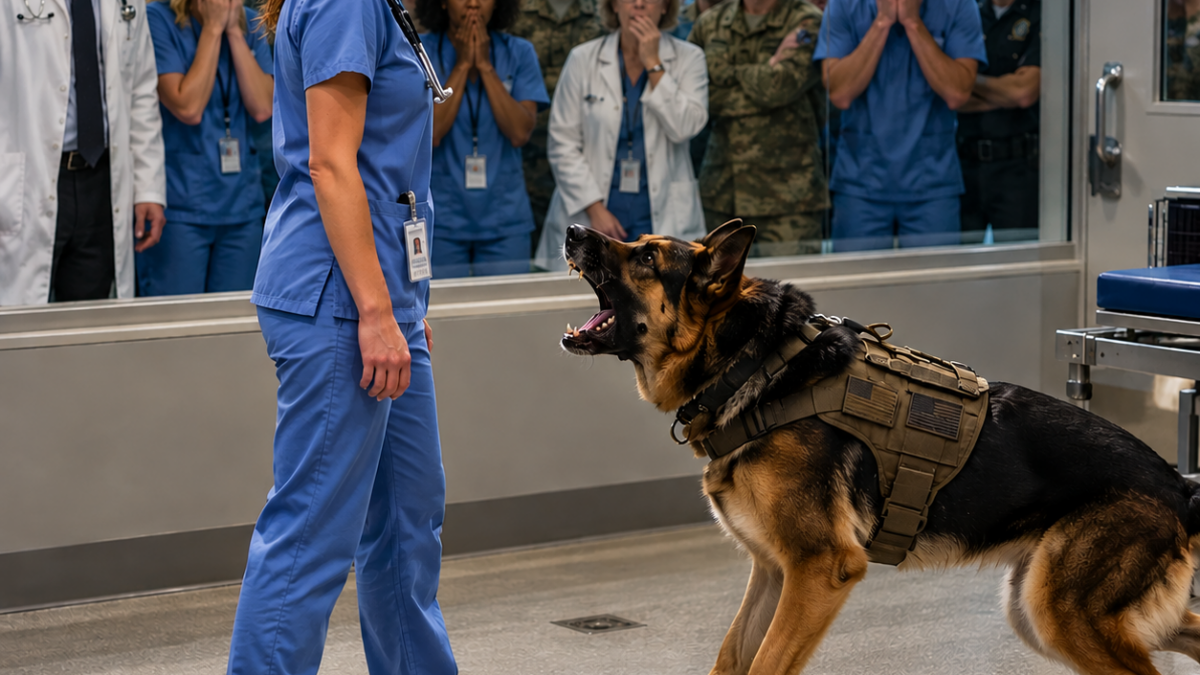
Every time somebody entered, his body stiffened.
Every time someone reached toward him, he backed away.
His breathing came too fast.
His eyes moved constantly.
Door.
Window.
Floor.
People.
Exit.
Door again.
He had refused to sit.
Refused food.
Refused his favorite rubber reward ball.
Refused Commander Hayes’s quiet command.
“Down.”
That was what frightened Hayes most.
Shadow had followed that command through gunfire.
Aircraft noise.
Crowded terminals.
Thunderstorms.
Hospitals.
Vehicle accidents.
Deployment transitions.
Retirement.
Now he acted as if the room itself had become something he could not trust.
Rebecca lowered herself into a chair several feet from the doorway.
“Let’s stop.”
One of the younger handlers looked at her.
“Stop?”
“Yes.”
“Everybody out except Commander Hayes.”
The handler stepped backward.
Rebecca continued:
“He’s telling us distance matters.”
“Let’s listen.”
The room cleared.
Hayes stayed.
Shadow’s barking stopped.
But his breathing did not.
Hayes crouched.
“Hey.”
Shadow watched him.
“I’m right here.”
No response.
Hayes placed the rubber toy on floor.
Shadow glanced once.
Then returned his attention to door.
Hayes’s face tightened.
Rebecca had known him only forty minutes, but she recognized the expression.
Fear disguised as concentration.
“You said this has never happened?”
“Not like this.”
“Anything recently?”
“No.”
“Change in appetite?”
“No.”
“Sleep?”
“Fine.”
“Pain?”
“Some stiffness after long walks.”
“Anything about hospitals?”
Hayes looked toward Shadow.
“He’s been examined before.”
“Here?”
“Not this wing.”
That mattered.
Rebecca stood.
“Where?”
“Retirement clinic at Fort Belvoir.”
“And before that?”
“Field veterinary units.”
“Mobile clinics.”
“Deployment facilities.”
Rebecca looked around.
Bright overhead panels.
The smell of disinfectant.
A cart squeaking every few minutes outside.
A stainless-steel latch clicking somewhere down hallway.
She wrote notes.
Then:
“Something in this environment may be triggering him.”
Hayes nodded.
“Can we finish without stressing him?”
“Not if he stays like this.”
“He doesn’t need a routine exam badly enough for us to force him through panic.”
Hayes exhaled.
“Good.”
Rebecca looked at him.
“You thought I’d insist?”
“I’ve met doctors.”
“Unfortunately so have I.”
He almost smiled.
Shadow barked again when a door closed at end of hallway.
Rebecca watched the dog’s ears.
Not the door.
He had oriented before the sound finished.
Hypervigilance.
Not aggression.
Something about the wing.
Something remembered.
Or expected.
Or feared.
For nearly four hours, they tried carefully.
Short attempts.
Long breaks.
One handler sat sideways on floor.
Another used familiar command patterns.
A behavioral specialist reduced visual stimulation.
Lights dimmed.
Carts moved.
Door partially covered.
Nothing changed enough.
Shadow remained functional only as long as nobody crossed a certain distance.
Whenever someone tried to begin the physical exam, his fear escalated.
By noon, word had spread through half the hospital.
The retired military dog nobody could touch.
That description irritated Rebecca.
“He isn’t refusing to be touched.”
She told one nurse.
“He’s refusing to be cornered.”
“Different thing.”
Down the hall, Olivia Bennett heard the barking for first time while signing a medication reconciliation.
She looked up.
Thirty-six.
Trauma nurse.
Dark hair twisted into a low bun.
Navy-blue scrubs.
No jewelry except a thin silver chain hidden beneath the collar.
She stood still for perhaps two seconds.
Then went back to her patient.
That was Olivia.
She had been at the hospital just under eight months.
Quiet.
Competent.
The sort of nurse who rarely volunteered information about herself unless it affected patient care.
She did not join every staff lunch.
Did not complain loudly.
Did not become involved in little hallway alliances.
If asked about her weekend, she said:
“Quiet.”
If asked where she grew up:
“Virginia.”
If asked why she became a nurse:
“Long story.”
She had worked emergency medicine before joining the military health system.
She was good with frightened people.
Not magically good.
She could not calm every patient.
But she did not take fear personally.
That mattered.
An angry patient did not automatically become an insulting patient in her mind.
A confused patient was not “difficult.”
A veteran refusing a procedure was not “noncompliant” until she understood why.
Olivia listened before she labeled.
That earned trust from patients.
It also irritated one senior nurse educator named Mark Ellison.
Mark was forty-seven.
Experienced.
Smart.
Technically good.
And deeply skeptical of what he called Olivia’s “soft approach.”
They had disagreed twice before.
Once about a combat veteran who refused to let anyone close a curtain behind him.
Mark said:
“He needs to cooperate.”
Olivia asked:
“Or we could leave it open.”
Another time an elderly patient kept removing a pulse-ox sensor.
Mark called him difficult.
Olivia discovered the adhesive was pulling fragile skin.
Neither incident was dramatic.
That was the problem.
Mark disliked repeatedly discovering that the quiet nurse had seen something he had missed.
By noon, staff had gathered outside Shadow’s room again.
Rebecca was ready to postpone.
Commander Hayes looked exhausted.
Shadow looked worse.
He had not slept.
Had barely drunk.
His mouth remained slightly open.
The whole morning had become a feedback loop.
People worried.
Dog sensed worry.
Dog grew more vigilant.
People became more concerned.
Olivia passed carrying IV supplies.
Mark saw her.
He glanced toward two other staff members.
Then smiled.
“Well.”
Olivia slowed.
Mark said:
“Maybe Nurse Bennett can fix him.”
Rebecca’s eyes narrowed.
Commander Hayes looked up.
Olivia stopped.
“What?”
Mark folded his arms.
“You’re good with difficult patients.”
“I’ve heard it all year.”
Olivia looked through observation glass.
Shadow stood near door.
Chest moving too quickly.
She did not smile.
Mark continued:
“Maybe compassion fixes military dogs too.”
One nurse beside him said:
“Mark.”
“What?”
“I’m joking.”
No one laughed.
Because the dog on other side of glass was frightened enough that the joke felt wrong.
Hayes stood.
“He isn’t aggressive.”
Mark lifted both hands.
“I didn’t say aggressive.”
“You said difficult.”
“Same implication.”
Rebecca stepped between conversation and door.
“We’re not turning this into a stunt.”
“Agreed.”
Mark looked toward Olivia.
“I was kidding.”
Olivia was still looking at Shadow.
Not at Mark.
The dog’s left ear.
The white fur just below his chin.
The way he held weight slightly forward.
Her face had changed.
Only Rebecca noticed.
“Olivia?”
She blinked.
“Yes?”
“You okay?”
Olivia looked toward Commander Hayes.
“Is that Shadow?”
Hayes frowned.
“Yes.”
The hallway became quieter.
Mark lowered his arms.
Olivia asked:
“Just Shadow?”
“What do you mean?”
“His working name.”
Hayes studied her.
“Shadow.”
“That’s always been his name as far as I know.”
Olivia looked through glass again.
Her fingers tightened around the IV package she was carrying.
“How old is he?”
“Nine.”
Her throat moved.
“Left ear injury?”
“Afghanistan.”
“Small white patch under chin?”
Hayes stared.
“Yes.”
Rebecca saw it before anybody spoke.
Recognition.
Not certainty.
Something close.
“Do you know this dog?”
Olivia did not answer immediately.
She looked embarrassed.
Almost.
“No.”
Then:
“Maybe.”
Mark laughed softly.
That sound ended the moment Hayes looked at him.
Olivia placed the IV supplies on a counter.
“May I ask something?”
Hayes nodded.
“What happened before he became operational?”
“What do you mean?”
“Before formal placement.”
“Training.”
“Anything else?”
“I don’t know every detail.”
She looked toward dog.
“Was he ever in a transitional foster program?”
Hayes became very still.
“I’ve heard there was one.”
Rebecca asked:
“You know him?”
Olivia’s eyes filled slightly.
“I don’t know.”
Then she shook her head.
“That sounds stupid.”
“No.”
Hayes stepped closer.
“What are you thinking?”
“There was a dog.”
“Almost ten years ago.”
“Same name.”
“Same ear.”
“Not injured then.”
“Same chin.”
Her voice became quieter.
“He lived with my family for eleven months.”
Nobody spoke.
Mark’s expression changed first.
Not belief.
Confusion.
Rebecca asked:
“Military working dog candidate?”
“Yes.”
“Before I became a nurse.”
Olivia looked at Hayes.
“I volunteered with a nonprofit that temporarily fostered dogs moving between early training phases.”
“It wasn’t operational training.”
“We didn’t teach protection work.”
“We didn’t teach patrol.”
“We gave them normal homes.”
“Crates.”
“House manners.”
Noise exposure.”
“People.”
“Cars.”
“Stairs.”
“Waiting.”
“Rest.”
Hayes looked through window at Shadow.
“Could it be him?”
“I don’t know.”
“I haven’t seen that dog since he was maybe a year old.”
“What did you call him?”
“Shadow.”
Hayes’s face changed.
A strange mixture of disbelief and hope.
Rebecca said:
“Do you want to go in?”
Olivia looked at Shadow.
Then at Hayes.
“Only if you’re comfortable.”
He nodded immediately.
Mark spoke:
“You really think a dog remembers someone after almost ten years?”
Olivia turned.
“I said I don’t know.”
Mark shrugged.
Rebecca’s voice hardened.
“Then maybe let the dog answer.”
The room was adjusted again.
No audience pressed against glass this time.
Rebecca ordered most people back.
Only essential staff.
Hayes.
Rebecca.
One technician.
Mark remained outside at a distance.
Director Richard Coleman had arrived after hearing about the unusual behavior.
Sixty-two.
Hospital administrator.
Former Navy physician.
He stayed quiet.
Olivia removed her badge lanyard because it swung.
Left stethoscope outside.
No treats.
No toy.
She entered.
Then stopped.
Shadow’s ears came forward instantly.
His barking stopped so abruptly the silence felt physical.
Olivia did not speak.
Did not approach.
She closed door softly behind herself.
Then sat.
Not directly facing him.
Three yards away.
Hands resting loose in lap.
Eyes lowered.
Her breathing slow.
Shadow stared.
Hayes stood behind glass.
“Jesus.”
Rebecca whispered:
“What?”
“He changed.”
Shadow’s mouth closed.
Breathing slowed.
His weight shifted.
Not backward now.
Forward.
A tiny movement.
Then stillness.
Olivia looked at floor.
A memory moved through her.
A townhouse in Alexandria.
Rain.
A young German Shepherd crouched beneath kitchen table after arriving from training transport.
Eight months old.
Too thin.
All legs.
One ear refusing to stand completely.
He had spent his first night refusing food.
Refusing water unless nobody watched.
Her mother, Elaine, said:
“Leave him alone.”
Olivia was twenty-seven then.
Working hospital registration while finishing nursing prerequisites.
She had wanted to help.
Wanted the dog to understand.
So she had crawled halfway beneath table.
Her mother stopped her.
“No.”
“Why?”
“Because you want him to feel better.”
“Yes.”
“That does not mean he wants you close.”
Elaine sat on kitchen floor ten feet away.
Turned sideways.
Opened a book.
Waited.
Forty minutes later, Shadow emerged.
Walked to water bowl.
Drank.
Then lay three feet from Elaine.
Olivia never forgot.
Trust was not something you reached for.
Sometimes it was something you made room for.
Inside examination room, the old Shadow took one step.
Outside, nobody moved.
Second step.
His nose lifted.
Olivia’s eyes closed for half a second.
She knew that walk.
Or wanted to.
That was worse.
Because hope can make ordinary resemblance feel sacred.
Shadow stopped halfway.
Sniffed air.
Olivia whispered:
“Hey, bud.”
Hayes’s hands tightened around edge of counter.
Shadow’s ears lifted.
Olivia used a voice she had not used in years.
Softer.
Lower.
“Take your time.”
Shadow stepped closer.
One step.
Two.
Then stopped.
Five feet away.
His head tilted.
Left.
Exactly as he had done when young.
Olivia pressed lips together.
Tears rose.
She did not reach.
Shadow sniffed.
His tail moved once.
Small.
Then again.
Hayes whispered:
“He never does that with strangers this fast.”
Rebecca said:
“I’m not sure she’s a stranger.”
Shadow approached until his nose reached Olivia’s right hand.
She kept palm down.
Still.
He smelled fingers.
Wrist.
Scrub sleeve.
Then abruptly pulled back.
Olivia froze.
Shadow stared at her face.
She whispered:
“It’s okay.”
No command.
No name.
Then something happened that Commander Hayes would later describe as the moment the room stopped being a hospital.
Shadow stepped forward again.
Lowered his head.
And pressed his forehead against Olivia’s knee.
She gasped.
Not loudly.
A small broken sound.
Then covered her mouth with one hand.
Shadow stayed.
Olivia’s other hand remained motionless for several seconds.
Finally she whispered:
“Can I?”
As though dog might answer.
She lifted her hand slowly.
Touched behind his left ear.
Shadow closed his eyes.
His entire body softened.
Tail swept once across floor.
Then twice.
Outside, Rebecca covered her mouth.
Hayes looked as if somebody had struck him.
Mark’s arms fell from his chest.
Director Coleman said nothing.
Shadow shifted closer.
Not climbing.
Not frantic.
He placed his head into Olivia’s lap.
Her shoulders began shaking.
“Oh, Shadow.”
There was no uncertainty now.
“He always did this.”
Hayes spoke through intercom.
“What?”
Olivia looked up.
“When he was scared.”
She stroked the fur below his ear.
“He’d put his head under your hand.”
“So you had to decide whether to touch him.”
“He never liked being grabbed.”
Hayes stared.
“That’s him.”
“Even now.”
Olivia laughed through tears.
“Apparently.”
Rebecca entered after several minutes.
Slowly.
Olivia stayed seated.
Shadow lifted head.
Looked at doctor.
Then back at Olivia.
Rebecca crouched at distance.
“Can I listen to his heart?”
Olivia looked at Hayes through glass.
Hayes nodded.
Then Olivia returned eyes to dog.
“What do you think?”
Shadow sighed.
Actually sighed.
Then stayed.
Rebecca moved one foot closer.
Pause.
Another.
Shadow watched.
No bark.
No retreat.
She touched stethoscope to his chest.
Hayes let out breath he had been holding all morning.
Normal heart.
Slightly elevated.
Understandable.
Lungs clear.
Eyes good.
Mobility assessment followed.
Olivia remained nearby.
Every time Shadow became tense, he glanced at her.
She never gave a command.
Never bribed.
Never restrained.
She simply stayed where he could see her.
The examination took twenty-three minutes.
Nothing dramatic.
Exactly what it should have been from beginning.
At end, Rebecca smiled.
“He’s healthy.”
Hayes rubbed his face.
“He nearly aged me ten years.”
Olivia laughed softly.
Shadow looked between them.
Then sat.
First time all day.
Hayes stared.
“Now you sit?”
Shadow’s tail hit floor.
Hayes shook his head.
“Traitor.”
The room laughed.
Tension broke.
Then Olivia stood.
Shadow stood too.
She took one step toward door.
He followed.
Hayes said:
“Shadow.”
The dog stopped.
Looked over shoulder.
Then at Olivia.
Olivia smiled.
“Go with your commander.”
Shadow returned immediately to Hayes.
Director Coleman raised eyebrows.
“He understood that?”
Hayes scratched Shadow’s neck.
“He understood her.”
Outside the room, people moved closer.
Mark stood near back.
No smile now.
Director Coleman asked:
“Nurse Bennett.”
“Yes, sir?”
“Have you worked professionally with military dogs?”
“No.”
“Not professionally.”
Hayes said:
“You said he lived with you eleven months.”
Olivia nodded.
“Why?”
She looked around.
The attention made her uncomfortable.
Shadow leaned against Hayes’s leg but kept watching her.
Olivia exhaled.
“My mother volunteered with a nonprofit that partnered with programs supporting military and service-dog pipelines.”
“Not operational training.”
“Just temporary fostering during transition windows.”
“Some dogs needed a home between early training phases.”
“Some needed more time around ordinary life.”
“Vacuum cleaners.”
“Doorbells.”
“Children.”
“Cars.”
“Being left alone without panic.”
“Handling.”
“Grooming.”
“Sleeping.”
Director Coleman asked:
“And Shadow?”
Olivia smiled.
“He was terrible.”
Hayes laughed.
“Now that I believe.”
“He chewed two chair legs.”
“Stole dish towels.”
“Barked at the washing machine.”
“Was terrified of umbrellas.”
Hayes stared at Shadow.
“You were afraid of umbrellas?”
Shadow ignored him.
Olivia continued:
“He came to us after a training transition.”
“They thought he had potential but needed stability.”
“My mother said every good working dog also needs to know how to turn off.”
“He didn’t know.”
“What does that mean?” Rebecca asked.
“Rest.”
Olivia looked at Shadow.
“He watched everything.”
“Doors.”
“Windows.”
“People moving.”
“If someone stood up, he stood up.”
“If a cabinet closed, he checked it.”
“He slept lightly.”
“He was always waiting for something.”
Hayes’s face softened.
“He still does that.”
“Yes.”
“But less?”
“Much less.”
Hayes looked proud.
“He earned that.”
Olivia nodded.
“My mother used to sit beside his crate and read.”
“Never put her hand in.”
“Never forced him.”
“Eventually he learned being near somebody didn’t always mean something was about to happen.”
Director Coleman asked:
“Why did he leave?”
Olivia smiled sadly.
“Because that was the point.”
“He was never ours.”
“He moved into the next phase.”
“We got a date.”
“Packed his things.”
“His training blanket.”
“Brush.”
“Toy.”
“Two days before pickup, I stopped sleeping.”
Hayes smiled.
“Because?”
“I knew I was going to cry.”
“Did you?”
“Like an idiot.”
Shadow’s ears lifted at her laugh.
“He climbed into my lap for first time that morning.”
“I remember thinking he knew.”
Rebecca said:
“Maybe he did.”
Olivia shook her head.
“Or maybe I want that.”
Both could be true.
Director Coleman asked:
“Did you follow his career?”
“For a while.”
“Program sent updates when they could.”
“Then fewer.”
“That’s normal.”
“Operational details aren’t family newsletters.”
“I knew he succeeded.”
“Knew he was placed.”
“Then life happened.”
“Nursing school.”
“My mother got sick.”
“She died.”
Her voice changed.
Hayes lowered his eyes.
“I’m sorry.”
“Thank you.”
Olivia touched silver chain beneath scrub collar.
“She kept one picture of him.”
“I kept another.”
Hayes froze.
“Picture?”
“Yes.”
“The one under oak tree?”
Olivia looked at him.
Her face went completely still.
“What?”
Hayes crouched.
Reached toward small leather pouch sewn into back of Shadow’s faded harness.
“I’ve carried something since he was assigned to me.”
He opened snap.
Pulled out folded plastic sleeve.
Inside:
A photograph.
Edges softened.
Color faded.
A young woman sitting cross-legged beneath an oak tree.
Hair loose.
Laughing.
A teenage-looking German Shepherd sprawled against her.
Left ear bent.
White patch beneath chin.
Shadow.
Olivia covered her mouth.
“No.”
Hayes turned it toward her.
“You?”
She took one step forward.
Hands trembling.
“That was our backyard.”
She accepted photograph.
Her thumb hovered above image.
“My mom took this.”
Nobody spoke.
“She had an old Canon.”
“This was maybe a week before he left.”
Hayes said:
“How did it get into his records?”
Olivia wiped cheek.
“We made a little packet.”
“Notes.”
Foods.”
“Quirks.”
“What scared him.”
“What calmed him.”
“Emergency contact.”
“Picture.”
“I thought it disappeared.”
Hayes looked at dog.
“When Shadow transferred to me years later, one of his old handlers gave me this.”
“Said it had followed him through several moves.”
“No one knew who the woman was.”
Olivia laughed quietly.
“I was nobody.”
Hayes shook his head.
“To him you weren’t.”
That sentence silenced the hallway.
Mark looked down.
Olivia’s eyes moved toward him briefly.
Then back to photograph.
She did not need victory.
That made what followed harder for him.
He stepped forward.
“Nurse Bennett.”
Olivia looked up.
“I owe you an apology.”
Nobody moved.
Mark’s voice had none of its earlier humor.
“I turned you into a joke.”
“And I called what he was doing difficult because I didn’t understand it.”
Olivia said nothing.
“I thought you were trying to prove compassion could solve everything.”
“I wasn’t.”
“I know.”
He swallowed.
“And I was wrong.”
Olivia folded photograph carefully.
“You don’t need to apologize to me for not knowing my history.”
“No.”
He shook his head.
“I need to apologize because I assumed your quietness meant you had nothing behind it.”
Olivia’s expression softened.
“That part you can apologize for.”
A few people smiled.
Mark did too.
Barely.
“I’m sorry.”
“Accepted.”
Then Olivia looked toward Shadow.
“And he wasn’t aggressive.”
Mark nodded.
“No.”
“He was scared.”
“Yes.”
“That matters.”
“It does.”
Hayes spent the next thirty minutes asking questions about Shadow’s first year.
Did he always sleep near doors?
Yes.
Did he hate vacuum cleaner?
Used to.
Why did he circle twice before drinking?
Because a metal bowl once slid across tile and scared him badly.
Why did he lean left when sitting?
He had always done that.
Did he steal socks?
Olivia laughed.
“Constantly.”
Hayes pointed at dog.
“You’ve been hiding crimes.”
Shadow panted.
By one in the afternoon, the hallway had returned to normal.
Doctors walked.
Patients moved.
Pages sounded.
The world did not remain suspended because one dog remembered a nurse.
But for Hayes, something had changed.
He had served with Shadow seven years.
Afghanistan.
Germany.
Stateside assignments.
Retirement.
He thought he understood almost everything about him.
Now he discovered Shadow had an entire emotional history from before they met.
That should not have surprised him.
People forget dogs have lives before us too.
Fear before us.
Care before us.
Rules before us.
Someone else may have built the first piece of trust we later mistake as something we created alone.
That afternoon, Hayes found Olivia near nurses’ station.
“Do you have a minute?”
She looked up from chart.
“Sure.”
He held the photograph.
“I think this belongs to you.”
“No.”
She shook her head.
“Keep it with him.”
“He’s carried it almost his whole life.”
“You sure?”
“Yes.”
Hayes turned it over.
On back, faded writing.
SHADOW — 11 MONTHS
BRAVE BOY
LOVES CHEESE
HATES UMBRELLAS
TAKE YOUR TIME
Then initials:
O.B.
Hayes smiled.
“You wrote this.”
Olivia groaned.
“I was twenty-seven.”
“Brave boy.”
“Stop.”
“Loves cheese.”
“He does.”
“Hates umbrellas.”
“Not anymore.”
“You’re welcome.”
She laughed.
Hayes became serious.
“There is something I don’t understand.”
“What?”
“Why today?”
Olivia looked down hallway.
“The wing?”
“Maybe.”
“You said something triggered him.”
She thought.
“When he lived with us, there was one place he hated.”
“Veterinary clinic?”
“No.”
“A training facility.”
“Bright floors.”
“Metal doors.”
“Echo.”
“Lots of unfamiliar people.”
“Nothing terrible happened there.”
“At least nothing I knew about.”
“But he was young.”
“Overwhelmed.”
“Once he panicked after a rolling equipment cart hit a wall behind him.”
Hayes nodded.
“There’s a cart outside exam room with a loose wheel.”
“Could be.”
“Or smell.”
“Or sound.”
“Or nothing obvious.”
“Memory in dogs isn’t a documentary.”
“Sometimes it’s association.”
“Body before thought.”
Hayes looked toward Shadow resting under chair.
“So he wasn’t recognizing you from across hallway?”
“I don’t know.”
“Maybe he was already searching because something reminded him of old life.”
“Then I walked in.”
“Smell.”
“Voice.”
“Posture.”
“Any of it.”
“You think he remembered your face?”
Olivia looked at dog.
“I think he remembered safety.”
That was the sentence Hayes carried home.
The next morning, Shadow woke at 5:30.
Same as always.
Walk.
Breakfast.
Water.
Then he stood beside front door.
Hayes looked at clock.
“No.”
Shadow stared.
“We are not going back to hospital.”
Tail wag.
“Absolutely not.”
Shadow walked to truck.
Hayes laughed.
“Unbelievable.”
He did not take him.
But a week later, they returned for follow-up.
No urgent need.
Rebecca wanted to make sure hospital itself did not become something Shadow feared permanently.
This time, preparation changed.
Quiet entrance.
Same exam room but equipment moved.
No crowd.
No cluster of handlers.
Olivia waited near far wall.
Shadow entered.
Stopped.
Looked around.
His breathing increased slightly.
Then he saw her.
Tail.
One wag.
Two.
He walked across room.
Pressed head against her knee.
Olivia scratched left ear.
“Hey, old man.”
Hayes said:
“He’s nine.”
“In Shepherd years, he has opinions about property taxes.”
Shadow sat.
Rebecca examined him.
No incident.
Afterward, Olivia and Hayes walked with him through hospital garden.
The day was warm.
Flags moving lightly.
Veterans sitting near fountain.
Shadow walked between them.
A retired Marine in wheelchair stopped.
“Handsome shepherd.”
Hayes smiled.
“Thank you.”
The Marine nodded toward Olivia.
“Yours?”
Olivia answered:
“No.”
“He belongs with his commander.”
Hayes said:
“I’m starting to think I’m just transportation.”
The Marine laughed.
Shadow looked up at Olivia.
They reached bench beneath maple.
Hayes sat.
Olivia remained standing until Shadow settled.
Then joined.
“Can I ask you something?”
She nodded.
“Were you scared going into that room?”
Olivia looked surprised.
“Yes.”
“You didn’t look it.”
“That’s nursing.”
“No.”
“I mean really.”
“What were you afraid he’d do?”
She looked at Shadow.
“Forget me.”
Hayes smiled.
“That was your fear?”
“Yes.”
“I wasn’t afraid he’d attack.”
“I was afraid I had carried him all these years in my memory and maybe to him I had been eleven months he no longer needed.”
Hayes thought.
“Would that have changed what those eleven months meant?”
Olivia smiled sadly.
“No.”
“But grief is not logical.”
“Is that what it was?”
“Maybe.”
“He left before my mother died.”
“That dog is tied to my last healthy years with her.”
“She loved him.”
“After he left, she kept his bowl in pantry for two years.”
“Why?”
“She said maybe another foster would come.”
“One never did.”
Her mother’s cancer had arrived first.
Breast.
Treatment.
Remission.
Return.
Then two hard years.
Olivia went to nursing school during that period.
Elaine told everybody her daughter chose healthcare because she was brilliant.
Olivia knew part of truth was simpler.
Illness had made her feel helpless.
She wanted a job that gave helplessness tools.
Not cures.
Tools.
Pain medication.
Clean dressings.
Monitoring.
A hand.
A chair.
Knowledge.
Waiting.
She learned nursing did not always mean fixing.
Sometimes it meant staying in room when fixing was finished.
Her mother taught her that too.
Near the end, Elaine once woke at three in morning.
Olivia sat beside bed reviewing medications.
Elaine said:
“You know what Shadow taught you?”
Olivia laughed.
“Mom.”
“I’m serious.”
“What?”
“You are always trying to help before anybody asks.”
“I don’t.”
“You do.”
“It’s exhausting.”
“Thank you.”
“Shadow taught you to sit down.”
Olivia remembered.
“You don’t always have to reach.”
“Sometimes make room.”
That was why she sat on floor.
Not because she knew Shadow would recognize her.
Because even if he did not, she had learned the lesson he gave her before she became a nurse.
Space can be care.
Hayes listened.
Then said:
“I wish more people understood that.”
“So do I.”
A few weeks later, Director Coleman called Olivia into his office.
She expected scheduling issue.
Instead, Rebecca Lawson was there.
Commander Hayes too.
Olivia stopped.
“Am I in trouble?”
Coleman smiled.
“Not today.”
Rebecca handed her a proposal.
Hospital Transition Support Initiative.
Working with retired military working dogs and service animals entering clinical environments.
Volunteers.
Handlers.
Veterinary behavioral support.
Trauma-informed principles.
Foster-network collaboration.
Olivia flipped through pages.
“This is because of Shadow?”
Coleman said:
“Partly.”
“More because what happened exposed a gap.”
“We know medicine.”
“We know animal handling.”
“We do not always know the history the animal brings into room.”
Hayes said:
“Same with people.”
Coleman nodded.
“Exactly.”
Olivia looked at him.
“You want me to run this?”
“No.”
She relaxed.
“Good.”
“We want you to consult.”
She frowned.
“I am not animal behaviorist.”
“We know.”
“I am not trainer.”
“We know.”
“So why me?”
Rebecca answered:
“Because you know what you don’t know.”
Olivia looked at her.
Rebecca continued:
“That matters more than pretending expertise.”
“We will have actual veterinary behaviorists.”
“Handlers.”
“Working-dog specialists.”
“We want someone from trauma nursing who understands environment, consent, pacing, and fear.”
Olivia sat.
Hayes said:
“And somebody who will tell Mark Ellison to stop calling frightened patients difficult.”
Olivia laughed.
“That’s worth consulting fee.”
The initiative began small.
Four volunteers.
One behavioral specialist.
Two retired handlers.
Olivia.
They adjusted spaces.
Reduced unnecessary crowding.
Added rubber runners over slick floors.
Changed how staff approached dogs with trauma histories.
Collected better background from handlers.
Not because every dog had a dramatic reunion waiting.
Most did not.
The point was not recreating Shadow’s story.
It was learning from it.
One retired Belgian Malinois hated rolling carts.
Another panicked when male staff wore hats.
A service dog developed stress after a hospital alarm because his owner had experienced a medical emergency during a similar sound.
None were “bad dogs.”
None needed sentimental miracle.
They needed history.
Context.
Professional handling.
Sometimes medication.
Sometimes training.
Sometimes simply another room.
Olivia became known around hospital for dogs after that.
She hated it.
Patients began saying:
“You’re the dog nurse.”
“I am a trauma nurse.”
“Same one?”
“No.”
Shadow visited every few months.
Sometimes with actual appointment.
Sometimes Hayes stopped by garden on way through Bethesda.
They never treated hospital like a petting zoo.
Shadow remained a working animal in retirement.
Disciplined.
Calm.
Not there for everybody’s entertainment.
But when Olivia appeared, something in him always changed.
Ears.
Tail.
A little younger.
Hayes noticed.
“Ten years disappear.”
Olivia said:
“For him or us?”
“Both.”
Mark changed too.
Slowly.
That mattered.
A lesser story would make him disappear after apology.
Real people rarely transform in one hallway.
He still had habits.
Still spoke too quickly sometimes.
Still called one patient “noncompliant” before Olivia asked why.
Then corrected himself.
“Sorry.”
“Refusing.”
“Let’s figure out why.”
Months later, he asked to observe the transition-support training.
Olivia looked suspicious.
“What?”
“I want to learn.”
“Are you dying?”
“Don’t ruin this.”
He attended.
Took notes.
During discussion about labels, facilitator wrote on board:
AGGRESSIVE
NONCOMPLIANT
DIFFICULT
ATTENTION-SEEKING
Then asked:
“What do these words tell us?”
Mark raised hand.
“That the speaker is frustrated.”
Olivia looked at him.
He shrugged.
“I have range.”
Afterward, he said:
“I used to think you were making everything emotional.”
“And now?”
“I think I was using labels to avoid curiosity.”
That was better apology than first.
Curiosity became one of Coleman’s recurring themes.
Not softness.
Not sentimentality.
Curiosity.
What happened before this moment?
What does this person think is happening?
What does this animal associate with this place?
What are we assuming because their behavior inconveniences us?
Questions made people safer.
Two years after first reunion, Shadow slowed.
Arthritis.
Longer naps.
No more jumping from truck.
Hayes bought ramp.
Shadow hated it.
Refused first three days.
Olivia visited house.
Hayes pointed.
“Use your magic.”
“No.”
“What?”
“I don’t have magic.”
“He trusts you.”
“He trusts you.”
“Not the ramp.”
They sat outside.
Ramp against truck.
Shadow nearby.
Olivia put cheese at bottom.
Hayes smiled.
“Loves cheese.”
“Historical evidence.”
They waited.
Shadow eventually used ramp.
Not because Olivia commanded.
Because Hayes practiced for week.
That is how most progress works.
Repetition.
Not miracle.
At twelve, Shadow’s kidneys began failing.
Hayes told Olivia by phone.
She sat in empty medication room afterward and cried.
Not because she had forgotten animals die.
Because memory does not make endings easier.
Sometimes it makes them heavier.
Shadow still enjoyed food.
Walks.
Garden.
But blood work worsened.
Then appetite.
Then mobility.
Rebecca worked with civilian veterinary specialist.
Comfort plan.
Hydration.
Pain management.
Quality-of-life tracking.
No heroic over-treatment.
Hayes struggled.
He had spent years protecting Shadow.
During service, there had always been something to do.
Move.
Call support.
Get veterinarian.
Change route.
Carry water.
Treat injury.
Protect.
Retirement taught him softer forms of care.
Old age taught him hardest.
Sometimes loyalty means refusing to demand more time than your partner can comfortably give.
One evening he called Olivia.
“I think we’re there.”
She did not say:
No.
Not yet.
Try another thing.
She asked:
“What did he do today?”
“Wouldn’t eat chicken.”
Shadow refusing chicken was serious.
“Walk?”
“Made it to mailbox.”
“Turned around.”
“Pain?”
“Managed.”
“But he looked tired.”
Hayes’s voice broke.
“Not normal tired.”
Olivia closed eyes.
“Do you want me there?”
Long silence.
“Yes.”
They arranged home euthanasia.
Hayes wanted Shadow in garden.
Maple shade.
His blanket.
Old faded harness beside him.
Not worn.
Placed nearby.
The photograph remained in leather pouch.
Olivia arrived early.
Shadow lifted head.
Tail moved once.
She sat beside him.
“Hey, old man.”
His nose reached her hand.
Hayes sat opposite.
No uniforms.
No hospital.
No audience.
Rebecca came as friend but another veterinarian performed procedure because Rebecca said she wanted to sit with them rather than work.
That mattered.
Hayes fed Shadow cheese.
Cheddar.
Small pieces.
Olivia laughed through tears.
“Your diet is terrible.”
Shadow accepted three.
Refused fourth.
Hayes whispered:
“Good boy.”
The veterinarian explained every step.
Sedation first.
Sleep.
Then final medication after they were ready.
Hayes put one hand beneath Shadow’s chin.
Olivia scratched behind left ear.
Exactly where she had a decade earlier.
Shadow’s breathing slowed.
Body relaxed.
His head grew heavier.
Hayes whispered:
“You did good.”
Olivia said:
“You were always brave.”
Then:
“You can rest now.”
Shadow slept.
The final medication came.
No drama.
No last bark.
No symbolic sunrise.
Just breath becoming slower.
Then stopping.
Hayes bent forward until his forehead touched Shadow’s.
Olivia covered her face.
Rebecca cried openly.
For several minutes, nobody moved.
Then Hayes reached for old harness.
Opened pouch.
Removed photograph.
He handed it to Olivia.
This time she refused again.
“No.”
“Please.”
“He carried it because it was part of him.”
Hayes looked at her.
“Now you carry it because you were too.”
She took it.
On back:
SHADOW — 11 MONTHS
BRAVE BOY
LOVES CHEESE
HATES UMBRELLAS
TAKE YOUR TIME
Olivia laughed while crying.
Hayes said:
“Keep it.”
She did.
Shadow was cremated privately.
Hayes kept ashes.
No giant memorial.
No national ceremony.
A retired working dog had served well.
Then lived.
Then died loved.
That was enough.
At hospital, Director Coleman asked whether Olivia wanted a plaque.
She said no.
They compromised.
No Shadow statue.
No dramatic wall.
Instead, a small framed photograph of an empty examination-room floor beneath a simple line in transition-support area:
BEFORE YOU LABEL THE BEHAVIOR, ASK WHAT THE FEAR REMEMBERS.
Olivia approved that.
Mark said:
“Too poetic.”
She replied:
“You like it.”
“I do.”
Hayes returned months later without Shadow.
That was harder than he expected.
He reached the same entrance.
Automatically turned toward truck.
No dog.
He nearly left.
Then Olivia saw him.
Walked over.
No speeches.
Sat with him in garden.
Hayes said:
“This place feels wrong without him.”
“Yes.”
“He used to hate it.”
“Then he didn’t.”
“Because of you.”
“No.”
Olivia shook her head.
“Because he learned it was safe.”
“I was just part of that.”
Hayes smiled.
“You always do that.”
“What?”
“Make yourself smaller inside the story.”
Olivia thought.
“Maybe.”
“You were important.”
“So were you.”
“That’s not answer.”
“No.”
She looked toward hospital.
“I spent years thinking if Shadow remembered me, it would prove those eleven months mattered.”
“And?”
“He remembered.”
“They mattered.”
“But now I think I was asking wrong thing.”
“What was right thing?”
“Did I give him something useful while I had him?”
Hayes answered immediately.
“Yes.”
“Then memory was extra.”
That became Olivia’s understanding of care.
People always wanted proof.
Thank-you.
Recognition.
Loyalty.
A patient remembering your name.
A dog recognizing your face.
A child returning years later.
Sometimes you receive that.
Often you don’t.
The care still counts.
Years after Shadow died, the transition-support program expanded.
Not because of one magical dog.
Because the principles worked.
Behavioral context.
Environmental adjustment.
Proper handling.
Better history.
Respect.
The hospital used same thinking with human patients.
Veterans with trauma.
Children afraid of procedures.
Older patients confused by unfamiliar rooms.
Not every lesson transfers perfectly from animals to people.
Olivia was careful about that.
But one principle did.
Fear changes behavior.
Punishing behavior without understanding fear often makes both worse.
Mark eventually became nursing director.
At first staff teased Olivia.
“Your old enemy.”
“He was never my enemy.”
“He mocked you.”
“Yes.”
“And now he runs department.”
“He also learned.”
“Annoying.”
“Growth usually is.”
Coleman retired.
Rebecca moved into veterinary leadership.
Hayes adopted no other working dog for two years.
Then a rescue group called.
Retired Belgian Malinois.
Eight.
Arthritis.
No bite history.
Hates thunder.
Hayes said no.
Then drove to meet him.
His name was Ranger.
Ranger did not like him.
Hayes called Olivia.
“He hates me.”
“You met fifteen minutes ago.”
“Shadow liked me.”
“Eventually.”
“Selective memory.”
“Occupational hazard.”
Ranger took six weeks to settle.
Hayes loved him differently.
That mattered too.
Nobody replaced Shadow.
Nobody needed to.
Love is not a parking spot.
A new animal does not tow the old one away.
Olivia visited Ranger once.
He ignored her.
Hayes smiled.
“Not impressed by famous dog nurse.”
“I’m devastated.”
Ranger eventually accepted cheese.
Progress.
On Shadow’s death anniversary, Hayes mailed Olivia one thing.
Not flowers.
Not card.
A photograph.
The original had been copied professionally.
One copy for him.
One for her.
Young Olivia.
Young Shadow.
Oak tree.
On back, Hayes wrote:
HE REMEMBERED.
BUT EVEN IF HE HADN’T, YOU STILL GAVE HIM HOME WHEN HE NEEDED ONE.
Olivia framed it.
Not at hospital.
At home.
Beside photograph of her mother.
That felt right.
Years later, a new nurse asked Olivia about it after coming over for dinner.
“Is that the dog?”
“Yes.”
“The one everybody talks about?”
Olivia smiled.
“People still talk?”
“Like legend.”
“Was he really attacking everybody?”
“No.”
“He never attacked anyone.”
“He was scared.”
“Did he really recognize you instantly?”
“Not instantly.”
“He needed time.”
“Did everybody cry?”
“Eventually.”
The young nurse laughed.
“Did the guy who mocked you get fired?”
“No.”
“What?”
“He apologized.”
“He learned.”
“That’s less satisfying.”
“It’s more useful.”
The nurse looked again at photograph.
“So what happened that day?”
Olivia thought.
Ten years of life before.
Years after.
Shadow’s service.
Hayes.
Her mother.
Hospital.
Fear.
Recognition.
Loss.
Nothing fit into viral sentence cleanly.
So she said:
“A frightened dog walked into a room.”
“Everybody kept asking how to control him.”
“I sat down.”
“And?”
“He remembered me.”
The young nurse smiled.
“That’s beautiful.”
“Yes.”
“It was.”
Then Olivia added:
“But the important part wasn’t that he remembered.”
“What was?”
“That before he recognized me, I was willing to wait.”
That was the truth.
The story had been told for years as a miracle of loyalty.
And there was loyalty.
Shadow had carried something across a decade that none of them could measure.
A scent.
A voice.
A posture.
A feeling.
Maybe all of it.
But Olivia never wanted people to miss the harder lesson because the reunion was more emotional.
Had Shadow not remembered her, she still would have sat on that floor.
Still would have looked away.
Still would have kept her hands to herself.
Still would have let him choose distance.
Because compassion was not the magical ability to make frightened creatures trust you.
Compassion was refusing to punish them for being afraid.
Mark had once laughed at her for believing kindness could fix everything.
He was right about one part.
Kindness does not fix everything.
Training matters.
Medicine matters.
Safety matters.
Expertise matters.
Sometimes distance matters.
Sometimes sedation is humane.
Sometimes another day is better than forcing today.
Olivia never confused gentleness with ignorance.
That was precisely why Shadow trusted her.
She did not need him to perform calmness so everyone else could feel competent.
She let fear be information.
Hayes understood that eventually too.
At Shadow’s last annual memorial walk—a small private tradition he kept with Olivia for years—they stood beneath a maple near the hospital garden.
Ranger was gone by then too.
Old age.
Peaceful.
Hayes had gone gray.
Olivia had more silver in her hair than she liked admitting.
The hospital looked different.
New wing.
New signs.
Same smell after rain.
Hayes said:
“You know the first thing I thought when he stopped barking?”
“What?”
“That you had some secret command.”
Olivia laughed.
“I did.”
“What?”
She sat on bench.
Hayes waited.
“Nothing.”
“That is not a command.”
“Exactly.”
He shook his head.
“You nurses are exhausting.”
“You soldiers are loud.”
“Former soldier.”
“Still loud.”
They sat.
People walked past.
Wheelchairs.
Families.
Uniforms.
Civilian clothes.
Dogs.
One young German Shepherd moved through garden beside a handler.
Alert.
Confident.
The dog glanced toward Olivia.
Kept walking.
Hayes watched.
“For a second…”
“I know.”
“It wasn’t him.”
“No.”
“That’s the worst part about loving dogs.”
“They keep appearing in other dogs.”
Olivia smiled.
“And best.”
Maybe.
Shadow had been gone many years.
But memory changed with time.
At first, Olivia remembered the final day.
Then hospital reunion.
Then old foster year.
Eventually smaller things returned.
The sound of his nails on kitchen tile.
The torn towel.
The way he slept with one paw over nose.
Her mother saying:
“Leave him alone.”
Shadow creeping from beneath table.
Cheese.
Umbrellas.
Oak tree.
Home.
The dramatic moments shrank.
Ordinary ones grew.
That is grief’s strange mercy.
The ending stops being the whole story.
When people told Olivia:
“He never forgot you.”
She would smile.
Maybe.
Dogs remember differently than people.
Nobody could ask Shadow what exactly he recognized.
But Olivia knew one thing.
On a bright hospital morning, after hours of fear, an old German Shepherd saw a woman who had once sat quietly near him when the world was new and confusing.
And his body changed before anyone explained why.
Breath slower.
Ears softer.
Tail moving.
Distance closing.
That was enough.
Not proof of mystical loyalty.
Proof that safety leaves traces.
Sometimes in a person.
Sometimes in an animal.
Sometimes across almost a decade.
And sometimes the people others underestimate are carrying entire histories no one bothered to ask about.
Mark had seen a quiet nurse.
The hallway had seen a frightened dog.
Commander Hayes had seen a partner behaving unlike himself.
Every label was incomplete.
Olivia knew that before anyone else.
Not because she was wiser.
Because Shadow had taught her when she was twenty-seven.
Do not decide what fear means from across the room.
Sit down.
Be still.
Give it space.
Let it come to you.
Years later, when she was asked what she remembered most about the day everybody became speechless, Olivia never said the photograph.
Never said applause.
Never said Mark’s apology.
Never said the moment twenty people realized she and Shadow had known each other.
She remembered one smaller thing.
Shadow’s first step.
That careful, uncertain step across the examination-room floor.
Because recognition did not begin when he put his head on her knee.
It began when he decided moving closer might be safe.
Everything else followed from that.
The dog everyone had called difficult had not needed someone tougher.
The nurse everyone had underestimated had not needed to prove she was special.
One of them needed time.
The other knew how to give it.
And after nearly ten years apart, Shadow crossed the room the same way he had crossed a kitchen floor when he was young—
one careful step at a time—
toward the person who had first taught him that sometimes the safest place in the world is simply beside someone who does not force you to come closer.

