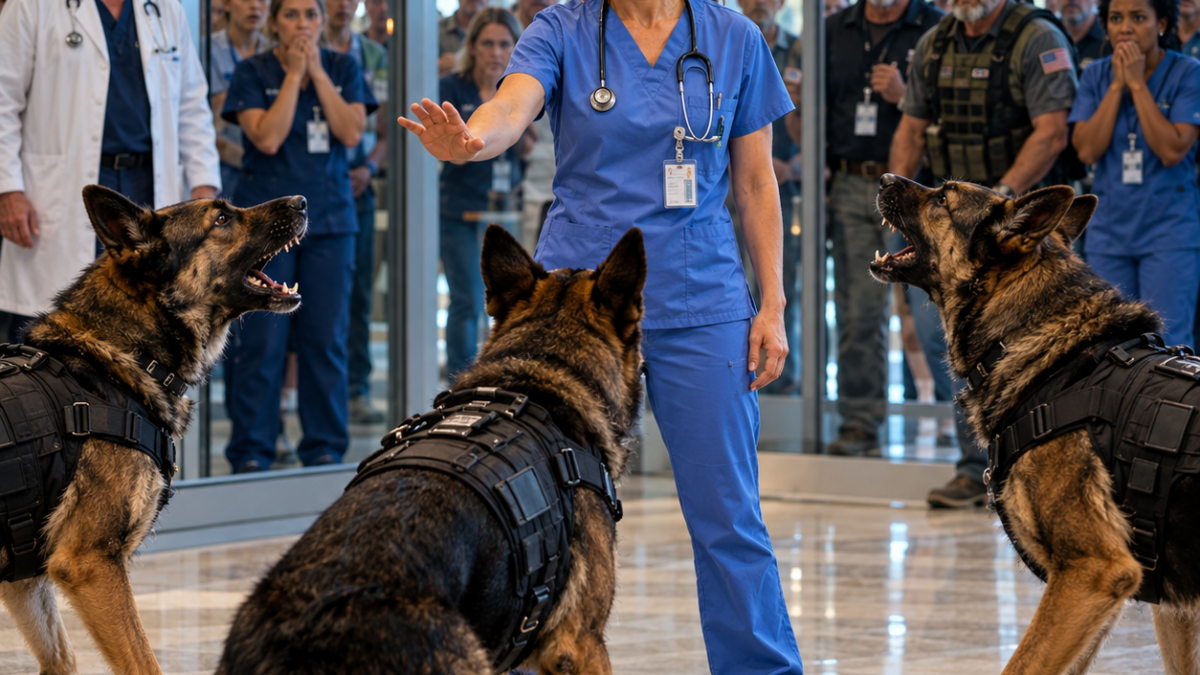
They Left the Quiet Nurse Alone With 3 Retired Military K9s Hoping She’d Fail—Then All 3 Dogs Sat at Attention and Revealed Her Secret Navy SEAL Medic Past.
PART2:
No jewelry except a plain ring she wore on a chain beneath her scrub top.
Nobody at Walter Reed knew why.
Thirty-three years old.
New trauma nurse.
Quiet.
Dependable.
Almost irritatingly calm.
Patients loved her.
That was obvious almost immediately.
One elderly Vietnam veteran arrived after falling at home and fracturing his wrist.
He was combative with transport.
Combative with radiology.
Combative with the resident.
Then Olivia sat beside him.
Not above him.
Beside him.
She noticed his hearing aids were in their plastic case on the bedside table.
She put them in his hand.
Waited.
When he could hear again, his entire personality seemed to change.
“You people keep talking like I’m dead.”
he said.
Olivia smiled.
“You’re very inconveniently alive, sir.”
PART3:
He laughed.
Then let the resident examine him.
A seven-year-old boy whose father had been injured during training refused to stop crying in the emergency waiting area.
Olivia knelt on the floor.
Did not tell him to be brave.
Did not say everything would be okay.
She asked:
“Do you want to know what’s happening next?”
He nodded.
So she explained.
Simple words.
No false promises.
His breathing slowed.
Another patient, a wounded Army captain recovering from a complicated infection, called her “the nurse who actually listens before she answers.”
That reputation spread faster among patients than staff.
Among coworkers, Olivia caused confusion.
She never complained.
That sounds like praise.
In hospitals, it can become dangerous.
A person who never says no gradually becomes the person everyone asks.
“Olivia, can you restock trauma two?”
“Sure.”
“Could you check the blanket warmer?”
“Of course.”
“Could you help transport Mr. Bailey?”
“Yes.”
“Environmental services is behind. Can you wipe down the observation glass?”
“No problem.”
“Supply room needs organizing.”
“I’ll take care of it.”
“Can you stay another twenty minutes?”
“Yes.”
“Can you cover lunch?”
“Yes.”
Every yes made the next request easier.
Charge nurse Kelly Martinez noticed first.
Kelly had been at Walter Reed nine years.
She was thirty-eight, sharp-eyed, fast-talking, and completely incapable of watching something unfair happen quietly.
One afternoon, she found Olivia kneeling inside a supply closet rearranging boxes of IV tubing.
“You know you can say no.”
Olivia glanced over her shoulder.
“I know.”
“Then I’m confused.”
“About?”
“Why you never do.”
Olivia put another box on the shelf.
“Because this needed doing.”
“That isn’t what I asked.”
“It’s my answer.”
Kelly folded her arms.
“You were hired as trauma nurse.”
“I am a trauma nurse.”
“You’re also currently inventorying gauze because somebody else didn’t feel like doing it.”
Olivia smiled.
“It’s gauze, Kelly.”
“That’s how it starts.”
“How what starts?”
“People deciding your time belongs to them.”
Olivia paused.
That sentence landed somewhere.
Kelly saw it.
“So you do understand.”
“Yes.”
“Then why?”
Olivia looked at the shelves.
“Because I’ve worked places where the person who says, ‘That’s not my job,’ can get somebody killed.”
Kelly’s expression changed.
She expected irritation.
Not that.
“Where did you work?”
Olivia picked up another box.
“A long time ago.”
“That is the least informative answer possible.”
“It answered the question.”
“No, it avoided one.”
Olivia smiled again.
Kelly pointed at her.
“One day I’m going to find out what your deal is.”
“I don’t have a deal.”
“Everyone has a deal.”
Then Dr. Victor Langford walked past.
He heard only the last sentence.
“Bennett.”
Olivia immediately stood.
“Yes, Doctor?”
“Trauma room three needs turnover.”
“Environmental services said they’re ten minutes out.”
“I’d prefer it now.”
Kelly opened her mouth.
Olivia spoke first.
“I’ll handle it.”
Langford nodded.
“Good.”
He walked away.
Kelly stared after him.
Then at Olivia.
“See?”
“What?”
“He doesn’t ask anybody else like that.”
Olivia removed gloves.
“He asked me.”
“No.”
Kelly lowered her voice.
“He picked you.”
That difference would matter later.
Dr. Victor Langford was not a stupid man.
Not cruel in the theatrical sense either.
That made him harder to recognize.
He had led one of the emergency departments at Walter Reed for almost fifteen years.
Brilliant physician.
Demanding.
Disciplined.
Fast.
He could read trauma imaging in seconds.
Could stabilize chaos when three ambulances arrived at once.
Could tell whether a resident was panicking even when the resident did not know yet.
People respected him.
Some feared him.
Langford believed in hierarchy because hierarchy had saved lives.
Clear command.
Clear roles.
Clear expectations.
The problem was that he had begun confusing confidence with competence.
Volume with authority.
Silence with uncertainty.
When Olivia joined the trauma department, he noticed she did not perform confidence the way he expected.
She did not interrupt.
Did not argue for attention.
Did not describe herself.
Did not display credentials beyond what was required.
Never told stories about impressive cases.
Never corrected people unless patient safety required it.
Langford interpreted that as softness.
In the first month, he told another physician:
“Bennett’s technically solid.”
“But?”
“She doesn’t have edge.”
Dr. Aaron Hughes looked at him.
“She has excellent patient outcomes.”
“That’s not leadership.”
“She isn’t applying to run the Pentagon.”
“This is Walter Reed.”
“She’ll encounter strong personalities.”
Aaron smiled.
“Victor, she works with us.”
“That proves the point.”
Langford did not laugh.
He sincerely believed Olivia needed hardening.
So he tested her.
Small ways.
Extra assignments.
Unpleasant tasks.
Responsibility beneath her role.
Sometimes responsibility above it.
He waited for complaint.
None came.
That irritated him more.
People who want you to resist sometimes grow angry when you do not give them the performance they expected.
Olivia completed every task.
Then went back to patients.
The housekeeping staff adored her.
Not because she cleaned.
Because she never treated cleaning as humiliation.
One elderly custodian named Mr. James found her replacing a trash liner one evening.
“You know they pay me for that.”
he said.
“I know.”
“So why are you doing it?”
“You were helping transport.”
Mr. James narrowed his eyes.
“You trying to take my job?”
“I don’t think I’m competitive.”
He laughed.
She always said good morning.
Knew names.
Knew whose daughter had started college.
Whose wife was undergoing chemo.
Which orderly preferred tea instead of coffee.
She remembered people because she had spent years in environments where remembering details could matter.
Nobody knew that part.
Not yet.
Her past remained carefully folded.
Like a uniform in a box.
Before nursing school, Olivia had served eight years in the United States Navy.
Not in an ordinary hospital assignment.
She had been trained as a special-operations combat medic and eventually attached to Naval Special Warfare support units during multiple overseas deployments.
The exact titles had changed over time.
Medical technician.
Independent-duty support.
Combat casualty care.
What mattered less than what she actually did.
She worked where conventional hospital rules met dust, darkness, rotor wash, blood, and distance.
She treated operators.
Sailors.
Partner-force personnel.
And military working dogs.
Especially dogs.
That part happened almost accidentally.
Her first K9 patient had been a Belgian Malinois named Torch.
Afghanistan.
Blast injury.
Handler wounded.
Veterinary support hours away.
Olivia stabilized both.
After that, handlers began remembering the quiet medic who did not treat working dogs like equipment.
She learned canine trauma protocols.
Heat injury.
Paw injuries.
Dehydration.
Penetrating trauma.
Anxiety after explosive events.
She worked alongside veterinary teams whenever possible.
But what people remembered was not her technical skill.
It was what happened afterward.
After the mission.
After surgery.
After everybody important went to sleep.
Olivia sat with dogs that could not understand why their handler was missing.
Dogs that startled at metallic noise.
Dogs that refused food.
Dogs who had spent years learning that commands meant safety, only to return from missions carrying something no command could switch off.
Titan had been one of those dogs.
Black-and-tan German Shepherd.
Large.
Focused.
Amber eyes.
Lead dog by temperament even before he earned official position.
He had served in explosive-detection work.
Never dramatic.
Never reckless.
Titan entered a room like he had already mapped every exit.
The first time Olivia met him, his handler had been evacuated after a blast.
Titan had no serious physical injury.
But he refused to settle.
Paced for hours.
Snapped toward anyone reaching too quickly.
Olivia did not command him.
She sat twelve feet away.
Read medical notes.
Ignored him.
Eventually Titan stopped pacing.
Lay down.
The next day, she did it again.
On the third day, he slept.
Shadow was different.
Sable German Shepherd.
Broad shoulders.
Intense.
The kind of dog junior handlers thought hated them until they learned he simply considered affection inefficient.
Shadow had experienced a vehicle rollover during deployment.
No major injury.
But afterward, every time somebody closed a metal door, he stiffened.
Olivia started finding him outside the medical tent during afternoon breaks.
He would stand near entrance.
Not approach.
Just wait.
She began bringing water outside.
One day she said:
“You don’t have to like me.”
Shadow sat.
That became their relationship.
Rex was oldest.
Black and tan.
Graying early around muzzle.
Gentler.
But loud rooms overwhelmed him after years around aircraft and blast noise.
Rex had once refused to enter a treatment building after hearing a metal tray crash.
Olivia sat outside beside him for forty minutes.
No leash pressure.
No command.
Just quiet.
Eventually he walked in behind her.
The three dogs served separate missions.
Different handlers.
Different years.
But all passed through the same rehabilitation rotation between deployments.
And all knew Olivia.
Handlers joked:
“You’re running an unofficial canine therapy unit.”
Olivia answered:
“They’re running one on me.”
Then there had been the final trust evaluation.
She had nearly forgotten that.
Before Titan, Shadow, and Rex transitioned out of active operational schedules, a behavioral team conducted one last unstructured observation.
Large training field.
Dogs released individually.
No handlers beside them.
No commands.
Multiple familiar personnel around perimeter.
Olivia happened to be there.
Titan found her first.
Sat near her boot.
Shadow came next.
Then Rex.
All three stayed.
For almost an hour.
No treats.
No commands.
Nobody understood why.
The senior handler at the time, Master Chief Daniel Reeves, did.
“They know who stayed after everybody else went to bed.”
he said.
Olivia hated the attention.
“Don’t make this weird.”
“It’s already weird.”
“I gave them water.”
“You gave everybody water.”
“Exactly.”
“You still don’t understand why people remember you.”
She did not.
Maybe she never fully would.
After eight years, Olivia left Navy service.
Not because she hated it.
Because the last deployment took too much.
A teammate died during an operation Olivia had helped support medically.
Then a dog named Mercer died in surgery after a catastrophic injury.
She carried both losses badly.
A commanding officer suggested instructor duty.
Olivia instead chose nursing school.
She wanted patients whose next hour depended on medicine, not gunfire.
She wanted fluorescent lights.
Stable walls.
Clean floors.
Ordinary emergencies.
Most of all, she wanted to stop being “the medic.”
So she did not talk about military service.
Not ashamed.
Not secretive in any official sense.
She simply wanted the present to stand on its own.
When people asked where she trained, she named nursing school.
When they asked why she was so calm in trauma, she said:
“Practice.”
When they asked whether she had ever worked with working dogs, she said:
“A little.”
Which is why, the afternoon Dr. Langford decided to teach her a lesson, nobody understood what he was actually arranging.
Three retired military working dogs arrived at Walter Reed for wellness evaluation.
Titan.
Shadow.
Rex.
They were part of a developing veterans’ rehabilitation initiative involving retired military K9s.
Handlers brought them through side entrance.
Reeves was there.
Older now.
More gray.
Still carried himself like the room had corners nobody else noticed.
Langford met them.
“Good afternoon.”
“Doctor.”
“Routine exams?”
“Mostly.”
Reeves rested one hand near Titan’s harness.
“Joints.”
“Dental.”
“Mobility.”
“Rex has been stiff lately.”
Langford nodded.
Then looked through observation-room window.
Olivia was inside cleaning glass.
He had reassigned her trauma shift.
Kelly had argued.
Langford ignored her.
His plan began as irritation, not malice.
He thought Olivia’s endless willingness made her naïve.
He wanted discomfort to teach boundaries.
In his mind, leaving her briefly with three aloof retired K9s would demonstrate that not every situation could be solved by quiet kindness.
Later, that explanation would embarrass him more than the act itself.
Because cruelty often sounds smaller when people narrate it internally.
“A lesson.”
“A test.”
“Building resilience.”
Words can make humiliation feel educational.
Langford turned to Reeves.
“I need signatures from the handlers.”
“Fine.”
“Could you step out for a few minutes?”
Reeves frowned.
“The dogs stay with us.”
“It will only be a minute.”
Langford smiled.
“Nurse Bennett will remain.”
Reeves looked through glass.
Olivia was stacking cleaning supplies.
“Does she have military working-dog experience?”
Langford shrugged.
“She says she’s worked with dogs a little.”
Reeves did not like that answer.
“These aren’t aggressive.”
“But they’re selective.”
“They don’t usually accept unfamiliar people immediately.”
“Then it’ll be useful experience.”
Reeves studied him.
“What exactly are you trying to accomplish?”
Langford smiled.
“Nothing dramatic.”
That should have ended it.
Reeves later admitted he regretted agreeing.
But Titan and the others were stable.
Handlers remained feet away.
Observation glass.
No real physical risk.
They stepped into hall.
Door closed.
Outside, staff noticed.
Kelly arrived first.
“What is this?”
One veterinary tech whispered:
“Langford asked handlers out.”
Kelly stared through glass.
Olivia stood alone.
Thirty feet away, Titan lifted his head.
Shadow followed.
Rex opened his eyes last.
“Open the door.”
Kelly said.
Langford folded his arms.
“They’re trained dogs.”
“That’s not what worries me.”
“Bennett needs to learn not to volunteer for everything.”
Kelly turned.
“You did this intentionally?”
Langford did not answer.
Which was an answer.
Inside, Olivia saw the dogs.
Actually saw them.
Not as three German Shepherds.
Not as military K9s.
As faces from another life.
Titan first.
The silver around his muzzle surprised her.
Shadow broader.
Older.
Rex gray enough around face that for a second she doubted herself.
Her chest tightened.
Eight years collapsed.
Dust.
Medical tent.
Rotor wash.
Night.
A hand on her shoulder from somebody no longer alive.
Titan rose.
One step.
Olivia did not move.
Shadow followed.
Rex waited.
Outside, the senior handlers leaned closer to glass.
Kelly whispered:
“Why aren’t they barking?”
“They usually don’t bark at strangers.”
Reeves said.
“What do they do?”
“Ignore them.”
Titan stopped six feet away.
Olivia breathed.
Then smiled.
Very slightly.
“You’re still leading the team.”
Titan’s ears lifted.
Reeves froze.
“What did she say?”
Kelly looked at him.
“You heard her.”
“That isn’t what I mean.”
Titan walked forward.
Then sat.
Straight.
Chest high.
Perfect military posture.
Olivia’s eyes filled immediately.
“Of course you are.”
Shadow sat beside him.
Then Rex.
Three German Shepherds in a line.
Outside, one handler whispered:
“No.”
Another said:
“What?”
“They haven’t done that together in years.”
Kelly looked between them.
“What does it mean?”
Reeves did not answer immediately.
He was staring at Olivia’s posture.
She had changed.
Not dramatically.
Shoulders squared.
Chin lifted.
Weight balanced.
Something old returned automatically.
Reeves stepped closer.
“I know that stance.”
Langford laughed nervously.
“Dogs sit.”
Reeves turned.
“Not like that.”
Inside, Olivia knelt.
Slow.
No reaching over heads.
Back of hand forward.
Titan leaned.
Touched her once with nose.
Shadow followed.
Rex last.
Then Olivia said:
“Shadow.”
Handler beside Reeves inhaled sharply.
Kelly said:
“What?”
Reeves pointed.
“His chart doesn’t use that call sign.”
“It was retired years ago.”
Olivia looked at Rex.
“Oh, buddy.”
“You really went gray.”
Rex’s tail moved.
Once.
Then twice.
A younger nurse laughed softly.
Outside the room, staff began gathering.
Doctors.
Nurses.
Techs.
An orderly.
Mr. James from housekeeping.
Nobody had announced anything.
Hospitals sense unusual silence the same way forests sense storms.
People came.
Shadow rose.
Moved behind Olivia.
Stopped at her left.
Titan remained in front.
Rex settled at right.
Reeves whispered:
“Protective triangle.”
Kelly stared.
“They’re protecting her?”
“No.”
He smiled through tears.
“They’re placing themselves where they used to around somebody they considered part of the unit.”
Dr. Langford’s face changed.
Olivia looked around.
“You three still hate being separated.”
Titan’s tail moved.
Then she said one word.
“Team.”
All three dogs responded.
Immediate.
Not aggressive.
Not performative.
Titan relaxed.
Shadow lay down.
Rex settled against her foot.
Reeves covered his mouth.
One younger handler looked at him.
“Sir?”
Reeves whispered:
“It can’t be.”
Then:
“Bennett.”
He looked at the name badge through glass.
“Olivia Bennett.”
His eyes widened.
“Doc Bennett.”
Kelly heard.
“Doc?”
Reeves walked toward door.
Hand trembling.
Opened it.
Titan glanced toward him.
Then back to Olivia.
Reeves entered slowly.
Olivia stood.
They stared.
Years.
Memory.
Then Reeves smiled.
“Doc.”
Olivia laughed once.
“Master Chief.”
His eyes filled.
“You disappeared.”
“I changed careers.”
“You disappeared.”
“Same thing sometimes.”
Reeves shook his head.
Then he hugged her.
Carefully.
The hallway erupted in questions.
Kelly pushed closest.
“You know each other?”
Reeves stepped back.
“No.”
He looked down at dogs.
“They know her.”
Then corrected himself.
“We all do.”
Langford entered last.
Confused now.
“What is going on?”
Reeves turned.
“You left these dogs alone with Doc Bennett?”
“Yes.”
“Why?”
Langford hesitated.
“She’s Nurse Bennett.”
Reeves looked at Olivia.
“You didn’t tell them?”
“Tell us what?”
Kelly demanded.
Olivia sighed.
“This is going to get annoying.”
Reeves laughed.
Then faced hallway.
“Before she became a civilian trauma nurse, Olivia Bennett served in the United States Navy.”
Silence.
“She supported Naval Special Warfare medical operations for almost eight years.”
Kelly blinked.
“What kind of support?”
Olivia answered before Reeves could make it sound larger.
“I was a combat medic.”
Reeves corrected:
“She was one of the medics people asked for when things went bad.”
Olivia gave him a look.
“Daniel.”
“What?”
“I’m retired.”
“So am I.”
Several veterans nearby had instinctively straightened.
Langford stared.
“You were attached to SEAL units?”
“Among others.”
“For eight years?”
“Yes.”
“You never put that in conversation.”
Olivia almost laughed.
“It’s on my employment file.”
“I mean you never said anything.”
“No one asked.”
That sentence hit harder than an accusation.
Kelly looked at the dogs.
“How do they know her?”
Reeves placed one hand on Titan.
“Because people misunderstand military dogs.”
“They think service ends after the mission.”
“It doesn’t.”
He looked toward Olivia.
“Some come back with injuries.”
“Some don’t.”
“Some return physically fine and spend weeks unable to settle.”
“Handlers rotate.”
Veterinary teams rotate.”
“Operators debrief.”
“But Doc…”
Olivia shook her head.
“Don’t.”
Reeves ignored her.
“Doc stayed.”
He pointed at Rex.
“This one hated loud rooms after a rough deployment.”
“She sat outside with him until he came in.”
Rex leaned against Olivia’s leg.
Reeves pointed at Shadow.
“This one pretended he hated everyone.”
Olivia smiled.
“He still does.”
Shadow rested his head against her arm.
People laughed.
Then Titan.
Reeves became quieter.
“Titan lost his handler for almost a week during recovery after an operation.”
“Handler had to be transferred.”
“Titan stopped sleeping.”
“She sat across from him every night.”
Olivia looked at Titan.
“He didn’t need me.”
“He needed routine.”
Reeves shook his head.
“Still doing that.”
“What?”
“Making what you did sound smaller.”
Olivia said nothing.
Kelly looked like she might cry.
Then asked:
“Were you their trainer?”
“No.”
“Handler?”
“No.”
“Then why are they acting like this?”
Reeves smiled.
“Because dogs do not care what job title you had.”
“They remember who was safe.”
That line moved through hallway.
Even Langford heard it.
Especially Langford.
Then Reeves told them about final trust test.
Field.
No commands.
No handlers.
Dogs released.
Titan walked to Olivia.
Shadow followed.
Rex last.
All three stayed.
Kelly covered her mouth.
“All three?”
“Yes.”
“Why?”
Reeves looked at Olivia.
“Ask them.”
That was when Dr. Langford finally understood what he had done.
Not just placed an experienced veteran with familiar animals.
He had intentionally arranged a public failure for a staff member because her quietness offended his model of strength.
His face reddened.
He looked at nurses behind glass.
At Kelly.
At Olivia.
At dogs.
Then down.
“I owe you an apology.”
Olivia studied him.
Nobody spoke.
Langford stepped closer.
“When you started here, I misread you.”
Olivia said nothing.
“I thought your kindness meant you lacked confidence.”
Still nothing.
“I gave you tasks outside your role.”
“Cleaning.”
“Supply work.”
“Housekeeping.”
“I told myself I was testing your professionalism.”
“But I was taking advantage of the fact you never complained.”
Olivia’s expression stayed calm.
Langford swallowed.
“Today I left you in this room because I wanted you to fail.”
No one moved.
Kelly’s eyes filled with anger.
Langford continued before she could speak.
“I wanted to prove you couldn’t handle every situation by being calm and agreeable.”
“I wanted…”
He stopped.
Then said the honest version.
“I wanted to embarrass you.”
Olivia looked at him for a long moment.
Then:
“Yes.”
One word.
No softening.
That surprised everyone.
Langford nodded.
“You’re right.”
Olivia said:
“I know.”
Kelly almost smiled.
Langford continued.
“I’m sorry.”
Olivia looked down at Rex.
Then back.
“When I was in the Navy, I mopped floors.”
“I cleaned blood off walls.”
“I carried trash.”
“I held flashlights.”
“I hauled supplies.”
“I changed dressings.”
“I sat with dogs.”
“I sat with dying men.”
“There wasn’t a useful job beneath anybody when it needed doing.”
“That’s why I never minded cleaning your windows.”
Langford lowered his head.
“But.”
Olivia’s voice changed slightly.
Everyone heard.
“That did not make it acceptable for you to assign those jobs to me because you thought I was too weak to object.”
Langford met her eyes.
“No.”
“You weren’t teaching humility.”
“No.”
“You were testing whether I would tolerate disrespect.”
“Yes.”
Kelly looked at Olivia with something close to awe.
Not because Olivia was angry.
Because she was precise.
Olivia continued:
“My silence wasn’t permission.”
That became the sentence staff repeated later.
My silence wasn’t permission.
Langford extended his hand.
“I am sorry.”
Olivia stared at it.
Then shook.
“I accept your apology.”
“But we’re going to have a conversation with administration about how this happened.”
Langford nodded.
“Yes.”
Director Richard Coleman had already arrived.
He stood in hallway.
Listened.
Then stepped forward.
“You won’t need to schedule it.”
He looked at Langford.
“We’ll have that conversation today.”
No one cheered.
That mattered.
This was not humiliation changing direction.
It was accountability.
Coleman turned toward staff.
“I think this department just learned something expensive.”
Kelly whispered:
“Emotionally expensive.”
Coleman almost smiled.
Then:
“First.”
“Never mistake quiet for weakness.”
“Second.”
He looked at Titan, Shadow, Rex.
“Character is what remains visible when résumé, rank, title, and uniform are removed.”
Mr. James from housekeeping spoke from back.
“I already knew she was good.”
People laughed.
Olivia pointed.
“See?”
“He’s been ahead of all of you.”
Mr. James grinned.
“I always am.”
After the crowd dispersed, Olivia sat alone in break room.
Kelly found her twenty minutes later.
No dogs.
No handlers.
No audience.
Just Olivia holding coffee she had not touched.
Kelly sat.
“You okay?”
“Yes.”
“Liar.”
Olivia smiled.
“Mostly.”
“Why didn’t you tell me?”
“About Navy?”
“Yes.”
“You never asked the right question.”
“I asked a hundred questions.”
“You asked what my deal was.”
“That counts.”
“No.”
Kelly studied her.
“Were you trying to hide it?”
Olivia thought.
“No.”
“Then why?”
“Because everyone back then knew me as Doc Bennett.”
“When I left, I wanted to find out who Olivia was.”
“Without rank.”
“Without deployments.”
“Without being the person everybody brought things to when they were bleeding.”
Kelly nodded.
“And now?”
“Now I’m apparently still the person everybody brings dogs to.”
Kelly laughed.
Then grew serious.
“You know what bothered me most?”
“What?”
“He thought kindness meant you didn’t know you were being mistreated.”
Olivia stared into coffee.
“I knew.”
“Then why did you let it go so long?”
Long silence.
“Because after you’ve worked places where people die over real problems, small disrespect can feel too small to confront.”
Kelly waited.
Olivia continued.
“That sounds noble.”
“It isn’t always.”
“Sometimes it means you let people practice on you until they start doing it to somebody who can’t absorb it.”
Kelly leaned back.
“That sounds like something you’ve been thinking about.”
“Since the supply closet.”
“Good.”
“Because I was going to keep bothering you.”
“I know.”
The administrative review was not dramatic.
Dr. Langford was not fired.
That surprised some people.
Olivia did not ask for it.
He was formally reprimanded for inappropriate supervisory conduct and deliberately creating a humiliating scenario.
Mandatory leadership counseling.
His assignments were reviewed.
Work-distribution patterns examined.
Staff interviews.
Olivia’s reassignment authority moved temporarily to another physician.
Langford apologized publicly at the next department meeting.
No excuses.
That mattered more than punishment to Olivia.
He stood in front of everyone.
“I confused compliance with consent.”
He said.
“And I confused leadership with the right to test people personally.”
“That was wrong.”
He looked toward Olivia.
“She owed me competent nursing.”
“She did not owe me tolerance for disrespect.”
Kelly later whispered:
“Someone helped him write that.”
Olivia answered:
“Probably.”
“Still true.”
Over the next months, Langford changed.
Not overnight.
Real change is usually awkward.
He caught himself assigning Olivia extra tasks once.
Stopped mid-sentence.
“Never mind.”
Olivia looked at him.
“Does it need doing?”
“Yes.”
“Then ask the whole team.”
He did.
Another day, housekeeping fell behind.
Langford picked up disinfectant wipes himself.
Mr. James saw him.
Nearly dropped mop.
“Doctor?”
Langford kept wiping.
“I’m broadening my skill set.”
Mr. James laughed so hard he had to sit down.
Titan, Shadow, and Rex returned two weeks later.
This time no spectacle.
No observation-room test.
Reeves came to trauma department.
Olivia looked up from chart.
“Good morning, team.”
Three tails moved.
Exactly together.
A wounded Marine sitting nearby smiled for first time that morning.
That sparked the next idea.
Reeves had already been developing retired-K9 therapy programming.
Walter Reed administration accelerated it.
Every second Friday.
Retired military working dogs paired with handlers and rehabilitation specialists visited recovering service members.
Not entertainment.
Structured encounters.
Mobility patients.
Amputees.
Traumatic brain injury recovery.
PTSD support groups.
Families.
Children.
Olivia became clinical liaison.
At first she refused.
“I have a full job.”
Coleman said:
“This is part of it now.”
“I’m not becoming dog lady.”
Kelly, behind him:
“You’ve already become dog lady.”
“Leave.”
Titan became especially effective with patients who disliked therapy rooms.
He would sit at end of hallway.
Patients walked farther to reach him.
Shadow bonded with quiet veterans who did not want to talk.
Rex preferred wheelchairs.
He would place chin gently on knees.
One Army staff sergeant named Marcus Hall had lost his left leg below knee.
He had barely spoken since surgery.
Rex sat with him twenty minutes.
No commands.
Marcus finally said:
“He’s old.”
Olivia answered:
“So are you.”
“I’m thirty.”
“War years count double.”
Marcus laughed.
His physical therapist later said it was first joke in three weeks.
Olivia never called dogs magical.
She hated that language.
“They aren’t curing anybody.”
She told staff.
“They’re creating a moment where someone’s nervous system feels safe enough to try something.”
That was enough.
Months passed.
Then a year.
Titan slowed.
Arthritis.
Shadow developed mild hearing loss.
Rex’s hips worsened.
Olivia noticed every change.
The reunion story spread inside hospital.
Not publicly at first.
Eventually a military publication wrote a small piece.
Olivia agreed only if article focused on K9 retirement care and therapy program.
Reporter tried to frame her as secret hero.
She corrected him twice.
“I wasn’t secret.”
“I was private.”
Important distinction.
The article still called her “the medic the dogs never forgot.”
Kelly printed it.
Taped it to break-room fridge.
Olivia removed it.
Kelly printed another.
They continued three weeks.
One evening, Reeves and Olivia sat outside hospital after a K9 session.
Titan at his feet.
Sunset.
Washington traffic.
He asked:
“Why’d you really leave?”
Olivia knew what he meant.
Navy.
She exhaled.
“Mercer.”
Reeves nodded.
He remembered dog.
“Then Webb.”
The teammate.
“Yes.”
“You blamed yourself?”
“I was medic.”
“That’s not answer.”
“Yes.”
“Still?”
“Sometimes.”
Titan leaned against Olivia’s knee.
Reeves watched.
“You know what you used to tell handlers when dogs didn’t make it?”
Olivia said nothing.
“You’d tell them care isn’t failure just because outcome hurts.”
“That sounds irritating.”
“It was.”
“Sorry.”
“Your turn.”
She looked at him.
Reeves pointed toward hospital.
“You stayed in medicine.”
“That matters.”
“Different uniform.”
“Same instinct.”
Olivia looked at Titan.
“Maybe.”
Then Reeves said:
“You know why they remembered you?”
“Because I smelled like beef jerky.”
“No.”
“That helped.”
“It’s because you never treated them like tools.”
Olivia smiled.
“Dogs shouldn’t be tools.”
“Neither should people.”
That sentence followed her.
Especially at work.
She became better at saying no.
Not harshly.
Clearly.
“Olivia, can you handle supply inventory?”
“Not today.”
“Can you stay late?”
“No, I’m at hours limit.”
“Could you cover two units?”
“Not safely.”
At first, some people were surprised.
Kelly celebrated each refusal like a sporting event.
“YES.”
“Kelly.”
“Boundaries.”
“Please stop applauding.”
“Never.”
Olivia learned something she had not learned in military service.
Service without boundaries can become self-erasure.
Helping because something needs doing is noble.
Being chosen repeatedly because everybody assumes you will absorb the burden is not.
Titan, Shadow, and Rex had taught her that too.
Dogs are generous with trust.
They are not indiscriminate.
They choose.
One second-Friday morning, Titan did not come.
Reeves arrived with Shadow and Rex only.
Olivia saw space where Titan should have been.
Stopped.
“Where is he?”
Reeves’s face answered before words.
“Last night.”
Olivia looked down.
“No.”
“Heart.”
“Fast.”
“He was home.”
“With handler.”
“He didn’t suffer long.”
The hospital hallway continued.
Phones.
Carts.
Voices.
Olivia heard almost none.
Shadow stood beside her.
Rex sat.
She crouched.
Pressed forehead to Shadow’s.
For years, Titan had been the lead dog.
First to step forward.
First to recognize her.
First to sit.
Now absence had shape.
The therapy program canceled that day.
Olivia argued against it.
“Patients expect them.”
Reeves said:
“They’ll understand.”
“No.”
“Olivia.”
“I’m okay.”
Reeves looked at her.
“Your silence isn’t permission.”
Her own words.
She closed eyes.
“Fine.”
They sat in rehabilitation room.
Same room where Langford once tried to humiliate her.
Shadow on one side.
Rex other.
No audience.
Langford came quietly.
Stopped at door.
“I heard.”
“Yes.”
“I’m sorry.”
“Thank you.”
He hesitated.
“Can I sit?”
Olivia looked up.
“Sure.”
He sat against wall.
No speech.
No lesson.
Ten minutes.
Then left.
That was when Olivia understood he had actually changed.
Not because he apologized.
Because he had learned when not to make himself central.
Titan’s memorial was small.
Handlers.
Staff.
A few patients.
Olivia refused microphone at first.
Then Reeves asked.
She stood.
“I don’t think dogs care about speeches.”
People smiled.
“Titan spent his life being described by what he could do.”
“Detect.”
Track.”
“Protect.”
“Lead.”
“All true.”
“But what I remember is what he did when there was nothing to accomplish.”
“He stayed.”
“Sometimes that is the hardest work.”
That was all.
Rex died the following year.
Old age.
Shadow lasted longest.
By then, Olivia had become assistant trauma coordinator.
Not because her Navy past suddenly made her leadership material.
That would have insulted everything.
She earned it at Walter Reed.
Patients.
Decisions.
Boundaries.
Teams.
Langford recommended her.
The promotion committee asked:
“What is your leadership philosophy?”
Olivia nearly laughed.
Then said:
“Make sure quiet people do not have to become loud before anyone notices what they’re carrying.”
She got the job.
Shadow continued therapy visits.
Older.
Slower.
One Friday, he entered trauma department.
Olivia said:
“Good morning, team.”
Only one tail wagged.
It hurt.
Still beautiful.
A young nurse watched Shadow walk directly to Olivia.
“Is that the dog from the story?”
Kelly answered from station:
“Yes.”
Olivia gave her look.
“What story?”
Kelly ignored.
“The three K9s.”
“The room.”
“The secret Navy medic.”
Olivia sighed.
“Please stop introducing me like an urban legend.”
Young nurse stared.
“You were really Navy special operations?”
Olivia looked at her.
“I was a medic.”
“That’s so cool.”
“Sometimes.”
“Why didn’t you tell anyone?”
Olivia smiled.
“You’re new.”
“Yes.”
“Give it time.”
Then she asked the young nurse:
“How’s your assignment load?”
The nurse hesitated.
“Fine.”
Kelly and Olivia both heard the hesitation.
Olivia put down chart.
“What happened?”
“Nothing.”
“Try again.”
The young nurse admitted she had been given extra cleanup tasks.
Supply errands.
Nonclinical responsibilities.
By a resident who assumed she would say yes.
Olivia listened.
Then said:
“We’ll fix that.”
No drama.
No dog reveal.
No badge.
No military history.
Just leadership.
That was probably the most important outcome of the whole story.
Not that three dogs exposed a hidden hero.
Olivia hated being called hero.
The important outcome was that somebody who had tolerated disrespect learned not to let the same pattern settle on people coming after her.
Shadow eventually died at sixteen.
Reeves called before sunrise.
Olivia sat on kitchen floor with phone.
Cried.
Then went to work.
Not because grief did not matter.
Because work still did.
That afternoon, she walked into rehabilitation room.
Three framed photographs now hung on wall.
Titan.
Rex.
Shadow.
No medals.
No dramatic captions.
Just names.
Service years.
Retirement years.
Underneath, small plaque:
THEY REMEMBERED WHO STAYED.
Olivia had argued against plaque.
Kelly won.
Of course.
Dr. Langford retired two years later.
At his farewell reception, he asked Olivia to speak.
She refused.
Then Kelly volunteered her anyway.
Olivia stood near podium.
Langford sat front row.
She said:
“Dr. Langford and I did not begin well.”
Laughter.
He covered face.
“That’s enough.”
“No.”
She smiled.
“He taught me something important.”
Langford looked suspicious.
“What?”
“That apologies are only meaningful if your behavior becomes inconveniently different afterward.”
The room laughed.
Langford nodded.
“Fair.”
Olivia continued.
“He changed.”
“He listened.”
“He became better.”
“That matters more to me than pretending good leaders never fail.”
Then she looked at him.
“Thank you.”
Langford’s eyes watered.
He stood.
Hugged her.
Later, Kelly whispered:
“You went easy.”
“He’s retiring.”
“Exactly.”
“Missed opportunity.”
Olivia laughed.
Years after the afternoon with the three dogs, people at Walter Reed still told the story incorrectly.
Stories get cleaner with repetition.
They said Dr. Langford locked a helpless nurse inside with dangerous military dogs.
Not true.
The dogs were never dangerous.
They said the K9s saluted.
Not literally.
They sat at attention.
They said Olivia had secretly commanded them overseas.
She had not.
They said she was a SEAL.
She was not.
She had served as a Navy special-operations combat medic supporting those teams.
They said the dogs saved her career.
Her career did not need saving.
What happened was both smaller and more meaningful.
A group of coworkers had built an opinion about a quiet person.
Then three old dogs walked into a room and revealed that opinion was incomplete.
The animals did not understand hospital hierarchy.
They did not know who headed emergency medicine.
Did not care who cleaned windows.
Did not care who had a louder voice.
Did not understand the social embarrassment Langford had designed.
They recognized scent.
Posture.
Memory.
Safety.
A person.
That stripped everything down.
Years later, a resident asked Olivia:
“Do you think dogs can judge character better than people?”
Olivia smiled.
“No.”
The resident looked disappointed.
“Really?”
“Dogs make mistakes too.”
“They respond to experience.”
“Training.”
“Association.”
“So what did those three know?”
Olivia thought.
“They knew who I had been to them.”
“That’s all.”
“That seems like character.”
“Maybe.”
“Or maybe character is what you become through enough small moments that someone remembers you years later.”
The resident wrote that down.
Olivia noticed.
“Don’t quote me.”
“Too late.”
She laughed.
She was forty-one then.
More gray in hair.
Still early.
Still first to notice patients who could not hear instructions.
Still remembered housekeeping staff names.
Still cleaned something occasionally when everybody else was busy.
Difference was she no longer allowed anyone to confuse willingness with obligation.
That mattered.
The old rehabilitation-room door was eventually replaced.
Observation glass renovated.
Floors changed.
Hospitals rebuild themselves constantly.
The exact room where Titan, Shadow, and Rex recognized Olivia no longer looked the same.
But every second Friday, the therapy program continued with new retired dogs.
New handlers.
New patients.
New stories.
Olivia never expected another reunion like the first.
You do not get many moments that perfect.
That is probably good.
Perfect moments are terrible things to build a life around.
She preferred ordinary ones.
A veteran smiling.
A child touching a German Shepherd’s ear.
A patient walking five extra steps because a dog waited there.
A nurse saying no without apologizing.
A physician asking instead of ordering.
Mr. James retiring after thirty-two years and receiving a standing ovation because Olivia made sure housekeeping staff were included.
Those things lasted.
One morning, Kelly found Olivia standing beneath the three photographs.
“What are you doing?”
“Nothing.”
“Thinking?”
“Unfortunately.”
“About them?”
“Yes.”
Kelly stood beside her.
Titan.
Rex.
Shadow.
“You know what I used to think that day was about?”
Olivia smiled.
“The dogs?”
“Yep.”
“What do you think now?”
Kelly considered.
“I think they embarrassed an entire building by being better listeners than we were.”
Olivia laughed.
“That’s dramatic.”
“It’s true.”
“They didn’t listen.”
“You know what I mean.”
Olivia looked at Titan’s photograph.
“Maybe.”
Kelly continued.
“They saw you.”
“We saw what was convenient.”
“The quiet nurse.”
“The woman who always said yes.”
“The person Langford could give extra work.”
“Then the dogs walked in and suddenly everyone wanted your biography.”
Olivia nodded.
“That bothered me.”
“I know.”
“Why?”
“Because nothing about my worth changed when people learned I served.”
“Nothing changed when Reeves called me Doc.”
“Nothing changed when they learned about SEAL teams.”
“I was the same person five minutes earlier.”
Kelly stared at her.
“That’s probably the actual lesson.”
“Yes.”
Olivia touched edge of frame.
“The badge was never the point.”
“What badge?”
“Figure of speech.”
Kelly smiled.
Olivia continued.
“People shouldn’t need a hidden impressive past before we decide they deserve respect.”
“Mr. James didn’t need to be a retired colonel before I said good morning.”
“The new nurse doesn’t need to be secretly decorated before we stop dumping work on her.”
“Quiet people don’t need a reveal.”
“They need people to pay attention.”
Kelly nodded.
“Okay.”
“What?”
“That’s the speech.”
“What speech?”
“For hospital leadership conference next month.”
“No.”
“I already volunteered you.”
“Kelly.”
“Boundaries.”
Olivia closed eyes.
“You are the reason boundaries exist.”
Kelly grinned.
The conference speech became popular internally.
Olivia titled it:
NO REVEAL REQUIRED.
The first slide showed no dogs.
Just a sentence.
RESPECT SHOULD NOT DEPEND ON DISCOVERING SOMEONE WAS MORE IMPRESSIVE THAN YOU ASSUMED.
The final slide showed Titan, Shadow, Rex.
Not in working gear.
Retired.
Gray.
Resting.
Underneath:
THEY REMEMBERED CHARACTER BEFORE ANYONE ASKED FOR CREDENTIALS.
Olivia spoke for twenty-two minutes.
No dramatic storytelling.
Mostly leadership.
Workload.
Quiet employees.
Invisible labor.
Professional boundaries.
The way organizations unintentionally reward the loudest self-narrators.
The risk of misreading humility as lack of ability.
At the end, one administrator asked:
“Would you have changed anything about that day?”
Olivia thought.
“Yes.”
“What?”
“I would have said no sooner.”
“To the room?”
“No.”
“To being mistreated.”
That answer became more useful than the story itself.
Because the most important lesson the dogs taught Olivia was not about loyalty.
It was about trust.
Trust is not passive.
Titan trusted Olivia because she had been predictable.
Shadow trusted her because she never forced contact.
Rex trusted her because she respected fear without humiliating him.
Years later, those same principles became how she led humans.
Be predictable.
Do not use authority to force closeness.
Do not humiliate people for needing time.
Do not interpret silence as agreement.
Do not confuse obedience with trust.
Dr. Langford had done exactly that.
He saw Olivia obey.
Assumed she trusted him.
She did not.
Not yet.
After he changed, she did.
That took time.
Years after retirement, Langford returned as a patient.
Minor cardiac event.
Stable.
Embarrassed.
Olivia happened to be on duty.
She entered.
He stared.
“No.”
She smiled.
“Yes.”
“Is there another hospital?”
“Several.”
“Transfer me.”
“Too late.”
He laughed.
Then winced.
“Don’t make me laugh.”
“I’ll add it to care plan.”
She checked monitor.
Reviewed chart.
Langford watched.
“You know.”
“What?”
“I still think about that room.”
“So do I.”
“I was an ass.”
“Yes.”
“I expected more resistance.”
“That was part of the problem.”
“I know.”
He looked at her.
“Thank you for letting me become better than that mistake.”
Olivia adjusted IV line.
“You did the work.”
Then:
“And I didn’t do it for you.”
“What?”
“Forgiveness.”
“I did that for myself.”
He nodded.
“Fair.”
Before discharge, Langford asked:
“Any dogs today?”
“No.”
“Shame.”
“Titan would’ve hated you.”
Langford stared.
Then Olivia smiled.
“He would’ve ignored you.”
“That’s worse.”
They laughed.
He went home.
Olivia stood in hallway afterward thinking about how strange life was.
The man who once tried to humiliate her had become a patient who trusted her.
The dogs who revealed her past were gone.
The room was gone.
Reeves had retired to North Carolina.
Kelly was still Kelly.
Time moved.
But some truths became clearer.
Kindness was never weakness.
Silence was never surrender.
Service was never permission for exploitation.
And respect should never arrive only after somebody uncovers a résumé impressive enough to shame themselves.
When Olivia was fifty, Walter Reed celebrated the therapy program’s fifteenth year.
Photographs covered one hallway.
Veterans.
Retired K9s.
Children.
Handlers.
Staff.
At center was an old image somebody had taken through observation glass.
Olivia kneeling.
Titan in front.
Shadow left.
Rex right.
The protective triangle.
She hated photograph.
Kelly loved it.
Of course.
At anniversary event, a young reporter asked:
“What were you thinking in that exact moment?”
Olivia looked at picture.
Everyone expected:
I knew they remembered me.
Or:
I felt proud.
Instead she said:
“I was thinking Titan had gotten old.”
Reporter laughed.
“That’s it?”
“Mostly.”
Then Olivia became serious.
“And I was thinking how strange it was that dogs I hadn’t seen in years recognized me before people who saw me every day had bothered to know me.”
The reporter stopped smiling.
That was the sentence he used.
Olivia allowed it.
Because by then she understood story no longer belonged only to her.
New nurses heard it.
New doctors.
New handlers.
Not as legend.
As warning.
The quiet person in your department may not have a secret military past.
Probably does not.
That is irrelevant.
You should not need dramatic proof before treating them with dignity.
You should not need three German Shepherds to tell you somebody’s kindness is intentional strength.
You should not need a hidden rank to learn that the custodian, nurse, orderly, technician, resident, veteran, patient, or stranger in front of you carries a life you cannot see.
Olivia never stopped arriving early.
Not 5:42 forever.
Age eventually negotiated with discipline.
But she remained early.
One morning, years after the three original K9s were gone, a new retired military dog named Archer came through the trauma department.
Young compared with the others.
Recently retired.
Nervous.
He stopped outside Olivia’s office.
Would not enter.
Handler encouraged.
Nothing.
Olivia stepped into hall.
Sat against wall.
Did not call him.
Did not reach.
Just waited.
A young nurse watched.
“How long will you sit there?”
Olivia smiled.
“As long as it takes.”
“Do you think he remembers you?”
“No.”
“Then why would he come?”
Olivia looked at Archer.
“He doesn’t have to remember me.”
“He just has to decide I’m safe.”
Ten minutes.
Fifteen.
Twenty.
Archer walked closer.
Sat beside her.
The young nurse smiled.
“Looks like you still have it.”
Olivia scratched gently beneath Archer’s chin.
“No.”
She said.
“You still don’t get it.”
“What?”
“It isn’t something I have.”
“It’s something I do.”
That may have been the clearest explanation of her entire life.
Not hidden greatness.
Not secret power.
Not some mystical connection.
Behavior repeated.
Patience repeated.
Respect repeated.
Staying repeated.
Titan, Shadow, and Rex had not remembered her because she once wore a uniform.
They remembered what happened when that uniformed woman entered a room.
She did not force.
Did not rush.
Did not leave when things became inconvenient.
That was all.
That was everything.
Dr. Langford had wanted to teach Olivia Bennett a lesson by leaving her alone with three military K9s.
Instead, Titan, Shadow, and Rex walked across the room and taught everyone outside the glass something he had been too proud to notice.
The quiet nurse was not quiet because she had nothing to say.
She was quiet because she had already lived through places where noise meant very little and actions meant everything.
Her willingness to clean a window did not make her less qualified to run a trauma room.
Her kindness did not make her weak.
Her humility did not erase discipline.
Her silence did not give anyone permission to disrespect her.
And the three dogs did not make Olivia extraordinary that afternoon.
They simply remembered something the humans around her had failed to notice.
She already was exactly who she had been showing them all along.

