They Built Their Dream Home on My Land While I Was Gone — Then the Court Order Arrived With a Demolition Crew
They Built Their Dream Home on My Land While I Was Gone — Then the Court Order Arrived With a Demolition Crew
They waited until I was ten hours away from home, caring for my injured brother, before they poured concrete across the land I had spent eight quiet years protecting.
They called it a misunderstanding, then tried to shame me in front of half the county for refusing to sell them the piece of my life they had already stolen.
But when the demolition crew rolled down my gravel driveway, every lie they had built into that foundation finally cracked wide open.
The first sound I remember was the crunch of my tires on the gravel road.
That slow, familiar sound had always meant I was home.
For eight years, it had been the sound of peace. It meant I had left the highway behind, left gas stations and traffic lights and the tired noise of other people’s urgency behind, and was almost back to the five acres I bought because I wanted quiet more than I wanted convenience.
But that afternoon, after ten hours on the road and ten days away helping my younger brother in Tennessee after surgery, the gravel sounded different.
Sharper.
Wrong.
The birds were quiet.
The air smelled like wet clay and diesel.
Fresh tire tracks cut through my grass where no tires had any business being. Deep tracks, heavy tracks, the kind made by work trucks and loaded trailers. They crossed my field in a lazy diagonal, crushing the grass flat, turning the soft ground into ruts. Near the edge of my driveway sat a stack of wrapped lumber, white plastic torn at one corner, like somebody had delivered a construction project to the wrong man’s land and expected me to be grateful.
I slowed the truck.
My hands tightened around the steering wheel.
For one confused second, I thought maybe I had turned into the wrong driveway. Exhaustion can do that to a man. Ten hours behind the wheel, gas station coffee, an aching shoulder from lifting my brother in and out of chairs, and a mind full of hospital smells and insurance calls can make the familiar feel strange.
But it was my driveway.
My mailbox was there, leaning a little to the left the way it had since the county snowplow clipped it three winters earlier.
My old farmhouse sat beyond the bend, pale blue siding weathered by sun and rain, porch swing moving slightly in the wind.
My oak trees stood along the eastern line.
My land.
Then I saw the concrete.
Fresh concrete.
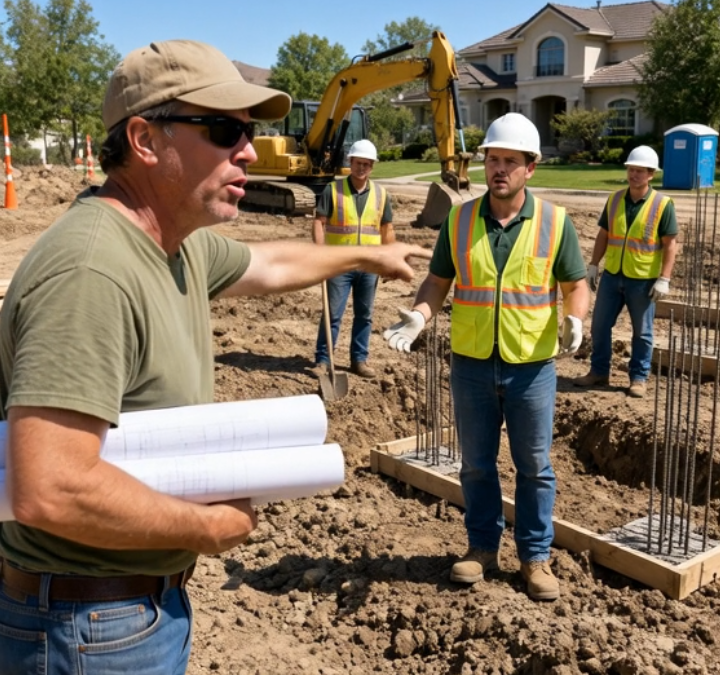
A wide square slab poured in the field near my driveway, wooden forms still nailed around the edges, rebar sticking up like rusted antennae waiting for walls. The surface was pale and new, still damp in patches, with boot prints near the edges and a few muddy handprints where workers had leaned on the forms. Orange spray paint marked corners. Plumbing stubs protruded from the slab like broken bones.
For a few seconds, my brain refused to accept what my eyes were showing me.
PART2:
There is no normal reason to find a foundation on your property when you did not pour it.
There is no polite explanation for someone else’s concrete sitting several feet inside your boundary line.
There is no version of “neighborly misunderstanding” that involves rebar.
I parked in the middle of the driveway and got out.
The ground was torn up.
Mud clung to my boots.
Generator noise hummed somewhere beyond the tree line. A compressor coughed. Nail guns popped in the distance like the world had decided to keep building before asking whether it had the right.
Somewhere nearby, workers were laughing.
That was the part that settled deepest in my chest at first. Not the concrete. Not even the tire tracks. The laughter. That easy sound of men working on a job site as if nothing unusual had happened, as if no line had been crossed, as if nobody had come home from a hard week to find strangers had decided where his land ended.
I stood there with my hands hanging at my sides, staring at that slab, and felt something inside me go very still.
Not rage.
Not yet.
Stillness.
The kind that comes right before a man understands he is being tested.
My name is Adam Whitaker, and I bought those five acres outside Mason Ridge, Missouri, because I was tired of being crowded.
Not in some dramatic way. I did not hate people. I did not want to live in a bunker or start wearing camouflage to the grocery store. I was not one of those men who thought every vehicle slowing near his property was a threat. I helped neighbors pull trucks from ditches in winter. I waved at the mail carrier. I gave extra tomatoes to the woman down the road who made salsa every August.
I just wanted space.
No HOA president measuring my grass.
No neighbor complaining because my trash cans were visible for fifteen minutes.
No guy named Brent sending a group email about mailbox harmony.
PART3:
I wanted deer at sunrise. Coffee on the porch. A gravel driveway that curved exactly where I wanted it to curve. Trees between me and the next human being. The kind of silence where you can hear the wind move through leaves before you feel it on your skin.
The property was not fancy.
It had an old farmhouse, a detached shed, a small field, and a stand of oak and hickory trees along the eastern edge. The house had uneven floors and stubborn plumbing. The shed roof needed attention every spring. The field flooded a little in heavy rain. The dry creek bed at the back only remembered it was a creek during storms.
But it was mine.
That mattered to me in a way I did not know how to explain to people who saw land only as square footage.
I grew up moving from rental to rental with a mother who could make any kitchen smell like home and a father who measured every month by what bills could be paid. We never had much. Our furniture always had dents from being carried in and out of trucks. My mother used to say, “Don’t get attached to walls, Adam. Get attached to people.”
I understood what she meant.
Still, some part of me spent my whole childhood wanting a place where nobody could tell us the lease was ending.
By the time I bought those five acres, my father was gone, my mother was in a memory care facility two counties over, and I had learned that peace was something you sometimes had to buy before you could build. I saved for years. Took overtime. Drove an old truck long after the transmission started making a noise that sounded like coins in a blender. I skipped vacations. I ate a lot of soup. And when the bank finally approved me, I walked that land alone the night after closing with a flashlight in one hand and the deed folded in my jacket pocket.
I still remember standing near the eastern boundary and whispering, “This is mine.”
Not because I wanted to keep the world out.
Because for the first time in my life, the world could not move me unless I agreed.
The land rolled gently down toward the dry creek bed, then climbed again toward the empty lot next door. For years, that lot stayed empty. Old farmland. Weeds. A few beer cans left by teenagers who thought nobody knew where they parked on Friday nights. In summer, Queen Anne’s lace and milkweed grew shoulder-high. In winter, the field flattened into brown silence.
I never minded the emptiness.
Empty land is one of the few neighbors that never lies to you.
Then Derek and Melissa Conway bought it.
At first, they seemed normal enough.
Derek was one of those men who shook hands too hard, like every greeting was a test of dominance. Big smile. Loud laugh. Sunglasses pushed up on his head even indoors. He wore polos with company logos and jeans too clean for a man who talked about building as much as he did. Contractor energy, though I later learned he worked in sales for a roofing supplier and mostly knew construction from invoices and confidence.
Melissa smiled more softly, but her eyes were always moving.
House.
Fence.
Truck.
Driveway.
Trees.
It was the kind of looking that felt less like curiosity and more like appraisal.
They came over the week after closing. I was replacing a broken hinge on the shed door when I saw them walking up the drive. Derek carried a six-pack like a peace offering. Melissa wore white sneakers that had no business on gravel.
“Adam Whitaker?” Derek called.
“That’s me.”
“Derek Conway. This is Melissa. We just bought next door.”
I wiped my hand on a rag and shook his.
He squeezed too hard.
“Good to meet you,” I said.
“Likewise.” He handed me a beer I did not ask for. “Figured we should introduce ourselves. We’re building our dream home.”
“Sounds like a big project.”
“Custom place,” he said. “Three-car garage, big kitchen, covered patio, maybe a pool later. Melissa’s been planning it for two years.”
Melissa gave a small laugh. “More like five.”
“Five,” Derek said, grinning. “She has binders.”
“I like organized people,” I said.
That was true, mostly.
Derek looked past me toward the curve of my driveway. “You’ve got a good setup here.”
“Thanks.”
“That drive comes in nice from the road.”
“It does.”
Melissa tilted her head, studying it. “You have such good access from the road.”
I nodded. “I like my driveway.”
She laughed, but not like anything was funny.
“It curves pretty far out.”
That was the first little comment.
At the time, I let it pass. People say strange things when they are picturing a future house. They look at land and imagine everything rearranged around their dream. They point at trees they do not own and picture views. They see a fence and wonder whether it could move. Most of the time, it is harmless. A fantasy, not a plan.
Over the next few months, survey flags appeared on their land.
Orange tape.
Wooden stakes.
Spray paint in the grass.
Then clearing started. Trucks came and went. Brush disappeared. Temporary power poles went up. A portable toilet appeared near the road. Workers cut a rough temporary driveway on their side and brought in gravel.
I did not complain.
People have a right to build on land they own.
That right matters to me.
All I expected was the same respect in return.
There were signs, looking back.
Derek once said, “Your driveway takes up the useful side of the land.”
I laughed because I thought he was joking.
He did not laugh back fast enough.
Melissa once pointed toward the narrow strip between my driveway and their proposed garage location and said, “It would make so much more sense if the access came through here.”
“Through my property?” I asked.
She blinked, then smiled.
“I just mean visually.”
Visually.
That word did a lot of work.
Another time, Derek caught me at the mailbox and said, “You ever think about straightening that driveway?”
“No.”
“Would make mowing easier.”
“I don’t mind mowing.”
He nodded like I had failed to understand helpful advice. “Just saying. That bend eats up space.”
“It’s my space,” I said.
His smile stayed, but his jaw tightened.
“Of course.”
Melissa was subtler. She asked questions that sounded casual if you did not listen too closely.
“Do you ever use that little field?”
“Do you have plans for it?”
“Would you ever sell a strip if someone needed access?”
“Is your deed old?”
“Were those markers already there when you bought?”
Each time, I answered plainly. No. Maybe one day. Depends. Yes. Yes.
Each time, her eyes moved again.
Driveway.
Field.
Boundary.
House.
At night, after the construction noise stopped, I sometimes stood on my porch and looked toward the work lights across the line. Their future home was still only dirt and ambition then. I tried to be generous. Building a house is stressful. People get obsessed. They start seeing every inconvenience as a problem someone else should solve.
Still, I never imagined they would actually act on it.
Then I left for Tennessee.
My younger brother, Caleb, had surgery after a workplace injury. A piece of equipment at the warehouse where he worked had pinned his leg against a loading dock, tearing ligaments and breaking two bones. He was thirty-nine and too proud to admit he needed help, which meant he absolutely needed help. His wife had left two years earlier, and their daughter was away at college, so when he called me the night before surgery and said, “I’m fine, but maybe you could come for a couple days,” I packed before he finished the sentence.
I locked my house, checked the shed, made sure the driveway camera was working, and left before dawn.
I remember thinking the property looked peaceful in the headlights.
The grass silver with dew.
The trees still.
The empty lot next door quiet except for one excavator parked like a sleeping animal.
Ten days later, I came home to concrete.
After the first shock passed, I walked straight to the old metal survey markers near the property line.
They had been installed when I bought the place. I knew where they were. I knew the boundary the way a man knows the layout of his own kitchen in the dark. One marker sat near the old hickory stump. Another near the low dip by the creek bed. I had shown them to fence contractors, insurance adjusters, even my nephew once when he asked why I cared about little pieces of metal in the ground.
The markers were still there.
Same coordinates.
Same line.
Same truth.
The foundation was not close to the boundary.
It was over it.
Several feet over.
Aggressively over.
Not the kind of mistake that happens when a form board shifts or a corner gets squared wrong. This slab had been planned as if part of my land were theirs to use. It angled into my field, swallowed a section of ground I had once thought might become a workshop, and sat close enough to my driveway that I could imagine garage doors opening where deer used to cross.
I pulled my old survey from the glove box because I kept a copy there after a fence issue years earlier.
The paper shook a little in my hand, though I was not afraid.
I was tired.
And disbelief has its own kind of tremor.
The slab sat well inside my property.
No ambiguity.
No gray area.
No honest mistake that covered this much land.
I called Derek from the field.
He answered on the second ring.
“Adam, what’s up?”
“You poured a foundation on my property.”
Silence.
Not confusion.
Not shock.
Annoyance.
Then he said, “No, our builder measured everything.”
“I am standing on my side of the line looking at your slab.”
“Our builder measured it.”
“I have the survey in my hand.”
“Well,” he said, his voice hardening, “maybe your markers are wrong.”
That sentence told me everything.
Innocent people do not immediately challenge legal property markers unless they have already built an excuse in their head.
“They are not wrong.”
“You sure?”
“Yes.”
“Look, Adam, I am not getting into this right now.”
“You need to stop construction.”
“Our crew is scheduled out.”
“Stop construction.”
“We will have our builder review it.”
“No.” I looked at the rebar. “You stop now.”
He exhaled, irritated, as if I had called to complain about music at a barbecue.
“I will call you back.”
He did not call back.
I stood in the field until the sun dropped low enough to turn the fresh concrete pink. A mosquito whined near my ear. My phone sat silent in my hand. Across the line, the temporary job trailer was closed. A blue tarp snapped in the wind. Somewhere, a dog barked once and stopped.
I walked the tire tracks back toward my truck, and every crushed blade of grass felt like an insult.
Inside the house, the silence felt different too. I set my bag down by the door and did not unpack. I opened the refrigerator, stared at food I did not want, closed it again, then sat at my kitchen table under the yellow light.
For eight years, that kitchen had been where I paid bills, drank coffee, fixed hinges, called my mother’s facility, and ate dinner alone without feeling lonely. That night, it felt like a war room.
I spread the survey across the table.
I opened my laptop.
I pulled up county parcel maps, old closing documents, photographs, insurance paperwork, anything that marked the boundary. I copied files into folders. I emailed myself backups. I went out with a flashlight and took photos from every angle, the beam catching the pale slab, the forms, the tire ruts, the lumber stacked too close to my drive.
At 10:17 p.m., Derek finally texted.
Builder says layout is correct. We can discuss tomorrow.
I stared at those words for a long time.
Not “Sorry.”
Not “We’ll stop until we verify.”
Not “Let’s check documents.”
Builder says layout is correct.
As if the builder were a priest and concrete were scripture.
I typed: Do not continue work on any structure encroaching on my property.
Three dots appeared.
Disappeared.
Appeared again.
Then nothing.
The next morning, a delivery truck dropped off more lumber.
That was when I understood the strategy.
Momentum.
They were going to keep building, keep spending, keep acting certain, and hope I would become too uncomfortable to enforce my own rights once the structure got more expensive.
It was not subtle.
It was not even clever.
But it works on people.
A lot of people do not want a fight. They do not want lawyers. They do not want neighbors glaring across fences for years. They do not want to be called unreasonable. They do not want whispers at the hardware store or awkward silence at the mailbox. So they compromise with people who never asked permission in the first place.
They sell a strip.
Grant an easement.
Move a driveway.
Let a small encroachment become a permanent scar on their deed.
I was not going to do that.
Not because I wanted drama.
Because property lines are only meaningful if they still matter when someone challenges them.
At noon, I drove to Mason Ridge Hardware to buy more marking flags and a new memory card for my driveway camera. I should have known the story had already started traveling. In towns like Mason Ridge, gossip does not move; it reproduces.
The cashier, a woman named Patty who had worked there since I was still renting and dreaming of land, rang up my items slowly.
“Heard you and the Conways are having some trouble,” she said.
I looked at her.
“That was fast.”
She winced, but curiosity won over embarrassment. “Derek came in this morning. Said there’s a little boundary confusion.”
“A little?”
“That’s what he said.”
“He poured a foundation on my land.”
Patty’s face changed. “Oh.”
“He mention that part?”
She shook her head.
Of course he had not.
By the time I got home, two more trucks had crossed my field.
I parked at the edge of my drive and watched one of the workers unload pipe near the slab. He was young, maybe twenty-five, wearing a sleeveless shirt and a baseball cap backward. He looked up when I approached.
“Do you know this foundation is in dispute?” I asked.
He shifted his weight. “You need to talk to the boss.”
“I did.”
He looked toward the slab.
“We just do what we’re told.”
That sentence made me angrier than if he had argued.
It is always easier to keep doing wrong when responsibility is somewhere else.
“Who is your boss?”
He pointed toward a white pickup. “Gary. Builder.”
Gary Morton was a broad man in his fifties with a sunburned neck and a pencil tucked behind his ear. He wore a company shirt that said Morton Custom Homes, though I would later learn most of his work was remodels and pole barns.
He climbed out of the pickup when he saw me coming, not smiling.
“You Adam?” he asked.
“Yes.”
“Derek said you might come over.”
“You poured onto my property.”
He folded his arms. “We laid out according to what we were given.”
“What were you given?”
“Site plan.”
“Prepared by who?”
He hesitated just long enough.
“Derek provided it.”
“Was it based on a licensed survey?”
“Look, I’m not getting in the middle of neighbor issues.”
“You’re already in the middle. Your concrete is on my land.”
His mouth tightened. “Then take it up with Derek.”
“I’m taking it up with everyone involved.”
Gary glanced at the crew, then back at me. “We’re on a schedule.”
“So am I.”
He frowned.
“My schedule involves keeping my land.”
That afternoon, I called a lawyer.
His name was Robert Kline.
He had a small office downtown above a tax preparation business, and his waiting room smelled like old coffee, printer toner, and carpet that had survived too many winters. The receptionist was a woman around seventy with silver hair, red glasses, and the calm authority of someone who had seen every kind of foolishness humans could create and file.
“Mr. Kline will be with you in a minute,” she said.
On the wall hung framed certificates, a faded photograph of Robert shaking hands with a judge, and a crooked watercolor of the county courthouse. I sat there with my survey folder on my lap, listening to an old clock tick too loudly.
I expected some dramatic moment.
A table slap.
A speech about property rights.
Instead, Robert silently chewed ice from a Styrofoam cup while reading my survey for fifteen minutes.
He was in his late sixties, narrow shoulders, sharp eyes, gray hair combed badly, the kind of attorney who looked unimpressive until he started asking questions. He wore a brown sport coat with elbow patches and had three pens clipped to his shirt pocket. Nothing about him said shark.
Everything about him said file cabinet.
Finally, he looked up.
“Well,” he said, “this is either gross incompetence or calculated stupidity.”
That became my favorite legal phrase of all time.
“What do we do?”
“We get a fresh survey.”
“I already have one.”
“I know.”
“It is accurate.”
“I know.”
“Then why?”
“Because courts love current documentation, and we want to remove every excuse before they invent it.”
“They’re still working.”
“Document it.”
“I have photos.”
“Take more.”
“They crossed my field.”
“Photograph the tracks.”
“They’re acting like I’m the problem.”
Robert leaned back. “People who create legal problems often resent being introduced to legal consequences.”
It was the first time I smiled all day.
He tapped the survey with one finger. “Do not touch the foundation. Do not threaten anyone. Do not block access in a way that creates a separate issue. Do not yell at workers. Do not give Derek the satisfaction of making you look unstable.”
“I’m not unstable.”
“I didn’t say you were. I said don’t let him edit the story.”
That advice stayed with me.
Because Derek was already editing.
Within two days, I heard he had told three different versions around town.
At the diner, he said the boundary was unclear.
At the hardware store, he said I was trying to shake them down for money.
At the feed store, he said, “Some people move out to the country and think they own the whole horizon.”
That one got back to me through Walt Jenks, an eighty-year-old cattleman who stopped by one evening with a jar of honey and an expression that meant he had come to ask a question without admitting curiosity.
“Adam,” Walt said, standing on my porch with his hat in his hand, “you giving those folks trouble?”
“No.”
He nodded toward the field. “Looks like they gave themselves trouble.”
I showed him the survey.
He read it slowly. Walt had land older than some family names in the county, and he treated boundary lines with the seriousness other men reserved for religion.
When he finished, he looked at the slab.
“That’s not confusion,” he said.
“No.”
“That’s appetite.”
I never forgot that either.
So I hired a licensed surveyor.
His name was Mike Alvarez.
Quiet man.
Gray beard.
No wasted movement.
He showed up two days later with equipment, records, and a calmness that made me feel better before he said a word. Mike did not smile much, but he shook my hand normally, which I appreciated more than usual after Derek.
“Show me what you’ve got,” he said.
I gave him the old survey, the deed description, county documents, photographs, and every note I had made.
Mike looked through them carefully.
“This won’t take long to answer,” he said.
“Good.”
“Might take longer to make them accept it.”
“Also good to know.”
Derek came outside while Mike was working. He stood near his temporary driveway with his arms crossed. Melissa stood behind him with sunglasses on, though the sky was cloudy. She had her phone in one hand.
“You really hired a surveyor?” Derek called.
“Yes.”
“That seems unnecessary.”
“Then the result should not bother you.”
He did not like that.
Melissa walked closer, heels sinking slightly into the soft ground. “Adam, can we just talk like adults?”
“We can talk after the survey.”
“That’s exactly the kind of attitude that makes this harder than it needs to be.”
I looked at her.
She smiled in that polished way people smile when they are trying to make witnesses think they are calm.
“We’re neighbors,” she said. “We have to live next to each other.”
“That was true before the slab too.”
Her smile thinned.
Derek pointed toward my driveway. “Your markers could be old.”
Mike, who had been setting up equipment near the hickory stump, looked up.
“Markers don’t expire because they inconvenience you,” he said.
For one perfect second, nobody spoke.
Then Mike went back to work.
He worked for three hours. Located pins. Shot measurements. Checked against county records. Marked the line with flags and paint. He moved with the slow precision of a man who had spent years making arguments unnecessary.
By the end, the answer was exactly what I already knew.
The foundation crossed several feet into my property.
Not inches.
Not a corner.
Several feet.
The survey report came back stamped and clean.
Robert drafted a certified demand letter the same day.
It was short.
Direct.
The foundation was an unlawful encroachment. The Conways had ten days to remove it voluntarily and restore the affected land. If they failed, I would seek removal and pursue all associated costs, damages, attorney’s fees, and any other remedies available.
We sent copies to Derek, Melissa, their builder, and their attorney once one appeared.
For three days, nothing happened.
Then a letter came back.
Their attorney called it an unfortunate boundary misunderstanding. He proposed that I sell them the affected strip of land or grant a permanent easement allowing the foundation to remain. He wrote that removal would create unnecessary hardship and that a reasonable agreement could avoid needless conflict.
I read the letter at my kitchen table and laughed.
Not because it was funny.
Because it was such perfect bully logic.
They created the problem, then treated compromise as my obligation.
They poured concrete without permission, then asked me to legalize the trespass because undoing it would be inconvenient.
Congratulations.
Your encroachment has unlocked a negotiation phase.
I called Robert.
“No sale.”
“I expected that.”
“No easement.”
“I expected that too.”
“Remove it.”
“I will answer accordingly.”
The next letter was firmer.
No sale.
No easement.
No permission.
Remove the foundation.
Stop construction immediately.
They ignored that one too.
Workers kept showing up. More materials were stacked near the slab. I saw plumbing supplies arrive. Then framing lumber. One morning, I found two crew members stretching lines across the foundation, marking wall layouts.
I stood on my porch watching them through the screen door, and for the first time since this started, rage finally came.
It was not loud.
It did not make me throw things.
It moved through me cold and clean.
There are insults that attack your pride, and there are insults that attack your reality. Derek and Melissa were not merely disagreeing with me. They were trying to replace the truth with repetition. Keep building. Keep acting certain. Keep telling everyone the line was unclear. Keep performing confidence until I got tired.
That afternoon, my driveway camera footage gave me something else.
I had installed the camera mostly to watch for deliveries and the occasional wandering dog. It faced the driveway entrance and caught part of the field. While reviewing footage, I saw Derek’s black pickup pull in on the second day I was gone. Gary Morton’s white truck followed. They stood near my drive with rolled papers spread across Derek’s hood.
Then Melissa walked into frame.
She pointed toward my field.
Not vaguely.
Not casually.
She pointed exactly where the foundation now sat.
Derek said something I could not hear.
Gary shook his head.
Derek pointed again, harder.
The camera did not capture audio, but body language has its own vocabulary. Gary looked uncertain. Derek looked impatient. Melissa looked around, toward my dark house, then back at the field.
That clip sat on my laptop screen like a match waiting for flame.
I sent it to Robert.
He called ten minutes later.
“That’s useful.”
“Does it prove they knew?”
“It proves discussion. It proves presence. It proves they were on your land while you were gone, reviewing layout near the disputed area. We’ll preserve it.”
“Robert.”
“Yes?”
“I want this stopped.”
“It will be.”
“When?”
“When the judge says so.”
I hated that answer because it was correct.
The law moves like a freight train you can hear long before it reaches you. Powerful, but not quick. In the meantime, Derek used speed like a weapon.
And humiliation.
Three days after the second letter, Melissa posted in a local community Facebook group.
She did not use my name, but Mason Ridge is the kind of place where not using a name is sometimes louder.
Some people would rather destroy a young family’s dream home than have a reasonable conversation about a few feet of unused field. Pray for patience. Building has shown us who people really are.
By noon, there were sixty comments.
Most were vague.
So sorry you’re dealing with this.
People are so selfish.
Some neighbors hate seeing others succeed.
A few asked for details. Melissa responded with heart emojis and phrases like boundary confusion and trying to work it out peacefully.
I read it twice, then closed the app.
My face burned.
Not because strangers believed her. Strangers believe whatever is posted first with the best lighting. My anger came from the performance. She had taken land, then positioned herself as the wounded party because I wanted it back.
That evening, I drove to my mother’s facility.
She was sitting by a window in the common room, a crocheted blanket over her knees, watching birds at the feeder. Some days she knew me immediately. Some days she knew she loved me but not why.
That day, she looked up and smiled.
“Adam,” she said.
It nearly broke me.
I sat beside her and held her hand. Her fingers were thin now, the knuckles larger than I remembered.
“You look tired,” she said.
“I am.”
“Work?”
“Neighbors.”
She made a small sound. “Neighbors can be harder than work.”
I laughed softly.
For a few minutes, I told her a simplified version. Land. Concrete. People who would not listen.
She frowned, staring toward the birds.
“Your father hated being pushed,” she said.
That surprised me. My father had been gone twelve years, and her memories of him came and went like radio stations in bad weather.
“He did?”
“Oh yes. But he learned late that yelling gives foolish people music to dance to.”
I looked at her.
She patted my hand.
“Use paper,” she said. “Paper remembers.”
Then she asked whether I had fed the dog.
I had not owned a dog in six years.
Still, I drove home lighter.
Paper remembers.
The next week, Robert filed for injunctive relief.
The court hearing was scheduled quickly because continued construction could make the dispute worse by the day. Robert prepared like a man assembling a machine. Old survey. New survey. Photos. Video clips. Certified letters. Proof of delivery. Screenshots of continued work. Notes from my conversations with Derek, Gary, and crew members.
“Judges like clean timelines,” Robert told me. “We are going to give the court a clean timeline.”
Derek gave the court emotion.
His attorney argued confusion, reliance on builder measurements, and hardship. He said the Conways had invested substantial money. He said the slab’s removal would be financially devastating. He said a negotiated land sale or easement was the more reasonable outcome.
The judge, a woman named Elaine Mercer with silver hair and a stare that made everyone sit straighter, listened without expression.
Then she asked one question.
“Do you have a competing licensed survey?”
Derek’s attorney hesitated.
“No, Your Honor.”
“Do you have any licensed survey that places the foundation fully on the Conway parcel?”
“No, Your Honor, but our position is—”
“The recorded survey stands.”
Derek stared at the table.
Melissa whispered something to him.
The judge reviewed the photographs again, then the video stills, then the demand letters.
“Mr. Conway,” she said, “when did you receive notice of the boundary dispute?”
Derek’s attorney started to rise.
“I’m asking your client.”
Derek cleared his throat. “Adam called me the day he got back.”
“After the foundation was poured?”
“Yes.”
“And did construction continue after that call?”
“We had materials scheduled.”
“That is not what I asked.”
Derek’s face tightened. “Yes.”
“Did construction continue after receipt of certified notice?”
His attorney said, “Your Honor, there was a good-faith belief—”
Judge Mercer lifted one hand.
Silence fell.
Derek swallowed. “Yes.”
She looked at the survey again.
“Good faith usually begins with verification,” she said.
That line made Robert write something on his legal pad.
The court ordered removal of the encroaching foundation within seven days. If the Conways failed to remove it, I was authorized to arrange removal and seek recovery of all costs.
Outside the courtroom, the air smelled like rain and hot pavement. I walked down the courthouse steps beside Robert, holding a copy of the order in my hand. It should have felt like victory. Instead, it felt like standing at the beginning of another hill.
Derek caught up near the sidewalk.
“You really want to do this?” he said.
I turned.
He looked less polished now. His face was flushed. His tie hung loose. Melissa stood behind him, arms crossed, eyes narrowed behind expensive sunglasses.
“I wanted you to stay on your land,” I said.
“You could have sold us the strip.”
“You could have asked before pouring.”
“That field is just sitting there.”
“So was your lot before you bought it.”
Melissa stepped forward. “Do you know what people are saying about you?”
Robert touched my elbow lightly, a warning.
I looked at her anyway.
“No,” I said. “And I’m starting to enjoy that.”
Her mouth opened, then closed.
Derek leaned closer. “This isn’t over.”
“No,” Robert said mildly. “But the foundation is.”
Seven days passed.
The foundation stayed.
No crew arrived to remove it. No contractor called. No plan was submitted. No apology came. Instead, Melissa posted another message online about cruelty, power trips, and neighbors who weaponize technicalities. Derek parked his truck near the slab several times as if occupying the scene could change the order.
On the seventh evening, I stood in my field as the sun went down. The court order was folded in my back pocket. The slab sat pale and stubborn in the fading light.
I felt no triumph.
Only certainty.
So I scheduled a demolition crew.
The night before demolition, I slept better than I expected.
You would think I would have been anxious.
I was not.
There is a strange peace that comes after the final decision.
No more arguing.
No more wondering.
No more hoping unreasonable people suddenly become reasonable.
The next morning, diesel engines rolled down my gravel road at 7:00 a.m.
I stepped onto the porch with coffee in my hand as the demolition crew arrived.
Excavator.
Hydraulic breaker.
Dump truck.
A skid steer.
The machines looked enormous against the quiet field, yellow arms and steel teeth, built for undoing what men should have known better than to do. The drivers parked carefully on my side, exactly where instructed. No one crossed the line without asking. That small courtesy nearly made me laugh because it proved how simple respect could be.
Robert arrived ten minutes later in jeans and work boots, looking like he was attending the most legally aggressive barbecue in Missouri.
Mike the surveyor arrived too.
We wanted the line confirmed again before a single piece of concrete was touched.
The air was humid. Storm clouds gathered far off in the west. The crew walked the slab. Mike marked the boundary. The demolition foreman, Leon, studied the site with the expression of a man who had removed many mistakes and stopped being surprised by any of them.
Leon was built like an old refrigerator, with a gray beard, tattooed forearms, and eyes that missed nothing. He wore a hard hat with a faded sticker that said measure twice, cry once.
“Only the encroaching slab?” he asked.
“All of it,” Robert said. “The entire foundation is built off that encroaching layout.”
Leon nodded. “Court order?”
Robert handed him a copy.
Leon read it, folded it, and handed it back.
“Good enough for me.”
Before work began, Robert sent one final notice to the Conways’ attorney.
Demolition will begin unless immediate legal intervention is obtained.
No response.
At exactly 11:42 a.m., Leon lowered the hydraulic breaker onto the corner of the foundation and pulled the trigger.
The sound was enormous.
Not sharp like an explosion.
Deep.
Violent.
Final.
The concrete cracked almost instantly. Jagged lines ran across the slab. Dust jumped into the air. Rebar bent with a metallic scream that made my teeth ache.
After weeks of frustration, I will admit something.
It felt satisfying.
Not because I enjoy destruction.
Because for the first time since I came home from Tennessee, the boundary was not being debated.
It was being enforced.
Twenty minutes later, Derek arrived.
His black pickup came down the gravel road too fast, throwing dust and stones. He slammed the brakes, jumped out before the truck fully settled, and came across the field yelling.
Melissa got out behind him.
Her anger was colder.
Sharper.
Derek’s was all volume.
“What the hell do you think you are doing?”
Leon kept working.
Robert stepped forward calmly.
“We are removing an unlawful encroachment under court authorization.”
“You are destroying my property.”
“Your foundation was built on Mr. Whitaker’s land.”
“That is disputed.”
“No,” Robert said. “It was disputed.”
He handed Derek copies of both surveys, the court order, and the certified notices.
Derek barely looked at them.
He kept yelling.
Melissa started recording with her phone.
“This is criminal property destruction,” she said.
“No,” Robert replied. “It is compliance with a court order.”
Derek pointed at me.
“You could have just sold us the strip.”
“I said no.”
“You are doing this out of spite.”
“I am doing this because you built on my land.”
“We spent thousands on that slab.”
“After you were warned.”
His face went redder.
“You have no idea what this is going to cost us.”
Leon leaned out of the excavator window.
“Y’all done?”
Everyone looked at him.
“I am on the clock.”
I almost laughed hard enough to spill my coffee.
Derek shouted for another ten minutes while the crew broke the slab piece by piece behind him.
That visual summed up the entire dispute.
Rage in front.
Reality behind.
Then other people started arriving.
Not invited.
Not needed.
But Mason Ridge has a sixth sense for public consequences.
A white county truck slowed near the road. Patty from the hardware store parked across from my mailbox and pretended to check her phone. Walt Jenks leaned against his old Ford with both arms crossed, watching quietly. Two men from Derek’s framing crew stood by their truck, faces unreadable. Gary Morton arrived last, jaw tight, looking like a man whose insurance agent was about to become very important.
Melissa noticed the small audience and changed tactics.
Her voice rose, but not in anger now. In performance.
“Adam, please,” she said, phone still recording. “Please don’t do this. We tried to work with you.”
I stared at her.
For a second, I saw exactly what she wanted. A clip. A moment. My hard face, her trembling voice, machines breaking concrete behind us. She wanted to make cruelty out of context.
Robert saw it too.
He stepped closer to her phone, not blocking it, just close enough that his voice would be recorded clearly.
“Mrs. Conway, for the record, Mr. Whitaker requested removal before legal action. You declined. Certified notice was sent. You declined. The court ordered removal. You declined. The court authorized Mr. Whitaker to remove the foundation. That is what is happening today.”
Melissa lowered the phone a fraction.
“You don’t have to humiliate us,” she said.
I answered before Robert could stop me.
“You did that when you poured concrete on land you knew was not yours.”
Her eyes flashed.
Derek turned toward the onlookers. “Everybody enjoying the show?”
Nobody answered.
Then Walt Jenks pushed off from his truck.
“I’ve seen men fight over fences for less,” he said. “Never seen one pour a slab first and ask permission later.”
Derek glared at him.
“Stay out of this.”
Walt smiled without humor. “Should’ve taken your own advice.”
By late afternoon, the foundation was gone.
Concrete hauled away.
Rebar removed.
Forms stacked.
The disturbed ground graded roughly smooth.
If someone had driven past that evening without knowing the story, they would never have guessed an entire legal disaster had existed there that morning.
I stood at the edge of my driveway after the crew left, looking at the empty ground.
The field was scarred but open again.
Mine again.
For the first time in weeks, I exhaled fully.
Then the lawsuit came.
Derek and Melissa sued first.
Wrongful destruction of property.
Emotional distress.
Construction losses.
Bad faith.
A dramatic complaint clearly written by an attorney billing hourly and hoping volume could do what evidence could not. According to their version, they were innocent homeowners victimized by my unreasonable refusal to negotiate. They claimed the boundary had been confusing. They claimed I had acted maliciously. They claimed the demolition was excessive. Melissa even attached screenshots of her community posts as if internet sympathy were evidence.
Robert was not worried.
“Documents do not get emotional,” he said.
He was right.
Surveys did not care about Derek’s feelings.
Certified letters did not disappear because Melissa was offended.
The court order did not become optional because demolition looked harsh.
We countersued.
Trespass.
Cost of demolition.
Survey fees.
Legal fees.
Damage to land.
Interference with use.
The case dragged for months.
Depositions.
Motions.
Letters.
Posturing.
Derek tried to blame the builder.
The builder tried to blame Derek.
Melissa claimed I had been unreasonable from the beginning.
Their attorney suggested the markers had been unclear.
Mike’s survey testimony ended that argument quickly.
Gary Morton sat for his deposition on a rainy Thursday in Robert’s conference room. I was present, sitting at the far end of the table with a legal pad I barely used. Gary looked smaller indoors. Without the truck, the crew, and the job site noise, he was just a man in a plaid shirt trying to explain why he had poured concrete where concrete did not belong.
Robert adjusted his glasses.
“Mr. Morton, did you hire a licensed surveyor before excavation?”
“No.”
“Did the Conways?”
“Not that I know of.”
“What did you rely on?”
“A site sketch.”
“Prepared by whom?”
Gary shifted. “Mr. Conway provided it.”
“Was that sketch stamped by a licensed engineer or surveyor?”
“No.”
“Did you observe existing survey markers?”
“Yes.”
“Did you verify the proposed foundation against those markers?”
“No.”
“Why not?”
“We believed the owner had resolved boundary questions.”
Robert looked up.
“Which owner?”
Gary hesitated.
“Mr. Conway.”
“Mr. Conway did not own Mr. Whitaker’s property, correct?”
“No.”
“Did Mr. Conway tell you he had permission to use any portion of Mr. Whitaker’s property?”
Gary’s eyes flicked toward Derek’s attorney.
“He said it was handled.”
“Those words exactly?”
“He said Adam knew the plan.”
Something in the room changed.
I felt it before I understood it.
Robert’s pen stopped moving.
“Mr. Conway told you Adam knew the plan?”
Gary swallowed. “That’s what I remember.”
Derek sat very still.
Robert leaned back. “Did you ever speak with Adam Whitaker before pouring the foundation?”
“No.”
“Did you ever see written permission from Adam Whitaker?”
“No.”
“Did you ever see an easement?”
“No.”
“Did you ever see a recorded document granting the Conways access or ownership over any part of Mr. Whitaker’s land?”
“No.”
Robert let the silence sit.
Then he said, “But you poured anyway.”
Gary looked down.
“Yes.”
That was the first crack in their story.
The second came from Melissa.
She had a harder time in deposition because she could not stop trying to manage the room. She smiled at the court reporter. She corrected small details that did not matter. She said “respectfully” before answers that were not respectful. She repeatedly described me as hostile, though every recorded interaction showed otherwise.
Robert was patient with her.
Too patient.
That was his style. He let people decorate the trap before asking them to step into it.
“Mrs. Conway,” he said, “did you ever discuss purchasing a strip of Mr. Whitaker’s land before the foundation was poured?”
“We talked generally about access.”
“With Mr. Whitaker?”
“In passing.”
“What did he say?”
“He wasn’t open.”
“So you understood he had not agreed to sell.”
“I understood he was difficult.”
“That was not my question.”
She pressed her lips together.
“No, he had not agreed.”
“Did he agree to an easement?”
“No.”
“Did he agree to move his driveway?”
“No.”
“Did he agree to allow any construction on his property?”
“No.”
Robert nodded, then placed a printed screenshot on the table. It was from her own Facebook post.
“You wrote, ‘Some people would rather destroy a young family’s dream home than have a reasonable conversation about a few feet of unused field.’ Correct?”
“Yes.”
“When you wrote ‘a few feet of unused field,’ were you referring to Mr. Whitaker’s land?”
She looked toward her attorney.
“You can answer,” her attorney said quietly.
“Yes.”
“So you knew the land belonged to Mr. Whitaker.”
“I knew he claimed it.”
Robert slid the stamped survey across the table.
“Did you have any document showing otherwise?”
She did not answer right away.
The court reporter waited.
Rain tapped the window.
Finally, Melissa said, “No.”
The third crack came from Derek, and it was not a crack so much as the wall collapsing because he kicked it himself.
Derek could not stand being made to feel small. You could see it in the way he sat, shoulders back, jaw forward, tapping his fingers whenever Robert paused. He wanted a fight. Robert gave him questions.
“Mr. Conway, did you tell Gary Morton that Mr. Whitaker knew the plan?”
Derek shrugged. “I don’t remember the exact wording.”
“Did you tell him the boundary issue had been handled?”
“I may have said something like that.”
“Had it been handled?”
“We were going to handle it.”
“That was not my question.”
Derek looked away.
“No.”
“Did you have permission from Mr. Whitaker to pour any part of your foundation on his land?”
“We didn’t believe it was his land.”
“Did you have a licensed survey supporting that belief?”
“Our builder—”
“That was not my question.”
Derek’s face reddened.
“No.”
“Did you receive a phone call from Mr. Whitaker on the day he returned from Tennessee?”
“Yes.”
“Did he tell you the slab was on his land?”
“He claimed that.”
“Did you stop construction?”
“No.”
“Did you receive certified notice from my office?”
“Yes.”
“Did you stop construction then?”
“No.”
“Why?”
Derek leaned forward.
“Because Adam was being unreasonable. We had money tied up. We had crews scheduled. We had a loan. We had already changed the design twice because of that stupid driveway, and at some point you can’t let one guy hold an entire project hostage because he wants to be king of five acres.”
There it was.
Not confusion.
Not mistake.
Resentment.
Robert looked at him for a long moment.
“Mr. Conway, do you believe refusing to give you land is the same as holding your project hostage?”
Derek opened his mouth.
Closed it.
His attorney said, “Objection to form.”
Robert smiled slightly.
“Of course.”
By the time we reached the final hearing, their story had thinned to threads.
Still, walking into court that morning, I felt the weight of it. Lawsuits wear people down in ways outsiders do not understand. It is not only the money. It is the waiting. The emails. The envelopes. The way your stomach tightens when your attorney calls. The way one person’s entitlement can keep living in your house long after the concrete is gone.
My brother Caleb drove up from Tennessee for the hearing. He walked with a cane now, slower than before, but he insisted on coming.
“You came for me,” he said. “I can sit in a courtroom for you.”
We sat together in the hallway outside the courtroom. He looked older than he had before the accident. Pain does that. It leaves a shadow even when a person smiles.
“You okay?” he asked.
“I’m tired.”
“Yeah.”
“I keep thinking maybe peace isn’t something you buy once.”
He looked at me.
“Maybe you have to defend it.”
The hearing itself was not dramatic.
No movie speech.
No surprise evidence.
Just a tired judge listening to adults explain why concrete had been poured where concrete did not belong.
At one point, Judge Mercer asked Derek directly, “Why did construction continue after you received formal notice of a boundary dispute?”
Derek gave a long answer about good-faith assumptions, scheduling pressures, contractor reliance, and wanting to avoid unnecessary delays.
The judge let him finish.
Then she said, “That is a lot of words for saying you proceeded at your own risk.”
That was the line that ended the case emotionally before it ended legally.
The final ruling came down two weeks later.
The foundation was an unlawful encroachment. I was within my rights to remove it after proper notice and court authorization. Derek and Melissa were ordered to reimburse demolition costs, both surveys, court costs, and a painful amount of attorney’s fees. Their contractor took a hit too, through a separate claim and insurance dispute, because apparently eyeballing property boundaries is not considered professional surveying in Missouri.
Shocking.
But the ruling did something more important than award money.
It corrected the story.
Not online, maybe. Not in every whisper. There would always be people who preferred Melissa’s version because it made better gossip. But in the only place that mattered, the facts stood still long enough to be recognized.
Afterward, in the courthouse parking lot, Derek walked past me without speaking.
Melissa stopped.
For a moment, I thought she might apologize.
Instead, she looked at me with red-rimmed eyes and said, “I hope you’re happy.”
I looked across the street at the courthouse lawn, where leaves were blowing in small circles near the curb.
“No,” I said. “I’m not happy. I’m done.”
She stared at me, and for the first time since I had met her, she seemed to have no response prepared.
Then Caleb, leaning on his cane beside me, said, “Ma’am, there’s a difference.”
She walked away.
For a while after that, the lot next door stayed quiet.
No trucks.
No generators.
No nail guns.
Just dirt, grass, and an awkward silence between properties.
Winter came early that year. Frost silvered the field where the slab had been. The scar in the ground hardened, then softened under rain, then froze again. I spread seed in the spring and watched thin green shoots push through. It was not perfect. Land remembers damage. But it also heals if you give it time.
I spent more evenings on the porch than usual.
Sometimes Caleb visited. He would sit with his leg propped on a chair, drinking sweet tea and pretending not to miss the life he had before the accident. Sometimes we talked about nothing. Sometimes we talked about our parents. Sometimes we watched deer move through the lower field where the grass was tallest.
One evening, he nodded toward the scar.
“You still thinking about that workshop?”
“Maybe.”
“You’ve been saying maybe for ten years.”
“Eight.”
“Same thing.”
I smiled.
The old motorcycle in my shed had belonged to our father. A 1974 Honda CB750, half-disassembled, dusty, stubborn, waiting. Dad bought it before he married Mom and kept it through every apartment, every move, every hard year. He always said he would restore it when things got easier.
Things never got easier.
After he died, I took it because I could not stand the thought of selling one more thing he had hoped for.
“I might build it there,” I said.
Caleb looked at me. “On the disputed area?”
“My area.”
He grinned. “That’s petty.”
“No. That’s poetic.”
Eight months after the demolition, construction started again next door.
This time, several feet farther from my property line.
Amazing how accurate measurements become once consequences show up.
Their house eventually went up. It was large, modern, and honestly not ugly. White siding, black windows, stone accents, a covered back patio with ceiling fans. The garage access was less convenient than they had wanted. The driveway had a sharper turn. The layout was not as perfect as the version they tried to steal from my side of the line.
That was not my problem.
Derek stopped waving.
Melissa stopped pretending to smile.
Sometimes I saw them at the mailbox, and there was always a tension in the air.
Not danger.
Memory.
We all remembered the sound of the breaker splitting concrete.
We all remembered that the line had been tested.
And we all remembered who had lost.
But justice does not always feel as clean as people think it will.
For months, I still found myself checking the boundary after storms, walking the line like a man making sure a locked door was still locked. I checked county records more than necessary. I saved every document twice. I kept Robert’s number pinned in my phone. When I heard trucks slow near the road, I looked out the window.
That bothered me.
I had won, but they had taken something anyway.
Not land.
Ease.
Before Derek and Melissa, I never thought about my boundary unless I was mowing or planning. After them, I thought about it whenever a strange vehicle passed. That is the hidden cost of being wronged. Even when you get justice, you still have to teach your body that the threat is over.
One Saturday in late spring, I drove to my mother’s facility with a small bouquet of wildflowers from the field. Her memory was worse by then. Some days she called me by my father’s name. Some days she thought I was a neighbor. That day, she knew me as someone safe, which was enough.
I placed the flowers in a vase by her bed.
“Pretty,” she said.
“They’re from the field.”
She touched one petal. “Your place?”
“Yes.”
“Good.” She smiled faintly. “You always wanted ground.”
“I did.”
“Did you get it?”
I sat beside her.
“Yes, Mom. I got it.”
She closed her eyes, still smiling.
“Then stand on it.”
The words landed harder than she could have known.
So I did.
That summer, Caleb and I started clearing the area where the illegal foundation had been. Not for a fight. Not for a statement. For the workshop.
We worked slowly because his leg still gave him trouble and my back was not as young as my pride. We rented equipment. We measured properly. Mike Alvarez came out again to mark setbacks, and I paid him without complaint. When the county inspector arrived, I had permits in a folder so neat Robert would have applauded.
The inspector, a woman named Denise Palmer, walked the site with a clipboard.
“This the place?” she asked.
“What place?”
She raised an eyebrow. “The Conway slab.”
I sighed. “That story still around?”
“Sir, I work county permits. That story has a retirement plan.”
I laughed despite myself.
Everything about my workshop was done slowly, correctly, almost stubbornly. The footings were placed well inside my line. The slab was modest. The framing simple. Metal roof. Wide doors. Enough room for tools, the Honda, and a workbench facing the trees.
When the concrete truck came, I stood there listening to it pour and felt something unexpected move through me.
Not anger.
Not satisfaction.
Grief.
Because the sound reminded me of the other slab. The one I came home to. The one that stole my field for a while. The one that turned my peace into paperwork.
Caleb noticed.
“You good?”
I nodded.
“Yeah.”
“You sure?”
I watched the wet concrete settle into the forms.
“This one asked permission.”
He smiled. “From who?”
“Me.”
By fall, the workshop was finished.
The first night I turned on the lights inside, the space glowed warm against the dark field. Tools hung on the wall. The old motorcycle sat in the center on a lift, dusty but somehow dignified. Caleb stood beside it with his cane, running one hand over the cracked leather seat.
“Dad would’ve loved this,” he said.
“Dad would’ve told us we were doing it wrong.”
“That too.”
We laughed.
Then we got quiet.
I thought of my father keeping that motorcycle through every rented house, every disappointment. I thought of my mother saying paper remembers. I thought of Derek saying maybe my markers were wrong. I thought of Melissa recording the demolition like outrage could edit facts. I thought of Leon leaning from the excavator, impatient with human foolishness because machines rent by the hour.
Mostly, I thought about the line.
Not just the property line.
The personal one.
The place inside a person where patience ends and dignity takes over.
Looking back, the wildest part was not the foundation.
It was their confidence.
That is what people underestimate in disputes like this. A lot of conflict does not come from confusion. It comes from certainty.
Someone becomes certain they deserve what is not theirs.
Certain their plan matters more than your boundary.
Certain their money, schedule, stress, or vision should pressure you into saying yes after they skipped asking.
Derek and Melissa were not stupid.
Not exactly.
They were entitled.
That is more dangerous.
Stupidity sometimes stops when facts appear.
Entitlement treats facts as obstacles.
The moment Derek said maybe my markers were wrong, I knew the fight would not be about measurement. It would be about ego. He could not handle being told no. The more evidence appeared, the harder he pushed, because backing down would have meant admitting the whole thing was his fault.
That is a psychological trap people fall into all the time.
They become so committed to winning the argument that they stop caring whether the argument rests on reality.
They confuse momentum with legitimacy.
They pour concrete and expect everyone else to adjust around it.
But a slab does not make theft respectable.
A schedule does not erase a deed.
A construction loan does not move a boundary line.
People have asked if I should have sold them the strip.
Maybe if they had asked before pouring concrete, I would have considered it.
Maybe.
Maybe not.
I did have plans for that area. A workshop. A small detached garage. A place to restore the old motorcycle in my shed that I kept pretending I would fix someday. But even if I had no plans at all, unused land is still owned land.
You do not lose rights because something looks convenient to someone else.
You do not become unreasonable for refusing to solve a problem created by another person’s trespass.
That matters.
Because once you reward that tactic, you teach the next person to use it.
Build first.
Pressure later.
Call compromise maturity.
Call resistance selfishness.
That is how boundaries disappear.
Not all at once.
A few feet at a time.
One evening, about a year after the demolition, I was in the workshop trying to remove a seized bolt from the motorcycle when someone knocked on the open doorframe.
I looked up.
It was Derek.
For a second, I thought I had imagined him. He stood just outside the threshold, hands in his jacket pockets, hair messier than usual, face older than when this started. His big house glowed behind him through the trees, every window lit.
I wiped my hands on a rag.
“What do you need?”
He looked at the motorcycle, then at the floor, then at me.
“Nice shop.”
“Thanks.”
Silence.
I waited.
Derek shifted his weight. “Melissa and I are separating.”
I did not know what to say to that.
“I’m sorry to hear that.”
He gave a humorless laugh. “Are you?”
“No. But it seemed like the decent thing to say.”
For the first time ever, Derek’s mouth twitched like he might smile honestly.
He looked toward the line between our properties. “We fought about that house before we ever broke ground.”
I said nothing.
“She wanted everything perfect,” he said. “I wanted to give it to her. Or maybe I wanted people to see I could. I don’t know anymore.”
The old me might have softened too quickly. The man who had spent months in court did not.
“That doesn’t explain my land.”
“No.” He nodded slowly. “It doesn’t.”
He looked at me then, and the arrogance was gone. Not replaced by humility exactly, but worn down by consequence.
“I told Gary you knew the plan,” he said.
“I know.”
“I told myself we’d work it out after.”
“I know that too.”
“I was wrong.”
The words hung in the workshop.
I had imagined an apology from Derek more than once. In some versions, I delivered a perfect line that made him feel the full weight of what he had done. In others, I simply closed the door.
Reality was quieter.
He looked tired.
I felt tired.
“Why are you telling me now?” I asked.
He swallowed.
“Because every morning I turn into that driveway and see the angle we had to use instead. Every morning. And I keep thinking about how much money I spent trying not to say what I should’ve said on day one.”
“What was that?”
He looked at the floor.
“I’m sorry.”
I did not answer right away.
Outside, cicadas sang in the trees. The workshop smelled like oil, concrete dust, and old metal. The motorcycle sat between us like a witness from another life.
Finally, I said, “I appreciate you saying it.”
His shoulders lowered a fraction, maybe from relief, maybe from disappointment that forgiveness did not arrive with music.
“I can’t undo it,” he said.
“No.”
“I know.”
“And an apology doesn’t make us friends.”
“I know that too.”
“But it’s better than another lie.”
He nodded.
Then he left.
I watched him walk back across his own driveway, staying well on his side of the line.
That mattered more than the apology.
Melissa never apologized. I did not expect her to. Some people would rather lose money, sleep, and marriage than surrender the version of themselves where they were wronged. The last I heard, she moved to St. Louis and told people country living had been toxic. Maybe that was true for her. Maybe the quiet gave her too much room to hear herself.
Derek stayed in the house for another year, then sold it.
The new owners were a retired couple from Kansas City named Henry and Laura Bell. Before they closed, Henry came over with a folder in one hand and a nervous smile.
“Mr. Whitaker?” he said.
“Adam.”
“Henry Bell. My wife and I are buying next door.”
“I heard.”
He held up the folder. “I wanted to introduce myself. And I brought our survey.”
I laughed so hard he looked startled.
Then I invited him in for coffee.
Henry and Laura turned out to be the kind of neighbors empty land trains you to appreciate. They waved, but not too much. They borrowed a ladder once and returned it cleaner than when they took it. They planted apple trees far from the line and asked before trimming branches that hung near my side. Laura brought over lemon bars the first Christmas and apologized for using pecans without checking for allergies.
The first time Henry needed to bring a truck close to the boundary to plant a drainage pipe, he knocked on my door with a printed diagram.
“I know this is probably overkill,” he said.
“It is not.”
He looked relieved.
And just like that, peace began returning not as a dramatic miracle, but as a habit.
The workshop became my favorite place.
Caleb came up twice a month. His leg improved enough that he could stand longer, though he still complained loudly whenever I handed him a tool from two feet away instead of placing it directly in his hand like royalty. We worked on Dad’s motorcycle slowly. Cleaned the carburetors. Replaced cables. Ordered parts. Watched videos made by men who somehow turned every repair into forty-seven minutes of throat clearing.
One cold November afternoon, the engine turned over for the first time in decades.
It coughed.
Sputtered.
Roared.
Then died.
Caleb and I shouted like we had won a championship.
From across the line, Henry Bell raised both arms in celebration though he had no idea what had happened.
That was the sound I had wanted on my land.
Not hydraulic breakers.
Not lawyers.
Not arguments.
Life.
A few weeks later, I spread gravel in front of the workshop. As I raked it smooth, I found a small piece of old rebar half-buried near the edge of the grass. It must have been missed during demolition, driven into the mud and forgotten.
I picked it up.
For a moment, I considered throwing it away.
Instead, I carried it into the workshop and set it on a shelf above the workbench.
Caleb saw it later and frowned.
“Why keep that?”
I looked around the shop. At the motorcycle. The tools. The concrete floor poured where I chose. The walls built with permits. The lights humming overhead.
“Reminder,” I said.
“Of what?”
“That peace without boundaries is just waiting for the next trespass.”
He thought about that.
Then he nodded.
My land feels quiet again now.
The deer still cross near the lower field. The oaks still throw shade across the driveway in the late afternoon. The scar where the slab sat has grown over. You can still see a difference if you know where to look, a subtle change in the grass and soil, but most people would miss it.
I do not miss it.
Every time I pass that spot, I remember coming home tired from Tennessee and seeing rebar where my field should have been. I remember Derek’s voice saying maybe my markers were wrong. I remember Melissa filming the demolition like outrage could edit the facts. I remember Leon leaning out of the excavator and saying he was on the clock.
Mostly, I remember the sound of concrete cracking.
It was loud.
It was ugly.
It was expensive.
It was also the sound of my property becoming mine again.
I do not regret what I did.
Not one inch of it.
Because at the end of the day, if someone can build on your land and face no consequence, then ownership becomes nothing more than a suggestion.
And I did not buy five acres for suggestions.
I bought land.
I bought peace.
I bought a line on a map that meant something.
Derek and Melissa tested that line while I was gone.
So I brought in the surveyor, the lawyer, the court order, and the demolition crew.
They thought poured concrete would make their mistake permanent.
They were wrong.
Concrete cracks.
Records last.
And when the breaker came down on that slab, it did more than remove an illegal foundation.
It reminded everyone on that gravel road that a boundary ignored is still a boundary.
And mine was never for sale.

