They Adopted One Bonded Cat and Left Her Sister Behind—11 Days Later, She Was Returned Starving and Walked Straight to Kennel 9 to Press Her Forehead Against Hers.
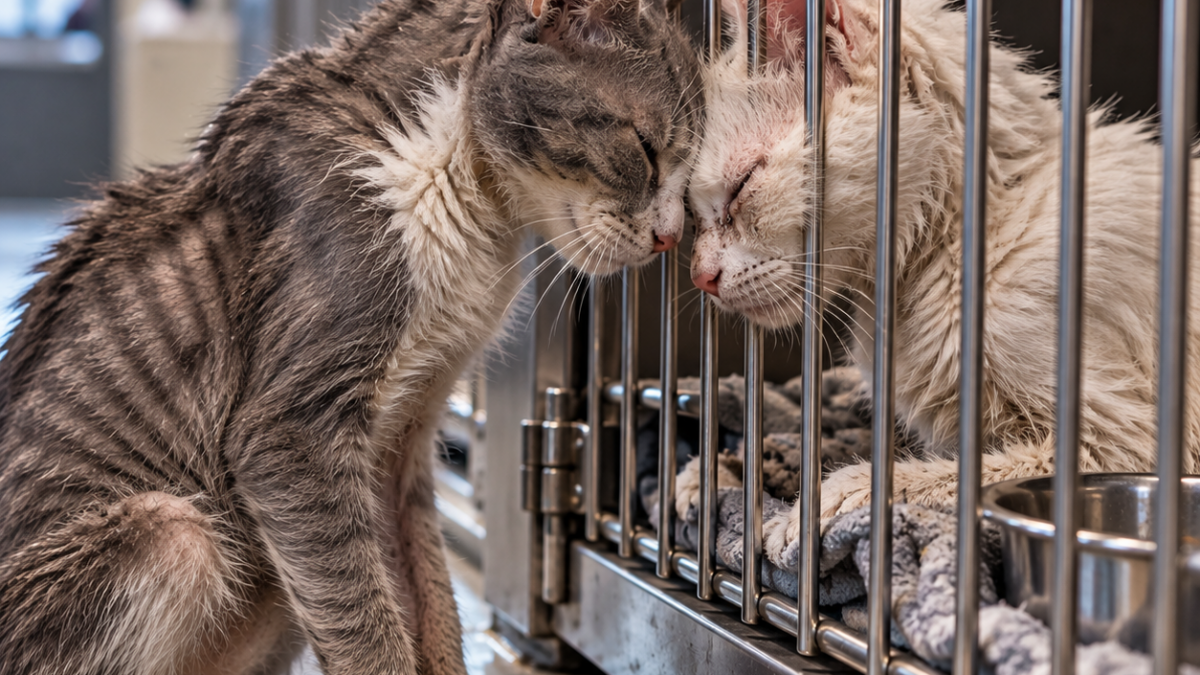
They Adopted One Bonded Cat and Left Her Sister Behind—11 Days Later, She Was Returned Starving and Walked Straight to Kennel 9 to Press Her Forehead Against Hers.
For eleven days, the gray cat sat at her new family’s front door refusing food, toys, warmth, and affection while thirty miles away her white sister was slowly starving in a shelter kennel.
Everyone kept saying the adoption would eventually “force them to adjust,” but I had watched those two cats stop functioning the first time we separated them, and I knew we had made a terrible mistake.
Then the gray cat came back, jumped from my arms, ran straight to kennel 9, and pressed her forehead against the bars—and when her sister crawled forward to meet her, an entire hallway went so silent that even the man who had insisted their bond was “just animal behavior” could no longer look away.
My name is Nora Bennett.
I have volunteered at Hawthorne County Animal Shelter for almost twelve years.
Long enough to know that animals do not arrive with neat explanations.
They arrive with fleas.
Broken teeth.
Matted fur.
Fear.
Bad histories.
No histories.
Owners who cry while surrendering them.
Owners who do not cry at all.
Some come in furious.
Some shut down.
Some wag their tails at everybody because optimism is apparently stronger than common sense.
And some arrive carrying another animal inside their emotional world so completely that separating the two is like cutting a rope neither of them knows how to live without.
That was Eleven and Ghost.
We did not know their names when they arrived.
We did not know whether they had ever had names.
PART2:
PART3:
“That sentence from you usually means something dramatic happened.”
He set the carrier down.
“Look.”
I crouched.
Inside were two female cats, maybe four years old.
One gray with white paws and a white patch along her chest.
The other completely white except for a faint cream shadow near one ear.
The white cat had pale green eyes.
The gray cat’s eyes were yellow-green.
Both were filthy.
Both were thin.
Neither hissed.
Neither growled.
They simply sat against each other.
Not next to.
Against.
Shoulder to shoulder.
Hip to hip.
The gray one had one front paw placed across the white cat’s paw.
“Did they fight the trap?”
“No.”
“Let you handle them?”
“Barely.”
“What does barely mean?”
Luis took off his cap and wiped his forehead.
“I had to reach under the shed. The white one came out first.”
“And?”
“The gray one came with her.”
“You grabbed both?”
“No.”
He shook his head.
“The gray one had her claws hooked into the white one’s fur.”
I looked at him.
“On purpose?”
“How should I know? I’m not Doctor Dolittle.”
He crouched beside me.
“When I moved the white cat, the gray one screamed.”
That got my attention.
“What kind of scream?”
Luis’s expression changed.
“Not angry.”
He looked through the carrier bars.
“More like I’d taken the floor out from under her.”
We carried them into intake.
Our standard procedure was simple.
Separate examination.
Weight.
Temperature.
Microchip scan.
Vaccination status.
Flea treatment.
Blood draw.
Basic behavior assessment.
Then kennel assignment.
The gray cat went first.
I remember this because the second we moved her into the exam room, the white cat began vocalizing from the carrier outside.
Not normal meowing.
Not a frightened cat yelling at strangers.
This was lower.
Repeated.
Almost rhythmic.
“Mrrrraow.”
Pause.
“Mrrrraow.”
Pause.
“Mrrrraow.”
Our intake technician, Jules, looked toward the door.
“What is that?”
“White cat.”
“She hurt?”
“No.”
“Mrrrraow.”
The gray cat froze on the exam table.
Her ears moved.
“Mrrrraow.”
The gray cat answered.
One sharp cry.
Then tried to get off the table.
“Okay,” Jules said. “That’s interesting.”
We finished quickly.
No microchip.
No collar.
Mild dehydration.
Low body weight.
Old scratches.
Nothing acute.
Then we switched them.
White cat on the table.
Gray cat into the carrier.
The gray cat did not cry.
She became still.
Too still.
Her face pressed against the carrier door.
Eyes fixed on the white cat.
Jules listened to the white cat’s heart.
“Fast.”
“Stress?”
“Probably.”
The white cat kept turning her head toward the carrier.
We assigned them separate kennels because that was procedure.
Kennel 9 for the white cat.
Kennel 11 for the gray.
They were directly across the aisle from each other.
That should have been enough.
It was not.
Within an hour, neither had eaten.
That alone meant nothing.
Shelter cats skip meals all the time during intake.
New smells.
Dogs barking.
Metal doors.
Strangers.
Disinfectant.
Fear suppresses appetite.
But their behavior was unusual.
The gray cat moved to the far side of kennel 11.
Not toward us.
Toward the wall nearest Ghost’s row.
She pressed her entire body against it and stayed.
The white cat paced.
End to end.
Back.
Forward.
Back.
Forward.
Every few seconds:
“Mrrrraow.”
The gray cat answered once.
Then the white cat stopped pacing.
She sat at the front bars.
Stared across the aisle.
We tried wet food.
Nothing.
Tuna.
Nothing.
Chicken.
Nothing.
Churu treats.
The universal diplomatic currency of cats.
Nothing.
Three hours later, our veterinarian examined them again.
No nausea.
No fever.
No obvious pain.
“Stress,” she said.
I asked, “Can we put them together?”
Dr. Patel looked through the kennel cards.
“After quarantine?”
“They came from the same location.”
“I know.”
“We already tested both.”
“I know.”
“So?”
She smiled.
“You aren’t asking medically.”
“No.”
“What are you asking?”
I pointed.
The white cat was still staring toward kennel 11.
“I’m asking whether we’re creating the stress.”
Dr. Patel studied them.
“Try it.”
We moved the white cat into kennel 11.
She stepped out of the carrier.
The gray cat stood.
No hesitation.
They touched noses.
Then the gray cat began licking the white cat’s forehead.
Not frantic.
Slow.
Deliberate.
The white cat closed her eyes.
Within nine minutes, both were eating.
Jules actually timed it because shelter workers are strange.
“Eight minutes, forty-three seconds,” she said.
“Seriously?”
“I wanted data.”
“Of course you did.”
The cats ate from separate bowls placed six inches apart.
Then they curled together.
The white cat rested her chin across the gray cat’s shoulders.
The gray cat wrapped her tail against the white cat’s side.
Dr. Patel stared through the door.
“Well.”
I smiled.
“Stress?”
She nodded.
“Apparently we were the stressful part.”
We listed them as bonded.
That should have protected them.
The gray cat became Eleven because she had originally been assigned kennel 11.
The white cat became Ghost because she moved so quietly once she was back beside Eleven that Jules joked she appeared out of nowhere.
The names were temporary.
Shelter names usually are.
But they stuck.
For the next five weeks, Eleven and Ghost became everybody’s favorite heartbreak.
They were easy cats.
Too easy.
They did not tear up bedding.
Did not swat.
Did not scream for attention.
They simply wanted to be together.
When Eleven ate, Ghost ate.
When Ghost used the litter tray, Eleven often followed thirty seconds later.
If one was examined, the other sat against the carrier until she returned.
They groomed each other every evening.
Always the face first.
Eleven cleaned Ghost’s ears.
Ghost washed the gray fur beneath Eleven’s chin.
During afternoon quiet hours, they slept so tightly intertwined that visitors regularly asked where the second cat was.
Then adoption conversations began.
People wanted Ghost.
She was beautiful.
Pure white coat.
Pale green eyes.
Photogenic.
A young couple named Ryan and Emma spent forty minutes with her.
Ghost liked Emma immediately.
Eleven watched from three feet away.
Ryan asked, “Could we adopt just the white one?”
Our adoption counselor, Maria, smiled gently.
“They’re bonded.”
“What does that mean exactly?”
“We strongly recommend placing them together.”
Emma looked at Eleven.
“They’re sisters?”
“We don’t know genetically.”
“So maybe they’re not.”
“The bond matters more than DNA.”
Ryan frowned.
“We only planned for one.”
Maria explained what had happened when they were separated during intake.
The refusal to eat.
The pacing.
The vocalization.
Ryan looked disappointed.
“We really love Ghost.”
“I understand.”
“Couldn’t they adjust?”
“Maybe.”
Maria paused.
“But we have evidence they struggle significantly apart.”
They left without either cat.
The following week, a woman named Jennifer came with her two sons.
Her eight-year-old loved Eleven.
The cat sat beside him for almost half an hour.
Jennifer asked whether she could adopt only the gray one.
Again we explained.
Again they left.
That happened seven times.
Seven interested homes.
Seven refusals when they learned two cats had to go together.
Shelter space was tightening.
Summer always did that.
Kittens everywhere.
Litters in boxes.
Pregnant cats.
Strays.
Owner surrenders.
We had kennels in the laundry room some weeks.
Our operations manager, Bruce Callahan, cared about numbers.
I want to be fair about Bruce.
He was not a monster.
That matters.
Real harm is rarely created by people wearing villain costumes.
Bruce had worked municipal animal services for twenty-one years.
He had seen dogs euthanized because no kennel was available.
He had seen kittens die because foster homes were full.
He knew every empty cage represented another animal we could say yes to.
That pressure made him practical.
Sometimes too practical.
During a staff meeting in mid-August, Bruce brought up Eleven and Ghost.
“Five weeks.”
Maria looked up.
“What?”
“They’ve occupied one kennel for five weeks.”
“They share it.”
“I know.”
“Then what’s the problem?”
“The problem is seven adopters walked.”
I said, “Because they wanted one.”
“Correct.”
Bruce clicked his pen.
“We need to reconsider the bonded designation.”
Maria’s face tightened.
“No.”
Bruce looked at her.
“No?”
“They stopped eating within an hour apart.”
“During intake.”
“So?”
“Every animal is stressed during intake.”
“They resumed eating when reunited.”
“Correlation.”
I stared at him.
“You sound like a research paper nobody asked for.”
Bruce ignored me.
“What objective evidence do we have that they cannot adapt separately long-term?”
Maria said, “We don’t separate bonded pairs to test whether they become miserable enough to prove us right.”
“I didn’t say test them.”
“You want to adopt one out.”
“If a good home presents.”
“And leave the other.”
“If necessary.”
The room became quiet.
Dr. Patel finally spoke.
“Bruce.”
He looked at her.
“I medically support placing them together.”
“Based on?”
“Behavior.”
“That is not a diagnosis.”
“No.”
Dr. Patel’s voice stayed calm.
“But eating is medical.”
Bruce leaned back.
“We are at ninety-seven percent capacity.”
Nobody had an answer to that.
He continued.
“If we turn away two injured strays next week because a bonded-pair policy prevented one healthy cat from going home, somebody will ask why.”
I hated that he was not entirely wrong.
That was what made the argument difficult.
Shelters do not make decisions in a world with unlimited cages.
Every yes can create another no.
Still, I looked through the glass at Eleven and Ghost sleeping together.
“I think if we split them,” I said, “we’re going to regret it.”
Bruce capped his pen.
“Noted.”
Four days later, the Bennett family came in.
No relation to me.
Mark and Sarah Bennett.
Two children.
A twelve-year-old boy named Caleb.
An eight-year-old girl named Molly.
They had recently lost an elderly tabby.
They wanted another calm adult cat.
Molly loved Eleven immediately.
She sat on the floor.
Eleven walked over.
Smelled her knee.
Then climbed halfway into her lap.
Ghost stayed close.
Sarah asked, “Are they sisters?”
Maria explained everything.
Mark’s face fell.
“Our lease allows one cat.”
Maria nodded.
“Then unfortunately this pair may not be a fit.”
Molly looked devastated.
“Why?”
Sarah touched her shoulder.
“Because they need each other.”
Molly looked at Eleven.
Then Ghost.
“What happens if nobody takes two?”
Maria hesitated.
“They stay here until somebody does.”
“How long?”
“We don’t know.”
That question hung in the room.
Bruce happened to be walking past.
He stopped.
“Can I speak with you?”
Maria gave him a look I recognized.
The look shelter workers exchange when they know management is about to create a problem.
Bruce joined the family.
He explained that the bonded designation was a strong recommendation.
Not a legal requirement.
Maria interrupted.
“They have demonstrated severe separation distress.”
Bruce said, “During initial intake.”
“They stopped eating.”
“Temporarily.”
I watched Sarah.
She looked uncomfortable.
“We don’t want to hurt either cat.”
Bruce smiled.
“Nobody is suggesting that.”
I said, “Actually that’s exactly what we’re worried about.”
Bruce turned.
“Nora.”
“What?”
“You’re a volunteer.”
“I noticed.”
“This is an adoption consultation.”
“And I’m telling them what I’ve observed.”
Mark asked, “Do you think Eleven would adjust?”
I answered honestly.
“I don’t know.”
Bruce looked relieved.
Then I added, “But I wouldn’t bet her health on it.”
Silence.
Molly was crying quietly now.
Eleven remained in her lap.
Ghost had moved beside them.
The two cats touched shoulders.
Sarah looked at Mark.
“We can’t take two.”
“I know.”
Molly whispered, “Could we ask Mr. Harland?”
Mr. Harland was their landlord.
Mark shook his head.
“He was very clear.”
Bruce said, “If you want Eleven, we can approve the adoption.”
Maria stared at him.
“Bruce.”
He did not look at her.
The family asked for fifteen minutes alone.
I went to the supply room.
Maria followed.
“He can’t do this.”
“He can.”
“He shouldn’t.”
“I know.”
“What are we supposed to do?”
I leaned against the shelving.
“Write everything.”
“What?”
“Put the recommendation in the file.”
“Already did.”
“Make them sign that we advised against separation.”
“She wants that cat.”
“Then make sure everyone remembers what happened if this fails.”
Maria looked toward the hall.
“Nora.”
“What?”
“Do you think I’m supposed to refuse the adoption?”
I wanted to say yes.
I wanted somebody to make the hard decision for all of us.
Instead I said, “I think you have to decide whether your job is getting an animal out the door or keeping an animal in the right home.”
That was unfair.
Maria’s eyes filled.
“That’s easy for a volunteer to say.”
She was right.
I could leave after my shift.
She had performance reviews.
Management.
Policy.
I apologized immediately.
“I’m sorry.”
She shook her head.
“No.”
“You’re right.”
“No.”
Maria wiped her cheek.
“You’re just saying the thing I don’t want to say.”
The family adopted Eleven on August 19.
The paperwork contained the note:
Shelter strongly recommends bonded placement with Ghost. Adopter understands known separation distress history.
I helped place Eleven into the carrier.
Ghost watched.
That image still makes my chest hurt.
Ghost did not scream.
That would have been easier.
She sat at the front of the kennel.
Eleven was inside the plastic carrier.
She turned around and pressed her nose through the little metal grate.
Ghost leaned forward.
Their noses touched through the carrier door.
Molly said, “She’ll be okay.”
Nobody answered.
Maria took Eleven to the lobby.
Ghost stood.
Her body stretched toward the kennel door.
Eleven began crying from the carrier.
Low.
Repeated.
The same sound Ghost had made on intake day.
“Mrrrraow.”
Ghost answered.
One cry.
The carrier moved down the hall.
“Mrrrraow.”
Ghost pressed against the bars.
“Mrrrraow.”
Then the lobby door closed.
Silence.
Ghost stayed at the bars.
For ten minutes.
Thirty.
Two hours.
At closing time, she was still there.
Food untouched.
I called Bruce over.
“Look.”
He watched.
“She’ll settle.”
“She hasn’t eaten.”
“It’s been four hours.”
“She’ll eat tonight.”
She didn’t.
The next morning, her breakfast remained untouched.
We offered tuna.
Chicken.
Churu.
Nothing.
She did not hide.
Did not hiss.
Did not pace.
She sat at the front of kennel 9.
Face near the bars.
Watching the hallway toward the lobby.
Waiting.
I called the Bennett family that afternoon.
Sarah answered.
“How’s Eleven?”
There was a pause.
“Quiet.”
“Eating?”
“Not much.”
My stomach tightened.
“How much is not much?”
“She licked some gravy.”
“Where is she spending her time?”
Another pause.
“By the front door.”
I closed my eyes.
“How long?”
“Since last night.”
“Is she hiding?”
“No.”
“Exploring?”
“No.”
“Playing?”
“No.”
“She sits on the mat.”
I looked across the hall.
Ghost sat at her kennel door.
Thirty miles apart.
Same posture.
Same refusal.
Same waiting.
“Sarah.”
“Yes?”
“I think they’re looking for each other.”
Her voice changed.
“What should we do?”
“Can your landlord reconsider?”
“We asked before.”
“Ask again.”
“We signed a one-cat lease.”
“I understand.”
“Molly is already attached.”
“I know.”
I hated every part of the conversation.
“Give Eleven tonight,” I said. “If she doesn’t eat, she needs veterinary evaluation.”
Ghost ate nothing that day.
On day two, I tried hand feeding.
Nothing.
I sat inside her kennel.
She allowed me to touch her.
But she kept looking around me toward the hall.
“She’s not coming through that door today,” I whispered.
Ghost turned her face away.
I immediately regretted saying it.
Animals do not understand promises, but sometimes words reveal something to the person speaking them.
Dr. Patel started appetite stimulants.
We monitored weight.
Hydration.
Vitals.
Medically, Ghost remained stable.
Emotionally, she seemed to be disappearing.
Day three.
Still no meaningful food.
Bruce stood outside kennel 9.
His face had changed.
“She should have eaten.”
“Yes.”
“Could be illness.”
“Both of them?”
He looked at me.
“The family says Eleven isn’t eating?”
“Barely.”
Bruce crossed his arms.
“This is unusual.”
“No.”
“What?”
“This is exactly what we told you would happen.”
His face tightened.
“Nora.”
“I know.”
“We had capacity concerns.”
“I know.”
“We had no proof—”
“She is your proof.”
I pointed toward Ghost.
Bruce’s voice became colder.
“Do not turn this into a morality play.”
“I don’t need to.”
I looked at Ghost.
“They’re doing that themselves.”
He walked away.
I felt satisfied for about ten seconds.
Then ashamed.
Because Ghost did not need me to win an argument.
She needed Eleven.
At the Bennett house, Eleven was doing worse.
Sarah called every day.
Day four:
“She still sleeps by the door.”
Day five:
“We tried heated bedding.”
Day six:
“Pheromone diffuser.”
Day seven:
“Chicken, salmon, three kinds of wet food.”
Day eight:
“She doesn’t play with Molly.”
Day nine:
“She lost almost a pound.”
That frightened me.
For a cat her size, more than a pound was significant.
“Get her seen today.”
Their veterinarian found no obstruction.
No obvious infection.
Bloodwork largely normal except changes consistent with reduced intake and mild dehydration.
Diagnosis:
Anorexia associated with stress.
Sarah called me from the parking lot.
“I feel horrible.”
“You didn’t know.”
“You warned us.”
“We all knew.”
“I took her anyway.”
“You followed the shelter’s approval.”
“But Ghost—”
Her voice broke.
“Molly asks every night if Ghost is lonely.”
I looked through the kennel window.
“Yes.”
I could not lie.
Sarah cried.
That evening Bruce called a meeting.
“We need to bring Eleven back.”
Maria said, “And then what?”
“Reunite.”
“Good.”
“Temporarily.”
I stared at him.
“What does that mean?”
“We stabilize both cats.”
“And?”
“We reevaluate placement.”
Maria laughed once.
Not humor.
“You’re still talking about separating them?”
Bruce rubbed his forehead.
“We cannot force the landlord to accept two animals.”
“Then we find another adopter for both.”
“And ask the Bennett family to give up Eleven after eleven days?”
“Yes.”
Bruce looked at me.
“You really think that’s best for the children?”
I nearly shouted.
Then stopped.
Because there it was again.
Everybody speaking for somebody else.
Ghost.
Eleven.
Molly.
The family.
Always explaining whose pain mattered most.
Maria said quietly, “Maybe we should ask them.”
Bruce looked at her.
“Ask who?”
“The family.”
The Bennetts made the decision on day eleven.
Sarah called at 6:42 a.m.
“We’re bringing her back.”
My chest tightened.
“Okay.”
“Something is wrong.”
“I know.”
“No.”
Sarah was crying.
“I mean really wrong.”
“What happened?”
“She didn’t sleep by the door last night.”
At first that sounded positive.
Then Sarah continued.
“She sat there.”
“All night?”
“Yes.”
“Did she lie down?”
“No.”
“Drink?”
“No.”
“Eat?”
“No.”
“We’re coming now.”
I arrived at the shelter before they did.
Ghost was lying on her side in kennel 9.
Thinner.
Coat dull.
Eyes half closed.
Her weight had dropped too.
Dr. Patel had been syringe-feeding small amounts.
Nothing about Ghost looked dramatic.
That was what made it frightening.
Suffering is not always loud.
Sometimes it simply removes pieces of an animal day by day.
At 8:14, the front doors opened.
I heard Molly before I saw her.
“Is Ghost okay?”
Sarah carried the cat carrier.
Inside Eleven sat upright.
The second they entered the building, Eleven changed.
Her head lifted.
Ears forward.
She began smelling the air.
I went to the carrier.
“Hey.”
Eleven looked past me.
Toward the corridor.
Sarah said, “She hasn’t looked that awake in days.”
Molly knelt.
“Eleven?”
The cat ignored her.
Not cruelly.
Completely.
I opened the carrier inside the secure hallway because I intended to carry Eleven back to intake.
I reached in.
She let me lift her.
For three seconds.
Then the cat twisted.
Dropped from my arms.
Landed on the concrete.
“Nora!”
“It’s okay.”
Eleven walked.
Fast.
Not running.
Not wandering.
Straight down the corridor.
Past kennel 3.
Past kennel 5.
Past kennel 7.
No hesitation.
Molly followed behind us.
“Where is she going?”
I knew.
Eleven turned at the cat ward.
Then stopped outside kennel 9.
Ghost was still lying down.
Eleven approached the bars.
One step.
Two.
Then pressed her forehead against them.
Ghost did not move.
My heart sank.
“Ghost.”
Nothing.
Eleven made one sound.
The old sound.
“Mrrrraow.”
Ghost’s ear twitched.
Eleven called again.
Ghost lifted her head.
Slowly.
Her eyes found Eleven.
I will never forget what happened next.
Ghost stood.
Not quickly.
Her legs looked weak.
She crossed the kennel.
Eleven did not move.
Ghost reached the bars.
Then she pressed her forehead forward.
Against Eleven’s.
Metal between them.
Gray fur.
White fur.
Two faces.
Eyes closed.
Foreheads touching through a gap barely wide enough.
Nobody spoke.
Sarah put one hand over her mouth.
Molly began crying.
Maria appeared behind us.
Then Dr. Patel.
Jules.
Luis.
Even Bruce.
Eleven and Ghost remained that way.
One minute.
Two.
Five.
Someone brought a chair for Sarah.
She shook her head.
Ten minutes.
The cats did not separate.
They weren’t rubbing frantically.
No loud cries.
No dramatic movement.
They simply stayed connected.
Breathing.
Foreheads pressed together.
At twelve minutes, Ghost began purring.
Quiet.
Almost too low to hear.
Eleven answered.
At fifteen minutes, Maria was crying openly.
Bruce stood in the back.
Arms no longer crossed.
At nineteen minutes, Ghost moved one paw through the lower bars.
Eleven placed her paw beside it.
Twenty minutes.
Twenty full minutes.
I had worked around animals for twelve years.
I had seen bonded dogs scream after separation.
Cats search rooms for deceased companions.
Animals refuse beds another pet used.
I had seen grief.
Attachment.
Fear.
But this was different.
They were not greeting.
They were holding each other with the only part of their bodies the metal allowed.
Sarah whispered, “Oh my God.”
Molly looked at her mother.
“Mom.”
Sarah nodded.
“I know.”
“Mom, we can’t leave her.”
“I know.”
“We can’t.”
“I know.”
Sarah crouched beside her daughter.
“The landlord—”
“I don’t care.”
“Molly.”
“She’ll die.”
The word hit everybody.
Sarah closed her eyes.
“We’re going to fix it.”
Bruce finally spoke.
“We can return Eleven to Ghost’s kennel.”
I turned.
“That should never have stopped being her kennel.”
He looked at me.
I expected defensiveness.
Instead he said, “You’re right.”
That quiet admission meant more than any argument.
We opened kennel 9.
Eleven entered.
Ghost began grooming her before the door fully closed.
Right between the ears.
Eleven leaned into her.
Then returned the grooming.
Five minutes later, Dr. Patel placed two bowls inside.
Neither cat touched them at first.
Molly watched through the glass.
“Please eat.”
Eleven smelled the food.
Ghost followed.
Then Eleven took one bite.
Ghost took one.
Another.
Another.
They ate side by side.
Sarah sat down hard in the nearest chair.
“They haven’t done that in eleven days.”
Molly smiled through tears.
“They were waiting.”
Nobody corrected her.
Technically, we could explain stress hormones.
Attachment behavior.
Environmental change.
Social buffering.
Loss of appetite.
All true.
Sometimes clinical language describes the mechanism while missing the meaning.
They had been waiting.
Sarah called Mark.
She put the phone on speaker.
He had already left work.
“What happened?”
“They’re together.”
Silence.
“And?”
“They ate.”
Another silence.
Then I heard Mark exhale.
“Oh.”
Sarah began crying again.
“We made a mistake.”
“No.”
“Yes.”
“We followed what the shelter approved.”
“We knew.”
“Sarah.”
“Molly won’t leave without Ghost.”
Molly yelled toward the phone, “Correct.”
Despite everything, Mark laughed.
“What about Harland?”
Sarah looked through the glass.
“I’ll call him.”
Mr. Harland owned the Bennett family’s duplex.
Retired electrician.
Sixty-three.
One-pet lease.
Strict.
Not because he hated animals.
Because twelve years earlier a tenant had kept five unapproved cats and left him with thousands in flooring repairs.
Sarah had already asked once.
He had said no.
She called again from our hallway.
“Mr. Harland?”
I could not hear his side.
Sarah explained.
“No, I understand.”
Pause.
“Yes.”
Pause.
“No, they’re both adults.”
Long pause.
Sarah closed her eyes.
“Could I send you something?”
She looked at me.
“The photo.”
“What photo?”
Maria held up her phone.
She had taken one through the hallway glass.
Eleven and Ghost.
Foreheads touching.
Eyes closed.
Bars between them.
Sarah sent it.
Then she waited.
We all pretended not to listen.
Thirty seconds.
One minute.
Then her phone rang.
She answered.
“Yes?”
Her face changed.
“Really?”
Molly grabbed my arm.
Sarah started laughing through her tears.
“Yes. Yes, absolutely.”
She hung up.
Molly shouted, “WHAT?”
Sarah hugged her.
“He said we can have two.”
The hallway erupted.
Actually erupted.
Jules clapped.
Maria cried harder.
Luis said something in Spanish and crossed himself.
Dr. Patel laughed.
I hugged Sarah.
Then looked at Bruce.
He had not moved.
“You okay?”
He stared through the glass.
“No.”
That surprised me.
“What?”
He rubbed his jaw.
“I approved that adoption.”
“Yes.”
“I know.”
“You were worried about capacity.”
“That doesn’t make it right.”
“No.”
He looked at me.
“How long would you like me to feel terrible?”
I thought.
“Long enough to change something.”
His face softened.
“Fair.”
The Bennetts did not take Ghost that day.
Dr. Patel insisted both cats stay forty-eight hours for monitoring.
Eleven needed fluids.
Ghost needed calories.
They needed bloodwork.
Careful refeeding.
Observation.
The family visited twice.
Each time Molly sat beside the kennel reading aloud.
The first book was Charlotte’s Web.
I warned her this was emotionally irresponsible.
She said, “They can’t understand English.”
“That doesn’t make it less dangerous for me.”
On the second morning, Eleven’s appetite was nearly normal.
Ghost’s improved dramatically.
They slept curled together.
Exactly as Luis had found them under the collapsed shed.
So tightly pressed that from the hallway you could mistake them for one animal.
Bruce asked me to attend a staff review.
I expected bureaucracy.
Instead he placed copies of the adoption file on the table.
“Our bonded-pair policy failed.”
Maria looked at him.
“The policy didn’t fail.”
Bruce nodded.
“I did.”
Silence.
He continued.
“I converted a welfare recommendation into an optional preference because we were full.”
Nobody interrupted.
“I told myself one adoption was better than none.”
He looked at Eleven’s weight chart.
“Then both animals stopped eating.”
Dr. Patel said, “Capacity pressure is real.”
“I know.”
“It isn’t just your fault.”
“I know that too.”
Bruce looked toward Maria.
“But the staff with the most direct observation objected.”
She nodded.
“I overrode them.”
He turned to me.
“You warned me.”
“I was rude about it.”
“You were.”
“Sorry.”
“Accepted.”
That was the closest Bruce and I ever came to friendship.
The shelter changed policy that week.
Animals designated as strongly bonded by veterinary and behavior staff could no longer be separated based on adoption demand alone.
Removing the designation required documented reassessment.
Adopters received written explanations.
If housing prevented taking both animals, staff helped explore landlord exceptions before finalizing the adoption.
We also created a temporary bonded-pair sponsorship fund so adoption fees for the second animal could be waived when cost, rather than housing, was the barrier.
A local newspaper eventually heard about the story.
Not from us.
Molly told her teacher.
Her teacher told somebody.
Small towns operate through an intelligence network governments would envy.
The reporter asked whether she could photograph Eleven and Ghost.
Sarah agreed only if the article focused on bonded animals, not blaming the shelter.
That mattered.
Because it would have been easy to turn Bruce into the villain.
Some people wanted to.
Online comments did anyway.
Fire him.
Sue them.
How could professionals be so cruel?
People love certainty from a distance.
The truth was messier.
The shelter had been overcrowded.
Bruce had made the wrong decision inside a real pressure.
Maria had warned him.
I had warned him.
The family had known.
Everybody wanted Eleven to have a home.
Nobody woke that morning intending to hurt Ghost.
And yet harm happened.
Intent did not change the weight loss.
Intent did not make Eleven eat.
Intent did not feed Ghost.
Good people can still make terrible decisions when they convince themselves practical concerns matter more than the evidence in front of them.
Accountability did not require pretending Bruce was evil.
It required admitting we were wrong.
That was harder.
The newspaper printed Maria’s photograph.
Two cats.
Gray and white.
Eyes closed.
Foreheads pressed together through metal bars.
The caption read:
Eleven and Ghost reunite after eleven days apart.
The image spread farther than any of us expected.
People started calling the shelter asking about bonded pairs.
Not only Eleven and Ghost.
Others.
A pair of thirteen-year-old cats whose owner had died were adopted together two weeks later.
Then two senior beagles.
Then a bonded rabbit pair.
Someone donated five thousand dollars specifically for bonded-animal adoption support.
Bruce taped the donation letter above his desk.
I asked why.
He said, “To remind myself that being corrected can be useful.”
The Bennetts came to take both cats home on August 31.
Mr. Harland came too.
That surprised everyone.
He stood in the lobby holding a plastic bag.
“What’s that?”
He looked embarrassed.
“Something for the cats.”
Inside were two identical beds.
Molly immediately said, “They’ll only use one.”
Mr. Harland looked confused.
“Why?”
“They do everything together.”
He stared at the two beds.
“Can I return one?”
Sarah laughed.
He knelt beside the carrier.
Eleven and Ghost were already inside together.
He looked through the bars.
“So you two are the troublemakers.”
Ghost blinked.
Eleven pressed against her.
Mr. Harland shook his head.
“I had one rule.”
Molly stood beside him.
“You changed it.”
“Yes.”
“Because of the picture?”
He looked at her.
“Because rules are supposed to solve problems.”
He glanced at the cats.
“Not create stupid ones.”
Molly nodded seriously.
“I like you.”
“Thank you.”
Then she added, “Your beds were unnecessary.”
That child had no mercy.
At home, Eleven walked out of the carrier first.
Ghost followed so closely their shoulders touched.
Sarah filmed only for us.
No social media.
No performance.
Eleven walked through the living room.
Past the sofa.
Past the kitchen.
Then she reached the front door.
The same mat where she had sat for eleven days.
Everybody stopped.
Sarah told me later her heart nearly broke.
Eleven smelled the mat.
Ghost approached.
Eleven looked at her.
Then turned away from the door.
Walked into the living room.
Ghost followed.
They never waited there again.
Within twenty-four hours, they had claimed one of Mr. Harland’s two beds.
Together.
Of course.
The second bed remained empty for three weeks until Molly filled it with stuffed animals.
Eleven began sleeping with Caleb.
Ghost preferred Molly.
But sometime around two in the morning, according to Sarah, both cats always relocated.
One would leave the child’s room.
The other followed.
By sunrise, they were together somewhere.
Couch.
Laundry basket.
Window seat.
Once, bizarrely, inside the empty bathtub.
Always touching.
They ate from separate bowls.
Side by side.
If Ghost started eating first, Eleven appeared within seconds.
If Eleven entered another room, Ghost followed.
Molly timed that too.
Apparently data obsession is contagious.
Average response time:
Twenty-seven seconds.
At school one morning, Molly’s teacher asked students to describe their pets.
Other children said:
“My dog is brown.”
“My hamster bites.”
“My fish is named Batman.”
Molly said:
“We have two cats, but it’s really one cat in two bodies.”
Her teacher emailed Sarah because she thought it was beautiful.
Sarah sent it to me.
I printed it.
Pinned it beside kennel 9.
Eleven and Ghost visited us three months after adoption.
They came for a routine vaccination clinic.
The moment the carrier entered the cat hallway, Ghost became tense.
Eleven pressed against her.
Ghost relaxed.
I opened the carrier in the exam room.
They came out together.
Dr. Patel laughed.
“Still ridiculous.”
I said, “Clinically ridiculous?”
“Severely.”
She examined Eleven.
Ghost sat two feet away.
Eleven remained calm.
Then Ghost’s turn.
Eleven waited beside the scale.
Nothing had changed.
Afterward Molly asked if we could show them their old kennel.
Sarah looked at me.
I wasn’t sure.
Would it frighten them?
We carried the closed carrier down the hall.
Kennel 9 was occupied by a tabby kitten named Pancake.
Eleven looked through the grate.
Ghost looked too.
No distress.
No crying.
They just watched.
Then Pancake hissed.
Eleven turned away.
Molly laughed.
“I think they’re over it.”
Maybe.
Or maybe safety changes memory.
I don’t know.
Animals do not explain themselves.
That is one of the most humbling parts of working with them.
We interpret.
Sometimes correctly.
Sometimes not.
But behavior is communication even when we cannot translate every word.
Eleven and Ghost had communicated clearly.
We were the ones who kept debating.
Months later, Bruce asked me a strange question.
“Do you think they would have died?”
We were cleaning after closing.
I stopped.
“If they stayed apart?”
“Yes.”
I thought about it.
“I don’t know.”
“Dr. Patel thinks eventually one of them would have eaten.”
“Probably.”
“So maybe we overstate the bond.”
I looked at him.
He immediately raised both hands.
“I’m not arguing. I’m asking.”
I considered.
“Maybe they would have physically survived.”
Bruce nodded.
I continued.
“But survival isn’t the only measurement we should use.”
He looked toward kennel 9.
I said, “If an animal stops eating, stops exploring, stops interacting, loses weight, and spends every day waiting at a door for the one being she trusts—how much more evidence do we need before we’re willing to call the separation harmful?”
Bruce leaned against the counter.
“Fair.”
“Also, if you ever split another bonded pair, Maria will kill you.”
“That too.”
The photograph remains at Hawthorne.
Maria printed it larger.
Not huge.
We are not a museum.
It hangs near the adoption counseling rooms.
Two foreheads.
One row of metal bars.
Eyes closed.
Underneath, Bruce wrote the text himself:
THIS IS WHAT BONDED MEANS.
PLEASE LISTEN BEFORE YOU SEPARATE THEM.
I suggested adding:
NORA WAS RIGHT.
He rejected that.
Abuse of power.
The following spring, a woman came in wanting to adopt one cat from another bonded pair.
Two orange brothers.
She loved one.
Could not take two.
I watched Maria explain.
The woman became frustrated.
“But how do you know they need each other?”
Maria pointed toward Eleven and Ghost’s photograph.
The woman studied it.
“What happened?”
Maria told her.
Not dramatically.
Just facts.
Separate.
Stopped eating.
Reunited.
Recovered.
The woman looked at the orange cats.
Then at the photograph.
“My daughter has asthma.”
“So two really isn’t possible?”
“Probably not.”
Maria nodded.
“Then these aren’t your cats.”
The woman looked disappointed.
Then she said, “Okay.”
No argument.
No exception.
Three days later, she adopted a single six-year-old black cat named Franklin who hated every other living animal.
Perfect match.
That is what good placement looks like sometimes.
Not getting the animal you first wanted.
Finding the animal whose needs fit your life.
Eleven and Ghost turned five.
Then six.
Every birthday, Molly sent us photos.
At five:
Both wearing party hats they clearly hated.
At six:
One cake-shaped cat treat between them.
Ghost refused hers until Eleven started eating.
Of course.
Sarah once called because Eleven needed dental work.
She was terrified Ghost would stop eating during the hospital visit.
Dr. Patel suggested they bring both.
Ghost stayed in a recovery carrier nearby.
Eleven underwent the cleaning.
When she woke from anesthesia, groggy and confused, Ghost began making that same low sound.
“Mrrrraow.”
Eleven answered.
Her heart rate settled.
The veterinary technician texted me:
THEY ARE STILL WEIRD.
I replied:
TECHNICAL TERM: LOVE.
She sent back:
TECHNICAL TERM: CODEPENDENT FUR DEMONS.
Either interpretation worked.
One winter, Ghost developed an upper respiratory infection.
Nothing serious.
Sneezing.
Watery eyes.
Mild fever.
Sarah separated their bowls.
Eleven refused dinner for one meal.
Sarah called me immediately.
“Do I panic?”
“No.”
“What do I do?”
“Put the bowls closer.”
“She might get sick.”
“She already sleeps with Ghost’s face on her neck.”
“Good point.”
Both ate.
Eleven caught the cold three days later anyway.
Some battles cannot be won.
Years passed.
The story became shelter folklore.
New volunteers heard about “the cats from kennel 9.”
Some assumed it was exaggerated.
Shelter stories grow with repetition.
A twenty-minute reunion becomes forty.
One pound becomes five.
Reality turns into myth.
So I kept the original notes.
Not because the legend needed protecting.
Because the truth was powerful enough.
Eleven lost just over a pound.
Ghost lost slightly less.
Eleven waited eleven days at the front door.
Ghost stopped eating immediately after separation.
When reunited, their foreheads remained pressed together for approximately twenty minutes.
They ate together that afternoon.
Those facts require no embellishment.
Molly is older now.
Not eight anymore.
The last time she visited, she was twelve.
Tall.
Braces.
More interested in her phone than shelter tours.
I teased her.
“You used to sit on the floor reading Charlotte’s Web to cats.”
“I was eight.”
“You cried.”
“Everybody cries at Charlotte’s Web.”
“Correct.”
She pulled up a photo on her phone.
Eleven and Ghost asleep beneath her desk.
Still touching.
“See?”
I smiled.
“How are they?”
“Old ladies.”
“They’re not that old.”
“They act old.”
“What does that mean?”
“They sleep all day and yell when breakfast is late.”
“That is also normal young-cat behavior.”
Molly looked at the photograph on the wall.
“You know I remember that day.”
“The reunion?”
She nodded.
“I thought Ghost was going to die.”
“So did I for a minute.”
Molly became quiet.
“Mom still feels guilty.”
“That isn’t necessary.”
“I tell her.”
“Good.”
“She says she should’ve listened.”
I looked at Molly.
“All of us should have.”
“But you did.”
“I argued.”
“Same thing.”
“No.”
I shook my head.
“Knowing something is wrong and preventing it are not the same.”
She considered.
“Then whose fault was it?”
Children eventually become old enough to ask adult questions.
Questions without clean answers.
I said, “A lot of people made one bad decision together.”
“Grandpa Harland too?”
“He didn’t know the cats.”
“Bruce?”
“Yes.”
“Mom and Dad?”
“Yes.”
“The shelter?”
“Yes.”
“You?”
I paused.
“Yes.”
She looked surprised.
“How?”
“I knew how serious their bond might be.”
“But you told everybody.”
“I could’ve pushed harder.”
Molly frowned.
“That sounds like you’re blaming yourself for not controlling other adults.”
I stared.
“Your mother teaching you therapy language?”
“TikTok.”
“Of course.”
She smiled.
Then I said, “Okay. Maybe I’m not responsible for the adoption decision.”
“Good.”
“But I am responsible for what I learn from it.”
Molly nodded.
“That sounds more normal.”
Children are useful that way.
Eleven and Ghost did not change the world.
I need to say that because stories about animals are often forced to become larger than the animals.
They did not create a nationwide law.
They did not make every landlord change pet policies.
They did not magically solve overcrowding.
Hawthorne still became full.
We still made painful decisions.
People still surrendered animals.
Bonded pairs were still harder to adopt.
Nothing became easy.
But something changed inside our building.
We listened differently.
When two animals arrived together, “they like each other” stopped being a casual note.
We documented eating.
Sleep.
Vocalization.
Proximity.
Stress during separation.
Behavioral recovery after reunion.
We stopped treating attachment as sentimentality.
We became slower to assume animals would simply “get over it” because separating them made placement easier.
That mattered.
One autumn, two senior dogs came in after their owner died.
Rosie and Hank.
Twelve and thirteen.
Rosie had arthritis.
Hank was nearly deaf.
Nobody wanted two old dogs.
After three weeks, a man offered to adopt Hank.
Years earlier, Bruce might have approved it.
Instead he sat with Dr. Patel.
Reviewed the notes.
Every night Hank slept with his head on Rosie’s back.
When Rosie went to radiology, Hank paced until she returned.
When Hank went outside, Rosie stood at the gate.
Bruce declined the single adoption.
The man became angry.
“You would rather leave him in a shelter?”
Bruce said, “I’d rather wait for a home that can meet the needs we have evidence he has.”
I heard about it afterward.
Walked into Bruce’s office.
“You said that?”
“Yes.”
“I’m proud of you.”
“Please leave.”
Six days later, a retired couple adopted Rosie and Hank together.
Bruce pretended not to be emotional.
He failed.
That was Eleven and Ghost too.
Not some dramatic revolution.
A decision made differently years later.
Sometimes change looks like that.
Quiet.
Unphotographed.
One animal kept beside another because people remembered what happened when we once decided separation was more convenient.
Sarah sends us a Christmas card every year.
The family on the front.
Mark.
Sarah.
Caleb.
Molly.
And usually two cats being held against their will.
Eleven always looks offended.
Ghost looks resigned.
Inside, Sarah writes a short update.
One year:
Still inseparable.
Another:
Ghost finally learned to open the pantry. Eleven is her accomplice.
Another:
Mr. Harland says allowing two cats was the worst financial decision of his life because he now buys them Christmas gifts.
He did.
I saw photographic proof.
Mr. Harland also eventually removed the one-pet clause from his leases.
He replaced it with a two-pet maximum plus deposit.
When I heard, I called him.
“Look at you.”
“Don’t start.”
“Soft.”
“I am not soft.”
“You bought them beds.”
“They needed furniture.”
“You changed your lease.”
“Economic decision.”
“Sure.”
He sighed.
“Nora.”
“Yes?”
“I’m glad she sent the photograph.”
There it was.
“So am I.”
The photograph is still on our wall.
Some days I barely notice it.
That’s what happens with things you see constantly.
Then a new adopter stops.
Reads the caption.
Asks what happened.
And I look again.
Two animals.
Bars between them.
One tiny gap where their foreheads met.
I remember the hallway.
Nobody speaking.
Molly crying.
Sarah covering her mouth.
Bruce standing in the back.
Ghost’s coat dull.
Eleven thinner than when she left.
Twenty minutes of silence.
I remember thinking:
We keep imagining love will be loud enough for us to recognize.
Sometimes it isn’t.
Sometimes it is an animal refusing breakfast.
A cat sleeping by a door.
A body pressed against the wall nearest another body.
A low call repeated into a hallway.
Sometimes love looks inconvenient.
That is where people get into trouble.
We respect attachment until attachment interferes with our plans.
Until it costs another adoption fee.
Another pet deposit.
Another kennel.
Another trip to the veterinarian.
Another compromise.
Then we call it dependence.
Behavior.
Adjustment.
Something the animal will overcome.
Maybe sometimes they do.
Eleven and Ghost refused.
Not intentionally.
Not rebelliously.
Their bodies refused for them.
No appetite.
No curiosity.
No normal function.
One waited beside a front door thirty miles away.
The other waited beside kennel bars.
Each facing the direction where the other had disappeared.
For eleven days.
Then the door opened again.
And Eleven did not need instructions.
She did not stop to greet me.
Did not explore.
Did not look confused by the shelter she had left.
She went straight down the hallway.
Straight to kennel 9.
Straight to the one living creature whose absence had turned food, warmth, children, toys, and a safe home into things she could not use.
And Ghost got up.
That part matters to me most.
Ghost had looked exhausted.
Weak.
Almost absent.
Then Eleven called.
And Ghost stood.
Not because somebody encouraged her.
Not because we offered chicken.
Because the voice she had been waiting for was finally on the other side of the bars.
They touched foreheads.
And for twenty minutes nobody in Hawthorne County Animal Shelter was stupid enough to separate them again.
Years later, I asked Dr. Patel how she would explain their bond medically.
She smiled.
“You want the clinical answer?”
“Yes.”
“Social attachment. Stress regulation. Familiar-partner buffering. Appetite disruption due to separation stress. Possibly long-established co-regulation.”
“And the nonclinical answer?”
She looked at the photograph.
“They loved each other.”
“You’re allowed to say that as a veterinarian?”
“Don’t tell the licensing board.”
I laughed.
Then she said something I never forgot.
“Science explaining something doesn’t make it less meaningful.”
I looked at her.
“What do you mean?”
“You know why a heart beats.”
“Yes.”
“Does that make a heartbeat less important?”
No.
Of course not.
Knowing stress hormones affected their appetites did not make their reunion less beautiful.
Knowing scent helped Eleven navigate the shelter did not make her trip to kennel 9 less extraordinary.
Knowing bonded animals use familiar companions for emotional regulation did not make twenty silent minutes with their foreheads touching less real.
Mechanism is not meaning.
It simply tells us how meaning travels through a body.
Eleven and Ghost are older now.
Their faces have changed.
Eleven has a little gray-white frosting around her muzzle.
Ghost has gained weight and no longer looks ghostlike at all.
She is, according to Molly, “shaped like an expensive pillow.”
They move slower.
Sleep more.
But still together.
Always together.
Last month Sarah sent me a video.
Sunlight across the living-room floor.
Two beds side by side.
Both empty.
On the couch, Eleven and Ghost were curled into one another so tightly that their paws overlapped.
Molly’s voice came from behind the camera.
“You have two beds.”
Neither cat moved.
“Two.”
Ghost opened one eye.
“Do you understand how beds work?”
Eleven began grooming Ghost’s face.
Molly sighed.
“Fine.”
The video ended.
I watched it three times.
Then walked into Hawthorne’s cat hall.
Kennel 9 stood open.
We had just cleaned it.
For one moment I could see the past.
White cat behind bars.
Gray cat outside.
Foreheads touching.
Then a staff member rolled a carrier down the hall.
New intake.
New story.
I stepped aside.
That is shelter work.
You do not get to freeze the beautiful moments.
Another animal always needs the space.
Another frightened body comes through the door.
Another family arrives believing they know what they need.
Another decision waits.
But some animals change the way you make the next decision.
Eleven and Ghost did that for us.
They taught us that attachment is information.
That convenience is not the same as welfare.
That an animal does not have to scream for suffering to be real.
That appetite can say what words cannot.
That waiting is behavior.
That absence can become physical.
And that sometimes the most compassionate thing you can do is believe what is happening in front of you before pain has to become dramatic enough to convince you.
There is one sentence written beneath their photograph now.
Bruce added it years after the reunion.
I think it is better than anything I could have written.
It says:
When someone becomes another living being’s whole world, do not separate them simply because two lives are less convenient than one.
Every morning, dozens of people walk past those words.
Most barely look.
Some stop.
Some ask.
Some cry.
And occasionally an adopter changes their mind.
Takes both.
Whenever that happens, I think of August 2024.
A carrier door opening.
A gray cat landing on concrete.
Fast paws in a hallway.
Kennel 9.
A white cat lifting her exhausted head.
One low cry.
Two foreheads.
Metal bars.
Twenty minutes.
Then food.
Then home.
People sometimes ask me which cat saved the other.
Ghost because she gave Eleven someone to return to?
Eleven because she came back?
The Bennett family because they returned her?
Mr. Harland because he changed the lease?
The shelter because we finally admitted our mistake?
I always give the same answer.
Wrong question.
They saved each other.
That was what we failed to understand the first time.
They had probably been doing it long before we found them beneath that collapsed shed.
Maybe through storms.
Hunger.
Cold nights.
The abandoned property.
Whatever life existed before us.
When we discovered them, we thought we had rescued two cats.
But when Luis shined his flashlight beneath that broken building, they were already surviving the only way they knew how.
Together.
And once you understand that, the rest of the story becomes painfully simple.
They were not two cats who happened to get along.
They were not a convenient pair.
They were not shelter roommates.
They were not a marketing problem because adopters preferred one.
They were two bodies carrying one sense of safety between them.
Separate the bodies, and each still breathed.
Their hearts still beat.
Their bloodwork still existed.
But something necessary disappeared.
Put them together again—
Ghost stood.
Eleven ate.
Ghost ate.
Their breathing slowed.
Their world became usable again.
Molly once described them better than any veterinarian, behaviorist, volunteer, or administrator ever did.
She was eight.
She had no research paper.
No clinical vocabulary.
No policy meeting.
Just two cats asleep in her bedroom.
Her teacher asked how many pets she had.
Molly said:
“Two cats.
But really it’s one cat in two bodies.”
Maybe that is not scientifically precise.
I don’t care.
After twelve years in animal rescue, I have learned precision is useful.
But so is recognizing truth when a child says it plainly.
Eleven and Ghost were two cats.
Two hearts.
Two bodies.
Two bowls.
Two sets of paws.
Two veterinary records.
Two adoption fees.
But for eleven days, one heart sat at a front door and the other sat behind shelter bars.
Neither understood why the other had disappeared.
Neither knew humans were debating leases, kennel capacity, adoption statistics, policy, or practicality.
They knew only absence.
Then a door opened.
And the world came back.
That photograph still catches me sometimes when I am leaving late.
The shelter is quiet.
Dogs sleeping.
Lights dimmed.
Phones finally stopped ringing.
I walk past adoption counseling.
There they are.
Gray forehead.
White forehead.
Bars between them.
Eyes closed.
I stop.
Every time, I remember the silence of that hallway.
And every time, I think the same thing.
We spend so much of our lives deciding what animals feel.
What they need.
What they will tolerate.
What they will eventually get over.
Maybe sometimes the wiser thing is simpler.
Watch.
Listen.
Believe them.
Because Eleven told us.
Ghost told us.
They told us when they stopped eating.
They told us when they waited.
They told us when one ran straight to kennel 9.
They told us when two foreheads met through steel.
And after eleven days of arguing with what they had been trying to say from the beginning, we finally listened.
They belonged together.
They always had.
And once we stopped trying to make their love fit our convenience, they went home the way they should have the first time.
Side by side.
So close that, if you looked quickly, you might still mistake them for one animal.
Just like Luis did beneath that collapsed shed.
Just like Molly did years later.
One life.
Two bodies.
And two hearts that had already decided long before any human paperwork ever did:
Where you go, I go.

