They Abandoned Their Cat 6 Miles From Home—Three Weeks Later, She Crawled Back Bleeding and Found Another Kitten in Her Place
PART3:
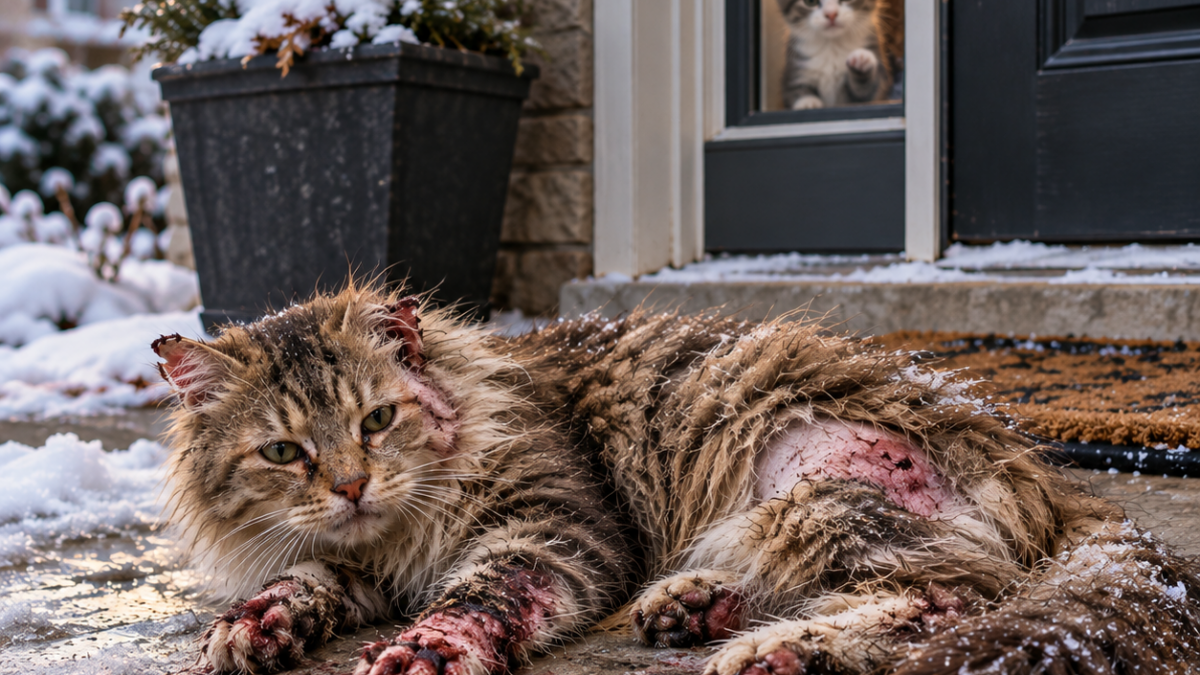
Another near the door.
Then another.
Tiny.
Smudged.
Paw-sized.
My stomach dropped.
“Where is she?”
The woman pointed inside.
“I put her in the laundry room.”
“You said she was a stray.”
Her face changed.
For only a second.
Then she said, “She used to be ours.”
I stopped.
“Used to?”
She looked toward the open door.
“My husband—”
Then she stopped.
I had heard that phrase before too.
My husband.
My boyfriend.
My roommate.
My landlord.
People often introduce responsibility by handing it to someone who is not standing there.
I said, “Show me the cat.”
The laundry room smelled before I saw her.
Infection.
Wet fur.
Dirt.
Old blood.
A sharp sour smell that comes from wounds left open too long.
Maple was lying on a folded bath towel beside the washing machine.
At first, I thought the caller had exaggerated how thin she was.
Then Maple lifted her head.
And I saw her spine.
Every ridge.
Every hip bone.
She was a long-haired brown-and-cream domestic cat, maybe seven years old.
At least she had been long-haired once.
Now her coat was a mass of mats.
Mud.
Leaves.
Burrs.
Blood.
Twigs.
Sections had fused together so tightly they pulled at the skin beneath.
One mat along her left side had peeled back enough skin that the area underneath looked bright pink and raw.
Her right ear was torn almost halfway down.
But the paws—
I had worked rescue for nine years by then.
Seen burns.
Broken jaws.
Embedded collars.
Mange.
Road rash.
I still had to look away.
Both front paw pads were gone.
Not scraped.
Gone.
The protective black tissue had worn away until the pink-red flesh underneath was exposed.
Dirt sat inside the wounds.
Small stones.
Tiny black fragments I later learned were asphalt.
One paw was still bleeding.
Her back feet were damaged too, but not as badly.
She had walked until her feet had stopped being feet.
And then she had kept walking.
I crouched.
“Hey, sweetheart.”
Maple looked at me.
Dull amber eyes.
One partially crusted with discharge.
She did not hiss.
Did not move.
The woman said, “She just showed up.”
I looked at her.
“How long had she been missing?”
Silence.
“How long?”
“About three weeks.”
“Did she get out?”
Her mouth opened.
Closed.
Then from the hallway, a child’s voice said, “Dad took her away.”
Everything in the room changed.
I looked past the woman.
A boy stood there.
Maybe ten.
Behind him, a girl younger by two years.
Both looked terrified.
The woman turned.
“Evan, go upstairs.”
The boy did not.
“You said Maple ran away.”
The woman closed her eyes.
I looked at her.
“What happened?”
She whispered, “Not here.”
I pointed toward Maple.
“This is happening here.”
The boy said, “Dad put her in the car.”
The mother said, “Evan.”
“He did.”
The boy started crying.
“I saw.”
The younger girl grabbed his sleeve.
“He said she was going somewhere else.”
I felt anger rise.
But anger does not stabilize dehydration.
It does not clean wounds.
It does not get antibiotics into a bloodstream.
So I pushed it down.
“What did your husband do?”
The woman whispered, “He left her.”
“Where?”
“Wooded area off County Road 14.”
“How far?”
“I don’t know.”
“From here?”
“Six miles. Maybe a little more.”
I stared at her.
Then Maple shifted.
One front paw moved.
She tried to push herself forward.
Her entire body trembled.
I immediately reached out.
“Don’t.”
She tried again.
Toward the hallway.
Toward the house.
The woman made a broken sound.
“Maple.”
The cat lifted her head.
Looked at her.
Then tried to stand.
She got one paw beneath herself.
The second collapsed.
Her chest hit the towel.
That was it.
Her body had spent everything getting there.
I slid the blanket under her.
“I’m taking her.”
The woman nodded.
“What clinic?”
“Emergency.”
“Can we—”
“What?”
Her eyes filled.
“Can we know if she makes it?”
I looked at her.
I wanted to say something cruel.
Something earned.
Instead I said, “Yes.”
Then I lifted Maple.
She weighed nothing.
That is not poetic.
It is the exact memory.
She weighed so little that my arms prepared for more and almost lifted too high.
Later, the clinic weighed her.
Five pounds.
Two ounces.
Her prior veterinary records showed she had once weighed nearly nine.
Almost half her body gone.
As I carried her toward the door, something gray flashed across the living room.
A kitten.
Maybe four months old.
Gray and white.
Healthy.
Bright-eyed.
A little red collar with a bell.
It jumped off the couch and ran toward the children.
Maple saw it.
I know she saw it because her head turned.
Just slightly.
Toward the sound.
The kitten stopped.
Maple stared.
The woman stared at Maple.
Nobody spoke.
There are moments you understand before anyone explains them.
“How long have you had the kitten?”
The woman covered her mouth.
“Two weeks.”
The math hit me.
Maple had been left in the woods three weeks earlier.
A week after abandoning a seven-year-old cat they had owned for six years, someone bought a kitten.
The boy began crying harder.
“We didn’t want him.”
His mother snapped, “That isn’t fair.”
“Dad bought him.”
“He thought—”
“What?”
I heard my own voice sharpen.
“What did he think?”
She looked ashamed.
“That it would be easier.”
I stared at the kitten.
Healthy.
Soft.
Playing with the girl’s shoelace.
Then at Maple.
Matted.
Bleeding.
Barely conscious in my arms.
Replaced.
Not after death.
Not after disappearance.
Not after months of searching.
After deliberate abandonment.
Maple had spent nearly three weeks trying to return to a home where her food bowl had already been given to someone else.
I left before I said something that would not help her.
The emergency clinic was fourteen minutes away.
Maple did not move during the drive.
At every red light, I reached back through the carrier and touched her shoulder.
“Stay.”
I do not know why I kept saying it.
Stay.
As if she had not already done enough of that.
At North County Emergency Veterinary Center, Dr. Priya Shah took one look at her and called for a treatment team.
“Temperature?”
“Low.”
“Blood pressure?”
“Can’t get clean read.”
“IV access.”
“Both front limbs?”
“Try hind.”
“Pain medication first.”
I stood against the wall.
Maple lay beneath warming blankets.
Her paws were photographed.
The wound on her side was clipped.
That revealed more damage than we could see through the mats.
A large section of skin had been torn away along her right flank.
Not fresh.
Several days old.
Infected.
Possibly from a predator.
Teeth?
Claws?
We never knew.
Her right ear had a deep tear consistent with a bite or snag.
Her gums were almost white.
Severely dehydrated.
Kidney values elevated.
Fleas.
Intestinal parasites.
Eye infection.
Muscle wasting.
Hypothermia.
And those paws.
Dr. Shah called me into a consultation room after the first stabilization.
“How far did you say she traveled?”
“Maybe six miles.”
“On these feet?”
“That’s what we’re trying to understand.”
Dr. Shah turned the photographs toward me.
“The front pads have been abraded through.”
“Can they regrow?”
“Not normally.”
My stomach tightened.
“What happens?”
“If she survives, granulation and scar tissue can cover the wounds. But mature pad tissue may not fully regenerate.”
“Meaning?”
“Hard surfaces could remain painful.”
“For how long?”
“Possibly permanently.”
I stared at the image.
“This didn’t happen in one day.”
“No.”
“How long do you think she walked like that?”
Dr. Shah thought.
“Based on tissue condition and early infection? Several days at least. Three to five would be reasonable.”
“On open wounds?”
“Yes.”
“Why didn’t she stop?”
Dr. Shah looked at me.
“She probably did.”
I blinked.
“What?”
“She didn’t necessarily walk continuously.”
“Right.”
“Cats travel in bursts. Hide. Rest. Move again. Avoid people.”
She pointed toward Maple’s paws.
“But yes. At some point the pads were lost, and she continued using them.”
I leaned back.
“Wouldn’t the pain stop her?”
“It should have.”
That answer sat between us.
“Then why didn’t it?”
Dr. Shah shook her head.
“I don’t know.”
Neither did I.
At the time, I wanted a simple explanation.
Home instinct.
Scent.
Memory.
Territory.
Direction.
Love.
People online later chose love.
Maybe love was part of it.
But animals are more complicated than the stories we write over them.
Maple might have followed familiar smells.
Road noise.
Landscape.
Instinct.
She may have traveled toward territory she recognized because it was the only map she had.
She did not know the house no longer wanted her.
That was human information.
Her body knew one thing.
Home was that way.
So she went.
The first forty-eight hours were critical.
Kidney values worsened before improving.
She needed fluids continuously.
Antibiotics.
Pain medication.
Wound cleaning.
Nutritional support in tiny amounts.
Too much food too fast after prolonged starvation can create its own dangers.
I had seen it before.
A rescue volunteer’s worst instinct is to feed.
Feed everything.
Feed until the animal looks less empty.
Bodies do not always forgive that urgency.
So Maple got teaspoons.
Measured.
Slow.
She hated the recovery collar.
That made me happy.
Anger requires energy.
On day two, she hissed when a technician changed her paw bandage.
I smiled.
The technician looked at me.
“That’s rude.”
“It’s excellent.”
“She tried to bite me.”
“Even better.”
Maple survived the second night.
Then the third.
By Monday, her kidney values began moving in the right direction.
That was when the questions started.
Animal control called.
Officer Ben Wallace came to the clinic.
Tall.
Beard.
Soft-spoken.
He photographed everything.
Asked for Maple’s former address.
Asked for veterinary records.
Asked exactly what the children had said.
I hated involving the children.
But this wasn’t a story about a cat who escaped.
Someone had driven her away.
Ben went to the house.
Later he called me.
“The husband admits taking her.”
I gripped the phone.
“He admits it?”
“Yes.”
“What did he say?”
“Claims he intended to leave her near a farm because someone there feeds barn cats.”
“Was there a farm?”
“Not at the location he described.”
“So he dumped her.”
“He left her in a wooded pull-off.”
“That’s dumping.”
“Yes.”
“Why?”
“Financial issues. Lease change. Veterinary expenses.”
I thought about the kitten.
“What about the new cat?”
Silence.
“Ben.”
“I saw the kitten.”
“Did he explain that?”
“He said his kids were upset.”
I laughed.
It came out ugly.
“So he replaced Maple to comfort the children after lying that she ran away?”
“Rachel.”
“What?”
“I need you to stay out of direct contact with this family.”
“I have no intention of talking to him.”
“Good.”
“I intend to think terrible things from a distance.”
“That is legal.”
“What happens now?”
“Investigation.”
“Charges?”
“Possibly.”
“Possibly?”
“We document. Prosecutor decides.”
I hated the word possibly.
Rescue teaches you many forms of uncertainty.
Possibly criminal.
Possibly adoptable.
Possibly recover.
Possibly tomorrow.
The family called every day.
Not the husband.
The wife.
Her name was Emily Harper.
The first time she called, I almost did not answer.
Then I thought of the kids.
“Is she alive?”
“Yes.”
Emily started crying.
“Can I see her?”
“No.”
Silence.
“Why?”
“She’s hospitalized.”
“I know.”
“And animal control asked us to restrict contact until they complete interviews.”
“Okay.”
She cried quietly.
Then said, “I should have stopped him.”
I said nothing.
“I knew he was taking her.”
My anger returned.
“You knew?”
“He said he found a farm.”
“You knew he was leaving your cat?”
“Yes.”
“Why?”
The question came out harsher than I intended.
Emily swallowed.
“We got a notice from the property manager. No animals on the renewed lease.”
“You had Maple for six years.”
“I know.”
“Did you ask for an exception?”
“Yes.”
“And?”
“No.”
“Did you look for a new home?”
“A little.”
“A little?”
“Our lease deadline was close.”
“So your husband drove her into the woods.”
Emily began crying harder.
“I told him not to.”
“But you let him.”
“Yes.”
There are moments when someone admits exactly what you wanted them to admit and it gives you no satisfaction.
That was one.
“Why didn’t you call a shelter?”
“He said shelters were full.”
“Did you call?”
“No.”
“Rescues?”
“No.”
“Friends?”
“No.”
“Post online?”
“No.”
Silence.
Then she whispered, “I thought she would be okay.”
I closed my eyes.
“In the woods?”
“I don’t know what I thought.”
That, at least, sounded true.
People often expect cruelty to require hatred.
It doesn’t.
Sometimes cruelty grows out of avoidance.
Cowardice.
Convenience.
Refusing to fully imagine what your decision feels like on the receiving end.
Emily said, “The kids think she ran away.”
“They know now.”
Silence.
“Evan saw.”
“Yes.”
“I didn’t know.”
“He told me.”
Emily sobbed.
I looked through the ICU window.
Maple slept beneath blankets.
Front paws wrapped like little white clubs.
“You need to tell your children the truth.”
“I know.”
“Not that Maple got lost.”
“I know.”
“Not that their father made a mistake.”
“I know.”
“Tell them adults made a decision that hurt her.”
Emily whispered, “Okay.”
We ended the call.
I felt sick.
Not triumphant.
Just tired.
Maple stayed hospitalized for nine days.
On day four she ate from a spoon.
On day five she groomed one shoulder.
On day six she tried to remove her own bandage.
By day seven, Dr. Shah said the kidney injury appeared reversible.
The flank wound remained our biggest concern.
Dead tissue had to be removed surgically.
The infected section extended farther beneath the skin than expected.
They placed drains.
Twelve days total.
The ear would heal with a notch.
Her paws required daily cleaning.
Nonstick dressings.
Antibiotic ointment.
Padding.
Then new bandages.
Every change hurt.
Even with medication.
Maple endured them with a peculiar quietness.
Not passivity.
She would growl.
Turn her head.
Sometimes try to pull away.
But afterward, when the dressing was finished, she did the same thing every time.
She looked toward the door.
At first I thought she was watching staff.
Then I noticed it happened at the same hour each evening.
Around 6:00.
That was not important until later.
On day nine, she was stable enough to leave intensive care.
The rescue needed a medical foster.
Denise called.
“You’re thinking it.”
“No.”
“You are.”
“I already have two cats.”
“Both healthy.”
“And a dog.”
“Also healthy.”
“I work.”
“You work from home three days a week.”
“Why do you know my schedule?”
“Because I exploit volunteers effectively.”
“No.”
Silence.
“Fine.”
Longer silence.
“Rachel?”
“What?”
“Maple can’t go to the shelter.”
I knew.
Paw wounds.
Drains.
Special food.
Medications.
Quiet environment.
A shelter would be miserable.
“Two weeks.”
Denise laughed.
“What’s funny?”
“Nothing.”
“Two.”
“Of course.”
“You always say that.”
“Do I?”
“Yes.”
“Then maybe stop making bad decisions.”
Maple came home with me on November 27.
I set up my guest room.
Low-sided litter tray.
Soft rugs everywhere.
No hard floor exposed.
Heated bed.
Water.
Wet food.
Medication chart taped to the wall.
My orange cat, Waffles, sat outside the door screaming because another animal existed somewhere he could not inspect.
Maple ignored him.
The first evening, she slept.
Deeply.
At 5:52 p.m., she woke.
Stood.
Her bandaged paws made soft thumping sounds on the rug.
She crossed the room.
Sat in front of the door.
And stared at it.
I waited.
“Need something?”
Nothing.
I opened the door a crack.
Maple looked into the hallway.
Did not move.
My dog was behind a baby gate at the far end.
Waffles was in my bedroom.
No threat.
Maple sat.
Ten minutes.
Then turned.
Walked back to her bed.
Curled up.
Next night.
5:47.
Same thing.
Door.
Sit.
Watch.
Twelve minutes.
Then back to bed.
Night three.
Again.
I called Denise.
“She does something weird.”
“That narrows nothing.”
“She sits at the front door every night.”
“Your front door?”
“At first the guest-room door. When I let her into the hall, she goes to the house entrance.”
“How long?”
“Ten or fifteen minutes.”
“Then?”
“Goes to bed.”
Denise became quiet.
“You think she’s waiting?”
“For what?”
“You know.”
I did.
I just did not want to say it.
Her family.
The people she had crossed six miles to find.
Nobody came.
Maple kept checking.
Every night.
At roughly the same time.
Six o’clock.
Maybe that had once been when the husband came home.
Maybe dinner.
Maybe children returning from activities.
Maybe meaningless coincidence.
But routine matters to animals.
They build time through sound and repetition.
A garage door.
Keys.
School bus.
Food bowls.
People arriving.
Maple had lived with them six years.
Six years of doors opening.
Then one door stopped.
She checked anyway.
That was the part that broke me.
Not the paws.
Not the blood.
The expectation.
Animals do not need to understand betrayal to feel absence.
One night, I sat beside her.
We both faced the door.
“You know they’re not coming.”
Maple’s ear moved.
“I don’t know why I’m telling you that.”
Nothing.
“I probably shouldn’t.”
She continued staring.
“The kids might want to.”
That was true.
“I think they do.”
I touched the rug beside her.
“But they can’t.”
Maple stayed for fourteen minutes.
Then returned to bed.
I started keeping track.
Day 1: 11 minutes.
Day 2: 13.
Day 3: 10.
Day 4: 15.
Day 5: 12.
By week two, the time shortened.
Eight minutes.
Then seven.
Her paws improved slowly.
The raw tissue began granulating.
Bright red healthy tissue.
Then fragile scar.
Dr. Shah warned me.
“This is not pad.”
“What does that mean practically?”
“Carpet, rugs, grass, soft surfaces. Limit rough concrete.”
“For life?”
“Likely.”
“She can never walk on pavement?”
“She can cross it. But prolonged exposure may hurt or cause injury.”
I thought about six miles.
“How did she do it?”
Dr. Shah looked at Maple.
“Because animals do impossible things until you realize they did them.”
That was not medical.
But it was true.
The flank wound healed.
Drains came out.
The mats were clipped away gradually.
We did not shave everything at once because her skin was too sensitive.
Without the long coat, Maple looked smaller.
Almost kittenlike.
Her fur eventually grew back unevenly.
The right side remained thinner around the scar.
Her torn ear folded slightly at the tip.
Her paws never looked normal.
Pink-gray scar tissue.
Soft.
Tender.
I bought foam mats for half my house.
My living room began looking like a children’s gymnastics center.
Waffles disapproved.
Maple did not care.
At first she hated my other animals.
Waffles approached once.
Maple hissed so violently he reversed three feet.
My dog, Bonnie, learned immediately that Maple controlled the hallway.
Slowly, boundaries formed.
Maple took the window.
Waffles took the couch.
Bonnie took everything else.
Then one afternoon I found Waffles sleeping eighteen inches from Maple.
Progress.
Two days later:
Ten inches.
One week later:
Same bed.
Not touching.
But close.
I took a picture.
Sent it to Denise.
She replied:
TWO WEEKS, RIGHT?
I ignored her.
The animal-control investigation continued.
Ben called occasionally.
The husband, Thomas Harper, had admitted abandoning Maple.
He argued that he believed outdoor cats survived in that area.
There were no charges filed immediately.
That infuriated people once the story spread.
And it did spread.
Not because I posted it.
A neighbor did.
One of the people who had seen blood spots on the sidewalk.
Her name was Janice Miller.
She lived two streets from the Harper house.
When Maple returned, Janice had seen Emily carrying her inside.
Later, after animal control questioned neighbors, Janice connected the blood she had seen along the sidewalk the night before.
She posted in a neighborhood group:
Did anyone else see blood marks along Briar Court Friday night? Animal control was here regarding an injured long-haired cat.
Someone responded.
Then another.
A man farther down County Road 14 said he had seen similar marks near the shoulder.
Ben retraced the likely route.
Not exact.
Impossible to know.
But enough to understand.
Intermittent blood marks appeared across several miles.
Not continuous.
Rain and traffic had erased much of them.
But there were points.
Shoulder.
Gravel.
Sidewalk.
Maple had bled toward home.
That detail reached local media.
Then social media.
“Cat Crawls Six Miles Home After Being Abandoned.”
People were furious.
Threats appeared.
Against the husband.
Against the wife.
Even against the family.
I hated that.
Children lived there.
Whatever adults had done, two children did not deserve strangers threatening their house.
I asked the rescue to issue a statement.
Please do not contact or harass the family. Animal welfare authorities are handling the investigation. Support Maple’s recovery and local rescue resources instead.
Some listened.
Many did not.
Outrage has appetite.
It likes villains more than solutions.
Donations arrived.
More than Maple needed.
We placed excess funds into a crisis-retention program.
Temporary food.
Low-cost vet care.
Emergency boarding.
Housing assistance referrals.
Because somewhere, another family would soon decide they “had no choice.”
Sometimes people genuinely have almost none.
But “almost none” is still a moment where intervention matters.
The first family helped by the fund was an elderly man facing eviction after hospitalization.
His cat needed temporary boarding for twelve days.
Twenty dollars a day might have separated them permanently.
Maple paid.
That felt better than a thousand angry comments.
Meanwhile, Maple kept checking the door.
Week three.
Five minutes.
Week four.
Three.
Then one night, she did not.
I noticed at 6:30.
Maple was on the heated bed.
I looked toward the front door.
Then at her.
“Forgot something?”
She stretched.
Stayed.
I sat on the floor.
Waffles climbed beside her.
Maple allowed his tail to touch hers.
I cried.
Ridiculous.
Quietly.
The next night, she went to the door again.
One minute.
Then walked away.
Healing is rude like that.
It refuses to happen symbolically on schedule.
But by month three, Maple stopped checking.
Completely.
The door became just a door.
Not a promise.
Not a question.
Not the direction love had disappeared.
Just wood.
Glass.
A lock.
Outside.
Inside.
Nothing more.
That was when Denise sent me adoption applications.
“No.”
She laughed.
“You always do this.”
“She’s not ready.”
“Dr. Shah cleared her.”
“She needs special flooring.”
“We can screen for that.”
“Soft diet.”
“Manageable.”
“Paw checks.”
“Yes.”
“Indoor only.”
“Obviously.”
“She hates being moved.”
“Most cats do.”
“She likes Waffles.”
Denise went quiet.
I realized my mistake.
“Oh no.”
“You said it.”
“Said what?”
“She likes Waffles.”
“That is an observation.”
“You built her an environment.”
“For recovery.”
“You bought permanent foam runners.”
“Medical.”
“You replaced your living-room rug.”
“It was old.”
“It was seven months old.”
I looked at Maple.
She was lying in the sun.
Flank scar visible through growing fur.
One torn ear angled sideways.
Waffles sleeping nearby.
Bonnie snoring beneath the window.
Home.
I exhaled.
“Send the paperwork.”
“Already did.”
“I hate you.”
“Frequently.”
I adopted Maple on February 28.
Three months after she returned to the house that had abandoned her.
Her new microchip registration listed my address.
That mattered to me more than I expected.
Address.
Home.
Same word.
Different meaning.
The Harper children asked to see Maple.
Animal control passed the request through the rescue.
My first reaction was no.
Then I thought about Evan.
The boy who had watched his father put Maple into the car.
The child who had been lied to.
Not his choice.
The younger girl too.
Sophie.
Eight.
I spoke with a counselor who worked with the family.
Then with Denise.
Then Dr. Shah.
We arranged one supervised visit at the rescue office.
Emily brought the kids.
Thomas did not come.
Good.
Evan entered first.
He was crying before he saw Maple.
Maple was on a blanket.
She lifted her head.
Evan stopped.
“Maple.”
Her body changed.
Not dramatic.
Ears forward.
Eyes wider.
She knew his voice.
Evan sat on the floor.
Did not approach.
Maple stood.
Walked toward him.
Her gait was careful now.
Soft surfaces only.
She smelled his hand.
Then pressed her cheek against his fingers.
The boy collapsed.
Not physically.
Emotionally.
He bent over her.
“I’m sorry.”
Maple purred.
That sound nearly destroyed me.
Sophie sat beside him.
Maple rubbed against her too.
Emily remained near the doorway.
Crying silently.
Maple noticed her.
Walked halfway.
Stopped.
Emily whispered, “Hi.”
Maple stood.
Then turned.
Returned to Evan.
I do not know what that meant.
Nobody does.
We should be careful turning animal choices into moral verdicts.
Maybe Maple smelled fear.
Maybe Emily’s body language felt different.
Maybe she preferred the child.
Maybe nothing.
Emily did not force it.
That mattered.
After twenty minutes, the children said goodbye.
Evan asked me, “Is she yours?”
“Yes.”
“Forever?”
“Yes.”
He looked relieved.
“Can you promise?”
I knelt.
“Yes.”
“If your landlord says no?”
“I own my place.”
“What if she gets expensive?”
My chest tightened.
“I’ll find help.”
“What if she gets sick?”
“She gets care.”
“What if she scratches stuff?”
I smiled.
“She already has.”
“What if—”
I put one hand gently on his shoulder.
“She stays.”
The boy nodded.
That was what he needed.
Not proof I loved her.
Proof difficult things would not send her away.
Sophie asked, “Can we send her toys?”
“Yes.”
They did.
For years.
Every Christmas.
A small package.
Two cat toys.
Sometimes three.
A card.
FROM EVAN AND SOPHIE.
Maple liked crinkle balls.
Ignored stuffed mice.
Destroyed feather wands.
Life became ordinary.
That is the best part of most rescue stories.
Ordinary.
Breakfast.
Window.
Naps.
Vet appointment.
Sunbeam.
Annoying another cat.
Getting older.
The dramatic part brings attention.
Ordinary is what the animal actually needed.
Maple gained weight.
Seven pounds.
Then eight.
Dr. Shah said stop at eight and a half because her paws carried weight differently now.
I obeyed.
Maple disagreed.
Her teeth remained sensitive.
Years of earlier dental problems combined with malnutrition.
She ate mostly wet food.
She demanded it at 6:03 a.m.
Not 6:05.
Waffles learned to benefit from her scheduling.
The two eventually slept together.
Not every night.
Maple remained independent.
But winter afternoons, when sunlight hit the heated bed, they curled side by side.
The first time their paws crossed, I thought of the blood trail.
I hated that I did.
Trauma can become a lens that makes every peaceful moment point backward.
I had to learn to stop doing that.
Maple was not her journey home.
She was not the abandoned cat forever.
She was Maple.
She chirped at birds.
Hated closed bathroom doors.
Loved tuna water.
Slept upside down.
Bit hairbrushes.
At some point I realized I had gone a week without thinking about County Road 14.
Then a month.
Justice had begun shifting.
Not because the investigation ended.
It never became public in detail.
Animal control completed its case.
The prosecutor reviewed it.
The final disposition remained private because of local procedure and family circumstances.
People online hated not knowing.
I learned to live with it.
Consequences do not always need an audience to be real.
Thomas and Emily separated the following year.
I learned this from the children’s counselor, not gossip.
Emily moved with Evan and Sophie into an apartment that allowed pets.
They did not get another cat.
The gray kitten remained with Thomas for a time.
Then, after the separation, he surrendered it legally to a rescue.
That cat was adopted within two weeks.
I had mixed feelings.
Part of me wanted hypocrisy punished.
He had discarded Maple, replaced her, then later relinquished the replacement too.
But surrendering through a rescue was exactly what he should have done the first time.
People can make a correct choice later without earning forgiveness for the first.
Both truths fit.
Evan and Sophie kept writing.
When Evan turned thirteen, he sent Maple a handwritten letter.
I did not show it to her because she could not read.
Obviously.
I kept it.
Dear Maple,
I am sorry I didn’t stop Dad.
I know I was a kid but I think about it.
I remember you sleeping on my feet.
I remember you waiting outside the bathroom for me.
I hope you don’t remember the woods.
Rachel says cats probably don’t think about memories the way we do.
I hope that’s true.
I hope your feet don’t hurt.
I hope you are warm.
I love you.
Evan
I cried so hard I had to leave the room.
Then I got angry.
Not at him.
At the way children inherit consequences from adult cowardice.
A thirteen-year-old should not have been asking forgiveness from a cat for something he had no power to stop.
I wrote back.
You did not abandon Maple.
You loved her before, and you love her now.
Adults are responsible for adult choices.
You are allowed to remember her without punishing yourself.
Then I added:
Her feet are okay on rugs.
She is warm.
She still steals chicken.
That seemed important.
Maple aged.
At nine, mild arthritis.
At ten, early kidney changes.
Nothing like the acute injury after her return.
Manageable.
Special diet.
More water stations.
At eleven, her paw scars became more sensitive.
Cold weather made her walk carefully.
I bought more heated mats.
My house began using enough electricity to power a small casino.
Denise said I was ridiculous.
I invited her to pay the bill.
She declined.
One afternoon, six years after Maple came back, Ben Wallace stopped by.
He had retired from animal control.
Gray in his beard.
He carried a folder.
“What?”
“Found something cleaning my garage.”
Inside was an old printed route map.
County Road 14 to Briar Court.
Red marks.
Places where neighbors had reported blood or where he had found possible traces.
I stared.
“Why did you keep this?”
“Case habit.”
“You want it?”
“No.”
“Why give it to me?”
He looked uncomfortable.
“Thought maybe you should decide.”
I nearly took it.
Then stopped.
“No.”
He raised an eyebrow.
“I don’t want it.”
“Sure?”
“Yes.”
For years I had imagined Maple’s path.
Every mile.
Where she slept.
Where the predator attacked.
When her paw pads wore through.
Which ditch she hid in.
How many times she stopped.
That map would let me turn suffering into geography.
I did not need it.
“Destroy it.”
Ben nodded.
“Okay.”
At the door, he looked back.
“She looks good.”
Maple was on the window bed.
“She’s old.”
“So are we.”
“Speak for yourself.”
He laughed.
After he left, I understood something.
For years, the six miles had been the biggest thing in Maple’s story.
It was what strangers knew.
The impossible distance.
The blood.
The road.
But Maple had lived far more miles inside my house afterward.
From bed to bowl.
Window to couch.
Kitchen to bedroom.
Thousands upon thousands of small safe journeys.
Those mattered more.
The worst path she walked did not deserve to remain the most important.
When Maple was twelve, she stopped jumping onto the couch.
Arthritis.
Paw sensitivity.
I built ramps.
Ugly ones.
Carpet-covered.
She used them immediately.
No dignity.
Just practicality.
At thirteen, Waffles died.
Cancer.
Maple looked for him for days.
That was painful in a different way.
She checked the heated bed.
Bathroom.
Kitchen.
Not the front door.
Never the front door.
That mattered to me.
She grieved inward.
Then one week later she slept in Waffles’s old spot.
I found her there in sunlight.
I cried.
Bonnie had died years before.
Old age.
Eventually Maple became the last of the original household animals.
Then, against my better judgment, Denise called.
“No.”
“You don’t know what I’m asking.”
“A cat.”
“Kitten.”
“No.”
“Blind in one eye.”
“Absolutely not.”
“Three weeks.”
“You said that about Maple.”
“I absolutely did not.”
“You spiritually did.”
The kitten arrived that afternoon.
His name was Milo.
Black.
One damaged eye.
Insufferable.
Maple hated him.
For two weeks.
Then I found him asleep with his face buried in her long chest fur.
Maple looked at me like she wanted assistance.
I laughed.
“You’re the senior cat now.”
She sighed.
I swear she sighed.
Milo learned from her.
Food schedule.
Window hierarchy.
How to scream at cabinet doors.
Where the heated mats were.
He followed Maple everywhere.
At first I worried.
What if she became bonded?
What if one died?
Then I stopped.
Love is not something you avoid because loss exists.
Maple had taught me that the hard way.
At fourteen, her kidneys worsened.
Slowly.
Subcutaneous fluids.
Diet.
Medication.
More frequent labs.
She tolerated treatment because she had apparently decided humans poking her was inevitable.
One evening, Evan visited.
He was seventeen.
Tall.
Almost unrecognizable.
Sophie was fifteen.
They had not seen Maple in years.
Maple was asleep when they entered.
Evan knelt.
“Hey.”
Her eyes opened.
I watched carefully.
Did she remember?
Impossible to know.
But when he offered his hand, she smelled him.
Then placed her face against his palm.
Evan cried instantly.
Sophie too.
They stayed for an hour.
Talked about school.
Their mom.
Life.
Before leaving, Evan asked, “Do you think she forgave us?”
I said, “I don’t think that is the right question.”
He looked at me.
“She wasn’t angry with you.”
“How do you know?”
“I don’t.”
“Then?”
“You were children.”
“That doesn’t mean she knew that.”
“No.”
I sat beside him.
“But forgiveness is a human framework.”
He looked at Maple.
“What do cats have?”
“Safety.”
“Trust.”
“Familiarity.”
“Comfort.”
“Fear.”
“Connection.”
I paused.
“She trusted you then.”
“Maybe she does now.”
He nodded.
“That can be enough.”
He asked if he could take a picture.
I said yes.
Maple on his lap.
Her scarred paws visible.
His hands supporting them carefully.
When he left, he whispered, “I’m glad you made it home.”
That sentence bothered me all night.
Made it home.
Which home?
She had made it back to Briar Court.
But that had not been home anymore.
Maybe location and home are not the same.
Maybe animals know that too, eventually.
Maple’s final year was quiet.
She turned fifteen.
Then sixteen.
Ancient-looking now.
Fur thinner.
Eyes cloudy.
Still beautiful.
Milo remained near her constantly.
When she moved, he moved.
I thought of Eleven and Ghost sometimes, bonded pairs from other rescue stories I had seen.
But Maple and Milo were different.
He adored her.
She tolerated him.
That was enough.
Her kidney disease advanced.
Appetite decreased.
Weight fell.
For months we managed.
Then one morning she did not get up for breakfast.
I knew.
People imagine there is always doubt.
Sometimes there is.
That morning there wasn’t.
Maple lay on her heated bed.
Breathing normally.
But tired.
Her body had the same look it had years earlier after reaching Briar Court.
Not panic.
Not fear.
Finished.
I called Dr. Shah.
She still practiced.
Gray in her hair now.
She came to my house.
Examined Maple.
Bloodwork would tell us numbers.
We did not need numbers.
Dr. Shah sat beside me.
“It may be time.”
I nodded.
Then cried.
Maple lifted her head.
Annoyed.
That made us both laugh.
“She hates emotion,” I said.
“Many cats do.”
Milo sat nearby.
Dr. Shah allowed him to remain.
Maple rested against my legs.
I touched one front paw.
The scar tissue was smooth now.
Soft.
Still not a normal pad.
Never had been.
For thirteen years I had protected those paws from rough pavement.
Rugs.
Grass.
Blankets.
Mats.
Carpet.
Softness.
I thought about that first photograph.
Blood on concrete.
Destroyed paws.
Closed door behind her.
I had kept the photograph.
Not displayed.
Stored.
Years earlier I thought I kept it as evidence.
Eventually I understood I kept it because I was afraid forgetting suffering meant disrespecting survival.
I was wrong.
Maple did not need the worst day preserved to make her life matter.
I stroked her paw.
“You walked far enough.”
My voice broke.
Dr. Shah looked down.
Milo leaned closer.
Maple’s breathing slowed after sedation.
Her body relaxed.
For a second she purred.
Soft.
Barely there.
Then rested.
I whispered, “You don’t have to find your way anywhere.”
One final breath.
Then stillness.
She was sixteen.
Thirteen years since the woods.
Thirteen years after a journey strangers later called miraculous.
I sat beside her.
Milo pressed against Maple’s side.
I did not move him.
Eventually Dr. Shah said, “She got a lot of time.”
I nodded.
“She got home.”
Then stopped.
I corrected myself.
“No.”
Dr. Shah waited.
“She got another home.”
That was more accurate.
After Maple died, I finally took out the original doorstep photograph.
I had not looked at it for years.
There she was.
Thin.
Matted.
Broken.
Bloody footprints on the step.
Door behind her.
Closed.
I stared a long time.
Then I noticed something I had forgotten.
Maple was not facing the door in the photograph.
She was facing the camera.
Me.
The carrier.
The next thing.
All those years, I thought the image was about rejection.
The door she had reached after six miles.
The home that had replaced her.
But looking again, I saw another interpretation.
The closed door was behind her.
Her face was turned forward.
I placed the photograph in an envelope.
On the front I wrote:
THE DAY MAPLE’S FIRST HOME ENDED.
Then beneath it:
AND THE REST OF HER LIFE BEGAN.
I donated the photograph to the rescue archive.
Not social media.
Not fundraising.
Our training program.
New volunteers see it during orientation.
I tell them the story.
Not to make them hate the family.
Not to create outrage.
To explain something rescue workers must understand.
By the time an animal reaches you, the obvious crisis may already be over.
Maple’s six-mile journey ended on that doorstep.
Our work began there.
Survival is not recovery.
Getting an animal out of danger is not the same as helping them believe danger has ended.
For months, Maple checked the door.
She had arrived physically.
Her mind was still traveling.
That distinction shaped how I fostered every frightened animal afterward.
Do not rush.
Do not demand affection.
Do not interpret waiting as rejection.
Do not assume a safe room feels safe because you know it is.
Do not expect an animal to understand that this door is different.
Time teaches what words cannot.
Years later, Evan contacted me again.
He was twenty-four.
Veterinary technician.
I read the email twice because I did not believe it.
He wrote:
You probably don’t remember all the things I said when I was ten.
I remember everything.
Maple is why I work with animals now.
For years I thought I owed her something.
Then I realized I couldn’t repay a cat who was gone.
So I try to make the next animal’s life better.
I work at an emergency clinic.
When someone says they can’t afford treatment, I don’t judge them first.
I help them find options.
When someone needs to surrender, I tell them surrendering safely is not the same as abandoning.
I wish my family had known that.
Thank you for taking Maple.
I cried.
Of course I did.
Then I replied:
Maple’s story did not need you to spend your life apologizing.
But I’m glad you learned something useful from her.
He wrote back:
Me too.
Sophie became a teacher.
Emily eventually volunteered with a pet-food assistance program.
I learned that years later.
I do not know whether she did it because of Maple.
Maybe.
Maybe not.
Thomas never contacted me.
I was fine with that.
Not every story requires reconciliation.
Not everyone earns access to what they hurt.
Sometimes accountability is distance.
The Maple Fund, as everyone insisted on calling the crisis-retention program despite my objections, helped hundreds of animals over the years.
Food.
Temporary boarding.
Vaccines.
Medication.
Emergency transport.
Pet deposits.
One landlord fee.
One broken furnace repair because an elderly woman refused to enter a shelter without her cats.
Every time somebody said, “I don’t know what else to do,” we tried to create one more option before abandonment became the option that looked easiest.
We could not save every relationship.
Some animals still needed surrender.
That’s okay.
Safe surrender can be love too.
That became one of Maple’s most important lessons.
Keeping an animal at all costs is not always kind.
Leaving one in the woods never is.
If you cannot continue care, ask.
Call.
Surrender.
Tell the truth.
Let somebody else take over before fear and shame turn into cruelty.
People used to ask me what I thought drove Maple those six miles.
I gave different answers over the years.
Instinct.
Territory.
Memory.
Scent.
Familiar roads.
Home orientation.
Maybe love.
Now I think the answer matters less.
What matters is that she moved toward what she knew.
Step after step.
Until the pads disappeared.
Until blood marked the road.
Until infection entered the wounds.
Until whatever attacked her tore skin and ear.
Still toward home.
People romanticize that.
They call it loyalty.
Devotion.
Unconditional love.
I understand why.
But sometimes I think there is something heartbreaking in it too.
Maple did not know the rules had changed.
She did not know humans had decided she was too expensive.
Did not know a landlord had said no.
Did not know a kitten had arrived.
Did not know children had been told she ran away.
She knew a route.
People.
Food bowl.
Couch.
Voices.
Six years of repetition.
Home.
So when she finally reached that door, she tried to walk inside.
Of course she did.
That is the part that stays with me.
Not because they refused her.
Emily actually picked her up.
Called us.
Helped.
The rescue took her from there.
But emotionally, that home had ended long before Maple knew.
She had traveled six miles toward a past.
She survived because the future happened to be waiting on the porch.
Me.
A carrier.
A clinic.
A heated bed.
Soft rugs.
Waffles.
Bonnie.
Milo.
Years.
That is what I wish people understood about rescue.
Sometimes the animal reaches the place it thinks it needs.
And our job is not to send it backward.
Our job is to build somewhere new.
I still drive County Road 14 occasionally.
Not intentionally.
It is simply one route across the county.
There is a wooded pull-off.
I believe it is the place.
Ben never confirmed.
I never asked.
For years, every time I passed, I looked into the trees.
Imagined Maple there.
Car door closing.
Engine driving away.
Cold air.
Silence.
I no longer do that.
Now when I pass, I think of her at fourteen years old yelling for breakfast.
Maple asleep on my heated blanket.
Maple swatting Milo.
Maple lying in sunlight.
Maple’s scarred paw resting on my hand.
That is memory’s responsibility too.
Do not let the worst image take every room.
Maple was abandoned once.
She was loved for thirteen years afterward.
One fact is dramatic.
The other is her life.
If you had met her near the end, you would not have known the story from looking.
You might have noticed the torn ear.
The slightly thin flank fur.
The odd texture of her front paws.
You might have asked.
I would tell you.
Then Maple would probably walk away because strangers were rarely worth effort.
She did not perform survival.
She did not behave like she owed anybody inspiration.
She simply lived.
Maybe that was the strongest thing about her.
The family had replaced her.
Maple never replaced herself.
She remained Maple.
Same cat.
Same stubbornness.
Same ridiculous preference for sleeping with one paw stretched straight forward.
Same habit of chirping instead of meowing when excited.
Same hatred of brushing despite having long fur.
What happened changed her body.
Changed where she lived.
Changed people around her.
It did not reduce her to what had been done.
Years after her death, a new volunteer once stood in front of Maple’s photograph during orientation.
She read the caption.
Then asked, “Did she really crawl six miles?”
“Walked, rested, hid, probably crawled some of it.”
“But yes.”
“And her family had another cat?”
“Yes.”
The volunteer’s face hardened.
“How can people do that?”
I had once answered that question easily.
Bad people.
Cruel people.
Monsters.
Now I answer differently.
“Usually by not thinking about the entire consequence.”
She looked confused.
I continued.
“People tell themselves the animal will be fine.”
“Someone will find her.”
“She’ll hunt.”
“She’ll adapt.”
“She’s just a cat.”
“They shrink what they’re doing until they can live with it.”
The volunteer stared at Maple’s photo.
“That sounds worse.”
“Sometimes it is.”
“Why?”
“Because it means ordinary people can do terrible things if they stop imagining the suffering on the other side of a decision.”
She was quiet.
Then asked, “What stops that?”
“Empathy.”
“Accountability.”
“Resources.”
“And sometimes one photograph you can’t look away from.”
She nodded.
I looked at Maple.
There are still blood marks visible in the image.
I wish they weren’t.
I wish the photo showed her years later.
Healthy.
Safe.
But maybe training needs the hard picture.
Then people see the second one too.
We hang both now.
The doorstep photograph.
And next to it:
Maple at fifteen.
On a heated bed.
Sunlight across her face.
Milo sleeping behind her.
Paws tucked beneath her chest.
Under the first photograph:
RETURNED AFTER THREE WEEKS.
Under the second:
HOME FOR THIRTEEN YEARS.
That’s the whole story.
Not the six miles.
Not the blood.
Not the kitten on the couch.
Both pictures.
One door closed.
Another opened.
People often say animals love us unconditionally.
I don’t think that’s completely true.
Animals have conditions.
Safety.
Food.
Comfort.
Trust.
Consistency.
We sometimes fail them and they still return because history is powerful.
Routine is powerful.
Attachment is powerful.
Maple returning did not prove the Harpers deserved her loyalty.
It proved Maple still knew them as home.
There is a painful difference.
She came back because she wanted them.
Not because they had earned that devotion.
Years later, lying beside her near the end, I thought about that.
Maybe love is not evidence that someone treated you well.
That applies to animals.
Maybe people too.
Maple’s return did not erase the abandonment.
Her affection did not absolve anyone.
Her endurance did not make what happened acceptable.
Survival is not permission.
That matters.
We love stories where loyalty conquers cruelty.
Sometimes loyalty simply survives it.
The responsibility remains ours.
To be worthy of what comes back.
The first family wasn’t.
Eventually, I hope I was.
I promised Evan she would stay.
She did.
Through paw pain.
Kidney disease.
Arthritis.
Vet bills.
Destroyed furniture.
Medication.
Old age.
All of it.
Not because keeping her made me heroic.
Because once you tell an animal, “This is home,” the sentence should mean something.
Maple did not understand my words.
She understood repetition.
Same bowl.
Same bed.
Same floor.
Same person.
Day after day.
Year after year.
That was how I answered the six miles.
Not with one dramatic rescue.
With thirteen ordinary years.
That was how home became true.
If I could go back to that November morning, I would do one thing differently.
I would not look behind Maple at the closed door.
I spent too many years angry at that door.
I would look at her.
Five pounds.
Matted.
Bleeding.
Destroyed paws.
Still conscious.
Still facing forward.
I would wrap her sooner.
Lift her.
Tell her what she could not possibly understand yet.
“You don’t have to walk anymore.”
Not because the journey was over.
Because someone else was finally going to carry part of it.
That is what she deserved from the beginning.
Maybe that is what every abandoned animal deserves.
Not praise for finding its way back.
Not a viral story about loyalty.
A world where it never has to.
But Maple did.
Nearly six miles.
Through cold woods.
Across gravel.
Over pavement that removed the skin from her feet.
Past fear.
Past pain.
Past whatever attacked her.
Following whatever invisible map remained inside her toward people she still recognized as family.
She reached the doorstep.
Miaowed once.
Tried to enter.
Collapsed.
And yes, there was another cat inside.
Yes, her place looked taken.
Yes, the family had moved on before Maple even knew she had been left.
That part will always hurt.
But it was not the ending.
The ending came thirteen years later.
A warm room.
A soft bed.
No pavement.
No blood.
No closed door to watch.
My hand under her scarred paw.
Milo beside her.
Dr. Shah sitting quietly across from us.
Maple too tired to move.
Too old to search.
Finally certain, in the only way an animal can become certain, that nobody was going to put her into a car and make home disappear again.
She spent three weeks finding her way back to the wrong house.
Then she spent the rest of her life learning she never had to find her way home again.
Because this time—
home stayed.

