The War Dog Who Saved 40 Marines Was Hours From Euthanasia—Then a Night Nurse Played His Fallen Handler’s Voice and Whispered, “You Held the Line. You Can Rest Now.
PART3:
Set Kaiser’s file in her lap.
Opened it.
She had read the clinical summary earlier.
Everyone had.
K9 KAISER.
German Shepherd.
Male.
Eight years.
Explosive detection.
Multiple deployments.
Severe handler-directed aggression.
Environmental hypervigilance.
Startle response.
Barrier aggression.
Food refusal.
Sleep disturbance.
Repetitive pacing.
High-risk bite history.
UNSUITABLE FOR RETURN TO DUTY.
UNSUITABLE FOR STANDARD ADOPTION.
BEHAVIORAL EUTHANASIA RECOMMENDED FOLLOWING MULTIDISCIPLINARY REVIEW.
The language was clinical because clinical language protects people from drowning in what happened.
Addison knew that.
Her brother’s medical records had used phrases like:
post-deployment adjustment difficulty.
sleep disturbance.
hyperarousal.
social withdrawal.
The paperwork had never said:
He wakes up screaming because part of him still believes he is in Fallujah.
It had never said:
He sits in the dark because daylight makes him feel guilty.
It had never said:
His little sister can hear him crying through the bedroom wall.
It had never said:
One night he will die because nobody around him understands how close to the edge he really is.
His name had been Ryan Collins.
Army combat medic.
Thirty-one when he died.
Three years before Addison came to Lackland.
She had learned something afterward.
Trauma often looks like anger to people standing outside it.
Inside, it may be fear.
She turned another page in Kaiser’s file.
The incident with Staff Sergeant Willis.
Willis had reached into the enclosure during routine care.
The report said he attempted to secure K9 Kaiser by collar for bowl exchange.
Kaiser had given almost no visible warning.
He turned.
Clamped onto Willis’s left forearm.
Drove forward.
Would not release.
Three people responded.
Chemical restraint required.
Willis needed surgery.
Tendon damage.
Nerve injury.
When Major Rockwell Volkov reviewed the incident, he had written:
Bite severity and absence of warning represent unacceptable risk.
No one could really argue with that.
Addison didn’t.
A dangerous dog is dangerous whether pain explains him or not.
Understanding is not the same as pretending risk does not exist.
She kept reading.
Then she found the deployment file.
Not complete.
Some details redacted.
But enough.
Helmand Province.
Corporal Thomas Hayes.
Primary handler.
Twenty-two.
Ohio.
Kaiser had worked with him almost exclusively for seven months.
Detection record exceptional.
Forty-plus personnel credited as likely beneficiaries of alerts to buried explosives across multiple patrols and route-clearance operations.
The phrase “saved forty Marines” had grown around Kaiser later because people like round numbers and heroes.
The official record was more careful.
What mattered was that he had been very good.
And Thomas Hayes had been his person.
There were photographs clipped into the file.
Thomas kneeling beside Kaiser.
Thomas sharing canteen water.
Kaiser asleep with his body against Thomas’s boots.
Thomas smiling while the dog tried to climb into a vehicle before being told.
Then the ambush.
The after-action report was only three pages.
Addison read it twice.
IED detonation beneath lead vehicle.
Small-arms fire.
Confusion.
Thomas hit by shrapnel at the neck.
Massive bleeding.
Kaiser dragged him by tactical vest toward lower ground.
Then stood over him.
Would not allow medics to approach.
Lunged.
Snapped.
One medic struck.
The team used an electrical incapacitation device to separate the dog.
Thomas loaded.
Kaiser restrained.
Thomas died during evacuation.
Addison stopped reading.
Thunder rolled outside.
Kaiser shook harder.
The file described his behavior after return.
Anytime two or more uniformed personnel approached together, arousal increased.
Direct collar contact triggered extreme response.
People reaching over his shoulders.
People coming from behind.
Tactical vests.
Helicopter noise.
Metal gurneys.
Explosive sound.
The pattern was there.
Not hidden.
Just fragmented across reports written by different people for different purposes.
Addison closed her eyes.
She imagined the scene not as a clinician.
As Kaiser.
Explosion.
Deafening pressure.
Thomas falling.
Blood.
Kaiser dragging him.
Men running.
Hands reaching.
Uniforms grabbing.
Thomas being pulled away.
Pain.
Shock.
A device striking him.
Then waking somewhere else.
No Thomas.
From that point forward, every collar grab might not be a collar grab.
It might be that moment happening again.
Every uniformed body leaning over him might be the people taking Thomas.
Every thunderclap might be artillery.
Every metal cart might be a medevac litter.
Addison whispered:
“Oh, sweetheart.”
Kaiser looked up.
She did not move closer.
Another crack of thunder.
The dog snapped at empty air.
Then spun.
Paced two frantic circles.
Stopped.
Stared at the gate.
Addison kept voice low.
“You think it’s happening again.”
His lips pulled back.
Not toward her exactly.
Toward everything.
“You’re still there.”
The growl rose.
She did not romanticize it.
This dog had seriously injured a man.
Fear can kill too.
But for the first time, Addison could see an internal logic.
Not random madness.
A loop.
The question was whether anybody could interrupt it safely.
She stood.
Kaiser lunged at bars.
The sound was enormous.
Addison froze where she was.
He slammed once.
Teeth snapping.
The whole kennel vibrated.
She backed away.
Not because she had failed.
Because she had learned something.
Proximity mattered.
Uniform mattered.
She looked down.
White veterinary coat.
Badge.
Radio clipped at hip.
Medical odor.
Gloves.
Everything about her might resemble the people who had restrained him.
Addison went to nurses’ station.
Took off coat.
Removed badge lanyard.
Set radio down.
Changed from scrub top into plain gray T-shirt she kept for emergencies.
Jeans.
No gloves.
Nothing hanging around her neck.
Then she opened her phone.
Earlier that evening, curiosity had made her search Thomas Hayes.
Memorial pages.
Old Marine-unit photographs.
Family posts.
Anything that showed him with Kaiser.
She had found one video.
Forty-three seconds.
Posted years earlier by Thomas’s mother.
Training range in North Carolina.
Wind noise.
A few Marines laughing.
Kaiser straining toward something beyond frame.
Thomas’s voice:
“Hold the line, Bubba.”
Then laughter.
“You and me.”
“Hold the line.”
Bubba.
It was not in Kaiser’s military record.
Not his working name.
Not command.
A private nickname.
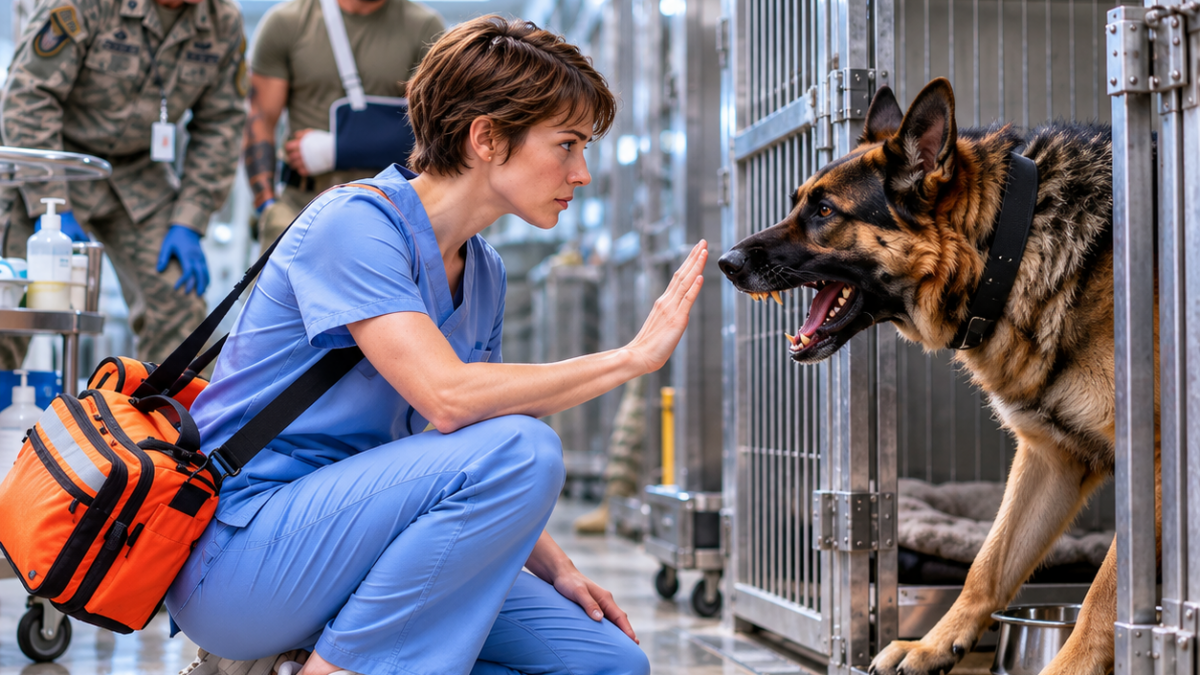
Addison returned to Cell 42.
Ten feet.
Sat on concrete this time.
Not stool.
Lower.
Less imposing.
Kaiser stared.
She placed phone on floor.
Did not reach toward bars.
Hit play.
Static.
Wind.
Then Thomas.
“Hold the line, Bubba.”
Kaiser froze.
Everything in him stopped.
Growl.
Pacing.
Teeth.
His ears rotated forward.
His body became rigid.
The audio continued.
“You and me.”
“Hold the line.”
Kaiser’s mouth closed.
He stepped toward the sound.
Not Addison.
The phone.
Then a sound came from him Addison had never heard in a German Shepherd.
A long, rising cry.
Not bark.
Not howl exactly.
Something between.
He pressed his forehead against the steel.
His eyes searched hallway.
Thomas again.
“Hold the line, Bubba.”
Kaiser whined.
Addison’s vision blurred.
She played it a second time.
Then a third.
Each time, same.
Freeze.
Search.
Whine.
The aggression did not disappear.
But something else broke through it.
Recognition.
Grief.
Addison whispered:
“He’s gone.”
Kaiser looked at her.
She swallowed.
“Bubba.”
The effect was immediate.
His ears shifted.
Addison felt her throat close.
“He’s gone.”
“I’m sorry.”
“You didn’t lose him because you failed.”
Kaiser paced once.
She continued.
“You held the line.”
Thunder shook the roof.
Kaiser flinched so hard his rear legs buckled.
Addison did not move toward him.
“You did your job.”
“He knew you were there.”
“He knew.”
Kaiser pressed his head into corner.
Addison lowered voice further.
“You can stand down now.”
Those were the words.
Not a command.
Not military language in any official sense.
Just something she wished someone had said to Ryan.
You can stop fighting.
You are home.
The war isn’t here.
You held the line.
You can stand down.
Kaiser lay down.
Not relaxed.
But no longer throwing himself at bars.
Addison sat there for forty minutes.
Then an hour.
No door opening.
No reaching.
No miracle.
Just presence.
At 3:11 a.m., Kaiser placed his chin on front paws.
At 3:36, he closed his eyes for nine seconds.
Opened.
Checked her.
Closed again.
At 4:02, Addison called Major Volkov.
He answered on fourth ring.
“Collins?”
“Sir.”
“What’s wrong?”
“Kaiser.”
Silence.
Then instantly alert.
“Did he get out?”
“No.”
“Are you hurt?”
“No.”
“What happened?”
“I think we missed something.”
Rockwell Volkov had spent twenty years treating military working dogs.
He did not enjoy being told he’d missed something by someone who had worked there less than three months.
Still, he asked:
“What?”
Addison explained.
Triggers.
Collar.
Uniform.
Thomas.
Video.
Response.
Volkov stayed quiet.
Then:
“Do not enter kennel.”
“I won’t.”
“Do not attempt handling.”
“I won’t.”
“I’ll be there at six.”
Addison said:
“His euthanasia is tomorrow.”
“I know.”
“Please don’t let them do it before you see this.”
Volkov’s voice softened slightly.
“No one is euthanizing him at four in the morning.”
“Stay outside.”
“I will.”
She hung up.
And kept sitting.
At 5:58, Major Volkov came down the hallway.
Blue uniform.
Addison saw Kaiser change instantly.
Head up.
Body stiff.
Lips tightening.
She lifted one hand.
“Sir.”
Volkov stopped.
Kaiser growled.
Addison said:
“Would you remove jacket?”
He stared.
“Excuse me?”
“Please.”
Volkov looked at dog.
Then Addison.
He removed outer uniform coat.
Placed it on chair.
Kaiser remained tense.
But did not lunge.
Addison picked up phone.
Played Thomas’s video.
Kaiser froze.
Volkov’s face changed.
“Again.”
She did.
Thomas:
“Hold the line, Bubba.”
Kaiser moved toward sound.
Whined.
Major Volkov took one slow breath.
“Where did you get this?”
“His mother’s memorial page.”
“That nickname isn’t documented.”
“I know.”
Volkov moved one step.
Kaiser stiffened.
“Stop.”
Addison said.
Major stopped.
She pointed.
“He’s reading approach.”
Volkov lowered his body slightly.
Turned shoulder.
Waited.
Kaiser’s growl eased.
Volkov whispered:
“Jesus.”
Not because dog was cured.
Because he had seen difference.
A measurable difference.
That mattered.
He said:
“Get Willis.”
Staff Sergeant Gary Willis arrived just after seven.
Arm still in sling.
The moment he entered in tactical uniform, Kaiser erupted.
Barking.
Lunging.
Slamming front gate.
Willis went pale.
“Same dog.”
Addison said:
“Take the vest off.”
“No.”
“Gary.”
“No.”
Volkov intervened.
“Do it.”
Willis stared at him.
Then removed tactical vest.
Kaiser continued barking.
Addison said:
“Turn sideways.”
Willis did.
“Don’t approach.”
He stayed.
The barking shortened.
Then stopped.
Kaiser watched.
Addison asked:
“When he bit you, exactly what did you do?”
Willis looked at sling.
“I told you.”
“Tell me physically.”
“I reached for collar.”
“From where?”
“Behind-left.”
“With which hand?”
“Right.”
“What were you wearing?”
“This vest.”
“Did you lean over him?”
“Yes.”
“Did he see you first?”
Willis hesitated.
“No.”
He looked at Kaiser.
Then at deployment photo.
His face changed.
“I looked like…”
“Maybe.”
Addison didn’t overstate.
“We don’t know exactly what he perceived.”
“But the pattern is worth testing.”
Willis swallowed.
“That son of a bitch nearly took my arm.”
“I know.”
“Don’t make him innocent.”
“I’m not.”
That mattered.
Addison looked directly at him.
“He hurt you.”
“Badly.”
“Trauma explains behavior.”
“It doesn’t erase what happened to you.”
Some tension left Willis’s face.
“Thank you.”
Major Volkov said:
“We pause the euthanasia.”
Willis looked sharply.
“Sir.”
“Pause.”
“Not cancel.”
“We conduct formal behavioral reassessment under controlled conditions.”
Willis frowned.
“You think this is reversible?”
Volkov looked at Kaiser.
“No.”
“I think we have new information.”
That was all responsible medicine could say.
The authorization was not ripped up.
Nobody falsified death.
Nobody lied to Pentagon officials.
Real systems do not work that way.
Instead Major Volkov wrote an emergency clinical hold pending reassessment based on previously undocumented trauma-associated triggers and evidence of context-dependent behavioral modulation.
It was less cinematic.
It was also legal.
And it saved Kaiser’s life for seventy-two more hours.
Sometimes seventy-two hours is enough to change everything.
A multidisciplinary team came in.
Veterinary behavior specialist.
Working-dog trainer.
Volkov.
Willis.
Addison.
Another handler who had never worked Kaiser.
They built controlled tests.
No direct exposure beyond safety barriers.
No dramatic touching.
No one “proving” bravery.
They changed one variable at a time.
Uniform.
No uniform.
Front approach.
Rear approach.
Collar tool.
Harness.
Voice recording.
Thunder playback at low volume.
Medical cart.
Tactical vest.
The results were ugly.
But consistent.
Kaiser was not generally safe.
He reacted violently to several specific combinations.
Especially uniformed men approaching from rear toward neck or shoulders.
High-intensity rotor-like sound.
Metal restraint equipment.
Multiple handlers crowding him.
But with a neutral-clothed handler seated at distance, no direct stare, no collar reach, and Thomas’s familiar phrase used as conditioned bridge, Kaiser’s arousal dropped significantly.
He ate.
That alone shocked staff.
For months, stressful assessments had ended with food refusal.
With Addison outside gate, he ate chicken from floor.
Not her hand.
No one was stupid enough to try.
On day two, he slept.
Twenty-two minutes.
Deep enough his paws moved.
Volkov watched through camera.
“First REM cycle I’ve seen him sustain.”
Addison said:
“That’s good?”
“It’s something.”
On day three, Willis came in wearing plain clothes.
No vest.
No sling by then except soft support.
He sat twenty feet away.
Kaiser stared.
Willis did not move.
Addison whispered:
“Hold the line.”
Kaiser looked at her.
Then Willis.
Willis’s voice broke.
“Tommy used to say that.”
Addison nodded.
“You knew?”
“Yeah.”
“Why wasn’t it in file?”
Willis smiled sadly.
“Because files don’t know everything.”
He looked toward Kaiser.
“I hated you.”
The dog watched.
Willis continued:
“You scared the hell out of me.”
“You still do.”
Kaiser lowered head.
Willis swallowed.
“I’m sorry I grabbed you.”
Addison looked at him.
He shrugged.
“Doesn’t mean he gets to eat me again.”
“No.”
“But I get it now.”
That was enough.
After three days, recommendation changed.
Not:
RETURN TO DUTY.
Never.
Kaiser would never work explosives again.
Not:
STANDARD CIVILIAN ADOPTION.
Too risky.
Not:
FULL REHABILITATION GUARANTEED.
Nobody could promise that.
The recommendation became:
MEDICAL RETIREMENT CONSIDERATION PENDING SPECIALIZED PLACEMENT WITH EXPERIENCED CAREGIVER, SECURE ENVIRONMENT, BEHAVIORAL MANAGEMENT PLAN, AND ASSUMPTION OF DOCUMENTED RISK.
A bureaucratic sentence.
Addison cried when she read it.
She asked to be considered.
Volkov said no immediately.
“You have no military working-dog handler certification.”
“I have emergency veterinary experience.”
“Not same.”
“I know.”
“You live alone?”
“Yes.”
“Secure yard?”
“Six-foot privacy fence.”
“Neighbors?”
“One on either side.”
“Children?”
“No.”
“Other animals?”
“No.”
“We would need home inspection.”
“Do it.”
“Behaviorist approval.”
“Okay.”
“Transition plan.”
“Okay.”
“Liability acknowledgment.”
“Okay.”
“Potentially months.”
“Okay.”
Volkov stared.
“Why?”
Addison knew the answer people expected.
Because he is hero.
Because he saved Marines.
Because nobody else will.
That wasn’t it.
She said:
“Because I know what it looks like when everybody decides someone’s worst moment is their whole identity.”
Volkov looked down.
She continued.
“My brother came home from war.”
“People loved him.”
“They wanted old Ryan back.”
“He couldn’t be old Ryan.”
“And every time he failed to act normal, everybody got scared or frustrated.”
“Eventually he stopped letting anybody close.”
She looked through observation glass.
“I can’t save my brother.”
“I know that.”
“I also know this dog may never be safe in ordinary home.”
“But if your team believes he can live with management, I can give him that management.”
Volkov said:
“You understand compassion cannot replace control.”
“Yes.”
“Love doesn’t prevent bites.”
“I know.”
“You may never be able to grab his collar.”
“Then I won’t.”
“You may need muzzle conditioning.”
“Then we’ll do it.”
“You may need to medicate during storms.”
“Fine.”
“You may organize your life around his triggers.”
Addison nodded.
“So be it.”
Volkov sighed.
“You are either exactly the right person or absolutely insane.”
“Can both be true?”
He almost smiled.
Transition took seven weeks.
Not one dramatic night.
Seven weeks.
Addison visited under supervision.
Same clothes at first.
Same place.
Same distance.
Kaiser learned her scent.
Her voice.
The phrase.
“Hold the line.”
Then:
“Stand down.”
They introduced basket muzzle through positive reinforcement.
No force.
At first Kaiser attacked it.
Then ignored it.
Then touched it for food.
Then placed nose inside for one second.
Five.
Ten.
Strap never tightened until behaviorist said.
Harness replaced collar as primary handling point where possible.
No one approached from behind.
No one leaned over.
Addison learned every signal.
Ear position.
Mouth tension.
Whale eye.
Weight shift.
Freezing.
Lip movement.
The difference between alert bark and escalating vocalization.
She learned when to stop.
Most important skill.
Stop before failure.
First time she stood inside the same fenced run, there was still a secondary barrier.
Kaiser paced.
Addison sat sideways.
Phone on ground.
Thomas’s voice played.
“Hold the line, Bubba.”
Kaiser approached barrier.
Lay down.
Week five, barrier opened under double-handler safety plan.
Kaiser did not rush.
He stood.
Addison stayed seated.
He approached.
Sniffed her shoulder.
Moved away.
Returned.
She did not touch.
Five minutes.
Then ten.
On third session, he pressed side against her arm.
Addison cried silently.
Did not hug him.
Trust is not permission to lose judgment.
Week seven, adoption-retirement package approved.
Special placement.
Medical retirement.
Continuing veterinary behavioral care.
Base retained records.
Follow-up required.
Willis signed witness page.
Before Addison left, he came to transport lot.
Kaiser was wearing basket muzzle and working harness.
Willis stayed twelve feet away.
“Hey.”
Kaiser watched.
Willis pointed at him.
“No hard feelings.”
Kaiser blinked.
Willis looked at Addison.
“That’s a lie.”
She laughed.
“Fair.”
He rubbed scar through sleeve.
“Some feelings.”
Then:
“Take care of him.”
“I will.”
Willis turned to Kaiser.
“Tommy would want you off base.”
His voice cracked.
“Go be a dog.”
Kaiser looked at him.
Then away.
Not forgiveness.
Dogs don’t owe narratives.
But no lunge.
That was progress.
Addison’s house sat outside San Antonio on small rural road.
Oak trees.
One-story.
Secure six-foot fencing.
Double gate.
No dog park.
No strangers touching him.
A yellow sign by front gate:
WORKING DOG RETIRED
DO NOT APPROACH
CALL OWNER
First night, Kaiser did not enter bedroom.
He slept beside back door.
Second night, hallway.
Third night, bedroom doorway.
A thunderstorm came on day eleven.
Addison had prepared.
Blackout curtains.
White noise.
Veterinarian-prescribed medication given early.
No uniform smells.
No visitors.
Safe den in interior room.
Thunder rolled.
Kaiser began pacing.
Addison sat on floor outside den.
No reaching.
“Hold the line.”
His breathing sped.
Lightning.
He whined.
“You held it.”
Another crash.
Kaiser trembled.
Addison whispered:
“You can stand down.”
Slowly he lay beside her.
Not on her.
Near.
That was victory.
Six months later, he slept with his back against her legs.
His coat shone again.
He gained healthy weight.
He played with a rubber ball.
He still hated helicopters.
Still could not tolerate strangers reaching toward neck.
Still wore muzzle for veterinary exams.
Still needed medication during storms.
Still had bad days.
Healing did not turn him into easy pet.
That would have been dishonest.
It turned him into a manageable, living dog with a person who understood what management required.
There is dignity in that too.
Major Volkov visited once.
No uniform.
Jeans.
Button-down.
He stopped at gate.
Addison came out.
“Kaiser secure?”
“Yes.”
She brought dog into fenced secondary yard.
Volkov stayed outside.
Kaiser saw him.
Stared.
No barking.
Volkov almost smiled.
“He looks good.”
“He is good.”
“No.”
Volkov shook head.
“He’s doing well.”
Addison understood correction.
A dog can be good and dangerous.
Loved and limited.
Improved and still damaged.
People like simple categories.
Safe.
Unsafe.
Hero.
Monster.
Reality asks for more nuance.
Volkov said:
“I almost euthanized him.”
“You made best decision with information you had.”
“That doesn’t make it feel better.”
“No.”
He looked at Kaiser.
“We failed to ask why.”
Addison leaned against fence.
“You asked if he could work.”
“You asked if he could be handled.”
“You asked if he could be adopted normally.”
“All reasonable.”
“But nobody asked what happened right before he attacked.”
Volkov nodded.
“Behavior is data.”
“Exactly.”
He stayed twenty minutes.
Before leaving:
“What did you say that first night?”
Addison looked at Kaiser.
“Something I wish someone had told my brother.”
“What?”
“You held the line.”
“You did your job.”
“You can stand down now.”
Volkov was quiet.
Then:
“Maybe people need that too.”
“They do.”
Years passed.
Kaiser became older.
His muzzle whitened.
His hips stiffened.
He still did perimeter checks every evening.
One slow lap.
Gate.
Fence corner.
Back porch.
Then inside.
Addison started calling him Bubba more than Kaiser.
Not to replace Thomas.
Never that.
The name belonged to the bond that had saved him once.
She treated it like inheritance.
Once, Thomas Hayes’s mother contacted her.
Linda Hayes.
She had learned through military working-dog retirement network that Kaiser was alive.
The original euthanasia plan had never been public.
Neither had all details.
Linda asked one question.
“Can I see him?”
Addison consulted behaviorist first.
Then Volkov.
Then thought for a week.
Thomas’s scent would be gone after years.
But voice?
Family resemblance?
Emotion?
No one knew.
They planned controlled visit.
Outdoor.
Distance.
No touch.
Kaiser muzzled.
Secondary handler present.
Linda arrived carrying small plastic container.
She was sixty.
Thomas’s eyes.
That was first thing Addison noticed.
She stood outside fence.
Kaiser came out.
Stopped.
Stared.
Linda began crying.
“Oh.”
Kaiser’s ears moved.
Linda whispered:
“Hi, Bubba.”
The dog froze.
Same as recording years earlier.
Addison’s chest tightened.
Linda took one trembling breath.
“Hold the line.”
Kaiser walked toward fence.
Not fast.
Stopped six feet away.
Whined.
Linda covered mouth.
“He remembers.”
Maybe.
Maybe tone.
Maybe word.
Maybe something no person could explain.
Addison did not pretend certainty.
Linda sat on ground outside fence.
Kaiser lay on inside.
They stayed that way forty minutes.
No touching.
No dramatic embrace.
None needed.
Before leaving, Linda gave Addison container.
Inside was Thomas’s old unit patch.
And a red rubber ball.
“Kaiser used to steal these.”
Addison smiled.
“Still does.”
Linda laughed through tears.
Then:
“Thank you for not letting his story end there.”
Addison shook head.
“Kaiser did that.”
“No.”
Linda looked at her.
“He needed someone to see him after Tommy was gone.”
That sentence stayed.
Kaiser died at fourteen.
Old age.
Degenerative myelopathy.
His back legs weakened.
Addison used support harness.
Then cart.
Eventually quality of life declined.
This time there was no controversy.
No danger label.
No midnight order.
Just a veterinarian in Addison’s living room.
Linda Hayes on video call.
Major Volkov retired by then.
Willis sent message.
Addison sat on floor.
Kaiser’s head in her lap.
No muzzle.
He hadn’t needed one with her in years.
She played the old forty-three-second video.
Thomas’s voice filled room.
“Hold the line, Bubba.”
Kaiser’s ear twitched.
Addison cried.
“You did.”
“You held it longer than anybody should’ve had to.”
She rested her forehead against his.
“You can stand down now.”
The veterinarian gave medication.
Kaiser relaxed.
Addison felt the exact moment his breathing stopped.
It hurt.
But not like Ryan.
Not the same.
Because this time love had stayed until the end instead of disappearing before anybody knew goodbye was happening.
Addison buried Kaiser beneath the biggest oak in yard.
No military cemetery.
No ceremony ordered from above.
But people came.
Volkov.
Willis.
Linda Hayes.
Three former handlers.
Two veterinary staff.
Someone brought folded American flag that had flown over training center one day in Kaiser’s honor.
Nobody pretended he had been perfect.
Willis spoke.
His left arm never fully regained strength.
He stood beneath oak and said:
“I was angry at him for years.”
People waited.
“He hurt me.”
“That’s true.”
“And he was hurting.”
“Also true.”
“One doesn’t cancel other.”
He looked at Addison.
“She taught me that.”
Then:
“I wish Tommy could see him.”
Linda whispered:
“He did.”
No one argued.
Major Volkov spoke last.
“When we evaluate military working dogs, we have an obligation to protect handlers, staff, families, and public.”
“Kaiser forced us to examine whether risk assessment without trauma context can become incomplete.”
“He was never returned to service.”
“He should not have been.”
“He was never made safe for ordinary adoption.”
“He couldn’t be.”
“But he was given a controlled retirement because somebody recognized a pattern we had not fully understood.”
He looked toward grave.
“That distinction gave him six more years.”
Six more years.
People love stories where compassion proves experts wrong.
This was not that story.
Experts had been right about danger.
Addison had been right that danger had a cause.
Both truths mattered.
What changed was not that Kaiser became harmless.
What changed was that the team found a way for him to live without asking him to become something he no longer could be.
That was why Addison kept his original red behavioral tag.
Not as insult.
Reminder.
UNDERSTAND DOES NOT MEAN UNDERESTIMATE.
She framed it beside photograph Linda gave her.
Thomas kneeling in Afghanistan.
Kaiser beside him.
Young.
Unscarred.
Alive.
Underneath, a second photograph.
Kaiser old on Addison’s porch.
Gray muzzle.
Rubber ball between paws.
Two lives.
Both true.
Addison stayed in military veterinary medicine.
She became behavior and trauma-care specialist.
Not because one night made her expert.
It didn’t.
She trained.
Studied.
Certified.
Worked with specialists.
Years.
She became especially interested in military and police dogs with operational trauma.
She taught new technicians one rule:
“Never confuse explanation with permission.”
A dog may bite because afraid.
You still protect staff.
A dog may growl because pain.
You still use barriers.
A dog may have trauma.
You still respect teeth.
But you ask why.
Because why can change how.
One young technician once asked:
“Was Kaiser the dog who almost got euthanized because everyone thought he was evil?”
Addison shook head.
“No.”
“They didn’t think he was evil.”
“They thought he was unsafe.”
“He was.”
“Then why didn’t they euthanize him?”
“Because we found a safe alternative.”
The technician looked disappointed.
Less dramatic.
Addison smiled.
“Reality is harder than heroes and villains.”
She was right.
Kaiser was not monster.
Willis was not cruel handler.
Volkov was not heartless officer.
Addison was not magical whisperer.
Thomas was not just dead Marine.
Ryan was not just tragedy.
They were all people and animals caught inside consequences of war, training, grief, fear, duty, and decisions made with incomplete information.
The miracle, if there was one, was not that Kaiser suddenly became gentle when one special woman said right words.
The words opened a door.
Then months of careful work held it open.
That’s the part stories often skip.
The patience.
The barriers.
The assessments.
The times he regressed.
The medication.
The muzzle.
The canceled appointments.
The storms.
The professional help.
The choice to stop when he said stop.
The willingness to love an animal without demanding he perform gratitude.
That was how Kaiser survived.
Not through sentiment.
Through understanding disciplined by safety.
Years after his death, Addison still dreamed about first storm sometimes.
Not the moment he lunged.
The moment she found him in corner.
Paws over muzzle.
Shaking.
Every person at Lackland knew what Kaiser did when he was angry.
Very few had seen what happened when he was afraid.
That difference became central to everything she taught afterward.
One night, during training lecture, she projected two photographs.
The first:
Kaiser snarling behind reinforced bars.
Teeth exposed.
Body forward.
The image everybody remembered.
Second:
Kaiser in dark rear corner during thunder.
Curled.
Trembling.
Eyes wide.
She asked students:
“Which dog is real?”
People hesitated.
Then someone said:
“Both.”
Addison nodded.
“Exactly.”
“Never make a treatment plan from one photograph.”
That became her rule.
Not just for dogs.
Maybe for people too.
Her brother Ryan had been one photograph to everyone after deployment.
Angry.
Distant.
Unstable.
He had also been the teenager who taught Addison to drive.
The medic who mailed their mother terrible postcards.
The man who cried when family dog died.
The brother who called every birthday until he stopped calling anyone.
Both.
Trauma had not erased the person before.
It had made access harder.
Addison could not go back and save Ryan.
She eventually stopped trying to make Kaiser serve as substitute.
That mattered.
For a while she had feared that’s why she’d fought so hard.
Therapist helped.
Kaiser wasn’t Ryan.
Ryan wasn’t Kaiser.
Saving one did not undo losing other.
Love does not balance books.
What Kaiser gave Addison was not redemption for Ryan’s death.
He gave her a chance to respond differently to pain once.
Then again.
Then many times.
That was enough.
The last object she kept from Kaiser was Thomas’s red rubber ball.
Chewed almost through.
It sat on shelf beside unit patch.
Whenever a new trainee asked about it, Addison told story.
Not the internet version.
Not:
War dog sentenced to die.
Brave nurse opens cage.
Dog becomes gentle.
Major tears order.
Secret adoption.
Happy ending.
She told real version.
Dangerous dog.
Dead handler.
Trauma trigger.
Night nurse notices pattern.
Old recording.
Pause.
Assessment.
Controlled retirement.
Years of management.
Then a good death.
And she always ended same way.
“Kaiser did not need somebody to prove he was harmless.”
“He wasn’t.”
“He needed somebody to stop asking only what was wrong with him and start asking what had happened to him.”
Then she’d pause.
“And once we knew that, we still had to decide whether there was a safe path forward.”
“For him, there was.”
“For some animals, there isn’t.”
“Compassion means telling truth about both.”
That was lesson.
But there was another one.
Quieter.
Personal.
The words Addison had whispered into the dark at two in the morning had not been training command.
They had been permission.
Not to forget Thomas.
Not to become old Kaiser.
Not to stop being scarred.
Permission to stop reliving the same battle every time somebody came near him.
“You held the line.”
“You did your job.”
“You can stand down now.”
Years later, Major Volkov told Addison he had used a version of those words with a retiring handler after the man’s last deployment.
Willis said them to himself before first surgery on his damaged arm.
Linda Hayes wrote them beneath Thomas’s photograph.
And Addison finally said them at Ryan’s grave.
She had avoided cemetery for four years.
Then one autumn morning she drove there alone.
Sat in grass.
Told her brother about Kaiser.
About Thomas.
About thunder.
About the night she almost convinced herself she could fix somebody by loving them hard enough.
Then she cried.
And whispered:
“You held the line too.”
“You did your job.”
“You can stand down now.”
Wind moved leaves.
Nothing miraculous happened.
No sign.
No voice.
No sudden peace.
But she stood afterward.
And for first time, leaving the cemetery did not feel like leaving Ryan behind.
That was what she had misunderstood all those years.
Standing down is not abandoning someone.
Resting is not surrender.
Survival is not betrayal.
Kaiser had taught her that because he had spent months fighting a battle that was already over.
He kept trying to save Thomas from the medics who had taken him away.
Again.
Again.
Again.
Every collar reach.
Every uniform.
Every thunderclap.
Until one night a woman sat outside his cage and finally told him the truth.
Thomas was gone.
Kaiser had not failed him.
The fighting could stop.
The dog did not understand every word.
But something in the voice.
The nickname.
The memory.
The absence of force.
The lack of hands reaching for his neck.
It was enough to interrupt the loop for one moment.
Then another.
Then another.
Until those moments became a life.
A limited life.
A carefully managed life.
But a life.
That was the difference.
Kaiser was scheduled to die because the people responsible for him believed there was no safe alternative left.
They were not monsters for believing it.
They were protecting others.
What saved him was not defiance of reality.
It was new evidence.
A pattern.
A possibility.
And a nurse stubborn enough to ask one more question before the final decision became irreversible.
Not:
Why is he vicious?
But:
What does he think is happening when he attacks?
That question changed everything.
And the answer was heartbreaking.
In Kaiser’s mind, the war had never ended.
His handler was still bleeding in the dirt.
The medics were still taking him away.
And Kaiser was still trying to save the one person he loved most.
So Addison gave him the words nobody had thought to try.
Not heel.
Not down.
Not release.
Not no.
She gave him permission.
“You held the line, Bubba.”
“You did your job.”
“You can stand down now.”
And for the first time since Helmand, the old war dog finally did.




