The Shelter Said the Old Gray Cat Wouldn’t Survive the Night—Months Later, a Message From His Former Family Made Me Understand Why He Had Stopped Trusting Anyone
PART3:
I was not isolated in the technical sense.
But there are different kinds of loneliness.
There is the loneliness of having nobody.
Then there is the quieter one.
The one that comes after years of having a person who knows where you keep the extra batteries, how you take your coffee, which stories you exaggerate, which side of the bed you sleep on, and exactly how to interpret the sound you make when opening an electric bill.
My husband, Tom, knew all those things.
When he died, people filled my house for six weeks.
Then life reclaimed them.
As it should.
Meals stopped arriving.
Calls became less frequent.
The world moved.
My house stayed quiet.
For a while I liked the quiet.
Then, somehow, quiet became something heavier.
Not exactly sadness.
More like life without witness.
If something funny happened in the kitchen, nobody heard me laugh.
If I woke from a bad dream, nobody asked why.
If I came home tired, there was no ordinary human voice saying:
Long day?
It had been eight years.
You are supposed to get used to things in eight years.
Apparently nobody told my house.
Still, I was not looking for a cat.
Especially not Smokey.
The shelter worker standing beside me wore blue scrubs under a faded Maple Lane sweatshirt.
Her nametag said CARA.
She had purple reading glasses pushed onto her head and dark circles under her eyes.
“He came in ten days ago,” she said.
“Owner surrender?”
She nodded.
“Family situation.”
“What kind?”
“I don’t have much more I can give you.”
That should have irritated me.
Instead I respected it.
Some people overshare when animals arrive.
Cara did not.
She gave me what mattered.
“He has barely eaten since intake.”
“Is he sick?”
“We think there’s more going on.”
“Then why hasn’t he been treated?”
Her face changed.
Not defensive.
Tired.
“He’s been examined as much as he’ll tolerate. We’re over capacity. We have respiratory cases in isolation. Two medical holds. A litter of neonatal kittens without a mother. And Smokey shuts down every time we handle him.”
I looked at him.
“Is he aggressive?”
“No.”
“Has he bitten?”
“No.”
“Scratched?”
“Not that I know of.”
“Then why is he unadoptable?”
She sighed.
“That word is harsher than I like.”
“But?”
“He won’t interact.”
“He won’t eat reliably.”
“He’s older.”
“He may need expensive dental work.”
“He’s terrified of handling.”
“We have cats sleeping in temporary crates in the laundry room.”
She looked straight at me.
“Tomorrow morning, the medical team has to make decisions.”
There are phrases people use because the plain sentence is too sharp.
Make decisions.
I knew what she meant.
“So tonight?”
Cara did not answer immediately.
Then:
“Tonight is probably his last chance to leave this building alive.”
I looked at Smokey.
Still hiding.
“What would happen if I fostered him?”
Cara’s expression changed so quickly it almost frightened me.
“You’d foster?”
“I asked what would happen.”
“We’d send you with his records, food, medication if prescribed, support.”
“And if it doesn’t work?”
“You call us.”
“What does doesn’t work mean?”
“That depends.”
“I need a better answer.”
She nodded.
Fair.
“If he stops eating entirely.”
“If he becomes medically unstable.”
“If he becomes unsafe.”
“If you cannot manage him.”
“We help.”
“And he comes back here?”
“If necessary.”
Where he would once again become tomorrow morning’s decision.
Neither of us said that.
I stood.
“I’ve never fostered.”
“You’ve had cats?”
“When I was a child.”
“That is almost worse.”
I laughed despite myself.
Cara smiled.
Then I asked:
“What would adoption change?”
She stared.
“For him?”
“Yes.”
“Everything.”
That answer got me.
Not the shelter.
Not Cara.
Not the deadline.
Everything.
Maybe because nobody had said that about anything in my life for years.
I looked back at the cage.
“Do you have paperwork?”
Cara blinked.
“Adoption?”
“Yes.”
“Are you sure?”
“No.”
For the first time, she laughed.
“That’s probably the most honest answer I’ve gotten all month.”
I signed the papers before I had time to become sensible.
The adoption fee had been waived for seniors.
Cara brought out a cardboard carrier.
Smokey would not enter.
Of course.
It took nearly twenty minutes.
No force.
A blanket.
Patience.
A shelter technician named Avery moved slowly enough that I began to understand how badly Smokey reacted to being reached for.
Every time a hand came near, his whole body tightened.
Not attack-ready.
Impact-ready.
Like he expected contact to hurt.
When they finally transferred him into the carrier, he did not hiss.
He did not fight.
He pressed his face into the back corner.
Cara handed me a folder.
“Call tomorrow.”
“I will.”
“Even if things seem okay.”
“I will.”
“Warm quiet room.”
“Food near where he hides.”
“Don’t pull him out.”
“Okay.”
“And if he doesn’t come out tonight, don’t panic.”
“I wasn’t planning to panic until you said that.”
She smiled.
Then her face softened.
“Thank you.”
I hated that.
Not because it was wrong.
Because it made me feel like I had done something when I had not done anything yet.
I had signed paper.
Smokey was still terrified.
“Don’t thank me until we know I can do this.”
Cara looked toward carrier.
“I wasn’t thanking you for fixing him.”
“What then?”
“For taking him somewhere tomorrow isn’t already decided.”
I carried Smokey to my car.
The ride home was almost completely silent.
The carrier sat on the passenger seat secured with the seat belt.
Every few minutes I glanced over.
His eyes were open.
Too open.
He never shifted.
Never meowed.
I had the strange thought that if the carrier had been empty, the car would have felt exactly the same.
At a red light, I said:
“This is a terrible idea.”
One yellow-green eye remained visible through the grate.
“You should know I talk when I’m nervous.”
Nothing.
“My son says I talk when I’m not nervous too.”
Nothing.
“I don’t expect you to care.”
The light changed.
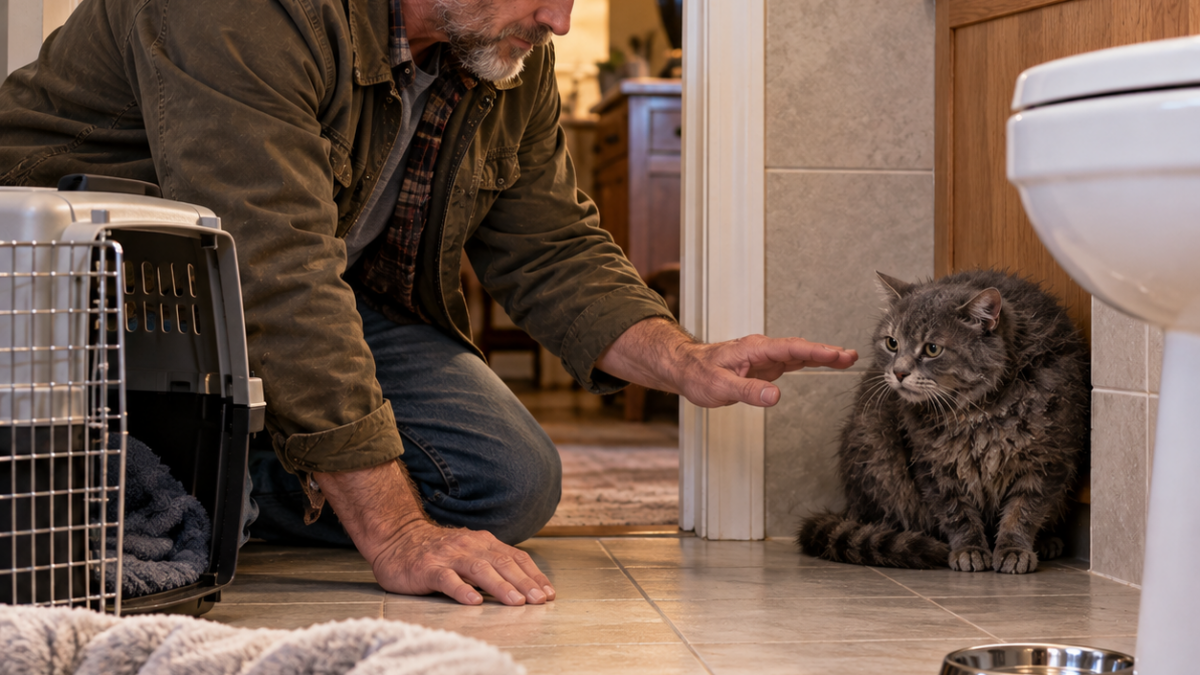
When we got home, I set him up in the spare bathroom.
It was the smallest room in the house.
Warm.
No appliances.
No big furniture.
I placed a shallow litter box in one corner.
Fresh water.
A dish of soft food Cara had sent.
An old fleece blanket.
The carrier beside the wall.
Then I opened the carrier door.
I backed out.
For two hours, nothing happened.
I checked by lying on the hallway floor and looking beneath the half-closed door like an idiot.
At 8:40, carrier.
At 9:15, carrier.
At 10:07, carrier.
At 10:36, empty carrier.
My heart jumped.
Then I saw a tail behind the toilet.
Smokey had moved six feet.
That was the first victory.
The next morning, maybe a teaspoon of food was gone.
The water looked untouched.
Litter had one small clump.
Alive.
I called Cara.
“He ate a little.”
“Good.”
“He’s behind toilet.”
“Expected.”
“He hasn’t looked at me.”
“Also expected.”
“When do I worry?”
“Honestly?”
“Yes.”
“We already worry.”
She said it kindly.
“We just worry differently now because he’s with you.”
That first week was not heartwarming.
I want that understood.
There was no montage.
No magical hand reaching under furniture.
No sudden purring.
Smokey existed around me like a rumor.
I would go into the bathroom and know he was there because I could feel him watching.
He hid behind the toilet.
Then inside the open vanity after I removed the cleaning supplies.
At night, I heard movement.
In the morning, slightly more food gone.
Sometimes less.
I began photographing the food bowl before bed so I could compare.
That is what my life became.
Forensic pâté.
He hated eye contact.
He hated footsteps approaching.
He hated hands most of all.
Once, I reached too quickly for his water bowl.
I was not touching him.
I did not even come within a foot.
Still, he slammed himself backward against the wall so hard the metal dish rattled.
I froze.
He froze.
I whispered:
“I’m sorry.”
Then I sat on the tile floor for fifteen minutes because leaving immediately felt wrong.
Smokey did not move.
That moment stayed with me all day.
Not because he was frightened.
Because his fear had history.
Animals do not invent flinching for drama.
Something teaches a body that movement toward it predicts pain.
Maybe one bad thing.
Maybe a thousand small ones.
I called Maple Lane.
Cara arranged an appointment with Dr. Elaine Foster, a veterinarian who worked with the shelter.
Getting Smokey into the carrier again took an hour.
I almost canceled.
He began panting.
I sat on the bathroom floor and cried.
“This is supposed to help you.”
Smokey did not care about intent.
He cared that the carrier had returned.
Eventually I put his entire hiding box inside a larger carrier and allowed him to stay beneath the blanket.
At the clinic, Dr. Foster did not drag him out.
That mattered immediately.
She opened the top.
Waited.
Spoke softly.
Used a towel.
She examined him in pieces.
Eyes.
Ears.
Mouth.
Joints.
Abdomen.
Weight.
Temperature.
Smokey shook.
I stood near the table feeling guilty enough to confess crimes I had not committed.
When Dr. Foster finished, she took off her gloves.
“He’s terrified.”
“I know.”
She paused.
“But he’s also hurting.”
That landed differently.
“What?”
“His mouth is in bad shape.”
She showed me dental photographs.
Inflamed gums.
Several painful teeth.
“One may be fractured.”
“Anything else?”
“Arthritis, likely hips and lower spine.”
“His left ear has chronic infection changes.”
“How long?”
“Impossible to say exactly.”
“But not ten days.”
“No.”
She looked at Smokey.
“This is older.”
I sat.
Suddenly every frightened thing he had done rearranged itself.
Maybe he hid because movement hurt.
Maybe he flinched because hands had meant being picked up while his hips screamed.
Maybe he stopped grooming because twisting was painful.
Maybe he stopped eating because chewing hurt.
“How did nobody know?”
Dr. Foster looked at me.
“Cats are extremely good at hiding pain.”
“But his family?”
“I don’t know his history.”
She kept her voice careful.
“People miss things.”
“Sometimes for too long.”
My anger came quickly.
It needed somewhere to go.
She saw it.
“Before you decide what happened,” she said, “help the cat in front of you.”
I looked at Smokey.
He was tucked under towel.
Only his face showing.
Dr. Foster outlined plan.
Pain relief.
Ear treatment.
Blood work.
Dental once stable.
Soft food.
Joint support.
Low-sided litter.
Warm bedding.
No unnecessary handling.
“And time.”
“How much?”
She smiled faintly.
“That’s the one thing nobody can prescribe.”
The bill was larger than I expected.
Not impossible.
Large enough to make me stare.
I paid.
On the way home I cried.
Not because of money.
Not mostly.
I cried because Smokey had spent days in that metal cage being described as withdrawn and unadoptable while pain had been speaking underneath all of it.
Then I cried because that sentence felt too familiar.
How often had I called someone difficult when they were scared?
Lazy when they were depressed?
Cold when they were grieving?
I had been called distant after Tom died.
A friend once told me:
“You’ve got to start choosing life again.”
She meant well.
I wanted to scream.
I had been choosing life every morning.
Getting out of bed was choosing life.
Paying the electric bill was choosing life.
Going to the grocery store and buying tomatoes for one person instead of two was choosing life.
People want recovery to look social.
Smiling.
Traveling.
Dating.
New hobbies.
Sometimes recovery is simply continuing to exist while everything familiar has disappeared.
Maybe Smokey and I had more in common than either of us needed.
After the vet appointment, I changed strategy.
Before, I thought my job was teaching him I was safe.
Now I realized my first job was making life hurt less.
That is different.
Trust is difficult to build in a body that is constantly braced against pain.
I gave medication mixed into food.
Dr. Foster had chosen options requiring minimal wrestling.
The ear treatment was harder.
I warmed the medication slightly.
Approached slowly.
Sometimes got one dose in.
Sometimes did not.
I learned that “successful care” and “perfect compliance” are not always the same thing with frightened animals.
I moved Smokey into my bedroom after a week.
Not because he had become comfortable.
Because the bathroom was too isolated, and Dr. Foster thought a quiet room where normal life happened might help.
I converted the corner of my closet into a shelter.
Blanket.
Low bed.
Food.
Water.
Litter nearby.
A tiny night-light.
Then I did one of the strangest things I have ever done for another living creature.
I started reading aloud.
At first, actual books made me self-conscious.
So I read junk.
A grocery circular.
My electric bill.
Instructions from a bottle of fabric softener.
The back of a soup can.
“Contains less than two percent of modified cornstarch,” I read one night.
Smokey stayed in the closet.
“Very compelling.”
Nothing.
“You should know I’m judging this recipe.”
Nothing.
“Who puts celery powder in chicken noodle soup?”
One ear moved.
I stopped.
Then continued.
His ear had moved.
That night I wrote it on a calendar.
SMOKEY MOVED EAR DURING SOUP LABEL.
Healing makes you ridiculous.
Days passed.
Then weeks.
His eating improved first.
Once pain medication had time to work, he finished half a plate.
Then nearly all.
The first time I heard him crunch one piece of dry food after his dental work, I felt absurdly proud.
The dental procedure removed four teeth.
One fractured badly.
Dr. Foster said:
“He may feel better than he has in years.”
Years.
That word made me angry again.
But anger had become less useful by then.
Smokey still hid.
Still flattened when I walked too close.
Still vanished if the doorbell rang.
But there were differences.
He began grooming.
Not much.
One shoulder.
Then chest.
He stopped sleeping in a tight defensive knot every minute.
Sometimes, through the closet opening, I could see one hind leg stretched behind him.
The first time that happened, I texted a photo to Eli.
He replied:
MOM THAT’S A CAT LEG.
I wrote:
HE NEVER STRETCHES.
He replied:
I’M HAPPY FOR YOU AND THE CAT LEG.
My granddaughter Lily began asking about Smokey on video calls.
“Can I see him?”
“He’s hiding.”
“Why?”
“He’s scared.”
“Of you?”
“Sometimes.”
She frowned.
“But you’re nice.”
“His body doesn’t know that yet.”
Children accept complicated truths more easily than adults when you give them plainly.
“How does it learn?”
“I guess by nothing bad happening for a long time.”
She thought.
Then:
“That’s a lot of days.”
“Yes.”
It was.
One rainy night about six weeks after Smokey came home, I had one of those days where nothing catastrophic happened and somehow everything felt wrong.
A doctor’s office messed up an appointment.
My car battery died.
I broke a glass Tom had bought on our honeymoon.
Eli called and sounded rushed, which was not his fault, but after we hung up I felt old in a way that had nothing to do with years.
I sat on the bedroom floor.
Back against the bed.
I cried quietly.
Not grief exactly.
Accumulation.
That is one of the secrets of adulthood.
People rarely collapse under one thing.
They collapse under seventeen small things that finally agree on a date.
Smokey was in the closet.
I could see his eyes.
“I’m not going to force you,” I said.
My voice sounded foolish.
“You don’t have to trust me tonight.”
He watched.
“Just don’t give up in this house.”
For a while, nothing happened.
Then one paw appeared.
Gray.
Careful.
Then the other.
Smokey came out.
Slowly.
He stopped three feet away.
Looked at me.
I did not move.
He stepped forward.
Stopped.
Another step.
Then he reached my knee.
I expected him to sniff and retreat.
Instead he leaned.
Just the side of his body against my leg.
No purr.
No head bump.
No dramatic curl into my lap.
He leaned.
And stayed.
Maybe thirty seconds.
Maybe one minute.
Time felt strange.
I did not touch him.
My hands stayed flat on floor.
Eventually he walked away.
Back into closet.
I sat there crying harder.
That was all.
And somehow it was everything.
Smokey had chosen proximity.
Not food.
Not medication.
Not because I cornered him.
He chose me.
For one minute.
The next morning he acted as if nothing had happened.
Cats have excellent boundaries around emotional follow-up.
Three months later, he slept at the foot of my bed most nights.
Not against me.
Never on pillow.
At my feet.
Always near escape route.
He still hid when people visited.
He still startled if I sneezed.
He still froze when I carried laundry baskets too quickly through the hallway.
But his coat was soft.
He had gained almost two pounds.
His eyes looked clearer.
He ate with his shoulders down instead of crouched like someone might steal his bowl.
Most importantly, he slept differently.
When he first arrived, Smokey slept folded tight enough that paws vanished.
Now, sometimes, I found him on his side.
One paw extended.
Belly partly exposed.
The first time I saw both eyes fully closed while he slept, I stood in the doorway for several minutes.
Safety looks boring from outside.
That is what people do not understand.
Sometimes the miracle is an animal sleeping deeply enough to dream.
The first time he purred, I nearly missed it.
I was reading in bed.
Smokey had climbed up near my ankles because he believed I was ignoring him.
I shifted.
The mattress vibrated.
Very faint.
I froze.
There it was again.
A rough, rusty little sound.
Not the smooth motor of a kitten.
More like an old appliance discovering electricity.
I held my breath.
“Are you purring?”
The sound stopped.
I waited.
It returned.
I cried.
Of course.
By then crying over Smokey had become one of my main hobbies.
Not long after, Maple Lane called.
Avery this time.
She had been the technician who helped move Smokey into his carrier on adoption night.
“We’re doing a senior adoption event.”
“Okay.”
“And Cara remembered Smokey.”
I looked toward the dining table.
Smokey sat beneath it, studying dust in a shaft of sunlight.
“What about him?”
“Would you let us share an update?”
I hesitated.
“Like social media?”
“A photo.”
“Before and after.”
“People need hope.”
I was not an internet person.
I had a Facebook account mostly because Eli created it after Lily was born.
My profile picture was three years old and slightly crooked.
I posted birthday messages.
That was about it.
Still, I looked at Smokey.
Soft coat.
Healthy weight.
One paw tucked beneath chest.
Not cured.
Not transformed into a social butterfly.
Safe.
“Yes.”
Then, without thinking:
“I can bring photos by.”
The shelter event was held on a Saturday in October.
I printed two pictures at the pharmacy.
The first came from Smokey’s intake record.
I had never really studied it.
When the machine printed the photograph and I held it under fluorescent pharmacy lights, I almost stopped breathing.
He looked smaller than I remembered.
Not physically.
Spiritually, if such a thing can be seen.
His face was turned away.
Fur rough.
Eyes huge.
Body wedged against cage wall.
Already halfway gone.
The second photograph was from my bedroom window.
Smokey sat on the sill watching birds.
October light touched his back.
One paw tucked.
His body loose.
Still old.
Still serious.
But present.
I stared at those two photographs side by side.
The difference was not happiness.
That word felt too large.
The difference was occupancy.
In the first, Smokey looked like he had already begun leaving his own body.
In the second, he looked like he lived there again.
Maple Lane smelled exactly as I remembered.
Bleach.
Detergent.
Wet fur.
Newspaper.
The sour chemical scent of fear beneath everything.
Dogs barked from the far wing.
A kitten cried somewhere.
Metal doors clanged.
Between noises came the strange shelter quiet.
Not peace.
Waiting.
Paper leaves covered lobby wall.
Hand-cut.
Orange.
Red.
Yellow.
Each one had a name.
ADOPTED.
FOSTERED.
FOUND HOME.
Avery met me at desk.
She took photos.
“Oh wow.”
I almost corrected her.
Not wow.
Safe.
Then I thought maybe safe deserved wow.
She pinned both photographs to a corkboard.
Under them she wrote:
SMOKEY — AGE 9
LABELED UNADOPTABLE
NOW SLEEPS AT THE FOOT OF A BED EVERY NIGHT
I did not like the word.
Unadoptable.
Avery saw my face.
“We hate it too.”
“Then why use it?”
“Because if we soften everything, people don’t understand how close some animals come.”
Fair.
I walked through cat room afterward.
The kittens got attention.
Naturally.
Tiny paws.
Big eyes.
One orange kitten kept falling backward into a blanket while a child laughed.
A striped young cat reached through bars toward every hand.
Then older cages.
Quiet ones.
A black cat with a torn ear sleeping heavily.
A calico with cloudy eyes.
A bonded tabby separated from companion because previous housing would not take both.
At bottom near end:
LEONARD
12 YEARS
SPECIAL DIET
THYROID MEDICATION
OWNER DECEASED
Leonard was brown.
Heavy-faced.
He did not come forward.
He watched.
That was all.
Avery stood behind me.
“He’s sweet.”
“Doesn’t look enthusiastic.”
“He has bad hips.”
“Thyroid meds.”
“Owner died.”
I crouched.
Leonard looked at me with tired dignity.
Something in my chest tightened.
There is something cruel about the way age becomes a disadvantage.
We do it to people too.
At jobs.
In dating.
In culture.
We say someone “still” looks good.
“Still” travels.
Still active.
Still sharp.
Still living alone.
As if continued worth past a certain age deserves surprise.
Shelters reveal that cruelty brutally.
Kittens represent possibility.
Senior animals represent cost.
Medication.
Patience.
Grief.
Shorter timelines.
We like rescue when it looks like a beginning.
Older animals ask us to enter the difficult middle.
By noon, Maple Lane was busy.
Families.
Teenagers.
Children.
A little girl cried over a rabbit.
Three people asked about Smokey’s photographs.
I answered honestly.
“He’s still scared.”
“Does he cuddle?”
“Sometimes.”
“Is he friendly?”
“With me, in his own way.”
“Was it expensive?”
“Yes.”
That last answer surprised people.
I did not want Smokey turned into propaganda where kindness magically costs nothing.
Mercy without acknowledging resources becomes dishonest.
Then a man in a hunting jacket stopped at photo board.
He looked at Smokey.
“That’s nice and all,” he said, not exactly to me, “but most people don’t have money to throw at a broken old cat.”
A woman beside him laughed.
“Exactly.”
She looked at photos.
“People romanticize this stuff online.”
“Meanwhile shelters stay full because nobody wants to talk about hard choices.”
Broken old cat.
Hard choices.
They walked away.
I remained.
Anger arrived.
Not hot.
Deep.
The kind that makes body cold.
Broken.
What does that word mean when used for living things?
Expensive?
Slow?
Inconvenient?
Not immediately gratifying?
Smokey was not broken.
He was hurt.
There is a difference.
I drove home angry enough to rehearse speeches for people who would never hear them.
Smokey smelled shelter on me.
He disappeared under bed.
I changed clothes.
Washed hands.
Sat on floor.
I slid one hand palm-down near bed.
Did not reach.
After a while, his nose appeared.
Then eyes.
Then face.
“I know,” I said.
“People are exhausting.”
He blinked slowly.
Then came forward and sat three inches from my fingers.
That was one of his versions of affection.
Not touching.
Allowing touch to exist nearby.
That evening Eli called.
Sunday routine.
“How’s Grandpa Cat?”
“He is not a grandfather.”
“He acts seventy.”
“He is nine.”
“Cat years.”
“Do not start.”
He laughed.
I told him about Leonard.
Then the hunting-jacket man.
The woman.
Broken old cat.
Hard choices.
Eli listened.
Then said carefully:
“Mom?”
“What?”
“Can I say something without you taking it wrong?”
“No.”
He laughed again.
Then said it anyway.
“I think old animals scare people.”
“Why?”
“They hear medication.”
“Vet bills.”
“Behavior issues.”
“And they feel trapped.”
I leaned against kitchen counter.
“That is probably true.”
He hesitated.
“But I think there’s another thing.”
“What?”
“People are afraid they’ll love something that’s going to die soon.”
That hit harder.
Because yes.
Of course.
Maybe that was beneath all of it.
We spend so much energy trying not to hurt.
Do not get attached.
Do not care too much.
Protect your peace.
Guard your energy.
Choose what serves you.
Set boundaries.
Move on.
Some of that language saves lives.
Some of it keeps us from becoming responsible for everyone else’s chaos.
But sometimes the same language becomes an excuse to avoid love that comes with a bill.
Or a deadline.
Or grief.
Tom had died eight years earlier.
Would I have loved him less if I had known exactly how many years we got?
No.
Would I have skipped last painful hospital months because they were inefficient?
No.
Then why do we imagine affection becomes foolish simply because loss is likely?
“You’re getting philosophical,” I told Eli.
“I have a four-year-old.”
“That’s not philosophy.”
“It is if she asks why worms don’t have faces at 6:00 a.m.”
Fair.
A week later Avery messaged me.
Maple Lane wanted to post Smokey.
I agreed.
The post went up Sunday morning.
Before picture.
After picture.
Short story.
Senior cat.
Pain treatment.
Time.
Safety.
Home.
By lunch, hundreds of comments.
At first they were beautiful.
Photos of old dogs.
Three-legged cats.
Blind rabbits.
A beagle with cataracts.
A one-eyed barn cat riding in a truck cab.
A widower in Kentucky wrote that his twelve-year-old dog kept him alive after his wife died.
A woman in Arizona said her unwanted shelter cat slept on her chest throughout chemotherapy.
A truck driver posted:
BEST COMPANY I EVER HAD.
I cried over strangers for two days.
Then the internet remembered it was the internet.
“Easy to be heroic with money.”
“Shelters shouldn’t guilt people.”
“Some animals are unsafe.”
“You spent all that on one old cat while kittens die.”
“It’s a cat, not a child.”
“This is emotional manipulation.”
“You can’t save them all.”
That one repeated.
You can’t save them all.
Nobody had claimed otherwise.
I could not save them all.
I could not save all the things I had lost in my own life.
Tom.
My parents.
Time.
The version of myself that expected people to remain.
But what a strange argument against helping one life.
If a person is drowning in front of you, do you walk away because there are oceans?
The comment section became war.
Animals versus people.
Money versus sentiment.
Shelter policy.
Euthanasia.
Veterinary costs.
One person accused shelters of hiding dangerous behavior.
Another accused anyone who surrendered a pet of being monstrous.
Then people began diagnosing Smokey from photographs.
Trauma.
Abuse.
Neurological problems.
Feral tendencies.
Grief.
Self-appointed experts explained my cat to me.
Then someone wrote:
This is what lonely women do when they don’t know what else to do with their love.
That one hurt.
More than I expected.
Lonely women.
As if tenderness from a woman without husband nearby requires diagnosis.
If a man rescues an old dog after his wife dies, people make movies.
If a woman does it, somebody asks what emotional hole she is filling.
Maybe I was filling one.
Maybe Smokey was too.
Why would that make care less real?
We are all full of holes.
Loss makes them.
Age makes them.
Love makes them eventually.
Three nights into the argument, I put phone face down in kitchen.
I felt dirty from absorbing too many opinions.
I sat on bedroom floor.
Not crying.
Just tired.
Smokey stood in doorway.
He watched.
Then walked toward me.
That alone would have been enough.
But he kept coming.
He placed one paw on my leg.
Then another.
Awkward.
Slow.
He climbed into my lap.
For the first time.
All eleven pounds of him.
He circled once.
Settled against my stomach.
I froze.
He froze.
Neither of us moved.
Then he relaxed by half an inch.
I put one hand lightly on his back.
Twenty minutes.
That cat stayed twenty minutes.
His breathing rose beneath my palm.
Warm.
Steady.
All I could think was:
People online are arguing some lives ask too much.
This animal has spent months teaching himself my lap is not a trap.
Which one of us is doing harder work?
The next morning, I woke to a private Facebook message.
HANNAH W.
I almost ignored it.
Then I opened.
I think that used to be my mother’s cat. If this is the same Smokey, I don’t know if I should even be writing. But I’ve been crying since I saw that photo.
I stared.
Anger came before thought.
Your mother’s cat?
The cat who arrived half-starved?
Painful teeth?
Chronic ear problem?
Terrified?
That cat?
I almost deleted it.
Instead:
What do you want to say?
Twenty minutes later, Hannah answered.
Then again.
Then again.
By afternoon, I had another version of Smokey’s life.
Her mother was Ruth Weller.
Ruth adopted Smokey as a kitten from a farm litter.
He had lived with her nine years.
Her husband died when Smokey was five.
After that, according to Hannah, Ruth and Smokey became nearly inseparable.
Then Ruth began falling.
At first, small.
Bruises.
Then missed bills.
Medication mistakes.
Getting lost driving to a grocery store she had used for thirty years.
A burned saucepan.
A neighbor found her outside at 2:00 a.m. wearing slippers.
Hannah and her brother stopped calling it stress.
Doctors stopped avoiding words.
Dementia.
Not severe at first.
Enough.
They tried home care.
Then Ruth fell down basement stairs.
Hospital.
Rehab.
Memory care.
The facility did not allow animals.
The family had six days to empty the house.
Hannah already rented a small place with two dogs.
Her brother had severe cat allergies.
They called friends.
Neighbors.
A country vet.
Posted online.
Nobody wanted a nine-year-old cat who hid from strangers and probably needed dental care.
So they took Smokey to Maple Lane.
“He was never mean,” Hannah wrote.
“Just shy.”
“My mom loved him.”
“I know that probably doesn’t matter to you after how he got there, but it’s true.”
I read that sentence six times.
I had wanted villains.
Villains are easy.
A family gets tired of old cat.
Dumps him.
Shelter nearly kills him.
Stranger rescues.
Clean.
Satisfying.
Shareable.
Instead:
An old woman got dementia.
Her children panicked.
Six days.
Housing rules.
Allergies.
Dogs.
Money.
Time.
A cat already in pain.
Failed choices stacked inside grief.
Sometimes love is true and still not enough.
I hated that.
Complicated truth does not let anger feel righteous.
I called Hannah.
I do not know why.
Maybe I wanted to hear remorse.
Maybe I wanted to accuse her in a voice instead of text.
She cried almost immediately.
“My mother asked for him every day at first.”
I closed my eyes.
“What happened?”
“She stopped.”
“What do you mean?”
“The dementia.”
“First she asked if Smokey was being fed.”
“Then she asked where he was.”
“Then she thought he had died years ago.”
“Then she stopped asking.”
Hannah’s voice broke.
“I should have tried harder.”
“Yes.”
I said it before I could soften.
Silence.
Then:
“I know.”
There was no defense.
That mattered.
“I didn’t know about his teeth,” she said.
“You should have.”
“Yes.”
“His ear?”
“I thought he always scratched it.”
“You should have taken him in.”
“Yes.”
“Why didn’t you?”
She breathed shakily.
“Because everything was happening.”
That answer made me angry.
Then sad.
Because everyone who has failed someone probably has some version of it.
Everything was happening.
It does not erase outcome.
Smokey hurt whether reasons were noble or selfish.
Fear happened.
Pain happened.
Cage happened.
But explanations are not nothing.
They help decide what we do with anger.
Before we hung up, Hannah asked:
“Would you send me a picture?”
I looked toward heater vent.
Smokey slept in a basket.
One paw hanging out.
Utterly undignified.
“Why?”
“I just want to know he’s okay.”
I took a picture.
Not posed.
Not pretty.
Old gray cat.
Asleep.
Safe.
I sent.
Her reply came immediately.
Thank you for doing what we didn’t.
That sentence stayed with me.
Not because it made me feel heroic.
It made me sad.
For Hannah.
For Ruth.
For Smokey.
For all the ways one living thing can fall through cracks while everybody around it is trying to survive something else.
I told Eli.
He said:
“Do you hate them less?”
“I don’t know.”
“Do you understand them more?”
“Yes.”
“That usually ruins hate.”
He was right.
In November, Smokey stopped eating.
It began with half breakfast.
Then dinner untouched.
By evening, he crouched beneath dresser.
Eyes dull.
Treat bag produced nothing.
Every cat owner knows the terror of a normal thing suddenly not happening.
I wrapped him in towel.
Carrier.
Emergency clinic.
This time he did not fight.
That frightened me more.
The emergency waiting room was too warm.
Fluorescent.
A teenager held a limping hound wrapped in a blanket.
A couple in scrubs carried cardboard box with air holes.
Nobody looked directly at anybody for long.
That room had the quiet of people bargaining privately with God.
Smokey was admitted.
Blood work.
Ultrasound.
Fluids.
The veterinarian returned.
“Pancreatitis.”
My stomach dropped.
“Is he dying?”
“Not necessarily.”
Not necessarily is a terrible phrase.
“He needs fluids.”
“Pain control.”
“Anti-nausea medication.”
“Monitoring.”
“Maybe overnight.”
“How much?”
She gave estimate.
I swallowed.
“Do it.”
At two in the morning, I sat alone at kitchen table staring at receipt authorization.
That was when practical comments returned.
Money to throw at broken old cat.
Hard choices.
You can’t save them all.
I cried over number.
Not because I regretted it.
Because I was afraid of how many times I could keep saying yes before my bank account said no for me.
That conversation is real.
People should be allowed to have it.
Vet care is expensive.
Medicine costs money.
Special diets cost money.
Love does not cancel arithmetic.
It just complicates it.
Smokey came home next afternoon.
Tired.
Stable.
For two days he wanted heating pad, watered food, and my hand resting beside him.
Not even on him.
Beside.
Third night, he walked into kitchen and yelled.
Actual yell.
Raspy.
Offended.
He wanted dinner.
I laughed so hard I sat on floor.
He yelled again.
That was when I understood rescue is not an event.
It is repetition.
Medicine again.
Laundry again.
Vet again.
Food again.
Patience again.
The same reassurance one hundred times.
Nothing glamorous.
Very little photographable.
Devotion is mostly boring once performance is removed.
In December, Maple Lane asked if I would volunteer.
Not cages.
Not intake.
Senior cat room.
Avery had told them about my reading habit.
Every Thursday afternoon, I began sitting between cages with paperback.
I read aloud.
History.
Mystery novels.
Newspaper.
Once an embarrassingly explicit romance because I grabbed wrong book from my nightstand.
Avery nearly fell over laughing.
“Those cats are learning too much.”
“They’re adults.”
The routine was simple.
No reaching.
No forcing.
Voice.
Presence.
The first weeks nothing changed.
Leonard watched.
June, a white-faced tortie, slept.
A black cat named Minnie hissed whenever I cleared my throat.
Then June ate while I read.
Minnie stopped hissing.
Leonard began sitting near front.
One Thursday, while I read about a nineteenth-century shipwreck, Leonard leaned his cheek against the bars.
Two weeks later, a man came for a kitten.
He walked out with Leonard.
Twelve years old.
Bad hips.
Thyroid meds.
The man had recently lost his wife.
He said:
“I don’t think I can handle kitten energy.”
Leonard apparently agreed.
I stood in stock room afterward crying into donated towels.
Avery found me.
“Good crying?”
“The worst kind.”
She nodded.
By January, Cedar Grove knew me as Smokey Lady.
At grocery store, people asked about him.
At pharmacy, a man told me his wife adopted a senior dog because of Smokey’s post and now dog followed him to bathroom “like a prison guard.”
The Facebook argument never died.
Every few weeks new person discovered post.
Resources are limited.
Sentimentality.
Quality of life.
Not every animal should receive unlimited intervention.
Some of those comments were fair.
I began distinguishing cruelty from uncertainty.
Cruel comments I ignored.
Honest questions I answered.
One woman wrote:
I’m not judging, but I don’t think every broken thing needs to be fixed.
I sat with it.
Then wrote:
Maybe. But I think every living thing deserves one place where it isn’t treated like trash.
That reply got shared more than original.
Virality is strange.
It takes quiet wounds and turns them into public property.
But I began to understand why Smokey’s story mattered to strangers.
It was not only a cat story.
Everybody knows a Smokey.
A parent after stroke.
A veteran after war.
A spouse after grief.
A child labeled difficult.
A friend who stopped answering calls.
Yourself during a year you barely survived.
Too many people know what it means to shut down in plain sight while world interprets silence as lack of worth.
One Thursday, Hannah contacted me again.
Ruth’s memory care had started allowing controlled pet visits with therapy animals.
“Could she see Smokey?”
My first answer inside myself:
No.
Smokey had spent months learning safety.
Why disturb it?
Hannah added:
I understand if absolutely not.
I asked Dr. Foster.
“Would it harm him?”
“Unknown.”
“How does he handle travel?”
“Poorly.”
“New people?”
“Poorly.”
“Then no.”
Dr. Foster nodded.
“That is reasonable.”
I told Hannah no.
She accepted immediately.
No guilt.
That helped.
Then, weeks later, Ruth declined.
Pneumonia.
Hospice.
Hannah wrote:
Mom is asking for Smokey again.
After months of not remembering him.
I stared.
I called Eli.
“Tell me not to do something stupid.”
“What’s stupid?”
I explained.
He was quiet.
“Would it hurt Smokey?”
“Maybe.”
“Would seeing Ruth help him?”
“I don’t know.”
“Would it help her?”
“Probably.”
“That is not enough.”
“I know.”
He said:
“What if she sees him by video?”
Simple.
We arranged video call.
Hannah held tablet beside Ruth’s bed.
I placed my phone low.
Smokey was in basket.
Ruth looked thin.
White hair.
Eyes unfocused.
At first nothing.
Then Hannah said:
“Mom, look.”
“Smokey.”
Ruth leaned.
Her face changed.
Not dramatically.
Just softened.
“Smokey boy.”
The cat’s ear moved.
I stopped breathing.
Ruth said it again.
Same phrase.
“Smokey boy.”
He stood.
Walked toward phone.
Sniffed.
Then sat.
Hannah began crying.
So did I.
Ruth reached one hand toward screen.
“There’s my boy.”
Smokey stared at her voice.
I cannot tell you what cats remember.
I will not invent.
Maybe tone.
Maybe name.
Maybe nothing.
But he stayed beside phone until Ruth grew tired.
A week later, she died.
Hannah sent one message.
Thank you for letting her see him.
I wrote:
I’m glad she did.
That closed something.
Not all.
Enough.
Spring came.
Smokey discovered windows.
Bird feeder.
Sun patches.
He developed opinions about breakfast time.
Strong opinions.
He still disappeared if repairman came.
Still did not enjoy being picked up.
I stopped trying unless necessary.
He learned to sleep on my bed with both eyes closed.
Then one February night, while I folded towels, he climbed directly onto warm pile.
Typical cat.
He stared at me.
Then head-butted my hand.
Firm.
Once.
I laughed.
He did it again.
A claim.
“All right.”
“I know.”
“You live here.”
He purred.
That sentence meant more than I expected.
You live here.
Not:
I rescued you.
Not:
You owe me.
Not:
You are fixed.
You live here.
Home is one of the few places where worth should not require performance.
That became my rule at Maple Lane too.
I started a small senior foster fund.
Nothing grand.
I did not have wealthy-donor money.
I put in a little.
Others added.
The widower with Leonard sent fifty dollars.
The grocery cashier sent twenty.
Eli set up online page despite my protests.
The fund paid for pain exams, dental checks, starter medications, and temporary foster supplies for older animals.
Avery called it Smokey Fund.
I hated name.
It stuck.
One policy changed.
Senior cats who shut down behaviorally would receive more explicit pain screening when medically possible before being labeled behaviorally unadoptable.
Not because every frightened cat has hidden tooth pain.
But because Smokey taught us something.
Behavior is information.
Pain speaks without language.
Maple Lane could not save every animal.
No shelter can.
But they could ask one more question before deciding what fear meant.
That mattered.
A year after I adopted Smokey, Cara found me at shelter.
“You know you almost didn’t take him.”
“I know.”
“I almost didn’t tell you that night.”
I looked at her.
“What?”
“I’d already had three people say no.”
“One couple wanted kitten.”
“Another woman said older cats depressed her.”
“One man asked if he came with vet guarantee.”
She smiled sadly.
“I was tired of asking.”
“What made you?”
She thought.
“You kept looking at him.”
That small thing.
A glance.
A pause.
A question.
Life turns on unimpressive hinges.
I did not save Smokey because I am exceptional.
I happened to stand in front of his cage on right night.
I had enough room.
Enough money.
Enough loneliness.
Enough stubbornness.
Another person might have stood there and not been able.
That does not make them cruel.
Capacity matters.
But capacity unused because of indifference is something else.
I learned to stop making universal morals out of personal ability.
Not everyone can adopt senior cat.
Not everyone can pay emergency bill.
Not every frightened animal can safely live in every home.
Mercy must live alongside reality or it becomes judgment.
Still, reality should not become camouflage for convenience.
That is line I carry.
Smokey turned ten.
Then eleven.
At eleven, arthritis worsened.
We adjusted medication.
Added steps beside bed.
Heating pad.
Low litter box.
At twelve, kidney values began creeping.
Not crisis.
Monitoring.
Dr. Foster said:
“He’s officially an old man.”
“He’s been an old man since nine.”
“Emotionally, yes.”
He became more affectionate with age.
Never social.
But mine.
He started sitting beside me on couch.
Not lap every time.
Close enough our sides touched.
When I read, he slept.
Sometimes his paw landed on my leg.
Lily visited once.
Smokey hid for entire first day.
Second day, watched from hallway.
Third morning, Lily sat on floor eating cereal.
She ignored him exactly as instructed.
Smokey crossed room.
Sniffed her sock.
Lily looked at me with eyes enormous.
I mouthed:
Don’t move.
He sniffed again.
Walked away.
Lily whispered after he left:
“He likes me.”
I whispered:
“He considered you.”
She nodded seriously.
“That’s enough.”
Smart child.
Smokey’s old story followed him less as years passed.
At first everyone asked:
Was he abused?
Did his first family hurt him?
What happened?
Over time those questions mattered less.
His life became present tense.
He likes chicken.
He hates thunderstorms.
He naps near vent.
He believes medication hidden in tuna is insult.
He distrusts vacuum.
He likes Lily’s socks.
That is healing too.
When history stops being first sentence.
One autumn, Hannah asked if she could visit me.
Not Smokey necessarily.
Me.
I hesitated.
Then said yes.
She drove three hours.
Brought Ruth’s old photo album.
There were pictures of Smokey as kitten.
Gray fluff.
Long tail.
Ruth holding him.
Ruth asleep in recliner with him curled against chest.
Smokey sitting in Christmas tree.
Smokey on windowsill.
Smokey older.
Healthy.
Loved.
I cried.
Not because photographs excused what happened.
Because they restored years I had erased in anger.
Smokey’s entire life before shelter had not been neglect.
There had been birthdays.
Windows.
A woman who loved him.
Sunlight.
Warm laps.
Then illness.
Then failure.
Both were true.
Hannah asked:
“Do you want these?”
“No.”
“They’re his.”
“They’re yours too.”
We copied some.
One photo sits framed on my shelf now.
Ruth maybe seventy.
Smokey six.
He is asleep on her chest.
I like knowing he was loved before me.
Love did not begin when I arrived.
Safety had been lost.
Then found again.
That is different.
Hannah met Smokey.
Carefully.
She sat on couch.
Did not reach.
He watched from doorway.
She cried before he came close.
Eventually he entered room.
Walked past.
No recognition I could prove.
He sniffed her purse.
Then sat under chair.
Hannah whispered:
“Hi, buddy.”
He blinked.
That was enough.
She did not ask to hold him.
I respected that.
Before leaving, she said:
“I used to wish he would forgive me.”
I looked at Smokey.
“He doesn’t think like that.”
“I know.”
“That may be worse.”
She smiled sadly.
“Maybe.”
We hugged.
I never expected that.
Life complicates itself if you let people remain human long enough.
Smokey lived with me another four years.
That is longer than anyone expected on adoption night.
Not all healthy.
Not all easy.
There were kidney issues.
Arthritis.
Another pancreatitis flare.
A heart murmur.
Medication charts on refrigerator.
Vet bills.
Special food.
Toward the end, weight loss.
He slept more.
Stopped jumping entirely.
I carried him only when needed.
He tolerated it from me.
Not loved.
Tolerated.
One winter morning, he did not come for breakfast.
I found him in basket near heater.
Awake.
Eyes tired.
I knew before vet.
Not because I am mystical.
Because if you live beside someone long enough, changes become language.
Dr. Foster examined him.
Blood work terrible.
Kidneys failing.
He was dehydrated despite drinking.
Nauseated.
Weak.
Options existed.
Hospitalization.
Aggressive fluids.
Maybe temporary improvement.
Maybe days.
Maybe weeks.
I asked the question I had feared since first night.
“Is he hurting?”
“Yes.”
“Can you fix that?”
“For a while.”
“For how long?”
“I don’t know.”
There it was.
The hardest form of love.
Not rescue.
Release.
People online had argued years earlier that not every life should be prolonged simply because we cannot bear loss.
They were not entirely wrong.
Mercy cuts both directions.
I sat on floor of exam room.
Smokey lay on blanket.
He looked at me.
No fear.
That nearly broke me.
The cat who once pressed behind litter pan while hands approached was now sick enough to die and still not afraid of mine.
I put palm beside his face.
He leaned his head into it.
I cried.
Dr. Foster waited.
“Can we do it here?”
“Yes.”
“On floor?”
“Yes.”
I called Eli.
Could barely speak.
He cried too.
Lily, older now, sent voice message:
“Tell Smokey I love him.”
I played it.
His ear moved.
Of course.
Always the ear.
Hannah answered immediately.
I told her.
She cried.
“Tell him Mom loved him.”
I did.
Maybe for us.
Maybe for him.
Then I held him as medication went in.
Not tightly.
Just enough.
He did not struggle.
He pressed one paw against my wrist.
His breathing slowed.
Stopped.
The room became horribly ordinary.
Fluorescent light.
Cabinet.
Sink.
My hand on warm fur that was already beginning to become memory.
I had signed adoption papers years earlier because someone said he might not survive until morning.
Now I sat beside him on last morning and understood something I had spent years learning.
Saving does not mean preventing death.
Nobody gets that power.
Saving can mean changing what happens before death arrives.
Smokey had pain treated.
He ate.
He slept.
He became demanding about dinner.
He purred.
He sat in sunlight.
He discovered my lap.
He smelled Lily’s sock.
He heard Ruth’s voice one last time.
He slept with both eyes closed.
That was the rescue.
Not immortality.
I brought his ashes home.
Of course.
The house became too quiet again.
For weeks, I heard phantom sounds.
A jump onto bed.
A food bowl.
A scratch near litter.
Grief reuses architecture.
I knew that already.
This time I did something different.
I did not let quiet remain unwitnessed.
Thursday after Smokey died, I went to Maple Lane.
Avery hugged me.
Cara cried.
I sat in senior cat room.
Could not read at first.
Leonard long gone to his widower.
June adopted.
Minnie still there.
Older now.
Still suspicious.
I opened book.
Voice shook.
Then steadied.
Minnie stopped hissing.
Two months later, she went home with a woman who had followed Smokey’s story for years.
That woman emailed me photograph.
Minnie asleep on couch.
Both eyes closed.
I stared for a long time.
The Smokey Fund continued.
We changed name officially to Safe Harbor Senior Fund because I finally won one argument.
People still call it Smokey Fund.
Fine.
Maple Lane added pain-screening protocol.
Senior foster network grew.
Not huge.
Maybe six regular homes.
Then nine.
Then twelve.
Nobody saved them all.
Nobody pretended.
They saved some.
That is enough to matter.
Years later, when someone asks what changed Smokey, I never say love by itself.
Love is too easy a word.
People say love when they mean feeling.
What changed Smokey was dependable safety.
Food that kept appearing.
Pain medication on schedule.
Hands that stopped when he flinched.
A room where nobody dragged him out.
A person who sat nearby without demanding affection.
Veterinary care.
Time.
Repetition.
A house where nothing bad happened often enough that his body finally noticed.
That is not romantic.
It is better.
I still think about that first shelter night.
Metal cage.
Plastic litter pan.
One eye.
Cara saying morning might be too late.
People love miracle stories because miracles happen all at once.
A prayer answered.
A door opens.
A dramatic transformation.
Smokey’s miracle happened so slowly you could miss it.
A teaspoon of food.
An ear twitch.
One stretched leg.
A rusty purr.
Thirty seconds against my knee.
Twenty minutes in my lap.
A head-butt.
Both eyes closed.
Maybe that is how most real miracles happen.
Small enough to require attention.
The internet eventually forgot Smokey.
Of course.
New stories.
New outrage.
New cats.
New arguments.
That is fine.
I did not need him remembered by strangers forever.
He was remembered where it mattered.
By me.
By Eli.
By Lily.
By Hannah.
By a shelter worker who began checking old cats for pain before calling them hopeless.
By people who adopted Leonard, Minnie, and others because one gray cat made age look less like an ending.
I have his photograph beside Tom’s now.
Not because cat equals husband.
People get foolish about comparisons.
They occupied different places.
But grief does not require ranking.
Love is not a contest for largest wound.
Tom taught me what it meant to build life with somebody.
Smokey taught me what it meant to offer safety without demanding proof it was working.
Both changed me.
Lily is a teenager now.
She asked recently:
“Grandma, do you think Smokey knew you saved him?”
I thought.
“No.”
She looked surprised.
“Really?”
“I think he knew his food came.”
“His pain stopped.”
“My hands didn’t hurt him.”
“He could sleep.”
“That was enough.”
She frowned.
“But didn’t he love you?”
“Yes.”
“Then he knew.”
Maybe.
But I do not need animal gratitude to justify care.
That matters.
Mercy that requires thanks is a transaction.
Smokey did not owe me affection because I signed paper.
The fact that he eventually gave it was a gift.
Not payment.
That may be the hardest thing he taught me.
Love is not proved by how quickly it comes back.
It is proved by how gently you can keep showing up while it is still afraid.
Sometimes people tell me my story makes them feel guilty because they surrendered an animal.
I never know what to say without context.
Some people need to surrender.
Housing.
Violence.
Illness.
Money.
Death.
Safety.
We should build better systems around those moments instead of pretending individual morality solves everything.
But surrender should not become disappearance.
Ask questions.
Give records.
Seek rescue partners.
Be honest about medical issues.
Try.
Then keep trying where possible.
Hannah taught me that too.
Her failure was real.
Her love for Ruth was real.
Her love for Smokey was real.
The harm was real.
Humans contain contradictions.
Animals absorb consequences anyway.
A good explanation is not repair.
But understanding can guide repair.
I stopped calling Hannah the woman who abandoned Smokey.
She became Hannah.
A daughter who made a bad choice during her mother’s collapse.
A person who lived with it.
A person who apologized.
A person who later donated every year to senior fund in Ruth’s name.
That does not rewrite cage.
It adds pages after it.
I like that better than permanent villains.
Cara once said:
“Smokey changed how people here talk.”
“What do you mean?”
“We used to say difficult.”
“Now somebody asks: painful?”
I smiled.
That is legacy I care about.
Not viral post.
Not comments.
One better question.
Maybe that is all any life leaves.
A better question in somebody else’s mouth.
When an old animal hides:
Is he mean?
Or hurting?
When a person shuts down:
Is she cold?
Or overwhelmed?
When somebody stops trying:
Lazy?
Or exhausted?
Not every answer is pain.
Sometimes difficult is difficult.
Sometimes aggression is unsafe.
Sometimes limits are necessary.
But asking first costs almost nothing.
Smokey’s ashes sit on shelf in a plain wooden box.
No dramatic urn.
Beside it is a small gray paw print the clinic made.
I keep one of Ruth’s photographs there too.
The one with Smokey sleeping on her chest.
And another from my house.
Smokey on windowsill.
Two homes.
Two women.
One cat.
Not a clean story.
A real one.
If you asked me whether I would do it again knowing the bills, the fear, the emergency clinic, the years, the ending—
yes.
Immediately.
Not because I am better than anyone.
Because I know what the other side looked like.
A cage.
A body folded behind a litter pan.
One night left.
And I know what came after.
Safety.
That word sounds small until you have lived without it.
Food.
Warmth.
Pain relief.
A quiet room.
A hand that stops.
A voice reading soup labels.
A bed.
A lap.
A woman on a screen saying, “Smokey boy.”
A child whispering, “He likes me.”
A final paw resting on my wrist.
When you have been frightened long enough, safety is not small.
It is the whole world.
And if there is one thing I want people to understand after every argument dies down, after every comment disappears, after every person decides whether I was sentimental or foolish or kind or wasteful, it is this:
Not every creature can be saved.
I know that.
Shelters are full.
Budgets are real.
Bodies fail.
Some behavior is dangerous.
Some suffering cannot be fixed.
Some endings arrive no matter how much money, love, medicine, or time we throw at them.
But a lot of beings get called hopeless when what they really are is hurting.
A lot get called difficult when they are scared.
A lot get called too much work when they have never had one safe place long enough to understand what safety feels like.
Smokey did.
Eventually.
The old gray cat the shelter thought might not survive until morning lived long enough to become ordinary.
That may sound like a strange miracle.
It is the one I wanted.
He became a cat who complained about dinner.
A cat who stole warm towels.
A cat who watched birds.
A cat who disliked visitors.
A cat who slept near my feet.
A cat whose life stopped being an emergency.
And on quiet nights, years before his body finally gave out, I would wake and look toward the foot of my bed.
There he would be.
Gray shape.
Whiskers twitching.
Paws loose.
Both eyes completely closed.
No cage.
No litter pan between him and the world.
No body braced for whatever hand came next.
Just an old cat sleeping deeply enough to dream.
I still think that was the miracle.

