The Most Loyal Military Dog Waited Four Years for a Man Everyone Said Was Dead—Then He Heard Five Words
PART3:
His ears moved.
I scratched lightly behind one.
He tolerated it.
“We’re a team now.”
Duke yawned.
I smiled.
“I don’t leave my team behind.”
At the time, it was something handlers said.
Something soldiers said.
Something I had said to men under my command.
A promise large enough to sound noble and ordinary enough that nobody expected life to challenge the wording literally.
Duke did.
Within two weeks, he knew the sound of my boots.
Within a month, he would refuse food if somebody else tried feeding him while I was nearby.
He learned where I kept tennis balls.
Learned which pocket held rewards.
Learned that if he put his head on my knee while I was writing reports, I would eventually stop working.
At night he slept beside my cot.
Not on it.
I tried.
Once.
He took up more space than a dog weighing seventy pounds had any physical right to occupy.
So we compromised.
His bed beside my boots.
Most mornings I woke with one paw resting on my boot anyway.
He did that during our first deployment together.
Then our second.
Duke never cared about rank.
Colonels meant nothing to him.
He once ignored a visiting general completely and became fascinated with the general’s aide because the man had beef jerky.
The general laughed.
The aide lost half his snack.
Duke considered the interaction successful.
When we were working, though, he changed.
Head down.
Ears forward.
Every movement deliberate.
The goofy dog who stole socks disappeared.
The soldier beside me emerged.
He found explosive components buried beside a road three weeks into our first deployment.
We rerouted.
Hours later engineers confirmed enough material was present to tear apart the first vehicle in our convoy.
Six men rode in that vehicle.
Duke never knew.
He got his ball.
That was enough.
Another time he alerted outside a compound entrance where nothing looked wrong.
One of the newer guys grew impatient.
“Dog’s wrong.”
I remember turning so fast the man stopped speaking.
“Duke’s not wrong.”
We waited.
Another team investigated.
Pressure plate.
Hidden.
Duke got chicken that night.
He preferred chicken to medals.
Smart dog.
Marcus Webb was our medic.
Marcus was the kind of man who could joke while stitching your arm and somehow make the joke funnier if the wound was worse.
He had broad shoulders, terrible handwriting, and an annoying belief that all emotional problems could be solved with coffee.
Duke adored him.
Not like me.
Nobody was me to Duke.
But Marcus was close.
Whenever Marcus opened a medical bag, Duke inspected it as though checking his work.
“Get your supervisor out of my aid station,” Marcus used to say.
“He’s auditing you.”
“He doesn’t have clearance.”
“He outranks you.”
“He’s a dog.”
“Exactly.”
Those are the memories that come back easiest.
Not explosions.
Not gunfire.
Small stupid things.
Marcus hiding Duke’s ball.
Duke finding it in thirteen seconds.
Fletch from Alpha Company slipping him bacon.
Me pretending not to see.
Heat.
Dust.
Bad coffee.
People complaining about home.
Everybody imagining we had unlimited time.
The night everything ended, the air was warm even after midnight.
There was almost no moon.
Our convoy stopped outside a compound near a village that existed on maps mainly as coordinates.
We had information about explosives moving through the area.
Duke went ahead with me.
He worked slowly.
Nose close.
I remember watching his shoulders.
Handlers learn to read tiny changes.
Breathing.
Tail.
Ears.
Speed.
Then he stopped.
Sat.
Hard alert.
I froze.
Raised my fist.
Everyone behind us stopped.
“Possible device.”
Duke looked at me.
Focused.
I reached for his lead.
Then the world turned white.
People describe explosions as loud.
That’s true only if you’re far enough away.
Close enough, the first sensation isn’t sound.
It is pressure.
The world slams into you before your brain understands there has been a noise.
I remember light.
Weightlessness.
Then nothing.
For the Army, I died that night.
At least that was the conclusion.
The device Duke found wasn’t the only threat.
A second blast came from another position.
The compound became chaos.
Smoke.
Fire.
Small-arms fire.
Men separated.
Marcus was badly wounded.
My unit found blood.
Equipment.
Part of my gear.
Duke.
They did not find me.
Duke was discovered in the rubble over the place where everyone believed my body had been.
He wouldn’t move.
They told me this later.
He snarled at soldiers he knew.
Wouldn’t let them approach.
He kept circling the debris.
Returning to the same place.
Lying down.
Then standing when someone came close.
Marcus had already been evacuated.
Others were injured.
Eventually my squad leader managed to leash Duke.
He said Duke fought him for nearly ten minutes.
Not biting.
Pulling.
Twisting.
Trying to return.
Trying to get back to me.
The Army listed me missing first.
Then, after evidence and intelligence assessments I did not understand until much later, presumed dead.
My mother received notification.
Later, a memorial.
A folded flag.
Duke received none of those explanations.
He simply watched me disappear.
I was alive.
Barely.
The blast had thrown me beyond the immediate search area into a collapsed irrigation trench near the rear of the compound.
I had multiple fractures.
Internal injuries.
A head wound.
I remember none of what happened during the first days.
What I know came later from fragments.
Reports.
Interviews.
Things men said around me assuming I didn’t understand.
A group moving through the area found me before American forces returned.
I was unconscious.
They took me.
Why I wasn’t killed immediately is something I have been asked more times than I can count.
I don’t know.
Maybe they thought I had intelligence.
Maybe I was more valuable alive.
Maybe one man made one decision in one moment.
War turns entire lives on decisions nobody records.
I disappeared.
Moved repeatedly.
Sometimes conscious.
Sometimes not.
There are pieces of those years I still don’t talk about.
Not because they’re classified.
Because words don’t improve them.
Cold rooms.
Hot rooms.
Dark.
Questions.
Waiting.
Periods of illness where I stopped knowing what month it was.
Once I spent so long without seeing open sky that when I finally did, sunlight hurt.
I tried counting days.
Lost count.
Started again.
Stopped.
I thought about my mother.
My sister.
Marcus.
My team.
And Duke.
Especially Duke.
Dogs do not understand missing-in-action classifications.
They understand presence.
Absence.
Return.
I kept wondering what had happened to him.
Was he with another handler?
Was he still working?
Was he hurt?
Had someone taken care of him?
Had he died in the blast after all?
There were nights when thinking about Duke was easier than thinking about people.
With people came guilt.
My mother believing I was dead.
Men from my team wondering whether they’d missed me.
Duke was simpler.
I could picture his ears.
His ridiculous stare when he wanted a ball.
The weight of his head across my boot.
I would close my eyes and imagine saying:
“Place.”
And seeing him circle twice before lying down.
I don’t know how much that helped.
Enough.
Three years passed.
I didn’t know it was three years.
Time in captivity isn’t normal time.
Eventually a joint operation recovered several people from a location where nobody expected to find us.
I was one.
I remember aircraft noise.
Hands lifting me.
English.
Someone saying:
“American.”
Then nothing.
When I woke properly, I was in a medical facility.
Bright lights.
White ceiling.
Machines.
I thought I had been captured again.
I tried getting out of bed.
Three people stopped me.
One nurse kept repeating:
“You’re safe.”
I didn’t believe her.
Not for days.
My identity took time to confirm.
I had lost weight.
Old injuries.
New scars.
There were errors in records and reasons I still cannot fully discuss.
Eventually fingerprints answered what memory could not.
Staff Sergeant Daniel Reyes.
Presumed killed.
Alive.
The first person I asked about was my mother.
The second was Duke.
The doctor thought I had said “Duke” as a person.
“Who’s Duke?”
“My dog.”
“We can find out.”
“No.”
My voice barely worked.
“Find him now.”
That became an obsession.
Too early, probably.
Therapists told me recovery required patience.
Doctors wanted surgery.
The Army had casualty affairs people.
Public affairs people.
Intelligence people.
Investigators.
Everyone wanted pieces of my story.
I wanted one dog.
Nobody could locate him quickly.
Military working dog records had changed.
Duke had been retired.
Transferred.
Placed through one program.
Then another.
One civilian handler placement failed.
There had been an incident when someone tried forcing physical contact.
No bite.
But enough defensive behavior to end the placement.
Another facility evaluated him.
Ultimately, somehow, Duke ended up at Milbrook County Animal Shelter in Tennessee.
Kennel 14.
By the time I learned that, I had been back in American custody for weeks.
I wasn’t strong enough to travel.
My left arm had nerve damage.
My right leg had been reconstructed.
I used a cane for short distances and a wheelchair for longer ones.
The doctors didn’t know how much function would return.
The Army wasn’t ready to announce publicly that I was alive.
Too many things still had to be resolved.
But I didn’t care.
I needed somebody I trusted.
Marcus.
I asked for him.
Nobody wanted to call immediately.
There were reasons.
Marcus had his own history after the blast.
I eventually learned the second explosion had thrown him against a wall.
Spinal injury.
Left leg damaged beyond saving.
He spent months in hospitals.
Years learning a new life.
By the time I came home, Marcus used a wheelchair most of the time.
He had started working with veterans and retired service dogs.
Finding them.
Transporting.
Connecting people who understood different versions of being damaged.
Someone finally gave me his number.
I called.
He answered:
“Webb.”
I couldn’t speak.
He said again:
“Hello?”
My throat closed.
“Marcus.”
Silence.
I heard his breathing.
Then:
“Who is this?”
I tried again.
“It’s Reyes.”
Nothing.
For so long I thought the call had dropped.
Then Marcus whispered:
“No.”
“Marcus.”
“No.”
“It’s me.”
He began crying.
Not quietly.
Marcus, the man who had stitched people during firefights, cried into the phone for almost a minute without saying a word.
Then he called me several names I probably deserved for being alive without notifying him sooner.
I laughed.
That hurt my ribs.
He cried harder because I laughed.
Finally:
“Where are you?”
“I can’t tell you much.”
“Are you home?”
“Stateside.”
“Are you okay?”
“No.”
“Good.”
I laughed again.
“What?”
“If you said yes, I’d know you’re an impostor.”
That was Marcus.
Then I asked:
“Duke.”
His voice changed.
“You found him?”
“Milbrook County shelter. Tennessee.”
“What?”
“Please.”
I swallowed.
“Find him.”
“I will.”
“Before…”
I couldn’t say it.
Marcus understood.
“Before what?”
“I’ve been told he’s classified as difficult.”
Silence.
“Daniel.”
“What?”
“I’ll find him.”
“Promise?”
“You asking me for promises now?”
“Yes.”
He exhaled.
“I promise.”
Marcus drove to Milbrook three days later.
I wasn’t there.
Everything I know about that first meeting came from him, Patricia Hail, Lacy Simmons, and the security camera recording that Patricia later gave me.
I have watched it exactly once.
Milbrook County Animal Shelter sat behind an old grain silo on a gravel road.
Small place.
Underfunded.
Too many animals.
Patricia Hail had run it eleven years.
She knew Duke.
Or thought she did.
For almost two years, Duke had lived in Kennel 14 without willingly letting a person touch him.
He ate.
Drank.
Allowed staff to clean using careful routines.
But emotionally?
Gone.
He lay facing a concrete wall.
Rarely barked.
Rarely made eye contact.
Didn’t approach visitors.
Potential adopters saw the warning on his kennel and kept moving.
Military dog.
Experienced handler required.
Behavioral shutdown.
Defensive response risk.
Unadoptable.
Patricia said he reminded her less of an aggressive animal than one who had made a decision.
If the person he wanted wasn’t coming back, he didn’t need anybody else.
I cannot tell you what hearing that did to me.
I had survived three years telling myself Duke was probably happy somewhere.
Another handler.
A yard.
A couch.
Some veteran feeding him chicken.
Instead he had been waiting.
Marcus arrived in his modified van.
Patricia met him.
He said:
“I’m looking for a military working dog.”
She knew immediately.
“Duke?”
“You still have him?”
“Yes.”
Marcus told me he nearly lost control right there.
Instead:
“Take me to him.”
He rolled down the kennel corridor.
Dogs barking.
Leashes rattling.
Then Kennel 14.
Quiet.
Duke in the back.
Head down.
Older.
Thinner.
Coat dull.
Marcus stopped outside the fence.
Duke didn’t look.
Marcus said later he had rehearsed all kinds of things during the drive.
“Hey, buddy.”
“You remember me?”
“Daniel’s alive.”
None felt right.
Finally he leaned forward.
And said five words.
“Daniel came back for you.”
Duke’s head snapped up.
That is the moment on the video I cannot watch again.
His ears rise.
His whole body changes.
Not gradually.
Instantly.
Like electricity goes through him.
He stands.
Stares at Marcus.
Sniffs.
Then crosses the kennel so fast he hits the chain link.
Lacy drops a mop bucket.
Patricia takes one step backward.
Duke presses his nose through the fence.
Whines.
A sound nobody there had heard him make.
Marcus rolls closer.
“Easy.”
Duke searches his face.
Then Marcus says:
“He’s alive.”
Duke freezes.
“Danny’s alive.”
The dog makes a sound.
Marcus still can’t describe it.
Neither can Patricia.
Not a bark.
Not exactly a cry.
Something between.
His entire body presses against the fence.
Marcus begins crying.
Then says:
“He’s coming back, brother.”
Duke looks toward the front entrance.
That part destroys me.
Immediately.
He looks toward the door.
Like I might walk in.
I wasn’t there.
I couldn’t be.
Not yet.
But from that day, Duke changed.
He began eating full meals.
Allowed Lacy to approach closer.
Then, two days later, let her attach a lead.
Patricia called Marcus crying.
“He walked outside.”
Marcus called me.
“Duke went into the yard.”
I closed my eyes.
“Did he…”
“What?”
“Did he look for me?”
Marcus didn’t lie.
“Yes.”
I cried after the call.
Not where anyone could see.
At that point I still had guards, medical staff, officers, people around constantly.
Privacy had become luxurious.
So I waited until night.
Then cried into a hospital pillow because my dog had spent four years expecting a dead man to return.
That guilt became its own injury.
A psychologist named Dr. Ellen Park tried to talk me through it.
“You didn’t choose not to come back.”
“Doesn’t matter to him.”
“You don’t know that.”
“He waited.”
“Yes.”
“I told him I don’t leave my team.”
“Daniel.”
“I left him.”
“You were abducted while unconscious after an explosion.”
“I still left.”
Dr. Park stared at me.
“You are applying moral responsibility to something that happened outside your control.”
I hated therapy sentences like that.
“Tell Duke.”
“Maybe you should.”
I looked at her.
She continued.
“When you’re cleared.”
That became the goal.
Walk enough.
Sit upright enough.
Travel.
Get to Tennessee.
Every physical therapy session, I pictured Kennel 14.
The first time I made it thirty yards with a cane, my therapist celebrated.
I said:
“Again.”
“You need rest.”
“Again.”
“Daniel.”
“My dog has waited four years.”
She didn’t argue.
Meanwhile Duke’s story began spreading.
Patricia had another problem.
County Commissioner Ray Denholm had been pushing budget cuts.
The shelter property was considered valuable for redevelopment.
Long-term animals were becoming political ammunition.
Duke’s file carried an aggression flag.
Transfer paperwork had begun.
A facility in Ohio had offered to take difficult working dogs for evaluation.
Nobody could guarantee what would happen after that.
Marcus hated it.
Patricia hated it.
I hated it.
The county called it risk management.
Marcus called me.
“They might move him.”
“When?”
“Within a month.”
“No.”
“I know.”
“No.”
“Daniel.”
“No.”
My heart monitor started complaining.
A nurse looked through the door.
I lowered my voice.
“You stop it.”
“How?”
“I don’t care.”
“You sound like a sergeant again.”
“Good.”
Marcus contacted my former unit.
Patricia contacted a reporter she trusted.
Once the Army authorized limited confirmation that I had been recovered alive, the story moved.
Local first.
Then Nashville.
Decorated military dog spends years waiting for handler presumed dead.
Handler found alive.
Suddenly people cared about Kennel 14.
Donations arrived.
Phone calls.
Adoption offers from people who did not understand that Duke wasn’t simply a sad pet needing a couch.
Veterans volunteered.
Retired handlers called.
Patricia bought Duke a new bed with donated money.
He refused it and slept beside the kennel door.
Waiting.
Every time Marcus arrived, Duke looked behind him.
That hurt Marcus too.
“I’m sorry, buddy,” he would say.
“Not today.”
Then finally, one Tuesday morning, Dr. Park walked into my room.
“You’re cleared for a two-hour supervised outing.”
I stared.
“Today?”
“If transportation is arranged.”
“It is.”
She smiled.
“You arranged it before clearance.”
“Yes.”
“Of course.”
Marcus was waiting downstairs.
Modified van.
Wheelchair lift.
He had driven three hours.
When I saw him in person for the first time since Afghanistan, neither of us knew what to do.
So we insulted each other.
“You look terrible,” he said.
“You’re in a chair.”
“So are you.”
“I have a cane.”
“You have a chair too.”
“Temporary.”
“Arrogant.”
“Short.”
“I’m taller sitting down.”
Then we hugged.
Hard.
Neither of us mentioned crying.
Some things between soldiers are understood by mutual agreement to have been caused by allergies.
The drive to Milbrook took forty minutes.
I stared out the window.
Marcus let me.
After twenty minutes he said:
“You scared?”
“Yes.”
“Good.”
I looked at him.
“What if he doesn’t remember me?”
Marcus laughed.
Not kindly.
“What?”
“Daniel.”
“What?”
“He wakes up when somebody says your name.”
“That isn’t the same as seeing me.”
“No.”
“What if I’ve changed too much?”
He looked at my scars.
My cane.
Thinner body.
Gray hair appearing at my temples.
“You smell the same.”
“That is deeply insulting.”
“Dogs don’t care about hair.”
“I do.”
“Duke doesn’t.”
I looked away.
Then the real fear came out.
“What if he remembers the explosion?”
Marcus became quiet.
“What if he sees me and it all comes back?”
“What if it does?”
“I don’t want to hurt him.”
Marcus thought.
Then said:
“You think you’ve been protecting him by staying away?”
“I haven’t been cleared.”
“That’s not what I asked.”
I stared.
He continued.
“Both of you have spent years living around a moment neither of you chose.”
I looked out the window.
“Maybe you let him decide what seeing you means.”
The shelter appeared.
Small.
Gray morning.
Gravel lot.
Old grain silo behind it.
Two local reporters were outside.
I immediately wanted to leave.
“No.”
Marcus locked the van doors.
“Open it.”
“No.”
“Marcus.”
“You waited four years.”
“I didn’t know.”
“He did.”
“Open the door.”
“You’re not running because somebody brought a camera.”
I glared.
He smiled.
“Nice to have you back, Sergeant.”
The lift lowered.
I used the cane rather than the wheelchair.
Stubborn.
Stupid.
Necessary.
Patricia met us inside.
I recognized her from video calls.
She looked at me and immediately started crying.
That made everything worse.
“Staff Sergeant Reyes.”
“Daniel.”
She nodded.
“Daniel.”
“Where is he?”
A bark echoed from the kennel corridor.
My knees nearly failed.
One bark.
Then another.
Not defensive.
High.
Urgent.
Duke had heard my voice.
I stopped breathing.
Patricia covered her mouth.
Marcus whispered:
“He knows.”
The barking became frantic.
Scratching.
Metal rattling.
I couldn’t move.
For three years I had imagined Duke dead.
Then alive.
Then waiting.
But imagination is safe because it remains inside you.
That sound made everything real.
“Let him out.”
My voice broke.
Patricia hesitated.
“Daniel—”
“Please.”
Lacy ran.
I heard the kennel latch.
Then claws on concrete.
Fast.
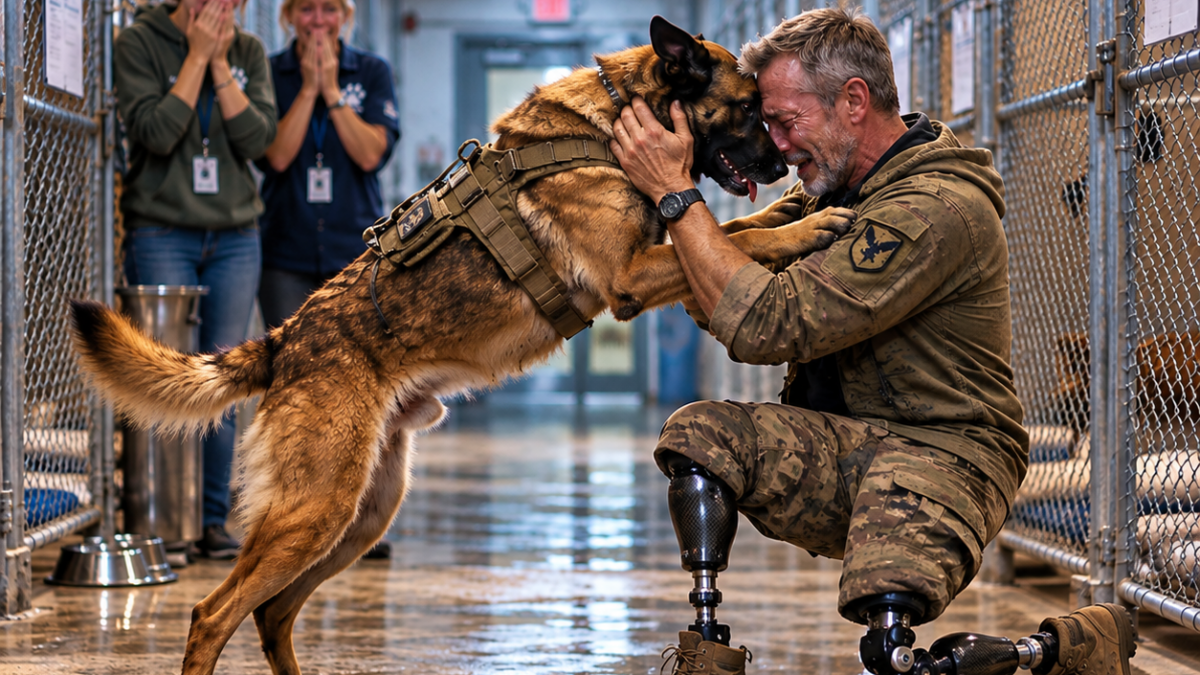
Duke came around the corner.
Older.
Scar along his muzzle.
Gray beginning around his face.
Thinner than the dog I remembered.
But Duke.
He saw me.
Stopped.
For half a second.
That half-second lasted four years.
His ears forward.
Nose working.
Eyes on mine.
Then he ran.
Full speed.
Eighty-five pounds of Belgian Malinois hit me in the chest.
Marcus had positioned his chair behind me.
Good thing.
I went backward.
My cane hit the floor.
I dropped to both knees anyway.
Pain shot through my bad leg.
Didn’t care.
Duke climbed into me.
Not on me.
Into me.
Head under my chin.
Paws against my shoulders.
His body shaking so hard I could feel his teeth click.
I wrapped both arms around him.
“I’m here.”
Duke made that sound.
The one from the kennel video.
Only louder.
“I’m here, boy.”
He pushed harder.
“I’m sorry.”
He licked my face.
“I’m sorry.”
Again.
“I told you.”
My voice disappeared.
I buried my face in his neck.
“I told you I don’t leave my team.”
Duke whined.
His tail struck the floor.
“I came back.”
I don’t know how long we stayed there.
Minutes.
Ten.
Twenty.
The world narrowed.
Fur.
Breathing.
Dog smell.
My hand finding the exact spot behind his ear he had loved in Afghanistan.
Duke remembered.
His back leg started kicking.
I laughed.
That laugh broke everybody else.
Lacy cried openly.
Patricia cried.
Marcus wiped his face and looked away.
Even Commissioner Denholm, who had arrived to argue about Duke’s transfer, stood motionless holding a folder.
I hadn’t noticed him.
Eventually Duke backed away enough to look at me.
Straight into my eyes.
The shelter staff later told me that was the first time in years he had sustained eye contact with anyone.
He studied me.
Then leaned forward and pressed his forehead to my chest.
That’s when I understood something.
Duke had not been waiting for the soldier who left.
He was accepting the man who returned.
Cane.
Scars.
Weak arm.
Everything.
Dogs are better at that than people.
We compare old photographs.
Measure ourselves against what we could once do.
Duke didn’t.
I was there.
Enough.
Commissioner Denholm cleared his throat.
Patricia looked at him.
“Ray.”
He glanced toward the reporters visible outside.
Then at Duke.
Then at me on the floor.
“I’ll amend the transfer order.”
Nobody cheered.
Good.
It wasn’t his story.
It was ours.
I looked up.
“Transfer?”
Patricia explained.
My anger rose.
Duke felt it immediately.
His ears shifted.
I stroked his neck.
“It’s okay.”
Denholm said:
“The county has liability standards.”
Marcus laughed.
“Now?”
Denholm ignored him.
I asked:
“Is Duke mine?”
Silence.
Technically, no.
The legal ownership chain was complicated.
Military retirement.
Placement agencies.
County.
Paperwork.
Everything in America becomes complicated if enough forms are involved.
Patricia said:
“We’ll fix it.”
I looked down at Duke.
“Then fix it.”
She did.
It took eleven days.
During those days, I visited whenever doctors allowed.
Duke became almost annoyingly alive.
He followed me.
Everywhere.
Physical therapy staff at the rehabilitation center initially refused to let him onto the floor.
Then someone from the Army made calls.
Then Duke appeared wearing a new harness.
The first session with him changed everything.
I was practicing parallel bars.
My right leg shook.
The therapist said:
“One more.”
I hated her.
Duke sat six feet away.
Watching.
I took a step.
Then another.
My knee buckled.
Duke stood.
I caught myself.
He whined.
“Stay.”
Duke sat instantly.
Military training.
Still there.
I stared.
The therapist stared.
“Again.”
This time she wasn’t talking to me.
I took three steps.
Duke remained.
Fourth.
Fifth.
At the end I turned.
“Come.”
Duke crossed the floor.
Pressed into my good side.
The therapist smiled.
“You respond better to him than me.”
“He has better bedside manner.”
Marcus started visiting with other veterans.
Word spread.
A Marine with a prosthetic leg met Duke.
A medic with severe anxiety sat beside him for twenty minutes without speaking.
Duke, who had refused human touch, rested his head on the man’s knee.
That was when the idea began.
Not mine.
Patricia’s.
She called one evening.
“The old county maintenance building beside the shelter is vacant.”
“So?”
“Ray was planning to sell it.”
I laughed.
“Ray loves selling things.”
“He also loves positive press.”
“Go on.”
“What if we built something?”
“What?”
“A program.”
Marcus leaned closer to the phone.
“What kind?”
“Retired service dogs. Veterans.”
I looked at Duke.
He was asleep with his chin on my boot.
Exactly like Afghanistan.
Patricia continued.
“There are dogs nobody knows how to place.”
Marcus nodded.
“And veterans nobody knows how to talk to.”
I looked at him.
“You volunteering us?”
He smiled.
“Absolutely.”
It took a year.
Donations came after Duke’s story spread.
Not just money.
Lumber.
Fencing.
Veterinary services.
Training equipment.
An HVAC contractor donated labor.
A church group painted.
A motorcycle club built kennel platforms.
Teenagers from the high school landscaped.
Someone from Texas sent ten thousand dollars anonymously with a note:
FOR DOGS WHO WAIT.
We named it Reyes-Duke Veteran Recovery Center.
I protested.
Lost.
Marcus said:
“You were dead three years. You don’t get a vote yet.”
Duke became the unofficial director.
Naturally.
He was older by then.
Slower.
But if a service dog arrived shut down, Duke somehow understood.
He never rushed.
He would lie nearby.
Wait.
Sometimes hours.
Sometimes days.
Veterans did the same.
There was a symmetry to it nobody had planned.
Broken routines meeting broken routines.
People who hated being stared at.
Dogs who hated being touched.
Nobody asking:
What’s wrong with you?
Instead:
Want to sit here?
That was enough.
My recovery remained difficult.
The reunion didn’t cure me.
I want that clear.
Stories like ours are often told as if one emotional moment erases injury.
It doesn’t.
I still woke sweating.
Still couldn’t tolerate closed rooms sometimes.
Still had nightmares where I heard Duke scratching through rubble and couldn’t reach him.
My left hand remained weak.
The right leg improved but never returned fully.
I walked with a cane most days.
Some days I used a chair.
For a long time I hated the chair.
Marcus noticed.
“You keep looking at wheels like they insulted your mother.”
“I hate needing it.”
“So?”
“So what?”
“You needed an aircraft to get to Afghanistan. Didn’t complain about that.”
“Not the same.”
“Needed a dog to find explosives.”
“Definitely not the same.”
“You needed medics.”
I glared.
“You’re annoying.”
“Need isn’t shame.”
He rolled away before I could answer.
Marcus had spent years learning lessons I was just beginning.
Duke taught me another.
He didn’t care whether I stood.
If I used the wheelchair, he walked beside it.
If I used the cane, he slowed.
If I fell, he came closer.
Never looked embarrassed.
Never asked when I would become the old Daniel again.
He only adjusted.
Animals don’t romanticize independence the way humans do.
They adapt.
One evening I was sitting on the recovery center porch.
Duke’s head across my lap.
A young veteran named Aaron was in the training yard with a retired Labrador.
Aaron had lost both legs above the knee.
He hated everyone.
I liked him immediately.
The Labrador kept dropping a ball beside him.
Aaron ignored it.
Dog picked it up.
Dropped it again.
Finally Aaron threw it.
Badly.
Dog ran.
Aaron smiled.
Just a little.
I looked at Duke.
“You did that to me.”
His ear moved.
“You annoying bastard.”
Tail thump.
The biggest test came two years after our reunion.
Duke was ten.
Maybe eleven.
Military records weren’t perfect.
He had arthritis.
Old blast-related hearing loss.
A heart condition we had begun monitoring.
He still came to the center most days.
Then, one night, I woke because something felt wrong.
Duke wasn’t beside the bed.
I found him in the hallway.
Standing strangely.
Breathing hard.
I knelt.
“Duke?”
He looked at me.
Then collapsed.
Emergency vet.
Two a.m.
Marcus drove because my hands shook too much.
The veterinarian stabilized him.
Heart rhythm.
Fluid.
Age.
Old injuries.
She spoke carefully.
“We can treat.”
“For how long?”
“I don’t know.”
“Is he suffering?”
“Right now, he’s uncomfortable. We can manage that.”
I sat beside Duke’s kennel.
For years I had been terrified that he would die before I returned.
Now I was terrified because I had returned and still couldn’t stop it.
That is grief’s trick.
It convinces you presence should grant control.
It doesn’t.
Duke recovered enough to go home.
Slower.
Medication morning and night.
Short walks.
No strenuous work.
We retired him officially from the recovery center.
He disagreed.
First morning I left without him, he stood at the door.
“No.”
Stare.
“You’re retired.”
Stare.
“Doctor’s orders.”
Stare.
“You taught nineteen grown men emotional regulation. Enough.”
He sat.
I left.
Ten minutes later Marcus called.
“Why is Duke standing in the middle of the center?”
I turned the van around.
He had figured out how to follow one of our volunteers through the connecting gate.
Retirement lasted nine minutes.
So we compromised.
Two days a week.
Mostly porch supervision.
Duke took the arrangement seriously.
He slept.
Eventually even that became too much.
His heart weakened.
One autumn evening, Dr. Morgan came to the house.
Not an emergency.
We had planned it.
Duke had stopped eating reliably.
Could no longer stand without help.
His breathing was becoming work.
I knew.
Still hated knowing.
Marcus sat on the porch.
Patricia came.
Lacy too.
Not because I asked.
Because Duke belonged to more people now.
But when the time came, everyone moved back.
Just me.
Duke.
The same boots, almost.
Different country.
Different life.
I sat on the floor.
His head in my lap.
I scratched behind his ear.
“You remember Kandahar?”
His eyes stayed on me.
“You probably remember better than I do.”
Tail moved once.
“I made you a promise.”
My voice shook.
“I thought I broke it.”
Duke breathed.
Slow.
“But maybe…”
I swallowed.
“Maybe coming back counts.”
He looked at me.
I laughed through tears.
“You waited way too long, you know that?”
His ear shifted.
“Stubborn.”
That was rich coming from me.
Dr. Morgan asked:
“Ready?”
No.
“Yes.”
The sedative went first.
Duke relaxed.
His breathing eased.
I bent down.
“I don’t leave my team.”
Tears fell into his fur.
“But sometimes…”
I couldn’t speak.
Marcus put a hand on my shoulder.
I tried again.
“Sometimes you have to let your team rest.”
Duke’s eyes closed.
I pressed my forehead against his.
“Good boy.”
The final medication went in.
His breathing slowed.
Stopped.
That was the quietest moment of my life.
For several minutes, I didn’t move.
I had spent four years terrified of being too late.
In the end, I was there.
That had to be enough.
We buried Duke on a hill behind the recovery center beneath a cedar tree.
No elaborate military ceremony.
I didn’t want one.
Marcus wanted a plaque.
I agreed.
It reads:
DUKE
MILITARY WORKING DOG
PARTNER. PROTECTOR. FRIEND.
HE WAITED.
Underneath, smaller:
AND WE CAME BACK FOR HIM.
People leave things there.
Tennis balls.
Flags.
Dog tags.
Notes.
One little boy left a toy soldier.
A veteran left a handwritten card:
THANK YOU FOR TEACHING ME HOW TO WAIT FOR MYSELF.
I kept that one.
Years have passed.
The center expanded.
Marcus runs intake.
Patricia still appears constantly despite claiming she retired from interfering in everybody’s life.
Lacy became a veterinary technician.
Commissioner Denholm eventually helped secure county funding.
I never let him forget he once tried transferring Duke.
He says I exaggerate.
I have paperwork.
I still walk with a cane.
My left hand never recovered completely.
I have nightmares.
Less often.
Sometimes I wake and reach toward the floor expecting Duke.
That emptiness is sharp.
Then I remember.
He waited for me.
I came back.
We got years nobody expected.
That is not a tragedy.
Grief is not proof that love failed.
It is proof something mattered enough to leave a shape behind.
Veterans visit Duke’s tree.
Some know the story before arriving.
Some don’t.
When they ask what made Duke extraordinary, they usually expect me to talk about Afghanistan.
Explosives.
Deployments.
Lives saved.
Yes.
He did those things.
But the most extraordinary thing Duke ever did happened in a cheap county shelter in Tennessee.
Nobody commanded him.
No training scenario.
No reward.
No tactical objective.
A man in a wheelchair said my name.
And a dog who had spent years refusing the world decided hope was worth standing up for one more time.
That was Duke’s last great mission.
Not finding a bomb.
Not clearing a building.
Not protecting a convoy.
He waited.
People underestimate waiting.
They think loyalty means chasing after someone.
Sometimes loyalty means staying in the same place after everyone tells you the person is gone.
Duke stayed.
Four years.
The shelter called him a ghost.
Maybe he was.
Not because he had disappeared.
Because half of him was still somewhere else.
With me.
And perhaps I was the same.
During captivity, during hospitals, during the months when I could not recognize my own body, part of me was still in that Afghan valley with a young Malinois beside my boots.
Neither of us knew the other was alive.
Both waited anyway.
That is what I tell the veterans who come through our gate now.
Especially the ones who believe too much time has passed.
Too much damage.
Too much anger.
Too many people have moved on.
I tell them about Kennel 14.
About Duke lying against a concrete wall.
About Marcus.
About five words.
Daniel came back for you.
Then I tell them something Duke taught me after I returned.
Coming back is not one moment.
It isn’t a plane landing.
It isn’t opening your eyes in a hospital.
It isn’t walking through a shelter door.
You can be physically home and still spend years finding your way back.
Coming back happens in pieces.
One meal.
One night of sleep.
One phone call.
One physical therapy session.
One dog resting his head across your lap.
One morning when you realize you went an hour without thinking about what happened.
Then two.
Then maybe a day.
The path is not straight.
Duke’s wasn’t.
Mine isn’t.
That does not mean we’re lost.
On quiet evenings I still sit on the porch.
The training yard beyond me.
A veteran laughing somewhere inside.
A dog barking.
Marcus arguing with somebody about paperwork.
Normal sounds.
I can see Duke’s cedar tree from where I sit.
Sometimes the wind moves its branches.
And I remember the first promise.
You and me.
We’re a team now.
I don’t leave my team behind.
For years I thought those words belonged only to me.
My obligation.
My failure.
Then I understood.
Duke made the same promise.
He just couldn’t say it.
He showed me.
In Afghanistan when he stayed over the rubble.
In Kennel 14 when he refused to replace me.
At the shelter door when he recognized my voice.
On the rehabilitation floor when he watched me learn to walk again.
Beside my bed when nightmares woke me.
At the recovery center when another broken veteran needed a quiet presence.
And finally, when his own body could no longer carry him, he trusted me enough to let me be there while he stopped fighting.
That was his last chance to prove his love.
He didn’t need it.
He had already proven it every day for years.
But I think maybe I needed one last chance to prove mine.
So I stayed.
Until the last breath.
Just like he had stayed for me.
And whenever someone asks me about the most loyal military dog I ever knew, I don’t tell them Duke never gave up.
That’s too simple.
Everybody gets tired.
Even Duke.
What made him extraordinary was that after everything war took from him, after loss, confusion, kennels, strangers, and four years of waiting for a dead man, he still found enough love left inside himself to stand up when he heard my name.
He still believed I might come through the door.
And eventually—
I did.

