The HOA Sold Vacation Guests Access to My Private Pool — Then Learned the Gate Code, the Deed, and the Lawsuit All Belonged to Me
The HOA Sold Vacation Guests Access to My Private Pool — Then Learned the Gate Code, the Deed, and the Lawsuit All Belonged to Me
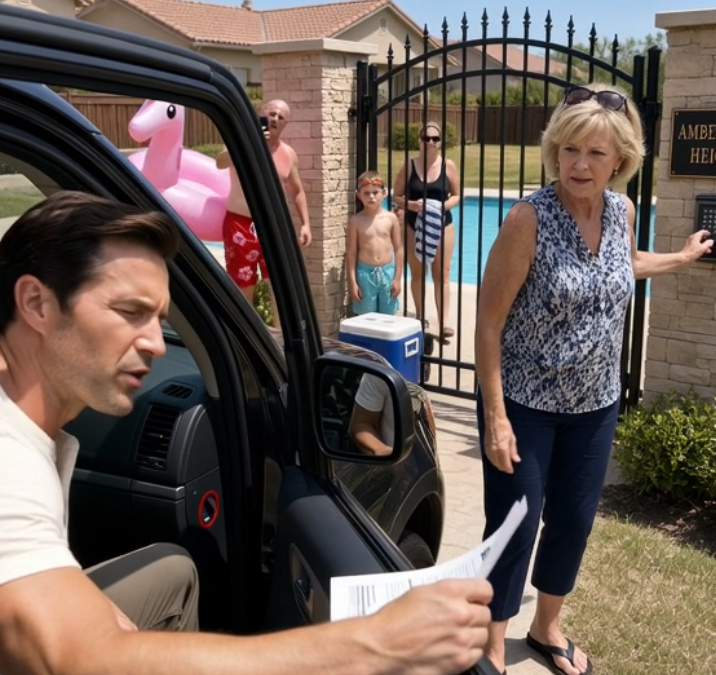
I came home to find strangers in swimwear waiting outside my pool gate, holding towels, a cooler, and a welcome packet signed by the HOA president.
She told them my private backyard was a premium community amenity, then threatened to fine me every day until I surrendered the gate code.
What she did not know was that I had spent fourteen months saving every newsletter, screenshot, fake access schedule, and signed lie she had been careless enough to put on paper.
I came home that Saturday and found four strangers in swimwear standing at my pool gate.
They had beach towels over their shoulders.
A cooler sat on the grass near the fence.
A pink unicorn float was tucked under one man’s arm.
A little boy in orange goggles was already barefoot on the sidewalk, staring through the slats at the water like he had been promised paradise and was waiting for the door to open.
Linda Voss stood at the keypad, jabbing numbers that had never opened that gate for anyone but me.
She pressed four digits.
Nothing.
She pressed them again.
Nothing.
Then she slapped the side of the keypad with her palm as if the metal had personally embarrassed her.
I parked in my driveway and did not get out right away.
For a moment, I just sat behind the windshield with both hands on the steering wheel and watched the president of my homeowners association try to break into my backyard in front of paying vacation renters.
Linda saw me.
Her expression went straight to annoyance.
Not surprise.
Not guilt.
Annoyance.
As if I had chosen the worst possible time to come home to my own house.
The second I opened my truck door, she snapped.
“Your gate is broken.”
I shut the door behind me.
“These guests have been waiting twenty minutes.”
I looked at the guests.
PART2:
The sunburned man holding the unicorn float looked like he wanted to disappear into the grass. The woman beside him clutched a canvas beach bag against her stomach. The little boy kept staring at the water through the fence, still hopeful, because children do not understand adult fraud until somebody makes them cry with it.
Linda jabbed one finger at the keypad.
“Reset the code right now.”
The sunburned man lifted his phone and photographed the keypad. He did it the way people photograph a dirty hotel room or a cracked shower tile. Like a maintenance complaint. Like evidence for a refund request.
The woman beside him looked from Linda to me and then back at the gate. She was beginning to understand something was wrong.
Not all the way yet.
Just the first crack of suspicion.
Linda waved a glossy folded packet at me.
Subdivision letterhead.
A welcome packet.
Her signature at the bottom.
The words were printed clean across the front page.
Premium pool access code provided on arrival.
“I am the HOA,” Linda said.
“This pool serves all our short-term guests.”
“Fix the code or the board fines you daily until you lose this house.”
I took the packet from her.
I did not open it right away.
I already knew what it said.
PART3:
I had seen the same line six months earlier in the Riveras’ guest binder when I was over for a porch beer and noticed the phrase premium pool access under our subdivision letterhead. There had been a four-digit code printed beside it.
That code had never opened my gate.
No code Linda knew had ever opened my gate.
No renter had ever had the right to stand where those four strangers were standing.
I unfolded the packet anyway.
I read three lines.
Long enough for the renters to shift their weight.
Long enough for the little boy with the goggles to ask his mother if they were still going swimming.
Long enough for Linda to fold her arms and stare at me like she owned the concrete under my shoes.
Then I asked quietly, “This is a private pool. Who told you it was rentable?”
Linda’s voice tightened.
The way a voice tightens when the people watching are also the people paying.
“Don’t make a scene.”
“I asked a question.”
“I am the HOA.”
“You are standing outside my fence.”
“This pool serves all our short-term guests.”
There it was.
Said out loud.
In front of four witnesses.
On letterhead.
With her signature.
I made a small, specific note of it in the part of my mind that keeps small, specific notes.
I had been collecting those notes for fourteen months.
Linda kept going because people like Linda think momentum is the same as truth.
“If you do not fix this code in the next ten minutes, I am writing you up for obstructing community amenity access. The board will fine you daily. Daily, Mr. Mercer. Until you lose this house, if that is what it takes.”
The sunburned man lowered his phone.
“Bro,” he said to the woman beside him. “This is awkward. Can we just get a refund?”
Linda did not hear him.
Linda was still talking at me.
I let her.
Every word was evidence.
Every sentence was something I would read back to her one day in a room full of neighbors.
Some of it I would read out loud.
Some of it I would simply place on a table beside a deed and let silence do the work.
I stood there with her glossy welcome packet in my hand and thought one full, clean thought.
She had no idea the only person who had ever known the real code to that gate was the man whose name was on the deed she kept pretending did not exist.
I folded the packet in half.
Then I folded it again.
I put it in my back pocket.
Then I turned to the renters.
“I am sorry you were misinformed. This pool is private property. It is not and has never been a community amenity. You will want to take that up with whoever sold you the booking.”
The woman stared at me for a moment.
“Are you serious?”
“Yes, ma’am. I can give you a written statement if you need one for a chargeback.”
She looked at Linda.
Then she looked at the welcome packet in my pocket.
“Thank you,” she said quietly.
It was not gratitude exactly.
It was the relief of hearing one honest sentence after paying for a lie.
Linda’s mouth opened.
Then closed.
Then opened again.
I walked past her.
I did not argue.
I did not raise my voice.
I did not slam my door.
I never slam doors.
I went inside, locked the storm door behind me, and walked straight to my office.
The manila folder was in the bottom drawer of my filing cabinet.
Fourteen months of paper.
Newsletters.
Screenshots.
Photos.
Emails.
Certified letters.
A plat map.
Bylaws.
A gate registration log.
And now, on top of all of it, Linda’s glossy welcome packet.
Through the kitchen window, I watched her turn back to the keypad.
She pressed the fake code again.
Then again.
Then once more.
Slower this time.
As if the numbers had misunderstood her the first three times.
They had not.
The numbers knew exactly who they belonged to.
Not Linda.
Not the HOA.
Not her renters.
Me.
I did not open the folder right away.
I poured a cup of coffee.
I sat at the kitchen table and looked through the back window at the fence line, at the corner of blue water I could see beyond the deck, and at the gate Linda kept trying to command.
Then I let myself remember why I bought the house in the first place.
Six years earlier, I had not been looking for a fight.
I had been looking for a quiet place to live.
I was fifty-five then, recently divorced, tired from twenty-eight years of running a small commercial insurance practice, and ready for a house that did not feel like a negotiation.
Divorce does that to a man. It makes him tired of rooms where every object has history on it. Tired of hallways where silence feels like accusation. Tired of furniture bought by two people and used by one. I did not want a mansion. I did not want a statement house. I did not want neighbors who measured success by how loudly they renovated kitchens.
I wanted quiet.
A small yard.
A decent kitchen.
A garage with enough space for tools.
A place where I could sit outside at night and not feel like the house was asking me what happened.
My realtor had been showing me a different place in the same subdivision when she pulled up to this curb and said, “Wait. Look at this listing first.”
The house was not the largest in Cedar Hollow.
It was not the fanciest.
The kitchen needed updating.
The roof had five years left in it.
The landscaping looked like it had been maintained by a man who owned good tools but no patience for decorative shrubs.
But the backyard had a pool.
Not a resort pool.
Not a luxury pool.
Just a good rectangular pool with clean tile, brick coping, a small shaded deck, and a black aluminum fence around it.
It felt private.
That was what I wanted.
Privacy.
The previous owner was an old contractor named Leonard Price.
He was eighty-one, sharp-eyed, and not in the mood for foolishness.
The day I first toured the house, he sat at the kitchen table with a stack of documents already waiting. Before I said anything about the pool, he slid the stack across the table.
“Read it,” he said. “Before you sign anything in this neighborhood, read every page.”
Most sellers hide problems.
Leonard organized them.
The deed.
The recorded plat.
The original gate installation paperwork.
The fence permit.
The grandfather clause negotiated with the developer when Cedar Hollow had converted into an HOA in the late 1990s.
A letter from the developer’s attorney stating that the pool, fence, keypad, surrounding deck, and all access controls were part of the private residential parcel and excluded from any common element designation.
A gate manufacturer registration log showing the master code belonged to the homeowner of record.
Leonard tapped the stack with one thick finger.
“This pool is yours if you buy the house. Not theirs. Never theirs.”
He leaned back and looked me dead in the eye.
“Do not ever let an HOA president talk you out of paper.”
That sentence stayed with me.
Do not ever let an HOA president talk you out of paper.
I bought the house.
Leonard’s attorney walked me through every document before closing. The pool was fully inside my lot line. The fence was three feet inside my boundary on every side. There was no easement. No shared maintenance clause. No common area overlap. No community access language.
The HOA had no right to use it, manage it, rent it, regulate it, advertise it, open it, or even demand the code.
I kept the originals in a fireproof box.
For five years, none of it mattered.
The HOA was boring.
Beautifully boring.
There were quarterly newsletters, a potluck in October, reminders about trash cans, and an old board president named Earl who mostly cared about the flowers at the front entrance. Earl sent emails with subject lines like Mulch Update and Friendly Reminder About Holiday Lights. He once apologized to the entire subdivision because the mulch delivery truck came two days early.
He was the kind of HOA president you forget to resent.
Then Earl retired.
Linda Voss ran for president on a platform of more amenities for residents.
She won by six votes.
That was the beginning.
Linda was fifty-eight, polished, energetic, and full of phrases that sounded harmless until you found the invoice attached.
Resident experience.
Lifestyle value.
Amenity potential.
Neighborhood branding.
Community monetization.
She spoke like a woman who had learned that if you put soft words around hard intentions, people nodded until the bill arrived.
Her husband, Greg, owned a small short-term rental LLC called Greg’s Subdivision Stays.
On paper, Greg owned it.
In reality, Linda ran it.
The listings, the guest packets, the pricing, the cleaning schedule, the photos, the fees, the messages to renters.
All Linda.
Greg watched football and signed what she put in front of him.
I knew this because she had announced it proudly at a spring potluck the year before, telling everyone that short-term rentals were the future of “boutique neighborhood income.” Most people nodded because they were holding paper plates of potato salad and did not want to get trapped in a debate near the lemonade cooler.
The first time I saw the word pool in an HOA newsletter, I almost missed it.
It was a single sentence in the summer events section.
Residents and guests are reminded to enjoy our beloved community pool feature responsibly during peak season.
There was no community pool.
There had never been a community pool in Cedar Hollow.
There was a splash pad.
A picnic shelter.
A mailbox kiosk.
A front entrance flower bed.
That was it.
My pool was a private pool behind my house, inside my fence, on my parcel.
I read the sentence three times.
Then I emailed the board.
Polite.
Short.
No accusation.
Just a correction.
My pool is private property and not a community amenity.
Please clarify in the next newsletter to avoid confusion.
No reply.
Three weeks later, the next newsletter went out.
Same sentence.
Word for word.
That was the day I opened the folder.
I printed the newsletter.
Highlighted the sentence.
Wrote the date on the top right corner.
Dropped it into a manila folder.
I did not post online.
I did not knock on Linda’s door.
I did not call her names.
I just started saving paper.
Linda gave me paper the way a leaky pipe gives water.
Three months in, the HOA installed a small wooden sign at the mouth of my cul-de-sac.
Residents and guests welcome.
At the bottom of the sign was a small arrow.
The arrow pointed toward the side of my house where the pool gate was.
I photographed it that evening.
Wide shot.
Close-up.
Date stamp.
Arrow.
Street sign.
Into the folder.
Five months in, I pulled the recorded plat from the county GIS portal.
The pool sat fully within my parcel.
No easement.
No common element.
No access corridor.
I printed it in color.
Into the folder.
Seven months in, a friend from the next subdivision texted me a screenshot.
He had stumbled across an Airbnb listing.
Premium pool access.
Seventy-five-dollar fee per stay.
Code provided on arrival.
The listing photo was my pool.
It had been taken through the fence slats from the cul-de-sac.
You could see the edge of my umbrella.
You could see the blue lounge chair I bought from Costco.
You could see the stone planter I had repaired after a freeze.
I sat with the screenshot for a long time before printing it.
Then I searched the second LLC listing.
Same language.
Same fee.
Different rental unit.
Two homes.
Roughly thirty stays a year each.
Seventy-five dollars per stay.
Fourteen months.
The math landed hard.
Linda was not just bossy.
Linda was not just careless.
Linda was selling tickets to my backyard.
Eight months in, she caught me at the mailbox one evening.
All sunshine.
All neighborly charm.
“Daniel,” she said. “Would you be willing to share the pool gate code with the board for emergency purposes? Just in case.”
I smiled politely.
“No.”
Her smile stayed in place.
“Of course. I just wanted to ask.”
That night, I changed the code.
The old code had been Leonard’s original. The code printed in Linda’s welcome packets. The code she must have been trying for months.
The new code was four digits no one in Cedar Hollow had ever seen.
I logged the change through the gate manufacturer’s owner portal. The portal recorded the change date, the homeowner name, the parcel address, and the master code history back to installation.
I printed the log.
Into the folder.
Nine months in, I sent a formal cease-and-desist email to the board.
No drama.
No accusations beyond what I could prove.
Please stop representing my private pool as a community amenity.
Please remove any reference to pool access from HOA materials and short-term rental packets.
Please provide written confirmation.
No response.
Into the folder.
Eleven months in, Mr. Patel, my neighbor three houses down, mentioned over the fence that Linda had once tried to fine him over the color of his mailbox.
“She is sloppy,” he said. “That is worse than being clever.”
I asked what he meant.
He smiled.
“She writes things down.”
I did not know then that Mr. Patel had spent thirty-one years practicing property law. He did not volunteer that fact. He just said that if I ever needed another set of eyes on an HOA letter, his eyes were free.
Fourteen months in, Linda stood at my gate with four renters, a unicorn float, and a welcome packet.
The folder was almost full.
I just needed her to do something stupid enough in front of enough witnesses to make all the paper land at once.
That Saturday afternoon, she did exactly that.
Two days later, I came home from the grocery store and found a bright orange violation notice taped to my front door.
HOA VIOLATION NOTICE.
Subdivision letterhead.
Linda’s signature.
Two hundred fifty dollars.
Five-day deadline.
Violation cited:
Obstructing community amenity access.
Refusal to surrender gate code to HOA office on demand.
I stood on my porch with a grocery bag in one hand and read it twice.
Refusal to surrender.
As if I had been ordered to turn over military equipment.
As if my pool gate code was a public resource.
As if saying no to a woman trying to sell my backyard was an act of rebellion.
I peeled the notice off carefully.
I put the groceries away.
Then I placed the orange notice on top of the folder.
At 3:07 p.m., the doorbell rang.
I checked the porch camera before opening the door.
I checked every camera now.
Linda stood on my welcome mat.
Behind her stood Doug Ellison, a board member I half recognized. He was pale, holding a green binder against his chest like a shield.
I opened the front door but left the storm door locked.
Then I placed a small handheld camera on the porch railing and tapped record.
“I am going to ask you to stop filming me,” Linda said immediately.
“This is a one-party consent state,” I said. “I am a party to the conversation. The recording stays.”
Linda looked at Doug.
Doug looked at his shoes.
“Did you receive the violation notice?”
“I did.”
“Are you prepared to surrender the gate code today, or does the board need to vote on a daily fine?”
“Linda, show me the bylaw that defines my pool as a community amenity. If you can show me that bylaw, we can discuss access. If you cannot, I want the violation withdrawn in writing by end of business tomorrow.”
“The board’s interpretation is final.”
“That is not a bylaw. That is a sentence.”
Doug’s eyes lifted for the first time.
Linda’s jaw tightened.
She reached into the green binder and pulled out a single printed sheet.
“Then maybe this will help you understand the seriousness.”
The header read:
RENTER POOL ACCESS SCHEDULE THIS WEEK.
Subdivision letterhead.
Linda’s signature.
Below that was a neat table.
Dates.
Times.
Rental units.
Guest names.
Number of guests.
Tuesday, 3 p.m., Henderson family, four guests.
Wednesday, 11 a.m., Caruso family, two guests.
Thursday, 1 p.m., Park-Lee party, six guests.
Six scheduled pool access windows.
For my pool.
On HOA letterhead.
With Linda’s signature.
She held it out to me.
I took it.
She expected me to argue.
I folded it in half.
Then folded it again.
Then put it in my back pocket.
Linda had no idea what she had done.
She had handed me a written confession.
Not a rumor.
Not a screenshot.
Not a neighbor statement.
A schedule.
Official-looking.
Signed.
Specific.
She thought paperwork in her hand meant authority.
She did not understand paperwork in my hand meant evidence.
“If you do not comply by Friday, the board will vote a daily fine,” she said. “We will place a lien on your title. We will make you understand how long a man like you keeps a house in this neighborhood when the HOA decides he does not.”
A man like you.
I made another note.
“I will respond in writing.”
“You will respond in cash eventually.”
“In writing.”
She stared at me.
Then she turned and marched down my porch steps.
Doug followed.
Before he reached the sidewalk, he glanced back.
His face was halfway between apology and warning.
I let the camera run another minute after they left.
People often say revealing things in driveways when they think the recording has stopped.
Linda was already on the phone.
“He is being completely unreasonable. The board is going to have to—”
I stopped recording.
Then I texted Mr. Patel.
Got a violation notice from Linda.
And something worse.
Are you free tonight?
He replied in two minutes.
Bring the notice.
Bring the something worse.
I will put coffee on.
Mr. Patel opened his door before I rang the bell.
His kitchen smelled like cardamom and warm milk. He waved me to the table without small talk.
I laid out the welcome packet, the violation notice, and the renter schedule.
He put on reading glasses.
He read the welcome packet.
Then the violation.
Then the schedule.
He read the schedule twice.
“How long has she been doing this?”
“Fourteen months that I can prove.”
“Probably longer.”
“The pool is fully on your lot?”
“Fully.”
“I have the recorded plat.”
He opened his laptop, pulled up the county portal from memory, typed in my parcel number, and traced the boundary.
“No easement,” he said. “No common area overlap. No recorded access.”
He clicked again and pulled up the HOA declaration.
“She cannot do this. Not the access demand. Not the fine. Not the lien. A lien filed without a valid underlying debt is slander of title. You can sue personally if she is foolish enough to record it.”
He said it calmly.
Like reading a weather report.
“Mr. Patel,” I asked, “what did you do before retirement?”
He smiled.
“Property law. Thirty-one years. Mostly title disputes and HOA work.”
Then he took a sip of coffee.
“I saw one of those welcome packets at the Riveras’ house last Christmas. I have been waiting for someone on this block to bring it to me.”
That was when my folder stopped feeling private.
It became something larger.
Patel drafted a records request that night.
Board minutes.
Bylaws.
Amenity definitions.
Treasurer records mentioning pool access, amenity fees, guest access, rental programs, or pool premium accounts.
“No accusations,” he said. “Just paper. Make her hand you the rope.”
“She will.”
The next morning, I mailed one copy certified to the HOA office and hand-delivered another to Carol, the board secretary, with Mrs. Rivera watching from her porch.
That evening, Mrs. Rivera came to my door with a plate wrapped in foil.
Her husband stood behind her with his hands in his pockets.
They looked embarrassed.
“We saw Linda on your porch,” Mrs. Rivera said. “We were not sure whether to stay out of it.”
I invited them in.
Over the next half hour, they told me the story I had half suspected.
The previous summer, two of their Airbnb guests had walked over to my pool gate while the Riveras were out. Linda had told them the pool was included with their stay. The code did not work. The guests demanded a refund. The Riveras paid out of pocket because the renters were angry and they did not understand yet that Linda had been selling something she did not own.
“We thought she had cleared it with you,” Mr. Rivera said. “I am sorry.”
“You should not have had to guess.”
He nodded.
“We should have asked anyway.”
I asked if they would write it down.
Dates.
Guest names.
Messages.
The code Linda had provided.
Mrs. Rivera was already scrolling through old texts.
Twenty minutes after they left, Mrs. Okafor knocked.
She lived two doors the other direction. Seventy-two years old. Sharp eyes. Soft slippers. No patience for nonsense.
“My grandson tried to use your pool last July,” she said. “He saw renters going in and thought it was open. Linda told him he was not on the rental list that week. He came home crying. I have carried that around for ten months. I will not carry it anymore.”
She handed me a folded piece of lined paper.
Dated.
Signed.
Two paragraphs.
She had written it before coming over.
By midnight, I had three neighbor statements on my kitchen table.
Patel notarized them the next morning.
Three days later, the HOA mailed my records request response.
The envelope was thick.
The bylaws were clean.
Common amenities were listed on page twelve.
Front entrance flower bed.
Splash pad.
Picnic shelter.
Mailbox kiosk.
No pool.
The certification page said the bylaws had not been formally amended in nine years.
The minutes were sloppy.
That mattered.
Someone had redacted names and dollar amounts with a black marker.
Badly.
On one page, the ink had not fully covered the line underneath.
A dollar figure bled through faintly.
$2,250.
The heading above it read:
Pool Premium Account Reconciliation.
I sat under the kitchen light and looked at it for a long time.
Patel was right.
She had handed me the rope.
She had even tied the knot.
Saturday morning at 9:14, my porch camera pinged.
Linda was in my cul-de-sac.
So was a white locksmith van.
So were four new renters in swimwear.
The Henderson family, by the look of them.
Cooler.
Towels.
Two children in flip-flops.
So were Mrs. Rivera, Mrs. Okafor, and a man from the next street I did not recognize. They stood on the sidewalk, phones in hand, watching.
Linda had brought an audience.
She just did not know what kind.
I picked up my handheld camera and stepped outside.
The locksmith was already kneeling by my pool gate.
Linda hovered over him.
“It is the HOA gate,” she said. “It is malfunctioning. We need it re-keyed today. The board authorized the work.”
The locksmith turned slowly and looked up at her.
“Ma’am, do you have a deed or work order showing ownership of this address?”
“I am the HOA president.”
“That is not a deed.”
“I have a newsletter.”
“That is also not a deed.”
She pulled a folded newsletter from her tote bag and waved it.
The locksmith did not take it.
He stood, dusted off his knee, and looked toward me.
I walked across the cul-de-sac.
I handed him a copy of my deed and my driver’s license.
He compared the name.
The address.
The house number.
The parcel.
Then he handed them back.
“Sir, I apologize for the disturbance.”
Then he turned to Linda.
“Ma’am, I cannot do this job. The address belongs to him. You need to leave.”
He said it loudly enough for everyone to hear.
That broke something in her.
“You work for who I tell you to work for,” Linda snapped.
“No, ma’am. I work for whoever can show me a deed.”
He packed his toolbox slowly. He climbed into the van and drove away.
Three neighbors filmed him leaving.
The Henderson family had stopped halfway across the cul-de-sac. The father set the cooler down. The mother pulled out her phone. One of the kids asked if they were still swimming.
Linda did the worst possible thing.
She called 911.
“Yes, hi. This is Linda Voss, president of Cedar Hollow HOA. I have trespassers blocking pool access at our community amenity. The homeowner is being aggressive with guests.”
I had said almost nothing.
Mrs. Rivera lowered her phone.
“Aggressive?” she said.
I went inside and picked up a slim folder.
Deed.
Bylaws.
Listing screenshot.
Welcome packet.
When the officers arrived eleven minutes later, the senior officer took in the scene with one sweep.
Linda rushed him.
“He is blocking access. He is harassing guests. He refuses community rules.”
The officer held up one hand.
“Ma’am. One at a time.”
Then he asked the one question Linda should have been dreading from the beginning.
“Are you the homeowner?”
“I am the HOA.”
“Are you the homeowner?”
“No.”
He turned to me.
“Sir, are you the homeowner of this address?”
“Yes.”
“Has anyone been harmed or threatened today?”
“No, sir.”
“Have you physically obstructed anyone?”
“No, sir. I came out of my house with a camera and a folder.”
He looked at the folder.
Then at the pool gate.
Then at Linda.
Then at the renters.
Then he made the small adjustment experienced officers make when the call they were sent to is not the call they are standing in.
“Ma’am,” he said to Linda. “Did you advertise this property for paid use?”
Linda froze.
The renters heard the freeze.
Mr. Henderson stepped forward.
“Officer, we booked through Airbnb. The listing said premium pool access included. Seventy-five-dollar fee. I have the confirmation.”
He handed over his phone.
The officer read it.
“And your relationship to Greg’s Subdivision Stays LLC, ma’am?”
“My husband owns it,” Linda said.
Quietly.
I handed the officer my slim folder.
He read the deed.
He read the listing screenshot.
He compared the listing to the renter’s confirmation.
Then he looked at Linda and said, clearly enough for every camera in that cul-de-sac to catch it, “Ma’am, I am advising you on the record. Any further attempt to access this property without the owner’s written consent may be charged as criminal trespass. Knowingly advertising property you do not own or control in exchange for payment may also create civil liability. Depending on what the homeowner provides in writing, it may become a criminal matter.”
He turned to me.
“Sir, do you want to file a report today?”
“Not yet. I would like the incident logged. I will be filing in writing.”
He gave me an incident number.
He gave Mr. Henderson one too.
By the time the cruiser left, the Hendersons were already on the phone with Airbnb support. Two other rental cars that had pulled up during the wait reversed out of the cul-de-sac without unloading.
Linda stood alone in front of my gate.
Mrs. Okafor walked up beside me.
“Now,” she said, “you tell me when the meeting is.”
Forty-eight hours later, Linda filed the lien.
She pushed it through an emergency board vote on a Monday night with only three members present.
Five thousand dollars.
Disrupting amenity operations.
Harassing community guests.
Obstructing the HOA’s use of a common facility.
Tuesday morning, the lien hit the county recorder.
Patel called before I finished my coffee.
“She filed it.”
“She actually filed it.”
“At the courthouse?”
“This morning. Public record by noon.”
I sat back in my chair.
“She thinks she won.”
“No,” Patel said. “She handed us a judge.”
A lien looks powerful to people who do not understand liens.
A lien is not magic.
A lien needs a valid debt underneath it.
Without that, it is paper with a fuse.
Patel drafted the motion to discharge it in one afternoon. A real estate attorney he had practiced with for fifteen years agreed to file it.
We sent three things that Wednesday.
The motion to discharge the lien.
A complaint to the state HOA regulatory body.
A demand letter to Greg’s Subdivision Stays LLC for unjust enrichment, false advertising, and unauthorized commercial use of private property.
Certified mail.
Every envelope tracked.
Every receipt saved.
By Thursday, the neighborhood had split.
A few short-term rental owners backed Linda quietly because her guest pipeline helped them.
A few stopped waving at me, which is how cowards vote in suburbs.
Everyone else began coming forward.
Mrs. Okafor collected signatures.
Mrs. Rivera knocked doors.
Patel made calls.
By Friday evening, we had forty-one signatures demanding a special meeting and a no-confidence agenda.
The bylaws required fifteen percent of homeowners.
We had more than double.
The meeting was scheduled for the following Thursday at 7 p.m.
Clubhouse.
During that week, my house was quiet.
No renters.
No keypad attempts.
No orange notices.
No Linda on the porch.
Across the subdivision, she was preparing her version of the meeting.
The version where she stood at the front and explained that I was selfish, hostile, unreasonable, and anti-community.
I prepared differently.
Patel and I built one folder.
Not a pile.
One folder.
In order.
Deed and plat.
Gate registration log.
Listing screenshots.
Welcome packet.
Renter schedule.
Bleed-through minutes.
Bylaws.
Neighbor statements.
Police incident card.
State complaint receipt.
“You do not dump it on them,” Patel said. “You place one piece at a time. Let the room do the work.”
Thursday night, the clubhouse was full ten minutes early.
I had lived in Cedar Hollow six years and had never seen that room full.
Not for potlucks.
Not for budget meetings.
Not even for the year Earl tried to organize a holiday sing-along.
People stood along the back wall.
The Hendersons sat in the back row with their refund paperwork.
Two other refunded renters sat beside them.
Greg sat near the door with both hands on his knees.
He did not look at Linda.
Linda sat at the board table, posture straight, agenda in front of her.
She opened strong.
“This man,” she said, gesturing at me, “has blocked community access to our pool. The board acted appropriately. Tonight is about restoring order.”
She still thought the meeting was hers.
Then I was given ten minutes under the special meeting rules.
I walked to the front and set the folder on the table.
I had written a speech.
I had thrown it away the night before.
Patel was right.
The room would do the work.
I opened the folder.
“Linda has been selling something she never owned.”
The room went still.
I lifted the first document.
“This is the recorded deed for my parcel. The pool sits one hundred percent inside my private lot line. There is no easement. No common area overlap. No HOA interest.”
I handed it to Carol, the board secretary.
Carol read it.
Then read it again.
The color drained from her face.
She set it down carefully.
I lifted the gate registration log.
“This is the manufacturer’s master code history. The gate code has always been registered to the homeowner of record at my parcel address. Not to the HOA. Not to the board. Not to Linda.”
I paused.
“The reason Linda’s codes never worked is simple. She never had the real code. She never had the right to have it.”
I placed the log beside the deed.
I lifted the listing screenshots.
“These are Greg’s Subdivision Stays LLC listings. They advertise premium pool access for seventy-five dollars per stay. The photograph is my pool, taken through my fence without permission.”
I lifted the renter schedule.
“This is the schedule Linda handed me. HOA letterhead. Her signature. Names, times, unit numbers, guest counts. She did not merely imply access. She scheduled access.”
The Hendersons stood in the back.
Mr. Henderson held up his welcome packet.
“We paid extra,” he said. “The packet said the pool was included. It has her signature.”
The woman three rows back turned to Linda.
“Did you sign off on those listings?”
Linda did not answer.
“Did you sign off on them, Linda?”
Greg stood.
Slowly.
He picked up his jacket.
He walked out of the clubhouse without speaking.
The door clicked shut behind him.
That sound did more damage than shouting ever could.
Patel stood next.
He opened the bylaws.
“Page twelve. Common amenities. Front entrance flower bed. Splash pad. Picnic shelter. Mailbox kiosk. No pool. The bylaws have not been amended in nine years.”
He sat down.
Pages began turning.
All over the room.
That was the sound I remember most.
Not yelling.
Not applause.
Pages turning.
Homeowners reading the rules they had been told to fear.
I placed the state complaint receipt on the table.
“The investigation opened Tuesday. A representative will take statements within thirty days.”
Then I sat down.
Linda tried once more.
“It was a community understanding.”
I said only one thing.
“Then the community can understand the refunds.”
After that, the meeting stopped being about me.
A homeowner stood.
“I was fined two hundred dollars for a paint color that is not in the bylaws.”
Another stood.
“I was fined for a mailbox finial.”
Another.
“My mother paid a late fee on a warning that was never voted on.”
Carol began stacking minutes, agendas, and signature sheets into a folder of her own.
She slid that folder away from Linda.
The board table emptied around her.
Doug stopped taking notes.
Phil moved his chair away.
Linda sat with her own welcome packet in front of her.
Her signature at the bottom.
Her words at the top.
Premium pool access code provided on arrival.
The no-confidence vote went 78 to 12.
Linda lost the room.
Then she lost the board.
Then she lost the case.
The lien hearing lasted four minutes.
The judge read the deed.
Read the motion.
Looked at the HOA attorney.
“Is the association prepared to argue that a private parcel with no recorded easement is a common amenity?”
The attorney did not even try.
“The HOA withdraws its position, Your Honor.”
The lien was discharged from the bench.
The state regulator issued its decision six weeks later.
Cedar Hollow HOA was fined twelve thousand dollars for fraudulent amenity advertising and improper assessment activity.
Linda was found individually responsible for material misrepresentation in the rental access documents.
The HOA insurance carrier denied coverage for her personal conduct.
Greg’s Subdivision Stays LLC settled privately.
The renters were refunded.
Several homeowners received reimbursement for improper fines.
The small wooden sign at the mouth of my cul-de-sac was removed at HOA expense.
The arrow came down with it.
Linda was recalled at the next election.
The woman fined for the imaginary paint violation became board president. Her first vote was to roll back fourteen of Linda’s “interpretive enforcement policies.” Her second was to require outside legal review before any future board could declare a private asset a community amenity.
Doug came to my porch one evening with a six-pack and an apology.
“I should have voted the other way,” he said.
“You did the second time.”
“That is the one that mattered.”
He nodded.
We drank one beer each on the back deck and did not talk much.
Some apologies do not need many words.
Linda still lives in Cedar Hollow.
I see her sometimes at the mailbox kiosk.
She does not look at me.
I do not look at her.
That is fine.
That is the point.
The folder is now in a fireproof safe in my closet.
The welcome packet sits on top.
Signed.
Dated.
Harmless, if you do not understand paper.
A souvenir of the afternoon Linda forgot that a glossy packet is not a deed.
Six months after the meeting, I hosted a small pool afternoon.
Not a community event.
Not an HOA function.
An invitation.
Mr. Patel came with his grandkids.
The Riveras brought lemonade.
Mrs. Okafor brought her grandson, the same boy Linda had turned away the previous summer. He was seven and a half now and entirely uninterested in legal history. He only wanted to know if the pool had a deep end.
I walked to the gate.
I punched in the code.
The keypad beeped once.
The latch clicked.
The gate opened.
Nobody asked what the code was.
Nobody needed to.
Mrs. Okafor’s grandson ran in and did a cannonball that soaked Patel from the knees down.
Patel laughed and said, “Worth it.”
I sat on the deck with a cold drink and watched my pool be used the way it was supposed to be used.
By people I invited.
On my terms.
Under my gate.
Linda had thought authority was a polo shirt, a packet, and a signature.
Real authority was quieter.
A deed.
A code.
A folder.
And the patience to let someone sign their own ending.
The gate stayed open the rest of the afternoon.
Not because the HOA told me to open it.
Because I chose to.
That was the difference.

