The HOA President Buried My Creek for Her Greenway—Then 168 Homes Started Flooding When the Stormwater Had Nowhere Left to Go.
PART2:
It allowed me to divert part of the flow for nursery irrigation.
That number mattered later.
At the beginning, I thought the number and my deed were enough.
They weren’t.
North of my property sat Stonebrier Landing Estates.
One hundred ninety-six houses.
Built beginning in 2003.
Nice neighborhood.
Large homes.
Curving streets.
Clubhouse.
Retention pond.
Parking areas.
Eventually pickleball courts, because apparently every HOA in America decided civilization depended on pickleball at the same time.
I wasn’t a member.
My land wasn’t part of their plat.
Never annexed.
Never dedicated.
No HOA dues.
No voting rights.
No covenants.
Nothing.
What we did share was water.
When you build one hundred ninety-six houses on high ground, you change what rain does.
Before development, much of it soaks into soil.
After development, it hits roofs.
Driveways.
Sidewalks.
Roads.
Parking lots.
That water has to go somewhere.
So Stonebrier’s developer built a retention pond near the bottom of the subdivision.
Storm drains fed it.
The pond had one principal outfall pipe.
One.
That pipe discharged across the property line into my creek.
Then my creek carried the water away.
For twenty years, the system worked so quietly nobody thought about it.
That is what good drainage does.
It disappears into ordinary life.
People worried about landscaping instead.
Then Karen Vossberg became HOA president.
Karen was in her third year when she finally turned her attention toward me.
She was good at HOA politics.
Very good.
Organized agendas.
Clean minutes.
Violation logs.
She recruited loyal board members.
The treasurer, Neville Ashcraft, had a particular habit of reading whatever Karen put in front of him with the solemnity of scripture.
If Karen wrote community safety initiative at the top of a page, Neville could make a parking fine sound like federal law.
Her major project that year was Stonebrier Greenway Phase Two.
Phase One had been successful.
Walking paths.
Landscaping.
Benches.
The sort of improvement that photographs well in newsletters.
Phase Two was bigger.
A loop trail.
Two pickleball courts.
Open lawn.
Lighting.
It needed flat land.
There wasn’t much flat undeveloped ground near Stonebrier.
Except mine.
More specifically, the bottomland where my creek ran.
Karen visited me in January.
The first meeting was almost pleasant.
She walked into the nursery office with a rolled site plan.
“Palmer.”
“Karen.”
“We’re expanding the greenway.”
“I heard.”
“We’d like to incorporate the channel corridor.”
I looked at the map.
The rendering showed a broad landscaped path exactly where my creek was.
Not beside it.
Where it was.
“What happens to the creek?”
“It’s primarily a drainage ditch.”
“No.”
She smiled.
“It functions as drainage.”
“It functions as a creek.”
“Terminology aside, we’d fill and grade the channel and improve the area.”
I looked at her.
“You’d fill it?”
“The association would install underground drainage where necessary.”
“Necessary according to who?”
“Our planning consultant.”
“Who is your hydrologist?”
She didn’t answer.
Instead, she said, “We’re prepared to discuss community benefits.”
“I don’t need community benefits.”
“Property enhancement.”
“My property isn’t in your community.”
Karen’s pleasant expression tightened slightly.
“We aren’t asking to annex anything.”
“You’re asking to fill a creek on my land.”
“We’re asking to improve an underused corridor.”
“No.”
She left.
The second time she came, Neville Ashcraft joined her.
They had a rendering.
Nice trees.
Path.
Families walking.
Pickleball courts in the background.
No visible creek.
I looked at it and said, “Still no.”
Neville tried to explain recreational value.
I stopped him.
“I’ll give you something.”
Karen looked interested.
“A walking easement.”
She waited.
“East bank.”
I pointed on the map.
“Sixteen feet wide. Defined path. No motorized vehicles. Renewable agreement. Channel stays untouched.”
It was a generous offer.
I didn’t have to make it.
I was trying to be practical.
Stonebrier residents already walked near the boundary.
A formal path would keep people out of nursery operations.
Karen stared at me.
Then she said the sentence that changed how I looked at her.
“The association doesn’t buy what the association already owns.”
I remember that exactly.
I wrote it down afterward.
Not because it made sense.
Because it didn’t.
People negotiating for land don’t say already owns unless somebody has told them they possess a right.
“What exactly do you think you own?”
“The greenway drainage corridor.”
“You mean my creek.”
“It has served the association for twenty years.”
“As an outfall.”
“Twenty years of use creates rights.”
“What rights?”
She rolled the drawing.
“Our attorney will handle that if necessary.”
The third meeting was in February.
No friendly version.
Karen had decided.
She told me the board was moving forward.
I told her no again.
She told me the community had legal drainage rights.
I said drainage rights were not ownership rights.
She said I was obstructing infrastructure planning.
I said I was farming my own property.
We got nowhere.
March twentieth, I found a notice zip-tied to my front gate.
COMMON AREA IMPROVEMENT NOTICE.
DRAINAGE DITCH A.
CHANNEL FILL AND GRADE.
COMMENCEMENT: APRIL 2.
I stood there reading it twice.
There was no signature box for me.
No consent.
No hearing notice.
No place to object.
Just a date.
So I did what you’re supposed to do.
March twenty-sixth, I mailed a certified letter to Karen and the HOA.
Short.
Plain English.
The channel is located on Parcel 22-064, property owned by Chadwick.
I do not consent to filling or grading.
I hold state water right WR11-0842.
Then the sentence that mattered:
If you fill that channel, the water from your subdivision has nowhere to go but back up into your subdivision.
I put that sentence alone.
No legal jargon.
No engineer vocabulary.
Nothing Karen could later say she misunderstood.
She signed for the letter March thirtieth.
I got the green return receipt.
D. Vossberg.
Slanted handwriting.
I put it in my filing drawer beside seed invoices.
I thought that ended it.
Who receives a warning like that, signs for it, and still proceeds?
Karen.
At four forty in the morning April first, air brakes woke me.
Trucks.
Staging along Bell Hollow Road.
I lay in bed staring at the ceiling.
My wife, Odet, rolled toward me.
“What is that?”
“Trucks.”
“For tomorrow?”
“Probably.”
“You sent the letter.”
“I know.”
“She got it?”
“I have the receipt.”
“Then they can’t possibly…”
She stopped.
We both knew that sentence had become unreliable.
April second, I reached the creek at 9:04.
Nine dump trucks.
Excavator.
Loader.
Grading equipment.
Garvin Ruddock’s company.
The first bucket of rock came down before I could cross the bank.
I had heard that creek every day of my life.
And suddenly the sound stopped.
Not faded.
Stopped.
Rock hammered into water.
The excavator moved.
More stone.
I ran down the road waving.
“Stop!”
Ned Bramhal, the equipment operator, paused.
Looked at me.
Then looked past me.
Karen stood behind the trucks in white sneakers.
Rolled map beneath one arm.
“Ned, shut it down,” I said.
Karen said, “Keep going.”
I pointed at the ground.
“Parcel 22-064.”
She barely looked at me.
“My deed.”
No answer.
“My creek.”
Karen snapped her fingers toward the driver.
“Continue.”
I stepped closer.
“You signed my letter.”
“It’s not a creek.”
“What?”
“It’s a drainage ditch.”
She said it loud enough for all nine drivers.
“Ditches get filled.”
“You never asked permission.”
“I don’t ask permission from a man who sells shrubs out of a barn.”
There are insults so strange they fail to hurt immediately.
I just stared at her.
Then she said, “If you interfere with this work, you’ll be cited, towed, and removed from association property.”
“Association property?”
“Yes.”
“This is my land.”
“You are obstructing a sanctioned improvement.”
She turned away.
The work continued.
I considered standing in front of the equipment.
For maybe five seconds.
Then I thought of my family.
My business.
Nine truck drivers watching.
A contractor.
Karen with a phone.
One bad move and suddenly I was the dangerous landowner charging machinery.
So I stepped back.
I photographed.
Video.
License plates.
Truck numbers.
Equipment.
Karen.
Work.
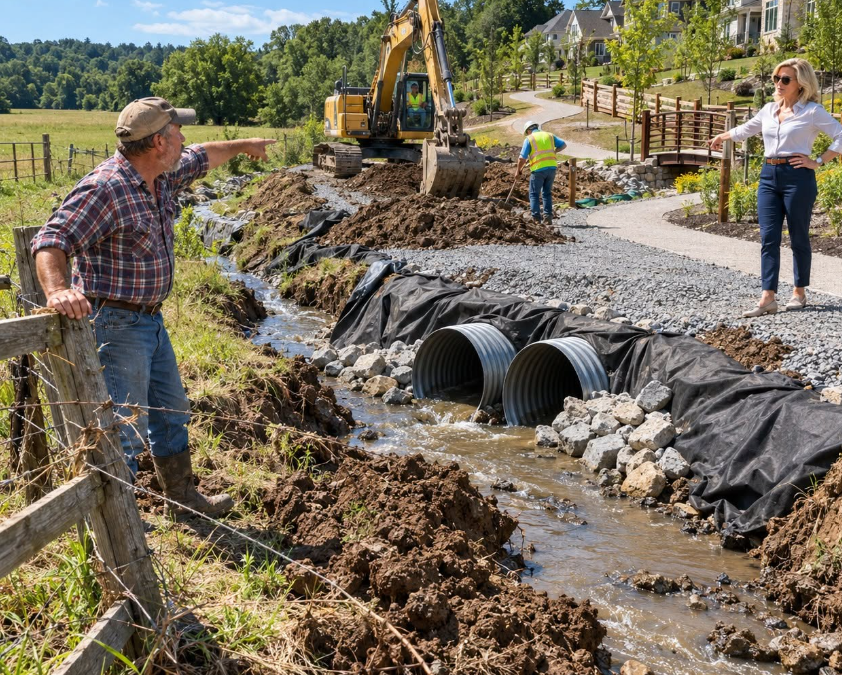
By noon, six hundred forty feet of running channel disappeared under roughly twenty-four hundred cubic yards of stone and fill.
Flat gray pad.
The creek had become a construction surface.
Karen walked it afterward.
Heel to toe.
Testing compaction like someone checking a new driveway.
I stood at my fence.
She looked pleased.
Uphill of her new pad sat one hundred ninety-six roofs.
A retention pond.
And every drop of rain those roofs would ever shed.
Water doesn’t care who has a clipboard.
That was the thing Karen never understood.
That evening, I went to the Stonebrier board meeting.
Manila folder.
No attorney.
My deed.
Instrument 1998-02214.
Parcel description.
Recorded Stonebrier plat.
I laid both in front of them.
“Your boundary ends here.”
I traced the line.
“My creek is one hundred thirty feet beyond it.”
Nobody answered.
A woman at the far end leaned forward.
Neville Ashcraft stared at his legal pad.
I said, “It’s not common area.”
Neville cleared his throat.
“This is a matter the board has already addressed.”
“When?”
“Prior to commencement.”
“How?”
He looked toward Karen.
Karen said, “Twenty years.”
“What?”
“For twenty years, that channel has carried Stonebrier drainage.”
“Yes.”
“That establishes prescriptive rights.”
I almost laughed.
“A right to discharge isn’t a right to fill.”
She said, “Look it up.”
Three board members nodded.
That was the first time I understood something dangerous.
Being legally right and being persuasive in a room are different things.
Karen had confidence.
She had titles.
She had a board.
I had documents.
And that night, documents lost.
So I hired a surveyor.
Ivor Blanchard.
April fifth, his crew restaked the entire boundary.
Pink ribbon every fifty feet.
Capped pins.
Six hundred forty feet.
Cost me $3,200.
Money I did not have sitting around.
By five that afternoon, every stake was gone.
Somebody had pulled them.
Stacked them neatly beside Bell Hollow Road.
Ribbon wound around the bundle.
That neatness made me angrier than if they’d thrown them into the creek.
I photographed everything.
Four angles.
Then I stood in the road with both hands on my head because I knew exactly what would happen if I walked uphill furious.
Next morning, a woman from Highfield Community Management came to my gate.
She wore a polo shirt.
Wouldn’t meet my eyes.
Envelope.
Notice of trespass.
According to the HOA, I was barred from entering the construction zone on Parcel 22-064 because of jobsite safety.
My parcel.
My creek.
My deed.
Their notice.
I asked, “Do you know what you’re handing me?”
“I just deliver them.”
She drove away.
Then came fines.
Five hundred dollars for interference with association personnel.
One hundred fifty dollars per day for continued obstruction beginning April second.
Whether I physically interfered or not.
Then a law firm letter.
If I continued publicly questioning the association’s rights in Drainage Ditch A, I could be liable for slander of title.
I called county code enforcement.
After two days, somebody listened.
I explained.
Private creek.
HOA fill.
State water right.
He typed.
Then:
“This appears to be a civil dispute.”
“There’s a water right.”
“Then contact the state.”
“They buried a channel.”
“Boundary questions are civil, sir.”
I sat in the county parking lot afterward.
My irrigation pump had been drawing storage water more heavily every day.
Forty thousand seedlings.
And government had just classified the destruction of my creek as neighbors disagreeing.
April seventh, an unknown number called.
“Mr. Chadwick?”
“Yes.”
“My name is Maud Kirkindall.”
Board member.
Older woman.
Careful voice.
“I want you to know not everyone is comfortable.”
“Comfortable with what?”
Pause.
“With what happened.”
I stood.
“Then say so publicly.”
“There were questions raised before.”
“What questions?”
Another pause.
“Somebody warned us about exactly this.”
My skin went cold.
“About flooding?”
“I’ve said too much.”
“Who warned you?”
“Please don’t call this number again.”
She hung up.
Somebody warned us.
Warnings get written.
Warnings get filed.
The question became:
Where?
April eighth, Ruddock’s crew returned.
Grader.
Vibratory roller.
The fill was compacted so hard my greenhouse glass buzzed a quarter mile away.
Orange-capped trail stakes went down the middle.
That evening Karen posted photos.
PHASE TWO UNDERWAY.
People liked it.
Asked about lighting.
Asked when pickleball courts would open.
That night I walked the low field with a flashlight.
The grass was soaked.
No rain for nine days.
I pressed my boot into the ground.
Water filled around it.
The spring at the top of the nursery had never stopped.
They hadn’t removed the source.
They had blocked the route.
Water was spreading underground through soil.
Searching.
My land was lower than Stonebrier at the creek.
But Stonebrier’s retention pond was now connected to a dead outfall.
I went home and pulled the recorded plat again.
There, in tiny print near the margin:
DRAINAGE AND OUTFALL SEE INSTRUMENT 2003-05412.
I had read past it twice.
April fourteenth, rain.
Not historic.
Not hurricane.
One point nine inches over five hours.
Regular spring rain.
Birdie Longacre lived low on Stonebrier Circle.
I had sold him three river birches years earlier.
He later told me he watched the retention pond fill like a bathtub.
Forty minutes.
Water rose to the outlet structure.
Then stopped draining.
Of course it did.
One pipe.
My creek.
Two thousand four hundred yards of rock.
By eleven, water crossed Bell Hollow Court.
Midnight, Stonebrier Circle became a shallow river.
Recycling bins floating.
Mulch.
Branches.
Twenty-two lots took water.
Nine basements flooded.
Cars sat with water over the hubs.
I stood at my north fence at two in the morning.
Rain jacket.
Flashlight.
I wasn’t happy.
That’s what people later assumed.
That I stood there enjoying revenge.
No.
I was terrified.
The fill was beginning to scour along its west edge.
Water had found a seam.
Stone made a slow grinding hiss.
If that pad failed suddenly, with the pond backed up behind it, the surge would come straight onto my property.
Greenhouses.
Equipment.
Buildings.
People.
I called 911.
“Obstructed drainage outfall. Retention pond above occupied homes. Fill is scouring.”
The dispatcher took it.
I called the county emergency line.
Same message.
Then I stood in the rain until four.
Watching a channel cut itself through rock I had been legally warned not to touch.
By eight the next morning, Birdie called.
“Palmer.”
“Yes.”
“She says you did it.”
I closed my eyes.
“Did what?”
“Blocked the drainage.”
Of course.
Karen stood at Stonebrier’s entrance telling flooded homeowners that the downstream landowner had dammed the creek in retaliation for the greenway.
Two men came to my driveway at 9:30.
One filming.
Angry.
His daughter’s basement was ruined.
He started accusing me.
I didn’t argue.
“Come with me.”
I walked them through wet grass to the fill.
Six hundred forty feet.
Gray stone.
Orange trail stakes.
One raw erosion cut.
The younger man lowered his phone.
“Where’s the creek?”
“Under that.”
Silence.
“Who did this?”
“Your association.”
Neither spoke.
Then:
“Nobody told us.”
They walked back much slower.
That afternoon I went to Cranmore Abstract and Title.
Asked Rosamund Teasdale for instrument 2003-05412.
Eleven pages.
Still warm when she handed them over.
I read standing at the counter.
Drainage and Outfall Maintenance Agreement.
Recorded November 2003.
Developer.
Stonebrier Landing Estates HOA.
My father.
Three provisions changed everything.
First:
Channel across Parcel 22-064 is privately owned land.
Association holds no possessory interest.
Only discharge rights.
Second:
That channel is the sole permitted outfall for Stonebrier’s stormwater system.
Sole.
Third:
The association assumes a perpetual, non-terminable obligation to keep the channel clear and unobstructed.
And if the association or its agents causes any obstruction, the association bears sole responsibility for resulting upstream and downstream damage.
I read that paragraph four times.
Karen hadn’t merely trespassed.
She had buried the only legal storm drain serving one hundred ninety-six houses in direct violation of an agreement her own HOA signed.
Rosamund asked, “You all right?”
“No.”
I looked at the page.
“It’s worse than I thought.”
I bought certified copies.
Delivered one to Highfield Community Management.
Mailed copies to every board member.
Delivered one to county offices.
Got stamped receipt.
That night Karen posted online.
The 2003 agreement is obsolete.
Secondary drainage exists through original agricultural tile.
Please do not engage with the downstream owner.
Secondary tile.
I knew those fields.
I’d never seen that tile move water.
Something was wrong.
Then the HOA produced an engineering report.
April twenty-fourth.
Thirty pages.
Professional cover.
Stamped.
I read page four at six in the morning.
Cause of flooding, according to their engineer:
Downstream hydraulic restrictions on receiving property.
Specifically:
Unpermitted stone weir.
Antique masonry ford.
My grandfather’s stones.
My father’s irrigation weir.
They moved the blockage downhill.
Karen didn’t deny water couldn’t escape.
She simply blamed structures that had existed safely for decades.
County code enforcement came April twenty-fifth.
Dexter Amber.
Polite.
He photographed the old ford.
Photographed my small irrigation weir.
Then issued me a ten-day removal notice.
“Those structures are part of the restriction.”
“The blockage is six hundred feet north.”
“Not according to the report.”
“That weir is on my water right.”
“Ten days, Mr. Chadwick.”
Two days later, the state suspended WR11-0842 during investigation.
Temporary.
Standard procedure.
Those words nearly destroyed my nursery.
I shut the intake off.
Forty thousand seedlings.
Storage tank bought four days.
Maybe.
I stopped irrigating sod.
Sacrificed fields first.
By day three, redbud leaves curled inward.
Plant stress.
You can bring them back from that.
Next stage?
No.
Then the HOA recorded a lien against Parcel 22-064.
$28,600.
Fines.
Daily penalties.
Engineering report costs.
They billed me for the report blaming me.
My bank saw the lien.
Equipment credit froze.
Two commercial sod contracts canceled.
Rumors had reached customers.
Code problems.
Water problems.
I sat with Averil Dowey and Rue Ellenwood.
Seasonal employees.
Six years with me.
“There isn’t enough work until I get this fixed.”
Rue cried.
Averil shook my hand.
“Call when you’re ready.”
That hurt worse.
May second, county building.
I finally got somebody to read the certified 2003 agreement.
He did.
All eleven pages.
Then slid it back.
“Private contract.”
“It governs drainage for 196 houses.”
“I don’t enforce contracts.”
He wasn’t corrupt.
Not lazy.
Wrong department.
That realization was brutal.
I had spent a month walking into offices asking the wrong people the wrong legal question.
That night Karen’s newsletter went out.
CAUSE IDENTIFIED.
APPROPRIATE AUTHORITIES ADDRESSING DOWNSTREAM RESTRICTIONS.
NOT RELATED TO PHASE TWO.
THANK YOU FOR TRUSTING YOUR BOARD.
I read it in a greenhouse with the irrigation pumps silent.
Forty thousand pots going quiet.
Then I looked at the routing stamp on my returned file.
A box had been checked and crossed out.
STORMWATER.
I stared at it.
Stonebrier operated under a municipal stormwater permit.
Of course.
A development that size had permitted outfalls.
Conditions.
Compliance reports.
Administrator.
And there was one thing a stormwater permit could not tolerate:
Destroying the named outfall.
I had been fighting about property.
The regulatory question was bigger.
Did Stonebrier still have a lawful discharge system?
Karen had answered that with nine trucks.
Before pursuing it, I removed Karen’s excuse.
May fourth, one in the morning.
Tripod.
Timestamped camera.
Pry bar.
Sledgehammer.
I took apart my father’s irrigation weir block by block.
My hand split open.
Blood on the handle.
I kept working.
By four, it was gone.
I photographed the clear channel downstream.
Wrote a compliance affidavit.
Delivered video and affidavit to Dexter Amber before ten.
Nine days into a ten-day deadline.
People later asked why I didn’t appeal.
Because I wanted their argument gone.
Now downstream of Karen’s fill there was nothing.
Nothing.
May sixth, I filed a formal complaint with the county stormwater administrator.
Winifred Stag.
Obstruction of permitted outfall.
False reporting.
Attached:
2003 agreement.
Photos.
Flood aerials.
Certified warning receipt.
State environmental referral for unpermitted alteration of natural watercourse.
For the first time since April second, I stopped seeing the pad as stolen property.
I saw it as failed stormwater infrastructure.
That changed everything.
Winifred called May eighth.
Direct voice.
“Mr. Chadwick.”
“Yes.”
“I’ve opened a file.”
I stood.
“I need a straight answer.”
“Yes.”
“Is there any structure on your property currently obstructing flow downstream from the association fill?”
“No.”
“My father’s weir was removed May fourth.”
“Documentation?”
“Code enforcement has video and affidavit.”
Pause.
“All right.”
Her tone changed.
“That’s helpful.”
“How long?”
“Depends what’s in the file.”
So I went hunting.
Public records request.
Complete Stonebrier stormwater compliance file.
All years.
All correspondence.
Nine days.
$110 in copy costs.
One banker’s box.
I searched.
First day.
Nothing.
Second day.
Two hundred pages down.
Ryder & Fitch Engineering.
September eleventh, 2019.
Addressed to Stonebrier Landing Estates board.
Drainage assessment commissioned by the HOA itself.
I read standing in my kitchen.
The channel on Parcel 22-064 is the sole permitted outfall.
The agricultural tile line Karen claimed was backup?
Collapsed and plugged during utility work in 2011.
Carrying no meaningful flow.
Then a sentence standing alone:
UNDER NO CIRCUMSTANCES SHOULD THE CHANNEL BE NARROWED, FILLED OR OBSTRUCTED, AS THE COMMUNITY HAS NO ALTERNATIVE DISCHARGE.
I sat down on the kitchen floor.
Four pages later:
Board minutes.
October ninth, 2019.
Item seven.
Ryder & Fitch assessment.
Possible easement negotiation with Chadwick property.
President Vossberg moves to table as premature.
Communication with adjoining owner deferred.
Vote:
Four to two.
Karen knew.
Four and a half years.
Engineer stamped warning.
She knew.
I called Maud Kirkindall.
She answered immediately.
“You found it.”
“October ninth.”
“Yes.”
“You were one of the two?”
“Yes.”
“Do you still have the report?”
“I kept my copy.”
“Why?”
“Karen collected the others after the meeting.”
My skin prickled.
“Will you say that to the county?”
“Yes.”
No hesitation.
There was more.
Annual stormwater certification.
Routine compliance form.
Signed by HOA president under penalty of perjury.
Certification:
All permitted outfalls clear, unobstructed, and functioning as designed.
Filed April twenty-second.
Twenty days after the fill.
Twenty days after Karen personally stood on my property while the creek disappeared.
After the first flood.
While residents were cleaning basements.
Signed:
Karen Vossberg.
I stared at the page.
She hadn’t only buried the outfall.
She certified it was clear.
County reached Garvin Ruddock.
No grading permit.
No watercourse alteration permit.
Contractor facing license trouble suddenly became cooperative.
His work order:
Stonebrier letterhead.
FILL AND GRADE CHANNEL STATION 0+00 TO 6+40.
PER K. VOSSBERG.
Handwritten below:
TAKE IT TO GRADE. DON’T CALL COUNTY.
Same slanted writing as my certified receipt.
For the first time, I thought the case might turn.
Karen responded by making the obstruction stronger.
May eighteenth.
Ruddock trucks returned.
I stood at my fence.
They raised the pad three more feet.
Armored the west face with riprap.
Huge angular stones.
The erosion channel from April disappeared beneath reinforcement.
Birdie stood beside me.
“They say it’s structural safety.”
I pointed uphill.
“Look at the pond.”
Karen was reinforcing the plug.
That same day, the HOA filed an emergency variance.
Argument:
The feature was an artificial farm ditch, excavated by the Chadwick family.
Not a natural watercourse.
Therefore no permit required.
If granted, the pad could become legal.
Then the board passed an emergency assessment.
$1,200 per household.
Legal defense.
That finally broke neighborhood loyalty.
One hundred ninety-six families.
Flooded once.
Blamed me.
Now billed $1,200 each to defend Karen’s project.
Birdie said the online argument hit hundreds of comments.
I prepared a rebuttal.
County aerial photo, 1962.
Dark winding channel.
Same.
Natural meander.
Spring flow report.
Water right WR11-0842.
The state does not issue creek water rights for a ditch somebody casually dug.
2003 agreement.
Stonebrier itself called it a channel and sole outfall.
Filed May twentieth.
Variance hearing May twenty-fourth.
Then forecasts changed.
Storm coming.
Four to six inches.
Expected night of May twenty-second.
I called county May twenty-first.
“The outfall is blocked.”
Assistant answered.
“They reinforced it.”
“Yes.”
“Forecast is four to six inches.”
“Yes.”
“Ms. Stag’s file is with hearing officer.”
“That’s two days after the storm.”
“It will be addressed at hearing.”
I hung up.
At sunset, I stood at the boundary.
The pad looked like a fort.
Three feet higher.
Riprap.
Behind it, Stonebrier porch lights came on one by one.
One hundred ninety-six houses.
People cooking dinner.
Kids.
Pets.
Cars.
Basements.
I knew what the retention pond would do.
Karen knew too.
She had my letter.
She had Ryder & Fitch.
The wind shifted.
Rain smell.
At 10:03 the next morning, it started.
I watched radar.
Red band.
By 4:20, four point six inches.
At 3:30, I called the emergency line again.
Same facts.
Obstructed permitted outfall.
No relief.
Occupied structures.
Then I called an eighty-one-year-old woman at 3:40.
Maud answered immediately.
“It’s coming.”
“I know.”
“Wake Stonebrier Circle.”
“What?”
“Tell them to move cars uphill. Get belongings out of basements.”
“Karen will say we’re panicking people.”
“She’ll say something either way.”
Maud did it.
The pond topped at 4:52.
I stood at the north fence.
Rain hard enough that my flashlight was useless.
I heard the water first.
Wide roar.
The pond overtopped.
But the pad held.
That was the nightmare.
If it had breached gradually, pressure might have escaped downstream.
Karen had armored it.
So water went backward.
The retention pond filled its inlet network.
Storm drains that were designed to carry street water downhill began carrying pond water uphill.
At 5:20, manhole covers started lifting.
Birdie later described one jumping from the road on a column of brown water.
Then Stonebrier’s streets became rivers.
Both subdivision entrances flooded.
County closed them at 5:40.
At 6:05,

