The HOA Had My Old Truck Towed as Junk—Then the Tow Driver Looked at Me and Said, “Boss, What Happened?”
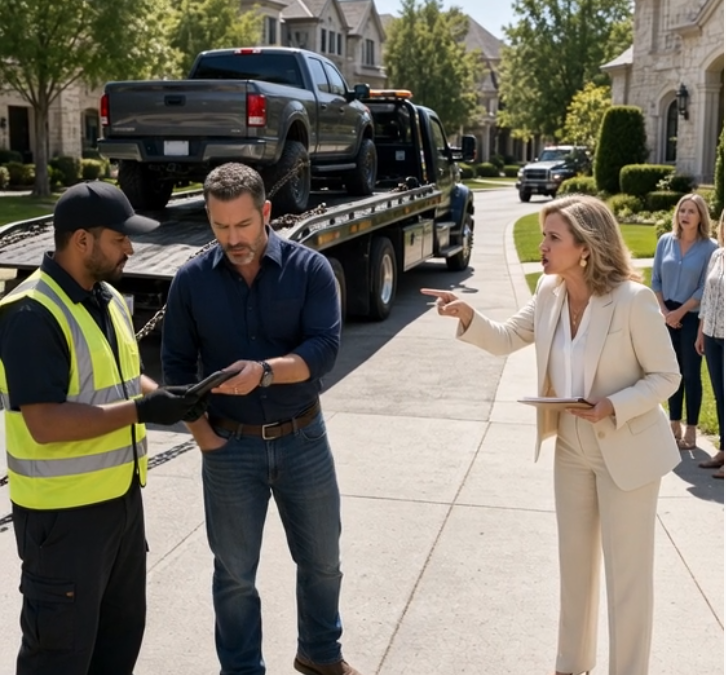
The HOA Had My Old Truck Towed as Junk—Then the Tow Driver Looked at Me and Said, “Boss, What Happened?”
The HOA president thought my faded blue Ford made the neighborhood look poor, so she had it dragged off my driveway before sunrise.
She expected me to pay towing fees, storage fees, and a fine for owning something she considered ugly.
What she did not know was that the tow truck bringing it back belonged to my company, and the driver knew exactly who I was.
The first thing I noticed was the oil stain that wasn’t there.
For three years, my old blue Ford had occupied the same corner of my driveway without leaking a drop, blocking a sidewalk, or giving anyone a real reason to complain.
That Tuesday morning, the concrete was empty.
The truck was gone.
A cream-colored envelope waited beneath the edge of my welcome mat.
I stood there in my work boots with a thermos of black coffee in one hand and the letter in the other, reading the first sentence twice before the meaning settled in.
The vehicle registered to your address has been identified as an abandoned, inoperable, or aesthetically hazardous conveyance and removed under Section 12, Paragraph 4 of the Cedar Ridge Community Association bylaws.
I lowered the paper and stared at the empty driveway.
Across the street, Victoria Grant stood at the edge of her lawn with a white coffee cup in her hand.
She wore a cream sweater, pressed black pants, and the satisfied expression of someone watching a plan reach its conclusion.
She did not wave.
She wanted me to know.
I folded the letter carefully and placed it inside my jacket pocket.
Then I looked at her.
She lifted her coffee slightly, not quite a toast, but close enough.
“Something missing?” she called.
My grip tightened around the thermos.
I thought about walking across the street.
I thought about asking how she had convinced anyone to remove a legally registered truck from private property.
I thought about the photograph tucked into the sun visor, the one showing my wife Claire, our daughter Lily, and me at a roadside stop in the Texas Hill Country six years earlier.
I thought about all the ordinary miles trapped inside that faded cab.
Then I did something Victoria clearly did not expect.
I took out my phone.
The number printed at the bottom of the notice belonged to Premium Roadside and Recovery.
I knew the number.
I had approved the new dispatch system that assigned it.
A young woman answered on the second ring.
“Premium Roadside and Recovery, this is Amanda speaking. How may I assist you?”
“My name is Ethan Walker.”
I watched Victoria across the street while I spoke.
PART2:
“A vehicle was removed from forty-four Birchwood Court this morning.”
“One moment, sir.”
Keys clicked in the background.
“Yes, I have that record. Two-thousand-four Ford F-150, blue, Texas plate ending in nine-three-six?”
“That’s correct.”
“The vehicle was removed under a Cedar Ridge Community Association authorization.”
“What reason was listed?”
“Inoperable or abandoned vehicle, visual nuisance, and possible safety concern.”
“Who signed the authorization?”
There was a pause.
“Victoria Grant, association president.”
“Was the removal verified by your compliance desk?”
Another pause followed, longer this time.
“The file shows an HOA standing contract and an officer certification.”
“Did anyone confirm that the truck was inoperable?”
“I’m not seeing a field verification.”
“Did anyone attempt to contact the registered owner?”
“No, sir.”
“Did the tow operator enter private property?”
PART3:
“The pickup notes indicate driveway access.”
I looked at the tire marks where a recovery vehicle had backed onto my property.
“Before we discuss fees, Amanda, I need you to open the registered-owner profile.”
“I already have your vehicle registration, sir.”
“Not the vehicle profile. The client authorization database.”
I heard more typing.
Then nothing.
“Amanda?”
“Yes, sir.”
“Do you see it?”
Her voice changed.
It became quieter and much more careful.
“Could you hold for one moment, Mr. Walker?”
“Of course.”
She put me on hold.
Across the street, Victoria watched with growing interest.
She believed I was negotiating with a towing dispatcher.
She probably expected me to learn that I owed hundreds of dollars in towing, processing, and storage fees.
She expected anger.
She expected humiliation.
She expected surrender.
Inside the Premium Roadside dispatch center, someone had just discovered that the truck they had removed belonged to the majority owner and chief executive officer of the company.
Four minutes later, the hold music stopped.
“Ethan?”
The voice belonged to Greg Wallace, my chief operating officer.
Greg had worked beside me for nine years. He was one of only a handful of people in the company who used my first name during business calls.
“Morning, Greg.”
“I’m looking at the file.”
“So am I, in a manner of speaking.”
“I don’t know how this passed authorization.”
“Neither do I.”
“The truck is at our North Austin secured lot.”
“Any damage?”
“I have a manager inspecting it now.”
“Who handled the tow?”
“Tyler Boone.”
I knew Tyler.
He had been with us for three years. Twenty-seven years old, careful, quiet, and one of the strongest operators we had.
“Did Tyler know whose truck it was?”
“No. Request came through the HOA portal. Victoria certified that the vehicle was abandoned and that the association had authority to remove it.”
“Was the truck on a public road?”
“No.”
“Was there a posted tow notice?”
“No.”
“Was there a compliance hold?”
“No.”
“Then why did dispatch release it?”
Greg exhaled.
“That is what I’m finding out.”
“Return it today.”
“Absolutely.”
“No charges.”
“Obviously.”
“Full inspection.”
“Yes.”
“Document condition before and after the tow.”
“Already happening.”
“And freeze all Cedar Ridge HOA authorizations until legal reviews the contract.”
There was a pause.
“Understood.”
“One more thing.”
“Yes?”
“I want the original authorization preserved exactly as submitted.”
Greg’s voice lowered.
“Ethan, do you think she falsified something?”
“I think someone decided authority was easier to claim than prove.”
“I’ll secure the record.”
“Thank you.”
I ended the call.
Victoria was still watching.
She smiled as though my silence confirmed defeat.
I walked back toward my house.
“Having trouble getting it back?” she asked.
I stopped near my porch.
“No.”
“Then I assume you understand why the association acted.”
“I understand exactly why you acted.”
Her smile thinned.
“The truck violated community standards.”
“Which standard?”
“You received multiple notices.”
“None identified a valid violation.”
“The board has discretion in matters affecting neighborhood appearance.”
“Not unlimited discretion.”
“We followed the bylaws.”
“No.”
I removed the letter from my pocket.
“You skipped two written notices, a thirty-day cure period, and a formal hearing.”
“You have received correspondence for more than a year.”
“Correspondence is not the same as a legally sufficient tow notice.”
“The vehicle was an obvious nuisance.”
“It was registered, insured, inspected, operational, and parked on my driveway.”
“Appearance matters.”
“So does ownership.”
Victoria folded her arms.
“You may disagree with the standards, but you agreed to follow them when you purchased here.”
“I agreed to the written covenants. I did not agree to rules you invent when someone refuses to obey you.”
Her eyes hardened.
“You should be careful about accusing an elected board officer of misconduct.”
“You should be careful about entering private property and removing a vehicle without permission.”
“The HOA authorized the removal.”
“The HOA does not own my driveway.”
“We have enforcement rights.”
“Then you can show me the section granting you the right to tow a functioning vehicle from private property without notice.”
“I do not conduct legal arguments in the street.”
“You started this one in my driveway.”
She glanced at my empty parking space.
“I hope this encourages you to make a better choice of vehicle.”
I looked at her for a long moment.
Then I said the sentence that ended the conversation.
“The company bringing it back belongs to me.”
Her expression did not change immediately.
The meaning reached her in stages.
First came confusion.
Then disbelief.
Then the quick mental search for an interpretation less embarrassing than the obvious one.
“What company?”
“Premium Roadside and Recovery.”
She let out a short laugh.
“You work for the tow company?”
“I own it.”
The coffee cup in her hand lowered by an inch.
“You own Premium Roadside?”
“Yes.”
“That’s impossible.”
“No.”
“They operate across the state.”
“Eleven metropolitan markets. Four hundred thirty-two active vehicles as of last Friday.”
Victoria stared at me.
I could almost see her reviewing every assumption she had made about my work boots, faded truck, plain house, and quiet habits.
A recovery vehicle turned onto Birchwood Court at the far end of the block.
Its amber lights flashed.
My blue Ford rode on the flatbed.
Tyler Boone drove slowly toward us.
He stopped in front of my house and lowered his window.
“Boss,” he called, looking from me to the empty driveway. “What happened?”
Victoria went completely still.
That was the moment she finally understood.
She had not merely hired a towing company to remove my truck.
She had hired my company.
She had signed my name into a system I owned.
She had instructed my employees to take my property from my driveway.
And she had done it under a contract I now intended to read line by line.
My daughter Lily was eight years old when we moved to Cedar Ridge.
Her mother had been gone for two years.
Claire died after a six-month fight with ovarian cancer that seemed, even while it was happening, too fast for our minds to accept.
One spring, she was teaching Lily to ride a bicycle.
By autumn, I was sitting beside her hospital bed pretending not to notice how much effort it took her to breathe.
Claire had a way of making ordinary things feel important.
A roadside taco eaten in a parked truck.
A rainstorm watched from the garage.
A grocery-store song sung badly on purpose.
She believed memories did not announce themselves when they were being made.
“You only recognize them later,” she once told me. “That’s why you should pay attention now.”
The Ford was one of those memories.
I bought it before our marriage, when I had almost no money and more confidence than experience. It was already used. The paint was bright blue then. The seats smelled like vinyl cleaner. The radio dial stuck between stations.
Claire came with me to the dealership.
We had six hundred twelve dollars in our checking account.
The truck cost forty-two hundred.
Buying it was irresponsible.
Claire insisted on the blue one.
“It looks like it has stories,” she said.
“It has a dent.”
“Exactly.”
“All trucks have dents.”
“That’s because trucks participate in life.”
I bought it.
We ate tacos in the cab that evening with the windows down.
Later, I used the truck to move us into our first apartment.
I drove Claire to the hospital when Lily was born.
I brought Lily home in a car seat strapped so tightly I checked it six times.
We took family trips in that truck.
We argued in it.
We apologized in it.
Claire spilled coffee across the center console and blamed the cup holder.
The dent in the rear bumper came from a crowded parking lot in Waco.
The cracked passenger mirror came from a fence post I refused to admit was closer than it looked.
The oxidized paint came from twenty years of Texas sun.
None of those things made the truck junk.
They made it ours.
After Claire died, the Ford became one of the few places where her absence and presence existed together.
Her hair tie remained around the turn-signal lever for almost a year.
A grocery list in her handwriting stayed inside the glove box until the paper faded.
The photograph on the sun visor became the thing Lily touched before long drives.
We did not discuss the ritual.
We did not need to.
Cedar Ridge attracted me because of the elementary school.
Lily had struggled with reading since first grade. Letters shifted. Words blurred. She worked twice as hard as her classmates and still came home believing she was stupid.
She was not.
The school three blocks from Cedar Ridge had a specialized literacy program with instructors trained in dyslexia support.
I bought the house after one tour.
The neighborhood was pleasant.
Brick homes.
Mature oak trees.
Sidewalks wide enough for bicycles.
A community pool.
An HOA that appeared ordinary in the disclosure documents.
I could have purchased something larger. Premium Roadside had grown beyond anything Claire and I imagined when I started with one used tow truck and a rented yard behind a tire shop. By the time Lily and I moved, the company operated hundreds of vehicles across Texas. We handled roadside recovery, accident response, municipal contracts, private-property towing, heavy-haul support, and disaster logistics.
My name appeared in business magazines occasionally.
I avoided interviews when possible.
I wore work boots because I spent time in yards and maintenance facilities.
I drove the Ford because I liked it.
I bought a modest house because it stood near the right school.
Victoria interpreted every choice as evidence that I did not belong.
She noticed the truck within days.
The first notice arrived eight months after our move. It politely suggested that the vehicle might not conform to community aesthetic expectations.
I checked the bylaws.
Vehicles parked in driveways had to be registered, insured, operational, and free of major visible damage.
The Ford met every requirement.
I sent a short response with copies of the registration and insurance.
Three months later, Victoria sent photographs.
She had circled the faded paint, cracked mirror, bumper dent, and rust spot in red ink.
The letter used the phrase property values four times.
I took the truck to a licensed mechanic. He inspected it and signed a statement confirming it was fully operational and safe.
I sent the statement by certified mail.
Victoria signed for it.
The next notice accused me of avoiding “the spirit of neighborhood standards.”
That phrase appeared nowhere in the covenants.
I replied that enforceable rules required written language.
She did not appreciate the distinction.
At the next quarterly meeting, she gave an eleven-minute presentation titled Neighborhood Aesthetic Concerns.
I did not attend.
I stayed home with Lily.
She was reading a story about a girl who built a raft to search for her missing brother. The word current confused her because it referred to both water movement and something happening now.
She became frustrated.
“I hate words that mean two things,” she said.
“Most important words mean more than one thing.”
“That’s terrible.”
“It can be.”
My phone buzzed.
Douglas Reed, a retired contractor from Birchwood Court, texted me.
Victoria is showing pictures of your truck.
Sandra Miles sent another message.
She is pushing for stricter enforcement.
A third neighbor wrote that Victoria had called for a vote supporting proactive aesthetic action.
I placed the phone face down.
Lily looked at me.
“Is something wrong?”
“No.”
“Your eyebrows changed.”
I smiled.
“My eyebrows are thinking.”
“Tell them to stop.”
She returned to the book.
I helped her understand current.
The meeting vote was eight to five in favor of stronger enforcement.
No bylaw amendment followed.
No specific rule changed.
Victoria treated the vague vote as a personal mandate.
She began driving past my house more often.
Sometimes she slowed down.
Sometimes she photographed the Ford.
Once, I saw her measure the distance between the front bumper and garage door.
“What are you doing?” I asked.
“Documenting.”
“Documenting what?”
“Potential access concerns.”
“I can walk around the truck.”
“That is subjective.”
“No.”
I stepped between the bumper and garage.
“That is physical space.”
She wrote something on her clipboard.
“You are consistently hostile during inspections.”
“You are consistently on my property without permission.”
“I’m standing on the sidewalk.”
“You measured from the sidewalk to my garage.”
“Visual inspection is permitted.”
“Then visually inspect your way back across the street.”
Victoria looked toward Lily, who was drawing with chalk near the porch.
“Children notice how adults respond to authority.”
I took one step closer.
“Do not bring my daughter into this.”
Victoria held my gaze.
“Then set an appropriate example.”
She left.
That sentence stayed with me.
She was not merely judging the truck.
She was judging us.
Victoria’s world was organized around visible signals.
A polished SUV meant success.
A fading Ford meant failure.
A tailored blazer meant authority.
Work boots meant labor.
A manicured lawn meant responsibility.
A child receiving reading support probably looked, to her, like another imperfection requiring explanation.
The towing happened two weeks after she lost a second board vote.
Douglas proposed a written clarification stating that legally operational vehicles could not be cited solely for age or cosmetic condition.
The motion received three votes.
Victoria opposed it.
She argued the existing bylaws already gave the president sufficient discretion.
That Friday, she submitted a tow request through Premium Roadside’s HOA portal.
She certified that the Ford was abandoned, inoperable, and located on association-controlled property.
All three statements were false.
She uploaded photographs showing faded paint.
She did not upload the registration, insurance, mechanic’s report, or my certified responses.
The request should have been rejected.
Our dispatcher processed it under Cedar Ridge’s standing contract.
That was a failure inside my own company.
I intended to address it.
But the legal responsibility for the false certification belonged to Victoria.
Tyler lowered the flatbed in front of my house.
He climbed out and approached me with the keys.
His face showed embarrassment.
“Mr. Walker, I’m sorry.”
“You followed the dispatch authorization.”
“I entered your driveway.”
“The file said HOA-controlled removal.”
“You should have received a private-property verification.”
“I didn’t.”
“That is a process failure.”
“Yes, sir.”
“Did the truck sustain damage?”
“No.”
“North Austin inspected it. We took photographs. I checked the cab before loading and again before leaving the lot.”
“Thank you.”
Tyler looked toward Victoria.
She remained across the street.
“Is that the person who called it in?”
“Yes.”
He lowered his voice.
“She told me the owner had abandoned it.”
“I was inside the house.”
“I know that now.”
I shook his hand.
“You’re not in trouble for relying on an authorization our system approved. But we are changing the system.”
“Yes, sir.”
He repositioned the flatbed.
The Ford rolled slowly down the ramp.
Its tires touched my driveway.
Lily had already left for school, so she did not see the return.
I watched every inch.
The truck looked the same.
Faded blue paint.
Dent in the bumper.
Cracked mirror.
Small rust mark.
Tyler parked it exactly where it had been.
Then he stepped out and handed me the keys.
“She’s back, boss.”
Victoria finally crossed the street.
Her face had recovered some of its composure.
“Mr. Walker, ownership of the towing company does not invalidate the HOA’s decision.”
“No.”
“The bylaws invalidate it.”
“Our attorney disagrees.”
“Has your attorney seen the authorization you signed?”
“I acted within my duties.”
“You certified the truck was abandoned.”
“It met the association’s practical definition.”
“What definition?”
“A vehicle displaying visible neglect.”
“That is not abandonment.”
“The distinction is technical.”
“The distinction is legal.”
She glanced toward Tyler.
“I assume your employee will remove the vehicle again when the association issues a revised authorization.”
Tyler looked at me.
I answered.
“Premium Roadside has suspended Cedar Ridge’s contract pending review.”
“You cannot retaliate against an association because of a personal dispute.”
“I can suspend a client who submits false towing certifications.”
“We submitted in good faith.”
“You claimed my private driveway was association-controlled property.”
“The HOA maintains enforcement rights throughout Cedar Ridge.”
“Enforcement rights are not ownership.”
“You are exploiting your corporate position.”
“No. I am preventing my company from participating in another unlawful tow.”
Victoria’s face reddened.
“You think owning a large business makes you exempt from the rules?”
“I think reading the rules makes me aware of what they say.”
“Your arrogance is remarkable.”
“So is yours.”
She turned toward Tyler.
“Return to your vehicle.”
Tyler did not move.
Victoria’s voice sharpened.
“I am the president of this association.”
Tyler looked at me.
“Boss?”
“You’re free to go.”
“Yes, sir.”
He returned to the flatbed.
The recovery truck pulled away.
Victoria watched it leave.
Then she faced me again.
“This is not over.”
“I know.”
For the first time, I meant it more than she did.
I took the Ford to our operations facility that afternoon.
Greg met me inside the inspection bay. The truck sat beneath bright white lights while a technician documented every panel.
“No tow damage,” Greg said.
“Good.”
“The authorization was processed under the automatic HOA priority system.”
“Why did we create that?”
“Municipal partners and large communities complained that verification caused delays.”
“So we allowed association officers to self-certify.”
“Yes.”
“That was a mistake.”
“It was.”
“How many private-property tows have gone through that process?”
“Over the last eighteen months?”
“Yes.”
“Four thousand three hundred twelve.”
“How many had owner contact before removal?”
“I don’t know yet.”
“Find out.”
Greg looked at the truck.
“You think this is bigger than Cedar Ridge.”
“I think any system that removed my vehicle from my driveway without checking could have done the same thing to someone without the resources to fight.”
“We’ll audit all HOA accounts.”
“Freeze questionable clients. Create manual verification for owner-occupied properties. Require photographic signage, documented notice, and title review where jurisdiction is disputed.”
“That will slow dispatch.”
“Then dispatch should slow.”
Greg nodded.
“You built this company to move fast.”
“I built it to move correctly.”
The distinction mattered.
Premium Roadside existed because I once watched my mother wait four hours beside a highway after her car broke down.
I was nineteen. The company she called kept losing the location. When a driver finally arrived, he treated her like an inconvenience.
Years later, after working dispatch and recovery jobs, I bought my first tow truck. I promised Claire I would build a company where stranded people were never made to feel powerless.
Growth complicated that promise.
Contracts became automated.
Systems replaced judgment.
Efficiency became a goal measured in minutes.
Victoria exploited exactly that weakness.
The irony was not lost on me.
She used rules without humanity.
My company used procedures without verification.
Both produced the same result.
Someone’s property disappeared because an official-looking request moved faster than the truth.
I ordered a full audit.
That evening, Lily came home and ran to the driveway.
She dropped her backpack beside the porch.
“The truck is back.”
“It is.”
She opened the passenger door.
She climbed onto the running board and reached for the sun visor.
The photograph remained inside its plastic sleeve.
Her finger touched Claire’s face.
“I thought they might throw this away.”
“So did I.”
“Why did they take it?”
“Someone said the truck was junk.”
Lily looked offended.
“It isn’t.”
“I know.”
“Mom picked it.”
“I know.”
“Did the person know that?”
“No.”
“Would it matter?”
“It should.”
She climbed into the cab.
The faint smell of old fabric, dust, and coffee remained.
Lily once described it as smelling like long drives.
She sat quietly.
“Are you going to sell it now?”
“No.”
“Promise?”
“Yes.”
She looked through the windshield toward Victoria’s house.
“Was it her?”
“Yes.”
“Why doesn’t she like us?”
The question landed harder than the tow.
“She does not know us.”
“That isn’t what I asked.”
I sat in the driver’s seat.
Lily waited.
“She decided what kind of people we were before she learned anything about us.”
“Because of the truck?”
“Partly.”
“Because I need reading help?”
My chest tightened.
“Who told you that?”
“No one. She looks at me strangely when the school bus drops me off early for tutoring.”
I turned toward her.
“Your reading has nothing to do with your intelligence.”
“I know.”
“Do you?”
“Most days.”
I put one hand over hers.
“You belong here.”
“So do you.”
“The truck belongs here too.”
She nodded.
“Then why can she take it?”
“Because people sometimes misuse authority.”
“What happens to them?”
“That depends on whether everyone else stays quiet.”
The emergency HOA meeting occurred the following Thursday.
Sixteen residents attended, nearly twice the usual number.
Victoria sat at the front beneath the Cedar Ridge logo. The board members occupied a long folding table. Douglas sat in the back with his arms crossed. Sandra carried a notebook. Several residents who supported Victoria’s earlier enforcement vote avoided looking at me.
I entered five minutes late and sat near the side wall.
Victoria was already speaking.
“The association acted under a reasonable interpretation of its authority. The vehicle displayed multiple characteristics associated with abandonment. The removal protected neighborhood appearance and preserved property values. Any procedural deficiency was technical and did not alter the underlying violation.”
I listened.
Victoria continued for several minutes.
She did not apologize.
She described the tow as a misunderstanding created by unusual ownership circumstances.
By that, she meant she would not have done it had she known I owned the company.
The admission was hidden inside careful language.
Douglas raised his hand.
“Ethan should speak.”
“This is an open meeting,” Victoria replied. “He may speak during resident comment.”
“You have spent twelve minutes talking about his truck. Then he should get twelve minutes.”
Victoria looked at the clock.
“Resident comments are limited to three.”
Sandra spoke.
“Give him the time.”
A board member named Brian shifted in his chair.
“I agree.”
Victoria’s expression hardened.
“Five minutes.”
I stood.
I carried a thin folder.
I placed copies of the truck registration, insurance, inspection, mechanic’s certification, correspondence history, and tow authorization on the front table.
“The truck was legal.”
“No one disputes that it was registered,” Victoria said too quickly.
I looked at her.
“Please let me finish.”
She pressed her lips together.
“The bylaws require two written violation notices identifying the specific breached provision. They require a thirty-day cure period. They require a hearing before a vehicle can be removed from private property. None of those steps occurred.”
Victoria opened her copy of the bylaws.
“You received letters.”
“I received aesthetic complaints. None identified a valid section authorizing removal.”
I lifted the authorization.
“The tow request certified that the truck was abandoned, inoperable, and located on association-controlled property. All three statements were false.”
The room became quiet.
“This document includes my name and address. It was submitted without my consent. It instructed a third party to enter my driveway and seize my vehicle. That is more serious than a disagreement over paint.”
Victoria leaned toward her microphone.
“The association relied on delegated enforcement discretion.”
“No delegation allows false certification.”
“Our counsel will determine that.”
“My company’s counsel is already reviewing it.”
A man near the center raised his hand.
“Did the HOA know Ethan owned the towing company?”
Victoria’s face tightened.
“That is irrelevant.”
“It seems pretty relevant,” Douglas said.
“No.”
I looked around the room.
“It is not relevant to whether the tow was wrong. If I were a warehouse worker, a teacher, a retired mechanic, or unemployed, the truck would still have been taken illegally. The fact that I own the towing company made the mistake visible quickly. It did not create the mistake.”
Sandra nodded.
“That is exactly the point.”
I continued.
“I have one question. Are the rules here designed to protect the people who live in Cedar Ridge? Or are they designed to give a small group of people a mechanism to punish anyone they decide does not belong?”
No one moved.
Victoria looked at the table.
Brian cleared his throat.
“I think we need an independent review.”
Victoria turned toward him.
“The board has internal procedures.”
“The president authorized the tow. That means the president cannot supervise the review.”
Another board member nodded.
Brian continued.
“I move that an independent committee review enforcement actions from the last three years.”
Victoria stared at him.
“We are not voting on unlisted agenda items.”
Douglas opened a binder.
“The bylaws allow emergency motions involving potential liability.”
Victoria’s face changed.
She had not expected anyone else to know the bylaws.
Sandra seconded the motion from the audience.
Victoria objected that Sandra was not a board member.
Another board member seconded it.
The vote passed four to three.
For the first time in four years, Victoria lost control of a meeting.
The review committee consisted of Douglas, Sandra, and a retired school principal named Margaret Lewis.
They received access to enforcement records.
Victoria resisted.
She delayed document production.
She claimed privacy restrictions.
The board’s attorney eventually instructed her to cooperate.
What the committee found was not dramatic in isolation.
Together, it was damning.
Seventeen citations had no clear basis in the written bylaws.
Four vehicles had been towed without required notices.
Three residents were fined for decorations not specifically prohibited.
A disabled veteran received penalties for a ramp that had already been approved by the city.
A widowed woman was threatened with a lien over a garden bench Victoria considered “visually deteriorated.”
Two families received different penalties for identical violations.
People who supported Victoria paid less.
People who challenged her paid more.
The HOA’s authority had become personal.
My company’s audit revealed another problem.
Cedar Ridge was not the only association misusing the automated portal.
Twelve HOAs had submitted removals without sufficient owner contact.
Thirty-nine vehicles required further review.
Seven had been removed from private residential property under questionable authority.
I ordered immediate refunds.
We paid for independent legal assistance where owners disputed the tows.
We terminated four contracts.
We rewrote the authorization system.
Every residential removal now required verified signage, photographic notice, confirmation of jurisdiction, and a second-level review.
HOA officers could no longer self-certify contested facts.
Greg worried about losing business.
“We will,” I told him.
“Some clients want speed.”
“They can find another company.”
“Our competitors will take them.”
“Then our competitors can carry the risk.”
“The changes will cost millions.”
“So would becoming the kind of company I started this business to oppose.”
Greg nodded.
He understood.
I did not tell Cedar Ridge about the company-wide audit.
The issue was not useful as a weapon against Victoria.
It was my responsibility.
When a system fails under your authority, blaming the person who exploited it does not erase your duty to fix it.
The HOA committee issued its report on a gray Friday morning.
It recommended refunding all unsupported fines with interest.
It recommended rewriting the enforcement policy.
It recommended requiring two-person review before towing or liens.
It recommended removing Victoria as president pending a full membership vote.
The report used careful language.
Its conclusion was simple.
The president had applied vague standards selectively, bypassed procedures, and used association power to target residents based on personal judgments.
The removal vote occurred the next Wednesday.
Forty-one residents participated.
It was the highest turnout in Cedar Ridge history.
Victoria addressed the room first.
She defended her record. She listed road repairs, pool maintenance, landscaping improvements, and reserve-fund growth. She said strong leadership often appeared harsh to people who resisted responsibility.
Then she made her worst mistake.
She looked toward me.
“Cedar Ridge must not become a place where wealth allows certain residents to place themselves above standards.”
The room reacted immediately.
Douglas stood.
“You thought he was poor when you towed him.”
“That is not true.”
“You called his truck junk for two years.”
“I evaluated the vehicle.”
“You evaluated the man.”
Sandra spoke next.
“The issue is not Ethan’s wealth. The issue is whether you would have taken the truck if you knew he could fight back.”
Victoria gripped the table.
“I would enforce the rules against anyone.”
“No,” I said.
Everyone looked toward me.
I had not planned to speak.
“You enforce your preferences against people you believe cannot stop you. You mistook silence for weakness. You mistook work clothes for lack of standing. You mistook an old truck for a worthless life. And when the truth embarrassed you, you called my resources unfair.”
Victoria faced me.
“You enjoyed humiliating me.”
“No. I would have preferred you never touched the truck.”
“You froze the HOA’s tow account.”
“My company suspended a client that submitted false information.”
“You used your position.”
“To prevent another unlawful removal.”
“You could have handled this privately.”
“You made it public when you turned my truck into a neighborhood presentation.”
She looked away.
The ballots were counted.
Thirty-three supported removal.
Eight opposed.
Victoria Grant was no longer president.
She gathered her papers slowly.
For years, she had entered meetings with a leather portfolio, a gavel, and the certainty that the room belonged to her.
That evening, she left carrying only a handbag and a stack of notes no one wanted.
She did not move away.
For several weeks, her silver SUV remained inside the garage.
Her Saturday car-washing routine stopped.
She avoided the mailbox when neighbors were outside.
I saw her occasionally through the kitchen window.
She looked smaller without the machinery of authority surrounding her.
I did not feel triumph.
Removal was necessary.
Humiliation was not the goal.
The truck returned.
The rules changed.
The targeting stopped.
That was enough.
Sandra asked why I did not sue.
“You have a clear case,” she said. “False certification, trespass, conversion, emotional damage.”
“I know.”
“Then why not file?”
“Because I want the behavior to stop.”
“It has.”
“Then a lawsuit would mostly be about punishment.”
“Would that be wrong?”
“No. But it is not what I need.”
“She should face consequences.”
“She lost the presidency. She will repay the towing cost and legal expenses. The association is refunding fines. People saw what happened.”
Sandra studied me.
“You really don’t want to win?”
“I want to know the same thing will not happen to someone who cannot make one phone call and reach the chief operating officer. That matters more.”
It did.
Victoria knocked on my door in late November.
The oak trees had released most of their leaves.
I was working in the garage when Lily called for me.
“Dad, Miss Victoria is here.”
I wiped my hands on a shop rag.
Victoria stood on the porch wearing jeans and a dark coat.
I had never seen her in jeans.
She held no papers.
“Can we talk?” she asked.
I opened the screen door.
“Come inside.”
She shook her head.
“Not yet.”
The answer surprised me.
“I came to apologize.”
I waited.
“I was wrong about the truck.”
“You were.”
“I was wrong about the bylaws.”
“Yes.”
“I was wrong about you.”
I said nothing.
She looked toward the driveway.
“I decided what kind of man you were before I knew anything about you. I decided that because you drove an old truck and wore work clothes, you did not care about the neighborhood. I used the rules to punish you for not matching what I thought Cedar Ridge should look like.”
Her voice began to shake.
“I told myself it was about property values. It wasn’t. It was about control.”
Lily stood quietly inside the hallway.
Victoria noticed her.
“I’m sorry,” she said to Lily. “For taking the truck.”
Lily looked at me before answering.
“That was my mom’s truck too.”
Victoria’s face tightened with pain.
“I didn’t know.”
“You didn’t ask,” Lily said.
The words were not cruel.
They were factual.
Victoria looked down.
“No. I didn’t.”
Lily returned to the living room.
Victoria faced me again.
“The worst part was not the tow,” I said.
She waited.
“The truck came back. The worst part was that you watched us for two years and decided we were less deserving of respect. You looked at my daughter and made her feel like she did not belong. That does not disappear because you learned my company is successful.”
Victoria nodded.
“I understand.”
“Do you?”
“I’m trying to.”
“That is not the same thing.”
“No.”
She looked toward her house.
“I considered moving.”
“Why didn’t you?”
“Because leaving would let me pretend the problem was Cedar Ridge. The problem was me.”
That was the first thing she said that sounded fully honest.
“I am sorry,” she continued. “For the truck. For the meetings. For using the rules against you. For making your daughter feel watched. I cannot undo it.”
“No.”
“I know.”
We stood in silence.
I did not forgive her that afternoon.
Forgiveness given to end discomfort is not always forgiveness.
Sometimes it is simply another form of avoidance.
But I believed her apology was real.
That mattered.
“Keep showing up differently,” I said.
“For how long?”
“As long as you live here.”
She nodded.
“That seems fair.”
She walked back across the street.
The truck returned again on Monday, officially, after our full inspection was complete.
Tyler had already brought it home once, but I sent it to the shop for a detailed mechanical review and documentation. He was assigned to return it again.
This time, Lily was home.
The flatbed stopped at the curb.
Tyler lowered the Ford carefully.
He had washed the exterior.
The faded paint still looked faded.
The bumper dent remained.
He treated the rust spot with a temporary inhibitor.
The cab had been cleaned.
He handed me the keys.
“She’s all set, Mr. Walker.”
“Thank you, Tyler.”
“I checked the visor.”
I looked at him.
“The photo is still there.”
He understood.
I shook his hand.
Lily ran from the house.
She climbed onto the running board and opened the driver’s door.
I sat behind the wheel.
She reached for the visor.
The photograph remained inside the clear sleeve.
Claire stood between us at a roadside stop.
Lily was three.
Her arms were raised for reasons neither of us remembered.
All three of us squinted into the sun.
Lily touched the plastic.
“It’s okay,” she said.
“What is?”
“The truck.”
“Yes.”
“No.” She looked at me. “I mean it remembers us.”
My throat tightened.
“Machines don’t remember.”
“This one does.”
I did not argue.
Over the next month, Lily and I worked on the Ford together.
We did not restore it completely.
That would have erased too much.
We sanded the worst oxidation.
We treated the rust.
We replaced the cracked mirror with an original part Lily found online.
She was intensely proud of the discovery.
“It fits better,” she said after I installed it.
“It should.”
“The cheap one looked wrong.”
“It worked.”
“That isn’t the same as fitting.”
She was right.
We touched up the paint.
The new blue did not match perfectly because twenty years of sun had changed the original color. One section near the rear door caught the light differently.
Lily wanted to redo it.
I told her perfection was not the point.
“What is?”
“Care.”
She looked at the truck.
“So something can still look old and be cared for?”
“Yes.”
“Like people?”
“Exactly.”
We left the bumper dent.
Claire believed dents were evidence of participation.
I kept the old aftermarket mirror.
Lily placed it on her desk like a trophy.
On the final Saturday, I removed the photograph from the visor.
I added a second picture.
It showed Lily and me beside a lake the previous summer.
We were both squinting.
Her arms were raised again.
I placed the new photo behind the old one.
Two versions of our family shared the same sleeve.
One included Claire.
The other showed that life had continued without replacing her.
Cedar Ridge changed gradually.
Margaret Lewis became the new HOA president.
She described her governing philosophy as “boring, documented, and kind.”
Residents approved it overwhelmingly.
The revised enforcement policy required clear written standards. No vehicle could be towed from private property without two notices, photographic proof, confirmation of jurisdiction, and review by two board members. No catch-all aesthetic provision could support a fine. Appeals went to an independent panel. Financial records were posted online. Improper fines were refunded with interest.
The HOA reimbursed the towing costs, though my company had charged none.
At my request, the amount was donated to the school literacy program.
Douglas organized a neighborhood yard sale.
Sandra planted vegetables along her side fence and left tomatoes on porches.
Children played basketball in driveways without anyone measuring the hoops.
The neighborhood did not collapse.
Property values did not fall.
Cedar Ridge simply became more honest.
Victoria attended meetings occasionally.
She sat near the back.
She did not interrupt.
When residents criticized her old policies, she listened.
Some neighbors never forgave her.
She accepted that.
Others slowly began speaking to her again.
She volunteered for the community food drive but refused a leadership role.
The first time I saw her carrying boxes beside Douglas, he looked at me and raised his eyebrows.
I smiled.
People are more complicated than the worst thing they have done.
That does not remove accountability.
It simply leaves room for change.
I attended one HOA meeting each year.
The budget meeting.
Showing up mattered.
Institutions rarely become abusive overnight.
They drift when reasonable people decide participation is inconvenient.
Victoria filled the empty space.
The lesson was not only about her.
It was also about everyone who stopped reading the minutes, stopped asking questions, and allowed one person’s certainty to become policy.
Premium Roadside changed too.
The new verification system reduced questionable tows.
It also cost us several contracts.
Three large HOAs left.
One manager told Greg that our process had become “unnecessarily owner-friendly.”
Greg forwarded me the email.
I printed it and framed it in the dispatch center.
Beneath it, I added one line.
THAT IS THE POINT.
We created a property-owner appeal line.
We retrained dispatchers.
We required operators to document private-property access.
Drivers could refuse a tow without penalty if authorization looked suspicious.
Tyler helped design the field checklist.
Amanda, the dispatcher who first answered my call, became part of the compliance team.
She apologized to me during a company meeting.
“You followed the system,” I said. “The system failed.”
“But I didn’t question it.”
“Now you will.”
“Yes, sir.”
“That is how systems improve.”
The audit led us to return dozens of vehicles without fees.
In two cases, we compensated owners for wrongful removals.
It was expensive.
It was necessary.
A company does not become ethical because its owner considers himself a good man.
It becomes ethical when its processes make doing the right thing easier than doing the wrong thing.
That lesson cost me one tow.
Other people had paid more.
One Sunday evening in early spring, Lily and I took the Ford for a drive.
The light stretched golden across the road.
She rolled down the window and moved one hand through the air.
The radio found a country station.
She made a face.
“Mom liked this song,” I said.
“No, she didn’t.”
“She tolerated it.”
“That’s different.”
“She sang it.”
“She sang everything badly.”
“That was her gift.”
Lily smiled.
We drove without a destination.
The truck’s engine held a steady rhythm.
After several miles, Lily pulled her hand inside.
“Dad?”
“Yes?”
“Do you hate Miss Victoria?”
I considered the question.
“No.”
“She took the truck.”
“She did.”
“She lied.”
“Yes.”
“She made us feel bad.”
“Yes.”
“Then why don’t you hate her?”
The road curved west.
Sunlight filled the windshield.
“Because anger is useful for telling you something is wrong. It is not always useful for deciding what to do next.”
“Were you angry?”
“Very.”
“You didn’t look angry.”
“I was trying not to let her choose my behavior.”
“What does that mean?”
“She expected me to shout. She expected me to threaten her. She expected me to look like the kind of person she had already decided I was. If I gave her that, she would have used it to justify herself.”
“So you stayed calm to win?”
“No. I stayed calm so I could remain myself.”
Lily thought about it.
“What if she never changed?”
“Then I would still have done the right thing.”
“For her?”
“For us.”
She nodded slowly.
Then she placed her feet on the dashboard.
“Feet down.”
“Why?”
“Airbags.”
“You always ruin the moment.”
“That is also my gift.”
She lowered her feet.
We continued west.
Years passed.
Lily’s reading improved.
She never became the fastest reader in her class.
She became one of the most careful.
She loved stories because she had fought so hard to reach them.
In middle school, she wrote an essay about the Ford.
Her teacher called me.
“Did an HOA really tow your truck?”
“Yes.”
“And you owned the towing company?”
“Yes.”
“That sounds made up.”
“It often does.”
The essay was titled The Things People Call Junk.
Lily wrote about the difference between condition and value. She wrote that faded paint did not mean neglect. She wrote that old objects could hold love invisible to strangers. She wrote that people made the same mistake with one another.
I kept a copy inside the glove box.
Victoria read it years later.
Cedar Ridge held a community writing night at the school. Lily was invited to read the essay.
Victoria sat in the back row.
Afterward, she approached us.
“You wrote beautifully,” she told Lily.
“Thank you.”
“I’m sorry I gave you the story.”
Lily was fourteen by then.
She understood more than she had at eight.
“You gave me the beginning,” she said. “We wrote the rest.”
Victoria nodded.
“That sounds fair.”
The Ford aged.
At twenty-four years old, it required a transmission rebuild.
Greg suggested replacing it.
“You can buy any truck you want.”
“I know.”
“This one costs more every year.”
“I know.”
“You are sentimental.”
“Deeply.”
“It’s bad business.”
“It isn’t a business asset.”
The rebuilt transmission lasted.
The rust returned near the wheel well.
We repaired it properly.
The paint never matched.
The seat fabric tore.
Lily stitched it with blue thread.
The repair looked obvious.
I liked it.
Claire would have liked it too.
One afternoon, a new family moved into Cedar Ridge.
The father parked an old work van in the driveway. Its paint was white and gray. The back doors carried marks from years of tools.
A week later, he received a polite notice.
The letter did not accuse him of violating aesthetics.
It asked only that he confirm registration and operation under the written vehicle rule.
He did.
The issue ended.
Margaret showed me the file.
“Boring enough?” she asked.
“Perfectly.”
The neighborhood learned.
Not perfectly.
No community does.
But enough.
People began asking a better question.
Not whether something looked unusual.
Whether it caused actual harm.
That distinction protected more than old trucks.
It protected gardens.
Accessibility ramps.
Children’s toys.
Working families.
Grieving widowers.
People whose homes looked lived in because they were.
When Lily turned sixteen, I taught her to drive in the Ford.
She sat rigid behind the wheel.
“You’re holding it too tight,” I said.
“I’m driving a historical artifact.”
“You’re driving a truck.”
“It remembers us.”
“You said machines don’t remember.”
“I was wrong.”
She looked at me.
“You admit that?”
“Rarely.”
“Should I record it?”
“Focus on the road.”
She drove through the Cedar Ridge entrance.
Victoria was outside collecting mail.
She saw Lily behind the wheel and smiled.
Lily waved.
Victoria waved back.
The gesture was small.
It did not erase anything.
It showed distance traveled.
By then, Victoria had spent years living without authority.
She joined no boards.
She gave no speeches.
She worked quietly with a local housing nonprofit that repaired homes for elderly residents.
Douglas told me she was good at the paperwork.
“She still loves forms,” he said.
“Forms are not evil.”
“The wrong people behind them are.”
“Sometimes the same people can learn.”
Douglas looked skeptical.
“You really believe that?”
“I believe people can change behavior. That is enough.”
When Victoria’s mother became ill, she asked whether Premium Roadside could help transport a modified van to another city.
She called the public number.
She did not call me.
Amanda handled the request.
The company charged the standard fee.
The van arrived safely.
A week later, Victoria mailed a thank-you note to the driver.
No special treatment.
No punishment.
Just service.
That was the kind of normality accountability should eventually allow.
The story of the tow became neighborhood folklore.
New residents heard exaggerated versions.
Some claimed I fired the entire dispatch office.
I did not.
Some said Victoria fainted when Tyler called me boss.
She did not.
Some said the Ford was worth a hundred thousand dollars.
It was not.
Some said I purchased the HOA and dissolved it.
I had no desire to own another organization.
The truth was better.
A woman used community authority to take something she considered worthless.
The tow company called the owner.
The owner turned out to be its boss.
That irony exposed the problem.
But the story mattered because I would have deserved the truck back even if I owned nothing.
Power did not make me right.
The documents did.
The truck was mine.
The driveway was mine.
The rules were clear.
The tow was false.
My money shortened the fight.
It did not create my rights.
That was the lesson I repeated whenever someone told the story.
Do not respect people only after learning they are powerful.
Respect them before you know what power they have.
Years later, on another Sunday evening, Lily and I drove the same western road.
She was preparing for college.
The acceptance letter sat inside her backpack.
She planned to study literature and education.
“I want to work with kids who think they are bad readers,” she said.
“You’ll be good at that.”
“How do you know?”
“Because you remember what it felt like.”
She looked toward the visor.
Two photographs remained inside the clear sleeve.
Claire, Lily, and me.
Then Lily and me.
“We need another one,” she said.
“For what?”
“Graduation.”
“Your arms will be up again?”
“Obviously.”
“Why do you do that?”
“I don’t know.”
“Your mother started it.”
“That sounds like something you blame on her because she can’t argue.”
“She would respect the strategy.”
At graduation, we took the photo beside the Ford.
Lily wore her gown.
Her arms were raised.
I squinted into the sun.
We added the picture to the visor.
Three moments.
One family.
Different shapes.
Same story.
The Ford still sits at the end of my driveway.
Its paint is faded.
The repaired mirror fits correctly.
The bumper dent remains.
The rust is under control.
People passing Cedar Ridge see an old pickup.
That is exactly what it is.
They do not see Claire eating tacos in the cab.
They do not see Lily in a car seat.
They do not hear late-night business calls taken from behind the wheel.
They do not see the morning I found the driveway empty.
They do not hear Tyler lowering the flatbed and asking, “Boss, what happened?”
They do not know that one unauthorized tow changed the policies of a statewide company and the culture of a neighborhood.
Objects rarely explain themselves.
People do not either.
You have to look longer.
Victoria looked quickly.
She saw faded paint and decided neglect.
She saw work boots and decided low status.
She saw quietness and decided weakness.
She saw a child receiving tutoring and decided deficiency.
She was wrong every time.
The truck did not make me successful.
Owning Premium Roadside did not make me worthy.
Claire’s memory did not require polished paint.
Lily’s intelligence did not depend on reading speed.
And Cedar Ridge did not become a better neighborhood because every driveway looked the same.
It became better when people stopped using appearances as proof of value.
The last time Victoria and I discussed the tow, we were both older.
Margaret had organized a retirement dinner after ten years as HOA president.
Victoria sat two tables away.
After dinner, she approached me.
“Do you still have it?” she asked.
“The truck?”
“Yes.”
“It’s outside.”
She smiled.
“Of course it is.”
We walked to the parking lot.
The Ford stood beneath a streetlight.
Victoria stopped beside it.
“The paint looks better.”
“Lily and I did some work.”
“The dent is still there.”
“Claire liked dents.”
Victoria touched nothing.
She kept a respectful distance.
“I spent years thinking standards created dignity,” she said.
“They can protect it.”
“But they cannot create it.”
“No.”
“I didn’t understand that.”
“You do now.”
“I’m sorry it took harming you to learn.”
“So am I.”
She looked through the window toward the visor.
“I judged a whole family through a windshield.”
“Yes.”
“I cannot believe how certain I was.”
“Certainty feels a lot like knowledge from the inside.”
She nodded.
“Do you forgive me?”
The question arrived many years after her first apology.
By then, I knew my answer.
“Yes.”
Her eyes filled.
“Why now?”
“Because forgiveness stopped feeling like permission. It feels like completion.”
Victoria looked at the truck.
“Thank you.”
“Do not thank me. Just remember.”
“I do.”
She walked away.
I remained beside the Ford.
The night air smelled of oak leaves and cooling pavement.
For a moment, I could hear Claire laughing in the cab after spilling coffee. I could see Lily at eight, touching the photograph to make sure it survived. I could see Tyler’s recovery truck turning onto Birchwood Court.
Memory layered itself over the parking lot until the present contained every version of the past.
Then Lily called.
She lived in another city by then.
She taught reading intervention at an elementary school.
“Are you driving home?” she asked.
“In a minute.”
“Take the truck?”
“Obviously.”
“Check the oil.”
“I own a towing company.”
“That doesn’t answer me.”
“I checked it.”
“Send me a photo when you get home.”
“Yes, ma’am.”
I climbed inside.
The engine started on the first turn.
The radio found a country station.
I left it there.
The truck rolled through Cedar Ridge beneath the streetlights.
Past Victoria’s house.
Past the community center.
Past the school where Lily learned that difficulty was not failure.
The neighborhood looked ordinary.
That was its strength.
Homes did not need to perform perfection.
Neither did the people inside them.
At forty-four Birchwood Court, I parked in the same place from which the Ford had once been taken.
I switched off the engine.
The cab settled into silence.
The photographs remained above me.
I sent Lily a picture of the dashboard.
Home, I wrote.
She responded immediately.
Truck too?
I looked through the windshield at the driveway, the house, and the street beyond.
Truck too.
There is a version of this story that ends when Victoria learns I own the tow company.
It is satisfying.
She freezes.
The driver calls me boss.
The truck returns.
The powerful woman is embarrassed.
But that is only the turn.
It is not the ending.
The real ending took years.
It happened when Cedar Ridge changed its rules.
When my company changed its procedures.
When residents stopped staying quiet.
When Victoria learned to live without authority.
When Lily drove the truck herself.
When an apology became understanding.
When forgiveness became possible without erasing accountability.
The old Ford was never junk.
It was never abandoned.
It was never inoperable.
It was simply old enough to carry visible history.
That was what Victoria could not tolerate.
She believed value should shine.
She believed success should announce itself.
She believed dignity should look expensive.
But the things that matter most rarely advertise themselves clearly.
They gather quietly.
In worn seats.
In faded photographs.
In repaired mirrors.
In daughters who keep trying.
In businesses built after children fall asleep.
In neighborhoods that learn from their mistakes.
In people who know who they are and do not need a polished stranger to confirm it.
Victoria had my truck towed because she thought it made Cedar Ridge look poor.
What she really exposed was the poverty of a system that treated appearance as character.
When the tow company called me boss, her authority collapsed for one embarrassing moment.
When the neighborhood examined what she had done, the deeper system collapsed with it.
That mattered more.
I still run my hand along the driver’s door sometimes before getting in.
The paint is smooth in some places and rough in others.
Every imperfection has a history.
The truck has participated in life.
So have I.
So has Lily.
So did Claire.
Nothing worth keeping remains untouched.
The goal is not to avoid dents.
It is to care for what carries you after they happen.
The Ford carried us.
I protected it when someone called it worthless.
Then it taught an entire neighborhood to look again.
That is why it remains in my driveway.
Not as a trophy.
Not as a warning.
Not as proof that I defeated an HOA president.
It stays because some things earn their place through years of service, memory, and love.
And no clipboard, tow order, polished SUV, or official-looking letter can change that truth.
The truck was mine.
The story was ours.
And when someone tried to erase both, all I had to do was make one phone call and wait for the driver to look at me in front of Victoria Grant and ask the question she should have asked long before she ever signed the towing form.
“Boss, what happened?”

