The HOA Called the Sheriff to Tow My 1961 Land Rover Off My Own Farm— Then the Sheriff Saluted Me and Found Their $2.5 Million Clubhouse on the Wrong Land.
PART3:
When my father brought it home in 1968, the thing had been half a corpse already. He had bought it from a retired surveyor who used it to cross logging roads and salt flats until the doors rattled like loose teeth. My father paid nine hundred dollars cash and a promise to deliver firewood all winter.
I was sixteen when we drove it onto the farm.
It smelled like diesel, canvas, wet dog, and my father’s pipe tobacco. The heater barely worked. The steering wheel had enough play in it to make you feel like you were negotiating with the road instead of driving on it.
But my father loved it.
He said machines, like people, deserved second chances if their frames were still sound.
After he died, I left the Land Rover under a tarp behind the barn for years because some grief is too heavy to touch. Then I retired, came home for good, and one morning I pulled the tarp back. A mouse had built a nest in the glove box. The tires were cracked. The paint was blistered. The seats were split. But the frame was still sound.
So I started rebuilding it.
Not for shows.
Not for resale.
For him.
Every bolt I freed was a conversation with a dead man. Every coat of primer was an apology for all the years I spent away. Every stubborn mechanical problem forced me to hear my father’s voice again.
Don’t force it, Sam. Listen to what it’s telling you.
Victoria saw an aesthetic violation.
I saw my father leaning over the fender in a red plaid shirt, laughing because I had dropped a socket into the engine bay for the third time that afternoon.
So when Victoria called it an eyesore, I felt something old and cold move through me.
Still, I kept my voice even.
“No,” I said.
Her sunglasses hid her eyes, but not her satisfaction.
“I expected you to say that.”
“I expected you to wear better shoes.”
The second guard looked down at her heels before he could stop himself.
Victoria ignored it.
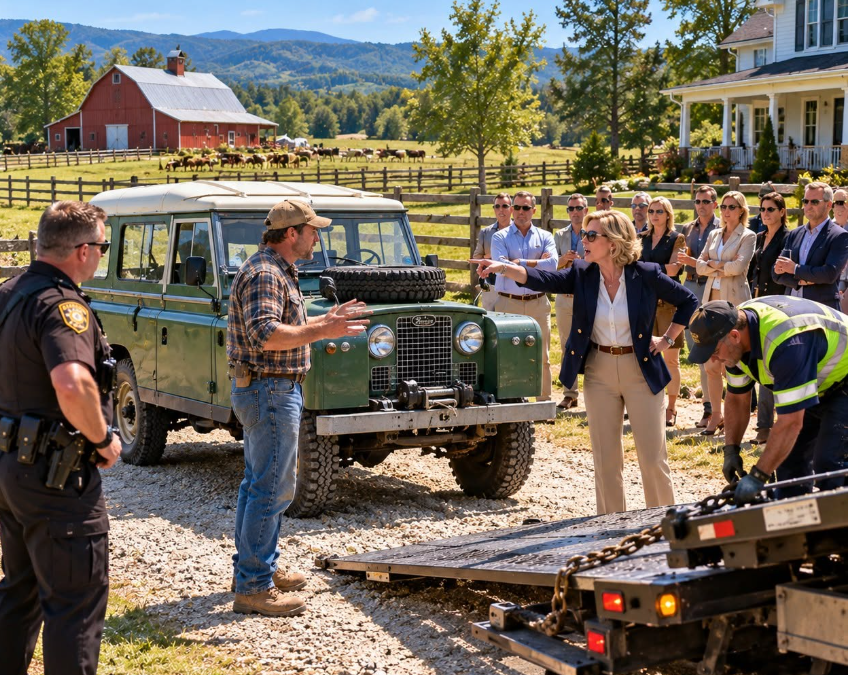
She lifted the clipboard and removed a bright red paper from beneath the clip. The paper was laminated, because of course it was. Across the top, in black block letters, it read FINAL TOW NOTICE.
Before I could stand, she strode to the workshop bay and slapped it against the Land Rover’s windshield.
The sound cracked through the morning like a hand across a face.
For a second, I was sixteen again, watching my father polish that same windshield with newspaper and vinegar before we drove into town for burgers.
I set my coffee down.
Slowly.
Victoria turned back toward me.
“By authority of Mist Bay Heights HOA, this vehicle is declared abandoned, noncompliant, visually hazardous, and subject to immediate removal.”
“It is inside my workshop.”
“It is visible from the approach.”
“It is on my land.”
“It is within the HOA’s scenic impact zone.”
“There is no such thing.”
“There is now.”
I stood.
The guards straightened.
I was seventy-two that spring, which meant younger fools often mistook my careful movements for weakness. They saw white hair, a weathered face, a limp in my right knee, and hands stiff from arthritis and assumed the man attached to them had become negotiable.
I was not negotiable.
I walked down the porch steps.
Victoria held her ground, though I noticed her fingers tighten around the clipboard.
I stopped beside the Land Rover and peeled the red notice from the windshield. The adhesive left a smear on the glass.
That bothered me more than the paper.
I held it up.
“Who authorized this?”
“I did.”
“You personally authorized someone to tow a vehicle from inside my building?”
“I authorized enforcement action.”
“That was not my question.”
Her chin lifted.
“The towing company is en route.”
I folded the notice once.
Then again.
Then I placed it in the breast pocket of my flannel shirt.
“You need to leave.”
Victoria’s smile returned.
“No, Mr. Calloway. You need to understand something. Your refusal to cooperate has forced escalation.”
She raised one hand.
One of the guards stepped forward.
Young.
Broad-shouldered.
Nervous under all that purchased authority.
“Sir,” he said, trying to make his voice deep, “we need you to step away from the vehicle.”
I looked at him.
“What’s your name?”
He blinked.
“Evan.”
“Evan, does your mother know you’re out here threatening old men before breakfast?”
His face reddened.
“I’m not threatening you.”
“Good. Let’s keep it that way.”
Victoria snapped, “Do your job.”
The second guard, older by maybe five years and more eager to impress her, moved toward the workshop opening. I stepped into his path.
He stopped.
There are moments when a person decides who they are.
I watched him search for himself.
He glanced at Victoria, then at me, then at the farm behind me—the barn, the white pines, the old well, the stone wall my grandfather built after the hurricane of 1938 knocked half the northern fence down.
“This is private property,” I said. “You have not been invited. You have no warrant, no court order, and no legal authority. If you touch that vehicle, you will be trespassing and attempting theft.”
He swallowed.
Victoria’s voice cut through the air.
“I’ve already called the sheriff.”
That was when I smiled.
Not much.
Just enough for her to notice.
She mistook it for disbelief.
“Oh, you think I’m bluffing?” she said. “I spoke directly to dispatch. Deputies are coming. I told them there is an escalating compliance situation involving an abandoned vehicle and an uncooperative property owner.”
“Did you tell them the property owner owns the property?”
Her lips thinned.
“The sheriff’s office enforces the law.”
“That’s what I’m counting on.”
For the first time that morning, uncertainty passed across her face.
It was brief.
Then she straightened, turning toward the road as if expecting cavalry.
We all heard the tow truck before we saw it.
A diesel engine growled beyond the windbreak. Yellow lights flashed through the fog. The truck turned in from County Road 6 and rolled up my gravel drive like it had every right to be there.
The driver was a heavyset man in a reflective vest, chewing gum with the confidence of someone who had no idea he was late to a bad decision.
Painted on the truck door was: BARKER’S RECOVERY & TOW.
I knew Tommy Barker.
He had once tried to tow a county snowplow while the driver was still sitting inside it eating a sandwich. Not maliciously. Tommy simply believed any vehicle could be towed if the paperwork looked official and the check cleared.
He climbed down, looked at me, then at Victoria, then at the Land Rover.
“Morning, Mr. Calloway,” he said.
“Tommy.”
He looked uncomfortable. “This yours?”
“Since before you were born.”
He winced.
Victoria stepped in. “Mr. Barker, the vehicle has been declared in violation and is subject to immediate removal.”
Tommy scratched his cheek.
“Yeah, I got the call from your office.”
“And you have the authorization.”
“I got a form.”
“Then proceed.”
Tommy looked at the workshop.
Then at me.
“Sam, where’s the property line exactly?”
I pointed behind Victoria toward the road.
“About two hundred and thirty feet that way.”
Tommy’s gum stopped moving.
Victoria said, “That is disputed.”
“No,” I said. “It is disliked.”
Tommy exhaled.
“Mrs. Sterling, I ain’t towing from inside a man’s shop unless a deputy tells me to.”
Her expression sharpened.
“The deputies are coming.”
“Then I’ll wait for the deputies.”
The fog thinned as we waited.
That was the thing about coastal mornings. They revealed themselves slowly. At first, everything looked softened and uncertain. Then the light changed, and the world became edges again.
Mist Bay Heights sat beyond the southern fence, a development of cedar-shake luxury homes rising along the bluff above the inlet. Twenty years ago, that land had been pasture and scrub pine. I used to graze sheep near the hill as a boy. Then the old McKenna property sold to a developer from Boston who named every lane after things he had bulldozed.
Meadow View Drive.
Fox Hollow Court.
Orchard Rise.
There had not been an orchard there in forty years, but that was how developers worked. First they erased the thing, then sold its name back to people with granite countertops.
At first, Mist Bay Heights kept to itself. Wealthy retirees, second-home owners, finance men who spent weekends pretending boats made them rugged. They complained about lobster traps stacked near the harbor, foghorns, gulls, church bells, the smell of low tide, and once, memorably, the existence of mud.
But they had no authority over me.
Everyone knew that.
The Calloway farm sat outside their subdivision, outside their covenants, outside their dues, outside their paint palettes, outside their committees, and outside their imagination.
That was the real offense.
Not the Land Rover.
Me.
A man who owned what they wanted without asking their permission.
The sheriff’s cruiser arrived at 8:12.
One cruiser.
No siren.
No drama.
Just a black-and-white Ford Explorer rolling up the drive with steady purpose. A second county vehicle followed, driven by Deputy Elena Ruiz, whose grandmother had bought eggs from my mother for thirty years.
Victoria put on her most serious face.
The guards stood taller.
Tommy Barker looked relieved.
The cruiser stopped near the maple tree. The driver’s door opened.
Sheriff Daniel Brooks stepped out.
He was fifty-three, square-jawed, and still built like the Marine he had once been. His hat sat low, his uniform pressed, his eyes sharp enough to cut excuses from the air. I had known Danny Brooks since he was a skinny kid riding his bike past my pasture with a fishing pole across the handlebars.
But that was not why he saluted me.
He walked toward us.
Victoria moved first.
“Sheriff, thank you for coming. I’m Victoria Sterling, president of—”
Daniel walked past her.
Straight to me.
He stopped three feet away, stood tall, and raised his right hand in a clean, formal salute.
“Master Chief Calloway,” he said.
Everything went quiet.
Even the gulls seemed to pause.
I returned the salute out of reflex more than ceremony.
“Sheriff.”
His eyes softened for just a moment.
“Been too long, sir.”
“Long enough for you to get gray.”
“Learned from the best.”
Victoria’s mouth had opened slightly.
The guards looked at me differently now.
That always happened after a salute. People who had dismissed an old man suddenly tried to imagine the younger version of him. They never got it right. They imagined medals and battle scenes, which was not entirely wrong, but not entirely right either.
They did not imagine cold nights on steel decks. They did not imagine body bags. They did not imagine pulling a nineteen-year-old out of black water while a storm tried to take you both. They did not imagine the smell of diesel and fear. They did not imagine the years of making decisions nobody should have to make and then coming home to a farm where the grass kept growing like the world had not changed.
Victoria recovered first.
“Sheriff Brooks, I appreciate your respect for local veterans, but we have an active enforcement matter.”
Daniel turned slowly.
His face became official.
“Mrs. Sterling.”
“It’s President Sterling.”
“Mrs. Sterling,” he repeated, with no change at all, “dispatch said you reported an abandoned vehicle trespass issue.”
“Yes. This vehicle is in violation of Mist Bay Heights standards and subject to tow.”
Daniel looked at the Land Rover.
Then at the workshop.
Then at me.
“Sam, that your vehicle?”
“Yes.”
“Your workshop?”
“Yes.”
“Your land?”
“Yes.”
He looked back at Victoria.
“Then I’m struggling with the abandoned part.”
She tightened her grip on the clipboard.
“The vehicle is visible from our scenic corridor and violates community standards.”
“Is Mr. Calloway a member of your HOA?”
“No, but—”
“Does his deed contain your covenants?”
“Our legal counsel believes—”
“That wasn’t my question.”
Victoria inhaled.
“Not directly.”
“Not directly means no?”
“It means the matter is complex.”
Daniel looked at Deputy Ruiz.
She was writing notes and not hiding her expression very well.
Daniel turned back to Victoria.
“Do you have a court order authorizing removal?”
“We have HOA authority.”
“Not over nonmembers.”
“We have an easement.”
Daniel held out his hand.
Victoria hesitated.
Then she opened her folder and produced several pages. Daniel read them slowly.
I watched his face.
That was one of Daniel’s gifts. He could read something absurd without immediately calling it absurd. He let foolishness sit there under its own weight until everyone else heard the cracking.
Finally, he said, “This appears to be a landscape maintenance easement for the Mist Bay entrance sign and drainage ditch.”
“Correct.”
“The entrance sign is on your side of the road.”
“Yes.”
“The drainage ditch runs along the county right-of-way.”
“Yes.”
“This does not give you authority over Mr. Calloway’s driveway, workshop, or vehicle.”
“It grants visual maintenance authority within the approach corridor.”
“No, ma’am. It grants permission to mow around a sign and clear a ditch.”
Victoria’s cheeks colored.
“That is an outdated interpretation.”
“It’s the words on the page.”
“Our counsel has expanded—”
“Counsel doesn’t expand deeds by wishing.”
Tommy Barker coughed into his fist.
Victoria shot him a look.
Daniel handed the papers back.
“Mr. Barker,” he said, “you will not be towing anything from this property today.”
Tommy raised both hands.
“Fine by me, Sheriff.”
Victoria stepped forward.
“Sheriff, with respect, you are not appreciating the broader issue.”
“I appreciate it fine.”
“This farm is directly impacting a multimillion-dollar residential community.”
“This farm predates it.”
“That does not exempt him from modern standards.”
“It exempts him from your standards.”
Her voice sharpened.
“Are you refusing to enforce the law?”
Daniel’s expression did not change.
“I’m refusing to enforce your preference.”
The words landed hard.
One of the guards looked down.
Victoria turned toward me, furious now.
“This is not over.”
“No,” I said. “I imagine it isn’t.”
She pointed toward the Land Rover.
“That vehicle is only the beginning.”
I believed her.
That was why, three weeks earlier, after her fourth notice and second threat of legal action, I had made a call of my own.
Not to a lawyer at first.
To a surveyor.
A real one.
Not a “community planning consultant” hired by the HOA. Not an architect’s assistant with a digital overlay. A licensed land surveyor named Gerald Pike, who had hands like tree bark and could read metes and bounds descriptions the way some men read baseball scores.
Gerald had spent two days walking my southern boundary with old deeds, GPS equipment, iron pins, historical tax maps, and a muttered hatred for developers who built first and measured later.
On the second afternoon, he stood near the white-pine windbreak and stared toward the HOA clubhouse.
“Sam,” he said, “you’re going to want a lawyer.”
That was when I learned Victoria’s problem was much bigger than my Land Rover.
Mist Bay Heights had built its new clubhouse two years earlier.
Two and a half million dollars, according to the ribbon-cutting article.
Cedar beams.
Stone fireplace.
Fitness room.
Private dining terrace.
Pool.
Outdoor kitchen.
Pickleball courts.
Glass walls facing the inlet.
The building had become Victoria Sterling’s monument to herself. Her name appeared in every article about it. She had stood in front of the fireplace holding giant scissors and told reporters the clubhouse represented “community vision, fiscal discipline, and respect for the natural beauty of the coast.”
Gerald Pike’s survey showed that the western wing, terrace, pool equipment structure, and part of the septic field sat across my boundary.
On my land.
Not by inches.
By forty-one feet at the deepest point.
Worse, the septic leach field cut into a protected buffer near the old spring channel that fed our marsh.
Gerald had looked sick when he told me.
“Did they pull permits?” I asked.
“They pulled something.”
“What does that mean?”
“It means the site plan on file doesn’t match what got built.”
So yes, when Victoria slapped a tow notice on my father’s Land Rover, I was angry.
But I was also ready.
Daniel Brooks was still standing in my driveway when a white pickup turned in from the county road.
Gerald Pike climbed out, wearing work boots, a waxed canvas jacket, and the expression of a man who had come to ruin somebody’s morning with math.
Behind him came my attorney, Margaret Vale.
Margaret was seventy-eight, five feet tall, and had been practicing property law since half the county still paid bills in person. She walked with a silver cane and wore pearls to depositions because she said men lied less confidently when they felt underdressed.
Victoria saw them and stiffened.
“Who are these people?”
“My surveyor,” I said. “And my lawyer.”
Her sunglasses turned toward the clubhouse beyond the trees.
For the first time, she understood the field of battle had moved.
Margaret approached Daniel first.
“Sheriff Brooks.”
“Ms. Vale.”
“Always a pleasure to see law enforcement arrive before the shouting becomes expensive.”
“Trying my best.”
She turned to Victoria.
“Mrs. Sterling.”
Victoria’s mouth pressed flat.
“You represent Mr. Calloway?”
“I do.”
“Then you should advise your client that escalating this matter is unwise.”
Margaret smiled pleasantly.
“I bill by the hour, dear. Escalation is how I buy jam.”
I almost laughed.
Victoria did not.
Gerald unfolded a large survey map across the hood of his truck and weighted the corners with stones.
The fog had nearly burned off now. Sunlight lit the property in clean detail. The white pines cast long shadows toward the south. Beyond them, you could see the peak of the HOA clubhouse roof rising above the hedge like a ship that had run aground in expensive landscaping.
Daniel stepped beside Gerald.
Deputy Ruiz joined him.
Victoria remained where she was, arms crossed.
Margaret tapped the map.
“This is the Calloway deed boundary as described in the 1897 transfer, reaffirmed in the 1934 probate, the 1962 farm consolidation, and the 1988 conservation filing.”
Victoria said, “Old documents are often inaccurate.”
Gerald looked personally offended.
“Old documents are often better than new guesses.”
Margaret continued.
“This is the Mist Bay Heights parcel boundary as conveyed to the developer. This is the clubhouse site plan submitted to the county. And this”—she tapped a red overlay—“is the actual as-built location.”
Daniel leaned closer.
His expression darkened.
“How far over?”
“Forty-one feet at the terrace. Twenty-eight feet at the west wall. The pool equipment enclosure entirely crosses the line. Part of the septic field appears to extend into Mr. Calloway’s land and possibly into the protected spring buffer.”
Victoria laughed.
It was not a happy sound.
“That is impossible.”
Gerald said nothing.
He simply pointed toward a line of orange flags already set near the windbreak.
I had placed them after he finished the survey, though they were low enough that Victoria had not noticed them when she marched in.
Daniel followed the flags with his eyes.
Then he looked toward the clubhouse.
Victoria turned as well.
From where we stood, the truth was suddenly visible.
The manicured hedge Mist Bay had planted to “soften the transition” did not run along the true boundary. It ran inside my farm, curving around the clubhouse terrace like a thief drawing curtains.
“Those flags are fabricated,” Victoria said.
Gerald blinked slowly.
“Ma’am, flags don’t fabricate surveys. Licensed professionals do surveys. Flags mark them.”
“Our surveyor never showed this.”
“Then your surveyor either didn’t look, didn’t know, or didn’t tell you.”
Her face changed.
That last possibility hit something.
Margaret saw it too.
“Who handled your site work, Mrs. Sterling?”
Victoria did not answer.
Daniel did.
“Sterling Coastal Development.”
Everyone looked at him.
Victoria’s lips parted.
Daniel’s eyes stayed on the clubhouse.
“I remember the permit file. Your husband’s company managed the expansion.”
Victoria’s voice turned cold.
“My husband is a respected contractor.”
“Then he knows how boundaries work.”
The silence that followed was different from the earlier silence.
Earlier, Victoria had been embarrassed.
Now, she was calculating.
She removed her sunglasses.
Her eyes were pale blue and furious.
“Mr. Calloway,” she said, each word polished sharp, “I strongly suggest we discuss this privately.”
“No.”
“This does not need to become hostile.”
“You brought guards and a tow truck to my farm.”
“I was enforcing standards.”
“You were trespassing.”
“We can resolve this.”
“I tried resolving it when I returned your first notice with a copy of my deed.”
“You mocked our process.”
“Your process mocked itself.”
Her mask slipped completely then.
“You stubborn old fool,” she snapped. “Do you have any idea what you’re threatening? That clubhouse serves one hundred and eighty families. It is the heart of our community.”
“No,” I said quietly. “It’s sitting on the heart of my farm.”
For a moment, no one spoke.
The white pines rustled in the sea wind.
I thought of my mother hanging sheets near that boundary when I was small. My sister chasing grasshoppers there. My father teaching me to set fence posts. My wife, Ellen, standing with me under those pines thirty years later, saying we should never sell because some places hold people even after they are gone.
Ellen had been dead six years.
My father twenty.
My mother thirty-one.
Victoria looked at the land and saw leverage.
I looked at it and saw everyone I had buried.
Daniel removed his hat, then put it back on.
“All right,” he said. “Here is what is going to happen. Mrs. Sterling, your guards and the tow truck are leaving Mr. Calloway’s property now.”
Victoria bristled.
“Sheriff—”
“Now.”
The guards did not wait for her approval.
Evan was already backing toward the SUV.
Tommy Barker climbed into his tow truck with the relief of a man who had narrowly avoided becoming evidence.
Victoria remained.
Daniel’s voice hardened.
“You can leave voluntarily, or I can cite you for trespass after warning.”
She stared at him.
Then at me.
Then at Margaret.
“This county has no idea what kind of mess you are creating,” she said.
Margaret smiled.
“Oh, I think we’re beginning to.”
Victoria turned and walked toward her SUV, heels sliding slightly in the gravel. She did not look back when she reached the door.
But before she got in, she said one final thing.
“You’ll regret making an enemy of us.”
I looked at the Land Rover behind me.
At the old windshield still marked with adhesive from her notice.
Then I looked at her.
“Victoria,” I said, “you were never important enough to be my enemy.”
Her face tightened with a hatred so pure it almost looked like pain.
Then she drove away.
The first week after that morning was mostly paperwork.
People imagine justice as a courtroom speech or a sheriff dragging the villain away in handcuffs. Sometimes it is. More often, it begins with copies.
Copies of deeds.
Copies of permits.
Copies of notices.
Copies of emails sent and ignored.
Copies of inspection reports.
Copies of checks.
Copies of surveys with red lines that make rich people suddenly develop memory problems.
Margaret filed a formal boundary encroachment notice by noon.
Gerald submitted his survey to the county recorder.
Daniel opened a trespass and attempted unlawful removal report because Victoria had sent a tow truck onto private property under false authority.
The county building office issued a temporary stop-use advisory for the clubhouse pending review.
That advisory hit Mist Bay Heights like a hurricane.
By Friday, I had reporters at the gate.
By Saturday, drones buzzed near my pasture until Daniel called the owners and reminded them that interfering with livestock counted as harassment. I did not have many animals anymore, just four old goats, six chickens, and a barn cat named Admiral who considered himself livestock management, but the warning worked.
Mist Bay residents began driving slowly past my farm.
Some glared.
Some looked embarrassed.
Some seemed confused, like they had bought into a postcard and nobody had warned them postcards have property lines too.
One woman stopped near the gate and rolled down her window.
“You’re destroying our community,” she called.
I was repairing a fence latch.
I looked up.
“I’m fixing a gate.”
“My daughter’s wedding is booked at that clubhouse.”
“I’m sorry to hear that.”
“Are you?”
“Yes.”
She seemed thrown by that.
I meant it.
That was the miserable part. Victoria deserved consequences. Her husband, if he had knowingly built over my line, deserved consequences. The board members who had ignored warnings deserved consequences.
But most people in Mist Bay Heights had just wanted a nice place to live.
They had been sold certainty.
Clean roads. Trimmed hedges. Ocean views. Clubhouse privileges. Rules that promised to keep disorder away.
They had not understood that sometimes the disorder is inside the people writing the rules.
The woman at the gate gripped her steering wheel.
“We paid dues for that clubhouse.”
“I know.”
“What are we supposed to do now?”
“Ask Victoria where your money went.”
Her face crumpled slightly, not into tears, but into the first terrible moment of realizing anger had been pointed in the wrong direction.
She drove off without another word.
Two days later, an envelope appeared in my mailbox.
No return address.
Inside were copies of HOA board meeting minutes from two years earlier. Someone had highlighted several lines.
Victoria: “Boundary concern is immaterial. Sterling Coastal has addressed.”
Treasurer: “Need confirmation before final payment.”
Victoria: “Do not delay project over outdated farm claim.”
Sterling Coastal invoice approved.
Another page.
Resident question: “Is there unresolved issue with Calloway line?”
Victoria: “No. Farm owner is confused. Counsel has reviewed.”
I sat at my kitchen table with the pages spread before me and felt something heavier than anger.
She had known.
Maybe not every detail.
Maybe not the full extent.
But she had known there was a boundary concern, and she had buried it beneath confidence.
That is how many disasters happen.
Not because nobody sees the line.
Because someone powerful decides the line is inconvenient.
I gave the documents to Margaret.
She read them once, then again.
“Well,” she said, “that makes the jam expensive.”
The public hearing was scheduled for the following Tuesday at the county administration building.
Before then, Victoria tried three different approaches.
First came intimidation.
A letter from a law firm in Portland accused me of interfering with HOA operations, damaging community reputation, and attempting to extort land concessions.
Margaret read it aloud in my kitchen while Admiral the barn cat sat on the table against house rules.
When she finished, she looked over her glasses.
“May I respond rudely?”
“Professionally rude.”
“I can do both.”
Second came charm.
Victoria herself called me from an unknown number.
I nearly did not answer.
“Samuel,” she said, voice soft as expensive fabric.
“No.”
She paused.
“Mr. Calloway. I think we both allowed emotions to overtake reason.”
“I didn’t bring security guards to your porch.”
“I regret the optics.”
“Not the act?”
“I regret that we reached that point.”
“That’s not the same thing.”
She exhaled.
“I am prepared to propose a generous settlement.”
“No.”
“You haven’t heard the terms.”
“I heard enough at generous.”
Her voice cooled.
“You are one man.”
“That’s been true my whole life.”
“You cannot fight an entire association indefinitely.”
“I don’t need indefinitely. I just need the truth to stand still long enough for people to see it.”
She was silent.
Then: “What do you want?”
It was the first honest question she had asked me.
I looked out the kitchen window at the southern field. The pines moved in the wind. Beyond them, the clubhouse roof rose where it should not.
“I want my land back,” I said.
“That may not be structurally feasible.”
“That is not my problem.”
“There are homeowners who will suffer.”
“Then you should apologize to them.”
Her voice sharpened.
“I am trying to protect them.”
“No,” I said. “You’re trying to hide behind them.”
She hung up.
The third approach came through betrayal.
And that one hurt.
My nephew, Andrew, arrived on Sunday afternoon in a silver SUV too clean for the farm road.
I had not seen him in eight months.
Andrew was my sister’s boy. Forty-two. Real estate broker. Good smile. Restless eyes. He had grown up spending summers on this farm, catching frogs in the drainage ditch and begging my father to let him ride in the Land Rover. After my sister died, I tried to stay close to him, but money had a way of rearranging his loyalties.
He stepped out wearing loafers and a quilted vest.
“Uncle Sam.”
“Andrew.”
He looked toward the pines.
“Place looks the same.”
“No, it doesn’t.”
He smiled sadly, like I had missed his attempt at nostalgia.
I invited him in because family is a door you do not close quickly, even when you hear trouble walking up the steps.
He sat at my kitchen table. Admiral immediately disliked him, which should have been my first warning.
I poured coffee.
Andrew did not drink it.
“I’ve been talking with some people,” he said.
“That usually costs someone money.”
He leaned back.
“I’m worried about you.”
“Convenient.”
“I mean it. This thing with Mist Bay is getting big.”
“It was big when they built on my land.”
“I get that. I do. But you have to think practically.”
There it was.
The word people use when they want you to surrender something sacred at a discount.
“Practically,” I said.
“The farm is too much for you.”
I stared at him.
He rushed on.
“You’re seventy-two. The upkeep, the taxes, the buildings. And now this legal fight? It’s stress you don’t need.”
“Did Victoria send you?”
He looked wounded.
“No.”
“Her lawyer?”
“No.”
“Her husband?”
His silence was half a second too long.
I set my cup down.
“Andrew.”
He rubbed his forehead.
“Sterling Coastal approached me months ago about a possible assemblage.”
“Assemblage.”
“A land package. Your farm, the old Bennett parcel, maybe some county frontage if they could—”
“My farm is not a package.”
“I know that’s how you feel.”
“That is what it is.”
He leaned forward, voice lowering.
“They were going to make a serious offer.”
“I never got one.”
“Because you don’t listen.”
“I listen fine.”
“No, you don’t. You shut everything down because of Grandpa and Aunt Ellen and all the ghosts you keep in these fields.”
The words hit harder than I expected.
Not because he was right.
Because he was careless with what he knew could hurt me.
I stood.
“You should leave.”
“Uncle Sam—”
“Now.”
He stood too.
His face flushed.
“You’re throwing away millions.”
“I’m keeping what was trusted to me.”
“By dead people!”
The kitchen went still.
Even Admiral stopped moving.
Andrew looked like he regretted it immediately, but regret after cruelty is not the same as restraint before it.
I walked to the door and opened it.
He swallowed.
“I’m sorry.”
“I know.”
“I didn’t mean—”
“You meant enough.”
He left without finishing his coffee.
I watched his SUV disappear down the road and felt older than I had that morning.
That night, I went to the workshop.
The Land Rover sat under warm lights, hood open, windshield cleaned of Victoria’s adhesive. I ran one hand along the fender.
My father had never been a sentimental man in public. He believed feelings were like good tools: valuable, but not to be left lying around where fools could damage them.
But the summer I enlisted, he handed me the Land Rover keys and said, “Wherever you go, remember roads bring you home both ways.”
I laughed at the time because I was young and thought leaving was the point.
When I came home from my last deployment, older than my own father had been in my mind, Ellen drove me from the airport. She took the long way along the coast. When we pulled into the farm, the Land Rover was still under its tarp, tires low, paint gone dull. I had looked at it and felt nothing because I was too tired to feel.
Ellen squeezed my hand.
“You’ll get to it when you’re ready,” she said.
She always knew.
She died before I was ready.
So the restoration became for both of them.
My father’s machine.
My wife’s patience.
My own attempt to make something whole after decades of leaving pieces of myself in places I never wanted to remember.
And Victoria Sterling had reduced it to an eyesore because it interfered with the fantasy she sold from her clubhouse terrace.
I stayed in the workshop until after midnight.
The next morning, I mounted the license plate.
At the public hearing, there were no empty seats.
Mist Bay residents filled the left side of the room. Farmers, fishermen, tradesmen, and old county families filled the right, though nobody had organized it that way. It simply happened, as if the room understood the division before anyone spoke.
Victoria sat in front with her husband, Charles Sterling.
Charles was handsome in a polished, hollow way. Tanned. Silver watch. Contractor’s hands too clean to have done much recent contracting. He kept one arm around Victoria’s chair but not touching her, a performance of unity without comfort.
Andrew sat two rows behind them.
That hurt more than I let show.
Margaret sat beside me, organizing folders.
Daniel Brooks stood near the back wall with Deputy Ruiz.
The county commissioners looked tired before the hearing began.
The building inspector spoke first.
He confirmed discrepancies between the approved site plan and the as-built clubhouse.
The environmental officer spoke next.
She confirmed potential intrusion into the spring buffer and ordered a full septic review.
Gerald Pike presented his survey.
Clear.
Dry.
Undramatic.
Devastating.
Then Victoria spoke.
She walked to the podium in a white blazer and pearls, looking less like a defendant than a woman accepting an award for surviving inconvenience.
“My name is Victoria Sterling, president of the Mist Bay Heights Homeowners Association,” she began. “I speak today not merely for myself, but for nearly two hundred families who built their lives around a promise of community, order, and shared investment.”
She was good.
I had to give her that.
She framed the encroachment as an unfortunate technical dispute. She called my farm “adjacent rural land.” She said demolition or closure of the clubhouse would punish innocent homeowners. She praised the HOA’s charitable events, youth swim programs, holiday drives, veterans’ brunches.
Veterans’ brunches.
Daniel’s eyebrows lifted at that.
Then she turned slightly toward me.
“Mr. Calloway’s service to this country is admirable,” she said, “and we respect his attachment to his property. But no single individual’s inflexibility should be allowed to destroy a community resource used by children, seniors, and families.”
There it was.
I was no longer the old fool.
I was the selfish veteran.
The stubborn landowner.
The man hurting children because he would not donate stolen land politely.
A murmur moved through the Mist Bay side.
Victoria lowered her voice.
“We offered dialogue. We offered compromise. We were met with hostility.”
I felt Margaret’s hand touch my sleeve.
A warning.
Do not react.
Victoria finished with tears in her eyes. Whether real or summoned, they worked on some people.
Charles Sterling spoke next.
He blamed subcontractors, historical map confusion, wetland revisions, and “ambiguous legacy boundaries.” He said Sterling Coastal acted in good faith. He said any mistakes were unintentional. He said correcting the issue could bankrupt the HOA and expose dozens of families to special assessments.
Then one commissioner asked him a question.
“Mr. Sterling, when did you first become aware there may be a boundary issue with the Calloway farm?”
Charles hesitated.
“Late in the process.”
“How late?”
“I would have to review records.”
The commissioner held up a printed email.
“Would July 18th, two years ago, be accurate?”
Charles looked at Victoria.
Victoria looked straight ahead.
The commissioner read aloud.
“From Charles Sterling to Victoria Sterling: ‘Survey pin is not where we expected. West terrace may be over old Calloway line. If we stop now, costs explode. Need board to approve revised landscape buffer and proceed before Sam gets a lawyer.’”
The room erupted.
Not loudly at first.
Just gasps.
Then voices.
Then shouting.
Victoria stood. “That email is privileged.”
The commissioner looked over his glasses.
“It was submitted by your HOA treasurer in response to a county subpoena.”
Victoria turned toward the audience.
In the third row, a thin man with gray hair looked down at his hands.
Her own treasurer.
The first crack from inside.
Charles leaned into the microphone.
“That email lacks context.”
The commissioner read another.
“From Victoria Sterling to Charles Sterling: ‘Proceed. The old man won’t fight if we control the narrative. Once structure is complete, he’ll have no practical remedy.’”
This time, the sound in the room was not confusion.
It was recognition.
Mist Bay residents began turning toward Victoria.
A woman whispered, “You knew?”
Someone else said, “You let us keep paying?”
Another voice: “My dues went into this?”
Victoria’s face had gone pale beneath her makeup.
Andrew stared at the floor.
I looked at him until he felt it and raised his eyes.
He looked ashamed.
Good.
Shame has a purpose if it arrives before it is too late.
The commissioners allowed Margaret to speak.
She did not use tears.
She did not use outrage.
She used documents.
She established the deed history, the survey, the ignored warnings, the unauthorized encroachment, the false tow notice, the attempted use of law enforcement to pressure me, and the pattern of misrepresentation to residents.
Then she called me to the podium.
I had not wanted to speak.
But some things cannot be said by lawyers.
I stood before the room and placed both hands on the sides of the podium so my fingers would not curl into fists.
“My name is Samuel Calloway,” I said. “My family has owned that farm for one hundred and twenty-nine years.”
My voice sounded older in the microphone.
“My grandfather cleared stones from fields that no longer exist because the county road took them. My father kept the farm alive through storms, drought, and years when nobody wanted small farms except the people born to them. My wife and I raised a daughter there.”
I paused.
The room stilled.
“My daughter, Ruth, died when she was nineteen.”
I had not planned to say that.
Margaret looked up sharply.
But once spoken, grief sometimes insists on its place.
“She died in a car accident on Route 11, coming home from college for Thanksgiving. After that, my wife planted white pines along the southern line because Ruth loved the sound of wind in evergreens. That windbreak is not a scenic buffer. It is not a landscape feature. It is where my wife went when she missed our child so badly she could not breathe inside the house.”
The Mist Bay side went quiet.
Victoria looked down.
I continued.
“The Land Rover Mrs. Sterling tried to tow belonged to my father. I restored it because memory deserves labor. The field they built into is not vacant land. It is not excess land. It is not a bargaining chip. It is part of a place where my family lived, worked, grieved, and kept going.”
My throat tightened.
I forced the words out.
“I am sorry the residents of Mist Bay Heights were lied to. Truly. But I did not lie to them. I did not build over a line. I did not hide emails. I did not send guards to someone’s porch. And I will not be shamed for refusing to surrender what was taken.”
No one spoke.
I looked at Victoria.
“You called me inflexible. Maybe I am. Fence posts should be.”
I stepped away from the podium.
The hearing lasted another two hours.
By the end, the county had issued emergency orders.
The clubhouse would remain closed pending structural, boundary, and environmental review. The HOA had thirty days to submit a remediation proposal. Sterling Coastal’s permits were referred to the state licensing board. The environmental office opened an enforcement case. The sheriff’s office expanded its investigation into false reporting and attempted unlawful seizure related to the tow incident.
Victoria left through a side door.
Charles followed.
The residents remained in clusters, stunned and angry, turning not toward me but toward one another as the truth settled among them.
Outside, on the courthouse steps, Andrew caught up with me.
“Uncle Sam.”
I kept walking.
“Please.”
That stopped me.
Not because he deserved it yet.
Because my sister had loved him.
He stood there with his hands in his pockets, face stripped of broker polish.
“I didn’t know about Ruth’s trees,” he said.
“You did.”
He swallowed.
“I forgot.”
That was worse, in some ways.
But more honest.
He looked toward the street.
“Charles offered me a finder’s fee if I could get you to sell.”
I waited.
“It was a lot of money.”
“I assumed.”
“I told myself it would help you. That you were holding on too hard. That maybe everyone would win.”
“Did you believe that?”
He shook his head.
“No. Not really.”
The wind moved between us.
“I’m sorry,” he said.
I had heard many apologies in my life. Some were keys. Some were paint over rot. Andrew’s was not enough to open anything yet, but it was not paint either.
“I’m angry,” I said.
“I know.”
“No. You don’t. But you can learn.”
He nodded, eyes wet.
“What do I do?”
“Start by telling Margaret everything.”
He flinched.
Then nodded again.
“All right.”
“And Andrew?”
“Yes?”
“When you talk about this farm, you use the names of the people who loved it. Not ghosts. People.”
His face broke then.
“I’m sorry,” he whispered.
This time, I believed him.
The next months were ugly.
Truth often is after it leaves the room where it was hidden.
Mist Bay Heights turned on itself.
Residents demanded Victoria’s resignation. She refused at first, claiming political persecution, misogyny, anti-development bias, and elder hostility, which was a bold accusation considering she had started the whole thing by trying to tow a seventy-two-year-old man’s family vehicle.
Then the treasurer released more documents.
Invoices.
Change orders.
Board votes held without quorum.
Legal warnings buried in executive session.
Special assessment funds shifted to landscaping meant to conceal the encroachment.
Charles Sterling’s company had billed the HOA for “boundary mitigation plantings,” a phrase that sounded better than “hedge to hide the stolen land.”
Victoria resigned eleven days later.
Her resignation letter thanked the community for the privilege of serving during “a difficult season of misinformation.”
Someone leaked it.
Nobody was moved.
Charles lost his contractor’s license pending state review. Sterling Coastal filed for restructuring. Their house in Mist Bay went up for sale quietly, then not quietly when reporters photographed the sign.
But consequences did not fix everything.
The clubhouse still stood partly on my land.
The pool sat empty behind locked gates.
The septic issue was worse than expected.
Remediation would cost more than anyone wanted to say out loud.
Mist Bay residents faced special assessments, lawsuits, insurance disputes, and the humiliating knowledge that their symbol of prestige had become evidence.
Some blamed me anyway.
That is human nature.
It is easier to hate the person holding up the mirror than the person who cracked your face.
For a while, I found notes in my mailbox.
Greedy old man.
Hope you’re proud.
You ruined Christmas brunch.
One said, Just die already.
Daniel increased patrols without making a fuss.
Deputy Ruiz stopped by often enough to pretend she liked my coffee, which she absolutely did not.
One evening, I found fresh tire tracks near the white pines. Someone had driven through the lower field and torn up grass near Ruth’s trees.
I stood there in the fading light, looking at the ruts, and felt a rage so deep it frightened me.
The Land Rover was running by then.
Not perfectly.
Old machines rarely give you perfect. They give you character and leaks.
I drove it down to the field with a shovel, rake, and bags of topsoil in the back. I worked until dark filling the ruts by hand.
Halfway through, headlights appeared at the gate.
I straightened, expecting trouble.
Instead, a woman climbed out of a minivan.
It was the same woman who had stopped at my gate about her daughter’s wedding.
Her name, I had learned, was Melissa Grant.
She walked toward me carrying work gloves.
Behind her came her husband, then another couple, then the HOA treasurer, then a teenage boy with a rake.
Melissa looked at the damaged ground.
Her face tightened.
“We heard,” she said.
I did not ask how.
Small counties have faster communication than military radio when shame is involved.
She pulled on her gloves.
“I’m sorry.”
I leaned on my shovel.
“You didn’t do it.”
“No. But I believed her too long.”
That was the first real bridge.
Not a grand speech.
Not a legal filing.
A woman putting on gloves in a damaged field.
Together, we repaired the ruts under the white pines. Nobody talked much. That made it better. Apologies are sometimes more useful when they become labor.
When we finished, Melissa placed a small bunch of grocery-store flowers near the base of one pine.
“For Ruth,” she said.
I had to turn away.
After that, the town changed in small ways.
Not everyone. Never everyone.
But enough.
Mist Bay residents began showing up at county meetings demanding accountability from their former board. Some apologized. Some did not. Some could not meet my eyes but stopped glaring. The angry notes ended after Daniel caught a retired hedge fund manager on camera placing one in my box and had a deeply educational conversation with him about harassment and federal mail laws.
Andrew gave a sworn statement to Margaret. His testimony helped establish that Sterling Coastal had continued trying to acquire my farm after learning of the encroachment, likely hoping to cure the boundary problem through purchase before anyone noticed.
He came by afterward, not to ask forgiveness, but to split firewood.
That was wise.
We worked two hours before he spoke.
“Aunt Ruth used to dare me to climb the hayloft,” he said.
“She dared everyone.”
“I was scared.”
“I know.”
“She called me a city squirrel.”
I laughed despite myself.
“She was right.”
He smiled, then wiped his face with his sleeve.
“I forgot too much,” he said.
“Yes.”
“I don’t want to keep forgetting.”
“Then don’t.”
It was not forgiveness yet.
But it was a road.
And roads, as my father said, bring you home both ways.
The final resolution came nine months after Victoria slapped the tow notice on my windshield.
By then, winter had stripped the trees bare and the inlet turned the color of steel. The Land Rover wore a canvas top again, patched but handsome. I drove it into town every Friday, partly because it needed exercise and partly because I enjoyed watching people pretend not to stare.
The court-mediated settlement was held in a conference room overlooking the harbor.
On one side sat me and Margaret.
On the other sat attorneys for Mist Bay Heights, their insurance carrier, Sterling Coastal’s bankruptcy counsel, and two new HOA board representatives who looked like they had aged ten years since volunteering for leadership.
Victoria and Charles attended by video from somewhere in Florida.
Their camera was off at first.
The judge ordered it on.
Victoria appeared in pearls.
Of course she did.
The settlement terms had taken months.
The western terrace, pool equipment structure, and illegal landscape buffer would be removed. The septic field would be relocated entirely onto Mist Bay property at Sterling Coastal and insurer expense. The damaged spring buffer would be restored under environmental supervision. The HOA would pay for a permanent surveyed boundary fence and conservation markers along my southern line.
The portion of the clubhouse wall that encroached twenty-eight feet created the hardest question.
Demolishing that wing risked structural damage to the entire building and enormous costs to residents who had already been deceived. Margaret believed we could force it.
Legally, she was probably right.
But law is not the only measure of repair.
In the end, I agreed to grant a narrow, paid structural encroachment license for that existing wall only, renewable every ten years, nontransferable without my consent, and conditioned on strict compliance, public acknowledgment of the violation, and annual payments into a county farmland preservation fund in Ruth’s name.
Not to me.
To farmland preservation.
Victoria hated that.
I could see it through the screen.
She had wanted me to look greedy.
Instead, every payment would protect land from becoming the next Mist Bay Heights.
The HOA also had to issue a written public apology.
Not “regret for confusion.”
Not “sorry if anyone felt harmed.”
A real apology.
The judge read it aloud before allowing signatures.
“Mist Bay Heights Homeowners Association acknowledges that it unlawfully encroached upon the Calloway Farm property, failed to address known boundary concerns, misrepresented its authority over Mr. Samuel Calloway’s land, and wrongfully attempted to enforce HOA rules against a nonmember property owner. We apologize to Mr. Calloway, to his family, and to the residents who were misled.”
Victoria’s face remained stone still.
Charles looked like he might be sick.
The judge looked at me.
“Mr. Calloway, do you accept?”
I thought of my father’s hands on the Land Rover hood.
My mother hanging sheets.
Ellen under the pines.
Ruth laughing in the hayloft.
I thought of Victoria’s red tow notice.
I thought of Daniel’s salute.
I thought of Melissa placing flowers under my daughter’s tree.
“I accept the apology from the association,” I said.
Margaret glanced at me.
She heard what I had not said.
Not from Victoria.
Not from Charles.
Some debts remain unpaid even after checks clear.
When the papers were signed, Victoria’s attorney requested that all parties refrain from public statements.
Margaret smiled.
“My client is a private citizen. He can speak about his own life.”
The attorney sighed.
Outside, reporters waited.
I had avoided them for months as much as possible. I had no interest in becoming a symbol. Symbols get flattened. People forget symbols have dishes in the sink and knees that ache when it rains.
But that day, I stopped.
A young reporter asked, “Mr. Calloway, are you satisfied with the outcome?”
I looked past her toward the harbor. Fishing boats rocked at their slips. Gulls wheeled overhead. The town smelled like salt, diesel, and winter.
“No,” I said.
The cameras leaned closer.
“Satisfaction isn’t the word. This should never have happened. My land should not have been taken. Those residents should not have been lied to. The sheriff should not have had to come to my driveway because someone thought an HOA title outranked a deed.”
I paused.
“But I am grateful the truth held.”
Another reporter asked, “What happens now?”
“Now,” I said, “people learn where the lines are.”
They used that quote everywhere.
Some people thought I meant property lines.
I did.
But not only that.
That spring, the illegal terrace came down.
I sat on my porch and watched from a distance as workers removed stone piece by piece. The pool equipment shed disappeared. The hedge was dug out. The land looked wounded afterward, raw and muddy, but honest.
Environmental crews restored the spring buffer with native grasses, bayberry, alder, and young pines.
On the day they planted the last pine, Melissa and her daughter came by.
Her daughter’s wedding had been moved to a church hall in town. She brought me a slice of cake in a plastic container.
“It was still beautiful,” Melissa said.
“I’m glad.”
“My daughter said the clubhouse would’ve been prettier, but the church had better acoustics.”
“That matters.”
She smiled.
Then she looked toward the restoration area.
“I’m on the new HOA board now.”
“My condolences.”
She laughed.
“We changed the rules.”
“Good.”
“No enforcement beyond our boundary. No private security. Independent audits. Open records. And we renamed the scenic corridor.”
I raised an eyebrow.
“What’s it called now?”
“County Road 6.”
I laughed hard enough that my knee hurt.
A month later, I received an invitation to a Mist Bay meeting.
I almost threw it away.
Then I saw the handwritten note from Melissa.
Please come. Not for them. For the record.
So I went.
The meeting was held in the reopened clubhouse, though much of the west side remained under repair. Without the illegal terrace, the building looked smaller. Less arrogant. More like a place and less like a statement.
Residents filled the room.
Some stood when I entered.
That made me uncomfortable.
I took a seat near the back.
Melissa stood at the front.
“We have one item before regular business,” she said.
A projector screen lowered.
On it appeared a photograph.
My Land Rover.
Not as Victoria had described it.
Not as an eyesore.
As it looked now, parked in front of my barn at sunset, gray paint glowing, old lines proud, the white pines behind it.
Melissa turned toward me.
“Mr. Calloway, the board voted unanimously to remove all prior violation notices issued against your property from our records, though we now acknowledge they were never valid. We also wanted to formally recognize that your farm is not a nuisance to our community. It is part of the history our community should have respected from the beginning.”
A few people applauded.
Then more.
I did not stand.
I could not.
My throat had closed.
Melissa continued.
“The new board has also voted to fund, with private donations from residents, a historical marker near the public road, if you permit it, describing the Calloway Farm and its role in the county’s agricultural history.”
I looked at the screen.
The Land Rover sat there like my father had just stepped away from it.
I thought of Victoria calling it that thing.
I thought of my father saying the frame was still sound.
“Maybe,” I said.
My voice was rough.
“Let me see the wording first.”
Laughter moved gently through the room.
After the meeting, people approached one by one.
Some apologized.
Some thanked me.
Some told me they had moved to Mist Bay because they loved the view of the farm and had not understood they were being taught to resent the very thing that made the place beautiful.
An older man named Peter approached last.
He had been one of the loudest defenders of Victoria early on. He stood before me twisting a baseball cap in his hands.
“I wrote one of those notes,” he said.
I looked at him.
“Not the worst one,” he added quickly. “But one of them.”
I said nothing.
His face reddened.
“I’m ashamed.”
“Good.”
He nodded, accepting it.
“I am.”
We stood there.
Then he said, “My father had an old Jeep. I sold it after he died. Didn’t think twice. Seeing your Rover… I wish I hadn’t.”
There it was again.
The thing beneath the thing.
It was never just a vehicle.
It was never just a clubhouse.
It was never just a line.
People fight hardest over objects when the objects hold what they do not know how to say.
“I’m sorry,” I said.
He nodded.
“Me too.”
That summer, I drove the Land Rover in the Fourth of July parade.
I did not plan to.
Daniel Brooks talked me into it by claiming the veterans’ float needed “mechanical dignity.” Margaret said that was nonsense and I should do it anyway. Andrew spent two weekends helping me polish the trim and fix a brake light that chose patriotism as its moment to fail.
On parade morning, the town gathered under a bright blue sky. Flags snapped from storefronts. Kids lined the sidewalks with paper bags for candy. The high school band sweated through uniforms. Fire trucks gleamed.
I wore my old dress uniform shirt, though not the full uniform. Some things belong to younger shoulders. My medals stayed in a small box at home. I did not need them that day.
The Land Rover started on the second try.
A personal best.
Daniel walked over before the parade began.
He looked at the vehicle, then at me.
“Your dad would like this.”
“Yes,” I said. “He’d complain about the paint first.”
Daniel laughed.
Then his expression softened.
“You doing all right, Sam?”
I looked down the street.
Andrew stood with Melissa’s family near the courthouse, holding a small American flag and looking nervous, like a man still learning how to be trusted.
Margaret sat in a folding chair beneath an umbrella, already criticizing parade logistics.
Deputy Ruiz was pretending not to feed popcorn to Admiral, who had somehow gotten into the passenger seat and refused to leave.
At the far end of the street, beyond the crowd, I could see the road leading back toward the farm.
“I’m doing better,” I said.
Daniel nodded.
The parade began with sirens and drums.
As I drove slowly down Main Street, people waved. Children pointed at the Land Rover. Old men leaned forward to inspect it. Someone shouted, “Looking good, Master Chief!”
I raised a hand.
Then we passed a group of Mist Bay residents.
Melissa was there.
Her daughter too.
Peter.
Several others I recognized from hearings, meetings, roadside glares, and later apologies.
They stood and clapped.
Not wildly.
Respectfully.
That was better.
Near the end of the route, a little boy pointed at the Land Rover and asked his mother, loud enough for me to hear, “Is that a hero car?”
His mother smiled.
“I think it carried some.”
I had to blink hard after that.
The historical marker went up in September.
We placed it near the public road, not on my inner property. I approved every word.
CALLOWAY FARM
Established 1897
Continuously stewarded by the Calloway family for more than a century, this coastal farm preserves agricultural, family, and environmental history along Mist Bay. Its fields, windbreaks, and spring channel remain part of the living landscape of the county.
Respect the land. Respect the line. Remember the people who kept it.
The last sentence was mine.
On the day it was installed, Andrew came early with a thermos of coffee.
He stood beside me as the crew set the marker.
“I’ve been thinking,” he said.
“That’s dangerous in real estate.”
He smiled faintly.
“I want out.”
“Of real estate?”
“Of the kind I was doing.”
I looked at him.
He stared at the marker.
“I kept selling people stories about land without caring what stories were already there.”
“That realization will cost you money.”
“Probably.”
“Good realizations often do.”
He nodded.
“I was wondering if you’d teach me more about the farm records. Deeds, conservation stuff, how you kept it intact.”
It was not forgiveness he was asking for.
Not exactly.
It was apprenticeship.
A way back through work.
My father would have understood that.
“We’ll start Saturday,” I said.
His eyes brightened.
“Really?”
“Don’t be late.”
“I won’t.”
“And wear boots.”
He looked down at his loafers.
“Right.”
The marker dedication was small.
No reporters this time.
Just a few neighbors, Daniel, Margaret, Melissa, Andrew, and some county folks.
I brought the Land Rover, parking it beside the fence.
After everyone left, I stayed.
The sun dropped toward the inlet. The white pines whispered in the evening wind. The restored spring buffer bent gold in the light. Beyond the boundary, the clubhouse stood quieter now, its illegal arrogance cut away, its remaining wall licensed and named for what it was.
An encroachment.
Not a conquest.
I walked to the Land Rover and opened the door.
The smell inside was still not comfortable. Oil, canvas, old leather, metal warmed by sun. But beneath it, if memory was allowed to have scent, there was my father’s pipe tobacco. Ellen’s hand lotion. Ruth’s strawberry gum from the summer she learned to drive it badly through the lower field while I pretended not to be terrified.
I sat behind the wheel.
For a moment, I let myself imagine them all there.
My father in the passenger seat telling me I was riding the clutch.
Ellen laughing with one hand out the window.
Ruth in the back, hair flying, shouting that we should go faster.
Grief did not vanish.
It changed shape.
Some days it was a stone in my chest.
Some days it was a road.
I started the engine.
It coughed, complained, then settled into a rough idle.
A good sound.
A sound with a frame still strong.
As I pulled up the driveway, I glanced once toward the place Victoria had stood that foggy morning with her clipboard and guards and certainty.
She had believed power was the ability to make other people move.
She had been wrong.
Real power is knowing when not to move.
Not from fear.
Not from shame.
Not from a red notice slapped across something sacred.
Not from a title that ends at a boundary.
Not from money dressed as community.
The farm rolled past slowly.
Barn.
Stone wall.
Pines.
Field.
Workshop.
Porch.
Home.
I parked the Land Rover exactly where it had been the morning she tried to take it.
Then I sat there until the engine ticked itself cool.
That old machine had survived rust, storms, neglect, grief, and one HOA president with a clipboard.
So had I.
And in the end, the thing Victoria Sterling never understood was the simplest truth of all.
Some land is not empty just because rich people cannot see what fills it, some men are not weak just because they speak softly, and some old vehicles are not eyesores.
They are proof.
Proof that history has weight.
Proof that boundaries matter.
Proof that memory can be rebuilt by hand, one stubborn bolt at a time.
Proof that when arrogant people mistake patience for surrender, they may find a sheriff saluting the man they tried to humiliate—and a whole county finally looking past the polished clubhouse to see exactly what was stolen to build it.

