The HOA Called My Private Road Their Shortcut—Until My Steel Gate and One Court Order Reminded Them Who Owned the Dirt
PART3:
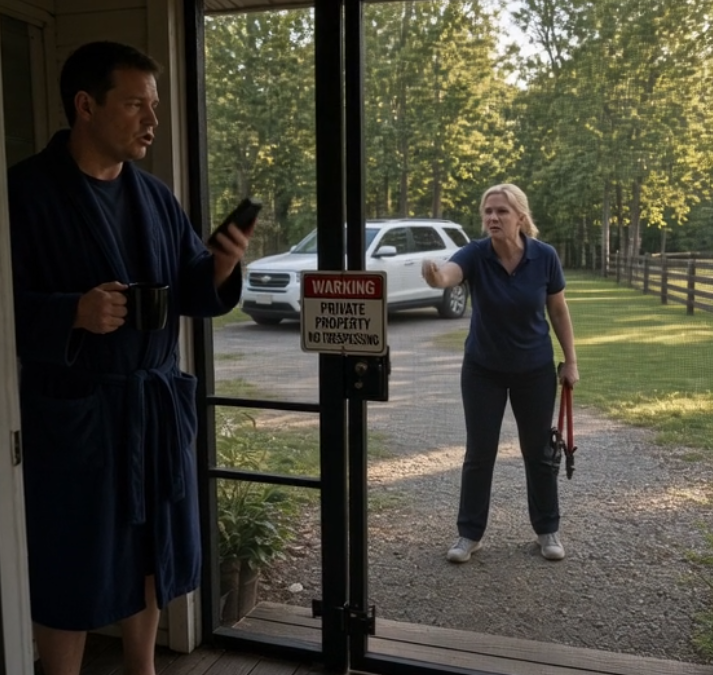
The ring camera above the gatepost had caught everything.
Her name.
Her title.
The attempted cutting of the lock.
The threat of fines.
The threat of a lien.
The threat to call the sheriff.
The word squatter.
The admission that she believed she could force access over my recorded property because people in Maple Crest had been using it long enough to convince themselves that habit had become law.
I walked down in my slippers, picked up the bolt cutters, and carried them back to the porch.
They were heavy, cheap, and almost new.
I set them on the kitchen table beside the manila envelope.
Inside that envelope were the documents Janine Whitmore should have opened months ago.
The recorded deed to my four-acre parcel.
The county-stamped 1998 plat of Maple Crest.
The gate permit.
The quiet title judgment entered by default in March.
The green return-of-service card stapled to the back.
Her signature was on that card in blue ballpoint pen.
Janine Whitmore had already been served.
Janine Whitmore had already ignored the court.
Janine Whitmore had already lost.
She just did not know it yet.
I made another coffee.
Then I sat at my kitchen table, listening to the old refrigerator hum and the house creak in the early sun, and I thought about Ruth Calloway.
Ruth had owned this land before me.
She was seventy-eight when she sold it. A widow. Small hands. Silver hair. A voice that had grown careful from years of being talked over. The first time I met her, she apologized three times before we reached the back fence. She apologized for the weeds. She apologized for the old barn leaning ten degrees to the east. She apologized for walking slowly.
I told her we had all day.
She looked at me then like she was deciding whether to believe kindness still existed when it was not trying to sell her something.
The day we closed, after the title officer had gathered papers and slid keys across the table, Ruth held my hand with both of hers and asked me one thing.
Not for more money.
Not for more time.
Not for help moving boxes.
She asked, almost whispering, “Please don’t let her win this time.”
Her daughter, Ellen, looked away when she said it. Not because she was embarrassed by her mother, but because she had heard that plea too many times in too many forms. Please make them stop. Please tell them I’m allowed to close my own gate. Please explain that I am not part of their neighborhood. Please tell me I am not crazy.
I had given Ruth my word.
Now Janine Whitmore had stood at my gate in an HOA polo, screaming about a shortcut that was never hers.
She did not know I had already settled that question with the county.
She did not know she had signed for the papers herself.
And she did not know that her favorite shortcut had ended the moment the steel gate closed.
My name is Thomas Mercer.
Most people call me Tom.
I am sixty-one years old, retired after thirty years of land surveying in Hollow County. I spent my working life walking boundary lines, pulling old plats, reading deeds, marking corners, settling fence disputes, and explaining to angry people that their memory of a property line was not a legal description.
I have been screamed at by farmers, developers, heirs, contractors, brothers, sisters, widows, hunters, real estate agents, and men with more confidence than paperwork.
After thirty years, I learned one thing about land that most people never understand until it costs them money.
The dirt does not care what you think you own.
It only knows what is written down.
Janine Whitmore thought she owned a shortcut because people had been using it for years. She thought habit could become law simply because she said it loudly enough. She thought fear could become authority if printed on HOA letterhead.
She was wrong about all of it.
The parcel I bought from Ruth Calloway sat just south of Maple Crest.
Four acres.
Old farmhouse.
A stand of oaks.
A back trail that cut through the woods and connected two bends of County Road 14.
On paper, it was simple.
Parcel 142-3804.
Outside Maple Crest.
Outside the HOA.
No recorded easement.
No access agreement.
No covenant.
No shared maintenance.
No membership.
No dues.
No authority.
On the ground, it was messier.
For thirteen years, Maple Crest residents had been cutting through Ruth’s land.
At first, it was just a boy walking to the school bus stop. His mother had asked. Ruth had said yes.
That mattered more than anyone in Maple Crest understood.
The boy brought friends.
Friends brought parents.
Parents brought joggers.
Joggers brought dog walkers.
Dog walkers brought golf carts.
Then came the SUVs.
By the time Ruth realized her quiet trail had become the unofficial back entrance for the north end of Maple Crest, the shortcut had a name on neighborhood Facebook groups.
Ruth’s Cut.
People posted traffic updates.
People warned each other when the trail was muddy.
People complained when low branches scratched their paint.
People asked if someone could “do something” about the roots near the bend.
People began treating Ruth’s land like public infrastructure.
Ruth tried to stop it.
She put up a small wooden sign.
PRIVATE PROPERTY.
NO THROUGH TRAFFIC.
Someone tore it down within a week.
She put up another one.
That one disappeared too.
Then she called the HOA, even though she was not a member and had never paid dues. She asked them to tell their residents to stop driving across her land.
That was when Janine Whitmore came to her front door with a clipboard.
Ruth told me that story the first day I walked the land with her. We had reached the back fence when she had to sit down on an old stump and rest. She apologized for needing to sit.
I told her again that we had all day.
We sat under the trees for nearly an hour while she told me what Maple Crest had done.
Janine had stood on her porch, Ruth said, and explained in a calm executive voice that the shortcut was a historic community access. She said Ruth had no right to close it. She said the HOA had recognized the path as part of the neighborhood’s essential circulation pattern. Then she handed Ruth a printed notice fining her four hundred dollars for obstructing community access.
Ruth paid.
She was seventy-two then.
Alone.
Afraid.
Still grieving her husband.
She did not know that an HOA cannot fine an outsider over land outside its declaration. She did not know the difference between a recorded easement and a phrase Janine had invented. She only knew Janine sounded certain.
That was the first fine.
There were eight more over four years.
Vegetation obstruction.
Unauthorized signage.
Interference with resident access.
Failure to maintain safe trail conditions.
Hazardous low limbs.
Unapproved barrier placement.
Noncompliant gravel surface.
Ruth paid almost three thousand dollars she did not owe.
She paid because Janine used words like lien, court, foreclosure, enforcement, and noncompliance.
Words can become weapons when handed to someone who has never been shown the shield.
By the time I met Ruth, the file in her kitchen drawer was three inches thick.
All void.
Every notice.
Every fine.
Every threat.
The HOA had no authority over Ruth’s parcel.
None.
I did not buy Ruth’s property because I wanted a fight.
I bought it because I liked old houses, old oaks, quiet mornings, and land whose corners I could still find without arguing with a developer’s lawyer. After my wife Elaine died, I stayed too long in a house that belonged to both of us. Every room had become a memory trap. Her gardening gloves by the mudroom door. The blue mug she used every morning. The porch swing where she read crime novels and pretended not to cry during sad parts.
For two years after she passed, I lived like a caretaker of a life that had already ended.
Then Ruth’s parcel came up for sale.
I knew the land. Everyone who had worked surveys in Hollow County knew it. Four acres of stubborn woods wedged between a subdivision and an old county road. Too small for farming. Too awkward for a developer. Too valuable to be ignored by people who thought every patch of dirt should serve someone richer.
I walked it once and felt something in my chest loosen.
The house needed work. The porch sagged. The upstairs smelled like old wallpaper. The barn roof leaked. But the oaks were magnificent. The back trail curved through shade and fern and red clay. The property had a tired dignity to it, like an old dog that had been kicked too many times but still lifted its head when a kind person entered the room.
Ruth watched me notice the tire ruts.
“They use it all day,” she said quietly.
“Who?”
“Maple Crest.”
I looked north through the trees. I could hear a golf cart before I saw it, whining over the trail like it belonged there. A man in sunglasses drove past with a dog in the passenger seat. He raised two fingers at Ruth like she was the one passing through his land.
Ruth lowered her eyes.
That gesture decided something in me before I admitted it.
The first thing I did after signing the closing papers was pull the original Maple Crest plat.
I knew exactly where to find it because I had surveyed Maple Crest in 1998 as a junior on a three-man crew.
My supervisor’s signature was in the corner.
My initials appeared on three pages of field notes.
I remembered the heat that summer. The ticks. The red clay. The way the developer had complained about every oak tree that complicated his roads. I remembered standing in that same tree line as a younger man, holding a prism pole and sweating through my shirt while the developer asked my supervisor if there was “any creative way” to show access through the Calloway parcel.
My supervisor, Daniel Brooks, had been sixty-four, sunburned, and impossible to impress. He chewed peppermint gum and believed every bad development began with the phrase “creative way.”
He told the developer, “Not unless Mrs. Calloway signs an easement.”
“She won’t,” the developer said.
“Then there isn’t.”
That was that.
The recorded plat showed the subdivision boundary clearly.
Maple Crest ended at the north line of Ruth’s parcel.
No easement crossed her land.
No access strip.
No reservation.
No trail.
No note.
Nothing.
In plain English, an easement is a recorded legal right to use someone else’s land for a specific purpose. It should be written down and filed with the county.
There is another type called a prescriptive easement. That one can sometimes arise after years of open, continuous, hostile use.
But the key word is hostile.
Not angry.
Not violent.
Unauthorized.
The use has to be without permission.
Ruth had given permission to the first boy’s mother in 2011. That single neighborly yes mattered. It meant the use began as permissive. Permissive use does not ripen into a legal right.
Not after five years.
Not after thirteen.
Not after a hundred.
Janine Whitmore’s whole kingdom had been built on Ruth being kind once.
I almost laughed when I found the answer.
Then I did not.
Because the law is one thing.
A bully with a clipboard is another.
Janine would not be argued out of her shortcut. She would not be persuaded by a friendly letter. She would not be reasoned with at a meeting.
People like Janine do not lose arguments.
They have to be removed from them.
So I filed a quiet title action.
A quiet title action asks a court to settle any disputed claims against property. I named every possible claimant.
Maple Crest HOA.
The board.
Janine Whitmore in her capacity as president.
Any unknown persons claiming an access right over parcel 142-3804.
The sheriff’s deputy served Janine at her home on March 12 at 2:14 p.m.
She signed the return card in blue ink.
According to the deputy, she glanced at the envelope, laughed once, and tossed it onto a foyer table without opening it.
She had thirty days to respond.
She did nothing.
On the thirty-first day, the judge entered default judgment.
The order was two pages long.
It stated that no easement, recorded or prescriptive, existed across my parcel.
It stated that Maple Crest HOA had no access rights across parcel 142-3804.
It stated that future attempts by Maple Crest HOA, Janine Whitmore, or persons acting under HOA authority to assert such a right could constitute clouding title and may give rise to slander of title liability.
I recorded the judgment.
Then I waited.
Two weeks later, I pulled a county permit for a residential security gate.
I hired a contractor.
We installed the gate in broad daylight with the permit taped to the post.
For three weeks, the gate stood quietly.
No one came.
No one knocked.
No one asked.
Then Janine Whitmore showed up at 6:42 a.m. with bolt cutters and a speech.
She was not fighting over the shortcut anymore.
She was fighting over the story she had told herself about who she was.
Two hours after she drove away, the sheriff arrived.
Not with sirens. Not with drama. Just Deputy Alan Price in a brown cruiser, rolling slowly down my gravel drive like he already knew this call had more paperwork than danger.
Alan had worked Hollow County long enough to have delivered bad news to half the roads on his route and speeding tickets to the other half. I knew him from survey disputes, hunting boundary complaints, and one memorable case involving a neighbor who moved a fence six feet during a rainstorm because he thought mud would hide the evidence.
He stepped out of the cruiser, glanced at the gate, glanced at the bolt cutters on my porch table, and sighed.
“Morning, Tom.”
“Alan.”
“Mrs. Whitmore called.”
“I assumed.”
“Says you blocked an established emergency access and threatened her when she tried to inspect it.”
I lifted my coffee.
“My robe is intimidating before breakfast.”
He almost smiled.
“Mind walking me through it?”
I handed him a printed copy of the quiet title judgment first. Then the deed. Then the gate permit. Then I showed him the video.
We stood on my porch while Janine’s voice came through my phone speaker.
Squatter on HOA-protected land.
Two hundred fifty dollars a day.
You will not be able to sell this house in this county.
Alan watched without interrupting.
When the video ended, he rubbed one hand over his jaw.
“She brought bolt cutters?”
“She left them.”
“Did she cut anything?”
“Tried. Failed.”
“Do you want to pursue attempted vandalism?”
“Not today.”
He looked at me.
“Tom.”
“I know.”
“You’re giving her room.”
“I’m giving the board rope.”
Alan studied the gate again.
“You always did like clean corners.”
“I like recorded ones.”
He nodded and took photographs for his report. Then he asked if he could retain the bolt cutters as evidence if things escalated. I told him yes. He bagged them, tagged them, and placed them in his cruiser.
Before leaving, he paused near the gate.
“You know she told dispatch this was HOA land?”
“She believes many things.”
“No,” Alan said, looking back at me. “She performs belief. That’s different.”
He was right.
Two days after the bolt cutters, Janine came to my front door.
This time, she brought a man with her.
Late forties. Khakis. Polo shirt. Folder in hand. Tired eyes.
I later learned his name was Brent Halloran, Maple Crest’s vice president.
Janine rang the bell three times in a row before I could come around from the side yard. When I stepped onto the porch behind her, she turned sharply. For half a second, she lost the advantage she thought she had created.
Then she recovered.
“Mr. Callaway,” she said, reading from a printed page, “as president of Maple Crest Homeowners Association, I am hereby serving you with a formal notice of violation.”
“My name is not Callaway.”
She paused.
Brent winced.
“Then perhaps you can clarify it for the record.”
“I would rather not.”
She pushed forward because forward was the only direction Janine understood.
She read the notice aloud.
Unauthorized obstruction of community access.
Two hundred fifty dollars per day beginning Monday.
Failure to cure within thirty days would result in a lien against the property.
She held out the paper.
I did not take it.
“Which page of your CC&Rs lists my parcel?”
She blinked. “Excuse me?”
“Your declaration. Which page lists my parcel?”
“That is not how this works.”
“What lot and block?”
“Mr.—”
“When was it annexed?”
Silence.
“It is the spirit of the document,” she said.
“That is not a page number.”
Brent looked at the porch railing.
He had probably tried to find my parcel in the HOA book and failed.
He had failed because it was not there.
“I am not debating technicalities on your porch,” Janine said. “The notice is served.”
“Leave it on the table.”
“What?”
“The notice. I will respond in writing.”
For a second, I thought she might refuse.
But the performance required paperwork.
She placed the notice carefully on the small side table near the door.
“You are making a serious mistake.”
“Noted.”
“I will call the sheriff again.”
“Please do.”
“I want you to understand that the community has rights.”
“Rights are written down.”
“You do not get to buy a piece of dirt and declare yourself a king.”
I did not answer.
She turned to leave.
Then, as I expected, she turned back.
People like Janine always need one more line.
“You have seven days, or we put a lien on this property. Do you understand me?”
I looked at Brent first.
Not her.
Him.
Because he was still reachable.
“I understand you perfectly.”
Janine held my eyes for one more second, decided she had won, and marched back to her SUV.
Brent followed half a step behind her.
When they left, I checked the porch camera.
It had recorded everything.
Name.
Title.
Fine schedule.
Lien threat.
A witness.
I picked up her notice and read it twice.
No parcel number.
No statutory citation.
No board authorization.
No legal authority.
It was three paragraphs of confident threats on official-looking letterhead.
The kind of paper that ruins scared people.
The kind Ruth had paid for years.
I slid it into a clear sleeve and added it to the manila envelope.
The folder was getting heavier.
Friday evening, Frank Riley came over with a six-pack and a folder of his own.
Frank lived on the Maple Crest corner lot closest to my parcel. Retired electrician. Late sixties. Soft-spoken. He had waved at me a few times across the fence, but we had never shared more than a nod.
That evening, he stood at the bottom of my porch steps and lifted the beer.
“You drink beer?”
“On Fridays.”
“Mind if I sit a minute?”
I opened the gate and let him through.
He climbed the porch steps and set his folder beside the six-pack. He did not open it right away. Some conversations need a bottle in hand before they can begin.
“I owe you an apology,” he said.
“For what?”
“For not coming over thirteen years ago.”
He looked toward the black steel gate where the dirt trail now ended.
“Ruth was a friend of my wife. Before Carol passed. They did church craft fairs together.” He rubbed the label off his bottle with his thumb. “I knew what Janine was doing. We all knew.”
“All?”
“Enough of us.”
“Why didn’t anyone stop it?”
Frank’s mouth twisted.
“Because anyone who crossed Janine got letters, fines, and threats. She ran that board like a courtroom where she was judge, clerk, and executioner.”
He opened the folder.
Inside were photographs.
Janine’s white SUV crossing Ruth’s land.
Janine jogging on the trail with a stopwatch.
Janine mowing part of Ruth’s property like it belonged to her.
Janine’s SUV again, spraying mud near Ruth’s fence after a rain.
Twelve photographs.
Dated.
Printed.
Below them were three letters from Ruth to the Maple Crest board.
Thin handwriting.
Increasingly tired.
Each letter asked the board to stop residents from driving across her property.
The last one mentioned Ruth’s grandson, Asher.
“That last letter,” Frank said, “came after Janine almost hit him.”
I looked up.
“He was seven,” Frank said. “Coming back from the bus stop. Janine took the shortcut too fast. Asher dove into the brush. Bumper missed him by maybe a foot.”
I felt something cold move through me.
“Was there a police report?”
“Ruth didn’t want trouble. She was scared they’d make it worse.”
“She wrote the board?”
“She begged them to put a chain across the trail. Offered to pay for it herself.” Frank took a long drink. “Janine tabled the motion. Then killed it in committee. Six to one.”
I placed the 1998 plat on the porch table and traced the boundary.
“Maple Crest ends here. The trail is here. On my side. Always has been. Every fine they issued against Ruth was void the day it was written.”
Frank stared at the map.
“Void?”
“Void.”
“She paid almost three thousand dollars.”
“I know.”
“She did not have three thousand dollars.”
“I know.”
Frank set his beer down.
For a moment, I thought he might cry.
Then he drank half the bottle and set it down again.
“What do you need from us?”
“The next HOA meeting.”
“Tuesday. Seven p.m. Clubhouse.”
“I need you there. I need those photos. I need Ruth’s letters. And I need anyone else Janine has bullied to show up.”
“They do not have to make speeches?”
“No. They just have to be in the room.”
Frank nodded.
“What is coming?”
“A correction.”
He looked toward the gate.
“That is thirteen years late.”
The week before that meeting, Maple Crest began to split open.
Not loudly at first. Neighborhoods rarely confront their own rot in public right away. They whisper. They text. They forward screenshots with question marks. They say things like, “Have you heard?” and “Is this true?” and “I always wondered about that trail.”
Frank did what quiet men do when they finally decide to stop being quiet.
He made phone calls.
He visited porches.
He asked people to look through old folders.
Doris Mayfield found the letter Janine had sent her fining her one hundred dollars for allowing grandchildren to draw chalk flowers on the sidewalk during a Memorial Day cookout.
A retired veteran named Hank Bell found three notices about the American flag on his porch because the pole bracket had been “nonconforming brushed brass.”
A young couple, Eli and Marissa Tran, found the certified letter Janine sent threatening fines over a backyard vegetable garden no one could see from the road.
None of those had anything to do with my gate.
All of them had everything to do with Janine.
Power does not usually start with bulldozers or bolt cutters. It starts with small humiliations people swallow because fighting seems harder than paying. A fifty-dollar fine. A threatening letter. A meeting where someone smiles while lying. A neighbor who says, “Just let it go.” A board that looks away because peace feels easier than courage.
Janine had built her rule on that.
But the gate changed something.
A closed gate gives people a shape for what they feel.
By Tuesday evening, Frank had done his work.
I walked into the Maple Crest clubhouse as his guest.
That mattered.
I was not a member, but the bylaws allowed members to bring guests. Janine had drafted that section herself in 2017 after she wanted to bring a landscape consultant to a meeting where residents opposed replacing old maples at the entrance.
Rules have a way of outliving intentions.
The room held about forty folding chairs.
Nearly every one was full.
Doris was there.
Hank Bell was there.
Eli and Marissa were there.
Frank sat in the second row with his folder.
The residents did not cluster. They sat apart, quiet, watching one another with the nervousness of people who had all been afraid alone and were just discovering they had company.
Janine sat at the head table.
Brent Halloran sat beside her.
Three other board members lined the row.
One of them was Margaret Voss, silver-haired, glasses on a chain, the kind of woman who looked like she read every document before signing anything and silently judged those who did not.
Janine called the meeting to order at 7:02.
She moved through the minutes, the treasurer’s report, landscaping, mailbox repainting, and a complaint about basketball hoops being left in driveways overnight. Her voice was smooth. Controlled. President-like. If you had not seen her swing bolt cutters at my gate, you might have believed she was reasonable.
Then she paused.
“Before new business, I want to update the membership on a serious matter.”
She did not look at me.
The room did.
“The owner of the parcel adjacent to our north boundary has installed an unauthorized barrier obstructing a long-standing community access route. He has refused to remove it. He has harassed members of this board. And on Saturday, he caused your HOA president to be subjected to a hostile interaction with a county sheriff’s deputy.”
I sat still.
Frank sat still.
Janine lifted a printed resolution.
“I am introducing Resolution 24-09, authorizing the board to spend up to forty thousand dollars from reserves to retain counsel and pursue civil action for obstruction of community easement and emotional damages.”
Emotional damages.
That one was new.
“Are there questions before we vote?”
A man in the fifth row stood.
“Where is the easement recorded?”
Janine smiled tightly.
“It is a historic community access.”
“That is not what I asked. What book and page?”
A younger woman raised her hand.
“And what parcel is it on? Is it association property?”
“It is adjacent to association property,” Janine said.
“So it is not in Maple Crest.”
The room shifted.
Janine had not expected questions.
For thirteen years, Maple Crest meetings had been ceremonies of obedience. Janine spoke. People complained privately. The board voted. Letters went out.
Now the chairs were creaking.
People were looking at one another.
“The board has reviewed the matter thoroughly,” Janine said. “I call for a vote.”
“Madam President.”
It was Brent.
Janine turned as if he had spoken out of turn at a funeral.
“Yes, Brent?”
“I would like the board to clarify jurisdiction before voting to spend forty thousand dollars.”
Her eyes narrowed.
“I tried to find the parcel in our declaration,” Brent continued. “I could not.”
“Brent, this is not—”
“I have a fiduciary duty to the association,” he said, voice shaking but still moving forward. “I will not vote yes on legal fees over property I cannot confirm we have authority over.”
The silence that followed was the sound of a wall cracking.
Janine recovered.
She always did.
“Fine. We will table the funding question and proceed with a non-binding membership vote endorsing legal action.”
She lifted the paper again.
“All in favor—”
“Madam President,” I said.
I did not stand.
I did not raise my voice.
But in a quiet room, certain words travel.
Janine looked at me directly.
“Sir, this is a closed membership meeting. You are not a member. You have no standing.”
“I am Mr. Riley’s guest under Section 4.3 of the bylaws you drafted in 2017.”
Two residents checked their phones.
Janine’s mouth tightened.
“Even so, you have no right to interrupt.”
“Before the vote, there is one document the board has not seen. I would like to give it to you. After that, you can vote however you like.”
I held up a sealed manila envelope.
Margaret Voss leaned forward.
“What is in the envelope?”
“A recorded court order. Six months old.”
Margaret looked at Janine.
“I think we should see it before we vote.”
“We do not need to entertain documents from non-members,” Janine snapped.
“I would like to see it,” Brent said.
“So would I,” Margaret said.
“Me too,” said another board member.
Three of five.
Janine could count.
She set down her gavel.
“Bring it forward.”
I walked down the center aisle and placed the sealed envelope in front of Margaret.
Then I returned to my seat.
The room was silent except for the ceiling vent.
Margaret opened the envelope and read for fifteen seconds.
Then she looked at Janine.
“Did you know about this?”
Janine did not answer.
Margaret put on her glasses and addressed the room.
“For the membership’s benefit, this is a recorded order from county district court dated March seventeenth. It is captioned in the matter of quiet title to parcel 142-3804, County Road 14. The named respondents include Maple Crest Homeowners Association and Janine Whitmore in her capacity as president.”
The room shifted again.
Heavier this time.
Margaret continued.
“The order is a default judgment entered because no response was filed within the statutory thirty-day period. The court finds that no easement of any kind, recorded or prescriptive, exists across the subject parcel. The court further states that any future assertion of such a claim by the named respondents may constitute clouding of title and may give rise to slander of title liability.”
She lowered the paper.
“Janine, this names you personally. Were you served?”
Janine opened her mouth.
“There must have been a clerical—”
I stood.
“With permission.”
Margaret nodded.
I held up a laminated card.
“This is the return-of-service card. Signed March twelfth at 2:14 p.m. at Mrs. Whitmore’s residence. The signature is in blue ink. I ask the board to compare it to the signature on Resolution 24-09.”
Margaret waved me forward.
I placed the card beside the resolution.
She compared the signatures.
So did Brent.
So did the rest of the board.
No handwriting expert was needed.
“Janine,” Margaret said, “this is your signature.”
“That is not—”
“This is your signature.”
Janine had no answer.
Most people imagine these fights ending in dramatic cross-examinations. They imagine a judge pounding a gavel while someone breaks down in tears.
In real life, many collapses happen quietly.
Under fluorescent lights.
At a folding table.
With one document the wrong person never bothered to open.
Margaret picked up Resolution 24-09 with two fingers, as if it had become dirty.
“In light of this judgment, I move to withdraw the resolution.”
“Second,” Brent said immediately.
“All in favor?”
Four hands rose.
Janine did not vote.
“Resolution withdrawn.”
I was not finished.
“Madam Chair, there are three more documents the board should see. I will be brief.”
Margaret nodded.
I held up the 1998 plat.
“This is the recorded plat for Maple Crest. It defines this association’s boundary. My parcel is not on it. I know this because I was one of the surveyors who walked the field notes in 1998. My initials are on three pages.”
Brent closed his eyes.
He understood then.
Janine had spent months trying to weaponize an HOA against the man who had helped survey the subdivision she governed.
I held up the notice she had hand-delivered.
“This is the violation notice Mrs. Whitmore gave me eleven days ago. It threatens daily fines and a lien on a parcel the HOA has no jurisdiction over. In this state, knowingly asserting a false claim against title can become very expensive.”
Then I held up Deputy Price’s incident report.
“This includes Mrs. Whitmore’s statement on body camera that she personally drove across my parcel every day for ten years and that no one gave her permission.”
Janine’s head snapped up.
“That statement does not create an easement,” I said. “It is a sworn admission of trespass.”
I placed the documents on the table.
Then Frank Riley stood.
He held one of Ruth’s letters.
“This is from Ruth Calloway,” he said. “Dated 2020.”
His voice shook once at the beginning, then steadied.
He read only the last paragraph.
“I have asked you four times now in writing to please tell people not to drive through my yard. I am seventy-six years old. My husband died in this house. I do not have the strength to fight a homeowners association I have never been a member of. Please. Please. Please.”
Frank folded the letter.
He sat down.
Doris covered her mouth.
Hank Bell looked at the floor.
Someone in the back whispered, “My God.”
Janine sat very still, but her face had changed. Not remorse. Not yet. Maybe not ever. It was calculation. She was looking for the door in the room, not the moral one. The escape route. The wording. The blame shift.
She found one.
“Ruth Calloway allowed access for years,” Janine said. “She benefited from community goodwill and then attempted to revoke a historic use after residents relied on it.”
Frank stood again.
“She was scared of you.”
Janine turned on him.
“Frank, you have always been emotional about this because of Carol.”
The room went cold.
Carol was Frank’s late wife.
Nobody moved.
Frank’s face did not redden. He did not shout. He simply looked at Janine with a sadness so complete it was worse than anger.
“My wife took Ruth to chemo appointments,” he said. “You fined Ruth while she was missing those appointments because she was too weak to answer the door.”
Janine looked away first.
That was when Doris stood.
Doris was small, round-shouldered, wearing a lavender cardigan buttoned crooked at the top. She looked like the kind of woman people talked over in grocery lines.
Not that night.
“You fined me over chalk drawings,” she said.
Janine’s lips tightened.
“That issue was resolved.”
“No. I paid it because I was afraid. My granddaughter drew flowers for Memorial Day. You said it lowered community standards.”
Hank Bell stood next.
“You fined me for flying the flag my son sent me from Afghanistan.”
“The bracket was not approved,” Janine said weakly.
“My son was dead.”
The room went silent again.
Hank’s jaw trembled.
“He was dead, Janine. That flag had been over his coffin. I put it on my porch because I could not breathe inside my own house. And you sent me a noncompliance letter.”
Janine had no answer for that either.
Eli Tran stood with Marissa’s hand in his.
“You threatened us over tomatoes,” he said. “You said food gardens attracted the wrong kind of attention.”
Marissa added, “You asked whether my family was used to different neighborhood standards.”
A murmur moved across the room.
Janine lifted both hands.
“This is becoming a personal attack.”
Margaret looked at her.
“No,” she said. “This is becoming testimony.”
That sentence changed the meeting forever.
For another forty minutes, residents stood one by one. Not all of them. Some people still looked at their laps. Some were not ready. Some perhaps had defended Janine too long to turn in public. But enough spoke.
A retired nurse fined for wind chimes her dead sister had given her.
A single father threatened over a basketball hoop his son used after school.
A young Black family repeatedly cited for “excessive gatherings” when relatives visited on Sundays.
A widower fined for letting his grass grow while he was recovering from heart surgery.
One story after another. Small cruelties. Petty humiliations. Letters that sounded official enough to make people pay rather than ask whether they had to.
By the end, Janine was not defending the shortcut.
She was defending thirteen years of fear.
Margaret finally tapped the table.
“This board will enter executive session immediately.”
Janine stood.
“As president, I object to this process.”
Brent looked at her.
“You are the process problem.”
No one clapped.
No one cheered.
It was better that way.
Some truths are too serious for applause.
The board entered executive session in the small office behind the meeting room. The residents stayed. People began talking quietly. Frank came to sit beside me.
“You okay?” he asked.
“No.”
“Me neither.”
After thirty-two minutes, the board returned.
Janine did not sit at the center this time.
Margaret did.
Her voice was steady.
“The board has voted four to one to remove Janine Whitmore as president, effective immediately, pending formal recall procedures under the bylaws. I will serve as interim president until a special election. The board is also suspending enforcement activity pending legal review of all current violation policies.”
Janine’s chair scraped back.
“You cannot do this.”
Margaret looked at the court order, Ruth’s letters, the plat, and the notice.
“We just did.”
Janine grabbed her bag.
Before leaving, she looked at me one last time.
“This is not over.”
I believed her.
That was why I had not played all my cards.
Within a week, Janine sent an email to half the neighborhood claiming she had been removed through an illegal ambush orchestrated by an outsider. She wrote that Maple Crest was under attack from “anti-community interests.” She described me as “a retired surveyor with a personal vendetta against planned neighborhoods.” She warned residents that losing Ruth’s Cut would lower emergency access, increase commute time, and reduce home values.
Then she made her most expensive mistake.
She wrote:
The owner of parcel 142-3804 has no right to block an established community easement, and buyers should be aware that the property is subject to ongoing access claims.
She sent it to residents.
She copied two local real estate agents.
One of them forwarded it to a title officer.
The title officer forwarded it to my attorney.
Her name was Ellen Park, and she had handled my closing. She was precise, polite, and entirely without patience for people who tried to cloud title after a court order told them not to.
She called me that afternoon.
“Tom, did you see the email?”
“I did.”
“You have a recorded judgment.”
“Yes.”
“She was named in it.”
“Yes.”
“She signed for service?”
“Yes.”
Ellen exhaled.
“All right. I am referring you to counsel.”
“I was hoping to avoid that.”
“You already avoided it. She refused to.”
My attorney, Grace Bellamy, was not dramatic. She had silver hair cut short, reading glasses on a chain, and a courtroom voice so soft people leaned in before realizing they had surrendered control of the room.
She reviewed the court order, Janine’s email, the violation notice, the body camera report, and the gate video.
Then she looked at me across her desk.
“Do you want revenge or correction?”
“Correction.”
“Good. Revenge is messy.”
“What does correction look like?”
“A retraction. Attorney’s fees. Recorded acknowledgment. Refunds to Ruth if we can document them. Board reforms. And Janine personally paying for the damage she caused if the facts support it.”
“Can you do that?”
Grace smiled faintly.
“Mr. Mercer, she kept writing things down.”
A preservation letter went out the next morning.
By then, Margaret had opened the HOA’s old files.
What she found was worse than anyone expected.
Ruth’s fine payments were all there.
Nine notices.
Nine checks.
Notes in Janine’s handwriting.
“Owner resistant but compliant.”
“Continue pressure.”
“Do not acknowledge nonmember issue.”
One email from Brent three years earlier asked whether the HOA had authority over Ruth’s parcel.
Janine replied:
The appearance of authority is sufficient if enforcement is not challenged.
That sentence did more than anger people.
It educated them.
The appearance of authority.
That was Janine’s whole system.
She did not need to be right. She needed people too tired, too grieving, too busy, too old, too scared, or too polite to force her to prove she was right.
Ruth had been all of those things at different times.
I took copies of the emails to Ruth at assisted living.
She lived forty minutes east of town in a facility with beige walls, cheerful staff, and windows overlooking a courtyard where someone had planted marigolds in straight lines. Ellen, her daughter, met me in the lobby.
“Mom has good days and tired days,” she said.
“What kind is today?”
“She’s been waiting by the window since breakfast.”
Ruth sat in a recliner with a crocheted blanket over her knees. She looked smaller than she had at closing, but her eyes sharpened when she saw me.
“Tom,” she said.
“Ruth.”
“Is the gate still up?”
“Yes, ma’am.”
“Good.”
I sat beside her and told her what had happened. Slowly. Carefully. Not all at once. I told her Janine came with bolt cutters. Ruth’s eyes widened at that, then narrowed.
“She always did like tools she didn’t understand,” Ruth said.
I told her about the court order being read aloud.
I told her about the board removing Janine as president.
I told her Frank had read her letter.
At that, her face changed.
“My letter?”
“The one from 2020.”
She looked toward the window.
“I was ashamed of that letter.”
“Why?”
“I begged.”
“No,” I said. “You documented.”
Her hands moved under the blanket.
“I wrote please three times.”
“They needed to hear it three times.”
She closed her eyes.
“Did people laugh?”
“No.”
“Did Janine?”
“No.”
“Good.”
Then I told her about the refund.
Ruth turned back.
“What refund?”
“The fines. Margaret found them. The HOA is returning the money.”
Ruth blinked.
“All of it?”
“All of it.”
Her mouth trembled.
“I paid those from Earl’s insurance money.”
Earl had been her husband.
“I know.”
“I told him I would be careful with it.” She pressed one hand to her chest. “I felt so stupid.”
“You were not stupid.”
“I was scared.”
“I know.”
“She made me feel like I had done something wrong by living in my own house.”
That sentence was the heart of it.
Not the shortcut.
Not the gate.
Not the money.
That.
A bully had made an old woman feel like an intruder on land she owned.
I leaned forward.
“Ruth, you asked me not to let her win this time.”
She looked at me.
“She didn’t.”
The tears came quietly.
Not loud.
Not theatrical.
Just breath moving through old hurt.
Ellen stood behind her mother’s chair and wiped her own face with both hands.
When Ruth could speak again, she said, “Read me the part Frank read.”
So I did.
The whole paragraph.
I have asked you four times now in writing to please tell people not to drive through my yard. I am seventy-six years old. My husband died in this house. I do not have the strength to fight a homeowners association I have never been a member of. Please. Please. Please.
When I finished, Ruth sat still for a long time.
Then she said, “I thought nobody heard me.”
“They heard you.”
“Late.”
“Yes,” I said. “Late.”
She nodded.
“Late is not never.”
The fallout took months.
It always does when a community has been trained to mistake fear for order.
Janine was formally recalled within thirty days. The vote was not technically unanimous because Janine voted against it and three households abstained, but every valid vote for removal counted the same. Brent voted to remove her. Frank voted. Doris voted. Hank Bell voted. Eli and Marissa voted. People who had never attended a meeting in years showed up with folding chairs from home because the clubhouse ran out.
Margaret Voss became interim president.
Her first act was to issue a formal written retraction of the violation notice against me.
Her second was a public apology to me and to Ruth Calloway.
Her third was to order refunds for improperly issued fines.
Doris got her chalk fine back.
Hank got his flag fine back.
Eli and Marissa got the vegetable garden money back.
Ruth received the full amount Janine had taken from her over the years, plus interest approved by the board after Margaret said, “Returning stolen peace at face value is not enough.”
That line made me like her.
Under the quiet title judgment and the later settlement, Janine personally paid my attorney’s fees.
Eleven thousand four hundred dollars.
The HOA did not pay it.
Janine did.
The slander of title threat was referred to the state real estate commission because Janine held a part-time real estate license she used to refer neighbors to agents.
I never asked what happened.
Some doors can close without you standing there to watch.
Maple Crest amended its bylaws three months later. Any board action claiming authority outside the recorded boundary now required a written opinion from outside counsel. Any fine over one hundred dollars required two board signatures and a documented covenant reference. Any lien threat required legal review. Guest complaints had to include parcel identification, governing authority, and appeal rights.
Frank Riley was elected to the board with the highest turnout in neighborhood history.
Brent stayed on too.
He became the kind of vice president every HOA should have.
The annoying one who asks, “Where is that written?” before anyone votes.
As for the shortcut, it changed faster than people expected.
Without tires, the ruts softened.
Grass came up in the center.
Leaves gathered where SUVs used to throw dust.
The packed clay loosened after the first hard rain.
By spring, ferns returned near the low bend.
By summer, two deer began bedding down where golf carts used to pass.
A trail is not always a road.
Sometimes it is a wound people keep reopening because it saves them three minutes.
One Saturday in May, Ruth’s daughter brought her by to see the gate.
I had asked first. I did not want to pull an old woman back through pain for my idea of closure.
But Ruth wanted to come.
Ellen helped her out of the car. Ruth stood with a cane in one hand and my arm under the other. She looked at the black steel gate for a long time.
“It’s pretty,” she said.
“It is practical.”
“Men always say that when something is pretty but expensive.”
I laughed.
She reached through the bars and touched the lock.
“Did she damage it?”
“No.”
“Good.”
“She tried.”
“I imagine she did.”
We walked slowly to the porch. Ruth wanted to see the kitchen one more time. I had changed some things, but not everything. The old yellow cabinets were still there. The window over the sink still framed the oaks. The mark on the pantry door where Ruth had measured Asher’s height remained untouched.
She noticed.
“You kept it.”
“It belongs there.”
Her fingers hovered over the pencil lines.
“Asher is fourteen now,” she said.
“I know.”
“He asked if the gate means nobody can cut through anymore.”
“It does.”
“He said good.”
Ruth smiled.
Then she turned to me.
“I was afraid selling meant running away.”
“No.”
“What does it mean?”
“It means you handed the fight to someone less tired.”
She looked out the kitchen window toward the trees.
“I used to love this house.”
“You can still love it.”
“It hurt to love it at the end.”
“I know.”
She nodded, then touched the counter once with her fingertips.
“Take care of it, Tom.”
“I will.”
“And don’t let the oaks fall unless they have to.”
“I won’t.”
“And if Janine comes back?”
I smiled.
“The gate is still practical.”
Ruth laughed then, a small bright sound that seemed to surprise even her.
A month later, I hung the bolt cutters on a nail in my garage beside a framed copy of the 1998 plat.
A private joke.
A reminder.
The manila envelope went into a kitchen drawer.
Deed.
Plat.
Judgment.
Green card.
Her signature.
I did not need it on the porch table anymore.
The gate held itself.
Of course, not everyone in Maple Crest became kind overnight. That is not how people work. Some residents still grumbled that losing Ruth’s Cut added four minutes to their drive. One man wrote a long post online about “outsiders destroying neighborhood connectivity.” Someone else complained that the gate looked “unwelcoming.”
Margaret replied publicly with one sentence.
“Private property is not required to welcome trespass.”
That post received eighty-three likes.
Frank printed it and taped it to his refrigerator.
The strangest apology came from Brent.
He stopped by one afternoon carrying a small box of old field notes he had found in HOA storage. Some were copies from the original Maple Crest development file. He thought I might want them because my initials appeared on several pages.
He stood on my porch, uncomfortable in the honest way decent men get when they have waited too long to become decent.
“I should have challenged her earlier,” he said.
“Yes.”
He looked at me, accepting the hit.
“I suspected she was wrong.”
“Yes.”
“But she always made everything sound urgent. Dangerous. Like if we didn’t back her, the whole neighborhood would fall apart.”
“That is how people like Janine keep power.”
“I know that now.”
“Knowing later is expensive.”
He nodded.
“I’m sorry.”
It was not a perfect apology. Those do not exist. But it was plain. No passive language. No “mistakes were made.” No “if you were offended.”
Just two words.
I accepted them.
“Do better on the board,” I said.
“I will.”
He turned to leave, then stopped.
“Tom?”
“Yes?”
“Why didn’t you just show her the court order at the gate that morning?”
I looked toward the black steel gate at the end of the trail.
“Because Janine already had it.”
He understood after a second.
“She needed an audience.”
“No,” I said. “The truth did.”
Summer came heavy and green.
The oaks filled out. The porch rail finally got repaired. I planted tomatoes where Ruth’s old herb bed had gone wild. The first one ripened in late July, split from rain, ugly and sweet.
Some evenings, I walked down to the gate at sunset and stood beside it.
Maple Crest was quiet on the other side.
No SUVs.
No joggers pretending not to see my house.
No dog walkers drifting through with headphones.
No golf carts whining over my dirt.
No HOA president with a clipboard.
Just black steel, county permit sticker, and the sound of wind in the oaks.
At first, I thought I walked there to make sure the gate was still closed.
Then one evening I realized I walked there because I liked seeing the land heal.
Grass where ruts had been.
Moss on the shaded side.
Leaves gathering undisturbed.
A rabbit near the bend.
The woods remembering itself.
That is what people like Janine never understand. Property is not just a thing owned on paper. It is where grief sits. Where children grow. Where husbands die. Where widows try to feel safe. Where old men start over. Where kindness can be abused if no one defends it.
Ruth had said yes once to a boy walking to a bus stop.
That yes was generous.
Maple Crest turned it into entitlement.
Janine turned entitlement into enforcement.
And for thirteen years, nobody with enough strength stood between her and the woman she was hurting.
I do not pretend that I fixed everything. I came late too. Ruth had already sold the house. She had already paid the fines. She had already spent years listening for tires in her yard. Justice after harm is not the same as protection before it.
But late is not never.
The last time I saw Ruth, she was sitting in the courtyard at assisted living under a red umbrella, watching two sparrows argue over crumbs. She was thinner. More tired. But when I sat beside her, she smiled before I said a word.
“Gate still up?” she asked.
“Still up.”
“Good.”
“Trail’s growing over.”
“Better.”
“Janine’s gone from the board.”
“Best.”
I handed her an envelope. Inside was a photograph of the gate in late afternoon light, the black bars bright along the edges, the oaks beyond it thick and green.
She studied it for a long time.
Then she said, “That looks like peace.”
I had thought it looked like a gate.
But Ruth was right.
A few weeks later, Ellen called to tell me Ruth had passed in her sleep.
I went to the service.
So did Frank.
So did Margaret.
So did Hank and Doris and Eli and Marissa.
No one from Maple Crest spoke during the service, because it was not our place. But afterward, in the church hall, Frank gave Ellen a check from the HOA’s restitution fund representing the final corrected interest payment. Ellen cried. Margaret cried too. Even Brent, who had come and stood quietly near the coffee urn, wiped his eyes when he thought nobody was watching.
I went home that afternoon and walked straight to the gate.
For a while, I just stood there.
Then I opened it.
Not for Maple Crest.
Not for traffic.
Not for convenience.
For Ruth.
I walked the old trail from end to end, slowly, remembering where the ruts had been deepest, where the low branch had scratched SUVs, where Asher had jumped into the brush, where Ruth had stood years earlier trying to explain to people who would not hear her that this was hers.
At the far bend, I stopped and looked back toward the farmhouse.
The trail was almost gone.
Not erased.
Healing.
There is a difference.
I closed the gate behind me when I returned.
The lock clicked with a sound so small and final it felt like a period at the end of a sentence Ruth had been trying to write for thirteen years.
Janine called it her favorite shortcut.
Ruth called it her land.
The county calls it mine.
The gate calls it closed.
And every time the wind moves through those oaks, I think about the morning Janine Whitmore swung bolt cutters at hardened steel, believing force could cut through ownership, fear could outrun paperwork, and a loud lie could survive forever if enough people repeated it.
She was wrong.
Some truths sit quietly in drawers.
Some wait in courthouse records.
Some hang on garage walls beside cheap bolt cutters.
And some stand nine feet wide at the edge of the woods, black steel in the evening light, reminding everyone who passes by that the dirt never belonged to the loudest person.
It belonged to the one whose name was written down.

