The HOA Called 911 on My Garage Dinner—They Didn’t Know the Man Flipping Burgers Had Trained the Police Chief
PART3:
Everything in my garage was exactly what it looked like.
Neighbors.
Food.
Children.
Chairs.
A grill.
The only hidden thing in that driveway was Karen Mitchell’s assumption that nobody there knew the law better than she did.
And assumptions like that are expensive.
The dispatcher must have asked her to stay on scene.
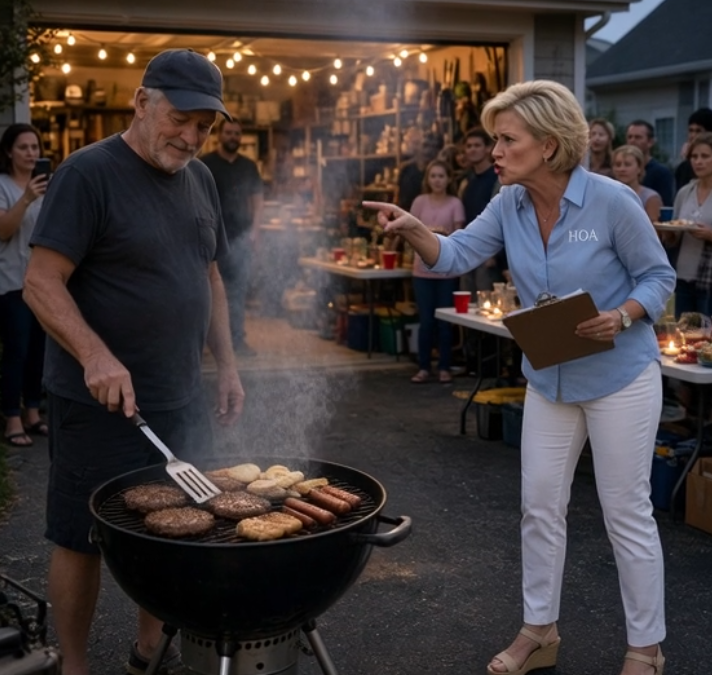
Karen smiled.
“I am staying right here,” she said.
Then she hung up and turned to the crowd.
“The police are on their way.”
Nobody answered.
That silence bothered her.
Karen liked fear with sound in it.
Stammering.
Apologies.
Promises to pay.
People running inside to grab checkbooks.
This silence was different.
It had weight.
Mrs. Chen was still filming. Maria had moved closer to Mr. Peterson. Tom stood between Karen and his daughter without making it obvious.
I put cheese on four burgers.
“Anyone want American?” I asked.
Mr. Peterson raised a hand.
The laugh that moved through the garage was small, but it changed the air.
Karen heard it.
Her eyes sharpened.
“You think this is funny?”
“No,” I said. “I think it is documented.”
That was the first time something uncertain crossed her face.
Only for a second.
Then the mask came back.
“You people will learn,” she said. “All of you. This community has rules. And I enforce them.”
She tapped her HOA pin.
“The board gave me full emergency authority.”
Mrs. Chen’s voice came from behind her phone.
“Which board, Karen?”
Karen turned.
“What?”
Mrs. Chen lowered the phone just enough for Karen to see her eyes.
“Which board gave you full emergency authority? You have not held an open meeting in fourteen months.”
The driveway went still.
Karen’s lips parted.
She had not expected Mrs. Chen.
Mrs. Chen was usually quiet. Her English was perfect, but Karen had long ago mistaken quiet for weakness.
That was one of Karen’s favorite mistakes.
“This is not your concern,” Karen said.
“It became my concern when you fined me three hundred dollars because my grandson laughed too loudly in my backyard,” Mrs. Chen said.
Karen’s jaw tightened.
Before she could answer, red and blue lights washed across the garage door.
The first patrol car rolled slowly to the curb.
Then the second.
Neighbors shifted instinctively.
That old fear moved through them.
It did not matter that they had done nothing wrong.
For eighteen months, Karen had trained them to believe authority always arrived on her side.
Two officers stepped out.
Officer Blake on the left.
Officer Ramirez on the right.
Both young.
Both careful.
Both with the posture of men responding to a call that had used the words hostile, trespassers, and children present.
Karen rushed toward them before they reached the driveway.
“Officers,” she said. “Thank God.”
She sounded like she had been trapped in a burning building instead of standing beside a grill and a table of potato salad.
“This man is hosting an illegal gathering. I have repeatedly ordered him to shut it down. He refuses. He is endangering the community.”
Officer Blake looked past her at my garage.
At the folding chairs.
At the kids.
At the plates.
At the grill.
At me.
His face changed in a way only I noticed.
Recognition.
Then confusion.
Then a professional effort to hide both.
“Sir,” he said, “can we speak with you?”
“Of course,” I said.
I set the spatula down.
Karen folded her arms.
“You need to remove him,” she said.
Officer Ramirez looked at her.
“Ma’am, we are going to figure out what is happening.”
“I just told you what is happening.”
“Yes, ma’am. We still have to figure it out.”
That did not please her.
I walked to the edge of the driveway.
Officer Blake lowered his voice.
“Mr. Morrison?”
“Yes.”
He hesitated.
“Detective Lieutenant Morrison?”
“Retired,” I said.
His shoulders shifted slightly.
“Sir, I have seen your name on training materials.”
“Then I hope they were useful.”
He almost smiled.
He stopped himself.
Karen noticed the exchange but not its meaning.
“Why are you whispering?” she demanded. “This is an HOA enforcement emergency.”
Officer Ramirez turned his body camera slightly toward her.
“Ma’am, what crime are you reporting?”
Karen blinked.
“Crime?”
“Yes, ma’am. You called 911. What crime occurred?”
She pointed at my garage.
“Unauthorized gathering.”
“That is not a crime.”
“Noise violation.”
Officer Ramirez looked toward the silent driveway.
“What noise?”
Karen’s eyes flashed.
“Do not patronize me. I am the HOA president. I have emergency powers.”
Officer Blake asked, “Can you show us those emergency powers in writing?”
Karen gripped her clipboard tighter.
“I do not have to prove my authority to patrol officers.”
That sentence landed beautifully.
Every phone in the driveway caught it.
Officer Blake kept his voice calm.
“Ma’am, if you are asking law enforcement to remove someone from private property, we need a lawful basis.”
“I gave you the basis.”
“You gave us an HOA complaint. That is not the same thing.”
Karen’s face turned red again.
“You people never take HOA violations seriously until someone gets hurt.”
I said nothing.
I watched.
Good officers let people talk.
Experienced officers know silence is sometimes the best interview technique.
Karen stepped closer to the officers.
“This man is encouraging trespassing. These people do not live at this address.”
I looked at Tom.
Tom looked at me.
Then Tom raised his paper plate.
“I was invited.”
Maria raised hers.
“So was I.”
Mrs. Chen lifted the tray of dumplings she had brought.
“I brought food.”
Mr. Peterson said, “I brought napkins.”
That small laugh moved again through the driveway.
This time, it was stronger.
Karen hated it.
“You are all part of the problem,” she snapped. “That is why the board has authorized enhanced enforcement.”
Officer Ramirez asked, “Ma’am, do you have a copy of the HOA bylaws with you?”
Karen lifted her clipboard.
“I have enforcement documentation.”
“May I see it?”
She hesitated.
That was the first real crack.
Then she handed him the clipboard.
He read for about twenty seconds.
His eyebrows moved slightly.
He handed it to Officer Blake.
Officer Blake read.
Then looked at me.
Then looked back at Karen.
“Ma’am,” Officer Blake said, “this document appears to be a violation notice.”
“That is correct.”
“It says Mr. Morrison owes seven hundred fifty dollars for hosting an unauthorized commercial gathering.”
“That is correct.”
“What commercial activity is occurring?”
“He is serving food.”
“To invited neighbors?”
“Without permit or insurance.”
“Is he charging money?”
Karen looked offended by the question.
“That is irrelevant.”
“It is very relevant.”
I could see Officer Blake settling into the same conclusion I had reached days earlier.
This was not police business.
Not yet.
But Karen was working hard to make it police business.
Officer Ramirez handed the notice back.
“Ma’am, this is a civil HOA issue at most.”
“At most?” Karen repeated. “You are refusing to enforce the law?”
“No, ma’am. We are telling you this is not a criminal matter.”
Karen turned to me.
Her eyes were bright with anger.
“You planned this.”
“I grilled burgers,” I said.
“You humiliated me in front of the community.”
“No,” I said. “You called 911.”
Officer Blake stepped between us slightly.
“Ma’am, you need to leave Mr. Morrison’s property unless he gives you permission to remain.”
Karen stared at him.
For one full second, she looked like she had heard a language she did not speak.
“I am the HOA president.”
“That does not give you the right to remain on private property after being asked to leave.”
I looked at Karen.
“Karen, please leave my property.”
There it was.
Clean.
Simple.
Documented.
Her mouth tightened.
“You will regret this.”
Officer Ramirez said, “Ma’am.”
Not loud.
Just enough.
Karen looked around the driveway.
At the phones.
At the neighbors.
At the officers.
At the grill smoke curling into the summer night as if nothing important had happened.
Then she turned and marched back toward the street.
Her heels hit the concrete hard enough to make the sound feel personal.
She stopped at the curb and looked back.
“This is not over,” she said.
No one answered.
The officers stayed another five minutes. They took names. They took a short statement from me. They explained, politely but clearly, that no crime had occurred.
Then Officer Blake stepped close enough that only I could hear.
“Sir,” he said, “is there something bigger going on here?”
I looked past him at Mr. Peterson, who was standing beside the cooler with his napkin packet held in both hands.
“Yes,” I said. “There is.”
Officer Blake nodded once.
“Need us to make a report?”
“I would appreciate that.”
“Detailed?”
“Very.”
He understood.
When the patrol cars drove away, nobody moved for a moment.
Then Lily whispered, “Can we eat now?”
That broke the spell.
People laughed.
Actually laughed.
Not nervously.
Not quietly.
For the first time since I had moved to Peaceful Valley Estates, I heard my neighbors laugh without looking over their shoulders.
I handed Mr. Peterson his cheeseburger.
He looked at me and said, “You were a police officer?”
“Detective lieutenant,” I said. “Retired.”
He stared at me.
Then he shook his head slowly.
“All this time, we had a detective flipping burgers.”
“Not exactly,” I said. “All this time, Karen had witnesses.”
I moved to Peaceful Valley Estates eighteen months earlier because I believed the name.
Peaceful Valley.
After twenty-six years in law enforcement, a person becomes vulnerable to names like that.
I wanted quiet.
A garage big enough for my tools.
A porch where I could drink coffee without a radio call dragging me into someone else’s worst day.
A neighborhood where the biggest crisis might be a missing cat or a mailbox hit by a teenager learning to drive.
I had retired on a Friday.
Cake in the conference room.
A plaque.
A handshake from the mayor.
A joke from Chief Tom Bradley about how I would be back as a consultant within six months because men like me did not know what to do with quiet.
I told him he was wrong.
He told me he hoped so.
I bought forty-eight Peaceful Valley Lane two months later.
Three bedrooms.
Two-car garage.
Maple tree out front.
A little workbench in the back corner where the previous owner had left pegboard and a jar full of mismatched screws.
It was exactly what I wanted.
The house sat in a tidy subdivision of ninety-six homes with walking paths, a community center, a playground, and an HOA.
I had dealt with HOAs before.
Most are annoying in the way small governments are annoying.
Minutes.
Committees.
Paint colors.
Parking rules.
People who believe a mailbox post can threaten civilization if painted off-white.
Annoying is not criminal.
Annoying is survivable.
Karen Mitchell was not annoying.
Karen was something else.
She had been elected HOA president three months before I moved in. Before that, she had served as secretary. Before that, she had been the kind of resident who sent long emails about trash bins and used the phrase declining standards with visible pleasure.
Nobody ran against her.
Nobody wanted the job.
That is how most petty kingdoms begin.
Not with a coup.
With exhaustion.
Karen’s transformation from board member to neighborhood dictator was fast and efficient. Within three months, she had weaponized every bylaw and invented several that existed nowhere except inside her laptop.
She created a position for herself called Community Safety Coordinator.
The title appeared in no governing document.
No vote established it.
No homeowner approved it.
But it sounded official.
That was enough for Karen.
She patrolled in a white BMW with a magnetic HOA seal on the passenger door. She printed violation notices on orange paper. She issued fines in neat escalating amounts.
Fifty dollars.
One hundred.
Two hundred fifty.
Seven hundred fifty.
She did not go after everyone at once.
Predators rarely do.
She started with people least likely to fight.
Mr. Peterson was seventy-eight. A widower. His wife, Alice, had been gone four years. He kept a small ceramic frog in the flower bed because Alice had bought it at a garage sale in 2003 and laughed all the way home about how ugly it was.
Karen fined him five hundred dollars for an unauthorized garden ornament.
When he asked where the bylaws prohibited ceramic frogs, she said, “I decide what is authorized in this community.”
That sentence traveled.
Not because people repeated it loudly.
Because they whispered it.
Maria Santos lived next door to me with two boys, eleven and eight. She worked days at an insurance office and evenings three nights a week at a pharmacy. Karen threatened her with lien proceedings over Christmas lights.
Not because the lights were still up in February.
Not because they blinked late at night.
Because Karen deemed them excessively festive and a safety hazard.
They were standard LED strings from a hardware store.
Maria took them down while her boys watched from the window.
Mrs. Chen got a noise violation because her six-year-old grandson laughed in the backyard at four in the afternoon on a Saturday.
Tom Rodriguez got fined for parking his work truck in his own driveway overnight.
Mrs. Patterson got a warning because her porch furniture was inconsistent with the community’s visual identity.
Nobody could explain what that meant.
Karen did not have to explain.
That was the point.
Her real weapon was not the fine.
It was the lien threat.
Every notice carried the same warning.
Failure to pay may result in legal action, lien placement, collection proceedings, and possible foreclosure.
The word possible did most of the work.
Most homeowners did not know what an HOA could or could not legally do. They knew only that a lien sounded dangerous and foreclosure sounded like losing everything.
So they paid.
And each payment taught Karen that fear worked.
I started documenting after I watched Mrs. Chen cry.
Karen had come to her porch with a notice folded in half and tucked under her clipboard. Mrs. Chen’s grandson had been playing outside.
Laughing.
Just laughing.
Karen called it a noise violation.
Mrs. Chen tried to explain that he was six.
Karen said community standards apply to all guests and occupants.
Mrs. Chen’s face fell apart.
That was when I took my first photograph.
Karen standing on the porch.
Notice in hand.
Grandson visible through the storm door behind Mrs. Chen.
Timestamp.
Location.
I told myself it was only habit.
It was not.
Some part of me knew this was not over.
Old detectives do not stop seeing patterns because they retire.
Karen isolated people.
That was the most effective part.
Neighbors stopped talking outside. Parents brought children in early. People avoided gathering in groups because Karen had started calling any gathering over six people an unregistered event.
She fined one family seventy-five dollars because their teenage daughter had three friends over after school and they sat on the front lawn eating popsicles.
Karen called it an unauthorized youth assembly.
I wish I were exaggerating.
I am not.
The community became a row of houses filled with people who checked curtains before stepping onto porches.
That is not peace.
That is occupation.
For eighteen months, I watched.
I collected.
I compared.
I read the real bylaws.
I requested documents quietly.
I kept a folder in my desk labeled MITCHELL.
By the night she called 911 on my garage dinner, that folder was already thick.
What happened next made it a case.
The morning after the garage dinner, I was on my front porch with coffee when Karen’s white BMW turned into my driveway like a patrol car responding to its own imagination.
She got out holding a manila folder against her chest. Her heels clicked across my concrete.
“Mr. Morrison,” she called. “We need to discuss last night’s unauthorized gathering.”
I set down the mug.
“Morning, Karen. Beautiful day.”
She slapped the folder onto my porch railing.
“This is your official notice of violation. Seven hundred fifty dollars. For hosting an unauthorized commercial gathering without proper HOA approval and required insurance coverage.”
I opened the folder.
The notice looked official if you had never seen an official document.
Letterhead.
Seal.
Signature.
Bold text.
References to Section 12.4B.
Commercial activities and public gatherings.
Community safety standards.
Event preapproval for gatherings exceeding six attendees.
“Commercial gathering?” I asked.
“You served food to multiple households without a permit,” Karen said. “That constitutes commercial catering activity under HOA regulations.”
“I grilled burgers for neighbors.”
“Without permit or insurance.”
“Was money exchanged?”
“That is not the standard.”
“What is the standard?”
“The standard is whatever the board determines protects the community.”
“Can you show me Section 12.4B in the bylaws?”
Her mouth opened.
Then closed.
Then opened again.
“I do not need to show you anything. I am the authority here. The board has granted me full enforcement powers.”
“As a homeowner,” I said, “I am entitled to review any bylaw I am accused of violating. It is basic due process.”
Her eyes narrowed.
“Due process? This is not a court, Mr. Morrison. This is a homeowners association. And I decide what is appropriate in this community.”
I pulled out my phone and started recording openly.
“Could you repeat that for my records?”
Karen’s expression hardened.
“You cannot record me. This is harassment.”
“This is my property,” I said. “And this state allows recording when one party to the conversation consents. I consent.”
She leaned forward.
“Fine. Record this. That seven hundred fifty dollar fine stands. If you do not pay within seventy-two hours, we will begin lien proceedings. If you continue to defy this board, we will pursue foreclosure.”
Then she smiled in a way that made the entire morning feel colder.
“I have done it before. I will do it again.”
That sentence was important.
I have done it before.
I will do it again.
She turned and walked toward the BMW.
At the driver’s door, she looked back.
“And if you think you can lawyer your way out of this, think again. The HOA has legal authority over this entire community. We own you people whether you like it or not.”
She drove away.
I kept recording until her plate disappeared around the corner.
Then I reviewed the notice.
The HOA seal was slightly off-center.
The font was wrong.
The footer did not match the legitimate documents I received at closing.
Either Karen was sloppy or she was creating her own version of HOA authority.
I already suspected the second.
The knock came at 8:30 that evening.
Soft.
Hesitant.
Like someone afraid the porch light might be seen from the street.
Maria Santos stood there, looking over her shoulder.
“I am sorry to bother you, Mr. Morrison,” she said. “But I saw what happened with Karen. And I think you should know some things.”
Within an hour, my living room became something between a support group and a witness interview room.
Maria had made quiet calls.
Seven neighbors sat around my coffee table with folders.
Mr. Peterson.
Mrs. Chen.
Tom Rodriguez.
The Pattersons.
Maria.
A retired nurse named Gail Warner.
A young couple, Nathan and Emily Brooks, who had been fined because their baby stroller was visible in the garage when the door was open.
Fear sat in that room like another person.
But so did hope.
Mr. Peterson opened his folder first.
His hands shook.
“She has been doing this to all of us,” he said. “Eighteen months. I paid over three thousand dollars.”
“Three thousand dollars?” Maria whispered.
He nodded.
“I was afraid.”
He looked embarrassed when he said it.
That made me angrier than the number.
No decent man should have to be embarrassed because someone frightened him with fake authority.
Maria slid her documents across the table.
Christmas lights.
Kids playing outside.
Parking in her own driveway.
A trash bin visible from the road because she had worked late and brought it in at 9:15 instead of before 8:00.
“I almost lost my house in my head every night,” she said. “Does that make sense?”
“It makes sense,” I said.
“She told me she could put a lien on it. She told me once a lien was filed, the bank could call my mortgage. She said my children would understand consequences.”
Mrs. Chen spread photographs across the table.
“I started taking pictures after the third fine,” she said. “She fined me for excessive garden maintenance because I watered flowers at seven in the morning. Noise ordinance.”
The photographs showed Mrs. Chen standing with a green watering can in broad daylight.
No machine.
No hose sprayer.
No crowd.
Just a woman watering flowers.
Tom Rodriguez had a violation for commercial vehicle storage because his contractor truck was parked in his driveway.
The bylaws allowed work vehicles under three-quarter-ton rating.
His truck complied.
Karen fined him anyway.
Gail Warner had a fine for improper wreath material.
Nathan and Emily had fines for stroller visibility, unauthorized chalk art, and excessive porch packages after their baby was born and relatives mailed supplies.
Every notice had the same defects.
Wrong letterhead.
No board vote.
Fake or misused bylaw citations.
Threatening language far beyond HOA authority.
I asked one question.
“Has anyone seen the board vote on these enforcement policies?”
Silence.
Tom said, “There has not been a public board meeting in over a year. Karen says they are executive sessions. Homeowners are not allowed.”
That was the hinge.
HOA boards are not private monarchies.
They have process.
Notice.
Minutes.
Voting requirements.
Records.
Karen had not only created fake fines.
She had eliminated oversight.
“How much has she collected from everyone here?” I asked.
They did the math together.
Slowly.
Painfully.
Twelve thousand four hundred and seventy-five dollars.
From seven households.
If the pattern extended through the neighborhood, the full number would be much higher.
Mrs. Patterson said what everyone else had been thinking.
“She targets people who cannot fight back. Mr. Peterson because he is alone. Maria because she is a single mother. Mrs. Chen because she thinks English being her second language means she will not argue.”
She swallowed hard.
“She is a predator.”
I sorted the documents by date.
By type.
By household.
Old habits took over.
I asked each person to make copies, preserve originals, and write a one-page statement in their own words.
Dates.
Amounts.

