The HOA Buried a Sewer Line Beneath My Orchard — Then the State Found 160 Illegal Hookups
PART2:
A straight diagonal line running from the northeast windbreak toward the new development called Silver Ridge Estates.
The first morning I noticed it, I was carrying coffee in an old travel mug, the one with a cracked lid and my daughter’s faded college sticker on the side. I had walked out expecting to check irrigation heads. Normal morning. Normal routine. Dog behind me. Sun just starting to hit the tops of the trees. Bees already working like nobody had told them it was early.
Then I stopped between two rows and stared.
Seventeen apple trees looked sick.
Nine pears farther downslope were yellowing.
Outside that corridor, everything was healthy.
Disease does not carry a ruler.
Neither do insects.
Weather certainly does not.
Something had happened underground.
I walked the line.
The soil felt softer beneath my boots, but not freshly tilled soft. Wrong soft. Settled soft. Like ground that had been opened, filled, and told to pretend nothing happened. A faint seam of young grass crossed the orchard at an angle too perfect to be natural. Several trunks leaned slightly where their root plates had shifted. Near one tree, I pushed a shovel into the earth and hit loose fill far sooner than I should have.
That was when my stomach tightened.
I went to the barn and brought out my compact excavator.
At first, I expected something old.
A drain tile my grandfather forgot to mention.
A collapsed irrigation channel.
Some buried farm fix from 1978 when men solved problems with backhoes, coffee cans full of bolts, and no documentation.
I wanted it to be something boring.
I wanted to dig three feet, find old clay pipe, curse my grandfather with love, repair it, and move on.
At three feet, the bucket struck crushed stone.
Fresh crushed stone.
I killed the engine.
The orchard went quiet around me except for bees and the distant whine of a mower somewhere inside Silver Ridge.
I climbed down.
Moved soil by hand.
Then I saw black plastic.
Not irrigation tubing.
Not electrical conduit.
A large-diameter utility pipe.
I stood there with both hands on the shovel.
For a long time, I heard nothing but bees.
The pipe ran directly toward Silver Ridge.
I had never authorized it.
Never granted an easement.
Never seen a construction notice.
Never signed anything allowing anyone to bury so much as a sprinkler line under that orchard.
I pulled out my phone and started taking photographs.
Wide shots.
Close shots.
Pipe.
Trench fill.
Tree damage.
Location markers.
My boots beside the exposed line for scale.
Then I put my hand against the pipe.
A faint vibration traveled through the plastic.
Steady.
Rhythmic.
Active.
Something was flowing through it.
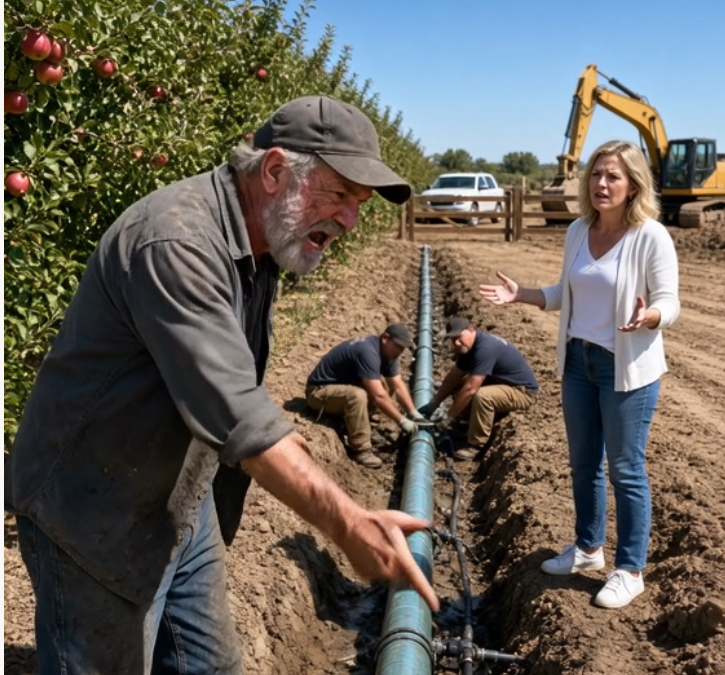
That was when a white SUV with the Silver Ridge HOA logo appeared at my eastern gate.
It came in too fast for a dirt lane, brakes chirping slightly on the hard-packed gravel.
Tessa Langford stepped out.
And before she even reached the fence, she shouted, “Stop digging!”
I looked at the pipe.
Then at her.
And I knew immediately that she already knew exactly what I had found.
Tessa Langford had the kind of confidence that could make an accusation sound like a permit.
She crossed toward me in beige slacks, expensive boots, and a white blouse that had never been within fifty yards of real agricultural work. Behind her came the community manager, a nervous man named Dennis Hale, carrying a folder with both hands like he expected it to explode.
Tessa pointed toward the excavator.
“You need to fill that back in.”
I rested both hands on the shovel.
“Why?”
“Because you’re interfering with utility infrastructure.”
“Under my orchard.”
“Approved infrastructure.”
“Approved by who?”
“The association and project engineers.”
“That’s not what I asked.”
Her jaw tightened.
“Nolan, don’t turn this into one of your property-line arguments.”
That sentence told me more than she intended.
We had property-line arguments because Silver Ridge had spent eighteen months pretending lines became flexible whenever construction got expensive.
Silver Ridge Estates had not existed when I was a boy. That hillside had been hay, cedar, rock, and deer trails. Then investors bought it, engineers arrived, survey flags started blooming like weeds, and suddenly the eastern boundary of my orchard had a decorative stone entrance across from it with gas lanterns, flower beds, and a sign promising LUXURY HILLSIDE LIVING.
I didn’t begrudge people homes.
Everybody has to live somewhere.
I did begrudge developers who looked at agricultural land like empty space waiting to become convenient for them.
Tessa had been around from the beginning. Officially, she was HOA president by the time Phase Three started. Unofficially, she seemed to be everywhere—at planning meetings, contractor briefings, landscaping decisions, road debates, drainage complaints, mailbox approvals, and anything involving the word “community.” She also ran a consulting company called Langford Community Strategies, which nobody explained clearly and everybody pretended was normal.
The first time she came to my farmhouse, she brought rolled engineering drawings and a smile that had practiced itself in mirrors.
That had been eighteen months earlier.
She spread the plan across my kitchen table.
A proposed sewer corridor cut through my northern orchard.
Ten meters wide.
Permanent easement.
Access rights.
Maintenance rights.
Construction rights.
“What are you offering?” I asked.
She named a number.
I laughed.
She frowned.
“That’s fair market value.”
“For dirt.”
“That’s what an easement is.”
“No. That’s what you think dirt is worth.”
I pointed at the corridor.
“Twenty-eight mature apple trees.”
“They can be replanted.”
“Fifteen years from now.”
She sighed.
“Nolan, development is happening whether you participate or not.”
“I know.”
“Then why make this difficult?”
“Because your route cuts through productive trees.”
“Our engineers selected the most efficient alignment.”
“Efficient for you.”
She folded her arms.
“The public-road alternative requires a pump station.”
“Then build one.”
“That’s expensive.”
“So are mature trees.”
She looked around my kitchen. Old cabinets. Work boots by the back door. Mud on the mat. A stack of invoices clipped under a magnet shaped like an apple because my granddaughter thought it was funny.
I watched the calculation form behind her eyes.
She had expected somebody who would be impressed by a check.
Instead, I had asked what the corridor would do to my soil.
I explained root compaction. The irrigation well. Drainage. The effect of heavy equipment. Permanent limitations on trenching and replanting. Access issues during harvest. Liability if anything leaked.
She waved it off.
“You’d be compensated.”
“I don’t want compensation.”
“Everybody wants compensation.”
“I want the pipe somewhere else.”
She leaned closer to the map.
“Routing east adds almost eight months.”
“Not my problem.”
“It will delay occupancy.”
“Not my problem.”
“Your land values will increase because of Silver Ridge.”
“My land produces income now.”
She rolled the plans.
“This is shortsighted.”
“No,” I said. “It’s farming.”
She left.
The complaints began two weeks later.
Noise violation.
Irrigation overspray.
Truck traffic.
Dust.
Agricultural equipment visible from Silver Ridge.
Storage shed appearance.
Ornamental fencing request.
Every letter came from the HOA.
Every one applied rules to land outside the HOA.
My attorney, Marissa Cole, answered most with a single paragraph:
Mr. Weller’s agricultural property is not subject to Silver Ridge covenants.
Eventually, the letters stopped.
I thought Tessa had accepted reality.
I was wrong.
Now she stood beside a hole in my orchard, looking at a pipe she claimed was approved, while Dennis Hale stared at the ground like a man who had misplaced his courage somewhere in the SUV.
I pointed into the excavation.
“Whose land is that pipe under?”
Tessa opened a folder.
“There’s a utility easement.”
“Show me.”
She flipped pages without handing me the folder.
“There.”
I stepped closer.
The page had a county filing stamp. Legal description. Utility language. At first glance, it looked legitimate.
Then I read the parcel number.
“That’s not mine.”
She barely blinked.
“It covers the corridor.”
“No.”
“Nolan—”
“This parcel is two miles south.”
Dennis looked at the page.
Tessa closed the folder.
“The mapping has been consolidated.”
“That’s not a legal phrase.”
“Our engineers verified the route.”
“Give me a copy.”
“I don’t provide internal project documents.”
“You’re standing beside a sewer pipe buried under my property and you won’t give me the document you say allows it?”
“It’s public sanitation infrastructure.”
“Then public records should be easy.”
Her voice hardened.
“You grow apples. Don’t pretend you’re qualified to interpret utility mapping better than licensed engineers.”
That was the moment I started recording.
I did not announce it dramatically. I simply raised the phone.
“Say that again.”
She saw the camera.
Stopped.
I said, “Repeat for the record that Silver Ridge installed this sewer line beneath my orchard.”
Tessa looked at Dennis.
Dennis looked at the ground.
Then she said, “I’m not participating in this performance.”
“Thought so.”
I crouched beside the exposed pipe.
The vibration was still there.
I looked at her.
“This line is active.”
“No one said it wasn’t.”
That answer came too quickly.
“You just admitted sewage is moving under my land.”
“I didn’t say sewage.”
“What is it?”
“System flow.”
“From where?”
“That is operational information.”
I stood.
“Tessa, I’m going to ask you one time. Did you connect houses to this line?”
She smiled.
Not pleasantly.
“You are tampering with infrastructure serving a residential community. If you damage it, you will be held responsible.”
Then she turned and walked back toward the SUV.
Dennis remained half a second longer.
He looked at me.
There was apology in his face.
Not enough courage to speak.
Then he followed.
I watched the SUV disappear beyond the fence.
The vibration under my hand continued.
That afternoon, I called Marissa Cole.
Marissa had represented me once during a water-right dispute and again when a fruit distributor decided a signed delivery contract was apparently more of a mood than an obligation. She was a small woman with sharp eyes, silver hair cut short, and a habit of making people regret vague sentences.
She listened without interrupting.
When I finished, she asked, “Did you damage the pipe?”
“No.”
“Turn a valve?”
“No.”
“Open anything?”
“No.”
“Good. Don’t.”
“I wasn’t planning to.”
“Don’t expose more than you already did.”
“Why?”
“Because if it’s carrying sewage, we need environmental people involved before you start opening infrastructure.”
I looked toward the orchard.
“Trees are dying.”
“Photograph everything.”
“Already started.”
“Survey?”
“Tomorrow.”
“Who?”
“Gavin Reddick.”
“Good.”
She paused.
“And Nolan?”
“Yeah.”
“If that easement page belongs to another parcel, don’t call Tessa again.”
“I wasn’t going to.”
“Good.”
“Why do lawyers always sound happier when people stop speaking?”
“Because clients usually improve their cases when they do.”
Gavin Reddick arrived the next morning.
He had surveyed agricultural property in the county for thirty years and carried enough satellite equipment to land aircraft. He was lean, sun-browned, and quiet, with the gentle impatience of a man who trusted coordinates more than conversation.
He walked the exposed section.
Checked county monument points.
Shot coordinates.
Then spent six hours following the disturbed seam through the orchard.
By evening, he had bad news.
The pipe ran nearly seven hundred feet through my property.
Not along an edge.
Not near an old easement.
Diagonal.
The exact route Tessa had wanted eighteen months earlier.
We found damage everywhere.
Seventeen apple trees with major root loss.
Nine pear trees showing compaction stress.
Two lateral irrigation lines crushed.
A natural drainage swale flattened.
Topsoil mixed with imported gravel.
And near the lower boundary, an inspection riser buried beneath nearly eighteen inches of fresh soil.
Gavin crouched beside it.
“This was hidden.”
“Maybe covered during grading.”
He gave me a look.
Gavin did not enjoy pretending.
“Somebody intentionally buried the access lid.”
I photographed it.
Then he measured the distance to my main irrigation well.
Ninety-four feet.
I stopped smiling.
“That’s too close.”
“For an unauthorized sewer line?”
“Any sewer line.”
My well supplied nearly all irrigation water during dry months. If contamination entered it, the problem would not be one row of apples. It could be the entire orchard.
Gavin stood.
“You need state involvement.”
“I know.”
Before that happened, I wanted to know who had actually dug the trench.
The trail cameras answered.
I used cameras for deer.
Not people.
Mostly.
There were eight around the orchard perimeter. The camera covering the eastern windbreak had recorded movement on three consecutive nights while I was away repairing a sorting machine two counties over.
I pulled the memory card.
Opened the files.
At 1:58 a.m., excavator lights appeared.
2:07.
Truck.
2:13.
Workers removed a section of fence.
2:31.
Steel road plates laid over soft ground.
The company logo on the equipment:
MALLORY UNDERGROUND WORKS.
I stared at the screen.
Next clip.
Excavation.
Next.
Pipe sections.
Next.
Backfill.
Night two.
More trenching.
Night three.
Fence restored.
Workers raking topsoil.
One man spread grass seed.
They were not simply working late.
They were hiding the disturbance.
I called Reed Mallory, owner of the company.
He answered politely, then became less polite when I mentioned the orchard.
“I can’t discuss client work.”
“You trenched seven hundred feet through my property.”
“We had an authorized corridor.”
“No.”
“We were provided legal mapping.”
“Send it.”
“Confidential.”
“I have video.”
Silence.
“Video of what?”
“Your machines entering at two in the morning.”
Longer silence.
“Nolan, look—”
“Why two in the morning?”
“Scheduling.”
“Three nights?”
“Scheduling.”
“Why remove and replace my fence?”
“We had access.”
“You didn’t.”
“We were told we did.”
“By Tessa Langford?”
Silence.
“Reed.”
“Yes.”
“Give me the deed reference.”
“What?”
“The easement.”
He hesitated.
Then read it.
I wrote the number down.
Looked it up.
Wrong parcel.
Two miles away.
I called back.
“Reed.”
“What?”
“Your easement is on the old Miller tract.”
Silence.
“What?”
“Opposite side of the county.”
“That’s impossible.”
“County database is free.”
“I’ll call you back.”
He did not.
Marissa sent cease-and-desist notices to Silver Ridge HOA, the developer, Mallory Underground Works, county planning, and the project engineer.
The letter demanded no additional work, no excavation, no access, no alterations, and preservation of documents.
Tessa responded within three hours.
The pipeline is already in active service and cannot reasonably be reversed due to a limited number of damaged fruit trees.
I forwarded the email to Marissa.
She called.
“She wrote ‘active service’?”
“Exactly.”
“Wonderful.”
“I don’t think wonderful means what lawyers think it means.”
“She just admitted operation.”
“Could be water.”
“You saw the proposed sewer plans.”
“Yes.”
“We’re finding out.”
Tessa offered twenty-five thousand dollars for a retroactive easement.
I declined.
She increased it to forty thousand.
Declined.
Then came the threat.
Any interference with service may expose you to damages resulting from loss of sanitation to approximately 160 households.
There it was.
One hundred sixty.
I read it again.
Then called Marissa.
“She just gave us the number.”
“I saw.”
“All 160 homes?”
“Sounds like it.”
“The county thinks that line is legal?”
“Let’s find out.”
We requested permits.
The county record showed something strange.
The pipe through my orchard did exist on one approved planning sheet.
But not as an active sewer.
It was labeled:
FUTURE STUB — CAPPED — NOT FOR SERVICE.
No house connections.
No commissioning.
No active flow.
Just a future possibility tied to later expansion approval.
Except there were two problems.
The approved future stub was not supposed to cross my orchard.
And the pipe beneath my orchard was carrying something.
Marissa contacted the state environmental quality division.
Two days later, Elise Maron called.
She was a civil engineer assigned to wastewater compliance. Her voice had the direct calm of somebody who had already read everything before calling.
“Mr. Weller?”
“Yes.”
“I’ve reviewed your submission.”
“Good.”
“Did you expose the pipe yourself?”
“Yes. One test excavation.”
“Any rupture?”
“No.”
“Any valve manipulation?”
“No.”
“Excellent.”
I almost laughed.
“Everyone keeps congratulating me for not breaking the sewer under my own trees.”
“For investigative purposes, that’s very helpful.”
“Fair.”
She continued.
“The permit for Silver Ridge shows a future capped stub.”
“That’s what we found.”
“It is not permitted to carry wastewater.”
“What if it is?”
“Then we have a significant problem.”
I looked toward Silver Ridge.
“How significant?”
“Depends on what is flowing and where it goes.”
“What do you mean?”
She paused.
“Are you certain it’s residential sewage?”
That question stopped me.
“What else would it be?”
“Industrial discharge. Groundwater bypass. Construction pumping. Unauthorized waste transfer. We don’t assume.”
I stared at the pipe.
Until then, I had been angry.
Now I felt something colder.
Uncertainty.
Elise scheduled inspection for Thursday.
The day before, Gavin and I reopened the buried access point without entering the system. He placed non-invasive equipment above the riser.
Flow signatures.
Regular.
Strong.
Morning peak.
Evening peak.
“Residential pattern,” he said.
“You’re sure?”
“Looks like it.”
“How many houses?”
He shook his head.
“Can’t tell.”
“Tessa said 160.”
“Then 160 people are flushing into a pipe that doesn’t legally exist.”
Thursday morning arrived gray.
Elise came with two state technicians.
Tessa arrived six minutes later with an HOA attorney.
That told me she had been notified.
She got out before the state vehicle had even fully parked.
“You cannot open that system.”
Elise looked at her.
“Good morning.”
“You need a court order.”
“No.”
“This is privately maintained infrastructure.”
Elise showed identification.
“We’re investigating an unpermitted wastewater conveyance system.”
Tessa pointed at me.
“He tampered with the line.”
“I exposed soil above it.”
“He damaged trees himself.”
That was new.
I laughed.
“You think I cut roots under seventeen apple trees?”
Her attorney touched her arm.
She ignored him.
Elise said, “Ms. Langford, do you have the pre-operational pressure test?”
Tessa blinked.
“Our engineering firm does.”
“Commissioning certificate?”
“Pending.”
“Final connection approval?”
“The system is in extended testing.”
“Flow authorization?”
“Our counsel can provide—”
“Do you have it today?”
No answer.
Elise nodded toward the technicians.
“Proceed.”
They opened the inspection point.
The smell answered several questions immediately.
Nobody said anything.
One technician lowered monitoring equipment.
Flow reading climbed.
He looked at Elise.
“That’s not a capped stub.”
Tessa said, “Testing volume.”
Elise stared into the manhole.
“From where?”
“Occupied sections.”
“How many?”
“I’d need to verify.”
I said, “One hundred sixty.”
Tessa turned toward me.
Elise looked at her.
“Is that accurate?”
Tessa hesitated.
“There are approximately that many homes in the new phase.”
“Connected?”
“Temporary service.”
“Under which authorization?”
“The development has provisional—”
Elise held up a hand.
“We’ll verify.”
The investigation unfolded in stages.
First, flow timing.
Usage peaked between six and eight in the morning.
Again between six and ten at night.
Classic residential wastewater.
Second, tracer dye.
State technicians coordinated with selected homes. Safe colored tracing agent entered approved fixtures. Minutes later, the dye appeared in the line beneath my orchard.
Third, connection count.
The county database showed zero authorized final hookups to the future stub.
Physical inspection inside Silver Ridge showed service laterals feeding house after house.
One.
Two.
Ten.
Twenty-seven.
Fifty-three.
Ninety.
One hundred twenty.
One hundred fifty.
One hundred sixty.
Elise stood over a manhole inside the subdivision with a tablet.
“One sixty.”
Her technician confirmed.
“All active.”
Tessa crossed her arms.
“Those homes needed sanitation.”
Elise looked at her.
“Those homes needed legally approved sanitation.”
“Families live there.”
“Who authorized occupancy?”
“County building issued certificates.”
“Based on what sewer documentation?”
No answer.
That question would become important later.
At the edge of my orchard, Elise issued the first violation notice.
Immediate freeze on further connections.
No additional occupancy tied to the system.
Full disclosure order.
Emergency monitoring.
Developer-funded interim sanitation.
Pipeline integrity assessment.
Well protection.
Tessa exploded.
“You cannot shut down a neighborhood.”
Elise remained calm.
“We’re not ordering an uncontrolled shutdown today.”
“Then what are you doing?”
“Preventing this problem from getting larger.”
“This investigation exists because one farmer is angry about trees.”
Elise turned toward her.
“Mr. Weller did not install 160 unauthorized sewer laterals.”
Silence.
“He didn’t activate a line before commissioning.”
Silence.
“He didn’t bury it outside its approved route.”
Silence.
“Whoever did those things created this investigation.”
Tessa’s face tightened.
The technicians found a dated valve label.
Activation: four months earlier.
That was before the project was legally approved for full use.
Far before the official commissioning paperwork.
Four months.
I thought about the orchard.
The trees had not died immediately.
Of course not.
The trench damage existed first. Then months of active flow added vibration and moisture. Settlement. Compaction. Stress.
Symptoms came later.
Just late enough for the people who buried the line to believe they had gotten away with it.
The state demanded records.
Every construction change order.
Valve authorization.
As-built drawing.
Home connection list.
Occupancy coordination.
Engineer certification.
Wastewater capacity calculation.
It did not take long before the story became worse.
The approved design had originally routed the main sewer along the public road east of Silver Ridge.
That route required seven hundred additional feet of pipe, a pump station, more excavation, utility coordination, relocation of decorative retaining walls, more time, and more money.
The shortcut through my orchard used natural slope.
Gravity did the work.
No pump station.
Less pipe.
Faster completion.
The savings were enormous.
But that still did not explain the forged-looking easement.
Then Reed Mallory called.
“I need to talk.”
“Now you can?”
“I should’ve sooner.”
We met at the county planning office with Marissa and Elise.
Reed brought a laptop, paper files, and job logs. He looked exhausted in the way men look when they have spent several nights discovering that loyalty to a client does not protect them from subpoenas.
“I was told the corridor was legal,” he said.
“I know.”
“At first.”
Marissa leaned forward.
“What changed?”
Reed opened an email.
From Reed to Tessa.
Subject: Right-of-way confirmation.
He had asked for deed support before mobilizing.
Tessa replied with the same folder she had shown me.
Wrong easement page attached to a Silver Ridge document.
Reed said, “I thought their legal people assembled it.”
“Did you verify the parcel?” Marissa asked.
“No.”
“Why?”
He looked ashamed.
“Because we were under deadline.”
That was the first honest answer.
He opened another email.
After his crews began staking, a site supervisor noticed survey markers did not match the corridor description. Reed emailed Tessa and Cole Danner, who represented the developer’s investors.
Cole replied:
Proceed. Land-right issues will be cured after installation. Once the physical infrastructure exists, relocation is economically unrealistic.
Marissa read it.
Then again.
Elise said, “That’s clear.”
Reed swallowed.
“There’s more.”
Another email.
Tessa:
Do not contact Weller directly. He already rejected the easement and will attempt to obstruct construction. Schedule work to avoid conflict with orchard operations.
I felt my jaw tighten.
“Schedule work when I’m gone.”
Reed nodded.
“Your delivery schedule was discussed.”
“How did you know it?”
“She did.”
I thought about the week I had taken the sorting machine two counties over.
Tessa had known.
Of course.
Silver Ridge security cameras covered the shared road. Fruit trucks were predictable. My own routine had been used against me.
Then Reed showed the change-order timing.
Pipe purchased before Tessa ever came to my kitchen offering to buy the easement.
That mattered.
They had ordered material assuming they would get my land.
The negotiation had been theater.
One more email destroyed any remaining ambiguity.
Tessa to Cole:
Weller will complain, possibly sue. By the time anything reaches court, the line will be underground and serving occupied homes. He won’t risk being blamed for taking 160 families offline. Finish first. Cure rights later.
Nobody spoke for several seconds.
I looked at Marissa.
She looked back.
There it was.
The entire plan.
Not mistake.
Not clerical error.
Leverage.
Build first.
Connect families.
Then use those families as human shields against removal.
I felt sick.
Not because they had outsmarted me.
Because of how casually they had planned to use innocent residents.
Elise asked Reed, “Why are you giving us this?”
He stared at the table.
“Because I’m not going to prison for somebody else’s deadline.”
Fair.
Self-preservation is not morality.
But it still produces evidence.
The state expanded the investigation.
Then the county did.
Then the developer’s lender.
Then the association’s insurer.
Once multiple institutions started asking for the same records, Silver Ridge stopped pretending this was a property dispute.
Tessa called a private board meeting.
She proposed a special assessment.
Every homeowner would pay toward emergency sewer remediation.
The association secretary refused to certify the meeting because the board had not been told the cause.
Residents found out anyway.
Word moves fast when people hear phrases like unpermitted sewage and special assessment.
A public meeting followed.
Packed clubhouse.
I went because Marissa told me to sit in the back and say nothing unless asked.
I lasted almost twelve minutes.
Tessa opened the meeting in a fitted black blazer, standing behind a podium with the Silver Ridge logo projected behind her.
“This association is facing an infrastructure dispute created by an adjacent landowner challenging longstanding development planning.”
That was impressive.
She had managed to describe illegal trenching under my trees without using one useful noun.
A resident raised his hand.
“Is our sewer legal?”
Tessa answered, “Our wastewater service is operational.”
“That’s not what I asked.”
The room shifted.
Another resident asked, “Did the state find 160 illegal connections?”
“Unauthorized is a technical classification.”
Elise was not at that meeting.
Marissa whispered, “That’s going in a letter.”
Tessa continued.
“The important thing is keeping families safe and avoiding disruption.”
I stood in the back.
She saw me.
Her expression changed.
“Mr. Weller has refused reasonable compensation.”
A woman turned around.
“Compensation for what?”
Tessa froze.
The woman repeated, “What were you trying to pay him for?”
That was when the meeting stopped belonging to Tessa.
I walked forward.
Not to the microphone.
Just far enough to be heard.
“For an easement she never had.”
Murmurs moved through the room.
Tessa snapped, “The corridor was always intended for infrastructure.”
“On my property.”
“You were offered fair value.”
“I declined.”
“Which endangered the project.”
“No. It changed your route.”
She pointed at me.
“You knew the public-road route was financially impossible.”
“It wasn’t impossible.”
“It required a pump station!”
A man near the front said, “Wait. There was another route?”
Silence.
I almost felt sorry for her.
Almost.
She had said too much.
I answered, “Yes.”
“Where?”
“Along the public road.”
“Why didn’t they use it?”
I looked at Tessa.
“Ask her.”
The board demanded records.
For the first time, most members saw the original engineering route.
Pump station.
Public right-of-way.
Legal.
More expensive.
But legal.
One board member named Caroline Ames asked, “How much did the orchard route save?”
Nobody answered.
Marissa had the figure.
“Approximately $1.8 million based on internal contractor estimates.”
The room exploded.
Not physically.
Voices.
Questions.
Tessa banged the table.
“This is confidential development information.”
Caroline stood.
“Our homes are connected to an illegal sewer and you’re worried about confidentiality?”
That was the beginning of Tessa’s fall.
The next blow came from money.
Investigators found Tessa had a private consulting company.
Langford Community Strategies.
It held a contract with the developer.
Bonus terms.
If the 160 homes achieved utility connection and occupancy before the fiscal quarter closed, Tessa received a substantial performance payment.
Marissa showed me.
“How substantial?” I asked.
She named the number.
I whistled.
“So this wasn’t only HOA work.”
“No.”
“She personally profited if they connected early.”
“Yes.”
I leaned back.
“That explains the deadline.”
“And the risk.”
Tessa had not buried the pipe because she cared deeply about infrastructure efficiency.
She needed those homes connected.
The pump-station route took too long.
My orchard saved months.
My refusal threatened her bonus.
So my refusal became something to erase.
The board suspended her.
She fought.
Of course.
At the suspension meeting, she stood behind the microphone.
“I have spent years protecting this community.”
Caroline responded, “From what?”
Tessa looked shocked.
“From cost overruns. Developer failures. Delays.”
“You connected our homes to an unapproved sewer.”
“I kept the project moving.”
“You buried it under someone’s orchard.”
“It was the only practical route.”
“You forged an easement?”
“I did not forge anything.”
Marissa whispered beside me, “Careful. They haven’t proven who assembled it.”
Good point.
Facts mattered.
Caroline asked, “Did you know Nolan refused the easement?”
“Yes.”
“Did you tell the board?”
Silence.
“Did you know construction proceeded anyway?”
Silence.
“Did you tell us?”
Silence.
“Did you receive money if homes connected early?”
Tessa’s attorney stood.
“My client will not answer questions relating to private contractual matters.”
That answer did the work for her.
The suspension passed.
Temporary at first.
Then state findings deepened.
Treatment capacity had been understated.
Silver Ridge’s receiving system was not approved for the extra volume.
Connection fees had been avoided.
Pressure testing on the rerouted section was incomplete.
As-built maps did not show the true location.
Some lateral connections were concealed beneath landscaping.
Regulators had inspected what they thought was a dormant future stub.
Then somebody returned after inspection.
Removed caps.
Connected the system.
Opened the valve.
That was not negligence.
That was sequence.
A plan.
The state refused to cut residents off immediately.
I supported that.
Tessa tried to use it against me.
At a preliminary hearing, her attorney argued, “Removal would threaten sanitation service for 160 families.”
Marissa stood.
“Mr. Weller has never requested an uncontrolled service interruption.”
The judge looked at me.
“Is that correct?”
“Yes, Your Honor.”
“What do you want?”
“The pipe off my land.”
“Immediately?”
“Safely.”
That distinction mattered.
I continued.
“The families didn’t bury it. They bought homes believing utilities were legal. I don’t want their bathrooms shut down because somebody used them to create leverage.”
The courtroom was quiet.
Across the aisle, Tessa stared at me.
Her strategy depended on portraying me as the man willing to punish 160 families over apple trees.
I had just removed that weapon.
The judge ordered temporary operation only under strict controls.
Continuous monitoring.
Emergency pump capability.
Temporary holding capacity.
No new homes connected.
Developer pays all costs.
Relocation plan due within ten days.
Tessa looked furious.
Not because residents were safe.
Because the pipe was now officially temporary.
The first relocation proposal tried to keep it in place.
The developer offered me a much larger easement payment.
Enough money to make any farmer pause.
I did not.
Marissa asked, “You sure?”
“Yes.”
“It’s significant.”
“My well is ninety-four feet away.”
“Testing is clean.”
“Today.”
She nodded.
“Then no.”
Second proposal:
Transfer pipeline to public utility.
Public utility declined.
They did not want unpermitted infrastructure on land without rights.
Third proposal:
Permanent court-approved easement.
I opposed it.
So did the state.
By then, engineers had identified velocity concerns caused by the natural slope.
My orchard route was not only illegal.
It was not ideal engineering.
It was cheap engineering.
That was worse.
The state approved the final solution.
Exactly the route I had suggested eighteen months earlier.
Public road.
Longer pipe.
Pump station.
Capacity upgrade.
Proper permits.
Proper fees.
Proper inspections.
No orchard.
No argument.
When I read the plan, I laughed.
Marissa asked, “What?”
“I should send Tessa my original map.”
“Don’t.”
“Frame it?”
“Maybe.”
Then came the leak.
A survey and integrity crew was assessing the orchard line before removal. Near the well-protection radius, they found elevated moisture.
At first, everyone hoped groundwater.
Testing showed sewage indicator compounds.
Small leak.
Not yet enough to contaminate the well.
But real.
I stood beside Elise while technicians sampled soil.
“How bad?”
“Localized.”
“My well?”
“Initial tests clean.”
“Initial.”
“We’re doing more.”
I looked at the young leaves on nearby trees.
“I told her.”
“I know.”
“From the beginning.”
“I know.”
“I told her a leak near this well could destroy the orchard.”
Elise looked at me.
“Nolan.”
“What?”
“Being right doesn’t make this feel better.”
No.
It did not.
For three days, I barely slept.
Every customer ran through my head.
Grocers.
Cideries.
Families.
One contamination story could destroy trust faster than contamination itself.
The second well test came back clean.
Then third.
Then fourth.
No measurable impact.
I sat in my truck afterward and cried.
Not dramatically.
Not loudly.
Just relief leaking out after weeks of anger had nowhere left to go.
I had not realized how scared I was until the danger passed.
The state ordered complete removal.
No abandonment-in-place.
No capped remnant.
Every section excavated.
Every disturbed area documented.
The removal crew included environmental engineers, soil specialists, surveyors, water technicians, attorneys, insurance representatives, and enough paperwork to bury a second pipeline.
I watched the first section come up.
Large black pipe lifted from the trench.
Mud dripping.
Roots hanging from disturbed soil.
The damage looked worse underground.
Apple roots severed clean.
Soil horizons mixed.
Compacted layers.
Crushed irrigation.
Temporary patches.
Tags turned downward.
Markers buried.
One inspector photographed everything.
Every joint.
Every stamp.
Every repair.
The pipe told the story better than people did.
At one section, Reed stopped.
“Look.”
Manufacturing date.
Months before Tessa’s formal easement offer.
He looked at me.
“They bought it before she met you.”
“I know what that means.”
“They expected yes.”
“No,” I said. “They expected it not to matter.”
That was worse.
The night construction had always haunted me.
Now I understood the confidence behind it.
They had not been improvising after negotiations failed.
They had built negotiations around a decision already made.
Ask politely.
Offer cheaply.
Pressure.
If refusal continues, install anyway.
Connect residents.
Create dependence.
Force retroactive permission.
It was efficient.
If you removed morality.
The developer’s lender froze further disbursements.
Title insurers paused pending sales.
Investors demanded new management.
Cole Danner was removed from the project.
He tried blaming Tessa.
Emails prevented that.
He had known.
He had encouraged creating a reality that could not easily be undone.
Now he got to watch reality undo itself with excavators.
Tessa was permanently removed as HOA president.
Her consulting contract was terminated.
Civil investigators reviewed the financial bonus.
The altered document package became part of a broader investigation.
I never followed every charge, filing, or administrative proceeding.
At some point, legal consequences belonged to other people.
My job was the orchard.
The settlement negotiations took months.
They covered tree replacement, lost crop revenue, years to maturity, soil restoration, irrigation repair, drainage reconstruction, well monitoring, survey costs, legal fees, environmental testing, business disruption, restoration oversight, and a permanent agreement barring any future utility easement through the orchard without my explicit written consent.
I did not become rich.
People hearing settlement numbers often imagine a farmer suddenly buying boats.
Most of the money had jobs before it arrived.
Replacing a fifteen-year apple tree does not mean buying a sapling.
It means replacing years.
Lost harvest.
Training.
Pruning.
Yield.
Soil.
Time.
You cannot write a check and make a tree older.
That was what Tessa never understood.
To her, my orchard was land value.
Square footage.
Route length.
Cost savings.
To me, a mature tree represented years of weather and work. My grandfather planted some of the oldest pears. My father grafted several cherries himself. You do not calculate that with development math.
Restoration started that fall.
Agricultural soil specialists rebuilt the damaged corridor.
Compacted layers loosened.
Imported fill removed where necessary.
Drainage re-established.
Irrigation replaced correctly.
The dead trees came out.
That was harder than I expected.
I had cut down trees before.
Old.
Diseased.
Storm damaged.
But these were healthy trees killed for a shortcut.
The saw went through the first trunk.
I put my hand against the wood afterward.
Ridiculous.
It was a tree.
But farmers grow attached to things they care for.
Maybe because everything alive on a farm is temporary and pretending otherwise would make the work impossible.
We replanted.
Apple.
Pear.
A few cherry replacements.
Young whips tied to stakes.
Small.
Fragile.
Nothing like what had been there.
Hank Brewer, who helps during harvest, stood beside me.
“Looks empty.”
“It is.”
“They’ll grow.”
“I know.”
“You don’t sound convinced.”
“I’ll be old before they’re full.”
He shrugged.
“Then somebody younger gets good apples.”
That sounded like something my grandfather would have said.
The new sewer construction along the public road began the following spring.
Pump station.
Traffic controls.
Permits.
Inspectors.
Daylight work.
Amazing what legitimate infrastructure looks like.
No removed fences at two in the morning.
No fake easements.
No buried access points.
No secrecy.
Silver Ridge residents complained about construction noise.
I enjoyed that more than I should have.
Not because they deserved inconvenience.
Because the legal route made visible the cost Tessa had tried to hide by shifting it onto me.
The replacement line took months.
It cost far more than the orchard shortcut.
It also worked.
Passed pressure testing.
Capacity certification.
Environmental review.
Final inspection.
One hundred sixty homes were transferred in stages.
Nobody lost sanitation.
Nobody’s family suffered.
That mattered to me.
The last home switched over on a Thursday.
Elise called.
“Temporary orchard line no longer active.”
I walked to the old valve site.
No vibration.
Nothing moving under the soil.
For the first time since I touched that pipe months earlier, the ground felt still.
A week later, the last section came out.
The excavator lifted it.
Reed was there.
Elise.
Gavin.
Marissa.
Several inspectors.
No Tessa.
She had sold her Silver Ridge house before the civil case finished.
Moved.
I never asked where.
The final pipe section swung above the trench.
Mud fell.
Then the operator lowered it onto a flatbed.
Done.
Seven hundred feet of somebody else’s assumption removed from my property.
Gavin handed me a final survey.
No utility line crossing the orchard.
Boundary restored.
I stared at the map longer than necessary.
Marissa said, “You should frame that.”
“You lawyers love framing paper.”
“Paper won.”
“No.”
She raised an eyebrow.
“The trees did.”
She looked toward the replanted row.
“Fair.”
The state required long-term well monitoring.
Every test came back clean.
Month three.
Month six.
Year one.
No contamination.
Elise visited for the final scheduled state sample.
We stood near the well.
She capped the bottle.
“Looks good.”
“How good?”
“Clean.”
“For real?”
“For real.”
I exhaled.
She smiled.
“You’ve asked that every time.”
“I grow food.”
“I know.”
She looked toward a pile of old pipe sections waiting for final disposal.
“You keeping one?”
“No.”
“Not even a little piece?”
“Why would I?”
“Souvenir.”
“I don’t need reminders buried in my barn.”
She laughed.
“What are you keeping?”
I held up Gavin’s survey.
“This.”
“That’s boring.”
“Exactly.”
I wanted boring.
Clean land.
Straight boundaries.
Legal maps.
Boring was beautiful.
Silver Ridge changed too.
New board.
New management.
New infrastructure rules.
Whenever survey crews needed to approach my boundary, I received written notice.
Not because I demanded ceremony.
Because good neighbors ask.
The new HOA president, Caroline Ames, visited once. She stood at the gate and called first.
Another good sign.
“I’m sorry,” she said.
“You didn’t bury it.”
“No. But the association benefited from it.”
“For a while.”
“We’ve adopted a policy. No board officer can authorize outside utility work.”
“Seems obvious.”
She smiled.
“Apparently obvious things need policies.”
“Often.”
She looked at the young apple trees.
“How long until those produce?”
“Some fruit in a few years. Full production takes longer.”
“Can we help?”
“No.”
“I mean residents.”
“No.”
She looked surprised.
“It’s not punishment.”
“Then why?”
“Because restoring the orchard is my job.”
She nodded.
“I understand.”
I appreciated that she did not argue.
Some Silver Ridge homeowners came to apologize.
Others avoided me.
Fine.
One man named Eric Wallace stopped his truck near my stand one Saturday.
“I bought one of the affected homes.”
“Which?”
“Lot 142.”
I knew the map too well.
“Sorry.”
He laughed nervously.
“Not your fault.”
“No.”
He looked toward the orchard.
“We didn’t know.”
“I know.”
“Tessa told us the sewer delay was caused by county bureaucracy.”
“I’m sure.”
“Then she said you were trying to extort the development.”
“Also sounds like her.”
He rubbed his neck.
“My wife was terrified we’d lose plumbing.”
“Nobody wanted that.”
“She made it sound like you did.”
“That was useful to her.”
Eric nodded.
“Yeah.”
He bought two bags of apples.
Paid full price.
I did not give him a discount.
Reconciliation has limits.
The criminal and civil investigations around Tessa and Cole continued.
I gave statements.
Produced emails.
Authenticated video.
Then returned to farming.
I learned long ago that lawsuits can become a second crop if you let them. You spend every day tending them. Thinking about them. Checking them. Talking about them. Eventually, they grow larger than the life you are trying to protect.
I refused.
Marissa handled the legal field.
I handled apples.
A year passed.
Then another.
The replanted trees grew.
First blossoms appeared on the strongest young apples.
White flowers.
Small.
Delicate.
I stood beside them one spring morning.
The original pipeline path was still visible if you knew where to look. Slightly different soil. Newer trees. But grass had returned. Drainage worked. The well tested clean. Silver Ridge rooftops rose beyond the eastern fence.
The development no longer looked like an enemy.
Just houses.
People living normal lives in homes attached to a sewer that now followed a legal route.
That is how it should have been from the beginning.
Sometimes people ask why I didn’t take the money when Tessa offered a retroactive easement.
The later offers were large.
Very large.
My answer is simple.
Some problems can be priced.
Some cannot.
If the line had been properly engineered, legally permitted, far from my well, and negotiated honestly before construction, maybe there was a number.
Maybe not.
But after someone sneaks onto your land at two in the morning, cuts roots, buries infrastructure, connects 160 homes, and then tells you reality is too expensive to reverse, money becomes secondary.
Signing after the fact would have turned trespass into strategy.
It would teach the next developer:
Build first.
Negotiate later.
Make the violation big enough and the owner will surrender.
I could not do that.
Not because I am heroic.
Because I still have land.
And someday someone else will own it.
Maybe family.
Maybe not.
But the deed should mean the same thing then as it does now.
You ask before you dig.
That is not radical.
That is civilization.
The hardest part of the whole story was not Tessa.
It was not the meetings.
Not even the state inspection.
It was the trees.
Trees do not understand lawsuits.
They do not know why a trench crosses their roots.
They simply respond.
Leaves yellow.
Branches weaken.
Fruit drops.
Then they die.
I walked past those seventeen apples every morning while the case grew. Each day a little worse. I knew evidence needed to stay in place long enough for experts to document it. I knew cutting them immediately would erase information. So I watched them decline.
That made the whole dispute feel personal in a way legal documents never could.
My grandfather used to say, “Land remembers everything you do to it.”
As a child, I thought he meant plowing.
Fertilizer.
Erosion.
Now I think he meant more.
Every shortcut leaves something behind.
Compaction.
Broken drainage.
Pollution.
Resentment.
A legal record.
Tessa tried hiding her shortcut under topsoil.
The orchard remembered.
The roots remembered.
The water remembered.
And eventually the pipe itself told on her.
One hundred sixty households create a lot of evidence.
Every shower.
Dishwasher.
Toilet flush.
Washing machine.
Every gallon traveled through a line that officially carried nothing.
That was the absurdity.
On paper, the pipe was dormant.
Underground, it was busy enough to hum.
The truth was flowing twenty-four hours a day.
All I had to do was notice.
Years later, Reed Mallory came by.
Not on business.
He had left underground contracting and started working for a municipal utility.
“Better hours?” I asked.
“Better lawyers.”
“That’s something.”
We walked the orchard.
He stopped near the replanted apples.
“I’m sorry.”
“You’ve said that.”
“Still.”
“You knew enough to stop.”
“I know.”
“Why didn’t you?”
He looked toward Silver Ridge.
“Money.”
“Deadline?”
“That too.”
“Fear?”
He nodded.
“If I’d refused, I thought we’d lose the whole contract.”
“And instead?”
“Almost lost the company.”
We stood quietly.
Then he said, “Tessa made it feel like the legal issue would become somebody else’s problem.”
“That’s how most bad decisions get sold.”
“Yeah.”
I looked at him.
“You gave the records.”
“Late.”
“Still gave them.”
He nodded.
I never forgave him exactly.
Forgiveness was not required.
But I stopped being angry.
That is enough sometimes.
Caroline later invited me to a Silver Ridge infrastructure meeting.
I declined.
Then she asked if I would attend ten minutes to explain agricultural boundaries to their new board.
I said, “Ten minutes.”
The meeting took ninety.
Of course.
One board member asked, “Why is an easement such a big deal if the owner is compensated?”
I answered, “Because an easement isn’t rent.”
He frowned.
“It permanently changes what somebody can do with their land.”
“Even underground?”
“Especially underground.”
I explained root zones. Well setbacks. Future planting. Trenching restrictions. Maintenance access. Liability. Compaction. Surface restoration.
He listened.
Then said, “I never thought about it.”
“That’s why you ask before buying one.”
Caroline smiled.
“See? Progress.”
I never joined their board.
I have enough trouble managing pear blight.
Tessa’s name slowly disappeared from conversation.
The civil matter against her consulting company ended. There were financial penalties. Repayment. Other proceedings. I did not track every detail.
I knew the important part.
She no longer controlled Silver Ridge.
She no longer controlled anything under my orchard.
Cole Danner left development management. The investors replaced his firm. Silver Ridge eventually completed its remaining phase under independent oversight.
The project became profitable anyway.
That is another irony.
They nearly destroyed themselves trying to save $1.8 million on a project worth far more.
People do that.
They risk everything to avoid a cost they simply do not like.
Tessa called the pump station unnecessary.
Now it sits beside the public road.
Concrete.
Fence.
Backup generator.
Nothing beautiful.
Nobody complains.
It does its job.
I pass it sometimes.
Every time, I think:
There you are.
The solution that existed before the crime.
The orchard produced a good crop three years after restoration.
Not full recovery. The replacement trees were still young. But the mature rows outside the corridor performed well.
One cidery owner came out before harvest.
His name was Sam Talley. He had bought my apples for twelve years.
He walked toward the new trees.
“These the sewer trees?”
“That’s a terrible name.”
“People know the story.”
“I know.”
He examined one.
“Healthy.”
“Yep.”
“Water good?”
“Tested.”
“I know. I’m asking you.”
“Good.”
He nodded.
“I never stopped trusting you.”
That meant more than settlement money.
Because contamination fear can ruin agriculture even when contamination never happens.
My customers stayed.
That was luck.
And honesty.
I had called them early.
Told them what was happening.
Shared test results.
Never hid it.
Tessa hid a pipeline.
I was not going to hide the investigation.
Transparency saved me.
One autumn afternoon, I found an old Silver Ridge brochure caught against my fence.
Luxury living.
Mountain views.
Community trails.
Modern infrastructure.
I laughed at that line.
Modern infrastructure.
The photograph showed rows of homes.
Everything clean.
No pump station.
No sewer.
No orchard.
Marketing has a way of removing whatever makes life possible.
I threw the brochure into recycling.
Not dramatic enough to burn.
The final long-term well test came several years after the original discovery.
Elise came herself.
She had been promoted.
I teased her.
“Big state boss still collects water?”
“Only for difficult farmers.”
“Good.”
The sample came back clean.
Final required monitoring concluded.
She called.
“You’re officially boring.”
“Best thing you’ve ever said.”
“Congratulations.”
I stood beside the well after we hung up.
The pump kicked on.
Water moved through irrigation lines.
Sprinklers opened farther down the orchard.
Sunlight caught the spray.
For months during the dispute, I had imagined that sound disappearing.
No irrigation.
No crop.
No business.
No orchard.
Instead, water still ran.
Clean.
That was my victory.
Not Tessa losing office.
Not the board vote.
Not the settlement.
Water.
Trees.
Fruit.
Work continuing.
People think justice should feel like watching the person who wronged you fall.
Sometimes.
But more often, justice is getting your ordinary life back.
The next year, the new apple row produced enough fruit for a small harvest.
Hank carried the first box to the packing shed.
“Want to know what we should call these?”
“No.”
“Pipeline Gold.”
“No.”
“Sewer Sweet.”
“Absolutely not.”
“Justice Apples.”
“You’re fired.”
He laughed.
We sold them as apples.
That was enough.
I keep Gavin’s final map in the farmhouse office.
Not framed.
Marissa still complains.
It is rolled inside a tube beside my deed.
No red line.
No sewer.
The northern water easement where it belongs.
Property boundary clean.
Sometimes when young farmers ask for advice about land records, I tell them:
Know your deed.
Know your survey.
Know every easement.
Know every utility crossing.
Do not assume because something is underground it was put there legally.
They laugh.
Then I tell the story.
They stop laughing.
Tessa’s whole strategy depended on invisibility.
Night work.
Buried markers.
Hidden riser.
Wrong deed page.
No as-built map.
Capped-stub permit.
Then active connections.
Everything worked only if nobody looked too closely.
But agriculture is looking closely.
That is the job.
Leaf color.
Soil moisture.
Bee activity.
Fruit size.
Wind.
Frost.
Insects.
Roots.
Patterns.
A developer saw thirty-eight acres.
I saw seventeen apple trees dying in a straight line.
That difference exposed everything.
The line through the orchard is green now.
Young trees stand where the old pipe ran. When spring comes, blossoms form. Bees move between them. The soil has settled. Grass hides most of the restoration scars.
You can still find the route if you know the history.
I always will.
Some wounds disappear to everyone except the person who remembers where they were.
That is okay.
Memory does not have to be anger.
Sometimes it is maintenance.
One evening, Caroline stopped at my roadside fruit stand.
She bought cherries.
“Board meeting tonight.”
“My condolences.”
“We’re reviewing capital reserves.”
“Exciting.”
“Very.”
She smiled.
“Want to know our new rule?”
“No.”
“Any infrastructure map involving land outside Silver Ridge requires independent title verification.”
“Groundbreaking.”
“Pun intended?”
“No.”
“It should’ve been.”
She paid.
Then paused.
“You changed this place.”
I shook my head.
“Tessa changed it.”
“How?”
“By showing you what happens when nobody checks.”
Caroline considered that.
“Fair.”
She drove away.
The sun dropped behind the orchard.
Silver Ridge lights came on beyond the fence.
One hundred sixty homes.
People cooking dinner.
Running dishwashers.
Bathing children.
Flushing toilets.
All of it traveling through a properly permitted system along the public road.
Nothing underneath my land.
Exactly how it should be.
I stood there until the evening turned blue.
Then I walked the diagonal where the pipe had been.
The young trees were quiet in the soft wind. Their leaves moved lightly, not sick, not yellow, not leaning away from disturbed ground. Just growing.
That is what land wants to do when people stop abusing it.
Grow.
Heal.
Hold truth in roots until someone notices.
Tessa thought the ground would keep her secret.
She thought buried meant gone.
She thought 160 homes connected to an illegal line would make the crime too inconvenient to undo.
She was wrong.
The state counted every hookup.
The emails told the plan.
The pipe came out.
The orchard stayed.
And every spring, when blossoms open over that restored row, I remember the morning I dug into soft soil and found black plastic humming under my trees.
I remember Tessa shouting, “Stop digging.”
I remember thinking she sounded scared.
Now I know why.
She was not afraid I would damage the pipe.
She was afraid I would uncover the truth.
And she was right.

