The HOA Bulldozed My Wife’s Lake House for Unpaid Dues — Then Discovered I Owned the Original Deeds to Every Home on the Water
PART3:
With the lake black below me and my wife’s house reduced to dust beneath my boots.
In that first minute, what I felt was a strange and terrible quiet.
The kind of quiet a man feels when someone has just made a mistake so enormous that the mistake has not yet reached them.
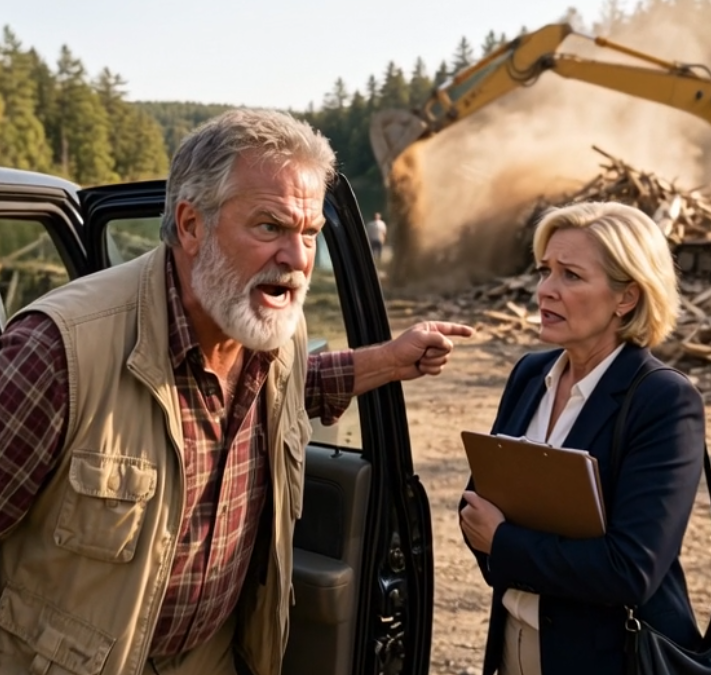
Linda Brask had no idea she had just demolished the home of the man who had signed every original deed in Lakeside Estates.
Including hers.
I opened the door and stepped out.
Linda took half a step back.
Instinct, maybe.
Or the smallest animal recognition that the man getting out of the truck was not the frightened widower she had rehearsed for.
I was fifty-four years old. I was not tall. I was not broad. I wore a fishing vest, a flannel shirt, faded jeans, and four days of beard. I did not look like power. I looked like a man who had spent too many years alone and too many nights staring at a lake that refused to answer him.
I walked past her.
Past Greg and his camera.
Past the idling excavator.
The operator was still in the cab, his hands resting on the controls, staring straight ahead with the uncomfortable expression of a man who had accepted a job and realized too late that the check might not be worth the memory.
I stepped over a length of copper pipe that had once fed the upstairs bathroom.
Then I bent down in the dust and picked up a piece of splintered oak about the size of my forearm.
The brass house numbers were still nailed to it.
Nine.
Six.
Lot 96.
The last lot platted in Lakeside Estates.
The only lot I had kept for myself.
I stood there in the wreckage holding that broken piece of door.
Behind me, Linda raised her voice again because silence was the only thing she did not know how to control.
“Mr. Vance, I need you to acknowledge service of the notice. The forty-eight-hour clock starts now. And you should know the lot will be replatted and resold by the HOA to recover demolition costs and fund community improvements.”
I turned around with the broken door in my hand.
I did not yell.
I have never been a man who yells.
I looked at Linda Brask and said one sentence.
“Linda, the clock has started.”
Then I paused.
“It just is not the one you are counting.”
For the first time that afternoon, her smile faltered.
Greg lowered his camera an inch.
I walked back to the truck. I placed the broken oak on the passenger seat. Then I opened the glove box.
Inside, behind the registration and an old folded fishing map, was a manila envelope so old the corners had gone soft. The flap was sealed with a wax stamp my father had used on legal papers long before email made men careless.
Across the front, in my own handwriting from twenty years earlier, were the words:
LAKESIDE ESTATES ORIGINAL PLAT — GRANTOR COPY.
I did not open it.
Not there.
Not in front of Linda.
I slid it out, placed it on the passenger seat beside the fragment of door, and closed the glove box.
Linda was still talking.
Still pointing at her clipboard.
Still performing for the neighbors.
Still standing on land whose history she had never bothered to read.
I started the truck.
Before I pulled away, I looked once through the windshield at the pile where my home had been.
Then I spoke so quietly no one outside could hear me.
“Linda, you should not have done that.”
I did not call 911 from the driveway.
I did not call my attorney from the road.
I did not get out and argue.
I drove.
I drove out through the front entrance of Lakeside Estates and turned onto the county highway. I kept both hands on the wheel and did not stop until I reached a small two-story motel twelve miles down the road, the kind of place with a hand-painted sign, thin towels, brown carpet, and a coffee pot in the lobby that had probably been running since the Carter administration.
I paid cash for three nights.
I carried a duffel bag, the manila envelope, Linda’s demolition order, and the broken piece of my front door up to Room 207.
I locked the door.
I sat at the laminate desk beneath the window.
I poured a paper cup of bad coffee.
Then, for the first time in five years, I let myself think clearly about Linda Brask.
Because I had not been ignoring her.
Not exactly.
I had been letting her exist.
There is a difference.
And that difference was lying in rubble on Lot 96.
Lakeside Estates began as my father’s land.
He bought the original two hundred acres in 1968, when the property was still a dairy farm with a sagging barn, overgrown pastures, split-rail fencing, and a long shoreline on Lake Marrow. Back then, the lake was quieter. No jet skis screaming across the coves. No vacation houses with glass walls and stone fire pits. Just bass boats, church picnics, and old men who still knew how deep the water got near the stumps.
My father, Raymond Vance, was not a sentimental man in public. He believed in paid bills, sharpened tools, and waking up before sunrise whether the work required it or not. But he loved that land in the private way serious men love things they are afraid to lose.
He kept cattle there for almost ten years, then leased the fields, then let the land rest. He said land needed seasons the same way people did. He said if you used every inch of something all the time, you eventually ruined what made it worth having.
When he passed in 2001, he left the property to me.
At the time, I was forty-one, married, and working as a civil site developer in Asheville. I knew how to take raw land and make it usable. Roads. drainage. utilities. setbacks. stormwater. I saw the earth the way engineers and developers see it, in elevations and easements, in retention ponds and slope percentages.
My wife, Caroline, saw it differently.
Caroline was an architect, but that word never felt large enough for her. She did not design buildings as if they were objects. She designed them as if they were conversations between people and weather and memory.
Where I saw road grades, she saw the way headlights would turn softly around a curve.
Where I saw utility access, she saw where children might run barefoot in July.
Where I saw parcel boundaries, she saw porches angled toward sunset, windows framing oak trees, a shoreline that belonged to everybody, not only the people who could afford to live closest to it.
“We can do this without making it ugly,” she told me the first spring after my father died.
We were standing near the old dairy barn. Honeysuckle had swallowed one side of it. Caroline had her hair tied back with a pencil stuck through it, which meant she had been sketching on anything she could find. A feed receipt, probably. She did that.
“Most developments become ugly because nobody is patient,” she said. “Everybody wants maximum lots, maximum pavement, maximum view. But this place already has a soul, Daniel. We just have to not ruin it.”
That was Caroline.
She could make restraint sound like ambition.
We spent three years planning Lakeside Estates.
Not because we needed three years.
Because Caroline insisted every lot should feel like it had been there before us.
We walked the land with a county surveyor named Ben Holt and a young attorney named Ruth Caldwell, who drew early plat maps by hand and carried them in cardboard tubes tied with ribbon. Ruth was only in her thirties then, sharp as broken glass, with reading glasses she did not need but wore because she said men listened better when a woman looked like a library.
The three of us fought over everything.
Road curves.
Tree preservation.
Drainage channels.
Dock access.
Sight lines.
Caroline fought hardest for the lakefront.
“We leave common shoreline,” she said.
“Thirty-two acres?” I asked. “That is a lot of value not sold.”
“It is a lot of value shared.”
“Caroline.”
“Daniel.”
She looked at me over the rolled plat like she was already daring the future to disappoint her.
“If we sell every pretty thing to the highest bidder, this becomes a subdivision. If we protect something together, it becomes a neighborhood.”
She won.
She usually did when she was right.
We platted ninety-six lots. We dedicated Lakeside Drive to the county as a public right-of-way. We left thirty-two acres of lakefront as common shoreline. We protected the old springhouse. We designed walking paths around the biggest oaks instead of cutting them down. We created view corridors without giving anyone the right to own the horizon.
And we kept the biggest cove for ourselves.
Lot 96.
Not because it was the most valuable, though it probably was.
Because Caroline stood there one October morning with fog lifting off the water and said, “Here.”
That was all.
Here.
So that became home.
In October of 2004, the final plat was recorded. I signed as declarant and trustee of the Vance Family Trust. Every buyer who came after that signed closing documents tracing back to that plat. Every deed in the neighborhood existed because my family transferred land out of the trust.
That did not make me a king.
I never wanted to be one.
It did mean that certain original rights remained reserved to the declarant unless properly released.
Ruth wrote that into the documents because she was careful.
Caroline approved it because she understood people better than I did.
“Neighborhoods forget where they came from,” she told me. “Paper helps them remember.”
In 2006, we created the Lakeside Estates HOA.
It was supposed to be boring.
That was the point.
A small annual budget. Pool maintenance. Mailbox standards. Common shoreline mowing. No neon paint. No junk cars in front yards. No short-term rentals without county approval. Fine cap of two hundred fifty dollars. Written notice before any assessment. Right to appeal. No authority to enter homes. No authority to seize land. No authority to alter, demolish, or remove any permanent structure on any private lot.
Ruth wrote it plainly.
I insisted on plain language.
If a farmer, a nurse, and a retired teacher could not understand the bylaws, then the bylaws were not done.
For thirteen years, the HOA worked.
It was dull.
It was small.
It collected dues, patched the pool fence, repainted signs, scheduled shoreline cleanup days, and occasionally reminded someone not to park a boat trailer on the street for six months.
Then Caroline got sick.
Cancer is too small a word for what it does.
It sounds clinical. Controlled. A diagnosis written in black ink on white paper.
But inside a house, cancer is not a word. It is a calendar. It is pill bottles lined up by the sink. It is a blue blanket in a recliner because beds become too far away. It is pretending soup tastes good. It is pretending not to notice when hair falls in the shower. It is the terror of good days because good days make hope reckless.
Caroline died in the lake house in 2019.
Peacefully, if that word can ever be true.
She wanted the windows open.
She wanted to hear the lake.
She wanted no machines humming near her. No hospital curtain. No fluorescent light.
The last thing she looked at was the cove she had chosen.
After that, I stopped attending meetings.
I stopped opening HOA emails unless the subject line looked urgent.
I paid the trust’s annual contribution automatically.
I fished.
I drank coffee on the dock.
I slept badly.
I let the neighborhood become background noise because the only room I could hear clearly was the one where my wife was missing.
That was the silence Linda Brask walked into.
Linda moved into Lot 41 in the spring of 2017.
Caroline saw the moving truck from our porch and waved.
“She looks organized,” Caroline said.
“She looks expensive,” I said.
Caroline laughed.
Linda’s house was one of the newer builds, all stone veneer, black shutters, and a front yard that looked like it had been threatened into perfection. She came from somewhere outside Raleigh, according to neighbor gossip. Divorced. No children at home. Worked remotely in something called operations strategy. She drove a white Lexus SUV and spoke to contractors as if they had been invented for her inconvenience.
I did not meet her then.
I did not truly notice her until much later.
She ran for the HOA board in 2019.
Her campaign flyer said:
I RUN THIS NEIGHBORHOOD LIKE PROPERTY VALUES MATTER.
At the time, I remember thinking it sounded a little severe.
Then I forgot about it.
Grief is useful to people who want power.
It gives them empty rooms to occupy.
By 2021, Linda had stacked the board.
Greg from Lot 18.
Marsha from Lot 7.
Tess from Lot 53.
Greg liked authority. He had once been assistant manager at a big box store and still carried the emotional residue of a man who missed having keys to locked rooms. Marsha liked rules because rules made the world feel less frightening. Tess liked being approved of by people louder than her.
With Linda, that made four votes in a five-seat board.
Then Linda began issuing what she called internal policy memoranda.
Not amendments.
Not recorded changes to the CC&Rs.
Memos.
That distinction mattered.
But only to people who read the original documents.
A memo created a compliance committee.
A memo expanded the fine schedule.
A memo allowed fines above the two-hundred-fifty-dollar cap for repeated violations.
A memo invented something called Article 14, subsection nine, compliance authority.
The original CC&Rs had only thirteen articles.
There was no Article 14.
There had never been one.
But most homeowners did not know that.
They saw letterhead.
They saw compliance language.
They saw deadlines.
They saw the possibility of liens.
They paid.
That is how kingdoms are built in quiet neighborhoods.
Not with swords.
With paper nobody reads.
In Room 207, I wrote names on motel stationery.
Mrs. Alvarez, Lot 22.
Fined three hundred dollars for a Christmas wreath.
The date of the fine was December 26.
The Hendersons, Lot 60.
Billed four thousand two hundred dollars for staining a fence an “unapproved beige,” even though three board members had the same color.
Mr. Goff, Lot 12.
Retired schoolteacher.
Widower.
His backyard koi pond was drained by a contractor Linda called to address an “attractive nuisance.”
The fish died on his lawn.
A young couple in Lot 38 sold after repeated threats of liens over a backyard pergola.
An older man in Lot 71 moved closer to his daughter after Linda fined him weekly for “visible grief storage,” which meant three boxes in his garage with the door open.
I wrote until the page filled.
Then I wrote another.
Then another.
When I finished, I looked at the broken piece of my oak door on the desk.
Linda had not started with my house.
My house was just the day she finally made the mistake in front of the right paper.
The next morning, I drove to the county recorder’s office.
The basement records room smelled like dust and toner. The clerk, Eleanor, remembered me from 2004. She had been younger then, with dark hair and bright lipstick, and she had stamped the first deeds from Lakeside Estates with the kind of care people only give paper when they understand paper can outlive everyone in the room.
“You still have the lake place?” she asked before she caught herself.
Then her face changed.
“I’m sorry,” she said softly.
News moves fast in a small county.
“I need certified copies,” I said.
“Of what?”
“Everything.”
She did not ask why.
I requested the original plat. The recorded CC&Rs. The declarant rights reservation. The dedication of Lakeside Drive as a public right-of-way. The trust deed for Lot 96. The annual HOA endowment record. The recorded fine cap. The original charter. The amendment procedure.
Eleanor stamped each one.
Forty-six dollars.
She handed me the envelope with both hands.
“Mr. Vance,” she said, “be careful with Linda Brask.”
I looked at her.
She did not explain.
She did not have to.
I returned to Lakeside Estates two days after the demolition.
My plan was simple.
Walk the lot.
Take photographs.
See if anything could be salvaged.
Leave.
That plan died the moment I pulled into what remained of my driveway.
There was a fresh metal stake driven into the dirt near where my porch steps used to be. Stapled to it was a yellow notice sealed in a plastic sleeve.
NOTICE OF LIEN.
LAKESIDE ESTATES HOA v. D. VANCE.
LOT 96.
TOTAL AMOUNT DUE: $47,300.
Demolition cost recovery.
Abatement administration.
Accumulated unpaid dues.
Late penalties.
Continuing daily fines pending lot reclamation.
The HOA had billed me for destroying my own house.
They had added late fees to the ashes.
I photographed the notice.
I did not remove it.
Then I drove to the clubhouse.
Linda was waiting.
Of course she was.
The blinds were open. Three cars sat in the lot. A printed agenda was taped to the door.
SPECIAL CONFERENCE.
D. VANCE LOT 96 RESOLUTION.
It was two in the afternoon on a Tuesday.
She had arranged this the moment she heard I had returned.
I walked inside.
Linda sat at the head of the long table.
Greg sat on her right.
Marsha sat on her left.
A small recording device lay between them, red light blinking.
Linda gestured to the chair opposite her.
“Mr. Vance, please sit. This conversation is being recorded for HOA records.”
I sat.
I wanted her voice preserved.
Linda folded her hands.
“As you have now seen, the board has filed a lien against Lot 96 in the amount of forty-seven thousand three hundred dollars. You have two options. Option one, pay in full within fourteen days. Option two.”
She slid a document across the table.
“You sign this quitclaim deed transferring Lot 96 to the Lakeside Estates Homeowners Association. The lien will be dissolved. The HOA will replat and resell the parcel. The proceeds will fund community improvements.”
Greg said, “We want to keep this neighborly.”
I looked down at the deed.
My name was already typed on the grantor line.
The grantee line said Lakeside Estates HOA.
They had prepared the theft before inviting me to the meeting.
“And if I choose option three?” I asked.
Linda smiled.
“There is no option three. If you do not pay or sign, the HOA will begin non-judicial foreclosure proceedings. Frankly, Mr. Vance, the quitclaim is a courtesy.”
I leaned forward.
“Linda, could you tell me, on the record, where in the original recorded CC&Rs the board has authority to demolish a home or force a deed transfer?”
She did not blink.
“Article 14, subsection nine. Compliance authority. It has been on the books for years. The fact that you never bothered to read your own governing documents is not the HOA’s problem.”
The recorder’s red light blinked between us.
I had the certified original CC&Rs folded in my jacket pocket.
I had drafted them with Ruth in 2006.
I knew there was no Article 14.
I did not correct Linda.
Not yet.
I wanted the lie whole.
I stood.
“I see,” I said. “Thank you for clarifying.”
I left the quitclaim deed on the table and walked out.
In the parking lot, someone caught up with me.
A young woman in a neat blouse.
Patricia.
The HOA secretary.
I remembered her vaguely. Lot 44, maybe. Quiet. Dark hair cut at her jaw. Always sitting near the wall at meetings in the old days, typing minutes without speaking unless spoken to.
She looked over her shoulder.
Then she pressed a small black USB drive into my palm.
She did not say a word.
She walked back inside.
There was a piece of clear tape on the drive.
One date was written on it in blue ink.
Fourteen months earlier.
Back in Room 207, I plugged the drive into my laptop.
There were forty-seven audio files and one folder labeled EMAILS.
I clicked the first recording.
Linda’s voice filled the room.
“Lot 22, Alvarez. Push the wreath fine to three hundred. She will pay. Pressure point is the son in Phoenix.”
Greg laughed.
Another file.
Linda again.
“Lot 12, Goff. Drain the pond. He is a widower. Pressure point is loneliness. He will cave if he has to stand on his lawn alone.”
I sat in the motel chair and listened to a woman read my neighbors like a butcher reading a cutting list.
Another file.
“The Henderson fence issue. Make the fine high enough that they don’t fight. They have twins in private school. Cash flow is the pressure point.”
Another.
“Lot 71. Visible grief storage. He opens the garage when he sorts his wife’s things. Hit him weekly. His daughter already wants him closer to Charlotte. Pressure point is exhaustion.”
Another.
“Tess, don’t ask whether we can do it. Ask whether anyone will stop us.”
Then came the file dated three months before the demolition.
Linda’s voice was smoother in that recording.
Excited.
“If we can scare Vance off Lot 96, the lakefront flips for two point four million. Greg, get the demolition contractor on standby. We need the house declared abandoned.”
Greg asked, “What if he comes back?”
Linda said, “Then he comes back to rubble.”
That was when the key turned inside me.
Not a snap.
Not a fire.
A key.
A door opening.
Grief had kept me underwater for five years. I had moved through my days slowly, letting Linda’s memos and rumors and petty cruelties pass above me like boats. But sitting there in that cheap motel room, with my wife’s house in ruins and Linda’s voice coming through my laptop speakers, I surfaced.
The next day, I started knocking on doors.
At each one, I said the same thing.
“My name is Daniel Vance. I lived on Lot 96. The HOA demolished my house. I am going up against Linda. If you have letters, fines, emails, photos, recordings, or receipts, I would like to see them.”
The first door was Mrs. Alvarez.
She opened it in a gray cardigan, with reading glasses hanging from a chain around her neck. She was in her late sixties, small and upright, with the careful movements of a woman who had been taught not to take up more space than necessary.
She listened.
Then she said, “Mr. Vance, I have been waiting three years for someone to ask me that.”
She brought me a shoebox.
Fine notices.
Canceled checks.
Handwritten notes from Linda.
The Christmas wreath fine.
A fine for garden gnomes.
A fine for the smell of basil from a kitchen window box.
“The smell of basil?” I asked.
Mrs. Alvarez nodded.
“She said it attracted bees.”
“She fined you for basil?”
“She said repeated violations showed disregard for community harmony.”
Her voice stayed calm, but her hands trembled as she lifted the papers.
“My husband planted basil every year. After he died, it was the first thing I planted alone. I paid the fine because I did not want trouble. Then I stopped planting it.”
She looked at the kitchen window.
“There are many ways to make a house feel less like yours.”
I took copies of everything.
At the Hendersons’ house, Mark Henderson met me in the driveway before I reached the door. He was a big man with tired eyes and paint on his forearm. His wife, Ellie, stood behind the screen door with one of the twins on her hip.
“You’re really going after her?” he asked.
“Yes.”
“Not just complaining?”
“No.”
He opened the garage and pulled out a plastic storage bin.
“Then you need this.”
Four thousand two hundred dollars for staining a fence an “unapproved beige,” even though three board members had the same color. Photographs showed identical fences in Greg’s yard and Linda’s side garden. Emails showed Mark asking for the written color standard and Linda replying that “community consistency is determined by the board’s visual discretion.”
Ellie came out while I was photographing the documents.
“She made me cry in this driveway,” she said quietly.
Mark looked down.
Ellie continued, “I was six weeks postpartum. The twins had colic. She stood right there and told me if we couldn’t maintain basic standards, maybe Lakeside Estates wasn’t the right place for a young family.”
Her mouth tightened.
“I still hear her when I look at that fence.”
At Mr. Goff’s house, no one answered at first.
I was turning away when the door opened.
Arthur Goff stood there in a brown cardigan and house slippers. He had taught eighth-grade history for thirty-six years. His wife, Elaine, had died two years before Caroline, and after that he had spent most of his time tending a koi pond in his backyard. Caroline once told me she liked passing his house because the pond sounded like a little laugh.
“Mr. Goff,” I said. “I’m Daniel Vance.”
“I know who you are.”
His voice was dry.
“May I speak with you about Linda Brask?”
He looked past me toward the road, then stepped aside.
His living room smelled like lemon oil and old books. On the mantel was a photograph of Elaine in a yellow dress standing beside the pond. She had one hand raised to block the sun, smiling at whoever held the camera.
Mr. Goff brought me a photo album and a digital camera.
Forty-three photographs of his pond.
The contractor draining it.
The fish on the lawn.
Linda across the street, arms folded, watching.
The camera held a video.
Linda’s voice was clear.
“Mr. Goff, I will personally make sure no one in this neighborhood invites you to a barbecue again.”
When the video ended, Mr. Goff said, “I have not been to a barbecue in three years.”
He did not cry.
That made it worse.
He sat very still in his chair, hands folded in his lap, looking at the blank camera screen.
“Elaine named the orange one Julius,” he said. “The big white one was Pearl. She liked Pearl best.”
“I’m sorry,” I said.
He nodded as if apologies belonged to another language.
“People think old men don’t need much. They are wrong.”
By evening, my passenger seat held a shoebox, a manila folder, a photo album, a camera, the broken door fragment, and the original plat.
The seat was getting crowded.
I called Ruth Caldwell.
She answered on the third ring.
“Daniel?”
She still had the same voice. Calm, dry, sharp around the edges.
“Ruth,” I said, and for a moment I could not continue.
She waited.
Good attorneys know when silence is not empty.
“They tore down the lake house,” I said.
There was a pause.
“Who?”
“The HOA.”
Another pause.
Then her voice changed. Not louder. Colder.
“Tell me everything.”
I told her about the demolition. The lien. The quitclaim deed. The USB drive. The recordings. The fake Article 14. The neighbors. The chain of fines. The plan to replat and resell Lot 96.
She was silent for a long time.
Then she said, “Daniel, you do not need to begin with a lawsuit.”
“I don’t?”
“No. You need a board meeting.”
“Ruth.”
“Bring the plat. Bring the CC&Rs. Bring Patricia’s recordings. Bring the neighbors. And whatever you do, do not tell Linda what you have.”
“She thinks she’s in control.”
“Good.”
“Good?”
“Let her call the meeting. Let her think she is running it. Arrogant people are most useful when they believe the room belongs to them.”
Linda called it within the week.
Before that, she escalated again.
My truck was towed from the motel parking lot.
Tidewater Tow and Recovery said it had been removed under Lakeside Estates HOA abandoned vehicle protocol.
My truck was not abandoned.
It was in a paid motel space twelve miles outside Lakeside Estates.
Linda had signed the removal order.
The release fee was nine hundred dollars, cash.
The man on the phone sounded embarrassed.
“I’m just telling you what the paperwork says, Mr. Vance.”
“Who requested the tow?”
He hesitated.
“Linda Brask. Lakeside Estates HOA.”
“From a motel parking lot?”
Another pause.
“Yes, sir.”
“Thank you.”
“For what?”
“For being honest.”
Then Pete Holloway from Lot 33 drove me to Lakeside Estates.
Pete was a retired fire captain with hands like fence posts and a voice permanently roughened by smoke. He had been one of the three neighbors who watched the demolition from across the street. When I knocked on his door, he could barely look at me.
“I should’ve done something,” he said.
“I’m not here for guilt.”
“That doesn’t mean I don’t have it.”
Now he drove me in his old pickup, jaw clenched the whole way.
At the entrance, a heavy galvanized chain blocked Lakeside Drive.
A sign read:
PRIVATE HOA ROAD.
RESIDENTS AND AUTHORIZED GUESTS ONLY.
TRESPASSERS WILL BE TOWED AND PROSECUTED.
Greg stood beside it wearing his compliance officer badge.
He had a clipboard.
Of course he had a clipboard.
“Mr. Vance,” he said, “your access is suspended pending lien resolution.”
I asked him who gave the HOA authority to chain a county road.
He tapped his clipboard.
“Article 3.”
I looked at Pete.
Pete called the sheriff’s department.
Twenty minutes later, Deputy Ortiz arrived.
Linda arrived right behind him.
She launched into her speech before he finished stepping out of the cruiser.
“Deputy, Mr. Vance is attempting to access a private HOA road after privileges have been suspended. We need him removed.”
Deputy Ortiz was younger than I expected, with tired eyes and the cautious patience of a man who had learned that neighborhood disputes can become more irrational than bar fights. He listened to Linda for almost a minute, then looked at me.
“Mr. Vance?”
I handed him one certified page.
The 2004 dedication of Lakeside Drive as a public right-of-way to Pitkin County.
Ortiz read it.
Then he looked at the chain.
Then at Linda.
Then back at the document.
Linda said quickly, “That is an old document. Our governing documents supersede it.”
Ortiz raised one finger.
He kept reading.
Then he folded the page and handed it back to me.
“Ma’am,” he said, “I need you to step away from the chain.”
Linda blinked.
“Excuse me?”
“I also need someone to explain how a private homeowners association came to have a padlock on a county road.”
Greg looked at Linda.
Linda looked at Greg.
Pete Holloway crossed his arms and smiled for the first time all day.
The chain came down that afternoon.
The body cam report was filed by five.
By the next morning, everyone knew something had shifted.
Linda called an emergency special meeting for Monday at 7:00 p.m.
One agenda item.
Vote to ratify demolition and reclamation of Lot 96, D. Vance, and permanently bar D. Vance from Lakeside Estates community privileges.
The agenda packet included Exhibit A.
The original 2004 recorded plat.
Linda had attached it herself.
When I told Ruth, there was the faintest pause on the line.
Then she said, “Daniel, she just attached the weapon she is about to be struck with.”
Monday night, the clubhouse parking lot was full.
I wore a charcoal suit jacket and no tie. I had not worn that jacket since Caroline’s funeral.
Ruth rode with me.
She wore a navy dress, reading glasses, and the calm expression of a woman who had spent forty years watching arrogant people underestimate quiet documents.
My father’s leather briefcase sat between her feet.
Inside were the certified plat, the CC&Rs, the declarant reservation, the trust endowment records, the USB drive, the tow paperwork, the lien notice, the quitclaim deed Linda had prepared, and the broken piece of oak door with the brass numbers still nailed to it.
The room was packed.
Seventy people in a space built for forty.
Mrs. Alvarez sat near the front, hands folded over her purse.
The Hendersons were behind her.
Mr. Goff stood at the back in a brown suit jacket that looked too formal for a clubhouse and too brave for the room.
Patricia sat near the side door with a laptop open and a livestream camera blinking red.
Linda sat at the head table in a cream blazer.
Greg was to her right.
Marsha to her left.
Tess farther down, pale and quiet.
The HOA attorney, a man named Brent with a poorly fitted gray suit, shuffled papers at the corner.
Linda began with slides.
Why Compliance Matters.
Community Standards.
Protecting Property Values.
She showed photographs of my demolished house.
She called the act unfortunate.
Necessary.
Regretful.
Responsible.
Then she said, “This is what happens when one homeowner thinks he is above the rules of his community.”
I did not move.
Ruth did not move.
Linda called the board vote.
Greg voted yes.
Marsha voted yes.
Tess hesitated, then voted yes.
Linda smiled.
“The board’s action is ratified.”
Then she asked for an advisory show of hands from members in good standing.
About half the room raised their hands.
Some quickly.
Some slowly.
Some because they were still afraid.
Linda saw only the raised hands.
“Thank you,” she said. “The board’s decision is endorsed. Lot 96 will be replatted and resold. The proceeds will fund a new pickleball court.”
The pickleball court.
Remember that.
Linda turned to Brent.
“Counsel, prepare the motion for entry into the official record.”
I stood.
Heads turned.
Linda’s smile fixed itself in place.
“Madam President,” I said, “before this vote is entered into the official record, would you please read aloud for the minutes the name listed as declarant on page one of Exhibit A, the original recorded plat you attached to tonight’s agenda packet?”
I held her eyes.
“I will wait.”
The room went quiet.
Linda’s smile held one second too long.
Greg looked at the packet.
Tess looked down.
Marsha opened her copy.
She turned to Exhibit A.
Her finger moved across the page.
Then stopped.
She did not speak at first.
She looked at Linda.
Linda said, “Marsha, read the agenda.”
Mr. Goff spoke from the back wall.
“Let her read it, Linda.”
Linda turned toward him.
The look she gave him had probably worked on him for years.
It did not work that night.
Marsha took a breath.
Then she read.
“Declarant of record, Lakeside Estates subdivision, plat filed October 14, 2004. Daniel R. Vance, trustee, Vance Family Trust.”
Her voice weakened.
She looked up.
“He was the seller of every lot in this neighborhood.”
A low murmur moved across the room.
Linda stood quickly.
“That is irrelevant to the board’s present authority.”
Ruth stood beside me.
“My name is Ruth Caldwell. I am Mr. Vance’s attorney. I drafted the original CC&Rs and founding HOA charter for Lakeside Estates in 2006.”
She walked to the front and placed the leather briefcase directly in front of Linda.
She opened it.
One document at a time, she handed the papers to Marsha.
Marsha read them aloud.
The original plat.
Daniel R. Vance, trustee, declarant.
Reserved rights retained by declarant.
HOA formed under declarant authorization.
The original 2006 CC&Rs.
Article 1.
Article 2.
Article 3.
All the way to Article 13.
Then Marsha stopped.
“There is no Article 14,” she said.
She turned another page.
“There is no subsection nine. There is no compliance authority section in this document.”
Linda stood.
“That is not the operative document. We adopted amendments.”
Ruth held up one finger.
“The CC&Rs cannot be amended in that manner without recorded consent of the declarant. Mr. Vance never consented. Article 14 exists only in a memo drafted by Mrs. Brask in 2021. It has no legal authority.”
The room went still in a new way.
Not fear.
Attention.
Marsha slowly removed her HOA pin from her lapel. She placed it on the table beside the plat.
Then Ruth handed over the trust endowment record.
“Lot 96 has not had unpaid HOA dues since 2006,” Ruth said. “The Vance Family Trust endowed the HOA and prepaid its annual contribution through a recorded funding agreement. The eleven-thousand-four-hundred-dollar dues claim is fictional. The forty-seven-thousand-three-hundred-dollar lien is fraudulent.”
Greg stood.
Picked up his clipboard.
Walked out the side door.
He did not come back.
Ruth gave me the USB drive.
I plugged it into Patricia’s laptop.
The first audio clip filled the room.
Linda’s voice.
“Lot 22, Alvarez. Push the wreath fine to three hundred. She will pay. Pressure point is the son in Phoenix.”
Mrs. Alvarez covered her mouth.
The second clip.
“Lot 12, Goff. Drain the pond. He is a widower. Pressure point is loneliness. He will cave if he has to stand on his lawn alone.”
Mr. Goff let out one broken laugh.
Then he sat down and put his face in his hands.
The third clip.
“If we can scare Vance off Lot 96, the lakefront flips for two point four. Greg, get the demolition contractor on standby. We need the house declared abandoned.”
Greg’s voice answered, “What if he comes back?”
Linda replied, “Then he comes back to rubble.”
The room made a sound I will never forget.
It was not a gasp.
It was not a shout.
It was the sound of seventy people realizing all at once that the person who had claimed to protect them had been hunting them.
Linda pointed at me.
“This is fraud. This man is impersonating—”
Brent, the HOA attorney, stood.
He looked at Ruth.
Then at the documents.
Then at Linda.
“I am withdrawing from this representation,” he said.
He placed his pen on the table and left.
Linda looked smaller without counsel.
Still dangerous.
But smaller.
She tried once more.
“You cannot prove he is the same Daniel Vance.”
Ruth placed my driver’s license, trust documents, tax history, and a photograph from 2004 on the table.
The photograph showed a younger me standing in an open field beside the county surveyor.
That field was now Lakeside Estates.
Linda stared at the photograph.
She had nothing left.
I stood.
I had prepared a speech for that moment.
In Room 207, I had written three versions.
One angry.
One dignified.
One legal.
I used none of them.
I looked at Linda Brask in her cream blazer.
At the woman who had smiled in my driveway while my house lay in dust.
At the woman who had named loneliness as a pressure point.
At the woman who had told my neighbors she owned the rules.
And I said, “I told you not to do that.”
The livestream caught every word.
The side door opened.
Deputy Ortiz walked in with another deputy.
He had been standing in the hallway for fourteen minutes.
He approached Linda.
“Mrs. Brask,” he said, “I need you to come with us and answer questions about a demolition order signed without legal authority, a fraudulent lien, and a vehicle removed under a false abandonment claim.”
“You are not under arrest.”
He paused.
“Yet.”
Linda did not resist.
She picked up her blazer, draped it over one arm, and walked out between two deputies while seventy neighbors watched.
No one clapped.
No one cheered.
That mattered.
This was not a victory parade.
It was a release.
A room exhaling after years of holding its breath.
Mr. Goff walked to the front of the room and stopped beside the table where Marsha’s HOA pin lay next to the original plat.
He looked around.
Then he said, “I have not been invited to a barbecue in three years.”
His voice cracked, but he kept going.
“I think I would like to host one.”
That was when the room finally laughed.
Not cruelly.
Warmly.
Carefully.
As if laughter had to learn how to live there again.
The legal part moved faster than I expected.
Linda Brask was charged six weeks later.
Fraud.
Unauthorized destruction of property.
Filing a false lien.
Conspiracy to coerce transfer of real property.
False report related to the tow order.
Misuse of association funds.
Her attorney advised her to take a plea.
She did.
Eighteen months in state custody.
Restitution ordered in full.
A permanent ban from serving on any HOA board, nonprofit board, or fiduciary committee in the state.
Greg pled to a misdemeanor and surrendered his contractor license after investigators found falsified renewal documents. Marsha settled the civil claim against her personally and moved to Tennessee to live near her sister. Tess cooperated, testified truthfully, and avoided prosecution, though she sold her house the following spring because shame can be its own foreclosure.
The fraudulent lien on Lot 96 was vacated within the month.
The HOA’s insurer paid full replacement value for the lake house. They also paid for the destroyed contents.
That included Caroline’s drafting tables.
Her old sketches.
The design files she had left in the studio.
No insurance check can replace a dead woman’s hand on paper.
But the adjuster tried to understand.
I appreciated that.
The homeowners received refunds for every fine Linda had issued without proper authority.
The total came to two hundred fourteen thousand dollars.
Mrs. Alvarez got back every dollar.
The Hendersons got back the fence fine.
Mr. Goff got damages for the pond.
The young couple from Lot 38 received a settlement after Ruth tracked them down through forwarding records.
The older man from Lot 71 got enough back to help with the move he never wanted to make.
Three weeks after the meeting, the membership voted to dissolve the old HOA.
The vote was 87 to 4.
A new association replaced it.
Five articles.
Plain language.
No secret memos.
No invented sections.
No compliance officer badges.
No authority to fine without a recorded vote, written notice, and appeal.
Mrs. Alvarez became secretary.
Mr. Goff joined the board.
His first motion banned any rule using the phrase attractive nuisance without a county safety citation attached.
The motion passed unanimously.
Ruth added one sentence to the new charter at my request.
The declarant attends no meetings but reviews the annual minutes.
That is all the authority I wanted.
It is more than I used before.
Less than I once ignored.
Lot 41, Linda’s house, went into foreclosure after the civil judgments stacked.
Some neighbors suggested the trust should buy it back.
They thought it would be poetic.
I refused.
I did not need Linda’s house.
I only needed her to remember whose deeds she had been standing on.
A young schoolteacher and her husband bought Lot 41. They have two daughters. The girls fish from the public dock Caroline and I built in 2007.
The public dock still belongs to the county because Caroline insisted the lake should never be only for the people closest to it.
I rebuilt the lake house on Lot 96.
Same footprint.
Same roofline.
Same porch facing the cove.
Not because I wanted to erase what happened.
Because Caroline had drawn that house to fit that land, and she had been right the first time.
The broken oak fragment with the brass nine and six is now set into the new front door. If you look closely, you can see the change in grain.
Most visitors do not notice.
I notice every time I come home.
The manila envelope is framed in my study, glass on both sides so the old wax seal is visible.
Above the small writing desk hangs Caroline’s photograph. I moved it from the old living room plan because the morning light is better there.
Some things I did not rebuild.
The electric gate is gone.
The roadside fence is gone.
There is no chain across the driveway.
There is no sign warning people away.
I locked myself away after Caroline died.
Linda mistook my absence for weakness.
I will not give the next Linda the same gift.
Mr. Goff hosted his barbecue that spring.
Almost everyone came.
He wore the brown suit jacket.
There were paper plates, lemonade, folding chairs, and a new koi pond running in the corner of his yard. Mrs. Alvarez brought empanadas. The Henderson children chased each other through the grass. Pete Holloway burned the first batch of burgers and declared it intentional.
I stood near the fence with a paper cup and watched the neighborhood become a neighborhood again.
People did not call me Mr. Vance that day.
They called me Daniel.
That mattered more than I expected.
Patricia still comes by twice a year.
The anniversary of the meeting.
The anniversary of the day she gave me the flash drive.
She never stays long. We sit on the porch. We drink coffee. We do not talk much about Linda.
Some truths do not need to be revisited once they have done their work.
This morning, I stood on the porch of the rebuilt house before sunrise.
The lake was still.
A thin mist hung over the cove.
Caroline used to call that cathedral fog.
I looked down the road toward the bend where I first saw the dust.
Then I looked at the new front door.
At the old brass numbers set into it.
Nine.
Six.
Lot 96.
The last lot.
The one I kept.
Linda Brask thought she was tearing down a delinquent homeowner’s house.
She thought a fake article in a memo was stronger than a recorded deed.
She thought a clipboard could become law if everyone around her stayed scared long enough.
For a while, she was almost right.
That is the part I had to live with.
Not that Linda was cruel.
Cruel people exist.
Not that Greg followed her.
Weak people follow louder people every day.
The part I had to live with was that I had let grief make me absent from a place I had created.
I had left my neighbors alone with a woman who understood silence as permission.
The house came back.
The money came back.
The fines came back.
But years do not come back.
A koi pond does not refill itself with trust.
A widow does not forget the day someone used her son in Phoenix as a pressure point.
A neighborhood does not become healthy because one tyrant leaves.
It becomes healthy when everyone starts reading the paper.
The real paper.
The deeds.
The bylaws.
The minutes.
The things people sign when they believe no one will ever look.
Linda’s mistake was not that she demolished the wrong house.
Her mistake was older than that.
She forgot that every kingdom built on unread paperwork can be ended by someone willing to read.
She forgot to check the deed.
She forgot to check the plat.
She forgot to ask who had signed the neighborhood into existence before she started calling herself its ruler.
And by the time she found out, the house was already gone, the room was already full, the camera was already recording, and every neighbor she had frightened was finally listening.
I told her in my driveway that the clock had started.
She thought I meant forty-eight hours.
I meant the time it takes for paper to become justice.
It took six weeks.
And on the morning the new house was finished, I unlocked the front door, stepped inside, and heard nothing.
No excavator.
No clipboard.
No voice telling me I owed a debt that did not exist.
Only the lake.
Only the floorboards.
Only the quiet.
For the first time since Caroline died, the quiet did not feel empty.
It felt like home.

