The HOA Bulldozed My Father’s 30-Year Windbreak for Million-Dollar Views—Then the County Made Them Stare at a 22-Foot Wall
 Switch from “Most Relevant” to “All Comments” so you don’t miss the rest of the story.
PART2:
PART3:
At first, it was just survey flags and a developer’s sign out by the road. Then came graders. Then retaining walls. Then streets with names like Sage Crest Lane and Riverstone Court, as if branding could make the hillside older than it was. Eventually ninety-two homes climbed the ridge west of us, each one larger and more expensive than the last, with stone veneer, black-framed windows, outdoor kitchens, glass railings, and carefully angled patios facing the valley.
The county knew exactly what those homes were being built beside. That was why High Mesa’s original development approval included agricultural compatibility conditions. The developer had to recognize that Monroe Valley Nursery already existed and had the right to keep operating. The approval included a sixty-foot buffer on High Mesa’s side of the boundary. There was also a recorded maintenance agreement allowing limited HOA access to help prune and irrigate vegetation along my berm where plantings overlapped and where the original developer had promised to help preserve the screen.
The words mattered.
Maintain.
Preserve.
Replace.
They did not say remove.
They did not say grade.
They did not say lower.
They did not say clear.
They definitely did not say destroy a thirty-year windbreak to improve luxury home views before an October real-estate tour.
But Helena Price had a talent for reading only the words that served her.
The first time she came to my office, she looked out of place before she even reached the door.
My office was a converted equipment shed with a metal roof, two muddy boot scrapers outside, old invoices clipped to a board, and a coffee maker that had survived longer than some marriages. Helena arrived in cream slacks, polished boots, oversized sunglasses, and a red blazer that looked expensive enough to resent dust. She was in her early sixties, trim, silver-blond, with a smile that never quite reached her eyes. She had the posture of someone used to entering rooms already believing she was chairing them.
My office manager, Rita, buzzed me.
“Caleb,” she said, “there’s a woman here from High Mesa.”
That tone told me more than the words did.
When I stepped out, Helena extended a hand as if we had scheduled an appointment.
“Caleb Monroe,” she said. “Finally.”
“Finally?”
“I’ve been meaning to connect with you. Helena Price. President of the High Mesa Estates Homeowners Association.”
I wiped my hand on my jeans before shaking hers, partly because I had just been checking irrigation filters, partly because she looked like a woman who needed to remember where she was standing.
“What can I do for you, Ms. Price?”
“Helena, please.”
“What can I do for you, Helena?”
She glanced around the office, taking in the maps, the seed catalogs, the muddy floor, the hand-labeled parts bins.
“We’d like to discuss an improvement opportunity.”
That was the first warning.
People who want to take something from you rarely call it taking. They call it improvement. Modernization. Alignment. A fresh start. A better use.
She opened a leather portfolio and placed a glossy rendering on my desk.
It showed the western edge of my property without the Green Wall.
No berm.
No mature junipers.
No pines.
No dense screen.
In their place were low native shrubs, river rock, decorative grasses, open sky, and a wide clean view across my property toward the Columbia River.
My nursery appeared as a few harmless green smudges in the background, like a landscaping feature that had politely agreed to stay small and quiet.
Helena tapped the rendering with one manicured finger.
“Look what the ridge could become.”
I stared at it for a long moment.
Then I looked at her.
“That isn’t what it becomes.”
Her smile tightened. “Excuse me?”
“That’s what it looks like when somebody deletes my business with Photoshop.”
She laughed lightly, as if I had made a rustic little joke.
“The HOA is prepared to pay to modernize the landscape.”
“No.”
“You haven’t heard the proposal.”
“You’re asking me to remove the windbreak protecting six commercial greenhouses.”
“We’re asking to open up a shared visual corridor.”
“No.”
“Mr. Monroe, the current condition is outdated.”
“It works.”
“It blocks significant views.”
“That is one of the reasons it works.”
She folded her hands. “We are not trying to create conflict.”
“You brought me a picture of my father’s windbreak erased.”
Her mouth paused before her smile returned.
“I understand there may be sentimental value.”
That was the second warning.
People who call your history sentimental are usually preparing to price it cheaply.
“My father built that berm because canyon wind nearly destroyed Greenhouse Two,” I said. “It is not sentimental. It is functional.”
“Functions can be replaced.”
“With what?”
“A more attractive landscape solution.”
“Will it stop fifty-mile-an-hour gusts?”
She looked annoyed, like wind was being difficult on purpose.
“Our consultants believe the current massing is excessive.”
“Your consultants grow trees?”
“They design high-end communities.”
“That answers my question.”
She inhaled slowly, opened another sheet, and slid it toward me.
The offer was twenty-five thousand dollars.
For a thirty-year windbreak.
For hundreds of cubic yards of compacted earth.
For mature junipers and pines.
For irrigation.
For privacy.
For protection.
For the thing my father had built after losing part of a greenhouse roof with my mother crying in the kitchen because she thought the nursery might not survive another season.
I looked at the number and almost laughed.
Instead, I pushed the paper back.
“No.”
Helena’s expression cooled.
“You might want to speak with an attorney before refusing.”
“I have one.”
“Then you should ask her about the maintenance agreement.”
“I have.”
That was not entirely true. I had asked about it years earlier when High Mesa’s landscapers wanted to prune branches. My attorney, Megan Sloan, had told me exactly what I already knew: limited access, vegetation care, no grading, no material alteration, no ownership transfer, no view easement.
Helena stood.
“I think you’ll find the HOA has rights here.”
“And I think you’ll find rights are not wishes with stationery.”
For the first time, her smile disappeared.
“Good day, Mr. Monroe.”
I watched her cross the yard toward her white Lexus SUV, stepping carefully around wet tire tracks as if the earth had personally offended her.
Rita came out behind me, arms folded.
“She seems fun.”
“She wants the Green Wall gone.”
Rita stared toward the ridge.
“They bought houses beside a nursery.”
“They want the river.”
“They already have the river.”
“They want more of it.”
Rita shook her head. “People with a view always think the thing in front of it is stealing.”
I should have taken Helena more seriously after that.
Not because her argument had merit, but because arrogance with a budget is never harmless.
Over the next several weeks, emails came. Polite at first. Then formal. Then threatening in that polished HOA way where every sentence sounds like it was written by someone standing behind a podium.
The board wished to discuss collaborative improvements.
The current vegetation appeared inconsistent with community standards.
The maintenance agreement granted High Mesa authority to preserve the buffer in a manner consistent with modern landscape design.
Residents had expressed concern regarding fire risk, pest habitat, and visual obstruction.
That last phrase appeared three times.
Visual obstruction.
I forwarded everything to Megan.
Megan Sloan had been my attorney for eleven years. She was not flashy. She wore plain suits, read documents like a surgeon reads scans, and had the calmest voice of any person I knew who could ruin someone’s afternoon with a paragraph. Her office was in Wenatchee, above a bakery, and she had represented farmers, orchard families, irrigation districts, packing houses, and more than one person who learned too late that rural land came with paperwork city people did not understand.
She called me after Helena’s third email.
“She is reaching,” Megan said.
“How far?”
“Far enough to pull something.”
“Can she?”
“No. Not legally. But people do illegal things every day with enough confidence.”
“What should I do?”
“Document every communication. Do not agree to any site work. If anyone enters your property, photograph, call me, and call law enforcement if necessary.”
“You think it’ll get that far?”
Megan paused.
“I think she wants something she has decided she deserves. That kind of person often mistakes refusal for a temporary obstacle.”
I remembered that sentence seven weeks later when I turned into the nursery just after sunrise and saw the excavator.
At first, my mind refused to understand what my eyes were seeing.
The machine was yellow against the gray morning, its bucket rising and falling where the Green Wall should have been. A dump truck idled nearby. Chainsaws whined. Men in orange vests moved through dust and broken branches. The smell of torn juniper and raw soil hit me before I even got out of the truck.
For a heartbeat, I was twenty-two again, standing in mud after the storm with my father.
Then I was fifty-two, and my father was dead, and the thing he had built with his own hands was being torn apart in front of me.
I slammed my truck into park so hard the gearshift cracked against my palm.
Rita came running out of the office.
“Caleb!”
I did not answer.
I ran.
By the time I reached the western boundary, half the berm was already gone. Not trimmed. Not pruned. Not maintained. Gone. Lowered almost to natural grade. Mature junipers lay twisted in piles, root balls exposed, branches snapped, trunks scarred white where saws had cut through living wood. Soil that had been compacted for decades sat loose in mounds, scraped and loaded and hauled as if it had never belonged to anyone.
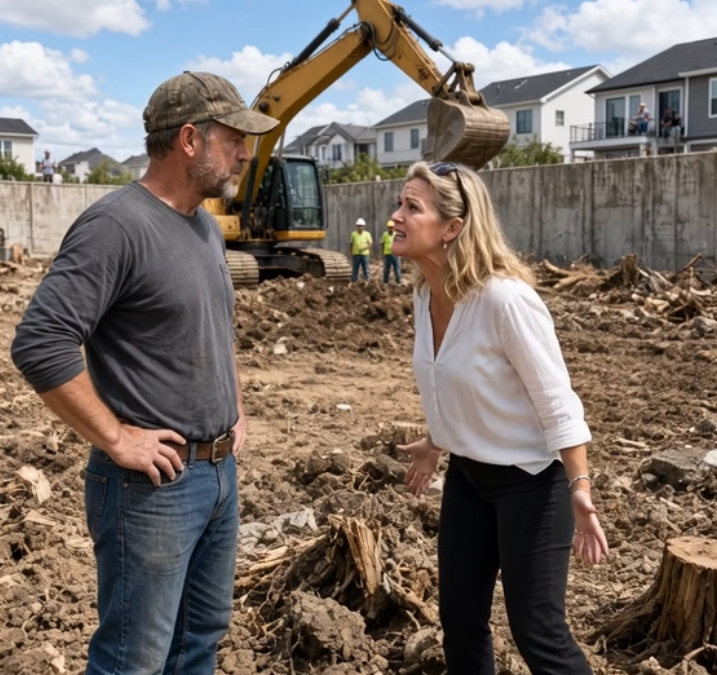
And there was Helena Price.
Red blazer.
White hard hat.
Phone raised.
Filming.
She looked satisfied. Not nervous. Not apologetic. Satisfied.
“Stop!” I shouted.
The excavator bucket froze midair.
A man leaned out from the cab. Mid-forties, beard, sunburned neck, work jacket with the name Dale stitched over the pocket. He looked from me to Helena and back again.
“Shut it down,” I said.
Helena lowered her phone.
“Mr. Monroe, this is authorized HOA maintenance.”
My chest was so tight I could feel my pulse in my teeth.
“Authorized by whom?”
“The board.”
“The board does not own my land.”
“The buffer has always been maintained as a shared landscape feature.”
“That is not what I asked.”
Dale climbed down from the excavator. He was smart enough to realize the argument at the property line was not his fight.
I pointed toward the orange stakes marking the excavation line.
“Who set your limits?”
Dale glanced at Helena.
She answered before he could.
“The maintenance corridor is clearly established.”
I walked to the nearest stake. I knew the land the way some men know their own living rooms. I knew the old iron pin sat east of that line, buried near a basalt rock my father refused to move because he said rocks that big had earned their place.
I stared at the stake.
Twenty-one feet inside my parcel.
“Licensed surveyor?” I asked.
Dale’s jaw shifted.
Helena stepped closer. “The board approved sixty-eight thousand dollars for this project.”
“For what?”
“Restoration.”
I looked at the ripped earth, the broken irrigation line spraying water into the dirt, the tree stumps, the exposed roofs of my greenhouses beyond.
“Restoration of what?”
Her eyes flicked toward the ridge homes above us. For just a second, she forgot to perform.
“The valley view.”
There it was.
Not maintenance.
View.
Dale pulled off his gloves and called his office. I heard him say, “We may have a boundary issue,” and then, “No, I’m shutting down until someone sends me documentation.”
Helena snapped, “The HOA is your client.”
Dale looked at the water pooling around her polished boots.
“The water is on his property.”
That was the first moment she lost control of the site.
I closed the nursery’s western irrigation valve with hands that shook from anger, not age. Then I photographed everything.
Every stump.
Every track.
Every orange stake.
Every machine.
Every license plate.
Every torn irrigation line.
Every pile of soil.
Every angle showing how far the excavation had crossed onto my land.
Helena stood in the gap where the Green Wall had been, lips pressed thin, phone down now.
Behind her, for the first time in decades, the ridge homes had their view.
Below them, fully exposed, were my forklifts, loading bays, greenhouse roofs, cold storage, stacks of nursery pallets, an idling refrigeration truck, workers moving between buildings, fan housings, pump sheds, and the unpretty truth of agriculture.
Helena looked over her shoulder.
For one small moment, she seemed confused.
Then she frowned.
“You need to screen this.”
I looked at the empty strip where my father’s windbreak had stood that morning.
“I did.”
My phone vibrated.
HIGH WIND WARNING.
GUSTS UP TO 58 MPH.
I stared at the alert. The canyon did not care about property disputes, HOA approvals, luxury listings, or red blazers. Wind came when wind came.
I turned the phone toward Helena.
“You just removed the thing that protects this nursery from that wind.”
Her face settled back into arrogance.
“Then perhaps you should improve your own property.”
That sentence stayed with me.
Not because it was clever.
Because it was cruel.
It told me she knew. She knew the berm mattered. She knew it was mine. She knew I had refused. She knew the windbreak protected something more important than her view. And she had done it anyway because she believed my loss was the cost of her improvement.
She had no idea the county was about to make High Mesa improve theirs.
We had maybe thirty-six hours before the wind hit.
Anger could wait. Grief could wait. Even justice had to wait.
Greenhouses could not.
My foreman, Luis Herrera, arrived ten minutes after I called him. Luis was fifty-eight, compact and strong, with silver hair under a ball cap and the kind of competence that made everyone around him stand straighter. He had worked with my father before he worked with me. He had held my daughter when she was a baby. He knew the Green Wall as well as anyone alive.
He stepped out of his truck, looked at the flattened berm, and said one word in Spanish that did not need translation.
Then he crossed himself.
“Your dad would haunt somebody for this,” he said.
“He might.”
“Good.”
We did not have time for more.
Luis called every rental yard within fifty miles. Concrete barriers. Steel posts. Wind fabric. Cross-bracing. Temporary fencing. Anything heavy enough to slow gusts before they hit greenhouse walls directly.
Rita started printing work orders and calling employees.
I called Emily.
My daughter was thirty-one by then and ran her own landscaping company in Cashmere. She had inherited my father’s stubbornness and my late wife’s eyes, dark and steady and impossible to lie to. She and I loved each other fiercely, but we had not always been easy together. After her mother died, I buried myself in the nursery because plants made more sense than grief. Emily was sixteen and needed a father who could sit still with pain. I gave her one who stayed busy instead.
We had repaired much of that over the years, but some regrets never stop being tender.
She answered on the second ring.
“Dad?”
“I need help.”
Those three words did what a hundred explanations would not have done.
“I’m on my way.”
She arrived with two employees, a flatbed trailer, and a face that changed when she saw the damage. She walked the length of the scar silently, stepping over roots and broken pipe. Then she bent down and picked up a cracked irrigation emitter.
“Did she know Grandpa built this?”
“Yes.”
Emily closed her hand around the broken piece.
For a moment I thought she might cry.
Instead, she nodded toward her trailer.
“Where do you want the first post?”
That was all.
No speeches.
We worked.
All afternoon, trucks moved in and out. Employees who had already finished their shifts came back. Luis’s nephews arrived. Emily’s crew unloaded steel posts. Rita’s husband brought portable lights. We set temporary barriers where the berm had been, stretched wind fabric, braced posts, anchored lines, moved vulnerable stock away from the western greenhouses, doubled straps on frames, and reinforced polycarbonate panels.
Above us, the ridge homes watched.
People stood on decks.
Some held coffee.
Some held phones.
A few looked concerned.
Most looked curious.
I wondered what Helena had told them.
Probably that we were being difficult. Probably that the HOA was improving a neglected buffer. Probably that a stubborn nursery owner was standing in the way of community enhancement.
People believe the first story that lets them keep feeling innocent.
After sunset, the temperature dropped. The wind had not arrived yet, but the air had that strange tightness it gets before a blow, like the whole valley is holding its breath. Dust clung to our clothes. Juniper sap stuck to my gloves. My back ached. My throat burned from shouting over equipment.
Around ten, Emily found me near Greenhouse Four, tightening a brace.
“You need to eat.”
“I’m fine.”
“You are not fine. You look like a man trying to outwork a heart attack.”
“Runs in the family.”
“Not funny.”
She handed me a wrapped sandwich anyway. Turkey, mustard, too much lettuce. I ate half standing up.
She leaned beside me against a stack of panels.
“I keep thinking about Grandpa,” she said.
“Me too.”
“He used to tell me the trees were soldiers.”
I smiled despite everything.
“He told you that?”
“When I was little. He said they stood guard so the baby trees could grow.”
“That sounds like him.”
She looked toward the gap.
“She destroyed soldiers.”
“She destroyed trees.”
“No,” Emily said. “She destroyed something that protected people who never thanked it.”
I looked at her then. Really looked. Dirt on her cheek. Hair tied back. Work gloves tucked under one arm. My little girl grown into a woman who knew how to hold grief without letting it stop her.
“Your grandfather would be proud of you,” I said.
Her expression softened, but only for a second.
“He’d be furious with you for not calling me sooner.”
“He probably would.”
“He’d be right.”
The wind hit after midnight.
It came down the canyon in hard pulses at first, then steady force. The temporary fabric snapped and boomed. Metal frames groaned. Loose grit blasted across the yard. The young trees in the open rows bent low, leaves shivering silver under the work lights.
Luis and I were at Greenhouse Four when the first panel tore loose.
It made a sharp crack, then lifted at one corner like a wing. We grabbed it together before it ripped free completely. The wind shoved against us with enough force to make my boots slide.
“Hold!” Luis shouted.
I held.
For hours, that was the whole world.
Hold.
Brace.
Tie.
Move.
Catch.
Save what can be saved.
The temporary reinforcement saved five greenhouses.
Greenhouse Four took the worst of it.
Six polycarbonate panels tore loose. Three racks of grafted cherry stock overturned. Wind-driven grit damaged nearly eighteen hundred young trees, scarring tender bark and shredding leaves. A mist line snapped. A heater vent dented. We lost power twice and ran backup generators until dawn.
At 4:16 a.m., while Luis and I were securing a loose panel with ratchet straps and prayer, my phone buzzed.
High Mesa noise complaint.
At 4:29, another one.
By nine in the morning, Helena had sent a formal HOA complaint claiming Monroe Valley Nursery was creating new industrial noise, excessive lighting, and unreasonable delivery traffic.
Nothing was new.
The buffer was gone.
I stood in my office reading that complaint with dirt in my hair, blood dried across one knuckle, and wind still rattling the building.
Rita watched my face.
“Caleb,” she said carefully, “don’t answer that email.”
“I’m not.”
“You look like you want to answer it with a forklift.”
“I’m considering options.”
“Call Megan.”
I forwarded the entire thing to Megan Sloan.
She called within three minutes.
“Did she really remove the thing that blocked the nursery and then complain she could see and hear the nursery?”
“All four hundred eighty feet.”
There was a silence so deep I could hear bakery trays clattering faintly below her office through the phone.
Then Megan said, “Do not answer her.”
“I wasn’t going to.”
“You were absolutely going to.”
“Maybe.”
“Don’t. I want everything. Deed. Maintenance agreement. Old survey. Photos. Contractor information. County subdivision file. Every email she has sent. Every complaint. Every wind damage invoice. And Caleb?”
“Yes?”
“Do not let anyone from High Mesa onto that strip again.”
I looked through my office window at the scar where the Green Wall had been.
“That won’t be a problem.”
“No,” Megan said. “I think for them it will be a very large problem.”
The direct loss from the storm came to about thirty-eight thousand seven hundred dollars. That number included damaged panels, irrigation repair, lost plant stock, emergency rentals, labor, and temporary protection. It did not include the loss of the trees themselves. It did not include thirty years of growth. It did not include my father’s hands in the dirt. It did not include the look on Emily’s face when she saw the flattened berm.
Insurance companies like numbers.
Some losses do not fit in columns.
The following Monday, Megan sent a licensed surveyor named Noah Kim to locate the original iron pins. Noah was younger than I expected, maybe late thirties, quiet, precise, with a habit of kneeling in dirt as if asking permission from the ground. He spent hours measuring, marking, checking, rechecking.
Helena came down once, sunglasses on, lips tight.
“What is this?” she asked.
“A survey,” I said.
“We already have boundary documentation.”
“No,” Noah said without looking up. “You have a landscape plan.”
Helena ignored him.
“Mr. Monroe, escalating this will not benefit anyone.”
“You should have thought of that before the excavator.”
Her jaw hardened.
“The community will not be held hostage by one commercial property.”
I looked at the exposed nursery behind me.
“You keep using words like community as if I’m not part of one.”
“You are not part of High Mesa.”
“No,” I said. “I was here first.”
Noah straightened and pointed toward the stakes.
“Preliminary, but clean. Excavation crossed between fourteen and twenty-four feet inside Monroe property for almost the entire length.”
Helena’s face did not change immediately.
That was how I knew she understood.
Not a disputed fence.
Not an ambiguous corner.
Not a mistake at the edge.
The contractor had crossed onto my land.
Helena turned and walked back up the slope without another word.
Megan found Condition 17 two days later.
I was in Greenhouse One checking humidity levels when she called.
“Are you sitting down?”
“No.”
“Sit.”
“Megan.”
“Caleb, sit.”
I sat on an overturned bucket beside a row of pear rootstock.
She read from High Mesa’s original county approval, dated fifteen years earlier, when the subdivision had still been a proposed development and my father was still alive enough to attend hearings in a clean shirt with soil under his fingernails.
The existing Monroe earth berm and associated mature vegetation serve as part of the required agricultural compatibility mitigation for High Mesa Estates. If said screen is materially reduced, removed, or becomes unavailable, High Mesa Estates shall install replacement visual and acoustical mitigation entirely within its sixty-foot agricultural buffer, designed to achieve substantially equivalent performance as approved.
I closed my eyes.
Megan read it again.
Then she said, “She didn’t remove your obligation.”
“What?”
“She activated theirs.”
For the first time since the excavator, I smiled.
Only briefly.
Because I still would have preferred my father’s trees.
But there was something powerful in realizing the land had not been defenseless. My father had gone to those county hearings. He had warned them. He had insisted on conditions that recognized the nursery’s reality. Somewhere in a county file Helena had never respected enough to read, my father’s caution had been waiting.
Not revenge.
Protection.
Two days later, County Planning Director Priya Shaw arrived with an environmental planner and an acoustical engineer.
Priya was in her mid-forties, wearing field boots, a navy jacket, and the expression of someone who had seen too many people create emergencies and then complain about paperwork. She introduced herself, shook my hand, and walked directly to the damaged boundary.
Helena appeared before they finished unloading their equipment.
This time she wore a camel coat, no hard hat, and carried another copy of the glossy rendering.
“The HOA restored the original grade,” she announced.
Priya looked at the bare excavation.
“Was a berm here when High Mesa received approval?”
Helena’s smile flickered.
“A form of landscape feature.”
“Was it approximately nine feet high?”
Helena hesitated.
The acoustical engineer, who had been looking at old county photographs on a tablet, answered before she could reshape the truth.
“Approximately.”
Priya turned back to Helena.
“Was it materially lowered?”
“It was maintained.”
The engineer said, “By about nine feet.”
Helena stopped answering.
Priya examined Helena’s rendering.
“No county approval stamp.”
“It was prepared for the board.”
“This is not the controlling document.”
For four hours, the acoustical engineer measured normal nursery operations. Forklift backup alarms. Greenhouse fans. Refrigeration unit. Loading bay noise. Truck movement. Pump shed hum. Nothing extraordinary. Nothing expanded. Nothing that had not existed before the ridge homes were built.
He was careful with his conclusion.
He did not say Monroe Valley Nursery had become illegal.
We predated High Mesa.
Our agricultural permits were valid.
Our operation had not materially expanded.
The change was simple.
High Mesa had removed a required mitigation feature.
Three days later, the county issued a formal notice of noncompliance to High Mesa Estates.
Twenty-one days to submit an engineered restoration plan.
Until compliance was restored, county review of High Mesa’s proposed four-point-eight-million-dollar clubhouse and pool expansion would be paused.
That clubhouse mattered more to Helena than she wanted to admit.
It was the centerpiece of her reelection campaign as HOA president. She had promised residents an expanded fitness center, resort-style pool, event terrace, wine room, pickleball courts, and “elevated community living aligned with High Mesa’s luxury identity.” There were renderings on the HOA website, banners at the entrance, and an October tour scheduled for brokers and prospective buyers.
Now the project had no approval date.
Helena called me the afternoon the notice went out.
I let it ring twice before answering.
“Caleb Monroe.”
“Withdraw your complaint.”
“I didn’t issue the county notice.”
“You brought them here.”
“Your excavator brought them here.”
“We can build a smaller mound.”
“Submit it.”
She went quiet.
Then her voice lowered.
“Do you understand what a twenty-two-foot wall will do to our property values?”
That was the first time she said the number.
Twenty-two feet.
The county engineer had modeled the replacement. Because the nearest houses sat uphill and the mature evergreens no longer existed, a small fence would not recreate the original screening. The immediate engineered option included rebuilt earthwork, acoustical panels, evergreen planting, and a barrier ranging from eighteen feet at the southern end to twenty-two feet near the highest homes.
All of it had to sit on High Mesa property.
Helena’s voice sharpened.
“It will destroy the view.”
“Yes.”
“You sound happy.”
I looked out my office window at Greenhouse Four, where two missing panels were still covered with temporary sheeting.
“I spent two nights keeping my greenhouses from coming apart.”
“You are enjoying this.”
“I would rather have my father’s berm.”
She hung up.
Forty-eight hours later, High Mesa filed a nuisance complaint against me.
The complaint requested restrictions on deliveries before 7 a.m., limits on greenhouse fan hours, new screening before use of the western loading bay, and additional lighting controls. Twelve residents submitted statements claiming nursery noise had suddenly become unbearable. Some described forklift beeping before sunrise. Others complained about truck headlights, refrigeration hum, dust, and “industrial visual impacts inconsistent with residential enjoyment.”
The dates destroyed Helena’s argument.
Every complaint started after the berm disappeared.
County compliance officer Maria Chen reviewed our operation. Delivery logs. Permits. Historical aerial photographs. Truck counts. Fan records. Utility usage. Employee schedules. Nothing had materially changed.
Then Maria pulled High Mesa’s recorded agricultural activity notice.
Every homeowner in High Mesa had signed disclosures acknowledging that neighboring agricultural land could create noise, dust, lights, fans, farm vehicles, irrigation activity, chemical odors within lawful limits, early deliveries, and seasonal work outside standard residential hours. The same disclosure referenced the buffer.
Maria’s written conclusion was simple.
No material expansion of nursery operations was observed. The recent change in perceived impacts corresponds with removal of the required compatibility screen.
Helena tried to turn me into the nuisance.
The county identified her demolition as the only new condition.
That should have been the end of her public narrative.
It was not.
Helena emailed all ninety-two homeowners the next morning.
Subject line:
MONROE INDUSTRIAL EXPANSION THREATENS HIGH MESA.
She claimed I had expanded operations, demanded an excessive wall, interfered with the clubhouse, refused reasonable compromise, and endangered property values. She called the county’s enforcement action “bureaucratic overreach prompted by a hostile commercial neighbor.” She said High Mesa families deserved protection from “industrial encroachment.”
By noon, Rita had printed the email and set it on my desk without a word.
I read it twice.
Then a message arrived from Carol Jennings, one of High Mesa’s board directors.
Carol was a retired school principal in her late sixties who lived two streets below the ridge. I had met her only once, at a county water meeting. She had struck me as direct, no-nonsense, the kind of woman who could silence a cafeteria with one raised eyebrow.
She forwarded Helena’s email with one question.
Didn’t the HOA remove the berm?
I replied with one word.
Yes.
Carol answered a minute later.
That part seems important.
It was.
Helena had spent weeks rearranging the story so the consequences appeared before the cause.
We stopped letting her.
Megan sent a preservation notice that same afternoon.
Board minutes.
Maintenance agreements.
Contractor bids.
Internal emails.
Insurance correspondence.
Survey exhibits.
Legal opinions.
Real-estate communications relating to the project.
Anything connected to the decision to remove the berm.
Helena’s attorney objected at first. Then High Mesa’s insurance carrier got involved. Then the board’s treasurer, Gordon Wells, began asking questions Helena had apparently hoped nobody would ask in sequence.
The records started arriving.
One email changed everything.
Six weeks before demolition, High Mesa’s property manager had written to Helena and Gordon:
Survey layer places most of berm on Monroe parcel. Maintenance agreement appears limited to vegetation care. Recommend owner consent and legal review before grading.
Gordon had replied:
Agreed. Do not sign grading contract yet.
Helena answered:
We are not grading private property. We are restoring a community buffer under recorded rights.
Two days later, the HOA’s regular attorney issued a written opinion:
Agreement does not authorize material soil removal. Written Monroe consent and county approval should be obtained before altering berm height.
Helena never gave that opinion to the contractor.
Instead, she personally signed the sixty-eight-thousand-dollar work order.
Scope:
Remove vegetation.
Lower roughly 480 linear feet of berm to natural grade.
Haul away excess soil.
Install low native landscaping.
Then came the contractor’s written question:
Please confirm High Mesa owns or controls all soil within excavation limits.
Helena responded:
Confirmed under maintenance agreement. Proceed before October tour.
Fourteen words.
Ownership.
Knowledge.
Timing.
Motive.
Proceed before October tour.
Megan read that line aloud in her office with the flat calm of someone placing a match beside gasoline.
“Why October?” she asked.
I already knew the answer would not be good.
We found out two days later.
Helena Price was not only HOA president.
She was also a luxury real-estate broker.
Three of the eight ridge homes nearest my property were listed through her office. Combined asking price: more than four million dollars. The marketing language had changed shortly before demolition.
Expanded river views.
Unobstructed panorama.
Newly opened eastern sightline.
Recent community landscape improvements enhancing valley exposure.
One listing included a drone photo taken after the berm came down, before the county notice went public.
Megan set the printed listings in front of me.
“She used HOA money,” I said slowly.
“To improve views.”
“On homes she was selling.”
“Allegedly.”
“Megan.”
“I know. But we use careful words until we don’t have to.”
I stared at Helena’s smiling headshot on the listing sheet. Same perfect hair. Same confident eyes. Same polished expression she had worn while filming my father’s trees being torn out of the ground.
For the first time, the fight shifted.
It was no longer just a farmer versus an HOA.
It was a board president using community power, community money, and a false interpretation of a maintenance agreement to alter private land after legal counsel warned her not to, with a possible personal financial benefit tied to nearby luxury listings.
Residents who had ignored the berm when it was only my problem began paying attention when it became their assessment risk.
High Mesa called an emergency board meeting.
More than sixty residents attended.
Megan advised me not to speak unless necessary, but she also said my presence mattered. Emily came with me. So did Luis, though he stood near the back with his arms crossed like a man attending a trial where he already knew the verdict. Noah Kim came with survey exhibits. Priya Shaw attended as the county representative. Maria Chen sat beside her with a folder thick enough to make Helena’s attorney uneasy.
The meeting was held in High Mesa’s temporary clubhouse, a modern building with exposed beams, polished concrete, and windows facing the valley. Through those windows, past the manicured patio, I could see the scar where the Green Wall had been. Without the berm, my nursery looked closer. Louder. More vulnerable. More real than the residents wanted.
Helena sat at the center of the board table in a navy suit, not red this time. Gordon Wells sat to her right. He was a retired accountant, mid-sixties, thin, balding, with wire-frame glasses and a face that looked like it had spent the past week discovering unpleasant math.
Carol Jennings sat to Helena’s left.
She did not smile.
Helena opened the meeting with a statement.
“High Mesa is facing an aggressive claim from a commercial operator attempting to exploit a routine landscaping project.”
Murmurs moved through the room.
Emily’s hand tightened around mine under the table.
Gordon interrupted before Helena could continue.
“Was the berm on his property?”
Helena turned to him slowly.
“The maintenance area crossed both parcels.”
“That wasn’t my question.”
Her eyes flicked toward the audience.
Gordon clicked a remote.
Noah’s survey appeared on the screen behind them.
Six boundary points.
Original iron monuments.
Excavation line.
Property boundary.
The orange stakes.
The entire lowered berm clearly inside Monroe Valley Nursery property for nearly its full length.
Gordon pointed with a laser.
“Was it on Monroe property?”
Helena said, “Predominantly.”
Noah spoke from the side of the room.
“All of it.”
She turned toward him.
“You were hired by Caleb.”
“Yes,” Noah said. “The iron monuments were not.”
The room changed.
It was subtle, but I felt it.
People stopped looking at me like the source of a problem and started looking at Helena like the owner of one.
Next came the maintenance agreement.
Gordon highlighted the language Helena had relied on.
Prune.
Replace vegetation.
Maintain irrigation.
Preserve screen.
Then he highlighted the language she had not shown the homeowners.
No material grading.
No soil removal.
No reduction in berm height.
No clearing without owner consent and county approval.
Carol leaned toward her microphone.
“Were we told this before approving sixty-eight thousand dollars?”
Helena’s mouth tightened.
“The agreement was in the board packet.”
“That is not an answer.”
“No,” Gordon said quietly. “We were not told.”
A man in the audience stood up.
“My wife and I were told the berm was an HOA landscape feature.”
Several people nodded.
Carol looked at Helena.
“Did you tell residents it was Monroe property?”
Helena lifted her chin.
“The legal status was complex.”
Megan whispered beside me, “It was not.”
Gordon clicked again.
The HOA attorney’s warning appeared.
DO NOT AUTHORIZE MATERIAL SOIL REMOVAL WITHOUT MONROE CONSENT AND COUNTY APPROVAL.
A sound went through the room. Not a gasp exactly. More like sixty people shifting at once.
Then Gordon displayed Helena’s message to the contractor.
CONFIRMED UNDER MAINTENANCE AGREEMENT. PROCEED BEFORE OCTOBER TOUR.
Nobody shouted.
That was worse.
Anger is loud when people still think they can change what happened. But betrayal has a quieter sound. It sounds like neighbors realizing they were not represented. They were used.
Carol spoke first.
“What October tour?”
Helena said, “A community marketing event.”
Megan stood then.
Only then.
She did not raise her voice.
She walked to Gordon and handed him three listing sheets.
Gordon looked at them, then at Helena, and something in his face fell.
Carol took one.
Her voice was flat when she read from it.
“Expanded river views. Unobstructed panorama. Recent community landscape improvements opening the eastern view.” She looked up. “Helena, these are your listings?”
Helena’s face flushed.
“I was improving property values for everyone.”
Gordon’s voice sharpened for the first time.
“With HOA money.”
“On land we didn’t own,” Carol added.
“After counsel warned you not to,” Gordon said.
Helena pointed toward me.
“And he gets to run trucks at four in the morning!”
There it was again.
The old trick.
When cornered on what she had done, she tried to put the nursery on trial.
I had not planned to speak. Megan’s hand moved slightly, a silent caution.
But I stood anyway.
The room turned toward me.
For a moment, I saw what they saw. A tired farmer in clean jeans that still somehow had dirt at the cuffs. Gray beard. Work hands. Not polished. Not rich in the way they understood richness.
“My first delivery truck arrived before sunrise when I was sixteen,” I said. “Your homes were built beside an existing nursery. The county required a buffer because everyone knew that. My father preserved it. I preserved it. The berm softened our fans, blocked our lights, hid our loading yard, and reduced wind. It protected you from us and us from the canyon.”
I looked at Helena.
“You removed it.”
The room was silent.
I kept going.
“You didn’t expose a new problem. You removed the solution.”
Emily looked down at the table. I could tell she was trying not to cry.
Helena turned toward Priya Shaw.
“Tell them the county is demanding a twenty-two-foot wall.”
Priya stood with her folder.
“The county is requiring High Mesa to restore the mitigation performance contained in its original approval. The wall is one engineered method because mature vegetation cannot be recreated instantly.”
“So ninety-two families are punished because one man refuses compromise?” Helena demanded.
Priya shook her head.
“The required buffer existed until High Mesa removed it.”
That sentence ended the argument.
Not my revenge.
Not a new rule.
Not a clever legal trap.
High Mesa’s own development approval.
Helena had destroyed the system that kept the requirement dormant.
The board entered executive session.
Forty-three minutes later, Gordon returned.
Helena did not come back with him.
His face was pale.
“The board has voted to remove Helena Price as president, effective immediately. Vote four to one. She remains a director temporarily pending the separate removal process required by the bylaws. I will serve as interim president.”
The room stayed quiet.
Gordon looked at me.
“We need to fix what we broke.”
That mattered.
I had no desire to destroy High Mesa. Most of the residents had never touched the berm. Most had never seen Helena’s emails. They had trusted their president.
Poorly.
But trust is not the same thing as conspiracy.
Settlement took three months.
No fantasy windfall.
No dramatic collapse of High Mesa Estates.
No moment where Helena was dragged away in handcuffs while everyone applauded. Life is rarely that clean, and justice, when it works, usually arrives with paperwork, invoices, revised plans, uncomfortable meetings, insurance adjusters, and signatures in blue ink.
The contractor’s insurer paid part of the direct physical damage: irrigation repair, temporary wind protection, damaged greenhouse panels, and lost plant stock.
High Mesa covered the remaining documented damages, surveying, engineering, legal expenses, and its share of restoration. The HOA signed a recorded acknowledgement stating it had no grading right over Monroe property, no view easement, no right to reduce berm elevation, and no authority beyond the narrow maintenance agreement.
New permanent boundary markers went in.
Visible.
Undeniable.
Set in concrete.
Painted caps.
Survey tags.
No more guesses. No more orange stakes placed by wishful thinking.
Then restoration began.
First, my earth berm was rebuilt to the original nine-foot profile using properly compacted fill. Watching machines rebuild what another machine had destroyed was strange. I should have felt satisfaction. Sometimes I did. Mostly I felt tired. Soil can be replaced faster than trust. Earth can be compacted faster than trees can grow.
Second came new evergreen rows. Junipers and pines again, because some traditions earn repeating. Emily designed the planting layout with better irrigation protection, deeper root zones, and a mix of species more resilient to drought and pests. She argued with me over spacing for two days, then proved she was right with three diagrams and a soil moisture chart.
My father would have loved that.
Third, because trees need years to mature, High Mesa built the county-required acoustical barrier on its own sixty-foot buffer.
Eighteen feet at the southern end.
Twenty-two feet at the highest point.
Dark bronze acoustic panels.
Stone columns.
Layered landscaping.
It did not look like a prison wall.
It was too expensive for that.
But it blocked every river view Helena had spent sixty-eight thousand dollars trying to create.
The irony did not require decoration.
Residents complained, of course. Some complained about cost. Some complained about aesthetics. Some complained that they had bought for a view and were now looking at a wall. Gordon handled most of them with the exhausted patience of a man cleaning up someone else’s parade.
At one meeting, according to Carol, a resident asked if the wall could be lowered once the new trees matured.
Priya Shaw’s written answer was simple.
Only if equivalent mitigation performance is maintained and approved by the county.
Equivalent.
That word became High Mesa’s new reality.
Only after the berm profile and first barrier sections passed inspection did the county resume review of High Mesa’s clubhouse expansion. By then, Helena’s reelection campaign was dead. Two of her clients had canceled their listing agreements. The third removed “unobstructed river panorama” from the advertisement and hired another broker.
At the annual election, Helena lost her board seat.
I did not attend.
I was unloading replacement evergreens with Emily and Luis.
More useful work.
The last time I saw Helena Price in person was not at a hearing or a meeting. It was at the nursery gate the following March, on a cold morning when the new berm grass had just begun to show pale green through erosion fabric.
She parked outside and stood near the gate without crossing.
I watched from the office window for almost a full minute before walking out.
She looked different. Smaller somehow, though her coat was still expensive and her hair still perfect. The confidence had not disappeared, but it had hardened into something defensive.
“Mr. Monroe,” she said.
“Helena.”
“I’m not here to argue.”
“That would be new.”
Her mouth tightened.
“I came to say the situation got out of hand.”
I waited.
The wind moved lightly through the young evergreens behind me.
“That is not an apology,” I said.
She looked toward the new wall on High Mesa’s side. From where we stood, only part of it was visible above the rebuilt berm, bronze panels catching dull morning light.
“Do you know what people say about me now?”
“No.”
“They act like I stole from them.”
“Did you?”
Her eyes snapped back to mine.
“I improved their property values for years.”
“You tried to improve your listings.”
“I did what every president before me was too timid to do.”
“You destroyed private property after your own lawyer told you not to.”
Her jaw worked.
For a second, I thought she might finally say it. I’m sorry. I was wrong. I hurt you. I hurt them. I hurt a place I did not understand.
Instead, she said, “You could have compromised.”
That was when I understood Helena fully.
She did not regret what she had done.
She regretted losing.
“Compromise means both sides give something,” I said. “You took first and negotiated after.”
She looked past me at the nursery.
“It’s ugly from up there.”
I almost laughed.
Not because it was funny.
Because even after everything, she still thought that was the point.
“My father used to say roots are ugly too,” I told her. “Doesn’t mean you get fruit without them.”
Her face changed in some small way. Maybe annoyance. Maybe confusion. Maybe the beginning of understanding that she had been speaking a language the land would never answer.
She turned to leave.
At her car, she paused.
“You got your wall.”
I shook my head.
“No, Helena. You got yours.”
She drove away.
A week later, Emily found one surviving juniper root ball near the north end of the damaged berm. Most of the tree had been crushed. The main trunk was ruined. But one branch still held green.
She called me over like she had found a wounded animal.
“Worth saving?” she asked.
I studied it.
“Economically?”
“Yes.”
“No.”
She smiled.
“That wasn’t my question.”
We replanted it beside the nursery office, sheltered from the wind. For weeks it looked like a mistake. Crooked. Half-brown. Pathetic in the way living things sometimes look when they are deciding whether to stay.
Luis shook his head every time he passed it.
“That thing is dead,” he said.
“It has one green branch.”
“I have one good knee. Doesn’t mean I should run marathons.”
Emily fussed over it anyway. Adjusted irrigation. Mulched it. Pruned dead wood. Talked to it once when she thought nobody was listening.
It survived winter.
The following spring, Gordon came down from High Mesa carrying a county compliance letter.
He stopped at the boundary marker.
Did not cross.
“Permission to come in?” he called.
That small question meant more than he probably understood.
I opened the gate.
He handed me the letter.
High Mesa’s agricultural-buffer condition had been restored. Clubhouse review could continue.
“Our recorded acknowledgement is attached,” he said.
“Permanent?”
“The property line always was.” He looked embarrassed. “The board’s understanding finally caught up.”
We walked toward the rebuilt Green Wall. The replacement trees barely reached my shoulder. Behind them, on High Mesa’s side, the bronze barrier towered over the slope.
Gordon looked up at it.
“People still complain about the wall.”
“People complained about the berm.”
“Not anymore.”
That was the part Helena never understood.
The berm was not stealing anyone’s view.
It was giving both properties privacy.
It softened our fans.
Blocked our truck lights.
Hid the loading yard.
Reduced wind.
High Mesa did not have to look at my nursery.
I did not have to look at ninety-two back patios.
It was a compromise built into the landscape.
My father understood that before High Mesa existed.
Gordon walked beside me in silence for a while.
Then he said, “I should have stopped her.”
I looked at him.
“Yes.”
He flinched slightly, but I did not soften it.
He deserved honesty more than comfort.
“I knew something was off,” he admitted. “But Helena always made dissent feel like obstruction. She’d say we were hurting property values, slowing progress, embarrassing the community. After a while, people stopped challenging her unless they had two hours to spare and a lawyer on speed dial.”
“That is how people like her keep power.”
“I know that now.”
“Knowing later is expensive.”
He nodded.
“I’m sorry.”
It was not a perfect apology. Those do not exist. But it was plain. No excuse dressed as context. No passive language. No “mistakes were made.”
Just two words.
I accepted them.
“Take care of your side,” I said.
“We will.”
Before he left, he stopped beside the rescued juniper near my office.
“This one from the old berm?”
“Yes.”
“Looks rough.”
“So do I.”
For the first time since I had known him, Gordon laughed.
Two years passed.
Trees grew.
That is what people forget about restoration. The paperwork ends long before the healing does. County files close. Insurance claims settle. Meetings move on. New residents arrive who only know the wall as something already there, not as the consequence of a woman in a white hard hat filming the destruction of living things.
But trees remember in rings.
Land remembers in drainage.
People remember in habits.
For two years, whenever high wind warnings came, I still walked the greenhouse line. I checked anchors. Listened for rattling panels. Watched the young evergreens bend. Felt the rebuilt berm take the first hit. Heard the acoustic wall catch what the trees could not yet absorb.
The system worked again.
Not exactly as before.
Maybe nothing rebuilt ever truly becomes what was lost.
But it worked.
Emily came by most Fridays. Sometimes for business. Sometimes with lunch. Sometimes just to check the rescued juniper, which had filled out on one side and remained stubbornly uneven. She said it had character. Luis said it had poor symmetry. Rita hung a small sign near it that read: MONROE EXECUTIVE BRANCH.
My father would have laughed himself breathless.
One evening in late September, near the anniversary of the demolition, Emily and I walked the western boundary after closing. The sun was low, turning the bronze wall warm and the young evergreen tips gold. The nursery had that end-of-day quiet that is never silent: fans humming, water ticking through emitters, distant forklift reversing, leaves moving lightly.
Emily slipped her hands into her jacket pockets.
“I used to think Grandpa built this place for trees,” she said.
“He did.”
“No. I mean, yes. But not only trees.”
I waited.
“He built it so people would know where they belonged. You. Grandma. Mom. Me. Luis. Rita. Everybody who works here.” She looked toward High Mesa. “Even them, in a weird way. The buffer told them where they belonged too.”
“That sounds like something your grandfather would say after pretending he wasn’t sentimental.”
She smiled.
“You’re sentimental.”
“I am not.”
“You replanted a mangled juniper.”
“That was your idea.”
“You agreed.”
“I was tired.”
“You cried when it budded.”
“I had allergies.”
She laughed, and for a moment the whole ugly story felt smaller than that sound.
We stopped near the highest point of the rebuilt berm. From there, before High Mesa existed, you could once see open hillside and sky. After High Mesa, you could see rooftops through gaps in the trees. After Helena’s demolition, they could see everything we were and decided it offended them. Now the young evergreens rose in front of us, and beyond them, the wall stood on High Mesa’s land.
No river view through that stretch.
No forklifts.
No truck headlights.
No loading docks.
No greenhouse fans.
No refrigeration equipment.
No stacks of pallets.
Exactly what the original county approval had promised.
A buffer.
Emily leaned her shoulder against mine.
“Do you ever wish the wall wasn’t there?”
I thought about it.
“I wish the original berm had never been touched.”
“That’s not what I asked.”
I looked down at her, and her grin told me she knew exactly whose words she was echoing.
“No,” I said finally. “I don’t wish it away.”
“Why?”
“Because some lessons need to stay visible.”
Below us, the nursery lights began to come on one by one. Soft yellow rectangles in the greenhouses. Security lights by the loading yard. The office lamp Rita always forgot to turn off until she remembered halfway to her car.
Above us, behind the wall, High Mesa settled into evening.
I wondered how many people up there still cursed the barrier. Probably some. Maybe many. People do not easily forgive losing a view they convinced themselves they deserved, even if it was never legally theirs.
But they had peace again.
So did we.
And peace, my father would have said, is not always pretty.
Sometimes peace looks like compacted earth, young trees, recorded documents, clear boundaries, and a wall tall enough to remind arrogant people that paperwork can sleep for fifteen years and still wake up stronger than money.
Helena Price spent sixty-eight thousand dollars trying to remove an obstruction.
Instead, she removed the protection that made two incompatible properties compatible.
She exposed every sound the berm had hidden.
She put my greenhouses directly into the wind.
She triggered a county violation.
She paused her own four-point-eight-million-dollar clubhouse project.
She exposed her real-estate conflict.
She lost the HOA presidency.
She lost her board seat.
And she activated a replacement barrier more than twice the height of the earth ridge she destroyed.
I did not invent that consequence.
Megan did not invent it.
The county did not invent it after the fact.
It had been sitting in High Mesa’s approval documents for fifteen years.
Waiting.
All Helena had to do was leave my father’s windbreak alone.
But she wanted a better view.
So the county gave her exactly what her own paperwork required instead.
Twenty-two feet of it.

