The Dying Shelter Cat Crawled Across the Floor for Her Kitten—Then a Stranger Made Her Final Night Mean Everything
PART3:
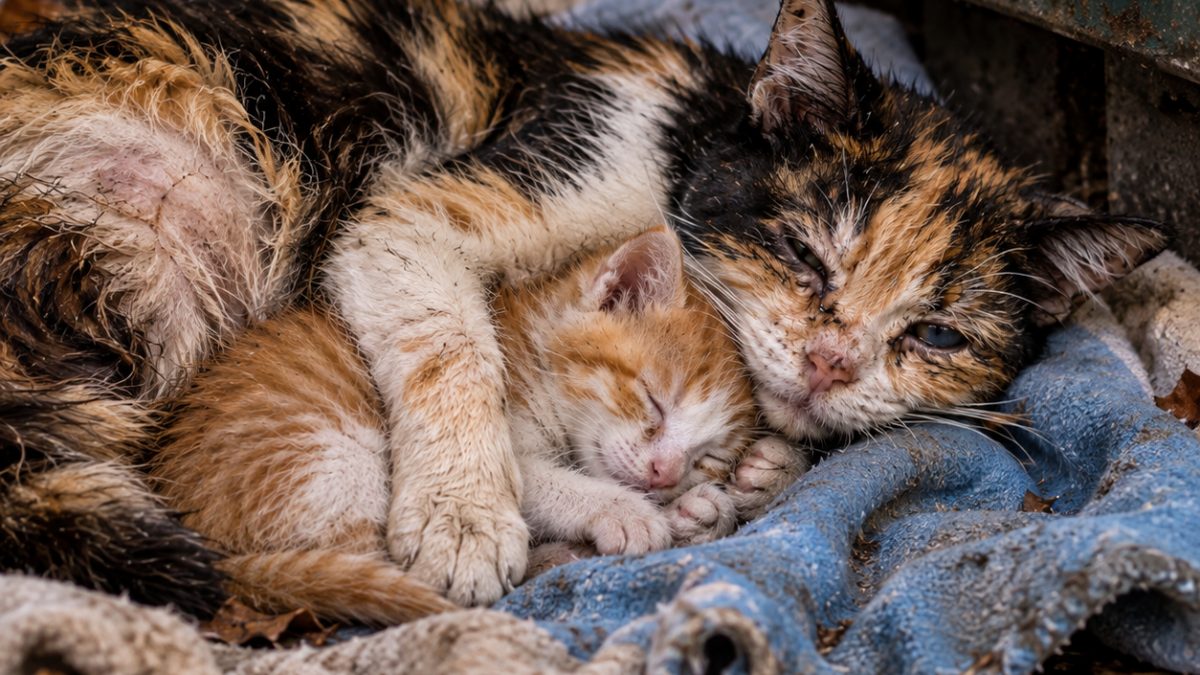
The kitten crawled deeper beneath her chin.
I whispered:
“Okay.”
Her eye remained on me.
“Okay, sweetheart.”
“I’m not taking him.”
The paw slowly dropped.
I sat back on my heels.
My hands were shaking.
I had seen maternal animals protect babies hundreds of times.
Young mothers.
Feral mothers.
Terrified mothers.
Strong mothers willing to tear your hand open if you reached too close.
This was different.
The cat in that box barely had enough strength to breathe.
Yet she had spent some of it stopping my hand.
I ran inside.
Called Dr. Lena Mercer, our shelter veterinarian.
She answered half asleep.
“Clara?”
“Sorry.”
“What happened?”
“Two cats outside.”
“Bad?”
“One kitten, one senior female.”
“How senior?”
“I don’t know.”
“But Lena…”
“What?”
“I think she may be dying.”
She was at the shelter twenty minutes later.
By then I had gotten the box inside without separating them.
We moved the entire bottom of the cardboard onto a warming pad because I refused to risk upsetting the mother until we understood her condition.
The kitten started crying when the box shifted.
The calico’s eyes opened immediately.
She tried to raise her head.
Couldn’t.
I held one finger near her nose.
“Your baby’s right here.”
She sniffed weakly.
Relaxed.
Lena examined the kitten first while he remained against his mother.
Male.
Orange-and-white.
Underweight but alert.
Mild dehydration.
Fleas.
No obvious respiratory infection.
No injuries.
Then the mother.
Lena’s face changed as soon as she touched her.
“What?”
I asked.
“Temperature’s low.”
“How low?”
“Too low.”
She listened to the cat’s heart.
Checked gums.
Eyes.
Teeth.
Palpated gently.
The cat barely reacted.
“She’s ancient.”
“How ancient?”
“Fifteen minimum.”
Then Lena looked again.
“Maybe seventeen.”
The number hit me strangely.
Seventeen years.
Someone had known this cat.
No animal reaches seventeen without history.
Even street cats collect history.
Porches.
Alleys.
People.
Winters.
Kittens.
Losses.
Somewhere, this old cat had spent nearly two decades becoming who she was.
Now she was in a wet cardboard box outside our shelter before sunrise.
Lena said:
“Severely underweight.”
“Dehydrated.”
“Arthritic.”
“One eye has advanced cataract changes.”
“Dental disease.”
“Heart sounds not great.”
“How bad?”
“I need bloodwork.”
The kitten climbed onto the mother’s ribs.
She turned her head slightly.
Licked his ear.
One slow lick.
Then another.
Lena stopped talking.
We both watched.
Finally she said:
“Let’s get them warm.”
I asked:
“Can they stay together?”
“For now.”
That became the first rule of Winnie’s life at Harbor Light.
For now.
Everything was for now.
We moved them into our quiet isolation room away from barking dogs.
Soft blankets.
Heat pad under half the bed.
Food and water within inches.
Low-sided litter tray.
We treated the kitten for fleas once it was safe.
Gave fluids.
Fed him.
He ate like someone had personally insulted him by allowing hunger to exist.
The mother would not touch food.
Not until the kitten finished.
At first I assumed coincidence.
Then I moved his dish to the other side.
She watched him.
When he finished, wandered off, and started attacking a towel, she finally lowered her head to her own dish.
Three bites.
That was all.
Then she lay back down.
I looked at Lena.
“She waited.”
Lena nodded.
“Looks like it.”
“What do we call them?”
Lena smiled faintly.
“That’s your department.”
The kitten had a perfectly round orange patch on his white chest.
Like a button.
“Button.”
He immediately knocked a small medicine cup off the counter.
Lena said:
“Trouble.”
“Button.”
She pointed at the mother.
“And her?”
I looked at the calico.
Her face was divided into black, orange, and white patches.
One clouded eye.
Torn ear.
Something deeply tired and deeply gentle about her.
Outside, the wind rattled the window.
“Winnie.”
“Why?”
“No reason.”
That was a lie.
My grandmother had been named Winifred.
She died at eighty-nine.
The final year of her life, she had become physically fragile while remaining fiercely protective of everybody else.
Eat first.
Take my coat.
Call when you get home.
She could barely stand and still tried to feed the family.
I never told anyone at the shelter that connection.
I didn’t need to.
The name fit.
Winnie.
Button.
Lena’s tests came back later that morning.
Kidney values concerning.
Anemia.
Signs of chronic disease.
Possible heart condition.
Nothing singularly dramatic.
That was almost worse.
Winnie’s body wasn’t failing because one terrible thing had happened.
It looked like time itself had been collecting debts.
Lena sat beside me.
“We can stabilize her.”
“Okay.”
“We can treat dehydration.”
“Okay.”
“Pain control.”
“Okay.”
“Supportive nutrition.”
“Okay.”
“But Clara.”
I knew.
“Say it.”
“She may not have much time.”
“How much?”
“I don’t know.”
“Days?”
“Maybe.”
“Weeks?”
“Possible.”
“Months?”
Lena hesitated.
“Less likely.”
I looked through the glass.
Button had climbed halfway across Winnie’s neck and fallen asleep.
Winnie lay motionless beneath him.
Her front paw curved over his back.
Not gripping.
Just there.
Lena said:
“We need to think quality, not quantity.”
I hated that sentence.
Not because it was wrong.
Because it was right.
In shelter work, quantity is seductive.
One more day.
One more week.
One more treatment.
You can turn love into insistence if you’re not careful.
Sometimes care means fighting.
Sometimes it means refusing to make suffering prove how much you care.
I knew all this.
Still hated hearing it about Winnie.
That first day, she survived.
Second day, too.
Then a third.
By the end of the week, she had done something none of us expected.
She stabilized.
Not improved exactly.
Stabilized.
She began eating small amounts.
Her temperature normalized.
She used the litter tray if we placed it close enough.
She even purred once when I scratched beneath her chin.
Button transformed faster.
Within five days, he became what eight-week-old kittens are supposed to be.
Chaos in fur.
He climbed my pants.
Attacked shoelaces.
Pounced on invisible enemies.
Discovered that Lena’s stethoscope could be stolen if she was distracted.
Once I walked into their room and found him hanging halfway up the side of a fabric playpen with an expression of absolute confidence.
“Button.”
He looked at me.
Released one paw.
Nearly fell.
“Excellent decision-making.”
He chirped.
Winnie opened her eyes.
The moment Button dropped back to the floor, she gave a low, raspy call.
He turned immediately.
Trotted to her.
Climbed into the bed.
Winnie put her paw across him.
That was when I started calling it her momma paw.
“Look.”
I pointed it out to one of our technicians, Jamie.
“Every time.”
Jamie smiled.
“She counts him.”
“What?”
“She always checks.”
I watched more carefully after that.
Jamie was right.
If Button was asleep against Winnie, she rested.
If he wandered away, one eye opened.
If he crossed the room, she lifted her head.
If he disappeared behind a box, she called.
Not loudly.
A rough little trill.
Button almost always returned.
Every ounce of energy she had seemed organized around one idea.
Where is my baby?
The strange thing was Button didn’t always behave as though Winnie was his mother.
Sometimes kittens raised through crisis attach loosely.
He played independently.
Slept against volunteers.
Climbed into laps.
But when frightened, he went to Winnie.
When a metal bowl fell in the hallway, Button sprinted directly beneath her front legs.
Winnie could barely stand.
Didn’t matter.
He still believed that was the safest place in the world.
We put out feelers.
Lost-cat groups.
Local Facebook pages.
Veterinary clinics.
Shelters.
No microchip.
No collar.
No response.
A woman called saying her elderly calico had disappeared in September.
Different markings.
Another sent photographs.
Not Winnie.
No one claimed them.
I began wondering whether whoever left the box had done it because Winnie was dying and they couldn’t afford veterinary care.
That explanation would have hurt, but I could understand it.
Then another possibility.
Maybe they had intentionally abandoned her because she was old.
That one made me angry.
Lena warned me.
“You don’t know.”
“I know.”
“You’re writing a villain because uncertainty bothers you.”
“I know.”
“Could’ve been an elderly owner hospitalized.”
“I know.”
“Could’ve been someone finding them outside.”
“I know.”
“Could’ve been a kid whose parents refused.”
“I know, Lena.”
She smiled.
“Okay.”
“Still angry.”
“Allowed.”
I did search the box.
No writing.
No receipt.
No blanket except an old towel.
Nothing.
Whoever had left Winnie and Button had erased themselves.
So we focused on what was in front of us.
Winnie.
Button.
Two weeks.
That was how long it took for me to get attached enough that everybody noticed.
Jamie said:
“You’re fostering them emotionally.”
“That’s not a thing.”
“It is.”
“I work here.”
“Exactly.”
I had always been careful.
At home I had one dog, Marlow, a nine-year-old black Lab mix.
One cat, Cricket.
Both former shelter animals.
If I adopted everything that broke my heart, I would have needed an aircraft hangar.
So I developed rules.
Love them here.
Help them leave.
Do not confuse saving with keeping.
Winnie was different.
Maybe because she wasn’t asking me to save her.
She was asking me to save Button.
That distinction went straight through every boundary I had built.
Every morning:
Winnie curled around Button.
Every night:
Momma paw.
I started sitting with them after my shift.
Sometimes twenty minutes.
Sometimes an hour.
I talked.
Mostly because Winnie listened better than humans.
“My electric bill is ridiculous.”
Slow blink.
“Jamie thinks she’s getting my Saturday shift next month. She is not.”
Blink.
“Marlow ate half a bag of bagels.”
No reaction.
“You could at least pretend to be surprised.”
Button attacked my sweatshirt string.
Winnie watched.
One night I said:
“You know, somebody’s going to want him.”
Her ear twitched.
“Orange kitten.”
“Cute face.”
“Zero manners.”
“Adoption gold.”
I smiled.
Then stopped.
Because Winnie was looking at me.
I knew I was projecting.
Animals do not understand adoption contracts.
They do not conceptualize mortality like we do.
I knew.
Still, I lowered my voice.
“I won’t let anything bad happen to him.”
Winnie blinked.
I whispered:
“I promise.”
That was a dangerous promise.
Promises to dying animals are always dangerous.
Three days later, Winnie fell.
I was changing their bedding.
Button had graduated to a larger playpen in the same room so he could move without climbing over his mother every second.
He was maybe six feet away.
I lifted the soiled blanket.
Button bounced after my hand.
Winnie woke.
Saw him across the room.
She stood.
Or tried.
Her front legs pushed.
Back legs trembled.
Then folded.
Her hips dropped.
She fell hard onto her side.
“Winnie.”
I dropped the blanket.
She tried again.
Her claws scraped the floor.
“Stop.”
She didn’t.
She dragged herself forward.
One paw.
Then another.
Her hindquarters barely followed.
I realized.
Button.
“Oh, Winnie.”
Button was standing against the mesh.
Crying.
Winnie pulled herself another six inches.
Her body shook.
I put both hands under her.
“No.”
She fought me weakly.
Not scratching.
Just pushing.
“Stop, sweetheart.”
Button cried again.
Winnie tried harder.
I couldn’t watch.
I picked Button up.
Placed him beside her.
The change was immediate.
Winnie collapsed.
Button curled under her chin.
Her breathing slowed.
Her paw moved.
Across his back.
Momma paw.
I sat on the floor.
Started crying.
Jamie walked in.
Saw me.
Then saw them.
“Oh.”
I wiped my face.
“Don’t.”
“Wasn’t going to say anything.”
“Good.”
She sat beside me.
For several minutes we watched.
Jamie whispered:
“She thinks he needs her.”
I said:
“He does.”
Jamie looked at me.
“Maybe.”
Then:
“Maybe she needs him.”
That was probably true too.
The next day Lena examined Winnie again.
Her kidneys had worsened.
Weight down.
Heart rate irregular.
Pain controlled, but weakness increasing.
“How long?”
I asked.
Lena didn’t answer immediately.
“Could be very soon.”
I sat with Winnie that evening.
Button was chewing a stuffed fish.
I said:
“Winnie.”
She opened her good eye.
I felt stupid talking like she could understand.
I did it anyway.
“Someone will love him.”
Blink.
“Someone will feed him.”
“Keep him warm.”
“Take him to a vet.”
“Let him destroy furniture.”
No response.
“I’ll make sure.”
Her eye stayed on mine.
“I promise.”
Then she slowly closed it.
I wished desperately that language could cross species when it mattered most.
Not tricks.
Not commands.
Not sit.
Stay.
Come.
Just one message.
Your baby will be okay.
You can rest.
A few days later Thomas Reed came into Harbor Light.
He almost left before getting past reception.
I saw him standing near the front desk with both hands in his coat pockets, looking toward the cat room but not moving.
Fifty-four.
Tall.
Weathered face.
Gray in his beard.
Blue work jacket with REED MARINE REPAIR stitched over the chest.
I said:
“Can I help you?”
He shrugged.
“Maybe.”
That is how grieving people answer simple questions.
“What are you looking for?”
“Cat.”
“Kitten?”
“Don’t know.”
“Indoor?”
“Yes.”
“Any age preference?”
“No.”
Then:
“Maybe not too old.”
He looked embarrassed as soon as he said it.
I didn’t judge.
“Why?”
Thomas looked toward floor.
“My last one was nineteen.”
“I’m sorry.”
“Nora.”
“What?”
“Her name.”
“Nora.”
He nodded.
“Had her since she was small enough to sleep inside my boot.”
“She died in February.”
My voice softened.
“That’s a long time.”
“Not when you’re at the end.”
No.
Never.
Thomas had spent eight months living in a house where every routine still expected a cat.
He still opened the laundry-room door carefully because Nora used to sleep behind it.
Still left half the couch open.
Still woke at 4:30 some mornings because for nineteen years Nora had demanded breakfast before sunrise.
He told me:
“I thought quiet would get easier.”
“Did it?”
“No.”
We walked through cat room.
Thomas didn’t choose by appearance.
Good sign.
He sat with a shy black cat for ten minutes.
Held out a hand to a six-year-old tabby.
Let an overweight tuxedo sniff his boots.
Then Button saw him.
Button launched himself directly onto Thomas’s pant leg.
Thomas looked down.
“Well.”
Button climbed.
Thomas caught him before he reached the knee.
The kitten settled against his chest.
Purring instantly.
I laughed.
“He has boundaries.”
“I can tell.”
Thomas scratched beneath Button’s chin.
For the first time since entering, his whole face changed.
Not dramatic.
Just softened.
He looked younger.
Button shoved his head against Thomas’s beard.
Thomas laughed.
That sound made something in me lift.
“I think this one’s defective.”
“Very.”
“Return policy?”
“Terrible.”
Button climbed into his lap.
Curled.
Thomas looked at me.
“What’s his name?”
“Button.”
He raised an eyebrow.
“I didn’t name him.”
“Yes, you did.”
“How do you know?”
“You look guilty.”
I smiled.
Then Thomas asked:
“Story?”
Every shelter animal has one.
Even if the answer is:
We don’t know.
I looked through the glass toward Winnie.
She was awake.
Watching.
“That’s his mother.”
Thomas followed my gaze.
His expression changed.
“That old girl?”
“Yes.”
“She’s his mom?”
“As far as we know.”
He stood, still holding Button.
Winnie lifted her head.
A sound came from her throat.
Rough.
Small.
Button turned.
Another call.
Thomas stopped.
Winnie pushed with her front legs.
Her chest rose.
Her hindquarters trembled.
I said:
“Winnie, no.”
She stood.
For one second.
Then two.
Thomas looked at me.
“Is she okay?”
“No.”
Winnie took one dragging step.
Another.
Her legs folded.
She caught herself.
Button began squirming.
Thomas immediately knelt.
“Here.”
He placed Button down.
Button ran to Winnie.
Buried himself beneath her chin.
She collapsed around him.
Momma paw.
Thomas stared.
“What’s wrong with her?”
I told him.
Seventeen.
Kidneys.
Heart.
Arthritis.
Weakness.
We didn’t know how long.
Maybe days.
Maybe less.
Thomas sat on his heels.
He said nothing for a long time.
Then:
“She always like that with him?”
“Yes.”
“Always?”
“Yes.”
He watched Winnie grooming Button’s head with one exhausted lick.
Then another.
Thomas stood.
His face had closed.
I knew that expression.
It was fear.
Not disgust.
Not inconvenience.
Fear of grief.
He handed me the adoption questionnaire.
“I need to think.”
My heart dropped.
I had already imagined Button in his house.
Safe.
Chosen.
I hated myself for being disappointed.
“Of course.”
Thomas looked at Winnie again.
Then Button.
“I’m sorry.”
“You don’t have to apologize.”
“I thought I was ready.”
“That doesn’t mean you aren’t.”
He nodded.
But he left.
Button watched the door.
I went back to Winnie’s room.
Sat beside her.
“Great.”
She blinked.
“You scared him off.”
Winnie did not look remorseful.
I whispered:
“Fair.”
That night, her breathing changed.
If you’ve spent enough time around sick animals, you hear it.
Not necessarily dying.
But different.
Shallower.
Longer pauses.
More work.
Lena came back after dinner.
Listened.
Checked gums.
Temperature.
“Clara.”
“I know.”
“Do you want to take them home?”
The question stunned me.
“My house?”
“For tonight.”
“Marlow.”
“Separate room.”
“Cricket.”
“Separate room.”
“What if—”
Lena looked at me.
“She may die either place.”
That was brutal.
Needed.
I stared at Winnie.
Then shook my head.
“No.”
“Why?”
“She knows this room.”
“Button knows it.”
“Moving them for me isn’t fair.”
Lena nodded.
“Okay.”
I stayed.
Button played until nine.
Then curled against Winnie.
I lay on a folded blanket beside their bed.
At ten, Jamie brought coffee.
At eleven, she left.
At 11:38, I whispered:
“Winnie?”
Her eye opened.
“I’m here.”
I touched her cheek.
“You did enough.”
My voice broke.
“You hear me?”
She couldn’t.
Still.
“You did enough.”
“You kept him alive.”
“You got him here.”
“You don’t have to keep doing everything.”
Winnie breathed.
Her paw lay across Button.
At 12:07, I finally drove home.
I hated leaving.
Lena promised to check the overnight camera.
I slept badly.
At 6:02 my phone rang.
Thomas.
Not Lena.
That confused me.
“Hello?”
“Clara?”
“Yes.”
“I’m outside.”
I sat up.
“What?”
“The shelter.”
I looked at clock.
“Thomas, we open at nine.”
“I know.”
“I need to talk to you.”
Twenty minutes later I pulled into parking lot.
Thomas stood beside his truck.
Large pet carrier on pavement.
Two ceramic bowls.
Bag of kitten food.
Another bag of senior food.
Folded blue blanket.
I stopped.
He looked exhausted.
“I didn’t sleep.”
Neither had I.
“I kept seeing her.”
He rubbed his face.
“I went home yesterday and Nora’s old bed was still in the closet.”
I said nothing.
“I haven’t moved it.”
“Eight months.”
“Still there.”
He looked at the blue blanket.
“That was hers.”
My throat tightened.
Thomas continued:
“I spent nineteen years with an old cat.”
“Last two years were pills.”
“Kidney food.”
“Fluids.”
“Steps beside the bed because she couldn’t jump.”
“Toward the end, I started getting angry.”
“At her?”
“At everything.”
“Then I felt guilty.”
“Because she needed me and I was tired.”
He looked at me.
“After she died, I swore next time I’d adopt young.”
“No medical mess.”
“No dying.”
“No watching another animal disappear.”
I understood.
“That’s reasonable.”
“No.”
“It’s human.”
Thomas shook his head.
“Maybe.”
“Then I saw Winnie.”
He looked toward shelter.
“She has no idea she’s old.”
“She has one job.”
“That kitten.”
“And she’s killing herself trying to finish it.”
Thomas swallowed.
“I know what it feels like when people decide old means finished.”
I waited.
He picked up carrier.
“I’ve got a warm house.”
“Wood stove.”
“One floor.”
“Plenty of room.”
“I’m home most nights.”
He looked at me.
“I want both.”
I stopped breathing.
“Thomas.”
“Both.”
“You understand—”
“She may die today.”
“Yes.”
“Tomorrow.”
“Yes.”
“Next week.”
“Yes.”
“She may need medication.”
“Yes.”
“Fluids.”
“Yes.”
“Veterinary visits.”
“Yes.”
“Possibly euthanasia if she suffers.”
His face tightened.
“I know.”
I stared.
“Why?”
Thomas looked almost offended.
“Because he shouldn’t have to leave her here just so I can get the easy part.”
That sentence broke me.
I turned away.
Pretended to unlock the door.
My hand missed keyhole twice.
Inside, Winnie was alive.
Barely.
Button woke the moment lights came on.
He screamed for breakfast.
Thomas laughed.
“There he is.”
Button ran toward him.
Then back to Winnie.
Thomas knelt.
“Morning, old girl.”
Winnie opened one eye.
Thomas placed the blue blanket on floor.
“Had a cat named Nora.”
Winnie blinked.
“She would’ve hated you.”
I laughed through tears.
Thomas continued:
“She hated everybody.”
Winnie seemed unimpressed.
“Anyway.”
He touched the blanket.
“This was hers.”
“I think you can borrow it.”
We called Lena.
She arrived.
Examined Winnie.
Her condition was fragile but stable enough to leave if transport was minimized and comfort prioritized.
Lena went through everything.
Medication.
Hydration.
Signs of distress.
When to call.
Emergency number.
End-of-life decisions.
Thomas asked questions.
Good ones.
“Can I keep Button with her if she declines?”
“Yes.”
“Can he hurt her accidentally?”
“Possible if he gets wild.”
“Supervise.”
“Food separately?”
“Yes.”
“Heater safe?”
“Not too close.”
“Stairs?”
“Keep her downstairs.”
“Litter tray low.”
“Already bought one.”
He had thought of everything.
Then paperwork.
Button.
Adoption fee waived as bonded medical placement.
Winnie.
Hospice adoption.
That phrase hurt.
Hospice adoption.
Thomas signed.
Not with dramatic flourish.
Just a man writing his name.
THOMAS REED.
I prepared carrier.
Placed blue blanket inside.
First Button.
He bounced around.
Then Winnie.
I slid hands beneath her.
She felt terrifyingly light.
As I lifted, she made one faint sound.
Button immediately crawled beneath her shoulder.
I settled her.
Winnie raised her head.
Looked around.
Different carrier.
Different blanket.
Different man.
She did not try to get out.
She placed her chin over Button.
Then closed her eyes.
I stared.
Thomas said quietly:
“She okay?”
“I think she’s tired.”
He looked at Winnie.
“Me too.”
Before he left, I crouched beside carrier.
“Winnie.”
Her eye opened.
I touched one finger to door.
“Remember what I told you?”
Thomas looked at me, confused.
I said:
“Your baby’s okay.”
My voice failed.
“He’s going home.”
Winnie blinked.
Slowly.
Then closed her eye.
Thomas carried them out.
I followed.
Watched the truck pull away.
For the first time since we found Winnie, I felt hopeful and terrified in equal measure.
Lena stood beside me.
“You did good.”
“I did paperwork.”
“You kept them together.”
“Thomas did.”
She nodded.
“Then he did good.”
That afternoon I texted Thomas once.
No pressure.
Just:
How are they settling?
He sent a photograph.
Button standing on a windowsill.
Tail straight up.
Behind him, Winnie lay on the blue blanket beside a cast-iron wood stove.
Warm.
Head up.
Watching him.
Caption:
She won’t stop tracking him.
I smiled.
Of course.
At 5:16 another photo.
Button upside down under a chair.
Thomas wrote:
Your kitten is broken.
I replied:
No returns.
At 7:42:
Winnie ate two bites of chicken.
At 8:03:
Button stole one.
At 8:05:
Winnie let him.
At 9:17 Thomas called.
I answered instantly.
“Everything okay?”
“Yeah.”
Pause.
“I think so.”
“What happened?”
“Nothing.”
He sounded emotional.
“Button’s running around.”
“Winnie’s watching.”
“Every time he leaves the room, she looks at me.”
I smiled.
“She does that.”
“I carried him back twice.”
“You’re trained already.”
Thomas laughed.
Then:
“Clara?”
“Yes?”
“She looks peaceful.”
I closed my eyes.
“Good.”
“Different.”
“How?”
“She isn’t trying to get up every second.”
That caught me.
“Maybe because he’s not leaving.”
“Maybe.”
Thomas said:
“I’m going to sleep on couch.”
“You don’t have to.”
“I know.”
“Nora made me do that last year.”
His voice softened.
“Feels familiar.”
We said goodnight.
I expected to hear from him during the night.
I put my phone beside pillow.
Volume on.
2:00 a.m.
Nothing.
3:30.
Nothing.
5:10.
Nothing.
At 6:41 my phone rang.
Thomas.
I knew.
Before answering.
The body knows certain calls.
I sat on edge of bed.
“Thomas.”
His breath trembled.
“Clara.”
“I’m here.”
“She’s gone.”
I covered my mouth.
Thomas continued.
“I’m sorry.”
“No.”
“Don’t apologize.”
“I woke up around six.”
“Button was still asleep.”
“And she…”
He stopped.
I gave him time.
“She was cold.”
My eyes filled.
“Was she peaceful?”
“Yes.”
“Very.”
“What happened last night?”
Thomas breathed.
Then told me.
Button had explored every room he could access.
Living room.
Kitchen.
Hallway.
Thomas kept bedroom doors closed.
Winnie stayed near stove on the blue blanket.
At first she tried to lift her head every time Button disappeared.
Then Thomas moved the blanket so she could see most of the living room.
Button chased a felt mouse.
Climbed a chair.
Attacked a paper bag.
Ate dinner.
Drank water.
Used litter box.
Every ordinary kitten thing.
And Winnie watched.
Around ten, Button returned.
Curled beside her.
Thomas turned off all but one lamp.
Sat in recliner.
Winnie raised her head once.
Looked toward him.
Thomas moved to the floor.
“It’s okay, old girl.”
He had said.
“I’m here.”
Button slept.
Winnie rested her chin against him.
Thomas drifted off around midnight.
When he woke briefly at three, both cats were still together.
At six:
Winnie gone.
Button awake.
Sitting beside her.
Thomas said:
“I didn’t know what to do.”
“What did he do?”
“He kept touching her.”
My heart cracked.
“With his nose.”
“Then he laid back down.”
Thomas started crying.
“Her paw.”
I knew.
“What?”
“It was still on him.”
Momma paw.
I bent forward over my knees.
Thomas whispered:
“Clara.”
“Yes?”
“At least she saw him home.”
I cried so hard I couldn’t answer.
He waited.
When I finally could:
“Yes.”
“She did.”
We made arrangements.
Thomas brought Winnie back to Harbor Light one final time.
Button came too.
We believed allowing him to see and smell her after death might help him understand her absence.
Nobody knows exactly what animals understand about death.
But sometimes they need the chance not to search.
We placed Winnie on her blue blanket in our quiet room.
Button approached slowly.
Sniffed her face.
Her paws.
Walked around.
Then sat.
Waited.
Nothing.
He pawed the blanket.
No response.
Finally he curled beside her for several minutes.
Thomas sat on floor.
I sat opposite.
No one spoke.
Then Button stood.
Walked toward Thomas.
Climbed into his lap.
Thomas closed his arms around him.
I thought:
There.
The transfer.
Not ownership.
Trust.
Winnie had carried Button as far as she could.
Now he chose Thomas.
We had Winnie cremated individually.
Thomas kept her ashes.
Not hidden.
Not formal.
A small wooden box on shelf near the stove.
Next to Nora’s.
He said:
“Figured they’d have things to argue about.”
Three weeks passed.
Button grew.
Of course.
Kittens are rude that way.
The world can break your heart and they still need breakfast.
Thomas sent photographs.
Button asleep in sink.
Button inside a boot.
Button climbing curtains.
Button staring into toilet like he’d discovered an ancient mystery.
Then one photo stopped me.
Blue blanket.
Same one.
Button asleep in center.
Stretched long.
Safe.
Thomas wrote:
Thought you’d want this.
I saved it.
Still have it.
Months later, I visited.
Thomas lived in a cedar-sided house overlooking a narrow inlet.
Fishing boats sat on cradles beside his workshop.
Inside smelled like wood smoke and coffee.
Button met me at door.
No hesitation.
He had doubled in size.
“Look at you.”
He climbed my jeans.
“Still terrible.”
Thomas called from kitchen:
“He bites my toes at four-thirty.”
“That’s love.”
“That’s assault.”
I picked Button up.
He purred.
On shelf above stove sat two wooden boxes.
Nora.
Winnie.
Between them:
A photograph Thomas had printed.
Winnie and Button on blue blanket.
Momma paw.
I couldn’t speak.
Thomas noticed.
“Too much?”
“No.”
“Perfect.”
He poured coffee.
We sat.
Button attacked a coaster.
Thomas said:
“I’ve been thinking about her.”
“Every day?”
“Most.”
“Regret it?”
He looked shocked.
“No.”
“Even though you had her one night?”
“Especially because I had her one night.”
He stared into coffee.
“I spent months being afraid to adopt because I didn’t want to lose another old cat.”
“Then I adopted one who died before breakfast.”
He laughed once.
“Turns out that wasn’t the worst thing.”
“What was?”
“Nora dying after nineteen years.”
“That was worse.”
“Because I loved her nineteen years.”
He looked at me.
“Pain isn’t proof something went wrong.”
That sentence stayed with me.
Pain isn’t proof something went wrong.
Sometimes pain is the receipt for love.
Thomas continued:
“I used to think a good adoption meant you get years.”
“Now?”
He looked at Button.
“Sometimes you get a night.”
“And you make the night count.”
That became something I told new shelter staff.
Not immediately.
At first Winnie’s story belonged to us.
But months later, a senior dog arrived.
Twelve-year-old shepherd mix.
Cancer.
Owner had died.
No family could keep him.
One technician said:
“Who’s going to adopt him if he’s only got weeks?”
I heard Thomas.
Sometimes you get a night.
I said:
“Maybe someone who understands what adoption is.”
A hospice foster took him.
He lived six months.
Best six months possible.
Later, an eighteen-year-old cat came in after her owner entered nursing care.
Kidney disease.
Hyperthyroidism.
Matted fur.
A family adopted her.
She lived four months.
I stopped measuring success exclusively in years.
Winnie had altered the math.
Before her, I unconsciously believed rescue meant extension.
More time.
More birthdays.
More Christmases.
The longer the better.
Of course time matters.
But peace matters too.
Safety.
Warmth.
Belonging.
The difference between dying in a damp cardboard box and dying on a blue blanket beside the kitten you’ve spent your last strength protecting.
That difference was one night.
One night can be enormous.
I also thought about the person who left the box.
For months, I was angry.
Then one winter afternoon, an envelope arrived at Harbor Light.
No return address.
Inside:
Twenty dollars.
And a note.
Three sentences.
I saw your post about Winnie and Button.
I am sorry.
I was scared.
That was all.
We had posted Winnie’s story on the shelter page after asking Thomas.
No identifying accusations.
Just her arrival.
Her adoption.
Her death.
Button thriving.
Was the note from the person who abandoned them?
We never proved it.
But I believed it.
Lena didn’t.
“You want closure.”
“Maybe.”
“Could be random.”
“I know.”
“What will you do?”
“Nothing.”
And I didn’t.
But I kept the note.
Not because it forgave abandonment.
Leaving animals in freezing weather is dangerous.
Winnie could have died before we arrived.
Button too.
Whoever left them should have knocked.
Called.
Asked.
Anything.
But fear makes people stupid.
Shame makes them hide.
Poverty makes people desperate.
Maybe someone had loved Winnie seventeen years and couldn’t watch her die.
Maybe they found her.
Maybe they were young.
Maybe cruel.
I would never know.
So I stopped inventing certainty.
That was another thing Winnie taught me.
Take care of the living thing in front of you before building a story about the person who failed it.
Button turned one.
Thomas invited us.
Yes.
A cat birthday party.
He insisted it wasn’t a party.
There was cake.
For humans.
A tuna treat shaped like number one.
For Button.
Jamie brought a toy.
Lena brought nothing because she said:
“He already has too much.”
She brought treats in her pocket.
Liar.
Thomas had framed Winnie’s photo.
Placed it on shelf.
At one point Button jumped beside it.
Sat.
Tail wrapped around paws.
For a second, his face looked exactly like hers.
Same tilt.
Same eyes.
Thomas whispered:
“Look.”
We all did.
Then Button knocked the frame over.
Moment destroyed.
Everyone laughed.
That was good.
Grief needs disrespect sometimes.
It keeps memory alive instead of sacred.
Years passed.
Button became a magnificent orange-and-white menace.
At three:
He opened cabinet doors.
At four:
He learned how to wake Thomas by dropping objects from bedside table.
At five:
He started sleeping on the exact section of blue blanket where Winnie had died.
Thomas never washed it after that first careful cleaning.
Not because of scent.
That was long gone.
Because humans attach meaning to fabric.
At six, Button developed urinary crystals.
Thomas panicked.
Treatment worked.
At seven, he got slightly fat.
Lena ordered weight loss.
Thomas accused her of body shaming.
At eight, Button became calmer.
Somewhat.
At nine, he started sitting at front window every evening before Thomas came home from the boatyard.
Thomas sent me video.
“You see this?”
Button waiting.
Tail moving.
“When I pull into driveway, he yells.”
I said:
“You gave him a home.”
Thomas responded:
“Winnie did.”
That was how he always framed it.
Not:
I saved Button.
Winnie delivered him.
Thomas finished the job.
By then I had moved from intake coordinator to shelter director.
Titles changed.
Work didn’t.
Animals still arrived.
People still surrendered them.
Volunteers still forgot where cleaning supplies went.
The furnace still broke every February as a matter of tradition.
We renovated the cat wing.
Added hospice room.
Warm lighting.
Low shelves.
Heated beds.
Large interior window.
We named it the Winnie Room.
Thomas objected.
“She was here two weeks.”
“Exactly.”
“Plenty of cats lived here longer.”
“It’s not an award.”
“What is it?”
“A reminder.”
“Of?”
I looked at him.
“Not every rescue has to be long.”
He stopped arguing.
At the dedication, we placed no sad photo.
No sick Winnie.
Instead, one image.
Winnie resting around Button.
Momma paw.
Underneath:
EVERY DAY OF SAFETY COUNTS.
That became our hospice philosophy.
We did not prolong suffering.
We did not abandon animals because time was short.
Both could be true.
When donors asked:
“Why spend money on an animal that may only live a week?”
I told them about Winnie.
One donor said:
“Wouldn’t it be better to spend on younger animals?”
A fair question.
Resources are real.
Shelters make brutal choices.
I answered:
“Sometimes.”
Then:
“But if an animal is already here and comfort is possible, short life does not mean worthless life.”
He wrote a check.
Not because I won an argument.
Because Winnie did.
One afternoon, nearly six years after Winnie’s death, a little girl named Ava visited with her father.
They were looking for kitten.
Of course.
Everyone wants kittens.
We had one.
Cute.
Healthy.
Likely adopted quickly.
We also had Maribel.
Fourteen-year-old tortoiseshell.
Owner died.
One eye.
Thyroid disease controlled with medication.
Ava walked past kitten room.
Stopped at Maribel.
“That one looks mad.”
Her father laughed.
“She does.”
Maribel hissed.
Ava loved her instantly.
They sat.
Maribel eventually approached.
Ava whispered:
“She’s old.”
Her father said:
“Yeah.”
“Will she die soon?”
He looked at me.
Parents hate when children ask shelter workers mortality questions.
I said:
“Maybe sooner than a kitten would.”
Ava thought.
“Would she be sad here?”
“We try not to make anybody sad.”
“But is this her house?”
“No.”
“Then she needs one.”
Her father closed his eyes.
He knew where this was going.
They adopted Maribel.
She lived two years.
Ava sent Christmas cards.
One showed Maribel wearing a ridiculous red bow.
I put it in Winnie Room.
That was Winnie’s legacy.
Not one kitten.
Permission to value short time.
Thomas aged too.
Of course.
Fifty-four when he adopted them.
Sixty-four before I realized how much time had passed.
His beard turned white.
Hands stiffened.
Boat repair slowed.
Button became ten.
Then eleven.
One snowy January morning Thomas called.
“Clara.”
My heart always reacted when he called unexpectedly.
“What’s wrong?”
“Nothing.”
Pause.
“Not nothing.”
“What?”
“I’m selling the shop.”
“Retiring?”
“Mostly.”
“You hate retirement.”
“I hate ladders more now.”
Fair.
He said:
“I’ve been thinking about Button.”
“He okay?”
“Perfect.”
“Then?”
“What if something happens to me?”
I smiled sadly.
There it was.
The other end of Winnie’s fear.
Not mother worried about baby.
Old man worried about cat.
“What do you want?”
“I want it in writing.”
“If I die.”
“If I’m hospitalized.”
“If I can’t care for him.”
“You take him.”
I said:
“Personally?”
“Yes.”
“That seems unfair to Marlow.”
“Your dog died four years ago.”
I stopped.
He remembered.
“Cricket?”
“Also gone.”
“You have room.”
“You’ve planned this.”
“Obviously.”
I laughed.
“Fine.”
“Promise.”
I froze.
Winnie.
I had promised her too.
“I promise.”
Thomas relaxed audibly.
“Good.”
“Also stop dying in hypothetical scenarios.”
“I’ll try.”
That conversation stayed with me.
We made formal paperwork.
Backup caregiver.
Veterinary authorization.
Trust amount for Button’s care.
Thomas was serious.
He had learned from Winnie.
Love means planning for the life that continues after yours.
At twelve, Button developed kidney disease.
Early.
Manageable.
Thomas reacted as though personally betrayed.
“He eats better than I do.”
“That’s not hard.”
“What does that mean?”
“You live on chowder and coffee.”
“Balanced.”
“No.”
Button started prescription food.
Regular labs.
Water fountain.
Thomas learned subcutaneous fluids eventually.
He hated needles more than Button did.
The first time:
“Clara, I can’t.”
“You can.”
“I repair engines.”
“Excellent.”
“Engines don’t look at me.”
Button looked at him.
Thomas groaned.
“Manipulative bastard.”
He learned.
At thirteen, Button slowed.
At fourteen, he stopped climbing the high windowsill.
Thomas built a ramp.
At fifteen, he slept more.
Blue blanket still there.
Faded.
Patched.
One corner shredded.
Thomas refused replacement.
At sixteen, Button’s kidney disease worsened.
Thomas called me.
His voice sounded like the man I’d met fourteen years earlier.
The man afraid of losing another old cat.
“Lena says we need to start thinking.”
Lena had retired from full-time work but still consulted.
I drove to Thomas’s house.
Button lay by stove.
Old.
White muzzle.
Orange fur thinner.
I sat.
He lifted his head.
“Hey, trouble.”
He gave one weak chirp.
Thomas said:
“I knew this was coming.”
“Knowing doesn’t help.”
“No.”
We sat.
On shelf:
Nora.
Winnie.
Now maybe soon Button.
Thomas whispered:
“I don’t know if I can do this again.”
“You don’t have to adopt again.”
He stared at Button.
“I mean I don’t know if I can let him go.”
That was different.
I took his hand.
“Remember why you took Winnie?”
He nodded.
“You didn’t give her a home to make her stay.”
“You gave her a home so she could rest.”
Thomas started crying.
I continued:
“Button deserves the same thing.”
He looked at me.
“Damn you.”
“I know.”
Button had good days still.
Then fewer.
One morning he stopped eating.
Medication did not restore interest.
He struggled to stand.
Thomas called.
Veterinarian came to the house.
No clinic.
No carrier.
Button lay on blue blanket beside stove.
Same place Winnie had spent her last night.
Thomas sat behind him.
I sat on floor.
The vet explained.
Thomas knew.
He asked for a minute.
Then leaned down.
“Your mom got you here.”
His voice broke.
“I got you the rest.”
Button purred faintly.
Thomas whispered:
“Best deal I ever made.”
Then:
“Go find those two old ladies.”
Nora and Winnie.
Button died peacefully.
Sixteen years old.
Thomas’s hand on his head.
My hand on Thomas’s shoulder.
And when it was over, Thomas picked up Winnie’s little wooden box.
Placed it beside Button.
“Full circle,” he said.
I cried all the way home.
People sometimes think shelter workers become numb.
No.
We become practiced.
Different.
You learn how to carry grief without dropping every other responsibility.
Next morning, dogs still needed feeding.
Cats needed medication.
Someone abandoned three guinea pigs in a laundry basket.
A puppy vomited a sock.
Life refused solemnity.
But that evening I opened my phone.
Scrolled back.
Sixteen years.
Found photograph Thomas had sent three weeks after Winnie died.
Button on blue blanket.
Tiny.
Sleeping.
Safe.
I compared it to final photograph.
Button old on same blanket.
Sixteen years between.
Winnie had one night.
Button had a lifetime.
That was the equation.
Not fair.
Not equal.
Still beautiful.
Thomas did adopt again.
Eventually.
He swore he wouldn’t.
For eight months.
Then Harbor Light took in a twelve-year-old orange cat named Murphy after his owner died.
Murphy had diabetes.
Missing two teeth.
Hated everyone.
I sent Thomas one picture.
No message.
He called five minutes later.
“You’re evil.”
“Yes.”
“I said no more.”
“I didn’t say anything.”
“You sent that face.”
“Information.”
“Clara.”
“What?”
“He’s old.”
“Yes.”
“Medical.”
“Yes.”
“Unpleasant.”
“Deeply.”
Silence.
“When do you close?”
I smiled.
“Six.”
Thomas arrived at 5:15.
Murphy hissed.
Thomas laughed.
“Perfect.”
He adopted him.
Of course.
When filling paperwork, Thomas looked at me.
“How long do you think?”
I said:
“No idea.”
He nodded.
“Good.”
He understood now.
Rescue wasn’t a transaction where you traded kindness for guaranteed years.
It was an agreement.
For whatever time we have.
That phrase ended up painted inside Winnie Room.
FOR WHATEVER TIME WE HAVE.
I retired after twenty-eight years at Harbor Light.
My last day, staff surprised me.
Cake.
Flowers.
Too many speeches.
I hated them.
Then Jamie, now assistant director, handed me a box.
Inside:
The original cardboard flap from Winnie’s box.
I stared.
“You kept this?”
“Lena did.”
The piece had been dried and flattened years ago.
Nothing written on it.
Just stained cardboard.
Behind it they had placed a photograph.
Winnie.
Button.
Momma paw.
I couldn’t speak.
Jamie said:
“We thought you should have it.”
I ran one finger over frame.
“Why?”
“Because this is the one that changed the shelter.”
That wasn’t exactly true.
Hundreds of animals changed us.
But Winnie changed language.
Changed how we described success.
Changed what we asked adopters to consider.
Changed whether we saw hospice animals as sad cases or opportunities for peace.
One animal can do that.
Not intentionally.
Just by needing something at the right time.
Retirement felt strange.
No barking at seven.
No bleach smell.
No phone calls during dinner.
No emergency intakes.
For first month, I woke at five automatically.
Then lay there.
Eventually, I began volunteering one morning a week.
Retirement, apparently, did not take.
One November, twenty-one years after Winnie arrived, I drove to Harbor Light before sunrise.
Fog.
Same kind.
Cold enough that breath showed.
I parked.
Walked toward entrance.
For one absurd second I looked at spot where box had been.
Empty.
Of course.
Inside, Winnie Room had changed paint colors.
New beds.
New staff.
Her photograph remained.
Momma paw.
A volunteer, maybe nineteen, saw me looking.
“Do you know that story?”
I smiled.
“A little.”
“She was old.”
“Yes.”
“Only lived one night after adoption.”
“Yes.”
“That’s so sad.”
I looked at picture.
“It is.”
Volunteer waited.
I added:
“And it isn’t.”
She frowned.
“How can both be true?”
I thought of Thomas.
Nora.
Winnie.
Button.
Murphy.
All animals.
All people who loved them.
“Because grief and failure aren’t same thing.”
She listened.
“Sometimes the sad ending is still the right ending.”
“Sometimes you can’t change how much time is left.”
“You can change what that time feels like.”
She looked at Winnie again.
Then:
“Is that enough?”
I smiled.
“Sometimes it’s everything.”
I still think about the first morning.
The box.
My hand reaching for Button.
Winnie’s paw.
That weak touch.
At the time, I understood it as refusal.
Don’t take him.
Years later, I understand it differently.
Maybe it wasn’t:
Don’t take him.
Maybe it was:
Not until I know.
Know what?
That he’s safe.
That he’s wanted.
That somebody will carry him next.
Winnie did not need another seventeen years.
Her body could not give her that.
She needed one thing.
Completion.
For all her frailty, she had been working toward it from the moment we found her.
Warm the kitten.
Feed the kitten.
Call him back.
Cover him.
Follow him.
Stay awake.
Stay alive.
Then Thomas came.
Not perfect.
Not fearless.
He almost left.
That matters to me.
If Thomas had been instantly heroic, the story would be smaller.
He was afraid.
He had already loved an old cat through decline.
Already paid the emotional price.
He wanted young.
Easy.
Healthy.
Years.
Then he went home and realized love wasn’t offering him the deal he wanted.
It was offering him a dying mother and her kitten together.
He could accept whole truth or walk away.
He came back.
That is courage most people recognize.
Not absence of fear.
Return.
Winnie watched Button explore a warm house.
Watched him eat.
Watched him play.
Watched him come back.
Then sometime between three and six in morning, her body stopped.
No shelter.
No cardboard.
No harbor fog.
No cold.
Blue blanket.
Wood stove.
Her kitten beside her.
Thomas nearby.
Momma paw still where it belonged.
People often ask me what the hardest part of shelter work was.
Death?
No.
Death was hard.
But not hardest.
The hardest part was understanding you cannot guarantee outcomes.
You can offer care.
Not control.
You can find home.
Not forever.
You can promise to try.
Not promise no pain.
The temptation is to measure yourself by whether every animal survives, every adoption lasts, every wound heals.
That will destroy you.
Winnie gave me a better measure.
Was she warmer because we were there?
Yes.
Was she less afraid?
I believe so.
Was Button fed?
Yes.
Was he protected?
Yes.
Did she leave him with someone who loved him?
Yes.
Did she die peacefully?
Yes.
Then we did something worth doing.
Thomas did too.
Sixteen years after Winnie’s death, Button returned in his own way to same lesson.
Not all goodbyes are failures.
Some are the final act of care.
My framed piece of cardboard hangs in my hallway now.
Visitors ask.
“What is that?”
Usually I say:
“An old shelter box.”
If they care enough to ask again, I tell them.
About Winnie.
Button.
Thomas.
The blue blanket.
Sometimes people cry.
Sometimes they say:
“I could never do that.”
Adopt a dying animal.
Foster hospice.
Love something they know they’ll lose.
I understand.
Not everyone can.
Not everyone should.
But I usually tell them what Thomas once told me after Button died.
He said:
“I spent half my life believing the worst thing love could do was leave me grieving.”
Then he looked at the two little wooden boxes on his shelf.
Nora.
Winnie.
And the third waiting for Button.
He said:
“I was wrong.”
“The worst thing would’ve been missing them because I was afraid of grief.”
That is what I carry.
Not the loss.
The choosing.
Winnie chose Button every time her body said stop.
Thomas chose Winnie after grief told him run.
We chose comfort when cure was not possible.
And Button spent sixteen years choosing the man who gave his mother permission to rest.
So when I remember Winnie now, I don’t picture her dying.
I picture one frail paw rising from that cardboard box.
Touching my hand.
A mother with almost nothing left, still saying:
Wait.
My baby.
And I picture that same paw hours before dawn, resting across Button’s back on a blue blanket inside a warm house.
The first time, it meant:
Don’t take him.
The last time, I believe it meant:
He’s home.
That was all Winnie had been fighting for.
And once she finally knew her baby was safe, she didn’t need to fight anymore.
She could close her eyes.
She could let go.
And for the first time in whatever long, difficult journey had brought her to us, Winnie could simply rest.



