The Cowboy Sent His Mail-Order Wife Away… But His Little Daughter Whispered, “I Need A Mother”
PART2:
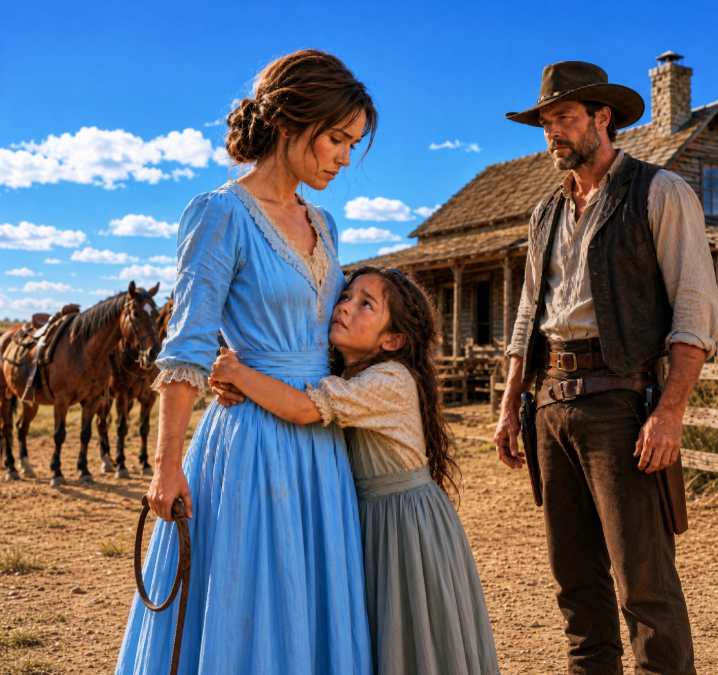
The child held on as if she had been waiting for permission to breathe.
“Mabel,” Caleb Whitfield said.
His voice was not sharp.
But it carried the sound of someone correcting something before it became too much.
The girl did not let go.
“I’ve been waiting for you,” she said into Emma’s dress. “Papa said you might not stay, but I don’t want you to go.”
Emma looked over the child’s head at Caleb Whitfield.
His face was impossible to read.
“Mr. Whitfield,” Emma said carefully, “I’m here.”
He did not answer right away.
His hand still rested near his belt.
The letters had begun in March.
Emma had answered the matrimonial notice in the Larkspur paper after staring at it for nearly three days in the back room of what had once been her father’s dry goods store in Ohio.
Matrimonial notices had run in western papers for decades by then. Ever since railroads pushed men out onto land faster than women followed, a trade of go-between newspapers had grown up to close the distance between lonely houses and women whose options had narrowed in the East.
Some people whispered about such marriages.
Emma did not have the luxury of whispering.
Her father’s store had gone under with his death.
PART3:
What remained after the creditors was not security, not even enough pride to live on.
Only debt.
Debt too large for a young woman with no formal trade to outrun by staying where she was.
She was not fleeing a broken engagement.
She had not been widowed.
No man had wronged her in a way that made a story interesting.
She had simply spent her twenties keeping her father’s ledgers, ordering stock, calming customers, balancing accounts, and discovering only after he was gone that competence did not pay debts when the law still expected a man’s name at the bottom of important papers.
Caleb’s letters had been short and practical.
He wrote about the ranch’s size, the distance to the schoolhouse, the winter weather, the number of cattle, the repairs needed on the north fence, and the fact that he had a daughter.
He mentioned Mabel exactly once in the first letter.
Mabel, seven, keeps to herself since her mother passed.
The sentence sat alone on the page, as though he had written it and then not known how to continue.
Emma had asked in her third letter what Mabel was like.
Caleb did not answer directly.
Instead, he wrote about the ranch water source, the distance to Larkspur, and the price of cattle that spring.
Emma read that non-answer more carefully than anything else he sent.
Some men wrote around the thing that mattered most because they had not yet found the words to write through it.
She packed one trunk.
Sold what little remained from her father’s store.
Paid the last bill she could pay.
And boarded a westbound train in the final week of May, telling herself that a marriage built on eleven letters was at least an honest kind of gamble.
Both parties had entered with their eyes open.
That was more than she could say for many marriages she had watched in Ohio.
The first supper at the Whitfield ranch was quiet in the way that meant everyone at the table was working hard not to say the true thing.
Mabel talked enough for all of them.
She talked about the horses.
About the creek behind the barn.
About how Biscuit, the pinto pony, disliked anyone brushing his left side unless he was bribed with apple peel.
She talked about a blue dress her mother had once sewn that still hung in the wardrobe because no one had decided what to do with it.
At that, Caleb’s fork stopped for half a second.
Then continued.
Emma noticed.
She had already begun noticing everything.
Caleb ate without saying much, watching her the way a man watched weather moving in from the west.
Not unfriendly.
Not warm.
Measuring.
When Mabel was sent to bed, she paused at the foot of the stairs and looked back at Emma as if memorizing proof that she was still there.
Emma gave her a small smile.
Mabel did not smile back.
She simply nodded once, as though some private agreement had been made, and went upstairs.
Caleb sat across from Emma with a cup of coffee he did not drink.
“I want to be honest with you,” he said.
“That would be a welcome beginning.”
His mouth almost moved.
Not quite a smile.
“I don’t know if I did the right thing sending for you.”
Emma folded her hands in her lap.
“That is an honest thing to say on a first night.”
“Sarah has been gone two years.”
His voice shifted around the name.
Not breaking.
Avoiding breakage.
“I told myself Mabel needed a mother. That was true enough to write down. But sitting here now, I don’t know if I sent for a wife because Mabel needs one or because it was easier to put it on paper than say out loud that I do not know how to do this alone.”
Emma looked at him carefully.
“Those are not different reasons.”
His eyes lifted to hers.
“They are the same reason said two ways.”
For the first time all evening, she saw him without guardedness in front of his face.
Only a tired man in a clean shirt sitting at a table too large for two people and a child who had learned to speak around an empty chair.
Then something in his expression tightened again.
“There is also the bank.”
Emma waited.
He stopped himself as if he had let out more than he meant to.
“Never mind that tonight.”
“You can tell me.”
“Not tonight.”
The door on that subject closed as firmly as it had opened.
Emma knew better than to pound on it.
He told her at first light.
Before Mabel was awake.
Emma came downstairs to find Caleb standing in the yard beside the wagon, his hat in his hands, looking as if he had spent the night deciding something that had given him no peace.
“I think this was a mistake,” he said.
Emma stopped on the bottom step.
“Not because of you,” he added quickly. “You did nothing wrong.”
“That is usually said right before someone is wronged anyway.”
He looked down.
“I have a note on this land I’m not sure I can carry. A girl who has already lost one mother. A ranch still standing mostly because it has not had the bad manners to fall down yet. I had no business bringing a stranger into that on eleven letters.”
“You knew all of that before you wrote the first one.”
“I know.”
“Then why is it only a mistake now that I have arrived?”
Caleb’s jaw tightened.
“Because before you arrived, you were paper and ink. Now you are a woman standing in my yard with one trunk and nowhere in this territory to go except where I told you there might be a home.”
“That sounds less like a reason to send me away.”
“It is exactly the reason.”
Emma studied him.
She was not angry.
That surprised him.
She looked at him the way a person looks at a decision they intend to respect while disagreeing with every part of it.
“All right,” she said.
Caleb blinked.
“All right?”
“I will not argue with a man about his own house.”
His face changed, but he said nothing.
Emma went upstairs to repack the few things she had unpacked the night before.
She did not see Mabel standing at the upstairs window with one hand flat against the glass, having heard enough through the floorboards to understand exactly what her father had decided.
By the time Emma came back down with her trunk closed, Mabel stood at the bottom of the stairs blocking the door.
Her small face was pale.
“Papa,” she said.
Caleb turned.
“Mabel.”
“Please don’t send her away.”
The words came quietly.
Not dramatic.
Not childish.
Worse.
Caleb’s face tightened.
“This is not something for you to worry over.”
Mabel shook her head.
“I need a mother.”
The room went still.
She did not say it as a demand.
She said it as a fact she had carried for two years and finally found the courage to place between them.
“Not just somebody,” she added. “Her. I already asked.”
Emma’s throat closed.
Caleb Whitfield stood very still in his own doorway, undone by his daughter in a way six hundred miles of Emma’s travel had not managed.
For one moment, Emma thought he would change his mind.
She saw it pass across his face.
Then stubbornness, or fear, or some twisted combination of both took hold again.
He loaded Emma’s trunk into the wagon.
He drove her anyway.
For the same stubborn reason a man finishes a job he has already decided is wrong rather than admit the deciding was the mistake.
Neither spoke for the first mile.
The road to Larkspur rolled between low grass and rising country, the mountains standing blue in the distance. Spring had come late that year, and the land still wore patches of green from snowmelt in the draws.
Caleb kept his eyes on the team.
Emma kept her hands folded in her lap.
Then, without quite meaning to, he said, “Constance is going to say I told you so.”
He looked as if he wished the words back the second they left him.
Emma turned.
“Who is Constance?”
“Nobody you need to worry about.”
That, of course, was the surest way to make sure she would.
He left her at Mrs. Doyle’s boarding house in Larkspur with her leather trunk, a curt tip of his hat, and an uneasiness in his shoulders that had nothing to do with the road.
Mrs. Doyle gave Emma a room and, within a day, mending work that paid little but paid something.
She was a large woman with gray hair pinned carelessly at the back of her head and a way of looking at people that suggested she had long ago stopped being fooled by tidy explanations.
On the second evening, as they folded shirts by lamplight, Emma asked, “Who is Constance?”
Mrs. Doyle folded one sleeve with more force than the task required.
“Constance Pruitt is Sarah’s older sister.”
Emma stilled.
“Caleb’s late wife.”
“That’s right. Married to Thomas Pruitt, who runs the bank and holds the note on Caleb’s land. Has since the winter Sarah died and Caleb had to borrow to get through it.”
There it was.
The bank.
Mrs. Doyle continued before Emma could ask.
“Constance made Sarah a promise at the end. The way people do at bedsides. Said she would look after Mabel if anything ever went wrong. She has held on to that promise for two years like it is the only thing keeping her sister alive somewhere.”
Emma set a folded shirt on the table.
“And now?”
“Now she has been to the circuit judge wanting guardianship.”
“That is not nothing.”
“No.” Mrs. Doyle looked at her. “She is not a villain, if that is what you are picturing. She is a grieving woman who decided controlling Mabel’s upbringing is the last way she can still keep her word to a dead sister.”
Emma said nothing.
“That does not make her right,” Mrs. Doyle added. “It makes her dangerous in a particular way. The kind that believes it is doing good.”
“When does the judge come?”
“Circuit judge passes through twice a year. Territory still young enough we don’t rate one full-time. Wyoming won’t be a state for three years yet, and out here justice travels on horseback like everything else. That is why it matters whose petition lands first. Constance has had two years to build hers.”
“And I have had two days.”
Mrs. Doyle’s mouth moved slightly.
“Small mercy, though. This is Wyoming.”
Emma looked up.
“Meaning?”
“Women here have stood as witnesses and sat as jurors longer than anywhere else in the country. Been that way since ’69. Constance will find Emma Vance a harder woman to talk over than she expects.”
Emma was quiet.
“Why does that matter specifically to a case like mine?”
“Because in most territories, a woman’s word in a courtroom counts for exactly what a man decides to let it count for. Here, it has already been settled in law for near twenty years that it counts the same as anyone else’s. Constance is used to arguing from behind her husband’s name.”
Mrs. Doyle placed another shirt in the pile.
“She is about to learn you do not need to stand behind anyone’s name at all.”
The next morning, Mabel took Biscuit without asking.
She saddled him herself the way her mother had taught her.
Cinch checked twice the way Sarah always required.
Then she rode the two hours to Larkspur with the grim determination of a seven-year-old who had decided the adults around her were handling things badly.
She found Emma on the boarding house porch.
Emma stood so quickly her mending slid from her lap.
“Mabel.”
The child sat straight on the pony, dusty and pale with effort.
“You came all this way alone?”
“Nobody would have let me if I asked.”
There had been wolf sign on the north range all that week.
Caleb had already lost two calves, which was the real reason his hand had never fully lost the habit of resting near his belt.
When a ranch hand rode in an hour later saying the girl and pony were gone, Caleb was in the saddle with his rifle before the man finished the sentence.
He found her safe on Mrs. Doyle’s porch.
The fear that carried him the whole two hours came out sideways as anger, the way fear on a father often does.
“You could have been killed on that road.”
Mabel looked up at him.
“I know how to ride it.”
“That is not the point.”
“Mama taught me before you let yourself teach me anything.”
The words landed harder than she meant them to.
Caleb said nothing.
The porch fell quiet except for Biscuit’s soft shifting in the dirt.
When Caleb finally looked at Emma over his daughter’s head, something in his face had shifted.
Not decided yet.
But no longer running from the deciding.
Two days later, Thomas Pruitt rode out to the ranch himself.
Caleb was up on the north fence repairing wire the wolves had torn loose chasing stock through it. Thomas did not dismount. He sat neatly in the saddle, wearing town clothes too fine for fence work and an expression that had learned to make threats sound like administrative necessity.
“Constance filed the petition Tuesday.”
Caleb did not look up from the wire.
“I expect she did.”
“I’ll tell you plainly since you will hear it anyway. The note comes due for review at the same session.”
Now Caleb’s hands stopped.
Thomas continued.
“If the judge finds your household unfit, the bank is not obligated to wait for harvest to call it in.”
Caleb turned slowly.
“Is that a threat, Thomas, or a fact?”
Thomas looked toward the house, then back at him.
“Both. Same as always.”
Caleb’s eyes hardened.
Thomas sighed.
“I did not marry into this to enjoy it, Caleb. But I have a wife who has not slept right in two years and a board that answers to depositors, not grief. Fix one problem, you likely fix the other.”
He turned his horse without waiting for a reply.
Caleb stood there with the wire in his gloved hands long after Thomas rode away.
That evening, he told Emma everything.
Not inside the house.
Not sitting stiffly across a table.
They stood along the fence line while he worked a length of new wire through the post and she held it steady.
Both hands busy.
Hard things were easier to say when the hands had somewhere else to put the fear.
“I should have told you the whole of it the first night,” Caleb said.
“You should have.”
“The note. Constance’s promise to Sarah. All of it.”
“But I’m still holding this wire,” Emma said. “So say it now.”
He did.
He told her about the worst winter in six years.
How the pass to Larkspur, ordinarily a two-hour ride, had drifted shut under snow for eleven straight days that January.
How Sarah’s fever turned bad in the night.
How there had been no getting a doctor out from town.
Caleb rode for help anyway, into a whiteout, because a man who loved his wife did not sit still simply because the mountain said no.
He came back two days later.
It was already over.
Mabel had been five.
Constance had sat with him the night after the funeral and said quietly that she had promised Sarah at the end she would see Mabel raised right.
Caleb had not argued.
Grief did not leave much room for arguing.
That unargued moment became, two years later, a legal petition he was still trying to understand how to fight.
“And the loan?” Emma asked.
“Taken out in the worst weeks after. Burial to pay for. Cattle lost. No way to move stock through snow. Thomas signed the note through the bank. Said it was family.”
“And now it is leverage.”
Caleb worked the wire harder than necessary.
“Yes.”
Emma twisted the wire tight.
“You are not fighting Constance.”
He looked at her.
“Not really.”
“I am certainly not fighting nobody.”
“You are fighting a promise she made to a dying woman you both loved. That is harder to win against than a bank note.”
Caleb stared at her for a long moment, the wire forgotten in his hands.
“That is the first time anyone said it plain like that.”
“Someone should have two years ago.”
Then Emma went back to holding the fence.
She found Sarah’s dress two days later.
Emma had been looking for a spare quilt in the wardrobe when her fingers touched blue fabric folded around tissue. She pulled it out slowly.
It was a woman’s dress.
Carefully sewn.
Faded only slightly at the shoulders.
Mended once along the side seam with tiny, patient stitches.
Emma stood holding it longer than she meant to.
The fear that stopped her was not the question of leaving or staying anymore.
That had already answered itself somewhere along the fence line while Caleb told the truth with wire in his hands.
This fear was smaller.
Harder.
She could marry Caleb, win the judge, help save the ranch, and still never be what Mabel actually needed.
Because Mabel did not need a wife for her father.
She needed Sarah.
And Sarah was not available.
No amount of effort from Emma could change that arithmetic.
She was still holding the dress when Mabel appeared in the doorway.
“You can wear that if you want.”
Emma turned.
“I don’t mind,” Mabel said.
“That is not why I am holding it.”
“Then why?”
Emma sat on the edge of the bed.
She was surprised to find herself answering honestly.
“I am afraid I will not be enough. That I will do everything right, and it still will not be what you actually lost.”
Mabel came into the room.
She considered this with the seriousness she brought to most things.
“You are not supposed to be Mama.”
Emma looked at her.
“I already had one of those,” Mabel said. “I just need somebody who stays.”
The simplicity of it pierced more deeply than comfort would have.
Mabel took the dress gently and hung it back in the wardrobe.
“You already stayed the whole hard part,” she said. “That is more than being enough. That is just true.”
Emma sat on the edge of the bed, covered her face, and for the first time since Ohio let herself cry.
Not from grief.
From the specific relief of being told plainly, by someone with nothing to gain from the lie, that she had already done the only part that mattered.
Constance came to the boarding house the morning before the hearing.
She arrived in a dark dress, gloves buttoned tight at the wrist, her hair arranged perfectly beneath her hat. She had Sarah’s eyes, Emma saw at once. Or rather Mabel had inherited eyes belonging to both sisters, and seeing them in Constance made the entire matter harder.
“I am not doing this to hurt her,” Constance said from the doorway.
Emma stepped aside.
“You may come in.”
“I will not stay.”
Emma nodded.
Constance refused the chair offered to her.
“I promised Sarah.”
“I know.”
“You did not know her.”
“No.”
“You do not know what I owe.”
Emma studied the woman before her.
Constance did not look cruel.
She looked exhausted in a way pride had not yet allowed anyone to name.
Emma thought of Caleb saying grief leaves little room for arguing.
“I know what Mabel told me,” Emma said.
Constance’s expression shifted.
“She said she does not need her mother replaced. She needs somebody who stays.”
Constance looked away.
“I intend to,” Emma said.
Constance had no answer.
She left without one.
The hearing took place the next morning in the back room of the mercantile because the circuit judge found the church too warm and the jail too small.
Half the town seemed to find reasons to linger nearby.
Judge Bartholomew Reed was a narrow man with spectacles, a tired horse, and the air of someone who had spent too many years carrying the law from one settlement to another and had learned that justice often arrived dusty, hungry, and late.
Thomas Pruitt sat beside Constance.
Caleb sat beside Emma.
Mabel sat between them with one hand locked tightly around Emma’s.
Mrs. Doyle stood near the back wall as if daring anyone to question her right to be there.
A neighbor named Ezra Coleman, pressed into it—Mrs. Doyle would later say by more of Constance’s asking than his own conviction—testified that a woman found through a newspaper advertisement was, in his words, an unknown quantity to raise a child around.
He said it looking mostly at his boots.
Emma understood, watching him, that he did not entirely believe it either.
When he finished, silence waited.
Emma stood without waiting to be asked.
The judge looked over his spectacles.
“Mrs. Vance?”
“Miss Vance,” Emma said. “For the moment.”
A faint cough moved through the room.
She placed eleven letters on the table.
One by one.
“These are Mr. Whitfield’s letters to me. You will find in them no romance, no deception, and very little poetry. You will find descriptions of his ranch, his household, his daughter, and the work expected of a wife here.”
Caleb looked down.
She continued.
“I answered them honestly. I came here with knowledge of his widowhood, his daughter, and the risk inherent in a marriage arranged across distance.”
She looked toward Ezra Coleman.
“The fact that I came through a newspaper does not make me rootless. It means I used the means available to me when my father died and left debt behind instead of protection.”
The room was very quiet now.
“I kept my father’s books for two years. I know debt. I know ledgers. I know what it means when a bank holds paper over a family’s head and calls it prudence. I know also what it means for a child to lose a parent and discover adults are more comfortable making plans around her than listening to what she says.”
Constance flinched slightly.
Emma did not look away from the judge.
“I was sent away. I came back. Not because I had nowhere else to go, but because Mabel asked me to stay, and because Mr. Whitfield finally told me the truth of what stood against him.”
She let her hand rest lightly over Mabel’s.
“I understand Wyoming women have stood as sworn witnesses since before many men in this territory could vote here themselves. I do not intend to be spoken over in a room that made space for my kind of testimony eighteen years before it made space for most.”
Mrs. Doyle smiled so slightly only Emma saw it.
Judge Reed leaned back.
“You speak boldly, Miss Vance.”
“I am speaking accurately.”
This time, even Caleb almost smiled.
Constance said nothing throughout.
Not out of defeat, Emma understood later.
Because there was nothing left in the argument that had not already been said more quietly on the boarding house porch the morning before.
Finally, Judge Reed looked at Mabel.
The room tightened.
“Mabel Whitfield,” he said gently. “Do you understand why we are here?”
Mabel nodded.
“Your aunt believes you would be better raised under her care.”
Mabel looked at Constance.
Constance’s face changed.
For one brief moment, all the legal shape of the matter fell away, and she looked only like a woman who had loved her sister and failed to save her.
The judge continued.
“Your father wishes you to remain at the ranch. Miss Vance has spoken of staying. I would hear from you plainly, if you are able. Where do you wish to live?”
Mabel’s hand tightened around Emma’s.
“With both of them.”
Constance closed her eyes.
Judge Reed said nothing for a moment.
Then he wrote something in his ledger.
Constance did not contest it further.
Something in her face as she watched her sister’s daughter hold Emma’s hand looked less like defeat than like a promise finally, quietly, set down.
They married in Larkspur in early October.
Not because the judge required it.
Not because Constance demanded it.
Because after the hearing, after the wire fence, after the dress, after Mabel’s hand in hers, Emma and Caleb understood that the question had changed.
Mrs. Doyle stood witness.
Mabel wore Sarah’s altered dress.
Emma had shortened it carefully, preserving the mended seam and the small row of buttons at the back. When Mabel first saw herself in the mirror, she did not cry. She only touched the skirt once and whispered, “Mama would like that it fits somebody again.”
Caleb had to leave the room for a minute.
No one commented.
Constance came to the ceremony.
She sat in the last row beside Thomas and did not speak until afterward. Then she came to Mabel, knelt carefully in the dirt outside the church, and adjusted one ribbon at the girl’s sleeve.
“Your mother wore blue well,” she said.
Mabel looked at her.
“I know.”
Constance nodded.
Then she stood and faced Emma.
“I cannot promise I will not make mistakes.”
Emma almost smiled.
“I would not believe you if you did.”
“I will try not to hold Sarah so tightly that Mabel cannot breathe.”
Emma’s throat tightened.
“That is a good place to start.”
The note was paid on schedule that winter.
No snowdrift closed the pass that year, and Thomas Pruitt, for what it was worth, never again mentioned the season Caleb had missed a payment.
Emma kept the wardrobe dress where it hung.
Each year on Sarah’s birthday, she asked Mabel whether she wanted it worn, displayed, or simply remembered.
Some years, it was one.
Some years, another.
By the second summer, there was a garden where the bare yard had been.
Curtains in the windows.
A debt fully cleared.
The house changed slowly at first, then all at once.
A row of beans near the porch.
A braided rug in the front room.
Mabel’s schoolbooks stacked neatly beside Emma’s ledger.
A blue curtain in the kitchen window that moved when the evening wind crossed the room.
Caleb stopped keeping his hand near his belt out of old habit.
The wolves moved on that spring, and once they had, he found that his hand had quietly stopped reaching for everything at all.
It happened so gradually he did not notice until Emma did.
They were standing in the yard one evening while Mabel brushed Biscuit near the corral. Caleb watched the slope beyond the barn, where the grass had grown high enough to ripple in the wind.
Emma looked at him.
“What?” he asked.
“Nothing.”
“That is never true when a woman says it like that.”
She stepped closer.
“You are standing with both hands empty.”
He looked down.
She was right.
His hands hung loose at his sides, not near his belt, not braced for trouble, not ready to reach for anything.
For a moment, he looked almost startled.
Then something in his face softened.
“I suppose I am.”
Emma slipped her hand into his.
He did not speak.
He did not need to.
On a warm evening in July, the three of them sat on the porch with Mabel between them. Biscuit settled in the corral beside the two ranch horses, swishing his tail at flies. The garden smelled of damp earth from that morning’s watering. Beyond the yard, the mountains stood darkening in the last light.
Caleb thought of a wagon ride to Larkspur he had once believed was the responsible thing to do.
He had been grateful every day since that his daughter had known better than he had.
Mabel leaned against Emma’s side.
Emma stroked the girl’s hair absently while reading a letter from Mrs. Doyle aloud. Halfway through, Mabel interrupted to correct her pronunciation of a neighbor’s name, and Caleb laughed before he could stop himself.
Emma looked up.
“What?”
“Nothing.”
She raised an eyebrow.
He smiled.
“That is apparently never true when I say it either.”
Mabel sighed in the long-suffering manner of a child surrounded by adults learning too slowly.
Caleb looked at them both.
The woman who had crossed six hundred miles on eleven letters.
The daughter who had ridden two hours alone because adults had failed to listen.
The house no longer bare.
The garden taking root.
The hand no longer waiting at his belt.
He thought about the dress in the wardrobe, not because it was sad, but because Emma had left room for it to mean more than one thing.
Memory.
Loss.
Belonging.
Proof that love did not require replacement in order to continue.
Mabel had been right from the beginning.
She had not needed her mother replaced.
She needed someone who stayed.
Emma had crossed the country ready to prove she could run a house, keep ledgers, survive judgment, and hold her own before a circuit judge.
What she had not been ready for was a seven-year-old telling her gently that none of that was the test.
The test was staying through the hard part.
And she had.
Caleb looked toward the road leading to Larkspur.
For two years, he had kept his hand near his belt because trouble once came without warning, because winter once took his wife while he was away trying to outride it, because grief had convinced him vigilance and love were the same thing.
They were not.
Love was not always reaching for the pistol.
Sometimes love was letting the hand fall empty.
Sometimes it was a woman on a boarding house porch, waiting.
Sometimes it was a child brave enough to say what everyone else avoided.
I need a mother.
Not just somebody.
Her.
The wind moved softly through the new curtains behind them.
Emma folded the letter in her lap.
Mabel yawned.
Caleb leaned back in his chair and let the evening settle over the three of them without reaching for anything at all.

