The Bank Sold Him 43 Starving Bison for $1,200 and Laughed—Months Later, DNA Tests Revealed a Rare Red Crown Bloodline and Breeders Begged for His Calves.
PART2:
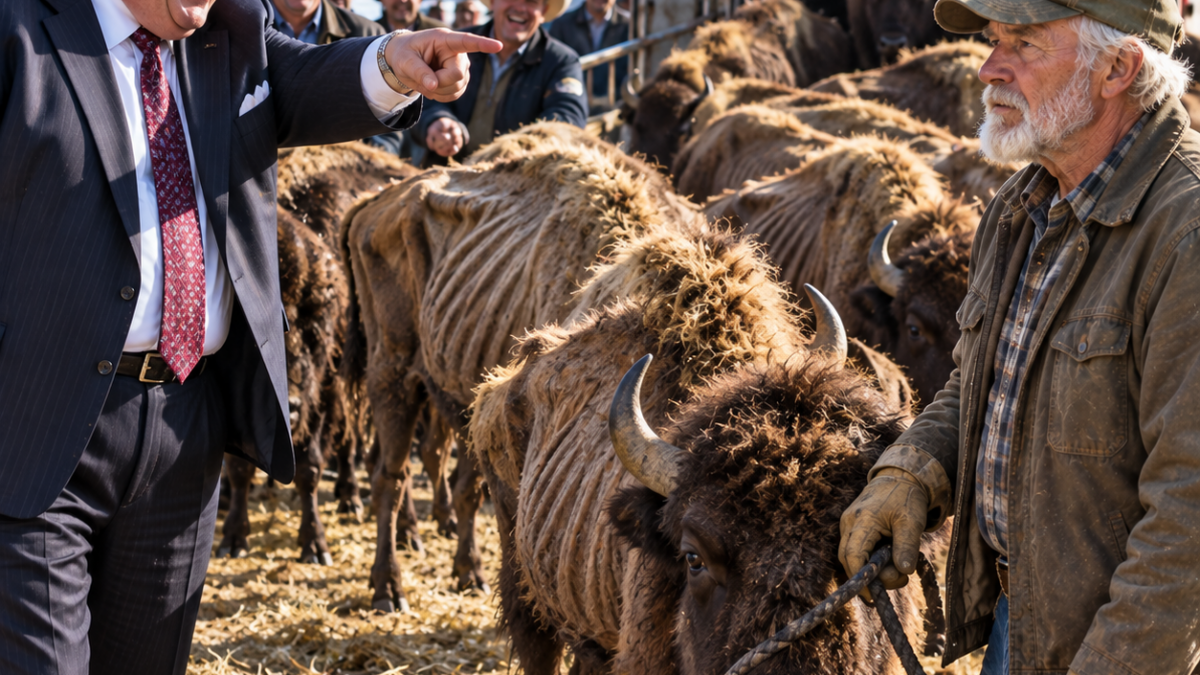
Forty-three American bison crowded against a rusting panel fence.
They were quiet.
Too quiet.
Healthy bison are not cattle.
They do not stand around waiting to please anybody.
Even calm ones carry a kind of pressure in them.
A wildness.
A suggestion that whatever fence separates you is being honored voluntarily.
These animals had none of that.
Shoulders too sharp.
Hips visible.
Bellies drawn up.
Dirty coats hanging loose across frames that should have been powerful.
A few stood with their heads low.
One old cow near the back shifted her weight carefully, as if each hoof had become a decision.
A man beside Walter shook his head.
“Dog food.”
Walter ignored him.
The man looked over.
“You buying?”
“No.”
“Good.”
He laughed.
“They’d eat your place bare and die anyway.”
Walter stepped closer.
One younger bull turned toward movement.
Eyes clear.
Not cloudy.
Breathing slow.
Another cow lifted her head when a trailer door slammed across the yard.
Walter watched.
Then watched again.
He had raised cattle since he was sixteen.
Worked feedlots.
Helped neighbors through calving seasons.
Spent twelve years running a mixed cattle-and-hay operation with his father before buying his own ground.
Bison were not cattle, but hunger looked similar in every large herbivore.
Disease had patterns.
Starvation had others.
He watched how they stood.
How they responded.
How they moved when one animal pushed another away from a patch of hay too poor to matter.
Weak.
Yes.
Dying?
Some.
Maybe.
But the whole herd?
Walter did not think so.
He walked around the pen.
The auction manager, Danny Bell, recognized him.
“Walter.”
“What happened to these?”
Danny looked uncomfortable.
“Bank took the ranch.”
“I know.”
“I mean the animals.”
“Feed ran out.”
“How long?”
“Nobody knows exactly.”
“Ranch manager quit.”
“Bank sent somebody twice a week.”
Walter’s jaw tightened.
“Twice a week?”
“They had water.”
“Some.”
Danny added that word reluctantly.
“What about hay?”
“Whatever was left.”
Walter looked back at the herd.
“That why they’re selling them today?”
“Bank wants the property cleared.”
“Development outfit already sniffing around.”
“Hotel?”
“Housing.”
“Something.”
“Bank doesn’t care.”
Walter did not answer.
The auctioneer sold the panels first.
Walter missed them.
Did not bid.
He kept walking back to the bison.
At eleven twenty, the bank president arrived.
Leonard Crowley.
Fifty-eight.
President of Prairie Union Bank.
Heavy man with expensive boots that had never been used to step in anything a boot was designed for.
His family had owned the bank for three generations.
Leonard carried himself the way men sometimes do when they have spent their entire adulthood being called sir by people who owed them money.
He shook hands.
Laughed loudly.
Clapped shoulders.
Then stood beside Danny and asked:
“When are those buffalo going?”
“After equipment.”
“Get them gone.”
“We have very little interest.”
“Put no reserve on them.”
Danny stared.
“None?”
“I want that ranch clean by Monday.”
Walter heard him.
Leonard noticed.
“Briggs.”
“Morning.”
“You here to buy my scrap?”
“Your bank’s scrap.”
Leonard smiled.
“Same difference today.”
Walter looked toward Lot 17.
“How much did you have them examined?”
Leonard shrugged.
“They’re livestock.”
“That wasn’t my question.”
“They’ve been looked at.”
“By who?”
“People.”
Walter almost smiled.
“People with a veterinary license?”
Leonard’s smile narrowed.
“You planning to file a report?”
“No.”
“You’re asking a lot of questions.”
“I’ve been accused.”
The auction resumed.
Walter watched buyers bid on tractors.
A feed wagon.
A nearly new skid steer.
Broken Horn’s assets disappeared piece by piece.
Then the auctioneer climbed onto the rail beside Lot 17.
“Ladies and gentlemen, forty-three head of American bison.”
A few laughs.
Someone shouted:
“Mostly bones!”
Auctioneer kept going.
“Entire herd sells together.”
“No guarantee.”
“As-is.”
“Where-is.”
“Buyer responsible for transport.”
“Do I hear five thousand?”
Nothing.
“Three thousand?”
Nothing.
“Two?”
One man raised a hand.
Then withdrew when his wife slapped his shoulder.
Laughter.
“Fifteen hundred?”
Silence.
Walter looked at the old cow.
She was watching him.
Not sentimentally.
Bison do not audition for rescue stories.
She was simply facing his direction.
“Twelve hundred?”
Walter raised his hand.
The yard quieted.
Auctioneer pointed.
“Twelve hundred.”
“Do I hear thirteen?”
Somebody behind Walter said:
“He finally cracked.”
Leonard Crowley laughed.
Actually laughed.
“Walter, you buying zoo animals now?”
Walter said nothing.
“Twelve hundred once.”
“Twice.”
“Sold.”
Gavel struck.
Forty-three starving bison.
$1,200.
Walter stood there thinking:
What the hell did I just do?
Leonard walked over.
Red-faced from laughing.
“Briggs.”
“You just bought yourself the most expensive fertilizer in the county.”
“Maybe.”
“They’ll be dead before the first real snow.”
“Maybe.”
“You know what feed costs?”
“Yes.”
“You know what bison fencing costs?”
“Yes.”
Leonard looked toward Walter’s old Ford.
Then back.
“Do you know what money costs?”
That was a banker’s joke.
Walter understood it.
He still had a mortgage.
Small, but real.
His late-season hay crop had underperformed.
Savings were thin.
Leonard knew all of it.
Walter had banked at Prairie Union for thirty-six years.
Leonard leaned closer.
“You’ll lose the farm trying to keep those things alive.”
Walter looked him in the eye.
“Then you’ll probably enjoy the paperwork.”
Leonard laughed again.
“Before Christmas.”
“What?”
“They’ll be dead before Christmas.”
Walter nodded.
“We’ll see.”
Then he called Dr. Susan Keller.
Susan had been the large-animal veterinarian for half the county for twenty-seven years.
She arrived at the auction yard carrying a medical bag, wearing mud-stained coveralls, and looking irritated before she reached the pen.
“This better not be forty-three bison.”
“It is.”
“Walter.”
“I know.”
“You bought these?”
“Yes.”
“How much?”
“Twelve hundred.”
“Total?”
“Yes.”
She stared at him.
“You know therapy is cheaper.”
“So I’ve heard.”
Susan entered the pen carefully.
Observed first.
Then examined the weakest animals.
Body condition.
Mucous membranes.
Hydration.
Temperature where possible.
Fecal samples.
Respiration.
She stood beside Walter afterward.
“Serious.”
“Disease?”
“Some parasites.”
“Nothing screaming outbreak.”
“Starvation?”
“Mostly.”
“Dehydration.”
“Mineral deficiency.”
“Neglect.”
“Can they recover?”
Susan looked back.
“Most?”
“Yes.”
“If you don’t kill them trying to feed them too fast.”
Walter nodded.
Refeeding syndrome.
Sudden rich feed after prolonged starvation could be dangerous.
“Slow.”
Susan said.
“Good hay.”
“Minerals.”
“Water.”
“Separate the worst.”
“Watch their rumens.”
“You lose one, maybe more.”
“Pregnant?”
“Could be.”
“Hard to tell under that condition.”
Walter exhaled.
“Anything I’m not seeing?”
“Yes.”
“What?”
“You don’t own enough trailer.”
That became the next problem.
His friend Cal Morris had two livestock trailers.
Not bison trailers, exactly.
Heavy pipe.
Strong gates.
Enough with modifications and patience.
Three trips.
Another local rancher helped.
Walter paid fuel.
Everybody warned him.
The bank president stood near the office while the first trailer pulled away.
Leonard cupped his hands around his mouth.
“Save some money for burial!”
Walter kept driving.
Then:
“You’ll be begging me for a loan by January!”
Cal looked over from the passenger seat.
“You want me to stop?”
“No.”
“Why?”
“So I can hit him?”
“No.”
“I was going to ask if you wanted to yell.”
Walter grinned.
“Drive.”
Briggs Farm was 160 acres.
Small by regional cattle standards.
Two main pastures.
One hay field.
Barn.
Machine shed.
Old farmhouse.
Shelter belts of cottonwood planted by Walter’s father.
The land had belonged to Walter for forty-one years.
He and Evelyn bought it when they were twenty-nine.
The original house had one working electrical outlet in the kitchen and a foundation that leaked every spring.
They fixed it.
Raised two daughters there.
Lost one son at birth.
Survived a drought in 1988.
A fire in 1996.
Cattle prices in 2008.
Evelyn died six years before the bison arrived.
Ovarian cancer.
Eleven months.
Walter still parked on the right side of the garage because she used to park on the left.
Still kept her coffee mug behind his.
Still had her old blue Ford pickup in the machine shed.
He had not driven it in years.
Could not sell it.
It smelled faintly like the peppermint gum she always kept in the console.
The day forty-three bison arrived, Walter did not think about bloodlines.
Or breeding.
Or profit.
He thought about fences.
Bison are built to test optimism.
The north pasture fence was four-strand barbed wire.
Not enough.
Walter added woven wire sections.
Pipe reinforcement.
Electric offset.
Used panels.
Whatever he had.
His neighbors said:
“You know they can jump?”
“Yes.”
“You know they can run through cattle fence?”
“Yes.”
“You know bulls can push a truck?”
“Yes.”
“Then why’d you buy them?”
That one was harder.
Because he saw something?
Because Leonard laughed?
Because he was lonely?
Because Evelyn would have told him not to and then helped anyway?
Walter did not know.
He told everyone:
“They were cheap.”
That explanation required fewer feelings.
He divided the herd.
Strongest twenty went to lower pasture.
Mid-condition group near barn.
Weakest eight inside a smaller reinforced paddock.
Susan designed feeding.
Native grass hay first.
Small quantities.
Frequent.
Minerals.
Warm water.
Slow increase.
The first week was brutal.
Two animals refused feed.
One cow went down and needed fluids.
A young bull developed digestive trouble.
Walter slept in two-hour blocks.
Every time the wind rattled the barn siding, he woke.
Walked out with flashlight.
Counted silhouettes.
Forty-three.
Again.
Forty-three.
Feed costs accumulated.
Transport.
Fence.
Vet.
Minerals.
Trough repairs.
The $1,200 purchase became a five-thousand-dollar problem almost immediately.
Then ten.
Walter’s savings dropped.
He sold two unused implements.
Canceled replacement shingles for the machine shed.
Started repairing everything himself.
He kept receipts in Evelyn’s old recipe box.
By November, the herd began changing.
Not dramatically.
Small improvements.
Heads higher.
Eyes brighter.
Dung normalized.
Coats cleaned.
Animals moved more.
One old cow still worried him.
Number 17 on the auction paperwork.
No name.
She was one of the worst when purchased.
Older.
Scar along her shoulder.
Left horn worn.
Susan guessed fifteen years, maybe older.
Walter kept her close.
One evening, she allowed him within six feet without moving away.
That felt like trust.
Or exhaustion.
He did not pretend to know which.
Then winter came early.
First major storm hit November nineteenth.
Twelve inches overnight.
Wind thirty miles an hour.
Temperature dropped below zero.
Walter woke at 2:17 a.m. because the house shook under a gust.
He pulled on boots.
Went outside.
Snow hit sideways.
The weakest paddock gate had drifted nearly shut.
Water trough heater failed.
Walter cleared ice.
Checked animals.
Then saw Number 17.
Down near the shelter wall.
He approached slowly.
No response.
Her head lay against snow.
Breathing shallow.
He called Susan.
2:34 a.m.
She answered on the fifth ring.
“Walter?”
“Old cow is down.”
“How cold?”
“Minus eight.”
“I’m coming.”
Road nearly impassable.
Susan arrived forty-seven minutes later.
Together they put windbreak panels around the cow.
Warm electrolyte water.
Blankets were useless over her massive body, but they blocked some wind near neck and shoulders.
Susan checked her.
“She may not make sunrise.”
Walter stared.
“Anything else?”
“We’re doing it.”
“She’s old.”
“She came in terrible.”
“I know.”
“You should go inside periodically.”
“I know.”
He did not.
Susan eventually sat in her truck between checks to warm up.
Walter stayed beside the cow.
Not touching constantly.
Just there.
He talked.
Bison could not understand his words.
That was fine.
He told her about Evelyn.
Told her how Evelyn would call him stupid for sitting outside at three in the morning with a buffalo.
Told her she would still bring coffee.
At 5:48, eastern horizon lightened.
The cow lifted her head.
Walter leaned forward.
“Come on.”
She shifted.
Front legs moved.
Tried to rise.
Slipped.
Fell.
Susan came running from truck.
“Don’t push her.”
“I’m not.”
Second attempt.
Front legs under.
Hindquarters struggled.
Then, slowly, impossibly, she stood.
Unsteady.
Steam rose from her body.
Walter laughed.
Susan swore.
The cow remained upright.
Took one step.
Then another.
Walter looked at Susan.
“She needs a name.”
“You bought forty-three.”
“I’m not naming forty-three.”
“This one.”
Susan smiled.
“Hope.”
Walter hated sentimental animal names.
So naturally, Hope stayed.
She became the herd’s center.
Not leader in some Disney sense.
Bison social structure is more complicated.
But she had experience.
When snow buried grass, Hope pawed and swept with her head.
Found forage.
Others followed.
Walter watched.
Realized how efficiently the animals used winter range.
They did not stand waiting for hay the way cattle often did.
They worked.
Moved.
Found shelter.
Reduced exposure.
Dug through snow.
The better they became, the more Walter wondered what they had been before neglect made them look ordinary.
Then hay disappeared.
Not literally.
Market disappeared.
Walter called Peterson Feed.
Sold out.
Meyer Brothers.
Sold.
Black Hills Hay Cooperative.
Committed.
Prices jumped nearly forty percent in three weeks.
Walter drove sixty miles to look at low-grade grass hay priced like alfalfa.
Something felt wrong.
Then Cal Morris called.
“You hear who bought Peterson’s last three hundred tons?”
“No.”
“Dakota Plains Holdings.”
“Who?”
“Never heard of them.”
Walter had.
Barely.
A company connected to Prairie Union Bank.
He drove home angry.
Could be coincidence.
Winter shortage.
Commodity purchase.
Legal.
Still useful to Leonard.
Then mortgage notice arrived.
Standard reminder.
Payment due.
Walter stared at numbers.
If he made full payment, hay reserve became dangerous.
If he bought feed, bank had leverage.
Three days later, Leonard Crowley pulled into his driveway.
Black SUV.
Folder.
Walter met him outside.
Leonard looked at recovering bison.
His smile faded slightly.
“Better than expected.”
“They’re alive.”
“For now.”
Walter said nothing.
Leonard opened folder.
“I can solve your problem.”
“I don’t have a problem you’re interested in solving.”
“You have a feed shortage.”
“Mortgage.”
“Forty-three mouths.”
“You’re what, seventy?”
“Seventy-two.”
“Even worse.”
Walter smiled.
“What’s the offer?”
“Bank buys this farm.”
“Clears remaining mortgage.”
“Takes livestock.”
“You walk away debt-free.”
“How much?”
Leonard named a number.
Far below market.
Walter laughed.
Leonard did not.
“Your place is next to the Broken Horn property.”
“Yes.”
“You combine parcels, access improves.”
Leonard’s eyes narrowed.
Walter continued.
“Developer wants one contiguous tract.”
“You’re guessing.”
“I’m old.”
“Not stupid.”
“This is a fair exit.”
“No.”
“You will run out of hay.”
“Maybe.”
“You’ll lose animals.”
“Maybe.”
“You’ll miss payments.”
“Maybe.”
“Then bank takes farm anyway.”
Walter stepped closer.
“Then why pay me now?”
Leonard looked at him.
That was answer enough.
The bank needed Walter’s land.
Broken Horn’s property alone had awkward access.
Walter’s 160 acres completed a road corridor to county highway.
Combined value increased dramatically.
The bison had been obstacle clearance.
Now Walter was obstacle.
He refused.
That night, instead of buying more hay, Walter rethought grazing.
He divided pasture into smaller sections.
Rotational use.
Stockpiled forage.
Sheltered draws.
Native grass.
Areas he had left untouched.
Bison adapted.
Hope broke crusted snow.
Herd followed.
Hay consumption dropped.
Not eliminated.
Enough.
Winter dragged.
Walter lost one older bull in January.
Natural causes compounded by age and condition.
He buried him with the tractor.
Forty-two remained.
Then March came.
Snow withdrew.
Animals changed.
Weight returned.
Shoulders thickened.
Coats cleaned.
Calves? Not yet.
Susan arrived for full examination.
Walked through herd slowly.
Then stopped at one cow.
“Walter.”
“What?”
“This one’s pregnant.”
He laughed.
“No.”
“Yes.”
Then another.
Another.
By end of examination:
At least nineteen females pregnant.
Walter sat on feed bunk.
Nineteen.
He had bought forty-three nearly dead animals for $1,200.
Now almost half the females were carrying next generation.
Susan looked over.
“You know what calves are worth?”
“Depends.”
“Depends is getting interesting.”
Then Hope began shedding.
Her winter coat came off in ragged sections.
Walter noticed a dark mark on left hip.
At first he thought scar.
He brushed loose fur.
Brand.
Three points.
Like a small crown.
He called Susan.
She looked.
Her expression changed.
“You ever seen this?”
“No.”
“I have.”
“Where?”
“Old records.”
“Conservation herds.”
“What does it mean?”
“Maybe nothing.”
“Maybe Red Crown.”
Walter frowned.
“Never heard of it.”
Susan had.
Red Crown was not an official national breed designation.
It was an old regional conservation line maintained decades earlier by several northern plains breeders.
Selected for winter hardiness.
Strong maternal traits.
Efficient forage use.
Low cattle introgression.
Much of the population had dispersed after ranch sales, droughts, and consolidation.
Some bloodlines disappeared into commercial herds.
The three-point crown brand had identified original animals and descendants on certain properties.
Walter and Susan checked others.
Same mark on several mature cows.
Faded.
Hidden under winter coat.
Hope.
Two others.
Then five.
Then more.
Susan sat down.
“This could matter.”
“How much?”
“We don’t know.”
“Brand proves ownership history.”
“Not genetics.”
“What proves genetics?”
“DNA.”
“How expensive?”
She told him.
Walter stared.
“That much?”
“For this many animals?”
“Yes.”
“Can we sample fewer?”
“We can screen.”
“But if you want real documentation for breeding value, more is better.”
He went home.
Looked at bank balance.
Almost nothing.
Winter had eaten money.
Fence ate money.
Vet work.
Fuel.
Feed.
Pump repairs.
He had enough to survive spring.
Not enough for testing without risk.
For three days he did nothing.
Then walked into machine shed.
Evelyn’s pickup sat under dust.
Blue 2004 Ford F-150.
One hundred twelve thousand miles.
She loved that truck.
Drove it to church.
Grocery store.
Cattle sales.
Kept peppermint gum in console and a knitted blanket behind seat.
Walter had not driven it since funeral.
He opened driver door.
Sat.
Smelled old vinyl.
Dust.
Faint peppermint that could not possibly still be real but was.
He put both hands on steering wheel.
“I’m sorry.”
No answer.
Of course.
He sold it two days later.
$8,400.
Enough for testing and breathing room.
Town found out.
Towns always do.
Leonard Crowley laughed again.
At café.
Loud enough for witnesses.
“Old Briggs sold his dead wife’s truck to prove his buffalo have royal blood.”
Walter heard about it from Cal.
Said nothing.
Samples went to livestock genetics laboratory.
Hair follicles.
Blood.
Identification records.
Paperwork.
Then drought came.
Hard.
Spring rain stopped.
By June, pasture went yellow.
By July, soil cracked.
Well level dropped.
Pregnant cows needed water.
Walter’s pump failed on a Tuesday afternoon.
Burned motor.
No pressure.
He had almost no cash left.
Found a used pump in Rapid City.
Drove three hours.
Installed it himself with Cal.
Changed broken pipe sections.
Then rationed pumping.
Morning.
Evening.
Storage tanks.
Move herd.
Every gallon counted.
Leonard returned.
Same folder style.
Different offer.
Still low.
Walter leaned against fence while banker spoke.
“Drought.”
“I see it.”
“Pump failure.”
“Fixed.”
“Mortgage.”
“Current.”
“Barely.”
“You’re exhausting yourself.”
“Yes.”
“I’m offering an exit.”
“No.”
Leonard lowered voice.
“What are you trying to prove?”
Walter looked at herd.
“Nothing.”
“Then sell.”
“If my land is such a burden, why do you want it?”
Leonard stopped.
Walter smiled.
“Drive safe.”
Then calving began.
First calf arrived during heat.
Healthy bull calf.
Then another.
Then twins? No, bison twins rare; avoid. One by one.
Nineteen calves.
One died shortly after birth.
Eighteen survived.
Mothers recovered well.
Nursed.
Moved.
Handled drought.
Susan returned.
Watched.
“Walter.”
“Yes.”
“If lab says Red Crown, you’re sitting on something.”
“How much?”
“I’m not saying.”
“You veterinarians love suspense.”
“I love not getting sued.”
Six weeks after samples went out, envelope arrived.
Walter waited for Susan.
Did not open alone.
They sat at kitchen table.
Evelyn’s empty chair opposite him.
Susan opened report.
Read silently.
Then again.
“What?”
Walter asked.
“Thirty-two adults show direct genetic association with archived Red Crown populations.”
He stared.
“What does direct mean?”
“It means this isn’t wishful thinking.”
She kept reading.
Sixteen of eighteen surviving calves showed particularly strong markers.
Very low domestic cattle ancestry.
High conservation value.
The specialist’s note:
Potentially one of the largest intact Red Crown-related breeding groups documented regionally in recent years.
Walter sat back.
Susan started laughing.
“What?”
“You spent $1,200.”
“Then about everything else I owned.”
“Still.”
Walter looked through kitchen window.
Hope stood near water tank.
One calf followed.
“What are they worth?”
Susan answered carefully.
“As meat?”
“One number.”
“As proven breeding and conservation stock?”
“Another world.”
Word traveled.
First through Susan.
Then another veterinarian.
Then university contact.
Then conservation ranch.
Then breeders.
Walter’s phone started ringing.
Montana.
Wyoming.
North Dakota.
Nebraska.
Colorado.
One breeder offered more for two calves than Walter had paid for the entire herd.
Another wanted semen rights from a young bull eventually.
A conservation program asked about genetic samples and partnership.
Walter did not celebrate.
He took notes.
Asked questions.
Then Prairie Union Bank sent a lawyer’s letter.
The bank claimed potential retained security interest in the herd.
Walter laughed when he read it.
Called attorney.
Auction receipt.
Bill of sale.
Transfer documents.
Payment.
All clear.
Bank’s new document referenced a secured asset agreement.
But asset number did not match.
Effective date conflicted.
No reference in auction package.
The supposed lien was either irrelevant or improperly applied.
Walter’s lawyer wrote back.
Bank escalated.
Then something unexpected happened.
A former Prairie Union employee called Walter.
Name was David Mills.
Worked special assets division during Broken Horn foreclosure.
He asked to meet.
Diner.
Far booth.
David looked nervous.
“What do you want?”
Walter asked.
“To tell you something before lawyers tell me I can’t.”
He explained.
Bank had known some animals carried unusual three-point brands.
An old ranch inventory mentioned Red Crown ancestry.
David recommended genetic testing before liquidation.
Leonard refused.
Testing cost money.
Delayed property sale.
Bank wanted land cleared.
Then after Walter purchased herd, Leonard reconsidered.
He suspected value.
But instead of admitting mistake, bank pushed financial pressure.
Hay purchase through affiliated company.
Aggressive farm-buy offer.
Goal:
Acquire Walter’s land.
Potentially regain herd indirectly.
Combine acreage for development.
Walter felt no triumph.
Only cold anger.
“You can prove that?”
David slid copies.
Emails.
Internal notes.
Enough to matter.
Public inspection and legal review followed.
Bank’s claim collapsed.
Auction sale had transferred herd.
No retained ownership.
The animals were Walter’s.
Then local newspaper discovered story.
Headline:
$1,200 BISON HERD MAY BE RARE GENETIC TREASURE.
Leonard stopped laughing publicly.
Breeders kept calling.
Walter refused to sell adults wholesale.
He sold selected young stock under breeding contracts.
Carefully.
Consulted geneticists.
Retained diversity.
No rush.
First major calf contract paid enough to make annual mortgage payment twice.
Second allowed new well.
Third paid fencing.
By end of following year, Walter walked into Prairie Union Bank.
Leonard’s office.
Placed cashier’s check on desk.
Remaining mortgage principal.
Every dollar.
Leonard looked at amount.
Then Walter.
“You don’t have to pay early.”
“I know.”
“There’s no prepayment penalty.”
“I know.”
“Why?”
Walter smiled.
“I don’t want us needing each other.”
Leonard signed payoff paperwork.
Walter stood.
At door, banker said:
“You got lucky.”
Walter turned.
“Yes.”
That answer seemed to bother Leonard more than argument would have.
Because Walter had been lucky.
He had also looked.
Worked.
Risked.
Suffered.
Luck does not cancel skill.
Skill does not cancel luck.
Adults should be able to hold both.
Walter renamed the farm.
Not immediately.
Took him months.
Then one morning, a wooden sign appeared near road.
RED CROWN PRAIRIE RANCH.
Cal Morris asked:
“When’d you become fancy?”
“I’m not.”
“You have a sign.”
“Necessary.”
“Why?”
“People keep driving past.”
Cal laughed.
Hope became old.
Older than Walter first believed.
She produced no calf that year.
Maybe done.
Did not matter.
She had become genetic matriarch of herd.
Walter never forgot the night she stood in snow.
Tour groups eventually asked to see her.
Walter hated tours.
Allowed school groups.
Not tourists.
One fifth-grade class visited.
Teacher asked him:
“Did you rescue them?”
Walter shook his head.
“I bought them.”
“But you saved them.”
“They saved themselves quite a bit.”
“What did you do?”
“Got out of their way where I could.”
He showed children winter grazing.
Water system.
Rotational paddocks.
Explained bison were not cattle with bigger shoulders.
Different behavior.
Different needs.
One boy asked:
“Are they worth a million dollars?”
Walter said:
“They’re worth what somebody agrees to pay.”
“Is that a million?”
“Go ask your teacher.”
Teacher laughed.
Bank president eventually retired early.
Not because of bison alone.
Prairie Union faced investigation over affiliated transactions and handling of distressed assets.
David Mills’ records triggered questions.
Hay-market manipulation claims were examined.
Development arrangement scrutinized.
No dramatic handcuffs.
No television trial.
Real financial accountability is often dull.
Audits.
Regulators.
Lawyers.
Board resignations.
Settlements.
Leonard left.
Bank merged three years later.
Walter did not care.
He had stopped banking there.
Moved accounts to small credit union twenty miles away.
The manager asked why.
Walter said:
“I prefer people who don’t try to buy my farm while pretending to help.”
Fair.
Hope survived another four years.
One October morning, Walter found her lying under cottonwoods.
Not struggling.
Old.
Breathing slow.
Susan came.
Examined.
Looked at Walter.
“It’s time.”
He knew.
Sat near Hope.
Not touching until she allowed him.
She lifted her head slightly.
He thought about first night.
Snow.
Warm water.
Sunrise.
“Good girl.”
he said.
He hated himself for saying something so ordinary.
Then realized ordinary was enough.
Susan helped her go peacefully.
Walter buried Hope on a ridge overlooking lower pasture.
Not because he believed animals needed views after death.
Because he did.
Years later, people still called his herd Hope’s herd.
Walter let them.
By then, Red Crown Prairie Ranch had seventy-nine bison.
Not all pure or identical.
Carefully managed.
Genetic records.
Conservation agreements.
Breeding stock.
Walter partnered with a university extension specialist.
He sold only enough young animals to support operation.
Never chased maximum revenue.
Cal accused him of being bad at capitalism.
Walter said:
“I’m excellent at owning things I want to keep.”
His daughters worried.
He was getting older.
They lived out of state.
One in Minnesota.
One in Colorado.
Neither wanted to run ranch.
That bothered Walter less than people expected.
Land was not a moral burden to pass to children.
He had learned something from nearly losing it.
Inheritance should create opportunity, not imprisonment.
He began succession planning.
Conservation easement protecting core habitat.
Lease arrangement with younger bison producer.
Rights for daughters.
No forced future.
One evening, his daughter Rachel asked:
“Dad, why didn’t you sell when bank offered?”
Walter looked toward pasture.
“At the time?”
“Yes.”
“Because they wanted me to.”
She frowned.
“That’s stubbornness.”
“Yes.”
“What’s the real answer?”
He smiled.
“That is the real answer.”
Then, after pause:
“They needed it more than I needed their money.”
“How’d you know?”
“They kept coming back.”
Simple.
People reveal value by pressure.
If someone insists your property is worthless while working desperately to acquire it, believe their effort more than their words.
Walter had.
He kept Evelyn’s peppermint tin after selling truck.
Found it under seat.
Three pieces of gum fossilized inside.
Worth nothing.
He kept it on kitchen shelf.
After first major breeding contract, Rachel asked:
“You could buy Mom’s truck back.”
The buyer still owned it.
Walter shook head.
“No.”
“Why?”
“You miss it?”
“Yes.”
“So?”
“Missing something doesn’t mean I need to reverse the choice.”
That surprised her.
Walter touched tin.
“Truck paid for answer.”
“What answer?”
“Whether I was crazy.”
Rachel laughed.
“And?”
“Still pending.”
The story spread online eventually.
People exaggerated.
Forty-three dying buffalo became fifty.
$1,200 became $800.
Some version claimed Walter discovered million-dollar “royal bison.”
Another said banker intentionally starved animals to hide genetics.
Not true.
Neglect happened.
Greed happened.
Pressure happened.
But Walter corrected anyone who asked.
Truth was good enough.
Bank seized a failed ranch.
Wanted property cleared.
Failed to investigate herd.
Sold cheap.
Then tried to exploit Walter’s finances after realizing mistake.
That was ugly enough.
No need to invent.
Walter became locally famous against his will.
A documentary crew called.
He declined.
Magazine came.
He allowed one interview because Susan pressured him.
Reporter asked:
“What did you see that everyone else missed?”
Walter looked annoyed.
“I saw hungry animals.”
“That’s it?”
“Mostly.”
“But you knew they were valuable?”
“No.”
“So why buy?”
Walter thought.
“Their eyes.”
Reporter leaned forward.
“What about their eyes?”
“They were still interested.”
“In what?”
“Everything.”
He explained.
Sick animals often withdraw.
These animals watched gates.
Tracked movement.
Competed for feed.
Responded.
They had not given up physiologically.
Walter did not romanticize them.
Some would have died without care.
One did.
Others could have.
But hunger is not same as terminal disease.
He knew that.
The rare genetics came later.
That answer disappointed reporter.
Too practical.
But practical truth is what saved them.
Years after auction, one of Broken Horn’s former ranch hands visited.
Name Miguel Herrera.
Had worked there before foreclosure.
He stood beside fence.
Watched herd.
Then saw Hope’s grave marker.
Simple rock.
HOPE.
Miguel cried.
Walter pretended not to notice.
Afterward Miguel said:
“Old owner would’ve wanted this.”
“Why didn’t he tell bank about Red Crown?”
“He did.”
Walter looked at him.
“What?”
Miguel explained.
Broken Horn’s owner, Thomas Reeve, had inherited some bison from an older conservation breeder.
He kept poor records.
Then finances collapsed.
Feed shortages.
Bank pressure.
Thomas became ill.
Everything fell apart.
He told special-assets officers herd had valuable old genetics.
Nobody cared.
Land worth more.
Animals complication.
Walter thought of David’s emails.
“You knew?”
“Some.”
“Why didn’t you bid?”
“No money.”
Miguel looked ashamed.
Walter shook head.
“That’s not shame.”
“It felt like abandoning them.”
“You didn’t own bank.”
“No.”
“You didn’t cause foreclosure.”
“No.”
“Then stop borrowing somebody else’s guilt.”
Miguel later worked part-time at Red Crown Prairie.
He knew bison.
Respected them.
Walter liked people who did not talk too much.
A perfect fit.
One winter, almost ten years after auction, another storm hit.
Heavy.
Wind.
Walter was eighty-two.
Could not check herd every two hours anymore.
Miguel did.
At sunrise, Walter stood by window watching animals break snow crust.
A young cow descended from Hope’s line led several calves toward sheltered forage.
Same motion.
Head sweeping.
Hooves digging.
Walter smiled.
People had begged to buy that cow’s mother as a calf.
He had refused.
Not because she was priceless.
Because price was not only metric.
That distinction had become central to everything.
The bank’s mistake was not merely undervaluing animals.
It misunderstood value itself.
To Leonard Crowley, the herd was an obstacle between foreclosure and real-estate development.
So he priced obstacle removal.
Walter saw living stock.
Then potential.
Then bloodline.
Then continuity.
Same animals.
Different accounting.
A thing can be worth very little inside one person’s plan and enormous inside another.
That is why forced sales produce strange outcomes.
Urgency lowers value.
Patience reveals it.
Walter had almost no money but enough time.
The bank had money but no patience.
That inversion changed everything.
At eighty-four, Walter finally stopped doing morning rounds alone.
Rachel moved closer.
Not to run ranch.
To help.
Miguel managed herd.
Conservation partnership expanded.
Annual sale brought breeders from multiple states.
Not an auction circus.
Appointments.
Records.
Health certificates.
DNA documentation.
Breeding recommendations.
One year, a young breeder offered an absurd amount for three calves.
Walter said no.
Breeder doubled.
Walter still no.
“Why?”
“Those three are staying.”
“Everything has a price.”
Walter laughed.
“That’s what banker told me.”
Breeder looked confused.
Walter sold him two different calves instead.
Good animals.
Better genetic fit.
Less money.
Rachel later asked:
“You realize you’re terrible businessman.”
“I own farm debt-free.”
“Fair.”
He smiled.
The old farmhouse changed.
New roof.
Well.
Fences.
Water system.
But he kept Evelyn’s kitchen.
Same cabinets.
Same table.
Same recipe box.
Receipts from first winter still inside.
Rachel found them once.
$846 hay.
$217 minerals.
$1,140 fencing.
$690 vet.
Fuel.
Pump.
Transport.
Stack of paper.
Total far more than $1,200.
People liked story because purchase price was dramatic.
Walter said:
“The cheap part was buying them.”
Saving them cost everything.
That was another truth worth keeping.
Rescue stories often end at acquisition.
Real care begins after.
Food tomorrow.
Water next week.
Fence next month.
Vet.
Winter.
Drought.
Birth.
Death.
The commitment after emotional moment is what matters.
Walter had not known whether he could sustain it.
He had simply kept solving next problem.
That is farming.
Not grand strategy.
Next broken thing.
Next hungry mouth.
Next weather system.
Next payment.
Some people called Walter visionary.
He hated that.
He had not envisioned Red Crown genetics.
He noticed animals.
Took chance.
Worked.
Then adapted.
Visionary sounded like retroactive mythology.
Most success stories get cleaned after outcome is known.
People remove fear.
Debt.
Regret.
Bad nights.
The moment you consider quitting.
Walter remembered all of it.
He remembered sitting at kitchen table during first winter counting hay bales.
Forty-six.
Three per day.
Then less if grazing worked.
Fourteen days reserve.
Mortgage due.
He remembered almost calling Leonard.
Almost.
Phone in hand.
Then Hope began digging through snow outside window.
Other bison followed.
Walter watched.
Put phone down.
Changed feeding plan instead.
That was how close the story came to ending differently.
Not destiny.
One animal digging snow.
One old man paying attention.
At eighty-five, Walter gave a talk at agricultural college.
Students expected inspiration.
He disappointed them.
He wrote five things on board.
- KNOW WHAT YOU’RE BUYING.
- KNOW WHAT YOU DON’T KNOW.
- CASH FLOW KILLS FASTER THAN BAD IDEAS.
- NEVER CONFUSE A BANKER’S URGENCY WITH YOURS.
- TAKE CARE OF THE ANIMAL BEFORE YOU CALCULATE ITS VALUE.
A student raised hand.
“What about intuition?”
Walter shrugged.
“Intuition is experience moving faster than explanation.”
“That sounds profound.”
“It isn’t.”
“Means you’ve made same mistake enough times.”
Laughter.
Then student asked:
“If DNA had come back ordinary, would you regret it?”
Walter took long pause.
“No.”
“Really?”
“I’d regret selling Evelyn’s truck.”
“I’d regret money.”
“But forty-two animals lived.”
“That counts.”
“How much?”
Walter smiled.
“More than zero.”
The student sat down.
That was Walter’s philosophy.
Not saintly.
Not selfless.
He wanted profit.
Needed it.
Enjoyed proving Leonard wrong.
Loved paying bank off.
But profit came after animals survived.
That order mattered.
One spring, a conservation breeder from Montana arrived.
Woman named Erin Walsh.
Young.
Thirty-six.
She had followed Red Crown reports for years.
Walked herd with Miguel.
Studied calves.
Then sat at Walter’s kitchen table.
“I want six heifers.”
“No.”
“Four.”
“Maybe three.”
“What price?”
She named high number.
Walter shook head.
“Lower.”
Erin blinked.
“You’re negotiating me down?”
“You’re doing conservation work.”
“We can pay.”
“Use difference on fencing.”
She laughed.
“Are you always like this?”
“Ask anybody.”
Contract signed.
Three heifers.
Breeding restrictions.
Record-sharing.
No immediate resale.
Walter was not just selling animals anymore.
He was distributing genetics.
That word would have made Leonard Crowley laugh at the auction.
Now serious breeders treated each mating like strategy.
Life likes that kind of irony.
Prairie Union’s old auction yard eventually closed.
Property sold.
Warehouse built.
Walter drove past once.
Did not stop.
Lot 17 gone.
Panels gone.
No plaque.
No memory except people.
Places do not preserve our stories automatically.
We do.
Rachel asked if he wanted a sign at ranch commemorating auction.
“No.”
“Why?”
“Sign already says Red Crown.”
“That’s enough?”
“Yes.”
Enough again.
Evelyn understood that word.
She and Walter never had much money.
They still felt rich at strange times.
Full freezer.
Good calves.
Rain after dry June.
Children home for Thanksgiving.
A truck that started.
Peppermint gum.
Walter thought of her every time breeders offered enormous money.
She would have been delighted.
Then suspicious.
Then ask whether they could afford roof.
Practical woman.
He wished she had lived to see herd.
That wish never softened.
Success does not replace witness you wanted beside you.
It sometimes sharpens absence.
One evening Rachel found him on porch.
Bison moving against sunset.
“You thinking about Mom?”
“Yes.”
“You think she’d believe all this?”
“No.”
“She’d say you got lucky.”
“Yes.”
“Then she’d tell everyone she knew first.”
Walter laughed.
“That too.”
Rachel sat.
“Would you have bought them if she were alive?”
Walter smiled.
“No.”
“Why?”
“She would’ve stopped me.”
They both laughed.
Then Walter added:
“Then she’d have made me turn around five miles down road.”
“Why?”
“Because she’d worry nobody else bought them.”
That was Evelyn.
Contradictions make love believable.
At eighty-seven, Walter signed farm-transfer documents.
Land went into family trust.
Conservation restrictions.
Rachel and sister beneficiaries.
Miguel long-term operating lease.
Red Crown herd protected from dispersal without genetic management plan.
Lawyer asked:
“You sure you want restrictions this strong?”
Walter looked out window.
“Yes.”
“You’re limiting future development value.”
“I know.”
“Could be substantial.”
“I know.”
The land bank once wanted had become more valuable precisely because Walter refused to convert it.
He found that satisfying.
Not because development was evil.
Because choice stayed his.
One afternoon, Leonard Crowley came back.
Walter had not seen him in years.
Leonard looked smaller.
Age does that.
Expensive coat.
No bank presidency.
He parked.
Walked to porch.
Walter did not invite him inside.
“What brings you?”
Leonard looked toward herd.
“Curiosity.”
“About?”
“How it turned out.”
“You read papers.”
“I wanted to see.”
They stood.
Silence.
Then Leonard said:
“We should’ve tested them.”
“Yes.”
“I recommended clearing livestock because carrying costs were high.”
“I know.”
“I wasn’t trying to kill them.”
Walter looked at him.
“I never said you were.”
“You thought it.”
“Sometimes.”
Leonard exhaled.
“I thought Reeve was exaggerating value.”
“Probably he was.”
“I thought you were crazy.”
“Probably I was.”
Leonard almost smiled.
Then:
“We did try to buy your farm because development needed access.”
“I know.”
“The hay purchase…”
He stopped.
Walter waited.
Leonard looked embarrassed.
“It was aggressive.”
“Yes.”
“That’s all you’ll say?”
“What do you want?”
“I don’t know.”
“Forgiveness?”
Leonard shrugged.
“Maybe.”
Walter considered.
“I don’t think about you enough to hate you.”
That landed.
Leonard nodded.
“Fair.”
Before leaving, he asked:
“What are they worth now?”
Walter smiled.
“Still curious about numbers.”
“Banker.”
“Retired.”
Walter looked at herd.
“More than twelve hundred.”
Leonard laughed.
Then left.
Walter never saw him again.
When Walter died at eighty-nine, it was winter.
Not dramatic.
Heart.
At home.
Rachel found him in recliner facing pasture.
Miguel said herd stood unusually close to south fence that morning.
People wanted to interpret that.
Walter would have objected.
Animals stand where animals stand.
No supernatural story needed.
Funeral was crowded.
Farmers.
Breeders.
Veterinarians.
Students.
Bank employees.
Neighbors.
Schoolchildren older now.
Susan Keller spoke.
She told story of Hope standing before sunrise.
Not as miracle.
As resilience.
Then Rachel spoke.
She brought Evelyn’s peppermint tin.
Placed it on podium.
“My father became famous for buying forty-three bison for twelve hundred dollars.”
“Everybody loves that number.”
“But twelve hundred dollars wasn’t the story.”
“The story was what came after.”
“Feed.”
“Snow.”
“Debt.”
“Water.”
“Fear.”
“Calves.”
“DNA.”
“Lawyers.”
“Years.”
She paused.
“He used to say the cheapest part was buying them.”
“That was true of almost everything he loved.”
People laughed softly.
“Love was cheap at the beginning.”
“Staying cost something.”
That line remained with everyone.
Red Crown Prairie Ranch continued.
Miguel managed.
Rachel handled trust.
Breeding program expanded carefully.
Calves from herd moved to conservation ranches across northern plains.
Some remained.
Hope’s descendants still carried strong markers.
No one called them royal bison except journalists.
Walter would have hated that.
Near south ridge, Hope’s grave remained simple.
Stone.
Name.
Dates approximate.
No sentimental quote.
At main gate, Red Crown sign weathered.
Rachel repainted letters once.
Underneath, she added nothing.
Because ending did not need explanation.
People driving past sometimes knew story.
Most did not.
They saw bison grazing.
Calves running.
Cottonwoods.
Old farmhouse.
Water tanks.
Working ranch.
That was enough.
The bank sold forty-three starving animals for $1,200 because they wanted them gone.
Walter bought them because he believed hungry was not the same as dying.
He was right.
Then he nearly lost everything keeping them alive.
That part matters.
He risked farm.
Sold his wife’s truck.
Worked through winter.
Fought drought.
Counted hay.
Rebuilt well.
Refused bad land offer.
Then discovered rare bloodline.
That discovery did not create their value.
It revealed one kind.
They had already been valuable as living animals.
The DNA simply translated that value into a language bankers and breeders understood.
Money.
That is why the bank came back.
Why lawyers appeared.
Why ownership was suddenly questioned.
When animals looked worthless, nobody wanted responsibility.
When calves became valuable, everyone remembered paperwork.
Walter understood that lesson better than most.
People often respect value only after market confirms it.
But markets arrive late.
They do not create every truth.
Sometimes the animal is worth saving before you know its pedigree.
Sometimes land is worth keeping before a developer confirms its location.
Sometimes an old truck is worth more as memory than transportation until the day selling it becomes the only way to protect something larger.
Sometimes one starving cow standing before sunrise can change how a man thinks about an entire herd.
And sometimes forty-three animals everybody laughed at become forty-two survivors, nineteen pregnancies, eighteen calves, a recovered bloodline, a debt-free farm, and a future nobody at the auction yard was patient enough to imagine.
Years later, one of the first calves from Hope’s line was sold under a conservation breeding contract to a ranch in Montana.
The breeder paid more for that one animal than Prairie Union Bank received for the entire original herd.
Rachel kept a copy of both receipts.
Walter’s auction slip:
$1,200.
Breeding contract:
$18,500.
People liked putting them side by side.
Before and after.
Worthless and valuable.
Rachel disliked that comparison.
She eventually wrote something beneath the framed auction receipt.
NOT WORTHLESS THEN.
NOT PRICELESS NOW.
JUST FINALLY UNDERSTOOD.
That was Walter’s real story.
Not that an old farmer outsmarted a banker.
Not that starving bison became treasure.
Not even that breeders eventually begged for calves.
It was that almost everyone at the auction saw what the animals looked like after neglect and assumed that condition described what they were.
Walter did not.
He looked longer.
And because he did, forty-two lives survived a winter they were expected to lose.
Eighteen calves lived through a drought.
A rare bloodline continued.
A farm escaped a bank’s pressure.
And an old man who thought he was spending the last money he could spare discovered he had not purchased forty-three dying animals at all.
He had purchased time.
Time for them to recover.
Time for their coats to grow back.
Time for old brands to appear.
Time for calves to be born.
Time for DNA to tell the truth.
Time for everyone who laughed to come back with checkbooks in their hands.
And by then, Walter Briggs had learned the one thing no banker in town seemed to understand.
Just because somebody sells something cheap does not mean they knew what it was worth.

