The 12-Year-Old Hound Everyone Rejected Dragged Her Tiny Blanket to Strangers—Then One Grieving Woman Discovered What Her Owners Had Hidden Inside It
The 12-Year-Old Hound Everyone Rejected Dragged Her Tiny Blanket to Strangers—Then One Grieving Woman Discovered What Her Owners Had Hidden Inside It
I came to the adoption event with my dead dog’s belongings, determined to leave before another pair of lonely eyes broke me.
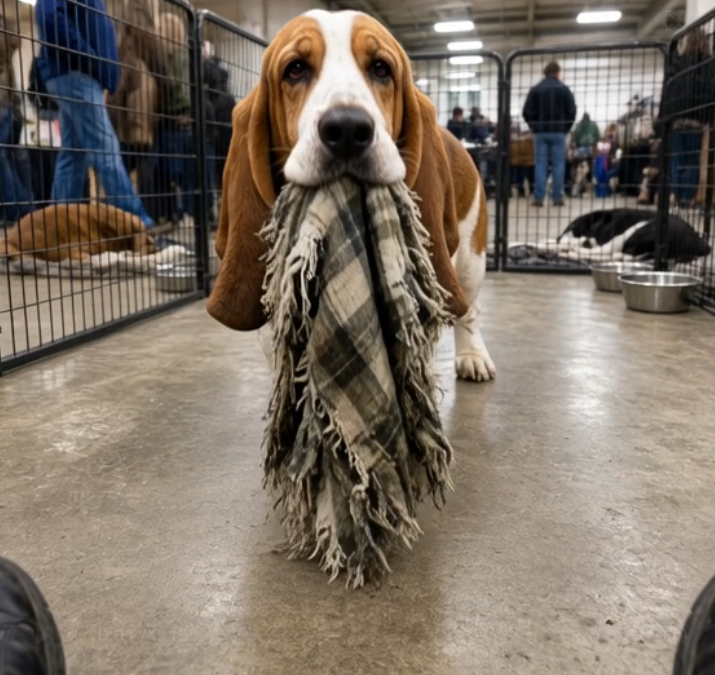
Then an elderly bloodhound named Mabel dragged a faded plaid blanket onto my shoes as if begging me to believe she could disappear neatly into my life.
By sunset, I would learn she had been abandoned for a reason darker than old age, and the people who left her behind were counting on a grieving dog to stay silent.
The rescue coordinator said something that stayed with me long after I left.
“She carries that blanket to anyone who sits with her,” she told me softly. “We think she’s trying to show them she won’t take up much room.”
At the time, I thought it was the saddest thing I had ever heard.
I was wrong.
I hadn’t gone to the adoption event looking for a dog. I went there to give away the belongings of one.
My beagle, Rosie, had died four months earlier at fifteen years old. Her beds, bowls, unopened food, toys, and little winter sweaters had been sitting in stacked cardboard boxes in my garage since the afternoon I came home without her. Every time I passed them, I felt the loss all over again, fresh and sharp, as if grief had teeth.
So on a windy Saturday morning outside Wichita, Kansas, I loaded everything into my Subaru and drove to a senior-dog rescue event at a converted train depot.
My plan was simple.
Drop off the boxes.
Thank the volunteers.
Leave before I became attached to anyone.
The depot was crowded when I arrived. Families moved between temporary pens while volunteers knelt with clipboards and leashes. Small dogs got the most attention. A terrier in a yellow bow had three different families waiting to meet her. Two fluffy Pomeranian mixes sat like royalty while children squealed over them.
Near the far wall, away from the busiest part of the room, an elderly bloodhound mix lay alone on a thin plaid blanket.
Her name was Mabel.
She had long ears, enormous paws, loose brown-and-white skin, and the saddest tail I had ever seen. It didn’t wag in happy sweeps. It gave one careful thump whenever someone looked her way, then stopped, as if she had learned hope was something best offered quietly.
Most people didn’t stop.
PART2:
I noticed her only because one of Rosie’s old sweaters slipped from the box in my arms and landed near Mabel’s pen. Before I could pick it up, she struggled onto her feet and shuffled toward the gate. Every step looked stiff. Her joints trembled. But she reached that sweater, lowered her head, and sniffed it for several seconds.
Then she looked directly at me.
I don’t know what passed between us in that moment. Maybe she smelled Rosie. Maybe I wanted to believe she did. But I crouched outside the wire, pressed my fingers through the gate, and whispered, “Sweet girl.”
Mabel stepped forward and leaned the whole side of her face into my hand.
She didn’t bark.
She didn’t lick.
She didn’t beg.
She simply stood there as if she had been waiting all morning for someone to touch her like she mattered.
A volunteer named Denise opened the pen so I could retrieve the sweater. Instead of leaving, I stepped inside and sat on the concrete. Mabel watched me with tired amber eyes, then turned, walked to the back of the enclosure, and gripped one corner of her plaid blanket between her teeth.
The blanket was old and too small for her. Its green-and-brown pattern had faded almost white in places, and one edge had unraveled into strings. She dragged it toward me slowly, stopping twice to adjust her grip. When she reached my shoes, she dropped it across them, turned in a careful circle, and lowered her big old body onto it.
Half of her hung off the fabric.
She seemed perfectly content.
“What is she doing?” I asked.
Denise smiled, but her eyes were wet.
“She does that whenever someone sits with her for more than a minute,” she said. “She brings them her bed.”
“Why?”
PART3:
Denise swallowed. “We think she’s trying to prove she can fit wherever they are. Like she’s saying, ‘This is all the space I need. Can I come with you?’”
The words hit me so hard I had to look away.
Denise told me Mabel’s story then. She had lived almost her whole life with a woman named Eleanor Whitcomb in an old farmhouse outside Hutchinson. Eleanor had no children, just a garden, a piano she played every Sunday, and Mabel. When Eleanor died suddenly, distant relatives came to clear out the property.
They took the furniture.
They took the dishes.
They took the framed photographs.
They took the jewelry, the quilts, even the curtains.
Then they drove away and left Mabel behind.
A neighbor found her days later sleeping on that plaid blanket beside the back door, still waiting for someone to come home.
“She was dehydrated,” Denise said. “Hungry. Confused. But she wouldn’t leave the rug. Animal control had to carry her with it.”
“How long has she been here?”
“Ten months.”
I looked down at Mabel.
Ten months of watching other dogs leave. Ten months of lifting her head when footsteps approached. Ten months of learning that most people glanced at her age, her stiff legs, her sagging belly, and moved on.
A family came by while we were talking. Their teenage daughter knelt and reached through the gate. Mabel struggled up immediately, picked up the blanket, and dragged it toward her.
Her tail thumped once.
Then twice.
Then faster.
For a few seconds, she looked younger. Hope lifted her face. Her ears perked. Her whole body seemed to ask, Is it you?
Then the father read her card.
“Twelve years old,” he said. “Let’s find one that can keep up with us.”
They walked away.
Mabel stood there with the blanket hanging from her mouth, watching them stop at a younger spaniel’s pen. After a moment, she lowered the fabric to the floor, gathered it carefully, and dragged it back to the corner.
No barking.
No whining.
Just surrender.
Something inside me cracked.
Four months earlier, I had held Rosie as she took her final breath. I had promised myself I would never love another dog because loving meant losing, and I didn’t think I could survive losing twice. But sitting there with Mabel, I saw the selfishness in my fear.
I was protecting myself from a future goodbye.
She was losing every day she could have spent being loved.
I crawled toward the back of the pen and sat beside her. This time, I pulled the plaid blanket across the concrete myself, spread it beside me, and patted the empty space.
“Would you mind sharing?”
Mabel studied me as if waiting for the joke to turn cruel.
Then she rose, walked over, and lowered herself against my leg.
I placed Rosie’s little sweater across her shoulders. It was far too small, but Mabel turned and sniffed it again. Her tail tapped the concrete once.
I looked at Denise.
“What would I need to do to take her home?”
Denise covered her mouth.
“Are you serious?”
I looked at Mabel, already falling asleep against my knee.
“Yes,” I said. “I think I am.”
The paperwork took nearly an hour. Mabel slept through most of it. When Denise clipped a blue leash to her collar, Mabel walked toward the exit, then suddenly stopped and turned back toward the empty pen.
For a second, I thought she was afraid to leave.
Then she shuffled inside, picked up her plaid blanket, and carried it out herself.
The entire room seemed to understand. One volunteer started crying. Another knelt and kissed Mabel’s head.
Denise whispered, “She’s been waiting a long time to carry that blanket through this door.”
Outside, Mabel didn’t know how to climb into my car, so I lifted her gently onto the back seat and arranged Rosie’s old bed beneath her. She placed the plaid blanket on top of it, then rested her head on the box containing Rosie’s collar and bowls.
I had come there hoping to empty my car of grief.
Instead, I drove home with it transformed into something warm and breathing.
For the first few weeks, Mabel moved through my house like a guest afraid of overstaying. She never climbed on furniture. Never barked for food. Never pushed open doors. If I left the room, she watched the spot where I had disappeared, but she didn’t follow until I called her.
Every evening, she dragged that faded blanket beside my chair and curled onto it.
It broke my heart every time.
“Sweetheart,” I told her one night, kneeling beside the oversized orthopedic bed I had bought her, “you don’t have to make yourself small here.”
She blinked at me, unconvinced.
The change came slowly. First, she began sighing in her sleep. Then she started leaning into me when I brushed her. Then one morning, when I was making coffee, I heard a heavy thud and found her on Rosie’s old bed in the living room, her chin lifted in mild defiance as if daring me to object.
I laughed so hard I cried.
Two months after I adopted her, everything changed again.
I was washing Mabel’s plaid blanket. I had done it before, carefully, on gentle cycle, because she panicked if it was gone too long. That day, one frayed seam tore open as I pulled it from the dryer. Something small and hard dropped onto the laundry room floor.
It was a brass key.
Taped to it was a brittle slip of paper with faded handwriting.
For Mabel, if no one listens.
My hands went cold.
I called Denise. Within an hour, she was at my kitchen table with the rescue coordinator, a woman named Carla Reeves. Carla recognized the handwriting immediately.
“That’s Eleanor’s,” she said.
“You knew her?”
“She donated to Second Mile every Christmas,” Carla said. “We didn’t know Mabel existed until the neighbor called animal control.”
Denise turned the key over in her palm.
“Could be a safe-deposit key.”
Carla’s face tightened. “Eleanor’s relatives told everyone there was no will. They said the estate was empty except the farmhouse.”
“But they left Mabel to starve,” I said.
Carla looked at me. “People who do that don’t usually stop at one cruelty.”
Over the next week, the three of us started asking questions. Carla contacted Eleanor’s longtime neighbor, Mrs. Alvarez, the woman who had found Mabel. Mrs. Alvarez remembered seeing a black pickup at the farmhouse the night before the relatives claimed they arrived. She remembered hearing raised voices weeks earlier, Eleanor shouting, “You will not sell my land while I’m alive.” She remembered Mabel barking through the screen door until Eleanor called her back inside.
Denise found the bank name stamped on the key.
I expected the bank to refuse us. Instead, after Carla produced old donation records and Mrs. Alvarez confirmed Eleanor’s connection to Mabel, the manager agreed to contact the estate attorney listed on Eleanor’s account.
That was how we met Thomas Greer.
He was seventy, sharp-eyed, and furious before he even sat down.
“I drafted Eleanor Whitcomb’s will myself,” he said. “She left the farmhouse and remaining funds to Second Mile Senior Dog Rescue, with lifetime care instructions for Mabel. I was told by her niece that Eleanor had revoked it.”
“Did she?” I asked.
“No,” he said. “And I never believed she did.”
The safe-deposit box held three things: the original will, a handwritten letter, and a small flash drive.
The letter was addressed to “Whoever protects Mabel.”
Thomas read it aloud in his office while Mabel slept at my feet.
If you are reading this, then my girl was left with the only thing I could hide quickly. My niece Corinne and her husband Dale have been pressuring me to sign over the farm. They think because I am old, I am foolish. I am not. I have made arrangements for Mabel and for the rescue that gives old dogs a chance. If anything happens to me, please make sure Mabel is not given to them. They do not love her. They only love what they can take.
The flash drive contained security footage from Eleanor’s porch camera.
Corinne and Dale Whitcomb arrived at the farmhouse two hours after the ambulance took Eleanor away. In the video, Dale kicked Mabel away from the door.
I heard Mabel whine through the recording.
Corinne said, “Leave the damn dog. Nobody’s adopting that old thing anyway.”
Dale laughed and answered, “Good. One less expense.”
Then they carried boxes out of the house.
Jewelry boxes.
Files.
The piano bench.
At one point, Corinne held up the plaid blanket and said, “Why does she keep dragging this filthy thing around?”
Dale said, “Let her have it. Makes her look even more pathetic.”
I had to leave the room.
In the hallway, I slid down the wall and covered my mouth. Not because I was surprised cruelty existed, but because I had spent months watching Mabel apologize for needing space in a world where someone had taught her she was a burden.
When the sheriff’s office opened an investigation, Corinne and Dale denied everything. They claimed they had arranged for someone to pick Mabel up. They claimed Eleanor had promised them the property. They claimed the videos were taken out of context.
Then they made one final mistake.
They showed up at the next Second Mile adoption fundraiser.
It was held in the same train depot, decorated with string lights and folding tables covered in donated baskets. Mabel came with me wearing a soft blue bandana. She moved slowly, but her head was higher now. Her blanket was folded in my tote bag because she still liked to have it nearby.
Corinne walked in wearing pearls and a cream coat, smiling like a woman arriving to collect sympathy. Dale followed her, red-faced and restless.
Carla stiffened when she saw them.
“What are they doing here?” I asked.
“Trying to get ahead of the story,” she said.
Corinne approached the donation table and raised her voice just enough for nearby people to hear.
“We’re heartbroken by these accusations,” she said. “Aunt Eleanor loved us. Unfortunately, some rescue people are exploiting an old woman’s confusion and a sick dog for money.”
The room went quiet.
Then she looked down at Mabel.
“And honestly, dragging that poor animal around at her age seems cruel.”
Mabel lowered her head.
I felt something ancient and protective rise in me.
I stepped forward. “Don’t talk about her like she isn’t standing right here.”
Corinne’s smile sharpened. “You must be the woman who took her. I hope they warned you she’s expensive.”
“She’s worth more than anything you stole.”
Dale moved closer. “Careful.”
“No,” I said, my voice shaking but clear. “You were careful. You were careful when you emptied Eleanor’s house. Careful when you left Mabel locked out with no food. Careful when you assumed an old dog couldn’t carry evidence.”
People began pulling out phones.
Carla walked to the front of the room and plugged Thomas’s laptop into the projector. She didn’t shout. She didn’t accuse. She simply said, “Since the Whitcombs would like transparency, we agree.”
The porch camera footage appeared on the wall.
Corinne’s own voice filled the depot.
Leave the damn dog. Nobody’s adopting that old thing anyway.
A sound moved through the crowd like a wave. Shock. Anger. Disgust.
Dale lunged toward the laptop, but the sheriff’s deputy near the door caught his arm.
Corinne’s face went white.
Mabel pressed against my leg, trembling. I knelt and pulled her blanket from my bag. She gripped the corner in her mouth, turned slowly, and did what she had done the first day I met her.
She dragged it toward me.
Only this time, she didn’t place it at my shoes like an apology.
She spread it across my knees, climbed halfway onto it, and leaned her full weight into me as if she finally understood she did not have to be small to be loved.
The investigation took months, but the truth held. The will was validated. The stolen property that could be recovered was returned to the estate. Corinne and Dale faced charges for theft and animal abandonment. The farmhouse was sold, and the proceeds funded a permanent senior-dog medical program at Second Mile.
They named it Mabel’s Room.
On the day the sign went up, I brought her back to the depot. Volunteers had transformed a quiet corner into a warm space with thick beds, ramps, soft lighting, and a painted sign that read: Old Love Is Still Love.
Mabel sniffed every bed, accepted twelve treats, and finally chose the smallest blanket in the room.
Of course she did.
She is fourteen now. She moves slowly. She takes joint medicine with breakfast and demands peanut butter afterward. She sleeps in the sunny spot by my window, snores like a tired old man, and has learned that barking once will make me come running like staff.
The plaid blanket is still with us. I have patched it three times. It is faded almost beyond recognition, and it barely covers half of her, but I will never replace it.
Sometimes, when friends visit, Mabel still drags it across the floor and lays it beside them.
But it means something different now.
She is not asking to be chosen.
She is welcoming them into her home.
I used to think I rescued Mabel because she needed somewhere gentle to spend her final years. But the truth is, she rescued the part of me that grief had frightened into hiding. She taught me that love is not measured by how long we get to keep someone. It is measured by whether we are brave enough to show up while they are still here.
I went to that depot carrying everything that reminded me of the dog I had lost.
I came home with an old hound, a torn blanket, a hidden key, and a heart that finally remembered how to open.
And every night, when Mabel falls asleep with her head on my foot, I understand what Eleanor must have known when she hid that key in the only thing no greedy relative wanted.
Sometimes the smallest, most unwanted thing in the room is carrying the truth everyone else tried to bury.

