For Two Years, the Retired Military K9 Wouldn’t Respond to Anyone—Then The Old Farmer Walked In
PART3:
Amara heard the change anyway.
A shift in the room.
The absence of ordinary movement.
The receptionist’s voice lowered.
A chair creaked.
Then footsteps came down the side hall.
Slow, but not weak.
Measured.
A man appeared at the entrance to the kennel corridor.
He was old.
Seventy, maybe older, though Amara knew better than to trust age by skin alone.
Some people aged from time.
Others aged from weather, work, and things they never said.
He wore a frayed olive shirt with the left pocket missing a button, faded work pants, and boots that had seen mud, gravel, manure, and maybe worse. His hair was silver, cut short without style. His face was narrow, sun-browned, and deeply lined. His hands were large and scarred, resting loosely at his sides.
But his eyes were what stopped Amara.
They were gray.
Calm.
And they were already reading the corridor before they landed on her.
Not glancing.
Reading.
Exits.
Corners.
Distances.
The lock on Koda’s run.
The position of the tech.
The clipboard.
The tranquilizer pole hanging on the wall.
The dog.
Always the dog.
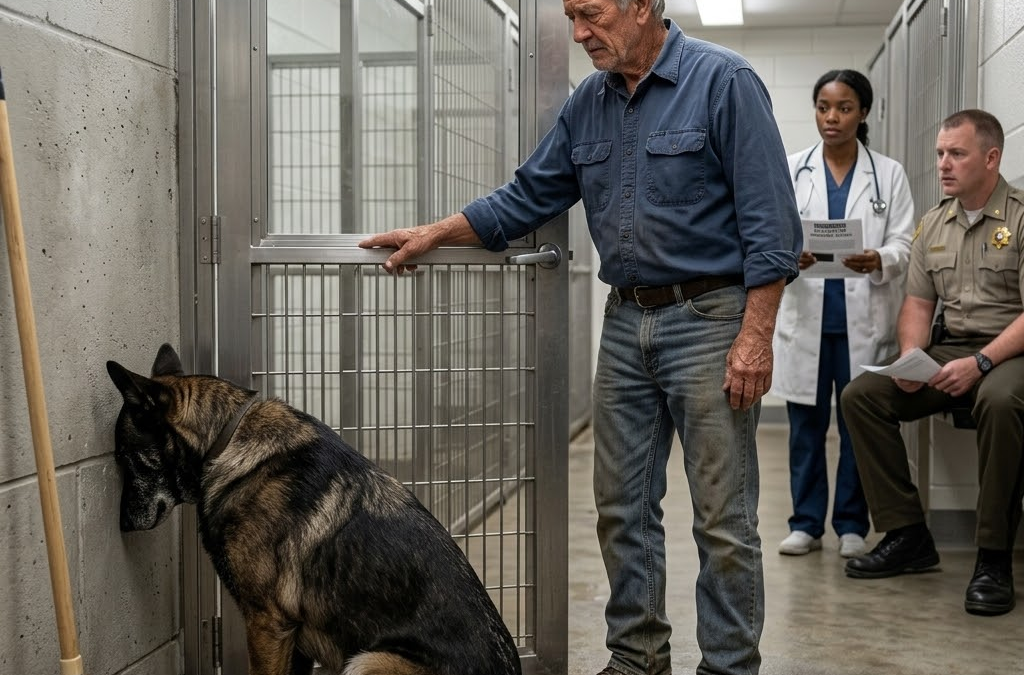
The old man looked through the kennel window toward the Malinois facing the wall.
“I’d like to see the Belgian,” he said.
His voice was quiet, rough with disuse.
“The Malinois.”
Amara stepped forward.
“Do you have an animal registered here, sir?”
“No, ma’am.”
“Are you here for an appointment?”
“No.”
The tech shifted uneasily.
The old man did not look at her.
“I’d like to see him alone if that’s all right.”
Amara stared at him.
“No,” she said.
He nodded once, as if that was a reasonable opening position.
“What’s your name?”
“Dell Pruitt.”
“Mr. Pruitt, that animal is under an active county order. He is not available for public visitation.”
“I’m not public.”
“Are you family to the registered handler?”
A pause.
Not hesitation.
Calculation.
“I knew his handler.”
“Knew?”
“Past tense.”
Amara’s grip tightened slightly on the tablet.
People came sometimes.
Old service buddies.
Local veterans.
Women with soft voices and bleeding hearts.
A retired deputy who thought all dogs needed was “a firm hand.”
Two online rescue advocates who offered prayers and then threatened to sue.
None of them had helped.
All of them had left shaken by the sight of a dog who seemed to have withdrawn so far inside himself that even pity could not reach him.
“Mr. Pruitt,” Amara said, “Koda has not responded to anyone in two years.”
“I heard.”
“He does not engage. He does not tolerate touch. He is not aggressive in the usual sense, but he is unpredictable if approached physically.”
Dell looked at the dog.
“He’s not unpredictable.”
Amara lifted her chin.
“You’ve been here less than two minutes.”
“Yes, ma’am.”
“And you believe you understand him?”
“No.”
That surprised her.
Dell’s eyes did not leave the run.
“I believe I recognize where he is.”
The sentence sat strangely in the corridor.
Not what he is.
Where he is.
Before Amara could answer, another woman entered from the front corridor.
Gail Morrow from county animal services.
Mid-forties. Brown hair pulled back. County lanyard. Clipboard held against her chest. Efficient shoes. Careful eyes. A woman who had made herself strong enough to do unpleasant necessary work without becoming cruel.
“Dr. Okafor,” Gail said. “I need the final assessment space clear, please.”
Her gaze moved to Dell.
“Sir, I’m going to ask you to step out to the waiting room.”
Dell did not argue.
He stepped back one pace, hands loose, posture neutral.
But he did not leave.
Gail’s expression remained patient.
“This won’t take long.”
“No,” Dell said. “It won’t.”
Amara looked at him sharply.
Gail opened the clipboard.
“Koda. Former MWD. Intake duration: twenty-four months. Multiple intervention attempts. Behavioral assessment final classification: non-rehabilitative. Humane euthanasia authorized pending veterinary signature.”
Her pen moved down the checklist.
Koda did not move.
He sat facing the wall as if paperwork belonged to another species entirely.
Dell watched him.
Not with hope.
Not with sadness.
With recognition.
“That isn’t surrender,” he said quietly.
Gail looked up.
“Excuse me?”
“That dog is not surrendered.”
Gail’s pen paused.
“I understand this may be emotionally difficult, Mr. Pruitt, but I’ve reviewed the case file.”
“I’m sure you have.”
“The clinic staff have worked extensively with him. We have to rely on documented outcomes.”
“Yes, ma’am.”
The politeness did not make him sound agreeable.
It made him sound immovable.
Gail lowered the clipboard slightly.
“Are you a licensed veterinary behaviorist?”
“No.”
“Certified trainer?”
“No.”
“Registered owner?”
“No.”
“Current handler?”
“No.”
“Then I need you to understand that you do not have standing to interfere with this process.”
Dell looked at her then.
His eyes were not angry.
That was worse.
“I’m not interfering,” he said. “I’m asking for five minutes before you kill him.”
The tech inhaled.
Gail’s face tightened.
Amara felt the words strike the exact place she had been trying to protect all morning.
Before she could stop herself, she said, “Gail.”
Gail turned.
Amara looked from Dell to the dog.
Every protocol said no.
Every result said there was no point.
Every part of her training said this old man, whoever he was, represented liability, emotion, and delay.
But every entry in the file said the same thing.
No response.
No change.
No path forward.
And for reasons she could not defend yet, Amara believed Dell Pruitt had seen something in less than two minutes that she had missed in two years.
“Give him five minutes,” she said.
Gail stared at her.
“Doctor—”
“He won’t enter the run.”
Dell said nothing.
Amara glanced at him.
“You won’t enter the run.”
He looked at Koda.
Then at her.
“No, ma’am,” he said.
It was not a promise.
Not exactly.
Gail sighed once through her nose.
“Five minutes.”
She wrote something on the clipboard.
Dell moved to the kennel window.
He did not place his hands on the glass.
Did not bend.
Did not call the dog’s name.
He simply stood.
The corridor’s fluorescent lights buzzed overhead. Somewhere near the front, a terrier barked twice and was shushed by its owner. A basset hound whined behind a closed exam door.
Koda remained facing the wall.
Dell remained still.
One minute passed.
Then two.
Gail shifted her weight.
Amara almost said something.
Then Dell spoke.
Not to them.
Not loudly enough to be performative.
To the dog.
The words were not English.
They were low, precise, and shaped by a mouth that had said them in dust, darkness, and danger long before this clinic corridor existed in anyone’s mind.
Amara knew the cadence before she knew why.
Pashto, maybe.
Or something near it.
She had heard similar sounds years ago during a military veterinary briefing on deployed working dogs, handlers, and reintegration patterns. She did not remember the vocabulary. Only the tone.
Not soft.
Not commanding in the obvious way.
A reminder.
Koda’s left ear moved.
A fraction of an inch.
The tech whispered, “Oh my God.”
Gail’s pen stopped moving.
Dell did not react.
That was the part that made Amara’s skin prickle.
A civilian would have gasped. Smiled. Pressed. Said, “Good boy,” too soon and broken the fragile bridge before it held weight.
Dell did nothing.
He let the movement exist without grabbing it.
Then he spoke again.
Same phrase.
Same measure.
Koda’s ear rotated farther back.
Still facing the wall.
But listening now.
Amara felt her pulse quicken.
“What did you say?” Gail asked.
Dell did not answer.
He moved.
One hand to the latch.
Clean.
Practiced.
No fumbling.
Amara stepped forward.
“Mr. Pruitt—”
He opened the kennel door and went inside.
Gail said, “Sir, you cannot—”
Dell did not go to the dog.
That stopped everyone.
He entered the run, let the door settle mostly closed behind him, and moved to the opposite wall. He crouched low, back nearly to Koda, face angled only slightly toward him. No direct frontal posture. No reaching. No looming. No pressure.
He sat beside the dog’s emptiness without demanding to become the center of it.
Koda did not move.
Still facing the wall.
Ears flat again.
Body suspended in that awful inward stillness.
Dell rested his hands on his knees.
Then he spoke another phrase.
Shorter.
Three syllables.
Maybe four.
Amara’s breath caught.
Koda’s head shifted.
Not turned.
Shifted.
As if some locked mechanism inside him had received a code it had almost forgotten existed.
Dell lifted his right hand.
Slow.
So slow it was nearly unbearable to watch.
He extended two fingers toward the space in front of Koda’s chest.
Not touching.
Waiting.
Gail’s clipboard remained raised, but she had stopped writing.
Amara found herself stepping closer to the window.
Dell spoke again.
The same short phrase.
Koda turned his head.
For the first time in two years, the Belgian Malinois looked at a human face.
Not fast.
Not startled.
Not alive in the joyful way Amara had once prayed to see.
It was slower than that.
He turned like a man who had stared at one wall so long he had finally accepted the wall had no more orders to give him.
His brown eyes found Dell.
Held there.
Something moved behind them.
Buried.
Damaged.
But moving.
Dell’s breathing did not change.
He did not smile.
He did not praise.
He held the two-finger position steady and let the dog look.
Then he said a second phrase.
Shorter still.
His fingers pressed gently but firmly to the center of Koda’s chest.
The dog went still.
But not as before.
This was not shutdown.
This was decision.
A long tremor ran through Koda’s body.
His ears lifted by degrees.
His nose worked once.
Then again.
He took one step.
Dell remained crouched.
Another step.
The dog lowered his head.
And pressed it into Dell’s chest.
Nobody moved.
Dell’s left hand rose and settled on the back of Koda’s skull.
Flat.
Steady.
No petting.
No excitement.
Just contact.
Koda leaned into him.
Really leaned.
Like something that had been holding itself upright for two years had finally decided it was allowed to transfer its weight.
Amara’s eyes burned.
Gail exhaled softly, as if she had not breathed since he entered the run.
Dell stayed kneeling on the concrete floor, one hand on the back of the dog’s head, the other against his chest.
He did not look at the observers.
He did not ask if they had seen.
He did not need confirmation.
Koda had given him all the confirmation in the world.
For two years, the dog had not responded to anyone.
Now his forehead was pressed against an old farmer’s shirt like he was listening for a heartbeat he recognized from another life.
Amara turned away suddenly.
Not because she wanted to stop watching.
Because she had work to do.
Her thumb moved across her tablet.
Koda’s intake file.
Handler record.
DoD transfer note.
Next-of-kin inquiry.
Pruitt, D.
The name had appeared before, buried in a routing queue that had never resolved because no one knew which agency owned the request. She opened an external veterinary-military consultation portal she rarely used. The clinic maintained access because sometimes retired working dogs arrived with histories nobody local understood.
She typed:
PRUITT, DELL
The search took longer than it should have.
When the file opened, most of it was black.
Dense redactions.
Page after page.
Unit designations gone.
Dates gone.
Locations gone.
Operational language stripped down to nothing.
Whatever Dell Pruitt had done for most of his working life, someone had gone to great effort to make sure the world never read the details.
Amara scrolled.
More black.
More silence.
Then one line appeared near the bottom of the third page.
Eight words surrounded by redaction.
Tier 1 MWD handler certification awarded 2003.
Below it:
Certification never again issued to active personnel.
Amara stared.
She read it once.
Twice.
A third time.
Then she looked through the kennel window.
Dell Pruitt was still kneeling on the floor with Koda’s head against his chest.
The old man in the frayed olive shirt was not a sentimental farmer who wandered into her clinic with hope.
He was a man the military had buried inside black ink.
A man certified at a level that no longer existed.
A man who knew how to speak to dogs who had lived where maps were classified and death had no witnesses.
Gail noticed Amara’s expression.
“What?”
Amara crossed the corridor and held out the tablet without speaking.
Gail read.
Scrolled.
Read again.
Her grip loosened on the euthanasia form.
For the first time that morning, her clipboard looked less like authority and more like paper.
Before either woman could speak, the corridor door opened sharply.
A man in a county animal services jacket strode in with the particular confidence of a supervisor who expected rooms to organize themselves around his arrival.
His name tag read:
HAROLD VANCE
SUPERVISING OFFICER
“What is going on here?” Vance demanded.
Gail straightened.
“Mr. Vance—”
His eyes landed on the kennel run.
Dell kneeling.
Koda leaning into him.
The dog’s eyes closed now, not sleeping, but present.
Vance’s jaw tightened.
“Who is this individual?”
Amara stepped forward.
“Dell Pruitt.”
“Is he licensed?”
“His federal certification—”
“I asked if he is licensed in Tennessee.”
Dell spoke before Amara could answer.
His voice remained level.
He did not look up from Koda.
“CFR Title Nine, Part Three, Subpart E. Section 3.140 permits a previously certified handler to conduct a behavioral assessment of a military working dog or former military working dog in lieu of veterinary behavioral determination, provided certification is on record and assessment is observed by a licensed practitioner.”
The corridor went silent.
Vance stared.
Dell’s right hand pressed once, slowly, at the base of Koda’s skull.
“Dr. Okafor is the licensed practitioner. She’s twelve feet behind you.”
Vance looked at Gail.
Gail looked at Amara.
Amara held up the tablet.
“His certification is on record.”
Vance took the tablet.
His face changed as he read, but only slightly.
A man like him did not surrender quickly.
“The euthanasia order is active.”
“A behavioral assessment supersedes the hold during evaluation,” Dell said.
Vance’s eyes narrowed.
“That regulation was revised after a case at Fort Bragg.”
“2011,” Dell said.
Vance looked up.
Dell still had not turned toward him.
“A working dog was euthanized during a behavioral hold because no certified handler was available to assess him. Congress got loud. The Army got embarrassed. The language changed.”
Vance flipped through his clipboard as if the answer might appear there through force.
It did not.
The regulation lived in a federal registry most county systems never accessed, tied to certifications issued fewer than forty times in program history. Dell knew that.
He had known before he walked through the door.
Vance lowered the clipboard two inches.
Not all the way.
“How long would you need?” Dell asked.
This time, he looked at Amara.
She felt the weight of the question.
Not medical time.
Not bureaucratic time.
Real time.
The amount of time required to prove that what had just happened was not a final spark before darkness, but a path.
“Seventy-two hours,” Amara said. “For an initial behavioral log. Then I can submit a revised status.”
Dell nodded once.
“Seventy-two hours.”
Koda shifted, pressing his shoulder against Dell’s knee.
Vance was silent for several seconds.
Then he said, “I’ll need your signature on an extension form, Doctor.”
“Of course,” Amara said.
Gail did not move as Vance left with Amara.
She stood in the corridor, clipboard at her side, watching the old man run two fingers slowly down Koda’s ear.
No one spoke.
For almost five minutes, nothing happened.
And everything happened.
Dell shifted his weight slightly.
A small index card slipped from the pocket of his olive shirt—the pocket with the missing button—and landed face up on the concrete.
Gail saw it before he picked it up.
A name.
A grid coordinate.
A date eleven years old.
Nothing else.
The handwriting was small and careful, printed by a man who intended the words to last.
Dell looked at the card.
For the first time since entering the clinic, his face changed.
Not much.
Enough.
He picked it up, smoothed one bent corner, and tucked it back into his shirt pocket.
His hands were steady.
Too steady.
Gail’s eyes moved to the floor beside him.
Only then did she notice the leash.
Brown leather.
Bridle-stitched.
Old, but cared for.
The clip was a military-pattern bolt snap, heavier than any standard leash clasp. Near the clip, the leather was dark with oil and age. The stitching near the middle had been repaired with waxed linen thread that did not quite match.
The kind of mismatch made by hands that valued function over appearance.
Gail remembered the file.
Pruitt, Dell.
Redacted.
Tier 1 MWD handler.
She looked at the leash again.
It did not look like something brought for Koda.
It looked like something carried because the hand could not leave it behind.
Dell noticed her looking.
He did not explain.
Koda’s breathing slowed against his chest.
Dell said quietly, almost to himself, “He didn’t come home either.”
Gail’s hand rose unconsciously to her collarbone.
The words were not meant for her.
They were for Koda.
Or for the leash.
Or for the name on the index card.
Or for a dog gone eleven years and still expected at a fence post by a man who knew better and kept the knot tied anyway.
Amara returned with the extension form.
She stopped outside the run.
She had heard the sentence.
She had seen the leash.
She understood enough not to ask.
Some grief did not become clearer when spoken.
Some grief only became smaller when handled with respect.
“Mr. Pruitt,” she said softly.
Dell looked up.
“Dr. Okafor.”
“The hold is extended seventy-two hours.”
“Good.”
“I’ll need to observe formally.”
“I know.”
“And if he regresses—”
“He will.”
The answer startled her.
Dell stroked the back of Koda’s skull once.
“He won’t climb out of two years of waiting in an afternoon. He’ll go back under. He’ll test the room. He’ll shut down when it gets too bright or too loud or too much. He’ll look for the man who isn’t coming. We don’t punish him for that.”
Amara absorbed the words.
“What do we do?”
Dell looked down at Koda.
“We keep showing up until he believes the new order.”
“What order?”
Dell’s face was unreadable.
“That he can stand down.”
The seventy-two hours began in silence.
Dell refused a chair.
He stayed on the floor inside the run until Koda fell into a sleep so deep Amara had to check his breathing twice from the window.
“He hasn’t slept like that,” she whispered.
Dell did not answer.
When he finally left the run, Koda woke and lifted his head.
Not panicked.
Watching.
Dell placed the old leather leash on the concrete just inside the kennel door.
Koda’s eyes followed it.
“I’ll be back,” Dell said.
The dog’s ears moved.
Dell closed the kennel door.
He did not say goodbye.
That mattered, though nobody understood why until later.
In the staff room, Amara gave Dell coffee in a paper cup.
He held it but did not drink.
Gail sat across from him with the folded euthanasia order in front of her. It remained folded the entire time.
“I need to ask,” Amara said.
Dell looked at her.
“The phrases. What language?”
“Pashto.”
“What did you say?”
A long pause.
“The first one roughly meant, ‘I see your post.’”
Gail looked up.
“And the second?”
“‘Your watch is covered.’”
Amara’s throat tightened.
“What did his handler use?”
Dell looked toward the kennel corridor.
“I don’t know every word his handler used. But I know where Koda served. I know what that language would mean inside him. I know what a dog hears when everyone else keeps saying the wrong things.”
“Which are?”
“Come. Sit. Look. Eat. Good boy.”
Amara frowned.
“Those are basic.”
“Yes.”
“So why are they wrong?”
“Because he wasn’t disobeying.”
Dell set the coffee down untouched.
“He was waiting.”
Gail’s expression changed.
Waiting.
She thought of the dog facing the wall for two years.
Not empty.
Not gone.
Waiting.
“For whom?” she asked, though she knew.
Dell’s eyes lowered.
“His handler.”
“Who was he?”
Dell’s hands went still on the table.
“Caleb Rusk.”
Amara recognized the name from the redacted paperwork.
“Was he family?”
“No.”
The answer was quick.
Too quick.
Dell noticed her notice.
He looked toward the window where late morning light washed across the parking lot.
“Some men become family without paperwork.”
Gail did not write that down.
It deserved better than a note.
Dell continued.
“Caleb was twenty-three when he came through the program. Too young to be as serious as he was. Too serious to be as young as he was. Koda was his second dog, but the first one he truly trusted with his whole life.”
“You trained them?” Amara asked.
“Some.”
“Your file says—”
“My file says what somebody allowed it to say.”
Amara accepted that.
“What happened to Caleb?”
Dell’s face closed.
“Ambush. Mountains. Extraction went sideways. Koda was found thirty-six hours later beside an irrigation wall with shrapnel in his shoulder and blood in his mouth that wasn’t all his. Caleb was gone.”
“Gone,” Gail repeated quietly.
“Body recovered later.”
The room fell silent.
Dell lifted the paper cup, remembered he did not want it, set it down again.
“They shipped the dog home. Too injured for redeployment. Too unstable for reassignment. Too quiet for people who only understood loud distress.”
Amara closed her eyes briefly.
“And we called him nonresponsive.”
Dell did not accuse her.
That made it harder.
“You named what you could see.”
For the first day, Dell did very little.
He sat in the run with Koda.
Not always touching.
Sometimes back-to-back. Sometimes near the door. Sometimes with the old leash lying between them. He spoke rarely. When he did, he used English only after Pashto, never before. The order of language mattered.
“I see your post.”
Silence.
“Your watch is covered.”
Silence.
“Easy now.”
By afternoon, Koda drank from a bowl while Dell sat six feet away.
By evening, he accepted a strip of boiled chicken from the floor near Dell’s boot.
Not hand-fed.
Not yet.
Dell told Amara not to rush it.
“Let him keep some dignity,” he said.
That sentence changed how she wrote the log.
Before, she would have written:
Accepted food with indirect human proximity.
Instead, she wrote:
Ate while maintaining chosen distance. No pressure applied.
It seemed small.
It was not.
On the second morning, Dell arrived before the clinic opened.
His blue 1994 Silverado was already parked in the far corner of the lot when Amara pulled in.
Backed in.
Nose out.
View of both entrances.
He stood beside it with the old leash in one hand.
“You slept?” she asked.
“No.”
“You need to.”
“Later.”
Men like Dell used later the way other people used prayers.
Inside, Koda was facing the wall again.
Gail, who had come early without being asked, saw Amara’s face fall.
Dell did not seem discouraged.
He entered the run and sat in the same place as before.
For twenty minutes, nothing happened.
Koda did not turn.
The wall took him back.
Amara felt hope begin its familiar retreat.
Dell spoke the first phrase.
No movement.
He spoke it again.
No movement.
He placed the leather leash on the floor and slid it gently across the concrete until it rested two feet behind Koda.
The dog’s nose twitched.
Only once.
Dell waited.
Fifteen minutes.
Twenty.
Then Koda’s left ear moved.
Gail whispered, “There.”
Dell did not acknowledge it.
Another ten minutes.
Koda turned his head.
Not all the way.
Enough.
Dell said the second phrase.
Your watch is covered.
Koda stood.
Stiff.
Uncertain.
He crossed to the leash, lowered his nose, and sniffed.
Then he looked at Dell.
Amara would remember that look for the rest of her career.
It was not joy.
Joy would come later, if it came at all.
It was recognition complicated by pain.
As if Koda had understood that the object on the floor was not his, but belonged to the same country of loss he had been trapped inside.
Dell reached for the leash.
This time, Koda did not retreat.
Dell clipped it gently to Koda’s collar.
Gail covered her mouth.
No one at Cedar Ridge had clipped a leash onto Koda in two years.
Dell did not pull.
He did not stand.
He simply held the other end and sat.
Koda felt the connection.
The old leather line between them.
The weight.
The history.
His body trembled.
Dell’s hand closed around the leash with muscle memory so old it looked involuntary.
“Not yet,” he whispered.
No one knew whether he said it to the dog or himself.
At 11:40 a.m., Koda took six steps out of the run.
The clinic stopped.
A receptionist halfway through answering the phone went silent. A client in the waiting room drew her terrier into her lap. A technician froze with a laundry basket in both hands.
Dell walked beside Koda, not ahead, not behind.
Beside.
The dog’s head remained low, but he moved.
Six steps became ten.
Ten became twenty.
They stopped at the side exit because the front lobby was too much.
Dell opened the door with his left hand, leash held in his right.
October air entered.
Koda lifted his nose.
He smelled wet leaves.
Oil from the parking lot.
Other dogs.
Pine from the ridge.
Rain coming.
Not war.
Not kennel disinfectant.
Not the wall.
The dog stepped outside.
Amara turned away and cried where no one but Gail could see.
Gail did not pretend not to notice.
She only said, “I’ll update the county record.”
“Use plain language,” Amara said.
Gail nodded.
For once, the form would be forced to carry the truth.
On the third day, Vance returned with two county officials.
He expected resistance.
Instead, he found Koda lying on a blanket in the exam room with Dell sitting beside him, reading an old paperback western aloud in a voice so flat and quiet it might have been weather.
Koda’s head rested on Dell’s boot.
Dr. Okafor handed Vance the behavioral log.
Three days of entries.
Food intake improved.
Water intake normalizing.
Accepted leash placement.
Exited kennel under handler guidance.
Slept in human presence.
Allowed limited physical examination.
No defensive aggression.
Response to certified handler commands.
Recommended status: euthanasia order rescinded.
Vance read it.
Then read it again.
“This is preliminary.”
“Yes,” Amara said.
“We’ll need extended placement.”
“I’ve already arranged a foster assessment.”
“With whom?”
Dell closed the book.
“Me.”
Vance looked at him.
Gail spoke before Vance could begin the wrong argument.
“Mr. Pruitt’s property has been checked against county requirements. Fencing adequate. Rural zoning. No minor children in residence. Veterinary follow-up scheduled. Dr. Okafor will supervise transition.”
Vance looked irritated.
Not because the plan was bad.
Because it was complete.
“That dog is not a pet.”
Dell looked at Koda.
“No.”
“Then what is he?”
Dell’s hand rested on the dog’s neck.
“A soldier without orders.”
Vance had no form for that.
The transfer happened at sunset.
Not because it had to.
Because Dell requested it.
“Too much light in the middle of the day,” he said.
Amara suspected he meant for both of them.
Koda walked to the Silverado on the old leather leash.
Every staff member at Cedar Ridge stood at the windows.
The dog hesitated at the truck.
Dell opened the passenger door.
Inside, on the seat, lay a folded army-green blanket and a canvas mat.
Koda sniffed.
Then jumped in.
The movement was stiff but clean.
Dell stood beside the open door for a moment.
His hand rested on the frame.
Amara approached.
“Mr. Pruitt.”
He looked at her.
“Thank you,” she said.
“For waiting?”
“For coming.”
Dell’s gaze dropped briefly.
“I should have come sooner.”
“You didn’t know.”
“No.”
But the word did not absolve him.
Some men could be forgiven by everyone except themselves.
Gail came next.
The euthanasia order was folded in her hand.
She had brought it because procedure required closure.
She looked at it.
Then at Koda.
Then she tore it in half.
Vance would hate that.
Gail seemed ready to let him.
Dell watched the paper fall into the clinic trash bin.
“Thank you,” he said.
Gail nodded, eyes bright.
“Take care of him.”
Dell’s hand tightened on the door.
“He’s not the only one.”
Then he closed the passenger door and drove away.
He took the county road instead of the highway.
The same road he had come in on. The one along the ridge. The one with pullouts he knew without needing signs. The one that dropped through the holler where trees closed over the blacktop like a tunnel and then opened onto pale fields gone yellow with October.
Koda sat upright for the first ten miles.
Scanning.
Too still.
Then slowly, impossibly, he lowered his head onto the folded blanket.
He did not sleep.
But he rested.
Dell kept both hands low on the wheel.
He did not turn on the radio.
As dusk deepened, the truck climbed the last hill toward his farm.
The land opened in front of them.
Pasture.
Fence lines.
A barn with peeling red paint.
A garden plot gone brown for the season.
A rusted disc harrow Dell kept meaning to move and never did.
A cedar post at the northeast corner of the property where the fence line turned and the hill dropped toward a dry creek bed.
Koda lifted his head before Dell parked.
His nose worked.
He smelled cattle from the neighboring property.
Old hay.
Cold soil.
Wood smoke from Farrell’s chimney half a mile away.
And something else.
Leather.
Oil.
Time.
Dell parked by the house but did not go inside.
He opened Koda’s door and clipped the leash.
“Come on.”
They walked the fence line in fading light.
Past the garden.
Past the water tank.
Past the disc harrow.
Down to the corner post.
There, looped over the cedar, hung another leather leash.
No.
Not another.
The same one.
Dell had carried it to the clinic and brought it back, but habit made it feel as if it belonged to the post and the post had only loaned it to him.
For eleven years, every morning at 6:15, Dell had walked to that post.
He checked the fraying near the clip.
Retied the half hitch.
Stood sixty seconds.
He had done it in rain.
Heat.
Snow.
Fever.
Before surgeries.
After funerals.
In darkness when he had to leave early.
He never explained it.
Not to his neighbor Farrell.
Not to the feed store men.
Not to himself in words.
Eleven years earlier, in a mountain valley whose name had been blacked out of every official record, Dell Pruitt had left a dog named Rook at a grid coordinate written on an index card.
Not by choice.
Never by choice.
Extraction had been smoke, screaming rotors, tracer fire, broken comms, blood, dust, and the impossible arithmetic of who could still move.
Rook had been hit.
Still alive.
Still guarding.
Dell had tried to go back.
Two men held him down in the bird.
One shouted in his ear that the dog was gone.
Dell heard Rook barking until the helicopter banked behind the ridge.
Or he imagined he did.
That was worse.
He came home without him.
A month later, a sealed report called the animal unrecoverable.
Dell bought the farm the next year.
He put the leash on the post the first morning.
Not because he believed Rook would come over the hill.
Not exactly.
Because some part of a handler does not survive unless the post stays ready.
Koda stopped two feet from the cedar post.
His whole body went rigid.
Dell felt it through the leash.
He did not pull.
He stood beside him.
“This was Rook’s,” Dell said.
The dog’s ears lifted.
“He didn’t come home either.”
Koda looked at the post.
At the leash.
At the field beyond.
At Dell.
The old man retied the half hitch with one hand while holding Koda’s leash with the other.
Same knot.
Same motion.
The leather creaked softly.
Then Dell stood.
Usually sixty seconds.
That evening, longer.
Koda stood with him.
Not facing a wall.
Facing the ridge.
The last light slid sideways over the pasture.
A cold wind moved through the dry grass.
For the first time in eleven years, Dell did not stand alone at the post.
For the first time in two years, Koda waited beside someone who understood that waiting could become a wound.
After a while, Dell said, “Come on.”
They walked back to the house.
The kitchen light was already on because Dell always left it that way, though he had lived alone long enough that light made no practical difference. He filled a bowl with water and set it near the back door. Koda drank half of it.
Dell laid an old blanket beside the stove.
Koda sniffed it.
Then walked past it into the hallway.
He found Dell’s bedroom.
Inside, at the foot of the bed, an old canvas dog cot sat folded against the wall.
Dell had not unfolded it in eleven years.
Koda stared at it.
Dell stared too.
Then he unfolded the cot.
The hinges were stiff. The canvas smelled of cedar and dust.
Koda turned once and lay down.
Dell stood in the doorway, one hand on the frame.
“You don’t have to earn sleep here,” he said.
Koda placed his head on his paws.
Dell went to bed without undressing properly, boots beside the mattress, ears tuned to the rhythm of another living creature breathing in the dark.
At 3:12 a.m., Koda woke growling.
Low.
Not aggressive.
Lost.
Dell was out of bed before thought fully formed.
He did not turn on the light.
Light could make a dream into a threat.
He sat on the floor six feet from the cot and spoke the first phrase.
I see your post.
Koda trembled.
Dell spoke the second.
Your watch is covered.
The growl broke into a whine.
Dell waited.
After several minutes, Koda crossed the room and pressed his head into Dell’s chest.
The old man held him until both of them could breathe normally.
Then he said, “That’ll happen again.”
Koda exhaled.
“Doesn’t mean we failed.”
By the end of the first week, Dell had a routine.
Morning fence post.
Breakfast.
Slow walk along the pasture.
Rest.
Leash work near the barn.
No visitors before noon.
No sudden touching.
No pity.
Koda began eating properly on day five.
He barked once on day nine when Farrell’s tractor backfired.
Dell marked it as progress.
Farrell, watching from the neighboring fence, lifted one hand.
“Got yourself a dog?”
Dell looked at Koda.
Koda looked at Farrell.
“Maybe,” Dell said.
Farrell, being a Tennessee farmer with enough sense to leave sacred things alone, nodded.
“Good-looking animal.”
“Yes.”
“He friendly?”
“No.”
Farrell nodded again.
“Fair enough.”
He did not ask about the fence post.
He did not ask why Dell looked less alone than he had in years.
Three weeks later, Dr. Okafor came to the farm for Koda’s follow-up.
Gail came too.
Officially for county documentation.
Unofficially because she needed to see the dog alive in a place paperwork had not imagined for him.
Koda met them from the porch.
Standing.
Alert.
Not relaxed exactly.
But present.
Amara stopped at the bottom step.
“Koda?”
The dog looked at her.
A direct look.
Brief.
Then away.
Amara smiled as if she had been handed something precious.
“He looked at me.”
Dell stood in the doorway.
“Don’t make a fuss.”
“I’m making an internal fuss.”
“That’s acceptable.”
Gail laughed softly.
Inside, the house was plain. Clean. Quiet. Coffee on the stove. Boots by the door. Two bowls near the mudroom. An old leash hanging by a nail. Not the Rook leash. A newer one.
The original still belonged to the fence post.
Amara examined Koda slowly with Dell present.
Heart.
Eyes.
Teeth.
Old shrapnel scars.
Muscle tone.
Weight improving.
She wrote notes by hand this time.
Not because the tablet failed.
Because some records deserved handwriting.
Gail walked to the kitchen window and looked toward the pasture.
She could see the cedar post in the distance.
The leather leash looped over it.
“Does he go there?” she asked.
Dell poured coffee.
“Koda?”
“Yes.”
“Every morning.”
“With you?”
Dell nodded.
“Does he understand?”
Dell handed her a mug.
“Dogs understand ritual better than people. People think rituals are about the past. Dogs know they’re about what happens next.”
Gail looked at him.
“And what happens next?”
Dell glanced toward Koda, who had settled beside Amara but kept one eye on him.
“We keep showing up.”
Amara submitted the revised status that afternoon.
Koda’s euthanasia order was rescinded permanently after thirty days.
His placement with Dell Pruitt became official after sixty.
At ninety days, Cedar Ridge received a letter from a federal office no one at the clinic had ever heard of, thanking Dr. Okafor for her “appropriate compliance with legacy handler assessment protocol.” The letter said almost nothing else and somehow managed to sound classified by existing.
Gail framed a copy of the rescinded order.
She did not hang it publicly.
She kept it in her desk drawer.
On hard days, she opened the drawer and looked at it to remember that procedure was supposed to protect life, not merely organize endings.
Amara changed how Cedar Ridge handled silent animals.
Not all of them could be saved.
She knew that.
Dell reminded her often.
“Hope isn’t a treatment plan,” he said.
But after Koda, she stopped writing “nonresponsive” too quickly.
She began asking different questions.
What is the animal waiting for?
What language has failed?
What duty does the body still think it has?
What grief are we calling behavior?
Six months later, Dell brought Koda back to the clinic voluntarily.
The waiting room fell silent when they entered.
Not from fear.
Memory.
Koda walked beside Dell on the old leather leash—not Rook’s, but one Dell had made from the same pattern, bridle-stitched by hand. His coat had filled out. His eyes remained serious, but no longer absent. He ignored the terrier near the front desk. Sniffed the air. Sat when Dell stopped.
Amara came out from the back.
“Well,” she said softly. “Look at you.”
Koda looked at her.
Then leaned—just slightly—against Dell’s leg.
Dell looked down.
“He’s showing off.”
“I can tell.”
Gail arrived ten minutes later with coffee because the receptionist had texted her.
She crouched several feet away.
“Hi, Koda.”
The dog watched her.
Dell said nothing.
Gail did not reach.
After a while, Koda stood, walked to her, sniffed her sleeve, then returned to Dell.
Gail’s eyes filled.
“I’ll take that.”
“You should,” Dell said. “That’s plenty.”
Before leaving, Dell paused near the kennel corridor.
The door to Koda’s old run had been left open.
Clean.
Empty.
Amara followed his gaze.
“I didn’t put another dog in there.”
“Why?”
“I don’t know.”
Dell looked at the run.
“Yes, you do.”
She did.
It had become a reminder.
Not of failure.
Of almost.
Dell stepped into the corridor with Koda beside him.
The dog paused at the old run.
His body stiffened.
Not fully.
Enough.
Dell placed a hand on his neck.
“I see your post,” he said quietly.
Koda exhaled.
“Your watch is covered.”
The dog turned away from the kennel and walked back toward the front door.
Amara watched him go, throat tight.
That was recovery, she realized.
Not forgetting the wall.
Leaving it when called by something stronger.
Years passed, as they do even when grief objects.
Koda grew older.
So did Dell.
The farm changed slowly. A new roof on the barn. Farrell’s grandson taking over more of the adjacent acreage. The garden plot shrinking because Dell no longer cared to plant more tomatoes than he could eat. The disc harrow finally moved after fifteen years because Koda kept sniffing snakes under it.
Every morning, Dell and Koda walked to the northeastern corner post.
The old leather leash stayed looped there.
Dell checked the fraying.
Retied the knot.
Stood sixty seconds.
Koda stood beside him.
Some mornings, the dog leaned against Dell’s leg.
Some mornings, he faced the ridge.
Some mornings, when the wind came from the west, he lifted his nose and seemed to read a message no human language could hold.
Dell never removed the index card from his shirt pocket except once a year.
On the date written there.
Name.
Grid coordinate.
Eleven years became twelve.
Then thirteen.
On that day, he would sit by the post, hold the card, and let Koda put his head in his lap.
No speeches.
No prayers out loud.
Dell was not a man who explained things to sky.
But one year, when Koda’s muzzle had gone gray and his hips had started stiffening in cold weather, Dell whispered, “I’m sorry I was late.”
Koda sighed.
Forgiveness, from a dog, often sounds like breath.
When Koda died, it was not dramatic.
He was old by then.
Older than anyone had expected a dog with his history to become.
He spent his last morning at the fence post.
Dell knew.
So did Koda.
The dog walked slower than usual, but he made it all the way to the cedar post. Dell checked the fraying, retied the half hitch, and stood.
Koda sat beside him.
After sixty seconds, Dell turned to go.
Koda did not.
Dell looked back.
The dog lowered himself beneath the post, front paws crossed, head high, eyes on the ridge.
Dell stood very still.
“All right,” he said.
He sat beside him.
The sun came sideways across the pasture.
Farrell’s cattle moved along the far fence.
A hawk circled above the dry creek bed.
Koda leaned once against Dell’s thigh.
Then he slept.
Dell buried him near the post.
Not under it.
Beside it.
Rook’s leash remained on the cedar.
Koda’s leash hung below it, new leather weathering slowly into old.
Two lines.
Two histories.
Two posts covered.
Dr. Okafor came to the farm that afternoon.
So did Gail.
Neither brought forms.
They brought coffee, a wool blanket, and silence.
Dell accepted all three.
At sunset, Amara stood beside the cedar post and looked at the two leashes.
“I used to think healing meant bringing them back,” she said.
Dell’s eyes remained on the ridge.
“No.”
“What does it mean?”
He was quiet for so long she thought he would not answer.
Then he said, “It means they don’t have to wait alone anymore.”
Years later, Cedar Ridge Veterinary Clinic trained new staff with Koda’s case.
Not as a miracle story.
Dell hated miracle stories.
Miracle stories made people lazy. They made suffering seem solved by one dramatic moment instead of patient, disciplined presence repeated until trust believed it.
So Dr. Okafor taught it properly.
She taught them about shutdown.
About military working dogs.
About handler loss.
About procedural humility.
About how “no response” does not always mean nothing is happening.
She taught them the difference between surrender and waiting.
On the last slide, she showed no photo of Dell’s face.
He would not have allowed it.
Only the cedar post.
Two leather leashes.
Pasture beyond.
Sunrise coming sideways across Tennessee grass.
Under the image were five words:
THE POST MUST STAY READY.
And when students asked what that meant, Amara told them about an old farmer who walked into a clinic where a dog had already been sentenced, sat beside him instead of in front of him, spoke in a language of duty and grief, and reminded everyone watching that sometimes the thing we call broken is only waiting for someone who knows how to say:
I see where you are.
Your watch is covered.
You can come home now.

