Teenagers S.h.o.t This Cat 7 Times and Left Him to D!e in a Ditch—Then a Nurse Heard Him Purring, and Today He Comforts Terrified Patients Before Surgery.
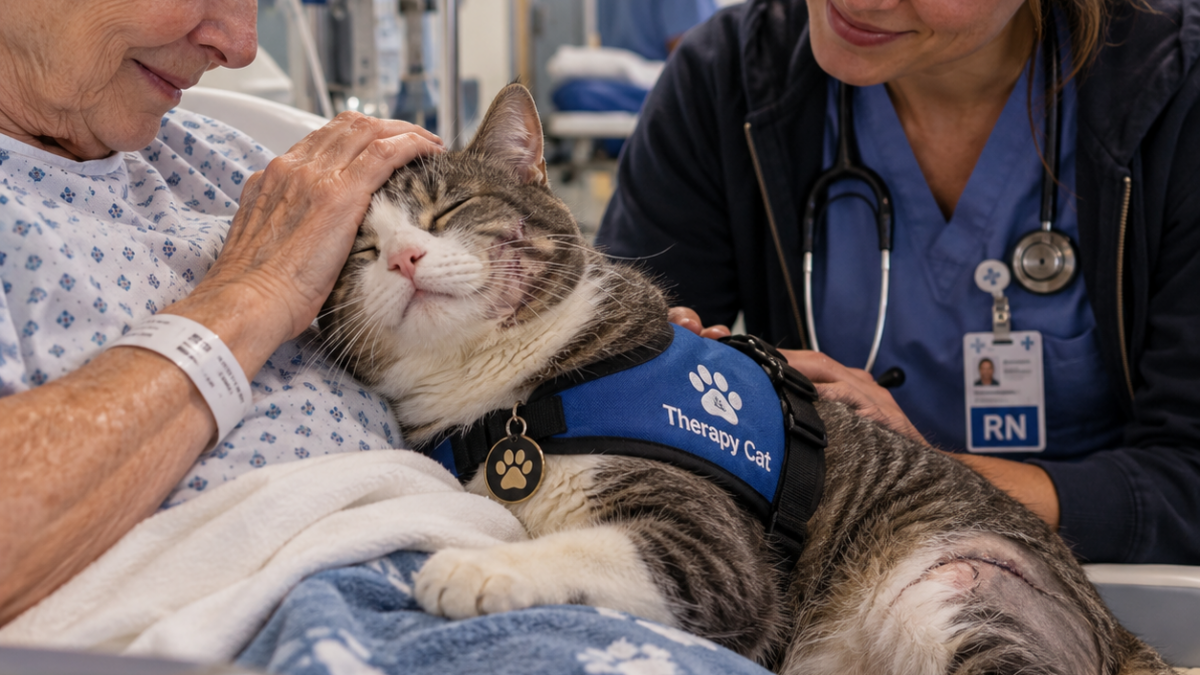
Teenagers S.h.o.t This Cat 7 Times and Left Him to D!e in a Ditch—Then a Nurse Heard Him Purring, and Today He Comforts Terrified Patients Before Surgery.
They had s.h.o.t the cat seven times, moved him between s.h.o.t.s as if he were a practice target, and dumped him in a roadside ditch before sunrise believing nobody would ever know what they had done.
The exhausted nurse who found him almost drove past—until she stepped into the freezing water, heard a faint purr coming from beneath the blood, and realized the animal everyone had treated as disposable was still choosing to trust her.
Months later, that same scarred cat would walk through the surgical wing of the rural hospital that first saved him, climb into the lap of a terrified patient, and begin a strange ritual no doctor, nurse, or therapist could ever teach him.
At 5:58 on a cold November morning, Rachel Bennett almost kept driving.
She would think about that for the rest of her life.
Not because she was careless.
Not because she didn’t care.
Because she was exhausted.
She had just finished a twelve-hour overnight shift at Cedar Valley Community Hospital in eastern Kentucky, though twelve hours had become nearly fourteen after a farm accident came through the emergency department at 4:11 a.m.
The patient was nineteen.
A piece of equipment had crushed two fingers on his right hand.
His father had followed the ambulance in muddy boots and stood outside the trauma bay saying the same sentence over and over.
“He’s supposed to take over the farm.”
Rachel had heard sentences like that for eighteen years.
He’s supposed to graduate.
She’s supposed to get married.
He’s supposed to come home.
She’s supposed to wake up.
In emergency medicine, a nurse learned quickly that human beings imagined the future with an arrogance life did not share.
By the time Rachel clocked out, her lower back hurt, dried antiseptic marked one sleeve of her blue scrubs, and the only thing keeping her awake was the paper cup of burned coffee sitting in the cup holder of her eleven-year-old Subaru.
She wanted her bed.
She wanted darkness.
She wanted six uninterrupted hours without anybody calling her name.
The sky was just beginning to brighten behind the Appalachian ridges.
Fog hovered low over Route 17.
Rachel was less than five miles from home when she saw something pale beside the road.
A grocery bag, she thought.
Then maybe a dead raccoon.
She passed it.
Ten yards.
Twenty.
Thirty.
Her hands tightened around the steering wheel.
She sighed.
“Rachel.”
She said her own name like a warning.
Keep going.
You are exhausted.
Animal control opens at eight.
PART2:
Whatever it is, somebody else will stop.
The shape remained in her rearview mirror.
Then she saw something move.
Not the body.
The water around it.
A tiny ripple.
Rachel hit the brakes.
Her coffee tipped over.
“Perfect.”
She reversed carefully along the shoulder, turned on her hazard lights, and stepped into the cold.
The ditch was deeper than it looked.
Dead weeds brushed her calves as she climbed down.
Water soaked immediately through her shoes.
The smell reached her next.
Mud.
Blood.
Something metallic.
Rachel stopped.
It was a cat.
A large gray-and-white male.
PART3:
He lay half-submerged in brown runoff water with one cheek against a patch of flattened grass.
His fur was matted dark along his side.
For one terrible second, Rachel thought the movement she had seen had only been water stirred by a passing truck.
Then she crouched.
“Hey.”
Nothing.
She moved closer.
“Oh, sweetheart.”
The cat’s front paw twitched.
Rachel’s exhaustion vanished.
She dropped to her knees.
The nurse took over.
Airway.
Breathing.
Circulation.
She knew cats were not people.
But blood still meant blood.
Breathing still meant life.
She slid two fingers gently against his ribs.
Rapid.
Shallow.
Alive.
The cat’s eyelids fluttered.
“Easy.”
Rachel pulled out her phone.
There was almost no signal in the ditch.
She climbed halfway up the embankment, called the county animal emergency number, and reached an answering service that told her the nearest veterinary clinic would not open for another hour.
Rachel looked back at the cat.
He would not make an hour.
She knew that much.
“Okay.”
She opened the rear hatch of her car and grabbed the emergency blanket she kept beside a roadside kit.
When she lifted him, he made no attempt to scratch her.
That frightened her more.
A healthy terrified cat fought.
This one simply sagged into her arms.
He was heavy.
At least fourteen pounds.
His fur was soaked.
His head rolled against her wrist.
Rachel wrapped him carefully in the reflective blanket.
“Stay with me.”
Something vibrated against her forearm.
She stopped.
At first she thought he was shivering.
Then she heard it.
A purr.
Weak.
Broken.
But unmistakable.
Rachel stared down at him.
“You have got to be kidding me.”
The cat’s eyes remained closed.
He purred again.
Rachel’s throat tightened.
Animals sometimes purred when frightened or injured.
She knew that.
It didn’t make the sound any less devastating.
There he was, body broken, lying in the arms of a stranger beside a freezing road.
And he was purring.
Rachel carried him to the car.
The closest emergency veterinary hospital was fifty-three miles away.
Cedar Valley Community Hospital was five miles behind her.
It was not an animal hospital.
It had no veterinarian on staff.
Bringing a cat into a human emergency department violated enough policies that Rachel could already imagine the administrative emails.
She turned the Subaru around anyway.
At 6:14 a.m., Dr. Marcus Hale was finishing paperwork when the automatic ambulance doors opened and Rachel Bennett came through carrying something wrapped in silver.
Marcus looked up.
“You forgot a patient?”
Rachel ignored him.
“I need oxygen.”
He frowned.
“For what?”
She peeled back the blanket.
Marcus stood.
“Rachel.”
“Don’t.”
“This is an emergency department.”
“He’s dying.”
“He’s a cat.”
“I am aware.”
Charge nurse Denise Cooper came around the desk.
“Oh my God.”
The cat’s fur had begun drying enough to reveal wounds Rachel could not see beside the road.
Small punctures.
Multiple.
Marcus’s expression changed.
“Those aren’t bites.”
Rachel looked at him.
“I know.”
Denise whispered, “Are those—”
“Gunshot wounds,” Marcus said.
Rachel’s jaw tightened.
Marcus stared for another second.
Then the physician in him defeated the administrator.
“Trauma room three.”
Rachel moved immediately.
Marcus pointed at Denise.
“Call Miller Veterinary.”
“They’re not open.”
“Wake Dr. Miller up.”
He looked at Rachel.
“And if hospital administration asks, this never happened.”
Rachel almost smiled.
“Which part?”
“All of it.”
For the next forty-five minutes, a rural human emergency department did everything it reasonably could to keep one badly injured cat alive until veterinary care became available.
Oxygen.
Warm blankets.
Fluids under telephone guidance from an increasingly awake and increasingly alarmed veterinarian.
They did not use human medications without veterinary instruction.
They did not pretend they were specialists.
They simply prevented him from getting colder and kept him breathing.
At 6:32, housekeeping worker Helen Morris walked past the open trauma bay and stopped.
“What happened?”
Rachel looked down.
“Somebody shot him.”
Helen covered her mouth.
“Who?”
“I don’t know.”
Helen stepped inside.
The cat was conscious now.
Barely.
One green eye opened.
His pupil looked normal.
His breathing remained shallow.
Helen touched one finger to the blanket.
The cat purred.
Helen’s eyes filled.
“He’s purring.”
Rachel nodded.
“He’s been doing that.”
“Why?”
Rachel looked at the wounds.
“I don’t know.”
By seven o’clock, half the hospital knew.
A respiratory therapist brought a pediatric oxygen hood that could be modified temporarily.
A lab technician found an old warming pad.
Someone from dietary brought a cardboard produce box lined with towels for transport.
Nobody called administration.
At 7:18, Dr. Evelyn Miller arrived wearing jeans beneath a winter coat and carrying two veterinary trauma bags.
She was sixty-three, blunt, and not easily impressed.
She examined the cat without speaking.
Rachel stood beside the table.
Finally Evelyn looked up.
“How long was he in the ditch?”
“I don’t know.”
“Temperature when you found him?”
“I didn’t have a thermometer.”
“Responsive?”
“Minimally.”
“Did he move his rear legs?”
“A little.”
Evelyn palpated along his spine.
The cat flinched violently.
Rachel reached for him.
Evelyn stopped her.
“Let me see his response.”
She continued the examination.
When she touched the right hip, the cat cried.
Rachel looked away.
Evelyn found a wound beneath the jaw.
Another behind the left shoulder.
Another along the rib cage.
Her face hardened.
“These are pellets.”
“Air rifle?”
“Looks like it.”
Marcus leaned against the doorway.
“Will he live?”
Evelyn didn’t answer immediately.
“Maybe.”
Rachel hated that word.
Evelyn glanced at her.
“If there isn’t internal bleeding we can’t control.”
“Then let’s move.”
“You just worked all night.”
“I’m driving.”
“You’re in no condition.”
“Then you drive.”
Twenty-five minutes later, Rachel was sitting in the passenger seat of Evelyn Miller’s pickup with the injured cat secured inside a crate between them.
She had not slept.
She no longer cared.
At Miller Veterinary Surgical Center, the first radiograph appeared on the monitor at 8:21.
Evelyn stopped speaking.
Rachel saw seven bright shapes.
Small.
Round.
Terribly obvious.
One near the jaw.
Two clustered around the left shoulder.
Two within the chest region.
One embedded near the right hip.
One beside the lumbar spine.
Rachel counted them twice.
“Seven.”
Evelyn nodded.
“Seven.”
“Can you get them out?”
“Not all.”
Rachel looked at her.
“Why?”
“That one beside the spine.”
Evelyn enlarged the image.
“It’s too close. If I go digging for it, I could cause more damage than leaving it.”
She pointed at another.
“This one’s deep in the pelvic bone.”
Rachel’s hands clenched.
“And the others?”
“I can probably remove five.”
“Probably?”
“Rachel.”
Evelyn turned toward her.
“You need to understand something. Removing the pellets is not the biggest problem.”
“What is?”
“The pattern.”
Rachel looked at the X-ray.
Evelyn pulled up another angle.
Then another.
“The trajectories don’t match.”
Rachel frowned.
“Meaning?”
“Meaning he wasn’t shot seven times from one position.”
A cold sensation moved through Rachel’s stomach.
Evelyn continued.
“Two came from the left.”
She changed the image.
“One from behind.”
Another.
“This one entered at a downward angle.”
Rachel stared.
“He moved.”
Evelyn’s mouth tightened.
“Or someone moved him.”
The room became very quiet.
Rachel whispered, “They kept shooting.”
Evelyn didn’t answer.
She didn’t need to.
Rachel pictured it without wanting to.
The cat running.
Someone laughing.
A pellet hitting him.
The cat trying to escape.
Another shot.
Another.
Maybe somebody picked him up.
Maybe they cornered him.
Maybe he had trusted them first.
Rachel felt suddenly sick.
“Who does that?”
Evelyn had spent thirty-eight years treating animals.
Her answer came without hesitation.
“People who think pain isn’t real when the victim can’t tell anybody their name.”
The surgery lasted more than three hours.
Rachel fell asleep in a waiting-room chair while still wearing her scrubs.
When she woke, Evelyn was standing in front of her.
Rachel shot upright.
“Is he alive?”
“Yes.”
The word hit her like air returning to a sealed room.
“Five pellets are out.”
“The other two?”
“Stay.”
“His spine?”
“Partial nerve injury. Left rear leg.”
Rachel rubbed both hands over her face.
“Paralyzed?”
“I don’t think so.”
“Think?”
“I’ll know more when the swelling comes down.”
“And his jaw?”
Evelyn sat.
“One pellet fractured a premolar and cracked part of the mandible. I removed the tooth. Bone should heal.”
Rachel stared at the floor.
“Seven.”
Evelyn nodded.
“Seven.”
“How is he still alive?”
Evelyn looked toward the recovery ward.
“Same reason some people survive things nobody thinks they should.”
“Which is?”
“I stopped pretending I understand that years ago.”
The sheriff’s office became involved that afternoon.
Deputy Tom Rivera photographed the recovered pellets.
Animal cruelty in the county was something people liked to believe happened somewhere else.
Not there.
Not among neighbors who saw one another at church and football games.
But Evelyn had treated enough deliberate injuries to know better.
Tom interviewed Rachel first.
“Where exactly did you find him?”
She gave him the location.
“Any houses nearby?”
“Several.”
“See a vehicle?”
“No.”
“People?”
“No.”
“How long do you think he’d been there?”
Rachel shook her head.
“I don’t know.”
Tom looked through the glass at the sedated cat.
“You keeping him?”
Rachel blinked.
“If he lives.”
“You already named him?”
“No.”
“You should.”
“He’s been unconscious most of the day.”
Tom smiled faintly.
“Doesn’t stop people from naming babies.”
Rachel looked at him.
Then at the cat.
Gray fur.
White chest.
Scarred face.
Bandages around his shoulder.
She thought about the sound in the ditch.
The purr that had been stronger than his breathing.
“Pulse.”
Tom frowned.
“What?”
“His name.”
Rachel looked through the glass.
“Pulse.”
The investigation moved slowly.
There were no traffic cameras along that part of Route 17.
No witnesses came forward.
No one reported a missing gray-and-white cat matching Pulse’s description.
Rachel posted photographs online without showing the injuries.
Nothing.
No owner.
No family.
No person who could explain where he came from.
Three days after surgery, Pulse stood.
Barely.
His rear left leg buckled immediately.
Rachel caught him before he fell.
“Easy.”
Pulse hissed.
It was the first angry sound she’d heard from him.
Rachel smiled.
Evelyn raised an eyebrow.
“You’re smiling because he hissed?”
“It’s progress.”
“He tried to bite you.”
“Even better.”
Pulse did not bite.
He limped back toward his blanket.
His left hip swung outward with each step.
Rachel watched.
“Will that go away?”
“Some of it may.”
“And if it doesn’t?”
“Then he limps.”
Evelyn shrugged.
“Cats don’t sit around comparing themselves with who they used to be.”
Rachel looked at Pulse.
“Maybe they’re smarter than us.”
“They usually are.”
Pulse went home with Rachel three weeks later.
Her husband had died six years earlier.
Her daughter was finishing graduate school in Lexington.
The house had become quiet in a way Rachel had once believed she wanted.
Pulse changed that immediately.
He hated closed doors.
He hated the sound of aerosol cans.
He hid whenever teenagers laughed outside.
He refused to sleep in the kitchen because the refrigerator compressor made a clicking sound that Rachel suspected reminded him of something else.
The first time her neighbor’s son fired a pellet gun at aluminum cans across the road, Pulse disappeared so fast Rachel initially thought he’d escaped.
She found him four hours later wedged behind the washing machine.
His body trembled.
His pupils were enormous.
Rachel lay on the laundry-room floor.
She did not reach for him.
“You’re okay.”
Pulse pressed himself harder against the wall.
Rachel remained there.
Ten minutes.
Twenty.
Thirty.
Her phone rang.
She ignored it.
Eventually Pulse crawled forward.
One inch.
Then another.
He placed his damaged jaw against her hand.
And purred.
Rachel cried quietly into the linoleum.
The next afternoon, she walked across the road and spoke to the neighbor.
The father apologized immediately.
The boy was fifteen.
He looked irritated.
“It’s just a pellet gun.”
Rachel stared at him.
“No.”
The boy shifted.
“It’s not like a real gun.”
Rachel held up her phone.
She showed him Pulse’s X-ray.
Seven pellets glowing white inside a cat’s body.
The boy’s face changed.
“Somebody did that?”
“Yes.”
“With one of those?”
“Yes.”
He stared at the screen.
Rachel said quietly, “One pellet is still beside his spine.”
The boy handed the gun to his father.
He never fired it near Rachel’s house again.
Pulse’s recovery took four months.
Five surgical follow-ups.
Weeks of restricted movement.
Pain medication.
Physical therapy.
A custom step Rachel built so he could reach her sofa without jumping.
One humiliating attempt at a cat harness that left Rachel bleeding from the wrist and Pulse sitting beneath the dining table looking smug.
He gradually became himself.
Whoever that was.
He loved scrambled egg.
He despised canned salmon.
He would chase a shoelace for twenty minutes but ignored every expensive cat toy Rachel’s daughter bought him.
He had a habit of sitting directly on whatever paperwork Rachel was trying to read.
He snored.
He drooled when deeply asleep.
And he purred constantly.
Not loudly.
Consistently.
Rachel returned to work once Pulse no longer needed round-the-clock care.
At first she left him home.
He hated it.
The first week, he tore half the blinds down.
The second, he dragged one of Rachel’s scrub tops into his bed.
The third, he urinated beside the front door despite never having litter-box problems before.
Evelyn listened to Rachel complain.
“Separation anxiety.”
“In a cat?”
“Congratulations. You are his emotional support nurse.”
Rachel groaned.
“What am I supposed to do?”
“Bring him to work.”
Rachel laughed.
Evelyn didn’t.
“You are serious.”
“Your hospital already broke every sensible rule for him once.”
“The administrator almost had a stroke.”
“And yet.”
Rachel crossed her arms.
“He cannot just live in an emergency room.”
“Not the emergency room.”
“Where, then?”
“Staff lounge.”
Rachel stared.
“This is a terrible idea.”
It was.
Which was why three days later Pulse was inside a carrier beneath a table in the second-floor nurses’ lounge at Cedar Valley Community Hospital.
Hospital administrator Leonard Price had approved a two-week trial after Rachel promised Pulse would never enter clinical areas, patient rooms, food-service areas, sterile zones, hallways, elevators, or anywhere else a cat obviously did not belong.
“He stays in the lounge,” Leonard said.
“Absolutely.”
“Carrier or enclosed recovery pen.”
“Yes.”
“No patient contact.”
“Of course.”
“No wandering.”
“Never.”
Pulse violated the last condition in forty-seven minutes.
Someone failed to latch the carrier.
Rachel was helping a post-operative patient when Denise called her.
“Rachel?”
“What?”
“Do not panic.”
Rachel froze.
“Where is he?”
“Third-floor surgery waiting area.”
“What?”
“Just come.”
Rachel ran.
Pulse was not running around.
He wasn’t knocking over equipment.
He wasn’t hiding.
He was sitting in the lap of eighty-one-year-old Margaret Ellison.
Margaret was scheduled for a total hip replacement.
She had arrived two hours early.
She was wearing a pale hospital gown under a blanket, compression stockings, and the expression Rachel knew well.
Fear disguised as politeness.
Margaret’s daughter stood nearby wiping tears from her eyes.
Pulse had somehow climbed onto Margaret’s lap.
His front paws rested on her abdomen.
His damaged jaw lay against her hand.
He purred.
Margaret stroked his head.
Rachel stopped.
“I am so sorry.”
Margaret looked up.
“For what?”
“He isn’t supposed to be here.”
“Well, neither am I, if we’re being honest.”
Rachel smiled despite herself.
“Mrs. Ellison—”
“Margaret.”
“Margaret, he’s technically an employee violation.”
Margaret’s daughter laughed.
Pulse did not move.
Margaret’s fingers trembled as they moved over his fur.
Rachel noticed.
“You nervous?”
Margaret looked down.
“My husband died during surgery.”
Rachel’s smile faded.
“Twenty-seven years ago.”
Margaret swallowed.
“Different surgery. Different hospital. Different century, practically. Everybody keeps telling me that.”
“But your body doesn’t care.”
Margaret looked at her.
“No.”
Rachel sat beside her.
“It remembers.”
Margaret nodded.
Pulse shifted closer to Margaret’s chest.
She inhaled.
Then slowly exhaled.
“What happened to his face?”
Rachel hesitated.
Margaret touched the irregularity along Pulse’s left jaw.
“Someone hurt him?”
Rachel nodded.
“Badly.”
Margaret’s eyes softened.
“But he’s here.”
“Yes.”
“He doesn’t seem scared.”
Rachel looked at Pulse.
“He is.”
Margaret frowned.
“Of what?”
“A lot of things.”
“Then why is he sitting with me?”
Rachel had no answer.
A transporter arrived.
“Mrs. Ellison? We’re ready.”
Margaret’s hand tightened around Pulse.
Rachel expected him to jump.
He didn’t.
Margaret looked at the transporter.
“Can he come?”
The transporter laughed.
“I don’t think infection control would love that.”
Margaret’s face fell.
Pulse stood.
He stepped off her lap.
Then remained beside the wheelchair.
Margaret whispered, “You’ll be here?”
Rachel assumed she meant her daughter.
Then realized Margaret was looking at the cat.
Rachel said, “I’ll keep him here.”
Margaret touched his head once more.
“Good boy.”
She was wheeled away.
Pulse watched until the double doors closed.
Then he turned.
He walked directly to an older man sitting alone three chairs away.
Rachel stared.
The man had a surgical wristband.
A gown beneath his robe.
Pulse jumped onto the empty seat beside him.
The man looked at Rachel.
“Is he allowed?”
“No,” Rachel said.
Then she sighed.
“But apparently he doesn’t care.”
That was the first day.
Leonard Price found out within hours.
He called Rachel into his office.
“You promised me.”
“I know.”
“No patient contact.”
“I know.”
“No hallways.”
“I know.”
“No unauthorized wandering.”
“I know.”
“And according to Denise, this cat spent four hours comforting pre-op patients.”
Rachel tried not to smile.
Leonard saw it.
“This isn’t funny.”
“No.”
“I have infection-control requirements.”
“I understand.”
“Liability.”
“I understand.”
“Allergy concerns.”
“Yes.”
“Animal-bite risk.”
“Pulse has never bitten anyone.”
Leonard stared at her.
“Do you know what lawyers do with the word never?”
Rachel sighed.
“Leonard.”
“No.”
“One week.”
“No.”
“Three days.”
“No.”
“Let infection control evaluate him.”
“No.”
“Ask the surgeons.”
“No.”
“Ask Margaret Ellison.”
Leonard paused.
Rachel saw it.
“What?”
He looked annoyed.
“She asked for him after recovery.”
Rachel smiled.
“She did?”
“Apparently the first coherent thing she said was, ‘Where’s my cat?'”
Rachel burst out laughing.
Leonard pinched the bridge of his nose.
“This is not happening.”
It happened.
Slowly.
Carefully.
Legally.
Far more formally than Pulse appreciated.
A veterinary behaviorist evaluated him.
Evelyn completed medical records and vaccinations.
Infection control established where he could and could not go.
Environmental services created cleaning protocols.
Patients had to consent.
Anyone with allergies, compromised immunity, open wounds, or other contraindications would not interact with him.
Pulse was never allowed in operating rooms, sterile procedure areas, medication rooms, kitchens, or intensive-care spaces.
He did not “work” alone.
He had a designated handler.
At first Rachel.
Then Denise.
Later three other nurses completed animal-assisted-intervention training.
Leonard insisted on calling it a six-month pilot.
Within two months, somebody had placed a tiny wooden bed near the nurses’ station.
Leonard demanded it be removed.
The next morning another appeared.
He removed that one himself.
The following day Dr. Marcus Hale brought in an orthopedic pet bed embroidered with the words:
PULSE — PATIENT RELATIONS.
Leonard stared at him.
Marcus shrugged.
“It was on sale.”
“You are the medical director.”
“Correct.”
“You are undermining me.”
“Also correct.”
The bed stayed.
But the strangest part was not that Pulse adapted to the hospital.
It was who he chose.
Visitors tried calling him.
He often ignored them.
Staff brought treats.
He took the treat and walked away.
Children fascinated him, but he rarely lingered with them unless they were patients.
He seemed particularly uninterested in healthy people sitting casually in the waiting room.
But give someone a hospital bracelet.
A gown.
An IV pole.
A face trying very hard not to look afraid.
Pulse noticed.
Rachel thought she was imagining it until Denise began keeping notes.
November 14.
Pulse sat with Charles D., age 67, awaiting gallbladder surgery.
November 17.
Pulse remained beside Linda M., age 52, before breast biopsy.
November 21.
Pulse selected Thomas R., age 74, cataract surgery, despite spouse repeatedly calling him from adjacent chair.
December 2.
Pulse remained with patient undergoing colon resection until transport.
December 8.
Pulse refused three visitors and climbed onto lap of pre-op patient crying quietly behind magazine.
Marcus read the list.
“Interesting.”
Rachel asked, “What’s interesting?”
“He may be reading body language.”
“Obviously.”
“Or scent.”
“What scent?”
“Stress changes body chemistry.”
Rachel looked across the waiting room.
Pulse was sitting against the thigh of a sixty-year-old man scheduled for a hernia repair.
“You’re saying he smells fear?”
“I’m saying we don’t actually know.”
Rachel smiled.
“Good.”
“Why good?”
“I don’t want everything explained.”
Pulse became known throughout Cedar Valley.
Not famous.
Not yet.
Just known.
Patients started asking for “the gray cat.”
A surgeon who initially complained about the program eventually began checking whether Pulse was scheduled on mornings when anxious pediatric cases came through the broader surgical service.
A nurse who claimed to hate cats was photographed asleep during break with Pulse on her stomach.
Someone printed the photograph.
It appeared on the bulletin board.
She threatened legal action against the entire hospital.
Nobody removed it.
Then came Daniel Foster.
Daniel was forty-six.
Six-foot-two.
A former high-school football coach.
The kind of man who filled doorways.
He arrived for surgery to remove a suspicious mass from his kidney.
He had been told it might be cancer.
His wife knew.
His brother knew.
His players knew he was “having a procedure.”
Nobody knew how terrified he was.
Rachel recognized fear quickly.
Some people cried.
Some talked constantly.
Some became angry.
Daniel became funny.
When the nurse checked his bracelet, he said, “Yep, still me.”
When anesthesia asked whether he had loose teeth, he said, “Only emotionally.”
When his wife asked if he wanted a blanket, he said, “I’m a grown man, Lisa.”
Then his hands shook so hard the water in his paper cup rippled.
Pulse was asleep beneath the nurses’ station.
His head came up.
He looked across the room.
Rachel watched.
Pulse rose.
He limped toward Daniel.
Daniel noticed him.
“That’s the famous hospital cat?”
Rachel smiled.
“That’s him.”
“Keep him away from me.”
“Not a cat guy?”
“I respect them from a distance.”
Pulse jumped onto the chair beside Daniel.
Daniel leaned away.
“Nope.”
Pulse moved closer.
“Seriously.”
Pulse put one paw on Daniel’s thigh.
Daniel looked at Rachel.
“Does he understand English?”
“When convenient.”
Daniel’s wife laughed.
Pulse climbed into Daniel’s lap.
The big man’s entire body stiffened.
“I don’t know what to do.”
“Nothing.”
“He’s heavy.”
“Don’t tell him.”
Pulse turned twice.
Then settled.
His scarred jaw rested directly over Daniel’s trembling hand.
Daniel looked down.
His smile disappeared.
Rachel watched his breathing.
Fast.
Then slower.
Pulse purred.
Daniel whispered, “What’s wrong with his leg?”
Rachel told him.
Not every detail.
Just enough.
Someone shot him.
Seven times.
Left him beside the road.
Daniel’s hand stopped shaking.
“Seven?”
“Yes.”
“And he lived?”
“Yes.”
Daniel touched the cat’s shoulder carefully.
“You’re a tough son of a gun.”
Pulse purred louder.
Daniel looked away.
His eyes filled.
Lisa reached for him.
He shook his head.
“I’m okay.”
Rachel said quietly, “You don’t have to be.”
Daniel laughed once.
The sound cracked.
“I’m terrified.”
His wife began crying.
Daniel stared at Pulse.
“I coach eighteen-year-old kids and spend half my life telling them fear is normal.”
Rachel nodded.
“Different when it’s yours.”
“Yeah.”
He swallowed.
“They say there’s a chance it’s cancer.”
Rachel did not offer fake reassurance.
“That’s scary.”
Daniel nodded.
“I have a fifteen-year-old daughter.”
Pulse shifted.
Daniel pressed his face briefly into the cat’s fur.
“I don’t want her to grow up without me.”
Nobody in the waiting room said a word.
When transport came, Daniel handed Pulse reluctantly to Rachel.
“Can he be here when I get back?”
Rachel smiled.
“If he wants to.”
Daniel looked offended.
“I’m having major surgery and it’s still up to the cat?”
“Those are the rules.”
Daniel laughed.
He came back four hours later.
The mass was cancerous.
But it had been localized.
Surgeons believed they got it all.
When Daniel opened his eyes in recovery, Pulse was not there.
Hospital rules did not allow it.
But after he transferred to a standard room, Rachel brought him.
Pulse walked to Daniel’s bed.
Daniel whispered, “Hey, tough guy.”
Pulse curled against his hip.
Daniel cried without trying to hide it.
A photograph of that moment would eventually change everything.
Lisa took it.
She asked permission before posting it.
Daniel agreed.
The caption was simple:
This cat was shot seven times and left to die. He sat with my husband before cancer surgery today. I think somehow he knew.
The post spread.
First locally.
Then across Kentucky.
Then nationally.
A regional television station called.
Rachel said no.
Leonard said definitely no.
Marcus said maybe.
Evelyn said only if nobody made Pulse wear a bow tie.
Then a reporter discovered the police report.
Seven pellets.
Five removed.
Two permanently embedded.
A fractured jaw.
Nerve damage.
Abandoned in a ditch.
Public attention changed the cruelty investigation overnight.
People started calling the sheriff’s department.
Most tips were useless.
Some were malicious.
A few mattered.
One call came from a woman named Melissa Grant.
Her son Evan had been seventeen the year before.
He had spent time with three boys from another county.
“They used to shoot at things.”
Deputy Rivera asked, “What kind of things?”
“Cans.”
“Anything else?”
Silence.
“Mrs. Grant?”
“Birds.”
Tom wrote it down.
“Anything else?”
Melissa began crying.
“My son came home once and threw his air rifle in the garbage.”
“When?”
She gave a date.
Two days after Rachel found Pulse.
“What did he say?”
“Nothing.”
“Did you ask?”
“He told me he was done with it.”
Tom’s voice softened.
“Where is Evan now?”
“Community college.”
“Can I speak with him?”
Another long silence.
“Yes.”
Evan Grant arrived voluntarily.
He sat with his mother.
He looked younger than nineteen.
Tom placed Pulse’s X-ray on the table.
Evan looked away immediately.
Tom noticed.
“You know this cat?”
“No.”
“Evan.”
“No.”
“Your mother says you stopped using your rifle around the time he was found.”
“So?”
“So I’m asking why.”
Evan said nothing.
Tom waited.
Silence was sometimes more useful than accusation.
After almost a minute, Evan whispered, “I didn’t shoot him.”
Tom said, “Okay.”
Evan looked surprised.
“I didn’t.”
“I heard you.”
“Tyler did.”
His mother covered her mouth.
Evan began shaking.
“It wasn’t supposed to be like that.”
Tom stayed still.
“What was it supposed to be?”
“We were shooting cans.”
“Who is we?”
Evan named three boys.
All between sixteen and eighteen at the time.
Tyler Meeks.
Cole Harris.
Brandon Tate.
“What happened?”
Evan stared at the floor.
“The cat came out behind this abandoned feed shed.”
“Where?”
He gave a location less than a mile from where Rachel found Pulse.
“Was he feral?”
“I don’t know.”
“Did he come near you?”
Evan’s face crumpled.
“Yeah.”
Melissa started crying silently.
Evan continued.
“He came right up.”
The words hit Tom harder than he expected.
“Then what?”
“Tyler said watch this.”
The first pellet hit Pulse in the shoulder.
The cat screamed and ran.
The boys laughed.
Evan said he laughed too.
That admission seemed to hurt him more than anything.
They chased the cat.
Not because they planned a killing.
Because at seventeen, surrounded by friends, cruelty had somehow turned into entertainment.
Tyler shot again.
Cole shot once.
Pulse hid beneath an old piece of farm equipment.
They dragged him out with a jacket.
Another shot.
Then another.
Evan said he told them to stop after he saw blood.
No one listened.
At some point, Pulse stopped running.
That made the boys uncomfortable.
So Tyler put him in the bed of his truck.
“Why?”
Tom asked.
Evan’s voice was barely audible.
“To get rid of him.”
They drove to Route 17.
They threw him into the ditch.
Evan looked up.
“I thought he was dead.”
Tom slid Rachel’s photograph across the table.
Pulse wearing a blue therapy vest.
Sitting beside Daniel Foster.
Evan stared.
“He lived?”
“Yes.”
Evan began sobbing.
Not dramatic.
Not performative.
He bent over, hands covering his face.
“I didn’t know.”
Tom waited.
“I didn’t know.”
“You left him in a ditch.”
“I know.”
“After watching him get shot seven times.”
“I know.”
“You could have called somebody.”
Evan nodded violently.
“I know.”
Melissa whispered, “Why didn’t you tell me?”
Evan looked at his mother.
“Because you’d know what kind of person I was.”
She began to cry harder.
Tom watched them.
He had arrested people who showed no remorse.
He had also watched guilt destroy young people who had done terrible things while trying to impress worse friends.
Consequences mattered.
So did truth.
All four young men were investigated.
The law could not deliver the kind of punishment social media demanded.
They had been minors at the time.
Evidence had limits.
Their exact individual roles differed.
Defense attorneys became involved.
The case became ugly.
Tyler denied everything.
Cole admitted firing once.
Brandon claimed he only watched.
Evan cooperated fully.
The recovered pellets were compared with weapons investigators located.
Digital messages were found.
One exchange from the night before Pulse was discovered became important.
Tyler had sent:
That thing still moving?
Cole responded:
Barely lol.
Evan had replied:
You guys are sick.
Tyler:
You laughed too.
Evan never answered.
The messages spread when court documents became public.
The community exploded.
Some demanded prison.
Some blamed parents.
Some blamed guns.
Some called it teenage stupidity.
Rachel hated that phrase.
One night Marcus found her in the hospital cafeteria staring at an article on her phone.
“They’re calling it stupidity.”
Marcus sat.
“People need easy words.”
“Seven shots aren’t stupidity.”
“No.”
“They moved him.”
“I know.”
“They watched him suffer.”
“I know.”
“And then drove away.”
Marcus waited.
Rachel looked furious.
“I want them hurt.”
Marcus said nothing.
She looked at him.
“Does that make me terrible?”
“No.”
“I am a nurse.”
“You’re also human.”
Rachel’s eyes filled.
“I don’t want to forgive them.”
“Then don’t.”
She stared.
“People keep asking if I forgive them.”
“Nobody gets to assign you forgiveness as homework.”
Rachel looked down.
Marcus continued.
“Justice and forgiveness aren’t the same thing.”
“What do you think should happen?”
“I think consequences should be real.”
He glanced toward the hall, where Pulse slept near the nursing station.
“And I think the boy who talked to police should spend the rest of his life understanding that failing to stop cruelty is still participation.”
Rachel was quiet.
“But?”
Marcus looked at her.
“But if he genuinely understands it, maybe the rest of his life can include preventing it too.”
The court ordered restitution, probationary conditions, community service, animal-cruelty education, and restrictions on firearm possession that varied by defendant and age under applicable law.
Tyler, whose evidence showed the most direct involvement and who remained openly contemptuous, received the harshest juvenile disposition available in the case, along with later adult consequences on related charges when investigators uncovered other misconduct.
It did not feel like enough to Rachel.
Nothing would have.
No sentence could remove the pellets from Pulse’s spine and hip.
No judge could give him back the morning before somebody taught him humans could become predators.
The first time Evan saw Pulse again happened by accident.
He was completing court-ordered community service at a county animal shelter participating in a cruelty-prevention program.
Rachel had brought Pulse there for a therapy-animal outreach event.
Evan entered the hallway carrying folded towels.
He stopped.
Pulse sat beside Rachel.
Evan’s face drained.
Rachel recognized him from court.
Her body went cold.
Neither spoke.
Pulse stood.
Rachel whispered, “Stay.”
Not to Pulse.
To herself.
Evan put the towels down.
“I’m sorry.”
Rachel said nothing.
His hands shook.
“I’m not asking you to forgive me.”
“Good.”
He nodded.
“I don’t deserve that.”
Rachel looked at him.
“Don’t tell me what you deserve.”
He swallowed.
“Okay.”
“You watched.”
“Yes.”
“You laughed.”
His eyes filled.
“Yes.”
“You could’ve picked him up.”
“Yes.”
“You could’ve called someone.”
“Yes.”
“You didn’t.”
“No.”
Rachel’s voice broke.
“He purred while I carried him out of that ditch.”
Evan covered his mouth.
Rachel continued.
“Do you understand that?”
He nodded, crying.
“No.”
Rachel shook her head.
“You don’t.”
Pulse limped toward him.
Rachel’s breath caught.
“Pulse.”
The cat continued.
Evan backed away.
“No.”
Pulse stopped two feet in front of him.
Evan sank slowly to his knees.
“I don’t deserve—”
Rachel snapped, “Stop saying that.”
He looked up.
“He’s not a judge.”
Pulse sniffed Evan’s hand.
The young man froze.
Pulse stepped closer.
Then sat.
Not on him.
Not against him.
Just near him.
Evan sobbed.
Rachel watched with her arms crossed tightly over her chest.
She felt no beautiful rush of forgiveness.
No cinematic release.
She was still angry.
But something changed.
Not toward what Evan had done.
That remained unforgivable in the sense that it could not be undone.
What changed was her understanding of what healing required.
Pulse did not need Evan punished every second for the rest of his life in order to remain alive.
Pulse had already moved forward.
Not because he forgot.
His limp proved otherwise.
But because suffering did not own every decision he made.
Rachel looked at Evan.
“If you mean you’re sorry, prove it for fifty years.”
He wiped his face.
“How?”
“Be different.”
“I am.”
“No.”
Rachel shook her head.
“You’re trying to be. There’s a difference.”
He nodded.
“Okay.”
“Speak when your friends are cruel.”
“I will.”
“Don’t laugh because you’re afraid not to.”
“I won’t.”
“Don’t wait until something is dying before you decide it matters.”
Evan looked at Pulse.
“I won’t.”
Rachel took a long breath.
“Then start there.”
Years later, Evan would become an animal-control officer in another county.
Rachel did not know that yet.
At that moment he was simply a nineteen-year-old carrying the ugliest thing he had ever done and learning that remorse meant nothing if it stayed inside him.
Pulse continued working at Cedar Valley.
His routine became increasingly specific.
He arrived around 7:00 most mornings Rachel worked.
He ate breakfast in the staff room.
Then wandered—always supervised—into the approved preoperative waiting area.
He selected someone.
Nobody could predict whom.
One morning it was a seventeen-year-old awaiting reconstructive knee surgery.
Another day it was an eighty-eight-year-old man scheduled for a pacemaker procedure.
Pulse disliked one particular orthopedic surgeon for reasons nobody understood.
Whenever Dr. Wallace entered the room, Pulse’s ears flattened.
Wallace took it personally.
“I save lives.”
Rachel smiled.
“He knows.”
“What does that mean?”
“Ask him.”
Pulse became especially attached to patients whose fear was quiet.
A woman named Theresa sat alone before a mastectomy.
She had told her husband not to come because she did not want him seeing her afraid.
Pulse climbed beside her.
Theresa stared at him.
“I know you.”
Rachel smiled.
“Apparently half the internet does.”
Theresa touched the ridge along his jaw.
“Is this where—”
“Yes.”
“The pellet?”
“One of them.”
Theresa looked down at her own chest.
“They’re taking both.”
Rachel sat beside her.
Theresa whispered, “Everybody keeps telling me I’m lucky because we caught it early.”
Rachel waited.
“I am lucky.”
Theresa’s eyes filled.
“But I hate when people say it.”
“Why?”
“Because I’m still losing something.”
Rachel nodded.
“Gratitude doesn’t cancel grief.”
Theresa looked at her.
Then at Pulse.
“He lost a tooth?”
“And some nerve function.”
“But he’s okay?”
“Depends what you mean by okay.”
Theresa smiled weakly.
“That sounds like a nurse answer.”
“It’s an annoying habit.”
Pulse rolled onto his side against Theresa.
She began stroking his fur.
“What does okay mean for him?”
Rachel thought.
“He eats.”
Pulse’s tail flicked.
“He sleeps.”
Another flick.
“He steals turkey.”
Theresa laughed.
“He limps.”
Rachel touched Pulse’s back gently.
“He gets scared.”
Theresa looked at her.
“And?”
“And he still has a good life.”
Theresa began crying.
Pulse did not move.
Three months later, Theresa returned with a scarf wrapped around her head after chemotherapy.
She brought Pulse a bag of treats.
He ignored the treats and climbed straight into her lap.
“You remember me?”
Rachel smiled.
“He remembers everybody with snacks.”
Theresa laughed.
Pulse purred.
Not every patient had a happy outcome.
That mattered too.
Seventy-four-year-old Frank Daley came in for exploratory surgery after months of abdominal pain.
His scan had already worried the doctors.
Frank knew.
His wife, June, knew.
Nobody said the word terminal.
Pulse spent almost three hours beside him.
Frank scratched beneath his chin.
“So you’re the bulletproof cat.”
Rachel said, “More like bullet-resistant.”
Frank smiled.
“I was in Vietnam.”
Rachel nodded.
“Infantry.”
Pulse kept purring.
Frank touched the cat’s scar.
“I carried pieces of metal for forty years.”
“Shrapnel?”
“Two pieces.”
He pointed near his shoulder.
“Doctors left them in.”
Rachel looked at Pulse.
“He has two too.”
Frank chuckled.
“Then we’re practically related.”
When transport came, Frank looked at Pulse.
“See you after.”
Rachel smiled.
“We’ll be here.”
But Frank never returned to that waiting area.
Surgeons found widespread cancer.
Complications developed.
He died six days later.
June came to the hospital two weeks afterward.
She asked for Pulse.
Rachel found him asleep.
She carried him to a quiet consultation room.
June sat.
Pulse went immediately to her.
She held him and cried.
“He said that cat understood him.”
Rachel sat nearby.
June wiped her eyes.
“He knew, didn’t he?”
“Frank?”
“No.”
She looked at Pulse.
Rachel hesitated.
“I don’t know.”
June smiled through tears.
“That’s okay.”
Pulse pressed his face beneath her chin.
June closed her eyes.
“He was so afraid.”
Rachel’s throat tightened.
“He didn’t look afraid.”
“Frank never looked afraid.”
June stroked Pulse’s fur.
“But that morning he told me his hands stopped shaking after this cat sat down.”
Rachel looked away.
June whispered, “Thank you for letting him have that.”
After she left, Rachel sat alone with Pulse.
“This job is terrible.”
Pulse licked his paw.
“We should quit.”
He continued grooming.
“You don’t care.”
Pulse turned his back to her.
Rachel laughed despite the tears.
The hospital’s therapy-animal program eventually received a formal name.
Leonard suggested Cedar Valley Animal-Assisted Support Services.
Everyone hated it.
Denise suggested Paws Before Procedures.
Leonard hated that.
Therefore everyone chose it.
A small sign appeared outside the surgical waiting area:
PAWS BEFORE PROCEDURES
Therapy animal visits are optional.
Please inform staff of allergies or concerns.
Pulse’s photograph appeared beneath it.
He looked deeply unimpressed.
The program expanded.
Two trained dogs joined.
Then another therapy cat named Maple.
But Pulse remained different.
Not better.
Nobody said better.
He simply had his own strange rhythm.
Maple loved everybody.
The dogs adored attention.
Pulse acted as though affection were an appointment he had personally scheduled.
He would identify one patient.
Settle.
Wait.
When staff came to take that person to surgery, Pulse would stand.
Watch them leave.
Then select another.
Rachel began noticing something else.
He occasionally refused to leave after a patient was called.
He would sit beside the doors.
Waiting.
At first Rachel thought he simply liked the location.
Then Margaret Ellison returned for follow-up care nearly a year after her hip replacement.
The first patient Pulse had ever comforted.
Margaret entered with a cane.
Pulse saw her.
He ran.
Or tried.
His limp made his run more of a crooked hop.
Margaret gasped.
“That’s my boy.”
She knelt with difficulty.
Pulse pressed into her.
Margaret looked at Rachel.
“He remembers.”
Rachel smiled.
“Looks that way.”
Margaret held his face.
“You waited for me.”
Rachel frowned.
Margaret looked up.
“You didn’t know?”
“What?”
“My daughter told me.”
“Told you what?”
“After they took me into surgery, he sat by those doors.”
Rachel looked toward them.
“For how long?”
“Until I came out.”
Rachel shook her head.
“I was working.”
“Three hours.”
Rachel stared at Pulse.
Margaret smiled.
“He wouldn’t leave.”
That evening Rachel began reviewing old notes.
Daniel Foster.
Theresa.
Frank.
Others.
Pulse often moved on quickly.
But certain patients?
He waited.
Not inside sterile areas.
Never beyond his permitted boundary.
Just outside.
Sometimes for hours.
When they returned from surgery, he would stand.
Then relax.
Denise stared at the pattern.
“You think he’s counting?”
Rachel laughed.
“No.”
“Then what?”
“I don’t know.”
Marcus leaned over the chart.
“He understands departures and returns.”
Rachel glanced at him.
“That’s almost profound.”
“I’m a doctor. We invoice separately for profound.”
The hospital eventually participated in a small observational study with a university psychology department.
Nothing sensational.
No claim that Pulse could detect disease.
No magical medical powers.
Researchers simply documented patient-reported anxiety levels before and after voluntary interactions with therapy animals.
Pulse did not “cure” fear.
That was never the point.
But many patients described feeling calmer.
Less alone.
More grounded.
One researcher interviewed Daniel Foster two years after his surgery.
“What did the cat do for you?”
Daniel thought.
“Nothing.”
The researcher looked surprised.
Daniel smiled.
“That’s the point.”
“What do you mean?”
“Everybody else was doing something.”
He counted on his fingers.
“My wife was reassuring me. Nurses were preparing me. Doctors were explaining. Family was texting. Everybody needed me to say I was okay so they could feel okay.”
He looked toward Pulse sleeping nearby.
“That cat didn’t need anything.”
He swallowed.
“He just sat there while I was scared.”
The researcher wrote something down.
Daniel said, “Sometimes that’s more useful than telling somebody not to be scared.”
Pulse aged.
Gray began to spread through the dark fur around his eyes.
The limp became more obvious in winter.
The pellet near his hip caused arthritis as he grew older.
Evelyn monitored the pellet near his spine carefully.
It remained stable.
Rachel gave him supplements, pain medication when appropriate, soft heated beds, ramps, and enough special treatment to make Leonard accuse her of creating a monster.
Pulse responded by stealing turkey from Leonard’s sandwich during a staff meeting.
Leonard pointed at him.
“Case closed.”
At eight years old—or approximately eight, since nobody knew his true age—Pulse stopped jumping onto high chairs.
At nine, Rachel began lifting him into patients’ laps when requested.
At ten, he reduced his own hours.
He would visit two patients.
Then return to his bed.
Nobody forced him to continue.
The rule at Paws Before Procedures was simple.
The animal got a choice too.
That rule came from Pulse.
Everything had come from Pulse.
One January morning, Rachel arrived at the hospital and found Leonard sitting on the floor beside Pulse’s bed.
She stopped.
Leonard glanced up.
“Don’t.”
Rachel looked at him.
“Is that emotion?”
“No.”
“You’re petting him.”
“Administrative inspection.”
Pulse was asleep with his head on Leonard’s thigh.
Rachel folded her arms.
“Very thorough.”
Leonard sighed.
“My wife has surgery today.”
Rachel’s teasing vanished.
“What kind?”
“Cardiac ablation.”
“Here?”
“No. Louisville.”
“Why aren’t you with her?”
“I’m leaving in twenty minutes.”
Pulse opened his eyes.
Leonard scratched behind his ear.
“She told me not to worry.”
Rachel smiled gently.
“Useful.”
“I told her the same thing.”
“Also useful.”
Leonard stared at the floor.
“I hate hospitals.”
Rachel laughed.
“You run one.”
“Exactly. I know too much.”
Pulse purred.
Leonard looked at him.
“You know, I wanted him gone.”
“I remember.”
“Liability.”
“I remember.”
“Infection control.”
“Yes.”
“Policies.”
“Very memorable speeches.”
Leonard smiled.
“Then my wife said something last night.”
“What?”
“She said, ‘I wish that cat could come with me.'”
Rachel looked at Pulse.
Leonard swallowed.
“I finally understood.”
He stood.
“Don’t make this sentimental.”
“I would never.”
“You absolutely would.”
Pulse stayed asleep.
Leonard’s wife did well.
Two weeks later, Leonard approved permanent funding for the hospital’s therapy-animal program.
He claimed the timing was unrelated.
Nobody believed him.
The eleventh anniversary of Rachel finding Pulse came on a rainy Thursday.
Rachel was older too.
Her hair had silver through it.
Her knees complained after long shifts.
She had reduced her schedule to three days per week.
Pulse was no longer officially working every morning.
He was an elderly cat now.
He slept more.
He ate less.
The scars had softened beneath thick fur, but Rachel could still feel the irregularity along his jaw.
The old pellets remained exactly where they’d always been.
One near the spine.
One in the hip.
Permanent witnesses.
That morning, Rachel almost left him home.
Pulse had been tired.
But when she picked up her keys, he walked toward the carrier.
Rachel sighed.
“Fine.”
At the hospital, he slept until nearly ten.
Then suddenly stood.
Rachel watched him limp toward the waiting area.
“Where are you going, old man?”
Pulse continued.
A young woman sat near the window.
Maybe twenty-six.
Hospital gown.
Bracelet.
No family beside her.
She stared at her phone without actually reading it.
Pulse stopped.
Looked at her.
Then at Rachel.
Rachel smiled.
“Okay.”
She lifted him carefully.
“Would you like company?”
The woman looked up.
Her eyes were red.
“Is that Pulse?”
Rachel laughed.
“He’s developed a reputation.”
“My grandmother told me about him.”
“Who’s your grandmother?”
“Margaret Ellison.”
Rachel stared.
“The hip replacement?”
The woman smiled.
“She says this cat saved her.”
Rachel looked down at Pulse.
“Your grandmother exaggerates.”
“She said you’d say that.”
Rachel placed Pulse gently beside the young woman.
“What are you having done?”
“Thyroid surgery.”
“Nervous?”
The woman nodded.
“My mother died last year.”
Rachel sat.
The woman stroked Pulse’s head.
“She always came with me for medical stuff.”
“I’m sorry.”
“Grandma wanted to come.”
“Why didn’t she?”
“She’s ninety-two.”
Rachel smiled.
“That hasn’t stopped her before.”
The woman laughed.
Then her eyes filled.
Pulse moved closer.
His damaged jaw settled over her wrist.
She looked down.
“Grandma told me about the ditch.”
Rachel nodded.
“She said he was still purring.”
“He was.”
“Why?”
Rachel had been asked that question hundreds of times.
She had given medical answers.
Emotional answers.
Scientific answers.
I don’t know answers.
That morning she said something different.
“Maybe it was the only thing nobody could take from him.”
The young woman stopped petting him.
Rachel continued quietly.
“They hurt his body.”
She touched the old scar beneath Pulse’s jaw.
“They scared him.”
Her fingers moved toward his shoulder.
“They left things inside him that he carried for the rest of his life.”
The young woman looked at Rachel.
“But they didn’t get to decide what he became afterward.”
Pulse purred.
The sound was softer now with age.
Still steady.
The young woman whispered, “I’m scared.”
Rachel smiled.
“So is he sometimes.”
“He doesn’t look scared.”
“Neither do you.”
That made her cry.
She buried her face briefly against Pulse’s fur.
He stayed.
When transport arrived, the young woman handed him back reluctantly.
“Will he be here?”
Rachel looked at Pulse.
He was tired.
Very tired.
But his eyes remained fixed on the surgical doors.
“Yes.”
Rachel settled him into his bed near the nurses’ station.
He immediately climbed out.
“Pulse.”
He moved toward the doors.
His back leg slipped.
Rachel caught him.
“Easy.”
Pulse continued.
Rachel carried him.
She sat in a chair outside the surgical wing and placed him on her lap.
He faced the doors.
One hour passed.
Then two.
Denise, now assistant nursing director, came by.
“He should rest.”
“I know.”
Pulse refused to turn away.
Three hours.
Rachel stroked his head.
“You remember Margaret, don’t you?”
Pulse purred.
At three hours and forty-one minutes, the doors opened.
The young woman was wheeled through.
Drowsy.
Stable.
Her eyes opened slightly.
She saw Rachel.
Then Pulse.
Her mouth moved.
“Stayed.”
Rachel leaned closer.
“What?”
The woman smiled weakly.
“He stayed.”
Pulse purred.
The next week, he stopped eating.
Rachel knew.
Evelyn knew.
Tests confirmed what they both feared.
Kidney failure.
Age.
Time.
Nothing cruel.
Nothing dramatic.
Just the ending every rescue story eventually reached if it was lucky enough to continue long enough.
Rachel took him home.
Hospital staff visited.
Marcus came with turkey.
Denise brought the old blanket from Pulse’s first hospital bed.
Leonard stood awkwardly in Rachel’s living room for fifteen minutes before finally kneeling beside the cat.
“You caused me eleven years of administrative problems.”
Pulse blinked.
Leonard scratched his head.
“Good cat.”
Then he walked outside and cried in his car.
Evan came last.
He was thirty now.
Uniformed animal-control officer.
Married.
A father.
He had spent years speaking at schools about animal cruelty, peer pressure, and the lie young people tell themselves when they believe watching violence makes them innocent.
He entered quietly.
Pulse was sleeping on Rachel’s sofa.
Evan looked at him.
“He got old.”
Rachel smiled.
“So did you.”
Evan sat on the floor.
Pulse opened his eyes.
Evan did not touch him until Pulse leaned forward.
Then he stroked the cat’s head.
“I’ve wanted to tell you something.”
Rachel stood in the doorway.
“Me?”
“Both of you.”
He swallowed.
“I’ve picked up hundreds of animals since I started this job.”
Rachel listened.
“Some dead.”
His voice shook.
“Some alive.”
He looked at Pulse.
“Every time I stop the truck for one, I think about that ditch.”
Rachel said nothing.
“I can’t change what happened.”
“No.”
“I know.”
He touched the gray fur between Pulse’s ears.
“But I’ve tried not to waste what happened after.”
Rachel felt tears rise.
“That’s all I asked.”
Evan looked at her.
“No.”
He shook his head.
“You asked me to prove I was sorry for fifty years.”
Rachel smiled.
“You’ve got thirty-nine left.”
Evan laughed through his tears.
“Yes, ma’am.”
Pulse purred beneath his hand.
The last morning came quietly.
Rain tapped against Rachel’s kitchen windows.
Pulse had stopped walking the night before.
He drank a little water.
Then refused more.
Rachel called Evelyn.
No clinic.
No carrier.
No final frightening drive.
Evelyn came to the house.
Before she arrived, Rachel wrapped Pulse in the same kind of silver emergency blanket she had used in the ditch eleven years earlier.
Not because he was cold.
Because it felt right.
She sat on the floor beside the front window.
Pulse rested against her chest.
His purr was faint.
Rachel laughed softly.
“Of course.”
He opened one eye.
“Still doing that.”
The purr continued.
Rachel’s face crumpled.
“You stubborn thing.”
She thought of Route 17.
Mud on her shoes.
Blood in gray fur.
The horrible thought that she nearly hadn’t stopped.
She thought about Margaret.
Daniel.
Theresa.
Frank.
Hundreds of patients whose names Rachel could not remember but whose frightened hands had rested on this cat.
She thought about the boys beside the abandoned feed shed.
The cruelty.
The investigation.
The anger.
Evan kneeling in a shelter hallway.
A life had been divided in two by seven pellets.
Before.
After.
Rachel looked down.
“Do you know what everybody says about you?”
Pulse’s eyes remained half closed.
“They say you’re brave.”
She stroked his cheek.
“I don’t think that’s right.”
His purr vibrated weakly against her palm.
“You were scared all the time.”
Her voice broke.
“That was the point.”
Evelyn arrived.
She sat beside Rachel.
Neither woman rushed.
Eventually Evelyn whispered, “Ready?”
Rachel shook her head.
“No.”
Evelyn nodded.
“I know.”
Rachel laughed through tears.
“That wasn’t the answer you were supposed to give.”
“There isn’t a correct answer.”
Rachel held Pulse closer.
“Will it hurt?”
“No.”
“Promise?”
“I promise.”
Rachel kissed the scarred side of his face.
Pulse purred.
The sedative went in.
His body relaxed.
Rachel whispered, “You can stop.”
The purring continued.
“You don’t have to take care of anybody.”
Softer now.
“No more waiting outside those doors.”
Pulse exhaled.
Rachel pressed her forehead against his.
“You can go.”
The purr faded beneath her hands.
And then it was gone.
For the first time since Rachel found him in that ditch, Pulse was completely silent.
Cedar Valley Community Hospital placed his little bed beneath a framed photograph near the surgical waiting area.
The administration initially suggested a tasteful memorial plaque.
The nurses ignored them and created something larger.
Patients sent letters.
Photographs.
Cards.
Daniel Foster wrote:
He sat with me when I was too afraid to admit I thought I was going to die.
Theresa wrote:
He taught me that losing part of your body doesn’t mean losing your life.
Margaret’s granddaughter wrote:
He waited for three generations of our family.
June Daley wrote:
My husband was not alone on the last morning he still believed he would come home.
Evan wrote the shortest message.
I was part of the worst day of his life.
He became part of the best work of mine.
The hospital kept the Paws Before Procedures program.
Other therapy animals came.
Patients loved them.
Staff loved them.
None replaced Pulse.
That was never the goal.
Years later, new nurses would see the photograph and ask Rachel, who still volunteered occasionally after retirement, why the old gray-and-white cat looked slightly crooked.
Rachel would tell them.
Pellet near the spine.
Nerve damage.
Old hip injury.
Broken jaw.
Seven shots.
Five removed.
Two left forever.
Then she’d tell them the part that mattered more.
“He kept coming back.”
Back to people.
Back to touch.
Back to rooms filled with strangers.
Back to humans even though humans were the reason he limped.
And when somebody inevitably said, “I don’t understand how an animal can forgive something like that,” Rachel corrected them.
“I don’t know that he forgave anybody.”
She would look at the photograph.
“I think people confuse healing with forgiveness.”
The young nurse would usually wait.
Rachel continued.
“Forgiveness is about whoever hurt you.”
She touched the edge of the frame.
“Healing is about not letting what they did control every day that comes after.”
That was what Pulse had done.
He carried two pieces of the attack inside his body until the day he died.
Literally.
He could not erase them.
He could not pretend they hadn’t happened.
They altered the way he walked.
The way he reacted to certain sounds.
The way his jaw felt beneath a human hand.
But they did not decide where he went each morning.
They did not decide whose lap he climbed into.
They did not decide whether he purred.
The people who used him as a target had imagined power meant being able to hurt something weaker.
Pulse spent the rest of his life proving how small that kind of power really was.
Because they got seven shots.
He got eleven more years.
Eleven years of warm beds.
Turkey stolen from staff lunches.
Sunlight through Rachel’s living-room windows.
Hands that touched him gently.
Hundreds of frightened patients learning they were allowed to be afraid.
A hospital that changed its rules because one wounded animal kept walking toward people who needed him.
A young man who spent decades trying to become better than the teenager he once was.
And a nurse who never again drove past something lying beside the road without looking twice.
Sometimes Rachel still traveled Route 17.
The ditch remained.
Grass grew there in summer.
Snow covered it in winter.
Drivers passed without knowing what had happened.
There was no monument.
No sign.
Rachel preferred it that way.
One spring morning, years after Pulse died, she pulled onto the shoulder.
She climbed down carefully.
Her knees weren’t what they used to be.
The ditch was dry.
Wildflowers grew where she remembered finding blood.
Rachel stood there for a long time.
She imagined that exhausted younger version of herself.
Coffee spilled in the car.
Wet scrubs.
Cold shoes.
One decision.
Stop.
She realized how frighteningly ordinary the most important decisions often were.
No music.
No warning.
No certainty that anything good would come from them.
You simply noticed something suffering.
And chose not to keep driving.
Rachel picked one wildflower.
Later that morning, she carried it into Cedar Valley Community Hospital.
The surgical waiting area had been renovated.
New chairs.
New flooring.
Larger windows.
But Pulse’s photograph remained.
She placed the flower beneath it.
A nervous man nearby noticed.
“Was that your cat?”
Rachel looked at him.
“Sort of.”
He smiled.
“I’m having surgery.”
“I guessed.”
“How?”
Rachel nodded toward his wristband.
“Oh.”
He laughed nervously.
A golden therapy dog entered with a volunteer.
The dog walked toward him.
The man hesitated.
Rachel smiled.
“Let him sit with you.”
“I’m not really a dog person.”
Rachel’s smile widened.
“I knew a man who wasn’t a cat person once.”
The therapy dog sat at his feet.
The man reached down.
His breathing slowed.
Rachel looked at Pulse’s photograph.
She could almost hear that steady little vibration again.
The first sound he had given her from inside a body full of wounds.
The last sound he had given her before letting go.
A purr.
Not proof that he wasn’t hurting.
Not proof that he wasn’t afraid.
Proof only that pain and trust could exist in the same body.
That scars and tenderness could live side by side.
That surviving something terrible did not obligate you to become hard.
And that sometimes the strongest answer to cruelty was not revenge.
It was what came afterward.
Another morning.
Another frightened person.
Another chance to choose gentleness.
Again.
And again.
And again.
Still moving forward.
Still trusting.
Still purring.

