She Woke From Surgery and Searched the Shelter for Six Hours—Her Three Kittens Had Been Adopted While She Was Under, and She Kept Their Empty Place Waiting for Them.
PART3:
Sophie closed her eyes.
Three kittens began nursing.
My coworker said:
“She probably is.”
That should have been our first clue.
Not that something bad would happen.
That she was still very much their mother.
Not simply the adult cat attached to an adoptable litter.
Their mother.
There’s a difference.
Shelters move quickly.
They have to.
Animals arrive every day.
Space matters.
Medical scheduling matters.
Adoption matters.
You make decisions based on safety, resources, and what seems reasonable at the time.
Sophie was intact.
Her kittens were old enough to begin the adoption process.
The plan was routine.
Sophie would be spayed the next morning.
The kittens would remain available.
Once she recovered, Sophie would be placed for adoption too.
Nobody in the room thought the plan was cruel.
That’s important.
No one woke up intending to hurt her.
Most animal-welfare mistakes do not begin with cruelty.
They begin with efficiency.
We had seen kittens separated from mothers before.
Weaning happens.
Adoptions happen.
Mothers move on.
Cats are resilient.
Those were the assumptions.
At 7:10 the next morning, Sophie was taken to surgery.
I was not there yet.
The veterinary team sedated her.
Prepared the abdomen.
Routine spay.
No complications.
While she was under anesthesia, a family came to meet Theo.
Then another adopter arrived for Millie.
Button had already been approved for a third home.
The shelter had a busy adoption morning.
People were excited.
Photographs.
Carriers.
Paperwork.
Three kittens left the building within two hours.
Safe homes.
Good families.
Exactly what shelters want.
By the time Sophie woke, all three were gone.
I arrived shortly after noon.
One of the technicians said:
“Sophie is recovering.”
I walked into the postoperative room.
She was still groggy.
Her pupils wide.
Head heavy.
Freshly shaved abdomen.
Small incision.
A soft towel beneath her.
Her family nest had been placed in the recovery cage.
Same towel.
Same blanket.
Same scent.
No kittens.
At first she didn’t notice.
Anesthesia makes animals strange.
She lifted her head.
Let it fall.
Blink.
Breathe.
Rest.
Then perhaps twenty minutes later, Sophie began trying to stand.
I opened the observation sheet.
“Easy, sweetheart.”
She got one paw under herself.
Then another.
Her back legs were still unsteady.
She smelled the blanket.
Stopped.
Her head moved.
One side.
Then the other.
She sniffed again.
Something in her changed.
Not panic yet.
Recognition of absence.
She moved toward the nest.
Quickly enough that she stumbled.
“Careful.”
Sophie shoved her nose beneath the top blanket.
Lifted it.
Nothing.
She dug with one paw.
Then the other.
Moved the towel.
Smelled.
Looked underneath.
Then repeated it.
I stood beside the cage.
At first I thought she was confused from anesthesia.
That explanation lasted maybe thirty seconds.
Then she made a sound.
Anyone who has fostered a nursing mother knows it.
Not a normal meow.
A soft chirping trill.
Questioning.
Come here.
Where are you?
Her kittens had answered that sound every time I’d heard it.
From the litter box.
From underneath blankets.
From the other side of the cage.
This time—
nothing.
Sophie called again.
Nothing.
She turned.
Looked at me.
Then at the nest.
Then behind her.
Her movements became faster.
I called the technician.
“Where are her babies?”
The technician smiled.
“They all got adopted this morning.”
I stared.
“All three?”
“Yeah.”
“While she was in surgery?”
The smile disappeared slowly.
“Yes.”
I looked back at Sophie.
She was pulling at the blanket.
The technician followed my eyes.
“Oh.”
That one word.
Oh.
Sometimes a whole mistake fits inside one syllable.
Sophie got to her feet.
Still unsteady.
Her surgical incision only hours old.
She moved toward the cage door.
At some point someone had not fully latched the upper catch.
I saw her shoulder hit it.
The door shifted.
I reached—
too late.
Sophie squeezed through.
She landed awkwardly.
Then started walking.
Not wandering.
Searching.
Straight toward the nearest cage.
She stood on her hind legs.
Looked inside.
Empty.
Next cage.
Young orange cat.
Not her kittens.
Sophie chirped.
The orange cat stared.
She moved on.
“Sophie.”
She ignored me.
I should have picked her up immediately.
Postoperative cats should not be running around recovery rooms.
But something stopped me.
Maybe the purpose in her movement.
Maybe guilt.
Maybe instinct.
I followed instead.
Sophie checked every enclosure.
She pushed her nose through bars.
Looked into carriers.
Went beneath a rolling cart.
Behind a bag of litter.
Under the exam table.
She called.
Again.
Again.
Again.
A technician crouched.
“Sophie, honey.”
The cat slipped around her.
She reached a stack of clean towels.
Clawed at the lower pile.
Three towels fell.
She buried her face into them.
Searching.
Nothing.
She went behind the trash bin.
Under the sink.
Into an open cabinet.
I heard myself say:
“She thinks they’re hiding.”
Nobody answered.
Sophie came back into the middle of the room.
Called.
Waited.
That was the worst part.
Not the calling.
The waiting afterward.
Her ears forward.
Body completely still.
Expecting three tiny voices.
Nothing.
She continued.
For hours.
We tried placing her back in the cage.
She cried.
Scratched at the door.
Paced.
So once she was medically stable enough, we allowed closely supervised searching within the recovery area.
Maybe that sounds foolish.
Maybe it was.
But we had already taken away the only answer she wanted.
At least we could let her look.
By hour three, anesthesia had mostly worn off.
Her walking became steadier.
The searching did not slow.
She checked places twice.
Then three times.
A cardboard box.
Laundry bin.
Cabinet.
Under sink.
Behind scale.
Every cage.
She even approached the main door and called toward the hallway.
I knelt.
“Sophie.”
She looked at me.
“They’re not here.”
That sentence was ridiculous.
Of course she couldn’t understand English.
But I needed to say it.
“They’re safe.”
Her ears moved.
“They went home.”
She walked away from me.
I started crying.
Quietly.
A coworker touched my shoulder.
“Don’t.”
“I should’ve thought about this.”
“You weren’t here.”
“Someone should have.”
“We thought they were ready.”
“They might have been.”
I watched Sophie call again.
“She wasn’t.”
That became the center of everything that followed.
The kittens could be ready to leave.
The mother could still be unready to lose them while unconscious.
Both things could be true.
After almost six hours, Sophie stopped.
Not gradually.
She simply returned to her cage.
Climbed inside.
Walked to the nest.
Sniffed once.
Turned in a circle.
Then lay down.
On her side.
Exactly as she had the night before.
Belly exposed.
Front legs slightly curved.
Rear legs positioned around empty space.
A nursing posture.
Except nothing was nursing.
She waited.
Five minutes.
Ten.
Twenty.
I stood outside the cage.
Sophie stared at the wall.
Her body remained arranged around the places where Theo, Millie, and Button had slept.
Someone whispered:
“Maybe she’s tired.”
I wanted that to be true.
The next morning, she was in the same position.
Food barely touched.
Water barely touched.
The blanket beneath her smelled like kittens.
She kept her face close to it.
We offered wet food.
Chicken.
Tuna water.
Treats.
Nothing.
She licked a little.
Stopped.
Day two.
Same.
That was when I took the photograph.
I almost didn’t.
Taking pictures of suffering can feel obscene.
But I wanted the shelter veterinarian to see exactly how she was positioning herself.
So I stood several feet away.
Phone low.
No flash.
Sophie never looked at me.
Click.
One photograph.
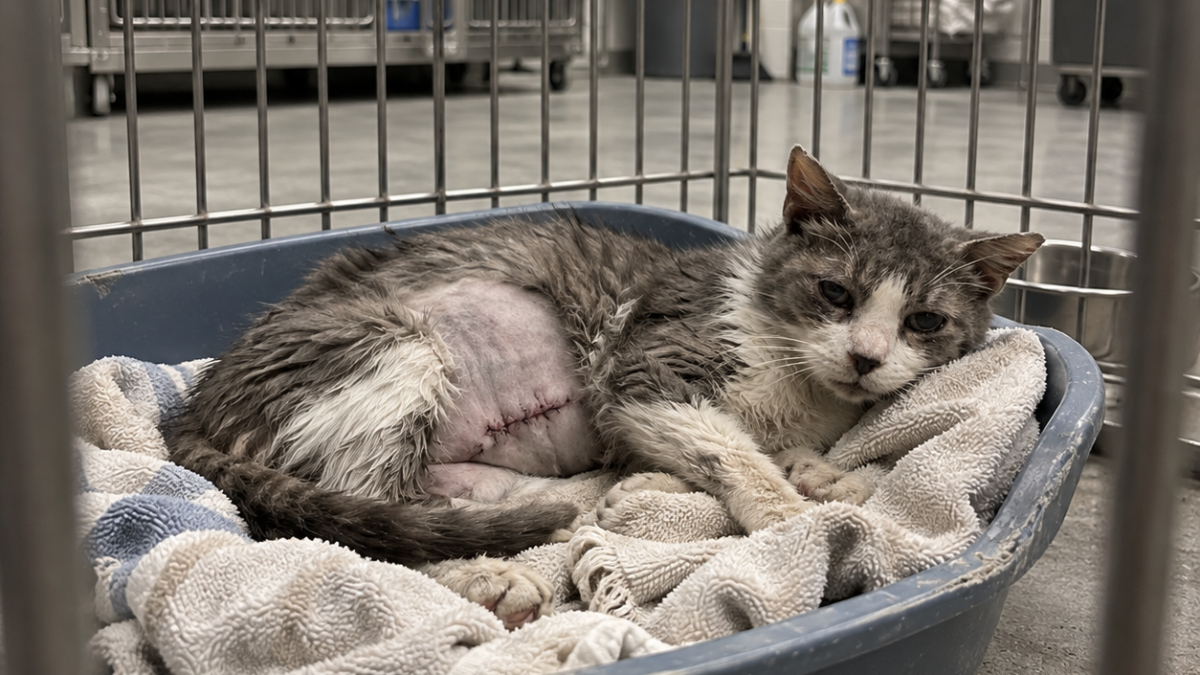
Gray-and-white mother cat.
Shaved belly.
Fresh surgery scar.
Empty nest.
Space curved around invisible kittens.
I sent it to our medical director.
Then to the shelter manager.
Underneath, I wrote:
She has barely moved.
Later that afternoon, I posted the photograph to our rescue’s social page.
Not as an attack.
Not for outrage.
I wrote:
“She was spayed while her kittens were adopted.
She woke up and they were gone.
This is day two.
She is still waiting.”
That was all.
No accusation.
No dramatic language.
I expected a few hundred people to see it.
By dinner, thousands had.
By midnight, tens of thousands.
The comments came faster than we could read.
Some people were furious.
“How could you do this?”
“Bring the babies back!”
“This is cruel!”
Others defended the shelter.
“The kittens are safe.”
“They were old enough.”
“Cats don’t think like humans.”
Then veterinarians joined.
Behaviorists.
Foster coordinators.
Shelter directors.
People with decades of experience.
The discussion became less about blame and more about something we had underestimated.
Timing.
Scent.
Hormones.
Postoperative confusion.
The emotional and behavioral stress of abrupt separation while the mother was unconscious and recovering physically.
One veterinarian wrote something I saved:
“The question is not whether kittens can eventually separate from their mother. The question is whether anesthesia, pain, hormonal state, unfamiliar surroundings, and sudden total loss of her litter all at once create avoidable distress.”
Exactly.
The problem was not adoption.
The problem was disappearing.
From Sophie’s perspective, she nursed three babies.
Lost consciousness.
Woke injured.
Babies gone.
No transition.
No scent exchange beyond an empty blanket.
No gradual separation.
No opportunity to see them leave.
Just absence.
By the third day, our director called a staff meeting.
Nobody defended the timing anymore.
Not because the internet yelled.
Because Sophie was still in the nest.
The medical director said:
“We need a protocol.”
The adoption coordinator looked devastated.
“I placed all three.”
Nobody blamed her.
She had followed normal procedure.
She whispered:
“They were going to great homes.”
“They did.”
“I thought we were doing the right thing.”
“We were doing one right thing.”
The director paused.
“At the wrong moment.”
That mattered.
We contacted the adopters.
Not to demand the kittens back.
The kittens were adjusting well.
Eating.
Playing.
Safe.
Pulling them abruptly from new homes might create another unnecessary disruption.
Instead, we asked for small blankets or towels carrying their scent.
All three families agreed.
Theo’s family returned a fleece square.
Millie’s brought a little washcloth she’d slept on.
Button’s family brought part of the towel from his carrier.
I placed them in Sophie’s nest.
She smelled the first one.
Stopped.
Smelled harder.
Then the second.
Third.
She began calling.
My heart broke all over again.
But this time something changed.
Instead of frantically searching the room, Sophie stayed in the nest.
She groomed the towels.
One by one.
Then lay across them.
That night she ate half a meal.
The next morning, almost all of breakfast.
Day four.
She finally stood on her own and walked willingly toward me.
I sat on the floor.
She placed one front paw on my knee.
Then climbed into my lap.
Careful around the incision.
I stroked her head.
“Hi.”
She purred.
Very quietly.
That was the first purr I’d heard since surgery.
I cried again.
Shelter volunteering involves an embarrassing amount of crying in utility rooms.
Sophie’s photograph continued moving online.
Other shelters wrote to us.
“What policy are you changing?”
“How old were the kittens?”
“How long do you recommend keeping mothers together after surgery?”
“What signs of distress did you see?”
We did not pretend we had all the answers.
We consulted veterinarians and feline behavior professionals.
Our protocol changed immediately.
Lactating mothers would no longer undergo routine procedures followed by simultaneous permanent separation from dependent or recently dependent kittens during immediate recovery unless medical or welfare circumstances required it.
When separation was appropriate, we would plan it.
Recovery first.
Scent continuity.
Gradual transitions where possible.
Monitor appetite.
Observe behavior.
Avoid stacking stressors unnecessarily.
Simple ideas.
Embarrassingly simple after you see the consequence.
The photograph was shared farther.
Animal-welfare groups reposted.
Shelters contacted shelters.
Training presentations used the case.
According to reports circulating through the rescue community afterward, thousands of shelters and foster networks reviewed or modified similar procedures.
Numbers were repeated online.
Some claimed more than eleven thousand organizations eventually changed protocols.
I never personally verified every one.
I couldn’t.
What I know is what I saw.
Emails.
Policy documents.
Training slides.
Messages from people in other states.
Then other countries.
“This photo changed how we handle nursing mothers.”
“We now recover moms with kittens present when medically appropriate.”
“We built a separation-transition checklist.”
One shelter in Canada sent me a picture of a mother cat recovering from surgery with four kittens sleeping safely in a neighboring enclosure where she could smell and hear them.
The technician wrote:
“Because of Sophie.”
I showed Sophie.
She licked her paw.
Cats remain deeply unimpressed by institutional reform.
Sophie never saw Theo, Millie, or Button again.
I know people hate that part.
They ask:
“Why not reunite them?”
Because the world is rarely arranged around perfect endings.
The kittens had gone to good homes.
They were thriving.
And by the time Sophie physically recovered enough for a reunion to be considered, each kitten had begun adapting to a new environment.
Veterinary guidance did not support repeatedly disrupting everybody simply to create a human version of closure.
We did receive updates.
Theo became enormous.
The kind of cat who occupies half a bed and believes all human pillows are legally his.
Millie bonded with a teenage girl who had lost her father the previous year.
Button grew into a chaotic little thief who stole socks and hid them beneath a couch.
I printed their pictures.
Placed them near Sophie’s enclosure.
Not because I believed she understood photographs.
For me.
Maybe for all of us.
Sophie remained at the shelter for six weeks.
Longer than I expected.
People wanted kittens.
Young cats.
Outgoing cats.
Sophie was quiet.
She no longer appeared acutely depressed.
She ate.
Groomed.
Played occasionally.
Accepted affection.
But there was a ritual.
Every evening, near closing, she pulled a small towel into one corner.
Turned.
Lay on her side.
Belly exposed.
Legs curved.
Space left open.
The same shape.
I noticed first.
Then another volunteer.
“She always does that.”
“Yes.”
“For how long?”
“Twenty minutes, maybe.”
“What is she doing?”
I knew what it looked like.
I didn’t want to say it.
Waiting.
Eventually she would stand.
Walk away.
Sleep somewhere else.
Next evening—
again.
I became attached.
Of course I did.
That’s another occupational hazard.
I told myself she would be adopted.
Someone better.
Someone with a bigger house.
More time.
Maybe another cat.
Someone who had not been involved in the worst morning of her life.
Then week six came.
She was still there.
One Friday evening, I sat in front of her cage after closing.
“Sophie.”
She walked over.
Rubbed her face against the bars.
“You’re making this difficult.”
Purr.
“I already have two cats.”
Purr.
“My landlord said two.”
Purr.
“That is a legally meaningful number.”
She reached one paw through the bars.
Touched my sleeve.
Manipulation.
I adopted her Monday.
My landlord accepted the third cat after I offered additional pet deposit and promised Sophie was “very calm.”
That was mostly true.
The first thing Sophie did in my apartment was climb on top of the refrigerator.
So much for traumatized little angel.
She spent an hour there judging everyone.
My resident cats, Oliver and Fern, stared up.
Fern hissed.
Sophie ignored her.
Oliver ate Sophie’s dinner.
Sophie slapped him.
Good.
Normal conflict.
I loved it.
Over the following weeks, Sophie adjusted.
She slept on my bed.
Discovered the sunniest window.
Developed an obsession with rotisserie chicken.
Learned that opening the bathroom cabinet at three in the morning produced an impressive crash.
She became a cat.
Not a symbol.
Not a viral photograph.
Sophie.
That mattered.
But the evening ritual continued.
Every night.
Usually between eight and nine.
She walked into the bedroom.
Found a small towel.
Sometimes I left one there.
Sometimes she dragged one from the bathroom.
She arranged it.
Not neatly by human standards.
Very deliberately by cat standards.
Then lay down.
Sideways.
Belly toward the open room.
Front legs curved.
An empty space along her abdomen.
Twenty minutes.
Sometimes fifteen.
Sometimes thirty.
Then she stood.
Left.
The first few weeks, I cried every time.
Eventually I stopped crying.
Mostly.
People offered explanations.
Habit.
Comfort behavior.
Residual maternal pattern.
Scent association.
Self-soothing.
Postpartum hormones initially, then learned routine.
All possible.
I am careful now when people say:
“She is saving space for her babies.”
I cannot know exactly what Sophie thinks.
No one can.
Animals have internal lives we infer from behavior.
We should respect that uncertainty.
But I know what she did when they disappeared.
I watched.
She searched.
She called.
She returned to their nest.
She stopped eating.
And years later, she still sometimes arranges her body in the same nursing position.
Whatever humans choose to call that—
memory.
habit.
grief.
body memory.
comfort.
It matters to her.
That’s enough.
Six months after adoption, Theo’s family visited me.
Without Theo.
We agreed transporting him unnecessarily wasn’t wise.
His owner brought photographs.
Big tabby.
Ridiculous cheeks.
Sleeping beside a boy.
I looked at Sophie.
She was sitting in the window.
I said:
“Your son is fat.”
Theo’s owner laughed.
Sophie ignored both of us.
Millie’s family sent Christmas cards.
Button’s family sent videos.
One showed him dragging a sock almost as large as his body down a hallway.
I laughed for five minutes.
All three kittens were safe.
That mattered.
The mistake did not ruin their lives.
It did not ruin Sophie’s either.
That’s another thing I want people to understand.
A painful event can matter without becoming an animal’s entire identity.
Sophie recovered.
She experienced joy.
She played.
She trusted.
She slept belly-up in the middle of my bed like she paid rent.
She stole chicken.
She chased moths.
She learned the sound of the treat drawer from two rooms away.
She did not spend every waking second mourning.
Grief doesn’t work that way in people either.
You can hurt and still eat dinner.
Miss someone and still laugh.
Remember and still build another life.
Maybe that is why I kept the original photograph.
I almost deleted it.
For months I couldn’t look.
Gray-and-white cat.
Shaved belly.
Empty nest.
Then one day I printed it.
Small.
Placed it inside a drawer.
Not on the wall.
Sophie is more than that moment.
But I didn’t want to erase it either.
Because uncomfortable photographs can teach.
The shelter changed because of that picture.
Not because we were evil before.
Because we saw something we had failed to notice.
That distinction matters.
If every welfare mistake becomes proof that someone is a monster, people hide mistakes.
Then nobody learns.
We made a decision that prioritized adoption efficiency and underestimated the mother.
We saw the consequence.
We admitted it.
We changed.
That’s what good organizations should do.
Years later, a new volunteer at the shelter asked me about Sophie.
She had heard “the famous mother-cat story.”
I hated that phrase.
Famous.
She asked:
“Was she really depressed for four days?”
“I can’t diagnose depression.”
“What happened?”
“She barely ate.”
“Barely drank.”
“Lay in the nursing nest.”
“Called for the kittens.”
“Looked for them.”
“That sounds depressed.”
“It sounds distressed.”
“Same thing?”
“Not necessarily.”
She nodded.
Then:
“Did the shelter really change all those policies because of one cat?”
“Yes.”
“That seems crazy.”
“No.”
“Why?”
“Policy is supposed to change when evidence changes your understanding.”
She thought.
“What did Sophie teach you?”
I looked at her.
“Don’t mistake something being routine for it being harmless.”
That became my answer.
Routine procedure.
Routine adoption.
Routine separation.
Individually reasonable.
Stacked together—
anesthesia.
pain.
strange environment.
hormonal mother.
three kittens.
sudden disappearance.
Not reasonable enough.
Shelter medicine has improved enormously because people keep asking these questions.
How do we reduce fear?
Can bonded animals remain together?
Can recovery spaces smell familiar?
Are we treating behavior as information?
Are we moving too fast because capacity is strained?
There are no perfect answers.
Shelters operate under real limitations.
Space.
Staffing.
Money.
Emergency intake.
Disease control.
You cannot design every transition perfectly.
But you can notice.
That’s what Sophie forced us to do.
Notice.
The photograph eventually became part of orientation at our shelter.
Not because I requested it.
I actually resisted.
Our director said:
“We need to show new people.”
“Why?”
“Because rules are easier to remember when you understand the animal behind them.”
So the slide appeared.
Sophie’s photograph.
Then:
AVOID ABRUPT POSTOPERATIVE SEPARATION OF NURSING MOTHERS AND LITTERS WHEN POSSIBLE.
ASSESS DEPENDENCE AND WEANING STATUS.
PLAN TRANSITION.
MONITOR POST-SEPARATION BEHAVIOR AND APPETITE.
The first time I saw it during training, my stomach turned.
Then I looked at the new volunteers taking notes.
Maybe that was worth it.
Sophie aged.
Two.
Three.
Four.
Five.
The surgical scar disappeared beneath fur long ago.
Her belly looks ordinary now.
If you met her, you would never know.
Except for the towel.
Every evening.
Same ritual.
I once tried removing all loose towels.
Not intentionally cruel.
Laundry day.
At eight-thirty, Sophie entered the bedroom.
Looked at the empty corner.
Then at me.
Then walked to the bathroom.
Opened the partly closed cabinet.
Dragged out a hand towel.
Problem solved.
I laughed.
“Okay.”
She arranged it.
Lay down.
I sat on the bed.
Watched.
Twenty-two minutes later, she left.
I never removed the towels again.
Some rituals deserve space even when we don’t understand them.
One winter evening, my niece visited.
She was eight.
Saw Sophie lying on the towel.
“Why does she sleep like that?”
I said:
“She used to have babies.”
“Where are they?”
“They grew up.”
“Do they live here?”
“No.”
“Did they die?”
“No.”
“Good.”
She looked at Sophie.
“Does she miss them?”
Children ask direct questions.
I said:
“I think maybe part of her remembers them.”
My niece sat carefully on the floor several feet away.
She did not touch Sophie.
After a minute she whispered:
“They could fit right there.”
I knew what she meant.
The space beside Sophie’s belly.
Exactly enough room for three kittens.
I swallowed.
“Yeah.”
My niece said:
“Maybe she thinks they’ll come back.”
Maybe.
Or maybe her body remembers a shape.
Maybe comfort.
Maybe expectation.
Maybe love.
We do not need certainty for compassion.
Sophie eventually stood.
Walked over.
Rubbed against my niece’s knee.
My niece smiled.
“She isn’t sad now.”
“No.”
That sentence stayed with me.
She isn’t sad now.
Humans sometimes freeze animals inside the saddest photograph we have of them.
Rescue posts do this accidentally.
Before picture.
Injury.
Fear.
Cage.
We remember suffering because suffering creates action.
But animals keep living after the photograph.
Sophie did.
The cat in that viral image is not still lying in that shelter cage.
She has a home.
Favorite chair.
A heated pad in winter.
Two feline roommates she tolerates.
A human who keeps buying the wrong brand of chicken treats according to her increasingly specific standards.
She watches birds.
Sleeps in afternoon sun.
Hates the vacuum.
Loves cardboard boxes.
When I shower, she sits outside the bathroom and screams as though I have entered a waterfall against medical advice.
She has a life.
The ritual does not erase that.
The life does not erase the ritual.
Both can exist.
That’s what memory is.
One year, around the anniversary of her adoption, I received an email from a shelter director several states away.
She attached a photograph.
Mother cat recovering from surgery.
Three kittens sleeping beside her inside a large recovery pen.
The mother still groggy.
One paw over a kitten.
The director wrote:
“We changed our protocol after seeing Sophie’s story.”
I stared at that picture for a long time.
Then went looking for Sophie.
She was asleep upside down on the couch.
I sat beside her.
“You did that.”
She opened one eye.
“You have absolutely no idea.”
Eye closed.
Fair.
A cat does not need to know her impact to have one.
I think about Theo, Millie, and Button sometimes.
They would be adults now.
Maybe seniors eventually.
Three separate lives built from one tiny family.
Do they remember Sophie?
I don’t know.
Science gives us pieces.
Cats recognize scent.
Mother-kitten bonds change after separation.
Memory works differently over time.
I won’t pretend certainty because the emotional version sounds prettier.
What matters is they were loved.
Sophie was loved.
They survived.
And because of what happened between them, other mothers may wake after surgery and hear their kittens breathing nearby instead of waking into silence.
That is enough.
More than enough.
The shelter staff changed too.
The adoption coordinator who placed the kittens stayed in rescue.
For a while she considered leaving because strangers sent hateful messages after the post spread.
That broke my heart.
She had spent eight years finding homes for thousands of animals.
One decision.
One blind spot.
People called her monster.
I told her:
“If you leave because you made a mistake, the people who never admit mistakes win.”
She stayed.
Later she became operations manager.
One of the strongest advocates for maternal-family transition planning in our organization.
That’s accountability.
Not destruction.
Learning.
A veterinarian who joined us later asked why the protocol had such detailed notes around postoperative reunion and scent continuity.
The adoption coordinator said:
“Because of Sophie.”
Not defensive.
Not ashamed.
Matter-of-fact.
We learned.
I respect her for that.
As for me, I stopped believing that love in rescue means preventing every painful thing.
Impossible.
We cannot.
Animals become sick.
Mothers lose kittens.
Kittens lose mothers.
Adoptions separate bonded animals when unavoidable.
Old pets die.
Fosters leave.
We cannot create a world without loss.
What we can do is stop adding preventable loss because we were too busy to notice.
That’s the lesson I carry.
Sophie never needed us to promise her kittens would stay forever.
They wouldn’t.
She needed a transition that acknowledged the bond before it ended.
We didn’t give her one.
Others get one now.
Because of her.
Tonight, when I finish writing this, Sophie will probably perform the ritual again.
She is older.
Slower.
Still gray and white.
Still beautiful.
Around eight-thirty, she will enter my bedroom.
Choose the little towel I keep folded near the corner.
Pull it into position.
Turn twice.
Then lower herself onto one side.
Her belly will face the open room.
Front paws slightly curved.
Empty space beside her.
Enough for Theo.
Millie.
Button.
She will stay there perhaps twenty minutes.
I no longer stand over her.
I no longer cry every time.
I let her have it.
Her ritual.
Her memory.
Whatever it means.
Then she will rise.
Walk into the living room.
Probably demand food.
Maybe slap Oliver if he’s in her chair.
Life will continue.
That matters too.
People love the sentence:
A mother’s body never forgets where her babies were.
Maybe that’s true in ways we don’t fully understand.
Maybe the body remembers scent, pressure, hormones, posture, routine.
Maybe Sophie simply found a position that once meant safety.
I don’t need to turn her into a human mother to respect what I saw.
I only need to remember the facts.
She woke.
She searched.
She called.
She waited.
Then, when no one answered, she returned to the place that still smelled like them.
And lay down with room left beside her.
Years later, she still sometimes leaves that room.
Three kitten-sized spaces.
No one trained her to do it.
No one rewards her.
No camera needs to be there.
She simply does.
Then gets up.
And lives.
That’s the part of Sophie’s story I wish more people understood.
Grief and life are not opposites.
You can carry a missing place and still build a home around it.
Sophie did.
The three kittens never came back.
They did not need to.
They were safe.
They were loved.
They became somebody else’s morning routine, somebody else’s warm body on the couch, somebody else’s reason to smile at a ridiculous sound from another room.
And Sophie became mine.
Not because I could replace them.
I couldn’t.
Not because she forgot.
I don’t think she did.
But because after the empty nest, there was still another chapter.
Then another.
Then years.
The photograph shows one terrible moment.
If you saw only that image, you might think Sophie’s story ended there.
It didn’t.
That’s why I keep telling the rest.
She was not forever the mother in the empty cage.
She became the cat on my pillow.
The thief of chicken.
The enemy of vacuum cleaners.
The ruler of the refrigerator.
The animal who changed policy without ever understanding what policy was.
And every evening, for a little while, she still becomes that young mother again.
She takes her towel.
Lies on her side.
Leaves three small spaces open.
Waits.
Then eventually gets up.
Because memory stays.
But so does life.

