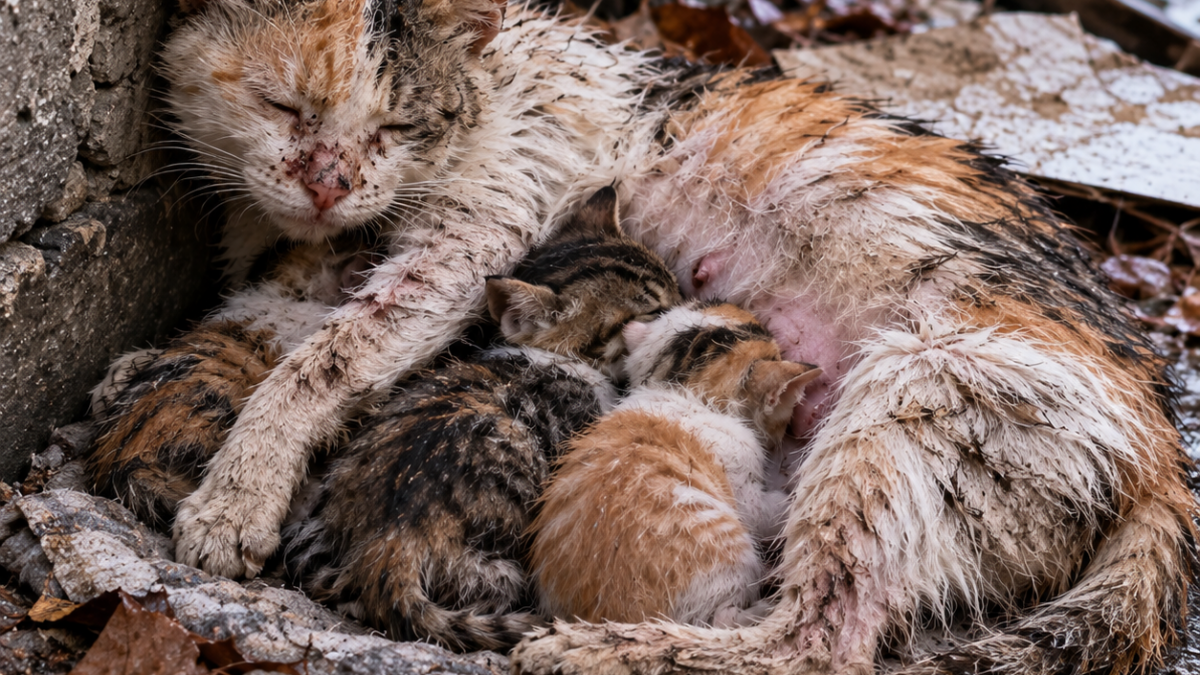
She Was Too Weak to Stand—But the Stray Mother Cat Refused to Leave the Three Kittens Hidden Beneath Her
PART3:
A manager who counted lateness in minutes.
Life offered many opportunities to decide something was not your problem.
Nora stood.
“I’ll come back.”
The cat watched her leave.
All morning, Nora thought about her.
During the meeting.
While answering emails.
During lunch.
Something about the cat not running bothered her.
At 1:10, Nora texted her supervisor that she needed to leave early for a personal matter.
At 1:42, she returned to Bellamy Street.
The cat was still there.
Exactly there.
Same wall.
Same broken cardboard nearby.
Same paw stretched out.
Six hours.
Nora’s stomach tightened.
She crossed slowly.
The cat watched her.
“Still here?”
No movement.
Nora stopped fifteen feet away.
The ground around the cat was ugly.
Broken concrete.
Bottle cap.
Dust.
Two torn pieces of corrugated cardboard.
A flattened fast-food bag.
Tiny stones.
Someone had spilled something dark near the wall days earlier.
Nothing soft.
Nothing safe.
No obvious reason for an animal to stay.
Unless she couldn’t move.
Nora thought injury.
Broken leg.
Hit by car.
Internal trauma.
She walked back to the market.
Bought a can of tuna and a bottle of water.
The cashier, Mr. Patel, knew her.
“For you?”
“The tuna?”
“Yes.”
“No.”
Nora nodded toward alley.
“The little cat.”
Mr. Patel’s expression changed.
“Brown-and-black one?”
“You know her?”
“She comes early.”
“Three weeks maybe.”
“Very scared.”
“Pregnant?”
“I thought.”
Nora looked at him.
“Pregnant?”
Mr. Patel shrugged.
“Was big before.”
“Now small.”
That sentence made Nora move faster.
She returned.
Opened the tuna.
The smell reached the cat.
Her nose moved.
For the first time, Nora saw hunger overpower fear.
The cat’s eyes fixed on the food.
Nora set the can down.
Backed away.
The cat did not stand.
She crawled.
Nora felt something inside her drop.
The cat dragged herself forward with two front paws, hindquarters low.
Three feet.
Then stopped.
Looked behind her.
Nora followed her gaze.
Nothing obvious.
The cat crawled another foot.
A small sound came from the wall.
Nora froze.
Not the mother.
Higher.
Thinner.
A tiny squeak.
The cat turned immediately.
Abandoned the tuna.
Crawled back.
Nora whispered:
“Oh my God.”
The mother shifted.
That was when Nora saw them.
Three kittens.
So small they almost disappeared beneath her.
One orange.
One darker tabby.
One pale gray-and-white kitten mostly hidden beneath the mother’s front leg.
Their eyes were closed.
Their ears were still folded.
Newborns.
Days old.
Maybe less than a week.
Nora covered her mouth.
The mother looked at her.
Not aggressive.
Terrified.
Nora understood suddenly.
She had not stayed because she was injured.
Or not only because she was weak.
She had stayed because this was the nest.
If that miserable patch of concrete could be called a nest.
The kittens pressed against her belly.
One nursed.
Another slept.
The smallest barely moved.
Nora sat on the ground.
Far enough away.
She called the first animal rescue number she found online.
Voicemail.
Second.
No answer.
Third.
A woman answered.
“North County Cat Rescue.”
“My name is Nora.”
“I found a mother cat and newborn kittens.”
“Are they in danger?”
Nora looked around.
Cars twenty feet away.
People passing.
Hot pavement.
Trash.
“No immediate attack.”
“But the mother is extremely thin.”
“She can barely walk.”
“How many kittens?”
“Three.”
“Eyes open?”
“No.”
“Is the mother breathing normally?”
“I think.”
“Any bleeding?”
“No.”
“Is she nursing?”
“Yes.”
“That’s good.”
“What should I do?”
“Do not move kittens away from her.”
“I won’t.”
“Do not grab mom.”
“Okay.”
“Can you place food and water nearby?”
“Yes.”
“I can have a volunteer there in about an hour.”
Nora looked at the smallest kitten.
“Can you make it sooner?”
The woman heard something in her voice.
“What are you seeing?”
“One baby looks… I don’t know.”
“Smaller.”
“Barely moving.”
Pause.
“I’ll call our closest foster.”
“Stay there if you can.”
Nora stayed.
She poured water into the shallow lid from a plastic container.
Placed it near the tuna.
The mother watched.
Nora backed away.
This time the cat crawled toward it.
She drank first.
Long.
Desperate.
Too fast.
Nora worried she would make herself sick.
Then tuna.
She took several bites.
Looked back.
Returned to kittens.
Licked the smallest.
Then crawled out again.
A few more bites.
Back.
The pattern repeated.
Food.
Babies.
Water.
Babies.
Never more than a few seconds away.
Nora felt embarrassed by how intensely she watched.
She had never seen motherhood reduced so completely to physical labor.
No sentimental picture.
No cozy bed.
No human language.
Just a depleted body making decisions every second.
Eat enough to produce milk.
Return.
Drink.
Return.
Stay between strangers and babies.
Stay.
Stay.
Stay.
At 2:37, a blue Subaru pulled into the alley.
A woman in navy scrubs stepped out carrying a carrier, towels, gloves, a small crate, and a trap.
“I’m Leah.”
“Nora.”
Leah Morales was forty-three and had been fostering neonatal kittens for nine years.
She had seen everything.
Or thought she had.
She crouched beside Nora.
“Show me.”
Nora pointed.
Leah did not approach immediately.
She watched.
Mother.
Breathing.
Posture.
Kittens.
Location.
Escape routes.
The cat saw her.
Body tightened.
Leah said softly:
“Hi, Mama.”
Nora whispered:
“She crawled to food.”
Leah nodded.
“I saw.”
“Is she hurt?”
“Maybe.”
“Could also be exhaustion.”
Leah placed another dish closer.
Strong-smelling wet food.
The cat stared.
Leah backed away.
Minutes passed.
The mother ate.
Leah looked at Nora.
“She’s lactating heavily.”
“She’s burning everything she gets.”
“What about the smallest?”
“I need a closer look.”
“How?”
“Slowly.”
Leah sat.
For fifteen minutes she did nothing.
That surprised Nora.
No grabbing.
No towel.
No trap.
Just presence.
Then she moved the carrier closer.
Blanket inside.
Food at entrance.
The mother stared.
Leah moved back.
Another ten minutes.
The mother did not enter.
Nora whispered:
“Can we put babies inside?”
“No.”
“She’ll think we’re taking them.”
“Then?”
“We convince her they all move together.”
Leah repositioned carrier directly beside the wall.
Removed top half.
Turned it into an open bed.
Placed a clean towel inside.
Then stopped.
The mother watched every motion.
Leah slowly slid a flat piece of cardboard beside the kittens.
Not under them yet.
Just beside.
Mother hissed.
Leah froze.
“Okay.”
Her voice remained calm.
“I hear you.”
Five minutes.
Try again.
This time the mother did not hiss.
Leah moved one corner of the towel closer.
Mother put a paw over the smallest kitten.
Nora almost cried.
Leah whispered:
“She’s scared we’re taking them.”
“How do we tell her we’re not?”
“We show her.”
Leah moved the entire bottom half of the carrier against the family.
Open side facing them.
Then placed food inside.
Mother sniffed.
No movement.
Minutes.
Finally she stood.
Or tried.
Her back legs trembled violently.
She made it halfway upright before collapsing to a crouch.
Nora looked at Leah.
Leah’s face had changed.
“That’s not good.”
The mother stepped into carrier.
One paw.
Then another.
Stopped.
Looked back at kittens.
Immediately reversed.
Leah whispered:
“She won’t leave.”
Nora said:
“Then move all of them?”
“Yes.”
“But together.”
Leah put on gloves.
Moved closer.
The mother growled.
Low.
Weak.
Leah stopped.
“Not taking them.”
She slid the carrier base beneath the edge of cardboard and debris where the kittens rested.
Inch by inch.
The mother could see them the entire time.
Then Leah gently lifted the smallest kitten first—not away, but two inches—placing him directly inside the carrier beside the mother.
The mother surged forward.
Weakness disappeared for one terrifying second.
She swatted.
Leah pulled back.
No contact.
The kitten squeaked.
Mother entered carrier immediately.
Pressed herself around him.
Leah whispered:
“Good.”
Second kitten.
Orange.
Mother watched.
No swat.
Third.
Tabby.
Now all three inside.
The mother lowered herself around them.
Leah replaced the carrier top.
Closed door.
Nora finally exhaled.
The cat’s eyes remained wide.
But she did not throw herself against the carrier.
Instead she began licking the gray-and-white kitten.
Slow.
Repeated.
Leah looked closely.
“Okay.”
“What?”
“I’m worried about that one.”
“Why?”
“He’s cold.”
Nora’s face fell.
“He was under her.”
“Doesn’t mean enough.”
Leah lifted carrier.
“We’re going.”
“Where?”
“Evergreen Veterinary Center.”
“Can I come?”
Leah looked at her.
“You found them.”
“Yes.”
Nora abandoned her car and rode with Leah.
The carrier rested between them.
Every few seconds the mother cat shifted.
The kittens squeaked.
The smallest made almost no sound.
Leah called ahead.
“Neonatal triage.”
“Three kittens.”
“One fading.”
“Mother severely underweight.”
“Possible dehydration.”
“ETA twelve minutes.”
Nora stared into carrier.
The mother looked back.
“What are we calling her?”
Leah asked.
Nora blinked.
“Do we need a name?”
“We’ll need something on the chart.”
Nora looked at the mother’s coat.
Dusty tortoiseshell.
One white spot under chin.
She thought about six hours beside the wall.
“June.”
“Why June?”
“My grandmother.”
“Did she look like a cat?”
Nora laughed despite herself.
“No.”
“She was stubborn.”
Leah nodded.
“June it is.”
At the clinic, the kittens were taken first.
The mother tried to follow.
A technician blocked gently.
June hissed.
Leah said:
“Keep one baby with her while they examine the others.”
The veterinarian agreed.
That mattered.
The orange kitten—largest—stayed against June.
The tabby and gray-and-white went to warming station.
Dr. Elena Morris examined June.
Temperature low-normal.
Weight five pounds, seven ounces.
She should probably have weighed seven or more.
Severe dehydration.
Flea infestation.
Mild anemia.
Worn paw pads.
No fractures.
No major trauma.
The weakness came from starvation, milk production, parasites, and exhaustion.
Nora asked:
“Can she survive?”
Dr. Morris looked at June.
“Yes.”
“If we can stabilize her and she keeps eating.”
“What about babies?”
“Two look reasonably strong.”
“And the little one?”
The veterinarian hesitated.
“He’s in trouble.”
The gray-and-white kitten weighed seventy-eight grams.
The others were over one hundred.
His body temperature was low.
Blood sugar dangerously low.
He had not been nursing effectively.
The clinic team warmed him slowly.
Gave tiny amounts of glucose.
Stimulated circulation.
Leah watched.
Nora stood outside treatment area.
June could hear the kitten’s faint cries.
Each time, she lifted her head.
She ignored food.
Ignored water.
Leah carried the kitten back once he was stable enough.
Placed him beside June.
The reaction was immediate.
June began licking him.
Hard.
Almost rough.
Leah adjusted his position near a nipple.
He tried.
Failed.
Tried again.
Latched.
Nora whispered:
“Is he eating?”
“Yes.”
Leah did not smile yet.
“Some.”
For the first night, they transferred the family to Leah’s foster room.
The room had once been a home office.
Now it contained washable floors, collapsible pens, scales, heating pads, kitten formula, syringes, bottles, disinfectant, and enough laundry to support a small hotel.
June entered a large enclosure.
Soft blankets.
Covered bed.
Food.
Water.
Litter box.
No concrete.
No alley.
No people passing.
No cars.
No rain.
No need to guard an exposed wall.
Still, June positioned herself between the kittens and enclosure door.
Leah noticed.
“Of course.”
Nora had followed.
She sat six feet away.
“What now?”
“We watch.”
“How often?”
“With that baby?”
“Every two hours tonight.”
“You do that?”
“Yes.”
“All night?”
“Yes.”
“For free?”
Leah looked at her.
“Mostly.”
Nora shook her head.
“That’s insane.”
“Yes.”
They weighed kittens.
Orange male: 112 grams.
Tabby female: 105.
Gray-and-white male: 79 after warming.
Leah wrote numbers.
“We need names.”
Nora said:
“Temporary?”
“They always start temporary.”
Orange became Rusty.
Tabby became Olive.
Smallest became Milo.
June ate ravenously once the room quieted.
One can.
Half another.
Then water.
Then she returned to kittens.
Leah replaced the dish.
June ate again.
Nora whispered:
“How much can she eat?”
“As much as she can safely tolerate.”
“She needs calories.”
“She’s feeding four bodies.”
Three kittens and herself.
The math was brutal.
At midnight, Nora went home.
At 1:00 A.M., Leah weighed Milo.
No gain.
At 3:00, slight loss.
At 5:00, unchanged.
He latched but tired quickly.
June kept licking him.
Moving him.
Pulling him back when he drifted away.
By sunrise, Leah called Dr. Morris.
“We need supplementation.”
Formula.
Syringe.
Small amount.
Every two hours.
June objected to anyone touching Milo.
So Leah developed a ritual.
Food for June.
Milo removed only inches away.
Feed.
Return.
June groom.
Repeat.
For two days, life reduced to grams.
Eighty-one.
Eighty-three.
Eighty-two.
Eighty-four.
Leah celebrated two grams like a lottery win.
Nora came after work.
Every day.
She brought food.
Laundry detergent.
Coffee.
One afternoon she sat outside enclosure while June watched.
“She still hates me.”
“She doesn’t hate you.”
“She looks like she’s planning my death.”
“That’s affection in tortoiseshell.”
Nora smiled.
June eventually ate while Nora sat nearby.
Then, on day five, Nora placed food inside.
June did not hiss.
Progress.
Milo reached ninety grams.
Rusty and Olive grew faster.
Their bellies rounded.
June’s body did not.
Every calorie seemed to disappear into milk.
Dr. Morris increased nutrition.
High-calorie kitten food for mother.
Supplements.
Parasite treatment.
Hydration.
By end of week one, June gained three ounces.
Tiny.
But something.
Nora asked Leah:
“Where did she come from?”
“No way to know.”
“No chip?”
“No.”
“Spayed?”
Leah gave her a look.
“Three kittens.”
“Right.”
“Sorry.”
“She might have been born outside.”
“Might have been abandoned.”
“Might have had a home once.”
“What makes you think that?”
“She knows litter box.”
“She tolerates human presence better than fully feral cats usually do.”
“Could’ve learned.”
Nora looked at June.
“Someone might have left her?”
“Possible.”
That possibility made Nora angrier than she expected.
“What kind of person—”
Leah interrupted.
“Careful.”
“What?”
“You don’t know.”
“Maybe owner died.”
“Maybe she escaped.”
“Maybe someone lost housing.”
“Maybe she was abandoned.”
“We don’t know.”
Nora sat back.
Leah continued:
“Rescue gets ugly when people invent villains because anger feels cleaner than uncertainty.”
Nora remembered that.
June did not need a villain.
She needed food.
Week two.
Kittens’ eyes opened.
Olive first.
Tiny blue-gray slits.
Rusty second.
Milo last.
His left eye opened before right.
Nora photographed everything.
June hated phone.
Nora learned to keep distance.
Milo remained behind.
He gained.
Slowly.
Then one morning stopped.
Weight 132 grams.
Next feeding, 130.
Next, 129.
Leah’s stomach dropped.
He was colder.
Less responsive.
June licked him constantly.
Leah called clinic.
They rushed in.
Dr. Morris examined.
Possible infection.
Maybe congenital issue.
Maybe fading kitten syndrome.
No simple answer.
Antibiotics.
Fluids.
Glucose.
Warmth.
Milo spent six hours in an incubator.
June paced the foster enclosure.
First time she had done that.
Back and forth.
Back and forth.
Searching.
She called.
Not loud.
Short sounds.
Rusty and Olive nursed.
June barely settled.
Nora sat beside enclosure.
“He’s coming back.”
June stared.
Nora knew promises to animals were ridiculous.
She made one anyway.
“He’s coming back.”
At 6:40 P.M., Leah returned with Milo.
Alive.
Weak.
June met him at the carrier door.
Leah placed him inside.
June grabbed him by scruff.
Moved him to center of nest.
Licked.
Licked.
Licked.
Milo complained weakly.
Best sound anyone had heard all day.
Leah whispered:
“Fight, little man.”
For three nights, Milo required supplemental feeding every ninety minutes.
Nora volunteered.
Leah refused first.
“You have work.”
“I can do Friday.”
“You need training.”
“Train me.”
So Nora learned.
Formula temperature.
Position.
Never feed kitten on back.
Aspiration risk.
Small amounts.
Stimulate elimination.
Weigh.
Record.
Watch breathing.
She became terrified of every mistake.
Leah said:
“Good.”
“Good?”
“Fear keeps you careful.”
Friday night, Nora stayed.
At 2:16 A.M., she fed Milo.
June watched from twelve inches away.
No growl.
Milo finished.
Nora returned him.
June sniffed her fingers.
Then, unexpectedly, rubbed her cheek once against Nora’s knuckle.
Nora froze.
Leah saw from doorway.
“Don’t move.”
“I’m not breathing.”
“That’s dramatic.”
“She touched me.”
“Yes.”
Nora’s eyes filled.
“I think she knows.”
“Maybe she knows you smell like her kitten.”
“Let me have this.”
Leah laughed.
June settled.
By week three, Milo began gaining consistently.
One hundred sixty grams.
Then 176.
Then 192.
Rusty and Olive crossed 250.
They started crawling farther.
Their world expanded.
June hated that.
She retrieved them constantly.
Rusty escaped nest.
June brought him back.
Olive tried climbing over folded towel.
Back.
Milo crawled three inches.
June moved him immediately.
Leah said:
“You’re going to have to let them grow up, Mama.”
June ignored her.
The kittens learned to walk badly.
Then better.
They attacked each other.
They discovered tails.
They discovered June’s tail.
She regretted motherhood visibly.
Nora laughed for the first time without feeling guilty.
The alley image still haunted her.
June stretched across concrete.
Body hollow.
Babies hidden.
Now she watched Rusty ambush Olive behind a stuffed mouse.
The difference felt impossible.
At four weeks, June began leaving nest voluntarily.
First five minutes.
Then ten.
She sat by window.
Sunlight.
Watched birds.
Sometimes kittens slept without touching her.
Nora noticed.
“She’s finally leaving them.”
Leah smiled.
“Because now she knows she can come back.”
That sentence hit Nora harder than expected.
Maybe because Nora’s own mother had died when she was twenty-three.
Maybe because abandonment had shaped her more than she admitted.
Maybe because she had spent years treating leaving and loss as the same thing.
June taught another version.
Leaving can be safe when return is trustworthy.
At five weeks, kittens began solid food.
Messy.
Rusty stood in bowl.
Olive ate from side.
Milo wore food across entire face.
June cleaned all of them.
Nora told her:
“You created monsters.”
June blinked.
Her weight improved.
Coat softened.
Flea dirt disappeared.
Eyes brighter.
She began grooming herself again.
That mattered.
Leah said animals in crisis prioritize survival.
Self-care returns when there is capacity.
June had spent everything on kittens.
Now some energy finally belonged to her.
One afternoon, Nora reached toward June.
Not to touch.
Just placed hand on blanket.
June approached.
Sniffed.
Then sat beside it.
Five minutes.
No contact.
Next day, closer.
Week later, June allowed one stroke along cheek.
Nora cried again.
Leah said:
“You cry a lot.”
“I’m emotionally available.”
“Exhausting.”
Adoption planning began around eight weeks.
Kittens needed vaccines.
Testing.
Spay/neuter at appropriate age.
June too once milk dried up.
Applications came after rescue posted photos.
Everyone wanted Milo.
Of course.
Smallest.
Survivor.
Gray-and-white face.
Big eyes.
Nora hated that.
“What about Rusty?”
“Applications too.”
“Olive?”
“Some.”
“June?”
Leah said nothing.
Nora knew.
Adult mother cats often wait.
Kittens leave first.
Mothers remain.
People love rescue stories until adoption requires choosing an adult animal with history and caution.
Nora stared at June.
“That seems wrong.”
“It’s common.”
“She did everything.”
“That doesn’t make strangers want her more than a kitten.”
Nora became angry.
Again.
Leah let her.
Then asked:
“You want to adopt her?”
Nora stopped.
“I…”
Exactly.
Wanting justice abstractly is easier than offering a home concretely.
Nora lived in a one-bedroom apartment.
Allowed one pet.
She had no pet.
She worked full time.
Possible.
But adoption was years.
Medical bills.
Responsibility.
Not just emotional climax.
Leah saw her thinking.
“Don’t adopt from guilt.”
“I’m not.”
“Don’t adopt because the story feels unfinished.”
Nora looked at June.
“Then what reason is good?”
“You want the cat.”
“The actual cat.”
“Not what she represents.”
Nora went home.
For three nights she thought.
June as symbol.
June as mother.
June as survivor.
Then June as cat.
Suspicious.
Quiet.
Food motivated.
Doesn’t like being picked up.
Likes sunny windows.
Tolerates cheek scratches.
Will probably hide from visitors.
Might never become lap cat.
Could live fifteen more years.
Could get sick next year.
No dramatic guarantee.
Nora realized she wanted that cat.
Not because June had been heroic.
Because over weeks she had learned her.
On Saturday, Nora told Leah.
“I want to apply.”
Leah raised an eyebrow.
“For?”
“June.”
“Why?”
Nora had rehearsed.
Then abandoned speech.
“Because I miss her when I leave.”
Leah nodded.
“Better answer.”
Application.
Landlord verification.
Veterinary plan.
Emergency contact.
Everything.
Approved.
But June still had kittens.
Nora would wait.
At nine weeks, Rusty and Olive were adopted together by a family with two older children.
Nora watched them leave.
June called briefly after.
Looked around.
Then returned to Milo.
Nora’s chest hurt.
A week later, Milo had an adopter too.
A respiratory therapist named Claire who had experience with medically fragile kittens.
Perfect.
Still painful.
The morning Milo left, June groomed him for fifteen minutes.
Whether she knew did not matter.
Nora knew.
Claire placed him in carrier.
June watched.
Carrier left.
June searched afterward.
Blankets.
Behind litter box.
Under chair.
She called.
Nora sat.
“I’m sorry.”
June ignored her.
For two days, she ate less.
Leah monitored.
By third, appetite returned.
But June became quieter.
The frantic motherhood disappeared.
Suddenly she was simply a small adult cat in a large enclosure.
Nora visited.
Sat inside.
No kittens between them.
June approached.
Sniffed her.
Then walked onto Nora’s lap.
Nora stopped moving.
Leah entered ten minutes later.
Saw.
Backed out.
Nora whispered:
“She’s never done this.”
From hallway:
“I know.”
June curled.
Her body was warm.
Heavier now.
Still lighter than ideal.
She rested her head against Nora’s stomach.
The cat who had once kept one paw extended between her babies and every stranger now slept on a stranger.
Trust did not return overnight.
It returned in inches.
June’s spay happened two weeks later.
Recovery uncomplicated.
Nora brought her home after.
One-bedroom apartment.
Third floor.
Window facing courtyard.
No alley.
No broken concrete.
No cardboard.
She prepared everything.
Covered bed.
Open carrier.
Food.
Water.
Litter.
Hiding box.
June entered.
Stayed in carrier for six hours.
Nora did not pull her out.
At midnight, June explored.
At 2:00, ate.
At 3:30, knocked a pen off desk.
At 4:00, Nora heard something crash.
She smiled into pillow.
Good.
By week one, June claimed the window.
Week two, couch corner.
Week three, foot of bed.
Month two, Nora woke with June asleep beside her shoulder.
She did not move for an hour.
The kittens thrived.
Rusty became enormous.
Olive remained clever.
Milo never grew as large as the others but became healthy.
Claire sent videos.
Milo chasing a ball.
Milo climbing couch.
Milo sleeping under blanket.
Nora showed June.
June showed no visible interest.
That was okay.
Motherhood was not a permanent performance.
June had done her job.
Now she was allowed to be something else.
A cat.
A beloved one.
Years later, Nora would still walk Bellamy Street sometimes.
The old wall was eventually demolished.
Apartments renovated.
Alley cleaned.
Dumpster replaced.
The exact patch of broken concrete disappeared beneath new pavement.
No plaque.
No marker.
Nora preferred it.
She did not need the place turned sacred.
The meaning traveled with her.
One evening, she ran into Mr. Patel.
He asked:
“How’s the cat?”
“Fat.”
He smiled.
“The babies?”
“All good.”
“Good.”
Then he said:
“I used to see her searching trash.”
“I thought she hated people.”
Nora looked at him.
“She had reasons.”
That became her simplest explanation.
June never became a cat who loved everyone.
When strangers visited, she hid.
When maintenance workers entered, she disappeared beneath bed.
Loud sounds sent her running.
She hated carriers.
She hated plastic bags.
She loved tuna too much.
She learned Nora’s work schedule.
Waited at door around 5:30.
At night she sometimes slept pressed against Nora’s ribs.
Other nights she wanted nothing to do with anyone.
Nora respected both.
Three years after rescue, Leah called.
“You busy Saturday?”
“Why?”
“Need help.”
“With?”
“Mom cat.”
Nora smiled.
“No.”
“Yes.”
“How many?”
“Four kittens.”
“Alley?”
“Abandoned garage.”
Nora came.
Not as trained foster.
Just extra hands.
That became a pattern.
She volunteered twice a month.
Laundry.
Transport.
Cleaning.
Occasional trapping.
Nothing glamorous.
She learned rescue is mostly cleaning things.
Stories focus on dramatic saves.
Reality is bowls.
Towels.
Medication charts.
Driving.
Waiting.
Paperwork.
And saying goodbye to animals you love because someone else is their home.
June became the reason Nora started.
Not the only reason she continued.
One night, a frightened cat arrived with no kittens.
Adult male.
Scarred.
Defensive.
Nobody knew his story.
Nora sat outside cage.
A new volunteer said:
“Was he abused?”
Nora almost invented something.
Then remembered Leah.
“We don’t know.”
“But look at him.”
“We know he’s scared.”
“That’s enough.”
The volunteer nodded.
Nora smiled.
She had learned.
Do not manufacture cruelty to make compassion easier.
Suffering does not need a villain to deserve help.
June aged.
At ten, arthritis.
At twelve, early kidney disease.
Nora learned subcutaneous fluids.
June objected.
Strongly.
The cat once too weak to stand now found energy to insult medical treatment.
Nora loved that.
Leah visited.
June hissed during fluids.
Leah said:
“That’s my girl.”
At thirteen, June slept more.
Milo’s adopter still sent birthday pictures.
Rusty and Olive remained together.
Their family sent Christmas card once with both cats wearing bow ties.
June looked at card and walked away.
Nora laughed.
“You really don’t care.”
Maybe she did.
Maybe not.
Humans do not need animals to confirm our narratives.
The fact that kittens survived was enough.
The fact that June got a life afterward was even better.
Her final year came gently.
Kidneys worsened.
Weight dropped.
Not alley-thin.
Never again that.
But enough.
Nora noticed before veterinarian said.
June stopped jumping to window.
Then ate half breakfast.
Then slept through Nora coming home.
The pattern felt familiar in a terrible way.
Nora asked Leah to come with her to appointment.
Leah did.
Dr. Morris, older now, still practicing, examined June.
She remembered.
“The wall cat.”
Nora smiled through tears.
“Yeah.”
Labs bad.
Treatment could buy time.
Maybe weeks.
Maybe months.
Quality mattered.
Nora chose treatment initially.
June responded.
Three good months.
Window.
Tuna.
Bed.
Then decline.
One evening, June tried to stand and stumbled.
Nora sat beside her.
June looked up.
Same eyes.
Older.
Softer.
No kittens behind her now.
No need to guard.
Nora said:
“You don’t have to stay for anybody.”
Her voice broke.
“You hear me?”
June blinked.
“You can go when you’re tired.”
The sentence mattered because fourteen years earlier—maybe more—June had refused to leave.
That had saved three lives.
But love cannot become another cage.
The final appointment happened at home.
Leah came.
Dr. Morris came.
June lay on Nora’s bed.
Sunlight.
Her favorite blanket.
No carrier.
No fear.
Nora held her.
Leah stroked her back.
Dr. Morris gave sedation.
June relaxed.
Nora whispered:
“You did enough.”
Again.
“You did enough.”
June’s head became heavy in her hand.
Breathing slowed.
Stopped.
Nora cried into tortoiseshell fur.
Leah cried too.
Afterward, Nora kept June’s collar.
Not ashes.
Those she scattered beneath a tree near her apartment.
The collar went into a drawer.
Beside an old photograph.
Taken the day of rescue.
June curled around three kittens on broken concrete.
Nora rarely looked.
The image hurt.
She preferred later photographs.
June fat in a sunbeam.
June asleep upside down.
June stealing chicken.
June glaring at snow.
June being ordinary.
Because rescue should not freeze an animal forever at the worst moment of its life.
The suffering is where we meet them.
It should not be where we leave them.
Years later, Nora became intake coordinator at North County Cat Rescue.
Leah retired.
On her final day, Nora gave her a framed photograph.
Not June.
A picture of the two women sitting on the floor of the foster room surrounded by laundry and six unrelated cats.
Leah laughed.
“Terrible photo.”
“Accurate.”
“Even worse.”
Then Leah handed Nora an old notebook.
First page.
June.
Rusty.
Olive.
Milo.
Weights.
Medications.
Dates.
Nora traced the numbers.
Milo:
78 grams.
81.
83.
82.
84.
Tiny arithmetic between life and death.
Nora whispered:
“I forgot how close.”
Leah nodded.
“People remember the rescue.”
“I remember the scale.”
That was rescue.
Not heroic music.
Numbers.
Temperatures.
Appetite.
One more feeding.
One more night.
One more gram.
The big stories are built from very small decisions.
A woman notices a cat who doesn’t run.
She comes back.
She brings food.
She makes a call.
A volunteer answers.
She waits instead of grabbing.
A veterinarian stays late.
A kitten gets fed at 3:00 A.M.
A mother cat receives enough calories to make milk another day.
Then another.
Eventually three kittens grow old enough to leave.
Eventually their mother learns nobody is going to take her food.
Eventually she sleeps with both eyes closed.
That is how lives change.
Not always one miracle.
Usually many small mercies stacked close together.
Nora later trained volunteers using June’s story.
But she changed one phrase people loved.
They often said:
“She refused to leave her babies.”
True.
But incomplete.
Nora would say:
“She refused to leave them until she learned she didn’t have to protect them alone.”
That was the transformation.
The first June Nora met believed every approaching body might be danger.
She stretched a paw.
Stay back.
The last years of her life looked different.
When Nora came home, June walked toward her.
When food arrived, she ate without scanning behind her.
When she slept, she slept.
When she was sick, she allowed care.
The babies survived because June protected them.
June survived because eventually she allowed someone to protect her.
Those truths belonged together.
One afternoon, a new intake arrived.
Young tabby mother.
Four kittens.
The cat pressed herself against kennel wall.
Eyes huge.
Volunteer asked:
“What do we do?”
Nora crouched.
“Nothing fast.”
“She looks terrified.”
“She is.”
“Should we move kittens?”
“No.”
“Then how do we help?”
Nora remembered broken concrete.
A tiny tortoiseshell body.
One paw extended.
“First we show her that nobody is taking anybody.”
Volunteer nodded.
They sat.
Waited.
Food near door.
Soft voices.
Time.
Eventually the mother ate.
Then returned to kittens.
Nora smiled.
Same pattern.
Different cat.
Not every rescue became dramatic.
Some mothers arrived healthy.
Some kittens did not survive despite everything.
That was the hardest truth.
Love is powerful.
Care matters.
Neither guarantees outcomes.
Nora lost kittens later.
She cried.
Blamed herself.
Leah called.
“You did enough.”
Nora recognized the words she had given June.
Eventually believed them.
Rusty died first among June’s kittens.
Seventeen.
Kidney failure.
His family contacted Nora.
Olive followed a year later.
Milo, improbably, lived to eighteen.
The smallest.
The one everyone feared would not survive a night.
Claire sent Nora his final photograph.
Old gray-and-white face.
Sleeping under a blanket.
Message:
HE GOT EIGHTEEN YEARS BECAUSE YOU STOPPED THAT DAY.
Nora replied:
Because June did first.
Claire answered:
Both.
Nora sat with that.
Both.
That is often the truest answer.
Who saved whom?
Mother saved kittens.
Woman saved mother.
Volunteer saved kitten.
Veterinarian saved family.
Family saved animals from a shelter.
Animals gave people purpose.
Everyone wants a single hero.
Life is usually a chain.
Break one link and maybe everything changes.
June’s chain began long before Nora.
Maybe someone once fed her behind a restaurant.
Maybe another stray taught her where to hide.
Maybe instinct carried knowledge older than any human story.
Nora was simply the person who noticed on that Tuesday.
Sometimes being the hero means nothing more complicated than noticing.
Not looking away.
Returning.
Calling.
Waiting.
The old wall disappeared.
But Nora could still locate the exact place in memory.
Three feet from fence.
Under a crack shaped like lightning.
Cardboard to left.
Stone near June’s back paw.
Whenever she passed the rebuilt alley, she remembered what had once existed there.
Not misery.
Not only.
A mother cat with almost nothing.
No bed.
No bowl.
No house.
No certainty.
Still finding enough to give.
Three small bodies pressed against her.
Her ribs visible.
Her fur dirty.
Her muscles trembling.
A bowl of food four feet away.
And yet every time hunger pulled her forward, love—or instinct, or duty, or whatever word one chooses—pulled her back.
She never trusted the world enough to leave them unattended.
Not until a carrier came.
Not until blankets.
Not until hands moved slowly.
Not until the kittens went with her.
Then, for the first time, June lowered her head.
Not fully relaxed.
Not safe yet.
But something had changed.
The entire burden no longer rested on one starving body beside a wall.
Someone else had taken a corner of the weight.
And that is what Nora remembered most.
Not the weakness.
Not the fear.
Not even Milo’s seventy-eight grams.
The moment June began grooming him inside the carrier while strangers carried the family away.
She was still afraid.
Still watching.
Still ready to protect.
But she was no longer alone.
For however many nights she had kept those kittens alive with milk she could barely afford to make and warmth her own body desperately needed, the job had belonged only to her.
Then a stranger noticed.
Another stranger came.
A door closed around all four together.
And finally, somebody carried the mother too.
That was the rescue.
Not taking babies away from danger.
Taking their protector with them.
Not rewarding sacrifice by demanding more.
Giving rest to the one who had refused to rest while anyone smaller still needed her.
June had spent the first part of her story saying, in every way a frightened animal could:
Don’t take them.
Don’t come closer.
They’re mine to protect.
By the end, she learned another truth.
They could still be hers.
And someone could help.



