She Was Scheduled to Die at 2:00—Then 13 Minutes Before, the Mother Cat Pushed Her Only Surviving Kitten Through the Cage Bars and Turned to Face the Wall
PART3:
She would only become alert if someone touched the kittens.
Then her head lifted immediately.
Every ounce of energy she had left seemed reserved for them.
The first kitten died overnight.
Too small.
The second stopped nursing the next morning.
We tube-fed.
Warm fluids.
Nothing worked.
The third died before the end of the seventy-two-hour mark.
Three tiny bodies.
Three empty spaces in the nest.
The mother kept licking them even after they had gone cold.
That part stayed with me.
Animals don’t grieve exactly like people do.
I know that.
We should be careful about assigning human thoughts to them.
But you can know that and still recognize loss when you see behavior change after something disappears.
The fourth kitten survived.
A little black-and-white female.
Strong suckle.
Round belly.
Loud voice.
We called her Baby C-17 on the paperwork.
The mother had no name.
That bothered me, but unnamed adults came through intake constantly.
We didn’t always get time to name everyone.
For nineteen days, the mother nursed that kitten.
She ate enough to keep producing milk.
Barely.
The kitten gained weight.
The mother didn’t.
Every time food arrived, she let the baby eat first if there was anything soft enough for the kitten to investigate.
She groomed her.
Curled around her.
Slept with one foreleg draped over her tiny body.
And then the shelter ran out of room.
The kitten was adoptable.
Tiny.
Cute.
Healthy.
Black-and-white markings.
The mother was the opposite of everything that moves quickly through a crowded shelter.
Adult.
Black.
Thin.
Quiet.
No known history.
No adopter applications.
No rescue hold.
No owner.
Not dangerous.
Just invisible.
Her euthanasia time was scheduled for 2:00 p.m.
I learned that around noon.
I remember asking:
“What about the kitten?”
“Too young to go with her.”
“Can she be fostered?”
“We’re calling.”
“And mom?”
My supervisor looked at me.
That look.
The one shelter workers develop when they have to say the thing nobody wants to say.
“We don’t have a placement.”
I looked toward C-17.
The mother was lying on her side while the kitten nursed.
“Can we wait?”
“We’ve already waited nineteen days.”
“I know.”
“We are twelve cats over capacity.”
“I know.”
“Emily.”
“I know.”
That word doesn’t help.
Knowing is not the same as accepting.
I spent the next hour doing what volunteers do when they are trying not to think.
Laundry.
Water bowls.
Medication cards.
Wiping kennel doors.
Refilling litter.
At 1:15, I checked C-17 again.
The mother was awake.
The kitten was asleep against her belly.
I crouched.
The mother looked at me.
She had golden-green eyes.
There was a small bald patch on the bridge of her nose.
At first we thought it was a skin condition.
The veterinarian said it was probably from repeated rubbing against the kennel door and bars.
She had apparently spent days searching for a way out.
Not frantically anymore.
But enough to wear the fur away.
“I’m sorry,” I whispered.
She blinked.
I hated myself for saying it.
Sorry is a human word.
It changes nothing for an animal.
At 1:30, somebody came through the cat room looking at kittens.
A young couple.
They stopped near C-17.
“Oh my God, look at the baby.”
I stood nearby.
The woman crouched.
“She’s adorable.”
The little kitten immediately waddled toward the front.
The mother stayed behind her.
The man asked:
“Can we adopt the baby?”
“She’s not old enough yet.”
“When?”
“A few weeks.”
They took a photo.
Asked how to place a hold.
Never asked about the mother.
I don’t blame them.
People want kittens.
That’s normal.
But I watched the mother watching them.
Then they left.
At 1:42, I started my final water check before lunch break.
Five cages.
Six.
Seven.
Then C-17.
The kitten was moving around the front of the kennel.
The mother was standing over her.
Something looked odd.
At first I thought she was carrying the kitten back toward the bedding.
Instead she picked her up by the scruff.
Normal maternal behavior.
Then she turned toward the kennel door.
The gap beneath the lower frame was small.
Too small for the mother.
But possibly large enough for a kitten.
I watched.
The mother lowered the kitten toward it.
Stopped.
Changed angle.
The kitten squeaked.
She adjusted again.
I thought:
What are you doing?
She pushed gently.
The kitten’s front paws appeared beneath the door.
I froze.
“Hey.”
The mother paused.
I didn’t move closer.
She tried again.
Tiny head through.
Shoulders caught.
She pulled the kitten back.
Changed her grip.
Another angle.
Slow.
Patient.
Not frantic.
I looked at the clock on the wall.
1:46.
My heart started beating harder.
The mother pressed the kitten forward again.
Head.
One shoulder.
Then the other.
The little body slid through.
At 1:47, the kitten dropped onto the narrow outer ledge.
I lunged forward and caught her before she could tumble to the floor.
The mother released her immediately.
She did not reach a paw through.
She did not cry.
She did not pace.
She turned around.
Walked to the back of the cage.
Sat facing the wall.
And stayed there.
I held the kitten against my chest.
She was warm.
Squirming.
Complaining.
Alive.
I stared at the mother.
“Hey.”
Nothing.
I crouched.
“Momma.”
Nothing.
The kitten cried.
That should have gotten her attention.
For nineteen days, every squeak had made her turn.
This time she didn’t.
She remained facing the wall.
I felt something inside me drop.
People can explain the behavior scientifically.
Maybe she was stressed.
Maybe she wanted the kitten away from a perceived threat.
Maybe the gap caught her attention.
Maybe I interpreted the timing because I knew the euthanasia schedule and she didn’t.
All of that may be true.
I don’t claim that cat understood a clock.
I don’t claim she understood what euthanasia meant.
But I know what I saw.
A mother spent several minutes finding a way to put her only surviving baby outside the barrier that trapped her.
Then she withdrew.
Whatever was happening in her mind, I could not stand there and let the next thirteen minutes proceed as scheduled.
I grabbed the kitten.
Ran.
My supervisor, Karen, was in the intake office.
I opened the door without knocking.
She looked up.
“What happened?”
I placed the kitten on her desk.
“Cancel C-17.”
Karen stared.
“What?”
“Cancel her euthanasia.”
“Emily—”
“I’ll foster.”
“You already have two cats.”
“I have a spare room.”
“You said your lease—”
“My landlord allows three.”
Karen looked at the kitten.
Then me.
“Emily.”
“I’ll pay her medical.”
“That’s not the only issue.”
“I’ll sign whatever.”
“She’s underweight.”
“I know.”
“She may have kidney problems.”
“I know.”
“She hasn’t been behavior-tested outside the kennel.”
“Fine.”
“Emily.”
“No.”
My voice cracked.
I hated that it did.
“You didn’t see what she just did.”
Karen’s expression changed.
“What?”
I told her.
Not beautifully.
Fast.
Out of breath.
Mother.
Kitten.
Bars.
Wall.
Karen looked at the clock.
1:52.
She stood.
“Where’s Dr. Patel?”
“Treatment.”
Karen picked up the phone.
I heard:
“Hold C-17.”
Pause.
“Yes.”
Another pause.
“I know what time it is. Hold her.”
She hung up.
Looked at me.
“You understand fostering her doesn’t guarantee she’s medically stable.”
“Yes.”
“You understand if she deteriorates—”
“Yes.”
“You’re taking responsibility for both?”
“Yes.”
Karen glanced at the clock again.
1:54.
Six minutes.
That is how she got her name.
Not immediately.
At first, she was still C-17.
But when we filled out the foster paperwork, Karen reached the name line.
“Do you want to name her?”
I looked at the clock.
Then at the euthanasia hold.
“Six.”
Karen frowned.
“Six?”
“She got six minutes back.”
Karen stopped writing for a second.
Then wrote:
SIX.
“What about the kitten?”
I looked at the tiny black-and-white body asleep in a towel.
“One.”
Karen laughed softly.
“Because she’s the only one?”
“Yes.”
Six and One.
Ridiculous names.
Perfect names.
I brought them home that evening.
I lived in a small two-bedroom apartment outside Nashville.
My own cats, Milo and Daisy, were confined to the living room while I prepared the spare bedroom.
Litter.
Food.
Water.
Blankets.
Cardboard hiding box.
Baby scale.
I placed Six’s carrier on the floor.
Opened it.
She didn’t move.
One cried from her smaller carrier.
Six’s ears shifted.
But she stayed inside.
Eventually she emerged.
Low to the ground.
Walked straight into the closet.
Sat at the back.
Facing the door.
That was where she stayed.
First night.
Second.
Third.
I slid food inside.
She ate when I left.
Used the litter box at night.
Allowed One to nurse if I placed the kitten beside her.
But she didn’t come out willingly.
She watched the doorway.
Constantly.
Like something was coming.
Or someone.
I slept on the hallway floor the first night because I didn’t want her alone.
That was stupid.
She probably preferred being alone.
But I needed to know she was breathing.
Every few hours I looked in.
Golden eyes.
Open.
Watching.
One was thriving.
She had no understanding of any of this.
Kittens are wonderfully selfish.
Warmth.
Milk.
Sleep.
Repeat.
She crawled over Six.
Bit her ears.
Kneaded her belly.
Six tolerated everything.
But there was a distance in her.
On the fifth day, One escaped the little pen I had built.
I was sitting in the hallway answering emails.
I heard tiny claws.
Looked up.
One toddled out.
Walked directly toward the closet.
I started to move.
Then stopped.
She reached Six.
For a second, the mother stayed frozen.
Then One climbed onto her front leg.
Six lowered her head.
Sniffed her.
And something changed.
She pulled the kitten against her chest.
Curled around her.
Started grooming.
One immediately found a nipple and began nursing.
Six closed her eyes.
I sat in the hallway with one hand over my mouth.
Crying again.
That was the first time Six looked peaceful.
Not happy.
I don’t know if cats think in those terms.
But her body softened.
Shoulders down.
Tail loose.
She stopped staring at the door.
For twenty minutes, she was simply a mother with her baby again.
From there, recovery came in tiny steps.
Day seven:
She came out of the closet after midnight.
Day nine:
She ate while I sat in the room.
Day twelve:
She accepted one touch beneath the chin.
Day thirteen:
She slapped me for trying a second.
Fair.
Day sixteen:
She climbed onto the windowsill.
Day twenty:
She purred.
Very quietly.
I thought I imagined it.
Then she did it again.
Dr. Patel rechecked her.
She had gained almost a pound.
Bloodwork better than expected.
No major disease.
Parasites treated.
Dental work needed eventually.
The bald patch on her nose began filling in.
“She may be adoptable,” Dr. Patel said.
I looked at Six.
Six looked at me.
“Don’t tell her.”
Dr. Patel laughed.
One grew fast.
Too fast.
Round belly.
Long legs.
Bold.
She attacked shoelaces.
Climbed curtains.
Tried stealing food directly from Six’s mouth.
Six never corrected her much.
Maybe because she had already lost three.
Maybe because One could do no wrong.
Again, that’s my human interpretation.
But if One launched herself onto Six while she slept, Six would open one eye, sigh, and let her stay.
I posted adoption photos.
One received applications immediately.
Six did not.
Of course.
Tiny kitten.
Adult black cat.
Same old problem.
Then one woman emailed.
Her name was Rebecca Sloan.
Fifty-nine.
Widowed.
Lived alone.
No other pets.
Her message was short.
I’m not interested in the kitten. I’d like to meet the mother.
I reread it.
Then called.
“Why Six?”
Rebecca laughed.
“Is that a test?”
“No.”
“I had a black cat for eighteen years.”
“Okay.”
“She died last winter.”
“I’m sorry.”
“Thank you.”
Pause.
“I keep seeing kittens. They’re lovely. But I don’t want a kitten.”
“Why?”
“I think I’d like to give a quiet animal a quiet house.”
That was the right answer.
Rebecca came Saturday.
She didn’t reach for Six.
Didn’t call her.
Didn’t make kiss noises.
She sat on the floor.
Talked to me.
Ignored the cat.
After twenty-five minutes, Six came out.
Walked around the room.
Stopped six feet away.
Rebecca kept talking.
Six moved closer.
Three feet.
Then sat.
Rebecca looked at me.
I whispered:
“That’s good.”
Another ten minutes.
Six approached.
Smelled Rebecca’s hand.
Then rubbed her cheek once against one finger.
Rebecca’s eyes filled.
She did not move.
“I think she remembers how to choose,” she whispered.
I knew then.
Six went home with Rebecca two weeks later.
I cried harder than I expected.
Fostering is strange.
You spend weeks convincing an animal it is safe.
Then when it finally believes you, you put it in someone else’s carrier.
People call that success.
It feels like grief wearing a name tag that says SUCCESS.
Rebecca sent photos.
Six under the dining table.
Six in a window.
Six sleeping on a green blanket.
Six eventually on Rebecca’s lap.
That one made me cry.
Again.
I cried a lot that year.
One stayed with me a little longer until she was old enough for spay surgery.
Then a family named the Parkers adopted her.
Two teenagers.
One older cat.
Screened patio.
The mother sent me photos almost every day the first week.
One adjusted in approximately eleven minutes.
No loyalty whatsoever.
Kittens.
Three months later, Rebecca asked whether Six could see One.
I wasn’t sure.
Cats do not necessarily need family reunions the way people imagine.
Separating a weaned kitten from a mother is normal.
Sometimes adult cats become stressed seeing one another after long separation.
So we made it calm.
Neutral room.
No forcing contact.
One arrived first.
Nearly grown.
Still black and white.
Still impossible.
Six entered in her carrier.
Door opened.
She came out.
Saw One.
Stopped.
One approached.
Sniffed.
Six sniffed back.
No dramatic sprint.
No embrace.
No movie moment.
They touched noses.
One rubbed past her.
Six watched.
Then sat down.
That’s all.
Rebecca looked disappointed for half a second.
I wasn’t.
Six’s body was relaxed.
No frantic grooming.
No desperate searching.
No distress.
Her kitten was healthy.
Safe.
Confident.
Six simply watched her.
And I remember thinking:
Maybe this is the best possible ending.
Not clinging.
Not fear.
Just knowing the baby can walk away and come back because nothing terrible is waiting outside the cage anymore.
We arranged occasional visits after that.
Not because Six needed them.
Because we did.
One would race around.
Six would watch from a chair.
Sometimes they’d sleep near one another.
Never quite touching.
The bald patch on Six’s nose mostly grew back.
Not completely.
A small thin place remained.
Every time I saw it, I remembered the kennel.
The rubbing.
Searching.
Trying to find some opening.
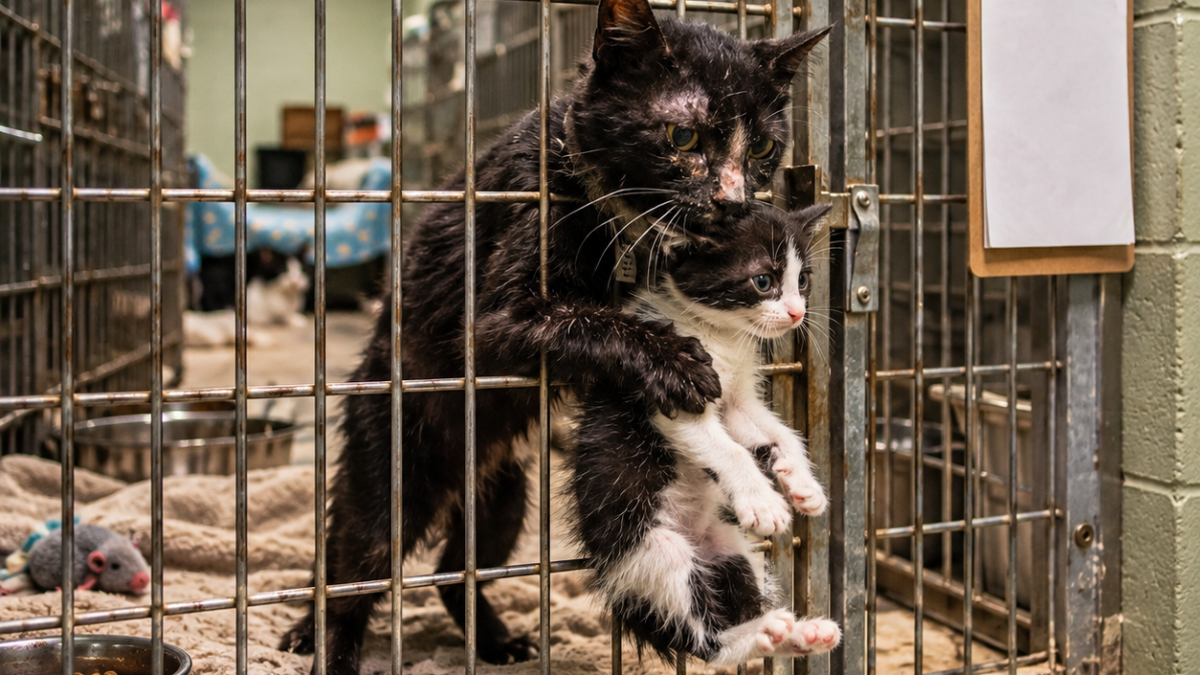
The image people always ask about is the kitten going through the bars.
They want to know:
Did Six really know she was going to die?
I always give the same answer.
I don’t know.
And I don’t want to turn her into something she wasn’t.
She was a cat.
Not a human mother reading an execution schedule.
Not a martyr making a philosophical sacrifice.
We cannot know what she understood.
But I know the facts.
She was scheduled for euthanasia at 2:00.
At 1:47, she maneuvered her only surviving kitten through a gap too small for herself.
The instant the kitten was outside, Six retreated to the rear of the kennel.
She turned away.
She did not respond to the kitten’s cries the way she normally did.
And watching that behavior made me intervene.
Those facts are enough.
I don’t need to know the exact thought inside her head for the moment to matter.
Sometimes compassion begins before certainty.
That day changed how I worked at the shelter.
Before Six, I thought rescue meant finding ways to save animals.
After Six, I understood that rescue also meant noticing.
Cages make animals easy to reduce to paperwork.
Three-year-old female.
Black.
Stray.
No chip.
Nineteen days.
No interest.
Euthanasia at 2:00.
Every line technically true.
None of them told you she had kept one kitten alive after losing three.
None told you she searched the bars until the fur wore off her nose.
None told you she would spend her last minutes trying to move her baby somewhere she couldn’t follow.
A file can tell you risk.
It cannot always tell you who is inside the cage.
That doesn’t mean every shelter can save every animal.
I wish it did.
People blamed our shelter when Six’s story eventually spread.
Some said:
“How could they schedule a nursing mother?”
Others said:
“Someone should be fired.”
I understood the anger.
But the reality was uglier and less satisfying.
Too many animals.
Too few homes.
Not enough fosters.
Not enough money.
People surrender pets faster than shelters can place them.
Unsterilized animals produce litters faster than rescues can absorb them.
There was no villain sitting behind a desk wanting Six dead.
There was a building beyond capacity.
That is harder to hate.
And harder to fix.
After Six, our foster list grew.
Her story circulated locally.
People volunteered.
One woman took three senior cats.
A retired teacher began fostering bottle babies.
A college student created adoption videos.
A local veterinarian discounted spays.
Small changes.
No miracle.
But enough to make some numbers move.
Karen framed Six’s original kennel card.
Not publicly.
She kept it inside her office.
C-17.
Female.
Black.
Three years.
Beside the 2:00 euthanasia notation, someone had written in red:
CANCELED 1:54 P.M. — FOSTER HOLD.
Whenever a new volunteer became overwhelmed by the shelter, Karen sometimes showed them the card.
Not to promise every story would end that way.
Because many don’t.
She showed it to remind them why thirteen minutes can matter.
Rebecca still sends me updates.
Six sleeps on her bed now.
That took almost a year.
At first she stayed at Rebecca’s feet.
Then near her knees.
Then one night Rebecca woke and found Six pressed against her side.
The message she sent me said:
SHE FINALLY DECIDED I’M SAFE ENOUGH TO SLEEP NEXT TO.
I replied:
YOU PASSED PROBATION.
One grew into a sleek, ridiculous young cat who believes every countertop exists for her.
The Parkers renamed her Winnie.
I pretended to object.
I still call her One privately.
Last August, on the anniversary of that day, Rebecca brought Six by the shelter.
Not into the kennel room.
I wouldn’t do that to her.
We sat outside under a tree.
Six wore a harness.
She hated it.
Rebecca apologized every thirty seconds.
I knelt.
Six sniffed my fingers.
Then rubbed her face against my hand.
The thin patch on her nose was still visible.
I touched beside it.
“Hey, Six.”
She purred.
I thought about 1:47.
About a tiny body sliding beneath steel.
About Six turning toward the wall.
At the time, I had interpreted that turn as surrender.
Now I’m not so sure.
Maybe exhaustion.
Maybe stress.
Maybe instinct.
Maybe she simply had nothing left after getting the kitten through.
What matters is what happened next.
Someone noticed.
Someone acted.
Six got six minutes.
Then a night.
Then a week.
Then another year.
Then a home.
One got a life that never included learning what 2:00 p.m. meant.
The last time Six and One met, I watched from across Rebecca’s living room.
One was bigger than her mother now.
She walked past Six.
Paused.
Touched noses.
Then jumped onto the windowsill.
Six stayed below.
Watched her.
No fear.
No urgency.
Just stillness.
Rebecca whispered:
“Do you think she knows?”
“What?”
“That she saved her?”
I looked at Six.
“I don’t know.”
Rebecca nodded.
Then smiled.
“I like to think she does.”
So do I.
But even if she doesn’t, I do.
Every time I see that thin place on her nose, I remember the cage she couldn’t escape.
Every time I see a photo of One stretched across a family’s couch, I remember the gap Six found.
She never found a way through those bars for herself.
Not physically.
She was too big.
But she found one for the smallest life still depending on her.
And somehow, by doing that, she opened a way out for both of them.
Six was supposed to have thirteen minutes left.
She got years.
One was supposed to lose her mother that afternoon.
She got to nurse beside her again five days later.
Sometimes people ask why I still remember the exact time.
1:47.
Because some times become permanent.
You can forget birthdays.
Appointments.
Years.
But I will never forget looking at the clock after that tiny kitten landed in my hands.
1:47.
Then looking at Six.
Facing the wall.
And thinking:
No.
Not today.
By 1:54, her death order was canceled.
Six minutes before the hour.
That is why her name is Six.
Not because six minutes saved her.
A cat saved herself in ways she could never understand.
A kitten helped.
A crowded shelter paused.
A volunteer happened to be watching.
A supervisor picked up a phone.
A foster home opened.
Rescue is rarely one heroic act.
Usually it is several ordinary people deciding not to look away at the same time.
But if you ask me where Six’s second life began, I can still point to the exact moment.
A black mother cat lowered her last living kitten toward the other side of the bars.
Adjusted her grip.
Tried again.
And again.
Until the baby fit.
Then she let go.
She could not follow.
She didn’t need to.
Someone was finally there to catch what she had pushed toward freedom.
And six minutes later, someone came back for her too.

