She Was Returned to the Shelter 7 Times and Never Found a Home—But Before Dying at 19 in Cage 14B, She Comforted 340 Terrified Kittens Through Their First Night.
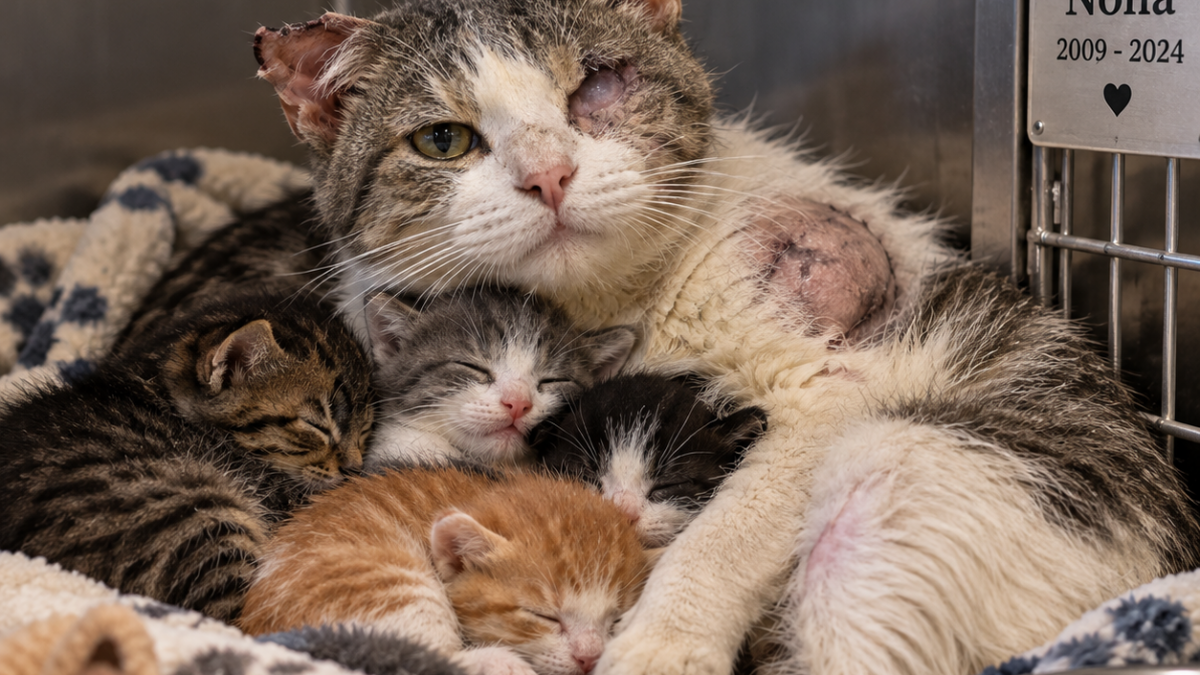
She Was Returned to the Shelter 7 Times and Never Found a Home—But Before Dying at 19 in Cage 14B, She Comforted 340 Terrified Kittens Through Their First Night.
Seven families looked at Nona’s blind eye, torn ear, and growing tumor and decided she was too damaged to love, sending her back to the same shelter cage again and again until the staff quietly stopped expecting anyone to choose her.
Years later, while hundreds of healthy kittens were carried out of that building toward warm homes, the old cat everyone had rejected spent every first night pressing her scarred body against frightened babies until they stopped crying.
And when Nona finally died at nineteen inside cage 14B—the same cage she had never truly escaped—the worn notebook at the front desk revealed that the cat who never found a family had helped 340 others find theirs.
The first time somebody returned Nona, she waited by the shelter’s front door for almost four hours.
Nobody noticed at first.
Rural Haven Animal Shelter was small enough that every person who worked there did three jobs at once and large enough that there was never enough time to do any of them properly.
Dogs barked from the concrete runs in back.
Phones rang.
Laundry machines shook the floor.
Somewhere there was always a cat knocking over a water bowl five minutes after somebody had changed it.
So when the Morrison family came through the front entrance on March 17, 2009, carrying Nona inside the same blue plastic carrier they had taken her home in eleven days earlier, shelter manager Beth Carver simply assumed they had forgotten vaccination paperwork.
Then she saw the little girl’s face.
The child was crying.
Her father was not.
He placed the carrier on the counter.
“We need to bring her back.”
Beth looked at him.
“I’m sorry?”
“The cat.”
Beth glanced down.
Nona sat inside the carrier.
White chest.
Large gray patches.
Half of her right ear missing.
Left eye cloudy and blue-white from an untreated infection that had probably happened years earlier.
The tumor on her left shoulder was visible even through her fur, a round swelling about the size of a walnut.
Beth looked back at the man.
“Is she sick?”
“No.”
“Did she scratch someone?”
“No.”
“Stop using the litter box?”
“No.”
“Fight with another animal?”
“No.”
Beth waited.
The father looked uncomfortable.
PART2:
PART3:
She hated the sentence the moment she saw it on paper.
The little girl stepped closer to the counter.
“Is she going to be okay?”
Her mother touched her shoulder.
“Come on, honey.”
The girl didn’t move.
“Is she?”
Beth looked at Nona.
“Yes.”
It was a lie.
Not because Nona was going to die.
Because Beth had no idea what “okay” meant for a cat who had just learned that home could disappear in eleven days.
The family left.
Beth opened the carrier.
Nona did not come out.
“Hey, girl.”
The cat remained curled against the back wall.
Beth reached inside carefully.
Nona pressed herself farther away.
That surprised her.
When the Morrisons adopted her, Nona had been friendly.
Quiet.
Patient.
The kind of adult cat who watched people before deciding whether to approach.
Beth waited.
Eventually Nona stepped out.
She walked directly to the lobby door.
Then sat.
“That’s not where we’re going.”
Nona looked through the glass.
A red minivan turned out of the parking lot.
The Morrisons.
Nona watched until it disappeared.
Then she stayed.
At noon, volunteer Lisa Grant walked past.
“Nona?”
The cat remained facing the door.
At one, Beth tried to carry her back to the cat room.
Nona wriggled down and returned.
At two, somebody came in to surrender two beagles.
Nona moved aside while the door opened.
Then sat back down.
At four seventeen, Beth finally picked her up and held her firmly against her chest.
Nona didn’t fight.
She simply kept her head turned toward the entrance while Beth carried her down the hallway.
Beth whispered, “They’re not coming back, honey.”
Nona’s good eye stayed on the disappearing lobby until the corner blocked it from view.
Her second adoption lasted twenty-three days.
The couple who took her were retired.
They had no children.
No other pets.
They told Beth they wanted an older animal because kittens were “too much nonsense.”
Nona seemed perfect.
Three weeks later, they returned her.
The husband carried the carrier.
The wife did the talking.
“It’s the lump.”
Beth looked at her.
“What about it?”
“Our friends keep asking what it is.”
“It’s a low-grade fibrosarcoma.”
“I know.”
“Dr. Patel explained it before you adopted her.”
“I know.”
“It isn’t currently life-threatening.”
“I understand.”
The woman’s voice became defensive.
“It’s simply upsetting to look at.”
Beth stared.
“To you?”
“To guests.”
Nona sat silently inside the carrier.
Beth wrote the reason.
Visible tumor makes adopters uncomfortable.
After the couple left, Nona did not wait at the door.
She walked back toward the cat room herself.
Beth noticed that too.
The third family kept her eight days.
Their return form said only:
Not what we expected.
Beth called the number afterward.
She rarely did that.
The woman who answered sounded irritated.
“What exactly were you expecting?” Beth asked.
“I don’t know.”
“You met her twice.”
“I know.”
“You saw her eye.”
“Yes.”
“You saw her ear.”
“Yes.”
“You saw the tumor.”
“Yes.”
“Then what changed?”
There was a long pause.
Finally the woman said, “She looks sad.”
Beth almost laughed.
Instead she asked, “What does that mean?”
“She just sits there.”
“She’s adjusting.”
“We wanted a more affectionate cat.”
“She was in your home eight days.”
“I don’t want to argue.”
“Neither do I.”
Beth ended the call.
She sat at her desk for several minutes afterward.
Then she walked down to Nona’s enclosure.
The cat was sitting against the back wall.
Beth opened the cage.
Nona did not come forward.
“You look sad, apparently.”
Nona blinked.
Beth sat on the floor.
“I’d look sad too.”
Five minutes passed.
Then Nona slowly came out and sat beside Beth’s knee.
Not on her.
Not touching.
Just nearby.
Beth understood.
“You don’t trust me either.”
Nona lowered her head.
“Fair enough.”
The fourth adoption lasted six weeks.
That one almost worked.
A twenty-nine-year-old woman named Andrea lived alone in a small farmhouse and adored Nona.
She sent photographs.
Nona sleeping beneath a kitchen chair.
Nona sitting on the windowsill.
Nona stretched across a quilt.
For the first time, Beth began believing the cycle was over.
Then Andrea lost her job.
Two weeks later she lost her apartment.
She came into the shelter crying so hard she could barely speak.
“I don’t want to do this.”
Beth hugged her.
“I know.”
“I tried my sister.”
“I know.”
“My mother.”
“I know.”
“I even asked my ex.”
Beth almost smiled.
“That’s desperation.”
Andrea laughed through tears.
Nona was on her lap.
Andrea buried her face against the cat’s fur.
“I’m sorry.”
Nona purred.
Andrea cried harder.
That return hurt Beth differently.
Because nobody was cruel.
Sometimes love existed and still wasn’t enough to change circumstances.
Andrea visited twice afterward.
Then moved to another state.
Nona watched her leave the second time.
She did not wait by the door.
By her seventh return, something inside Nona had changed.
She was six years old then.
Seven adoptions.
Seven carriers.
Seven homes.
Seven returns.
Some lasted days.
One lasted months.
There was always a reason.
A landlord.
A new baby.
A new boyfriend with allergies.
A dog that “didn’t like her.”
Her appearance.
The tumor.
The eye.
The ear.
Sometimes the reason sounded legitimate.
Sometimes it sounded cowardly.
The result was always the same.
The carrier arrived.
The door opened.
Nona came back.
After the seventh return, Beth sat in the intake room with veterinarian Dr. Sanjay Patel.
Nona crouched beneath the table.
Beth held her file.
Seven red RETURN stamps ran down the adoption history.
Sanjay sighed.
“Maybe we should stop listing her.”
Beth hated the idea.
“That feels like giving up.”
“It might feel worse to keep sending her out.”
“You think returns are hurting her?”
Sanjay looked beneath the table.
Nona’s good eye was open.
Watching.
“Wouldn’t they hurt you?”
Beth rubbed her forehead.
“She’s only six.”
“I know.”
“She could live another ten years.”
“I know.”
“Maybe more.”
“I know.”
“And we’re talking about putting her in permanent shelter housing.”
“I’m talking about not making her audition for people who keep deciding her scars are inconvenient.”
Beth looked down at the file.
“What about the tumor?”
“We monitor it.”
“Could we remove it?”
“Technically?”
“Yes.”
“Probably.”
Beth looked hopeful.
Then Sanjay continued.
“But we’d need wide margins. Fibrosarcomas can be invasive locally. On that shoulder, reconstruction could get complicated.”
“How much?”
He gave her a rough estimate.
Beth closed her eyes.
The shelter’s entire medical budget was already stretched across heartworm treatment, emergency surgeries, vaccines, spay-neuter costs, and animals arriving after being hit by cars.
“We don’t have that.”
“No.”
“Would surgery guarantee it doesn’t come back?”
“No.”
“Is it hurting her now?”
“No evidence of that.”
Beth looked at Nona again.
“So we monitor.”
“We monitor.”
“And stop listing her.”
Sanjay nodded.
“For now.”
“For now,” Beth repeated.
It would become forever.
Nona moved into cage 14B.
Calling it a cage made it sound worse than it was.
But calling it anything else would have been dishonest.
It was larger than the standard adoption enclosures.
Clean.
Temperature controlled.
Raised sleeping shelf.
Soft bedding.
Food and water areas separated from the litter box.
A small enrichment platform.
Volunteers visited.
She got time in the cat room when staffing allowed.
But at night, a metal door still closed.
Bars still separated her from the hallway.
A laminated card still read:
14B — NONA.
Beth hated that card.
Nona didn’t seem to.
At least not anymore.
She developed routines.
Breakfast at six thirty.
Nap after seven.
Demand treats from Lisa at eleven.
Ignore Beth between noon and two.
Allow Sanjay to examine the tumor while pretending she wasn’t annoyed.
Sit at the front of the cage during evening feeding.
Sleep.
Weeks became months.
Months became a year.
Nona stopped appearing on the shelter website.
People walking through the cat room rarely saw her.
Long-term housing was in the back corridor because those animals generally needed quieter conditions.
New arrivals came through there too.
Sick cats.
Pregnant cats.
Cats recovering from surgery.
Kittens too young for the adoption floor.
Nona watched them all.
Her life might have remained small and unnoticed if three kittens had not been abandoned behind a gas station on a rainy September night.
Volunteer Megan Hall was working alone after closing.
She was twenty-two, studying veterinary technology at the community college, and had agreed to cover the evening because Lisa’s mother was sick.
At 8:46 p.m., a sheriff’s deputy arrived holding a cardboard beer box.
“I found these behind Miller’s Gas.”
Inside were three kittens.
Maybe three weeks old.
Two tabbies and a black female.
Cold.
Thin.
Fleas crawling through their fur.
Their eyes were open.
Their voices were enormous.
Megan took them immediately.
“Oh, you poor things.”
The deputy winced as all three screamed.
“They’ve been doing that since I picked them up.”
“Good.”
He looked confused.
“Good?”
“Means they have energy.”
She weighed them.
Checked hydration.
Warmed them slowly.
Prepared formula.
Two drank.
The smallest refused.
She called Sanjay.
He walked her through what to watch overnight.
“They need quiet.”
Megan looked at the screaming box.
“Tell them.”
She moved them into a warmed enclosure in the long-term corridor because the neonatal room was being disinfected.
Two cages away from Nona.
The kittens screamed.
At nine thirty.
At ten.
At ten forty-five.
Megan changed bedding.
Fed them again.
Held them.
Wrapped them.
Nothing worked.
Whenever she separated one, it screamed harder.
Whenever she put them together, all three screamed at once.
At 11:17, Megan walked back down the corridor carrying laundry.
That’s when she noticed Nona.
The old cat was pressed against the right side of cage 14B.
Not sleeping.
Not watching Megan.
Watching the kittens.
Her cheek was against the bars.
Her body stretched as close to them as the enclosure allowed.
Megan stopped.
“Nona?”
No reaction.
The kittens cried.
Nona’s tail moved once.
Megan stepped closer.
“What are you doing?”
Nona stood.
She walked to the cage door.
Scratched once.
Then looked at Megan.
Megan laughed.
“No.”
Nona scratched again.
“You can’t fix everything.”
Another scratch.
Megan put the laundry down.
“Absolutely not.”
Nona stared.
Megan lasted perhaps twenty seconds.
“Fine.”
She unlocked 14B.
Nona stepped into the corridor.
She didn’t run.
She didn’t investigate.
She walked directly toward the kittens.
Megan followed.
“Easy.”
Nona sniffed through the bars.
The smallest kitten screamed directly into her face.
Nona did not flinch.
Instead she made a sound Megan had never heard from her.
A low chirrup.
The kitten stopped crying for two seconds.
Then started again.
Megan’s expression changed.
She looked at Nona.
Then the kittens.
“This is probably a terrible idea.”
She opened the kitten enclosure.
Nona climbed in.
Immediately, the black kitten backed into a corner and hissed.
Nona sat.
No response.
The tabby crawled toward her.
Nona lowered her head.
She licked his forehead.
Once.
Again.
Then his ears.
The kitten became still.
Nona moved to the second.
Face.
Ear.
Neck.
The black kitten remained in the corner.
Nona did not pursue her.
She lay down.
The first tabby climbed against her belly.
The second followed.
The black kitten watched.
Five minutes passed.
Then she crawled forward.
Nona kept her eye half closed.
The kitten touched her nose.
Nona licked her face.
The black kitten folded against Nona’s chest.
At 11:36 p.m., for the first time since arriving, the corridor became silent.
Megan sat on the floor outside the cage.
All three kittens slept.
Nona remained awake.
Her one clear eye watched the hallway.
Megan whispered, “What just happened?”
Nona stayed with them until morning.
Beth came in at six thirty.
She found Megan asleep in a chair.
Nona awake.
Three kittens buried against her.
Beth stared.
“What did you do?”
Megan woke suddenly.
“What?”
“Why is Nona in there?”
“Oh.”
Megan rubbed her eyes.
“She asked.”
Beth looked at her.
“She asked.”
“Pretty clearly, actually.”
Beth walked closer.
Nona lifted her head.
One kitten yawned.
Beth smiled.
“You have got to be kidding me.”
The kittens remained with Nona whenever staff could supervise.
The smallest began eating properly.
The black female stopped hissing at human hands.
Nine days later, a foster family took all three.
Megan carried the empty kitten carrier down the corridor afterward.
Nona sat inside 14B.
She watched.
Megan stopped.
“You okay?”
Nona blinked.
“They got a home.”
Nothing.
Megan opened the cage.
Nona came forward.
Megan scratched beneath her chin.
“You helped.”
Nona leaned into the touch.
The following month, another kitten arrived.
Five weeks old.
Orange.
Found alone in a drainage pipe.
He cried from the moment he entered the building.
Nona stood.
Walked to her cage door.
Scratched.
Megan happened to be there.
She stared.
“No way.”
Scratch.
“Nona.”
Scratch.
Megan opened the door.
Nona went to the kitten.
He stopped crying within ten minutes.
After the third time, staff started paying attention.
After the fifth, Beth began taking notes.
After the tenth, it stopped feeling accidental.
New kittens reacted differently to humans.
Some reached for anyone immediately.
Some froze.
Some scratched.
Some bit.
Some screamed until their voices became hoarse.
Some remained so silent staff worried about them more than the loud ones.
Nona treated them all the same.
She approached slowly.
She groomed their faces.
If they hissed, she waited.
If they struck at her, she moved back.
If they hid, she lay near the hiding place.
She never forced contact.
The first staff member to call it “Nona Night” was Denise Walker, an older volunteer who worked most Fridays.
A litter of four had arrived from a burned-out shed.
Everyone was exhausted.
Denise carried them down the hall and said, “All right, babies. Nona Night.”
The phrase stayed.
Initially unofficial.
Then routine.
Any kitten medically safe for contact but frightened by shelter isolation could spend supervised time with Nona during its first forty-eight hours.
Sanjay set rules.
Vaccinations when age appropriate.
Isolation requirements respected.
No kittens with suspected contagious illness.
No unsupervised mixing if behavior was uncertain.
Nona didn’t get to overrule medicine.
Beth joked that Nona thought she should.
By 2013, the front desk had a spiral notebook.
Nobody remembered who started it.
The cover simply said:
NONA’S BABIES.
Entries were inconsistent.
May 4 — 2 gray tabbies, barn surrender.
May 19 — black female, 6 weeks, screamed all night until Nona.
June 2 — 4 orange kittens.
June 8 — tiny calico, possible orphan.
July 14 — feral male, bit Megan twice, did not bite Nona.
Sometimes there were names.
Sometimes just descriptions.
Some entries included outcomes.
Adopted together.
Fostered.
Healthy.
Went home Saturday.
One note read:
Tuxedo kitten would not eat. Ate after watching Nona.
Another:
Three babies from highway box. Slept 7 hours beside her.
And another:
Tiny black kitten finally purred.
Nobody counted seriously at first.
Nona didn’t know numbers.
She did not know there was a notebook.
She simply knew crying.
And every time she heard it, she stood.
Years passed.
Her tumor grew.
Slowly.
A walnut became a plum.
Then something larger.
Every three months, Sanjay examined it.
“Still soft enough.”
“Still mobile.”
“Still no ulceration.”
“Still eating.”
“Still jumping.”
Eventually Beth asked again.
“What if we removed it now?”
Sanjay looked at her.
“You know the answer.”
“We have more donations than we used to.”
“The surgery would be larger now.”
“But possible?”
“Possible isn’t the same as wise.”
Beth hated veterinarian answers because they sounded too much like shelter answers.
Nothing definite.
Nothing easy.
“Would you do it if she were yours?”
Sanjay looked through the exam-room window.
Nona was grooming a six-week-old kitten on the table.
“She is ours.”
Beth went quiet.
Sanjay continued.
“And that’s why I’m not putting a senior cat through radical shoulder surgery for a mass that isn’t currently causing pain just because humans don’t like looking at it.”
Beth nodded.
She understood.
Still, she touched the tumor gently.
“I hate this thing.”
Sanjay smiled.
“Nona doesn’t.”
That was true.
Nona seemed entirely uninterested in the parts of herself people found ugly.
The eye clouded further.
Her torn ear sagged.
Her shoulder distorted as the mass grew.
She limped occasionally after sleeping too long.
Then got up and went to whatever kitten was crying.
Adopters sometimes saw her during tours.
One afternoon, a mother and teenage daughter passed the long-term corridor.
The girl stopped.
“What’s wrong with that cat?”
Beth looked through the bars.
“Nona?”
“Her shoulder.”
“A tumor.”
The mother pulled her daughter closer.
“Does it hurt?”
“No.”
“Is it cancer?”
“A low-grade cancer, yes.”
The girl looked horrified.
“Why don’t you put her down?”
Beth stared at her.
The mother looked embarrassed.
“Emily.”
“What? If nobody wants her and she’s sick—”
“Nona isn’t dying.”
“But look at her.”
Beth felt anger rise.
Then she saw the girl’s age.
Maybe fourteen.
Old enough to be thoughtless.
Young enough to learn.
Beth opened cage 14B.
Nona came forward.
Beth picked her up.
“Want to meet her?”
Emily stepped back.
“No.”
“Okay.”
Beth sat on the floor instead.
At that exact moment, a small kitten in the neighboring room began crying.
Nona’s ears lifted.
She stepped off Beth’s lap.
Walked toward the sound.
Emily watched.
Beth opened the kitten pen.
A newly surrendered brown tabby cowered against the back.
Nona entered.
The kitten hissed.
Nona lay down.
Five minutes later, the kitten had crawled against her side.
Emily hadn’t moved.
“She does that?”
Beth nodded.
“With almost every kitten who comes through here.”
“Why?”
“We don’t know.”
Emily looked at Nona’s tumor.
Then her eye.
Then the tiny kitten pressed against her.
“How long has she been here?”
“Years.”
“No one adopted her?”
“Seven people did.”
“What happened?”
“They brought her back.”
Emily’s face changed.
“All of them?”
“All of them.”
The girl became quiet.
Before leaving, she put five dollars into the donation jar.
A week later she returned with forty-three dollars collected from classmates.
“Can this be for Nona’s kittens?”
Beth smiled.
“Absolutely.”
People did want Nona, eventually.
Just not in the way adoption forms measured.
She became the shelter’s secret.
Volunteers spoke about her.
Foster families knew her.
Some people came specifically to meet “the kitten grandma.”
A local newspaper wrote a small article.
Nobody used the word viral.
The photograph showed Nona lying with five kittens stacked against her.
Her blind eye faced the camera.
The tumor was visible.
Beth almost asked the photographer to use another angle.
Then stopped herself.
That was Nona.
All of her.
The article brought three adoption inquiries.
For Nona.
Beth was stunned.
One came from a family two counties away.
Another from a woman in Louisville.
The third from an elderly widower named Henry Bell.
He came to the shelter in person.
Seventy-six years old.
Retired carpenter.
Hands permanently rough from forty years of work.
He sat beside cage 14B.
Nona walked to him.
Henry did not stare at her eye.
Didn’t ask immediately about the tumor.
He simply extended two fingers.
Nona sniffed them.
Then rubbed her cheek against his hand.
Henry looked at Beth.
“I’d like her.”
Beth’s heart jumped.
“You understand she’s older.”
“I’m older.”
“She has medical needs.”
“So do I.”
“Her tumor may eventually require treatment.”
“Mine already did.”
Beth smiled.
Henry pointed at a scar visible above his shirt collar.
“Throat cancer. Twelve years clear.”
They talked for almost an hour.
Beth approved the application.
That evening, she sat beside Nona.
“You might finally be going home.”
Nona groomed her paw.
“Could you at least act excited?”
The next morning Henry called.
His voice sounded different.
“I’m sorry.”
Beth’s stomach dropped.
“What happened?”
“My daughter.”
Beth closed her eyes.
“Allergies?”
“No.”
“What?”
“She thinks I’m too old to take on a cat with medical problems.”
Beth stared at her desk.
“What do you think?”
“I think she’s wrong.”
“Then—”
“But she lives fifteen minutes away and takes me to chemotherapy follow-ups. If something happens to me, she’d be responsible.”
Beth had no argument.
Henry’s voice broke.
“I don’t want that cat returned again.”
Neither did Beth.
Henry never adopted Nona.
But every Wednesday for three years, he visited her.
He sat beside cage 14B.
Read the newspaper.
Shared tiny pieces of approved chicken.
Sometimes kittens crawled over him too.
One winter, Henry stopped coming.
Beth called.
His daughter answered.
Henry had suffered a stroke.
He died nine days later.
A week afterward, his daughter arrived carrying a wooden box.
“My father made this.”
Inside was a small raised cat bed.
Solid oak.
Sandpapered smooth.
The front had one word carved into it.
NONA.
Beth covered her mouth.
“He told me she never got her house.”
Henry’s daughter looked down.
“So he made her a bed.”
They placed it inside 14B.
Nona slept in it that same night.
Years continued.
Kitten 101 was a tortoiseshell with one missing rear paw.
Kitten 126 had pneumonia and could only spend time with Nona after medical clearance.
Kitten 143 was so feral he climbed the wall of his enclosure when Beth approached.
Nona spent four nights beside him.
On the fifth, he allowed Megan to touch his back.
Kitten 177 was brought in after his mother was killed by a car.
He screamed whenever left alone.
Nona barely slept for two days.
She kept one paw over him while he slept.
Kitten 203 arrived with two siblings.
One died overnight despite treatment.
The surviving kittens would not eat the following morning.
Nona groomed them.
By afternoon, both took formula.
Kitten 241 was named Cricket.
Cricket became famous among staff because she followed Nona everywhere.
If Nona ate, Cricket ate.
If Nona slept, Cricket climbed on top of her.
If Nona used the litter box, Cricket waited outside as if guarding the door.
When Cricket’s adoption day came, the new family arrived excited.
A little boy carried a new carrier decorated with stars.
Beth placed Cricket inside.
Cricket cried.
Nona stood at the front of 14B.
Cricket screamed louder.
The boy looked worried.
“She doesn’t want to go.”
Beth knelt.
“She’s scared.”
“What if she doesn’t like us?”
“Give her time.”
The boy looked toward Nona.
“Can that cat come too?”
His mother laughed awkwardly.
“One cat is enough.”
The boy walked to Nona’s cage.
“Are you her mom?”
Nona sniffed his fingers.
Beth swallowed.
“Kind of.”
The child thought.
“I’ll take care of her.”
Beth looked at him.
“Nona?”
“No. Cricket.”
He smiled.
“So she doesn’t have to.”
Beth looked away for a second.
Cricket went home.
That night, Nona slept alone.
By morning, another litter had arrived.
She got up.
Again.
That became the detail Beth never stopped thinking about.
Nona watched them leave.
Every one.
Kittens arrived terrified.
They learned the shelter was survivable.
They learned human hands could bring food.
They learned cages weren’t always punishment.
They learned sleep.
Touch.
Warmth.
Then somebody chose them.
A family arrived.
Paperwork was signed.
A carrier closed.
The front door opened.
Gone.
Nona stayed.
The staff began to wonder if that hurt her.
They could never know.
But sometimes after an adoption, Nona sat at the front of 14B longer than usual.
Watching the corridor.
Once, Megan saw her nose pressed against the empty kitten cage for almost ten minutes.
She crouched beside her.
“You miss them?”
Nona said nothing.
Megan’s eyes filled.
“That’s the deal, though.”
She scratched behind Nona’s torn ear.
“You make them brave enough to leave.”
Nona leaned into her hand.
“But you don’t get to.”
Megan regretted saying it immediately.
She sat on the floor.
“I’m sorry.”
Nona climbed into her lap.
Megan laughed through tears.
“You’re comforting me now?”
Apparently.
By 2018, Nona was thirteen.
The tumor had grown to roughly the size of a small lemon.
Her blind eye looked almost silver.
The torn ear folded lower.
She moved more slowly.
Beth had gone gray.
Megan had finished school, married, and become the shelter’s veterinary technician.
Lisa had arthritis.
Sanjay talked about retirement but never seemed to actually retire.
Rural Haven itself changed.
New flooring.
Better ventilation.
A renovated kitten room.
More foster homes.
Online adoption listings.
Social media fundraising.
One thing remained exactly the same.
Cage 14B.
And Nona.
Visitors sometimes asked why she wasn’t in foster care.
Beth had tried.
Twice.
Nona stopped eating both times.
The second foster home lasted four days.
Nona spent nearly every hour beside the bedroom door.
When Beth brought her back to the shelter, Nona walked directly to 14B.
A kitten cried from down the hall.
Nona ate that night.
Sanjay shrugged.
“This is home.”
Beth hated hearing it.
“A shelter cage is not a home.”
“Maybe home isn’t always the building we’d choose for someone.”
“Don’t turn philosophical on me.”
“I’m a veterinarian. Philosophy is cheaper than retirement.”
Beth looked at Nona.
“She deserved a couch.”
“Yes.”
“A window.”
“Yes.”
“One person who chose her.”
Sanjay looked at Beth.
“She has twenty.”
“It’s not the same.”
“No.”
He paused.
“But don’t make the mistake of turning the life she actually has into nothing because it wasn’t the life we wanted for her.”
Beth looked at him.
Sanjay continued.
“She knows every sound in this building.”
Nona’s ear moved as a food can opened down the corridor.
“She knows your footsteps.”
Nona glanced toward Beth.
“She knows Megan’s car.”
Nona’s tail moved.
“She knows when kittens arrive before half of you do.”
Beth smiled despite herself.
Sanjay touched the edge of the cage.
“Maybe she never got adopted.”
He looked at Nona.
“But that doesn’t mean she was unloved.”
Beth carried that sentence for years.
In 2020, Nona lost the remaining vision in her left eye completely.
Her right eye was still functional, but aging.
Her world narrowed.
Sound became more important.
Smell.
Routine.
She no longer climbed to the highest platform in 14B.
Staff added a ramp to Henry’s wooden bed.
They moved her bowls closer.
Nobody mentioned retirement from kitten duty because everyone assumed Nona would make that decision herself.
She did not.
A five-week-old tabby arrived one night after being found beneath a restaurant dumpster.
Nona was asleep.
The kitten cried.
Her head lifted.
Megan watched from the doorway.
“No.”
Nona stood.
Her rear legs shook slightly.
“You’re off duty.”
Nona walked toward the cage door.
Megan folded her arms.
“You’re fifteen.”
Scratch.
“Nona.”
Scratch.
“You have arthritis.”
Scratch.
Megan opened the door.
Nona walked out.
“Fine.”
Megan followed.
“But you’re unionizing tomorrow.”
Nona spent the night beside the kitten.
At some point after midnight, Megan found both sleeping.
Nona’s chin rested over the kitten’s back.
Megan took a photograph.
It became her phone background for the next four years.
The notebook reached 300.
Nobody planned a celebration.
Beth discovered it while checking records.
“Wait.”
She flipped backward.
“Is this right?”
Megan came over.
“What?”
“Three hundred.”
Lisa looked up from the reception desk.
“Three hundred what?”
“Nona babies.”
Everyone went quiet.
They counted twice.
The records were imperfect.
Some litters had group entries.
Some old pages were missing dates.
The number was approximate.
But they knew it was at least around three hundred.
Beth walked down the corridor.
Nona was asleep.
A six-week-old calico lay across her front legs.
Beth crouched.
“Three hundred.”
Nona did not wake.
“You know what you’ve done?”
Nothing.
“Of course you don’t.”
Beth smiled.
“Probably better that way.”
By late 2023, Nona’s kidneys began showing their age.
Nothing catastrophic.
Numbers drifting.
Weight dropping.
More water.
More sleep.
Megan noticed first.
Sanjay confirmed it.
“Chronic kidney disease.”
Beth looked toward the exam table.
Nona was eighteen.
Almost nineteen.
“How long?”
Sanjay sighed.
“You know I hate that question.”
“I still ask.”
“Months, maybe.”
“Maybe longer?”
“Maybe.”
Beth nodded.
“What do we do?”
“Keep her comfortable.”
Medication.
Diet changes.
Fluids when needed.
Warm bedding.
Monitoring.
Choice.
Always choice.
Nona continued kitten nights.
Fewer.
Shorter.
Staff did more of the physical work.
Sometimes a kitten curled beside her while she slept rather than the other way around.
In January 2024, Nona stopped eating breakfast.
Megan offered chicken.
Nothing.
Tuna.
Nothing.
A treat Nona had loved for fourteen years.
She sniffed it.
Turned away.
Megan knew.
She called Sanjay.
He came before the shelter opened.
Bloodwork confirmed what they feared.
Her kidneys were failing.
Sanjay sat with Beth and Megan in the exam room.
“We’re close.”
Beth stared at the floor.
“Is she suffering?”
“Not acute pain.”
“Nausea?”
“Probably some.”
“Can we control it?”
“For a little while.”
Beth’s voice cracked.
“How little?”
Sanjay looked at her.
“Beth.”
She covered her face.
Megan began crying.
Nona lay on Henry’s wooden bed.
Her breathing slow.
Her body so much smaller than anyone remembered.
Beth whispered, “Nineteen years.”
“Almost,” Sanjay said.
“Fifteen here.”
Megan looked at Nona.
“More than that.”
Beth nodded.
Fifteen years.
Seven returns.
Hundreds of kittens.
One cage.
They discussed euthanasia.
Not that day.
Nona was still comfortable enough.
Still drinking.
Still responding to touch.
They decided to watch.
That evening, animal control brought in one kitten.
Five weeks old.
Gray tabby.
Male.
Found beneath a bridge after flooding.
No mother.
No siblings.
Cold.
Terrified.
He cried.
Megan looked toward 14B automatically.
Then stopped herself.
“No.”
Nona’s head lifted.
Megan walked to her.
“Not tonight.”
The kitten cried again.
Nona tried to stand.
Her legs slipped.
Megan put a hand against her chest.
“Nona.”
The old cat looked toward the sound.
One good eye now cloudy with age.
The kitten screamed.
Nona struggled again.
Megan began crying.
“You’re impossible.”
She wrapped Nona in a blanket and carried her.
Not into the kitten’s cage.
She brought the kitten to 14B.
Beth sat nearby.
Sanjay had gone home.
Lisa stayed after closing.
Nobody said why.
Megan placed the kitten beside Nona.
He hissed once.
Nona lifted her head.
Slowly.
Very slowly.
She licked his forehead.
One time.
The kitten stopped.
Nona licked his ear.
Twice.
Then his face.
Three small strokes.
The kitten crawled beneath her chin.
Nona rested her head on her paws.
The kitten pressed against her chest.
Nona closed her eye.
Megan sat outside the cage.
“That’s enough.”
Her voice broke.
“You’ve done enough.”
At 2:13 a.m., Lisa checked them.
Both sleeping.
At 4:37, Megan woke from a chair and looked inside.
Nona was breathing.
The kitten was asleep against her.
At 6:02, Beth arrived.
She went directly to 14B.
The kitten was awake.
Nona wasn’t.
Beth knew before she touched her.
“Nona?”
No movement.
She opened the door.
Her hand rested on the old cat’s side.
Still warm.
No breath.
Beth lowered her head.
“No.”
Megan came running.
Stopped.
Then covered her mouth.
Lisa stood behind them.
No one said anything for a long time.
The gray kitten climbed over Nona’s front leg.
He meowed.
Then nudged her face.
Once.
Twice.
Megan broke.
She lifted him gently.
“Come here.”
The kitten cried.
Beth bent over Nona.
For fifteen years she had told herself she was prepared for this.
Shelter workers became experts in endings.
Old dogs.
Sick cats.
Animals arriving too injured to save.
Animals adopted after years and never seen again.
Animals dying with strangers holding them because nobody else came.
Beth thought experience would make Nona’s death manageable.
It didn’t.
She rested her forehead against the edge of cage 14B.
“I’m sorry.”
Megan looked at her.
“For what?”
“She died here.”
Megan wiped her face.
“She wanted to be here.”
“In a cage.”
“Beth.”
“She never got out.”
“That’s not true.”
Beth looked up.
Megan pointed toward the hallway.
“She went everywhere that mattered.”
Beth shook her head.
“That’s something we tell ourselves.”
“No.”
Megan’s voice hardened.
“Don’t do that to her.”
Beth stared.
“Don’t make her life tragic because nobody adopted her.”
“How can you say that?”
“Because I watched her.”
Megan was crying openly now.
“She wasn’t sitting in that cage waiting for somebody to rescue her every second of every day.”
Beth looked at Nona.
Megan continued.
“She had routines. People. Kittens. Henry. Us.”
“She deserved more.”
“Of course she did.”
Megan knelt beside Beth.
“But deserving more doesn’t mean what she had was meaningless.”
Beth’s face crumpled.
Megan touched Nona’s paw.
“She made this place hers.”
The final count took three days.
The spiral notebook had become three notebooks over the years.
There were gaps.
Duplicated entries.
Litters counted together.
Staff used medical intake records to reconcile what they could.
The final estimate was 340 kittens.
Maybe slightly more.
Nobody could prove an exact number beyond that.
Beth wrote 340.
It was enough.
Then they looked at outcomes.
Most had been adopted.
Some fostered first.
A few transferred.
Some had died because rescue work did not always produce miracles.
But hundreds had left Rural Haven alive and eventually entered homes.
People began sending photographs after the shelter posted news of Nona’s death.
The post was simple.
Today we said goodbye to Nona, age 19.
For nearly fifteen years, she comforted frightened kittens during their first nights in our shelter.
Our records show approximately 340 kittens spent time with her.
She was loved deeply.
Within hours, photographs filled the comments.
An orange cat sleeping on a couch.
“Pretty sure this is #68. Adopted 2014.”
A black cat beneath a Christmas tree.
“This is Shadow. We were told Nona taught him to trust people.”
Two tabbies asleep together.
“Our boys were found at a gas station. They stayed with Nona.”
A tortoiseshell beside a baby.
“She was terrified of everyone when we adopted her. Thank you, Nona.”
Cricket appeared too.
Older now.
Round.
Still wearing the same white patch beneath her chin.
Her owner, the little boy now a teenager, wrote:
You took care of her until I could.
Beth cried reading that one.
So did Megan.
Then came a message from Andrea.
Nona’s fourth adopter.
The woman who had returned her years earlier after losing her job and apartment.
She had seen the story online.
Her message was long.
I have thought about her for fifteen years.
I need you to know I didn’t stop loving her.
I still have the quilt she used to sleep on.
I always wondered whether somebody eventually chose her.
I am sorry I wasn’t able to be the person who kept her.
Beth stared at the screen.
Then replied:
She was loved.
Andrea responded:
Was she happy?
Beth sat for a long time before answering.
Finally she typed:
Yes.
I believe she was.
A week after Nona died, somebody came to ask about adopting her.
Beth almost laughed.
The woman had seen an old online article shared with the memorial post.
“I know this is probably strange, but is Nona available?”
Beth’s face changed.
“I’m sorry.”
The woman saw it.
“Oh.”
“She died last week.”
The woman covered her mouth.
“I had no idea.”
“It’s okay.”
“I saw her picture and thought…”
She looked embarrassed.
“I thought she was beautiful.”
Beth swallowed.
“She was.”
The woman looked toward the cat room.
“Do you have another older cat?”
Beth stared at her.
“Yes.”
“One people overlook?”
Beth smiled.
“We have several.”
The woman adopted a twelve-year-old black cat with diabetes.
That was the first.
Then more people came.
Nona’s story traveled farther than anyone expected.
Not millions.
Not some overnight internet spectacle.
But enough.
Enough that older cats got applications.
Cats missing eyes.
Cats with scars.
A three-legged orange tom named Leonard who had been at the shelter nine months went home.
A senior tortoiseshell named Bessie was adopted by a retired teacher.
A blind kitten named Moon found a family willing to learn how to make a house safe for her.
People began writing “Nona adoption” in the referral box on applications.
Beth kept every one.
She also made a decision.
Cage 14B would not be used again.
The board objected.
“We need capacity.”
“It’s one enclosure.”
“One enclosure matters.”
“So did she.”
Beth rarely fought the board emotionally.
This time she did.
“We have forty-seven cat cages.”
“Beth—”
“She lived in that one for more than twelve years.”
“Which is exactly why another cat could use it.”
“No.”
Silence.
Beth continued.
“We can build another enclosure.”
“With what money?”
“I’ll raise it.”
“And 14B becomes what?”
Beth looked down.
“I don’t know.”
Eventually they left it.
Henry’s wooden bed remained inside.
The bowls were removed.
The litter pan gone.
The door stayed closed.
A small card appeared.
NONA
2005–2024
340 FIRST NIGHTS MADE LESS LONELY.
Visitors started leaving things.
Tiny toys.
Notes.
Photographs of adopted cats.
One child left a drawing showing Nona surrounded by hundreds of kittens beneath a giant yellow sun.
Another wrote:
Thank you for being everyone’s mom.
Beth almost removed that note because Nona had never actually been a mother.
Then she decided technical accuracy could lose one battle.
The gray tabby from Nona’s final night survived.
Staff named him Fourteen.
Beth hated the name.
Megan loved it.
“That’s terrible.”
“It’s perfect.”
“People will ask why.”
“Then we’ll tell them.”
Fourteen was adopted three weeks later.
The family who took him knew the story.
A young couple with an eight-year-old daughter.
The girl carried him carefully.
Before leaving, she walked to cage 14B.
“Did he sleep with her?”
Beth nodded.
“Her last night?”
“Yes.”
The girl looked at Fourteen.
“So he was her last baby?”
Beth’s throat tightened.
“Yes.”
The girl kissed the kitten’s head.
“I’ll take care of him.”
Beth had heard that sentence before.
From another child.
About Cricket.
She smiled.
“That’s the idea.”
A few months after Nona’s death, a regional animal-welfare group asked Beth to speak at a fundraising dinner.
She almost declined.
She hated public speaking.
Megan threatened to tell everyone about the time Beth accidentally locked herself inside the feed closet unless she agreed.
So Beth went.
Two hundred people sat at round tables.
Projected behind her was a photograph of Nona.
Cloudy eye.
Torn ear.
Tumor visible.
No flattering angle.
Beth stood at the microphone.
She had written a speech.
She didn’t use it.
“I spent years feeling sorry for this cat.”
The room became quiet.
“I don’t mean compassion.”
She looked at the photograph.
“I mean pity.”
She paused.
“I looked at Nona and saw everything she didn’t have.”
No couch.
No private home.
No family with her name on their mailbox.
No bedroom window.
No person saying, this is my cat and she’s coming with me.
Beth continued.
“And those things matter.”
Her voice shook slightly.
“Every shelter animal deserves a safe permanent home if one can be found.”
She looked toward the audience.
“But after Nona died, one of my staff said something that made me realize I’d been unfair to her.”
Beth took a breath.
“I had reduced her whole life to the thing she never got.”
Nobody moved.
“Nona was returned seven times.”
A photograph of her original intake card appeared.
“People were frightened by her damaged eye.”
Another.
“Uncomfortable with her tumor.”
Another.
“Put off by her appearance.”
Beth looked back at Nona’s photograph.
“For years, I thought that meant her story was about rejection.”
She shook her head.
“It wasn’t.”
The next image showed Nona surrounded by kittens.
“Her story was about what she did next.”
Another photograph.
Nona grooming a tiny black kitten.
“She could not control who chose her.”
Another.
Nona sleeping with three orange kittens across her chest.
“She could not control who returned her.”
Another.
An older Nona with gray fur around her muzzle and one kitten tucked beneath her chin.
“She couldn’t remove her scars.”
Beth’s voice broke.
“She couldn’t make herself younger.”
Another.
“Healthier.”
Another.
“Prettier to people who only knew how to look at damage.”
Beth paused.
“But every time something smaller than her arrived afraid, she made a choice.”
The room was completely still.
“She moved closer.”
Beth wiped her eyes.
“Three hundred and forty times, give or take.”
Somebody in the audience began crying.
Beth continued.
“I don’t know what Nona understood.”
“I don’t know whether she knew the kittens left for homes while she stayed.”
“I don’t know whether cats think about fairness.”
A faint smile.
“Sometimes I’m grateful they don’t fill out complaint forms.”
A few people laughed.
Then Beth became serious again.
“But I know this.”
“Every night a kitten screamed down that hallway, Nona could have stayed in her bed.”
“She was old.”
“She was tired.”
“Eventually she was almost blind.”
“She had cancer on her shoulder.”
“Arthritis.”
“Kidney disease.”
“Nobody would have blamed her.”
Beth looked at the photograph.
“She got up anyway.”
The shelter received enough donations that night to build six new long-term cat suites.
Not cages.
Rooms.
Small ones.
Each had a window.
Shelves.
Hide boxes.
Natural light.
Soft bedding.
The wing opened the following year.
The board wanted to name it after a major donor.
The donor refused.
“Name it after the cat.”
So they did.
NONA HOUSE.
Above the entrance was a sentence Beth had chosen.
A cage should never mean you are alone.
Older cats moved in first.
Then medical cases.
Then cats waiting longer than everyone hoped.
Cage 14B remained where it had always been.
The building renovation plans called for removing the old long-term corridor eventually.
When construction started, Beth stood beside the contractor.
“This section goes?”
“All of it.”
She pointed.
“Not that door.”
The contractor frowned.
“It won’t lead anywhere.”
“I know.”
“Then why keep it?”
“Just the door.”
He looked at her.
“Architect is going to hate this.”
“Architect doesn’t have to live here.”
They preserved the metal door from 14B.
It was moved into Nona House.
Mounted flat against a wall.
Henry’s wooden bed beneath it.
The three notebooks sat inside a glass case nearby.
Not because Nona was famous.
Because memory mattered.
Volunteers who had never met her learned the story during orientation.
The instruction was not sentimental.
It was practical.
Don’t judge an animal’s future by how they behave on intake.
Fear can look like aggression.
Shutdown can look like indifference.
Scars can look frightening.
Age can look inconvenient.
Medical problems can make people look away.
Sometimes the animal everybody walks past has the most to give.
Years after Nona died, Megan became shelter director when Beth retired.
On Beth’s final day, the staff held a small party in Nona House.
Beth hated parties centered on her.
She spent most of it pretending to refill water bowls.
Megan found her standing beside the old door.
“You hiding?”
“Yes.”
“Badly.”
Beth touched the 14B number.
“I thought she’d be adopted.”
Megan stood beside her.
“I know.”
“Even after we stopped listing her.”
“I know.”
“I always thought somebody would walk in.”
Megan smiled.
“Somebody did.”
Beth looked at her.
“A lot of somebodies.”
“That’s not what I mean.”
Megan nodded toward the photographs surrounding the memorial.
Nona with kittens.
Nona with Henry.
Nona lying across Lisa’s lap.
Nona asleep against Beth’s arm during a storm.
Staff Christmas pictures.
Volunteer photos.
A dozen people surrounding her on her eighteenth birthday.
Megan said, “You keep saying nobody chose her.”
Beth frowned.
“Nobody adopted her.”
“That’s paperwork.”
“Megan.”
“You chose her every day.”
Beth looked away.
“So did I.”
Megan pointed toward Henry’s bed.
“So did Henry.”
The notebooks.
“So did every volunteer who stayed late.”
The photographs.
“Every person who brought her special food.”
Another.
“Every foster who sent pictures back because they wanted Nona to know her kittens were okay.”
Beth laughed through tears.
“She couldn’t read.”
“Don’t ruin this.”
Beth wiped her face.
Megan’s voice softened.
“She didn’t have one person.”
“No.”
“She had a shelter full.”
Beth looked toward the old cage door.
“Do you think that was enough?”
Megan did not answer quickly.
Finally she said, “I think love should always try to give more.”
Beth listened.
“But I also think we’re arrogant when we decide a life wasn’t worthwhile because it wasn’t perfect.”
Beth smiled faintly.
“You’re getting philosophical.”
“Worked with Sanjay too long.”
They laughed.
Dr. Patel had finally retired two years earlier.
He still volunteered every Tuesday.
Nobody believed retirement had taken.
Before Beth left that evening, she went into the kitten room.
A new litter had arrived that morning.
Four babies.
Healthy.
No mother.
Frightened.
A foster family was picking them up the next day.
One little white kitten hissed at Beth.
She sat on the floor.
“Fair.”
The kitten hid.
Beth waited.
She did not reach in.
Did not force him out.
After several minutes, he appeared.
One step.
Then another.
Beth extended a finger.
The kitten sniffed it.
Then crawled into her lap.
Beth stroked his head.
“I knew somebody who would’ve liked you.”
The kitten began to purr.
Beth closed her eyes.
For a second, she could hear another corridor.
Metal doors.
Laundry machines.
Three abandoned kittens crying behind a gas-station box.
A scarred cat pressing herself against the bars.
Scratch.
Scratch.
Scratch.
Let me in.
Beth opened her eyes.
The kitten slept against her.
She looked around Nona House.
Windows.
Sunlight.
Soft beds.
Room.
All the things she had once wished she could give Nona.
Maybe that was another part of the old cat’s legacy.
The shelter had changed because she stayed long enough to expose everything shelters needed to do better.
She taught frightened kittens cages didn’t have to mean abandonment.
Then, after she was gone, she taught the humans cages shouldn’t be the best they could offer.
That mattered.
So did the 340.
But Beth eventually stopped introducing Nona by that number.
Numbers made good headlines.
They also hid things.
Three hundred forty kittens sounded extraordinary.
It was extraordinary.
But the real story had happened one kitten at a time.
One crying animal.
One old cat standing.
One door opening.
One face being cleaned.
One frightened body becoming warm.
One first night survived.
Then another.
Then another.
For fifteen years.
That was how Nona lived.
Not as a saint.
Not as some magical mother cat who understood destiny.
She could be stubborn.
She once bit Sanjay during a blood draw and then refused to look at him for three days.
She stole food.
She hated nail trims.
She knocked antibiotics out of Megan’s hand.
She developed a particular hatred of one blue mop bucket.
She occasionally shoved kittens away when they climbed over her face.
She was a cat.
Which made what she did more meaningful, not less.
Nobody trained her.
Nobody rewarded her.
Nobody taught her that comforting kittens was her job.
At any point she could have stopped.
Especially near the end.
She didn’t.
A reporter once asked Megan years later whether she believed Nona knew she was helping kittens get adopted.
Megan thought for a moment.
“No.”
The reporter looked surprised.
“You don’t?”
“I think that’s a human story.”
“What do you think Nona understood?”
Megan smiled.
“Crying.”
The reporter waited.
“She understood somebody was crying.”
“That’s it?”
“Maybe that’s enough.”
Megan looked toward the old 14B door.
“Maybe we complicate kindness because we want it to require a philosophy.”
She shrugged.
“Nona heard something afraid.”
“She went to it.”
“She stayed.”
The reporter wrote that down.
Then asked the question everybody asked.
“Do you think she knew she never found a home?”
Megan’s eyes moved toward Henry’s bed.
The notebooks.
The photographs.
Nona House.
She remembered Beth’s question years earlier.
Was it enough?
Megan had spent a long time thinking about the answer.
Finally she said:
“I think Nona knew other cats left and she stayed.”
The reporter nodded.
“And?”
“And I think she got up the next night anyway.”
Megan’s voice softened.
“That’s the part that matters to me.”
“Why?”
“Because most of us are kind when we think kindness will eventually reward us.”
She looked toward the kitten rooms.
“We tell ourselves if we’re patient enough, somebody will choose us.”
“If we love enough, love will come back in the same shape.”
“If we sacrifice, somebody will notice.”
“If we do good, life will be fair.”
Megan shook her head.
“Nona never got that deal.”
The reporter said nothing.
“She watched kittens leave.”
“She watched people carry them out.”
“She stayed.”
“Then another scared kitten arrived.”
“And she did the same thing again.”
The reporter’s eyes filled.
“Do you call that love?”
Megan smiled sadly.
“I don’t know what cats call it.”
She glanced at Nona’s photograph.
“But that’s what I call it.”
Nona never slept on a family’s couch.
That was true.
She never had a stocking with her name hanging over somebody’s fireplace.
She never sat in the front window of a private home watching snow.
She never woke a child by walking across their pillow.
Never waited by a kitchen door for one particular person’s car.
Never became somebody’s cat in the legal sense recorded on an adoption contract.
Those absences were real.
They deserved to be acknowledged.
But so did everything she had.
Henry’s wooden bed.
Beth’s hands.
Megan’s laugh.
Lisa’s Friday-night treats.
Dr. Patel pretending he wasn’t giving her extra chicken after exams.
Hundreds of kitten bodies sleeping against hers.
A staff who checked her before they checked themselves during storms.
People who drove back after midnight because somebody had noticed she wasn’t eating.
Volunteers who sat with her through kidney-fluid treatments.
A little notebook at the front desk filling with lives that touched hers and then moved on.
And on the last night of her life, a gray kitten beneath a bridge had arrived believing the world was cold, loud, and empty.
Nona had barely enough strength to lift her head.
She did it anyway.
One lick.
Another.
One last frightened face cleaned by the cat nobody wanted.
Then sleep.
When morning came, the kitten opened his eyes.
Nona didn’t.
Maybe that was cruel.
Maybe it was beautiful.
Maybe it was both.
The kitten eventually went home.
So did almost all the others.
Nona stayed behind.
Not because she had less worth.
Not because she failed some invisible test every other cat passed.
Sometimes life does not give the gentlest soul the ending people think it deserves.
Sometimes there is no late miracle adopter.
No surprise mansion.
No wealthy stranger paying for everything.
No final rescue that erases years of waiting.
Sometimes the beautiful part is not that suffering is magically corrected.
Sometimes it is that suffering fails to make someone cruel.
Seven families returned Nona.
Hundreds of kittens came to her afterward.
She never learned to punish the next frightened creature for what the previous humans had done.
She never looked at a crying kitten and thought:
Nobody stayed for me.
Why should I stay for you?
She stayed.
Again.
Again.
Again.
Until her body could not stand anymore.
And long after cage 14B was empty, that became the lesson people carried from Rural Haven Animal Shelter.
Being unwanted by the wrong people does not make a life worthless.
Being overlooked does not mean you have nothing to give.
A scar is not a verdict.
A body can be imperfect and still be a place where someone else feels safe.
And sometimes the creature who never gets the home everyone hoped for becomes the reason hundreds of others learn they are brave enough to enter one.
Nona was returned seven times.
She was blind in one eye.
Half an ear was gone.
Cancer changed the shape of her shoulder.
She grew old behind a metal door.
No adoption certificate ever carried her name again.
But 340 kittens knew the warmth of her body.
Three hundred forty frightened animals learned on their worst night that they had not been abandoned by the entire world.
Three hundred forty chances for fear not to become permanent.
And when Nona’s heart finally stopped inside cage 14B, she left behind something no adoption record could measure.
Not a home she had received.
Homes she had helped create.
Not one family who had chosen her.
Hundreds of families whose cats had once been held together by her.
Not the story of a cat nobody wanted.
The story of a cat who understood, better than most humans ever do, that being denied love does not prevent you from giving it.
And perhaps that is why the old door from cage 14B still hangs inside Nona House.
Not as a monument to where she was trapped.
As a reminder of what kept passing through it.
Terrified kittens went in.
Calmer kittens came out.
People who thought damaged animals had less value walked in.
Sometimes better people came out.
And for fifteen years, whenever crying echoed down that rural shelter hallway, one battered old cat lifted her head, rose from the bed someone had built because he could not take her home, walked to the bars of the cage she had every reason to hate, and scratched softly at the door.
Not because she expected someone to choose her.
Not because she believed this time would be different.
Not because there was anything waiting for her beyond that hallway.
She scratched because somewhere nearby, something smaller than her was afraid.
And Nona knew what that felt like.
So she asked to be let out.
One more time.
And she went to sit beside it.

