She Was Born Without Back Legs and Left to Die in a Plastic Bag—Then She Became Mom to 19 Orphaned Kittens
PART3:
I thought I had misunderstood.
“Amputated?”
“No.”
“Trauma?”
“No.”
“She was born that way.”
Silence.
The coordinator continued carefully.
“Her body ends at the pelvis.”
I closed my eyes.
“Spine?”
“Seems intact, but we don’t know yet.”
“Bring her.”
“Are you sure?”
“No.”
I opened the warming incubator anyway.
“Bring her.”
Twenty-eight minutes later, I held Caster for the first time.
Except she wasn’t Caster yet.
She was Kitten Four.
That was what the intake sheet said.
Kitten Four.
Female.
Approximately five days.
Congenital absence of both hind limbs.
Severe dehydration.
Hypothermia.
Possible systemic infection.
Poor suck reflex.
Prognosis guarded to grave.
That’s medical language for:
Don’t get attached.
People tell neonatal fosters that constantly.
Don’t get attached.
As if feeding a creature every ninety minutes while holding its entire body in one hand somehow creates emotional distance.
She fit in my palm.
Her eyes were closed.
Her ears were still folded.
Her fur was mostly white with gray patches along her back and head.
Where her hind legs should have been, her little body simply narrowed and ended.
No wounds.
No scars.
No evidence that anything had ever been there.
She had been born exactly like this.
I touched one finger to her chest.
Her heartbeat was fast and weak.
“Hey.”
Nothing.
“You don’t know me.”
She opened her mouth.
No sound came out.
“I know.”
The veterinarian examined her immediately.
Temperature dangerously low.
Blood sugar low.
Severe infection.
Likely aspirating when she tried to nurse.
Too weak to latch properly.
The vet looked at me.
“You know what I’m going to say.”
“Yes.”
“She may not survive tonight.”
“I know.”
“Even if she survives the infection, we have no idea what her quality of life will be.”
“I know.”
“She may never move independently.”
“I know.”
The vet sighed.
“You always say that.”
“Because you keep telling me things I already understand.”
She smiled sadly.
“Forty-eight hours.”
“What?”
“If she makes forty-eight hours, we’ll know more.”
I looked down at the kitten.
“Then let’s get her through forty-eight hours.”
That first night became a series of ninety-minute alarms.
Warm formula.
Syringe.
Tiny amounts.
Too fast and she could aspirate.
Too slow and she would not get enough.
I fed her drop by drop.
Then stimulated her.
Checked her temperature.
Changed the pad.
Recorded everything.
1:30 a.m.
1.2 milliliters.
Urinated.
Temperature improving.
3:00 a.m.
1.5 milliliters.
Weak swallowing.
3:00 became 4:30.
4:30 became six.
At sunrise, she was still alive.
I remember looking through the kitchen window while holding her against my chest.
Outside, birds had started making noise.
The world had continued all night without knowing this tiny thing was fighting for every breath.
I whispered:
“One.”
One night.
That was all.
The second night, she was stronger.
Not strong.
Stronger.
There’s a difference.
By the end of forty-eight hours, the veterinarian checked her again.
Still infection.
Still fragile.
But temperature stable with support.
Weight:
Ninety-one grams.
Three grams.
It felt like winning the lottery.
The vet looked at the number twice.
“She gained.”
“I can read.”
“You haven’t slept.”
“I can still read.”
She laughed.
“Keep going.”
So I did.
For twenty-two days, I fed her every ninety minutes.
Day and night.
My longest stretch of sleep was around eighty minutes.
Sometimes seventy.
Sometimes forty because she would wake early.
I built her a nest from rolled fleece blankets arranged in a horseshoe.
Heating pad beneath half of it.
Never all of it.
Newborn kittens need warmth but also somewhere to move away if they become too hot.
Caster couldn’t move away normally.
So I checked constantly.
My house became a neonatal ICU.
Syringes on the counter.
Formula powder.
Digital scale.
Thermometer.
Medication chart.
Laundry.
Endless laundry.
At one week, she opened one eye.
Then the other.
Blue.
Cloudy newborn blue.
She looked at me.
I cried.
Not because she was adorable.
She was.
But because dead kittens don’t open their eyes.
She had made it long enough to see something.
At two weeks, she started making noise.
Her first real meow was terrible.
Tiny.
Scratchy.
Furious.
I laughed so hard I scared her.
“Okay.”
She yelled again.
“You’re angry.”
Again.
“That is excellent.”
The infection slowly responded to antibiotics.
Her breathing cleared.
She started taking more formula.
Weight climbed.
One hundred twenty grams.
One fifty.
Two hundred.
The veterinarian became cautiously optimistic.
Then came the question everybody had been avoiding.
Movement.
What happens when a kitten has no hind legs?
Cats normally distribute weight across four limbs.
Hind legs provide propulsion.
Balance.
Jumping power.
Posture.
Bathroom positioning.
Caster had none.
At first she dragged herself poorly.
Her front legs pulled while her lower body slid behind.
She got frustrated.
Very frustrated.
Caster had one personality trait that became obvious early.
She hated being unable to do something.
If she wanted to reach a blanket and couldn’t, she screamed.
If I moved her, she screamed because I had helped.
She wanted to do it herself.
At eight weeks, something changed.
Her shoulders had grown.
Her chest widened.
She planted both front paws.
Pulled.
Stopped.
Pulled again.
Her whole body moved.
Not gracefully.
But intentionally.
I sat on the floor watching.
Caster crossed twelve inches.
Then collapsed.
I picked her up.
She bit my finger.
Not hard.
I laughed.
“Okay.”
I put her back exactly where she had stopped.
She pulled again.
That became her version of walking.
Except calling it walking never felt accurate.
Caster propelled herself.
Front legs.
Chest.
Shoulders.
Core.
Everything above the pelvis working together.
She became stronger every week.
By four months, her front legs looked almost oversized.
Not grotesque.
Athletic.
She could cross my living room in seconds.
Her back half slid smoothly over rugs.
On hardwood she moved even faster.
The first time she figured out how to climb the couch, I was in the kitchen.
I heard scratching.
Then silence.
I walked into the living room.
Caster sat on the cushion.
I stared.
She looked back.
“How?”
She started washing her paw.
“Caster.”
Nothing.
“There is no physical explanation for this.”
Nothing.
I put her on the floor.
She glared at me.
Then hooked both front claws into the fabric.
Pulled her entire body upward.
One grip at a time.
Within fifteen seconds, she was back on the couch.
I stopped moving her after that.
She had made her point.
The litter box required more work.
Standard boxes were too high.
I cut down one side.
Used washable pads underneath.
Experimented with litter depth.
Caster figured out how to balance using her front legs.
Within weeks, she was more consistent than several fully able-bodied foster cats I’d had.
The veterinarian laughed during one appointment.
“This cat is going to make everything I tell people sound stupid.”
“What did you tell me?”
“That she might never move independently.”
Caster launched herself across the exam table toward a bag of treats.
The vet caught it.
“Exactly.”
Caster became my permanent foster failure.
That’s what rescue people call an animal you intended to foster but could not let go.
Except I did not officially decide to keep her.
It just became obvious nobody else should be responsible for adapting to her while she was still learning.
Then months passed.
Then she owned the house.
Decision made.
At five months old, Caster met Jasper.
Jasper was two weeks old.
Black.
Tiny.
Mother gone.
Found alone beneath a porch after heavy rain.
He screamed constantly.
Some kittens cry because they’re hungry.
Some because they’re cold.
Jasper cried because he seemed terrified whenever nothing touched him.
I had spent the first evening holding him between feedings.
Couldn’t do that all night.
I prepared his incubator.
Caster heard him.
She was sleeping on the couch.
Her head came up.
Jasper cried again.
Caster slid down.
Crossed the floor.
I said:
“Caster.”
She ignored me.
She reached the incubator.
Obviously couldn’t climb inside.
So she yelled at me.
I laughed.
“What?”
Another meow.
Jasper answered.
Caster looked at me.
Then the incubator.
Then me.
“You’re serious?”
Meow.
I lifted her in.
I expected curiosity.
Maybe sniffing.
Instead, Caster moved directly toward Jasper.
Four minutes.
I know because I looked at the clock.
Within four minutes, she had wrapped both front legs around that kitten.
Jasper stopped crying.
Completely.
Caster started licking his face.
Slow strokes.
Forehead.
Eyes.
Ears.
Jasper leaned into her.
Caster cleaned him for almost forty minutes.
I sat beside the incubator in disbelief.
She had never had a mother.
Not really.
She had spent her first five days sealed in a plastic bag beside dead siblings.
She had never watched another mother cat raise kittens.
Nobody had shown her what to do.
Yet she positioned Jasper against her abdomen for warmth.
When he crawled away, she hooked one front paw around his body and gently pulled him back.
No claws.
No force.
Just:
Come here.
That evening I called the veterinarian.
She answered:
“What’s wrong?”
“Nothing.”
“Then why are you calling at nine?”
“I think Caster adopted a baby.”
Pause.
“What?”
I told her.
The vet laughed.
“You’re joking.”
“Video coming.”
I sent it.
Thirty seconds later:
“Oh my God.”
“I know.”
Another pause.
Then:
“I think your cat thinks she’s a mother.”
I looked down at Caster.
Jasper asleep beneath her chin.
“I think she is.”
Jasper stayed three weeks.
Caster never produced milk.
Obviously.
I remained responsible for feeding him.
But everything between feedings?
Caster.
Cleaning.
Warmth.
Contact.
Teaching boundaries.
As Jasper became mobile, he climbed all over her.
Chewed her ears.
Attacked her tail—what little tail position she had.
Pounced on her front paws.
Caster tolerated almost everything.
If he became too rough, she placed one paw firmly against his head and held him still.
Not hitting.
Just:
Enough.
I started joking that she had invented feline timeout.
When Jasper reached adoption age, a family chose him.
Good home.
Two children.
Another young cat.
Perfect.
The night before his adoption, he slept curled against Caster.
The next morning, I placed him in a carrier.
Caster watched.
She did not cry.
Cats don’t understand adoption paperwork.
She only knew Jasper left.
For two days afterward, she was quieter.
She slept near the incubator.
Checked it.
Then life returned.
I thought Jasper had been an accident.
A weird maternal instinct triggered once.
Then came Minnie.
Then Teddy.
Then two orange brothers named Peaches and Finn.
Caster did exactly the same thing.
Every time.
New kitten enters.
Caster hears cry.
Caster moves.
No hesitation.
No introduction period.
No:
Who is this?
No jealousy.
Nothing.
She simply went to work.
I began introducing neonatal fosters to her carefully.
Always supervised initially.
Health status checked.
Quarantine first when necessary.
Caster waited outside the foster room like an impatient nurse.
Once medically safe, I would place the kitten near her.
She transformed.
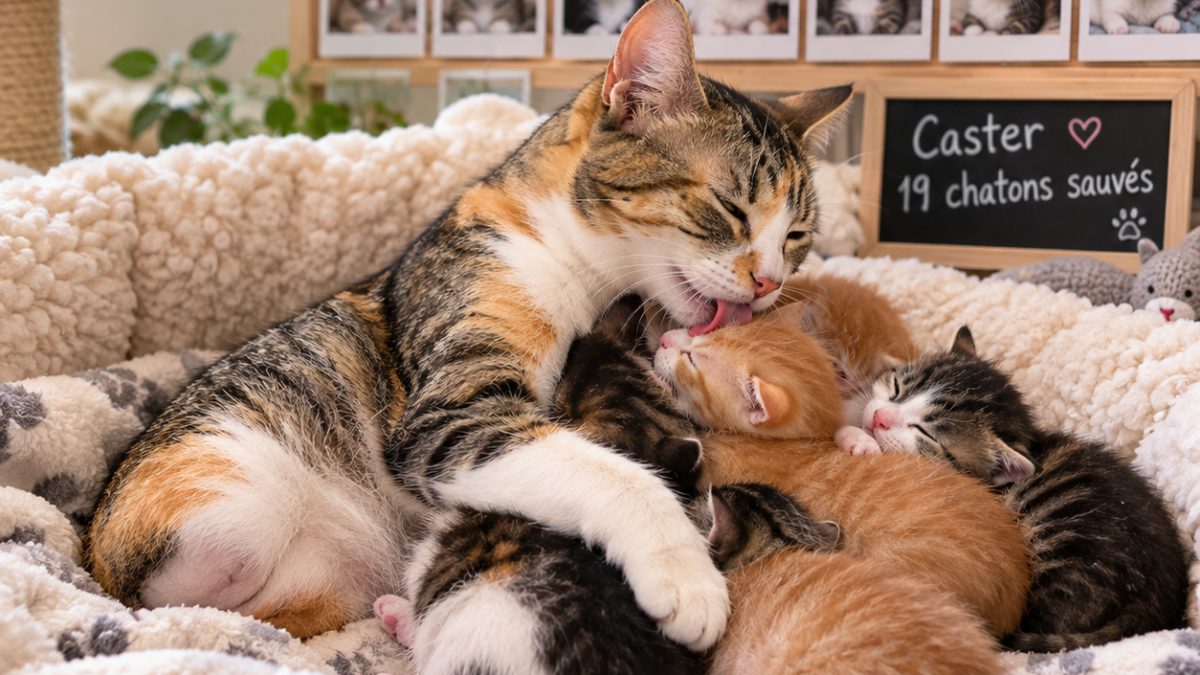
Her whole posture softened.
She wrapped her front limbs around them.
Those enormous shoulders that had developed because she had no hind legs became perfect for holding babies.
She shaped herself around them like a crescent.
One paw over their bodies.
Chin resting on their heads.
When they cried, she groomed them.
When they were cold, she pressed her torso against them.
When frightened, they crawled beneath her chest.
She would lower herself.
Stay completely still.
Some of those kittens had never known a mother.
They knew Caster.
That was enough.
People always asked:
“Do the kittens know she’s disabled?”
I never knew how to answer.
Know what?
They saw exactly who she was.
They watched her move using two legs.
They learned to walk normally using four.
They did not compare.
No kitten ever stopped and thought:
Mom does locomotion incorrectly.
They climbed on her.
Followed her.
Slept against her.
Copied her grooming.
Chased her across floors.
One kitten even started dragging himself behind her briefly because he appeared to think her method was a game.
He had four perfectly functional legs.
I had to laugh.
The kittens did not think Caster was missing something.
Adults did.
Humans entered my house and immediately said:
“Oh, poor baby.”
Caster hated that tone.
She would look at them, launch herself across the room at ridiculous speed, climb the couch, and stare down as if to say:
Poor who?
By age two, she’d raised fourteen kittens.
Fourteen.
Every one survived.
Every one was adopted.
Above Caster’s bed, I started hanging photographs.
Jasper.
Minnie.
Teddy.
Peaches.
Finn.
Lola.
Bean.
Charlie.
Smudge.
Rosie.
Archie.
Milo.
Poppy.
June.
Fourteen faces.
Different homes.
Different stories.
Caster kept none.
That part became harder for me to watch.
After every adoption, she became quiet for a day or two.
She checked sleeping spots.
Sniffed blankets.
Sometimes sat near the foster-room door.
Then another kitten eventually arrived.
Caster heard the cry.
And moved.
Every time.
No hesitation.
People like to say animals are pure because they don’t understand loss.
I don’t believe that.
Caster understood absence.
She just never let absence make her refuse the next one.
That is different.
At her two-year veterinary appointment, Dr. Lauren Matthews spent almost forty minutes examining her.
Shoulders.
Spine.
Skin.
Abdomen.
Joints.
Then she sat back.
“Incredible.”
“What?”
“Her body.”
Caster was stealing cotton balls from a counter.
“Please elaborate before she destroys your clinic.”
Lauren ran her hand over Caster’s shoulders.
“Feel this.”
I did.
Muscle.
Dense.
“Her forelimb and shoulder development is remarkable.”
“How remarkable?”
“For her size? Roughly multiple times what you’d expect in an average cat.”
Caster bit the cotton-ball bag.
Lauren took it away.
“She’s built a different biomechanics system.”
“That sounds expensive.”
“It will be.”
I looked at her.
“What do you mean?”
Lauren’s expression softened.
“Her spine is compensating.”
She showed me.
Curvature.
Postural adaptation.
The front half of her body carried everything.
“She’ll probably develop arthritis early.”
“How early?”
“Hard to know.”
Caster was two.
The thought hit too soon.
“Pain?”
“Eventually.”
“Now?”
“Some early stress signs, but nothing severe.”
“What do we do?”
Weight management.
Joint support.
Soft surfaces.
Monitor skin.
Routine exams.
Anti-inflammatory strategies later.
Caster had also developed thick protective calluses along the underside of her body.
Natural padding.
Her skin had adapted to years of contact with floors.
Lauren shook her head.
“She literally rebuilt herself.”
I looked at Caster.
She was trying to open a cabinet.
Lauren continued:
“Her whole body changed because moving required it.”
Then she looked at the foster photographs on my phone.
“And she used that strength to raise fourteen kittens.”
I smiled.
“Nobody told her she had a mission.”
Lauren said:
“Apparently nobody needed to.”
In late 2023, someone offered to adopt Caster.
A wonderful family.
Truly.
Not impulsive.
Not pity adoption.
They had researched mobility-disabled cats.
Large single-story house.
No other pets.
Ramps.
Soft flooring.
Financial resources for future medical care.
They met her twice.
Caster liked them.
I considered it.
Seriously.
Fosters are not supposed to keep every animal.
Our job is often letting go.
That family could have given her comfort I worried I might not always provide while managing neonatal fosters.
I spent three nights thinking.
Then another kitten arrived.
Tiny tabby.
Nine days old.
Mother killed by a car.
He screamed the moment I brought the carrier inside.
Caster was asleep.
Her head rose.
She heard one cry.
That was enough.
She crossed the living room.
Slower than when she was younger, but immediate.
Reached the foster area.
Looked up at me.
Open it.
I did.
Within sixty seconds, she had curled around the kitten.
He stopped crying.
That night I emailed the family.
I said no.
My friend asked:
“Why?”
“They’re perfect.”
“I know.”
“They can give her a house designed for her.”
“I know.”
“Then why keep her?”
I looked through the doorway.
Caster lay with the tabby pressed under one front leg.
“Because I think we’d be taking something away.”
“What?”
“Her work.”
My friend frowned.
“She isn’t working.”
“Yes, she is.”
“She can’t nurse them.”
“I know.”
“You do all the feeding.”
“Yes.”
“So what does she actually do?”
I looked at her.
“Everything I can’t.”
Warmth without equipment.
Touch without human hands.
Cat behavior.
Safety.
Belonging.
Then I said the sentence that finally clarified it for me.
“She isn’t a disabled cat fostering kittens.”
My friend waited.
“She’s a mother who happens to be missing her back legs.”
I knew that sounded sentimental.
It was also true.
I contacted the family and explained.
They understood.
One of them said:
“Then that’s where she belongs.”
I cried after hanging up.
By early 2025, Caster was approaching five.
Nineteen kittens.
That number still feels unreal.
Nineteen tiny animals who had lost mothers, littermates, homes, or all three.
Nineteen who learned comfort pressed against a cat with half the number of legs biology usually provides.
Caster had slowed.
Not dramatically.
But I saw it.
I knew her too well not to.
The living-room crossing took longer.
She rested between rooms.
Some mornings she stretched her shoulders before moving.
On cold days, she hesitated.
Arthritis beginning.
Lauren confirmed it.
Early.
As predicted.
We started medication as needed.
Joint support.
Warm bedding.
More rugs.
I built low ramps despite Caster’s opinion that ramps were an insult to her climbing ability.
The first time I showed her one beside the couch, she ignored it and climbed straight up the upholstery.
“Fine.”
She sat on the cushion.
“You’ve made your position clear.”
Two weeks later, when nobody was watching, she started using the ramp.
I pretended not to notice.
Dignity matters.
Her calluses had become thick.
Almost like leather.
The underside of her body told the history of every floor she had crossed.
Every kitten she had reached.
She no longer moved as quickly.
But the response never changed.
Cry.
Head up.
Move.
Every time.
The nineteenth kitten was named Oliver.
White with an orange tail.
Found alone behind a restaurant dumpster.
Maybe twelve days old.
Terrified.
Would not settle.
I brought him home.
Caster was asleep on a heated bed.
Oliver cried.
One sound.
Caster opened her eyes.
Then started moving.
Slow.
Pull.
Rest.
Pull.
I almost picked her up.
Stopped myself.
She hated that.
She crossed the entire room.
Oliver cried again.
Caster accelerated.
Not much.
Enough.
When she reached him, she wrapped both front legs around his body.
Oliver disappeared beneath her chest.
Silence.
I sat on the floor.
Caster groomed his head.
Again.
Again.
Again.
Her movements were slower now.
Same intention.
Oliver fell asleep.
I looked at the wall above her bed.
Nineteen photographs soon.
And suddenly I understood something that had taken five years.
When I first received Caster, everybody talked about what she would never do.
Never walk normally.
Never jump normally.
Never move like another cat.
Possible poor quality of life.
Possible complications.
Possible early arthritis.
All reasonable concerns.
Good veterinary concerns.
We needed to think about them.
But somewhere along the way, the list of things she lacked became completely irrelevant to the life she built.
Caster didn’t compensate by pretending she had four legs.
She created another way.
She used what she had.
Two front legs became four legs’ worth of strength.
Her chest became propulsion.
Her shoulders became engines.
Her body created calluses to protect itself.
Her spine changed.
She adapted.
Then she used that adapted body not merely to survive.
She used it to comfort others.
That distinction matters to me.
Survival is extraordinary.
But Caster did not stop there.
She had every reason, if cats reason about such things, to protect herself from attachment.
Her first experience of life was abandonment.
A tied plastic bag.
Three dead siblings.
Cold.
Hunger.
No mother.
She could have grown into a cat who wanted nothing near her.
Instead, every time another abandoned baby arrived, she moved toward it.
That is the part that breaks me.
Not the missing legs.
Not even the survival.
The direction.
Toward.
Always toward.
She had been thrown away.
She moved toward the abandoned.
She had been left cold.
She became warmth.
She had lost every sibling.
She became family.
She never had a mother teach her how to love kittens.
She became the mother.
People sometimes tell me:
“She doesn’t know she’s disabled.”
I disagree.
Caster knows exactly what her body can and cannot do.
She knows a jump requires planning.
She knows certain surfaces hurt.
She knows the couch used to be easier.
She knows some days she needs the ramp.
Animals understand bodies.
What she doesn’t know is the human story we attach to difference.
She does not know she is supposed to feel incomplete.
Neither did the kittens.
To Jasper, she was Mom.
To Minnie, Mom.
To Peaches and Finn, Mom.
To Oliver, Mom.
They didn’t count legs.
They counted warmth.
Safety.
Heartbeat.
Tongue washing their faces.
Front paws pulling them close when the world felt too large.
That’s how animals measure one another.
Maybe we could learn something.
The original plastic bag is long gone.
I wish I could say I kept it as some kind of symbol.
I didn’t.
It was biohazard trash.
It disappeared the first night.
Good.
Caster’s life should not be defined by the container someone tried to make her coffin.
Her story lives elsewhere.
Nineteen adoption photographs.
Nineteen families.
Messages.
“Jasper sleeps with our daughter every night.”
“Minnie learned to open cabinets.”
“Peaches is fourteen pounds now.”
“Poppy still kneads blankets exactly the way Caster taught her.”
Those are Caster’s legacy.
One year, a family brought one of her former fosters back to visit.
Finn.
Huge orange cat.
Nearly twice her size.
We were curious whether they would remember.
Cats don’t always respond to reunions the way people hope.
Finn came out of his carrier.
Looked around.
Saw Caster.
Stopped.
Caster lifted her head.
Finn walked toward her.
No drama.
No movie moment.
He simply lowered himself beside her.
Caster washed the top of his head.
Exactly as she had when he weighed less than a pound.
Finn closed his eyes.
I lost it.
His family cried too.
Someone whispered:
“He remembers his mom.”
Maybe.
Maybe he remembered scent.
Maybe familiarity.
Maybe nothing humans can name.
It didn’t matter.
For ten minutes, a giant adult cat became a kitten again.
Caster cleaned him.
Then got bored and left.
Very maternal.
I keep thinking about the person who tied that bag.
I don’t know who they were.
Never will.
I don’t know whether they knew one kitten was alive.
Whether they noticed she had no hind legs.
Whether that influenced their decision.
People ask whether I’m angry.
Yes.
Of course.
But anger toward an unknown person is useless after a point.
What matters is what happened next.
Someone noticed movement.
Someone climbed into a ditch.
Someone called a rescue.
A coordinator called me.
A veterinarian said forty-eight hours and treated her anyway.
I set alarms.
Caster drank.
Antibiotics worked.
She grew.
Then Jasper came.
Then another.
Then another.
A life can turn on very small decisions.
Untie the bag.
Answer the phone.
Say yes.
Feed one more time.
Wait one more night.
Give the strange little cat a chance to show you what her body can become.
Caster is older now.
Not old by normal cat standards.
But her body has worked harder.
We don’t pretend otherwise.
Her future will involve pain management.
Possibly more mobility support.
Maybe a custom cart if she accepts it.
Knowing Caster, she will hate it for two weeks, then use it only when nobody is watching.
We will adapt.
That’s what she taught me.
Sometimes I worry about the day she can no longer reach a crying kitten on her own.
I try not to live there yet.
Caster doesn’t.
She lives in the current kitten.
Current blanket.
Current meal.
Current patch of sunlight.
That is enough.
One evening not long ago, I sat beside her bed.
Oliver had been adopted that afternoon.
Nineteen.
The nineteenth photograph waited to be printed.
Caster was quiet.
She had checked the foster room twice.
Then returned to her heated bed.
I sat on the floor.
“Do you miss them?”
She looked at me.
Slow blink.
“I do.”
Nothing.
“You keep doing this.”
She started washing her paw.
“Every single time.”
No response.
“You know they’re leaving.”
Wash.
“And you love them anyway.”
She stopped.
Looked at me.
Then crawled into my lap.
Caster is terrible at philosophy.
Probably healthier.
I stroked her shoulders.
Those huge muscles.
Built from necessity.
Five years earlier, I could hold her entire body in one hand.
Eighty-eight grams.
Eyes closed.
Cold.
No hind legs.
Three dead siblings.
Less than forty-eight hours, maybe.
Now she filled my lap.
Strong.
Scarred by nothing visible except use.
A little gray showing near her face.
Nineteen kittens behind her.
Who knows how many ahead.
I thought about the veterinarian’s words from years ago.
Her body rebuilt itself around a life nobody could predict.
That’s true.
But the more important thing is what she built with it.
Family after family.
Kittens who arrived alone and left knowing what it meant to sleep against another heartbeat.
That’s what Caster did.
Nobody asked her.
Nobody trained her.
Nobody rewarded her.
She saw something small that needed comfort.
And moved toward it.
Every time.
That’s the whole story, really.
Not a miracle cat.
Not an inspirational disability story.
Not a lesson about overcoming.
Caster doesn’t care about inspiring anyone.
She’s a cat.
She steals chicken when I turn around.
She gets angry if breakfast is late.
She once knocked an entire container of formula off a counter and then sat in the powder like she had been framed.
She is stubborn.
Bossy.
Occasionally rude.
And completely herself.
That’s why I love her.
Her body is not a tragedy.
What happened to her was.
Being born different was not what hurt her.
Being thrown into a ditch was.
Those are not the same thing.
Caster survived the cruelty.
Then built a life far larger than the person who abandoned her could ever have imagined.
Nineteen kittens.
Nineteen families.
Nineteen small lives changed because the kitten nobody expected to survive became the cat other kittens ran to when they were afraid.
Maybe someday there will be twenty.
Maybe twenty-five.
Maybe nineteen will be the final number.
It doesn’t matter.
She has already done enough.
More than enough.
Every photograph above her bed proves it.
Sometimes visitors stand beneath them and count.
“One, two, three…”
They reach nineteen.
Then look down at Caster.
Usually she is asleep.
Front legs curled beneath her.
Body resting on the thick padding we use now.
They ask:
“Does she know those are all her babies?”
I always say:
“I don’t know.”
Because I don’t.
Then I look at the photographs.
And I think about all those kittens who arrived without mothers.
They cried.
Caster came.
They were cold.
Caster wrapped around them.
They were dirty.
Caster washed them.
They were afraid.
Caster lowered her chest over them and stayed until fear passed.
Then one by one, she watched them leave.
And when another cry came through the door, she got up again.
Maybe slowly now.
Maybe with arthritis.
Maybe with shoulders that have already done the work of four legs for nearly five years.
But she moves.
Toward.
Always toward.
Caster was born without back legs.
Someone once decided that meant her life was disposable.
Nineteen kittens would disagree.
To them, she was never the cat missing half her legs.
She was never disabled.
Never broken.
Never incomplete.
She was warmth.
She was safety.
She was the body they crawled beneath when the world felt frightening.
She was the tongue that cleaned their faces.
The paw that pulled them back.
The heartbeat they fell asleep listening to.
She was home.
And most of all—
she was Mom.

