She Was Born Without Back Legs and Expected to Die Within 48 Hours—Five Years Later, She Had Become the Foster Mom Who Raised 19 Orphaned Kittens.
PART3:
“Barely.”
“Breathing?”
“Yes.”
“Warm?”
“No.”
“Get her here.”
“Veterinarian first?”
“We’ll stabilize enough for transport. Then veterinarian.”
“Rebecca, they may recommend—”
“I know what they may recommend.”
I heard myself becoming sharper than I intended.
“Just bring her.”
Twenty-one minutes later, Megan pulled into my driveway.
She carried a small cardboard evidence box under her raincoat.
Not a carrier.
A box.
Inside, wrapped in a towel, was the smallest kitten I had ever seen.
Ninety grams.
Maybe less.
Wet white-and-gray fur.
Umbilical cord still attached.
Eyes sealed shut.
Her front legs moved weakly.
Behind her rib cage, her little body narrowed.
Then simply stopped.
No thighs.
No knees.
No feet.
Nothing.
My brain rejected it for a second.
I had seen amputations.
Spinal injuries.
Deformities.
But never this.
Megan whispered, “The other three were underneath her.”
I didn’t ask for details.
I already had too many.
I put the kitten beneath my sweatshirt against my skin.
She was cold enough that I flinched.
“Come on, baby.”
No sound.
I rubbed gently.
Not too much.
Newborns that cold have to be warmed slowly.
Megan watched.
“Anything?”
“Give her a minute.”
The kitten opened her mouth.
No cry came.
Her tiny front paw moved against my skin.
Megan looked away.
“Jesus.”
“Call Dr. Hernandez.”
“She opens at eight.”
“Call her cell.”
“You have her cell?”
“I foster neonatal kittens. Of course I have her cell.”
Dr. Elena Hernandez met us at the clinic thirty minutes later wearing sweatpants beneath a lab coat.
She weighed the kitten.
Eighty-nine grams.
Temperature dangerously low.
Severe dehydration.
Possible aspiration.
Early signs of infection around the umbilical area.
And then the congenital deformity.
Dr. Hernandez took radiographs once the kitten was warm enough.
She stared at them for a long time.
I stood beside her.
“What exactly are we looking at?”
“Bilateral hind-limb agenesis.”
“In English.”
“She was born without the structures that would normally form her hind legs.”
“Spine?”
“Mostly intact.”
“Pelvis?”
“Partially formed.”
“Organs?”
“We need imaging, but bladder and bowel function appear present.”
I looked at the tiny shape in the incubator.
“Can she live?”
Elena didn’t answer.
“Elena.”
“I don’t know.”
“That’s different from no.”
She gave me a look.
“Rebecca.”
“What?”
“She’s eighty-nine grams.”
“I know.”
“She’s severely chilled.”
“I know.”
“She has an infection.”
“I know.”
“And even if we stabilize all of that, we have no idea whether she can eventually eliminate normally, move without chronic injury, or live without pain.”
“I know.”
“You asked if she can live.”
“Yes.”
Elena looked at me.
“Maybe.”
That was enough.
“What do we do?”
She exhaled.
“Warmth.”
“Okay.”
“Antibiotics.”
“Okay.”
“Formula by syringe if she can swallow.”
“Okay.”
“Every ninety minutes.”
I nodded.
“Day and night.”
“I heard you.”
“For days.”
“Elena.”
She stopped.
“I said okay.”
She looked through the incubator door.
“You know she may die tonight.”
“Yes.”
“Or tomorrow.”
“Yes.”
“And if we determine she’s suffering—”
“I know.”
My voice softened.
“I am not asking you to keep her alive for me.”
Elena looked at me.
“I just don’t want somebody else to decide her whole life before she’s even warm.”
That was the beginning.
The first night, I slept eighteen minutes at a time.
I know because I kept a notebook.
6:45 a.m. — 1.2 mL formula.
8:15 — 1.4.
9:45 — 1.3.
Urinated with stimulation.
No stool.
Temperature improving.
11:15 — refused first attempt.
11:23 — 0.8 mL.
1:00 p.m. — 1.5.
She had no mother to stimulate her after feeding, so I did it with warm cotton.
No mother to keep her temperature stable, so I built a nest with heating pads beneath layers of fleece.
No siblings.
No heartbeat beside her except the little plush toy with a battery-operated pulse I put inside the incubator.
At 2:40 that first morning, she finally cried.
A tiny squeak.
It was the most beautiful sound I had ever heard.
I started crying.
My husband, David, appeared in the kitchen doorway wearing pajama pants.
“What happened?”
“She yelled at me.”
He stared.
“And that’s good?”
“Very.”
He looked inside the incubator.
The kitten squeaked again.
David smiled.
“She’s angry.”
“Excellent.”
“What are we calling her?”
“We aren’t.”
Rebecca Rule Number Four:
Never name the critical ones too early.
David knew the rule.
He also knew I broke it constantly.
He watched her pull herself forward using only her front paws.
“She moves like one of those little furniture wheels.”
I looked at him.
“What?”
“Casters.”
I looked down.
The kitten dragged herself forward another inch.
“Caster.”
David frowned.
“I was making a joke.”
“Too late.”
And that was her name.
Caster.
For twenty-two days, my world became ninety-minute intervals.
Feed.
Warm.
Stimulate.
Weigh.
Clean.
Sleep.
Repeat.
She developed pneumonia in the first week.
Elena warned me again.
“She may not make it.”
Caster made it.
At eleven days, one eye cracked open.
At twelve, the other.
At fifteen, she hissed at David when he picked her up.
He looked personally offended.
“I named you.”
“Technically you named a wheel.”
“She owes me.”
At three weeks, she weighed 224 grams.
Still far below where I wanted her.
But alive.
At four weeks, she did something nobody expected.
She tried to sit.
Her front paws spread wide.
Her tiny torso lifted.
Without back legs to stabilize her, she toppled sideways.
Then tried again.
And again.
And again.
David watched from the floor.
“She doesn’t know she’s missing anything.”
I shook my head.
“She knows she can’t do what the others do.”
“How?”
“Because she keeps trying.”
Caster learned to move before we could teach her.
She planted both front feet.
Pulled.
Dragged her body.
Reset.
Pulled again.
At first the motion looked exhausting.
Within weeks it became fast.
Her shoulders broadened.
Her front legs became unusually muscular.
Her claws learned traction.
I sewed little fleece sleeves to protect the skin beneath her pelvis.
She hated them.
She would pull them off with her teeth.
We tried padded drag bags.
She escaped those too.
Eventually we built a routine around what Caster herself preferred.
Soft surfaces.
Short distances.
Regular skin checks.
Protective balm.
Low furniture.
Ramps.
A specially designed litter tray with a shallow front edge.
The first time she used it independently, I screamed so loudly David thought somebody was injured.
I called Elena.
“She did it.”
“Who did what?”
“Caster used the litter box.”
There was a pause.
“You called me at ten forty at night for that?”
“Yes.”
Elena laughed.
“I’m hanging up.”
“You’re proud.”
“Extremely.”
At two months, Caster could cross my living room faster than some healthy kittens.
She couldn’t walk.
So she invented something else.
Pull.
Slide.
Pull.
Slide.
When excited, she almost hopped with her front half, dragging the rest behind her.
When she wanted onto the sofa, she climbed.
Not elegantly.
Front claws into fabric.
One paw higher.
Then the other.
Muscle.
Determination.
Gravity losing slowly.
The first time she reached my lap without help, I cried.
Caster bit my finger.
Apparently she considered the moment less emotional.
People online loved her.
Too much, sometimes.
I posted progress videos for donors who helped cover her medical care.
One video showed Caster crossing the room toward a toy mouse.
It spread farther than anything I had posted before.
Comments flooded in.
Inspirational.
Amazing.
Miracle cat.
Then others came.
Cruel.
“You should have put her down.”
“This is selfish.”
“Keeping a disabled animal alive for attention is abuse.”
“She can’t possibly have quality of life.”
I knew better than to read comments.
I read all of them.
One stayed with me.
You’re forcing this cat to suffer because you can’t let go.
That evening I sat beside Caster.
She was attacking a shoelace.
Not gently.
She seized it in her teeth and growled when I tried to take it.
David sat beside me.
“You’re reading comments again.”
“No.”
“Rebecca.”
I handed him my phone.
He read.
Then looked at Caster.
Caster launched herself at the shoelace and rolled halfway onto her back.
David said, “She looks devastated.”
“That’s not funny.”
“It is a little.”
“What if they’re right?”
“They aren’t.”
“How do you know?”
He pointed.
“Ask her.”
“She’s a cat.”
“Exactly.”
Caster dragged herself to my knee.
Climbed my pajama leg.
Bit my sleeve.
Then crawled into my lap and began purring.
David raised an eyebrow.
“Strong testimony.”
Still, I made an appointment with Elena.
Not because strangers knew more than us.
Because love can become biased.
I needed somebody who cared about Caster but wasn’t me.
Elena performed a full examination.
Skin.
Spine.
Bladder.
Bowels.
Musculoskeletal strain.
Shoulders.
Pain response.
She watched Caster move.
Climb.
Play.
Eat.
Use her litter box.
Then she sat across from me.
“Do you want the veterinary answer or the internet answer?”
“Veterinary.”
“She has challenges.”
“I know.”
“She’ll be at higher risk for shoulder and elbow arthritis.”
“Okay.”
“Skin irritation.”
“Okay.”
“Possible urinary complications as she ages.”
“Okay.”
“We’ll monitor.”
“Quality of life?”
Elena smiled.
“Excellent.”
I started crying.
She handed me a tissue.
“Stop letting people who have never met your cat diagnose her through a thirty-second video.”
“I know.”
“And stop pretending keeping her alive means we are obligated to keep her alive forever regardless of suffering.”
“I know.”
“Every month, we ask the same question.”
“Is she comfortable?”
“Exactly.”
Caster climbed onto Elena’s shoe.
Then began chewing the lace.
Elena sighed.
“For the record, she’s an awful patient.”
That became our agreement.
No heroics for the sake of a story.
No turning survival into an obligation.
If Caster hurt, we treated.
If treatment failed, we reassessed.
If quality of life disappeared, we would let her go.
Caster did not care about any of this.
She was busy becoming a cat.
A strange one.
An extremely opinionated one.
A cat who slept upside down.
A cat who loved rotisserie chicken.
A cat who hated closed doors.
A cat who stole bottle nipples from foster supplies.
And then, six months after she arrived, Milo came.
He was four weeks old.
Orange.
Found beside his dead mother near an industrial park.
He had been alone long enough that his body seemed permanently clenched.
Foster kittens cry differently depending on why they’re afraid.
Hungry cries are sharp.
Cold cries are repetitive.
Lonely cries have a rhythm I still can’t explain.
Milo had the lonely cry.
I fed him.
Held him.
Wrapped him.
Nothing worked.
He screamed whenever I put him down.
Caster was asleep in a fleece bed near the sofa.
At the first cry, one ear moved.
Second cry.
Her head lifted.
Third.
She looked at me.
“No.”
She pulled herself out of the bed.
“Caster.”
She began crossing the room.
Pull.
Slide.
Pull.
Slide.
“Leave him alone.”
Caster ignored me.
Milo screamed again.
She accelerated.
David looked up from his book.
“Where’s she going?”
“To annoy my new intake.”
Caster reached the kitten pen.
She pressed herself against the low mesh wall.
Milo saw her.
He stopped crying.
For maybe three seconds.
Then started again.
Caster scratched at the mesh.
I stared.
“No.”
Scratch.
“You are not getting in there.”
Scratch.
“Caster.”
David laughed.
“Good luck.”
I opened the pen.
Caster hauled herself inside.
Milo backed away.
He hissed.
Caster stopped.
I watched carefully.
She was young.
Strong.
Not aggressive, but I had never seen her around a kitten this small.
Milo hissed again.
Caster lowered herself.
Waited.
Then crawled forward.
She sniffed him.
Milo swatted at her face.
Caster did nothing.
He swatted again.
She leaned forward and licked his forehead.
One stroke.
Milo froze.
Caster licked him again.
Face.
Ear.
Top of head.
Milo’s body loosened.
She kept going.
For almost forty minutes.
I checked the clock because I could not believe it.
Caster groomed that filthy little orphan until his orange fur lay flat.
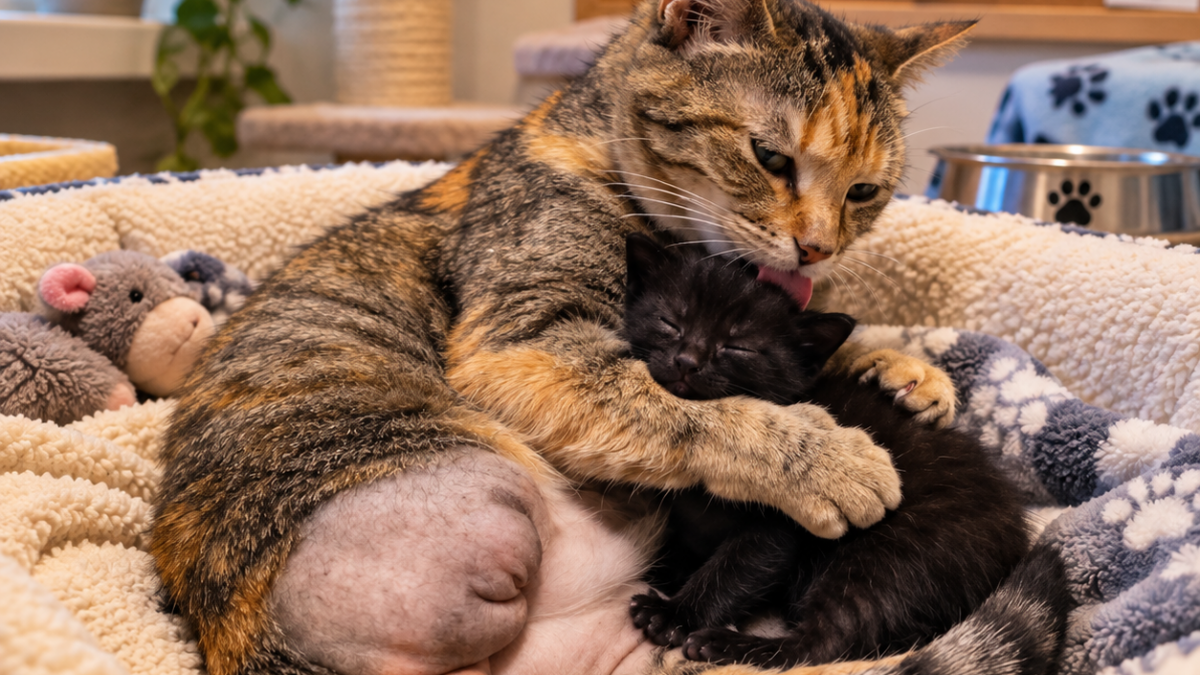
Then she curled her front legs around him.
Not accidentally.
Around him.
Milo buried his face against her chest.
And fell asleep.
David whispered:
“What the hell?”
I didn’t answer.
Caster had never had a mother long enough to learn that behavior.
If her mother had been present at all after birth, it could only have been hours.
Caster had been found sealed in a bag.
No adult cat had raised her.
I had.
And I definitely had not taught her how to wash a kitten’s ears.
Milo slept for three hours.
Caster barely moved.
That night she refused to sleep in her normal bed.
She slept with him.
The next morning Milo ate better.
Within days his constant crying stopped.
He began following Caster.
That was ridiculous because Caster moved in a way no kitten should have been able to imitate.
Milo tried anyway.
For a week, he sometimes dragged his own back legs behind him while playing.
David stared.
“Is he copying her?”
“Yes.”
“Should we stop him?”
“How?”
Milo eventually discovered that using all four legs was faster.
Caster seemed unoffended.
She taught him everything else.
Grooming.
Play boundaries.
How hard was too hard to bite.
Where the litter box was.
Why human ankles were excellent ambush targets.
At nine weeks, Milo went to his adoptive family.
I expected Caster not to care.
She cared.
She searched the kitten room.
Checked beneath the sofa.
Returned to the empty pen.
For two days she slept more.
She ate.
Played.
But less.
David said, “She misses him.”
I resisted.
“Or she likes the routine.”
“Rebecca.”
“What?”
“She misses him.”
I sat beside her.
“You knew he was leaving.”
Caster looked at me.
Obviously she had not known anything.
I scratched under her chin.
“This is foster care.”
She purred.
“We keep them until they don’t need us.”
Caster closed her eyes.
“Then we let them go.”
She didn’t approve.
Neither did I.
Three weeks later, Daisy arrived.
Black-and-white female.
Five weeks.
Found inside an abandoned shed.
The moment Daisy cried, Caster’s head lifted.
She crossed the room.
Less than a minute.
David checked his watch.
“Fifty-two seconds.”
“What?”
“From first cry to kitten.”
“You timed her?”
“Science.”
Daisy became number two.
Then Jasper and June.
Numbers three and four.
They had been bottle babies after their mother was hit by a car.
Caster slept between them.
June would crawl onto Caster’s back while Jasper tucked himself beneath her chin.
Number five was Pepper.
Pepper hated everyone.
Seven weeks old.
Feral enough to bite through leather gloves.
I spent days trying to get close.
Caster did not chase him.
She entered the room and lay ten feet away.
Pepper hissed.
Caster groomed herself.
Pepper growled.
Caster slept.
On the third night, Pepper crept closer.
On the fourth, he slept beside her.
On the fifth, he allowed me to touch him while his body remained pressed against Caster.
I whispered, “You’re cheating.”
Caster purred.
Pepper went home two weeks later.
Then came Lucy.
Then Bean.
Then twin tabbies Oliver and Owen.
Nine kittens.
Caster was two.
People began calling her “Mama Caster.”
I hated the name at first.
“She isn’t their mother.”
David gave me a look.
“I know.”
“She doesn’t nurse.”
“I know.”
“She’s spayed.”
“Yes.”
“She doesn’t—”
“Rebecca.”
“What?”
“You know motherhood isn’t exclusively lactation.”
I stared.
He smiled.
“Married a foster mother.”
I threw a dish towel at him.
Still, he was right.
Caster did the parts she could.
She warmed them.
Cleaned them.
Corrected rough play.
Slept beside them.
Stayed near the frightened ones.
When bottle babies woke screaming at two in the morning, sometimes Caster reached them before I did.
She would drag herself across the floor, climb into the pen, and start grooming.
By the time I arrived with formula, the kitten would be quieter.
I once joked:
“You are making me look unnecessary.”
Caster ignored me.
At three, we tried mobility wheels.
A veterinary rehabilitation specialist suggested a custom cart.
The logic made sense.
Reduce strain on shoulders.
Improve mobility.
We raised money.
Measurements were taken.
The cart arrived.
Bright aluminum frame.
Tiny wheels.
Harness.
A marvel of engineering.
Caster hated it with the passion of a thousand suns.
We put her in.
She froze.
Then tried to back out.
Then screamed.
Not cried.
Screamed.
I removed it immediately.
The rehabilitation specialist laughed.
“Okay.”
“That lasted twelve seconds.”
“We can acclimate slowly.”
We tried.
Treats.
Short sessions.
Positive reinforcement.
Caster learned exactly one thing:
If she saw the cart, she could hide under the couch.
After three weeks, Elena said:
“Stop.”
“What about her joints?”
“We manage them another way.”
“But the cart—”
“Is for her.”
“I know.”
“Not for us to feel clever.”
That hit.
We put the cart away.
Caster resumed sliding across the house.
Her choice.
We adapted around her.
Rubber runners.
Low ramps.
Protective mats.
Joint supplements.
Physical therapy.
Massage.
The rehabilitation specialist worked on shoulder flexibility.
Caster tolerated treatment if bribed with chicken.
Number ten was Charlie.
Charlie almost killed her.
Not intentionally.
He had panleukopenia.
We did not know immediately.
By the time symptoms appeared, he had already been in our home.
Caster had been exposed.
Charlie went into isolation.
Emergency care.
He died thirty-six hours later.
I sat in the clinic parking lot afterward holding an empty carrier.
That never gets easier.
People assume experienced fosters become tough.
We don’t.
We become functional while devastated.
There is a difference.
When I came home, Caster searched the carrier.
Then the house.
Then the kitten room.
She smelled Charlie’s bedding.
I had not yet washed it.
She sat beside it for almost an hour.
My heart broke.
Then Caster developed a fever.
I panicked.
Elena admitted her immediately.
Tests.
Fluids.
Monitoring.
Caster had been vaccinated, but I knew nothing was certain.
For three days she stayed at the hospital.
I visited twice daily.
She hated the kennel.
Hated the IV.
Hated me for leaving her.
On day three, her temperature normalized.
Tests remained negative.
Elena sent her home.
I sat in my car with Caster inside the carrier and cried from relief.
She yelled at me the whole drive.
I had never been happier to hear her complain.
After Charlie, I almost stopped fostering.
Not because of Caster.
Because of me.
“I can’t keep doing this.”
David sat across from me at the kitchen table.
“You say that every time one dies.”
“This was different.”
“Because Caster was at risk.”
“Yes.”
He nodded.
“That matters.”
“What if the next kitten brings something worse?”
“We quarantine properly.”
“What if quarantine fails?”
“We talk to Elena.”
“What if—”
“Rebecca.”
I stopped.
“You don’t have to foster forever.”
“I know.”
“Caster doesn’t have to either.”
“I know.”
“So take a break.”
We did.
Two months.
No kittens.
The house was quiet.
Caster seemed fine.
She played.
Slept.
Demanded food.
Then the rescue called.
A three-week-old kitten.
Mother dead.
No foster available.
I said no.
Then heard crying through the phone.
Caster heard it too.
She was across the room.
Her head lifted.
She moved toward my phone.
I stared at her.
David stared at me.
“Don’t.”
“I didn’t say anything.”
“You have the face.”
“What face?”
“The foster face.”
I looked at Caster.
She scratched at my leg.
The kitten cried again through the speaker.
Caster became frantic.
I closed my eyes.
“Bring him.”
Number eleven was Theo.
Caster reached him forty-seven seconds after his carrier entered the house.
David timed it.
Of course.
She groomed him for twenty-three minutes.
Then slept with one paw across his neck.
I finally understood something.
Fostering was not only something I was asking Caster to do.
She wanted it.
Not in some mystical destiny way.
Not because she understood rescue statistics.
She heard babies.
She moved toward them.
Simple.
That distinction became important when people began offering to adopt her.
Caster’s story had spread.
Videos of her with kittens reached huge audiences.
One showed three babies piled around her while she cleaned the smallest.
Another showed a kitten trying to imitate her sliding gait.
One showed Caster hauling herself across the room when a new arrival cried.
People wrote from everywhere.
“I’ll adopt her.”
“She deserves a real home.”
“Please stop making her work.”
That one made me angry.
Work.
As if she punched a time card.
As if I placed kittens beside her for content.
One family seemed genuinely wonderful.
Quiet home.
No stairs.
Experience with disabled animals.
Financial resources.
Excellent veterinarian.
They lived forty minutes away.
The woman, Denise, visited twice.
Caster liked her.
I considered it.
Really considered it.
After all, foster animals are supposed to leave.
I had failed foster 101 years ago with Caster.
She had become ours.
But maybe an even better home existed.
A home without constant new kittens.
Less disease exposure.
Less disruption.
More individual attention.
Denise said:
“She can retire.”
I remember the word.
Retire.
It sounded kind.
I discussed it with Elena.
“With her age and joints, quieter might eventually make sense.”
“So you think she should go?”
“I didn’t say that.”
“What are you saying?”
“Watch the cat.”
That was Elena’s answer to everything.
Watch the cat.
So I did.
The night before Denise’s third visit, an emergency foster arrived.
Two kittens.
About four weeks.
One badly underweight.
They began crying from the carrier.
Caster was asleep in my bedroom.
She woke.
Crossed the hallway.
Entered the kitchen.
Forty-nine seconds.
She pulled herself toward the carrier with such force that one protective pad slipped off.
I picked her up.
“Slow down.”
She struggled.
I put her beside the kittens.
Instant quiet.
The next afternoon Denise came.
Caster was lying with both babies beneath her front legs.
Denise watched for a long time.
Then said:
“I understand.”
I looked at her.
“You don’t have to—”
“No.”
She smiled.
“She shouldn’t come with me.”
I felt both relief and guilt.
“Are you sure?”
“I wanted to rescue her.”
Denise watched Caster clean one kitten’s face.
“Looks like she’s busy rescuing everybody else.”
Caster stayed.
Not because I believed she had been born for a mission.
I don’t like that idea.
It can turn suffering into destiny.
Caster did not lose half her body so she could inspire us.
Her littermates did not die so she could become extraordinary.
Bad things do not need to happen for a reason.
Sometimes they simply happen.
What mattered was what Caster did with the life that remained.
Number twelve was Pip.
Number thirteen, Hazel.
Fourteen and fifteen were brothers named Sam and Dean by a volunteer who watched too much television.
Caster raised both until they were ten weeks old.
Sam was adopted first.
Dean cried that night.
Caster slept nose-to-nose with him until morning.
He went home two days later.
Caster searched for them.
Again.
Every time.
That part never changed.
After an adoption, she became quiet.
Sometimes one day.
Sometimes three.
She checked rooms.
Sniffed empty beds.
Waited.
Then life resumed.
I occasionally wondered whether fostering was unfair to her.
Give her babies.
Let her attach.
Take them away.
Repeat.
So I asked the question I always asked.
Not the internet.
Not myself.
The cat.
Was she eating?
Yes.
Playing?
Yes.
Seeking kittens voluntarily?
Always.
Sleeping comfortably?
Yes.
Engaging with us?
Absolutely.
Pain?
Managed.
Quality of life?
Good.
Then number sixteen arrived.
Her name was Willow.
Tiny gray female.
Born with a twisted front paw.
The rescue coordinator laughed when she called.
“I have a special one for your special one.”
I hated the wording.
Then I met Willow.
Her paw turned inward at the wrist.
She could walk.
Awkwardly.
Veterinary evaluation suggested she might improve with therapy.
Caster saw her.
No reaction to the leg.
Of course not.
Why would there be?
Willow climbed directly onto Caster’s back.
Caster looked offended.
I laughed.
“You have no idea that you’re supposed to think she’s different, do you?”
Caster cleaned Willow’s ear.
For six weeks, Willow followed her everywhere.
The funniest part was watching Willow develop Caster’s confidence.
A kitten with a visible deformity who entered hesitant became the boldest animal in the house.
She attacked toys.
Climbed furniture.
Terrorized David’s shoelaces.
When Willow went to an adoption event, people asked about her paw.
Some hesitated.
Then a ten-year-old boy sat on the floor.
Willow climbed him like a tree.
He shouted:
“This one!”
His mother asked:
“Don’t you want to see the others?”
“No.”
“But her foot—”
The boy shrugged.
“She can climb me.”
Willow went home.
I came back carrying an empty carrier.
Caster sniffed it.
Walked away.
Then slept most of the afternoon.
Number seventeen nearly became a permanent resident.
Benny.
Black kitten.
Three weeks old.
Found inside a storm drain.
He bonded to Caster harder than any before.
At twelve weeks, he was still sleeping against her.
I delayed adoption once.
Then twice.
David finally said:
“You are the problem.”
“What?”
“He’s ready.”
“He’s attached.”
“To Caster.”
“Exactly.”
“He can attach to somebody else.”
“How do you know?”
“That is literally foster care.”
I hated when my husband used my own speeches against me.
A family applied.
Two children.
Gentle.
Experienced with cats.
Benny loved them during the meeting.
I approved the adoption.
The night before he left, I slept on the floor near Caster and Benny.
I told them both:
“This is stupid. Neither of you understands me.”
Benny stepped on my face.
Caster purred.
The next day, Benny left.
Caster did not eat dinner.
I sat beside her.
“I know.”
No response.
“He has a family.”
Caster stared toward the hallway.
“He’s going to sleep in a twelve-year-old girl’s bed.”
Nothing.
“They bought him a cat tree that cost more than my first car.”
Caster lowered her head.
“You did your job.”
I hated the word the moment I said it.
Job.
I corrected myself.
“You helped him.”
Caster closed her eyes.
Three days later, she was herself again.
Number eighteen arrived when Caster was four and a half.
A fragile tortoiseshell named Birdie.
Birdie had severe diarrhea.
Not contagious.
Nutritional.
She was weak.
Caster usually groomed babies relentlessly.
With Birdie, she did something different.
She lay beside her.
Didn’t overwhelm.
Didn’t climb over.
Just contact.
Birdie slept pressed against Caster’s chest.
Her recovery took weeks.
When she finally began playing, Caster tolerated attacks on her ears, tail, and face with the patience of a saint.
Except once.
Birdie bit her nose.
Caster slapped her gently.
Birdie looked shocked.
I laughed for five minutes.
“Motherhood has limits.”
Birdie went home in December.
Caster was approaching five.
Her shoulders had begun showing the first signs of wear.
Elena noticed before I did.
“She’s compensating differently.”
“What does that mean?”
“Less range through the left shoulder.”
“Arthritis?”
“Early.”
My stomach tightened.
“What do we do?”
“Medication when needed.”
“Physical therapy.”
“Yes.”
“Swimming?”
Elena looked at me.
“Have you met your cat?”
“Good point.”
Caster hated water.
We began laser therapy.
Gentle stretching.
Weight management.
More padded surfaces.
I started carrying her longer distances.
Caster hated that too.
She wanted independence.
If I picked her up while she was traveling somewhere, she’d squirm until I returned her to the floor.
“Your joints are old.”
She stared at me.
“You are five.”
Stare.
“That’s young for normal cats.”
Caster pulled away.
“Fine.”
She crossed the hallway herself.
Slower now.
Still determined.
Then came number nineteen.
January.
Cold.
A shelter employee called at 11:40 p.m.
“One kitten.”
“How old?”
“About five weeks.”
“Medical?”
“Stable.”
“Why me?”
Silence.
That meant something.
“What happened?”
“Owner surrender.”
“A kitten?”
“Man found him under his porch. Tried keeping him. His landlord threatened eviction.”
“Social?”
“Terrified.”
I rubbed my eyes.
Caster was asleep beside David.
“We’re supposed to be reducing fosters.”
“I know.”
“Her shoulders.”
“I know.”
“No neonates.”
“He’s eating independently.”
“No sick kittens.”
“Healthy.”
I hesitated.
Then heard it.
Crying.
Through the phone.
Caster’s head lifted.
David opened one eye.
“No.”
I whispered:
“I haven’t said yes.”
Caster dragged herself off the bed.
David sat up.
“She heard the phone?”
“Apparently.”
Caster started toward the bedroom door.
Slower.
Pull.
Slide.
Pull.
Slide.
The kitten cried again.
Caster moved faster.
David looked at me.
“She’s going to the front door.”
I sighed.
“Bring him.”
The kitten arrived after midnight.
Small brown tabby.
Huge ears.
We named him Scout.
The moment I opened the carrier, he backed into the corner.
Caster entered the room.
She took fifty-eight seconds to cross it.
Slower than before.
Still under a minute.
Scout hissed.
Caster stopped.
Scout growled.
Caster lay down.
No challenge.
No pressure.
Just presence.
Ten minutes.
Twenty.
Scout crept forward.
He sniffed Caster’s front paw.
She licked his forehead.
He jumped.
Then returned.
Caster groomed him slowly.
Eventually he crawled beneath her front leg.
She wrapped both paws around him.
I sat on the floor.
David beside me.
Neither of us spoke.
Nineteen.
Nineteen kittens.
Some bottle fed.
Some feral.
Some injured.
Some simply scared.
Nineteen animals who arrived without mothers.
Nineteen who learned sleep against the body of a cat who had never possessed two rear legs herself.
Scout became Caster’s last foster kitten.
I did not know that then.
Two weeks later, Caster woke crying.
Not kitten crying.
Pain.
I found her near the litter box.
She had moved only a few feet.
Her left shoulder trembled.
My stomach dropped.
Emergency appointment.
Radiographs.
Progression of arthritis.
Soft tissue strain.
Nothing catastrophic.
But Elena looked serious.
“Her body is telling us something.”
I knew.
“No more constant long-distance dragging.”
“Yes.”
“More carrying.”
“If she’ll allow it.”
“She won’t.”
“Then negotiate.”
“And fosters?”
Elena did not answer immediately.
I looked at her.
“Say it.”
“I think we retire her from active fostering.”
The word again.
Retire.
Years earlier I had rejected it.
Now it landed differently.
“Completely?”
“At least until she’s pain-free.”
I nodded.
Scout remained with us through recovery because separating them suddenly seemed unnecessary.
Caster received anti-inflammatory medication.
Rest.
Therapy.
More padding.
Within days she improved.
But when Scout cried from the next room, she still tried to cross.
I carried her.
Set her beside him.
That became the compromise.
Caster no longer ran to the kittens.
We brought safe kittens to her.
Scout went home at eleven weeks.
His adopter was a pediatric physical therapist named Jenna.
During the meeting, Jenna watched Caster moving.
“She doesn’t use a cart?”
“No.”
“Hates it.”
“Smart cat.”
“Why?”
“Half my patients hate the devices adults think are perfect for them.”
I laughed.
Jenna adopted Scout.
Before leaving, Scout ran back to Caster.
He shoved his head beneath her chin.
Caster washed his face.
Long.
Slow.
Then Scout was placed in his carrier.
Caster watched him leave.
Number nineteen.
The house became quiet.
Too quiet.
For a week, Caster searched.
Then settled.
No new foster came.
Not immediately.
We had promised Elena.
One month.
Two.
Caster’s shoulders improved.
She spent more time in windows.
More time asleep on my lap.
Less time crossing the entire house unnecessarily.
I expected her to seem relieved.
She seemed bored.
Then a kitten arrived for only one night.
Not officially ours.
A foster’s car had broken down during transfer.
Four-week-old female.
Healthy.
Just needed somewhere safe until morning.
The kitten cried.
Caster woke.
She tried to move.
I picked her up.
“You’re retired.”
She struggled toward the sound.
“Caster.”
She looked at me.
I sighed.
I carried her to the kitten.
Set her down.
Caster immediately pulled the baby beneath her front legs.
David laughed.
“Retirement going well.”
“Shut up.”
That was how we learned retirement didn’t need to mean removing the thing she loved.
It meant changing how she did it.
Caster no longer crossed entire rooms.
We transported babies to her.
Short supervised visits.
Healthy kittens only.
No high-risk infectious cases.
No overnight chaos unless necessary.
She groomed.
Held.
Comforted.
Then slept.
Her body had adapted once.
Now our home adapted again.
At five years old, Caster was not elderly.
But her front body had done the work of four legs.
Her shoulders looked like those of an athlete.
Her chest broad.
Front paws powerful.
The skin beneath her abdomen had thickened where years of movement created friction.
I checked it every night.
Moisturizer.
Pads.
Massage.
She still climbed onto my lap occasionally without help.
It took longer.
I never helped unless she asked.
That mattered.
People with disabled animals hear the same sentence constantly.
“Poor thing.”
I stopped allowing it in my house.
Not because Caster’s life was effortless.
It wasn’t.
Disability was real.
Her limitations were real.
Pain management was real.
Accessibility mattered.
But pity flattened her into one fact.
No back legs.
It erased everything else.
Stubborn.
Affectionate on her schedule.
Excellent with kittens.
Terrible with houseplants.
Chicken thief.
Veterinary menace.
Professional shoelace destroyer.
My cat.
Caster.
One afternoon, a local reporter came to interview me after a rescue group nominated Caster for an animal-welfare award.
I almost refused.
Then they promised the story would focus on special-needs foster care rather than “inspiration.”
The reporter sat in my living room.
Caster slept beside me.
She asked:
“Do you think Caster knows she’s disabled?”
I hated the question.
I tried not to show it.
“She knows her body.”
The reporter waited.
“She knows what she can reach.”
“What she can’t.”
“She knows when something hurts.”
“She knows stairs require help.”
“She knows climbing the couch takes work.”
I stroked Caster’s head.
“What I don’t think she knows is that humans have created a ranking system for bodies.”
The reporter became quiet.
“She doesn’t know another cat is considered more complete.”
I looked toward the foster room.
“She doesn’t know she’s supposed to be tragic.”
“Do the kittens notice?”
“They notice how she moves.”
The reporter smiled.
“So they do notice.”
“Of course.”
I nodded.
“Animals aren’t blind.”
“Then what do people mean when they say the kittens don’t notice she’s different?”
I thought.
“They mean the kittens don’t attach moral meaning to it.”
The reporter wrote that down.
“What does that mean?”
“A kitten doesn’t look at Caster and think less.”
“Or brave.”
“Or inspirational.”
“Or broken.”
“It thinks…”
I smiled.
“Warm.”
“Safe.”
“Smells like cat.”
“Cleans my face.”
“Lets me sleep here.”
“That’s enough.”
The article came out the following Sunday.
The headline wasn’t terrible.
THE CAT WHO COULDN’T WALK BUT TAUGHT 19 ORPHANS HOW TO FEEL SAFE.
I still rolled my eyes.
David framed it.
Traitor.
The article brought donations to our rescue.
Enough to fund neonatal supplies for a year.
More importantly, three people applied to foster special-needs cats.
One adopted a three-legged kitten.
Another took a blind senior cat.
A third became an emergency bottle feeder.
Caster did not know.
She was busy sleeping.
That spring marked five years since the plastic bag.
Megan still worked animal control.
She came over.
Brought a small gift.
A silver tag for Caster’s collar.
Front:
CASTER.
Back:
19 BABIES AND COUNTING.
I laughed.
“She is not counting.”
“I am.”
Megan sat on the floor.
Caster pulled herself toward her.
“Do you ever think about that morning?”
I did.
All the time.
The bag.
Three bodies.
One cold kitten.
Eighty-nine grams.
“They threw her away.”
Megan nodded.
“Whoever did it.”
We never found them.
No camera.
No witnesses.
No identification.
Nothing.
For years, that had bothered me more than I admitted.
I wanted justice.
A name.
A charge.
Someone forced to look at what they had done.
Then one day I realized I had spent more emotional energy imagining punishment than Caster had ever spent on the past.
Not because accountability didn’t matter.
It did.
Because Caster did not live backward.
She couldn’t.
Animals rarely do in the way humans can.
They carry fear.
Associations.
Trauma.
But not narratives about what should have happened.
Caster’s life was what was in front of her.
Warm bed.
Food.
My voice.
David’s lap.
A crying kitten.
That simplicity did not make her less intelligent.
Sometimes I thought it made her wiser than me.
Megan scratched beneath Caster’s chin.
“Three of them died.”
“I know.”
“And this one…”
She shook her head.
“Five years.”
I smiled.
“She was supposed to have forty-eight hours.”
Caster bit Megan gently.
Megan laughed.
“Still rude.”
“Extremely.”
We celebrated Caster’s fifth birthday with chicken.
No cake.
She would have considered cake an insult.
Elena came.
So did Jenna with Scout.
Milo’s family sent a photograph.
So did Willow’s.
Benny’s.
Pepper’s.
Families began sending updates once they heard about the anniversary.
Nineteen photographs.
Not all at once.
But enough.
Adult cats.
Healthy.
Sleeping on beds.
Windowsills.
Children’s laps.
One stretched across a keyboard.
Another wearing a ridiculous holiday sweater.
Scout was huge.
David stared.
“He was tiny.”
“They all were.”
I arranged the photos across the dining table.
Caster lay nearby.
I looked at them.
Nineteen.
“You don’t know any of this, do you?”
Caster cleaned her paw.
“Milo has a screened porch.”
Nothing.
“Willow’s family built her ramps.”
Nothing.
“Pepper still hates strangers.”
Caster stopped and looked at me.
“Yeah, that tracks.”
I touched her shoulder.
“Every one of them got home.”
Caster leaned into my hand.
“Because of you?”
That would have made a better story.
It also would not have been true.
They were saved by many people.
Animal control.
Veterinarians.
Donors.
Fosters.
Adopters.
Drivers.
Shelter technicians.
Caster did one part.
An important part.
She taught frightened babies that contact could be safe.
That first night could end.
That another heartbeat could be nearby.
That mattered.
But I refused to turn her into a miracle that erased everybody else.
Caster herself had survived for the same reason.
Not because she was uniquely brave.
Because Megan stopped.
Because Elena treated.
Because donors paid.
Because I fed her every ninety minutes.
Because David built ramps.
Because people showed up.
Courage matters.
Care matters too.
Maybe more.
That became the lesson Caster gave me.
People loved saying:
“She never gave up.”
But Caster was a newborn.
She didn’t make some conscious heroic decision in that bag.
Her body kept breathing.
Then humans intervened.
Later, yes, she persisted.
Adapted.
Climbed.
Moved.
Mothered.
But survival had never been an individual achievement.
Nobody survives entirely alone.
Not Caster.
Not her nineteen kittens.
Not us.
A few months after her fifth birthday, something happened that frightened me more than her arthritis.
Caster developed a urinary blockage.
Rare in females.
Possible with her anatomy and mobility issues.
She stopped urinating properly.
Became restless.
Then lethargic.
I recognized danger.
Emergency clinic.
Catheterization.
Imaging.
Hospitalization.
I sat in the same waiting room where, five years earlier, Elena told me she might not survive two days.
Elena came out after midnight.
“She’s stable.”
I exhaled.
“Cause?”
“Inflammation. Possibly mobility-related pressure and bladder emptying issues.”
“Permanent?”
“Too early to know.”
“Surgery?”
“Not yet.”
“Pain?”
“Controlled.”
I nodded.
Then asked the question.
“Quality of life?”
Elena sat beside me.
“Rebecca.”
“I need you to say it.”
“Right now?”
“Yes.”
“Still worth treating.”
I cried.
Again.
Elena had seen me cry over this cat in every possible room.
Caster came home two days later.
New urinary management.
More frequent checks.
A bladder expression technique I had to learn.
Caster hated it.
Obviously.
We adapted.
Again.
That word defined her life.
Not overcome.
Not conquer.
Adapt.
Something changes.
You change with it.
A month later, a two-week-old orphan arrived at the rescue.
I said no.
Not because of Caster.
Because I was tired.
Another foster took him.
Good.
That mattered too.
Learning that you are not the only person capable of helping.
Caster slept beside me.
For once, no kitten cried.
I looked at her.
“Maybe we’re done.”
She purred.
“Five years.”
Nothing.
“Nineteen babies.”
She stretched.
“You’ve done enough.”
Caster opened one eye.
I wondered if humans ever truly believe that sentence about ourselves.
Done enough.
Helped enough.
Loved enough.
Rest now.
Caster seemed to.
She retired slowly.
Not ceremonially.
No final litter.
No announcement.
She simply had fewer foster encounters.
Sometimes a kitten visited for an hour.
Sometimes none for months.
She became Aunt Caster to younger foster cats.
She spent mornings in sunlight.
Afternoons sleeping on my chest while I worked.
Evenings yelling at David for chicken.
Her world grew quieter.
Not smaller.
Quieter.
Scout visited once a year.
He still shoved his head beneath her front leg.
Caster still cleaned him.
Even though he outweighed her.
At six, if we were lucky enough to get there, I knew arthritis would progress.
At seven, perhaps more.
Nobody could promise.
That used to frighten me.
Now I understood.
Caster’s entire life had been built without promises.
Forty-eight hours became a week.
A week became a month.
A month became five years.
Nineteen kittens.
Thousands of feedings.
Countless naps.
One ruined sofa.
Two destroyed houseplants.
Three custom mobility devices she refused.
Four veterinarians she had bitten.
And more love than the plastic bag at the beginning had any right to predict.
Sometimes people still write to me.
“My disabled kitten was just diagnosed. Should I euthanize?”
I never answer yes or no.
Not from a message.
I tell them:
Find a veterinarian who understands disability.
Assess pain honestly.
Assess function honestly.
Don’t confuse inconvenience with suffering.
Don’t confuse survival with quality of life either.
Adapt the environment.
Then watch the animal.
Watch what they choose.
Food.
Play.
Connection.
Curiosity.
Comfort.
Rest.
Joy.
Caster taught me that quality of life isn’t measured by how closely a body resembles the body we expected.
It is measured by whether that life still contains things worth waking up for.
Caster always had things worth waking up for.
Chicken.
Sunlight.
My lap.
And, for five extraordinary years, crying kittens.
One evening, long after Scout had been adopted, David and I sat on the living-room floor with Caster between us.
No foster kittens.
No cameras.
No article.
No big lesson.
Just rain outside.
Caster’s head rested on my leg.
David scratched her shoulder carefully.
“You realize she has no idea she’s famous.”
“Good.”
“No idea about nineteen kittens.”
“Nope.”
“No idea people call her inspirational.”
“She would hate that.”
“She hates most things.”
“True.”
He smiled.
“Do you think she misses fostering?”
I looked at Caster.
A kitten video played faintly from my phone.
A cry sounded.
Caster’s ears lifted.
She looked toward it.
David laughed.
“There’s your answer.”
I turned off the phone.
“No.”
Caster stared at me.
“You are retired.”
She scratched my leg.
David burst out laughing.
“Absolutely not.”
Scratch.
“Caster.”
Scratch.
I picked her up.
Carried her toward the foster room.
There were no kittens.
She looked around.
Then back at me.
I felt guilty.
“You heard a video.”
Caster meowed.
“I know.”
I held her against my chest.
Her front paws wrapped around my neck.
Strong.
Still strong.
I thought of the first kitten.
Milo.
The tiny orange body disappearing beneath those same paws.
I thought of Willow’s twisted leg.
Pepper’s terror.
Charlie’s empty carrier.
Benny’s goodbye.
Scout’s last grooming.
Nineteen beginnings.
Caster had never given birth.
Never nursed.
Never experienced the biology people often use to define motherhood.
But she had done the part that mattered to nineteen frightened animals.
She stayed close enough that they could sleep.
Maybe that was motherhood too.
Maybe it was fostering.
Maybe it was instinct.
Maybe none of the labels mattered.
I carried her back to the sofa.
She settled against me.
Outside, rain fell harder.
A ditch somewhere filled with water.
Five years earlier, a plastic bag had been found beside one.
I used to think about that bag as the beginning of Caster’s story.
I don’t anymore.
The bag was something somebody did to her.
It doesn’t deserve ownership of the opening.
Her story began when Megan heard something alive inside.
When she opened it.
When an eighty-nine-gram kitten took another breath.
When someone decided the next minute was still worth trying.
That’s the beginning I choose.
Not abandonment.
Discovery.
Not what was missing.
What remained.
Two front paws.
One beating heart.
One furious little voice.
Enough.
Caster never grew back the body nature had not given her.
She never needed to.
Her front legs grew strong enough to carry her.
Then strong enough to wrap around Milo.
Daisy.
Jasper.
June.
Pepper.
Lucy.
Bean.
Oliver.
Owen.
Charlie.
Theo.
Pip.
Hazel.
Sam.
Dean.
Willow.
Benny.
Birdie.
Scout.
Nineteen.
Some of them had four perfect legs.
Some didn’t.
None cared how many Caster had.
They knew her smell.
Her warmth.
Her tongue washing formula from their faces.
The weight of one paw over their shoulders at night.
They knew that when they cried, she came.
Sometimes quickly.
Sometimes slowly.
Eventually being carried when her own joints grew tired.
But she came.
That is what I remember when someone calls her inspirational.
Not that she conquered disability.
She didn’t.
She lived with it.
Every day.
Not that pain never touched her.
It did.
Not that love magically fixed her body.
It didn’t.
The miracle—if you need that word—was much smaller.
She kept having a life.
A real one.
Messy.
Funny.
Frustrating.
Useful.
Loved.
And within that life, nineteen smaller animals found something they desperately needed.
Not an inspirational symbol.
Not a lesson in courage.
A warm body in the dark.
A tongue cleaning their face.
Two front legs wrapping around them.
A heartbeat saying:
You can sleep now.
You are not alone.
Sometimes I wonder what Caster would have become if she had been born with four legs.
Maybe exactly the same cat.
Maybe she still would have mothered every orphan.
Maybe not.
We’ll never know.
And I am glad.
Because her value has never depended on imagining a version of her that was more complete.
Caster was never half a cat.
Not for one second.
She was exactly one Caster.
Stubborn enough for three cats.
Strong enough for nineteen kittens.
And loved enough that nobody who met her ever again looked at a disabled animal quite the same way.
The person who abandoned that plastic bag saw four newborn kittens whose lives were inconvenient.
Three died.
One lived.
And the one they left without even two back legs spent the next five years running—yes, running, in the only way she knew how—toward every smaller creature who cried for help.
She never asked whether they were worth the effort.
Never asked whether they would stay.
Never asked what she would receive when they left.
She heard them.
She went.
She held them.
And when each one was strong enough to walk away on four legs of its own, Caster let it go.
Then she waited.
Not for praise.
Not for another photograph.
Not for someone to call her brave.
Just for the next small cry from another room.
And every single time she heard it, those powerful front paws started moving again.

