She Said She Wasn’t Ready to Adopt—Then the Shelter Dog Took Her Sleeve and Refused to Let Her Leave
She Said She Wasn’t Ready to Adopt—Then the Shelter Dog Took Her Sleeve and Refused to Let Her Leave
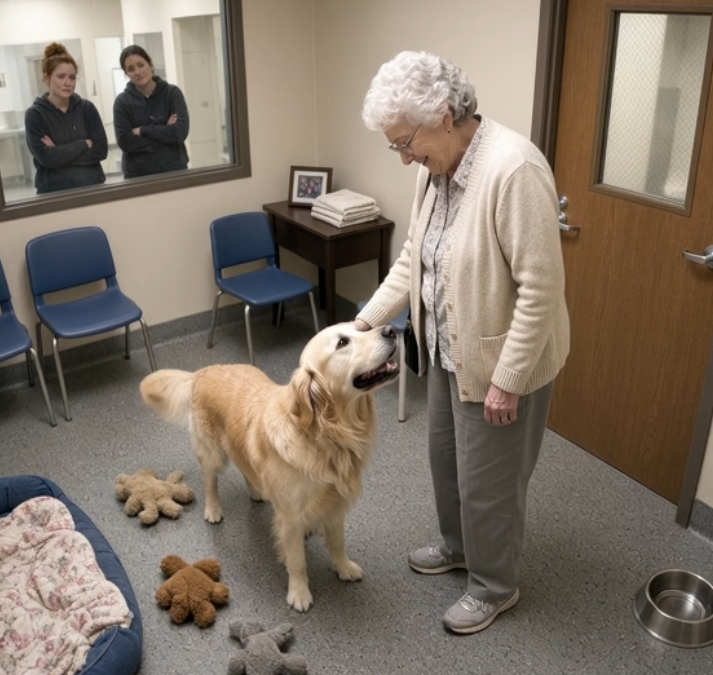
Margaret walked into Cedar Creek Animal Shelter insisting she was only there to look, but the lonely dog in the last visiting room seemed to know she was carrying a grief no one else could see.
Oliver had already lost one home, one owner, and nearly every chance at being chosen, and he refused to watch another kind heart walk away from him.
When his teeth closed gently around her cardigan sleeve, the whole room went silent, because everyone understood he was not begging for attention—he was begging not to be abandoned again.
The morning Margaret Leland drove to Cedar Creek Animal Shelter in Springfield, Missouri, she told herself three lies before she even backed out of the driveway.
The first was that she was going because she needed something to do.
The second was that she only wanted to spend an hour around animals.
The third was that she absolutely, under no circumstances, was ready to bring a dog home.
She said the last one out loud twice while checking her reflection in the hallway mirror.
“I am not adopting,” she told the quiet house.
The house, as usual, did not answer.
For forty years, Margaret had been surrounded by sound. School bells ringing through bright hallways. Children whispering too loudly in library corners. Little hands turning picture book pages with wonder. Chairs scraping. Sneakers squeaking. Small voices asking whether dragons were real, whether dolphins slept, whether she had any books about brave girls, sad dogs, lost grandparents, magic trees, or kids who felt invisible.
Margaret had always known how to help them find the right story.
Then retirement came.
At first, she thought she would enjoy the stillness. No early alarms. No book fairs. No overdue notices. No morning announcements crackling through speakers. She imagined tea on the porch, flower beds, long novels, and slow afternoons with her husband, Robert.
But life had a cruel way of handing people freedom only after taking away the person they wanted to share it with.
Robert died eight months after her retirement.
One winter morning, he kissed her cheek before driving to the hardware store, promised to fix the loose railing on the back steps, and never came home. A heart attack, the doctor said. Quick, they told her, as though quick meant painless for the person left behind.
After that, silence stopped feeling peaceful.
It became a living thing.
It sat with her at breakfast. It followed her down the hallway. It waited beside Robert’s empty chair and lay across his side of the bed. Some evenings, Margaret turned on the television just to hear another human voice, then muted it because the laughter sounded too bright for the room.
Her daughter, Emily, noticed first.
“You need company, Mom,” she said one Sunday after church, standing in the kitchen with a dish towel in her hands and worry on her face.
“I have plenty of company,” Margaret replied. “Mrs. Dunn calls every Tuesday. And I go to book club.”
Emily looked toward the living room, where Robert’s recliner still faced the window. “You know what I mean.”
Margaret knew.
That made it harder.
PART2:
“You’ve spent your whole life taking care of everyone else,” Emily said gently. “Maybe it’s time someone took care of you.”
Margaret smiled the way mothers smile when they want their children to stop being afraid for them.
“Maybe someday.”
Someday was safer than yes.
Someday did not require bowls on the kitchen floor or muddy paw prints or another living heart depending on hers. Someday did not ask her to risk loving something she might lose.
But on that Thursday morning, after waking from a dream in which Robert was laughing in the backyard and calling to a dog they had owned thirty years ago, Margaret sat up in bed with tears on her cheeks.
By ten fifteen, she was parked outside Cedar Creek Animal Shelter.
It was not a beautiful building. The brick was faded, the sign had been patched after a spring storm, and a row of muddy paw prints stained the concrete near the entrance. But there were flowers in two big planters by the door, and someone had taped a child’s drawing of a smiling brown dog to the front window.
Margaret sat in her car for almost five minutes with both hands on the steering wheel.
“You’re only looking,” she whispered.
Then she went inside.
The lobby smelled faintly of disinfectant, dog shampoo, and old tennis balls. Behind the front desk, a young woman with curly red hair looked up and smiled.
“Good morning. Welcome to Cedar Creek.”
Margaret clutched her purse strap. “Good morning. I’m not ready to adopt.”
The young woman blinked, then softened. “That’s perfectly okay.”
PART3:
“I mean it,” Margaret added quickly, as if the woman might try to trick her into leaving with a leash. “I just thought maybe I could sit with a few dogs for a little while.”
“Of course,” the volunteer said. “My name’s Jenna. We have several who would love that.”
As Jenna led her down the hall, barking rose from the kennel area in waves. Some dogs jumped happily against gates. Others spun in circles. One elderly beagle bayed as if announcing Margaret’s arrival to the entire county.
Margaret smiled despite herself.
Then they reached the quieter wing.
“These are dogs who need a little more patience,” Jenna explained. “Some are shy. Some are older. Some have been through loss.”
Margaret’s steps slowed.
Loss was a word that had weight.
Jenna stopped outside a kennel near the end. Inside, a cream-colored Golden Retriever mix lay on a folded blanket. He had a soft gray muzzle, soulful brown eyes, and fur that curled slightly around his ears. He lifted his head when they approached but did not come to the gate.
“This is Oliver,” Jenna said. “He’s six, though people always think he’s older because of the gray.”
“He’s beautiful,” Margaret whispered.
Oliver looked at her.
Not eagerly. Not fearfully. Just deeply, as if he were reading a page she had not opened.
“He came in about four months ago,” Jenna said. “His owner passed away.”
Margaret’s throat tightened. “Oh.”
“The family surrendered him. Said they couldn’t keep him.”
There was something in Jenna’s tone that made Margaret glance at her. “But?”
Jenna hesitated. “But he wasn’t surrendered gently.”
“What does that mean?”
“It means he waited in a garage for two days before anyone brought him in.”
Margaret turned back toward the kennel.
Oliver had lowered his head again, but his eyes remained on her.
“His owner was an older man named Harold Benton,” Jenna said quietly. “From what neighbors told us, he loved Oliver like a son. Walked him every morning. Took him through drive-throughs for plain biscuits. Read the newspaper out loud to him.”
Margaret let out a breath that trembled.
“When Mr. Benton died, his nephew took over the house. He told us Oliver was inconvenient. Too old. Too attached. Then he said Oliver had ‘bad energy.’”
Margaret’s hand tightened around her purse strap. “Bad energy?”
Jenna’s mouth pressed into a thin line. “People say cruel things when they want to feel less guilty.”
Oliver’s tail moved once at the sound of Jenna’s voice, but he still did not approach.
“Would you like to meet him?” Jenna asked.
Margaret almost said no.
Not because she disliked him.
Because she felt something open inside her, sudden and dangerous.
“Yes,” she said.
Jenna brought Oliver into a visiting room with pale blue walls, two chairs, a basket of toys, and a rug patterned with little paw prints. Margaret did not sit in the chair. She lowered herself carefully onto the floor, smoothing her tan cardigan over her knees.
Oliver stood near the far wall.
Margaret did not call him.
She had spent decades working with children who had been shy, angry, grieving, frightened, or ashamed. She knew the terrible pressure of being told to perform trust before you were ready.
So she simply sat.
Jenna watched through the window from the hall.
For several minutes, Oliver did nothing.
Margaret looked down at her hands and spoke softly, not quite to him and not quite to herself.
“I used to read to children who thought nobody noticed them,” she said. “The trick was not to make them come close. The trick was to leave a chair open.”
Oliver’s ears twitched.
Margaret smiled faintly. “Robert used to say I could make friends with a mailbox if I waited long enough.”
Oliver took one step.
Then another.
His paws made almost no sound on the rug.
Margaret kept her eyes lowered.
“I had a dog when I was young,” she continued. “A little black mutt named Scout. He stole socks and hated thunder and once ate an entire plate of deviled eggs before Easter lunch.”
Oliver came closer.
Margaret could see his paws now. Cream fur. Nails trimmed short. A small scar along one leg.
He stopped just beyond reach.
She did not move.
A full minute passed.
Then Oliver stepped to her side, circled once, and lay down with his back against her hip.
Margaret’s eyes filled so quickly she had to blink hard.
“Well,” she whispered, “hello there.”
Very slowly, she placed her hand on the top of his head.
Oliver closed his eyes.
The shelter noise faded behind the door. No barking seemed to enter that small room. No phones rang. No one spoke. Margaret stroked Oliver’s soft fur, over and over, and felt the strange ache of being understood by an animal who knew nothing about her except the shape of her loneliness.
Almost an hour passed that way.
Jenna eventually stepped in, wiping at one eye before pretending she had not been.
“How are we doing?”
Margaret looked embarrassed. “I’m sorry. I didn’t mean to take so much time.”
“You’re fine,” Jenna said. “He hasn’t stayed that calm with anyone since he came here.”
Oliver opened his eyes but did not lift his head.
Margaret swallowed. “He’s very sweet.”
“He is.”
“I’m just not sure I’m ready.”
Jenna nodded kindly. “That’s okay. You don’t have to decide today.”
But Oliver heard something change in the room.
Margaret could feel it in the way his body stiffened against her leg.
She stood slowly, brushing dog hair from her skirt with shaking fingers. “Thank you for letting me visit with him.”
Oliver got up too.
Margaret tried not to look at him.
If she looked, she feared she would make a promise she was not brave enough to keep.
She took one step toward the door.
Then another.
Behind her, Oliver followed.
Not rushing.
Not barking.
Just walking with quiet certainty, as if they had already agreed on the ending.
Margaret reached for the door handle.
That was when she felt the smallest tug.
She looked down.
Oliver had taken the sleeve of her cardigan gently between his teeth.
He was not pulling hard. He was not chewing. He was simply holding on.
His brown eyes stayed locked on hers.
His tail barely moved.
The visiting room went silent.
Jenna froze in the doorway.
Through the window, two staff members stopped walking. Someone at the front desk turned to look. Even the barking in the hall seemed to fall away for one impossible second.
Margaret stared at Oliver’s mouth on her sleeve.
There was no demand in him.
Only a question.
Please don’t leave me too.
The words were not spoken, but Margaret heard them as clearly as if Robert himself had whispered them into the room.
Her face crumpled.
“Oh, sweetheart,” she said.
She sank to her knees, and Oliver immediately released her sleeve. The moment she opened her arms, he stepped into them and pressed his head against her chest.
Not lightly.
Fully.
As if he had been holding himself upright for four months and had finally found somewhere to set down the weight.
Margaret wrapped both arms around his neck.
Oliver let out a long, deep sigh.
It was the kind of sigh that changes a room.
Jenna covered her mouth. One of the kennel attendants turned away and walked straight into the hallway. Later, she would admit she had cried beside the supply closet for three minutes before she could come back.
Margaret held Oliver and rocked slightly, tears slipping down her cheeks into his fur.
“I told everyone I wasn’t ready,” she whispered.
Oliver leaned harder against her.
Margaret laughed through her tears.
“But maybe you knew I was.”
The paperwork took twenty-seven minutes.
Margaret read every line carefully because librarians do not sign things without understanding them. Jenna explained the adoption fee, medical history, vaccinations, food routine, and Oliver’s fear of being left alone too long.
When she mentioned that last part, Margaret looked down at Oliver, who was sitting with one paw resting on her shoe.
“That makes two of us,” she said.
At the front counter, an older shelter employee named Denise brought out a worn manila envelope.
“This came with him,” she said. “We usually keep personal items, but his surrendering relative didn’t want any of it.”
Inside was a faded blue collar, a photograph, and a small children’s book with a cracked spine.
Margaret picked up the book first.
The Velveteen Rabbit.
Her breath caught.
Robert had given her a copy on their second date because she had told him it was the first story that ever made her cry.
She opened the cover.
Inside, in shaky handwriting, someone had written: To Oliver, who stayed when the world got quiet. Love, Harold.
Margaret pressed one hand to her mouth.
Then she lifted the photograph.
It showed an elderly man in a plaid shirt sitting on a porch, Oliver’s head resting on his knee. Both of them were looking at the camera with the peaceful expression of two souls who had chosen each other.
“His owner loved books?” Margaret asked.
Denise nodded. “Neighbors said Mr. Benton was a retired school custodian. He couldn’t read well when he was younger, but later in life he taught himself. Loved library books. Especially children’s books.”
Margaret looked at Oliver.
For the first time since Robert died, she felt something other than loss connecting one moment to the next.
Not replacing him.
Never replacing him.
But continuing.
Before driving home, she texted Emily.
I think someone just checked out the last book my heart was holding.
Emily called within ten seconds.
“Mom?”
Margaret laughed and cried at once. “I adopted a dog.”
“You did?”
“His name is Oliver.”
Emily’s voice broke. “I’m coming over.”
“No,” Margaret said, looking at Oliver already sitting in the passenger seat like he had been riding there his whole life. “Meet us at the shelter parking lot first. I want you to see where he chose me.”
By the time Emily arrived, Margaret was standing beside her car with Oliver’s leash in one hand and the old copy of The Velveteen Rabbit in the other.
Emily got out and stopped.
Oliver looked at her calmly.
Then he stepped behind Margaret, not hiding exactly, just making sure she stayed close.
“Oh, Mom,” Emily whispered.
“I know,” Margaret said.
Emily hugged her mother carefully over Oliver’s head. “Dad would have loved him.”
Margaret looked down at Oliver’s gray muzzle.
“Yes,” she said. “I think maybe he helped send him.”
The first night home was not easy.
Oliver followed Margaret from room to room, afraid to let her out of sight. When she went into the bathroom and closed the door, he whimpered softly on the other side. When she opened it, he pressed against her legs so hard she almost lost her balance.
At bedtime, she placed a dog bed near her dresser.
Oliver stared at it.
Then at her.
Then at the bedroom door.
Margaret sighed, lifted the blanket, and patted the space beside the bed. “All right. Just for tonight.”
Oliver climbed onto the rug next to her side and rested his chin on her slippers.
At two in the morning, Margaret woke to the sound of him dreaming.
His paws twitched. A low whine trembled in his throat.
She reached down in the dark and touched his head.
“I’m here,” she whispered.
Oliver quieted.
So did she.
In the weeks that followed, the house changed.
Not all at once. Not dramatically. But steadily.
A water bowl appeared by the kitchen island. A leash hung beside Robert’s old cap. Dog biscuits filled the blue ceramic jar that once held peppermints for neighborhood children. Fur gathered on the living room rug. Mud appeared near the back door. The porch swing creaked every morning beneath Margaret, and Oliver lay across her feet while she drank coffee and read the newspaper out loud.
At first, she did it as a joke.
Then she remembered Harold Benton had done the same thing.
So she kept doing it.
“City council is arguing again,” she told Oliver one morning. “You’d think grown adults could share a room without barking.”
Oliver thumped his tail.
He followed her to the garden, to the mailbox, to the laundry room, to the pantry, and once directly into the hall closet, where they both stood in confusion until Margaret laughed so hard she had to lean against the wall.
But beneath his sweetness, fear still lived in him.
If Margaret picked up her purse, Oliver stiffened.
If she put on her shoes, he watched her with worried eyes.
The first time she left him for twenty minutes to go to the pharmacy, she returned to find him sitting by the front door, trembling but silent.
She knelt immediately. “Oh, Oliver.”
He pressed his face into her shoulder.
“I came back,” she said. “I will always come back.”
It took time for him to believe her.
Trust, Margaret learned, was not one grand gesture. It was repetition. The same kindness, over and over, until fear grew tired of arguing.
Three months after the adoption, Cedar Creek invited Margaret to speak at a fundraiser.
She almost refused. Public attention had never suited her. She had spent her life behind library desks, helping other people shine.
But Jenna called personally.
“People need to hear what older dogs can mean,” she said. “And what they still have to give.”
So Margaret went.
The event was held in a community hall decorated with paw-print banners and framed photos of adopted pets. Oliver lay beside Margaret’s chair while people came over to meet him. He accepted gentle hands politely, but his eyes always returned to her.
Halfway through the evening, Denise stepped onto the small stage and told Oliver’s story.
She spoke about Harold Benton. About loss. About the day Oliver held Margaret’s sleeve.
Then she said something Margaret did not expect.
“We also learned, after Oliver’s adoption, that his former owner had left a small donation in his will to support senior pet adoptions. His nephew failed to disclose it and tried to claim the money himself. That matter has since been corrected through proper legal channels, and tonight, the Harold Benton Senior Companion Fund officially begins.”
The room burst into applause.
Margaret stared at Denise.
Jenna leaned close and whispered, “Harold wanted dogs like Oliver to have a chance. Now they will.”
Margaret looked down at Oliver.
He was watching her, calm and steady.
For a moment, she imagined Harold Benton somewhere beyond grief, smiling because the love he left behind had not been buried by greed after all.
When Margaret stood to speak, her hands shook.
She looked out at the crowd and saw shelter volunteers, families, children, elderly couples, and dogs wearing little bandanas. She had planned to say something brief and polite.
Instead, she told the truth.
“I came here because my house was quiet,” she began. “Too quiet. I thought grief had made me empty. I thought adopting a dog meant I had to be ready to feel everything again, and I wasn’t sure I could survive that.”
The room listened.
“Then Oliver took my sleeve.”
Soft laughter moved through the audience.
Margaret smiled down at him. “He did not jump. He did not bark. He did not perform. He simply held on. And in that moment, I realized he was asking the same question I had been asking since my husband died.”
Her voice trembled.
“Will anyone stay?”
Oliver stood then, as if hearing something in her tone, and leaned against her leg.
Margaret placed a hand on his head.
“I thought I was choosing a dog,” she said. “But the truth is, he found me. And he taught me that being left behind is not the end of love. Sometimes it is the place where a new love begins.”
By the time she finished, people were crying openly.
Not because the story was sad.
Because it was honest.
Months passed.
Oliver became known around the neighborhood as Margaret’s shadow. Children stopped to pet him on walks. Mrs. Dunn brought him homemade treats. Emily visited more often, sometimes finding her mother and Oliver asleep in the recliner, both snoring softly, Robert’s old quilt spread across them.
Margaret still missed her husband.
She always would.
Some mornings, she still reached for two coffee mugs. Some evenings, she still turned toward his chair to tell him something funny before remembering. Grief did not vanish because Oliver arrived.
But it changed shape.
It no longer filled every room.
It made space for paws clicking across hardwood, for warm weight against her feet, for the gentle responsibility of being needed.
One evening near sunset, Margaret sat on the porch swing with Oliver beside her. The sky over Springfield glowed peach and gold. A breeze moved through the maple tree Robert had planted twenty years earlier.
Margaret opened The Velveteen Rabbit and read aloud until her voice softened.
Oliver rested his head on her knee.
When she reached the inscription, she traced Harold’s handwriting with one finger.
To Oliver, who stayed when the world got quiet.
Margaret looked at the dog who had held her sleeve and refused to let her disappear back into loneliness.
“You stayed too,” she whispered.
Oliver sighed his deep, peaceful sigh.
This time, it did not sound like fear leaving.
It sounded like home arriving.
And maybe that was the lesson neither Margaret nor Oliver could have learned without losing what they loved first. Sometimes the ones waiting behind shelter doors are not looking for perfect families, perfect houses, or perfect timing. Sometimes they are simply waiting for one person wounded enough to understand them, gentle enough to wait, and brave enough to stay when staying matters most.
Margaret had walked into Cedar Creek Animal Shelter believing she was not ready to adopt.
Oliver had known better.
He had seen the truth in the quiet way she sat on the floor, in the sadness she carried without complaint, in the tenderness of a hand that asked for nothing and offered everything.
So when she turned to leave, he did the only thing a heartbroken dog could do.
He held on.
And because he did, two lonely lives found their way out of silence together.


