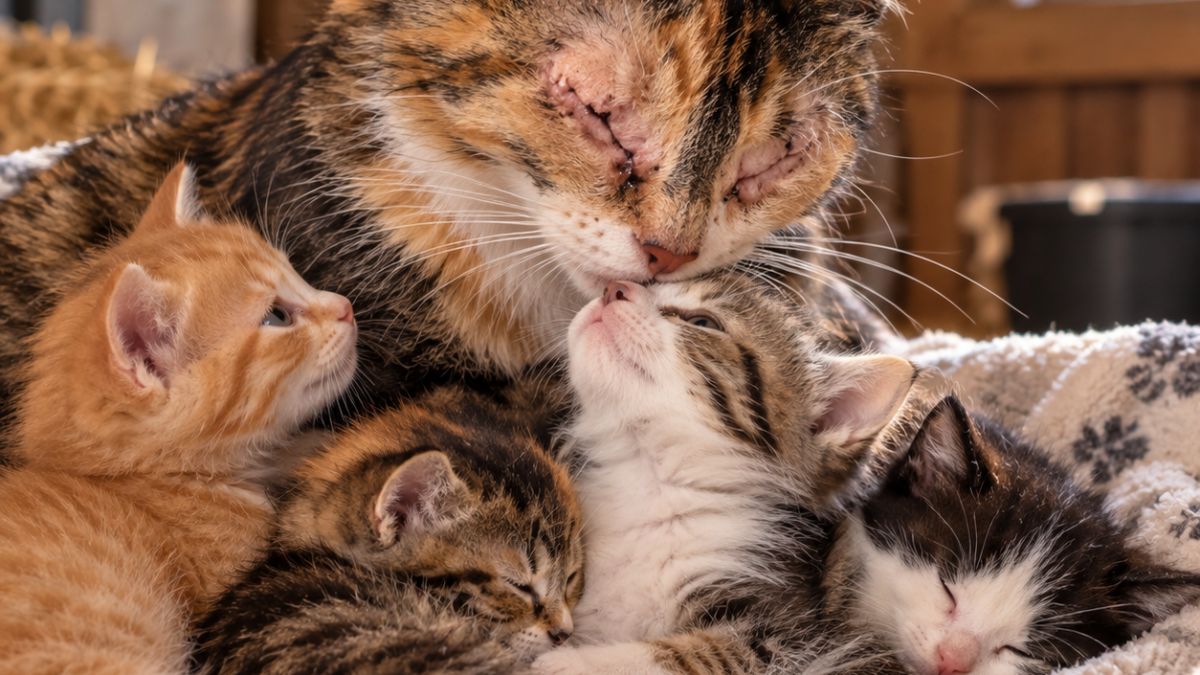
She Lost Both Eyes Fighting Off a Coyote to Save Her 4 Kittens—Now Every Night, the Blind Mother Touches Each One With Her Nose to Make Sure They’re Still There.
PART3:
Some orange.
Some cream.
Tortoiseshell.
Dad pointed toward the wall.
“Look.”
Two feet above the ground, the wooden siding had claw marks.
Fresh.
Deep.
Parallel lines.
I touched one.
“Cat?”
“Looks like.”
“What happened?”
Dad pointed toward the brush line.
“Tracks.”
There were coyote prints.
I knew them well enough.
Longer than a dog’s.
Tight.
Straight.
Mixed among them were smaller marks.
Cat tracks.
Blood.
“What did you find?”
Dad’s jaw tightened.
“She’s alive.”
Relief and dread arrived together.
“Where?”
He turned.
“Come slow.”
We followed the blood.
Thirty yards.
Maybe more.
Past a rusted disc harrow.
Across wet weeds.
Toward an old section of wire fence that had collapsed years before and never been worth repairing because that pasture was no longer used.
Under the bent wire and thorn brush was a hollow space.
Protected on three sides.
I saw the kittens first.
Four of them.
Tiny.
Four weeks old at most.
One orange.
One black.
Two mottled like their mother.
They were pressed together beneath dead grass and leaves.
Alive.
Clean.
No visible blood.
Then their mother moved.
She was sitting directly in front of them.
Facing us.
At first, my brain refused to process her face.
The left side was dark with dried blood.
Her left eye was gone.
Not closed.
Not swollen shut.
Gone.
The socket partially collapsed beneath dried blood and torn tissue.
The right eye was worse in a different way.
Still present.
But swollen grotesquely large.
Clouded.
Bluish-white.
Fluid ran from the corner.
I stopped breathing.
“Oh my God.”
Dad whispered, “Easy.”
The cat heard us.
She stood.
Not well.
Her legs shook.
But she stood.
Then she arched her back.
Not toward escape.
Toward us.
Between the sound of our footsteps and the kittens.
Dad said quietly, “She can’t see us.”
I looked at him.
“How do you know?”
“She doesn’t track movement.”
He shifted left.
The cat’s head did not follow.
He snapped his fingers.
Her ears moved.
Head turned toward sound.
Dad moved right.
Again.
She tracked sound.
Not us.
“Oh, God.”
Her body was covered in smaller injuries.
Scratches across shoulders.
Blood dried beneath the chin.
One puncture near the neck.
But the face—
I could barely look.
And yet she was not hiding.
She had positioned herself like a wall.
Four kittens behind.
Everything else in front.
I crouched.
“Hey.”
Her head snapped toward my voice.
A low growl vibrated in her throat.
Dad said, “Don’t reach.”
“I know.”
She swayed.
One front leg buckled.
Then corrected.
Still standing.
I had worked around farm animals all my life.
I had seen mothers protect young.
Cows charge dogs.
Hens attack snakes.
Barn cats move litters three times because one human touched the bedding.
But there was something terrible about this.
She had no eyes left to threaten us with.
No visual warning.
No idea how many of us stood there.
No idea what we were.
Still she got between us and them.
I said softly, “We’re not taking them from you.”
Meaningless words.
She growled again.
Dad looked toward the kittens.
“How do we move them?”
“All together.”
“Carrier?”
“I brought two.”
“You planning ahead?”
“You said blood.”
He nodded.
“Fair.”
I backed away slowly.
The mother remained standing until my footsteps moved farther.
Then I heard her sit heavily.
I returned with a large dog crate, towels, and an old laundry basket.
Dad had called Dr. Lena Ortiz, the veterinarian in town.
She told us not to separate the kittens unless absolutely necessary.
“Get the mother contained with them if you can. Low light. Warm. No pressure on the face.”
Low light felt like a cruel instruction for an animal who had already lost the world.
We put the kittens into the crate first.
Their mother heard them crying.
She went wild.
Not attacking.
Searching.
Head whipping toward the sound.
Paws stepping through brush.
Trying to find them.
“Put them down,” I said.
Dad lowered the carrier.
One kitten squeaked.
Mother moved toward it.
Fast.
Blind.
She hit the side of the crate with her shoulder.
Stumbled.
Then shoved her nose through the open door.
The kittens crawled toward her.
That changed everything.
She followed their smell inside.
We closed the door.
She immediately curled around all four.
Not relaxing.
Guarding.
One paw across the front.
We drove to Dr. Ortiz’s clinic.
Dad drove.
I sat in the back beside the crate.
The kittens nursed.
The mother cat’s breathing was shallow.
Fast.
Every pothole made her tense.
I kept talking.
Not because she understood.
Because silence felt impossible.
“You’re okay.”
“We’re almost there.”
“They’re with you.”
“All four.”
That phrase came out without thought.
All four.
Her ears twitched.
I would say it many times after that.
At the clinic, Dr. Ortiz met us at the back entrance.
One look and her face hardened.
“What attacked her?”
“Coyote tracks.”
“How long ago?”
“We don’t know.”
Dr. Ortiz crouched beside the carrier.
The cat growled.
“Good.”
I stared.
“Good?”
“She still has fight.”
“That seems like a lot of fight.”
“It is.”
We moved them into a quiet treatment room.
A technician named Marissa lifted each kitten one at a time.
Mother panicked every single time.
She turned toward the sound.
Raised herself.
Tried to follow.
Dr. Ortiz said, “Keep them talking.”
Marissa laughed nervously.
“To the kittens?”
“Yes.”
“They don’t speak English.”
“I’m aware.”
But sound helped.
We examined the kittens first.
Four weeks.
Maybe slightly more.
Good body condition.
Hydrated.
No punctures.
No fractures.
No blood except their mother’s.
Perfect.
All four.
Then the mother.
Dr. Ortiz sedated her lightly.
It was the only way to evaluate her face without causing more trauma.
I stayed.
Dad did too.
The left eye had been destroyed completely.
Nothing salvageable.
The right had ruptured.
Massive trauma.
Infected tissue.
No vision.
Dr. Ortiz used one of those calm medical voices that somehow makes terrible information worse.
“She has no functional vision in the right eye.”
“Can it recover?”
“No.”
“Left?”
“No eye to recover.”
I looked at Dad.
He looked at the floor.
“How long has she been like this?”
Dr. Ortiz examined the wounds.
“At least forty-eight hours.”
Dad looked up sharply.
“You’re sure?”
“Approximately. The swelling, dried blood, infection, tissue response.”
“So she’s been blind two days?”
“At least.”
I thought of the kittens.
“What has she been eating?”
“Probably nothing.”
“Water?”
“Maybe dew, maybe nothing.”
“She nursed them.”
Dr. Ortiz nodded.
“She did.”
“She kept them clean.”
“Yes.”
“She moved them.”
Dr. Ortiz looked at me.
“What?”
I told her where the blood began.
Behind the shed.
Then where we found them.
Thirty yards away.
She went quiet.
Dad said, “There were drag marks.”
Dr. Ortiz shook her head.
“Not drag marks.”
“What?”
“Look at the kittens.”
We did.
“They’re clean.”
“So?”
“If she dragged them, you’d likely see dirt patterns. Injuries. Abrasions.”
“What are you saying?”
“She probably carried them.”
One by one.
Blind.
That image hit me so hard I sat down.
“How?”
“Same way any queen moves kittens.”
“Without seeing?”
“Smell. Memory. Touch.”
Dr. Ortiz stared at the mother cat.
“Cats don’t need vision to pick up their babies.”
“But thirty yards.”
“Yes.”
“Four trips.”
“Yes.”
Dad said, almost to himself, “Eight.”
I looked at him.
“What?”
“Four out.”
He counted with one finger.
“Four back to get the next one.”
I pictured it.
Blood.
Darkness.
Pain.
Face destroyed.
One kitten in her mouth.
Walking from shed to brush.
Then turning around.
Going back.
Again.
Again.
Again.
Dr. Ortiz examined puncture wounds around the face.
“Coyote is very plausible.”
“Could it have been a dog?”
“Possible.”
Dad said, “Coyote was here all week.”
He told her about the tracks.
The dead barn cat on the neighboring property.
The calls at night.
Dr. Ortiz looked at the facial wounds.
“The pattern fits a canid bite.”
She pointed near the left side.
“First impact here.”
Then right.
“Another here.”
Two bites.
Two eyes.
I wanted to be sick.
“Why didn’t it kill her?”
Dr. Ortiz shrugged.
“Maybe she fought hard enough.”
Dad said, “There was other blood.”
“What?”
“Not hers.”
“You’re sure?”
“Different trail. Less.”
Dr. Ortiz looked at him.
“She injured it.”
Dad nodded.
“Likely.”
The cat had six pounds of body.
The coyote maybe thirty-five.
Forty.
It found the kittens.
She met it at the shed wall.
The claw marks suddenly made sense.
She had braced herself there.
Back to the wood.
Face outward.
Keeping the predator in front of her.
It struck her once.
Then again.
Took both eyes.
She still kept it from the kittens.
When the coyote left—
she moved them.
That part is what changed me.
Not the fight.
The thing after the fight.
People understand defense in adrenaline.
Attack comes.
Body reacts.
Mother fights.
But afterward?
Shock.
Blindness.
Pain.
No food.
No water.
And still the next decision in her body was:
Move the babies.
Hide them better.
Then nurse them.
Then guard the entrance.
When Dad found her forty-eight hours later, she was still at her post.
Dr. Ortiz looked at me.
“She needs surgery.”
“When?”
“As soon as she’s stable enough.”
“Both eyes?”
“Both.”
The left socket needed cleaning and closure.
The destroyed right eye had to be removed.
Infection had already begun in the left side.
“She’ll live?”
Dr. Ortiz paused.
I hated pauses.
“She has a good chance.”
“Good?”
“Not guaranteed.”
“What are the risks?”
“Sepsis. Poor nutrition. blood loss. infection. anesthesia.”
I looked at the kittens.
“Can they stay?”
“With her as much as possible.”
“We’ll supplement them.”
“Why?”
“She’s in no condition to support four entirely alone.”
Mother was waking.
Her head moved.
The kittens squeaked.
Instantly she tried to rise.
Dr. Ortiz put one hand gently against her shoulder.
“Easy.”
She kept trying until Marissa placed one kitten near her chest.
Then another.
Three.
Four.
Mother stopped.
Dr. Ortiz looked at me.
“Interesting.”
“What?”
“She settled when all four were back.”
I did not understand how important that would become.
Surgery happened the next morning.
Two hours.
Both eyes removed.
Left socket aggressively cleaned.
Right closed.
A drainage point left temporarily.
Antibiotics.
Pain medication.
Fluids.
The first photograph after surgery looked brutal.
Her face swollen.
Both eye areas shaved.
Stitches curving where eyes once were.
But somehow she looked calmer.
The source of pain was gone.
The damage remained.
But the active destruction had stopped.
The kittens stayed in a warming enclosure nearby while she recovered.
When she woke, she panicked.
Head moving.
Front paws scraping.
Trying to orient.
Marissa brought one kitten.
Mother smelled it.
Licked.
But did not settle.
Second kitten.
Still restless.
Third.
Still.
Fourth.
Then—
her body relaxed.
Not completely.
But enough.
Dr. Ortiz noticed.
“She knows.”
“What?”
“They’re all there.”
“How?”
“No idea.”
The first week was terrible.
Infection from the left socket did not respond enough to the first antibiotic.
Culture.
Change medication.
Then fever.
Second change.
Weight dropped.
She had arrived around seven pounds.
Within weeks, barely five.
We supplemented the kittens because nursing drained her.
She fought syringe feeding.
Hated pills.
Despised cone collars.
Loved her kittens.
Every procedure ended the same.
Return all four.
She would touch them.
Sniff.
Groom.
Settle.
I began visiting every evening after work.
At first because Dad asked.
Then because I couldn’t stop.
We needed a name.
The clinic had written “Tortoiseshell Queen – Whitmore Farm.”
I hated that.
Marissa called her “Mama.”
Too generic.
Dad suggested “Scar.”
Absolutely not.
Then one evening, I walked into the recovery room during sunset.
Light came through the blinds.
The cat was curled around her kittens.
Dr. Ortiz said, “She keeps turning toward the window.”
“She can’t see it.”
“No.”
“Then why?”
“Heat.”
Maybe.
The sunlight warmed one side of the kennel.
The cat always chose it.
I said, “Sol.”
Dad frowned.
“What?”
“Sol. Sun.”
He looked at the blind cat.
“Seems rude.”
“It doesn’t mean she sees it.”
Dr. Ortiz smiled.
“She feels it.”
Sol became her name.
By week three, the kittens were climbing.
That created chaos.
Blind motherhood had been manageable while babies stayed in a pile.
Now they had opinions.
One crawled beneath the bedding.
Another climbed the kennel door.
The orange male screamed constantly.
Sol adapted.
She mapped everything by sound and smell.
If a kitten cried left, she moved left.
If one wandered too far, she made a low chirping call.
They came back.
Mostly.
But evening was different.
The first time I saw the counting, I thought it was grooming.
It was around 8:15.
Clinic quiet.
Lights lowered.
The kittens were settling.
Sol stood.
Slowly moved among them.
Her nose touched the orange kitten’s head.
Pause.
Then the black.
Pause.
Then tortoiseshell one.
Pause.
Then tortoiseshell two.
Pause.
She returned to her bed.
I said, “Did you see that?”
Marissa was filling charts.
“What?”
“She checked them.”
“She always checks them.”
“No.”
I stood.
“She did them one at a time.”
Marissa looked.
“That’s weird.”
Next evening, I watched.
Same sequence.
Not same physical order, because kittens moved.
But same pattern.
Touch one.
Pause.
Move.
Touch next.
Pause.
Until all four.
Then lie down.
I recorded video on the third night.
Sent it to Dr. Ortiz.
She replied:
She’s inventorying.
I laughed.
Then cried.
The phrase sounded funny.
It wasn’t.
Every night.
One.
Two.
Three.
Four.
Sometimes a kitten moved after being counted.
Sol would find it again.
Sniff.
Maybe recalibrate.
No one could tell me exactly what was happening cognitively.
Maybe she recognized scent.
Maybe she needed contact with each body.
Maybe it was maternal routine.
Maybe blindness intensified a behavior she had always had.
I did not need a scientific fairy tale.
I only knew she did it.
Consistently.
And she did not settle until every kitten had been touched.
One night, Marissa temporarily took the orange kitten to weigh him while the others were sleeping.
Sol started her ritual.
First.
Second.
Third.
Then searched.
Her nose moved across the bedding.
Again.
Again.
Head lifted.
She made a low call.
Marissa froze.
“Oh.”
Sol moved faster.
Not frantic.
But unmistakably searching.
Marissa returned the orange kitten.
He squeaked.
Sol found him immediately.
Touched his head.
Then lay down.
Marissa leaned against the counter.
“Okay.”
I knew.
That was the moment everybody stopped calling it coincidence.
The infection lasted longer than expected.
Three antibiotic courses.
Eleven weeks total treatment.
Two emergency rechecks.
One reopened stitch.
One night of fever that scared everyone.
Sol lost almost a third of her body weight before stabilizing.
The kittens?
Perfect.
Infuriatingly perfect.
At six weeks, they were running.
At seven, wrestling.
At eight, attacking each other’s tails.
No scars.
No injuries.
Not one.
Sometimes I would watch them climb over Sol.
Blind mother.
Stitched face.
Thin body.
And think:
They have no idea what she paid.
That sounds unfair.
But babies should not know.
That is the whole point of protection.
The protected get to remain innocent.
At ten weeks, adoption planning began.
I hated it.
Not because they should stay together forever.
Because dividing that little family felt wrong after everything.
Dr. Ortiz was practical.
“Kittens do well in pairs.”
“We have four.”
“Perfect.”
“Sol?”
Silence.
I knew the answer.
Blind adult tortoiseshell.
Medical history.
Special needs.
Not impossible.
But harder.
The kittens would be adopted first.
Everybody loves kittens.
Adults wait.
Disabled adults wait longer.
I said, “She comes with me.”
Dr. Ortiz looked at me.
“You didn’t even let me finish.”
“I know.”
“Claire.”
“What?”
“You have two dogs.”
“They’re cat-safe.”
“Pickles.”
“Pickles doesn’t belong to me.”
“Pickles lives on your porch.”
“He belongs to capitalism.”
“What does that mean?”
“Nothing.”
She smiled.
“You sure?”
No.
Absolutely not.
I had never owned a blind cat.
My house had steps.
Furniture.
Dogs.
Work.
I liked leaving doors open.
I moved chairs constantly.
Sol would require consistency.
I said yes anyway.
Dad was less surprised.
“I knew.”
“You did not.”
“You’ve been at the clinic every night for two months.”
“That proves concern.”
“You named her.”
“That proves administrative necessity.”
“You bought blind-cat ramps online.”
I stared.
“How do you know?”
“You used my Amazon account.”
Right.
“She still isn’t yours.”
Dad smiled.
“Sure.”
Before Sol came home, the kittens were adopted.
Two and two.
First pair to a family with teenage twins.
Second pair to a retired couple who had recently lost two elderly cats.
We scheduled adoptions on different days.
That was deliberate.
One pair gone.
Then time for Sol to adjust before the next.
The first morning after two kittens left, she searched.
Counted the remaining two repeatedly.
Then searched beyond them.
My heart broke.
Dr. Ortiz warned us.
“She knows the group changed.”
“Does she think they’re lost?”
“We can’t know.”
“She keeps looking.”
“I know.”
The adopters sent blankets with each kitten’s scent.
We left those with Sol.
Maybe helpful.
Maybe not.
The second pair left four days later.
That night was the hardest.
Sol got up at her usual time.
Moved through the bedding.
No kittens.
She searched.
Slow.
Nose down.
Then faster.
Every corner.
Water bowl.
Blanket.
Kennel door.
She called.
Once.
Then again.
I sat beside the enclosure.
“Sol.”
She turned toward me.
I opened the door.
Put my hand near her nose.
She smelled me.
Then pushed past my fingers and searched again.
I cried silently.
The part of rescue nobody puts in the happy update is this:
Sometimes the right next step still hurts.
The kittens were old enough.
Healthy.
Going in pairs.
Good homes.
Keeping all four forever would not necessarily have been better.
But Sol did not know adoption plans.
She knew four bodies had disappeared.
One night later, she searched less.
Then again.
For almost a week, 8:15 came and her body remembered the counting.
Stand.
Search.
Pause.
No kittens.
That was when I brought home a blanket all four had slept on before leaving.
Sol curled around it.
I hated myself for thinking it looked like grief.
Maybe it was.
Maybe scent comfort.
Either way, she slept.
Two weeks later, Sol came home with me.
I rearranged everything.
Furniture stayed against walls.
No chairs in random pathways.
Textured mats marked transitions.
Rug before the stairs.
Different rug before the kitchen.
Water in the same place.
Food in the same place.
Litter box never moved.
Baby gates for the first week.
My dogs, Sadie and Boone, met her through barriers.
Sadie sniffed.
Sol hissed.
Boone barked once.
Sol launched herself toward the sound with such speed that Boone retreated behind me.
I laughed for five minutes.
Blind did not mean helpless.
That became the first thing Sol taught everyone.
She mapped the house in three days.
Walls.
Corners.
Furniture.
Step.
Doorways.
By day five she could go from bed to water to litter to my couch without touching anything.
By day eight she climbed onto the couch.
By day ten she found my bed.
I woke at 3:00 a.m. with a blind tortoiseshell standing on my chest.
“Hello.”
She sniffed my face.
Then stepped on my throat.
“Wonderful.”
She curled beside my shoulder.
That became her place.
The doorway behavior started immediately.
Every threshold.
Stop.
Head up.
Listen.
Longer if the room had unfamiliar sound.
Then move.
Visitors thought she was afraid.
She wasn’t.
She was checking.
Air.
Footsteps.
Dog nails.
Voice.
Object movement.
A sighted cat glances.
Sol listened.
My father built low wooden guides along the porch so she could sit outside safely.
Screened enclosure.
No open yard.
Not after a coyote.
Never.
At first she refused the porch.
Wind confused her.
Too many sounds.
Birds.
Trees.
Trucks.
Cows.
Open space without walls.
I sat beside her.
Ten minutes.
Then five the next day.
Eventually she loved it.
Sun.
Warm boards.
Smells.
She would lift her face to light she could never see.
Dad said, “Name fits.”
“Don’t sound shocked.”
“I still think it’s rude.”
“She likes sun.”
“Fair.”
The kittens’ families sent updates.
Photos.
The orange and black pair grew huge.
The tortoiseshell sisters remained tiny.
Healthy.
Happy.
I showed photos to Sol.
Completely ridiculous.
She could not see them.
Still I talked.
“Orange one is fat.”
Ear twitch.
“Black one steals socks.”
Nothing.
“The girls sleep together.”
Sol purred.
Coincidence.
Probably.
I kept talking anyway.
Three months after separation, the retired couple asked if they could visit with the two tortoiseshell kittens.
I hesitated.
Would reunion help?
Confuse her?
Stress everyone?
Dr. Ortiz said, “We don’t know.”
That phrase again.
Eventually we arranged it in my living room.
The carriers came in.
Sol was asleep.
One kitten meowed.
Sol’s head shot up.
Instantly.
She stood.
The second kitten answered.
Sol moved.
Not running.
Fast.
Straight toward the sound.
The carrier doors opened.
Two nearly grown kittens stepped out.
Sol reached them.
Sniffed.
One rubbed against her face.
Then the other.
Sol began grooming immediately.
Forehead.
Ear.
Neck.
The kittens climbed over her.
I cried.
Of course.
Then something happened.
Sol moved between them.
Nose to one head.
Pause.
Nose to second.
Pause.
Then—
she kept searching.
My heart cracked.
One.
Two.
Looking for three.
Four.
Even months later, some part of her routine still expected four.
I touched her shoulder.
“Sol.”
She turned toward me.
The kittens followed.
Eventually she settled.
Their family stayed an hour.
When they left, Sol searched briefly.
Then came to me.
That mattered.
Home had changed.
Her babies were part of memory.
I was part of now.
A year passed.
Then two.
Sol became famous locally because the clinic shared her story during a fundraiser.
Blind mother fights coyote.
Saves four kittens.
Counts them with nose.
People loved it.
Too much sometimes.
They called her superhero.
Warrior mama.
Angel.
Legend.
I understood.
But I also watched Sol fail to find a treat under a chair and yell until I moved it three inches.
She was not myth.
She was a cat.
She knocked over water.
Stole Boone’s bed.
Bit me during nail trims.
Had terrible breath.
Once walked directly into an open cardboard box and then acted offended that the box existed.
I preferred her that way.
Trauma stories flatten animals into symbols.
Sol deserved personality.
At five, she developed chronic dental disease.
At six, mild arthritis.
At seven, she stopped climbing the taller cat tree.
Dad built a lower one.
She loved it.
At eight, Boone died.
Old dog.
Sol searched his sleeping place for days.
Not dramatic.
Just checking.
At nine, Sadie died too.
Sol became the only animal in my house.
I thought she might enjoy the quiet.
She did for three weeks.
Then started screaming at 5:00 a.m.
I called Dr. Ortiz.
“Medical?”
“Probably not.”
“Then why?”
“Maybe bored.”
“She’s eighty in cat years.”
“She still has opinions.”
I fostered a quiet senior cat named Harold.
Blind Sol hated him.
Harold worshiped her.
Three months later, I adopted him accidentally.
Sol tolerated his existence as long as he respected a two-foot radius.
He did.
Mostly.
Every evening, Sol still had a ritual.
Not the exact counting.
That disappeared when the kittens did.
But around 8:00, she made a slow circuit through the house.
Food.
Water.
Hallway.
Living room.
My bedroom.
Harold.
Then me.
Nose against my hand.
Pause.
Continue.
I sometimes wondered if she had transferred the pattern.
Not counting kittens.
Checking the household.
Everyone present.
Doors known.
Sounds accounted for.
Impossible to prove.
Beautiful to imagine.
I kept the thought private.
Years after the coyote attack, Dad brought it up.
We were sitting on my porch.
Sol was stretched in sunlight.
He said, “You think she remembers?”
“The coyote?”
“Yeah.”
I looked at her.
“I don’t know.”
“She still freezes when they howl.”
That was true.
Coyotes still passed along the creek.
At night, if one called nearby, Sol became stone.
Head raised.
Body low.
No movement.
Harold would keep sleeping.
Sol listened until the sound faded.
Then she would walk through the house.
Check room.
Check me.
Return to bed.
“Maybe,” I said.
Dad looked at her face.
Smooth healed sockets beneath fur.
“She paid a lot.”
That sentence bothered me.
“For the kittens?”
“Yeah.”
“She didn’t choose a price.”
He looked at me.
“What do you mean?”
“We tell it like she made some heroic calculation.”
I stared toward the field.
“She heard a predator near her babies and fought.”
Dad nodded.
“That doesn’t make it less.”
“No.”
I looked at Sol.
“But I don’t want people thinking sacrifice makes suffering good.”
He was quiet.
Then said, “Fair.”
That became important later.
Sol’s story spread farther online.
People used phrases like:
A mother’s love is stronger than pain.
She gave her eyes for her babies.
She chose blindness so they could live.
I understood the poetry.
But technically, she did not choose blindness.
A coyote took her eyes.
She chose—or instinct drove her—to stand between danger and her kittens.
The injury was not the noble part.
Protection was.
There is a difference.
Otherwise we start romanticizing the harm.
Sol never needed to lose her eyes to prove she loved them.
She had loved them before.
Her blindness was damage.
Her life after it was adaptation.
Both truths deserve space.
At ten, Sol developed high blood pressure.
Medication.
At eleven, early kidney disease.
Manageable.
At twelve, slower.
More careful in doorways.
Longer pauses.
At thirteen, almost no climbing.
I added ramps.
Textured carpet.
Warm beds.
She still navigated by memory.
If I moved a chair, she found it within hours.
I learned never to move furniture casually.
My friends joked my house had been arranged by a blind cat.
Correct.
One night, I did something stupid.
I brought in a new dining table.
Different shape.
Moved the chairs.
Forgot to block access until Sol mapped it.
She entered the room.
Hit one chair lightly.
Stopped.
Head up.
I froze.
“Sorry.”
Sol backed up.
Took a different line.
Touched the chair with whiskers.
Moved along edge.
Found gap.
Continued.
No panic.
No disaster.
I realized then how much I still underestimated her.
Blindness was not confusion.
It was information gathered differently.
Sol knew sound reflection.
Floor texture.
Smell.
Airflow.
Vibration.
Whisker contact.
Memory.
She did not live in darkness the way sighted people imagine darkness.
She lived in a world built from other signals.
The veterinarian who later specialized in ophthalmology once explained it beautifully.
“Vision loss changes navigation.”
“Not existence.”
I remembered that.
At thirteen, one of Sol’s kittens died.
The orange male.
Cancer.
His family wrote to me.
I cried harder than I expected.
I looked at Sol and wondered whether she had any concept that one of the four was gone.
No.
Not in human terms.
Maybe scent memory.
Maybe no memory at all.
I did not tell her.
That sounds ridiculous.
Still.
That evening at 8:00, Sol made her circuit.
Living room.
Kitchen.
Harold.
Bedroom.
Me.
Nose to my hand.
Pause.
Then bed.
One.
Two.
Three.
Four.
I thought of the kittens.
Four warm heads beneath her nose years earlier.
She had checked them because she could not look.
Maybe that was the purest definition of care I had ever seen.
Not seeing.
Knowing through contact.
At fourteen, Sol’s kidneys worsened.
Fluids twice weekly.
Then more.
She tolerated them badly.
Her patience had limits.
At fifteen, she began losing weight.
Nothing catastrophic.
Slow.
Old-cat decline.
Dr. Ortiz had retired by then but still called.
“How is my favorite impossible patient?”
“Rude.”
“Still?”
“Very.”
“Good.”
Harold died that year.
Sol searched the house.
More than when the dogs died.
Harold had been near her constantly for seven years.
She checked his bed.
Food bowl.
Hall.
At 8:00, her circuit became longer.
For three nights.
Then shorter.
I left his bed in place for a month.
One afternoon, Sol slept in it.
Grief.
Comfort.
Smell.
Who knows.
I sat beside her.
“You spent seven years pretending you hated him.”
She purred.
“Liar.”
At sixteen, Sol began having bad days.
Arthritis.
Kidneys.
Dental pain we could manage only so much.
But good days still outnumbered bad.
Sun.
Wet food.
Heated pad.
My lap.
Dad visited often.
He had slowed too.
The man who once followed blood through wet grass now walked with a cane.
He would sit beside Sol.
Scratch under her chin.
“Old lady.”
Sol purred.
“You’re older,” I told him.
“Rude.”
“Accurate.”
One March evening, exactly sixteen years after the attack, coyotes called from the creek.
Closer than usual.
Three voices.
Sol was asleep.
Her head lifted.
Body stiff.
I was at the table.
I stopped.
The calls came again.
Sol stood.
Slowly.
Walked into the hallway.
Checked the front room.
Kitchen.
Then my bedroom.
Then came to me.
Her nose touched my knee.
Pause.
She turned.
Went back to her bed.
No kittens.
No danger inside.
All accounted for.
I cried.
Dad called the next morning.
“Why do you sound weird?”
“Coyotes.”
Pause.
“Sol okay?”
“Yes.”
“She check the house?”
“How did you know?”
He laughed softly.
“That’s who she is.”
Maybe.
Or maybe that was who we had learned to see.
Sol died at seventeen.
Not suddenly.
Kidneys.
Age.
Her body gradually stopped asking for another day.
Dr. Nguyen, who had taken over Dr. Ortiz’s practice, came to my house.
Sol was on the heated bed near the stove.
Her favorite place.
Dad came too.
He was eighty-one.
Sat in a chair beside us.
Sol was tiny again.
Not like after the coyote.
Just old.
Light.
Fragile.
I placed one hand near her nose.
She touched it.
Then moved her head.
Toward Dad.
He offered his fingers.
Nose touch.
Pause.
Back to me.
I laughed through tears.
“Still counting.”
Dad cried.
I’d seen him cry three times in my life.
Grandmother’s funeral.
Mom’s funeral.
Sol.
Dr. Nguyen gave the sedative.
Sol relaxed.
I held her.
Dad kept one hand on her back.
Her breathing slowed.
Before the final medication, I whispered:
“All here.”
That was what I had said during the drive sixteen years earlier.
All four.
All here.
Now it meant something else.
Dad.
Me.
Home.
No kittens to protect.
No coyotes to fight.
Nothing missing she needed to search for.
“All here.”
Final injection.
One breath.
Another.
Then stillness.
Sol died without eyes and with nothing left she needed to see.
I know that sounds sentimental.
Maybe it is.
But after living with her for sixteen years, I learned sight was never the most important way she knew where she belonged.
She knew footsteps.
Floorboards.
My breathing.
Dad’s cough.
The refrigerator motor.
Rain on the roof.
Harold’s smell.
Sunlight as heat across her fur.
She knew home through repetition.
Safety through predictability.
Love through contact.
We buried her near the old apple tree.
Not behind the equipment shed.
Never there.
Dad asked if I wanted the kittens’ families notified.
“Yes.”
Three were still alive then.
Old cats themselves.
Their families sent pictures.
One sleeping on a child’s bed.
One obese and dignified.
One curled beside another cat.
Four kittens had survived the coyote night.
Three lived long enough to outlive their mother.
One had died before.
All four got years she nearly lost everything to give them.
That fact mattered.
Weeks after Sol died, Dad and I walked behind the equipment shed.
The old claw marks were still faintly visible.
Weathered.
Almost gone.
The shed had been repainted twice.
But if you knew where to look, lines remained.
Dad touched the wood.
“That where she fought?”
“Yeah.”
We walked to the collapsed fence.
Mostly removed now.
Brush cut back.
Nothing dramatic.
I expected emotion.
Instead I noticed wildflowers.
Tiny purple ones.
I laughed.
Dad said, “What?”
“Nothing.”
We stood there.
Sixteen years earlier, this had been the center of the worst thing that ever happened to Sol.
Now it was weeds.
Fence wire.
Flowers.
That was comforting.
Places do not have to remain sacred to pain.
The story moved.
So did she.
The clinic kept one photograph of Sol on their wall.
Not the graphic intake picture.
I asked them not to use that one.
Instead:
Sol after surgery.
Face healed.
Four kittens piled around her.
Her head lowered.
Nose touching one kitten.
Beneath it, Dr. Ortiz had written:
SHE COULD NOT SEE THEM.
SHE STILL KNEW WHEN ONE WAS MISSING.
That photograph stayed.
New technicians asked.
Someone told the story.
Probably exaggerated over time.
Farm stories do that.
Maybe the coyote became bigger.
Maybe the distance became longer.
Maybe the counting became exactly 8:00 every night.
Memory smooths details.
So I kept notes.
Thirty yards.
Four kittens.
At least forty-eight hours blind before discovery.
Eleven weeks treatment.
Three antibiotic courses.
Four healthy babies.
One mother who checked them each night with her nose.
The truth was enough.
I eventually volunteered with the clinic’s foster program.
Special-needs cats.
Blind cats especially.
People feared them.
“I have stairs.”
“They’ll learn.”
“What if I move furniture?”
“Don’t at first.”
“Will she find the litter box?”
“Yes.”
“Will he be unhappy?”
“Why?”
“Because he can’t see.”
I would think of Sol on my screened porch.
Face lifted into sunlight.
“Blind is not the same as miserable.”
That sentence became my answer.
Some blind cats arrived frightened.
Some confident.
Some reckless.
One launched off countertops as if vision were a suggestion.
Each different.
Sol had never been a template.
She just taught me not to confuse disability with absence of life.
One foster named Juniper had both eyes removed because of congenital glaucoma.
A family met her and said, “Poor thing.”
Their ten-year-old son asked:
“Why poor?”
Mother said, “Because she can’t see.”
Boy looked at Juniper.
Juniper was attacking his shoelace.
He said, “She doesn’t look poor.”
They adopted her.
I thought Sol would have approved.
People still tell me the most extraordinary part of her story was fighting the coyote.
Maybe.
I think about the thing after.
Carrying.
Imagine the physical reality.
A cat with catastrophic facial trauma.
No vision.
Bleeding.
Pain.
Possibly shock.
Finding kitten by smell and sound.
Taking it by the scruff.
Walking thirty yards.
Putting it down.
Turning back.
Reorienting.
Thirty yards through darkness that had not existed a few minutes earlier.
Finding the next.
Again.
Again.
Again.
That was not one burst of adrenaline.
That was a sequence.
A task.
Complete one.
Return.
Complete next.
Then sit at the entrance.
Wait.
Nurse.
Guard.
Two days.
When Dad approached, she still stood.
That will always humble me.
But I refuse to say she sacrificed her eyes “so the kittens could keep theirs.”
It sounds beautiful.
Too beautiful.
Coyotes do not negotiate.
She did not trade body parts.
She protected them and was mutilated doing it.
The harm was real.
The love was real.
We do not need to turn one into the price of the other.
Sol deserved her eyes.
She deserved safety.
She deserved never to meet that coyote.
And after losing what she should not have lost, she still deserved a full life.
She got one.
That is the ending I care about.
Not martyrdom.
Life.
Sixteen years.
Warm stove.
My bed.
Dad’s hands.
A screened porch.
Sun.
Harold.
Wet food.
No predators.
No babies to defend forever.
A home she could memorize and trust.
People sometimes ask:
“Was she brave?”
Yes.
Probably.
“Did she know what she had done?”
I don’t know.
“Did she remember the kittens after they left?”
I don’t know.
“Was counting them intentional?”
I don’t know.
Those answers disappoint people.
They want certainty.
I don’t.
I saw enough.
Every night during recovery, Sol moved from kitten to kitten.
Nose touch.
Pause.
Next.
Until four.
If one was absent, she searched.
When returned, she settled.
Call it counting.
Call it scent-checking.
Call it maternal inventory.
Call it whatever makes you comfortable.
I know what it looked like.
A blind mother making sure every baby she had nearly died protecting was still there.
One.
Two.
Three.
Four.
That was enough.
Years after Sol died, I found an old video on my phone.
Ten seconds.
Bad quality.
Clinic lights.
Kittens squeaking.
Sol younger.
Thin.
Fresh scars.
She moved.
Touched kitten one.
Then two.
Three.
Four.
Then lowered herself around them.
I watched it six times.
On the seventh, I noticed something I had forgotten.
After the fourth kitten, Sol lifted her head toward the camera.
Not looking.
Listening.
My voice in the video said:
“All four, Mama.”
Sol’s ears turned toward me.
Then she lay down.
I cried so hard I had to stop the video.
Not because she was gone.
Because for sixteen years I had remembered myself as the person who gave Sol a home.
Watching that clip, I realized the relationship had started earlier.
Before the house.
Before adoption.
Before recovery.
In that clinic room, I became part of the nightly count.
A voice.
A sound she learned belonged near her kittens.
Later:
Footsteps in my hall.
Breathing beside her bed.
Hand she could find.
Dad’s cane.
Harold’s purr.
Home is partly the list of things a body stops needing to verify.
Sol spent her first weeks after blindness checking everything.
Her kittens.
Doors.
Rooms.
Sounds.
By the end, she slept through storms.
Slept while I moved in the kitchen.
Slept while Dad came through the door.
Because trust had replaced checking.
Except sometimes.
Sometimes she still made the rounds.
Maybe habit never disappears completely.
I understand that now too.
I check the locks twice at night.
I call Dad if he doesn’t answer by noon.
I count animals when fostering.
One.
Two.
Three.
Humans do it too.
We touch what we love to confirm it remains.
Parents count children in hotel rooms.
Teachers count students on buses.
Farmers count calves after storms.
I counted kittens every time I entered Sol’s recovery room.
All four.
Maybe that is why her ritual moved me so much.
It was not alien.
It was painfully familiar.
To love something vulnerable is to keep counting.
Are you here?
Are you here?
Are you here?
Are you here?
Good.
Sleep.
If Sol’s story has a lesson, I do not think it is that mothers should destroy themselves for their babies.
I hate that kind of lesson.
Love should not require self-erasure.
I think the lesson is simpler.
Loss changes how we find each other.
Sol lost sight.
She found them through touch.
Then smell.
Then sound.
Later, she found me the same way.
We spend so much time believing one lost ability closes the world.
Sometimes it closes one door.
The rest of the senses start building windows.
Sol never saw the house where she spent most of her life.
Never saw me.
Never saw my father.
Never saw the warm stove.
Never saw Harold sleeping beside her.
Never saw the apple tree.
Never saw her own healed face.
But she knew all of it.
Maybe not visually.
Still knew.
And I think that is what I remember most when I miss her.
Not blindness.
Recognition.
The way she knew Dad from his boots.
Me from my voice.
Home from its floor.
Harold from his smell.
Sun from warmth.
Kittens from nose to fur.
One.
Two.
Three.
Four.
The last time Dad and I visited Dr. Ortiz before she moved out of state, she asked about Sol.
This was years before Sol died.
I told her Sol was sleeping in my bed, bullying Harold, and yelling for dinner.
Dr. Ortiz smiled.
“Good.”
Then she got quiet.
“You know, I still think about that case.”
“The coyote?”
“The kittens.”
I knew what she meant.
She said, “I have treated thousands of animals.”
“I believe you.”
“I’ve seen maternal behavior.”
“Sure.”
“Bonded pairs.”
“Yeah.”
“Queens move kittens all the time.”
“I know.”
She looked at me.
“But I had never watched a blind cat check four babies like that.”
I smiled.
“Neither had I.”
“She always stopped after four.”
“Yes.”
Dr. Ortiz shook her head.
“Animals make you careful about saying what they don’t understand.”
That sentence stayed with me.
We are too confident about the limits of animals.
They do not think like us.
True.
That does not mean they think less.
They understand worlds we barely notice.
Scent maps.
Vibrations.
Routine.
Body warmth.
Calls.
The absence of a familiar body.
Sol taught me that knowledge does not need eyes.
Love does not either.
When she died, I kept one thing.
Not her collar.
Not a medical record.
Not the photographs.
A tiny fleece blanket from the clinic.
The kittens had slept on it.
It had been washed hundreds of times.
No scent remained.
Probably.
I keep it folded in a drawer.
Sometimes I think about throwing it away.
Then don’t.
Not because Sol needs it.
Because I do.
Humans count too.
Photograph.
Blanket.
Memory.
Story.
One.
Two.
Three.
Four.
Still here.
Still here.
Still here.
Still here.
The equipment shed is mostly gone now.
Dad finally replaced it.
The old wall with claw marks came down.
He called me before demolition.
“You want the board?”
“What board?”
“With her scratches.”
For a second, I wanted it.
A piece of wood.
Proof.
Then I said no.
“Sure?”
“Yes.”
“Why?”
I looked toward the house.
Sol was alive then.
Asleep by the stove.
“Because she doesn’t live back there.”
Dad nodded.
The board was burned with the rest.
I’m glad.
Scars do not always need museums.
Sometimes survival deserves to move forward without dragging the site of violence behind it.
Sol did.
She left the shed.
Left the brush.
Left the clinic.
Left motherhood.
Left fear, slowly.
Became old.
That is the real miracle.
Not that she survived the coyote.
That she had enough ordinary years afterward for the coyote to become one chapter instead of the title.
The title I give her now is simpler.
Sol.
My cat.
The one who liked sunlight.
The one who stopped in doorways.
The one who bullied dogs.
The one who knew every inch of my house without ever seeing it.
The one who once had four kittens.
The one who made sure.
Always made sure.
If I close my eyes now, I can still picture something I technically should not be able to picture because Sol herself never saw it.
A clinic kennel.
Four kittens settling into sleep.
Their mother rising.
Moving carefully through the bedding.
Nose to the first small head.
Pause.
Second.
Pause.
Third.
Pause.
Fourth.
Pause.
Then down.
Body curled around them.
The room quiet.
Everything accounted for.
She did not need to see them.
She only needed to know.
And night after night, until the babies were grown enough to leave her, she asked the same question four times in the only language she had left.
Are you here?
Are you here?
Are you here?
Are you here?
Four tiny bodies answered against her nose.
Yes.
Yes.
Yes.
Yes.
Only then did she sleep.

