She Called the Scarred Shelter Cat Ugly—Then the Firefighter Said, “Your Grandchildren Are Alive Because of Him.”
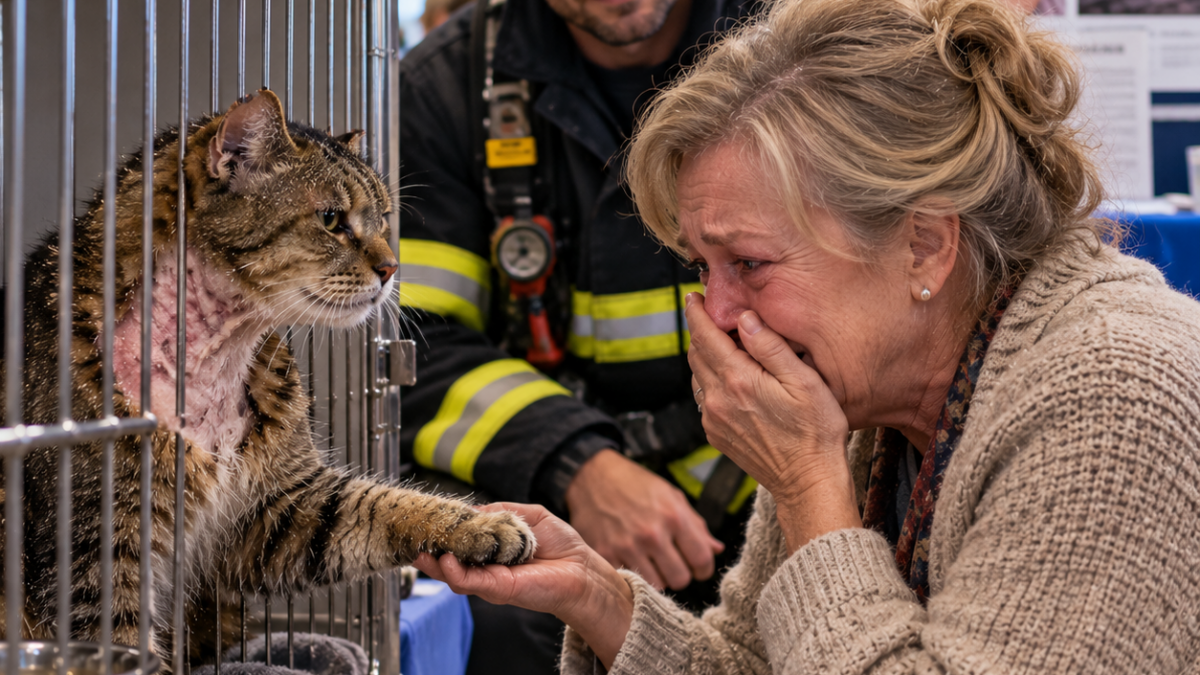
She Called the Scarred Shelter Cat Ugly—Then the Firefighter Said, “Your Grandchildren Are Alive Because of Him.”
Diane Miller came to the adoption event looking for an older cat to fill the silence left by her husband’s death, but when she saw Clyde’s burned neck, torn ear, cloudy eye, and ruined voice, she pulled her hand away and quietly said he was too ugly to live with.
I was standing beside Clyde’s cage when she said it, and I knew those scars were not the result of neglect or a street fight—they were the price he had paid for running back into a burning house after every human being had already escaped.
Then Diane asked me what street the fire happened on, and when I gave her the address and date, her face went white because the two babies Clyde had refused to abandon were her own grandchildren.
The first thing Diane Miller noticed about Clyde was his paw.
Not his face.
Not the cloudy left eye.
Not the torn ear.
Not the wide pink-and-gray band of damaged skin around his neck where fur had never grown back.
His paw.
It came through the bars slowly.
Tentative.
Five brown toes reaching between the metal as if Clyde understood that asking too much had never gone particularly well for him.
Diane stopped walking.
It was a cold Saturday morning in February, and our county animal shelter had taken over half the community recreation center for its annual winter adoption event.
The building smelled like coffee, disinfectant, wet coats, dog shampoo, and the faint sour edge that follows thirty nervous animals into one room no matter how often somebody mops.
Outside, sleet rattled against the windows.
Inside, children moved from cage to cage with the relentless optimism of people who believed every animal should immediately become theirs.
Most families went straight toward the kittens.
Bright eyes.
Round faces.
Soft paws.
Tiny bodies that fit into two hands.
People lifted phones before they even read the information cards.
“Look at this one.”
“Oh my God, she’s adorable.”
“Can we hold him?”
“Mom, please.”
Clyde sat near the far wall beneath a handwritten sign:
CLYDE
MALE — APPROX. 8 YEARS
QUIET HOME PREFERRED
NO ADOPTION FEE
ASK STAFF ABOUT SPECIAL CARE
He had been waiting eighteen months.
PART2:
That number bothered me more every time I saw it.
My name is Ethan Cole.
I was thirty-eight then.
Lieutenant with the North Valley Fire Department.
Twelve years on the job.
And I had known Clyde longer than anybody working the adoption floor that morning.
I was kneeling beside his cage when Diane approached.
She was sixty-four.
Short silver hair.
Dark green wool coat.
Wedding ring still on her left hand.
She had been circling the older cats for almost twenty minutes without touching any of them.
Finally she stopped near me.
“I don’t want a kitten.”
I looked up.
“Good.”
That surprised her.
“Good?”
“Kittens are running a strong public-relations campaign.”
She laughed softly.
It was a tired laugh.
“I noticed.”
She looked along the row of cages.
“My husband died two years ago.”
People tell firefighters things quickly.
Maybe because we wear uniforms.
PART3:
Maybe because we meet them on days when pretending everything is fine feels pointless.
Diane glanced down at her ring.
“Heart attack.”
“I’m sorry.”
“Thank you.”
She rubbed her thumb across the gold band.
“The house is too quiet.”
There was no dramatic break in her voice.
That made the sentence sadder.
“I don’t want an animal that needs me to chase it all day.”
She smiled faintly.
“I just want something older.”
“Something that might sit beside me.”
I looked at Clyde.
“He understands sitting.”
Diane followed my eyes.
Clyde had been curled in the rear of his cage beneath a fleece blanket.
At the sound of her voice, he raised his head.
Then stood.
Slowly.
His back legs were a little stiff in cold weather.
He walked to the front.
Diane crouched.
“Well, hello.”
Clyde pressed his forehead against the bars.
She smiled.
“That’s a serious face.”
His paw appeared.
He extended it through the gap.
Diane offered two fingers.
Clyde placed his paw over them.
I had watched people ignore him all morning.
Children stared.
Adults read the medical card and moved on.
One woman whispered that she could never handle “looking at injuries like that.”
A man asked whether Clyde’s cloudy eye meant he was contagious.
Another family loved him until they learned he occasionally woke at night and cried.
Diane was the first person that morning Clyde reached for.
For about five seconds, I thought maybe that was it.
Maybe eighteen months ended right there.
Then Clyde turned his head.
Diane saw his neck.
Her smile disappeared.
The burns had healed long ago.
But healed does not mean erased.
The skin around his throat was uneven and pale.
A wide crescent ran from the left side of his neck down toward the shoulder.
Some areas were smooth.
Others ridged.
The hair follicles were gone.
His left ear ended in an irregular edge where burned tissue had eventually been removed.
Diane pulled her hand back.
Clyde left his paw stretched through the bars.
“Oh.”
I knew that sound.
Shelter volunteers learn it.
Oh can mean sympathy.
It can mean fear.
It can mean disappointment.
It can mean I was interested until I saw the part of you that makes this inconvenient.
Diane looked at me.
“What happened to him?”
I waited.
She looked back at Clyde.
Then said the sentence that changed both their lives.
“I know this sounds awful.”
Clyde slowly lowered his paw.
“But I couldn’t look at that every day.”
She swallowed.
“He’s just…”
She stopped.
I probably should have let her.
Instead I said:
“Ugly?”
Her eyes filled with embarrassment.
“I’m sorry.”
“No.”
“I shouldn’t have said it.”
“You were thinking it.”
She looked at me.
I had spent twelve years walking into houses where people had said things far worse under far more understandable circumstances.
Fear.
Grief.
Shock.
None of those had taught me that humiliating people makes them wiser.
So I didn’t scold her.
I looked at Clyde.
He had not retreated.
That was Clyde’s way.
He rarely retreated from people.
Even after everything people had failed to do for him.
I asked:
“Do you know how he got those scars?”
Diane shook her head.
I sat down on the folding chair beside his cage.
“Eighteen months ago.”
Clyde’s ears moved at my voice.
“January ninth.”
“Cold night.”
“Coldest we had that winter.”
Diane looked back at him.
And I told her about the night Clyde burned.
The call came at 1:47 in the morning.
Residential structure fire.
Possible entrapment.
Briarwood Lane.
I was riding Engine 6.
Captain at the time was Marcus Hill.
Driver was Eddie Navarro.
Firefighter Jasmine Lee rode across from me.
I remember the dispatch because the address looked familiar.
Not personally.
Just one of those streets every firefighter knows after enough medical calls.
A subdivision built in the late nineties.
Two-story houses.
Attached garages.
Narrow side yards.
Vinyl siding.
Mature trees packed too close together.
The temperature was eleven degrees.
Water froze wherever it landed.
By the time we turned onto Briarwood, the sky above the houses was orange.
You know a working fire before you see the flames.
The smoke tells you.
Color.
Volume.
Pressure.
That night it rolled low and heavy across the road.
The front windows on the second floor had already failed.
Flames moved inside two bedrooms.
Neighbors were standing in the street wearing pajamas under winter coats.
Someone was screaming.
We stopped short of the house.
Lines came off.
Marcus began size-up.
I remember a man stumbling toward us without shoes.
Blood on one hand.
“Babies!”
That word changes everything.
“Where?”
“Upstairs.”
“How many?”
“Two.”
“Which room?”
He pointed.
Then pointed somewhere else.
“I don’t know.”
His wife was on the lawn coughing.
Bare feet.
Nightgown.
Hair burned at one side.
She was crying so hard she could barely speak.
“The twins.”
“Where?”
“Back room.”
“Left?”
“I don’t know.”
Smoke does that.
People who have never stood outside their own burning home imagine they would become precise.
They would tell us:
Second floor, east bedroom, six feet right of the stairs.
Real people say:
Up there.
My babies.
Please.
Please.
Please.
Marcus grabbed my shoulder.
“Cole, Lee. Primary search.”
We masked up.
Went in.
Heat hit immediately.
Visibility maybe three feet near floor.
Less above.
The stairwell had fire overhead.
We advanced.
Jasmine behind me.
I could hear the hose team entering below.
The father had said back bedroom.
There were three bedrooms upstairs.
That was the problem.
We had seconds.
Maybe minutes.
No certainty.
Then something moved through the smoke.
Low.
Fast.
For one instant, I thought it was falling debris.
Then it hit my boot.
A cat.
Large tabby.
Eyes huge.
Whiskers curled from heat.
He ran past me down the stairs.
I remember thinking:
Good.
One thing got out.
Then he stopped.
Halfway down.
Turned.
Looked back at me.
I shouted:
“Go!”
He did.
Down.
Gone.
Jasmine and I continued.
We checked the first bedroom.
Empty.
Bed.
Closet.
Under it.
No children.
Hallway heat increasing.
The second door was partly open.
We searched.
Nobody.
Then I heard something.
Not a child.
A cat.
That same broken, desperate cry.
Somewhere behind us.
I turned.
Clyde was back.
He had run into the house again.
I could barely believe it.
He stayed low beneath smoke.
Then ran past our boots toward the end of the hallway.
Stopped at a closed door.
Clawed.
Hard.
Scratched the wood so violently his front paws slid.
Then he screamed.
That is the only word.
Cats do not sound the way people expect when terrified.
It was raw.
Harsh.
Almost human enough to cut through everything else.
Jasmine shouted:
“That room!”
I reached Clyde.
He moved aside only when my hand touched the door.
The knob was hot.
I forced it.
Smoke pushed out.
The room was worse.
A crib near the wall.
Another portable crib closer to window.
Two children.
Twin toddlers.
Eighteen months old.
One slumped against the side of the crib.
The other on the floor near it.
Clyde ran to them.
Not away.
To them.
He pressed his body against the child on the floor.
Jasmine took the crib.
I took the floor.
No time for elegant assessment.
Both breathing.
Barely responsive.
We had to move.
I tucked one child against me.
Turned.
The ceiling made a sound I still hear sometimes.
A deep crack.
Jasmine shouted.
“Move!”
Part of the ceiling came down.
Not the whole room.
Burning plaster.
Insulation.
Wood.
Enough.
I saw Clyde beside the crib.
Then debris hit him.
Across the neck.
Shoulder.
He disappeared beneath a falling section.
I had a child in my arms.
There is a rule inside emergencies nobody likes talking about afterward.
You cannot save everything at once.
People imagine courage as refusing to choose.
Real rescue often means choosing very quickly and living afterward with everything you did not choose.
I carried the child.
Jasmine had the other.
We moved.
Down the hall.
Stairs.
Outside.
Paramedics took them.
Oxygen.
Airway management.
A thousand voices.
I turned back.
Marcus grabbed my arm.
“Where are you going?”
“Cat.”
He looked at the house.
Then at me.
“Conditions?”
“Upper hall deteriorating.”
“Cole.”
“He led us to them.”
That changed something in his face.
Not because animals outrank firefighter safety.
They do not.
We do not kill firefighters for pets.
But the hallway had not been declared untenable yet.
The attack line was still holding stairs.
The room was searchable.
Marcus looked toward interior crew.
Then:
“You have one controlled pass.”
I went.
Jasmine stayed with medical.
Another firefighter covered me.
The smoke had worsened.
I found the bedroom.
Debris pile.
There was no crying now.
I moved a section of drywall.
Then another.
Clyde lay under burned insulation.
Alive.
Barely.
His neck and shoulder were burned.
One ear was badly injured.
He was shaking.
Still facing the cribs.
I wrapped him in my coat liner.
Carried him out.
Outside, the babies were being loaded into separate ambulances.
Their mother had also been transported.
The father stood beside a police officer, sobbing.
I put Clyde into the hands of an animal-control officer who had just arrived.
“Emergency vet.”
“He’s burned.”
The officer looked at the cat.
Then at me.
“I’ve got him.”
That was the last I saw of Clyde for six days.
The twins survived.
So did their mother.
The children had significant smoke inhalation.
One spent several days in pediatric intensive care.
The family’s house was destroyed.
The official fire investigation later determined that an electrical failure near an overloaded bedroom space heater had ignited nearby material.
None of that mattered to me as much as one fact.
If Clyde had run outside and kept going, Jasmine and I would probably still have searched the third bedroom.
Eventually.
Maybe fast enough.
Maybe not.
I have learned not to build certainty around hypotheticals.
What I know is this:
Clyde came back into a burning house.
He led us to a closed door.
Two children were behind it.
That is enough.
Six days after the fire, I drove to the emergency veterinary hospital.
I told myself I was only checking.
Firefighters do that.
We become attached to strange things after bad calls.
A child’s toy.
A family.
A dog we carried from an apartment.
A photograph we found under rubble.
Clyde was in an oxygen enclosure.
Half his neck bandaged.
Left ear blackened along edge.
One eye swollen.
He looked terrible.
I stood beside the cage.
He opened the good eye.
Then tried to stand.
The veterinary technician said:
“He knows you?”
“No.”
She smiled.
“Looks like he disagrees.”
Clyde reached his paw toward the acrylic wall.
That was the first time he did it.
The same thing he had done to Diane.
He stayed at the hospital three weeks.
Burn treatment.
Debridement.
Eye care.
Pain control.
Nutrition.
The smoke damage affected his voice.
His left eye never cleared completely.
Part of his ear eventually had to be removed.
The skin around his neck healed badly because some burns were too deep for normal hair regrowth.
He lived.
That was supposed to be enough.
But survival creates logistical problems.
The family had nowhere to go.
Their insurance placed them temporarily in extended-stay housing that prohibited animals.
Then one child developed respiratory complications requiring frequent appointments.
The parents moved in with relatives two hours away.
Someone said they would take Clyde temporarily.
That fell through.
Another relative had aggressive dogs.
Months passed.
The family surrendered him to the county rescue with the intention that he find a stable home.
They cried when they did it.
I know because shelter director told me.
I never judged them.
People love saying:
I would never give up my pet.
Most people saying that have never stood beside the ashes of everything they own while two children are still receiving respiratory treatment.
Life makes choices uglier than opinions.
I started visiting Clyde.
At first weekly.
Then whenever shifts allowed.
When he moved from medical foster into the shelter, I brought his blue blanket.
He remembered me.
Or maybe he remembered the smell of smoke that never quite leaves turnout gear.
I don’t know.
But every time I came, he pressed his head into my hand.
Months passed.
Applications came.
Then failed.
One family had three dogs.
Not ideal.
Another wanted an outdoor cat.
Absolutely not.
A retired couple liked him until they heard he sometimes panicked at smoke-alarm sounds.
A young woman adopted him for two days.
Returned him because his nighttime pacing made her anxious.
Eighteen months.
That morning at the adoption event, I told Diane all of it.
Not every detail.
Enough.
When I finished, she was staring at Clyde.
Her face had gone pale.
“He didn’t lose a fight,” I said.
“He survived a fire.”
She looked at his neck.
“That scar?”
“That’s where part of the ceiling came down.”
Her lips trembled.
I should have stopped.
Instead I said:
“He stayed beside two babies when he could have run.”
Diane stared at me.
Then:
“What street?”
I frowned.
“What?”
“The fire.”
“What street?”
“Briarwood Lane.”
Her hand moved toward her mouth.
“What number?”
I told her.
Her eyes filled instantly.
“What date?”
“January ninth.”
She made a sound.
Not quite a sob.
Then grabbed the side of the folding table.
I stood.
“Ma’am?”
“Those were my grandchildren.”
Everything in the room seemed to go quiet even though it didn’t.
Dogs barked.
Children laughed.
A volunteer called somebody’s number over a microphone.
But for me, there was only Diane.
Her hand over her mouth.
Clyde watching from behind metal bars.
I said:
“Your grandchildren?”
“My daughter.”
Her voice shook.
“Emily.”
“Emily Miller?”
“Emily Carter now.”
I remembered the mother.
Not her name immediately.
Then I did.
Emily Carter.
“Yes.”
Diane began crying.
“The twins.”
“Noah and Grace?”
Her knees seemed to weaken.
I pulled over the folding chair.
She sat.
“Oh my God.”
Clyde came closer.
Diane looked at me through tears.
“We were told firefighters found them.”
“We did.”
“No.”
She shook her head.
“I mean…”
“Nobody told us…”
Her breathing broke.
“Nobody ever told me about the cat.”
I sat beside her.
“Your daughter knew Clyde was found in the room.”
“She knew he was burned.”
“But those first days were chaos.”
“She had smoke injuries too.”
“The twins were transferred.”
“Clyde went to a different veterinary hospital.”
“Fire reports don’t usually contain a heroic-cat narrative.”
I gave her a small smile.
“Official paperwork is less sentimental.”
Diane wiped her face.
“But Emily loved that cat.”
“I know.”
“She thought he was dead at first.”
“I know.”
“When they told her he lived…”
“She wanted him back.”
“I know.”
Diane looked at me.
“You talked to her?”
“Once.”
“After the fire.”
“She cried.”
“She said she couldn’t take him into temporary housing.”
Then I added:
“She did not abandon him because she stopped loving him.”
Diane closed her eyes.
“I was in Arizona.”
“My husband’s sister had surgery.”
“I flew home the next morning.”
“By then Emily was in the hospital.”
“The babies…”
She stopped.
I waited.
“My husband was still alive then.”
She looked down.
“He died six months later.”
“After that everything…”
Her hand shook.
“I knew Clyde disappeared into rescue.”
“I thought he was just injured and they couldn’t take him.”
“I didn’t ask enough.”
That was guilt talking.
I recognized it immediately.
“You were taking care of your family.”
“I called him ugly.”
Clyde was sitting inches away.
Diane looked at him.
“I called the animal that saved my grandchildren ugly.”
I said:
“He doesn’t speak English.”
She laughed through tears.
It was a terrible joke.
Exactly what she needed.
Then she slowly lowered herself from the chair to her knees.
Her joints clearly objected.
She ignored them.
Clyde stood.
Diane moved close to the cage.
“I’m sorry.”
Clyde reached his paw through the bars.
The second time.
She offered her wrist.
His paw settled against it.
Then he made that ruined little sound.
Air through an old tire.
Diane covered her face.
That was when the shelter director, Monica, found us.
She looked from Diane to me.
Then Clyde.
“What happened?”
Diane pointed at the cage.
“I need an application.”
Monica blinked.
“For Clyde?”
“Yes.”
“Okay.”
“No.”
Diane wiped her cheeks.
“Not okay.”
“I mean now.”
Monica looked at me.
I shrugged.
“Seems urgent.”
The adoption process still took time.
That mattered.
Emotion is not a substitute for good placement.
Monica interviewed Diane.
Household.
Other pets.
No.
Grandchildren visiting?
Yes.
Veterinary history?
She had owned cats before.
Windows?
Screens.
Smoke detectors?
That question nearly derailed the interview because Diane started crying again.
Monica waited.
Then continued.
We discussed Clyde’s trauma.
He did not like being restrained around neck.
Harness only for transport.
No collar unless extremely loose and breakaway.
Skin care for the scar.
Eye monitoring.
His voice would probably remain damaged.
He sometimes paced after waking.
During thunderstorms or television fire alarms, he hid under furniture.
Diane listened.
Then said:
“I wake up at three most mornings.”
Monica looked up from the form.
Diane rubbed her ring.
“The house gets very lonely around three.”
She looked toward Clyde.
“Maybe we can be awake together.”
That sentence nearly finished me.
I went to the coffee table so nobody would see.
By noon, Clyde’s adoption card had a red sticker across it.
PENDING.
Children still stopped.
Adults still commented on his scars.
But something had changed.
He was no longer waiting for just anyone.
He was waiting for Diane.
The shelter required a home visit because of Clyde’s medical and behavioral needs.
Monica did it the following Tuesday.
Diane’s house was a small brick ranch on Maple Street.
Three bedrooms.
One level.
Quiet.
The living room still looked inhabited by two people even though only one lived there.
A second recliner.
Two coffee mugs in the cabinet beside the sink.
Men’s coat still hanging in hall closet.
Monica later told me Diane had apologized for that.
“I haven’t figured out what to move.”
Monica told her:
“You don’t have to move anything for us.”
They chose a room for Clyde’s litter box.
Placed a low cat tree near the window.
Removed a scented candle because some smoke odors could trigger him.
Checked screens.
Diane bought a heated pad but then returned it after learning burned skin could have altered temperature sensitivity.
She replaced it with thick fleece blankets.
She asked more questions than most adopters.
“What if he hides?”
“Let him.”
“What if he cries at night?”
“Talk to him.”
“What if he doesn’t want me touching his scars?”
“Then don’t.”
“What if he never becomes affectionate?”
Monica said:
“Then you give him the home anyway.”
Diane nodded.
“That seems fair.”
Clyde went home Friday.
I arranged my shift so I could be there.
Not as firefighter.
Just Ethan.
I drove to the shelter wearing jeans and an old North Valley sweatshirt.
Diane arrived with a new carrier.
Too small.
We told her.
She laughed at herself.
Bought a larger one from shelter shop.
Clyde hated carriers.
He always had.
When the door opened, he stiffened.
I put the blue blanket inside.
He sniffed.
Diane sat on the floor.
“No rush.”
That was the right thing to say.
Clyde stepped in on his own after five minutes.
At Diane’s house, we opened the carrier in the living room.
He did not come out for twenty-three minutes.
Diane sat on couch reading a paperback.
Didn’t call him.
Didn’t reach.
Didn’t bribe.
Finally Clyde’s head appeared.
Then one paw.
Then another.
He walked around the room.
Sniffed the baseboards.
Inspected the hallway.
Looked into the kitchen.
Stopped beside the second recliner.
Jumped up.
Turned three circles.
Sat.
Diane looked at me.
“That was Harold’s chair.”
Her husband.
I said:
“Apparently it’s Clyde’s now.”
She smiled.
“Harold would’ve complained.”
“Would he mean it?”
“No.”
Clyde fell asleep there.
I left quietly.
The first week was difficult.
Diane called me twice.
Not because anything was wrong.
Because she needed reassurance.
On night three, Clyde woke at 2:41.
Walked the hallway.
Checked every bedroom.
Cried outside the guest room.
Diane followed.
He walked to the front door.
Then kitchen.
Then back to hallway.
“He keeps checking.”
I sat at my own kitchen table with the phone against my ear.
“Yes.”
“For what?”
I knew.
“The babies.”
Silence.
“Oh.”
“He did it in foster care.”
“Sometimes he wakes and walks room to room.”
“He checks beds.”
“Doors.”
Diane’s voice softened.
“He still thinks they’re there?”
“I don’t know what cats think.”
“But his body remembers something.”
She was quiet.
Then:
“What should I do?”
“Let him finish.”
“And then?”
“Sit down.”
“Be where he can find you.”
She called the next morning.
“What happened?”
“He checked every room.”
“Then jumped beside me.”
“Good.”
“We watched infomercials until four.”
I laughed.
“Sounds therapeutic.”
“It was terrible.”
Two weeks later, Emily called me.
I had not spoken with her since after the fire.
Her voice was hesitant.
“Firefighter Cole?”
“Ethan.”
“Right.”
“My mom told me.”
I knew what she meant.
“I’m sorry nobody explained Clyde’s role clearly.”
“No.”
She interrupted.
“That isn’t why I’m calling.”
I waited.
“She adopted him?”
“Yes.”
Emily began crying.
Quietly.
“I kept telling myself giving him up was temporary.”
“I know.”
“Then housing became another housing.”
“My husband’s job moved.”
“The twins had appointments.”
“Every time I thought we could take Clyde back, something else happened.”
“You don’t owe me an explanation.”
“Yes, I do.”
“No.”
I sat in the firehouse kitchen.
Nobody else was around.
“You had two children recovering from smoke inhalation.”
“You had no house.”
“You found him rescue placement instead of pretending you could care for him when you couldn’t.”
“That is not the same as not loving him.”
Emily breathed.
“My mom said he waited eighteen months.”
“That part hurts.”
“It should.”
I did not lie.
“But it does not erase what was true then.”
She was quiet.
Then:
“Can the kids see him?”
“That’s Diane’s decision now.”
“I know.”
“I’m asking if you think it would be bad for Clyde.”
“Start slow.”
“Let him choose.”
The first visit happened that Sunday.
I was not there.
Diane sent a photograph afterward.
Noah and Grace were three now.
They did not remember the fire.
They barely remembered Clyde.
Children that age do not preserve events the way adults expect.
But Clyde remembered them.
Or recognized them.
Or recognized their scent.
Again, I will not turn an animal into something magical to improve a story.
I can tell you only what happened.
When Noah entered the house, Clyde stood from Harold’s chair.
His ears went forward.
He froze.
Grace came behind her brother.
Clyde made that rough little sound.
Then walked toward them.
Not ran.
Walked.
He sniffed Noah’s shoes.
Grace’s coat.
Then pressed his head against Grace’s knee.
The twins crouched.
Emily cried.
Diane cried.
Clyde eventually sat between both children.
Noah touched the scar.
Diane gently moved his hand away.
“Not there.”
“Why?”
“He got hurt.”
“How?”
Emily looked at her mother.
Then told them a simple version.
“Clyde helped firefighters find you when there was a fire.”
Noah stared at the cat.
“He found us?”
“Yes.”
“Like a superhero?”
Emily smiled.
“No.”
Then she corrected herself.
“Maybe a little.”
They visited every other Sunday after that.
Clyde developed a routine.
When the twins arrived, he followed them.
Living room.
Kitchen.
Hallway.
If one child went into a different room, Clyde chose the space between them.
At bedtime during occasional sleepovers, he sat outside the guest-room door.
Not inside.
Outside.
Watching.
Diane told me:
“He still works.”
I said:
“Retired poorly.”
She laughed.
Four months after the adoption, I finally visited.
Spring had arrived.
The trees along Maple Street were budding.
Diane’s house looked different.
Not dramatically.
Just lived in again.
A child’s drawing on refrigerator.
Two small shoes beside front door even though the twins were not there that day.
A cat bed by window.
A soft navy blanket folded over Harold’s old chair.
Clyde had gained nearly two pounds.
His coat looked healthier.
The scars were exactly the same.
That was important.
Love had not made him beautiful in the conventional way.
The cloudy eye stayed cloudy.
The missing ear did not grow back.
The scar did not disappear.
His voice remained broken.
He was not transformed into something easier to look at.
The person looking had changed.
Diane sat on the couch.
Clyde jumped beside her.
She rested one hand carefully behind his shoulders, avoiding the sensitive section of his neck.
“He wakes me less now.”
“Good.”
“I’m not sure.”
I laughed.
She smiled.
“Sometimes I miss our three-in-the-morning television.”
Clyde closed his eyes.
On a side table was a framed photograph.
Noah and Grace.
Clyde between them.
Grace’s arm around his body.
Noah holding a book.
I picked it up.
“When was this?”
“Last weekend.”
“They asked to read to him.”
“Does he enjoy books?”
“No.”
“Good.”
“Would’ve ruined the story if he did.”
Diane smiled.
Then became serious.
“I need to tell you something.”
I set the picture down.
“What?”
“The day I called him ugly.”
I waited.
“I think about it all the time.”
“You probably shouldn’t.”
“I wish I could take it back.”
“Why?”
She looked at me like the answer was obvious.
“Because it was cruel.”
“Yes.”
I agreed.
“But you changed your mind.”
“That doesn’t erase saying it.”
“No.”
“Nothing erases anything.”
I pointed toward Clyde.
“His scars are still there.”
She looked down at him.
“So what do I do with it?”
“Remember why you were wrong.”
“That’s different from punishing yourself forever.”
She was quiet.
Then:
“Is that firefighter wisdom?”
“No.”
“Therapy.”
That made her laugh.
I had started seeing a therapist two years before.
Not because of Clyde.
Because after twelve years in fire service, my brain had collected enough things it did not know where to store.
Dead children.
People we couldn’t reach.
Sounds.
Smells.
Families.
Calls that went perfectly.
Calls that did not.
For years I thought the good outcomes were supposed to cancel the bad ones.
They don’t.
Human beings are not ledgers.
Clyde had become connected in my mind to one of the good calls.
Two babies survived.
A cat survived.
Everybody loves those stories.
But I still remembered the ceiling coming down.
The split second when I chose children first.
I knew it was right.
I would make the same choice again.
My body did not care.
Sometimes in dreams, Clyde disappeared under debris and I never went back.
One night after visiting Diane, I dreamed the old version.
Fire.
Bedroom.
I carried Noah out.
Then Grace.
Went back.
No Clyde.
I searched until my air alarm screamed.
Woke at 3:12.
Sat on my bed.
Sweating.
The next morning, I stopped by Diane’s before shift.
No call.
I simply needed proof.
She opened the door in a robe.
“Ethan?”
“Sorry.”
“Is everything okay?”
Then Clyde appeared.
Walked past her.
Looked at me.
Meowed his broken meow.
I crouched.
He pressed his head into my hand.
Diane understood without me explaining.
She opened the door wider.
“Coffee?”
“Yes.”
We drank coffee at six in the morning while Clyde sat between us.
Sometimes rescue keeps happening after the emergency is over.
Nobody puts those parts in incident reports.
Diane’s life changed too.
Before Clyde, she had been declining invitations.
Church lunches.
Neighbors.
Her daughter.
She said she did not feel depressed.
Only tired.
That is how many lonely people describe loneliness.
Not sadness.
Fatigue.
Everything requiring more energy than silence.
Clyde created obligation.
Breakfast.
Medication for his eye.
Veterinary appointments.
Litter box.
Blankets.
He needed her home.
Then the twins wanted to visit Clyde.
Emily began coming too.
Diane cooked again.
At first for the children.
Then neighbors.
Then herself.
One afternoon, Monica from the shelter called me laughing.
“You know what Diane did?”
“What?”
“She volunteered.”
“At the shelter?”
“She says she wants older-cat duty.”
I laughed.
“Does she know what that means?”
“Apparently.”
Diane began spending two Saturdays a month at the shelter.
Not with kittens.
With the old ones.
Scared ones.
Cats with kidney disease.
Cats surrendered after owners died.
Cats with one eye.
Missing legs.
Bad fur.
The animals people looked at and then looked away from.
She became annoyingly effective.
She would sit beside visitors and say:
“Do you want cute, or do you want company?”
Monica eventually had to tell her not to emotionally interrogate adopters.
Diane ignored her.
One elderly orange cat named Bernard had been waiting seven months.
Diane convinced a retired schoolteacher to meet him.
Bernard went home that afternoon.
“Don’t get arrogant,” I told Diane.
“I learned from Clyde.”
“That cat has no humility.”
“Neither do firefighters.”
Fair.
The fire anniversary came.
January ninth.
I usually worked anniversaries badly.
I never requested them off.
That felt too ceremonial.
But my body remembered dates whether my schedule did or not.
That morning, Emily invited me to breakfast.
Diane’s house.
Twins.
Clyde.
I almost refused.
Then went.
Noah and Grace were four.
They had decorated pancakes with so many chocolate chips that the meal became dessert.
Diane wore an apron that said CATS ARE CHEAPER THAN THERAPY.
Emily gave me a small envelope.
Inside was a photograph from the fire department archive.
The house.
Smoke.
My crew.
And in one corner, barely visible:
Clyde.
Outside.
Turned toward the burning doorway.
The moment before he ran back in.
I had never seen the photograph.
“Where did you get this?”
“Dad found it online.”
Emily looked at the picture.
“He wants a copy too.”
Her husband had been the barefoot man on the lawn.
He had spent years believing he failed his children because he could not get upstairs.
Trauma had divided that family in quiet ways.
Clyde had become one of the bridges back.
Grace climbed onto the chair beside me.
“That’s Clyde?”
“Yes.”
“He looks scared.”
I looked again.
She was right.
His body low.
Tail down.
Eyes wide.
Scared.
People use brave as though brave and scared are opposites.
Firefighters know better.
Brave people are afraid all the time.
So are brave cats, apparently.
“Yes.”
“He was scared.”
Grace frowned.
“Then why did he go back?”
Children ask the worst questions.
Because they require honest answers.
“I don’t know.”
She thought.
“Because we were there?”
“Maybe.”
She looked at Clyde asleep beneath table.
Then smiled.
“He likes me.”
“That could be it.”
A year passed.
Then another.
Clyde got older.
His kidneys required monitoring.
His cloudy eye worsened slightly.
The scarred skin developed a small sore one winter and needed treatment.
Diane handled all of it.
No dramatics.
Appointments.
Medication.
Care.
At seventy, Clyde became less interested in patrolling every room.
I’m joking.
Diane was seventy.
Clyde was maybe eleven.
But he aged fast after what his body had survived.
He still checked the guest-room door whenever the twins slept over.
Just slower.
Noah began soccer.
Grace took dance classes.
Emily went back to work full time.
Diane attended everything.
Clyde waited at home.
The empty house was not empty anymore.
It contained evidence of people returning.
Backpacks.
Cat toys.
Extra toothbrushes.
Photos.
Noise.
A life.
Clyde did not cure grief.
Harold was still dead.
Diane still missed him.
She spoke about him often.
Sometimes she cried.
The difference was that grief no longer had the entire house to itself.
One evening I visited after shift.
Diane was sitting beside the window.
Clyde on her lap.
She said:
“Harold would’ve loved him.”
“You think?”
“He liked ugly things.”
I stared.
She laughed.
“That came out terribly.”
“Extremely.”
“I mean he liked old furniture.”
“Not helping.”
“Broken radios.”
“Stop.”
“Cars nobody else wanted.”
I laughed.
She looked down at Clyde.
“He always said you could learn a lot about somebody by what they thought was worth fixing.”
That sentence stayed with me.
A few months later, Clyde became sick.
Not suddenly.
That would almost have been easier.
He started eating less.
Then sleeping more.
Blood work showed kidney disease progressing.
Medication helped.
Fluids.
Diet.
For nearly a year, he remained comfortable.
Then one November, Diane called me.
“Ethan.”
Her voice told me.
I was at the station.
“What happened?”
“He won’t stand.”
I drove over.
Not with lights.
No siren.
There was no emergency to beat.
Clyde was on Harold’s chair beneath the navy blanket.
Diane sat beside him.
Emily was driving over with the twins.
The veterinarian was coming to the house.
Clyde opened his good eye when I entered.
I sat on the floor.
“Hey, buddy.”
His paw moved.
Barely.
I offered my fingers.
He placed it over them.
Same gesture.
Adoption event.
Veterinary hospital.
First visit.
Beginning.
Everything in one paw.
Diane cried.
“I don’t want him hurting.”
“He isn’t going to.”
“I know.”
Then:
“I’m not ready.”
Nobody ever is.
Emily arrived.
The twins were old enough now to understand some of it.
Noah cried openly.
Grace sat beside Clyde and read the same children’s book she had read to him for years.
He did not lift his head.
But one ear moved when she spoke.
The veterinarian explained everything.
Diane listened.
Asked questions.
Then made the decision people make when love becomes the willingness to take pain instead of extending someone else’s.
Clyde died in Harold’s chair.
Diane’s hand rested behind his shoulders.
Emily touched his paw.
Noah and Grace sat on the floor.
I stayed near the window.
After his breathing stopped, nobody spoke for a while.
Then Grace asked:
“Is he still a hero?”
Diane made a sound halfway between a laugh and a sob.
I crouched beside her.
“Yes.”
Grace looked at the scars around his neck.
“They’re still ugly.”
Emily froze.
Diane looked at her granddaughter.
Grace continued:
“But I like them.”
Children.
No diplomacy.
No fear.
Just truth.
Diane kissed the top of her head.
“So do I.”
We had Clyde cremated.
Diane kept the urn in the living room.
Not like shrine.
Beside Harold’s photograph.
Two lives that had filled the house in different ways.
The blue blanket went to the shelter.
Monica washed it.
Put it into the cage of another older cat.
Diane continued volunteering.
A month after Clyde died, a scarred black cat came in after surgery.
One eye removed.
Nobody wanted him.
Diane sat beside the cage.
A woman walked past.
Stopped.
Made the face.
That same small recoil.
“Oh.”
Diane looked up.
The woman said:
“Poor thing.”
Then:
“I don’t think I could handle looking at that.”
Diane did not get angry.
She later told me she wanted to.
Instead she said:
“Would you like to hear how he lost the eye?”
The woman hesitated.
Then sat.
That cat went home three weeks later.
Not with that woman.
But somebody else.
Diane had learned the difference between making people ashamed and making them see.
So had I.
Years later, whenever firefighters from my department speak at schools, someone inevitably asks about animals.
Have you ever rescued a dog?
A cat?
A bird?
Once, one second-grader asked whether we had ever rescued a dinosaur.
I said not successfully.
But when people ask about the bravest animal I ever met, I tell them about Clyde.
I do not say he knew exactly what he was doing.
I cannot know that.
I do not claim he understood fire behavior or rescue strategy.
He was a cat.
A badly frightened cat.
What I say is simpler.
He escaped.
Then went back.
He led us to a door.
Two children were behind it.
When the ceiling came down, he was still beside them.
That is enough.
And when I tell people about the scars, I never call them beautiful.
That phrase always bothered me.
Scars do not need to become beautiful to deserve respect.
Clyde’s scars were rough.
Uneven.
Uncomfortable.
Sometimes painful.
They were not decorations.
They were evidence.
Evidence that a body had survived something it was never meant to endure.
Diane once called him ugly because she saw the damage before she understood the history.
Most of us do that in one form or another.
We see the thing first.
The scar.
The limp.
The burned skin.
The shaking hand.
The broken voice.
The grief.
The behavior that makes someone difficult.
And we decide what it means before asking what happened.
Diane learned that in a shelter aisle.
I learned it in burning houses.
Clyde probably knew it all along.
He never seemed interested in what anybody looked like.
Only whether they stayed.
The last photograph Diane gave me hangs inside my locker at the firehouse.
It was taken a few months before Clyde died.
Noah and Grace sit on the couch.
Older now.
Clyde between them.
Diane behind the couch with both hands resting on the back.
His damaged ear points sideways.
His cloudy eye catches the light.
The scar around his neck is fully visible.
Nobody tried to hide it.
On the back, Diane wrote:
HE SAVED THEM FIRST.
THEN HE SAVED ME.
I used to correct her when she said that.
I told her Clyde did not save her the way he saved the twins.
There was no smoke.
No fire.
No locked bedroom.
Eventually I stopped correcting her.
Because she was right in the way that mattered.
The night of the fire, Clyde ran back into a house full of smoke because two small children were still inside.
Years later, Diane knelt in front of a shelter cage carrying a loneliness nobody else could see.
Clyde reached through the bars.
He did not know she was their grandmother.
He did not know she had insulted him.
He did not know what grief had done to the rooms waiting at her house.
He simply offered his paw.
Once.
Then, after she pulled away, he offered it again.
Maybe that is why I still think about him.
Not because he was fearless.
Not because scars made him special.
Not even because he helped us find two children.
Because after fire, injury, abandonment, hospitals, cages, failed adoptions, and eighteen months of people looking at him and choosing something prettier—
Clyde still reached for somebody.
Diane eventually learned what those burned places meant.
But Clyde never needed to know what her scars meant before deciding she was worth reaching for.
And in the end, that may have been the bravest thing he ever did.

