Seven Combat K9s Were Scheduled to Be Euthanized When a Scarred Navy SEAL Walked In and Said, “I’ll Take Them All”—Then the Most Dangerous Dog Did Something No Handler Had Seen in Six Months.
Seven Combat K9s Were Scheduled to Be Euthanized When a Scarred Navy SEAL Walked In and Said, “I’ll Take Them All”—Then the Most Dangerous Dog Did Something No Handler Had Seen in Six Months.
Seven retired combat K9s were scheduled to be put down before the week was over.
The military called them too aggressive, too traumatized, too dangerous to ever live outside steel cages again.
Then a scarred Navy SEAL walked into the commander’s office, pointed at the euthanasia files, and said five words nobody in that room was prepared to hear.
“I will take them all.”
The halls of the 341st Training Squadron at Lackland Air Force Base had always been loud.
Sharp barks.
Handler commands.
Boots on polished floors.
Metal bowls sliding across kennel concrete.
The disciplined chaos of the world’s finest military working dogs being trained, tested, corrected, praised, and pushed toward the dangerous work that would one day save American lives on roads most civilians would never see.
But Sector 4 was different.
Sector 4 was quiet.
Not peaceful.
Never peaceful.
It was the kind of quiet that comes before a storm breaks something.
The maximum-security quarantine wing sat behind two locked steel doors, down a corridor that smelled of bleach, old rubber, antiseptic, and the metallic bite of fear. The fluorescent lights overhead buzzed faintly, casting everything in a sterile blue-white pallor. Every kennel door had reinforced mesh. Every gate had double locks. Every warning label had been printed in red.
DO NOT APPROACH WITHOUT HANDLER CLEARANCE.
BITE RISK.
COMBAT TRIGGER RESPONSE.
NO DIRECT EYE CONTACT.
Inside Sector 4 were seven dogs.
Belgian Malinois.
Dutch Shepherds.
And one massive ninety-pound German Shepherd named Havoc.
Together, those seven dogs had completed twenty-two combat deployments. They had cleared roads in Helmand Province. Searched compounds in Iraq. Found hidden explosives beneath trash piles, rugs, culverts, burned-out vehicles, market stalls, and school entrances. They had saved patrols from buried pressure plates and tripwires. They had found insurgents in walls, tunnels, dry wells, and irrigation ditches.
Men were alive because of them.
Fathers came home because of them.
Entire convoys survived because one dog stopped walking and refused to take another step.
But war has a way of collecting payment later.
The military knew how to build dogs like that.
PART2:
It did not always know what to do with them when the war stayed inside their heads.
By the time the seven were moved into Sector 4, every one of them had a file thick enough to feel like a confession.
Severe canine post-traumatic stress.
Unpredictable aggression.
Combat-triggered panic response.
Handler aversion.
Startle-to-bite reaction.
Helicopter trigger.
Gunfire trigger.
Dark room trigger.
Vehicle rumble trigger.
Medical restraint trigger.
Human proximity trigger.
Loaded weapons with broken safeties.
That was the phrase in the final Pentagon directive.
Loaded weapons with broken safeties.
Captain Gregory Mitchell sat in his sterile office with seven manila folders spread across his desk.
His pen hovered over the authorization forms.
PART3:
He had been a military dog man for twenty-three years. He had seen dogs retire well, retire broken, retire into quiet homes with handlers who understood their nightmares. He had seen dogs buried with honors. He had seen dogs that could not be saved.
He knew the difference between sentiment and safety.
At least, that was what he had told himself all morning.
But every time he looked at the names on those folders, the argument sounded weaker.
Zeus.
Titan.
Valkyrie.
Apollo.
Ghost.
Ranger.
Havoc.
Havoc’s folder sat on top.
German Shepherd. Male. Ninety pounds. Dark sable and black. Shrapnel scarring along left flank. Deep notch missing from right ear. Three deployments. Confirmed explosive detections: thirty-one. Confirmed combat assists: classified. Medical evacuation trigger event on base three days prior.
Mitchell read the incident summary again even though he already knew every word.
A medical evacuation helicopter had flown low over the base.
The rhythmic thumping of the rotors had reached Sector 4.
Havoc had gone from stillness to violence in less than two seconds.
He had broken through a reinforced kennel latch, slammed Specialist Wyatt Evans into the concrete, and nearly severed the young handler’s forearm before the emergency response team subdued him.
Wyatt survived.
Barely.
Havoc was sedated and returned to isolation.
After that, the directive came down.
Euthanasia for all seven.
No sanctuary would take them.
No rescue would sign liability.
No handler could safely reassign them.
No facility would risk them.
Captain Mitchell lowered the pen.
His office felt too cold.
A knock did not come.
The heavy wooden door swung open.
Chief Petty Officer Nathaniel Rawlings stood in the doorway.
“Nate,” Mitchell sighed, setting the pen down. “You cannot just barge into my office.”
Nathaniel Rawlings did not look like the kind of man anyone should tell what he could not do.
He was forty-one, though grief, war, and pain had given him the face of someone older. His beard was untrimmed. His eyes were ice-pale and sleep-deprived. A scar ran from his temple into his hairline. His right leg moved stiffly when he stepped into the room, the titanium femur beneath his jeans never letting him forget Ramadi.
He wore faded jeans, a heavy canvas jacket, boots still carrying Montana dirt, and the blank, dangerous calm of a man who had survived things most people only saw in movies and never wanted to discuss them afterward.
Former SEAL Team Six.
Retired one year earlier after an IED blast left him medically alive and spiritually unresolved.
A legend in the Naval Special Warfare community.
A problem for anyone who liked clean paperwork.
“You’re about to put down heroes,” Nate said.
Mitchell leaned back.
“Close the door.”
Nate did.
The room became smaller.
“Nate—”
“I will take them all.”
Mitchell stared at him.
The words seemed to hang in the air between them, absurd and impossible.
“You’re not serious.”
“I am.”
“You haven’t even heard the full assessment.”
“I read enough.”
Mitchell stood.
“No, you did not. Because if you had, you would not be standing in my office asking for seven combat-traumatized K9s flagged as lethal.”
Nate pointed at the folders.
“They are not lethal. They are injured.”
“Havoc almost killed Wyatt Evans on Tuesday.”
“Havoc had a helicopter trigger in a concrete prison after months of isolation.”
Mitchell’s jaw tightened.
“You live alone on five hundred acres of frozen dirt in the Bitterroot Mountains. You are not a certified handler anymore. You have a bad leg. These dogs are apex predators with combat psychosis.”
“Then they’ll feel right at home.”
“This is not funny.”
“I’m not laughing.”
Mitchell walked around the desk.
“You think you can love them better? Is that the plan? Take them into the woods, talk rough, and let the mountains fix what war broke?”
Nate’s face did not change.
“No.”
“Then what?”
“I understand them.”
Mitchell’s expression softened despite himself.
“Nate.”
“No.”
The word cracked through the room.
Nate stepped closer to the desk.
“Twelve years ago in Fallujah, a bomb dog named Buster took a bullet meant for my chest. He died with his head in my lap and his teeth still locked on the man who tried to kill me. I owe my life to a dog who never got to retire.”
Mitchell said nothing.
Nate’s voice dropped lower.
“I have the land. I have the time. I have secure kennels. I have no neighbors within twenty miles. And I understand what is in their heads better than any civilian behaviorist who wants them calm enough to photograph.”
Mitchell looked at the seven folders.
“You are not trying to save only them.”
Nate’s eyes sharpened.
Mitchell continued, quieter now.
“You are trying to save yourself.”
For a moment, Nate said nothing.
Then he leaned both hands on the desk.
“Maybe the trick is that nobody gets saved alone.”
Mitchell closed his eyes.
He hated that sentence because it sounded like truth.
“If I do this,” he said slowly, “it has to be off the books.”
Nate nodded once.
“A classified transfer of military assets to a private citizen.”
“Fine.”
“If one of them gets loose and hurts a civilian in Montana, it is my career and your freedom.”
“They won’t.”
“You do not know that.”
“No,” Nate said. “But I know what happens if you sign those papers.”
The pen on Mitchell’s desk seemed to grow heavier.
Nate looked toward the folders.
“Let me see them.”
Mitchell shook his head.
“No.”
“I need to see them.”
“Absolutely not.”
“Greg.”
The old familiarity did what rank could not.
Mitchell looked away first.
“Sector 4 rules apply. Red line. No contact. Wyatt escorts you. You ignore one order, you leave.”
“Fine.”
“You walk in there thinking you need to prove something, you will get hurt.”
Nate’s mouth twitched without humor.
“That ship sailed in Ramadi.”
Specialist Wyatt Evans led him down the hall fifteen minutes later.
Wyatt’s right arm was wrapped from wrist to elbow, bulky with bandages beneath a sling. He looked too young to have already learned fear of a dog he once admired.
“Chief Rawlings,” Wyatt said as they approached the Sector 4 doors, “you need to stay behind the red line.”
“Understood.”
“Havoc is in the last run.”
“I know.”
“He doesn’t bark.”
Nate glanced at him.
Wyatt swallowed.
“He just waits.”
The doors opened.
The sound inside Sector 4 was not barking.
It was impact.
Steel rattled under heavy bodies.
Chain-link shuddered.
A Malinois slammed once against his enclosure and went silent, panting hard, eyes fixed.
A Dutch Shepherd paced in tight, mechanical circles.
Another dog stood motionless with his nose in the corner, trembling without sound.
Nate did not look at them with pity.
Pity was useless in places like this.
He looked with recognition.
At the last run, Havoc sat in shadow.
The German Shepherd was terrifyingly magnificent.
Dark sable and black coat.
Thick chest.
Heavy head.
Scar tissue crossing his left flank in pale ridges.
A deep notch missing from his right ear.
Amber eyes locked on Nate the moment he entered the hall.
Havoc did not lunge.
Did not growl.
Did not lower his head.
He assessed.
Looking for weakness.
Looking for fear.
Looking for the lie behind the man’s breathing.
Wyatt stopped outside the red line.
“Chief.”
Nate stepped across it.
“Chief!”
Nate ignored him.
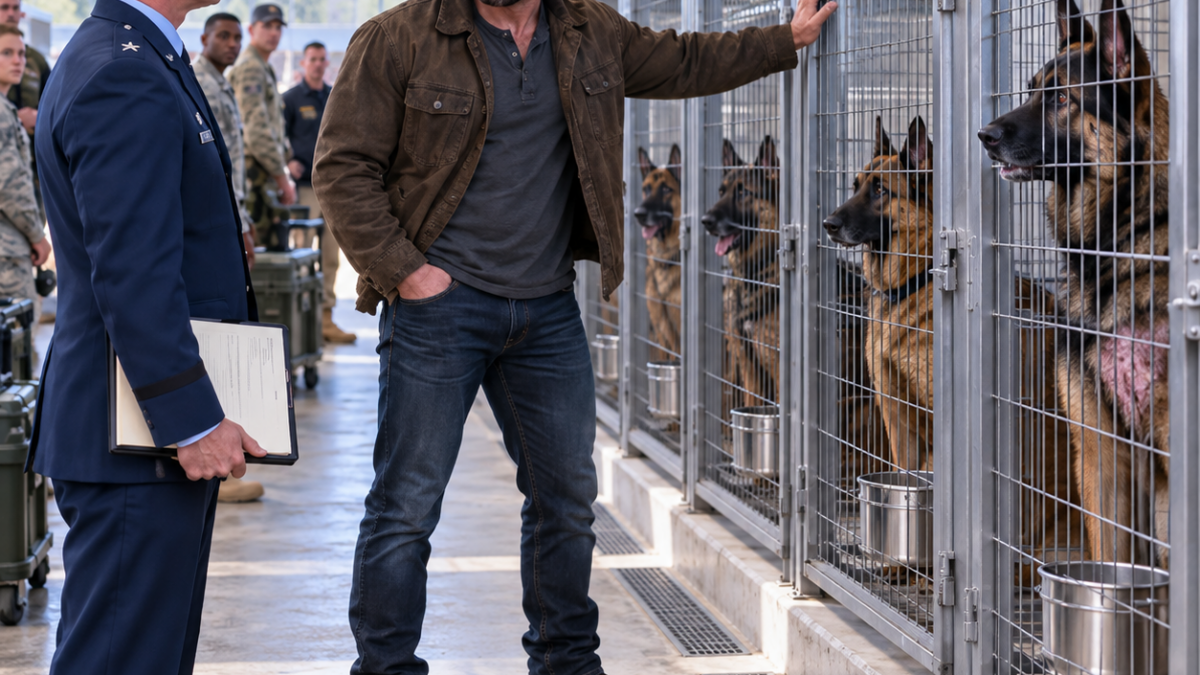
He walked to the reinforced cage and lowered himself slowly onto one knee.
His bad leg protested with a spike of pain sharp enough to turn his vision white for half a second.
He let it pass.
He did not speak.
He placed his scarred hand against the cold steel mesh.
For a long minute, neither man nor dog blinked.
Sector 4 seemed to hold its breath.
Then Havoc moved.
Slowly.
One paw.
Then another.
The huge dog stepped out of the shadow and lowered his scarred muzzle toward the mesh.
Wyatt’s breath caught.
Havoc stopped inches from Nate’s hand.
His nostrils flared.
Rain, leather, gun oil, old blood, titanium, pain, mountain cold, and the particular chemical signature of a man who still woke up fighting wars that were officially over.
The dog leaned forward.
His heavy snout touched the chain-link exactly where Nate’s palm rested.
Wyatt whispered, “He hasn’t let anyone near him in six months without trying to tear the cage apart.”
Nate’s throat tightened.
“He knows.”
“What?”
“He knows I’ve been where he’s been.”
Havoc closed his eyes for half a second.
Not trust.
Not yet.
But something had passed between them that procedure had no category for.
Transporting seven highly aggressive, traumatized military dogs across the country was not a rescue.
It was a controlled disaster.
Nate had retrofitted a massive climate-controlled horse trailer with heavy-gauge steel dividers, reinforced latches, shock-absorbent flooring, separate water systems, and emergency sedation access ports. He had built it for worst-case scenarios because he knew better than to confuse hope with planning.
Loading took twelve hours.
Each dog had to be sedated just enough to move without turning the hallway into a bloodbath, but not so much that respiratory failure became a risk.
Zeus, the Belgian Malinois, fought the sedation until his legs failed beneath him and still tried to bite a handler’s boot.
Titan, a Dutch Shepherd with a burn scar down his muzzle, screamed when the transport sling tightened around his chest.
Valkyrie snapped at shadows.
Apollo vomited twice from stress.
Ghost went rigid and silent, which worried Nate more than the ones who made noise.
Ranger refused to leave the kennel until Nate sat in the hall for forty minutes and let the dog stare at him long enough to decide the world was not ending yet.
Havoc walked into the trailer last.
No sedation top-off.
No struggle.
He watched Nate.
Nate watched him.
Then the dog stepped into his compartment and turned to face the door like a sentry accepting temporary confinement under protest.
By the time the truck rolled north, Captain Mitchell stood in the rain near the loading dock, arms folded tight.
“You sure?” he asked.
Nate leaned from the driver’s window.
“No.”
Mitchell almost smiled.
“At least you are learning honesty.”
“If this goes bad, it goes bad on me.”
“No,” Mitchell said. “It goes bad on both of us.”
Nate nodded.
“Then I’ll make sure it doesn’t.”
The miles were ugly.
Sedatives wore off somewhere in Wyoming.
The trailer came alive behind him.
Bodies slammed steel.
Claws scraped floors.
Barks turned into full-throated panic as semis passed too close, air brakes screamed, rain hit the roof, and highway vibrations became whatever each dog’s mind feared most.
Nate drove for nineteen hours with one hand on the wheel and the other resting near the trailer monitor.
He spoke occasionally through the internal speaker system.
Not commands.
Cadence.
Low.
Even.
Words that did not matter as much as rhythm.
“I hear you. Hold fast. Still moving. Still here.”
Some dogs quieted for minutes.
Some did not.
Havoc never barked.
That worried Nate too.
The Bitterroot ranch sat at the end of a winding dirt road deep in western Montana, surrounded by dense pine forest, jagged peaks, and enough isolation to make most people uneasy by sunset.
Nate had bought the land with deployment money, hazard pay, disability settlement, and the kind of stubborn planning men do when they are building somewhere to disappear.
The log cabin stood on a rise overlooking the valley.
Behind it, he had spent the last of his savings building a high-security kennel facility. Heavy steel runs. Enclosed training yard. Double fencing. Heated floors. Sound-dampened sleeping stalls. Medical bay. Backup generator. Reinforced doors. Camera system. Remote locks.
It looked extreme.
For seven dogs like these, it was barely enough.
The first two days were brutality.
Offloading one dog at a time.
Kevlar sleeves.
Bite poles used only to prevent catastrophe, never punishment.
No unnecessary touch.
No shouting.
No crowding.
No pride.
By the end of the second day, Nate was bruised from shoulder to thigh. His bad leg throbbed so violently he vomited behind the feed shed and kept working anyway.
The pack dynamic was chaos.
Separated by steel mesh, the dogs challenged each other constantly.
Zeus threw himself at Titan’s divider.
Valkyrie snapped through bars at Apollo.
Ghost refused food.
Ranger stood on his cot and stared at corners.
But Havoc was different.
He did not waste energy barking at the others.
He paced his run endlessly.
Back and forth.
Back and forth.
Eyes tracking the tree line.
Then the sky.
Then the ridge.
Then the access road.
He was still on patrol.
On the fifth night, the storm came.
It started with a temperature drop so sharp the cabin windows fogged within minutes. Wind moved through the pines with a low moan. Then thunder rolled across the Bitterroot Mountains, not a clean crack but a deep concussive rumble that felt less like weather and more like artillery heard from underground.
Inside the cabin, Nate froze.
His own chest tightened.
Ramadi returned in fragments.
Concrete dust.
A flash of orange.
The taste of blood.
Someone screaming his name through a radio net that had already dissolved into static.
He put one hand against the table and forced air into his lungs.
Then he thought of the dogs.
“Damn it.”
He grabbed his coat and flashlight and limped into the rain.
The kennel facility was pandemonium.
Zeus spun in frantic circles.
Valkyrie shredded the rubber edge of her sleeping platform.
Apollo barked until his voice broke.
Ghost hit his body against the door in silent, awful rhythm.
Ranger cowered beneath his cot, teeth bared at a threat nobody else could see.
Then Nate’s flashlight found Havoc’s run.
Empty.
For one heartbeat, Nate’s mind refused to accept it.
The reinforced gate had buckled outward.
The locking mechanism hung broken, bent by desperate force.
“Havoc!”
His shout vanished into the storm.
Rain blinded him.
Wind shoved him sideways.
He swept the flashlight beam across the yard.
Nothing.
Nate ran toward the perimeter fence, pain exploding in his titanium femur with every step.
The outer fence was eight feet high, angled wire across the top.
If Havoc got over it, he would disappear into thousands of acres of wilderness.
A traumatized combat dog loose in the mountains.
A lethal threat to anyone who stumbled onto him.
A death sentence once authorities heard.
Nate found him near the eastern property line.
But Havoc was not trying to jump the fence.
He was digging.
Frantically.
At the muddy ground beneath a massive dead pine tree.
His paws tore through roots and rock. Mud flew behind him. He whined in a strange high, desperate pitch Nate had never heard from a dog that size. Not fear exactly. Warning stretched past language.
“Havoc! Stand down!”
The dog ignored him.
Nate approached carefully.
“Havoc!”
He reached for the heavy leather collar.
The moment his hand made contact, Havoc spun.
The bite came like lightning.
Jaws clamped down on Nate’s forearm.
Pain detonated up his arm.
Even through the heavy canvas jacket, teeth scraped bone. Havoc’s weight drove him backward. Nate hit the mud hard, breath knocked from his lungs. Blood mixed instantly with rain.
But Havoc did not continue the attack.
He released.
Stared at the blood on Nate’s sleeve.
Then at Nate’s face.
Something snapped back into his eyes.
Recognition.
Horror.
Not at the man.
At himself.
Then the dog grabbed Nate’s jacket sleeve and began dragging him backward, away from the tree.
“Stop!”
Nate fought him.
“Havoc, stop!”
Crack.
The sound was louder than thunder.
The massive dead pine split at its rotted base.
A violent gust took it.
The sixty-foot trunk crashed down exactly where Nate had been lying two seconds earlier.
The impact shook the ground.
Mud, bark, rainwater, and broken branches exploded across the yard.
Nate lay breathless, staring at the trunk that would have crushed his skull.
Havoc stood over him, shivering, rain streaming from his coat, licking the blood from Nate’s torn sleeve.
The dog had not been trying to escape.
His hypersensitive hearing had caught the microscopic splintering of roots beneath the storm.
He had been digging to relieve pressure.
When that failed, he dragged his new handler out of the kill zone.
Nate reached up with his good arm.
“You saved me.”
Havoc pressed his wet head into Nate’s chest.
A whine left him.
Not the frantic warning now.
Something softer.
Something broken open.
Thirty minutes later, they were inside the cabin.
The fire roared in the stone hearth. Nate sat on the rug, wrapping a trauma bandage around his bleeding forearm. Havoc lay beside him, exhausted, eyes on the flames.
The other six dogs had quieted after the storm moved east, though the cameras still showed them pacing in their runs.
Nate tightened the bandage with his teeth and winced.
“You’re a good boy, Havoc,” he said. “A damn good boy.”
Havoc did not look away from the fire.
Nate reached out and stroked the thick fur behind the dog’s right ear.
His fingers brushed something hard under the skin.
He paused.
Not a microchip.
Too large.
Too round.
He parted the fur.
A faded surgical scar ran in a straight line along the side of Havoc’s neck, hidden beneath dense sable hair.
Nate frowned.
He pressed gently.
Havoc did not flinch.
The object beneath the scar felt like a small metal disc, about the size of a quarter, embedded deep in muscle.
Nate grabbed his phone and turned on the flashlight.
When he held the light close against the skin, he saw it.
A faint green blink.
Rhythmic.
Alive.
A chill moved through him that had nothing to do with the storm.
Standard military working dogs were chipped for identification.
They were not implanted with active battery-powered transponders.
Nate stood, crossed to the desk, and pulled Havoc’s file from the locked drawer.
Vaccinations.
Deployment history.
Injury report from Helmand.
Trigger notes.
Retirement review.
Transfer authorization.
Nothing about surgical hardware.
Nothing about a transponder.
Nothing about a blinking green light beneath the dog’s skin.
Nate took out his encrypted satellite phone.
There were only a handful of numbers still programmed into it.
Most belonged to men who would never answer.
One belonged to Dr. Emily Carter.
Former DoD veterinary surgeon.
The woman who had patched up working dogs in Afghanistan while mortar fire shook dust from tent poles and handlers threatened to murder anyone who let their dogs die.
She answered on the second ring, voice thick with sleep.
“Do you have any idea what time it is, Rawlings?”
“Emily, I need your help.”
A pause.
“Nate? Are you bleeding?”
“Yes.”
“Of course you are. Why are you calling?”
“I took in seven retired K9s from Lackland. Euthanasia list.”
“Please tell me you are joking.”
“One of them, Havoc, has hardware in his neck.”
“What kind of hardware?”
“Active. Quarter-size disc. Green LED. Embedded under surgical scar behind the right ear.”
The line went silent.
Only satellite static hissed in his ear.
“Emily?”
Her voice, when it returned, trembled.
“Nate, tell me you did not file official adoption paperwork for a dog named Havoc.”
“Mitchell pushed the transfer through. Off the books, but yes.”
“Listen carefully.”
“I am.”
“Three years ago, DARPA ran a black-book program called Operation Cerberus.”
Nate looked at Havoc.
The dog stared at the fire, unaware that his name had just changed shape.
“They were trying to implant neural-link transponders into high-drive K9s,” Emily continued. “Remote influence. Behavioral override. Satellite-linked stimulus control. It was supposed to create controllable military dogs for high-risk environments.”
Nate’s jaw tightened.
“Jesus.”
“The dogs went violently unstable. Handlers objected. One whistleblower disappeared. The program was supposedly burned and all assets destroyed.”
“Havoc was an asset.”
“If he has that disc, he is not just a retired K9. He is stolen government property from a highly illegal project.”
Before Nate could answer, headlights swept across the cabin windows.
Not one pair.
Three.
Heavy tires crunched up the long gravel drive.
Nate killed the lamp.
Through the rain-streaked glass, three black unmarked SUVs rolled toward the cabin.
Their headlights cut on fully, pinning the porch in white light.
Emily’s voice sharpened through the phone.
“Nate?”
“They’re here.”
“Who?”
“Not rescue.”
Havoc stood.
Fur along his spine lifted into a hard ridge.
A low, terrifying growl rolled through the cabin.
The war had followed them to Montana.
The SUV engines died simultaneously.
Rain hammered the tin roof.
Nate moved quickly now, the old rhythm returning.
Pain went distant.
Fear went useful.
He crossed to the locked cabinet beneath his desk, retrieved his Glock 19, then slung an SR-25 rifle over his shoulder. He placed the satellite phone on the desk but left the line open.
Through thermal optics, he watched four men dismount from the lead vehicle.
Their movements were too smooth.
Too synchronized.
Suppressed short-barreled rifles.
Heavy plate carriers.
Digitized camouflage without insignia.
Private military contractor posture.
Not federal agents.
Not MPs.
Not local law.
A black-ops retrieval team.
Someone with deep pockets and zero interest in warrants had come for Havoc.
One of the men spoke into a radio.
Nate tuned his headset to scan.
Static.
Then a voice.
“Primary residence in sight. Recover asset. Handler secondary.”
Nate’s mouth went flat.
He looked at Havoc.
The dog did not bark.
Military training overrode instinct.
He knew ambush movement when he smelled it.
“Stay with me,” Nate whispered.
Havoc pressed his heavy shoulder against Nate’s good leg.
Ready.
Nate slipped out the back door into the tree line moments before the front door blew inward.
The crash of splintering wood echoed across the valley.
Suppressed gunfire followed.
Short controlled bursts into shadows.
“Target not inside,” a voice crackled over the radio. “Check kennel compound. Secure primary asset. If handler interferes, neutralize him.”
Nate’s jaw tightened.
They were not here to repossess.
They were here to erase.
Operation Cerberus was not dead.
Havoc carried something they needed back.
Or something they needed destroyed.
Moving through freezing mud, Nate flanked the kennel perimeter.
Inside the facility, the six other dogs were already in full trigger response. Gun oil. Stranger sweat. Tactical movement. Suppressed fire. The storm. The smell of Nate’s blood.
The whole compound shook with barking.
The contractors approached the kennel gate with tranquilizer rifles and capture poles.
They expected broken animals.
They expected cages.
They expected fear.
They were not expecting a coordinated defense.
Nate keyed a remote fob.
The secondary maglocks disengaged with a heavy mechanical clack.
He did not release the dogs into open wilderness.
He opened their runs into the fully enclosed, fortified half-acre training yard the contractors had just entered.
Six combat K9s exploded into the mud.
Zeus came first, a seventy-pound Belgian Malinois moving like a thrown blade.
Titan and Valkyrie cut left and right.
Apollo circled low.
Ghost emerged in absolute silence, which somehow terrified the men more than barking.
Ranger drove straight down the center line and forced the intruders backward without touching them.
The dogs did not attack directly.
They had no handler command.
But they swarmed.
Circled.
Snapped at vests.
Drove the men into each other.
Created a living vortex of teeth, muscle, noise, and military discipline warped by trauma into territorial fury.
“Fall back!” one contractor screamed.
Zeus launched from a wooden platform and slammed both paws into the man’s chest plate, knocking him into the mud.
Nate moved.
He rounded the feed shed, Glock raised.
He did not want to kill Americans on his land, even rogue mercenaries.
He fired three rounds into the mud at the second contractor’s boots, showering gravel and water across his legs.
“Drop your weapons now!”
The contractor spun, rifle lifting.
He was fast.
Havoc was faster.
The German Shepherd exploded from the shadows and bypassed the Kevlar vest, jaws locking around the man’s forearm with precise, crushing control. The rifle dropped into mud. The contractor screamed.
Havoc pinned him, teeth holding the wrist at the edge between restraint and ruin.
The dog looked to Nate.
Waiting.
Nate lowered his weapon slightly.
“Good boy. Hold.”
Havoc held.
A spotlight flashed from the tree line.
Nate’s vision went white for half a second.
The team leader stepped from the pines with a rifle leveled at Nate’s head.
“Call off the mutt, Rawlings.”
Nate did not move.
The leader wiped rain from his tactical goggles.
“You’re in over your head. You think this is about a rabid dog? That transponder in his neck holds decrypted source code for a two-hundred-million-dollar neural weapons interface.”
Nate’s eyes flicked once toward Havoc.
“DARPA lost the prototype in Helmand three years ago,” the leader continued. “A handler tried to whistle-blow and went off-grid. We’re taking the dog and cutting that chip out of his throat right here.”
Nate stepped directly in front of Havoc.
Shielding him.
“If you wanted this quiet,” Nate said, “coming to a Navy SEAL’s ranch in the middle of the night with a hit squad was a massive miscalculation.”
“You’re one man with a bad leg.”
“True.”
“I have two more trucks coming up the mountain.”
Nate smiled grimly.
“You didn’t do your homework.”
The leader’s rifle remained steady.
“I don’t just live in the Bitterroot Mountains,” Nate said. “I own the only access road for twenty miles.”
Before the contractor understood, a massive boom rolled up from the valley below.
Orange fire lit the low storm clouds near the gorge crossing.
The solitary wooden bridge on the access road was gone.
Nate had prepared contingencies for the kind of men who believed only they planned ahead.
The reinforcements were not coming.
The leader’s rifle lowered a fraction.
Only a fraction.
Enough.
Nate moved.
Fast despite the leg.
He swept the man’s knees from under him and drove him into the mud. His titanium femur screamed. He ignored it. One knee dropped onto the contractor’s chest plate. The Glock pressed against the center of the man’s ballistic helmet.
“Here is how this plays out,” Nate growled.
The leader spat mud.
“They’ll kill you, Rawlings.”
“No,” Nate said. “They’ll negotiate.”
The man laughed once.
“The Pentagon doesn’t want this program exposed.”
“Exactly.”
Nate leaned closer.
“Which is why Dr. Emily Carter already has high-resolution scans of Havoc’s hardware uploaded to a dead-man switch server. If I don’t enter a localized passcode every twelve hours, everything goes public. Operation Cerberus. Neural interface blueprints. Illegal use of mercenaries on U.S. soil. Names. Contracts. Funding lines. All of it.”
The leader stared up at him.
For the first time, fear entered his eyes.
The retired SEAL had not just prepared for a firefight.
He had set a trap around truth itself.
“What are your terms?” the contractor asked.
Nate’s voice went colder than the rain.
“You and your men walk off my mountain tonight. Tomorrow morning, Captain Mitchell at Lackland receives an official classified directive granting full amnesty, medical retirement, and federal funding for all seven dogs on this property.”
The leader swallowed.
“Havoc stays with me,” Nate continued. “The chip stays with me until a military surgeon of my choosing removes it on my terms. If anyone drives past my property line again, the data leaks.”
The contractor closed his eyes.
He understood checkmate when he saw it.
By dawn, the storm had broken.
Pale golden light washed over the jagged peaks of the Bitterroot Range. Rain steamed from the yard in thin mist. The unmarked SUVs were gone, abandoned near the property line until the men could extract themselves through back trails on foot.
Inside the cabin, everything was quiet.
The front door was broken.
Mud tracked the floor.
Blood stained one rug.
Nate’s forearm throbbed beneath fresh bandages.
But the dogs were alive.
Havoc lay sedated on the large rug before the stone fireplace while Dr. Emily Carter worked over him with a specialized surgical kit brought in by chartered medevac helicopter just after sunrise.
Nate sat beside him the entire time, one hand resting on the dog’s spine.
Finally, Emily lifted a small stainless-steel basin.
Inside lay the quarter-sized metallic disc, bloodstained, its green light dead at last.
“The extraction is complete,” she said.
Nate stared at the device.
“It was deep?”
“Embedded in muscle. Wrapped in scar tissue. Whoever placed it knew how to hide it from routine exams.”
She looked at Havoc.
“The handler who put this in him overseas knew exactly what he was doing.”
Nate frowned.
“You think a handler hid it?”
“I think someone tried to stop Cerberus from disappearing into another black budget. If the whistleblower couldn’t get out with the data, he used the toughest dog in the unit to carry the truth home.”
Nate looked at Havoc.
Sleeping.
Breathing.
Finally free of the blinking thing beneath his skin.
“He wasn’t just surviving.”
“No,” Emily said softly. “He was carrying evidence.”
The thought settled into Nate with weight.
Havoc had not merely lived through the war.
He had won a silent battle nobody even knew was being fought.
“Will he be okay?”
Emily stripped off her gloves.
“Physically, yes. Sore for a few weeks. Mentally?”
She looked at Nate.
“He’s a combat veteran. He has scars. But after what he did last night, after how he protected you, after how he held instead of killed?”
She smiled faintly.
“He’s not broken. He just needed someone who understood his war.”
Three months later, the Bitterroot ranch no longer looked like a fortress built by a lonely man trying to keep the world away.
It looked like a beginning.
Federal funding had arrived through classified channels nobody at the local bank understood and nobody in Washington wanted to discuss.
The property became the Bitterroot Sanctuary for Retired Military Working Dogs.
Heavy chains disappeared.
Open-air training fields replaced tight runs.
Agility courses rose near the tree line.
Sound-dampened recovery stalls gave the dogs somewhere to retreat without feeling trapped.
Veterinary staff rotated in.
Trauma-informed handlers came for training.
Captain Mitchell visited once and stood in the yard with his hands in his pockets, watching Zeus trot through an obstacle course with a young handler who knew better than to rush.
“You did it,” Mitchell said.
Nate stood beside him, arms folded.
“We’re doing it.”
Mitchell looked toward Havoc.
The German Shepherd lay on the porch steps, eyes half closed, one ear tracking everything.
“He looks different.”
“He is different.”
“You are too.”
Nate did not answer.
He did not need to.
The six other dogs slowly began to change.
Zeus stopped launching at every new sound.
Titan learned to sleep through wind.
Valkyrie accepted grooming from one handler and only one, which everyone agreed was a diplomatic victory.
Apollo discovered that tennis balls existed and became temporarily unbearable.
Ghost began approaching people from the front instead of behind.
Ranger stopped circling corners and started choosing sunny patches.
None of them became normal.
Normal was not the goal.
Peace was.
Structure was.
Trust.
Choice.
Work without war attached to it.
But Havoc changed most.
He no longer paced endlessly along the fence line.
No longer watched the sky for helicopters.
No longer scanned every ridge as if ambush lived in the trees.
He stayed close to Nate, an unwavering shadow.
Not because he was ordered to.
Because both of them understood proximity as medicine.
Late one afternoon, as the Montana sun lowered behind the pines, Nate walked onto the porch carrying a mug of coffee and a second empty mug out of habit. He still did that sometimes. Brought two of things when only one was needed. A leftover from years of team life.
He sat heavily in the wooden rocking chair, bad leg stretched in front of him.
The pain was still there.
It always would be.
But it no longer owned every room he entered.
Havoc trotted up the steps.
His tail moved softly.
A sight that would have been impossible months earlier.
The big German Shepherd sat beside the chair and rested his heavy chin on Nate’s thigh.
Nate reached down and scratched the healed surgical scar behind Havoc’s right ear.
The dog sighed.
Eyes closing.
Trusting the hand near the place where men had once hidden a nightmare.
Across the yard, Zeus barked at Apollo for stealing a toy.
Valkyrie sprinted through the long grass.
Ghost slept in the sun.
Ranger watched a handler repair a fence as if supervising.
Normal barks echoed across the valley.
Happy barks.
Messy barks.
Dogs becoming dogs again.
Nate looked over the sanctuary and felt something inside his chest loosen.
For years, men had called him dangerous.
Too damaged.
Too hypervigilant.
Too violent for quiet rooms.
Too haunted for ordinary life.
The dogs had been labeled the same.
Broken.
Unadoptable.
Loaded weapons with broken safeties.
But labels were often written by people standing too far away.
People who saw reactions and never asked what pain lived underneath.
People who knew how to create warriors and then acted shocked when war followed them home.
Havoc shifted his head against Nate’s leg.
Nate looked down.
“You and me both, huh?”
The dog’s tail thumped once.
Nate smiled.
He thought of Buster, the dog who had taken a bullet for him in Fallujah.
He thought of the handler who had hidden Cerberus inside Havoc, trusting a dog to carry truth through chaos.
He thought of Captain Mitchell, pen hovering over seven files.
He thought of the storm, the dead pine, the bite that had turned into a rescue, the men who came to cut a secret out of a dog’s throat and found a mountain full of teeth waiting.
Most of all, he thought about what would have happened if he had arrived one hour later.
The world would have lost seven heroes and called it procedure.
Nate lifted his coffee and watched the last light turn the peaks gold.
The dogs played below.
Havoc breathed warm against his leg.
For the first time in years, Nate Rawlings did not feel like a man waiting for the next explosion.
He felt exactly where he was supposed to be.
People would later tell the story for the twist.
The retired SEAL demanding all seven dogs.
The deadly K9 named Havoc.
The hidden transponder.
Operation Cerberus.
The black SUVs in the Montana storm.
The firefight that never became a massacre because one man understood that even broken warriors still obeyed the right kind of trust.
But Nate knew the real story was quieter.
It began in a commander’s office with a pen that had not yet touched paper.
It began when someone looked at seven dangerous files and remembered seven living beings.
It began when a dog pressed his muzzle against a scarred hand through steel mesh and said, without words:
You know.
And the man answered:
Yes.
I do.
They had been created for war.
Labeled too dangerous for peace.
Discarded by systems that feared what they could no longer control.
But in the frozen wilderness of the Bitterroot Mountains, seven retired K9s and one haunted Navy SEAL found something the military could never issue, classify, implant, or command.
They found a place to stand down.
They found a reason to wake without fighting.
They found a pack.
They found peace.




