Rosie Was Returned Before Her First Breakfast, But the Man Who Finally Chose Her Refused to Close Another Door
Rosie Was Returned Before Her First Breakfast, But the Man Who Finally Chose Her Refused to Close Another Door
Rosie’s new life ended before her first breakfast.
After nine months of waiting at the rescue gate, the seven-year-old beagle finally rode away with a man who promised he could handle her fear.
By sunrise, he brought her back, and the look in Rosie’s eyes told everyone she had expected to be abandoned all over again.
Rosie arrived at the rescue on a gray Tuesday afternoon in rural Ohio, tied to the back of a county animal control truck with a frayed rope still hanging from her collar.
She was seven years old, though at first glance she looked older. Her muzzle had already gone white, her long ears were scratched and dirty, and her ribs showed faintly beneath a coat that should have been soft but had become dull from weather, stress, and neglect.
The rescue center sat at the end of a gravel road between soybean fields and a stand of old maple trees. It was not fancy. The building had peeling white paint, a sagging porch roof, and kennels that filled too quickly every spring. But it was warm inside, and the people there knew how to love animals who arrived carrying invisible damage.
Martha Jensen, the rescue director, met the animal control officer at the gate.
The officer looked tired.
“She was chained behind an empty house,” he said. “Owner moved out. Neighbors thought someone was feeding her, but nobody was.”
Rosie stood beside him, trembling.
She did not bark. She did not pull. She simply stared toward the road, as if she expected the person who had left her behind to return at any moment and explain that it had all been a mistake.
Martha crouched slowly.
“Hi, sweetheart,” she whispered.
Rosie looked at her but did not move closer.
There are dogs who arrive at shelters angry. Dogs who arrive wild with panic. Dogs who arrive so shut down that they seem to have already left their own bodies.
Rosie arrived waiting.
That was the saddest part.
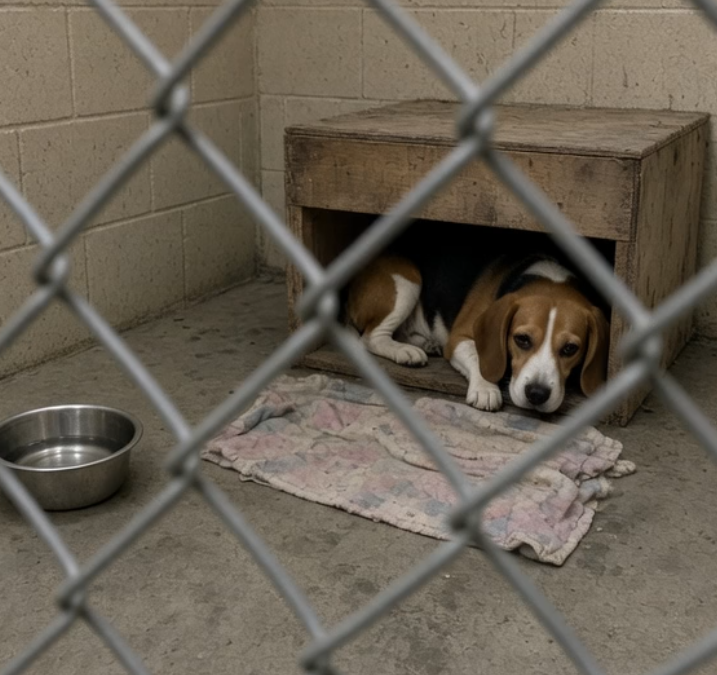
For the first few weeks, every vehicle that turned into the gravel parking lot made her body come alive. She would leap up from her blanket, rush to the gate, rise onto her back legs, and press her nose through the wire.
A red pickup.
A mail truck.
A minivan.
A tractor.
It didn’t matter.
Rosie checked every face.
Each time the visitor passed her kennel without stopping, her tail slowed. Then it dropped. Then she returned to her blanket and lay down with her chin on her paws.
“She thinks they’re coming back for her,” one volunteer said quietly.
Martha watched Rosie stare through the gate.
“No,” she replied. “She hopes they are.”
Hope lasted longer than anyone expected.
For months, Rosie kept getting up.
Younger dogs left around her. Puppies with clumsy feet and pink bellies. Small dogs with bright eyes. Big goofy dogs who threw themselves against kennel doors and made families laugh. Even shy dogs found homes when the right people came along.
Rosie watched them go.
PART2:
Sometimes she wagged at the departing families. Sometimes she gave one soft bark, as if wishing them luck. But after each adoption, she would look toward the parking lot again.
Her turn never came.
By the fifth month, she stopped jumping up for every car.
By the seventh, she stopped standing unless someone called her name.
By the ninth, she spent most afternoons beneath the old wooden bench in the exercise yard, where the shade fell across the dirt and the noise of the kennels seemed farther away.
Her graying chin rested on her paws.
Her eyes remained open.
She was still listening.
Then Eric came.
He arrived on a Wednesday evening in a clean silver truck, wearing work boots, a company jacket, and the expression of a man who had already decided what kind of dog he needed. He told Martha he worked long hours and did not want a puppy.
“I need something calm,” he said. “Older, preferably. A dog that doesn’t need constant attention.”
Martha glanced toward the yard.
Rosie was beneath the bench, watching them.
“She’s calm,” Martha said carefully. “But she has abandonment anxiety.”
Eric frowned. “Meaning?”
“She cries when she thinks someone is leaving her. She may scratch at doors. She was left chained outside an empty house. Being shut away is hard for her.”
Eric nodded too quickly.
“I understand.”
Martha studied him. “It may take patience.”
“I can handle patience,” he said.
PART3
People say things like that in rescue centers all the time.
Sometimes they mean it.
Sometimes they only mean they like the idea of themselves being patient.
Martha brought Rosie inside.
At first, Rosie stood near the wall. She sniffed the air, then Eric’s boots, then the sleeve of his jacket. Eric crouched and patted his knee.
“Come here, girl.”
Rosie hesitated.
Then, slowly, she walked forward and rested her chin against his hand.
Eric smiled.
“She’s sweet.”
“She is,” Martha said. “Very sweet.”
The adoption papers were signed that evening.
Every volunteer in the building found a reason to walk through the lobby before Rosie left. They had watched her wait for nine months. They had watched the hope slowly fade from her face. Now, when Eric clipped his leash onto her collar, Rosie’s ears lifted.
She followed him willingly to the truck.
Before climbing in, she turned back.
Martha stood on the porch with two volunteers.
Rosie wagged her tail.
Not wildly.
Not like a puppy.
Just once, twice, three times.
As if she finally understood.
My turn came.
Martha pressed a hand to her chest as the truck pulled away.
“Please be good to her,” she whispered.
The next morning, just after sunrise, headlights appeared at the end of the gravel road.
Martha was not there yet. The rescue did not officially open until eight. But Tyler, the morning kennel assistant, had arrived early to start feeding, and he saw the silver truck pull into the lot.
Rosie was in the passenger seat.
She was sitting upright, looking through the windshield.
Tyler knew before Eric stepped out.
Some returns come with apologies. Tears. Shame. Long explanations. People who truly wanted the adoption to work but were overwhelmed, grieving, or unprepared.
Eric did not look ashamed.
He looked irritated.
When Martha arrived ten minutes later, he was standing near the front door holding Rosie’s leash.
“She howled most of the night,” he said. “Every time I closed the bedroom door, she scratched at it. I have work. I need sleep. I need a dog that can be alone.”
Martha looked at Rosie.
The beagle’s ears hung low. Her tail was tucked. Her eyes were fixed on the ground.
“Eric,” Martha said slowly, “we talked about this.”
“I know what you said.”
“One night is not enough time.”
“I can’t have a dog screaming all night because I close a door.”
“She thought you were leaving her.”
“I was in the next room.”
“She didn’t know that.”
Eric exhaled sharply and pushed the leash toward her.
“I’m sorry, but this isn’t going to work.”
Rosie did not resist when Martha took the leash.
That was what broke her heart.
Rosie did not pull toward Eric. She did not bark after him. She did not seem confused.
She stood in the cold parking lot and watched his truck disappear down the gravel road.
Then she walked to the rescue entrance and lay down beside the locked door.
No sound.
No protest.
No fight.
It was as though she had always known she would be brought back.
Martha sat on the concrete beside her.
The morning air smelled like damp leaves and dust from the road. Inside the kennels, dogs barked for breakfast, but Rosie did not lift her head.
Martha stroked one long ear.
“You weren’t trying to cause trouble,” she whispered. “You were only afraid the door meant someone was leaving you again.”
Rosie closed her eyes.
After that, Martha changed the way they cared for her.
Rosie was moved into the reception room during the day, where she could hear phones ringing, volunteers talking, doors opening, and people moving through the building. At night, a volunteer stayed nearby until she fell asleep. Sometimes they read books aloud. Sometimes they folded laundry. Sometimes they simply sat in the chair beside her bed and let her know the room was not empty.
The first few nights were hard.
Whenever someone stood, Rosie lifted her head.
Whenever a door closed, she trembled.
If a volunteer stepped into the hallway, Rosie began to cry—a low, broken sound that seemed to come from somewhere deeper than fear.
But no one punished her for it.
No one called her difficult.
No one dragged her back to a kennel and decided she had failed.
They waited.
Slowly, Rosie learned that footsteps could leave and return.
Doors could close and open again.
A person could walk away without disappearing forever.
Weeks passed.
Her body began to soften. She slept more deeply. She started accepting treats again. She lifted her head when visitors entered. Sometimes she even wagged.
But she no longer ran to the gate.
Martha noticed that too.
Hope had become careful.
Then, on a rainy Saturday afternoon, Walter Bell came through the door.
He was seventy-two years old, a retired school custodian with large hands, muddy boots, and a brown coat shiny at the elbows. He removed his cap as soon as he stepped inside, as if entering the rescue was no different from entering someone’s home.
“My name’s Walter,” he said. “I called about adopting an older dog.”
Martha smiled. “I remember.”
He looked around the reception room. A young terrier barked from behind the counter. A black lab mix thumped his tail against a crate. Rosie lay on her bed near the window, watching the rain slide down the glass.
Walter saw her and grew still.
“That one,” he said quietly. “What’s her story?”
Martha hesitated.
Not because Rosie’s story was difficult to tell, but because it mattered who heard it.
“Her name is Rosie,” she said. “She was abandoned once. Adopted once. Returned after one night.”
Walter’s face tightened.
“Why?”
“She cried when doors closed.”
He looked back at Rosie.
“Can’t blame her for that.”
Martha studied him. “She may follow you everywhere. She may panic if she thinks she’s being shut out. She’ll need time and patience.”
Walter nodded.
“I’m not looking for a quiet dog,” he said. “I’ve had enough quiet.”
Something in his voice changed the room.
Martha led him to the small visiting area and brought Rosie in.
Rosie stopped several feet away.
Walter sat in the chair and did not call her.
He did not pat his knee. Did not whistle. Did not reach out.
He simply rested his hands on his thighs and waited.
Minutes passed.
Rain tapped against the windows.
Rosie watched him.
Walter looked at her with the tired gentleness of a man who understood empty rooms.
“My wife passed in February,” he said, though Rosie could not understand the words. “House has been too still ever since.”
Rosie took one step.
Then another.
Walter kept still.
She reached his boots first and sniffed them. Then his pant leg. Then his hand.
Finally, she rested her head on his knee and released a long, trembling sigh.
Walter’s eyes filled.
“Well,” he whispered, scratching beneath her chin, “I think we could keep each other company.”
This time, Martha did not let the adoption happen that day.
She asked Walter to visit three more times.
He did.
Each visit, Rosie approached a little sooner.
Each visit, Walter waited.
On the fourth visit, he brought a worn flannel blanket from home and laid it on the floor.
“This smells like my place,” he said. “Thought she might want to know what she’s getting into.”
Rosie curled up on it and fell asleep.
Martha turned away before Walter saw her cry.
A week later, Rosie left the rescue again.
This time, no one cheered too loudly. No one wanted to frighten her. Martha clipped the leash to Rosie’s collar and walked her to Walter’s old blue pickup.
Rosie paused at the passenger door.
Her body went tense.
Martha crouched beside her.
“I know,” she whispered. “It’s scary to try again.”
Walter opened the truck door and placed the flannel blanket on the seat.
“I’ll bring her back to visit,” he said. “But I won’t bring her back to leave her.”
Rosie looked at him.
Then she climbed in.
For three days, the rescue heard nothing.
Martha tried not to worry.
On the fourth morning, a voicemail arrived.
In the background, Rosie was baying loudly.
Not crying.
Baying.
Full beagle voice, dramatic and shameless.
Walter laughed into the phone.
“She follows me into every room,” he said. “Last night, I closed the bathroom door, and she sang like I’d sailed across the ocean. So I opened it, and she sat on the bath mat until I finished brushing my teeth.”
There was a pause.
Then his voice softened.
“I’ll never shut her out again. She needs to know I’m still here.”
Martha listened to the message three times.
By winter, photographs began arriving at the rescue.
Rosie stretched across Walter’s bed with her ears spread like velvet.
Rosie riding beside him in an old tractor, nose lifted into the wind.
Rosie asleep beneath the kitchen table while Walter drank coffee from a chipped mug.
Rosie standing in the doorway of the barn while snow fell behind her.
In every picture, she was close enough to touch him.
Walter wrote notes on the backs.
“She helped me fix the fence.”
“She supervised stew.”
“She does not approve of the vacuum.”
“She has claimed my late wife’s chair. I think Helen would approve.”
The photo that made Martha cry came in spring.
Rosie sat on the porch beside Walter at sunset. His hand rested on her back. Her eyes were half closed. She was not watching the driveway.
She was listening to Walter.
Months later, Walter brought Rosie back to the rescue for a visit.
The moment she stepped from the truck, every volunteer came outside.
Rosie looked different.
Not younger, exactly.
Loved.
Her coat shone. Her body had filled out. Her tail wagged when Martha called her name.
But when Walter walked toward the porch, Rosie followed immediately, pressing against his leg.
Martha smiled through tears.
“Still worried he’ll leave?”
Walter looked down at Rosie.
“No,” he said. “Now she just likes knowing where I am.”
He sat on the bench outside the rescue, the same old wooden bench Rosie had once hidden beneath in the yard. Rosie climbed up beside him, put her head on his thigh, and sighed.
Walter scratched behind her ear.
“I used to hate the noise,” he said quietly. “After Helen died, every sound in the house hurt. The refrigerator humming. The floorboards settling. My own chair creaking.”
He looked at Rosie.
“Then this one came along and filled the place with footsteps, snoring, howling, and opinions.”
Martha laughed.
Walter’s eyes stayed on Rosie.
“Turns out silence was never peace,” he said. “It was just loneliness behaving itself.”
Rosie closed her eyes under his hand.
The rescue still had dogs waiting. Dogs who barked at the gate. Dogs who hid beneath blankets. Dogs who watched cars with painful hope.
But Rosie no longer watched the driveway for someone who had left her.
Now, whenever she heard footsteps in the hallway, she knew they belonged to someone who was coming back.
And if Walter ever forgot and closed a door between them, Rosie reminded him.
Loudly.
Not because she was difficult.
Not because she was broken.
Because once, a door had meant abandonment.
And now, in a farmhouse full of warmth, coffee, old floorboards, and a man who understood the ache of an empty home, every opened door meant something else.
It meant, I’m still here.
It meant, you’re still wanted.
It meant, this time, nobody is taking you back.

