Rich Kids Mocked My Old K9 Because I Was Homeless—Then One Command Made the Whole Park Go Silent
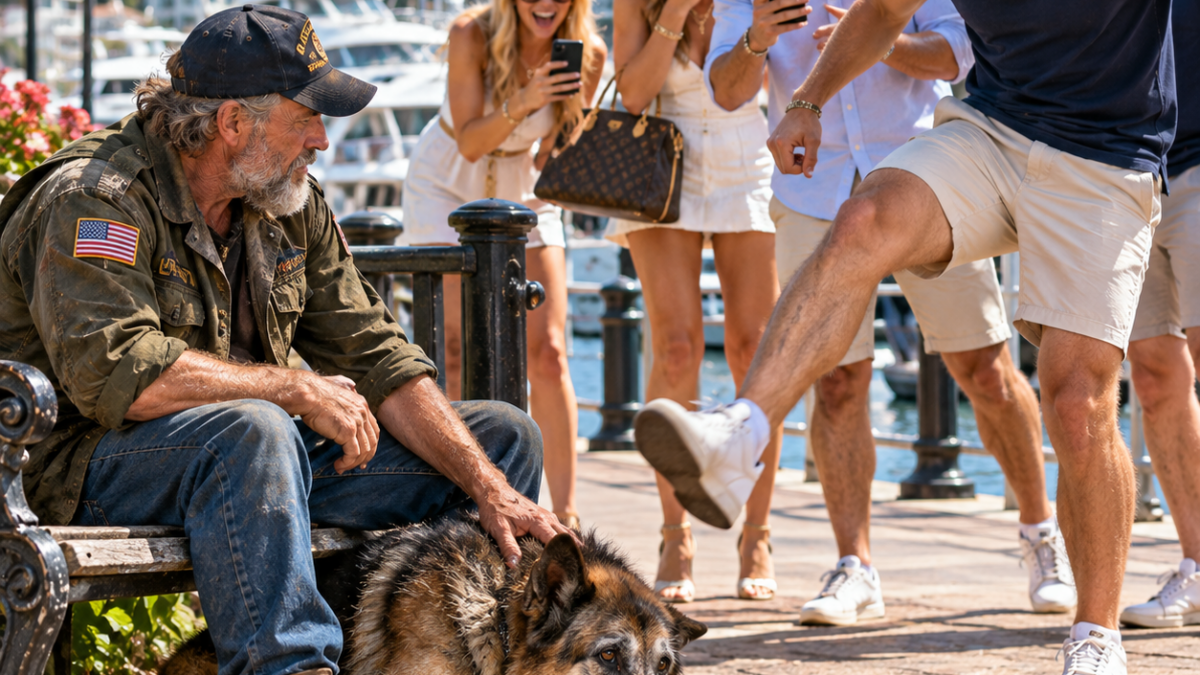
Rich Kids Mocked My Old K9 Because I Was Homeless—Then One Command Made the Whole Park Go Silent.
Four rich teenagers spent twenty minutes laughing at my worn-out boots, filming my thirteen-year-old German Shepherd, and asking whether an “old homeless mutt” could still do tricks, never realizing the man holding his leash had spent twenty-six years in Naval Special Warfare working beside dogs exactly like him.
When a terrified woman screamed across Fairview Park and Duke launched off the ground with the speed and discipline of a dog half his age, I shouted one command I had not used in nearly a decade—and every cop, veteran, and laughing teenager within earshot suddenly stopped talking.
But the real humiliation did not begin until the boys’ wealthy parents tried to have Duke seized as a dangerous animal, because the investigation that followed uncovered the unedited video, the lies their children had told, and the reason an old Navy SEAL K9 handler had chosen to sleep in a truck rather than abandon the dog who had already lost one handler before him.
My name is Walter Briggs.
I was sixty-eight years old when a seventeen-year-old kid wearing a watch worth more than my truck looked down at Duke and asked if I was waiting for him to die so I could finally afford dinner.
His three friends laughed.
I didn’t.
Duke didn’t either.
Mostly because Duke was asleep.
He lay beneath the third bench from the fountain in Fairview Park with his gray muzzle resting between his front paws, one ear folded slightly lower than the other and his breathing slow enough that strangers occasionally stopped to make sure he was still alive.
He was.
Just old.
There is a difference.
Duke had been a German Shepherd once capable of clearing a six-foot barrier like gravity was a rumor.
At thirteen, he considered stepping off a curb an administrative decision.
His hips were bad.
His hearing was not.
His pride was intact.
And despite what the boys assumed, he was not some stray I’d found behind a grocery store.
He had served.
So had I.
Neither of us wore signs explaining it.
That was intentional.
The boy with the expensive watch was named Preston Hale.
I didn’t know that yet.
At the time, all I knew was that he had the kind of haircut requiring somebody else to make an appointment for him and a private-school blazer draped over one shoulder because apparently sleeves had become optional for wealthy teenagers.
His friends were Connor Bell, Chase Whitmore, and Ethan Sloan.
All seventeen.
All students at St. Bartholomew Preparatory Academy.
Tuition: more than most people in Fairview earned working full time.
I learned those details later.
That morning they were simply four boys carrying iced coffees and expensive phones.
A fifth student walked several steps behind them.
Girl.
Dark hair.
School blazer actually being worn.
Canvas backpack instead of leather.
She looked uncomfortable.
Her name was Maya Chen.
PART2:
She would eventually save Duke’s life.
But I’m getting ahead of myself.
Preston pointed his phone at me.
“You cool being on camera?”
I looked at the lens.
“No.”
He laughed.
“That’s not really how public spaces work.”
Technically, he had a point.
A public park is a public park.
That did not make him less irritating.
I looked away.
Duke’s ear twitched.
Preston crouched.
“What’s his name?”
No answer.
“Old Yeller?”
Connor laughed.
Ethan said:
“Bro, that’s dark.”
Preston turned the camera toward Duke.
“How old is he?”
PART3:
“Thirteen.”
That was my first mistake.
Giving him anything.
“Thirteen?”
He whistled.
“Dude’s got one paw in the grave.”
Maya said quietly:
“Preston, stop.”
He ignored her.
“Is he like an emotional-support thing?”
“No.”
“Service dog?”
“No.”
“So he’s just… your dog?”
“Yes.”
Preston looked at my coat.
Then the backpack beside me.
Then my truck parked beyond the trees.
A twenty-two-year-old Chevrolet Silverado with a camper shell.
He put the pieces together.
“You live in that?”
I said nothing.
Connor followed his eyes.
“No way.”
Chase looked genuinely curious.
“You actually sleep in the truck?”
“Yes.”
The three boys exchanged glances.
I had seen that look before.
Not cruelty yet.
Opportunity.
Cruelty often begins when one person realizes the crowd might reward it.
Preston swung the phone back toward himself.
“Fairview survival challenge.”
Maya groaned.
“Don’t.”
He grinned into the camera.
“We found a real-life wilderness veteran.”
That word caught me.
Veteran.
I looked at him.
“You serve?”
He laughed.
“What?”
“You called me a veteran.”
“Like… old person.”
“Then use old person.”
Connor snorted.
Preston’s smile tightened.
“Okay, sir.”
He leaned toward Duke.
“What does he eat?”
“Food.”
“Very informative.”
“Glad I could help.”
For the first time, Chase smiled at me instead of with Preston.
Preston noticed.
He reached into a bakery bag and removed half a croissant.
“Think he’ll do tricks?”
“No.”
“What if I pay him?”
“He doesn’t have a bank account.”
Connor laughed harder.
Preston looked annoyed.
He tossed the croissant onto the ground in front of Duke.
Duke opened one eye.
Looked at the pastry.
Looked at me.
Then closed the eye again.
I almost smiled.
Preston said:
“That’s sad.”
“He’s trained not to take food from strangers.”
The words came out automatically.
All four boys looked at me.
Maya too.
Preston glanced at Duke.
“Trained?”
I regretted saying it.
“Basic obedience.”
“Prove it.”
“No.”
“Come on.”
“No.”
“Hundred bucks.”
He took out his wallet.
Actually removed a hundred-dollar bill.
Held it between two fingers.
“Make the old guy do something.”
Duke lifted his head.
Not at the money.
At Preston’s tone.
I placed two fingers lightly against his shoulder.
He settled.
“No.”
Preston looked at my boots.
The worn knees of my jeans.
The truck.
Then the hundred.
“You sure?”
“Yes.”
“Could buy yourself a motel room.”
Maya said:
“Preston.”
He turned.
“What?”
“That’s enough.”
He laughed.
“I’m offering him money.”
“You’re humiliating him for content.”
“It’s a joke.”
“To who?”
That shut him up for two seconds.
Then he looked at me.
“She’s sensitive.”
“I noticed.”
Maya flushed.
I said:
“She seems observant.”
Preston did not like that either.
He folded the hundred back into his wallet.
Then Connor stepped closer to Duke.
“Can I pet him?”
“No.”
Connor stopped.
Not offended.
“Does he bite?”
“He has teeth.”
That got Chase.
He laughed.
Even Maya smiled.
Preston rolled his eyes.
“Jesus, dude.”
He stepped around the bench.
Too close.
Duke sat up.
Slowly.
Pain in the hips.
But his eyes changed.
Old working dogs do that.
Most people miss it because they’re watching ears and teeth.
Handlers watch the eyes.
Duke was awake now.
Preston reached toward the faded collar.
I said:
“Don’t.”
His hand stopped.
“What?”
“Don’t touch his collar.”
“Why?”
“Because I asked you not to.”
He stared at me.
Then smiled.
That smile told me exactly what kind of teenager he had become.
One who had learned that boundaries were negotiable if the person enforcing them looked poor enough.
He moved his fingers toward the brass tag again.
I stood.
Six foot one even after age stole half an inch.
Preston straightened too.
He was maybe five eleven.
“You’re serious?”
“Yes.”
“It’s a dog tag.”
“My dog.”
He shrugged.
“Whatever.”
Then his shoe landed on Duke’s leash.
Maybe accidental.
Maybe not.
Duke looked down.
I said quietly:
“Take your foot off the lead.”
Preston looked at my face.
Then at his friends.
His phone remained recording.
“What if I don’t?”
Maya stepped forward.
“Preston, just move.”
He smiled.
Then lifted his shoe.
“Relax, Grandpa.”
I did.
That’s another thing people misunderstand about old military men.
The dangerous ones are rarely the ones screaming.
Anybody can shout.
Control is quieter.
I bent.
Picked up Duke’s leash.
“Come on, boy.”
Duke rose.
Stiffly.
Preston called after me:
“Where you going?”
“Away from you.”
Connor laughed.
Preston said:
“Make sure you get our good side.”
I heard Maya:
“Delete that.”
Then we walked toward the fountain.
I thought the incident was over.
At 7:42 a.m., a woman screamed.
Not startled.
Not surprised.
Terrified.
There is a difference.
I learned it early.
You hear enough men scream underwater, in aircraft, on ranges, in hospitals, eventually your body recognizes fear before your mind translates sound.
Duke recognized it too.
His head came up.
The old dog’s entire body changed.
Pain disappeared.
Age disappeared.
He was looking past me.
Tree line.
Forty yards.
Woman on the ground.
Jogging clothes.
One shoe half off.
A man moving toward her quickly.
Too quickly.
She was trying to crawl backward.
“Help!”
Duke surged.
I had not unclipped the leash.
The handle tore out of my hand.
“Duke!”
He accelerated.
Not the stumbling gait he used getting into the truck.
Straight.
Low.
Focused.
Preston stopped laughing.
Every head in the park turned.
The man near the woman grabbed at her wrist.
She kicked.
He raised his other arm.
Duke hit him.
Not wildly.
Shoulder into legs.
The man went down.
Duke repositioned instantly and clamped onto the man’s right forearm.
Hold.
No shaking.
No tearing.
Pressure.
Control.
I was already moving.
My cane stayed beside the bench.
Didn’t think about it.
My right knee protested.
Ignored it.
The man screamed.
“Get this dog off me!”
Duke held.
The woman crawled away.
Two joggers ran toward her.
The man tried punching Duke with his free hand.
Duke adjusted.
Still held.
I was twenty yards out.
“Duke!”
His ears flicked.
He did not release.
Too much motion.
Too much threat.
Old instincts.
I reached the edge of the scene.
The command left my mouth before I consciously chose it.
“OUT!”
Not yelled like an angry pet owner.
Projected.
Short.
Flat.
A command built for noise.
Duke released instantly.
Moved backward.
I followed with:
“HEEL.”
He came to my left side.
Sat.
Panting.
Gray muzzle.
Old dog again.
The whole park went silent.
Then the man tried to get up.
I pointed at him.
“Stay down.”
He looked at me.
Something in my voice convinced him.
Sirens approached.
Preston and his friends had followed.
Phones up.
No one laughing.
Maya was already kneeling beside the woman.
“Are you hurt?”
“My ankle.”
“Did he hit you?”
“No.”
“Don’t move.”
Good instincts.
The first patrol car crossed the grass.
Young officer.
Maybe twenty-six.
He got out fast.
Hand near his holster.
“Everyone back!”
I raised both hands.
“Dog under control.”
Duke sat against my leg.
The officer saw the man.
Saw blood on the sleeve.
Saw the woman.
“Whose dog?”
“Mine.”
“Keep him there.”
“I will.”
Second officer arrived.
They separated everybody.
The man began talking fast.
“She fell.”
“I was helping.”
“That dog attacked me.”
“I did nothing.”
The woman shouted:
“He was following me!”
Officer turned.
“He grabbed me.”
The man said:
“She misunderstood.”
A third officer ran his name.
That changed the temperature.
Officer touched his radio.
Listened.
Looked at his partner.
Then down at the man.
“Turn over.”
“What?”
“Turn over.”
“Why?”
“Now.”
Cuffs.
The man started protesting.
One officer said:
“You’ve got two active warrants.”
That silenced most of us.
Later I learned they involved stalking and assault allegations in neighboring jurisdictions.
The woman sat in the grass shaking.
Maya held her water bottle.
Paramedics arrived.
Preston had stopped filming himself.
Now he filmed everything else.
I noticed.
Did not care yet.
A sergeant arrived last.
Mid-forties.
Name tape:
RAMIREZ.
He walked toward Duke.
Stopped.
Looked at me.
Then looked again.
His face changed.
“Sir?”
I knew that tone.
Recognition trying to cross time.
He removed his sunglasses.
“Master Chief?”
My stomach dropped.
Duke looked up.
The boys looked at me.
I said:
“Sergeant, let’s not.”
Ramirez stared.
“Walter Briggs?”
“Yes.”
He exhaled.
“No way.”
Preston lowered his phone a few inches.
Ramirez actually smiled.
Then caught himself.
“I was at Coronado in ’09.”
“Long time ago.”
“You ran the handler integration block.”
“Part of it.”
His eyes went to Duke.
“Is that Duke?”
“Yes.”
“The Duke?”
I hated where this was going.
“No such thing.”
Ramirez laughed once.
“Sir, half the working-dog people in my unit learned from your training notes.”
Preston whispered:
“What the hell?”
I closed my eyes for half a second.
Ramirez looked toward the other officers.
“This man spent his career in Naval Special Warfare.”
I said:
“Ramirez.”
“Sorry, Master Chief.”
“Walter.”
He nodded.
“Walter.”
But the damage was done.
Connor stared at me.
“You were a Navy SEAL?”
I looked at him.
“Once.”
Chase’s mouth opened.
Preston raised the phone again.
I said:
“Don’t.”
For the first time all morning, he listened immediately.
The woman on the ground looked at Duke.
“What did he do?”
I turned.
“What?”
“Your dog.”
She was still shaking.
“He moved before I screamed twice.”
Duke sat.
Tongue out.
She looked at his scarred flank.
“He knew.”
I didn’t answer.
Dogs know a lot of things people call mysterious because admitting they read us better than we read ourselves makes us uncomfortable.
Ramirez crouched near Duke but did not touch him.
“Permission?”
I nodded.
He offered the back of his hand.
Duke sniffed.
Allowed one scratch beneath the jaw.
Ramirez said:
“How old?”
“Thirteen.”
“Thirteen?”
“Don’t tell him.”
Duke looked offended anyway.
Maya laughed nervously.
Preston did not.
He looked at me differently.
Not kinder.
Calculating.
That worried me more.
Because Preston Hale had grown up in a world where status determined whether somebody deserved respect.
Ten minutes earlier I was homeless.
Now I was interesting.
Same man.
Same dog.
Only the label changed.
That’s not respect.
That’s hierarchy.
I knew the difference.
The officers took statements.
Animal control was notified automatically because Duke had bitten someone.
Standard procedure.
I understood.
Ramirez hated it.
“It’s protocol.”
“I know.”
“They may require quarantine review.”
“I know.”
“You need an address.”
There it was.
I looked toward my truck.
His eyes followed.
“You’re living there?”
“Temporarily.”
“Since when?”
“Seven months.”
“Master—Walter.”
“Don’t.”
He stopped.
I knew what he wanted to say.
How?
Why?
A retired Master Chief.
Pension.
Benefits.
How does somebody like that end up sleeping in a Silverado?
The answer was boring enough that nobody on social media would have liked it.
A storm damaged my rental house.
Electrical fire followed.
Landlord’s insurer fought over habitability.
The owner decided to sell instead of repair.
Temporary housing offered through one program would not accept Duke because of breed restrictions.
Another veterans’ residence allowed service dogs but not retired working dogs unless they qualified under a specific assistance designation.
Duke did not.
I had money.
Not much.
Enough for motel rooms.
But most motels that accepted large German Shepherds wanted deposits and nightly pet fees that turned weeks into stupidity.
More important, Duke did badly in small unfamiliar rooms.
Paced.
Would not sleep.
The truck was familiar.
Camper shell.
Mattress platform.
Ventilation.
Portable battery.
Storage.
Not comfortable.
Ours.
So I told myself it was temporary.
Then weeks became months.
People saw truck.
Backpack.
Old dog.
Unshaven man.
Their brains supplied a story.
Homeless.
They were not wrong.
I had no fixed residence.
But the word carries assumptions.
Drunk.
Broken.
Lazy.
Dangerous.
Failed.
Human beings love categories because categories prevent questions.
Ramirez asked quietly:
“You need help?”
“No.”
“Everybody needs help.”
“I need Duke cleared.”
“We’ll work on it.”
That phrase bothered me.
We.
I had spent years avoiding we.
Before I could answer, an animal-control officer arrived.
She was professional.
Read the scene.
Talked to police.
Looked at the bite.
Watched Duke.
“This appears defensive intervention.”
Ramirez said:
“Trained intervention.”
She looked at him.
“He’s a retired military dog?”
I answered:
“Among other things.”
She looked at me.
“And you’re his handler?”
“Yes.”
“Current vaccinations?”
I pulled records from the truck.
I kept Duke’s paperwork better organized than my own.
She smiled slightly.
“Of course you do.”
Then:
“I still need a formal review because a bite occurred.”
“Take the report.”
“We may require observation.”
“He stays with me.”
“I can’t promise that.”
My body went cold.
Ramirez noticed.
The officer continued.
“If the health department accepts home observation and vaccination status is verified, maybe.”
“I don’t have a home.”
She paused.
Not judgment.
Problem-solving.
“Then we may have to use county veterinary boarding.”
“No.”
“Mr. Briggs—”
“Duke doesn’t kennel well.”
“It’s temporary.”
“No.”
I felt my voice changing.
Too hard.
I forced it down.
She said:
“I’ll see what I can do.”
That was reasonable.
I knew.
Still hated it.
The woman Duke protected was named Rachel Larkin.
Thirty-four.
Physical therapist.
Two children.
She gave her statement.
Before ambulance transport, she asked for my hand.
I offered it.
She squeezed.
“Thank you.”
“Thank him.”
I nodded toward Duke.
She reached.
Stopped.
“Can I?”
“Yes.”
She touched his head.
Duke leaned slightly into her palm.
Preston filmed that.
I saw him.
Again said nothing.
I should have.
By noon, the first edited video was online.
Not Rachel’s rescue.
The earlier footage.
Preston had posted a thirty-eight-second clip.
It began with me standing over him after he stepped on Duke’s leash.
My warning:
“Take your foot off the lead.”
Then a cut.
Duke running.
Another cut.
Man screaming with Duke on his arm.
Another cut.
Me shouting:
“OUT!”
Caption:
HOMELESS VET’S ATTACK DOG GOES CRAZY IN FAIRVIEW PARK.
The first hour:
Seven thousand views.
Second:
Twenty-eight thousand.
By evening:
More than one hundred thousand.
Comments split exactly how the internet always splits.
Hero dog.
Dangerous dog.
Crazy homeless guy.
Fake veteran.
SEAL.
Not a SEAL.
Arrest him.
Buy him a house.
Put the dog down.
Give the dog a medal.
Everyone absolutely certain after thirty-eight seconds.
I didn’t see any of it until Ramirez found me.
Duke and I were near the library charging my phone.
He walked up holding his screen.
“We’ve got a problem.”
I watched.
Once.
Then again.
“Where’s the rest?”
“The kid cut it.”
“Maya filmed?”
“I saw her phone.”
“We need her footage.”
Ramirez said:
“I’ve already told investigators.”
“You investigating?”
“Off duty now.”
“Then stop.”
He looked at me.
“No.”
“I didn’t ask you.”
“Correct.”
I almost told him to go to hell.
Instead:
“Duke?”
“Animal control wants him tomorrow morning for assessment.”
My stomach tightened.
“They taking him?”
“Probably observation, yes.”
“How long?”
“Could be ten days.”
“No.”
“Walter.”
“No.”
“Listen.”
“I listened.”
“If you refuse, it gets worse.”
“I know how systems work.”
“Then don’t make this one harder.”
He crouched so we were eye level.
“You taught me that.”
I hated him a little for remembering.
The next morning I walked Duke into county animal services myself.
He stopped at the entrance.
That was all.
One step.
Stopped.
His ears flattened.
I knew immediately.
Memory.
Kennels.
Metal doors.
Dogs barking.
Before me, Duke had had another handler.
That was part of the story almost nobody knew.
His original name had been Bishop.
His first handler was Petty Officer Maria Reyes.
Naval security support before transferring into a specialized working-dog program attached to teams rotating through overseas sites.
Maria raised Bishop from young.
Then died during an operational incident when he was still early in his career.
Details were complicated.
Some remained private.
The important part was that Bishop survived.
Afterward he became difficult to place.
Would not bond.
Shut down.
A working dog without a working relationship.
Somebody suggested transfer.
Somebody else suggested retirement.
I met him during evaluation.
He bit my sleeve the first day.
Not my arm.
Sleeve.
Held.
Looked at me.
I said:
“Out.”
He released.
Sat.
That was the beginning.
I never erased Maria.
Neither did he.
I changed his call name later because the transfer paperwork had already relabeled him Duke and because sometimes dogs carry more than one life.
Duke became mine without ceasing to have been hers.
That’s how loyalty works.
Not replacement.
Addition.
At the county entrance, he remembered something.
I touched his neck.
“I’m here.”
He looked at me.
“I’m coming back.”
His tail moved once.
The animal-control officer from the park met us.
Her name was Kelly Morgan.
“I’ll personally monitor him.”
“Thank you.”
“He’ll have a quiet run away from the main bank.”
“Thank you.”
“You can visit.”
“How often?”
“Every day if you’re not disruptive.”
“Define disruptive.”
She smiled.
“I was warned about you.”
“By Ramirez?”
“Yes.”
“Traitor.”
Duke went with her.
He looked back twice.
The second time almost broke me.
I slept worse that night than I had in seven months in the truck.
No Duke breathing beside me.
No nails shifting on plywood.
No gray nose appearing near my shoulder at four a.m.
People think loneliness is absence of conversation.
It isn’t.
Sometimes it’s the absence of breathing you’ve trained yourself to hear.
At 7:10 the next morning, a black SUV pulled into the park.
Graham Hale stepped out.
Preston’s father.
I knew immediately.
Same posture.
Same assumption that space would open around him.
Expensive navy quarter-zip.
Pressed slacks.
No tie.
Silver hair.
He walked toward my bench.
“Mr. Briggs?”
“Yes.”
“Graham Hale.”
He offered a hand.
I looked at it.
Then shook.
“Preston’s father.”
“I figured.”
He sat without asking.
“I wanted to clear the air.”
“About?”
“Yesterday.”
I waited.
“Preston can be immature.”
“Yes.”
“He didn’t mean harm.”
“He meant humiliation.”
Graham smiled patiently.
“Teenagers perform for each other.”
“They do.”
“He’s learned from it.”
“Good.”
“I’d like us to keep this from escalating.”
That sentence told me everything.
Not apologize.
Not correct.
Contain.
“What do you mean?”
“The videos are getting attention.”
“Yes.”
“Media have contacted the school.”
“Not my problem.”
“St. Bartholomew has a reputation.”
“Also not my problem.”
He folded his hands.
“I understand you’re in a difficult housing situation.”
There it was.
I looked at him.
“How?”
He smiled.
“Fairview is small.”
No.
Fairview was eighty thousand people.
He had looked.
“I serve on the St. Bartholomew foundation board.”
“Congratulations.”
“And several civic committees.”
“Very impressive.”
He heard the tone.
“I may be able to help.”
“Help what?”
“Housing.”
I stared.
“In exchange for?”
“No exchange.”
“Then why mention the videos?”
His expression cooled.
“I simply think everybody benefits if this remains a misunderstanding between young people and an older gentleman.”
Older gentleman.
Not veteran now.
Not Master Chief.
Back to useful label.
“What would that look like?”
“Preston deletes the post.”
“He should.”
“You decline media interviews.”
“I already am.”
“You avoid making accusations against the boys.”
“What accusations?”
“Harassment.”
“They harassed me.”
“That’s subjective.”
“One touched my dog’s collar after I told him not to.”
“Teenage foolishness.”
“He stepped on the leash.”
“Did you suffer injury?”
I almost laughed.
Graham leaned closer.
“And there is the dog-bite issue.”
“My dog stopped a man wanted in two counties.”
“That is one interpretation.”
“No.”
I looked directly at him.
“That is the police report.”
Graham’s jaw tightened.
“Dogs that attack people create liability.”
“Then it’s fortunate your son isn’t the one deciding.”
He stood.
“You seem determined to make enemies.”
“I was drinking coffee on a bench.”
“I can get you into a furnished veteran apartment by Friday.”
That surprised me.
“Can you?”
“Yes.”
“Why couldn’t the county do that seven months ago?”
“I have relationships.”
Of course.
“Take the apartment.”
He looked satisfied.
“And give it to someone waiting behind me.”
His satisfaction disappeared.
“You’d rather sleep in a truck?”
“I’d rather not let your son learn that his father can buy silence.”
His face became flat.
“You have no idea what you’re refusing.”
“I do.”
“You think being a SEAL makes you special?”
There it was.
I stood.
“No.”
He looked almost confused.
“I think your son should learn I didn’t become a person worth respecting when Sergeant Ramirez said the word Master Chief.”
Silence.
“I was the same man when Preston thought I was nobody.”
Graham walked away.
That afternoon, St. Bartholomew issued a statement.
It did not mention me by name.
It said:
Several students witnessed a concerning animal incident involving an unhoused individual at Fairview Park. The school is cooperating with local authorities and prioritizing student safety.
Concerning animal incident.
Unhoused individual.
Student safety.
I read it three times.
Maya Chen read it too.
Then she did something brave.
She emailed the school principal.
Subject:
THAT IS NOT WHAT HAPPENED.
She attached eleven minutes of unedited video.
I didn’t know until that evening.
Ramirez came to animal services while I visited Duke.
“You need to see this.”
“No more videos.”
“This one matters.”
He played Maya’s footage.
Preston approaching.
The money.
The jokes.
My refusal.
Connor asking permission to pet Duke.
Preston touching the collar.
My warning.
His foot on the leash.
Maya telling him to stop.
Then the scream.
The camera swung.
Man closing on Rachel.
Duke breaking away.
The takedown.
My commands.
Rachel shouting:
“He was following me!”
Police.
Warrants.
Everything.
No edits.
No ambiguity.
Then something else.
After I left with Duke to talk to animal control, Preston’s phone had kept recording nearby audio.
Connor:
“Dude, take the first part down.”
Preston:
“Why? It’s blowing up.”
Maya:
“You made it look like Duke attacked randomly.”
Preston:
“People click what they click.”
Maya:
“Rachel was being attacked.”
Preston:
“She fell.”
Maya:
“You saw him grab her.”
Then Graham Hale’s voice on speakerphone.
Preston had called him.
His father:
“Do not post anything else until I speak to the school.”
Preston:
“Already posted.”
Graham:
“Then frame it around public safety.”
I looked at Ramirez.
“Where’d she send this?”
“Principal. Police. Animal control.”
“Media?”
“Not yet.”
“Good.”
Ramirez hesitated.
“Her scholarship is partly funded by the Hale family foundation.”
I looked at him.
“Does Graham know she has this?”
“He does now.”
That worried me.
Next morning, Maya was called into the principal’s office.
Her mother came.
So did Graham Hale.
And his attorney.
Maya later told me what happened.
Principal Marianne Foster began by thanking Maya for “providing context.”
Graham called the recording inappropriate.
Maya’s mother asked why.
He said:
“Students shouldn’t distribute footage of private conversations.”
Maya replied:
“It happened in a public park.”
Graham said:
“You recorded my son.”
“You were on speaker.”
His lawyer stepped in.
Principal Foster looked exhausted.
Then Graham made the mistake.
He looked at Maya’s mother and said:
“I would hate for a disagreement like this to complicate Maya’s relationship with the Hale Scholars program.”
The room changed.
Maya’s mother took out her phone.
“Can you repeat that?”
Graham immediately backtracked.
Too late.
Principal Foster ended the meeting.
Then contacted the school’s board counsel.
By lunch, Graham had been recused from anything involving Maya.
By evening, he was furious.
I knew none of that yet.
I was sitting beside Duke’s kennel.
Kelly Morgan opened the door.
“Walk with me.”
My heart sank.
“What happened?”
“Nothing bad.”
She led me to an assessment yard.
Duke walked beside her.
Leash loose.
Veterinary behavior specialist waited.
So did a police K9 trainer from another county.
Independent review.
Good.
They had watched footage.
Examined injury pattern.
Observed Duke.
The trainer asked:
“What cue did you use?”
“Out.”
“Before engagement?”
“None.”
“He made the decision?”
“Yes.”
“Has he done that since retirement?”
“No.”
“Any aggression history?”
“No inappropriate aggression.”
He smiled.
“Handler answer.”
“Accurate answer.”
They tested basic obedience.
Sit.
Down.
Stay.
Recall.
Duke moved slowly but correctly.
Then a controlled decoy movement behind fencing.
Duke noticed.
Did not lunge.
Looked at me.
The trainer nodded.
“No generalized reactivity.”
They discussed.
Kelly finally said:
“We are not designating him dangerous.”
My legs almost gave way.
“When can he leave?”
“Today.”
Duke looked at me as if he’d known all along.
I crouched.
Bad idea.
My knees cracked like kindling.
He walked into my chest.
Head beneath my chin.
I held him.
Did not care who watched.
Kelly said:
“He barely ate yesterday.”
I looked at Duke.
“Manipulative.”
His tail moved.
“Did you eat?”
No answer.
“Traitor.”
The trainer laughed.
Outside, news vans waited.
I stopped.
Kelly cursed.
“Someone leaked the release.”
Ramirez stood beyond them.
He looked apologetic.
I shook my head.
A reporter called:
“Mr. Briggs!”
Another:
“Master Chief Briggs!”
Another:
“Can you confirm Duke served in Naval Special Warfare?”
I kept walking.
One question stopped me.
“Do you think the students targeted you because you’re homeless?”
I turned.
Cameras.
Microphones.
Duke beside me.
I could have destroyed Preston in that moment.
He had handed me everything.
I thought about seventeen.
Stupid.
Cruel.
Performative.
I had known boys like that in uniform later.
Some changed.
Some didn’t.
I said:
“They targeted somebody they thought had less power than they did.”
Silence.
“That matters more than whether I’m homeless.”
A reporter asked:
“What do you want to happen to them?”
“I want them to understand why it was funny to them.”
“What about Preston Hale?”
“I don’t know him.”
“You don’t want punishment?”
“I didn’t say that.”
I looked at the cameras.
“Consequences and revenge are different things.”
Then I left.
That clip went farther than Preston’s.
By evening, people knew my name.
Unfortunately, people also knew my career.
Former Naval Special Warfare Master Chief.
Working-dog trainer.
Multiple deployments.
Commendations.
Things I had spent years not discussing.
Someone found an old Navy photograph.
Me at forty.
Lean.
Uniform.
Duke younger beside me.
The internet decided I was heroic.
Same people who had called me dangerous twenty-four hours earlier.
That made me angrier than the insults.
I was not better because someone found a photograph.
Rachel Larkin agreed to speak publicly.
She stood outside Fairview PD with her ankle braced.
“I was being followed.”
She said.
“The man grabbed me after I fell.”
“Duke stopped him.”
“If that dog hadn’t crossed the park, I don’t know what would’ve happened.”
Her voice broke.
Then:
“Please stop calling him dangerous.”
That mattered.
Police confirmed the man faced outstanding warrants and new charges arising from the incident.
That mattered more.
Facts settled.
Then another story emerged.
Why was I homeless?
Reporters dug.
I refused.
Ramirez finally asked permission to tell one narrow truth.
“Not your whole life.”
“What?”
“That you’re waiting on housing that accepts Duke.”
“No pity.”
“Not pity.”
“Then what?”
“Systems problem.”
I considered.
“Fine.”
The Fairview Veterans Coalition got involved.
They discovered something ugly but ordinary.
Several transitional housing programs excluded retired military and police working dogs unless they were currently certified service animals.
Duke was neither pet in the ordinary sense nor service dog under those programs.
He existed in a bureaucratic crack.
I had refused to surrender him.
That was it.
No gambling.
No drugs.
No lost pension.
No tragic secret.
I chose my dog over a bed that did not allow him.
A local reporter wrote:
HE WASN’T HOMELESS BECAUSE HE HAD NOWHERE TO GO. HE WAS HOMELESS BECAUSE THE PLACE HE COULD GO WOULD NOT TAKE HIS DOG.
I hated the headline.
Duke got extra treats from strangers for two weeks.
He loved the headline.
Meanwhile, St. Bartholomew had a crisis.
Maya’s video spread after the school board completed an initial review.
The school released it with family consent and police approval after redactions.
Preston’s edit became obvious.
The jokes.
The hundred-dollar bill.
My truck.
The leash.
Everything.
Parents got angry.
Not all at Preston.
Some said:
“Teenagers make mistakes.”
True.
Others said:
“The school is punishing kids because of social-media outrage.”
Possible concern.
Then Graham’s meeting with Maya came out.
That changed things.
Threatening—or appearing to threaten—a scholarship student because she contradicted a major donor was bigger than teenage cruelty.
The school’s independent counsel interviewed everybody.
Maya.
Her mother.
Principal Foster.
Graham.
His lawyer.
Students.
The conclusion was careful.
Graham had improperly inserted himself into a student disciplinary matter where his son was involved and referenced scholarship funding in a context reasonably perceived as pressure.
He resigned from the foundation board before they could vote.
His family’s charitable fund remained.
His control over it did not extend to school discipline anymore.
Preston faced the student honor council.
So did Connor, Chase, and Ethan.
Their involvement differed.
Connor had laughed but later told Preston to delete the misleading video.
Chase barely participated.
Ethan had reposted the clip with mocking captions.
Preston organized most of it.
The school suspended Preston for the semester.
Required restorative service and digital-ethics work before he could apply to return.
Ethan received shorter suspension.
Connor and Chase got disciplinary probation and service.
Some people thought that was too light.
Some thought too severe.
I wasn’t on the board.
Good.
The legal question was separate.
Preston had touched Duke after being told not to and interfered with the leash, but no major charge came from that.
Again, reality is less satisfying than revenge stories.
Not every bad act is a felony.
Not every cruel person needs handcuffs.
Sometimes the right consequence is everyone finally seeing what you did.
Preston did have to remove the video.
The platform took copies down where possible.
Impossible to erase completely.
Internet.
Nothing dies.
A week later, Maya came to Fairview Park.
Alone.
Duke and I sat on the third bench.
She stopped ten feet away.
“Mr. Briggs?”
“Walter.”
She nodded.
“Can I sit?”
“Yes.”
She sat at the far end.
Duke sniffed the air.
“Maya.”
“Yes?”
“Thank you.”
She looked down.
“For the video?”
“For not editing reality to protect somebody powerful.”
She shrugged.
“It was just the truth.”
I smiled.
“People say that until truth costs them something.”
She understood.
“My mom was scared I’d lose the scholarship.”
“Were you?”
“Yeah.”
“You still did it.”
She looked at Duke.
“I kept thinking about how Preston treated you before Sergeant Ramirez recognized you.”
I waited.
“He didn’t care that he was hurting somebody.”
She swallowed.
“Then the second he found out you were a SEAL, he acted like you’d become a different person.”
There it was.
Seventeen years old and she understood exactly what bothered me.
“I noticed.”
She touched the bench slat.
“That’s what made me mad.”
“Good reason.”
“Can I ask something?”
“Yes.”
“Why didn’t you tell them?”
“Tell them what?”
“Who you were.”
I looked at Duke.
“Because who I was wasn’t relevant to whether they should treat me decently.”
She sat with that.
Then:
“My grandfather was Army.”
“Most grandfathers claim Army eventually.”
She laughed.
A few minutes later Duke stood.
Walked toward her.
Slow.
She froze.
“He’s fine.”
Duke sniffed her knee.
Then placed his head on her thigh.
Maya’s eyes filled.
“Oh.”
“That’s expensive.”
“What?”
“He charges by the minute.”
She laughed through tears.
Duke closed his eyes.
Old traitor.
Two days later, Preston came.
With his mother.
Not Graham.
His mother was named Elizabeth Hale.
She looked tired in a way wealth cannot fix.
No makeup beyond what normal people wear.
Plain sweater.
Preston stood beside her.
Hands in pockets.
No phone.
That was new.
Elizabeth said:
“My son asked to come.”
I looked at him.
“Did you?”
“Yes.”
“Why?”
He swallowed.
“Apologize.”
I waited.
His mother started to speak.
I raised a hand.
Not rude.
Just:
Let him.
Preston looked at Duke.
“I was a jerk.”
I said nothing.
“I thought it was funny.”
“Why?”
He looked at me.
“I don’t know.”
“Try.”
His mother watched.
Preston shifted.
“Because my friends were there.”
“That’s not why it was funny.”
“No.”
He looked toward my truck.
“I thought…”
He stopped.
“Thought what?”
“That you couldn’t do anything.”
There it was.
Honest.
Ugly.
Useful.
“You thought I was weak.”
“Yes.”
“Because?”
He hated this.
Good.
“Because you were homeless.”
“And old?”
“Yes.”
“And Duke?”
“Old.”
“So somebody with less power was funny.”
He looked down.
“Yes.”
His mother closed her eyes.
I said:
“That’s more honest than ‘I made a mistake.’”
Preston looked up.
“I’m sorry.”
I believed he meant something.
Not everything.
People don’t transform in a week.
“I accept that you’re sorry.”
His face showed confusion.
Not the same as forgiveness.
Not the same as trust.
He said:
“Can I pet Duke?”
Interesting.
First time he’d asked.
I looked at Duke.
Then:
“Let him smell you.”
Preston offered his hand.
Duke sniffed.
Then turned away.
I almost laughed.
Preston’s mother did.
He smiled reluctantly.
“Still hates me.”
“No.”
“How do you know?”
“If he hated you, you’d know.”
He nodded.
Then reached into his coat.
My body tightened.
He noticed.
Slowly removed something.
Brass tag.
Duke’s old secondary service tag.
My stomach dropped.
“Where did you get that?”
His face went red.
“I took it.”
The morning at the bench.
When he reached for Duke’s collar.
He had not just touched it.
He had slipped the old tag from the split ring.
I stood.
His mother stared at him.
“You told me you found that.”
“I lied.”
I took the tag.
The brass was scratched.
Stamped:
DUKE
MWD RET.
And on the back, the older name I had added years earlier:
BISHOP / M. REYES
I had thought it fell off.
Searched for days.
My hand started shaking.
Preston saw.
“What does the other name mean?”
I sat again.
“His first life.”
Elizabeth said:
“Walter, I am so sorry.”
I barely heard her.
Preston looked frightened.
Not of me.
Of having finally touched something he understood mattered.
“Who was M. Reyes?”
I looked at Duke.
Then the tag.
“His first handler.”
“What happened?”
“She died.”
Silence.
Preston whispered:
“Oh.”
“He kept that tag through two names and two handlers.”
I turned it between my fingers.
“I thought I’d lost it.”
“I didn’t know.”
“No.”
I looked at him.
“You didn’t ask.”
His eyes filled.
Seventeen-year-old boys hate crying in public.
He blinked hard.
“I’m sorry.”
This time it meant something deeper.
He left without touching Duke.
That afternoon I fixed the tag to the collar with a stronger ring.
Duke tolerated the procedure.
Then slept.
A month passed.
Housing issue moved.
Not because Graham Hale fixed it.
Good.
A coalition of veterans organizations and local animal-welfare advocates created an interim foster-housing policy for retired working dogs accompanying veterans.
Nothing magical.
Forms.
Insurance.
Waivers.
A local nonprofit had four small cottages used for transitional housing.
One became available.
Pet policy amended.
Duke approved.
I almost refused.
Habit.
Pride.
Then Maya’s words came back.
Truth costs something.
So does accepting help.
I took the cottage.
One bedroom.
Tiny kitchen.
Fenced patch of grass.
Duke walked inside.
Sniffed everything.
Then chose the place directly in front of the refrigerator.
Of course.
That first night I slept in a real bed.
Duke on a rug beside me.
At 2:13 a.m., I woke because something felt wrong.
Silence.
I reached down.
His fur.
Warm.
Breathing.
My body relaxed.
I realized I had learned to sleep like a handler again.
Always listening.
The cottage program director asked:
“Long-term plan?”
“Find rental.”
“Dog-friendly.”
“Obviously.”
“You have income.”
“Yes.”
“Then this should be straightforward.”
I laughed.
Nothing involving housing and a ninety-pound German Shepherd is straightforward.
But three months later, I rented a small house near Fairview.
Backyard.
One story.
No stairs.
Duke’s hips appreciated that.
Rachel Larkin visited.
She brought her children.
Eight and ten.
They were terrified of Duke at first.
Understandable.
Their mother knelt.
“This is the dog who helped me.”
Her daughter asked:
“Did he bite the bad man?”
Rachel glanced at me.
I said:
“He stopped someone from hurting your mom.”
The little girl considered.
Then offered Duke a treat.
Duke looked at me.
I nodded.
He took it gently.
Progress.
Rachel had recovered physically.
Emotionally slower.
She started running again, but never alone.
She said:
“I hate that he changed that for me.”
“The man?”
“Yes.”
“He doesn’t get to own running.”
“I know.”
“Knowing is easier.”
She smiled.
“Did you learn that in the SEALs?”
“No.”
“Where?”
I looked at Duke.
“Dog.”
She laughed.
St. Bartholomew started a service partnership with the veterans coalition.
I had nothing to do with it initially.
Then Principal Foster asked whether I would speak to students.
“No.”
She called again.
“No.”
Maya asked.
I said yes.
Manipulative child.
I stood in an auditorium with six hundred teenagers.
No dress uniform.
I don’t own one anymore.
Jeans.
Button-down.
Old boots.
Duke beside me.
I did not tell war stories.
Did not talk about missions.
Did not show medals.
I said:
“Some of you know me because a video went around.”
Silence.
“Some know I served.”
More silence.
“That is not why I’m here.”
I looked across expensive blazers.
Scholarship kids.
Rich kids.
Normal kids.
Scared kids.
Arrogant kids.
All of them unfinished.
“The most important thing that happened in Fairview Park occurred before anybody knew my rank.”
I told them about the bench.
The hundred dollars.
The leash.
Not names.
They knew anyway.
“I was worth exactly the same amount of dignity before Sergeant Ramirez recognized me as after.”
Nobody moved.
“Duke was worth the same respect before he stopped a dangerous man as after.”
I let that sit.
“If you only respect someone after discovering their résumé, that’s not respect.”
A few students looked down.
“It’s status recognition.”
Then I told them something from dog handling.
“A working dog does not care what car you drive.”
“He does not care what school your parents can afford.”
“He cares whether your signals are consistent.”
“Whether you are safe.”
“Whether you can be trusted.”
“Dogs simplify us.”
I looked at Duke.
“He has met admirals and janitors.”
“He greeted both with the same nose.”
That got a laugh.
“Try being more like that.”
I finished.
No standing ovation.
Thank God.
Just quiet.
Then questions.
One kid asked about SEAL training.
I redirected.
One asked if Duke killed anyone.
“No.”
One asked:
“Were you mad at Preston?”
I looked toward the back.
He was there.
I had not known.
“Yes.”
Everybody laughed nervously.
“Did you hate him?”
“No.”
Preston looked up.
“Why?”
“Because seventeen is too young to be permanently defined by your worst twenty minutes.”
The auditorium went completely still.
I looked directly at Preston.
“But it’s old enough to be responsible for them.”
He nodded once.
That was enough.
Afterward, Preston approached.
Duke allowed him to scratch behind one ear.
Progress for both.
Graham Hale never apologized to me.
He issued a public statement about “lessons learned.”
Corporate language.
I expected nothing else.
The independent school review found his scholarship comment improper.
He resigned from the foundation board.
His company later donated money anonymously to the veteran-dog housing project.
I knew because people talk.
I told the director:
“Take it.”
“You sure?”
“Money doesn’t need moral purity to buy insulation.”
She laughed.
I never thanked Graham.
He never asked.
Maybe that was our version of peace.
Maya kept her scholarship.
Earned it.
Not charity.
That mattered to her.
She graduated the following year.
Valedictorian.
Her speech mentioned neither Preston nor me.
Good.
She talked about the danger of confusing comfort with character.
I liked that.
Duke aged.
Slowly.
Then quickly.
That’s how old dogs do it.
Fourteen came.
His back legs weakened.
Walks became shorter.
Fairview Park remained sacred territory.
Third bench.
Fountain.
Sprinklers.
Every few Saturdays, Rachel joined us.
Sometimes Ramirez.
Sometimes Maya when home from college.
Once Preston.
Usually no one.
Duke preferred no one.
One morning, a little boy pointed.
“Is that the hero dog?”
His father looked embarrassed.
I said:
“He’s retired.”
The boy approached.
“Can I pet him?”
Perfect question.
I checked Duke.
“Slow.”
The boy offered a hand.
Duke sniffed.
Accepted.
The father said:
“We saw the video.”
“Sorry.”
He laughed.
Then:
“Thank you for your service.”
People say that because they don’t know what else to say.
I learned to accept it.
“Thank you.”
Duke had two names on his tag.
The boy noticed.
“Who’s Bishop?”
“Also him.”
“How can he have two names?”
I thought about it.
“Long life.”
The boy nodded as if that made complete sense.
Children are better with complexity than adults.
Duke turned fifteen.
The veterinarian stopped using optimistic language.
Kidneys.
Hips.
Heart.
Nothing catastrophic.
Just age collecting its debts.
I knew before the vet told me.
Handlers know.
One evening Duke refused dinner.
Next morning he ate.
Then refused again.
He slept more.
We spent a final week doing things slowly.
Truck ride.
Park.
Chicken.
Rachel visited.
Ramirez.
Maya.
Preston came last.
He was eighteen.
Starting college.
He sat on the floor beside Duke.
“I still feel bad.”
I said:
“Good.”
He looked up.
I smiled.
“Not forever.”
He touched Duke’s paw.
“I was horrible to him.”
“Yes.”
“To you.”
“Yes.”
“You really don’t make apologies easy.”
“Easy apologies are usually useless.”
He nodded.
Then:
“Do you think he remembers?”
“What?”
“The park.”
“Which part?”
“Me being awful.”
I looked at Duke.
“Probably.”
Preston winced.
“But dogs don’t keep score like people.”
He looked relieved.
“Don’t get comfortable.”
That made him laugh.
When Duke died, it happened at home.
The house I almost refused because accepting it felt too much like being rescued.
Funny.
Duke lay on his blanket near the back door.
I sat beside him.
His head in my lap.
The vet came to us.
No clinic.
No kennel.
I held the brass tag.
Duke.
Bishop.
Maria.
Me.
Several lives on one small piece of metal.
I whispered:
“You did enough.”
His ear moved.
“You don’t have to watch anymore.”
His breathing slowed.
Then stopped.
I had been present when men died.
Friends.
Teammates.
My wife.
Nothing trains you for losing a dog.
Nothing should.
I stayed on the floor a long time.
The house felt enormous.
The next morning I woke at 5:12.
Reached down.
Empty rug.
That was the worst moment.
Worse than the final breath.
Habit discovering absence.
We buried Duke beneath a tree near Fairview Park.
The city had rules against burying animals inside the public park, so the veterans coalition arranged a small memorial garden on property adjacent to it.
Legal.
Quiet.
No spectacle.
Rachel came.
Her children.
Ramirez.
Maya.
Preston and his mother.
Kelly Morgan from animal control.
The trainer who assessed him.
A few retired handlers.
No news cameras.
I refused.
The stone carries both names.
BISHOP
KNOWN TO MOST AS DUKE
MILITARY WORKING DOG
PARTNER
HE KEPT WATCH
I added a small line below.
ASK BEFORE YOU REACH.
Maya laughed when she saw it.
“He’d approve.”
“Yes.”
Preston stood there longest.
When everybody started leaving, he approached me.
“I’ve been thinking about what you said at school.”
“That sounds dangerous.”
He smiled.
“About respect.”
I waited.
“My first week at college, there was a guy sleeping outside the student center.”
I looked at him.
“I almost walked past.”
“But?”
“I bought two coffees.”
“That isn’t the lesson.”
“I know.”
He looked annoyed.
“I asked his name.”
That was better.
“What was it?”
“David.”
“Good.”
“We talked for twenty minutes.”
“About?”
“Baseball mostly.”
I nodded.
Preston looked at Duke’s stone.
“I would’ve filmed him before.”
“Maybe.”
“I hate that.”
“You should.”
He looked at me.
“But don’t confuse shame with growth.”
“What does that mean?”
“Shame says, ‘I’m terrible.’”
“Growth says, ‘I did something terrible and I’m responsible for becoming different.’”
He stood quietly.
“Which one do you think I am?”
“Not my decision.”
That frustrated him.
Good.
Some questions should remain with the person asking.
After Duke died, people assumed I would leave Fairview.
I didn’t.
The house felt empty, but it was home.
The veterans coalition asked me to help build its retired working-dog housing program.
I said I was too old.
They ignored me.
We created four rules.
No veteran should be forced to surrender a retired working dog to access temporary housing.
Behavior assessment when needed.
Reasonable insurance.
Case-by-case decisions instead of blanket breed bans.
Nothing revolutionary.
Just paperwork written by people who understood the problem.
The first resident was a former Air Force security-forces sergeant named Tony Alvarez.
His dog, Rex, was twelve.
Belgian Malinois.
Absolutely insane ears.
Tony arrived at the cottage holding one duffel.
Rex jumped from the truck.
Sniffed me.
Looked at the cottage.
Tony said:
“You sure about this?”
“Yes.”
“They told me you made the rule.”
“No.”
“I heard—”
“Lots of people made the rule.”
He nodded.
Then:
“I heard you used to be somebody.”
I laughed.
“I’m still somebody.”
He looked embarrassed.
“That’s not what I meant.”
“I know.”
Rex barked at a squirrel.
Tony sighed.
“This is going to be a problem.”
“Probably.”
We became friends.
Fairview Park changed too.
The third bench got a small plaque.
I didn’t authorize it.
Maya arranged it.
WITH RESPECT FOR DUKE — WHO REMINDED US TO LOOK TWICE.
I hated plaques.
Still do.
But that one stayed.
Sometimes people sit there without knowing the story.
Best outcome.
One morning, maybe a year after Duke died, I sat with coffee.
No dog.
That still felt wrong.
A group of St. Bartholomew students crossed the park.
Younger than Preston’s class.
One boy noticed a man sleeping on another bench.
Backpack beneath his head.
He slowed.
His friends continued.
Then he walked to the food kiosk.
Bought something.
Returned.
I watched.
He did not film.
Did not wake the man aggressively.
He placed the bag near the man’s belongings and left.
Maybe he learned nothing from us.
Maybe he did.
You never know where influence ends.
People still ask me about the “rich kids who mocked the homeless Navy SEAL.”
The title bothers me.
Not because it is false.
Because it misses the point.
The fact I was a Navy SEAL made the story satisfying for strangers.
Reversal.
Humiliation.
The old homeless man was secretly important.
The rich boys were wrong.
But what if I hadn’t been?
What if I had been exactly who Preston assumed?
No military career.
No Master Chief rank.
No famous working-dog program.
No old photograph somebody could find.
What if I had been a man who made mistakes, lost his job, slept in a truck, and loved an old dog?
Would stepping on the leash have been acceptable then?
Would the hundred-dollar joke have been funnier?
Would humiliation become harmless?
No.
That is what Preston eventually learned.
I think.
It is certainly what I learned.
For most of my military career, rank entered rooms before I did.
People stood.
Listened.
Called me Master Chief.
Then I retired.
Eventually I became an old man on a park bench.
No visible status.
That was educational.
You discover who is polite because they are kind and who is polite because they are impressed.
There is a difference.
Duke never cared.
Dogs are brutally democratic.
He did not care whether Maria Reyes wore a uniform.
He did not care whether I did.
He did not care whether Rachel was a physical therapist.
Whether Maya had a scholarship.
Whether Preston’s father was rich.
He cared about scent.
Tone.
Hands.
Intent.
Safety.
Trust.
The essentials.
Maybe that is why his last years changed so many people without him understanding any of it.
A scream in a park woke something in him.
An old command woke something in me.
Then the world decided our histories made us worthy of attention.
But Duke had known the truth long before that.
Worth is not rank.
It is not money.
It is not housing.
It is not age.
It is not whether strangers recognize your name.
And dignity should never depend on somebody discovering that the man they mocked once did something impressive.
I still go to the third bench.
Gas-station coffee.
Same fountain.
Same sprinklers.
Some mornings I talk to Duke.
Not out loud.
Usually.
I tell him about Tony and Rex.
About Maya finishing college.
About Preston, who sent me a photograph last Christmas.
He volunteers now with a mobile veterinary outreach program.
No caption.
Just him kneeling beside an old shepherd belonging to a veteran in transitional housing.
On the back he wrote:
I asked first.
I keep that photograph.
Not because it proves I changed him.
People change themselves.
Or don’t.
I keep it because it reminds me that seventeen is young enough to be cruel and still young enough to become someone else.
Duke understood that too, I think.
The first time Preston asked permission, Duke gave him one sniff and walked away.
The last time, Duke let him hold his paw.
That’s not forgiveness in the human sense.
Dogs do not write moral philosophy.
But it was enough.
Most things that matter turn out to be small.
A hand offered instead of grabbing.
A leash no longer stepped on.
A camera lowered.
A scholarship student refusing to delete the truth.
A police sergeant recognizing an old instructor.
A woman saying the dog saved her.
A county officer choosing to look at evidence instead of headlines.
A housing rule changed.
An old tag returned.
One bench.
One dog.
One command.
People remember the command.
“OUT.”
Short.
Sharp.
The moment everybody went silent.
But that wasn’t the most important thing I said that week.
The most important thing came later, when Preston stood beside me without his phone and admitted why he thought humiliating me was safe.
“You thought I couldn’t do anything.”
He said yes.
That was the whole problem.
He had confused lack of visible power with lack of human value.
A lot of adults do the same thing.
They just learn to hide it better.
Duke never did.
Maybe that’s why I miss him every morning.
He looked at people once.
Smelled them once.
And somehow understood things the rest of us need entire lifetimes to learn.
The stone beneath the tree has weathered now.
Rain darkened the letters.
Grass grows along the base.
Sometimes visitors leave military coins.
Sometimes tennis balls.
Once someone left a croissant.
I laughed so hard I had to sit down.
I threw that one away.
Duke never wanted Preston’s croissant.
He had standards.
Last week, I stood there at sunrise.
Nobody else around.
I touched the top of the stone.
Cold.
“Morning, boy.”
Wind through leaves.
Traffic beyond the park.
Nothing supernatural.
No sign.
No answer.
I didn’t need one.
For years I believed I had been Duke’s handler.
That was technically true.
But looking back, I’m less certain which one of us handled the other.
Maria gave him his first life.
I gave him another.
Then in my worst season, when the world saw an old homeless man and an old useless dog, Duke gave one more thing back.
He reminded me that neither age nor loss cancels purpose.
He reminded a terrified woman she wasn’t alone.
He reminded a group of teenagers that cruelty reveals the person holding the camera more than the person in front of it.
And he reminded an old Master Chief who had spent too many years measuring himself by what he used to be that a man does not need a uniform, a house, or a title to still be responsible for what happens in front of him.
That morning in Fairview Park, Preston Hale thought he had found somebody powerless enough to make funny.
Then a woman screamed.
Duke ran.
I gave one command.
And everybody finally looked twice.
I just wish they had understood sooner that they never should have needed a reason.

