RCA Karen Forged 12 Signatures to Claim My Farm Gate—Then Her $90,000 Tesla Met a Peterbilt
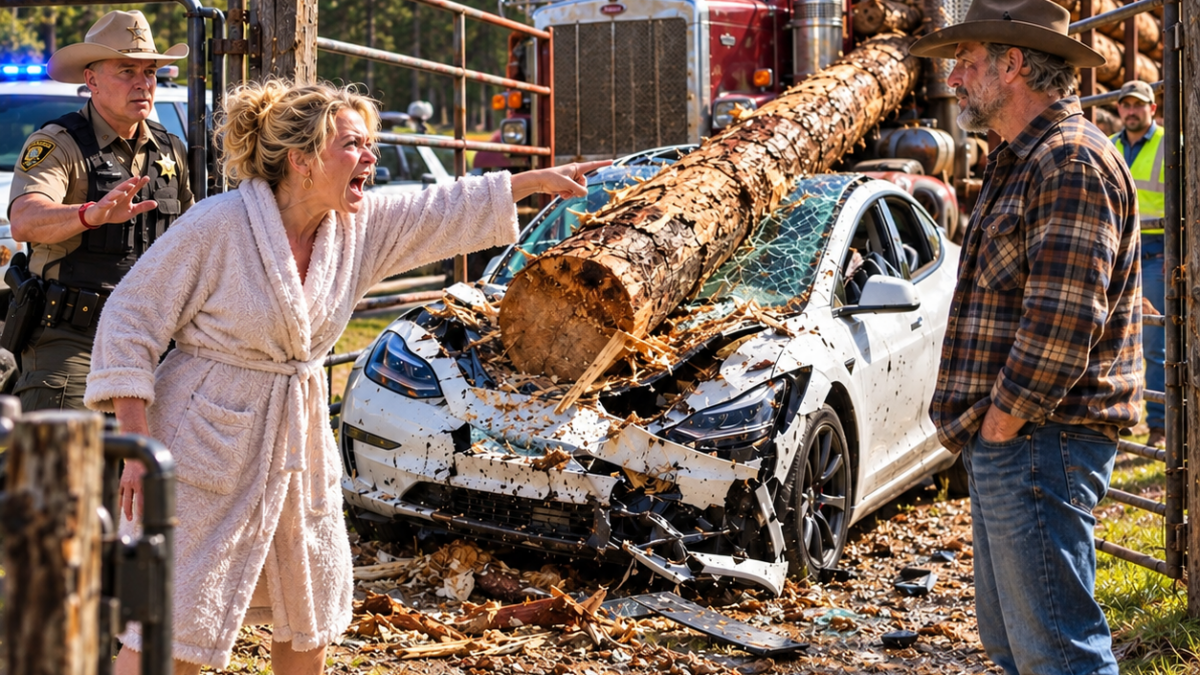
RCA Karen Forged 12 Signatures to Claim My Farm Gate—Then Her $90,000 Tesla Met a Peterbilt.
For fourteen months, the chairwoman of the Residential Community Authority parked her $90,000 white Tesla across the steel farm gate my grandfather welded in 1960, insisting twelve forged signatures gave her neighborhood permanent control over my private road.
She ignored three certified warnings, laughed at my boundary survey, and deliberately blocked the only entrance my logging contractor needed for a $42,000 timber harvest that was keeping my eighty-five-acre family farm from sliding into foreclosure.
Then, at 5:12 on a black Tuesday morning, I photographed her Tesla blocking my gate for the forty-ninth time—and as the headlights of a loaded Peterbilt appeared down the county road, Karen stepped onto her porch in a bathrobe, folded her arms, and dared me to do something about it.
My name is Kyle Mercer.
I am the third generation of my family to work eighty-five acres of land that nobody wanted until somebody built expensive houses across the road from it.
My grandfather bought the first forty acres in 1958.
Added another twenty-three in 1964.
Then seventeen more in the seventies.
The last five came from a neighbor who moved to Florida and decided cows were somebody else’s problem.
By the time I inherited the place, the farm was a strange patchwork of pasture, hardwood timber, hay ground, creek bottom, two barns, an old farmhouse, and one heavy steel gate facing County Road 18.
That gate mattered.
More than Karen ever understood.
My grandfather welded it himself in 1960.
Not decorative.
Not pretty.
Four-inch steel pipe.
Heavy hinges.
Rust along the lower rail.
He built it wide enough for tractors, loaded hay wagons, cattle trailers, and eventually the kind of commercial trucks nobody in 1960 could have imagined needing.
For decades, nobody questioned whose gate it was.
Then Creekstone Estates arrived.
Luxury subdivision.
One hundred and six houses.
Stone entrance pillars.
Curved sidewalks.
Decorative streetlights.
Matching black mailboxes.
The developer bought a former soybean field across County Road 18 and spent two years turning it into what their brochures called:
“Refined country living without the inconvenience of agriculture.”
PART2:
I laughed the first time I saw that.
They wanted the view.
Not the smell.
Not the equipment.
Not the dust.
Definitely not the work.
Still, I didn’t care.
Their land.
Their houses.
Their rules.
The Residential Community Authority—RCA—formed after construction.
Basically their version of an HOA with a more important-sounding name.
I never joined.
Never signed covenants.
Never accepted restrictions.
My farm wasn’t part of the development.
County maps showed the boundary clearly.
The subdivision stopped at the county road.
My land started on the opposite side.
Simple.
Then Karen Caldwell moved in.
Biggest house on the cul-de-sac.
Three-car garage.
White Tesla Model X.
Perfect landscaping.
Outdoor kitchen.
PART3:
Swimming pool shaped like something from a resort brochure.
Within six months she joined the RCA board.
Within a year she was chairwoman.
And within eighteen months she decided my gate bothered her.
The first conversation happened at 7:20 one Saturday morning.
I was replacing a fence staple when her Tesla stopped beside the road.
Window lowered.
Karen wore sunglasses large enough to monitor an eclipse.
She said:
“Are you Kyle?”
I looked around.
“No, I’m Taylor Swift.”
She didn’t laugh.
“You own this property?”
“Yes.”
“The RCA has received several complaints about that gate.”
I looked at the gate.
Then her.
“What did it do?”
“Excuse me?”
“It hasn’t left the property lately.”
Her mouth tightened.
“The rust is visible from Creekstone.”
“So?”
“It negatively affects the aesthetic transition into the neighborhood.”
“You built your neighborhood across from a farm.”
“That doesn’t mean adjacent properties can ignore community standards.”
I stared at her.
“My farm isn’t part of your community.”
“Visually, it is.”
That was my introduction to Karen logic.
Legal boundaries were apparently optional if she could see something.
I said:
“Have a good morning.”
Then went back to work.
Three days later, I received an RCA courtesy notice.
REQUEST FOR EXTERIOR GATE IMPROVEMENT.
It instructed me to repaint the gate black and replace the upper section with “decorative ranch-style architectural fencing consistent with Creekstone’s visual standards.”
Estimated cost:
$6,800.
I threw the notice into my truck.
Then forgot about it.
Karen did not.
A week later, she parked across my gate for the first time.
White Tesla sideways.
Completely blocking access.
I was leaving at 6:40 a.m. with a livestock trailer.
I got out.
Walked across the road.
Rang her bell.
She opened wearing workout clothes.
“Your car is blocking my gate.”
“I know.”
That answer changed everything.
“Move it.”
“I wanted to discuss the notice.”
“We’re discussing your car.”
“The RCA is trying to work with you.”
“You parked across private access.”
“You’ve ignored correspondence.”
“Move the Tesla.”
She smiled.
“Paint the gate.”
I stood there for three seconds.
Then:
“Move your car.”
She finally did.
Thirty-two minutes later.
I photographed the entire thing.
Time.
Date.
License plate.
Gate.
First entry.
I did not know there would eventually be forty-nine.
The second blockade came nine days later.
Same Tesla.
This time orange traffic cones.
Two of them.
Like she had established an official checkpoint.
I called.
No answer.
Texted.
No answer.
Waited twenty-four minutes before she appeared.
She carried coffee.
“Morning.”
“Move your car.”
“You really should reconsider the gate.”
“No.”
She sighed as if I were a disappointing employee.
“That road doesn’t serve any meaningful residential function.”
“It serves my farm.”
“Very occasionally.”
That irritated me.
“How would you know?”
“We observe traffic.”
“We?”
“The RCA.”
“Why?”
“Community planning.”
She moved the Tesla.
I documented it.
Entry two.
By entry seven, I started keeping a spreadsheet.
Date.
Arrival time.
Duration.
Photos.
Witnesses.
Any RCA notice attached to the gate.
By entry fifteen, fake violation notices appeared beneath my windshield wiper.
PRIVATE ACCESS OBSTRUCTION.
VISUAL NUISANCE.
UNAPPROVED COMMERCIAL ACTIVITY.
I called a property attorney.
Ray Dawson.
Ray was sixty-one.
Practiced land-use and real estate law for thirty-four years.
His office looked like paperwork had reproduced overnight.
I brought my deed.
Survey.
Photos.
RCA notices.
He read everything.
Then asked:
“Did you ever sign anything with Creekstone?”
“No.”
“Your grandfather?”
“Dead fifteen years before Creekstone broke ground.”
“Previous owner?”
“Family ownership before that.”
He nodded.
“Your farm isn’t part of their RCA.”
“I know.”
“I need you to understand something.”
“What?”
“You knowing and them admitting are different problems.”
He ordered a new boundary survey.
Pulled county records.
Checked recorded easements.
Nothing.
No shared road.
No cross-access.
No RCA interest.
My gate sat 11 feet inside my boundary.
The gravel approach from County Road 18 had been permitted decades earlier.
Ray sent a cease-and-desist letter.
Certified mail.
Karen signed.
Three days later:
Entry twenty-two.
Tesla across gate.
I called the sheriff.
Deputy Holt arrived forty minutes later.
Karen had moved the Tesla by then.
I showed photographs.
Letters.
Survey.
He looked tired before I finished.
“Neighbor dispute.”
“She’s blocking access to agricultural property.”
“Vehicle isn’t there now.”
“Twenty-two times.”
“Have your attorney handle it.”
“Can you issue trespass notice?”
“Property boundary issues are civil.”
“Survey says it’s mine.”
He shrugged.
“I’m not a surveyor.”
That sentence followed me for months.
Ray was furious.
Not at Holt personally.
At the situation.
He sent Karen another letter.
Then a third.
Each one more specific.
No permission to park.
No right to obstruct.
No RCA authority.
Preserve evidence.
Stop entering the property.
Karen responded with a new tactic.
A recorded easement claim.
I remember Ray calling.
“You sitting down?”
“No.”
“Sit.”
I sat on a feed bucket.
“Karen filed an access declaration.”
“What does that mean?”
“She claims Creekstone residents have historic easement rights through your gate.”
I laughed.
“No.”
“I know.”
“Historic since when?”
“Her document claims continuous community use since 2006.”
“There was no community use.”
“I know.”
“Who signed it?”
“Apparently twelve neighboring landowners.”
I stopped laughing.
“Twelve?”
“Yes.”
“Which landowners?”
Ray emailed the document.
I opened it on my phone.
Twelve signatures.
Names.
Addresses.
Affidavit language claiming the gate and farm lane had been openly used by Creekstone residents for recreational and maintenance purposes for more than fifteen years.
I recognized two names immediately.
Ted Morrison.
Jill Morrison.
They lived south of me.
Not in Creekstone.
Ted was seventy-four.
Jill seventy-one.
They had never used my gate without asking.
I drove to their house.
Ted answered.
I showed him.
His face changed.
“That ain’t my signature.”
Jill came in.
She looked.
“Mine either.”
There it was.
Not misunderstanding.
Not aggressive interpretation.
Forgery.
Ray immediately filed a challenge.
Requested county review.
Secured sworn affidavits from Ted and Jill.
Then tracked other signatures.
Four belonged to Creekstone residents who said they’d signed what Karen described as a “community access petition,” not a sworn easement declaration.
Three denied signing anything.
Two signatures belonged to former residents who had moved before the document date.
One person was dead.
That left Karen with a problem much larger than my rusty gate.
The county temporarily flagged the easement claim and issued a status restriction while they reviewed it.
That restriction became my nightmare.
Until the clerk ruled, neither side was supposed to alter access conditions aggressively.
Karen interpreted that as permission to keep parking.
Every morning.
Tesla.
Cones.
Sometimes five minutes.
Sometimes forty.
Sometimes an hour.
She wanted me angry.
I stopped giving her anger.
I gave her numbers.
Entry 38.
Photo.
Entry 39.
Video.
Entry 40.
Witness statement.
Every morning I walked down with black coffee and my phone.
Click.
Karen saw me once.
She was leaning against the Tesla.
“You keep taking your little photos.”
I took another.
“Forty.”
She smiled.
“Nobody cares.”
I didn’t answer.
She walked closer.
“Sweetie, when the county recognizes the easement, you’ll be lucky if they let you keep that ugly gate at all.”
Click.
“Forty-one.”
Her smile vanished.
Money became the real pressure.
The farm had not been doing well.
Input costs up.
Equipment repair.
Property taxes.
A bad hay year.
A medical bill from the previous winter.
Then a timber consultant told me the back acreage had mature hardwood ready for a selective harvest.
Oak.
Poplar.
Some hickory.
Enough to help.
The bid came in around $42,000 net to me after harvesting costs.
That was breathing room.
Mortgage payments.
Seed.
Fuel.
Repairs.
Maybe enough to replace the hydraulic pump on the old Deere before it destroyed itself completely.
The logging contractor was Bennett Timber & Hauling.
Foreman named Virgil Moss.
Forty-two years moving timber.
Everything about Virgil looked built for bad weather.
He walked the access route with me.
Measured the gate.
Turn radius.
Road base.
Then looked across County Road 18 at Creekstone.
“That white Tesla yours?”
“No.”
“Good.”
“Why?”
“Because she’s parked right where my trucks need to swing.”
“That is the problem.”
I explained.
Virgil scratched his beard.
“When are they ruling?”
“Hopefully soon.”
“We can’t stage loaded equipment if access isn’t clear.”
“I know.”
“I’ve got two Peterbilts and a loader booked.”
“I know.”
“If we miss the window, I have another job two counties over.”
“How long?”
“Could push you six weeks.”
I did not have six weeks.
Karen knew about the logging job because RCA residents had seen Virgil surveying.
Then she filed a complaint accusing me of preparing “unapproved industrial operations adjacent to residential property.”
Ray laughed when I forwarded it.
“She can’t approve or deny your farm operation.”
“I know.”
“County forestry permit okay?”
“Yes.”
“Haul permit?”
“Yes.”
“Road use?”
“Yes.”
“Then ignore her.”
I wanted to.
But I also knew that if Karen parked across the gate on harvest morning, Virgil wasn’t going to drive around her.
Commercial drivers don’t improvise around $90,000 vehicles.
They stop.
Call dispatch.
Lose hours.
Contract gets delayed.
I lose money.
Then the county clerk finally called Ray.
Four weeks after the easement challenge.
I was in the equipment barn cleaning grease off a fitting.
Phone buzzed.
Ray.
I answered.
He didn’t say hello.
“It’s dead.”
I stopped.
“What?”
“The easement claim.”
My chest tightened.
“Official?”
“Signed order this afternoon.”
I leaned against the rear tire.
“They reviewed survey, historic aerials, deeds, affidavits.”
“And?”
“No easement.”
I closed my eyes.
“Forged signatures?”
“Flagged for separate review.”
“County recorder?”
“Yes.”
“District attorney referral possible.”
“Possible.”
I exhaled.
For fourteen months I’d been arguing over something my family had never legally surrendered.
Now the record finally said so in language even Karen couldn’t reinterpret.
Ray asked:
“When is timber harvest?”
“Three weeks.”
“Good.”
“We send notice today.”
“No.”
I thought about Karen.
“Send three.”
Ray laughed.
“That’s excessive.”
“So was forty-one blockades.”
First certified notice.
County easement claim rejected.
Private gate confirmed.
Commercial logging operation scheduled.
No parking.
No obstruction.
Active work zone.
Vehicles may be subject to lawful removal and ordinary risks associated with ongoing commercial operations.
We were careful with wording.
Ray did not write:
Your Tesla will be crushed.
Because responsible lawyers do not write movie dialogue.
He wrote what mattered.
Do not park there.
Commercial vehicles will be entering.
Obstruction creates safety and liability issues.
Karen signed for it Thursday at 2:47 p.m.
Saturday morning:
Tesla across gate.
Click.
Entry forty-two.
Warning two was hand-delivered.
Witness:
Earl Perkins.
Eighty years old.
Retired diesel mechanic.
Had lived on County Road 18 since before I was born.
We walked to Karen’s front door.
She opened wearing white slacks and a pale blue sweater.
I handed her the envelope.
She looked at Ray’s letterhead.
Then me.
“What is this?”
“Second notice.”
“I already received one.”
“Then this one should be easy.”
She opened it.
Read maybe two paragraphs.
Then laughed.
Actually laughed.
Earl watched.
Karen said:
“You think a logging company scares me?”
“No.”
“You’ve turned a simple community access issue into some fantasy property-rights crusade.”
“The county killed your easement.”
“Administrative decision.”
“Correct.”
“We’re appealing.”
“Doesn’t change ownership.”
“It will.”
I said:
“Do not block the gate on harvest day.”
Karen folded the letter.
“Or?”
“Don’t.”
She smiled.
“What are you going to do, Kyle?”
Nothing.
That was the point.
I wasn’t going to do anything stupid.
No pushing her vehicle.
No chains.
No tractor.
No threats.
Commercial operation would proceed through legal channels.
If she obstructed it, law enforcement and towing would be contacted.
Everything documented.
Karen wanted confrontation.
I wanted evidence.
She looked at Earl.
“You’re witnessing intimidation.”
Earl laughed.
“Ma’am, he’s telling you not to park on his land.”
She slammed the door.
Warning three went certified and by email.
Then Ray sent a copy to RCA counsel.
That mattered.
For the first time, the rest of the RCA board saw the entire timeline.
County ruling.
Survey.
Forged signatures.
Forty-plus obstruction events.
Scheduled timber harvest.
One board member called me privately.
Her name was Denise Harper.
“I had no idea.”
“What?”
“That Karen filed the easement documents.”
“She did it under the RCA name.”
“We never voted on that.”
I stopped.
“Are you sure?”
“Yes.”
“Ask for the minutes.”
“I am.”
That opened another door.
Karen had represented the easement claim as a board-authorized action.
No recorded vote existed.
No motion.
No meeting entry.
No board approval.
She had apparently treated “chairwoman” as a synonym for “owner.”
Harvest morning arrived Tuesday.
My alarm rang at 4:35.
I didn’t need it.
Already awake.
Coffee.
Boots.
Jacket.
Folder.
Phone.
At 5:12 I drove toward the gate.
Dark.
Cool air.
Mist low over the pasture.
Headlights crossed the gravel.
Orange cones reflected first.
Then white paint.
Tesla Model X.
Perfectly horizontal.
Centered across the gate.
Entry forty-nine.
I stopped.
Put the pickup in park.
Took a photograph.
Timestamp visible.
Then video.
Slow pan.
My gravel.
My gate.
Tesla.
County road.
Cones.
I called Ray.
He answered groggy.
“She did it?”
“Yes.”
“Don’t touch the car.”
“Wasn’t planning to.”
“Call sheriff.”
“Already next.”
Deputy dispatch logged obstruction.
I called Virgil.
“How far?”
“Fifteen minutes.”
“Gate blocked.”
Silence.
Then:
“Tesla?”
“Yes.”
Virgil exhaled.
“Of course.”
“Don’t enter until sheriff is here.”
“Wasn’t going to.”
Good.
That is the part dramatic retellings always change.
Nobody wanted a forty-ton logging truck smashing anything.
Virgil had insurance.
A commercial license.
A company.
A family.
He wasn’t risking all of that for my feud.
I wasn’t asking him to.
At 5:28, Karen’s porch light came on.
Front door opened across the road.
She walked outside in a cream bathrobe.
Coffee mug.
Slippers.
She saw my truck.
Raised the mug.
Like a toast.
I got out.
Stayed on my side.
She called:
“Morning, Kyle.”
I said nothing.
She walked toward the road.
Stopped near her Tesla.
“You seem upset.”
I raised my phone.
Recording.
She smiled.
“You really have a problem with consent.”
“What?”
“You’ve been notified forty-eight times not to block this gate.”
“This is RCA access.”
“No.”
“County ruling is being appealed.”
“It doesn’t grant you access during appeal.”
“We disagree.”
“We?”
She took a sip.
“The authority.”
Then we heard it.
Low.
Deep.
Far down County Road 18.
Diesel.
Heavy.
Peterbilt.
Karen looked toward the sound.
Then back at me.
“You actually scheduled them?”
“Yes.”
She laughed.
“What are they going to do?”
I said:
“Wait for law enforcement.”
Her smile disappeared slightly.
“What?”
“You thought I was going to hit your car?”
She didn’t answer.
“No.”
I held up my phone.
“I want your car moved.”
She crossed her arms.
“Not happening.”
The Peterbilt headlights appeared around the bend.
Virgil’s lead truck.
Empty log trailer behind.
Slowing well before the gate.
Air brakes hissed.
Then second truck behind it.
Loader transport farther back.
All stopped safely on the shoulder under company traffic control.
Virgil climbed down.
Reflective jacket.
Hard hat.
He walked toward me.
Then looked at Karen.
“Ma’am, is that your Tesla?”
“Yes.”
“You need to move it.”
“No.”
“This is our contracted access.”
“Not anymore.”
Virgil looked at me.
I handed him the county order.
He had already seen it.
This was for the record.
Karen said:
“Your company enters here and you’ll be sued.”
Virgil nodded.
“Then I guess we wait for the deputy.”
That irritated her more than aggression would have.
Nobody was giving her the fight.
At 5:46, Deputy Holt arrived.
Same deputy from months earlier.
He pulled behind my truck.
Saw the Tesla.
Saw the Peterbilts.
Saw Karen.
His face said:
Not this again.
He approached.
“Morning.”
I handed him the county ruling.
Survey.
Certified notices.
Dispatch event numbers.
Photos.
He read.
Karen stepped forward.
“Deputy Holt, the RCA is appealing that administrative ruling.”
He looked at her.
“Do you have an active court order giving you possession or access?”
“My attorney—”
“Do you?”
“No.”
“Then why is your vehicle on Mr. Mercer’s property?”
“It is within the access corridor.”
Holt looked at the survey stakes.
Then the map.
Then the Tesla.
“Ma’am, the county’s determination says otherwise.”
“You told him this was civil before.”
“It was disputed before.”
“And now?”
“Now I have a county ruling.”
Her jaw tightened.
“I’m not moving it.”
Holt sighed.
“Then I’m documenting refusal.”
That changed her expression.
“You’re what?”
“You’ve been asked by the property owner.”
“You’ve received documented warnings.”
“You’re blocking commercial access.”
“I am ordering you to move the vehicle.”
Karen stared.
“You don’t have authority to order me off RCA property.”
Holt looked around.
“This isn’t RCA property.”
Silence.
Then:
“Move the Tesla.”
“No.”
He gave her another opportunity.
She refused.
That was entry fifty.
Not my spreadsheet.
Deputy Holt’s report.
Refusal after direct instruction.
He called for a tow company rated for electric vehicles.
Karen laughed.
“You cannot tow my car.”
Holt said:
“Watch us.”
Thirty minutes later, the flatbed arrived.
That should have been the end.
But Karen had locked the Tesla.
Refused to provide access.
Refused key card.
Refused phone control.
The tow operator explained he’d recover it under deputy authorization using proper equipment.
Karen started filming.
Shouting.
Threatening lawsuits.
Neighbors came outside.
Phones everywhere.
RCA board members arrived.
Denise Harper walked straight toward Karen.
“What have you done?”
Karen snapped:
“Go home.”
“You filed those easement signatures without a board vote.”
“Not now.”
“You used my name.”
Karen froze.
Denise held papers.
“I pulled the recorder filing.”
“Karen, you certified this as authorized by the board.”
“We discussed access.”
“No.”
“We discussed the ugly gate.”
Neighbors murmured.
Deputy Holt heard it.
He asked:
“What filing?”
Denise handed him a copy.
Then Ted Morrison appeared.
Earl had called him.
Ted held his sworn affidavit.
“My signature on that paper is fake.”
Everything stopped.
Holt looked at Karen.
“Sir?”
Ted pointed.
“I never signed it.”
His wife Jill stood beside him.
“Neither did I.”
Holt’s expression changed.
No longer neighbor dispute.
He called a supervisor.
Karen started talking fast.
“They’re confused.”
“The petition circulated months ago.”
“Documents were converted.”
“Electronic signature process.”
Ted shouted:
“I don’t use electronic signatures.”
Karen turned red.
Then the tow operator started loading the Tesla.
And this is where the story everybody tells later becomes exaggerated.
People say a Peterbilt crushed Karen’s Tesla.
That’s not exactly what happened.
The Tesla was being moved so the authorized logging convoy could enter.
Karen continued interfering with the tow and repositioning herself near the work zone despite deputies repeatedly telling her to stand back.
The vehicle was ultimately moved clear.
But during the chaos, after the tow operator had repositioned it along the shoulder, the Tesla ended up partly within the turning envelope needed by the first logging rig.
Virgil refused to move.
Correct decision.
Traffic had to be stopped again.
Another tow adjustment was ordered.
Karen screamed that nobody was touching her car.
She ran toward it.
Holt blocked her.
Finally the Tesla was shifted.
The first Peterbilt began its slow turn.
Forty-ton combination once loaded.
Wide wheelbase.
Large trailer.
Virgil’s driver crawled.
Spotter outside.
Everything deliberate.
Then Karen did the one thing nobody expected.
She remotely commanded the Tesla forward.
Maybe she thought she was moving it away from the tow operator.
Maybe she wanted to block the truck again.
I don’t know.
Investigators later pulled vehicle data.
What mattered in that moment was simple.
The white Tesla moved several feet into the active turning path.
Virgil’s driver stopped immediately.
But heavy commercial vehicles do not stop like passenger cars.
The Peterbilt’s front bumper made contact with the Tesla’s rear quarter.
Not high speed.
Not a cinematic explosion.
A slow, sickening crunch of aluminum, glass, and plastic under enormous mass.
The Tesla rotated.
One rear door folded.
Quarter panel collapsed.
Glass shattered.
Everyone froze.
Karen screamed.
“My car!”
Virgil’s driver set the brake.
Shut down.
Got out shaking.
“I stopped.”
Deputy Holt said:
“Nobody move anything.”
Karen ran toward the Tesla.
He intercepted her.
“You moved it.”
“No!”
“Ma’am, I watched it move.”
“You people hit me!”
The driver said:
“It came into my turn.”
Dash cameras.
Truck cameras.
My phone.
Neighbor phones.
Deputy’s body camera.
Tesla event data.
Karen had managed to create the most thoroughly documented low-speed collision in county history.
Nobody was injured.
That mattered.
The Tesla looked terrible.
That also mattered to Karen significantly more.
She kept shouting:
“That’s a ninety-thousand-dollar vehicle!”
Virgil muttered:
“Not anymore.”
I looked at him.
He shrugged.
Maybe inappropriate.
Still funny.
The logging operation paused for nearly three hours while the collision was documented and vehicles cleared.
That delay cost money.
Bennett Timber documented every minute.
Labor.
Idle equipment.
Crew.
Haul schedule.
My attorney did too.
Karen’s obstruction had now moved beyond annoyance.
There were actual measurable damages.
The bigger story became the forged easement.
A sheriff’s supervisor arrived.
Then a county investigator.
Ted and Jill gave statements.
Denise gave hers.
Other neighbors started checking signatures.
By lunchtime, eight of the twelve were disputed.
Within days:
All twelve had problems.
Five people denied knowingly signing an easement affidavit.
Three said they signed a general neighborhood petition with different language.
Two signatures belonged to people who were no longer residents at the stated date.
Ted and Jill denied signing anything.
The county recorder referred the matter.
District attorney’s office opened a review.
The RCA board called an emergency meeting.
Karen attended with an attorney.
She no longer carried the clipboard.
I did not attend at first.
Ray did.
He called afterward.
“You’re going to enjoy this.”
“What happened?”
“Board voted to suspend her.”
“How close?”
“Ten to one.”
“Who voted for her?”
“Karen.”
Of course.
Then Ray said:
“There’s more.”
“What?”
“They found out she’s been billing RCA legal expenses related to your gate without board authorization.”
“How much?”
“Almost nineteen thousand.”
I sat down.
“She spent nineteen thousand trying to claim a gate she didn’t own?”
“Apparently.”
“That’s impressive.”
“Not the word I’d use.”
The logging harvest eventually resumed.
Two days later.
Not because Karen won anything.
Because collision investigation and access had to be reset.
Virgil’s crews worked twelve days.
Selective harvest.
No clear-cut.
Forester marked every tree.
Loaded logs rolled out through my grandfather’s sixty-year-old gate exactly as planned.
Every truck photographed.
Not out of paranoia anymore.
Habit.
At the end, Virgil handed me the final settlement paperwork.
Net:
$41,680.
Close enough.
That money saved the farm.
Paid delinquent equipment balance.
Property taxes.
Seed.
Hydraulic repairs.
Kept enough reserve to survive winter.
Karen had known how badly I needed that harvest.
That’s the part I never forgot.
This wasn’t simply aesthetic control.
She knew blocking the gate could force me into financial trouble.
During discovery in the civil case, emails came out.
One message from Karen to another RCA officer read:
“If Mercer can’t move timber, he may finally become motivated to entertain purchase options.”
Purchase options.
There it was.
Creekstone’s developer had approached me twice about selling a strip of frontage.
I refused.
Karen’s RCA had begun discussing whether my farm could someday become a “buffer expansion opportunity.”
They didn’t own the developer.
But several board members wanted more controlled green space.
Karen saw financial pressure as leverage.
Ugly gate was just the beginning.
My property was the goal.
Ray read the email twice.
Then said:
“That helps.”
It did.
Our civil case focused on trespass, interference with business, legal costs, access obstruction, property-related misrepresentations, and actual damages.
Not fantasy damages.
Actual.
We had receipts.
Logging delay.
Attorney fees.
Survey.
Lost farm hours.
Gate repair from RCA signs.
Everything.
Karen countersued.
Of course.
Claimed negligence in connection with the Tesla collision.
That claim did not survive the evidence well.
Video showed her vehicle move into the truck’s path after officers had already directed her to keep it clear.
Insurers handled much of the vehicle dispute.
I never learned her exact final payout.
Didn’t care.
What I know is that the Tesla was later declared repairable but with a bill large enough that Karen traded it instead.
She bought a Lexus.
Parked it in her garage.
Growth.
The forged-signature matter moved more slowly.
Real legal cases do.
Months.
Document examiners.
Interviews.
Original petition forms.
Electronic files.
Metadata.
The prosecution ultimately alleged Karen had altered or caused alterations to signature pages attached to a different petition and then used those signatures to support the easement filing.
Not twelve people secretly sitting around signing fake deeds.
Much less cinematic.
Much more believable.
Her attorney negotiated.
Some charges were reduced.
She eventually entered a plea to offenses related to filing a false instrument and making materially false representations in the county recording process.
Probation.
Community service.
Restitution connected to recording and investigative costs.
No dramatic prison sentence.
People online would’ve complained.
I didn’t.
The important thing was the easement was gone.
The forged filing was formally discredited.
The farm stayed mine.
The RCA settled separately.
They paid a substantial portion of my legal expenses.
Reimbursed documented business losses related to the obstruction.
Issued a written acknowledgment that:
My parcel was outside RCA jurisdiction.
The gate belonged exclusively to me.
The RCA held no access rights.
No RCA member or officer could park, place cones, signage, or barriers within my entrance.
They also adopted a rule requiring full board authorization and outside counsel review before asserting any claim involving non-RCA property.
I suggested adding:
DO NOT FORGE SIGNATURES.
Ray advised me not to send that email.
Good lawyer.
Karen resigned before the board could permanently remove her.
Her resignation letter was seven pages.
I did not read it.
Thomas from across the road did.
He summarized:
“Everyone else’s fault.”
Sounds right.
Creekstone eventually got a new chairwoman.
Denise Harper.
First thing she did was walk to my gate.
On foot.
Stopped at the road.
Did not cross.
“Can I come over?”
That mattered.
“Yeah.”
She stepped onto the gravel.
Looked at the rusty gate.
“You know it’s ugly.”
I laughed.
“Get off my land.”
She laughed too.
Then:
“I’m serious about one thing.”
“What?”
“We owe you an apology.”
“The board already sent one.”
“Corporate apology.”
“True.”
She handed me a small envelope.
Inside was a photograph.
My grandfather’s gate in 1987.
I had never seen it.
“How?”
“One of Creekstone’s older residents bought the original farmhouse east of the road before the development.”
She pointed.
“Found old county-history photos.”
There was Grandpa.
Young enough that I almost didn’t recognize him.
Standing beside the gate.
Work shirt.
Hands on hips.
Fresh paint on the steel.
It hadn’t always been rusted.
I stared for a long time.
Denise said:
“I figured you should have that.”
“Thank you.”
She looked toward the subdivision.
“We’re not asking you to repaint it.”
“Smart.”
“But…”
“No.”
“I didn’t even say anything.”
“Still no.”
She laughed.
After that, relations improved.
Not perfect.
Some Creekstone residents still hated the logging trucks.
I understood.
They’re loud.
Some hated manure smell.
Also understandable.
One family complained about rooster noise despite living almost half a mile away.
That one I ignored enthusiastically.
But the new RCA understood boundaries.
Their authority ended at their plat.
Mine began at my survey line.
Simple.
A year later I rebuilt the gate.
Not because Karen wanted me to.
Because the lower hinge finally failed.
I could have replaced it entirely.
Virgil offered to fabricate a modern one.
Powder coated.
Automatic opener.
Keypad.
Nice.
I said no.
We removed Grandpa’s old steel gate.
Cut out the corroded lower sections.
Welded new material.
Reinforced hinges.
Sandblasted.
Then I had to decide color.
Earl stood there.
“Black?”
“No.”
“Green?”
“No.”
“What?”
I chose the original color from the old photograph.
Deep red.
My grandfather had painted it red.
Nobody remembered because sixty years of weather turned it brown.
I painted it myself.
Three coats.
When finished, it looked completely different.
And exactly right.
Denise drove by.
Stopped.
Window down.
“Looks beautiful.”
I leaned on the post.
“RCA approved?”
She laughed.
“We wouldn’t dare.”
Good answer.
I mounted a small brass plate on the inside.
Not visible from Creekstone.
FORGED BY HAROLD MERCER — 1960
RESTORED BY KYLE MERCER
NO PERMISSION REQUIRED.
Ray saw it.
“You enjoy provoking people.”
“Only from inside my property.”
“Legally safer.”
The Tesla incident became county folklore.
Virgil hated that people called it:
“The Peterbilt that crushed the RCA lady’s Tesla.”
He always corrected them.
“It was a low-speed contact.”
I told him:
“That’s less marketable.”
He said:
“I carry commercial insurance. I prefer less marketable.”
Fair.
His driver, Marcus, came back the following summer.
He was still bothered by the accident.
Even though investigators cleared him of wrongdoing.
I understood that.
When you’re driving something that heavy, any collision stays with you.
I told him:
“You did exactly what you were supposed to.”
He nodded.
“I know.”
Didn’t sound convinced.
I said:
“The video proves it.”
He looked at the gate.
“She really moved the car.”
“Yes.”
“Why?”
I thought.
“Because she thought everybody else would stop first.”
Marcus nodded slowly.
“That’ll get you hurt around trucks.”
And around life.
Karen had spent fourteen months assuming the world would always yield.
Neighbors.
Deputies.
County staff.
Me.
Commercial crews.
A forty-ton truck.
Eventually something didn’t.
Not because we wanted a collision.
Because physics is less impressed by titles than people are.
That’s what everybody remembers.
But I remember photograph forty-nine.
Dark road.
Orange cones.
White Tesla.
My grandfather’s gate behind it.
For fourteen months I had been told:
Nobody cares.
Nobody cares about your photos.
Nobody cares about your survey.
Nobody cares about certified letters.
Nobody cares about your old gate.
She was wrong.
Documentation feels useless right up until the day somebody needs to know what happened.
Photo one looked petty.
Photo ten looked obsessive.
Photo forty-nine looked like a pattern.
Three certified warnings looked excessive until Karen claimed she didn’t understand.
Then her signatures were sitting on the receipts.
Ted’s affidavit looked boring until investigators compared it with the easement.
Survey stakes looked like sticks with pink flags until a deputy needed to know where private property began.
Evidence is boring.
That’s why arrogant people underestimate it.
It doesn’t perform.
It waits.
Karen performed.
Bathrobe.
Coffee.
Tesla.
Clipboard.
“I dare you.”
The paperwork waited.
Then it answered.
My farm is still here.
Eighty-five acres.
Less timber now.
More sunlight reaching the forest floor.
The selective harvest opened room for new growth.
White oak seedlings came up the next spring.
Deer started using the cut lanes.
Farm finances stabilized.
Not rich.
Never will be.
But stable.
I kept one log from the harvest.
Large red oak section.
Virgil thought I was crazy.
I had a local mill slab it.
Earl and I built a table.
Heavy.
Six feet long.
It sits in the farmhouse kitchen.
On one corner I burned:
HARVEST 49.
Nobody understands unless I tell them.
That’s fine.
My granddaughter sits there now when she visits.
She is eight.
Likes tractors.
Hates vegetables.
She asked me last Christmas:
“Grandpa, is this the gate where the rich lady parked?”
“Yes.”
“Why?”
“She thought she owned it.”
“Did she?”
“No.”
“Why did she think that?”
“Long story.”
“Did the truck really smash her car?”
I hesitated.
Kids love mythology.
“It bumped it.”
“My dad said crushed.”
“Your dad exaggerates.”
“Was she mad?”
“Very.”
“Did you laugh?”
“A little.”
She thought.
“That’s mean.”
I smiled.
“Yes.”
Children are inconveniently moral.
Then she asked:
“Why didn’t she just move?”
That was the whole story.
“I don’t know.”
Adults spend thousands of dollars answering questions children solve in six words.
Why didn’t she just move?
Pride.
Control.
Entitlement.
Fear of losing status.
Maybe all.
Maybe none.
But the cost of saying:
“I was wrong”
kept rising until it became higher than losing the argument.
First it would’ve cost nothing.
Move the Tesla.
Later:
Admit gate wasn’t RCA property.
Then:
Withdraw easement claim.
Then:
Explain signatures.
Then:
Answer board questions.
By the end, admitting the truth meant admitting everything before it.
So she kept going.
That’s how small disputes become disasters.
People assume escalation happens because the original issue matters enormously.
Usually the original issue becomes irrelevant.
Nobody cared about the gate color anymore.
The fight became about whether Karen could be told no.
She couldn’t tolerate it.
I could.
That was my advantage.
I didn’t need her to agree with me.
I needed the records to.
They did.
I still photograph things.
Not everything.
I’m not insane.
But property issues?
Yes.
Contracts?
Yes.
Equipment condition.
Boundary markers.
Deliveries.
Certified mail.
Earl makes fun of me.
“You documenting lunch?”
“If necessary.”
He says I became paranoid.
Ray calls it:
“Successfully educated.”
I prefer that.
Last spring, Creekstone held a neighborhood yard sale.
Cars lined the road.
Denise called me three days beforehand.
Noticed that?
Called.
“Could overflow parking use the grass near your entrance?”
I said:
“No.”
She said:
“Okay.”
That was it.
No retaliation.
No letter.
No fake easement.
No Tesla.
Just:
Okay.
The simplest word Karen never learned.
Later I offered them a strip of pasture farther down for four hours.
Written permission.
Temporary.
No property interest.
Denise laughed when she saw the agreement.
“Four pages?”
“Ray.”
“Of course.”
She signed.
People parked.
Nobody blocked the gate.
Everyone went home.
Community did not collapse.
Sometimes boundaries make generosity possible.
If I believed saying yes once meant losing control forever, I’d always say no.
Because the new board respects no, I can occasionally say yes.
Karen never understood that.
She thought authority created cooperation.
Mostly it created resistance.
The old Tesla is gone.
Karen moved from Creekstone the following year.
House sold.
I heard she moved closer to the city.
I never verified it.
No interest.
Her brother’s consulting arrangement was investigated separately.
The RCA recovered some legal expenses.
The board changed insurance policies.
Boring aftermath.
Real aftermath.
Nobody stood in court while a judge announced that Karen had lost “everything.”
She didn’t.
She lost her position.
Money.
Reputation.
Tesla value.
Some legal freedom during probation.
But life continued.
Mine too.
That’s the better ending.
Revenge stories want villains destroyed.
I wanted my gate open.
I got it.
The Peterbilt wasn’t the hero.
Neither was the sheriff.
Neither was Ray.
The hero, if a gate dispute needs one, was patience.
Forty-nine photographs.
Twelve signatures checked.
Three certified warnings.
One survey.
County records.
Minutes.
Receipts.
Dash cameras.
Body cameras.
Boring things.
Karen had expensive technology.
A Tesla.
Digital locks.
Security cameras.
RCA management software.
What beat her was an old survey and neighbors saying:
“That isn’t my signature.”
Sometimes the simplest evidence is strongest.
I keep photograph forty-nine.
Printed.
Not on display.
Inside the farm file.
White Tesla.
Orange cones.
Steel gate.
Dark morning.
If you zoom in, you can see my truck headlights reflecting across the Tesla’s rear door.
Farther down the road, just barely visible, two tiny white points.
Peterbilt headlights.
I did not know exactly what would happen in the next hour.
Nobody did.
I only knew one thing.
For fourteen months, I had explained.
Requested.
Warned.
Documented.
Waited.
That morning, I was finished arguing.
The county had ruled.
The logging contract was valid.
The gate was mine.
The work was scheduled.
From that point on, Karen’s choices belonged to Karen.
That’s an important distinction.
You cannot control whether someone keeps making bad decisions.
You can stop protecting them from the record of those decisions.
That’s what I did.
And when her Tesla rolled back into the turning path of a Peterbilt she’d been warned about three separate times, the crunch everybody remembers lasted less than two seconds.
The evidence that led to it took fourteen months.
Forty-nine mornings.
Twelve forged signatures.
Three certified warnings.
One county ruling.
And a gate my grandfather welded sixty-five years ago.
The gate survived.
So did the farm.
Karen’s idea that she owned either one did not.

