RCA Karen Cut Off Water to 30 Seniors—Then My 4K Camera Caught Her on My Property at 2:47 A.M.
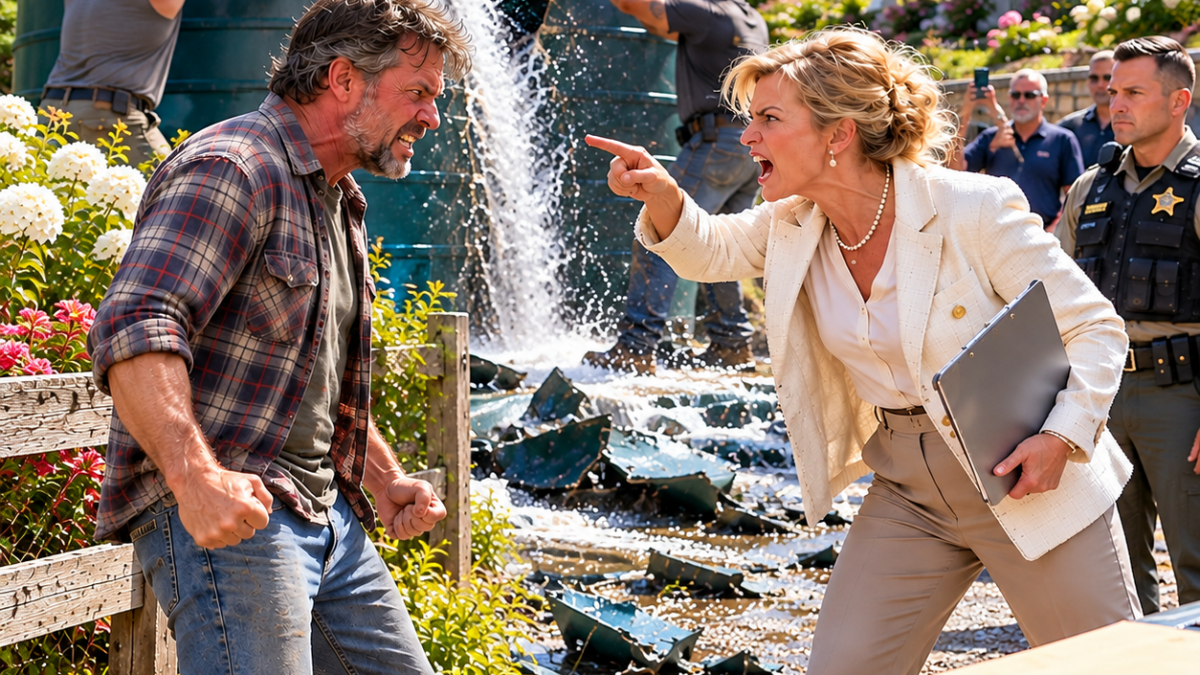
RCA Karen Cut Off Water to 30 Seniors—Then My 4K Camera Caught Her on My Property at 2:47 A.M.
For two years, the rainwater system behind my garage quietly kept a community garden alive for thirty elderly neighbors who were stretching Social Security checks between groceries, utilities, and prescription bottles.
Then RCA Chairwoman Karen Whitfield decided the blue tanks offended her “community aesthetic,” shut down the garden’s access to water, and threatened to enter my property and tear the entire system apart whether I agreed or not.
What she did not know was that I had already pulled the original 1987 charter, documented my property rights, upgraded the system, and installed three 4K cameras—so when she came through my rear gate at 2:47 in the morning dressed in black and carrying a steel crowbar, I didn’t stop her immediately.
I let her keep going.
My name is Sebastian Cole.
I live in a neighborhood outside San Antonio that most people would describe as ordinary.
Single-story houses.
Older oaks.
Concrete driveways.
A few newer builds squeezed between homes that had been standing since the late eighties.
My grandfather bought our property in 1989.
Back then there was more open land, fewer fences, and nobody had invented a committee for deciding whether a rain barrel matched the architectural character of a subdivision.
He built the iron gate at the front himself.
Heavy black steel.
Hand-welded scrollwork.
Not elegant in the fancy sense.
But solid.
The kind of thing made by a man who believed anything worth building should outlive the person who built it.
When he died, the property came to my father.
When my father died, it came to me.
By then the neighborhood had changed.
The original civic association had become something called the Residential Community Authority.
RCA.
It was not technically an HOA in the classic sense.
Not every parcel was bound by the same restrictions.
Some homes, including mine, predated several later amendments.
That distinction would become extremely important.
Most people didn’t know it.
Karen Whitfield counted on that.
PART2:
She had become board chairwoman three years earlier.
Pearl-white Lexus.
Perfect blond bob.
Pearls almost every day.
Clipboard always tucked under one arm like she was inspecting troops.
Karen loved rules.
Or more accurately, she loved rules that could be interpreted in ways that gave her control over other people.
Trash cans visible six minutes after pickup?
Notice.
Grass half an inch taller than her preferred standard?
Notice.
Work truck parked in a driveway?
Notice.
Holiday decorations left up after January 10?
Notice.
A retired mechanic on Juniper Lane once got three letters in two weeks because the faded red color of his shed “created visual inconsistency.”
He had owned the shed since 1994.
PART3:
Karen had moved into the neighborhood in 2018.
That detail never seemed to bother her.
I mostly avoided her.
I’m an electrician.
Commercial work.
Long days.
Hot attics.
Industrial panels.
Pulling wire until my shoulders ache.
When I get home, I want three things.
Quiet.
Coffee.
And nobody telling me what color a water tank is allowed to be.
The tanks started because of drought.
The original system was simple.
Two large food-grade storage tanks behind my detached garage.
Gutters routed through a first-flush diverter.
Basic filters.
A pump.
About eight hundred gallons total capacity.
I spent roughly $3,200 putting it together properly.
Not because I was trying to make some environmental statement.
Water bills were rising.
Texas heat is brutal.
And rain that runs off a roof into a storm drain never made sense to me when I could store it.
The system was invisible from the street.
You couldn’t see it from my driveway.
You couldn’t even see it from most of my backyard unless you walked behind the garage.
Which Karen eventually did.
But before Karen, there was the garden.
Directly behind my back fence sat two acres of land owned by a small senior nonprofit.
Years ago it had been an unused utility parcel.
Then a retired schoolteacher named Evelyn Patterson convinced the county and a local church to help turn it into a community garden.
Thirty raised beds.
Tomatoes.
Beans.
Peppers.
Squash.
Herbs.
A few fruit trees.
Most of the gardeners were in their late sixties, seventies, or eighties.
Some lived alone.
Some were widowed.
Most lived on fixed incomes.
For them, that garden wasn’t a hobby.
It supplemented food.
That matters when a person is choosing between thirty dollars of vegetables and thirty dollars toward heart medication.
Mrs. Patterson was seventy-eight when I met her.
Arthritis twisted her fingers.
She wore an enormous straw hat and called everybody younger than sixty “kid.”
One afternoon, not long after I installed my tanks, I saw her dragging four one-gallon plastic jugs from a hatchback toward the garden.
I climbed over the back fence.
“You planning to carry all those?”
She looked at me like I’d asked whether gravity still worked.
“That was the idea.”
“Why?”
“City water line got shut off.”
“What happened?”
“Old pipe.”
“How long?”
“They say maybe weeks.”
She shrugged.
“We’ll manage.”
I looked at her hands.
Then the garden.
Texas afternoon.
Ninety-seven degrees.
“Weather’s going to kill everything.”
She smiled.
“That’s gardening.”
“No.”
I pointed toward my garage.
“I have water.”
That became a buried PVC line.
Nothing fancy.
I dug the trench myself.
Installed a shutoff valve on my side.
Ran it under the fence.
Small distribution manifold in the garden.
I told Mrs. Patterson:
“Don’t tell everybody where it comes from.”
She asked:
“Why?”
“Because somebody will invent paperwork.”
She laughed.
For two years, it worked.
Rain came.
The tanks filled.
Garden used water.
When the tanks got low, people conserved.
I added filtration.
Then UV sterilization for any use around harvested produce.
Nobody made a big deal of it.
The seniors just called it “Sebastian’s water.”
I hated that.
It wasn’t my water once it left the pipe.
It was tomatoes.
It was cucumbers.
It was three jars of salsa Mrs. Patterson left on my porch every August.
It was Mr. Lee growing Korean peppers he said nobody in local grocery stores sold correctly.
It was Frank Mendoza, a retired Army mechanic, raising zucchini so large nobody knew what to do with them.
The garden was alive.
That was enough.
Then Karen noticed the tanks.
Tuesday afternoon.
I had just gotten home from a twelve-hour commercial job.
My Ford sat in the driveway.
I was on the porch wiping grease off my hands when her Lexus stopped half in the road.
White.
Polished.
Engine running.
Karen stepped out holding a silver clipboard and a roll of heavy-duty tape.
She walked directly through my open gate.
No greeting.
No knock.
She went to my grandfather’s iron gate and started taping a neon-orange paper onto it.
I watched for maybe five seconds.
Then:
“You’re standing on private property.”
She didn’t turn.
“The RCA has authority here.”
“No, it doesn’t.”
That got her attention.
She smoothed the tape hard with her palm.
“This is your final warning, Sebastian.”
“My final warning about what?”
“The barrels.”
“What barrels?”
She stared at me.
“The blue water containers behind your garage.”
I smiled.
“You’ve been behind my garage?”
Her expression shifted almost imperceptibly.
“I can observe violations from common areas.”
“There is no common area behind my garage.”
“The RCA received a complaint.”
“From who?”
“I am not required to disclose complainants.”
“Of course.”
She tapped the paper.
“They violate community visual standards.”
“They aren’t visible from the street.”
“That is irrelevant.”
“Seems fairly relevant to a visual standard.”
Karen’s mouth tightened.
“If they are not removed within forty-eight hours, the RCA will contract a crew to remove them at your expense.”
I actually laughed.
“And you will be fined two hundred dollars per day until compliance.”
She said it with complete confidence.
Not because she had read my deed.
Because confidence had worked for her before.
I stepped down from porch.
“Put that in writing.”
She tapped the orange notice.
“I just did.”
“Good.”
“You think this is funny?”
“No.”
I took out my phone and photographed the notice while it was still attached.
“I think you’re creating evidence.”
That made her pause.
Then she recovered.
“You don’t understand how this community works.”
“I understand my property.”
“The board voted.”
“On my backyard?”
“On environmental structures.”
I almost laughed again.
“Environmental structures?”
“They attract the wrong kind of elements.”
That phrase stayed with me.
Wrong kind of elements.
She didn’t mean mosquitoes.
She meant people.
Specifically the seniors behind my fence.
Because by then Karen’s real-estate interests had started creeping into neighborhood business.
She owned a brokerage called Whitfield Residential Partners.
Her husband handled small development projects.
A company tied to them had quietly begun purchasing parcels along the road behind the community garden.
I didn’t know the whole plan yet.
I knew enough to be suspicious.
I crossed my arms.
“I care what my deed says.”
Karen said:
“Community standards supersede individual preferences.”
“That sounded better in your head, didn’t it?”
She glared.
“My attorney will be contacting you.”
“Excellent.”
“We will remove those tanks.”
“No.”
“Yes.”
“No.”
“You’re being hostile.”
“I’m being accurate.”
That made her angrier than shouting would have.
She turned.
Walked back toward Lexus.
Her heels clicked on concrete.
Before getting in, she looked back.
“Forty-eight hours.”
Then she drove away and threw gravel onto my lawn.
I waited until Lexus disappeared.
Then peeled the orange notice off my grandfather’s gate carefully.
Not because I was angry.
Because I didn’t want to tear it.
Evidence should remain intact.
The next morning I took a personal day.
First stop was county records.
I pulled my deed.
Survey.
Original subdivision plat.
RCA charter.
Amendments.
Meeting records.
Anything connected to property-use restrictions.
The clerk looked at the stack and asked:
“Dispute?”
“Maybe.”
“Association?”
“Yes.”
She smiled without humor.
“We see a lot of those.”
I spent almost four hours reading.
Here’s what mattered.
My parcel was part of the original 1987 plat.
Several restrictions Karen relied on had been adopted decades later.
There was no recorded amendment showing my lot had ever become subject to those particular backyard-structure rules.
The original charter included explicit language supporting water conservation, drought resilience, and small-scale environmental systems.
Even better, Texas law strongly protected residential rainwater harvesting from blanket bans by property associations, subject to reasonable placement and safety requirements.
My tanks were behind the garage.
Screened.
Professionally plumbed.
Food-grade.
Not a drainage hazard.
Not connected to potable municipal lines.
Not visible from street.
Karen’s position was weaker than I had hoped.
Then I searched property records behind the garden.
That’s where things became interesting.
A limited liability company called Whitfield Development South had option agreements on two adjacent parcels.
Another parcel had been purchased outright.
The community garden sat between those properties and the most direct access road.
I printed everything.
Then went to hardware store.
Three cellular 4K cameras.
Battery backup.
Cloud storage.
Motion alerts.
Night vision.
One went inside a hollowed-out birdhouse facing rear gate.
One beneath eave pointed toward tanks.
One hidden high in oak covering the buried-line valve and fence.
I did not install them to trap Karen.
That’s what I told myself.
I installed them because she had threatened to enter my property.
But I knew her type.
Authority without accountability creates recklessness.
And Karen had spent years learning nobody called her bluff.
By Thursday evening, cameras were live.
I also upgraded my system.
The original eight-hundred-gallon capacity had served well, but drought cycles were getting harsher.
I added another tank and reinforced the platform.
Roughly twelve hundred gallons total now.
Better pump.
Commercial-grade UV.
Lockable valve box.
Everything neat.
Everything code-compliant.
If Karen wanted to call it an eyesore, she would have to trespass far enough to find it.
Then she made her next move.
The garden water stopped.
Mrs. Patterson knocked on my door at 7:10 Friday morning.
She looked angry.
Not worried.
Angry.
“Kid.”
That meant trouble.
“What?”
“No water.”
I walked behind house.
Opened my valve box.
Everything normal.
Pump pressure normal.
Tank level good.
I followed buried line to fence.
No leak.
Then climbed over.
The downstream valve on garden side had been chained shut.
New brass padlock.
On the fence hung a laminated sign:
RCA SAFETY CLOSURE
UNAUTHORIZED WATER DISTRIBUTION
CONTACT COMMUNITY AUTHORITY
I stared.
Mrs. Patterson said:
“Can they do that?”
“No.”
“You sure?”
“Yes.”
“Because Karen came yesterday.”
There it was.
“What did she say?”
“That water was unsanitary.”
“Did she test it?”
“No.”
“Did anybody?”
“No.”
I cut the lock.
Opened valve.
Water flowed.
Mrs. Patterson smiled.
“Good.”
Then another senior, Mr. Lee, said:
“She told us the garden may close.”
I turned.
“What?”
“She said land-use review.”
Mrs. Patterson’s expression changed.
“She called this whole thing temporary community recreation.”
The garden had existed nearly twelve years.
I asked:
“Did she say why?”
“Improvement.”
That word.
Improvement.
I went home.
Pulled development maps again.
The geometry was obvious.
Garden land plus adjacent parcels could support a narrow luxury-townhome project if access and utility easements were rearranged.
The garden stood in the middle.
A living obstacle.
Thirty seniors were harder to remove than empty dirt.
But if water disappeared?
Beds died.
Participation dropped.
Association could label site underused.
Then “redevelopment” becomes easier to sell.
I called an attorney.
Not RCA’s attorney.
Mine.
A woman named Elena Marquez.
Property law.
Sharp.
Efficient.
No patience for drama.
I showed her deed.
Charter.
Orange notice.
Garden lock.
Development records.
She looked through everything.
Then said:
“You’ve got three separate issues.”
“I was hoping for one.”
“No.”
She held up finger.
“First, association jurisdiction over your lot.”
Second.
“Rainwater-harvesting protections.”
Third.
“Interference with private water distribution and possible trespass.”
Then she looked at development records.
“And perhaps a fourth.”
“Conflict of interest?”
“Potentially.”
“Can they shut off the garden?”
“Who owns the valve?”
“The nonprofit.”
“Did RCA have authority?”
“I don’t see it here.”
She tapped file.
“Do not confront her beyond what is necessary.”
“I wasn’t planning to.”
“Good.”
“I installed cameras.”
Elena looked up.
“Excellent.”
That night I stayed awake too long.
Texas humidity pressed against windows.
Laptop open on kitchen table.
Three feeds.
Cold coffee.
Nothing happened.
Saturday.
Nothing.
Sunday.
Nothing.
Monday.
Karen sent email.
SUBJECT: FINAL COMPLIANCE DEMAND.
She claimed my system posed:
Mosquito risks.
Visual blight.
Potential contamination.
Unapproved utility distribution.
She demanded removal within twenty-four hours.
Elena replied for me.
Very short.
Please identify recorded covenant provision establishing authority over Mr. Cole’s rainwater system and provide any water-quality testing supporting contamination claim.
Karen’s response came forty minutes later.
The Board is not required to justify established standards to individual residents.
Elena forwarded it.
Her message:
Keep this.
Tuesday night.
I worked late.
Got home after ten.
Ate standing over sink.
Checked cameras.
Everything quiet.
At midnight, I considered sleeping.
At 1:30, still awake.
At 2:47, laptop flashed red.
MOTION DETECTED — ZONE 2.
I leaned forward.
Rear camera adjusted.
A dark figure moved near fence.
Black slacks.
Black turtleneck.
Dark shoes.
Pearls.
Karen.
If she had removed pearls, perhaps I would have respected operational commitment.
She held a two-foot steel crowbar.
My first instinct was to go outside.
Second was to call police.
Third was better.
Record.
I started screen capture on laptop even though cloud cameras already recording.
Karen went to rear gate.
Tried latch.
Locked.
She looked around.
Then inserted crowbar between gate and post.
Pried.
Once.
Twice.
Wood flexed.
Metal latch tore loose.
She entered.
That was criminal trespass territory in my mind.
I called sheriff’s non-emergency line.
Quiet voice.
“My property is being entered right now by someone I previously warned not to.”
The dispatcher shifted immediately.
“Is person armed?”
“Crowbar.”
“Are you inside?”
“Yes.”
“Stay inside.”
“I will.”
“Do not confront.”
“I won’t.”
“Units are en route.”
I almost smiled.
Perfect.
Karen walked straight toward tanks.
No hesitation.
Meaning she knew exactly where they were.
She passed Camera Two.
Full face.
Night vision.
Pearls.
Crowbar.
Then she did something even better for my case.
She took out phone.
Turned flashlight on.
Examined plumbing.
And said out loud:
“Let’s see how permanent this is.”
Camera audio caught it.
I couldn’t believe my luck.
She wedged crowbar under PVC support.
Pulled.
Nothing.
The system was reinforced.
She moved to exposed supply manifold.
Swung crowbar.
Crack.
One pipe split.
Water sprayed.
Karen jumped.
Then instead of stopping, she swung again.
Pump line shattered.
Water erupted harder.
She cursed.
My kitchen alert started showing pressure drop.
Karen attacked valve housing.
One camera caught her face.
Another caught crowbar striking equipment.
Third caught broken rear gate behind her.
She was building my case so efficiently I almost felt professionally obligated not to interrupt.
Then she turned toward line going under fence.
She followed it.
Found locked box.
Pried lid.
Opened.
Reached inside.
Closed valve.
The garden line died.
Again.
Not accidentally.
Deliberately.
She looked at broken system.
Then raised phone.
Took photographs.
Maybe for board.
Maybe for herself.
Then she smiled.
That’s the frame Elena later loved most.
Not because smiling is illegal.
Because it removed any argument about accidental damage.
At 2:58, patrol headlights appeared.
Karen froze.
She looked toward front.
Then did something I still find difficult to believe.
She tried to leave through rear gate.
Exactly where deputy was coming from alley.
Deputy Martinez found board chairwoman in black clothes, holding crowbar, beside broken gate at three in morning.
I watched on camera.
He said:
“Ma’am, put that down.”
Karen lifted free hand.
“This is community-authorized maintenance.”
“Put crowbar down.”
“You don’t understand. I’m board chairwoman.”
“Crowbar. Ground.”
She complied.
Second deputy came from driveway.
I stepped outside only after dispatcher told me.
Karen looked at me like I had personally betrayed her.
“You called police?”
I looked at broken pipe spraying water.
“No, Karen. The decorative crowbar did.”
She pointed.
“This system is illegal.”
Deputy Martinez said:
“Ma’am, stop talking for a moment.”
She didn’t.
“I have authority to abate violations under RCA charter.”
I said nothing.
This is something I learned working around electricity.
When something is arcing, don’t touch it unnecessarily.
Let breaker trip.
Deputy asked me:
“Do you own property?”
“Yes.”
“Did she have permission to enter?”
“No.”
“Any prior notice?”
I showed orange threat.
Email.
Attorney letter.
Deputy looked at Karen.
“Were you told not to enter?”
She said:
“The RCA has implied right of entry.”
Deputy:
“That isn’t what I asked.”
Silence.
Then Karen shifted.
“I believed I had authority.”
Not same as yes.
But close enough.
I gave deputy camera access on tablet.
He watched entry.
Gate pried.
Crowbar strikes.
Valve closure.
Karen’s face changed.
First time all night she looked worried.
“You recorded me without consent.”
Deputy actually blinked.
“This is his backyard.”
“That’s illegal surveillance.”
“No, ma’am.”
She looked at me.
“You set me up.”
“No.”
I answered honestly.
“I protected my property.”
Sheriff’s office didn’t haul her away in dramatic handcuffs immediately.
Reality is usually slower.
They documented.
Took crowbar.
Photographed damage.
Took statements.
Issued trespass warning.
Referred property-damage complaint.
Karen left around four in her Lexus after another board member came to pick her up because deputies would not let her drive while the situation was still being sorted.
By sunrise, my backyard looked terrible.
Broken pipe.
Water everywhere.
Damaged valve housing.
Gate latch torn.
But tanks survived.
Most important:
Evidence survived.
At 6:15, Mrs. Patterson appeared behind fence.
She saw water.
“Oh, no.”
“It’s fixable.”
“Was it her?”
I looked at her.
“Yes.”
Mrs. Patterson’s jaw tightened.
“What do you need?”
“Coffee.”
Twenty minutes later, thirty seniors were in garden.
Not because I called them.
Because senior communities have communication systems more efficient than federal intelligence.
One had coffee.
One had donuts.
Mr. Lee brought PVC glue.
Frank Mendoza brought tools even though I owned better tools.
Mrs. Patterson carried my grandfather’s old wrench like she was preparing for war.
“You don’t need to help.”
She said:
“Neither did you.”
That shut me up.
By nine, damaged line repaired temporarily.
Garden had water again.
At ten, Karen sent an RCA-wide email.
She claimed:
Unauthorized water infrastructure suffered failure overnight.
Board members were investigating possible safety hazards.
She did not mention crowbar.
I forwarded email to Elena.
Elena called immediately.
“Do not respond.”
“I wasn’t going to.”
“You have footage?”
“Three angles.”
“Audio?”
“Yes.”
Pause.
“Three angles?”
“Yes.”
Another pause.
“Elena?”
“I am experiencing professional joy.”
That afternoon we assembled evidence.
Original system receipts.
Camera footage.
Orange notice.
Emails.
Garden shutoff lock.
Broken lock.
Property survey.
RCA charter.
Development records.
Photos before and after.
Repair invoice estimate.
Gate damage.
Police incident number.
Elena sent formal preservation notice to RCA.
Preserve:
Emails.
Texts.
Board minutes.
Development communications.
Attorney communications not privileged under applicable rules.
Any discussions involving Whitfield Development South.
Any notices related to community garden.
Any communications about my rainwater system.
Karen called emergency board meeting.
I attended.
So did seventy residents.
Normally ten people showed up.
Mrs. Patterson brought twelve seniors herself.
Board room inside community center became standing-room only.
Karen sat at front.
Different blouse.
Same pearls.
She tried opening with procedural language.
“We are here to address an unfortunate misunderstanding involving unauthorized infrastructure.”
A man behind me said:
“Show crowbar video.”
Laughter.
Karen’s face hardened.
“This meeting will maintain decorum.”
Mrs. Patterson stood.
At seventy-eight, she barely came up to microphone.
“Did you shut off our water?”
Karen said:
“The RCA temporarily suspended an unverified private supply.”
“Did you ask us?”
“We were protecting residents.”
“From tomatoes?”
More laughter.
Karen banged gavel.
“Enough.”
Elena attended beside me.
Not speaking yet.
Karen continued.
“The board has received concerns regarding contamination risk and improper water transfer.”
I raised hand.
She ignored.
I raised again.
Finally:
“Mr. Cole.”
“Did RCA test water?”
Karen hesitated.
“We rely on established safety principles.”
“So no?”
“We had reason—”
“Elena.”
My attorney spoke calmly.
“Madam Chair, was any laboratory testing conducted?”
Karen looked at board counsel.
Board counsel looked uncomfortable.
“No testing has been provided to me.”
That mattered.
Then a resident asked:
“Why did you go onto Sebastian’s property at three in morning?”
Karen snapped:
“That is under investigation.”
Mrs. Patterson said:
“We saw video.”
The room erupted.
Karen’s gavel became useless.
Finally Elena stood.
“We are not here to argue facts already captured in timestamped footage.”
She held folder.
“We are here because my client has requested the RCA immediately withdraw every notice concerning his rainwater system, confirm his parcel is not subject to the later restrictions cited, reimburse repair costs, cease interference with garden’s lawful water access, and preserve all communications related to potential redevelopment of the garden parcel.”
That last sentence changed room.
Karen’s face.
Board members.
Residents.
“Redevelopment?” somebody asked.
Karen said:
“There is no redevelopment plan before this board.”
Elena nodded.
“Then preservation should be easy.”
I almost smiled.
A board member named Henry Wallace leaned toward Karen.
“What is she talking about?”
Karen whispered:
“Private commercial matter.”
Wrong answer.
Henry’s eyes widened.
“Private?”
Elena placed copies of property records on table.
“Entities associated with Ms. Whitfield’s family have acquired or optioned parcels bordering the community garden.”
Murmuring.
Mrs. Patterson whispered:
“I knew it.”
Karen stood.
“This is defamatory.”
Elena:
“These are county filings.”
“You are implying—”
“I am describing ownership records.”
Henry asked:
“Did you disclose this to board?”
Karen didn’t answer.
Another board member, Sheila Grant:
“Karen.”
Silence.
“Did you disclose?”
Karen said:
“It was not relevant.”
The room exploded.
That was the moment water dispute became governance crisis.
Over next two weeks, everything unraveled.
Board hired independent counsel.
My attorney demanded records.
Residents requested meeting minutes.
A former treasurer produced emails showing Karen had proposed “evaluating alternative use” of garden six months earlier.
Another email referred to:
Low utilization potential once supplemental water support is discontinued.
That phrase was devastating.
Not because it explicitly admitted a scheme.
Because it showed somebody anticipated water support disappearing before evaluating land as underused.
Elena circled it.
“That’s your motive language.”
Then came a message from Karen to a developer representative:
If garden participation declines through summer, board may have basis to discuss consolidation.
No smoking gun saying destroy Sebastian’s system.
But enough context to make her 2:47 a.m. crowbar expedition look much worse.
The board chair had commercial interests near garden.
She had pressured water source.
She had physically damaged the system.
She had shut valve.
Then described resulting failure as infrastructure problem.
You don’t need dramatic conspiracy when ordinary self-interest is documented.
Karen tried three strategies.
First:
Authority.
She claimed RCA rules permitted emergency access.
Problem:
No emergency.
No imminent danger.
No legal authority to pry open my gate with crowbar at 2:47 a.m.
Second:
Safety.
She claimed rainwater posed contamination risk.
Problem:
No test.
My system used first-flush diversion, filtration, and UV treatment.
Water was used for irrigation, not piped into homes.
Third:
Mistake.
She claimed she intended only to inspect.
Problem:
4K video showed repeated crowbar strikes.
Including audio.
“Let’s see how permanent this is.”
Hard to inspect plumbing by hitting it.
Criminal process moved slowly.
Property damage.
Trespass.
Potential vandalism.
I won’t pretend sheriff’s office treated it like major felony operation.
They didn’t.
But evidence was clear.
The prosecutor accepted charges based on damage level and entry facts.
Karen’s attorney negotiated.
Meanwhile civil exposure grew.
Repair cost.
Gate.
Lost water.
Legal fees.
Potential claims tied to garden interference.
RCA insurance carrier got involved.
Insurance carriers have magical ability to make arrogant boards suddenly discover compromise.
Then Karen made another mistake.
She called me.
Not through attorney.
Directly.
I answered because Texas is one-party consent jurisdiction and Elena had already instructed me how to handle communications.
Karen said:
“You’ve made your point.”
I replied:
“What point?”
“This has gone far enough.”
“You came onto my property with a crowbar.”
“I was enforcing community standards.”
“At 2:47 in morning?”
Silence.
Then:
“You know what you’re doing.”
“I do.”
“You’re destroying my reputation.”
“No.”
I sat at kitchen table where I had watched her cameras.
“You did that in 4K.”
She hung up.
I sent recording to Elena.
Elena replied:
You really are having fun now.
I wasn’t.
Not exactly.
I was angry.
But mostly tired.
People imagine disputes like this feel triumphant once evidence appears.
They don’t.
You spend evenings organizing files.
Answering emails.
Paying attorneys.
Repairing things that never should have been broken.
Neighbors take sides.
Rumors spread.
Some people supported me.
Others said:
“Both sides should calm down.”
That phrase irritated me more than Karen sometimes.
Both sides.
One side had rain barrels.
The other entered property with crowbar.
But neutrality feels sophisticated to people who haven’t bothered reading facts.
The seniors kept gardening.
That’s what mattered.
We replaced temporary repair with permanent upgraded manifold.
I installed additional shutoff on garden side controlled by nonprofit.
No RCA access.
Mrs. Patterson insisted on paying for part.
I refused.
She threatened to sell zucchini in front of my house until I agreed.
We compromised.
Garden donated labor.
I bought material.
Frank Mendoza helped trench.
Mr. Lee redesigned drip lines.
Within month, water use dropped twenty percent.
Seniors treated conflict like engineering challenge.
Then summer hit.
Hot.
Dry.
Exactly why system existed.
The twelve-hundred-gallon upgraded storage made difference.
Every time it rained, tanks filled.
Every time garden valve opened, cameras logged.
Karen stopped driving past my house.
White Lexus still appeared around neighborhood.
Just not my street.
At RCA special election, residents voted to remove her as chairwoman pending investigation.
Not unanimous.
But overwhelming.
Henry Wallace became interim chair.
His first act:
Suspend disputed fines.
Second:
Commission legal review of RCA authority by parcel.
That review confirmed what I had said from beginning.
Not every original property was bound by later backyard restrictions.
Mine was not.
Third:
Adopt conflict-of-interest disclosure policy for board members holding nearby commercial property interests.
That one passed unanimously.
Karen resigned from board entirely two weeks later.
Her letter blamed:
Hostile environment created by misinformation.
Mrs. Patterson read it aloud in garden and nearly choked laughing.
The redevelopment idea collapsed.
Not because my water system alone stopped it.
Because once residents started looking, nonprofit garden’s land status became clearer.
Long-term use agreement.
Donor restrictions.
Community-benefit commitments.
It was much harder to convert into townhouses than Karen had suggested.
Whitfield Development South eventually withdrew one option.
Sold another parcel.
Garden remained.
The criminal case ended months later.
Karen entered agreement on property-damage and trespass-related counts.
Restitution.
Community service.
Probationary terms.
No dramatic prison sentence.
Frankly, I didn’t need one.
I wanted record.
I wanted reimbursement.
I wanted her unable to pretend nothing happened.
Civil side resolved too.
RCA insurer covered part of damage and fees after negotiation.
Karen personally reimbursed deductible-related portion and gate repair under settlement.
My grandfather’s gate was repaired by a welder named Luis Ortega.
When he finished, he ran his hand over new latch.
“Stronger than original.”
“Good.”
He smiled.
“You expecting tanks?”
I laughed.
“No.”
“Women with crowbars?”
“Maybe.”
He added a reinforced plate anyway.
The orange violation notice still hangs in my workshop.
Framed.
Not because I’m sentimental.
Because sometimes paperwork deserves a retirement display.
Under it I mounted one still image from Camera Two.
Karen.
Black turtleneck.
Pearls.
Crowbar raised.
No caption.
Doesn’t need one.
But the ending I remember most wasn’t board meeting.
Or court.
Or Karen losing chair.
It happened months later.
October.
Cooler morning.
Garden harvest day.
Thirty seniors.
Families.
Tables full of vegetables.
Mrs. Patterson handed me a tomato nearly size of softball.
“This one’s yours.”
“I don’t even like tomatoes.”
“You’ll learn.”
She pointed toward water line.
Pump clicked.
Drip irrigation started.
Simple sound.
Water moving.
No argument.
No notice.
No lock.
Just water.
I looked back at my property.
Blue tanks behind garage.
Still ugly, according to one former chairwoman.
Beautiful to me.
Because usefulness has an aesthetic too.
The system cost more after repairs and upgrades.
Probably closer to $5,000 total by then.
People asked why I kept spending money on it.
Could have disconnected garden.
Avoided drama.
Let nonprofit solve its own utilities.
Maybe.
But once you see Mrs. Patterson carrying gallon jugs with arthritic hands, it’s hard to pretend the problem belongs to somebody else.
That’s the thing Karen never understood.
She thought leverage came from controlling inconvenience.
Make water difficult.
Make garden difficult.
Make rules difficult.
Eventually people give up.
Sometimes they do.
But she accidentally created opposite.
She made thirty elderly gardeners angry.
She made their children angry.
She made neighbors curious.
She made me read documents.
Never make an electrician with insomnia read your governing charter out of spite.
That is free advice.
RCA changed after Karen.
Not magically.
Boards are still boards.
Meetings are still unbearable.
Somebody still complains about mailbox colors.
Henry calls me occasionally asking technical questions.
I usually regret answering.
But association now posts board agendas publicly.
Conflict disclosures.
Clear appeal process.
No property entry without defined legal authority or emergency.
Environmental systems policy was rewritten to align with state requirements and original conservation language.
Rainwater systems still must be safe.
Secure.
Properly maintained.
Fair enough.
Reasonable standards are not oppression.
Unchecked authority is.
That’s the distinction.
People online tend to simplify stories like mine into:
HOA Karen gets destroyed.
I don’t love that.
Not because Karen was sympathetic.
She wasn’t.
Because the useful lesson isn’t revenge.
It’s documentation.
When Karen first taped notice on my gate, yelling would’ve done nothing.
If I had thrown notice away?
No evidence.
If I had threatened her?
She could’ve framed me as unstable.
If I had confronted her in backyard at 2:47?
Maybe argument.
Maybe injury.
Maybe no clear record.
Instead:
Photograph.
Records.
Survey.
Charter.
Attorney.
Cameras.
Police report.
Preservation letter.
Timeline.
Arrogant people often expect emotional resistance.
They know how to fight shouting.
They struggle with organized evidence.
I learned that from my grandfather.
He kept receipts for everything.
Once I teased him.
“You still have warranty for a lawnmower you don’t own.”
He said:
“Paper is patient.”
I didn’t understand then.
I do now.
Karen was impatient.
My documents weren’t.
The law wasn’t.
The cameras definitely weren’t.
4K is remarkably unemotional.
It doesn’t care who is chairwoman.
It doesn’t care who sounds confident.
It doesn’t care who owns Lexus.
It records.
That’s why the footage mattered.
Not because technology won.
Because memory is debatable.
Video isn’t perfect truth, but it narrowed the space for lies.
Karen said inspection.
Video showed crowbar.
Karen said emergency.
Timestamp showed 2:47 a.m. after written threats.
Karen said safety closure.
Audio showed:
“Let’s see how permanent this is.”
Karen said infrastructure failed.
Video showed her striking it.
Facts accumulated.
Eventually confidence couldn’t outrun them.
Mrs. Patterson still gardens.
She’s eighty now.
Moves slower.
Still bossy.
She has a younger volunteer carry heavy jugs now, though system means she rarely needs them.
Mr. Lee built a rain gauge station.
Frank Mendoza died last winter.
Heart failure.
The garden planted a mesquite in his honor.
He would have complained it wasn’t productive enough.
We buried a small wrench-shaped marker beneath it.
The garden changed too.
More drip irrigation.
Shade cloth.
Compost station.
Accessible raised beds.
Local high school sends students some Saturdays.
What Karen called an aesthetic hazard became one of neighborhood’s most active community spaces.
Funny how that works.
My tanks still sit behind garage.
I painted them dark tan eventually.
Not for RCA.
Because blue plastic really was ugly.
I’ll give Karen that much.
But paint was my choice.
That matters too.
You can dislike something without believing you own it.
One spring morning, new resident knocked on my door.
Young couple.
They had installed two rain barrels.
Received confusing RCA email about review.
They asked:
“Are these allowed?”
I laughed.
Then realized they were nervous.
“Yes.”
“With conditions.”
I showed them updated guidelines.
Placement.
Overflow management.
Mosquito screens.
No cross-connection.
They looked relieved.
The husband pointed behind garage.
“You’re the guy?”
“What guy?”
“The camera guy.”
I closed my eyes.
Apparently story survives.
His wife laughed.
“We heard someone tried to smash your system.”
“Long time ago.”
“Did you really have three cameras?”
“Yes.”
“Why three?”
“One camera is evidence.”
I smiled.
“Three cameras are a documentary.”
They laughed.
Then went home to set up barrels.
That felt better than Karen’s restitution check.
The neighborhood learned.
Not fear.
Boundaries.
Karen moved about a year later.
Sold her house.
White Lexus disappeared.
I heard she moved to a gated community north of Austin.
Maybe they enjoy clipboards there.
I don’t know.
I hope she learned something.
Maybe she didn’t.
Not every antagonist has a transformation.
People sometimes simply leave.
That’s life.
I never spoke to her again after settlement.
The last communication came through attorney.
No apology.
Fine.
I didn’t need apology to validate what happened.
This is another mistake people make.
They think closure requires person who harmed you to admit everything.
It doesn’t.
Sometimes closure is a repaired gate.
Water flowing.
Case file closed.
Garden alive.
That’s enough.
I still wake early sometimes.
Years of construction work will do that.
Around six, backyard is quiet.
I make coffee.
Walk behind garage.
Check pressure gauge.
Tank levels.
Filters.
I can hear garden before I see it.
Voices.
Tools.
Birds.
Somebody laughing.
Then drip lines clicking on.
Water moves through buried PVC under fence.
Invisible.
That’s how whole thing began.
Invisible help.
For two years, most neighborhood never knew.
That’s probably how it should have stayed.
But once Karen tried to stop it, system became symbol.
I never wanted that.
I built water storage.
Not movement.
But objects become symbols when somebody decides to control them.
For Karen, tanks symbolized disobedience.
For seniors, survival.
For me?
Property line.
Responsibility.
Maybe stubbornness.
A reminder that ownership is not just right to say no.
It’s also freedom to say yes.
Yes, use my water.
Yes, grow food.
Yes, help neighbor.
Karen’s version of community meant uniformity.
Same fences.
Same colors.
Same standards.
My version is messier.
An electrician digging a trench after work.
A retired teacher growing tomatoes.
A Korean grandfather cultivating peppers.
An Army mechanic fixing valves.
A board that sometimes needs to be reminded where its authority ends.
Community isn’t everybody obeying same person.
It’s people choosing to carry part of each other’s weight.
That’s why her plan failed long before cameras.
She misunderstood what she was attacking.
Not tanks.
Not PVC.
A network.
Mrs. Patterson once told me:
“Karen thought garden survived because of water.”
I asked:
“Didn’t it?”
She shook head.
“No.”
“Water helped.”
“What kept us alive was everybody getting mad.”
Maybe.
Anger can be fertilizer.
In controlled quantities.
The famous Camera Two still sits in birdhouse.
Same angle.
Newer battery.
Cloud subscription annoyingly expensive.
I’ve considered removing it.
Then remember crowbar.
It stays.
My grandfather’s gate has reinforced latch.
Orange notice framed.
Manila folder in fireproof box.
Elena still represents me if RCA sends anything weird.
She jokes that I’m her only client with categorized folders titled:
WATER WAR.
I tell her she lacks imagination.
She tells me to pay invoice.
Fair.
If I could go back to that first Tuesday afternoon, when Karen smoothed neon notice onto gate, I wouldn’t change much.
Maybe I’d make fresh coffee before camera watch.
Cold coffee is terrible.
But strategy?
Same.
Don’t shout.
Don’t threaten.
Don’t make your case emotionally if documents can make it factually.
Let people show you who they are when they believe nobody is watching.
Then save footage.
In the end, Karen wanted to prove she had authority over something she did not own.
So she crossed boundary.
Literally.
She pried open gate.
Walked onto private land.
Damaged protected equipment.
Closed water line serving thirty seniors.
And photographed her own work.
Arrogance has a strange relationship with evidence.
It assumes evidence will somehow respect status.
It doesn’t.
A camera doesn’t know chairwoman from trespasser.
It only knows pixels.
At 2:47 a.m., mine captured enough pixels to change an entire board.
That’s funny.
But not funniest part.
The funniest part happened a year after settlement.
RCA held neighborhood sustainability workshop.
New board asked me to demonstrate rainwater harvesting.
I almost refused.
Mrs. Patterson volunteered me without permission.
So there I was.
Community center.
Standing beside diagram.
Explaining first-flush diversion and UV filtration.
Someone in back asked:
“What color can tanks be?”
I said:
“Any color except pearl-white Lexus.”
Room lost it.
Even Henry.
I admit.
That felt good.
Then I became serious.
“Build it safely.”
“Know your deed.”
“Know your governing documents.”
“Don’t assume a board notice equals legal authority.”
“And don’t climb fences with crowbars.”
More laughter.
But I meant every word.
The garden is still there.
Thirty original seniors became twenty-two as people moved, passed away, or stopped gardening.
New members joined.
Children.
Veterans.
Young families.
The water line still runs.
My system still catches rain.
Every storm, I stand behind garage listening to water rush from gutters into first-flush diverter, then tanks.
That sound is satisfying.
Free water falling from sky.
Hard to argue with.
Karen tried.
She lost.
Not because I was smarter.
Not because I was tougher.
Because boundaries were documented.
Because neighbors cared.
Because law existed.
Because cameras were on.
And because once someone chooses to swing a steel crowbar at your property in front of three 4K lenses, there isn’t much left for you to prove.
My grandfather used to say:
“Never argue longer than the facts require.”
I think about that a lot.
Karen argued for months.
The camera needed fourteen minutes.

