RCA Karen Crushed My Grandfather’s Barn Before Court—Then My Trail Cameras Blew Up Their $740,000 Road Deal
RCA Karen Crushed My Grandfather’s Barn Before Court—Then My Trail Cameras Blew Up Their $740,000 Road Deal
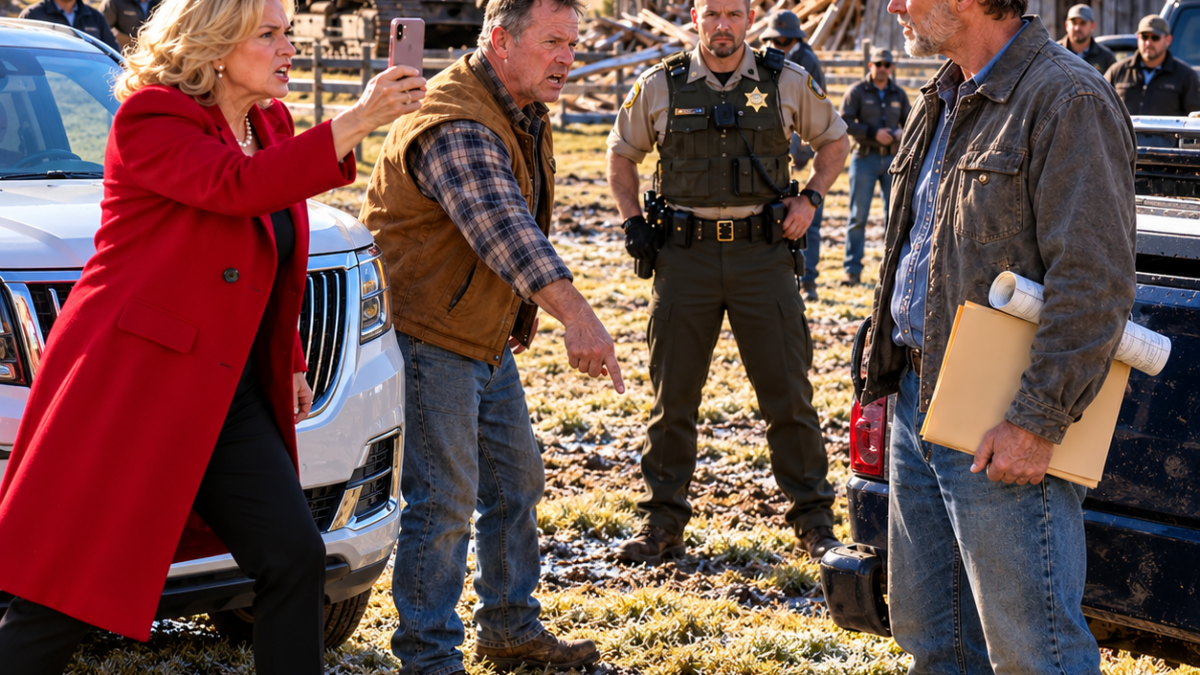
At 6:12 on a freezing Colorado morning, RCA Chairwoman Karen Prescott stood beside her pearl-white SUV in a bright red coat while her husband drove a yellow bulldozer through the cedar barn my grandfather had built by hand thirty years earlier.
They thought the fake easement they had recorded against my ranch, the counterfeit demolition notice they taped to my door, and a $740,000 emergency-road contract would all become irreversible facts before our 9:00 a.m. court hearing.
What they did not know was that three cloud-connected trail cameras had already recorded the broken gate, the bulldozer crossing 182 feet onto my land, Karen filming the destruction, Russell bragging about the “community corridor,” and the exact moment he reached for my phone while the real county deputies were already on their way.
My name is Mason Roark.
Every time I walked into the barn on the north pasture, I smelled my grandfather before I saw anything else.
Split cedar.
Machine oil.
Old hay.
And the faint tobacco smell that had somehow survived years after he quit smoking his pipe.
The barn was not beautiful.
At least not in the way people from North Crest used that word.
No stone veneer.
No designer lights.
No ornamental cupola.
It was thirty years old, weathered silver on the south wall, darker along the shaded side, with a galvanized roof my grandfather had patched so many times that three different shades of metal crossed it.
The east wall leaned maybe half an inch.
One sliding door complained every winter.
There was an old horseshoe nailed above the entry.
And inside, beneath a window facing the pasture, stood the workbench.
My grandfather built that too.
Three-inch timber top.
Scarred from decades of vise marks, drill holes, hammer blows, spilled oil, and one burn mark from the time I dropped a soldering iron when I was thirteen.
Above the bench sat a dented red Folgers coffee can filled with miscellaneous bolts.
I never moved it.
My grandfather, Earl Roark, died the previous spring at eighty-four.
For months afterward I sorted his tools.
Sockets.
Pipe wrenches.
Fencing pliers.
Old Craftsman ratchets.
Two torque wrenches that were older than me.
I donated duplicates.
PART2:
Kept things I didn’t need.
And left the Folgers can exactly where he had placed it.
Grief makes fools of efficient people.
Sometimes a rusted bolt becomes sacred because the person who last touched it can’t touch anything again.
Roark Ranch was forty-six acres outside Bellweather, Colorado.
My grandfather bought it in 1989.
Back then, the western edge of town was pasture, scrub oak, and gravel roads.
North Crest didn’t exist.
Silver Pines didn’t exist.
Neither did the Residential Community Authority that would one day decide the quickest way to solve a road problem was to forge my signature.
My grandfather’s 1989 warranty deed was uncomplicated.
Forty-six acres.
Metes and bounds.
No RCA declaration.
No HOA covenant.
No access easement benefiting the neighboring subdivision.
No thirty-foot road corridor.
Nothing.
His rule was simple.
“If somebody says they own part of your dirt, make them show you where you signed it away.”
I heard that sentence more times than I wanted as a teenager.
Turns out old men repeat themselves because young men eventually need the words.
The northern barn sat 182 feet inside my surveyed boundary.
Not near it.
PART3:
Not straddling some ambiguous line.
One hundred eighty-two feet.
Behind it was my equipment yard.
Tractor.
Stock trailer.
Hay.
Fuel shed.
Room to swing a twenty-four-foot livestock trailer without backing blind toward the county road.
The neighboring development was upscale.
North Crest was the proposed expansion of an already expensive subdivision called Aspen Ridge.
The homes were the kind with stone entrances, heated three-car garages, and neighborhood newsletters that used phrases like “architectural harmony.”
I had no problem with the houses.
I had a problem with people who confused proximity with ownership.
The trouble started when the county fire authority reviewed plans for thirty-two new homes.
The existing neighborhood entrance curved down a steep grade.
One way in.
One way out.
The fire marshal required a secondary emergency-access route before certificates of occupancy could be issued for the new section.
Reasonable.
Wildfire country.
Winter ice.
Emergency vehicles need options.
The developer had two choices.
Build the road entirely on land they already owned.
Or convince me to grant a permanent corridor across Roark Ranch.
Their internal option involved blasting through a rock shelf and constructing a retaining wall.
Expensive.
My pasture was flat.
Convenient.
And apparently, in their minds, negotiable until I stopped saying no.
Karen Prescott came to my gate first.
RCA board chairwoman.
Late forties.
Perfect blond hair.
Pearl earrings.
Silver clipboard.
Pearl-white luxury SUV.
Her husband Russell stood beside her.
Russell owned Prescott Civil and Grading.
That mattered.
A lot.
He unfolded a plan across the hood of Karen’s SUV.
“There.”
He traced a black line.
Thirty-foot corridor.
From county road.
Across my north pasture.
Past the barn.
Through the equipment yard.
Then into North Crest.
I stared at it.
“That cuts my ranch in half.”
Karen smiled.
“Not in half.”
“Functionally.”
Russell tapped the plan.
“We’d fence both sides.”
“You’re running a road through my trailer turnaround.”
“We can redesign your turnaround.”
“My turnaround isn’t yours to redesign.”
Karen shifted her clipboard.
“This is about community cooperation, Mason.”
“My ranch isn’t in your community.”
“We’re offering eighty-five thousand dollars.”
“No.”
She blinked.
Just once.
Russell looked at me like I’d skipped a negotiating step.
“You haven’t heard terms.”
“I heard permanent easement.”
“Yes.”
“No.”
Karen’s smile cooled.
“Your grandfather would have understood this is about public safety.”
That annoyed me more than the offer.
“You didn’t know my grandfather.”
“No, but—”
“Then don’t use him.”
Russell rolled plan up.
“Think about it.”
“I did.”
“Eighty-five thousand is fair.”
“It doesn’t matter.”
Karen said:
“Everything has a number.”
“Not this.”
One week later:
One hundred ten thousand.
No.
Then one hundred forty thousand.
No.
After that, their tone changed.
A notice arrived citing grass-height rules.
My north pasture allegedly violated RCA landscape standards.
I mailed back a certified copy of the 1989 deed and one sentence:
ROARK RANCH IS NOT SUBJECT TO YOUR DECLARATION.
Three days later:
Violation for galvanized roof.
Same response.
Then:
Commercial vehicle restriction because my F-250 sat outside.
Same response.
I kept every certified receipt.
Every envelope.
Every notice.
My grandfather taught me taxes.
My job taught me evidence.
I should explain that part.
I had spent seventeen years with the United States Marshals Service.
Fugitive investigations.
Federal warrants.
Joint task forces.
Transport.
Long hours in bad neighborhoods, rural roads, motels, parking lots, and occasionally someone’s kitchen while they explained why the person we were looking for absolutely wasn’t in the bedroom we could hear moving around in.
I was not a lawyer.
Not a land-use expert.
But I knew documentation.
Dates.
Chain of custody.
Photographs.
Originals.
Copies.
Who said what.
When.
And the difference between suspicion and something you could prove.
I also knew there was one thing bullies hated more than resistance.
A clean record.
Karen came to my fence after the fourth returned notice.
She didn’t get out of Lexus immediately.
She lowered window.
“Mason.”
I walked over.
“You keep sending these back.”
“They aren’t applicable.”
“You don’t understand how this community works.”
“I understand how recorded covenants work.”
Her jaw tightened.
“You may discover county records aren’t as simple as you think.”
That was an odd sentence.
It stayed with me.
That night I walked north pasture with flashlight.
Cold.
Moon behind clouds.
My beam crossed two orange stakes.
Fresh.
Twenty-three feet inside my boundary.
Then another.
Line pointed directly toward barn.
I photographed each stake.
Pulled none until I had measured.
Next morning I called Owen Maddox.
Licensed surveyor.
Twenty years in Bellweather County.
Owen had surveyed ranch after my father died and again when I inherited.
He came with GPS equipment and old plats.
Spent two days finding original 1989 iron monuments.
Blue flags went in.
Then he called me over.
“Mason.”
“What?”
He pointed at orange stakes.
“They aren’t close.”
“How far?”
“Twenty-one to twenty-five feet inside your parcel.”
“Survey error?”
“No.”
“Could somebody have used wrong map?”
He looked at me.
“For six hundred feet?”
Silence.
“No.”
He handed me signed exhibit.
“Their line isn’t accidental.”
I hired Dana Whitaker that afternoon.
Property attorney.
Mid-forties.
Fast thinker.
Zero tolerance for people who called fraud “a misunderstanding.”
I brought:
Deed.
Certified letters.
RCA notices.
Survey.
Orange-stake photographs.
She spread everything across conference table.
Then searched county recorder’s public index.
Parcel number.
Owner name.
Roark Ranch.
Her expression changed.
“What?”
She turned monitor.
A document had been recorded eleven days earlier.
TEMPORARY EMERGENCY ACCESS EASEMENT.
Grantor:
Mason Roark.
Grantee:
Aspen Ridge Residential Community Authority.
Thirty-foot construction and emergency corridor.
North pasture.
Through barnyard.
My stomach dropped.
At bottom:
My signature.
Almost.
I leaned closer.
“That isn’t mine.”
Dana zoomed.
“Look at the R.”
I did.
“What?”
“Final stroke.”
My normal signature had an upward hook.
This one ended flat.
She opened scan of green certified-mail return receipt from one of my earlier responses.
Put them side by side.
Exact pressure shape.
Exact slight wobble.
Same compression artifact.
She whispered:
“Oh.”
“What?”
“They didn’t imitate your signature.”
She pointed.
“They lifted it.”
“From the certified card?”
“Looks like it.”
Someone had digitally copied my signature from proof that I sent Karen my deed and pasted it onto an easement claiming I granted land.
The irony almost made me laugh.
Then Dana looked at notary block.
APRIL VOSS.
I knew name.
Not personally.
Prescott Civil and Grading accounting clerk.
Russell’s company.
Dana sat back.
“This just became bigger.”
“How much bigger?”
“Forgery allegations.”
“Fraudulent recording.”
“Possible notary misconduct.”
“Trespass if they act on it.”
“Civil liability.”
“We need sheriff.”
I called Sheriff Celia Hartwell.
I knew her professionally.
Not socially.
Important distinction.
I did not call as a Deputy Marshal asking favor.
I called as a landowner reporting suspected forged instrument.
Celia listened.
Asked for copy.
Then said:
“Do not touch original electronic records.”
“Understood.”
“Do not confront notary.”
“Wasn’t planning to.”
“Get cameras.”
“I have two old trail cams.”
“Get better ones.”
So I did.
Three high-definition cellular trail cameras.
Cloud upload.
Timestamp synchronization.
One aimed at north gate.
One at barn.
One at equipment yard.
Separate power.
Separate cloud account.
If somebody smashed camera, footage would already be uploaded.
Dana filed civil complaint to void easement.
Emergency request for temporary restraining order.
Hearing set Friday, 9:00 a.m.
That should have slowed reasonable people.
Instead it accelerated Karen.
Thursday afternoon I found red laminated notice taped to barn.
UNSAFE STRUCTURE
DEMOLITION AUTHORIZED IN 72 HOURS.
Permit number.
Bellweather County seal.
Official-looking.
Except I knew nobody had inspected barn.
Dana called county building administrator while I stood beneath notice.
He searched permit.
Then went quiet.
“That number isn’t yours.”
“What is it?”
“Fire-damaged detached garage on Oak Creek Road.”
“Twelve miles away?”
“Yes.”
“So this notice?”
“Not county-issued.”
“Can you put that in writing?”
“Absolutely.”
Email arrived 4:15 p.m.
No inspection of Roark Ranch.
No demolition order.
Permit number unrelated.
Dana forwarded to RCA counsel.
At 6:30 p.m., RCA counsel emailed:
Our office did not prepare or authorize this notice. We have advised RCA to take no action pending Friday hearing.
That should have ended night.
At 8:14 my phone rang from blocked number.
“Mr. Roark?”
“Yes.”
“Trevor Hale.”
I recognized name.
Foreman for Prescott Civil.
“What can I do for you?”
He spoke quietly.
“I quit tonight.”
“Okay.”
“Russell told me to stage D6 at your north gate before sunrise.”
My whole body went still.
“Why?”
“He says easement becomes enforceable once corridor is physically established.”
“That isn’t how easements work.”
“I know.”
He continued.
“I checked demolition permit after guys started asking.”
“Fake.”
“Yes.”
“I refused.”
“What did Russell say?”
“That he’d drive machine himself.”
“When?”
“Before hearing.”
“How early?”
“Five-thirty staging.”
I looked toward clock.
“Why are you telling me?”
Long pause.
“Because my name’s on job logs.”
“And?”
“And I don’t want to explain to a judge why I bulldozed a man’s barn on a fake permit.”
Fair.
I said:
“Thank you.”
“Don’t tell Russell I called.”
“I won’t unless subpoenaed.”
He laughed nervously.
“That’s not comforting.”
“It shouldn’t be.”
I called Dana.
Then Sheriff Hartwell.
Celia said:
“Do not sit outside waiting for them.”
“I wasn’t planning to.”
“Stay safe.”
“Cameras are live.”
“Call 911 if entry occurs.”
“Understood.”
Then she said:
“And Mason?”
“Yes?”
“You are not working.”
“I know.”
“No badge.”
“I know.”
“This is a local property matter.”
“I know.”
She paused.
“Good.”
That distinction mattered to me too.
My federal credentials were not a weapon in a land dispute.
I wasn’t going to arrest anyone over barn.
I wasn’t going to threaten anyone with federal authority.
I was Mason Roark.
Property owner.
Nothing more.
At 5:41 Friday morning, I was awake.
Coffee.
Coat.
Boots.
Laptop.
Camera feeds.
Freezing fog sat low over north pasture.
6:03.
Headlights on county road.
Camera One.
White SUV.
Then yellow machine on trailer.
Prescott Civil truck.
6:07.
Russell unloaded D6.
No county vehicle.
No sheriff.
No building inspector.
No fire authority.
Karen in bright red coat stood beside Lexus filming.
6:10.
Russell drove toward gate.
Stopped.
Got down.
Looked at chain.
Karen said something camera mic barely caught.
“Just do it.”
Russell climbed back.
Bulldozer blade nudged gate.
Chain snapped.
6:12.
D6 crossed boundary.
Camera timestamp.
Then barn.
I called 911.
“My name is Mason Roark.”
“What’s happening?”
“Bulldozer has entered my private ranch and is demolishing a structure.”
“Any weapons?”
“Construction equipment.”
“Are you in danger?”
“I am inside my residence.”
“Stay away from operator.”
“I will.”
“Deputies responding.”
I drove my F-250 to north pasture by internal ranch road.
Not county entrance.
Stopped twenty yards from barn.
Too late for east wall.
D6 blade had already punched through cedar.
Roof screamed.
Corrugated metal folded.
Hay spilled.
One corner collapsed.
My grandfather’s workbench stood behind splintered studs.
For one second I forgot cameras.
Court.
Everything.
I saw him.
Not literally.
Memory.
His hands around wrench.
His voice:
Don’t reef on it, Mason. If a bolt won’t move, figure out why.
The anger hit so hard my vision narrowed.
I wanted to drag Russell out of machine.
Instead I remembered why I had spent seventeen years doing a job where losing temper gets people hurt.
I recorded.
Karen stood near road.
Red coat.
Phone raised.
Smiling.
Recording too.
Russell killed engine.
Jumped down.
Picked red fake demolition notice from dashboard.
Walked toward me.
Tossed it into mud by boots.
“You had seventy-two hours.”
I looked at paper.
“You printed that yesterday.”
“You chose not to cooperate.”
“It’s fake.”
His face hardened.
“Official order.”
“No.”
“Your barn was in corridor.”
“No.”
Karen approached.
“The community access corridor supersedes your obstruction.”
I kept my phone chest level.
Recording.
“Say that again.”
She smiled.
“The barn was inside community access corridor.”
“You believe easement is valid?”
“It was recorded.”
“Did I sign it?”
“You granted it.”
“Did I sign it?”
Her smile tightened.
“You’re trying to create a technicality.”
I almost laughed.
Russell stepped closer.
“You need to put phone away.”
“No.”
He reached for it.
My hand went inside coat.
Not for gun.
For credentials wallet.
I flipped it open low.
Silver star caught morning light.
Russell froze.
Six inches from phone.
Karen’s smile disappeared.
I said clearly:
“Read the leather carefully, Russell.”
He did.
“I am off duty.”
Silence.
“I am not placing you under federal arrest.”
I kept voice calm for camera.
“I am not exercising federal authority over this dispute.”
His hand withdrew slightly.
“I am displaying credentials because you are reaching for my property and I do not want this interaction to become physical.”
Russell swallowed.
Karen lifted phone.
“I have this!”
“Good.”
“You’re intimidating a contractor with a badge.”
“No.”
I closed wallet.
Put it away.
“Keep filming.”
Her eyes narrowed.
“Make sure your video shows blue survey flags behind you.”
I pointed.
“Broken chain.”
“The fake notice in mud.”
“Bulldozer 182 feet inside my property.”
“And your husband telling me corridor supersedes my barn.”
Russell shouted:
“That order is valid!”
“It uses permit number from burned garage twelve miles away.”
His face changed.
“The county administrator confirmed it yesterday.”
Karen said:
“You’re lying.”
“Your attorney received email.”
Silence.
“Your attorney withdrew support for demolition last night.”
That landed.
Russell looked at Karen.
Not me.
Interesting.
Then headlights came through fog.
Sheriff SUVs.
Two.
Deputies approached.
Hands visible.
Professional.
Russell started:
“Officer, this man—”
Deputy held hand.
“Turn off equipment.”
“It is off.”
“Keys.”
Russell hesitated.
“Keys.”
He handed them.
Deputy asked me:
“Mr. Roark?”
“Yes.”
“Anyone injured?”
“No.”
“Any weapons involved?”
“No.”
“Did you authorize entry?”
“No.”
“Did you authorize demolition?”
“No.”
Second deputy photographed chain.
Gate.
Blue survey flags.
Barn.
Bulldozer tracks.
Karen tried explaining.
“We are acting under recorded emergency easement.”
I handed deputy copy of filed lawsuit challenging instrument.
Certified survey.
County email on fake demolition permit.
RCA counsel email.
He read enough.
Then said:
“Everyone stays separated.”
No cinematic handcuffs.
No shouting.
No federal takeover.
Local deputies did their job.
Exactly as they should.
At 7:05 Dana arrived.
Still in courtroom suit beneath winter coat.
She looked at barn.
Stopped.
“Mason.”
“I know.”
“Workbench?”
I looked.
“Still standing.”
Barely.
She turned toward Karen.
Karen said:
“You’re trespassing on RCA emergency corridor.”
Dana actually smiled.
“Mrs. Prescott.”
“What?”
“You destroyed disputed property less than three hours before a judge was scheduled to decide whether your easement exists.”
Karen lifted chin.
“Recorded instrument speaks for itself.”
Dana’s smile vanished.
“Yes.”
“So does forgery.”
For first time, Karen went pale.
At 7:22, Sheriff Hartwell arrived herself.
Not because I was federal officer.
Because alleged fraudulent easement plus active demolition had escalated.
She reviewed scene.
Asked deputies what they had.
Then asked Russell:
“Who prepared demolition notice?”
“Our office.”
“Which office?”
“Prescott Civil.”
“County didn’t issue it?”
Russell looked at Karen.
Celia said:
“Don’t look at your wife.”
Silence.
“Who created notice?”
“I don’t know.”
“Permit number?”
“Administrative staff.”
“Which staff?”
No answer.
Then:
“Who authorized bulldozer entry?”
Karen stepped in.
“The RCA board.”
Celia:
“Provide resolution.”
Karen held up phone.
“I don’t have it here.”
Dana said:
“We subpoenaed board minutes yesterday.”
Karen glared.
The barn creaked behind us.
One rafter dropped.
I flinched.
Sheriff looked at damage.
Then said to deputies:
“Photograph before anyone moves anything.”
At 8:05, we left for courthouse.
I didn’t want to.
I wanted to stay with barn.
Dana said:
“Mason, the hearing matters more now.”
She was right.
The courthouse was fifteen minutes away.
At 8:57 we entered.
Karen arrived with separate attorney.
Not original RCA counsel.
New one.
Russell with another.
At 9:03 judge entered.
Judge Elaine Porter.
Fifties.
No patience.
Our emergency TRO had been based on forged easement and imminent demolition.
Now demolition had already occurred.
Dana opened:
“Your Honor, circumstances changed at 6:12 this morning.”
She placed still image on screen.
Bulldozer through barn.
Timestamp.
Judge stared.
“When was this recorded?”
“Today.”
“Whose bulldozer?”
“Prescott Civil and Grading, owned by respondent Russell Prescott.”
“Who is woman?”
“RCA Chairwoman Karen Prescott.”
Judge looked over glasses at Karen.
“Today?”
“Yes, Your Honor.”
“Before this hearing?”
“Yes.”
Judge leaned back.
“Counsel?”
Karen’s attorney stood.
“Your Honor, my client acted pursuant to recorded emergency easement and community-safety obligations.”
Judge:
“Was demolition permit valid?”
Pause.
“We are investigating administrative discrepancy.”
Dana handed county letter.
“No discrepancy.”
Judge read.
Her expression hardened.
“Permit number belongs to another structure?”
“Yes.”
Judge looked at Karen’s counsel.
“Did you know?”
“I learned this morning.”
Karen whispered to attorney.
Judge noticed.
“Mrs. Prescott will have opportunity later.”
Then Dana showed easement.
Signature comparison.
Certified-mail card.
Survey.
Original 1989 deed.
Owen’s signed exhibit.
Judge asked:
“Mr. Roark denies signing?”
“Yes.”
“Notary?”
“Employee of Mr. Prescott’s company.”
Karen’s attorney stood.
“Notary verification has not been conclusively disproven.”
Dana said:
“We have certified-mail image showing source signature from which digital copy appears to have been taken.”
Judge leaned forward.
“Appears?”
“We have retained forensic document examiner.”
“Report?”
“Preliminary affidavit filed at 7:40 this morning.”
Dana handed it.
Examiner found pixel-level duplication artifacts inconsistent with wet signature on recorded instrument.
Judge read.
Then looked at respondents.
“Why was easement recorded eleven days ago?”
Karen’s counsel:
“Emergency access needs.”
“Negotiations?”
“Yes.”
“Did Mr. Roark refuse?”
“Yes.”
“Repeatedly?”
“Yes.”
Judge looked at me.
“How many offers?”
“Three.”
“Highest?”
“One hundred forty thousand.”
“And then document appeared?”
“Yes.”
Silence.
Judge’s face said everything.
Then Dana introduced camera footage.
Not all.
Enough.
Gate.
Chain.
Entry.
Barn demolition.
Karen’s statement:
“The barn was sitting inside a community access corridor. It was coming down with or without your permission.”
Judge paused playback.
“Did Mrs. Prescott know hearing was at nine?”
Dana played Trevor Hale sworn declaration.
Russell told crew he intended to establish corridor before judge sees map.
Karen’s attorney objected to hearsay details.
Judge reserved.
But damage already visible.
She issued temporary restraining order immediately.
No further entry onto Roark Ranch.
No road construction.
No reliance on disputed easement.
No alteration of boundary.
Preserve all project records.
Preserve electronic communications.
Preserve notary logs.
Then she added:
“Given destruction this morning, I am also ordering no removal, repair, or alteration of damaged barn area except measures necessary for immediate safety and weather protection until parties document condition.”
I wanted to repair workbench.
Couldn’t yet.
But understood.
Evidence.
At 10:18, hearing ended.
At 10:23, Dana’s phone started ringing.
First call:
County development office.
They had learned emergency-access corridor was enjoined.
North Crest occupancy approval could not proceed without lawful second route.
Second call:
Developer.
Not RCA.
Actual developer financing thirty-two homes.
Their general counsel wanted to know why a forged easement appeared in project file.
Third:
Bank.
Construction lender.
Road-access condition was part of draw schedule.
Fourth:
Prescott Civil insurer.
They wanted incident report.
By noon, the $740,000 emergency-road contract was frozen.
That’s number Karen cared about.
Seven hundred forty thousand dollars.
Prescott Civil had been awarded road construction and retaining package contingent on access corridor.
Her husband’s company.
Approved while she chaired RCA.
Another problem.
The project was not simply about “community safety.”
It was profitable.
Russell’s company stood to collect $740,000.
The straight route across my pasture avoided expensive blasting and retaining wall.
Alternative route on land they owned had been estimated closer to $1.6 million.
My refusal wasn’t just inconvenient.
It destroyed margin.
That explained escalation.
It did not excuse it.
By afternoon, development partner issued hold.
No site work.
No payments.
No equipment mobilization.
Preserve documents.
Karen went from triumphant at 6:12 to being removed from North Crest contract calls before dinner.
The barn still hurt more.
I came home after court.
Walked alone into wreckage.
Roof partly collapsed.
East wall gone.
Hay crushed.
One tractor fender bent.
Workbench survived.
A cedar beam had fallen across it but missed center.
The Folgers can was on floor.
Dented worse.
Bolts everywhere.
I picked it up.
Sat on overturned bucket.
For first time that day, I cried.
Not because barn was valuable.
County tax assessment listed structure at maybe thirty-eight thousand.
Insurance could rebuild.
Lumber could be replaced.
But my grandfather had measured those boards.
Driven those nails.
Taught me there.
No settlement restored that.
People say property is just stuff.
Usually people whose stuff isn’t currently broken in mud.
Dana called.
I almost didn’t answer.
“You okay?”
“No.”
“I figured.”
Silence.
Then:
“Don’t clean yet.”
“I know.”
“Structural engineer tomorrow.”
“I know.”
“Mason.”
“What?”
“You’re allowed to be angry.”
“I am.”
“Good.”
“Just don’t call anyone.”
“I wasn’t planning to.”
“Also good.”
Next morning, investigators returned.
Sheriff.
County building official.
Insurance adjuster.
Structural engineer.
Forensic document examiner.
Owen surveyor.
We documented every inch.
Bulldozer track marks crossed blue survey line at exact coordinates.
Broken gate chain.
No public corridor.
No emergency condition.
No county permit.
No signed easement from me.
Camera time synchronized.
Russell’s D6 GPS telemetry later showed path.
Prescott Civil used fleet tracking.
I almost admired irony.
Their own commercial system placed machine on my property at 6:09 and engine load spike at 6:12.
You could not invent cleaner data.
Then board records arrived.
RCA emergency meeting supposedly approving corridor.
Minutes vague.
Motion:
Proceed with necessary emergency access preparation consistent with legal rights.
No vote authorizing demolition.
No vote authorizing trespass.
No vote authorizing forged notice.
Several board members said Karen told them easement was “fully executed by Roark.”
One email from board member Henry Sloan:
Has Mason actually signed?
Karen:
Recorder accepted instrument. That is what matters.
That email became central.
Not:
Yes.
He signed.
Instead:
Recorder accepted instrument.
That is what matters.
It was not what mattered.
Recording office records documents.
It does not independently authenticate truth.
Dana said:
“She knew enough not to answer.”
Then notary April Voss hired lawyer.
Smart.
Initially, everyone assumed she had knowingly notarized fraud.
Reality turned out more complicated.
April admitted Russell asked her to notarize a document he claimed Mason had signed remotely and sent electronically.
She did so without me physically appearing.
Already improper.
She said Karen told her “Mason finally came around.”
She never spoke to me.
Never verified identity in person.
Never witnessed signature.
Her notary journal had no proper entry.
Bad.
Maybe criminal.
But she also produced email.
Russell:
Need this stamped today. Board has execution confirmation.
April:
Did Mason appear before another notary?
Russell:
No need. We have his certified signature verification.
There it was.
Certified signature verification.
My green mail card weaponized.
April cooperated.
Her testimony hurt Russell badly.
Forensic examiner confirmed easement signature image matched certified return card at pixel level, including scanning artifacts.
Not similar.
Copied.
Then source document was found on Prescott Civil office computer.
Filename:
ROARK_SIG_FINAL.png
Created two days before easement.
Metadata associated with Russell’s workstation account.
At that point, nobody called it misunderstanding anymore.
Sheriff referred case to district attorney.
Potential charges were for prosecutors, not me.
I stayed out of that decision.
My role was witness and victim.
Not badge.
That boundary became important because Karen’s defense strategy shifted.
She couldn’t erase video.
Couldn’t erase metadata.
So she tried to make me villain.
At RCA town hall, she said I had used federal position to intimidate community volunteers.
Someone leaked video.
Full uncut.
It showed me saying:
“I am off duty. I am not placing you under federal arrest, and I am not exercising federal authority.”
Her argument collapsed almost immediately.
My agency’s internal affairs still reviewed interaction after complaint.
As they should.
They interviewed me.
Reviewed body-worn personal recording.
Camera footage.
Deputies.
No federal enforcement action taken.
Credentials displayed briefly in context of preventing physical confrontation when Russell reached toward me and phone.
Review closed without discipline.
That was relief.
I had been careful because I knew scrutiny would come.
Federal credentials do not make you right in private dispute.
Deed did.
Survey did.
Video did.
Certified receipt did.
County records did.
That became almost funny.
Karen thought badge would be scandal.
Badge turned out least important piece.
The barn was more important.
The forged signature was more important.
The road money was more important.
Then conflict-of-interest documents surfaced.
Karen had voted on contract award to Prescott Civil.
Her husband’s company.
RCA bylaws required disclosure and recusal for direct financial interests.
Minutes showed she disclosed “family familiarity with contractor” but still participated.
Family familiarity.
Her husband owned 92 percent.
The developer assumed RCA had handled internal governance.
They had not.
Prescott Civil’s $740,000 contract contained representation:
Contractor possesses all necessary access rights or shall rely on owner-provided access instruments.
That became fight between Russell and RCA.
Russell said RCA supplied easement.
Karen was RCA chair.
Corporate finger pointing became almost philosophical.
Dana told me:
“Don’t interrupt people while they sue each other.”
Good advice.
North Crest developer terminated Prescott Civil for cause pending investigation.
Not because bulldozer crushed sentimental barn.
Because contract risk became radioactive.
No valid corridor.
Fraud allegations.
Fake permit.
Potential regulatory exposure.
Insurance reservation of rights.
Their $740,000 contract died.
Alternative emergency road had to be built inside development property.
Rock blasting.
Retaining wall.
Costly.
But legal.
The developer sued RCA for delay damages.
RCA sued Prescott Civil.
Prescott Civil counterclaimed.
Homeowners got assessment notices.
Then got angry enough to read minutes.
Karen’s support evaporated.
She had sold them story that I was stubborn rancher blocking safety.
Now they learned:
I had offered no land.
She claimed I did anyway.
Her husband stood to earn $740,000.
Board never had legitimate demolition order.
Barn was destroyed three hours before court.
That timeline was impossible to explain gracefully.
At recall meeting, clubhouse overflowed.
I didn’t attend initially.
Didn’t need spectacle.
Then Henry Sloan called.
“Mason.”
“What?”
“People want to hear from you.”
“Why?”
“Karen keeps saying easement was valid until judge voided it.”
“That isn’t how forgery works.”
“I know.”
“Then tell them.”
“They want landowner.”
I went.
Karen sat at front.
Red coat gone.
Cream suit.
Pearls.
Russell wasn’t there.
Lawyers advised.
Henry gave me microphone.
I kept statement short.
“My ranch is not subject to RCA declaration.”
“The county survey places barn 182 feet inside my boundary.”
“I declined three offers for easement.”
“Eleven days later, an easement bearing copied image of my signature was recorded.”
“A fake demolition notice using unrelated permit number was posted.”
“At 6:12 Friday morning, before our 9:00 hearing, Prescott Civil entered my land and demolished barn.”
“I am not asking RCA residents to take my word for this.”
“Documents are public.”
“Court order is public.”
“Survey is public.”
“County email is public.”
“Video exists.”
Then I handed microphone back.
Karen stood.
“You’ve omitted context.”
I sat.
Henry asked:
“What context makes copied signature valid?”
Karen’s face hardened.
“It wasn’t copied.”
Someone shouted:
“Metadata says it was!”
Another:
“Why did your husband have the PNG?”
The room turned.
Karen tried gavel.
She was not presiding.
Henry said:
“You’re not chairing this meeting.”
That was moment her power ended psychologically before vote.
Recall passed 84 percent.
Karen removed as board chair.
Board referred governance issues to independent counsel.
Russell’s company lost preferred-contractor status.
North Crest expansion delayed eleven months.
Not destroyed.
Homes eventually built.
Emergency road went where it should have gone from beginning.
On land developer owned.
The civil case over my ranch continued.
Judge eventually voided recorded easement.
Order stated no credible evidence I had executed grant.
Forgery findings handled separately through investigation.
County recorder indexed corrective instrument.
Title clean.
That mattered.
False recorded easement can poison property for years.
Lenders.
Sales.
Insurance.
Future heirs.
Dana made sure it was fully cross-referenced.
Then damage case.
Barn.
Equipment.
Gate.
Lost hay.
Cleanup.
Engineering.
Attorney fees where recoverable.
Punitive claims based on conduct.
We mediated.
Prescott Civil insurer initially argued intentional acts excluded.
Of course.
RCA insurer argued association didn’t authorize destruction.
Also of course.
Karen and Russell each blamed organization structure.
Eventually settlement involved multiple parties.
I won’t pretend I received fantasy millions.
I did not.
But enough to rebuild barn properly, replace damaged equipment, restore fencing, cover substantial legal costs, and compensate for property loss.
More importantly, settlement included recorded acknowledgment RCA held no access rights across Roark Ranch and permanent covenant that future road access required separate negotiated instrument.
No ambiguity.
I insisted.
Money spends.
Recorded boundaries last.
The criminal side took longer.
Russell eventually entered plea connected to fraudulent instrument and property damage.
April’s cooperation mattered.
Karen faced separate consequences tied to participation and false documents.
No dramatic long prison terms.
Probation.
Restitution components.
Community service.
Professional fallout.
What destroyed them most was not jail.
Reputation.
Contracting relationships.
Insurance.
Licensing scrutiny.
Nobody wants grading contractor whose name is attached to fake demolition order before court hearing.
Prescott Civil shrank rapidly.
Then dissolved.
Karen sold Lexus first.
I only know because one neighbor sent me photo.
I didn’t ask.
Then house went on market.
She and Russell moved.
Not far enough for some residents.
Far enough for me.
The barn rebuild became complicated emotionally.
Contractor asked:
“Replica?”
I said:
“No.”
“New?”
“Mostly.”
I didn’t want fake old barn pretending nothing happened.
We salvaged what we could.
Cedar beams.
North wall.
Workbench.
Horseshoe.
Folgers can.
One section of roof tin.
New barn uses old footprint.
Same dimensions.
Stronger framing.
Better foundation.
Fire-resistant siding where practical.
Galvanized roof.
Still.
Because grandfather would’ve laughed if RCA got that too.
Workbench went back under north window.
Not refinished.
I left scars.
One new gouge from collapse.
It’s history now.
Folgers can returned shelf.
I found most bolts in mud.
Not all.
Fine.
First morning rebuilt barn was finished, I made coffee.
Walked inside alone.
Smelled new lumber.
Wrong smell.
Too clean.
I sat on stool.
Touched bench.
For a while I hated new building because it wasn’t his.
Then remembered something.
Grandfather once replaced whole south wall after windstorm.
I had complained boards looked different.
He said:
“A barn’s supposed to keep working, not stay old for your feelings.”
He would’ve said same now.
So I used barn.
That’s how you honor workspaces.
Not shrine.
Use.
I fixed a hydraulic hose at bench.
Put wrench back in drawer.
Spilled coffee.
Better.
By spring, it started smelling right.
Hay.
Oil.
Dirt.
Time.
North Crest eventually built.
Thirty-two homes.
Secondary road through their own land.
Developer blasted rock.
Built retaining wall.
Cost more.
Too bad.
Safety requirement met legally.
One morning I drove past entrance.
Fire truck practicing route.
Wide.
Safe.
No ranch involved.
Proof alternatives existed all along.
They had simply preferred cheaper theft.
That’s what angered me most.
Not desperation.
Convenience.
They weren’t landlocked.
Weren’t saving lives that morning.
They wanted to avoid cost.
Karen wrapped economics in “community safety.”
People do that.
Moral language can make greed sound civic.
The cameras are still on ranch.
Upgraded now.
Cloud subscription every month.
Worth it.
Camera Three—the barn camera—became evidence star.
It caught bulldozer crossing.
Karen filming.
Russell’s statements.
Fake notice.
His reach for phone.
My badge disclaimer.
Deputies arriving.
Every second.
One afternoon Sheriff Hartwell visited rebuilt barn.
She looked at camera under eave.
“That thing cost what?”
“Four hundred.”
“Saved you?”
“Maybe half million in arguments.”
She laughed.
“Good return.”
I showed her workbench.
She ran hand over cedar.
“Your grandfather?”
“Yeah.”
“Glad it made it.”
“Me too.”
Then she looked at me.
“You did something right that morning.”
“What?”
“You didn’t fight him.”
“I thought about it.”
“I know.”
“You don’t know.”
“Mason.”
Fair.
She continued.
“If you’d thrown punch, story becomes two men fighting near bulldozer.”
“Instead story is machine entering private property while owner documents.”
Evidence likes calm.
Not because calm is morally superior.
Because chaos creates ambiguity.
I teach younger deputies something similar.
Not this exact case.
But principle.
Don’t contaminate facts with ego.
When somebody is wrong, don’t help them manufacture shared blame.
Let evidence breathe.
Karen could not handle that.
Every time I refused shouting, she escalated.
Every time I mailed deed, she invented new paper.
Every time I said no, she treated it as challenge to authority.
She believed persistence created rights.
It doesn’t.
A no remains no even if you ask with better letterhead.
RCA changed afterward.
New board president Henry Sloan.
Governance audit.
Conflict policy.
Independent legal review for easements.
No contractor affiliated with board member without full disclosure and recusal.
No enforcement on parcels outside recorded declaration.
No demolition actions without verified county authority.
Basic adulthood.
Again, rules often arrive after someone demonstrates their absence.
Henry asked me to serve on land-use committee.
I laughed.
“No.”
“You’d be good.”
“No.”
“You understand boundaries.”
“Exactly why I’m saying no.”
He laughed.
We became friends anyway.
Karen’s old orange stakes stayed in my shop.
Two pieces.
I wrote dates on them.
Not trophy.
Reminder.
Trespass rarely starts with bulldozer.
It starts with small assumptions.
Stake twenty-three feet over line.
Letter that shouldn’t apply.
Notice on barn.
Copied signature.
Each step tests whether you’ll notice.
If you ignore one, next gets larger.
My grandfather’s fence-post rule finally made sense.
Never let bully move fence post inch past survey marker.
Not because inch matters by itself.
Because unchecked inch becomes road.
I occasionally wonder what would’ve happened if I had accepted $140,000.
Simpler maybe.
No destroyed barn.
No lawsuits.
No cameras.
But ranch would’ve been permanently divided.
Stock trailer problem.
Traffic.
Emergency vehicles.
Maintenance.
Future expansion pressure.
An easement is forever in ways money isn’t.
Grandfather knew that too.
“Never sell tomorrow for a check you like today.”
Another sentence I used to roll eyes at.
Old men are irritatingly patient teachers.
Russell’s bulldozer remains in one photograph on my wall.
Not framed fancy.
Just print beside survey.
Yellow machine halfway through cedar.
Timestamp 06:12:14.
Under it I taped certified-mail green receipt.
The one my signature was stolen from.
Dana saw display.
“That’s dark.”
“It reminds me.”
“Of?”
“Never send Karen certified mail?”
She laughed.
“No.”
I pointed.
“Evidence cuts both ways.”
That receipt was meant to prove she got my deed.
She used signature to fabricate easement.
Then same receipt helped prove source of forgery.
Document abused.
Document vindicated.
Paper is patient.
My grandfather said similar.
People ask why $740,000 contract “collapsed” if contract was between RCA and Prescott Civil.
Because access was foundational.
Without legal corridor, work couldn’t proceed.
Then once forgery and conflict issues emerged, developer and insurer refused performance.
Contract depended on something that didn’t exist.
Trail cameras didn’t magically cancel agreement.
They destroyed factual premise supporting it.
That’s more accurate.
Video proved entry and demolition before hearing.
Metadata proved signature copying.
Survey proved location.
Deed proved ownership.
Certified letters proved notice.
County email proved demolition order fake.
Trevor’s call and declaration proved urgency before court.
No single piece won.
Case was stack.
Bullies love isolated arguments.
They hate stacks.
A few years have passed.
Roark Ranch still forty-six acres.
North pasture repaired.
Grass grew over bulldozer tracks.
Gate chain replaced.
I installed heavier steel gate.
Not because afraid.
Because old one was bent.
Blue survey flags long gone.
Iron monuments still there.
Every winter I walk line.
Not obsessive.
Okay, maybe a little.
Barn stands.
New cedar weathering.
Workbench inside.
Folgers can.
One day my nephew, twelve, visited.
He picked up old wrench.
“Why’s this one so beat up?”
“Grandpa Earl’s.”
“Can I use it?”
My first instinct:
No.
Sacred.
Then I heard grandfather in head.
Tools are made to work.
I handed it.
“Right size?”
He checked bolt.
“Yes.”
“Then use it.”
He tightened hinge.
Too hard.
I stopped him.
“Don’t reef on it.”
He looked confused.
“If a bolt won’t move, figure out why.”
There.
The sentence survived too.
Maybe that’s legacy.
Not barn.
Not bench.
Instructions passed to next kid.
Karen crushed walls.
Could not crush that.
I no longer think about her often.
That’s another kind of victory.
For first year, every white Lexus raised pulse.
Every certified letter annoyed me.
Every bulldozer sound pulled me back.
Eventually faded.
Trauma doesn’t have to be battlefield-sized to linger.
Watching family structure destroyed while someone smiles and records affects you.
I talked to therapist.
Yes, federal fugitive investigator went to therapy over barn.
No shame.
Loss is loss.
Anger is physical.
You either process it or let it drive.
I had seen what happens when men let grievance become identity.
Didn’t want it.
Therapist asked:
“What did barn represent?”
I said:
“My grandfather.”
She said:
“No.”
I got irritated.
Then she said:
“Your grandfather died before barn.”
Obviously.
“So barn wasn’t him.”
I hated that.
Because correct.
She continued:
“It was connection.”
“Yes.”
“Can connection be rebuilt?”
Not barn.
Connection.
I thought about workbench.
Nephew.
Wrench.
Maybe.
That helped.
Court records eventually became public enough that local paper covered story.
Headline was terrible.
FEDERAL MARSHAL’S BARN BATTLE WITH HOA.
It wasn’t HOA.
RCA.
I sent correction.
They ignored.
Reporter’s article focused badge more than deed.
More dramatic.
But residents knew.
The people who mattered knew.
Mason Roark did not win because federal law enforcement.
Mason Roark won because property records.
If I’d been plumber with same deed and same cameras, result should have been same.
I insist on that.
Badges shouldn’t create property rights either.
That was whole point.
No title substitutes for lawful authority.
Not RCA chairwoman.
Not contractor.
Not Deputy Marshal.
Everybody stays in lane.
Karen didn’t.
One summer evening Henry from RCA came by.
We sat on rebuilt barn porch drinking beer.
He looked toward North Crest road on other side ridge.
“Know what that retaining wall cost?”
“I don’t care.”
“Over a million.”
“Good.”
He laughed.
“Still bitter?”
“No.”
“You sound bitter.”
“I sound financially satisfied.”
Then he became serious.
“If Karen had just negotiated differently?”
“No.”
“You wouldn’t sell?”
“No.”
“Ever?”
“Maybe.”
That surprised him.
“What would change?”
“Route.”
“Compensation.”
“Control.”
“Maybe seasonal emergency-only gate, no public traffic.”
“Recorded restrictions.”
“Lots of things.”
He looked confused.
“So issue wasn’t road?”
“Never.”
“What was?”
“Choice.”
That is always core.
Property rights aren’t religion.
Sometimes easements make sense.
Neighbors cooperate.
I let county utility crew cross land occasionally.
I granted telecom trench years ago.
But consent matters.
Karen treated consent as obstacle to engineer around.
Once you do that, cooperation ends.
Henry nodded.
“We could have saved everybody a fortune.”
“Yes.”
“Russell too.”
“Yes.”
“He was making good money already.”
“Greed isn’t only for broke people.”
Henry laughed.
“True.”
The fake easement copy remains in county correction history.
Can’t erase completely.
That’s okay.
Sometimes public record should show scar.
Parcel now has clean notation:
Instrument voided by court order.
No valid emergency-access easement.
Future title examiner will see story.
Maybe ask.
My heirs will know.
I wrote a ranch binder.
My father would’ve loved.
Deed.
Survey.
Court order.
RCA settlement.
Road maps.
Gate photos.
Camera diagrams.
Instructions.
First page:
IF ANYONE CLAIMS ACCESS TO NORTH PASTURE, CALL LAWYER BEFORE YOU CALL THEM.
Dana saw.
“Excellent.”
Then I added:
DO NOT LET THEM BORROW WRENCH.
She rolled eyes.
Humor helps.
The exact moment Karen lost wasn’t 6:12.
Not 9:00.
Not recall.
It happened earlier.
Maybe when she chose to treat certified mail as signature source instead of warning.
Maybe when Russell saved PNG.
Maybe when fake permit copied.
Maybe when Trevor refused.
Maybe when camera uploaded first frame.
Consequences often begin before people notice.
By time bulldozer hit cedar, evidence was already moving.
Cloud server.
County email.
Court docket.
Survey certification.
Dispatch recording.
They thought physical destruction created leverage.
It created liability.
That’s lesson.
Irreversible action can strengthen wrong position only if other side has no remedy.
Here, crushing barn did not create road right.
It created damaged barn.
Their easement remained invalid.
Bulldozer can’t bulldoze title.
Karen believed reality could be made to catch up to paperwork she invented.
If corridor existed physically before judge ruled, maybe court would preserve status quo.
But courts don’t usually reward self-help built on alleged forgery.
Especially not hours before hearing.
She didn’t create status quo.
She created Exhibit A.
Then B.
Then C.
Trail cameras made sure.
At 6:12:14, blade entered wall.
At 6:12:22, Karen’s phone raised.
At 6:13:03, Russell backed and pushed again.
At 6:14:41, fake notice thrown at boots.
At 6:15:10, Karen said corridor language.
At 6:16:02, Russell reached for phone.
At 6:16:11, credentials displayed.
At 6:16:18, disclaimer on audio.
At 6:23:55, sheriff headlights appeared.
Nine minutes.
That was enough to sink three quarters of million dollar contract.
Not because video was cinematic.
Because it answered questions cleanly.
Who entered?
When?
Where?
With what?
After what notices?
Before what hearing?
Evidence is simply chronology that can survive somebody lying about it.
I still work cases.
Different pace now.
Thinking retirement soon.
When I do, Roark Ranch will get more of me than it wants.
Fence repair.
Barn projects.
Cattle maybe.
Not many.
I like quiet.
Sometimes at dawn, fog settles same way it did that morning.
I stand near north gate.
For a second memory overlays pasture.
Yellow D6.
Red coat.
Cedar falling.
Then current world returns.
Grass.
Barn.
Blue mountains.
Fence where it belongs.
That’s healing too.
Place reclaims itself from event.
Karen Prescott wanted a thirty-foot corridor.
In the end she got none.
North Crest got legal road elsewhere.
Prescott Civil lost $740,000 contract.
RCA rewrote rules.
My title got stronger.
Barn got rebuilt.
And old bench remained.
Not perfect justice.
But enough.
If grandfather could see it, he would probably complain I overpaid for cameras.
Then ask resolution.
Then be impressed.
Then tell me barn roof flashing is wrong.
That’s him.
I miss it.
I keep one broken cedar board from original wall mounted above workbench.
Not polished.
Still bulldozer scrape.
Small brass plate beneath it:
6:12 A.M.
NO EASEMENT.
My nephew thinks it’s funny.
Dana calls it petty.
I call it accurate.
Because after everything, that was entire case.
No easement.
Not after four violation letters.
Not after forged filing.
Not after fake county notice.
Not after bulldozer.
Not after Karen filmed herself.
Not after $740,000 contract.
Not after board voted.
Not after physical road stakes appeared.
None of those things created right that I never granted.
Powerful people often assume momentum is authority.
If they move fast enough, spend enough, build enough, pressure enough, other person will eventually surrender because undoing it feels impossible.
Sometimes that works.
That’s why documentation matters before first machine arrives.
Survey.
Deed.
Certified mail.
Photos.
Cloud cameras.
A lawyer who answers phone.
And enough patience not to give other side the confrontation they’re hoping for.
My grandfather taught me to take care of tools.
Pay taxes.
And never let bully move fence post past survey marker.
For years, I thought last part was rancher’s stubbornness.
Now I understand.
A fence post is never only fence post when somebody is testing whether your no means no.
Karen moved hers twenty-three feet.
Then tried to turn that lie into thirty-foot road.
Then thirty-two homes.
Then $740,000 contract.
Then bulldozer.
I kept original line.
That is why the road runs somewhere else today.
And every morning when I unlock rebuilt barn, I pass the workbench where grandfather taught me how to fix almost anything with patience and right wrench.
He never taught me how to fix forged easement.
Turns out answer wasn’t wrench.
It was blue survey flags, certified mail, three trail cameras, and letting arrogant people keep talking until their own words became evidence.

