RCA Karen Built 40 Boat Slips on My Private Lake—Then Her $1.8 Million Marina Opened on Cracked Mud
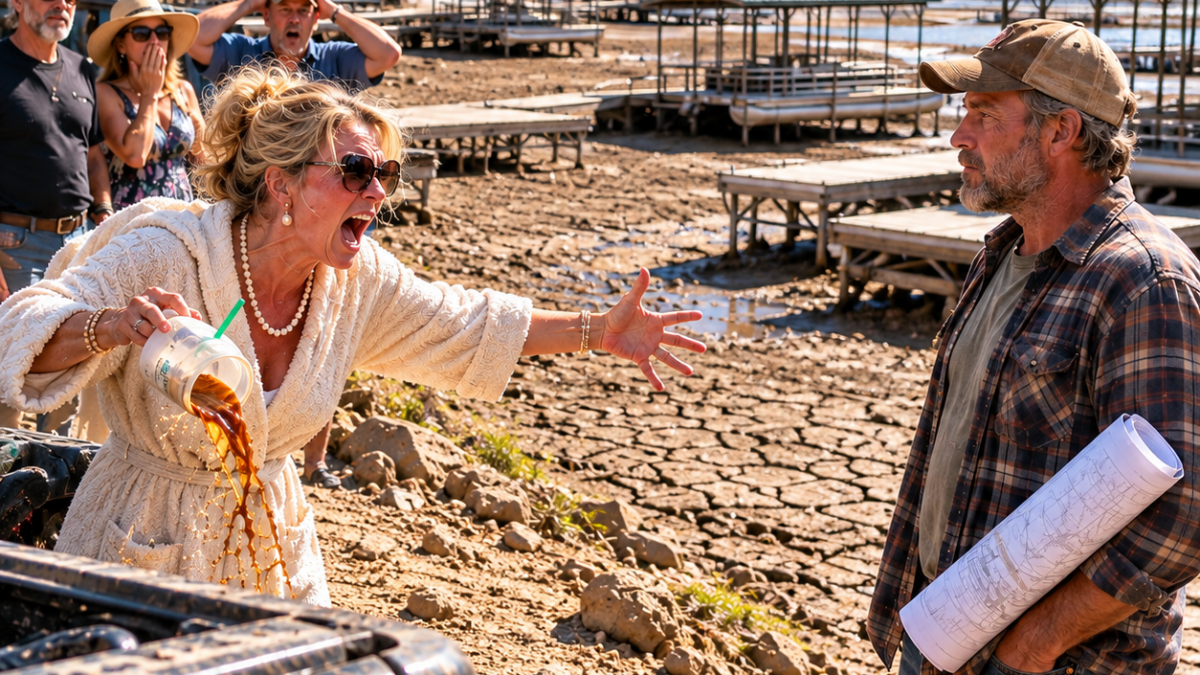
RCA Karen Built 40 Boat Slips on My Private Lake—Then Her $1.8 Million Marina Opened on Cracked Mud.
The RCA board chairwoman secretly drove forty polished boat slips into the bed of my family’s private 85-acre reservoir, sold “exclusive marina memberships” for $45,000 each, and announced a champagne grand opening before she had ever bothered to ask who actually owned the water beneath them.
When I showed her my 1967 deed, she laughed, handed me an RCA notice on my own shoreline, and told me the community had voted to “take control of a shared natural resource.”
What Karen Whitmore didn’t know was that Blackwood Lake was not a decorative neighborhood pond—it was a regulated engineered reservoir, and a state-mandated maintenance drawdown was scheduled to begin ten days before her grand opening.
My name is Daniel Mercer.
The first thing I noticed when I came home that Tuesday was the concrete truck.
The second was the row of docks.
Forty of them.
I had been gone four days on a business trip to Dallas.
I turned down the dirt access road leading to Blackwood Lake expecting to see exactly what I had seen most of my life.
Water.
Mesquite.
The old pump house.
My father’s maintenance shed.
Maybe a heron standing near the south inlet.
Instead I saw heavy equipment crawling along my eastern shoreline.
A skid steer.
Two pile drivers.
Three utility trucks.
A concrete mixer.
Men in reflective vests.
And forty brand-new cedar-and-steel boat slips extending into my lake in perfect rows.
I hit the brakes hard enough that gravel exploded around my truck.
For a few seconds, I just sat there.
Hands on steering wheel.
Engine running.
Trying to make my brain accept what my eyes were reporting.
Blackwood Lake had belonged to my family since 1967.
Not shoreline access.
Not a fractional interest.
Not a recreation easement.
The entire reservoir.
Lakebed.
Dam.
Spillway.
Access road.
Pump station.
Eighty-five acres of water and the land beneath it.
PART2:
My grandfather bought the property when the reservoir was still young.
My father, William Mercer, was a civil engineer who spent nearly forty years maintaining it.
He reinforced the dam.
Rebuilt the emergency spillway.
Mapped sediment accumulation.
Regraded the eastern embankment.
Logged water elevations.
Filed annual inspection paperwork.
Argued with state engineers.
Argued with county engineers.
Argued with me when I was fifteen because I wanted to jump off the intake tower.
Blackwood wasn’t just a scenic lake.
It was an engineered water-control structure.
That distinction mattered.
Apparently not to the people pouring a luxury marina across it.
I killed the engine and got out.
One worker looked at me.
Then another.
I walked toward the nearest supervisor.
Hard hat.
Orange vest.
Clipboard.
“Who authorized this?”
PART3:
He looked uncomfortable immediately.
“Sir?”
“The docks.”
I pointed.
“All of this.”
He glanced behind me toward the road.
“We’re working under contract.”
“With who?”
“Silver Pines Estates.”
“Who signed?”
“The RCA.”
I stared at him.
“Residential Community Authority?”
“Yes, sir.”
“Show me.”
He flipped through clipboard.
Pulled out a work authorization.
At the bottom was a signature.
KAREN WHITMORE
BOARD CHAIRWOMAN
SILVER PINES ESTATES RCA
I laughed.
Not because anything was funny.
Sometimes disbelief comes out wrong.
The supervisor’s shoulders stiffened.
“Is there a problem?”
“This is private property.”
His face changed.
“I was told this shoreline was controlled by the development.”
“You were told wrong.”
He looked back at machinery.
Then at document.
“Do you have proof?”
“Yes.”
“Can I see it?”
“Absolutely.”
Before I could reach my truck, a white Lexus came down the access road.
Of course.
Pearl-white.
Freshly washed.
The kind of vehicle that looked expensive even under construction dust.
It parked beside my Ford at an angle that forced me to walk around it.
Karen Whitmore stepped out.
Navy blazer.
White blouse.
Designer sunglasses.
Pearls.
Always pearls.
She had been chairwoman of the Silver Pines RCA for two years.
Silver Pines was the luxury subdivision built on the ridge east of my property.
Large homes.
Stone entrances.
Private security.
Landscaped medians.
Residents who paid more for their backyard pools than my grandfather had paid for Blackwood Lake.
Nothing wrong with wealth.
What bothered me was the way Karen treated wealth like a zoning category.
If enough expensive houses surrounded something, she believed it became theirs.
She shut her Lexus door.
“Daniel.”
She smiled.
“I see you’ve noticed the improvements.”
I looked at her.
“Improvements?”
“The marina.”
“You built forty docks in my lake.”
“Forty premium slips.”
“I own the lake.”
Karen removed her sunglasses slowly.
“That’s an outdated way of looking at this.”
I thought I’d misheard.
“Outdated?”
“Silver Pines has matured.”
“What does that have to do with my property?”
“The lake contributes directly to our residents’ property values.”
“So?”
“The community voted.”
I actually looked around to see whether someone else was hearing this.
“Your community voted to take my lake?”
She sighed.
“Daniel, don’t be dramatic.”
“I’m standing beside forty docks I didn’t authorize.”
“Waterfront amenities benefit the entire area.”
“I don’t care.”
“That attitude is exactly why the board had to act.”
I stepped closer.
Not threatening.
Just close enough that she had to stop performing for the workers.
“Karen.”
“Blackwood Lake is privately owned.”
“The subdivision boundary ends ninety feet up that hill.”
“You have no shoreline easement.”
“No water rights.”
“No marina rights.”
“No recorded access.”
“And you definitely don’t have permission to pour concrete on my lakebed.”
She smiled.
That was the moment I knew she either hadn’t read anything or didn’t care.
“Community standards supersede individual obstructionism.”
I blinked.
“Individual obstructionism?”
“Yes.”
“That’s not a property-law concept.”
“I’ll consult our attorney.”
“You should’ve done that before construction.”
Her smile thinned.
She opened the folder in her hand.
Pulled out a printed notice.
Then held it toward me.
SILVER PINES ESTATES RCA
WATERFRONT ACCESS COMPLIANCE NOTICE
I didn’t take it.
“What’s that?”
“A notice requiring you to cease interference with approved community improvements.”
I laughed again.
“You’re serving me a violation notice for interfering with construction on my own lake?”
“The board has authorized shared use.”
“The board can’t authorize something it doesn’t own.”
“Again, that’s your interpretation.”
“No.”
“That’s my deed.”
She waved one hand.
“Your deed is almost sixty years old.”
“And?”
“The region has changed.”
“Deeds don’t expire because nearby houses become expensive.”
Her jaw tightened.
“Grand opening is next weekend.”
I looked toward docks.
“What grand opening?”
“The Silver Pines Marina.”
Of course she had named it.
“Membership is already fully subscribed.”
That got my attention.
“What do you mean subscribed?”
“Forty households.”
“How much?”
She smiled again.
“That’s association business.”
“How much, Karen?”
“Forty-five thousand per premium slip.”
Everything in me went still.
Forty slips.
Forty-five thousand dollars each.
$1.8 million.
“You sold access to my lake.”
She corrected me.
“We sold membership in a community amenity.”
“Built on my lake.”
“Blackwood is a shared natural resource.”
“No.”
I kept my voice low.
“It is an engineered reservoir sitting on privately deeded land.”
“You’re being hostile.”
“I’m being accurate.”
That annoyed her.
It always does when people mistake contradiction for aggression.
Karen put the notice on hood of my truck.
“I suggest you cooperate.”
“Put every claim you just made in writing.”
She paused.
“What?”
“The shared resource.”
“The community vote.”
“The authority to build.”
“The membership rights.”
“All of it.”
“Send it to me.”
“Why?”
“So there’s no misunderstanding later.”
She looked suspicious.
Then arrogant again.
“I’d be happy to.”
“Good.”
“And Daniel?”
“Yes?”
“Do not interfere with construction.”
She put sunglasses back on.
“This marina opens Saturday after next.”
She got into Lexus.
Drove away.
I didn’t chase.
Didn’t yell.
Didn’t tell workers to move one more board.
I pulled out my phone.
Photographed everything.
Each dock.
Each piling.
Concrete path.
Transformer box.
Electrical conduit.
Contractor names.
License numbers.
Truck plates.
Work authorization.
Temporary signs.
I walked the shoreline slowly.
The supervisor followed me.
“Sir, if this is really your property, we need to know.”
“It is.”
“Can you send me documentation?”
“Yes.”
He handed me card.
His name was Mike Jensen.
Jensen Marine Construction.
He looked genuinely uneasy.
“We were given a survey.”
“Whose?”
“RCA’s engineering package.”
“I’d like a copy.”
“I’ll have to ask.”
“Please do.”
Then I drove to Robert Hayes.
Robert had represented my family for twenty years.
He was sixty-three, nearly bald, wore suspenders, and possessed the legal temperament of a man who enjoyed discovering somebody else had written something stupid.
I put photographs on his conference table.
He looked at first.
Second.
Third.
Then up at me.
“You’re joking.”
“No.”
“These are in Blackwood?”
“Yes.”
“How many?”
“Forty.”
He stared.
“Who?”
I put Karen’s notice beside photographs.
Robert read.
Then sat back.
“Oh, this is going to be unpleasant.”
“For who?”
He smiled.
“We’ll see.”
He pulled county GIS maps.
My deed.
Subdivision plat.
Recorded easements.
Title history.
Twenty minutes later, he traced one line with his pen.
“Silver Pines boundary ends here.”
“Ninety feet uphill.”
“Correct.”
“No access easement.”
“None.”
“No shoreline rights.”
“None.”
“Water rights?”
“None.”
“Lakebed?”
“Yours.”
I leaned back.
“So she’s trespassing.”
“Potentially, yes.”
“Selling memberships.”
“That’s where things get more interesting.”
I showed him Silver Pines website.
It had taken me less than five minutes to find.
Glossy rendering.
Boats.
Champagne.
Sunset.
A couple walking along a marina that did not exist two weeks earlier.
Header:
SILVER PINES PRIVATE MARINA
FOUNDING MEMBERSHIP — $45,000
Limited to 40 residences.
Permanent premium slip access.
Exclusive Blackwood Lake boating privileges.
Transferable with residence subject to RCA approval.
Robert read silently.
Then again.
“She actually wrote permanent?”
“Apparently.”
He zoomed.
“Yes.”
Then looked at me.
“She is promising rights the RCA does not own.”
“How bad is that?”
“Depends how much money they’ve collected.”
“All forty are supposedly sold.”
Robert did math.
“Potential exposure is $1.8 million.”
“Before construction.”
“Before legal fees.”
“Before refunds.”
“Before contractor disputes.”
“Before insurance.”
I looked at calendar.
Saturday after next circled.
Grand opening.
Then something clicked.
My father’s maintenance binder.
I said:
“Robert.”
“Yes?”
“The drawdown.”
“What drawdown?”
I stood.
“Blackwood’s scheduled inspection.”
He frowned.
“Dam?”
“Yes.”
Every three years, state permit conditions required a controlled maintenance drawdown.
Not full drainage.
Blackwood was too large for that.
But enough to lower water level significantly.
Inspect submerged riprap.
Check lower spillway.
Access intake structures.
Survey sediment.
Service valves.
The date had been set months earlier.
Approved.
Filed.
Contracted.
Ten days away.
Robert looked at me slowly.
“How low?”
“About twelve feet.”
He stared toward marina photo.
“How deep are those slips?”
“Maybe seven feet right now.”
His expression changed.
“Daniel.”
“Yes.”
“You’re telling me those docks…”
“Will be standing over mud.”
“When?”
I looked at calendar.
“Three days before grand opening.”
Robert took glasses off.
Cleaned them.
Put them back on.
Then said:
“Do absolutely nothing to change the schedule.”
“I wasn’t going to.”
“Good.”
“State-required maintenance proceeds exactly as planned.”
“Exactly.”
“No acceleration.”
“No delay.”
“No manipulation.”
“Agreed.”
He pointed at me.
“I mean it.”
“I know.”
“If they built a marina without understanding reservoir operations, that is not your problem.”
I smiled.
“Robert.”
“What?”
“I think my father would’ve enjoyed this.”
Robert smiled too.
“Your father would’ve sent them a thirty-page engineering memo until they surrendered.”
That evening I opened his filing cabinet.
William Mercer organized documents like a man expecting court.
Original 1967 deed.
Dam permit.
Topographic maps.
Bathymetric surveys.
Valve-maintenance logs.
Spillway inspection photographs.
State correspondence.
And current drawdown approval.
I spread them across kitchen table.
Blackwood Lake wasn’t just legally mine.
Its operational schedule was regulated.
Water elevation wasn’t dictated by recreation.
It was dictated by safety.
The next morning, Robert sent formal cease-and-desist.
It identified property ownership.
Demanded construction stop.
Demanded proof of claimed easement.
Demanded disclosure of membership agreements.
Demanded contractors preserve all plans.
Demanded RCA stop representing any permanent Blackwood rights.
Karen responded personally.
I wish I were inventing it.
Mr. Mercer continues to mischaracterize a community resource as solely private despite decades of neighborhood reliance on Blackwood Lake’s aesthetic and recreational benefits.
Aesthetic benefit.
That apparently transferred title now.
Robert called.
“Do you want to hear the best part?”
“What?”
“She copied thirty-seven people.”
I laughed.
“Board?”
“Board, contractor, management company, several residents.”
“Why is that good?”
“Because now they all have your ownership notice.”
The contractor stopped pile-driving that afternoon.
Mike Jensen called me.
“We received attorney letter.”
“Good.”
“Our agreement says RCA has full site control.”
“They don’t.”
“We’re suspending new work pending clarification.”
“Smart.”
But much of marina was already built.
Forty slips.
Concrete promenade halfway complete.
Electrical rough-in.
Decorative posts.
Karen went ballistic.
She posted an RCA notice accusing me of obstructing scheduled improvements.
Then another website update.
CONSTRUCTION DELAY RESOLVED — GRAND OPENING PROCEEDING AS PLANNED.
Robert read it.
“Resolved?”
“No one resolved anything.”
“Apparently Karen did.”
She also emailed members.
Blackwood Lake access is secure and protected under RCA community-use authority.
Another statement.
Another exhibit.
I documented everything.
Three days later, the first membership agreement reached us.
One resident forwarded it anonymously.
It was worse.
SILVER PINES MARINA MEMBERSHIP LICENSE
$45,000 initiation fee.
Annual maintenance charge.
Exclusive assigned slip.
Perpetual community access.
Boating, fishing, and guest privileges.
No language stating rights depended on Mercer approval.
No language admitting RCA didn’t own shoreline.
Robert stared at signature block.
Karen Whitmore.
Again.
“How many signed these?”
“Maybe forty.”
“Has money moved?”
We found out soon enough.
Residents began calling my office.
First was Dr. Henry Talbot.
Cardiologist.
Lot 18.
He sounded annoyed.
“I paid for Slip 7.”
“I don’t have a Slip 7.”
“Silver Pines assigned me Slip 7.”
“On my lake.”
“Karen said matter was resolved.”
“It isn’t.”
Silence.
“What exactly do you own?”
“The lake.”
“All of it?”
“Yes.”
“Shoreline?”
“Yes.”
“Lakebed?”
“Yes.”
He swore softly.
“I wired forty-five thousand dollars.”
“I’m sorry.”
“You’re not honoring memberships?”
“I never sold one.”
That call was first crack.
Then others.
A retired CEO.
A dentist.
Two business owners.
A couple from Houston.
Same story.
They had paid.
Some full amount.
Some deposits.
Karen had told them marina was approved.
One resident said she had described my family’s interest as “obsolete historic ownership superseded by community-use doctrine.”
Robert nearly choked.
“There is no doctrine like that.”
“I assumed.”
“No, I mean she invented words.”
More members demanded answers.
Karen responded with confidence.
Board counsel is finalizing access agreement.
No agreement existed.
Then state maintenance crew arrived.
Tuesday.
7:00 a.m.
Two inspection trucks.
Valve contractor.
Survey team.
Dam-safety engineer.
I met them at south control structure.
Engineer was Angela Ruiz.
She had been inspecting Blackwood for nearly a decade.
She looked east.
Saw marina.
Stopped walking.
“What is that?”
“Problem.”
“Did you build docks?”
“No.”
“Who did?”
“Residential association.”
She stared.
“On a regulated reservoir?”
“Yes.”
“With permits?”
“Not from me.”
Angela’s expression became very professional.
“Show me.”
We drove to shoreline.
She photographed pilings.
Electrical conduit.
Concrete.
Then looked at me.
“Any modifications below normal pool elevation require review under your maintenance permit conditions.”
“I know.”
“Did they penetrate liner zones?”
“Not near dam.”
“Still.”
“I know.”
“Any geotechnical review?”
“Not that I’ve seen.”
She wrote.
“Drawdown proceeds today.”
“Understood.”
Karen arrived forty minutes later.
White Lexus.
Again.
She got out carrying folder.
“What is happening?”
Angela said:
“Scheduled maintenance drawdown.”
Karen looked at water.
“What?”
“Reservoir inspection.”
“You can’t lower lake.”
Angela looked at her.
“And you are?”
“Karen Whitmore.”
“Silver Pines RCA chair.”
“Why does that matter?”
Karen pointed at docks.
“We have a grand opening Saturday.”
Angela looked at me.
Then at her.
Then at water.
“This reservoir’s permit holder is Mr. Mercer.”
“That doesn’t give him right to sabotage community facilities.”
I said nothing.
Angela did.
“This drawdown was authorized months ago.”
Karen’s face changed.
“What does drawdown mean exactly?”
Angela answered:
“Water elevation will drop approximately twelve feet.”
Karen looked at marina.
“How quickly?”
“Controlled release over several days.”
“You can’t.”
Angela gave her a look.
“This is dam-safety maintenance.”
Karen said:
“Residents paid for boating access.”
Angela actually paused.
Then:
“That sounds like a private contractual issue.”
Karen turned to me.
“You planned this.”
“No.”
“You waited until marina was built.”
“I didn’t build it.”
“You could reschedule.”
“State inspection window is fixed.”
“You’re doing this to embarrass me.”
“No.”
I looked at forty docks.
“You did that.”
Valve opened.
The drawdown began.
Slowly.
Nothing dramatic first.
A few inches.
Then foot.
Shoreline moved.
By Wednesday evening, dock ramps angled downward.
Thursday morning, boats that had been temporarily brought in for display were removed in panic.
Thursday afternoon, outer slips had less than three feet under them.
Friday?
Mud.
Thick black lakebed.
Pilings standing absurdly high.
Fish habitat structures exposed farther out.
Old rocks visible.
The polished cedar marina looked like someone had built a boardwalk across a drained construction pit.
By Friday evening, Blackwood was down nearly ten feet.
Grand opening banners were already installed.
SILVER PINES MARINA GRAND OPENING
SATURDAY 11 A.M.
CHAMPAGNE • LIVE MUSIC • WATERFRONT LUNCH
Waterfront.
Technically.
The water was about a hundred yards away.
I expected Karen to cancel.
She didn’t.
That should tell you everything about her.
She sent residents a message Friday at 8:14 p.m.
Temporary reservoir maintenance has created a brief cosmetic water-level condition. Grand opening will proceed to celebrate completion of this historic community amenity.
Cosmetic.
I forwarded to Robert.
He replied:
Please tell me she used the word cosmetic.
I sent screenshot.
His response:
I love my profession.
Saturday came clear.
Bright Texas sun.
Eleven a.m.
I stood on my side of property with Robert, Angela Ruiz, and a county inspector.
Why county inspector?
Because once state dam staff saw unpermitted commercial electrical and concrete work along regulated shoreline, calls got made.
The county wanted permits.
Electrical.
Commercial access.
ADA pathway.
Shoreline disturbance.
Nobody could locate approved applications.
The RCA had apparently treated project as private association landscaping.
Forty electrified boat slips.
Landscaping.
At 10:45, luxury SUVs started arriving.
Mercedes.
Range Rovers.
Cadillacs.
People dressed for a marina party.
They walked down hill.
Then stopped.
One by one.
Because marina didn’t reach lake anymore.
It stood over cracked mud.
Decorative rope posts.
String lights.
Fresh cedar.
Forty empty slips suspended above exposed reservoir bed.
A live trio played near tent.
Trumpet.
Bass.
Keyboard.
To their credit, they continued.
Catering staff looked confused.
Champagne tables were set.
Karen stood beneath white canopy with microphone.
Pearls.
Blazer.
Smile so rigid it looked painful.
Residents gathered.
Some furious already.
Dr. Talbot saw me.
Walked over.
“Is this maintenance legitimate?”
Angela answered before I could.
“Yes.”
“Scheduled?”
“Months ago.”
He looked toward Karen.
“She told us Daniel drained lake because lawsuit.”
Robert said:
“That’s false.”
Henry closed eyes.
“Of course it is.”
At eleven exactly, Karen tapped microphone.
“Welcome, Silver Pines residents, to a historic moment.”
A resident behind me muttered:
“Historic mud.”
Someone laughed.
Karen continued.
“Today we celebrate completion of our beautiful new private marina.”
A woman raised hand.
“Where’s water?”
Scattered laughter.
Karen smiled.
“As everyone knows, Blackwood Reservoir is undergoing temporary maintenance.”
Another voice:
“How long?”
Karen hesitated.
“Briefly.”
Angela whispered:
“Refill depends on rainfall and inspection results.”
I looked at her.
“How long likely?”
“Could be weeks.”
The resident apparently heard.
“Weeks?”
Now crowd stirred.
Karen raised hand.
“The important thing is that your permanent access rights are fully secured.”
Robert stepped forward.
“That’s not true.”
Silence.
Karen stared.
“You are disrupting private event.”
Robert held folder.
“I’m Robert Hayes, counsel for Daniel Mercer, owner of Blackwood Lake.”
People turned.
Karen snapped:
“This is not appropriate.”
Henry Talbot shouted:
“I paid you forty-five thousand dollars. Let him speak.”
That ended her control of room.
Robert didn’t grandstand.
He simply said:
“The Mercer family owns the lake, shoreline, and lakebed under recorded deed. Silver Pines RCA holds no recorded marina easement, no access easement, and no right to grant perpetual recreational use.”
A woman near front said:
“Then what did we buy?”
Robert looked at Karen.
“That’s a question for your board.”
Karen grabbed microphone.
“The RCA’s counsel is finalizing legal recognition of historic community rights.”
Robert said:
“Your counsel received our cease-and-desist nine days ago.”
Someone swore.
Another resident:
“You sold these after that?”
Now Karen’s face changed.
She had continued accepting at least several final payments after receiving ownership challenge.
We later confirmed it.
Terrible decision.
She said:
“The board acted in good faith.”
County inspector stepped forward.
“Who pulled shoreline construction permits?”
Karen looked at him.
“Excuse me?”
“Electrical permits.”
“Concrete work.”
“Commercial-use approval.”
“Who?”
Her expression went blank.
“We hired licensed contractor.”
Mike Jensen, standing off to side because Karen had apparently required contractor representation, spoke.
“Our contract stated RCA would secure owner authorization and permitting.”
Every head turned toward him.
Karen looked like she wanted him dead.
“You were responsible for construction compliance.”
Mike held up copy.
“Section 4.2.”
Robert almost smiled.
Angela then addressed crowd.
“This reservoir is subject to state maintenance requirements.”
She pointed toward exposed lakebed.
“These structures appear to have been installed without coordination with permit holder.”
Karen said:
“The RCA understood lake to be community-controlled.”
Angela asked:
“Based on what recorded instrument?”
Silence.
Karen’s microphone felt suddenly very loud in empty air.
Then came the moment that ended event.
Mrs. Elaine Crawford, seventy-three, owned one of largest homes in Silver Pines.
Widow.
Former banking executive.
She walked to Karen.
Held her membership folder.
“How much of my forty-five thousand dollars is refundable?”
Karen said:
“Elaine, let’s discuss privately.”
“No.”
“How much?”
“The membership is transferable.”
“To whom?”
Silence.
“My slip is twelve feet above mud.”
Laughter erupted.
Not kind.
Karen said:
“The water will return.”
Elaine pointed at me.
“Does he have to let us use it when it does?”
Karen didn’t answer.
Elaine turned.
“Mr. Mercer?”
I said:
“No.”
Not cruelly.
Just fact.
“I have not granted RCA or membership holders access rights.”
Elaine nodded.
Then looked at Karen.
“Refund me.”
Others joined.
“Me too.”
“I want refund.”
“What did we pay for?”
“Did board verify title?”
“Who approved this?”
“Where’s attorney?”
The trio stopped playing.
Smart.
Grand opening ended without ribbon cutting.
By noon, champagne untouched.
By one, residents were in clubhouse demanding emergency board meeting.
By two, RCA management company had frozen marina-account disbursements pending legal review.
By Monday, chaos.
Membership revenue had been deposited into a project account.
Construction company had already received substantial payment.
Concrete subcontractor.
Electrical contractor.
Marketing.
Catering.
Design.
Karen had spent a meaningful portion of money.
Refunding $1.8 million was no longer simple.
Board members panicked.
Three claimed Karen had told them property rights were cleared by counsel.
Counsel denied giving such opinion.
He produced emails.
In one, he had written:
Before proceeding, board should obtain recorded shoreline access instrument or written license from Mercer ownership.
Karen replied:
Daniel will not cooperate. Community-use position is sufficient.
It wasn’t.
Another email:
I do not recommend representing marina rights as perpetual until title issue is resolved.
Karen marketed them as permanent anyway.
That email did enormous damage.
Robert filed suit.
Trespass.
Unauthorized improvements.
Damage to lakebed.
Declaratory judgment confirming exclusive ownership and lack of RCA access rights.
Injunctive relief.
We also demanded removal or licensed resolution of docks.
Residents filed separate claims against RCA for refunds and alleged misrepresentation.
Not every homeowner sued.
Enough did.
RCA insurance carrier got involved.
Then construction company asserted they had been misled about site control.
Everyone started pointing at everyone.
Karen initially blamed me.
At emergency board meeting she said:
“Mr. Mercer intentionally manipulated reservoir levels to destroy a community project.”
Angela Ruiz attended by video.
Bad idea for Karen.
Angela said:
“No.”
One word.
Then explained.
Drawdown was scheduled months before marina construction.
Required under maintenance cycle.
Notice filed with state.
Valve operations logged.
No acceleration.
No deviation.
No sabotage.
Karen tried:
“But he knew.”
Angela replied:
“The permit holder is not obligated to redesign lawful reservoir maintenance around unauthorized private construction.”
That was one of best sentences I had ever heard.
Board chair vice president, Mark Ellison, turned toward Karen.
“Did you know about maintenance schedule?”
She said:
“No.”
I raised my hand.
Robert passed printed email.
Two months before construction, Silver Pines property-management office had received annual reservoir operations notice because adjacent landowners were routinely informed about temporary water-level changes.
Karen was copied.
She had opened email.
We had read receipt through management archive.
Mark said:
“You knew.”
Karen said:
“I get hundreds of emails.”
Wrong answer.
Very wrong.
By end meeting, board voted 5–1 to suspend Karen’s chair authority pending independent investigation.
Karen voted against.
Naturally.
Mark became acting chair.
His first phone call next morning was to me.
“Daniel.”
“Yes?”
“I owe you an apology.”
“You do.”
He exhaled.
“Fair.”
“What do you want?”
“Stop representing rights you don’t have.”
“Done.”
“Refund residents.”
“We’re working on it.”
“Remove structures.”
“That may take time.”
“Then pay license if you want them to remain temporarily.”
Silence.
“You’d consider license?”
“Temporary construction-removal license.”
“Oh.”
“Not marina operation.”
“Understood.”
“Everything in writing.”
“Absolutely.”
Robert negotiated removal plan.
This mattered because ripping forty docks out carelessly could damage reservoir bed more.
We required engineering review.
Electrical decommissioning.
Concrete removal where feasible.
Sediment stabilization.
Shoreline restoration.
Contractor insurance.
RCA paid.
Some pilings had to remain until water levels allowed safe extraction.
State monitored.
No one loved process.
But that’s what responsible resolution looks like.
Slow.
Documented.
Unexciting.
The lake eventually refilled.
Not overnight.
Rain.
Inflow.
Controlled operations.
Six weeks later, water returned near normal pool.
By then decorative marina signs were gone.
Most docks removed.
A few temporary structures remained awaiting extraction.
Silver Pines residents stood on ridge and watched.
Some blamed Karen.
Some blamed board.
A few blamed me because losing a $45,000 fantasy hurts and anger wants target.
One man confronted me at grocery store.
“You could’ve worked with us.”
I said:
“You could’ve asked.”
He stopped.
That was whole issue.
Nobody asked.
Karen had told them asking wasn’t necessary.
Entitlement is often just permission invented after desire.
We want it.
Therefore there must be legal theory allowing us to have it.
That’s not how property works.
The investigation into RCA finances took months.
Karen had not personally stolen $1.8 million.
Important distinction.
Money had gone into association-controlled marina project.
But she had personally driven representations, approved contracts, continued sales despite title warnings, and failed to disclose uncertainty.
Board’s insurer covered some claims.
Association reserves covered more.
Special assessment covered part.
That made residents furious.
They paid once to buy imaginary slips and again through association costs to unwind project.
Refunds came in stages.
Some full.
Some through settlement packages.
Legal fees were ugly.
Karen resigned before recall vote.
Her resignation letter said:
I can no longer serve effectively in an environment where personal hostility has replaced visionary leadership.
Elaine Crawford printed it and wrote:
Visionary mud.
It circulated everywhere.
Karen’s real-estate brokerage suffered too.
Membership marketing had used language that drew regulatory attention.
I won’t pretend she went to prison.
She didn’t.
What happened was more realistic.
Lawyers.
Refunds.
Board removal.
Professional complaints.
Settlement.
Insurance questions.
Lost reputation.
The slow consequences of signing your name to promises you had no right to make.
Silver Pines rewrote governance rules afterward.
Independent title review required before any project involving outside property.
Conflict-of-interest disclosures.
No board member could approve contracts tied to personally affiliated developers without recusal.
Large capital projects required counsel certification.
Membership sales required documented underlying rights.
Basic things.
Things adults should already know.
But rules are often written after somebody proves why they are needed.
Blackwood recovered.
Shoreline scar from concrete took longer.
We replanted native grass.
Removed debris.
State inspector monitored.
My father’s maintenance crew finished dam inspection.
Everything structurally sound.
One afternoon Angela Ruiz stood beside me looking over lake.
“Your dad would’ve hated those docks.”
“Yes.”
“Why?”
“He hated decorative lighting.”
She laughed.
Then:
“You know people are going to tell this story like you drained lake on purpose.”
“I know.”
“Correct them.”
“I do.”
Because that matters to me.
I did not drain an 85-acre reservoir to humiliate Karen.
That would’ve been reckless.
I followed an existing state-mandated maintenance schedule.
Reality embarrassed her.
Not me.
That difference makes story better anyway.
Karen built a marina on reservoir she didn’t control without asking person who controlled water level.
Then scheduled grand opening over known maintenance period.
You don’t need revenge when arrogance handles logistics.
My father taught me that.
William Mercer was not funny man.
He was engineer.
Engineers have humor, but they hide it inside specifications.
When I was young, he used to say:
“Water always wins arguments eventually.”
I thought he meant erosion.
Maybe he did.
But Blackwood taught me another version.
Karen believed lake was scenery.
Blue background for real-estate brochures.
She saw waterfront premium.
Boat slips.
Membership revenue.
Champagne.
My father saw elevation curves.
Hydraulic pressure.
Spillway capacity.
Sediment.
Emergency drawdown.
Gate maintenance.
Same water.
Different understanding.
One viewpoint was prettier.
Other was real.
That’s why engineering mattered.
You can market fantasy until physics arrives.
Physics doesn’t attend board meetings.
It doesn’t care about logos.
It doesn’t recognize RCA authority.
Open valve.
Water level falls.
Pilings become exposed.
Mud cracks.
Done.
A few months after settlement, Silver Pines held board election.
Elaine Crawford ran.
Won.
First time she called me, I expected problem.
Instead:
“Would you come speak at board meeting?”
“No.”
She laughed.
“You didn’t even ask why.”
“I know why.”
“We want to discuss legitimate lake access.”
“There isn’t any.”
“Currently.”
“Correct.”
“What if residents want to pay for limited seasonal use under license?”
That surprised me.
“What kind?”
“Nonexclusive.”
“Revocable.”
“No permanent docks.”
“Maybe kayak launch.”
“Maybe fishing days.”
“Recorded clearly as permission, not property right.”
I was silent.
Elaine said:
“We learned.”
Apparently.
I met with Robert.
He said:
“You don’t owe them anything.”
“I know.”
“Don’t confuse generosity with obligation.”
“I know.”
“You considering it?”
“Yes.”
“Why?”
I looked out office window.
Because not every Silver Pines resident was Karen.
Most people had been sold story.
They paid because they believed board had done homework.
Some were arrogant.
Most were just misled.
Punishing them forever wouldn’t restore my shoreline.
So we negotiated.
Seasonal community license.
Small gravel kayak access at north edge.
No motorized marina.
No permanent structures.
Limited fishing permits.
Insurance.
User rules.
Annual fee to cover maintenance.
Explicit language:
This license conveys no easement, riparian right, ownership interest, permanent access right, or appurtenant property right.
Revocable under defined conditions.
Every Silver Pines resident received summary in plain English.
Elaine insisted.
The first Saturday program opened, twelve kayaks appeared.
No champagne.
No live band.
No $45,000 membership.
Just families.
One little boy caught bluegill.
Too small.
Released it.
He looked thrilled.
I sat on dock my father built.
The only permanent dock I actually authorized.
Elaine walked over.
“Think your father would approve?”
“Of kayaks?”
“Of sharing.”
I thought.
“Yes.”
Then:
“He’d charge you for maintenance.”
She smiled.
“We’re paying.”
Good.
I learned something from whole mess.
Boundaries and generosity are not opposites.
You can only give freely when it is clear what is yours to give.
Karen treated permission as weakness.
She thought if lake benefited neighborhood, neighborhood acquired entitlement.
Wrong.
Ownership gave me power to refuse.
It also gave me power to say yes later, on terms that respected truth.
That felt better.
The old marina site became wetland restoration zone.
We removed concrete where possible.
Replanted.
Birds came back.
Turtles never cared.
One half-rotted decorative post remained for months because extraction equipment couldn’t reach safely.
It had little brass number.
SLIP 32.
I kept it after removal.
Mounted in my workshop.
Robert saw.
“You’re sentimental.”
“No.”
“You mounted evidence.”
“Historical artifact.”
He laughed.
Beside it I framed grand-opening invitation.
A glossy photograph of boats on deep blue water.
Printed months before construction.
Underneath, I wrote:
11:00 A.M.
WATER LEVEL: -10.4 FT
Robert said:
“Petty.”
“Accurate.”
“Both can be true.”
Fair.
Karen moved out of Silver Pines about a year later.
White Lexus disappeared.
Her house sold.
I heard she relocated to Dallas.
I never contacted her.
She never apologized.
I didn’t need one.
People overestimate apologies.
A real apology would’ve been meaningful.
But absence of one didn’t change deed.
Didn’t change refunds.
Didn’t change board records.
Didn’t change restored shoreline.
Closure isn’t always somebody saying:
I was wrong.
Sometimes closure is survey pin still where grandfather put it.
Water back at normal elevation.
Docks gone.
That’s enough.
Blackwood Lake remains private.
Still 85 acres.
Still regulated.
Still annoying to maintain.
Dam inspections aren’t cinematic.
Most reservoir ownership is paperwork and mud.
I spend more money on vegetation control than anyone imagining “private lake” ever expects.
People hear private lake and think jet skis.
I think seepage monitoring.
That’s inheritance.
My father left me beauty.
Also responsibility.
Karen wanted beauty without responsibility.
That’s why marina was doomed before first piling went in.
She saw surface.
Never asked what held it there.
One fall morning, years later, I found one of old Silver Pines marina brochures in filing cabinet.
It said:
A permanent waterfront legacy for generations.
I stared at phrase.
Then walked outside.
Blackwood calm.
Morning fog.
Original dam.
My father’s riprap.
Real legacy.
Not forty cedar slips.
Not branding.
Maintenance.
Records.
Knowing when water must be lowered even if neighbors don’t like view.
Legacy is work nobody photographs.
Maybe that’s why Karen couldn’t understand it.
She specialized in appearances.
Blackwood specialized in reality.
The state drawdown happened again three years later.
This time I sent Silver Pines notice.
Elaine replied:
Received. Kayak access closed during maintenance. Good luck with inspection.
That simple.
No threats.
No Lexus.
No marina.
Water dropped.
Mud exposed.
Kids walked shoreline during supervised ecology day and found old bottles, fishing weights, one rusted bicycle frame.
Then water returned.
Normal cycle.
Amazing what happens when everyone understands who owns what.
I still have original 1967 deed.
Heavy stock.
Edges worn.
My grandfather’s signature.
Survey description nobody reads for fun.
Karen once dismissed it as outdated.
Funny thing about old paper.
If valid, recorded, and never conveyed, age doesn’t make it weaker.
Sometimes age makes it harder to argue with.
Forty docks looked substantial.
Concrete.
Steel.
Electricity.
Money.
Websites.
Contracts.
An 85-acre lake surrounded by luxury houses made RCA claim feel socially powerful.
But none of that outweighed one recorded fact.
They didn’t own it.
That’s the whole story underneath everything.
A board voted.
Residents paid.
Contractors built.
Chairwoman announced.
Marketing promised.
Champagne chilled.
And deed still said Mercer.
People confuse activity with authority.
If enough people act like something is true, it can become emotionally convincing.
Not legally.
Karen had workers.
Forty contracts.
A million-dollar project.
Board vote.
Residents cheering.
I had file folder.
For a while, hers looked stronger.
Then somebody read folder.
That’s why I document.
Not because paper is exciting.
Because confidence is temporary.
Records wait.
On grand-opening morning, Karen stood beneath banner calling marina historic.
Technically she was right.
People still talk about it.
Just not for reason she expected.
The famous photo was taken by resident.
Forty polished docks.
White tent.
Champagne tables.
And behind them, nothing but cracked black mud stretching toward distant strip of water.
Karen at microphone.
Pearls.
Face frozen.
I was in background holding blue maintenance binder.
Someone posted it online.
Caption:
WHEN YOUR HOA FORGETS TO CHECK WHO OWNS THE LAKE.
I hate that they called RCA HOA.
Otherwise accurate.
The photo got passed around for months.
People asked if it was staged.
No.
Reality occasionally has excellent composition.
But my favorite image came later.
No people.
No drama.
Taken after restoration.
Same shoreline.
Native grass.
Water.
Heron standing where Slip 12 had been.
No dock.
No banner.
No money.
Just lake.
That’s what remains after arrogance gets removed.
The property itself.
Still doing what it did before everyone tried monetizing it.
My grandfather bought Blackwood in 1967.
My father spent his life keeping it safe.
I inherited not only water but obligation not to let somebody else’s enthusiasm damage it.
Karen thought forty docks made her claim real.
They didn’t.
She thought forty paid memberships made it permanent.
They didn’t.
She thought an RCA vote could manufacture property rights.
It couldn’t.
And she thought the grand opening would be the moment everybody saw her vision come to life.
Instead, at exactly eleven that Saturday morning, forty wealthy families stood in expensive shoes at the edge of an empty marina while wind blew across cracked mud.
No boats.
No lake beneath slips.
No ribbon cutting.
Just pilings.
Contracts.
And a question nobody had bothered asking before writing $45,000 checks.
“Who actually owns the water?”
I already knew the answer.
It had been sitting in a file folder since 1967.

