Police Ordered Their K9 to Take Down a 78-Year-Old Man Reaching Into His Coat—Then the Dog Stopped Three Feet Away and Did Something No Officer Could Explain.
PART2:
Neighbors complained about it at homeowner meetings even though the street had no formal association. They called it an eyesore, a hazard, a place where raccoons probably had more rights than people.
The county records said the property belonged to Harrison Cole, seventy-eight years old, widower, no recent employment, no known criminal history, no active driver’s license, and no relatives listed locally.
But in the panic of the call, none of that helped.
The officers on scene did not know whether the man on the porch was Harrison Cole, the fugitive, an accomplice, or a terrified hostage trapped inside his own home.
At the center of the police line stood Officer Mitchell Davis.
Ten years on the force.
Former patrol officer.
Five years assigned K9.
A man known for staying calm in situations where calm felt insulting.
He had talked people off bridges, out of kitchens, away from weapons, and through doorways where lesser officers might have kicked first and asked later. He had a reputation for patience, but patience was not command. And command had already arrived in the form of Sergeant Brian O’Connor.
O’Connor stood near the front cruiser with a megaphone gripped in one hand, a radio clipped to his shoulder, and sweat running from beneath his sunglasses.
He was a man who believed overwhelming force saved lives because hesitation got people killed. He had commanded enough dangerous scenes to trust pressure more than time. The longer the standoff dragged on, the more agitated he became.
Behind Mitchell’s cruiser, in the customized air-conditioned K9 compartment, Bruno paced.
Ninety pounds of German Shepherd.
Black muzzle.
Amber eyes.
Muscle stacked beneath a glossy coat.
A dog built like a warning.
Bruno was the most decorated canine in the Monroe County Police Department. He had tracked fleeing suspects through swamps and construction yards, located missing children in the woods, found firearms tossed into drainage ditches, and stood between Mitchell and danger more times than Mitchell admitted in reports.
The public called Bruno fearless.
Mitchell knew better.
Bruno was not fearless.
Bruno was trained.
There was a difference.
Fearless animals made mistakes. Trained animals made choices inside fear.
Bruno watched the house through the mesh partition, body vibrating with contained drive. He could not see everything, but he could hear enough. Radios. Officers shifting. The metallic clack of weapons. O’Connor’s voice. The crowd. Mitchell’s breathing.
He knew this shape.
A line.
A target.
A command waiting in the air.
Mitchell glanced back at him once.
Bruno’s eyes met his through the rear compartment.
Ready.
Always ready.
That was the thing people admired most about police dogs.
It was also the thing that sometimes broke Mitchell’s heart.
Sergeant O’Connor lifted the megaphone.
“This is the Monroe County Police Department,” his voice boomed across the cul-de-sac. “Step off the porch. Keep your hands where we can see them. Do it now.”
The old house gave no answer.
Heat shimmered above the police cruisers.
Somewhere behind the tape, a woman began crying quietly.
The officers waited.
One minute.
Two.
A bead of sweat slid down Mitchell’s spine beneath his vest.
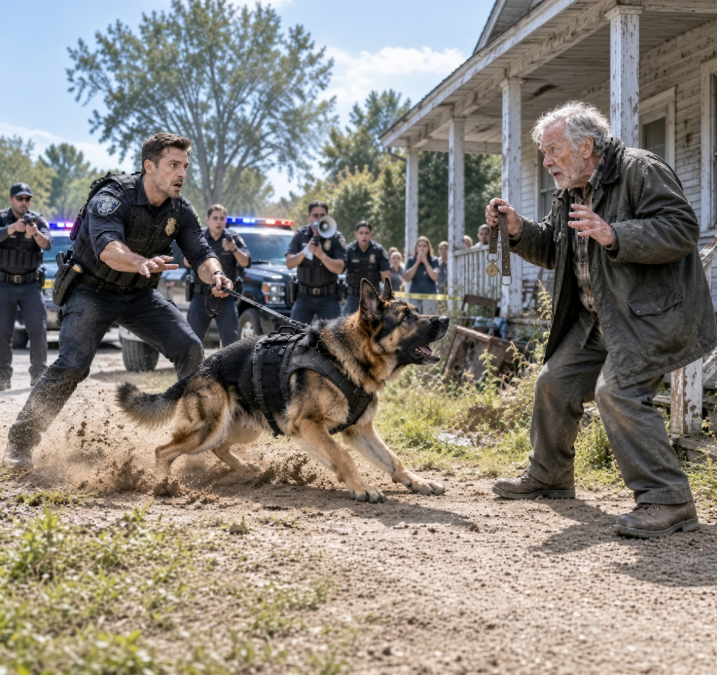
Then the rusted screen door on 442 Sycamore Drive groaned open.
Every weapon rose.
A collective breath seemed to leave the street.
The figure stepped out from the shadow of the porch awning.
An elderly man.
Stooped.
Thin.
Silver hair unkempt.
Face deeply lined.
He wore a heavy dark winter jacket despite the suffocating summer heat. It hung oversized on his narrow frame, the kind of coat a man might wear because it was the nearest thing to grab, or because age had ruined his sense of weather, or because grief sometimes made comfort more important than temperature.
But to the officers, the coat meant only one thing.
Dark jacket.
Possible concealment.
Possible weapon.
Harrison Cole squinted into the sunlight.
He did not raise his hands.
Did not run.
Did not speak.
He looked confused, as if the police cars and armed officers and flashing lights had appeared in his yard from some dream he had not finished waking from.
“Hands in the air!” O’Connor barked through the megaphone. “Right now!”
Harrison took one shaky step down the porch stairs.
He walked with a painful shuffle, leaning slightly to one side. His face pinched against the brightness. His eyes moved slowly across the line of cruisers, but there was no recognition in them. Not the recognition of a suspect calculating escape. Not the defiance of a cornered man.
Confusion.
Fear arriving late.
Mitchell lowered his weapon a fraction.
“Sarge,” he said quietly. “Wait. Look at him.”
O’Connor did not turn.
“I am looking.”
“He’s confused. He might be deaf, or dementia, or heat stroke. He doesn’t even know we’re talking to him.”
“We don’t take chances, Davis.”
“The fugitive was reported tall. This man—”
“Was reported wearing a dark jacket,” O’Connor snapped. “That coat could hide a shotgun. If he draws, we have a bloodbath in a residential zone.”
Mitchell looked back at Harrison.
The old man had reached the bottom of the porch stairs.
He finally seemed to notice the weapons.
The megaphone.
The crowd.
The line of officers.
Terror washed across his weathered face.
His trembling hands lifted halfway.
For one fraction of a second, it looked as if he might comply.
Then his right hand darted downward.
Into the pocket of the heavy dark coat.
A rookie officer on the left flank shouted, “He’s reaching!”
Another yelled, “Weapon!”
O’Connor spun toward Mitchell.
“Davis! Deploy the dog! Take him down before he fires!”
Mitchell’s stomach dropped.
Everything in him screamed that something was wrong.
The posture.
The age.
The confusion.
The terror.
But the chain of command stood there in a sweat-soaked uniform, shouting over live radio, while half a dozen armed officers believed a weapon was coming out of that coat.
A split second of hesitation could cost lives.
It could also take one.
“Go!” O’Connor roared. “Go, go, go!”
Mitchell moved because training moved through him before doubt could stop it.
His hand hit the release.
The K9 cruiser door swung open.
Bruno exploded out like a spring released from maximum tension.
His paws hit the burning asphalt with a heavy rhythmic thud. He came to Mitchell’s left leg and locked in position, every muscle alive, amber eyes fixed on the elderly man across the yard.
The crowd behind the tape screamed.
Abigail Fischer covered her mouth and turned away.
Mitchell looked at Harrison Cole one last time.
The old man was still digging in the coat pocket.
His face pale.
Sweat slicking his temples.
His mouth moving, though no sound carried.
“Davis!” O’Connor shouted.
Mitchell pointed a gloved finger directly at Harrison.
He took the breath he always took before releasing his partner.
Then he shouted the German command that turned Bruno from waiting force into motion.
“Fass!”
Bruno launched.
Forty yards separated the police line from the porch.
Bruno covered it in seconds.
He did not bark.
A trained dog on a bite command did not waste air on warning. His body was a black-and-tan blur across dead grass and dust, silent and terrible, driving toward the old man’s center mass with perfect tactical efficiency.
Mitchell jogged forward behind him, one hand near his holster, ready to pull Bruno off as soon as the suspect was down.
He hated this part of the job.
People assumed K9 handlers loved the power.
The command.
The dramatic takedown.
Mitchell hated the violence even when it was necessary.
Thirty yards.
Twenty.
Ten.
Harrison looked up.
At last, he saw Bruno.
Really saw him.
A massive German Shepherd hurtling toward him like a freight train.
The old man froze.
He did not run.
Did not pull out a weapon.
Did not shield himself.
His frail shoulders sagged, and he closed his eyes as if accepting impact from a world that had been striking him for years.
Five yards.
Bruno lowered his center of gravity.
Jaws parting.
Teeth flashing.
Preparing for the leap.
Then the impossible happened.
Three feet from Harrison Cole, Bruno slammed on the brakes.
The stop was so abrupt it looked unnatural. His front paws dug into the dry dirt, carving two deep trenches into the lawn as dust burst up around him. His hindquarters swung slightly, muscles fighting momentum, body twisting to prevent the strike he had been trained to complete.
Dust swallowed dog and old man.
Mitchell froze mid-stride.
O’Connor lowered the megaphone.
Every officer on the line stood paralyzed.
The dust thinned.
And what emerged from it made the entire street fall silent.
Bruno had not attacked.
He had not bitten.
He had not knocked Harrison down.
The fierce, battle-hardened K9 sat perfectly still at the old man’s feet.
His ears, usually pinned during a strike, were forward.
His mouth closed.
His head tilted slightly, as if listening to a sound only he could hear.
Then he let out a long, high-pitched whine.
Harrison opened his eyes.
He looked down at the massive dog that had been inches from destroying him.
His right hand trembled inside the coat pocket.
Slowly, carefully, he pulled it free.
No gun.
No knife.
No weapon.
In his frail, arthritic fingers was an old leather dog collar.
Dark brown.
Cracked.
Tarnished by age.
Attached to it was a faded brass tag, scratched nearly smooth by years of touch.
Harrison’s grip faltered.
The collar slipped from his fingers and landed in the dirt with a soft thud.
Bruno looked at the collar.
Sniffed it once.
Then looked up into Harrison’s eyes.
The sound that came from the dog was not tactical, not trained, not anything Mitchell had ever heard from him in five years.
It was a broken, whimpering cry.
Bruno stepped forward and pressed his black muzzle against Harrison’s trembling knees.
“What the hell is going on?” O’Connor whispered.
Then louder, as if volume might force the world back into sense.
“Davis! What is your dog doing? Call him off! Get him back here!”
Mitchell did not answer.
His legs felt heavy as he crossed the yard.
His hand fell away from his holster.
Harrison’s knees buckled.
He collapsed into the dirt and buried his face in Bruno’s thick neck.
The old man began to sob.
Not embarrassed tears.
Not fear.
Deep, chest-heaving cries of a man whose grief had been locked away for so long that when the door finally opened, it nearly broke him apart.
Bruno pushed into him.
Then did something Mitchell had never seen him do with any suspect, victim, child, officer, or handler.
He lifted his front paws and placed them around Harrison’s shoulders.
Not aggressively.
Not dominance.
Almost an embrace.
The dog rested his heavy chin on top of Harrison’s head, shielding the old man from the police line.
When O’Connor took one step forward, Bruno turned his head and growled.
Low.
Warning.
Teeth bared at his own colleagues.
The moment his eyes returned to Harrison, they softened, and he resumed licking tears from the old man’s face.
“Control your animal!” O’Connor shouted.
He drew his sidearm.
“If that dog has gone rogue, I will put it down right now!”
Mitchell moved faster than thought.
He stepped directly between O’Connor’s gun and Bruno.
“Hold your fire!”
“Davis—”
“Put the gun down, Brian. Do not shoot my dog.”
O’Connor stared at him.
Mitchell did not move.
Behind him, Bruno growled again.
Not at Mitchell.
At the weapon.
The sound moved through everyone there like a current.
Slowly, O’Connor lowered the gun.
Mitchell turned back toward Harrison.
He crouched in the dirt a few feet away, keeping his voice calm enough for both man and dog.
“Sir,” he said. “My name is Officer Mitchell Davis. This is my partner, Bruno. Are you hurt?”
Harrison slowly lifted his head from the dog’s fur.
His eyes were red and swollen.
But beneath the fear was something deeper.
Something ancient.
Something waking from a grave.
He looked at Mitchell.
Then at the tarnished brass tag lying in the dirt.
Then back at the dog.
His hand moved to the top of Bruno’s head.
The dog closed his eyes under the touch.
Harrison spoke in a hoarse whisper.
“His name isn’t Bruno.”
Mitchell stared.
Harrison’s fingers slid through the thick fur behind the dog’s ears, finding a place with the certainty of old memory.
“His name is Bear,” Harrison choked. “And he was supposed to be dead.”
The radio on Mitchell’s shoulder crackled with frantic voices.
Perimeter questions.
Status requests.
Commands overlapping.
He heard none of them.
The world had narrowed to a patch of dirt, an old man, a police dog, and a collar that looked like it had survived a lifetime in someone’s pocket.
O’Connor approached slowly now, gun lowered but still in hand.
“What do you mean his name is Bear?” Mitchell asked.
Harrison took a shuddering breath.
His hands remained buried in the dog’s fur.
Bruno—Bear—pressed his face against Harrison’s chest as if trying to climb back into a life stolen from him years earlier.
“Seven years ago,” Harrison began, “I lived in a small valley town in Washington State.”
His voice was weak at first.
Then steadier, because memory, once opened, demanded to be heard.
“I had a daughter. Amelia. And a grandson. Toby.”
The name broke him.
He had to stop.
Bear whined and licked the old man’s chin.
Harrison continued.
“When Toby was ten, I bought him a German Shepherd puppy. He picked him out from a litter because the pup kept sitting on his shoes and chewing his laces. Toby said any dog that stubborn had already chosen him.”
A ghost of a smile passed across his face.
“We named him Bear. Biggest paws I’d ever seen on a puppy. Fell over his own feet for months.”
Mitchell looked at the massive K9 pressed against Harrison now.
The image of him as a clumsy puppy was almost impossible.
Almost.
“He was the smartest animal I ever knew,” Harrison said. “Not just trained-smart. Heart-smart. He knew when Amelia had migraines before she said a word. He knew when I’d had too much coffee and not enough sleep. And Toby…”
His voice faltered.
“Toby was his world.”
The crowd behind the tape had gone silent.
Even officers who should have been watching windows and fence lines found themselves listening.
“He slept at Toby’s feet every night,” Harrison said. “Followed him to the creek. Followed him to the school bus stop. Followed him to the barn. If Toby climbed a tree, Bear sat underneath it and complained until he came down.”
Harrison reached toward the old collar in the dirt.
Mitchell picked it up gently and handed it to him.
“This collar,” Harrison said, rubbing his thumb over the faded leather, “was the first one Toby bought with his own money. He saved allowance for months. Said Bear deserved something that made him look official.”
The brass tag was scratched nearly illegible.
Mitchell could just make out one letter.
B.
“What happened?” Mitchell asked softly.
Harrison closed his eyes.
“The spring floods of 2019.”
The air seemed to change.
Even the heat felt colder.
“The river breached the dam in the middle of the night. We had warnings, but nothing like what came. The water hit our property like a freight train.”
His hand tightened around the collar.
“It was dark. Rain so loud you couldn’t hear yourself scream. Amelia was trying to get emergency bags from the hall. I was trying to get Toby to the attic stairs. Bear was barking like mad, running between us, trying to herd us the way he did with goats when they got loose.”
He swallowed hard.
“The first floor flooded in minutes. Not hours. Minutes. Furniture moving like toys. Glass breaking. The whole house groaning.”
Bear pressed closer to him.
“We got to the roof through the attic window. The water was everywhere. Black and wild. Trees floating past. Pieces of barns. Propane tanks. Cars. Things you couldn’t name because they were moving too fast.”
Harrison’s voice cracked.
“Toby slipped.”
No one moved.
“He was right beside me. One second his hand was in mine. The next, the shingles broke loose under his foot, and he slid.”
Harrison’s breath caught.
“I grabbed for him. I missed.”
Bear let out a low whimper.
“He fell into the current. Amelia screamed. I still hear it. Every night, I still hear it.”
Mitchell felt his throat tighten.
“Bear didn’t hesitate,” Harrison whispered. “He jumped after him.”
For a moment, the yard disappeared in Harrison’s telling.
There was only black water, rain, screaming, and a dog launching into impossible current because the boy he loved was in it.
“I saw him reach Toby,” Harrison said. “He grabbed Toby’s shirt in his teeth. He fought like something holy. He was trying to drag him toward a submerged oak tree.”
His whole body shook.
“But the water was too fast. A piece of debris came downriver. Part of a barn wall, maybe. It hit them.”
Harrison covered his mouth.
“They both went under.”
Bear’s head lowered into Harrison’s lap.
“I screamed until my lungs burned. Amelia screamed until she had no voice left. They never came back up.”
The silence that followed pressed against everyone.
Sirens still flashed.
Radios still crackled.
But for that moment, the street belonged to an old man’s grief.
“They found Toby three days later,” Harrison said. “Miles downstream.”
He bent forward, forehead touching Bear’s head.
“They never found Bear. We thought the river took him all the way out. I told myself maybe it was better not knowing. Maybe the river had given him peace.”
His fingers curled into the dog’s fur.
“But it destroyed us. Amelia moved away. She couldn’t bear the valley. I couldn’t either. Everywhere I looked, I saw my boy and his dog. The creek. The porch. The bus stop.”
He looked toward the broken house behind him.
“I moved here to Monroe County because I didn’t know how to live anywhere that remembered me.”
Mitchell looked down at the collar.
“You carried this with you.”
“Every day,” Harrison said. “It was Bear’s spare collar. Toby kept it hanging by his bed. After the flood, it was all I had left that belonged to both of them.”
He wiped his face with a shaking hand.
“I wasn’t reaching for a weapon. I was scared. I saw all of you yelling, and I couldn’t understand. I reached for the collar because when I’m afraid, I hold it.”
Mitchell’s chest tightened.
He looked at Bruno.
Bear.
The dog he thought he knew better than any living creature.
“When we got him,” Mitchell said slowly, “the academy record said he came from a rescue program. Found half-dead on a riverbank in rural Oregon. No microchip. Collar gone. Severe dehydration. Paw injuries. Broken rib.”
Harrison stared.
“Oregon?”
“Hundreds of miles downstream,” Mitchell said.
Bear’s amber eyes lifted toward him.
“A shelter took him in. Said he was too driven, too intense, too protective for a regular adoption. He kept escaping crates and opening latches. They transferred him into a working dog program. He tested off the charts.”
Mitchell breathed out.
“He wasn’t abandoned.”
He looked at Harrison.
“He survived.”
Harrison made a sound that was half sob, half laugh.
Bear licked his hand.
“All these years,” Harrison whispered. “All these years, Bear.”
Mitchell’s own eyes burned.
“He remembered you,” he said. “My God. He remembered you.”
Before Harrison could answer, glass shattered somewhere behind the house.
The sound cut through the moment like a gunshot.
Tactical training flooded back into Mitchell’s body.
O’Connor snapped his radio up.
“Movement in the rear! Flank units converge on the backyard now!”
Mitchell stood, drawing his weapon.
“Stay down, Harrison! Stay on the ground!”
From the side of the dilapidated house came the real nightmare.
A tall, heavily built man burst through overgrown bushes, wearing a dark, sweat-soaked jacket. His face was twisted with panic. In his right hand, he gripped a heavy revolver.
The fugitive.
The man everyone had been looking for.
He had been hiding in Harrison’s backyard shed the entire time, waiting for police to leave.
Now, realizing the perimeter had boxed him in, he made one desperate run.
“Drop the weapon!” O’Connor roared.
The fugitive did not drop it.
He saw the police line.
Then his wild eyes found Harrison kneeling in the dirt.
Vulnerable.
Close.
A hostage.
The fugitive lunged toward the old man, raising the revolver.
“No!” Mitchell shouted, lifting his weapon.
The angle was impossible.
Harrison was too close.
If Mitchell fired, he risked hitting him.
But Mitchell did not need to fire.
The dog that had been licking tears from an old man’s face vanished.
In its place came the animal every officer on that street knew.
But this time, Bear was not acting on a police command.
He was not responding to procedure, training, or duty.
He was protecting family.
A guttural roar erupted from his chest.
Bear launched.
Ninety pounds of muscle and devotion crossed the space between Harrison and the armed fugitive in one impossible burst.
The fugitive tried to pivot the revolver.
Too slow.
Bear hit him square in the chest.
The impact sounded like a car crash.
The man’s feet left the ground. The revolver flew from his hand and clattered across the asphalt. They hit the dirt in a tangle, but Bear was already in control.
His jaws clamped onto the fugitive’s right shoulder with terrifying precision.
The man screamed, thrashing.
Bear did not yield an inch.
He stood over him, eyes blazing, growl rolling low and absolute, promising destruction if the man moved another muscle.
“Hold him!” Mitchell shouted, sprinting forward. “Hold him, Bear!”
He did not even realize he had used the old name until after it left his mouth.
Officers swarmed.
Hands.
Cuffs.
Boots in the dirt.
Weapon secured.
Fugitive dragged onto his stomach.
Only when Mitchell placed one hand on the back of Bear’s neck and whispered the release command did the dog let go.
The threat was neutralized.
The real suspect was in custody.
The yard fell into the strange, exhausted silence that follows violence when everyone realizes they are still alive.
Mitchell holstered his weapon and dropped to one knee beside Bear.
The dog turned away from the arrested man and trotted straight back to Harrison.
He sat beside the old man, leaning his full weight into Harrison’s side like a silent guardian who had finally found the place he had been searching for through years of training, commands, kennels, patrol cars, and names that were not his first.
O’Connor walked over slowly.
His aviators were pushed up onto his forehead.
His face looked drained.
He stared at the fugitive being loaded into a cruiser, then at Harrison, then at the dog.
For the first time since Mitchell had known him, Sergeant Brian O’Connor seemed entirely lost for words.
“Davis,” he said finally, voice thick. “I almost…”
He stopped.
Everyone knew the rest.
I almost ordered you to unleash him on an innocent man.
I almost shot him when he refused to leave that man.
I almost turned a miracle into another tragedy.
Mitchell rested his hand on Bear’s back.
“It’s okay, Sarge.”
O’Connor looked at him sharply, but Mitchell’s eyes stayed on the dog.
“Bear knew.”
The investigation that followed cleared Harrison Cole of wrongdoing almost immediately.
The real fugitive had broken into the backyard shed after fleeing through alleyways behind Sycamore Drive. He had planned to wait out the police response, then escape when the perimeter loosened. Abigail Fischer had seen movement on Harrison’s porch and assumed the man in the dark coat was the fugitive. She had been wrong, but not malicious. Fear had filled in what distance could not see.
Harrison had not heard the first commands clearly.
His hearing had deteriorated over years.
His confusion had been worsened by heat, fear, and the sudden arrival of armed officers in a yard he rarely left.
His heavy winter coat, the detail that nearly got him attacked, was something he wore despite the weather because its inner pocket held the old collar.
Bear’s spare collar.
Toby’s collar.
The one object Harrison reached for when the past came too close.
The local news learned about the incident within hours.
By evening, the story had spread across Monroe County.
The police dog who stopped short.
The old man with the collar.
The fugitive in the shed.
The dog who remembered.
People argued over the department’s tactics. They argued over O’Connor’s command decisions. They argued over whether Bruno should have been released at all.
But beneath all the arguments was the image no one could stop talking about.
A ninety-pound police K9, ordered to attack, choosing instead to sit at the feet of an old man he had not seen in seven years.
The bureaucratic nightmare began almost immediately.
According to county law, Bruno was government property.
A trained police canine.
A fifty-thousand-dollar asset.
Monroe County had invested years into his housing, veterinary care, training, certification, and tactical deployment.
He was not legally Harrison’s dog.
There was no surviving microchip data connecting him to Bear. No original collar. No ownership papers from Harrison’s family after the flood. The old leather collar proved emotion, not legal possession.
Several officials were sympathetic.
Sympathy did not automatically retire a working dog.
Mitchell knew that.
He also knew he could not put Bear back in the cruiser like nothing had happened.
The first night after the standoff, Bear returned home with Mitchell, as he always did after shift.
He ate.
Drank.
Inspected the backyard.
Lay in his usual place by the kitchen door.
But he did not settle.
Every few minutes, he lifted his head and looked toward the front window.
At midnight, Mitchell sat on the floor beside him.
“You looking for him?”
Bear’s ears moved.
Mitchell rubbed the thick fur behind his neck.
“I know.”
He did know.
That was the problem.
Mitchell had spent five years thinking of Bruno as his partner.
His dog.
His responsibility.
His shadow in the dark.
His backup in rooms where humans lied and dogs did not.
Bear had saved Mitchell twice.
Once in a warehouse when a suspect hiding behind insulation came at him with a blade.
Once during a night track when Mitchell stepped too close to a drainage drop and Bear’s sudden refusal to move made him look down before he fell.
Mitchell owed him more than he could explain.
And now he had to ask whether loving his dog meant letting him go.
The next morning, Mitchell began building the case.
Not casually.
Not emotionally.
Like a detective.
He requested the original rescue records from Oregon.
He tracked the shelter intake date.
Matched it to the flood timeline.
Found a veterinary note describing injuries consistent with long-distance flood debris trauma.
He contacted agencies in Washington State.
He found old newspaper coverage of the 2019 flood.
There, buried beneath stories about washed-out bridges and damaged farms, was a paragraph about ten-year-old Tobias Cole and the family German Shepherd, Bear, both lost after the dog jumped into the floodwater attempting rescue.
Mitchell printed it.
Then he found Harrison’s former neighbors.
One remembered Toby and Bear walking to the bus stop.
Another had a photo from a birthday party where a younger Harrison sat in the background while a German Shepherd puppy slept under Toby’s chair.
A third remembered the spare collar.
“Toby bought that collar,” she told Mitchell over the phone, crying before the conversation ended. “He showed everyone. Said Bear needed a backup in case he became famous.”
Mitchell gathered everything.
Photos.
Flood reports.
Rescue intake documents.
Vet records.
Witness statements.
He also requested Bear’s service file from Monroe County.
Five years of deployments.
Finds.
Apprehensions.
Officer safety interventions.
Searches.
Commendations.
Lives saved.
Then he wrote a petition.
Not to take Bruno from the department.
To retire Bear with honor.
The first person to sign was Mitchell.
The second was O’Connor.
He signed quietly, in his office, without looking up for several seconds afterward.
“I made the wrong call that day,” the sergeant said.
Mitchell did not answer.
O’Connor swallowed.
“I’ve replayed it.”
“I know.”
“I saw a coat. I saw a hand in a pocket. I saw a threat.”
Mitchell waited.
O’Connor looked toward the window.
“That dog saw a man.”
That was the closest thing to an apology Mitchell expected.
It was enough.
The petition grew quickly.
Officers signed.
Dispatchers.
K9 trainers.
Veterinarians.
Neighbors on Sycamore Drive.
Even Abigail Fischer signed, adding a handwritten note apologizing to Harrison for the call that nearly destroyed him.
Mitchell brought the case before the city council three weeks later.
He wore his dress uniform.
Bear sat beside him, alert and still, wearing his tactical collar.
Harrison sat in the front row, hands folded over the old leather collar in his lap.
The chamber was full.
Reporters lined the back wall.
Council members shuffled papers, cleared throats, and prepared for what they assumed would be a difficult policy discussion.
Mitchell made it something else.
He stepped to the microphone.
For a moment, he could not speak.
Bear looked up at him.
Mitchell steadied.
“This dog has served Monroe County with honor, bravery, and unmatched loyalty for five years,” he began. “He has saved my life. He has saved the lives of fellow officers. He has protected citizens who will never know how close danger came to them.”
Bear sat motionless.
“But before he was our K9 partner, before he was called Bruno, before he wore a police collar, he was a little boy’s best friend.”
The room became very still.
“His name was Bear. He belonged to a boy named Toby Cole, and when floodwater took that child, Bear jumped after him. He paid the ultimate price trying to save him, or so everyone believed.”
Mitchell looked down at the dog.
“But Bear survived. He came to us because tragedy tore him away from the family he loved. He served us because that is what good dogs do. They give everything to the people in front of them.”
His voice shook.
“He has done that for this county. Now we have the chance to give something back.”
Harrison lowered his head.
Mitchell continued.
“I am not here to argue that equipment should be discarded when emotion enters the room. I am here to say Bear is not equipment.”
A few council members looked up sharply.
Mitchell did not soften.
“He is a living partner who has earned retirement. And more than that, he has found the family he never stopped remembering.”
He placed one hand lightly on Bear’s head.
“This dog has earned his way home.”
No one moved for several seconds after he finished.
Then one woman in the second row began crying openly.
The council vote was unanimous.
On a crisp autumn morning two months after the standoff, a small ceremony was held in the cleaned-up front yard of 442 Sycamore Drive.
The yard looked different now.
Off-duty officers had spent weekends pulling weeds, hauling rusted tools, trimming branches, repairing porch boards, and clearing the path. Someone fixed the mailbox. Someone replaced the broken porch light. Someone painted the front steps.
Harrison had argued against most of it until O’Connor told him officers were terrible at sitting with guilt and he might as well let them do yard work.
That had ended the argument.
Neighbors came too.
Quietly.
No cameras this time, except one department photographer standing far back.
Mitchell stood in the driveway holding a standard leather police leash.
At the end sat Bear.
Still sharp.
Still alert.
Still strong.
But different somehow, as if the dog already knew the day had arrived.
Harrison stood on the porch wearing a clean flannel shirt and a tentative smile, both hands gripping the rail.
Mitchell walked up the wooden steps.
He crouched in front of Bear.
For a moment, he just looked at him.
Five years of patrols moved through him.
Night tracks.
Bite work.
Training fields.
Quiet mornings after hard calls.
The weight of the leash in his hand.
The sound of paws behind him.
The steady presence in every dangerous place Mitchell entered.
“You were the best partner I ever had,” Mitchell whispered.
Bear leaned forward and pressed his forehead against Mitchell’s chest.
Mitchell closed his eyes.
Then he unclipped the heavy tactical police collar from Bear’s neck.
The department insignia gleamed in the morning light.
Mitchell held it for a second longer than necessary.
Then from his pocket, he removed the old leather collar.
Not as it had been in the dirt that day.
He had cleaned it carefully.
Conditioned the leather.
Polished the brass tag until the faded letters shone as much as age allowed.
BEAR.
The name was still there.
Worn.
But there.
Mitchell fastened it around the dog’s neck.
Bear lifted his head.
Harrison made a small sound from the porch.
Mitchell stood and handed him the leash.
“He’s yours, Harrison.”
His voice cracked.
“He’s officially retired. He’s a civilian now.”
Harrison took the leash.
Then immediately dropped it.
He fell to his knees and wrapped both arms around Bear.
The dog let out a joyous bark so sudden several officers laughed through tears. His tail wagged hard enough to shake his whole body. He licked Harrison’s face with relentless affection, all tactical stoicism melting away to reveal the puppy who had once slept at Toby’s feet.
Harrison sobbed into his fur.
This time the sobs were different.
Still grief.
But grief with warmth inside it.
Mitchell stepped back.
A tear slipped down his cheek.
He was losing the best partner he had ever had.
But he knew, without any doubt, that Bear was exactly where he had always been meant to be.
The first night Bear stayed at 442 Sycamore Drive, Harrison did not sleep much.
Neither did Bear.
They moved through the house together like two ghosts relearning the shape of the living.
Harrison showed him the kitchen.
The back room.
The repaired porch.
A faded framed photo of Toby, age ten, sitting on a fence rail with a German Shepherd puppy in his lap.
Bear sniffed the frame.
Then sat.
For a long time, he did not move.
Harrison lowered himself into the chair beside him.
“That’s your boy,” he whispered.
Bear leaned against his knee.
In the weeks that followed, neighbors began seeing Harrison outside more.
At first only on the porch.
Then at the mailbox.
Then walking slowly down Sycamore Drive with Bear at his side.
The old dog did not pull.
Did not roam.
He matched Harrison’s pace with the careful patience of an animal who understood that the man beside him had been broken long before his body became frail.
Children in the neighborhood asked to pet him.
Bear looked to Harrison first.
If Harrison nodded, Bear allowed it.
If Harrison hesitated, Bear stepped slightly forward and became a wall.
Nobody took offense.
Everyone knew the story now.
Abigail Fischer came by one afternoon carrying banana bread and an apology she had rehearsed for three days.
Harrison listened.
Bear sat between them.
When Abigail cried, Harrison surprised them both by taking her hand.
“You made the call you thought would keep people safe,” he said.
“I almost got you killed.”
Harrison looked down at Bear.
“No,” he said. “You helped bring him home.”
Mitchell visited every Sunday.
At first, he told himself it was for transition support.
Then for welfare checks.
Then because Harrison made coffee so terrible it felt like a challenge.
Eventually, he stopped explaining.
He would sit on the porch with Harrison while Bear lay between them, head on his paws, eyes moving from one man to the other as if keeping track of the two halves of his life.
Sometimes Mitchell brought the tactical collar.
Not for Bear to wear.
Just to let Harrison see it, hold it, understand the years Bear had lived between river and reunion.
Sometimes Harrison brought out Toby’s photo albums.
Not all at once.
Only when he was ready.
There were pictures of Bear as a puppy chewing a shoelace. Bear asleep under a Christmas tree. Bear soaked in creek water. Bear and Toby covered in mud beside a collapsed snow fort. Bear wearing the old leather collar, brass tag new and bright.
Mitchell studied them with quiet reverence.
He was learning the life his partner had before him.
Harrison was learning the life Bear survived after the flood.
Between them, Bear slept.
But not deeply.
He still preferred doorways.
Still lifted his head at strange engines.
Still watched hands.
A retired police dog did not become only a house pet because paperwork said civilian.
But slowly, other habits returned.
He chased a tennis ball once, surprising himself.
He stole a piece of toast from Harrison’s plate and looked deeply unrepentant.
He discovered the sunny patch in the front room and claimed it with the seriousness of a man staking land.
One night in late November, the first cold rain struck Monroe County.
Harrison woke to Bear whining beside the bed.
For a moment, Harrison was back in Washington.
Rain on roof.
Water rising.
Toby screaming.
He could not breathe.
Bear pressed his head beneath Harrison’s hand and shoved upward, forcing touch, forcing present, forcing the old man back into the room.
No flood.
No black water.
Only rain.
Only a dog.
Only survival.
Harrison sat on the edge of the bed with both hands in Bear’s fur until dawn.
“I thought I lost you,” he whispered.
Bear leaned harder against him.
“I thought I lost everything.”
Outside, rain ran down the windows.
Inside, Bear stayed.
On the anniversary of the flood, Harrison asked Mitchell to drive him to Washington.
Mitchell took leave without hesitation.
O’Connor approved it before Mitchell finished explaining.
They drove with Bear in the back seat, the old collar around his neck, the tactical collar packed in Mitchell’s bag because part of Bear belonged to every road now.
The valley had changed.
Flood repairs.
New houses.
Empty lots where old ones had been torn down.
The river looked harmless in daylight, which Harrison said felt like an insult.
They visited Toby’s grave.
Harrison stood there for a long time, one hand on Bear’s head.
“This is him,” he whispered. “This is Bear.”
The dog sniffed the stone.
Then lay down beside it.
Mitchell walked away to give them space.
He stood under a cedar tree and looked toward the river, thinking about all the ways lives split and somehow, impossibly, found each other again downstream.
When Harrison returned, his face was wet, but his shoulders seemed lighter.
Not healed.
That was not the word.
People used healed too quickly.
As if grief were a wound that closed clean.
But Harrison had brought Bear home to Toby.
And something unfinished had finally been witnessed.
Months later, Monroe County retired Bruno’s badge number.
Not Bear’s.
Bruno’s.
Because Mitchell insisted both names mattered.
Bruno was the K9 who served the department.
Bear was the dog who never stopped belonging to a boy.
At the ceremony, O’Connor spoke briefly.
No theatrics.
No excuses.
He simply said, “That day taught me the difference between compliance and understanding. I’m still learning it.”
That was enough.
Mitchell kept Bruno’s tactical collar mounted in his home office.
Harrison kept Bear’s old collar on him.
Bear needed no collar indoors.
The house knew his name.
So did Harrison.
So did Mitchell.
So, eventually, did everyone on Sycamore Drive.
People still told the story in different ways.
Some said the dog disobeyed an attack command.
Some said instinct overrode training.
Some said the collar triggered scent memory.
Some said love did what science could not explain quickly enough.
Mitchell never argued.
He had seen enough of dogs to know that humans often needed many words for truths animals carried simply.
Bear remembered.
That was the story.
He remembered the boy.
He remembered the old man.
He remembered the collar.
He remembered love before duty, before violence, before the name Bruno, before patrol cars and bite sleeves and commands shouted across yards.
And when ordered to attack, he stopped.
Not because he had failed his training.
Because somewhere beneath all that training, the first promise remained.
Protect family.
That was what he did in the flood.
That was what he did on Sycamore Drive.
That was what he did every night afterward, sleeping beside Harrison’s bed, ears tuned to rain, engines, footsteps, and dreams.
Years can pass.
Names can change.
Collars can be lost.
Records can fail.
Rivers can tear families apart.
But sometimes love survives in the oldest part of a living creature.
Past command.
Past distance.
Past grief.
Past death, or what everyone believed was death.
Officer Mitchell Davis had released his K9 to stop a threat.
Instead, Bear found his way home.
And in doing so, he reminded an entire police department, an entire street, and one broken old man that the heart remembers what the world misplaces.
Even after seven years.
Even after hundreds of miles.
Even after everyone else has stopped looking.

