On Her Wedding Morning, a Kansas Bride Returned Every Dollar Tied to Her Marriage—Then the Cowboy Asked One Question She Wasn’t Prepared to Answer.
PART3:
The word nobody had used plainly.
Payment.
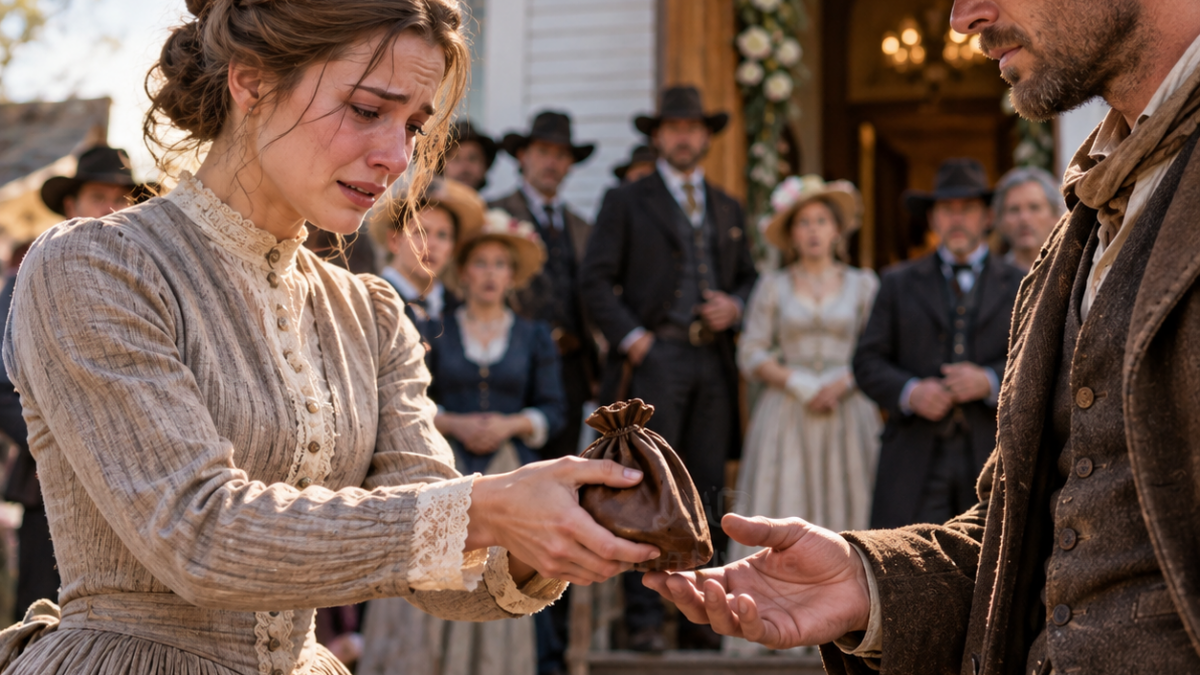
Colt closed his fingers around the pouch.
He had imagined many things that morning.
Her brother arriving late.
A broken wagon wheel.
Cold feet.
A quiet confession.
Even an empty road, though he had hated himself for imagining it.
He had not imagined Beatrice walking into the churchyard with the debt in her hands.
“Why bring it back today?” he asked slowly. “Instead of simply not showing up at all?”
The question settled between them more heavily than the pouch.
Beatrice stared at him.
Later, she would understand that his question mattered more than any vow they might have spoken inside the church that morning. More than the dress. More than the guests. More than the ledger hidden in Colt’s ranch house. More than the old handshake that had tried to reach across nine years and decide two lives before either life had been old enough to object.
But in that moment, all she felt was the heat of the sun on her neck, the tremor in her fingers, and the terrible relief of being asked the one thing no one else had cared enough to ask.
Why today?
Why return the money if she meant only to run?
Why face him at all?
Nine years earlier, her father, Everett Wren, had borrowed six hundred dollars from Colt’s father during the worst drought Solitude County had seen in a generation.
People who had not lived through that summer spoke of it too simply.
Drought.
As if the word itself were dry enough to explain cattle dropping in the fields, wells sinking low, mothers measuring flour by the spoonful, men riding home from market with empty wagons because buyers knew desperation when they saw it and paid accordingly.
The Wren Ranch had nearly folded that year.
Half the county had nearly folded.
There was no bank within a day’s ride willing to lend to a rancher already bleeding stock and hope. There were only neighbors, memory, pride, and whatever a man’s word was still worth when the creek ran thin and children asked why supper looked smaller.
So Everett Wren had gone to Henry Bishop.
Two men at a table.
Coffee gone cold.
Hats set aside.
A ledger open between them.
Six hundred dollars.
Enough to keep the Wrens’ cattle alive.
Enough to hold the land through one more season.
Enough to keep a family from leaving Kansas with what they could carry in one wagon.
The agreement had not been written in any bank record.
Only in Henry Bishop’s careful hand, and in the minds of the two men who shook on it.
The debt would settle eventually.
Not in cash.
Not in cattle.
Through marriage.
Everett’s only daughter, Beatrice, would marry Henry’s son, Colt, when both came of age.
Beatrice had been fourteen then.
Colt had been twenty-two.
Old enough to understand the arrangement, but young enough to believe fathers knew more about destiny than sons did.
Nobody called it a sale.
That would have been vulgar.
Nobody said Beatrice was being traded.
That would have been cruel.
They dressed it in gentler words.
A match.
An understanding.
A future joining of good families.
A practical solution.
That was how people made harsh things sound respectable in 1883.
They lowered their voices and gave cruelty a clean shirt.
Everett insisted until his death that he would have wanted the match regardless. Colt Bishop was steady, land-rich, not given to drink, and had never once been cruel in public or private as far as anyone knew. The Bishop land bordered the Wren water rights, and in Kansas, water could turn affection practical faster than any sermon.
Beatrice grew up believing the story because children believe the shape of the world adults build around them.
She knew she was expected to marry Colt.
She knew it the way she knew Sunday came after Saturday and calves came in spring.
But she did not know about the ledger.
Not until her father died.
Not until Thomas, older, frightened, and newly responsible for a ranch already leaning toward ruin, showed her the page.
Six hundred dollars.
Interest never fully agreed upon.
Balance unpaid.
Written beneath it in Henry Bishop’s neat script:
To be settled by marriage arrangement between Colt Bishop and Beatrice Wren upon proper age.
Beatrice remembered staring at the words until they blurred.
Not because she hated Colt.
That would have made everything simpler.
She liked him.
That was the worst of it.
Across eighteen months of courtship, she had come to like him more than she intended. He brought books instead of flowers because he had noticed flowers made her sneeze and books made her argue. He listened when she spoke about cattle prices, water rights, and seed varieties, not with indulgent amusement but with real attention. He did not laugh when she disagreed. He did not speak over her. He had the rare habit of changing his mind when she proved him wrong, though he did so with the wounded dignity of a man surrendering a fort.
He had never treated her as stupid.
In a county where women’s opinions were often permitted only after supper and before men grew tired of hearing them, that counted for more than any bouquet.
So Beatrice told herself she was saying yes to Colt.
Not to the debt.
Not to Thomas’s fear.
Not to her father’s promise.
Not to the ranch.
To Colt.
She told herself this while sewing her wedding dress by lamplight.
She told herself while Thomas counted money in the kitchen with his jaw tight.
She told herself while neighbors smiled too knowingly.
She told herself until the morning of the wedding, when she stood before the dress hanging on her door and felt something inside her go utterly still.
She could not put on white while a ledger still held the door shut behind her.
So she did not.
She put on her traveling dress.
Gathered the money Thomas had raised.
Walked alone to the church.
And placed the debt in Colt Bishop’s hands.
Now he stood before her, the pouch heavy in his palm, and asked why she had brought it back instead of simply disappearing.
“Because I couldn’t stand at that altar not knowing,” she said.
The words came steadier than she felt.
“Not knowing what?”
“Whether I was marrying you, or marrying my way out of a debt my father signed over my life before I was old enough to speak for myself.”
Someone behind her whispered, “Lord have mercy.”
Beatrice ignored it.
“I needed to know which one it was before I said vows I could never unsay. Before the church door closed behind me and everyone called it done.”
Colt’s face had gone pale beneath the dust and sun.
“And which is it?” he asked. “Now that you’re standing here having given the money back instead of walking away entirely?”
Beatrice opened her mouth.
No answer came.
The honest answer arrived slowly, unwelcome and complicated.
“I don’t know yet,” she said at last.
The churchyard seemed to hold its breath.
“I know I cannot marry you today with that money sitting unpaid between us. I know I could not wear that dress and pretend the question was settled just because everyone else preferred it settled. But I don’t know if returning the money means I do not want to marry you at all.”
Her voice trembled then.
She hated it.
“It may only mean I needed to give back what was never mine to marry away before I could discover the rest honestly.”
Colt looked down at the pouch.
His thumb moved over the worn leather.
For a long moment, he said nothing.
Beatrice watched his jaw work.
Watched pride, shame, fear, and something softer pass across his face like weather over prairie grass.
Then he looked up.
“Then let’s discover the rest honestly.”
The words nearly knocked her down.
Colt stepped closer, lowering his voice so only she and the nearest shameless listeners could hear.
“Starting with a fact my father should have made plain to yours nine years ago, and I should have made plain to you the first time we walked out after church and you argued that my bull was overpriced.”
Despite everything, Beatrice almost smiled.
“You said he was worth every penny.”
“You said he looked like a barrel with horns.”
“He did.”
“He still does,” Colt said. “And you were right.”
That small admission hurt more than it should have.
Because it sounded like the man she had come to know.
Not the ledger.
Not the arrangement.
Colt lifted the pouch.
“I could have forgiven this debt at any point in the last four years.”
Beatrice went still.
“What?”
“When my father died, I inherited his ledger. I saw the page. I saw what he had written. I told myself the match had been settled long ago. I told myself you had grown up expecting it, that your father approved, that mine approved, that if we liked each other well enough there was no harm letting an old promise carry us toward a future we might have chosen anyway.”
His throat moved.
“That was cowardice.”
Beatrice’s eyes stung.
Colt continued.
“I forgave the debt in my own mind the day I inherited it. I never meant to collect it. Not from Thomas. Not from you. But I kept the page because some part of me was afraid of exactly what you are doing now.”
“Standing in front of half the county humiliating you?”
“No.” His mouth tightened. “Finding out whether you would still choose me once the money was not holding the door closed behind you.”
Beatrice looked at him.
For the first time that morning, the anger in her shifted.
It did not disappear.
It had earned its place.
But beneath it, something else moved.
Recognition.
He had been afraid too.
Not in the same way.
Not under the same weight.
But afraid enough to let silence do damage.
“You should have told me,” she said.
“I know.”
“Before today.”
“I know.”
“Before the dress. Before the guests. Before my brother counted coins like my future could be stacked on a table.”
Every word struck him.
He accepted them.
“I know.”
That made it harder to stay cruel.
She almost wished he had defended himself.
It would have been easier to leave.
Inside the church, the organist touched one key by mistake, a soft uncertain note that died immediately.
Beatrice turned toward the sound.
The door stood open.
Her wedding waited inside like a trap made of flowers.
Colt followed her gaze.
Then he took one step back.
Not toward the church.
Away from it.
“You do not have to marry me today,” he said.
She looked at him sharply.
“You do not have to marry me ever. Not to settle this. Not to save the ranch. Not to keep Thomas from panic. Not to honor our fathers. Not to make sense of eighteen months neither of us asked to begin the way they did.”
His hand tightened around the pouch.
“If you marry me, Beatrice Wren, it ought to be because you have looked at me with nothing owed and still found me worth choosing.”
The churchyard went so quiet that a horse stamped near the hitching rail and made three women jump.
Beatrice felt something loosen in her chest.
It was not joy.
Not yet.
More like air entering a room long closed.
“What will you tell them?” she asked, nodding toward the guests.
Colt looked at the church.
Then at her.
“The truth, if I can manage it.”
“That the wedding is canceled?”
“That the wedding was never the question we should have been asking.”
A laugh startled out of her.
It broke halfway into something like a sob.
Colt looked down at the pouch.
“Take the money back.”
“No.”
His eyes returned to hers.
“No?”
“I brought it to you because I will not marry under debt. But I will not take it back while the question of the debt remains tangled. If you mean to forgive it, forgive it plainly. Not here in the dust while everyone watches and wonders what bargain we are making now. Not because I forced your hand at church.”
His expression changed.
Approval.
Respect.
Love, perhaps, though neither of them was ready yet to say it safely.
“What do you want me to do?”
“Something that cannot be mistaken for another arrangement.”
Colt nodded slowly.
“All right.”
The murmurs began again when they turned together toward the church steps.
Mrs. Bell pressed both hands to her mouth. The preacher stood in the doorway looking deeply uncomfortable with being present for truth before noon. Thomas Wren was nowhere to be seen. He had stayed at the ranch, believing his sister would arrive at the church like a sensible woman and come home as Mrs. Bishop.
He did not yet know how wrong he was.
Colt climbed the first step.
Then the second.
He turned to face the waiting guests.
“My friends,” he said.
His voice carried better than Beatrice expected.
“There will be no wedding here today.”
The churchyard erupted.
Not loudly.
Not at first.
Whispers moved like wind through wheat.
Colt lifted one hand.
The whispers lowered.
“This delay is not Beatrice Wren’s shame. If any shame belongs here, it belongs to the men who let an old debt stand too long where honest choice should have stood instead.”
An older man near the door muttered something about private family matters.
Colt’s eyes found him.
The man went quiet.
“I will speak with her family,” Colt continued. “Then with mine, what remains of it. Until then, I ask you not to turn a woman’s courage into gossip simply because it made you uncomfortable.”
That did not stop the gossip.
Nothing ever stopped gossip.
But it changed its shape.
Beatrice left the churchyard alone.
Colt did not follow her.
She was grateful for that.
If he had followed, someone would have made a story of it. If he had offered his arm, people would have called it reconciliation. If he had let her lean, someone would have said she had been forgiven, as if she had been the one needing pardon.
So she walked back the way she came, with her head up, empty-handed now, the dust gathering on the hem of her plain dress.
The wedding guests watched.
Some with pity.
Some with offense.
Some, mostly women, with expressions Beatrice could not read then but would understand better years later.
Recognition.
At the Wren Ranch, Thomas was waiting on the porch.
He had heard before she arrived.
Of course he had.
Bad news traveled faster than horses when neighbors helped it along.
Her brother stood with his arms crossed, face tight beneath the brim of his hat. Thomas was twenty-seven, but since their father’s death, fear had aged him unevenly. He had their mother’s fine hands and their father’s temper, both wasted too often on ledgers, fencing repairs, bank visits, and nights staring at accounts that refused to become kinder by dawn.
“You gave it back,” he said before she reached the steps.
Beatrice stopped.
“Yes.”
“The only thing standing between this family and losing the ranch outright.”
“No,” she said. “I gave back money that had been standing between me and my own life.”
His face reddened.
“Do you understand what you’ve done?”
“I believe I do.”
“Do you?” He came down one step. “Because from here it looks as if you traded our survival for your peace of mind.”
His voice cracked on survival.
That softened her more than his anger deserved.
“Colt said he could have forgiven the debt at any time.”
Thomas froze.
“What?”
“He said he had already forgiven it in his own mind. He never meant to collect.”
For a moment, hope flickered.
Then calculation followed.
Thomas had spent too long surviving not to measure every opening for danger.
“If he had already forgiven it, why hand the money back? Why ruin the wedding? Why not let him forgive it after you were married?”
“Because then I would spend the rest of my life wondering whether the forgiveness came because he wanted me, or because forgiving a debt was simpler than collecting it from his bride’s family.”
Thomas stared at her.
“You always were too proud.”
“No.” Beatrice looked past him toward the barn, the fields, the dry ridge beyond. “I have not been proud enough.”
He flinched.
She had not meant to wound him.
Not exactly.
But truth often drew blood even when aimed carefully.
Thomas turned away.
“We needed this.”
“I know.”
“Do you? Father left us with drought debt, sick stock, failing fences, and neighbors waiting to see if we fall. Colt Bishop’s land borders our water. His name opens doors ours no longer does. You think I wanted to push you? You think I enjoyed counting coins for your wedding like a butcher weighing meat?”
“No.”
“Then why do this?”
“Because I am not meat.”
The porch fell silent.
Thomas looked at her then, really looked.
Beneath his anger, shame began to stir.
Not enough to apologize.
Not yet.
But enough to make him look away.
“I don’t know how to save this place without him,” he said.
The honesty in that sentence nearly broke her.
Beatrice climbed the steps and stood beside her brother, both of them looking out across land their father had loved badly, desperately, and perhaps not wisely.
“Maybe we were never meant to be saved by my marriage,” she said.
“Easy thing to say after burning the bridge.”
“Maybe the bridge was rotten.”
Thomas gave a humorless laugh.
“Spoken like a woman who does not have to rebuild it.”
Beatrice turned toward him.
“I have been rebuilding this family in ways you never counted because they did not appear in ledgers. Do not mistake your fear for the only labor being done here.”
Thomas’s mouth shut.
That was the end of the conversation.
For that day.
Three days later, Colt Bishop rode to the Wren Ranch.
Not to see Beatrice.
To see Thomas.
Beatrice watched from the kitchen window as he came up the road on a dark bay gelding, hat low, coat dusty, shoulders set. He did not dismount fully. He swung one leg over the saddle and remained half-mounted, as if whatever he had come to do should not require hospitality.
Thomas walked from the barn wiping his hands on a rag.
His posture changed when he saw Colt.
Bracing.
Defensive.
Ashamed.
“I hear,” Colt said, “you have been telling half the county your sister ruined this family’s chances.”
Thomas’s jaw hardened.
“She gave back the money.”
“I know. I was there.”
“What version of events would you prefer?”
“The true one.”
Colt reached into his coat and pulled out a ledger.
Beatrice stopped breathing.
Even from the window, she recognized it.
Dark cover.
Worn edges.
Her future had lived inside that book longer than she had known.
Colt opened it.
Found the page.
Thomas took a step closer.
“What are you doing?”
“What should have been done before she had to walk across a churchyard with money that never should have been treated as the price of her hand.”
Colt gripped the page.
Then tore it cleanly from the binding.
The sound carried across the yard.
Loud.
Final.
Shocking as a gunshot in polite company.
Thomas stared.
Colt held the torn page out.
“This debt is forgiven.”
Thomas did not take it.
Colt dropped it into the dust between them.
“It has been forgiven since the moment your sister proved she would rather risk everything than marry me for the wrong reason.”
Thomas’s face shifted.
“Why would you do this now? With no marriage to show for it?”
“Because the marriage was never supposed to be the payment.”
The words struck the yard with the force of something long overdue.
Colt continued.
“It took Beatrice handing back money I never should have allowed either family to treat as currency to make that plain to me. Whatever happens between her and me from here will happen because she chooses it freely. Not because your family owes mine. Not because our fathers shook hands in a dry year. Not because fear makes cowards of us all if we let it.”
Thomas looked at the torn page in the dust.
His anger had nowhere to stand now.
That made him look younger.
For one moment, he was not the brother who had pressured her.
Not the man who had counted coins.
Only a son left too early with his father’s mistakes and no idea how to keep them from becoming his own.
“I thought I was saving us,” Thomas said quietly.
Colt’s voice softened.
“I know.”
Thomas looked up.
Colt gathered his reins.
“That does not mean she was yours to spend.”
Then he turned his horse and rode away.
Beatrice did not move from the window until he was gone.
That evening, Thomas told her.
He came into the kitchen after supper, stood near the stove, and held his hat in both hands like a boy waiting outside the schoolmaster’s door.
“He forgave it,” he said.
“I know.”
Thomas looked up sharply.
“I saw from the window.”
“Oh.”
Silence stretched.
“He tore the page out,” Thomas said. “Right from the ledger. Like it weighed nothing.”
Beatrice thought of the pouch in Colt’s hands.
“No,” she said softly. “I imagine it weighed a great deal.”
Thomas nodded once.
He would not look at her.
“I was wrong to say you traded survival for peace of mind.”
She waited.
He swallowed.
“I was scared.”
“I know.”
“That is not an apology.”
“No.”
He looked at her then.
“I am working toward one.”
That was more than she expected.
So she accepted it.
The next afternoon, Beatrice rode to Colt’s ranch.
She did not tell Thomas.
She did not ask permission.
She saddled her mare, packed nothing but gloves and a canteen, and followed the north road past the dry creek bed, across land where the wind moved low through the grass and dust lifted behind the horse like memory.
Colt’s ranch sat wider than the Wren place.
Not grand.
Kansas did not lend itself easily to grandeur.
But solid. Fenced well. Barn roof sound. Cattle lean but healthy. Windmill turning with a steady complaint. A place that had suffered drought but not yet been broken by it.
She found Colt mending fence on the north section.
The same stretch of land that bordered the Wren water rights.
He looked up when he saw her.
For a moment, he did not move.
Then he set down the wire cutters and stood.
No smile.
No assumption.
No expectation.
That steadiness nearly undid her.
“You didn’t have to do that,” she said.
“Forgive the debt?”
“Tear the page.”
“I did.”
“For me?”
“No.”
The answer struck oddly.
Colt removed his gloves.
“I did it because you were right in the churchyard. That debt never should have been standing between us at all. Whether you marry me or never speak to me again, you deserved to make the choice with clear ground under your feet.”
Beatrice looked toward the half-mended fence.
“And if I choose not to marry you?”
He nodded once, as though he had prepared himself for the question and still hated hearing it.
“Then I will have lost a woman I genuinely came to love across eighteen months of courtship that had less to do with that ledger than I was coward enough to admit.”
Her heart moved painfully.
“And?”
“And I will keep my self-respect, which is worth something, even on the days it does not feel like enough.”
She had no answer.
Not yet.
They stood in the wind with fence wire between them and everything else removed.
No ledger.
No father.
No Thomas.
No guests.
No dress.
No debt.
Just a man and a woman who had almost married before asking the only question that mattered.
Beatrice rode home without giving him an answer.
Colt did not ask for one.
That might have been what began to answer it.
For the better part of a week, Beatrice walked the fence line alone every morning.
The Wren land was not pretty in the way Eastern women wrote about land in books. It was not lush, not gentle, not easily romantic. It was scrub grass, dust, stubborn creek beds, cattle tracks, wind, low hills, and sky so wide it sometimes made loneliness feel official.
She loved it anyway.
She walked with her skirt catching burrs and her boots whitening with dust, turning over eighteen months of courtship she had never fully trusted.
Had she liked Colt because she had been told to?
Had she admired him because admiration made obedience easier?
Had she mistaken relief for affection?
Had she fallen in love with a man, or simply made a prison comfortable enough to sleep in?
The questions were brutal.
She forced herself to ask them anyway.
At the mercantile on Thursday, Sadie Bell caught her near the flour sacks.
Sadie was thirty-six, unmarried by choice if you believed her and by sharp tongue if you believed men. She ran the church flowers, half the town’s gossip routes, and an informal school of practical wisdom nobody admitted attending.
“You look,” Sadie said, setting down her basket, “like someone trying to untangle barbed wire with bare hands.”
Beatrice almost smiled.
“That may be accurate.”
“Everyone is saying you called off the wedding.”
“Everyone says a great many things.”
“True. Most of them badly.” Sadie looked at her more gently. “Are you all right?”
“I don’t know.”
“That is at least more interesting than yes.”
Beatrice leaned one hand against the shelf.
“I keep trying to work out how much of what I feel for Colt is real. Separate from the debt. Separate from Thomas’s fear. Separate from the fact that I was raised to expect him.”
Sadie studied her.
“Sounds to me like you already know what you feel.”
Beatrice looked over.
“And you’re trying to decide whether you trust yourself enough to believe it,” Sadie finished.
That landed harder than advice should.
“I don’t want to choose him only because I was pointed toward him.”
“Then do not.”
“I don’t want to lose him only because I was angry about the pointing.”
Sadie’s mouth curved.
“There is the trouble.”
Beatrice said nothing.
Sadie picked up her basket.
“Most women I know never get asked the question at all. Seems worth taking a week to answer it properly, now that you have been given the chance.”
“By Colt?”
“By yourself,” Sadie said. “Though he had the sense to step aside and let it happen. That counts for something in a man.”
Beatrice thought about that all the way home.
By the second day after that, she knew she missed him.
Not the safety of his land.
Not the forgiveness of the debt.
Not the relief in Thomas’s shoulders.
Him.
She missed the way he listened when she disagreed.
Not politely.
Seriously.
She missed the books he brought wrapped in brown paper, pretending he had happened upon them by chance when everyone knew books did not simply happen upon ranchers in Kansas. She missed the crease between his brows when she made a better point than he did. She missed the way he never filled silence just because it was there. She missed his dry humor, his steady hands, his refusal to flatter her when respect would do.
She had been asking the wrong question.
It was not whether her feelings were real.
They were.
The question was whether she was brave enough to trust them when nothing forced her hand anymore.
She found him again at the north fence.
Of course she did.
Men like Colt Bishop repaired things when they did not know how to wait.
He was driving a post when she rode up, each strike clean and controlled. He stopped the moment he saw her. Set the hammer aside. Gave her his full attention as if the fence, the cattle, the land, and the whole restless state of Kansas could wait.
That was when she knew.
Not because he looked handsome, though he did in the way work makes some men honest.
Not because she was relieved.
Because he did not reach for her answer.
He let her bring it.
“I had the wrong question,” she said.
Colt rested one hand on the fence post.
“Did you?”
“I spent a week trying to decide how much of what I feel for you was real. Separate from the debt. Separate from the wedding. Separate from everything my father and yours decided before I was allowed a voice.”
He waited.
“Sadie Bell set me straight.”
“She is known to do that.”
“The question was never whether my feelings were real.” Beatrice stepped closer. “The question was whether I was brave enough to trust them once nothing was forcing my hand.”
Colt’s expression shifted.
Hope, carefully restrained.
“And what did you decide?”
“That I love you.”
The words came clean.
No tremor.
No debt behind them.
No church full of witnesses pulling them out.
Just truth.
“I love you,” she said again, because the first time felt so new she wanted to know it would stand. “Not because of land, or money, or water rights, or anything my father and yours ever shook hands over. I love you because you are the only man I have ever known who cared more about whether I trusted my choice than whether my choice was convenient for you.”
Colt crossed the distance between them.
Then stopped.
A foot away.
Asking even with his stillness.
“Beatrice.”
“Yes.”
“I would like to ask you something.”
She laughed softly, tears stinging her eyes.
“Again?”
“Properly this time.”
He took off his hat.
No church.
No guests.
No ledger.
Only wind moving over the grass and a half-mended fence behind him.
“Beatrice Wren,” he said, “will you marry me? Not because your father owed mine anything. Not because either family needs the arrangement. Not because a page once said so.”
His voice roughened.
“But because I have spent eighteen months falling in love with a woman sharp enough to walk away from a debt disguised as a wedding, and I do not intend to spend the rest of my life pretending I would not miss her every day.”
Beatrice felt the answer rise.
This time, it did not feel like a door closing behind her.
It felt like one opening.
“Yes,” she said.
Colt’s breath left him.
“Yes?”
“Yes.”
He reached for her then.
She met him halfway.
When he kissed her, it was not the kiss of a man claiming what had been promised.
It was the kiss of a man stunned to be chosen.
The second wedding took place in autumn.
Same church.
Same preacher.
Fewer flowers because Mrs. Bell said the first batch had been wasted on public emotional confusion and she would not be taken advantage of twice.
More certainty.
That was what everyone noticed, though not everyone said it.
Beatrice wore the same dress she had not worn the first time. She fastened it that morning with steady hands while Thomas stood awkwardly near the doorway, twisting his hat brim.
“I owe you an apology,” he said.
She looked at him in the mirror.
“I know.”
He gave a small, pained laugh.
“You might let a man approach it before agreeing.”
“I wanted to save you time.”
He looked down at his hat.
“I was more frightened for the ranch than I was thinking clearly about what was fair to ask of you.”
She turned.
Thomas continued, words difficult but honest.
“Colt forgiving that debt without conditions taught me something about the difference between survival and decency that I should have known before. Or maybe Father should have known. Or maybe fear taught all of us badly.”
“You were scared,” Beatrice said.
“That explains it. Does not excuse it.”
“No.”
“I pushed you too hard.”
“Yes.”
His mouth twisted.
“You are not making this easy.”
“You did not start with easy.”
He nodded.
“Fair.”
She softened then.
“I forgive you, Thomas. But I need you to understand something.”
He looked up.
“If I had married him the first time, with that debt still standing between us, some part of me would have resented you both for the rest of my life.”
He went pale.
“I did not think of that.”
“I know.”
“I should have.”
“Yes.”
That was their peace.
Not perfect.
Real.
At the church, Colt stood outside again.
This time, he was not watching the road with dread.
He turned when Beatrice arrived on Thomas’s arm.
For a moment, he looked exactly as he had months before.
Same good shirt.
Same hat in hand.
Same dark hair refusing discipline.
But everything between them had changed.
Thomas stopped at the church steps.
Then, quietly enough that only Beatrice heard, he said, “Choose well.”
She squeezed his arm.
“I already have.”
Inside, the pews were full.
Half the county had come.
Some for affection.
Some for curiosity.
Some because gossip ripened best when witnessed firsthand.
The preacher’s hands shook less this time.
When he asked who gave the bride, Thomas answered steadily.
“She gives herself, with her family’s blessing.”
A few women in the pews lowered their eyes.
A few men shifted uncomfortably.
Sadie Bell smiled like she had been personally responsible for civilization.
Colt and Beatrice spoke their vows plainly.
No one mentioned the ledger.
No one mentioned the pouch.
No one mentioned the debt that had once tried to stand where love should.
But when Colt slid the ring onto Beatrice’s finger, his thumb brushed her hand once.
A promise beneath the promise.
Free and clear.
The Wren Ranch survived that year.
Not by miracle.
Not by marriage alone.
Survival was rarely that romantic.
It survived because Colt and Thomas learned to share water rights without turning every dry week into a battlefield. It survived because the Bishop and Wren cattle grazed rotationally across land that had once been defended by pride more than sense. It survived because Beatrice had a better head for accounts than either man and no longer allowed them to pretend otherwise. It survived because rain came late but came. It survived because families, like land, sometimes endure when the fences are repaired honestly.
The drought years that followed tested them all.
Some neighbors failed.
Some left.
Some stayed and became harder.
Colt and Beatrice built a house near the creek, not grand, but sound. A porch wide enough for evening wind. A kitchen Beatrice designed with more shelves than anyone thought necessary until she filled all of them. A small study where Colt kept books he pretended were for her and then read himself.
In the top drawer of his desk, wrapped in cloth, he kept the torn ledger page.
Beatrice found it one winter night years later while searching for sealing wax.
She unfolded it and stood very still.
The page had yellowed.
The handwriting remained sharp.
Six hundred dollars.
Marriage arrangement.
Settled.
She heard Colt step into the doorway behind her.
“I didn’t keep it as a trophy,” he said.
“I know.”
“As a warning.”
She turned.
He leaned against the doorframe, older now, lines at his eyes, shirt sleeves rolled as always.
“A warning against what?”
“Against letting fear call itself patience.”
Beatrice looked down at the page again.
Colt came closer.
“I kept it because I still sometimes wake at night thinking how close I came to marrying you without ever finding out if you would have chosen me freely.”
She reached for his hand.
“You did find out.”
“Because you forced the question.”
“Because you asked the right one.”
He shook his head.
“You walked across the churchyard.”
“You tore the page.”
They stood together in the lamplight, each crediting the other, both right enough.
Thomas married two years later.
A woman from the next county named Clara, who had a laugh like church bells and a habit of saying exactly what she meant before any man had time to prepare. At his own wedding, Thomas made a point of telling anyone who asked—and several who had not—that no debt, ledger, water right, or fatherly arrangement had anything to do with his choice.
Clara eventually told him to stop before people began suspecting otherwise.
He and Beatrice grew closer with time.
Not immediately.
Siblings wounded by fear do not heal just because one apology lands well.
But ordinary life wore the sharpness down.
Harvest meals.
Babies born.
Cattle lost.
Fences mended.
Letters sent.
Arguments survived.
Years passing without anyone turning another person’s future into collateral.
When their first daughter was born, Colt asked Beatrice what she wanted to name her.
She said, “Grace.”
He looked at her.
“For mercy?”
“For the thing we nearly missed.”
Grace Bishop grew up hearing some version of the story, though never all at once.
She knew her mother had almost refused to marry her father.
She knew a ledger page had been torn.
She knew Uncle Thomas became strangely firm whenever anyone joked about arranged matches.
She knew her father sometimes told young men courting young women, “Ask plainly. And make sure she can say no without losing something.”
That became Colt Bishop’s reputation over time.
Not his land.
Not his cattle.
Not even the water rights that saved two ranches in lean years.
But that sentence.
Ask plainly.
Make sure she can say no without losing something.
Men laughed sometimes when he said it.
They laughed less after Colt looked at them.
Years later, after the county had changed and rail lines had brought in strangers who knew nothing of the drought that shaped the old families, someone asked Beatrice whether she had ever regretted walking across the churchyard with the money.
She was sitting on the porch then, silver in her hair, a basket of mending beside her, Colt asleep in a chair nearby with a book open on his chest.
She thought for a long moment.
“No,” she said.
“Not even with everyone watching?”
“Especially because everyone was watching.”
The young woman asking frowned.
“I would have been mortified.”
“I was.”
“And still?”
Beatrice looked toward the creek.
“That was the morning I learned embarrassment can last a week, but the wrong marriage can last a lifetime.”
The young woman said nothing.
Beatrice picked up her mending.
“The first wedding would have made sense to everyone,” she said. “That was the danger of it. A thing can make sense and still be wrong.”
She looked at Colt, sleeping with one hand resting over his heart.
“The second wedding made sense to me.”
That was enough.
The question that changed everything was not only Colt’s question in the churchyard, though that opened the door.
Why bring it back today?
It was not only Beatrice’s answer.
Because I couldn’t stand at that altar not knowing.
It was not even Colt’s confession that he could have forgiven the debt long before pride and fear forced her to carry money through dust in front of half the town.
The true question came later.
When the debt was gone.
When the wedding was canceled.
When Thomas’s fear no longer had the right to command her.
When Colt’s leverage had been torn from the ledger and dropped in the dirt.
When Beatrice walked the fence line alone and asked herself what most people never have the courage or the freedom to ask:
If nothing forces my hand, what do I choose?
That is a harder question than it sounds.
Many people know what they feel only when circumstances give them permission. When debts, deadlines, expectations, families, fear, or survival push them toward the answer. Fewer know what they want when every external reason is removed and all that remains is the plain, unforced truth of the heart.
Colt loved her enough to give up his leverage before he knew whether she would come back.
That was his courage.
Beatrice loved herself enough to walk away before she knew whether love would remain.
That was hers.
And somewhere between the pouch of money, the torn ledger page, the half-mended fence, and the second wedding, two people discovered that a vow only means something when both hearts are free to refuse it.
She came to return the wedding money.
He asked why.
And that one question did what all the fathers, ledgers, handshakes, droughts, and expectations in Kansas had failed to do.
It gave Beatrice Wren her choice back.
And only then could she choose him.

