On Her Final Night After 41 Years as a Nurse, She Heard a Cry From a Medical Dumpster at 3:14 A.M.—Then She Opened a Tied Black Bag and Saw What a Mother Cat Had Done to Keep Five Newborns Alive.
PART3:
She could start an IV on a dehydrated patient with rolling veins. She could calm a combative dementia patient without raising her voice. She could hear a change in breathing from the doorway. She could walk into a room and know when a family needed facts and when they just needed someone to stand there quietly and not run away from their pain.
But hospitals had changed.
Administrators with shiny shoes and clean hands had started measuring care in minutes and money. Nurses became numbers on staffing grids. Patients became satisfaction scores. Compassion became something praised in emails and punished in overtime reports.
And lately, Evelyn had heard the word “legacy” too often from people who wanted her gone politely.
“Your legacy will always be here,” said Rebecca Voss, the hospital’s chief operations officer, during the retirement lunch that afternoon.
Rebecca had said it while glancing at her phone.
She was forty-two, polished, ambitious, and always dressed like she was five minutes away from a television interview. She had come to St. Agnes two years earlier after a private hospital network bought the facility and started using words like modernization and efficiency. She smiled often, but it rarely reached her eyes.
Evelyn had never trusted people who smiled at suffering like it was a budget issue.
“You’ve given this hospital so much,” Rebecca had continued in front of the staff. “Now it’s time to let the next generation lead.”
The room had clapped.
Evelyn had smiled because she had learned long ago that dignity often meant swallowing what would only exhaust you to say.
But Maya Flores, one of the younger nurses Evelyn had trained, had caught her eye from across the break room. Maya had not clapped right away. Her lips had pressed together, and her eyes had said what Evelyn felt.
They are pushing you out.
Not legally.
Not openly.
But unmistakably.
First it had been fewer preferred shifts.
Then little comments about “transition planning.”
Then the written warning after Evelyn had stayed forty-two minutes past the end of her shift to comfort a confused veteran whose daughter was driving in from two counties away.
“Unauthorized overtime,” Rebecca had called it.
Evelyn had looked at the woman sitting behind the glass desk and said, “He thought he was dying alone.”
Rebecca had folded her hands. “That doesn’t change policy.”
No, Evelyn had thought. I suppose it doesn’t.
Now, on her final night, policy was sleeping comfortably somewhere while Evelyn finished caring for patients whose names Rebecca would never know.
“Evie?”
Maya’s voice pulled her back.
Evelyn looked up.
Maya stood at the medication cart, holding two paper cups and wearing the tired, bright-eyed expression of a nurse who had survived half the night on coffee, adrenaline, and spite. She was thirty-one, with dark hair pulled into a messy bun and a pen tucked behind one ear. Evelyn had mentored her during her first terrifying year out of nursing school.
“You okay?” Maya asked.
Evelyn smiled. “I’m fine, honey.”
“That means no.”
“It means I’m sixty-three and my feet hurt.”
Maya rolled the cart closer. “We saved you a corner piece of cake.”
“At three in the morning?”
“Cake is a vital sign on night shift.”
Evelyn laughed softly. “That may be the most accurate thing anyone has said in this hospital all week.”
Maya placed one of the paper cups beside Evelyn. “Tea. No sugar. Like you drink when you’re pretending not to be emotional.”
“I do not pretend.”
“You absolutely pretend.”
Evelyn took the cup, grateful for the warmth against her fingers. “You’re getting bold now that I can’t write you up.”
“You never wrote anybody up.”
“I could have.”
“You once caught Aaron sleeping in the supply closet and covered him with a blanket.”
“He had twins at home.”
“He was snoring next to the wound care supplies.”
“He was still breathing. That was good enough.”
Maya smiled, then her face softened. “I’m going to miss you.”
Evelyn looked down at the chart in front of her.
There were words that could have fit inside that moment, but none of them felt strong enough.
So she said, “You know how to reach me.”
“That’s not the same.”
“No,” Evelyn admitted. “It isn’t.”
For a while, neither of them spoke.
Down the hall, a call light blinked.
Maya glanced toward it automatically.
Evelyn did too.
Both women moved at the same time, then stopped, laughing quietly.
Maya pointed a finger. “No. Mine. You are officially on ceremonial duty.”
“I’m still on the clock.”
“You’re on the clock until seven. I’m giving you four hours to learn how to be retired.”
“That sounds dangerous.”
“It is. Start by sitting down.”
Maya walked off toward the patient room before Evelyn could argue.
Evelyn watched her go with an ache in her chest that had nothing to do with age.
She finished her charting, checked on two patients, adjusted an IV pump that kept beeping for no reason except that machines enjoyed emotional timing, and then finally allowed herself to step away from the floor.
The break room smelled like coffee, disinfectant, and frosting.
Her cake sat on the table beneath plastic wrap, the words HAPPY RETIREMENT EVELYN written in blue icing. Someone had placed a disposable crown beside it. Someone else had taped a sign above her locker that read LEGEND.
Evelyn touched the edge of the sign with two fingers.
Legend.
What a strange word.
People called you a legend when they no longer needed you to show up tomorrow.
She opened her locker out of habit, then remembered it was empty.
The space inside looked too clean.
For decades, that locker had held spare socks, granola bars, extra pens, hand lotion, a tiny sewing kit, old birthday cards from coworkers, and once, for three stressful days, a hamster belonging to a patient’s child because nobody had known what else to do with it.
Now there was nothing.
Evelyn closed the locker gently.
She suddenly needed air.
Not a long break. Just one minute outside the sealed warmth of the hospital, away from fluorescent lights and farewell decorations and the terrible kindness of people acting like the ending was beautiful because they did not have to live inside it yet.
She took her jacket from the chair and slipped through the rear staff corridor.
The hallway behind the kitchen was dimmer than the rest of the hospital. The floors were older there, the walls scuffed by carts and deliveries. This was the part patients never saw. No murals. No donation plaques. No smiling posters about excellence. Just pipes, vents, laundry bins, stacked boxes, and the tired mechanical heart of a building that never stopped consuming grief.
Evelyn pushed open the metal exit door.
Cold air hit her face.
She breathed it in.
November had sharpened the night. The sky was black and moonless above the hospital roof. Frost glittered along the edges of the loading dock. The employee parking lot stretched out beneath sodium lights, scattered with cars belonging to people too tired to remember where they had parked.
Behind the building, near the service lane, stood the dumpsters.
Regular trash.
Recycling.
Cardboard.
And the locked container for regulated medical waste pickup.
Evelyn was not supposed to be near that area unless disposing of approved materials. There were signs on the fence warning staff not to leave bags outside designated bins. Another sign had been added recently after someone complained about stray cats behind the cafeteria.
DO NOT FEED ANIMALS ON HOSPITAL PROPERTY.
That had Rebecca Voss written all over it.
For months, staff had seen a small white-and-orange cat near the loading dock.
She was thin at first, cautious, quick to vanish under parked cars or behind the laundry carts. The kitchen workers called her Clementine because of the orange patches over her ears. One of the janitors called her Mama even before anyone knew she was pregnant.
Evelyn had seen her several times.
Once, during a thunderstorm, the little cat had crouched beneath the overhang near the oxygen tank storage area, watching rain spill off the roof. Evelyn had been leaving after a brutal shift and had stopped with one hand on her car door.
The cat had stared at her.
Evelyn had stared back.
“You look how I feel,” Evelyn had said.
The cat blinked slowly.
After that, Evelyn started keeping a small bag of kibble in her trunk.
She was not the only one.
Maya fed her.
So did Luis from Environmental Services.
So did Darlene, who worked in the cafeteria and claimed she hated cats right up until she started saving pieces of plain chicken in a napkin.
But when Rebecca Voss saw a volunteer leaving a dish of water near the loading dock, there had been an email.
Effective immediately, staff are prohibited from feeding or encouraging stray animals on hospital property. Such behavior creates liability, sanitation risks, and reputational concerns.
Reputational concerns.
Evelyn had read that phrase three times.
Not suffering.
Not hunger.
Reputation.
A week later, the dishes vanished.
Clementine vanished too.
Then someone said they had seen her near the old maintenance shed, belly round with kittens.
Evelyn had worried.
She had called a local rescue, but the volunteer said they were full and could only help if the cat was trapped safely. Evelyn had borrowed a humane trap from a neighbor, but before she could bring it in, Rebecca sent another email warning that unauthorized trapping, feeding, or removal of animals from hospital grounds would be considered a policy violation.
Evelyn had stared at the email until the words blurred.
Then she printed it and put it in her bag.
Not because she planned to fight.
Because some part of her had learned to save evidence before she knew what it meant.
Now, standing outside on her final night, she wondered if Clementine had found somewhere warm.
She hoped so.
The cold air moved against her face.
She closed her eyes.
For the first time all night, the hospital sounds faded.
And that was when she heard it.
Not a scream.
Not a full cry.
A small, thin, broken sound came from somewhere near the waste enclosure.
Evelyn opened her eyes.
She listened.
Nothing.
A truck rumbled on the main road beyond the parking lot.
The wind nudged an empty plastic cup across the pavement.
She almost told herself it had been a bird.
Then it came again.
A faint, strained whimper.
Evelyn turned toward the dumpsters.
Her body knew before her mind did.
She had heard that kind of sound from newborn babies too weak to cry properly. She had heard it from patients waking from anesthesia, from frightened children, from the old and very ill when pain had taken most of their strength.
It was the sound of life asking quietly not to be missed.
“Hello?” Evelyn called.
Her voice looked foolish in the dark.
No answer.
She stepped off the loading dock and moved carefully across the pavement. Frost made the ground slick. Her breath came out in pale clouds. The smell hit her as she neared the waste area—garbage, bleach, damp cardboard, old food from the kitchen bins, and the metallic medical smell she had known too long.
The regulated medical waste container sat inside a fenced enclosure, its heavy lid lowered but not fully latched.
That was wrong.
It should have been locked.
Evelyn’s pulse quickened.
The sound came again.
Closer now.
A tiny, desperate mew.
Evelyn froze.
“Oh, God,” she whispered.
She looked around.
The loading dock was empty.
The security camera above the door glowed with a small red light.
Somewhere inside, a cart rattled.
Evelyn stepped into the enclosure.
The medical waste container was large, waist-high, made of hard plastic with warning labels on the side. It was not a place for anything living. Even sealed waste inside it could include contaminated materials waiting for pickup.
She lifted the lid.
The smell worsened.
Inside were tied bags, sealed containers, discarded packaging from approved medical disposal. And on top of several closed bags, placed as if someone had set it there carefully, was a large black garbage bag.
It moved.
Not much.
Just enough.
Evelyn’s breath stopped.
The knot at the top of the bag had been pulled tight.
Tighter than a normal trash bag.
Twisted.
Double-knotted.
Deliberate.
The sound came from inside.
A weak scratching.
A wet, breathy cry.
Evelyn did not remember climbing onto the side brace of the container, but suddenly she was leaning over it, reaching both hands in, gripping the slick plastic. The bag was heavier than she expected. Not heavy like trash. Heavy like bodies.
“Hold on,” she said, though she did not know who she was speaking to. “I’ve got you. Hold on.”
Her hands shook as she lifted the bag out and lowered it onto the pavement.
The knot resisted her fingers.
She pulled.
It would not loosen.
“Damn it,” she whispered.
Evelyn Hart almost never cursed at work.
That night she cursed like a woman who had earned every word.
She dug into her jacket pocket for bandage scissors and realized she had left them upstairs. She looked around frantically, then remembered the small utility blade clipped to the key ring she used to open supply boxes.
Her fingers fumbled with it.
The bag moved again.
A sound came from inside, softer now.
“Don’t you dare stop,” Evelyn said. “Do you hear me? Don’t you dare.”
She sliced carefully near the top, away from whatever was inside. The plastic split with a faint tearing sound.
Warm, stale air escaped.
The smell made Evelyn’s stomach turn.
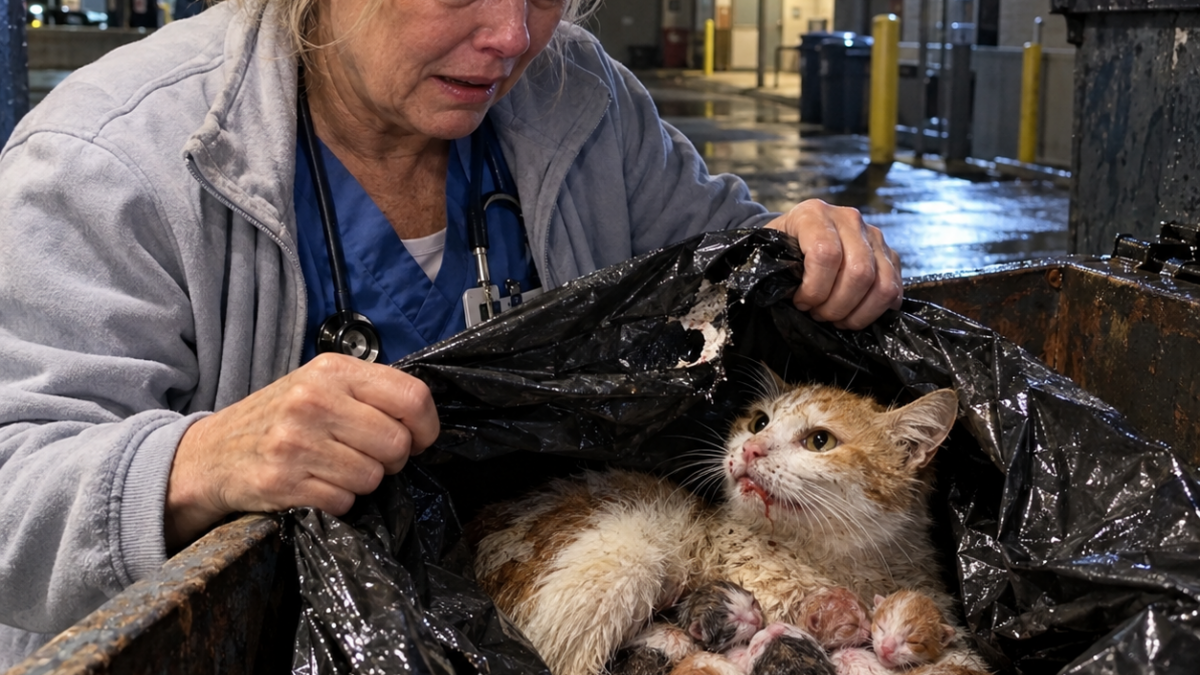
Inside the bag, curled in the darkness atop a flattened towel stained with birth fluids, was Clementine.
The little white-and-orange cat lay twisted around five newborn kittens.
For half a second, Evelyn could not move.
The mother cat’s fur was damp. Her sides rose and fell too quickly. Her eyes were enormous in the dim security light. Blood stained the white fur around her mouth. Her upper lip was torn. Saliva and blood darkened a small ragged hole chewed near the top of the bag, a hole barely wider than a quarter.
She had made it with her teeth.
She had made it while trapped inside a sealed plastic bag with five babies pressed against her belly.
The kittens were impossibly small.
Wet-looking.
Blind.
Barely furred.
Three squirmed weakly.
Two lay still.
Something old and fierce rose inside Evelyn.
Not panic.
Not horror.
Purpose.
She had felt it at nineteen when a premature baby turned blue in her hands and the senior nurse shouted, “Breathe for him until he remembers how.”
She felt it now.
“Okay,” she said, voice suddenly steady. “Okay, Mama. I’m here.”
Clementine stared at her.
The cat did not hiss.
She did not claw.
She did not try to run.
Her mouth opened, but no sound came out.
Then, as Evelyn carefully widened the torn bag, Clementine stopped crying entirely.
She simply watched.
Later, when people asked Evelyn what that moment felt like, she would struggle to explain it.
The cat’s silence was not surrender.
It was recognition.
As if every cry had been a signal sent into the dark, and once someone answered, she could save what little strength she had left.
Evelyn slipped her hands under the towel and lifted the entire bundle.
The mother cat flinched, then pressed her chin protectively over the kittens.
“I know,” Evelyn whispered. “I know. I’m taking all of you. Nobody gets left.”
The bag, the towel, the cat, and the kittens trembled in her arms.
Evelyn hurried toward the staff door.
The card reader blinked red the first time she swiped because her hands were slick with condensation, blood, and fear.
“No,” she said sharply.
She wiped her badge on her jacket and swiped again.
Green.
The door unlocked.
She pushed through with her shoulder and carried them inside.
The warm air of the hospital wrapped around them.
For a moment, the absurdity struck her.
She had spent forty-one years bringing human beings back from edges.
Now, in her final hours, she was carrying a bleeding stray cat and five newborn kittens down a restricted corridor beneath signs about infection control.
Then one of the kittens made a sound so faint Evelyn barely heard it.
And everything else stopped mattering.
“Maya!” Evelyn shouted.
Her voice cracked through the service hallway.
No answer.
She kept moving.
“Maya!”
A door opened near the supply room.
Luis Ortega, the night environmental services supervisor, stepped out holding a mop handle.
He was a broad-shouldered man in his fifties with kind eyes and a permanent expression of patient exhaustion. He saw Evelyn, saw the bundle in her arms, and his face changed.
“Madre de Dios,” he breathed. “Is that Mama?”
“Get Maya,” Evelyn said. “Now. And warm towels. Saline bags. The infant warmers are on the floor but don’t say that out loud. Move.”
Luis did not ask questions.
Good people rarely did in emergencies.
He dropped the mop handle and ran.
Evelyn carried Clementine into the small staff procedure room near the employee clinic, a space used for minor injuries and occupational health evaluations. It was technically closed at night, but Evelyn knew where the spare key was because she had known where everything was in that hospital for decades.
She pushed the door open with her hip, cleared a rolling cart with one arm, and set the bundle gently on the exam table.
The lights were too bright.
Clementine blinked, then immediately tried to curl tighter around the kittens.
“Easy,” Evelyn murmured. “Easy.”
She pulled on gloves, though part of her wanted bare hands, wanted touch and warmth and skin. Training won. She checked the kittens one by one.
Three were cold but moving.
One was colder.
The fifth was limp.
“No,” Evelyn said.
It was not a plea.
It was an order.
Maya burst in wearing a look Evelyn had seen on nurses entering bad rooms.
“What happened?”
“Trash container,” Evelyn said. “Black bag. Tied shut. Newborns, likely only a few hours old. Two critical. Mama has oral trauma, dehydration, possible shock. Get warmed saline bags, towels, a syringe, glucose if we can get veterinary guidance, and call Lakeside Animal Rescue. Tell them emergency neonatal kittens, mother injured.”
Maya stared for half a second.
Then she moved.
“On it.”
Luis came in behind her carrying towels from the warmer.
“I found these,” he said, breathless.
“Good. Put them there. Not too hot. We need gradual warming.”
“They were in the medical waste?” he asked.
Evelyn looked at him.
His face hardened.
“Who does that?” he whispered.
“Someone who thought nobody would open the bag.”
Maya returned with supplies.
For the next ninety minutes, the world narrowed to heat, breath, and tiny bodies.
Evelyn worked with the concentration of a surgeon.
She wrapped warmed saline bags in surgical towels and placed them near, not directly on, the coldest kittens. She rotated them every four minutes because direct heat could burn fragile skin. She rubbed gently with gauze to stimulate circulation. She checked color, movement, reflex. She spoke in a low, constant stream.
“Come on, little one. Come on. That’s it. You don’t get to leave after your mama worked that hard.”
Maya assisted silently at first, then began taking orders before Evelyn gave them.
“Fresh towel?”
“Now.”
“Bag cooling.”
“Switch it.”
“Rescue’s voicemail.”
“Call the emergency vet instead.”
“I’m calling both.”
Luis stood near the door, hands clenched, helpless in the way men often looked when they were kind but had never been taught what to do with tenderness under pressure.
Evelyn looked at him. “I need you to check the loading dock camera. See if security is at the desk.”
Luis nodded once and disappeared.
Clementine lay on the table, trembling violently.
Her mouth was bleeding again.
Every few minutes, she lifted her head despite the pain and tried to lick the kittens.
“Not yet,” Evelyn whispered, gently blocking her. “Let me get them warm first.”
The cat looked at her with such exhausted offense that Maya let out a choked laugh that turned into a sob.
“I’m sorry,” Maya said, wiping her cheek with her shoulder. “I’m sorry. I just—”
“Don’t apologize,” Evelyn said. “Crying means you’re still human. Just don’t drip on the sterile field.”
Maya laughed again, brokenly.
The smallest kitten did not respond for twenty-three minutes.
Evelyn knew because Maya kept time on her phone.
At 3:42 a.m., the kitten’s paw twitched.
Maya saw it first.
“Evie.”
“I see.”
The paw moved again.
Then the tiny mouth opened.
No sound came out, but the chest shuddered.
Evelyn bent close, her own breath held hostage.
“Again,” she whispered. “Give me another one.”
The kitten breathed.
Maya covered her mouth.
Evelyn kept rubbing.
At 3:58 a.m., the second limp kitten let out a thin, furious squeak.
It was the smallest sound in the room.
It sounded like victory.
Maya turned away and cried openly.
Luis reappeared at the door, stopped, and stared.
“He’s alive?” he asked.
“She,” Evelyn said, though she had not checked. “And yes.”
Luis crossed himself.
Clementine heard the squeak.
With a strength Evelyn could not understand, the injured cat pulled herself forward and placed one shaking paw over the kitten’s back.
Not herself.
Not her bleeding mouth.
The baby.
Evelyn looked at that paw and felt something inside her break cleanly, like ice cracking on a lake.
She thought of every mother she had watched choose pain if it meant a child might suffer less.
She thought of women in labor grabbing her hand hard enough to bruise while apologizing for hurting her.
She thought of Daniel during chemo, pushing away nausea long enough to ask if she had eaten.
She thought of all the quiet forms love took when no one was applauding.
“Okay, Mama,” she said, voice thick. “You did it. You kept them alive.”
Clementine closed her eyes.
At 4:19 a.m., the emergency veterinarian called back and walked them through what could safely be done until the rescue arrived. At 4:37, a volunteer named Tessa from Lakeside Animal Rescue answered on the third call, her voice rough with sleep until Maya explained.
“I’m coming,” Tessa said. “Keep them warm. Don’t separate if you don’t have to. I’ll be there in twenty-five.”
Evelyn looked at the clock.
Her retirement shift ended in less than three hours.
The thought felt obscene.
In another room, her cake waited beneath plastic wrap.
Her locker was empty.
Her farewell card sat on the break room table, full of messages about rest and gardening and long-deserved peace.
And in front of her lay a mother who had chewed through plastic until her mouth bled so her children could breathe.
There were moments in life when God, or fate, or whatever cruel and beautiful force watched over small creatures, placed a question in front of a person.
Who are you when no one important is looking?
Evelyn had spent forty-one years answering that question the same way.
She was not going to change on her last night.
At 4:46, Luis returned again.
His face was pale.
“I found Marcus in security,” he said.
Marcus Bell was the overnight security guard. He was twenty-six, new, and always nervous around administrators. Evelyn had once brought him soup when he worked through a snowstorm.
“He checked the camera?” Evelyn asked.
Luis hesitated.
“What?”
“He says the loading dock camera was offline from two-thirty to three-thirty.”
Maya looked up sharply. “That’s convenient.”
Luis nodded. “But the south hallway camera near the staff exit was working. He said Ms. Voss was here tonight.”
Evelyn stilled.
Maya’s eyes widened. “Rebecca?”
“At two-fifty-eight,” Luis said quietly. “She came through the service corridor with Kyle Draper.”
Evelyn knew the name.
Kyle Draper was the contracted waste disposal manager who had taken over when the hospital changed vendors. He wore expensive watches, called staff “team members” without remembering their names, and had once snapped at Luis for asking about overflowing sharps containers.
Maya’s voice dropped. “Why would Rebecca be here at three in the morning?”
Luis glanced at the cat. “Maybe because she didn’t want witnesses.”
Evelyn did not speak.
There were rules in hospitals about accusations.
There were procedures, chains of command, incident reports, official reviews, legal departments, risk management.
But there were also black garbage bags tied tight enough to kill.
“Did Marcus save the footage?” Evelyn asked.
Luis looked uncomfortable. “He said he can’t release footage without authorization.”
“Tell him to preserve it.”
“I did.”
“And?”
“He said Ms. Voss told him earlier tonight to archive nothing from the loading dock because maintenance was testing cameras.”
Maya cursed.
Evelyn took off one glove slowly.
Her face had gone very calm.
Maya knew that look.
Everyone who had ever underestimated Evelyn Hart should have feared that look.
“Luis,” Evelyn said, “I need you to do exactly what I tell you. Do not break the law. Do not steal anything. But write down what Marcus told you. Time. Words. Everything. Sign it.”
Luis nodded.
“Maya, document the condition in which they were found. Photos. Not for social media. Evidence. Include the bag. Include the knot. Include the hole she chewed.”
Maya already had her phone out.
“Use hospital incident reporting too,” Evelyn said.
“That goes to Rebecca’s office,” Maya replied.
“Yes,” Evelyn said. “And once it does, she will know we know. So before that happens, we make sure other people know too.”
Maya swallowed. “Who?”
“Animal control. Police non-emergency. The state veterinary board if needed. And Dr. Whitaker.”
Maya blinked. “The chief medical officer?”
“He owes me.”
“Why?”
“I kept his first wife from suing this hospital in 1998.”
Luis stared.
Evelyn gave him a look. “Long story.”
At 5:03 a.m., Tessa from Lakeside Animal Rescue arrived through the ambulance bay wearing pajama pants under a heavy coat, hair shoved beneath a knit hat, and the fierce expression of someone who had seen too much cruelty to be surprised but still enough goodness to keep coming.
She took one look at Clementine and the kittens and whispered, “Oh, sweetheart.”
For reasons Evelyn could not explain, those two words nearly undid her.
Tessa worked quickly, gently examining the cat’s mouth, checking hydration, warming the kittens further, preparing a carrier lined with clean blankets and heat packs.
“She needs a vet immediately,” Tessa said. “Mouth trauma, cracked teeth likely, dehydration. Kittens need monitoring every hour.”
“I’m coming with you,” Evelyn said.
Maya turned. “Evie, your shift—”
“My shift ends at seven.”
“The retirement breakfast—”
“Can wait.”
Maya’s eyes shone.
Tessa looked between them. “You’re the nurse retiring today?”
Evelyn nodded.
Tessa’s face softened. “Hell of a last shift.”
Evelyn looked at Clementine, who was trying again to clean the kittens despite blood at her mouth.
“No,” she said. “It’s a reminder.”
At 5:22, Dr. Alan Whitaker arrived in the procedure room wearing a wrinkled dress shirt under his coat and the expression of a man dragged from sleep into a moral crisis.
He was seventy, half-retired himself, white-haired and sharp-eyed. He had delivered bad news to families for thirty-five years and still remembered every nurse who had stood beside him when words failed.
“Evelyn,” he said, taking in the room. “Maya called.”
“Thank you for coming.”
His gaze moved to the cat, the kittens, the black bag on the counter, the bloody hole in the plastic.
The softness left his face.
“Who found them?”
“I did.”
“Where?”
“Regulated waste container behind the loading dock.”
Dr. Whitaker’s jaw tightened. “Living animals were placed in a medical waste container?”
“Yes.”
“Inside a sealed plastic bag?”
“Yes.”
“And the security camera?”
“Conveniently offline.”
His eyes flicked to her.
Evelyn held his gaze.
He understood.
Doctors and nurses develop a second language after enough years inside institutions. It is made of pauses, glances, and omissions. It is the language used when the truth is too dangerous to say before the evidence is safe.
Dr. Whitaker turned to Maya. “Have you documented everything?”
“Yes, sir.”
“Send copies to me. Personal email. Not hospital.”
Maya blinked. “Sir?”
He looked at her over his glasses. “Did I stutter?”
“No, sir.”
He pointed to the bag. “Do not let that disappear.”
Evelyn picked it up carefully with gloved hands and placed it inside a clear evidence bag from the employee clinic supply cabinet.
Dr. Whitaker watched her seal it.
Then he said quietly, “Rebecca Voss has been trying to close the old charity clinic wing for six months. She hates anything that makes us look uncontrolled. Strays. Volunteers. Poor patients. Nurses who remember this place before it became a brand.”
Evelyn said nothing.
Dr. Whitaker looked toward the carrier where Clementine lay with her kittens. “I’m not accusing anyone without proof.”
“No,” Evelyn said. “Neither am I.”
“But I know what arrogance smells like,” he said.
“So do I.”
At 5:41, animal control arrived with a police officer named Dana Mercer.
Officer Mercer was in her forties, with tired eyes, a calm voice, and the kind of presence that made people stand straighter without knowing why. She listened as Evelyn explained. She looked at the bag. She photographed the knot, the hole, the blood. She spoke to Tessa. She spoke to Maya. She spoke to Luis.
Then she stood beside the exam table and looked at Clementine.
The mother cat opened one eye.
Officer Mercer exhaled slowly.
“My grandmother used to say you can judge a person by what they do to something that can’t fight back.”
Evelyn nodded. “Your grandmother was right.”
“This is animal cruelty,” Officer Mercer said. “Potentially aggravated, depending on intent and injuries. Also improper disposal and possible tampering if hospital cameras were intentionally disabled. I’ll need formal statements.”
“You’ll have mine,” Evelyn said.
Officer Mercer studied her. “I heard today was your last day.”
“So did I.”
For the first time, the officer smiled faintly. “Life has poor timing.”
“No,” Evelyn said, looking at Clementine. “Sometimes it has perfect timing and terrible manners.”
At 6:18 a.m., Rebecca Voss walked into the procedure room.
She did not knock.
She wore a camel-colored coat over a cream blouse, her hair smooth, her makeup flawless, her expression arranged into concern so polished it looked manufactured.
Behind her came Kyle Draper, the waste vendor manager, broad-faced and tense, holding a tablet like a shield.
“What is going on here?” Rebecca asked.
No one answered immediately.
Evelyn was sitting beside the carrier with Clementine’s kittens tucked against their mother. Maya stood near the counter. Luis leaned against the wall, arms crossed. Dr. Whitaker stood near the door with Officer Mercer beside him.
Rebecca’s eyes moved across the room and landed on the cat.
Something flickered in her face.
Not surprise.
Recognition.
Evelyn saw it.
So did Dr. Whitaker.
Rebecca recovered quickly. “Why is there an animal in a clinical space?”
Maya opened her mouth.
Evelyn lifted one hand slightly.
Maya closed it.
Rebecca turned to Evelyn. “Mrs. Hart, I understand emotions are high on your last day, but this is a serious violation of infection control.”
Officer Mercer stepped forward. “I’m Officer Mercer. This is an active animal cruelty investigation.”
Rebecca’s posture stiffened. “Investigation?”
“Yes, ma’am.”
Kyle shifted behind her.
Rebecca gave a small laugh, the kind people use when trying to put reality back in its place. “Surely that’s unnecessary. We’ve had an ongoing stray animal issue. It’s possible a staff member mishandled a disposal bag or—”
“A living cat and five newborn kittens were tied inside a trash bag and placed in the regulated medical waste container,” Evelyn said.
Her voice was quiet.
That made it worse.
Rebecca’s eyes sharpened. “And you believe that happened deliberately?”
“The knot believes it.”
Maya looked down to hide the flash of satisfaction on her face.
Rebecca’s smile thinned. “Evelyn, I understand you’ve been attached to this animal. But we cannot allow staff to create hysteria over a stray cat.”
Tessa, who had been kneeling by the carrier, stood slowly.
“She chewed a hole in plastic until she split her mouth open,” Tessa said. “Two kittens were nearly dead. That’s not hysteria. That’s evidence.”
Rebecca looked at her as if noticing her for the first time. “And you are?”
“Tessa Reed. Lakeside Animal Rescue.”
“I don’t recall authorizing an outside rescue inside this facility.”
Officer Mercer said, “I did.”
Rebecca turned back to the officer. “Officer, St. Agnes will cooperate fully, of course. But this is private hospital property, and there are protocols—”
“Then you’ll understand why I need security footage preserved immediately.”
Rebecca’s face did not change.
Kyle’s did.
Evelyn saw his hand tighten around the tablet.
“Unfortunately,” Rebecca said smoothly, “some of our exterior cameras were undergoing maintenance overnight.”
“At three in the morning?” Dr. Whitaker asked.
Rebecca turned to him. “Alan. I didn’t realize you were here.”
“I came when a nurse with more integrity than most boards of directors called me.”
The room went still.
Rebecca’s eyes cooled. “That’s unnecessary.”
“So is tying newborn animals in a garbage bag.”
“I did no such thing.”
No one had accused her.
Not directly.
The words hung there.
Officer Mercer wrote something down.
Rebecca realized her mistake a heartbeat too late.
“I mean,” she said, “obviously no one here would do something like that.”
Evelyn stood.
She was not tall, but something about her made the room pull toward her.
“Then you’ll have no objection to preserving all footage from every camera between two and four this morning,” she said. “Interior, exterior, service corridor, loading dock access, security desk. You’ll also preserve key card logs for the staff exit and waste enclosure.”
Rebecca’s jaw tightened. “Mrs. Hart, you are no longer in a position to make administrative demands.”
“My shift ends at seven.”
“It may end earlier.”
Maya’s head snapped up.
Dr. Whitaker took one step forward. “Careful, Rebecca.”
Rebecca looked at him. “Are you threatening me?”
“No. I’m reminding you that retaliation against a mandated reporter and witness to a suspected crime tends to look bad in court.”
Evelyn felt the words settle over the room.
Court.
That was when Kyle Draper cleared his throat.
“I have a pickup schedule,” he said. “I’m supposed to clear that container by six-thirty. If law enforcement is done, my team needs to proceed.”
Officer Mercer turned to him. “Your pickup is suspended.”
Kyle blinked. “Excuse me?”
“That container is part of a crime scene until cleared.”
Rebecca said, “Officer, that creates regulatory complications.”
“I imagine tying animals in a medical waste bin creates a few too.”
Maya coughed to hide a laugh.
Rebecca looked at Evelyn with something close to hatred.
For the first time that night, Evelyn saw the woman beneath the polish.
Not powerful.
Not composed.
Afraid.
But fear in people like Rebecca rarely looked like humility. It looked like anger.
“This,” Rebecca said, voice low, “is exactly why boundaries matter. For years, this hospital has tolerated staff acting on emotion instead of policy. Feeding strays. Hoarding expired supplies for charity patients. Staying late without authorization. Treating this facility like some personal mission instead of a modern healthcare operation.”
Evelyn listened.
There it was.
Not about infection control.
Not about safety.
About contempt.
“For forty-one years,” Evelyn said, “this hospital was a place where people came when they were hurt.”
Rebecca’s eyes flashed. “It still is.”
“No,” Evelyn said. “People still come here hurt. That is not the same thing.”
Silence.
Rebecca stepped closer. “You should be very careful how you choose to end your career.”
Evelyn met her gaze.
“My career ended the way it began,” she said. “With something helpless in my hands and someone telling me not to care too much.”
No one spoke.
Then Clementine made a low sound from inside the carrier.
Every eye turned.
One of the kittens had wriggled away from her belly. Though the mother cat trembled with exhaustion, though her mouth was swollen and split, she lowered her head and dragged the kitten gently back against her body.
She winced as she did it.
But she did it.
Officer Mercer looked from the cat to Rebecca.
Rebecca looked away first.
At 6:52 a.m., the carrier was loaded into Tessa’s rescue van.
Evelyn rode with them.
She did not clock out.
She did not attend the breakfast.
She did not cut the cake.
Maya followed in her own car. Luis promised to stay long enough to give his written statement. Dr. Whitaker remained behind to speak with hospital legal and, Evelyn suspected, to make Rebecca regret many recent life choices.
As the rescue van pulled away from St. Agnes, Evelyn looked back at the building.
For more than four decades, that hospital had been the center of her life.
She had entered it at twenty-two, newly licensed, terrified, wearing white shoes she polished every night because the older nurses said scuffed shoes showed a lazy mind.
She was leaving at sixty-three in the passenger seat of an animal rescue van with blood on her scrub top and a black garbage bag sealed in evidence behind a police officer’s report.
It was not the goodbye anyone had planned.
Maybe that was why it felt honest.
The emergency veterinary clinic smelled different from the hospital.
Less bleach.
More fur.
More fear in the waiting room, but a softer kind. People clutching carriers. Dogs leaning against legs. A teenager crying over a rabbit wrapped in a towel. An old man whispering to a Labrador that had probably once been young enough to pull him down sidewalks.
Clementine was taken back immediately.
Evelyn stood in the exam room while Dr. Priya Shah, the emergency veterinarian, assessed her with quick, gentle hands.
“She recently gave birth,” Dr. Shah said. “Within hours. Oral lacerations. Upper lip tear. Two fractured teeth. Dehydration. Mild hypothermia but improving. She’s underweight. No obvious fractures. Kittens are premature or small but viable.”
“Will they live?” Evelyn asked.
Dr. Shah looked at her.
Veterinary doctors, Evelyn learned in that moment, had the same eyes as human doctors when asked a question that deserved hope but required truth.
“They have a chance,” Dr. Shah said. “A real one, because you got them warm. Neonates crash fast. Those two you revived might not have lasted another fifteen minutes.”
Maya, standing beside Evelyn, covered her mouth.
Evelyn nodded, absorbing the information the way nurses do.
Later, she might feel it.
Now, she needed instructions.
“What does she need?”
“Fluids. Pain control safe for nursing. Antibiotics. Dental follow-up once she stabilizes. Soft food. Close monitoring. The mouth will hurt every time she grooms or eats. Nursing may be painful because of positioning and exhaustion, but cats are extraordinary mothers.”
“She already proved that,” Evelyn said.
Dr. Shah smiled sadly. “Yes. She did.”
They cleaned Clementine’s wounds.
The cat tolerated everything with quiet, watchful dignity until they tried to take the kittens too far from her. Then she struggled, weak but fierce, trying to rise despite trembling legs.
“Okay,” Dr. Shah murmured. “Okay, Mama. We hear you.”
Evelyn stepped closer. “Can she keep them with her?”
“Yes. As long as she’s stable.”
When the kittens were placed back against Clementine, she lowered her head and began cleaning them again.
Her tongue moved carefully.
Every movement hurt.
Evelyn saw it in the flinch of her whiskers, the pause after each lick, the way her eyes squeezed shut.
But she did not stop.
Tessa whispered, “I’ve seen a lot of mothers. She’s something else.”
Evelyn watched Clementine work.
“No,” she said softly. “She’s exactly what a mother is when nobody interrupts her courage.”
By 10:30 that morning, the story was no longer contained.
Maya had not posted anything publicly, but hospitals are made of walls with ears. Staff knew. Security knew. Animal control knew. A police report existed. Dr. Whitaker had sent an email to the hospital board requesting immediate preservation of footage and records, copying legal counsel, risk management, and the county investigator.
Rebecca Voss responded at 9:12 a.m. with a formal statement about “unverified allegations,” “emotional escalation by departing staff,” and “unauthorized removal of material from hospital property.”
At 9:27, Dr. Whitaker replied to all.
The “material” in question was a living mother cat and five newborn kittens found tied inside a plastic bag in a medical waste container. Choose your next words carefully.
Maya showed Evelyn the email on her phone in the vet clinic parking lot.
Evelyn read it twice.
Then she sat down on the curb and laughed.
Not because it was funny.
Because exhaustion had finally found a crack.
Maya sat beside her.
The sky had turned pale gray. Morning traffic moved beyond the clinic. Evelyn’s scrub pants were stained. Her hair had escaped its clip. Her retirement crown, which Maya had apparently brought from the break room, sat absurdly in her lap.
“You missed your party,” Maya said.
“I was busy.”
“They’re saving the cake.”
“Good. Cake improves with scandal.”
Maya leaned her shoulder against Evelyn’s. “Are you okay?”
Evelyn watched a woman carry a shaking Chihuahua through the clinic doors.
“No,” she said honestly. “But I’m steady.”
“That’s not the same.”
“No. It’s what comes before okay.”
Maya nodded.
For a while, they sat without speaking.
Then Maya said, “You know they’re going to come after you.”
“Yes.”
“You’re retired now. They can’t fire you.”
“They can still try to make me look foolish. Angry. Unstable. An old nurse too attached to a stray cat.”
Maya’s face hardened. “That’s not what happened.”
“I know.”
“We all know.”
Evelyn looked at her. “Knowing is not the same as proving.”
Maya pulled out her phone. “Then we prove it.”
Over the next forty-eight hours, the truth began to surface in pieces.
Not all at once.
Truth rarely arrives politely.
It came through a janitor who remembered seeing Kyle Draper near the waste enclosure at 2:41 a.m.
It came through a cafeteria worker who had heard Rebecca arguing with someone in the service corridor about “getting rid of the problem before the accreditation walkthrough.”
It came through key card logs showing Rebecca entered the rear staff corridor at 2:52 a.m. and Kyle accessed the waste enclosure at 3:01.
It came through Marcus, the young security guard, who first claimed he knew nothing, then broke down when Officer Mercer asked why the loading dock camera had been disabled manually from the security desk.
Marcus cried when he told them.
Rebecca had instructed him to turn off the loading dock camera for “maintenance testing.” She had said the COO had authority. She had said it was routine. She had told him not to log it because the new vendor was correcting a camera angle before an inspection.
He had believed her because she wore authority like armor.
Then Kyle arrived carrying something in a black bag.
Marcus had seen it on the south hallway camera, the one Rebecca forgot about.
He had not known what was inside.
He had told himself it was trash.
People tell themselves many things when power asks them not to notice.
The camera did not show Kyle tying the bag.
It did not show Rebecca touching it.
But it showed enough.
Rebecca Voss and Kyle Draper walking through the service corridor at 2:58 a.m.
Kyle carrying a tied black garbage bag with both hands.
Rebecca holding the door open.
The bag moving.
Rebecca looking down at it.
Kyle saying something.
Rebecca recoiling, then gesturing sharply toward the exit.
At 3:03, they returned without the bag.
At 3:06, Rebecca stopped at the security desk.
At 3:08, Marcus disabled the loading dock camera.
At 3:14, Evelyn heard the cry.
That timeline became the spine of the investigation.
But the heart of it came from the people Rebecca had overlooked.
The kitchen workers.
The janitors.
The nurses.
The transporters.
The exhausted, underpaid, invisible people who knew how buildings breathed at night.
Darlene from the cafeteria admitted Clementine had given birth behind the old linen carts near the unused storage alcove.
“She was scared,” Darlene told Officer Mercer, twisting a napkin in her hands. “I heard little squeaks. I thought, oh Lord, she had them here. I put a towel down. I was going to call the rescue after breakfast rush. Then Ms. Voss came through.”
According to Darlene, Rebecca had seen the cat and kittens at approximately 1:40 a.m. during a late inspection with Kyle Draper.
“She went cold,” Darlene said. “Not scared. Cold. She said, ‘This is exactly the kind of thing that makes us look like a county shelter instead of a hospital.’ I told her I’d call someone. I said I’d handle it. She told me my job was food service, not animal control.”
Darlene’s voice broke.
“I should’ve stayed with them.”
Evelyn heard that later and called her.
“You did not do this,” Evelyn said.
“I left them.”
“You planned to help.”
“It wasn’t enough.”
“No,” Evelyn said, “but guilt belongs to the person who tied the bag. Do not steal responsibility from the cruel. They already take enough.”
Darlene cried then.
So did Evelyn, after she hung up.
The local news learned of the story on the third day.
No one knew who tipped them.
Maya claimed innocence with an expression so unconvincing Evelyn almost smiled.
The first article was small.
Retiring Nurse Rescues Cat And Newborn Kittens From Hospital Waste Container.
Then came a larger piece.
Security Footage Raises Questions After Animals Found Tied In Trash Bag At St. Agnes.
By the end of the week, Clementine had a new name.
Not officially.
Not yet.
But online, people started calling her the Last Shift Cat.
Because Evelyn’s last shift had become her first act of retirement.
Photos released by the rescue showed the mother cat lying in a soft blanket with five kittens pressed against her belly. Her mouth was swollen, her eyes tired, but her paw rested protectively over the smallest kitten.
The image spread faster than anyone expected.
People donated.
They sent blankets, kitten formula, heating pads, soft food, vet funds.
Children mailed drawings.
Retired nurses wrote letters.
Mothers wrote paragraphs about nights they had stayed awake with sick babies, about pain they endured quietly because love had no off switch, about the way an animal in a garbage bag somehow made them feel seen.
But admiration has a shadow.
Where there is attention, there is defense.
And where there is defense, people with money hire language.
St. Agnes released a public statement.
We are aware of an incident involving a stray animal found near hospital property. We take all concerns seriously and are cooperating with authorities. At this time, there is no evidence that hospital leadership engaged in wrongdoing. We ask the public to avoid speculation and respect the privacy of our employees.
Near hospital property.
Evelyn read those three words at her kitchen table.
Her house was small, yellow, and quiet, with Daniel’s old woodworking tools still arranged in the garage exactly as he had left them because grief sometimes made museums out of ordinary rooms. A maple tree shed leaves across the front walk. The refrigerator hummed. The retirement flowers from the hospital sat in a vase beside a stack of unopened cards.
Near hospital property.
Not inside a medical waste container.
Not tied in a bag.
Not bleeding.
Near.
She had spent decades charting facts precisely because lives depended on truth.
Respirations 8 and shallow.
Blood pressure 82 over 46.
Patient reports pain 9 out of 10.
Two newborn kittens hypothermic and unresponsive.
Mother cat chewed breathing hole in sealed bag until mouth bled.
Truth mattered because false language was often where harm hid.
At 7:12 that evening, Evelyn’s phone rang.
Unknown number.
She answered.
“Mrs. Hart?” a smooth male voice asked. “This is Anthony Keller. I represent St. Agnes Regional Medical Center.”
Evelyn looked at the phone, then put it on speaker and set it on the table.
“Good evening.”
“I’m calling regarding recent public statements and media attention surrounding the animal incident.”
“The animal cruelty case,” Evelyn corrected.
A pause.
“The alleged incident.”
“No,” Evelyn said. “The alleged perpetrator is unknown. The incident happened.”
Another pause.
Mr. Keller tried a warmer tone. “Of course. We understand this has been emotional. Given your long and valued history with St. Agnes, the hospital would like to resolve this matter respectfully.”
“Resolve?”
“We’re prepared to offer you a formal retirement recognition, including an additional stipend, in exchange for a mutual non-disparagement agreement and the return of any hospital property or materials currently in your possession.”
Evelyn looked at Daniel’s photograph on the sideboard.
He had been a high school history teacher. He used to tell his students that corruption rarely began with evil laughter. It began with people making peace with smaller lies.
“What materials?” she asked.
“Any photographs, internal communications, or physical items connected to the incident.”
“The bag.”
“If you possess it, yes.”
“It is evidence.”
“It is hospital waste material.”
“It had six living beings inside it.”
Mr. Keller’s voice cooled. “Mrs. Hart, you should understand that regulated medical disposal materials are subject to strict handling laws. Removing them could create liability.”
Evelyn almost admired the audacity.
Almost.
“Are you suggesting I should have left them in the container?”
“I’m suggesting public narratives can become complicated.”
“No,” Evelyn said. “Suffering is complicated. Your sentence is not.”
“Mrs. Hart—”
“I am going to say this once. The police have photographs. Animal control has statements. The rescue has veterinary records. Dr. Whitaker has documentation. I have no interest in money from St. Agnes. I have no interest in a retirement plaque large enough to cover a crime. And if you call me again to suggest that saving newborn animals from a sealed garbage bag was a liability issue, I will invite Officer Mercer to join the conversation.”
Silence.
Then Mr. Keller said, “You may want to consult counsel.”
“I already consulted my conscience,” Evelyn said. “It had a shorter wait time.”
She hung up.
Her hands shook afterward.
Courage often looks clean from the outside. Inside, it can feel like nausea, trembling, and wishing someone else could carry the weight for one hour.
Evelyn made tea she did not drink.
Then she drove to the veterinary clinic.
Tessa had arranged a foster room in the back for Clementine and the kittens. A small camera monitored them. Heat lamps warmed the nesting box. A sign on the door read QUIET PLEASE: NURSING MOTHER.
Evelyn stood outside the glass window.
Clementine lay curled around her kittens.
Her mouth was still swollen, but she lifted her head when Evelyn entered.
“Hi, Mama,” Evelyn whispered.
The cat’s ears twitched.
Tessa stood beside Evelyn. “She knows you.”
“She knows I come with soft food.”
“No,” Tessa said. “She knows you.”
Evelyn sat in the chair near the nesting box.
Clementine watched her for a long moment.
Then, slowly, painfully, she stood, stepped over her kittens, crossed the blanket, and pressed her forehead against Evelyn’s wrist.
Evelyn’s eyes filled instantly.
“Oh,” she whispered. “There you are.”
The cat leaned into her hand.
Evelyn stroked the orange patch between her ears with one finger.
“You did so well,” she said. “You impossible, stubborn, brave little thing.”
Clementine closed her eyes.
For the next six weeks, Evelyn visited almost every day.
At first, she told herself she was only helping.
Tessa needed volunteers.
The kittens needed weighing.
Clementine needed medication.
Evelyn, newly retired, needed somewhere to put the hours that used to belong to the hospital.
But the truth was simpler.
She loved them.
The kittens grew from trembling commas of life into noisy, demanding little creatures with round bellies and ridiculous confidence.
Tessa named them after things connected to survival.
Spark.
Mercy.
Bishop.
June.
And Penny, the smallest, who had been one of the two nearly lost that night.
Penny became Evelyn’s favorite, though she denied having one.
Penny was white with a tiny orange spot on her head and a voice far too large for her body. She nursed with ferocious determination and later learned to climb out of the box before the others, usually to crawl into Evelyn’s lap and fall asleep like she had accomplished something heroic.
Clementine healed slowly.
The cuts inside her mouth closed.
The swelling faded.
The cracked teeth had to be treated, one removed and one smoothed to prevent pain.
For weeks, nursing hurt her.
Dr. Shah confirmed what Evelyn already saw.
Every feeding caused discomfort.
Every time the kittens latched and kneaded and shifted, Clementine’s jaw tightened. Sometimes she paused and breathed through it.
But she never pushed them away.
Not once.
Eight to ten times a day, she fed them.
For six weeks.
Around 350 feedings with a wounded mouth.
Evelyn counted because nurses count.
Not because numbers capture love.
Because sometimes numbers are the only way to force people to understand the size of sacrifice.
During those weeks, the investigation widened.
Kyle Draper was the first to break.
Men like Kyle often confuse arrogance with loyalty until consequences enter the room.
According to Officer Mercer, Kyle initially claimed he had removed “contaminated animal matter” from the service corridor after Rebecca ordered him to handle it.
Then his attorney arrived.
Then security footage from the south hallway emerged.
Then Marcus’s statement confirmed camera tampering.
Then Kyle changed his story.
He said Rebecca had instructed him to “bag the animals and dispose of them off-site.” He claimed he thought they were dead.
That lie lasted eight minutes.
Because the hallway camera had audio.
Not perfect.
Not courtroom-drama clear.
But clear enough.
The recording captured Rebecca’s voice saying, “Is it still making noise?”
Kyle said, “Yeah.”
Rebecca said, “Then don’t stand there holding it where someone can hear.”
Kyle said, “This isn’t part of my contract.”
Rebecca said, “Your contract gets renewed next month. Handle it.”
Handle it.
Two words.
A whole moral collapse.
The public did not hear the recording at first, but the investigators did. So did hospital legal. So did the board.
Rebecca was placed on administrative leave.
The hospital statement changed.
St. Agnes is deeply disturbed by emerging information and has initiated an independent review.
Evelyn read that sentence aloud to Clementine during one visit.
“Emerging information,” she said. “That’s what they call getting caught.”
Clementine blinked.
Penny bit Evelyn’s shoelace.
“Yes,” Evelyn said. “Exactly.”
But justice moved slowly, and Rebecca did not go quietly.
Through anonymous sources, stories began appearing online.
A retired nurse with a history of conflict.
An emotional staff member known for feeding strays despite policy.
Questions about whether the animals were actually inside the container or merely nearby.
Claims that activists were exploiting the hospital.
Evelyn tried not to read comments, failed, then regretted it.
Most were kind.
Some were cruel.
That is the ratio of humanity in public.
One evening, she found a comment under a news post that made her sit very still.
Maybe the nurse staged it for attention. Old people hate becoming irrelevant.
Evelyn stared at the words.
Old people hate becoming irrelevant.
She thought she had developed thick skin after forty-one years.
She had been yelled at by drunk patients, cursed by frightened families, insulted by doctors before hospitals learned to pretend hierarchy had softened. She had been vomited on, bled on, lied to, blamed, thanked, hugged, and forgotten.
But that sentence found the bruise.
Because some part of her had feared it was true.
Not that she staged anything.
Never that.
But that she had become irrelevant.
That the world had moved on while she was washing hands and warming blankets. That her kind of care belonged to a slower time. That people like Rebecca were the future, and people like Evelyn were sentimental artifacts being politely thanked out the door.
She closed the laptop.
The house felt too quiet.
She went to Daniel’s side of the closet and opened the door.
His shirts still hung there.
Not all of them.
She had donated many.
But a few remained because grief negotiated in pieces.
She touched the sleeve of his blue flannel.
“You’d know what to say,” she whispered.
Of course, he did not answer.
The dead never say what we want.
They say what they already left inside us.
Evelyn remembered Daniel in his classroom, sleeves rolled, chalk dust on his fingers, telling teenagers that history turned because ordinary people refused to let powerful people define reality.
“Don’t underestimate a witness,” he had said once over dinner. “Kings hate witnesses. Bosses hate witnesses. Bullies hate witnesses. A witness says, ‘I saw what you did, and I will not let you rename it.’”
Evelyn stood in the closet doorway and breathed until the tightness in her chest eased.
The next morning, she gave her first interview.
She had refused three television requests and five online shows. She did not want spectacle. She did not want to become a character in someone else’s outrage machine.
But when a local journalist named Hannah Pierce asked to sit with her quietly at the rescue and focus on the facts, Evelyn agreed.
They met in the foster room.
Hannah was younger than Evelyn expected, maybe twenty-eight, with a notebook instead of a camera crew and a gentleness that did not feel fake.
She watched Clementine nurse the kittens, then asked, “What do you want people to understand?”
Evelyn looked at the cat.
Clementine’s eyes were half-closed. Penny and Spark were tucked against her belly. Bishop was upside down. June was kneading the blanket with great seriousness. Mercy had fallen asleep with milk on his chin.
“I want them to understand she was not trash,” Evelyn said.
Hannah wrote that down.
Evelyn continued. “That sounds simple, but cruelty begins when someone decides a living thing is inconvenient enough to stop being real. A stray cat. A patient without insurance. An old nurse. A cafeteria worker. A janitor. A mother in pain. The moment you accept that some lives are just problems to dispose of, you become capable of terrible things while still thinking of yourself as efficient.”
Hannah looked up slowly.
“Do you believe that’s what happened at St. Agnes?”
“I believe a mother and five newborns were tied in a bag and thrown where they were not expected to survive,” Evelyn said. “I believe someone counted on the rest of us being too busy, too tired, or too afraid to hear them.”
“And you heard them.”
Evelyn shook her head.
“She made sure I did.”
The article came out two days later.
Its headline was simple.
“She Was Not Trash”: Retired Nurse Speaks After Rescuing Mother Cat From Hospital Waste Bin.
It went national by evening.
But the line people repeated most came near the end.
Cruelty begins when someone decides a living thing is inconvenient enough to stop being real.
Evelyn did not know how to feel about becoming a quote.
She preferred being useful.
The hospital board scheduled a public meeting under pressure from donors, staff, animal welfare groups, and a county commissioner who had adopted three rescue dogs and knew a political firestorm when she smelled one.
Evelyn did not want to attend.
Maya insisted.
Tessa insisted.
Dr. Whitaker called and said, “You don’t owe them your presence, but they owe you the discomfort of looking at you.”
So Evelyn went.
The meeting was held in the hospital auditorium, a room normally used for training seminars, blood drives, and cheerful PowerPoint presentations about patient engagement. That evening, every seat was full.
Staff lined the walls.
Reporters stood at the back.
Luis sat with Darlene.
Maya sat beside Evelyn, one hand wrapped around a paper cup of coffee she never drank.
Rebecca Voss sat at the front with her attorney.
She looked thinner.
Still polished, but brittle now.
Kyle Draper was not present.
His contract had been terminated. Charges were pending. Rumor said he had taken a plea deal in exchange for cooperation.
The board chair, a silver-haired man named Charles Whitcomb, opened with language.
Institutions love language.
He spoke of concern, disappointment, transparency, process, values, trust, ongoing review.
Evelyn listened until the words blurred into the familiar fog organizations release when trying to look repentant without bleeding money.
Then public comments began.
A young nurse spoke first.
Then Luis.
Then Darlene, voice shaking, described finding Clementine in the service corridor and being ordered away.
Rebecca stared at the table.
When Maya stood, Evelyn felt something shift in the room.
Maya walked to the microphone in navy scrubs, hair pulled back, badge clipped at her chest.
“My name is Maya Flores,” she said. “I’ve been a registered nurse at St. Agnes for seven years. Evelyn Hart trained me.”
Her voice wavered slightly, then steadied.
“When I started here, I thought nursing was mostly skill. Medications. Charting. Procedures. Staying calm. Evelyn taught me that skill matters, but attention matters more. She taught me to notice when a patient says they’re fine but their hand is gripping the sheet. She taught me to listen when no one else thinks there’s anything worth hearing.”
She turned, looking directly at the board.
“That night, she heard a dying animal behind a building full of people. She heard her because listening is who she is. And the fact that this hospital tried to reduce that to a policy violation is exactly why so many of us are exhausted.”
Applause rose.
The board chair tapped his microphone. “Please, let’s maintain order.”
Maya did not move.
“I’m not finished.”
The room quieted.
Maya looked at Rebecca.
“For two years, we have been told compassion is inefficient. We have been warned about overtime for sitting with dying patients. We have been told not to feed hungry animals, not to make waves, not to embarrass leadership, not to document too much in emails. This cat was not the first living thing treated as a problem here. She was just the first one who made enough noise after being thrown away.”
This time the applause was louder.
Rebecca’s attorney leaned toward her and whispered.
Evelyn sat very still, tears in her eyes.
Then Dr. Whitaker stood.
He did not go to the microphone immediately.
He moved slowly, every year of his age visible but none of his authority diminished.
“My name is Alan Whitaker,” he said. “I have served as physician, department chair, medical director, and chief medical officer in this hospital for thirty-seven years. I have made mistakes. This institution has made mistakes. But there are lines that cannot be crossed by policy, budget pressure, public relations, or ambition.”
He held up a folder.
“In this folder are statements from thirty-two staff members who describe a culture of intimidation under current operations leadership. Not disagreement. Intimidation. Nurses discouraged from filing safety reports. Environmental services staff threatened for raising sanitation concerns. Food service workers told they were replaceable when they tried to help an animal in distress.”
The board members shifted.
Rebecca’s face drained of color.
Dr. Whitaker continued. “Also included is the preliminary timeline from the county investigation. I will not disclose evidence improperly. But I will say this: any statement from this hospital minimizing what happened is not only morally shameful, it is factually reckless.”
The room went silent.
He looked at Evelyn.
“This hospital became respected because people like Evelyn Hart made it worthy of trust one bedside at a time. If leadership believes reputation can be protected by hiding cruelty instead of confronting it, then leadership has confused branding with honor.”
He stepped back.
For several seconds, no one moved.
Then the room erupted.
The board chair gave up tapping his microphone.
Evelyn lowered her head.
Maya squeezed her hand.
Then someone called her name.
“Mrs. Hart?”
It was the board chair.
Evelyn looked up.
“Would you like to speak?”
Every instinct in her body said no.
She was tired.
She hated microphones.
She had not come to perform pain for a room full of strangers.
But then she looked at Rebecca.
Not because she wanted revenge.
Because Rebecca was staring at her with the same expression she had worn in the procedure room.
Anger.
Fear.
Contempt.
The look of a woman who still believed the worst thing about what she had done was that others had found out.
Evelyn stood.
The room quieted before she reached the microphone.
She had worn a simple gray sweater, black pants, and her nursing pin on the left side of her chest. Not the retirement crown. Not the old badge.
The pin had been given to her at graduation forty-one years earlier.
Daniel had polished it the night before her first shift.
She touched it once, then spoke.
“My name is Evelyn Hart. I was a nurse here for forty-one years.”
Was.
The word landed hard.
“I thought my last night would be quiet,” she said. “I thought I would finish charting, eat a piece of cake, hug my coworkers, and leave through the front doors like a person ready to become someone else.”
A few soft laughs moved through the room.
“But at 3:14 in the morning, I heard a sound behind the hospital. It was small. So small I almost dismissed it. When I found the bag, it was tied shut. Not loosely. Not accidentally. Tied. Inside was a mother cat and five newborn kittens.”
She paused.
“The mother had chewed a hole through the plastic so her babies could breathe. The hole was barely large enough to pass air. She tore her own mouth doing it. Two kittens were dying. We warmed them for ninety minutes. They survived.”
She looked at the board.
“Those are facts.”
No one spoke.
“I have spent most of my life in rooms where facts mattered. If a patient was bleeding, we did not call it a moisture event. If someone stopped breathing, we did not call it a temporary airflow concern. If a child was afraid, we did not call it behavioral inconvenience. We named things truthfully because naming them truthfully was the first step toward helping.”
Her voice grew stronger.
“So I will name this truthfully. A living mother and her babies were treated as disposable. Then, when people found out, the institution I served for forty-one years tried to make the witness sound emotional instead of asking why cruelty had become easier than compassion.”
Rebecca’s eyes glittered.
Evelyn did not look away.
“I am emotional,” Evelyn said. “I hope I stay emotional until the day I die. Emotion is not the enemy of professionalism. Cruelty is. Cowardice is. Pride is. The belief that a title makes your life more important than someone else’s pain is.”
A murmur moved through the room.
Evelyn took a breath.
“I don’t want revenge. I want accountability. I want every worker in this hospital, from surgeons to housekeepers, to know that when they report harm, they will not be punished for making leadership uncomfortable. I want the people who tied that bag, ordered that bag moved, or helped hide it to face consequences. I want this hospital to remember that care is not a slogan. It is an action taken when no one profitable is watching.”
Her hands trembled.
She placed them flat on the podium.
“And I want you to know something about that cat. She was injured. She was cold. She was trapped. She had every reason to give up. But she used the only weapon she had—her teeth—to make a hole just big enough for breath. She did not save herself. She saved her babies first.”
The room was silent now in the way sacred places are silent.
Evelyn’s voice softened.
“If an animal in a garbage bag can understand that life is worth fighting for, then surely the people running a hospital can remember it too.”
She stepped away.
No applause came at first.
People were crying.
Then Luis stood.
Maya stood.
Darlene stood.
One by one, the room rose.
Not for spectacle.
Not for a viral moment.
For witness.
Rebecca remained seated.
So did her attorney.
But everyone saw that too.
Three days later, Rebecca Voss resigned before termination could be finalized.
The hospital statement used careful words.
Personal reasons.
Leadership transition.
Commitment to rebuilding trust.
Two weeks after that, charges were announced against Kyle Draper and Rebecca Voss related to animal cruelty, conspiracy, and evidence tampering. The legal process would take months. Lawyers would argue. Deals would be discussed. Rebecca would never admit she meant for the animals to die. Kyle would insist he was pressured. Their attorneys would talk about panic, misunderstanding, poor judgment.
But the audio remained.
Is it still making noise?
Then don’t stand there holding it where someone can hear.
Some sentences cannot be softened.
The court later sentenced Kyle to probation, community service with restrictions, fines, and a ban from animal-related work. Rebecca received a suspended jail sentence, probation, mandatory counseling, community service at a shelter not affiliated with the case, and was barred from holding certain healthcare administrative roles during the probation period.
Some people said it was not enough.
Evelyn sometimes thought they were right.
But when Rebecca stood in court in a plain navy suit, no cameras allowed inside, and the judge described her actions as “a profound failure of moral judgment made worse by an attempt to conceal it,” Evelyn felt something loosen.
Not because punishment healed everything.
It did not.
But because the truth had entered the record.
Officially.
Plainly.
No near.
No incident.
No policy misunderstanding.
A mother cat and five newborn kittens had been tied in a plastic bag and thrown away.
And people had said no.
By then, the kittens were eight weeks old.
They were chaos.
Spark climbed curtains.
Mercy fell asleep in food bowls.
Bishop attacked his own reflection.
June studied every room like she was planning to purchase property.
Penny followed Evelyn everywhere during visits, yelling until picked up.
All five were adopted into carefully screened homes.
Maya adopted Penny.
She claimed it was because Penny needed medical monitoring.
Evelyn laughed so hard she had to sit down.
“You just wanted my favorite,” she said.
Maya held Penny against her chest. “You said you didn’t have a favorite.”
“I lied for morale.”
Tessa adopted out the others to families who sent updates regularly. Spark went to a retired firefighter and his wife. Mercy went to a teacher with two gentle children. Bishop went to a young couple who had recently lost an older cat and cried when he climbed into their carrier. June went to Darlene, who continued claiming she was not a cat person while buying a cat tree taller than herself.
That left Clementine.
The mother.
By then, everyone knew what would happen except Evelyn.
She avoided saying it because saying it made her feel foolish.
She had not owned a pet since Daniel died. They had once had a mutt named Henry, who snored like an old tractor and lived to sixteen. After Henry passed, Daniel’s illness came soon after, and then the house had become too quiet for another heartbeat.
Evelyn told herself she was too old to start over.
Too set in her ways.
Too used to silence.
Too uncertain about the shape of retirement.
Then one afternoon, she arrived at the rescue and found Clementine sitting in the front office window, watching the parking lot.
“She does that when it’s close to your usual time,” Tessa said.
“She watches for everyone.”
“No,” Tessa said. “She watches for you.”
Evelyn hung up her coat.
Clementine jumped down, crossed the room, and walked straight to her.
Her mouth had healed, though a tiny scar remained on her upper lip. One missing tooth gave her expression a crooked seriousness. Her white-and-orange fur had grown softer with good food. She was still thin in that elegant stray-cat way, but strength had returned to her body.
She stopped at Evelyn’s feet.
Looked up.
Meowed once.
It was not a plea.
It was a decision.
Evelyn bent down.
“You know,” she said, “I was planning to ask you properly.”
Clementine blinked.
“But I suppose you’ve never waited for permission when something mattered.”
Tessa appeared behind the desk holding adoption paperwork and trying very hard not to smile.
Evelyn looked at her. “You had that ready?”
“For two weeks.”
“You’re smug.”
“I foster animals. Smugness is all I have left.”
Evelyn signed the papers.
Under pet name, she hesitated.
Clementine was the name the staff had used, and it suited the cat in color and sweetness.
But it did not belong to what had happened.
Not entirely.
Evelyn thought of that night. Her emptied locker. The cake waiting in the break room. The final hours of a career she thought had already given everything it had to give.
She thought of the small sound in the dark.
She wrote one word.
Last.
Tessa read it and looked up.
“Last?”
Evelyn nodded. “I thought she’d be the last life I saved in uniform.”
Tessa’s eyes softened. “That’s beautiful.”
Evelyn looked down at the cat, who was attempting to chew the corner of the adoption folder.
“It’s also inaccurate,” she said. “She saved five before I ever touched the bag.”
Last came home in a blue carrier on a rainy Thursday afternoon.
Evelyn had prepared the house as if welcoming royalty.
Soft bed near the window.
Food dishes in the kitchen.
Litter box in the laundry room.
A knitted blanket on Daniel’s old recliner because Evelyn suspected, correctly, that Last would claim it within twenty minutes.
At first, Last explored cautiously.
She sniffed baseboards.
Inspected chair legs.
Paused beneath the dining table.
Then she entered the living room.
Daniel’s recliner sat beside the bookshelf, the one Evelyn had not been able to give away.
Last jumped onto it, turned in a careful circle, tucked her paws beneath her body, and settled like she had always belonged there.
Evelyn stood in the doorway.
For six years, that chair had been absence.
Now there was a small white-and-orange cat in it, blinking sleepily at her with a scarred lip and half-closed eyes.
Evelyn cried.
Not loudly.
Not dramatically.
Just enough.
Last watched her, then stretched one paw over the arm of the chair.
Evelyn crossed the room and placed her fingers against it.
“Alright,” she whispered. “We’ll keep going then.”
Retirement did not become easy all at once.
People lie about endings when they call them beginnings too quickly.
For weeks, Evelyn woke before dawn, convinced she was late for work.
She reached for a badge that was no longer on her dresser.
She checked her phone expecting staffing texts.
She stood in the kitchen at 6:45 a.m. with nothing urgent to do and felt panic rise in her chest.
Last helped.
Not by being magical.
By being ordinary.
She demanded breakfast.
She knocked pens off the table.
She slept on clean laundry.
She followed Evelyn from room to room, not clingy exactly, but present. A small living witness to morning, afternoon, and dusk.
The house changed around her.
Evelyn opened curtains more often.
She stopped leaving the television on just to create noise.
She cleared one shelf in the hallway and placed a framed photograph of Last with her kittens beside Daniel’s picture.
Then, after the court case ended, Officer Mercer returned the piece of plastic.
It had been cleaned only enough to make it safe to handle, not enough to erase what it was.
The hole was small.
Shockingly small.
A ragged oval, edges torn by teeth, faint brown staining still visible near one side.
Evelyn held it in her hands for a long time.
She remembered lifting the bag.
Remembered the terrible stillness of the two cold kittens.
Remembered Clementine going silent the moment she was found.
She took the plastic to a small framing shop downtown.
The man behind the counter, Mr. Lawson, asked what it was.
Evelyn told him.
He removed his glasses.
Then he helped her choose a simple black frame with a white mat.
At the bottom, on a small brass plate, she had one word engraved.
BREATHE.
She hung it on the hallway shelf beside the photograph.
Visitors noticed it immediately.
Some asked gently.
Some stared.
Some cried before Evelyn finished explaining.
Months passed.
St. Agnes changed, imperfectly but noticeably.
The board hired a new operations director who had previously worked as a nurse. The hospital created an anonymous safety reporting system administered outside the leadership chain. Staff overtime rules were revised to allow compassionate exceptions. A formal partnership was established with Lakeside Animal Rescue to humanely handle animals found on hospital grounds.
The policy sign behind the building changed too.
The old one had read, DO NOT FEED ANIMALS ON HOSPITAL PROPERTY.
The new one read, REPORT ANIMALS IN DISTRESS IMMEDIATELY. HUMANE ASSISTANCE REQUIRED.
Maya sent Evelyn a picture of the sign.
Evelyn showed it to Last.
Last sniffed the phone and walked away.
“You’re right,” Evelyn said. “Policy signs are not treats.”
Every few weeks, Evelyn returned to St. Agnes as a volunteer patient advocate.
Not because she missed the institution.
Because patients still needed witnesses.
She helped elderly patients understand discharge instructions. She sat with families waiting for updates. She taught a class for new nurses called Listening Before the Alarm.
On the first day of class, twenty-four young nurses sat in a training room with notebooks and guarded expressions. Many knew her from the news. That made Evelyn uncomfortable, so she began with a story about accidentally wearing two different shoes during a double shift in 1989.
They laughed.
Then she said, “The most important thing I can teach you is this: never let a system convince you that your attention is foolish.”
She told them about quiet sounds.
About patients who say they are fine when they are not.
About families who ask the same question three times because grief has made memory impossible.
About janitors and cafeteria workers and security guards who see things nurses miss.
About policies that help and policies that hide.
Near the end, a young man raised his hand.
“Are you going to tell us about the cat?”
Evelyn smiled.
“I already have.”
He looked confused.
She said, “The lesson is the same.”
That spring, Lakeside Animal Rescue hosted a fundraiser in the park.
They called it the Last Chance Gala, though it was neither a gala nor formal. There were folding tables, donated cupcakes, a silent auction, children with painted faces, dogs in bandanas, cats available for adoption in shaded tents, and a banner with Last’s photograph.
Evelyn was asked to speak.
She tried to refuse.
Tessa ignored her refusal.
“You don’t have to give a speech,” Tessa said. “Just say something.”
“That is a speech.”
“Wear comfortable shoes.”
Maya came with Penny in a harness, which Penny hated but endured because she enjoyed attention more than dignity.
Luis came with his wife and grandchildren.
Darlene came carrying June in a carrier decorated with pink stickers.
Officer Mercer came off duty.
Dr. Whitaker came with a check large enough to make Tessa cry.
And Evelyn came with Last in a soft-sided carrier, though Last spent most of the event sitting calmly on a blanket in Evelyn’s lap like a queen receiving tribute.
When Evelyn stepped onto the small platform, the crowd quieted.
She looked out at the people gathered there.
Families.
Nurses.
Animal rescuers.
Retirees.
Children holding balloons.
People who had donated five dollars or five hundred.
People who had followed the story online and driven two towns over to meet the cat who would not give up.
Evelyn had written notes.
She did not use them.
“I spent forty-one years as a nurse,” she began. “And for most of those years, I believed saving a life meant doing something dramatic. CPR. Emergency surgery. A medication given at exactly the right second. And sometimes, yes, it is that.”
Last shifted in her lap.
Evelyn rested one hand on her back.
“But more often, saving a life is quieter. It is checking one more time. Listening after everyone else has stopped listening. Opening the door. Picking up the phone. Refusing to look away from something small because someone else has decided it is not important.”
She looked down at Last.
“This cat was sealed in a bag with her newborn kittens. She could not save herself completely. But she did what she could. She made a hole. A small one. Just enough for air. Just enough for time. Just enough for someone to hear.”
The crowd was still.
“I have thought about that hole every day since. I think most of us, at some point, are trapped in something we did not choose. Grief. Fear. Cruelty. Illness. Loneliness. Shame. And maybe we cannot tear the whole bag open alone. Maybe all we can do is make one small hole and breathe until help comes.”
Maya wiped her eyes.
Officer Mercer looked down.
Evelyn’s voice trembled, but did not break.
“So if you are the one trapped, keep making noise. If you are the one walking by, listen. And if you are the one with power, remember that your character is not measured by how you treat the important. It is measured by what you do when something helpless becomes inconvenient.”
She lifted Last gently, just enough for the crowd to see her.
The cat blinked in the sunlight, unimpressed by fame.
Laughter rippled through the tears.
“This is Last,” Evelyn said. “But she was never the end of anything.”
The applause rose like weather.
Not wild.
Not empty.
Warm.
Evelyn held Last close and felt the cat’s heartbeat against her arm.
Years from then, people would still ask about the framed plastic in Evelyn’s hallway.
Some would know the story already and ask anyway because people like hearing miracles told by the person who witnessed them.
Others would see the strange little torn piece and assume it was some odd keepsake from a woman who had lived too long with hospital memories.
Evelyn never minded explaining.
She would lead them to the shelf.
There would be Daniel’s photograph.
Last’s adoption picture.
A small snapshot of five grown cats from five different homes, all healthy, all loved.
And in the center, the black frame.
Inside it, the piece of plastic remained ugly.
It did not become beautiful because of what happened after.
Some things should remain ugly.
They should remind us that cruelty was real.
That someone tied the knot.
That someone walked away.
That breath almost ran out.
But the hole was there too.
Small.
Ragged.
Defiant.
Made by a mother who did not know the word surrender.
When visitors asked, “What is that?” Evelyn would look at Last, usually sleeping in a patch of sunlight as if she had never known darkness, and then she would answer.
“That,” she would say, “is what a mother looks like when giving up is not something she knows how to do.”

